A Chapter of: Vermont Needed Child Care; Here’s How They Got It
What Comes Next
Since Act 76 passed, more than 100 new child care programs have opened in Vermont, creating over 1,700 new spaces for children and nearly 400 new early childhood educator jobs—and close to 8,000 additional children in Vermont are now receiving tuition assistance. First Children’s Finance has a permanent Vermont office. The Vermont Association for the Education of Young Children is one of the champions of legislation to professionalize the early childhood profession that is still pending in the state legislature; if it passes, Vermont will be the first state to do so. Building Bright Futures maintains Vermont’s Early Childhood Strategic Plan and provides legislators and the state with data on how the early childhood system is faring.
In 2024, a red wave overtook Vermont and much of the country. Many of the child care champions who made up the state legislature’s supermajority lost their seats. “I don’t think Act 76 would be passed today,” said Dmitri Garder, one of the business champions who’d testified in support of the law. Unlike in 2022, when the child care champions had faced little to no liability for their support, during the 2024 election, Americans for Prosperity, a national 501(c)(4), ran ads in the state targeting some of the members who’d voted for the child care bill for raising taxes.
But the Let’s Grow Kids Action Network has stayed involved in each legislative session. They issued a slew of endorsements in 2024 and plan to do so again in 2026. They maintain an office in Montpelier, and Sarah Kenney serves as chair of the board.
In the 2024 legislative session, the legislature modified the state’s Child Care Financial Assistance Program to make it an entitlement program. Lawmakers struck out the six words “to the extent that funds permit” from the existing law, meaning that anyone who qualified could access the program and it would be up to the state to find the funds.50
They’d secured a complete transformation in child care funding: access to child care was no longer dependent on the availability of state funds or one-time infusions like the American Rescue Plan. Instead, they made child care an entitlement and set it down in statute.
It is one of the only states in the country to have done so.
“The Dream for the Organization Was Realized”
In September 2025, Let’s Grow Kids held its final public event at Hula in Burlington—the same location where they’d kicked off their business community support in 2021. National experts spoke about the impact that Act 76 has had on child care advocacy efforts across the country and how it could serve as a model to other states interested in building child care infrastructure. Rick Davis was there too, easily appearing as spry and energetic as he had been when the group launched. Buzz Schmidt’s prediction that he might slow down at age 80 was not readily apparent.
As part of the planned sunset, Let’s Grow Kids made a commitment to share what had worked for it so that other states and localities could learn from the team’s experience, and to document what they and other child care advocates hoped could be the beginning of a much broader movement.
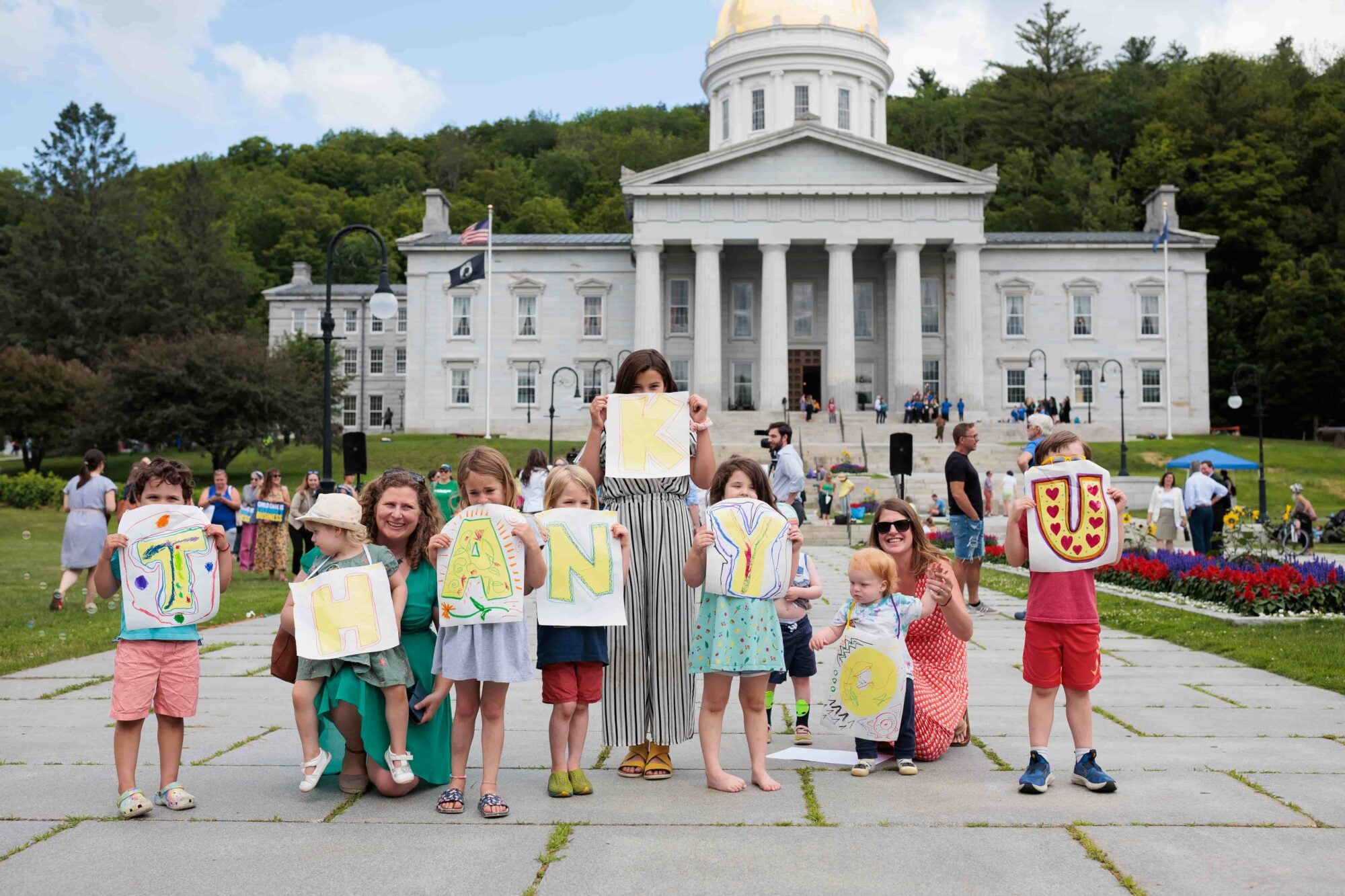
Photo courtesy of Let’s Grow Kids Action Network, used with permission.
Tere Gade, who produced the original fundraising document for Let’s Grow Kids back in 2018, conducted a follow up in 2025 with donors to see how they felt about their investment. Her takeaway: They were pleased with their investment and considered it worthwhile. “Their dream for the organization was realized,” she said.
Child care, as an issue, continues to have robust bipartisan support. Most American children are raised in households where all parents work, and even parents who do not rely on formal child care systems still have child care needs that arise and would like access to options.
And yet the United States still does not have a federal system in place to build and support such infrastructure. Absent federal action, it will be up to the states to chart a way forward. States like Vermont, advocacy groups like Let’s Grow Kids, and persistent visionaries like Davis and Richards will be the ones to bring about these changes. Richards’ own leadership on this issue has given her enough statewide recognition that she has announced a run for governor against Phil Scott in 2026.
“I like to think about what is the one thing a human can do to make the biggest positive impact in the world,” said Richards, speaking about her gubernatorial campaign and how her child care work at Let’s Grow Kids has impacted it. “When I realized early childhood education was that lever just sitting there—where our inaction is causing all this detrimental harm to our society and the action [needed] is very clear and concrete—it felt obvious. It’s within our power to [change]. And when you do, it has this immeasurable impact downstream on all these things that we care about.”
New Mexico announced in September 2025 that it would be the first state to offer universal child care to all of its children, regardless of income.51 On March 10, 2026, it was codified into law. In November 2025, Zohran Mamdani was elected mayor of New York City, with public support for child care as one of his signature issues. Other states and localities have begun to explore child care as a major driver of economic opportunity worthy of public investment, although in many cases, the lack of concrete legislative action or a dedicated funding source means that change remains more aspirational than real.52
And yet, as a former staffer of Let’s Grow Kids mused, “I’m still surprised by the level at which New Mexico and New York are getting more attention than Vermont.” She pointed out that U.S. Sen. Bernie Sanders posted on X about New Mexico’s free child care for all initiative, “The rest of the country should follow New Mexico’s lead,” making no mention of the progress that had happened in his home state with Act 76.
Vermont may continue to struggle to get attention for its progress—possibly because of its size, its liberal leanings, its predominantly rural population, or its relative homogeneity. But what Vermont accomplished is the most effective example to date of a movement to build child care infrastructure in this country. The lessons and playbook exist here for others who want to see this change.
Could this happen elsewhere? The blueprint now exists—it’s up to the changemakers to make it happen.

Vermont Needed Child Care; Here’s How They Got It
- Prelude: What Just Happened in Vermont?
- Looking for Impact, Zeroing in on Early Education
- Building a Legislative Case and Growing Grassroots Support
- Philanthropy: Where to Find $56 Million?
- COVID-19 Shutdown, Support, and Pivot
- Bringing the Business Community on Board
- Getting Political, Giving Endorsements, and Setting the Stage
- Act 76—Child Care or Bust
- Veto Override
- What Comes Next
- Acknowledgments and Methodology
Citations
- See page 184 of the budget bill passed in 2024 (for the SFY2025 state budget): Vermont General Assembly, Act 113 (H.883), Fiscal Year 2025 Appropriations Act (2024), https://legislature.vermont.gov/Documents/2024/Docs/ACTS/ACT113/ACT113%20As%20Enacted.pdf.
- Vermont’s Act 76 still has the 575 percent of the federal poverty line as the income threshold for receiving assistance. New Mexico, like Vermont, only provides child care subsidies for families where all parents work or are in school. A truly universal system, like public education, would be available to families regardless of parents work or education status.
- New Mexico has a dedicated funding support for early childhood programs through the Land Grant Permanent Fund but the portion of the funding for child care specifically is at the discretion of the state’s executive branch.