A Chapter of: Vermont Needed Child Care; Here’s How They Got It
Veto Override
When Republican Phil Scott ran for governor in Vermont in 2016, he had made a rule: No tax increases.
Since taking office in 2017, Scott commemorated his first 100 days with the declaration that he had “followed through on his commitment not to propose, or sign, a budget or bill that adds new taxes and fees or increases spending faster than growth in the economy or average wages, whichever is lower,” according to Vermont’s Business Magazine. And in his 2023 inaugural address, aware of the forthcoming child care legislation that session, he reiterated again that this was not the time to increase the tax burden: “We certainly can’t ask lower- and middle-income families to cover the costs for their wealthier neighbors. We must find ways to achieve our shared goals without adding taxes and fees because this only increases the cost of living.”
In May 2023, when the bill for child care infrastructure passed 118–27 in the House and 24–6 in the Senate (largely along party lines but with close to a dozen Republicans46 supporting it), Vermont was on the precipice of making child care nearly universal in the state. This legislation included significant updates to the Child Care Financial Assistance Program to expand the subsidies to families with incomes up to 575 percent of the federal poverty level (which is a family of four making close to $180,000 a year). It also increased the amount of money that each child care provider could receive for a child on state subsidy, which would lead to higher teacher pay and higher, more stable profit margins for providers. These changes were expected to cost an additional $125 million per year,47 and would be paid for by a new 0.44 percent payroll tax in the state, split between employers (75 percent) and employees (25 percent). For a salaried employee making $50,000 per year, the new payroll tax meant paying an additional $55 each year.
For Gov. Scott, even if he had agreed with each and every improvement to child care, there was one nonstarter for him: the new payroll tax.
There are three ways a bill becomes a law in the state of Vermont: (1) the governor can sign it, (2) the governor can veto it and then the state legislature can override it, or (3) the governor can take no action and allow the bill to become law without the governor’s signature.48 The Let’s Grow Kids team had hoped for Scott’s signature but also held out hope that he’d allow the bill to become law by taking no action. Either way, it would demonstrate that some public goods, like access to quality child care, were worth the tax increase.
Aly Richards continued to meet with Scott’s staff, particularly the policy team. Earlier in 2023, Scott had hired Janet McLaughlin, who’d previously worked at Let’s Grow Kids, to head up the Child and Development Division of the Department for Children and Families. McLaughlin had been with the Permanent Fund for Vermont’s Children and stayed on when the group transitioned to Let’s Grow Kids. When Richards took maternity leave in the fall of 2018, McLaughlin had stepped in as interim CEO. Now that the child care legislation had passed the state legislature, having someone like McLaughlin in such a prominent role would allow for a robust and comprehensive implementation.
Both possibilities could be true: The governor could support the child care bill and want it to succeed, but he also could readily veto it.
Still, the team held out hope. They had endorsed Gov. Scott in 2022 and held him up as a child care champion. Was there a chance that the bill could become law without a veto?
If the Governor Won’t Sign the Bill, the Kids Can Instead
On Monday, June 5, 2023, an email notice came with the governor’s intent to veto the legislation, which he did the next day. “I know some headlines will probably read ‘Scott vetoes child care,’ but I’m not vetoing child care. I’m vetoing the payroll tax,” Scott said at a press conference that same afternoon. “No governor in state history has been as committed to funding child care, and I’m very proud of that record.” Scott pointed to his proposal of a one-time infusion of $56 million from the general fund to expand child care subsidies, which would allow an additional 4,700 families to receive support, and was included in Act 76. This had happened in January 2023, before the legislation passed.
Let’s Grow Kids released a statement expressing disappointment. They couldn’t celebrate until Act 76 was signed into law. “It was a tough decision and the messaging around it was difficult,” Richards said. The governor had been supportive of child care, but the veto stung.
Senate Pro Tempore Phil Baruth wasn’t deterred. He hadn’t expected the governor to sign the legislation, but he still felt that the child care champions should be audacious in their celebration and push back against Scott’s narrative. He enlisted Let’s Grow Kids to organize a bill-signing featuring kids and a cardboard version of the bill right in front of the State House. The kids were given markers to scribble all over the bill, thereby “signing” it into law. “If the governor won’t sign the bill, we are going to have kids sign it instead,” he said.

Photo courtesy of Let’s Grow Kids Action Network, used with permission.
Baruth presented the cardboard, scribbled-over copy of the bill to Richards on the steps of the Capitol. “Here, your bill is signed into law now,” he said.
It was a beautiful day outside, Richards recalled. “Beautiful words spoken by everyone.” Kids held signs saying thank you. Her own twins signed the cardboard bill. “We were relieved,” she said. “But it was more a final check than a big emotion.”
Let’s Grow Kids still held on to its ambitious agenda. They were in year eight of that 10-year timeline and had to keep running.

Photo courtesy of Let’s Grow Kids Action Network, used with permission.
The veto override vote took place on June 20, 2023, and Act 76 officially became law. The child care bill was set to be implemented at the start of the fiscal year, which falls on July 1.
Ten days later, ready or not, implementation would begin.
The Sunset Process Begins
For years, Let’s Grow Kids had struggled to attract national attention, especially from funders and media. It had an audacious goal, but there was no precedent for achieving it anywhere in the United States—no state had a revenue stream dedicated to child care. Even states that were considered more generous with their child care funding provided support only through budget surpluses or discretionary spending—not with a dedicated tax.
By June 2023, when the bill was passed and Gov. Scott’s veto had been overridden, national funders could see the success of Let’s Grow Kids, and fundraising expanded. The goal had been to raise $56 million by June 2023. When they surpassed that goal and hit $60 million, Lucia Campriello, Hannah Burnett, and the development team put together a forecast expense budget that would last until 2025 when Let’s Grow Kids would sunset.
“Once we proved it could be done, the national money came in,” said Burnett. Until 2023, there was no clear path forward or established playbook—or even an idea of what it might look like to achieve success. “There was no clarity on how to do it until we did it.”
Externally, Let’s Grow Kids was more prominent than ever with a big legislative win, national attention, and fundraising goals surpassed. Yet a quiet, behind-the-scenes effort to sunset the organization began in earnest. The plan had always been to have Let’s Grow Kids come to an end in 2025—limit the work to a 10-year campaign, as Buzz Schmidt had outlined for Rick Davis a decade prior. And now a plan was coming together on how the baton would be passed and the organization dismantled.
For Sherry Carlson, who served as Let’s Grow Kids’ chief program officer, finding the right home for the organization’s programmatic work was the only way to ensure that it could continue. Carlson’s leadership during the pandemic was critical to keeping so many child care providers afloat and winning the support of early educators for Let’s Grow Kids’ grassroots campaign.
But finding the right partnership wouldn’t be easy. For years, she had explored partnering with existing organizations in Vermont to see if one might want to absorb some of their work when Let’s Grow Kids began to sunset. While she was able to find potential partners who were aligned with Let’s Grow Kids’ mission, they did not necessarily have the capacity or focus to do the same type of work.
In early 2021, Carlson had connected with First Children’s Finance, a national group that provides business support to child care providers who want to expand. Expansion was a key component of the broader child care infrastructure: More spaces would need to be created to meet demand. Let’s Grow Kids supported the transition of its child care business and technical assistance programs to First Children’s Finance, including Make Way for Kids grants, the Shared Services VT resource platform, and the Child Care Business Administration course developed in partnership with Vermont Higher Education Collaborative. These programs were funded by the state of Vermont through its Early Childhood Capacity Building grants and Business Technical Assistance Program.
In February 2023, First Children’s Finance opened its first Vermont office and hired Erin Roche, another Let’s Grow Kids staffer, to be the state director. Roche had been at Let’s Grow Kids long enough to know the programs well and could take the baton and continue. “I couldn’t have thought of anyone else more perfect,” said Carlson. And with that, one aspect of Let’s Grow Kids could now continue on without them.
But the mentorship and professionalization of early childhood educators still needed a home. The child care workforce needed to be robust and would require new people to enter the field if Vermont’s new child care infrastructure were to work. The National Association for the Education of Young Children had a Vermont chapter, but only one part-time staffer as of 2021. Let’s Grow Kids saw the organization as a potential partner for their provider work and helped the Vermont chapter secure a full-time executive director. They paid the position’s salary for the first three years to help the organization get up and running. By the time Let’s Grow Kids completed its sunset in 2025, the chapter had expanded to almost 30 staffers.
Finally, Let’s Grow Kids wanted to sustain its effort to collect data on Vermont’s child care programs and provide periodic reports to the state.49 Building Bright Futures had served as an advisory board for the governor and the state’s Child Development Division, and through a multiyear grant from Let’s Grow Kids, they would take on the role of collecting data and publishing reports on the state of child care in Vermont.
“We wanted to build credibility and strength,” said Carlson. Data-keepers would be needed to show if the legislation was working, and to cite which parts needed improvements long after Let’s Grow Kids had disbanded.
Keeping the Political Pressure On
Legislatively, Let’s Grow Kids had a big win, but politically the pressure was still on to make sure the child care champions continued to win seats in the state legislature. They would be needed not only to protect Act 76’s funding streams but to find ways to improve the law’s implementation and to ward off any attempts to dismantle or undo the law. Constituents would also need to be reminded that their increased tax burden was a good investment. While some employers, like Michele Asch’s Twincraft, covered the entire cost of the payroll tax for their employees, most employees saw their take-home pay shrink, if only slightly.”
Let’s Grow Kids Action Network would be the vehicle for making this happen after Let’s Grow Kids had sunsetted. Its role would be to protect the child care bill in each new legislative session—in part by maintaining support for existing child care champions keeping them accountable, and enlisting new ones.
In October 2023, only four months after the Act 76 legislation was passed, Tenenbaum and her political team at Let’s Grow Kids Action Network launched the “Courage in Action Child Care Tour.” For several weeks, the Let’s Grow Kids Action Network team visited child care programs throughout the state, focusing on those that had already seen significant progress under Act 76 in the form of increases in teacher wages, expansion in construction, or more options for families to utilize free child care.
“It was a little risky because it was so early,” said Tenenbaum. “I wanted to do this mostly for our candidates, but also to make sure people were understanding the impact.” It was one thing, she reasoned, to send out emails, but it was more beneficial to gather in public and give the legislators who supported the bill a chance to take credit.
“It’s human nature to forget what you did and immediately have an attitude about it,” said Richards of passing Act 76. “People think, ‘Oh, it didn’t immediately change my life and it’s not going to work.’” They had to show what success they had achieved in only four months, both to the public and to the child care champions in the legislature who had brought this about, and ensure their long-term support for protecting the statute.
“We’d done this big public investment,” Tenenbaum recalled. “You have to make sure people know it’s working.”
Tennenbaum and her team braced themselves for the chance that they might hear that the bill wasn’t working and that people were dissatisfied. But that was OK, she reasoned; people could be inspired by whatever progress they had made. Already, in 2024, more providers were opening their doors than closing—the first time this had happened in Vermont since 2018.
And it was during one of those visits—in the southern part of the state where a vacant high school had been turned into a community center, part of which would be designated for child care—that they were joined by members of Connecticut’s legislature. They had heard about Act 76 and were thinking about improving child care in their state. Shortly thereafter, at another stop, a delegation from Massachusetts also came to hear more. “We started getting people coming up and visiting, asking to join this webinar or take this meeting, [from] all over the country,” said Richards.
Since then, Richards has been contacted by people working on child care policy in several states, including Arkansas, Colorado, Connecticut, Massachusetts, and Nebraska, wanting to learn how Let’s Grow Kids helped the state pass its landmark child care law. In these conversations, Richards points to the trove of data Vermont has gathered about how increasing access to child care has impacted the state’s workforce participation and increased tax revenue, and how quality child care has contributed to improving education factors like kindergarten preparedness.
In June 2024, Richards and Davis traveled to Washington, DC, with members of the Vermont Business Roundtable to attend the first-ever National Child Care Innovation Summit, hosted by the U.S. Chamber of Commerce and the Chamber Foundation. Of all the “innovations” she heard discussed, Richards noticed that none of them addressed how to pay for child care. In her remarks to the panel on state actions, Richards challenged the prevailing wisdom in the room that fixing child care required private solutions. Richards asked, “What about public investment? No matter what state you are in, child care is a broken business model and you have to find capital. Until we all agree that public investment is key, we are not going to move forward on child care.”
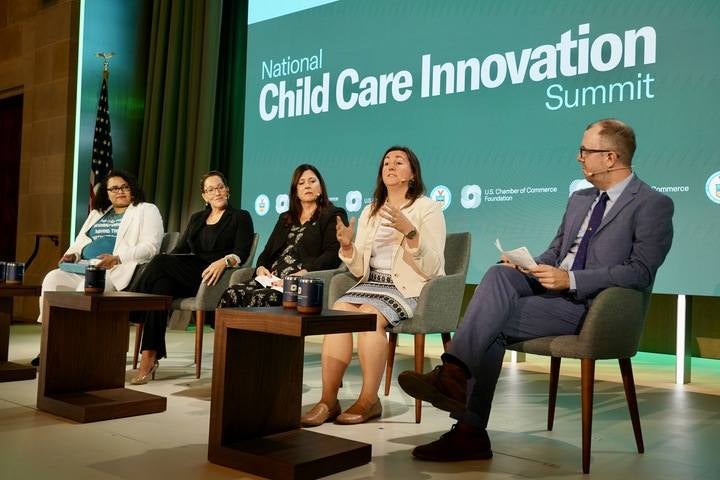
Photo courtesy of Let’s Grow Kids Action Network, used with permission.
She described the moment as a “mic drop.” All the ideas surrounding child care—technological innovations, resource-sharing, employer-supported child care—could yield some progress, but none addressed the core problem of what made child care a broken system: the lack of public investment.
One state had done it. Within a year of implementation, Richards knew they had data to show it was promising.
Passing near-universal child care in Vermont was one thing, but selling it to the general public elsewhere was another. Would any other state be willing to take this on?

Vermont Needed Child Care; Here’s How They Got It
- Prelude: What Just Happened in Vermont?
- Looking for Impact, Zeroing in on Early Education
- Building a Legislative Case and Growing Grassroots Support
- Philanthropy: Where to Find $56 Million?
- COVID-19 Shutdown, Support, and Pivot
- Bringing the Business Community on Board
- Getting Political, Giving Endorsements, and Setting the Stage
- Act 76—Child Care or Bust
- Veto Override
- What Comes Next
- Acknowledgments and Methodology
Citations
- There was one Republican senator who voted for the bill and nine Republican House members who voted yes, plus an Independent and a Libertarian who both caucused with the Republicans, bringing the total to 12.
- Earlier cost estimates for expanding child care—notably the Blue Ribbon Commission’s estimate of $206 million in 2016 and the RAND report’s estimate of $279 million in 2023—were higher than Act 76’s price tag of $125 million for several reasons. First, during the intervening years between the release of the Commission’s report and the passage of Act 76, the state made incremental progress towards the Commission’s recommendations, integrating millions of additional dollars for child care into the state’s budget with each step. Second, the estimate from RAND was based on a projected expansion of child care subsidies that was far beyond what ultimately passed in Act 76, including increased wages for early childhood educators, expanded eligibility for families, and ensuring that no family receiving subsidy support spent more than 7 percent of their income on child care.
- The idea of letting a bill become law wasn’t unusual for Gov. Scott, who by 2021 had already set the record for the most vetoes issued by a Vermont governor. “Phil Scott Vetoes More Legislation Than Any Other Vermont Governor in History,” Vermont Democrats, June 2, 2021, https://www.vtdemocrats.org/post/phil-scott-vetoes-more-legislation-than-any-other-vermont-governor-in-history.
- Let’s Grow Kids had done this with their Stalled at the Start reports every two years, from 2016 to 2024: https://letsgrowkids.org/publications-and-resources.