A Chapter of: Vermont Needed Child Care; Here’s How They Got It
Bringing the Business Community on Board
Michele Asch had a problem.
Business was growing: Twincraft Skincare, a soap and lotion manufacturer located in Winooski, Vermont, just outside of Burlington, had seen a surge in demand during the COVID-19 pandemic. But Asch, who was the chief people officer, was struggling to hire and retain staff. With more than 400 employees, Twincraft was one of the top employers in the state, yet she couldn’t find enough people to work. She would hear from would-be employees that one of their chief concerns with coming to work was the lack of child care, and Vermont didn’t have enough options.
One standout employee, Asch recalls, spent an hour driving each morning to drop her kids off in two different towns before driving to work, though she lived only 15 minutes away. Asch began doing her own research and couldn’t find a child care option in Winooski. She went to the city of Winooski and learned they had been forced to return half of a $200,000 state-administered Promise Community Grant intended to expand local child care because no operator could be secured to open and run the program.33
“Usually you have such high demand that the free market takes care of things. That is when I learned, no way.” Twincraft, Asch knew, had recently hired two former child care workers who didn’t make enough money. They’d make more working in manufacturing, but Asch also realized she was contributing to the labor shortage that was causing child care providers to close or, in the case of Winooski, never open.
Asch decided she would look into opening her own child care center—how hard could it be? A colleague recommended she connect with Richards, who came to her conference room with one of Let’s Grow Kids’ program staff. Did she know how hard it was to open a child care center without any experience? Did she know who the experts were she needed to contact?
“Aly, we make skincare. Can’t I just pay into a system so we can get this child care fixed?” Asch asked.
By this point, Richards knew that the team’s existing strategy for bringing business leaders on board to become champions for child care wasn’t working sufficiently. Business leaders, like the early child care providers, would be more likely to listen and respect one of their own. Asch was someone who experienced the problem of a broken child care system and saw this as a workforce issue that needed a solution. If businesses like Twincraft wanted to stay, grow, and manufacture products in the state, they needed to find a way to retain young employees and bring new ones in.
On the spot, Richards made the decision to bring Asch into the inner circle of Let’s Grow Kids. A week later, Richards, Asch, and Davis met for lunch. They offered her a seat on the board and started brainstorming ways to bring business leaders into the conversation. The goal was for business leaders to view child care as an investment, and the pitch would be more effective coming from a fellow businessperson, not an advocate, philanthropist, or child care provider.
“She’s a badass,” Richards said of Asch, and the moniker stuck. Michele Asch, Rick Davis, Aly Richards, and Tom MacLeay, a longtime confidant of Davis’ and a Let’s Grow Kids board member, became the “Badass Task Force.” From then on, until Let’s Grow Kids sunsetted in 2025, they would meet every few weeks, 90 minutes at a time, for strategy check-in sessions.
If they were going to raise revenue or create a new tax, they wouldn’t just need the business community on board, they’d need the business community to own the idea. They would need groups like the Vermont Business Roundtable to shift from thinking about child care as a business need to advocating for policy changes on the state level. And they would need business leaders, like Asch, to be the ones to sell it.
Thus began the CEO Sprint.
Bringing The C-Suite On Board
Dimitri Garder had already seen the types of failures possible when state governments tried to do too much. He had previously been appointed to Gov. Peter Shumlin’s health care business advisory team in an effort to get single-payer health care up and running in Vermont. The idea had been that the state could build its own health care exchange, but in the end they couldn’t craft legislation in such a way to control rising health care costs without significant tax increases. “It was a dismal failure,” Garder said. “The economics didn’t hold together, and the governor lacked significant business support for the initiative.”
So he was reluctant to tackle another state government project when, in 2021, he was approached by Let’s Grow Kids to join the CEO Task Force and come up with ideas for how Vermont could fund child care infrastructure. He’d joined the board of the Vermont Business Roundtable and went on a mission to make Vermont a better place to live and do business. Garder understood deeply how hard it was to start a business in Vermont—he was CEO of a data quality company but relied on a largely remote team.
“It is much riskier to move to Burlington than to move to Austin for your tech job,” he said. If the job didn’t work out in Vermont, there would be fewer opportunities to find a new one, and he wanted to change that.
Richards approached Garder with a message similar to her pitch to Asch: Vermont had the second-oldest population in the country and was aging rapidly. They had a declining workforce population and needed to change that. Some of this demographic crisis wasn’t unique to Vermont: Baby Boomers were retiring and the birth rate nationwide was declining, and this was compounded in rural places with out-migration and young people clustering in major cities for better economic and social opportunities. Child care in Vermont, Richards argued, was a workforce issue. Building out the child care infrastructure could help kids and create more productive workers—getting moms and dads back into the workforce and stabilizing family budgets when the lack of child care options may have kept one parent at home.
“You have two generations of workforce,” said Garder, referring to the parents who are able to go to work and the children getting the early education to prepare them for the labor force as adults. “I always add a third cadre of workers—the child care providers themselves.” He was convinced that this was a worthy investment, but he wasn’t sure how to pay for it or what would be most impactful for his business colleagues to hear.
He could get the Vermont Business Roundtable on board with the workforce premise, but there wasn’t a consensus on what the revenue source should be. Most business leaders would be against it, and he was sympathetic to their concerns.
But Richards knew that Garder would be instrumental in getting the Vermont Business Roundtable to support whatever revenue increase would be needed. There seemed to be enough consensus that Vermont needed a major investment in child care to shore up its workforce. But they still didn’t have a way of discussing and thinking through the different revenue models to get there.
Richards assembled six C-Suite level executives, Garder and Asch among them, and hired Mary Peterson, a former state tax commissioner, to facilitate a conversation, nicknamed the CEO Sprint. The six executives represented a diverse group of business leaders from different sectors and parts of the state, including manufacturing, banking, and technology. Richards ensured they had small and large businesses and gender diversity. But she had no idea what to expect.
The CEO Sprint Takes Off
From the beginning, the idea of implementing a payroll tax to pay for child care was extremely unpopular among the CEOs.
“The concern was it was a camel’s nose under the tent,” said Garder. Vermont didn’t have a payroll tax, and creating one just for child care might mean that other causes would seek to jump aboard, hiking that tax up further and further.34 It would make more sense, the CEO team reasoned, to leverage an existing tax source to pay for child care.
Peterson brought data to the meetings with a matrix of funding sources and the pros and cons of each. The CEO Sprint took place over Zoom in the early days of the pandemic. “We took the broadest lens we possibly could,” said Garder. Income tax and property tax were debated as reasonable alternatives to the payroll tax.
Michael Seaver, the Vermont president of People’s United Bank, was also in the discussion. Seaver had begun his career as a bank teller before working his way up to the top position. He and his wife prided themselves on sending their three boys to public school and were deeply committed to the future of the state. As Seaver explained, he knew investing in early education made sense, but he was adamant against raising taxes to do so. “Take existing funds for K–12 education and reallocate it for early childhood,” he said. But through the conversations, he understood that the K–12 system struggled to get enough funds, and no matter how many times the CEO Sprint had come up with creative ways to slice up the pie for funding to make room for child care, there wasn’t a workable solution to allow for two robust systems.
“If we wanted to not completely miss supporting another generation of children in Vermont, we were going to have to swallow hard and raise more revenues to support the effort,” Seaver said. He was beginning to realize that this would be the only way forward.
Property taxes, already high in Vermont, were discussed but ultimately dismissed. A broad income tax with a very low rate, split between individual and corporate taxes, was considered as an option. The CEO Sprint team shared the idea with the state legislature’s Joint Fiscal Office to see if it might be feasible and model how it might look. The response gave them the impression that an effort like this would require reforming the entire tax code.
And so “the payroll tax came up again,” said Garder. “It pegged child care investments as a workforce issue,” one that would be paid for by those already in the workforce.
“We wanted a way to connect the raising of revenue with the purpose,” said Seaver. He explained that they’d come up with a payroll tax plan that was a shared burden—one split between the businesses that needed more employees and the individuals who needed better access to child care in order to work.
“I felt strongly about this,” said Seaver of the shared burden. “It’s always easy to pass a tax when you are putting it on someone else and not sharing the burden. It needed to be that shared responsibility.”
Garder recalls the concern that child care could be pigeonholed as a workforce issue and lose the message that this infrastructure would be good for kids, families, and Vermonters.
Then the circular logic took over. If not the payroll tax, then what? No to property taxes, no to income taxes. Health care, an early idea for Let’s Grow Kids, also couldn’t handle additional taxes (and the group couldn’t create a system to funnel health care funds to child care that could be justified).
The payroll tax continued to emerge as the “most elegant solution that checked every box,” said Asch. There were more arguments in its favor: A payroll tax allowed the payment burden of the child care program to be placed on workers, not retirees. As more people took advantage of the program and went to work, the revenue stream would grow. It would be a dedicated tax just for child care, meaning no one would have to worry about going back and getting more money from the legislature at a later date. And unlike property taxes, it wouldn’t target people who were retirees or on fixed incomes.
By the end of the six-month sprint period, all six CEOs were on board with the idea of raising revenue and recommended the creation of a brand-new payroll tax.
But raising taxes was never going to be a popular idea with the business community.
They’d need to find a way to sell it to their peers.
“I Put My Skin in the Game and You Should Too”
In October 2021, Let’s Grow Kids gathered over 100 business leaders and investors at a popular new coworking space in Burlington. Known as Hula, it skewed toward younger employees in the tech-forward industry—more start-up entrepreneurial workspace and less traditional office park.
The event, “Child Care: How Businesses Lead the Way,” required guests be vaccinated, given lingering COVID-19 sensitivities. Richards moderated a panel. Jim Crook, who as one of the state’s top venture capitalists had invested in a number of local business start-ups in Vermont, stood up and said, “I put my skin in the game and you should too.”

Photo courtesy of Let’s Grow Kids Action Network, used with permission.
Let’s Grow Kids unveiled the option for corporate sponsorships so that interested business partners could publicly share their support and invest in the campaign. Corporate sponsors came in at the $2,500–$10,000 level, with several larger, six-figure gifts as well. “It was symbolic of engagement,” said Lucia Campriello, the chief development officer. “We slapped their logos all over the van that drove around the state for organizing events,” said Campriello. “It was largely a participation tactic and way for Let’s Grow Kids to showcase business support for the campaign.”
The meeting marked the turning point, said Campriello, for both Let’s Grow Kids’ fundraising campaign and business organizing. Instead of raising money as part of an annual appeal, the team began asking for money with a focus on their limited 10-year campaign timeline. Business leaders and philanthropists could fund Let’s Grow Kids like a capital campaign that would sunset in 2025. It allowed them to make bigger asks, explained Campriello, and bringing the business community closer to the advocacy process also gave them a bigger stake in Let’s Grow Kids’ success.
“We no longer had to make the case for why child care was important,” said Campriello. The pandemic had made that clear. Following the Hula event, the business coalition had crystallized, cementing child care as an issue that would need their support and advocacy efforts.
That didn’t mean they had everyone’s support. Not all businesses would support a revenue increase, and those who saw child care as valuable still worried that a payroll tax would make Vermont less affordable to families when the goal was to do the opposite.
It was one thing to believe in the value of child care and another to advocate for raising taxes to fund it.
Let’s Grow Kids would have to find a way to create more champions and neutralize the opposition. The team already had learned that the business community was more likely to listen to one of its own than to an advocate, expert, or fundraiser.
So the child care champions of the business community got to work.
The Unique Peer Pressure of Business Colleagues
Let’s Grow Kids soon learned that the most effective business advocacy was done one-to-one with business leaders talking directly to one another. So the team deployed their business champions to persuade those on the fence or those who hadn’t yet formed an opinion.
Asch personally invited other manufacturers in the state to meet with Richards, vet the proposal, and ask any and all pointed questions. The Twincraft conference room was filled with business leaders of Vermont’s most recognizable brands: Bag Balm, Runamok Maple, Birnn Chocolates, Vermont Creamery, Lake Champlain Chocolates, Burton Snowboard, and Mamava. Down the hall was Twincraft’s manufacturing plant that produced high-end soaps and lotions for the country; Asch made sure everyone who attended the meeting went home with a gift bag of samples. Discussing child care needs was top of the agenda, but it was just as powerful to convene this group of Vermont’s business leaders in the same room and show that they were willing to go to bat for this issue as a necessary investment and smart business decision.
Those peer-to-peer conversations were critically important, explained Richards, because “you have a trusted business partner running a successful business. They can literally say, ‘I’ve studied this deeply with my values and my prowess, and I’m here to tell you [this] is the deal with child care in summary form.’” The business leaders who had been skeptical of the payroll tax were more inclined to hear that their counterparts at other Vermont companies were supportive and saw the economics of the policy to be a sound investment in the workforce.
Asch said her biggest challenge wasn’t that other leaders disagreed with the need for child care but that they didn’t fully understand why this state-organized effort funded by the payroll tax was the proposed solution. Manufacturers, in particular, said Richards, wound up being one of the strongest supporters of the child care policy. “The minute it clicks for someone as a manufacturer is [when they realize] ‘I don’t have a functioning business if I don’t have someone on the line,’” she said.
“We spent a lot of time educating business leaders on the problem and why it was necessary for public investment and what the ROI [return on investment] was going to be,” said Asch. “Everyone wants the solution that doesn’t add the additional tax—I certainly did,” she said.
“Once they understood [the child care plan], they would enthusiastically or reluctantly support it,” Asch said. “I don’t pay individually to have our roads done. I pay into a system to have the trucks come in to pick up the [Twincraft] soap. [Child care] is necessary infrastructure for doing business.”
Asch would also explain why the CEO Sprint had decided on the payroll tax as the optimal funding solution. With the payroll tax, there would be less opposition from retirees, but it did mean that businesses would be shouldering the burden of paying for this infrastructure. If they wanted child care infrastructure in Vermont, business leaders in the state would have to either support a tax increase or, at a minimum, not launch a vociferous opposition.
Small and large business leaders were called for the conversations. “It really benefits small businesses,” said Asch. “They have to pay the payroll tax but they could never afford to take care of child care on their own.”
One business leader, Asch recalled, had said he was for the child care provisions but not the payroll tax. “OK, what are your ideas?” Asch recalls asking him. He got quiet, and then admitted that the payroll tax was what they needed.
The opposition, Asch noted in her conversations, wasn’t about child care. It was about how much and how fast we needed to fix it. “Once we got people to sit down and see the structure of the system, there was support. The challenge was getting people to sit down.”
But Will Business Support Translate to Legislative Action?
By 2022, Let’s Grow Kids had 330 businesses in the state willing to pledge their support.
“I don’t think there was a business in Vermont that hadn’t heard of Let’s Grow Kids,” Asch said.
In April 2022, Let’s Grow Kids brought the business champions to the steps of the State House for a press conference called “Child Care is Everyone’s Business” and featured over 50 business leaders touting the economic impact of public investment in child care. By then, the business community was more prepared to own the payroll tax as their idea. “We had a group of super champs who had done the exploration themselves,” said Hannah Burnett, part of the Let’s Grow Kids development team.
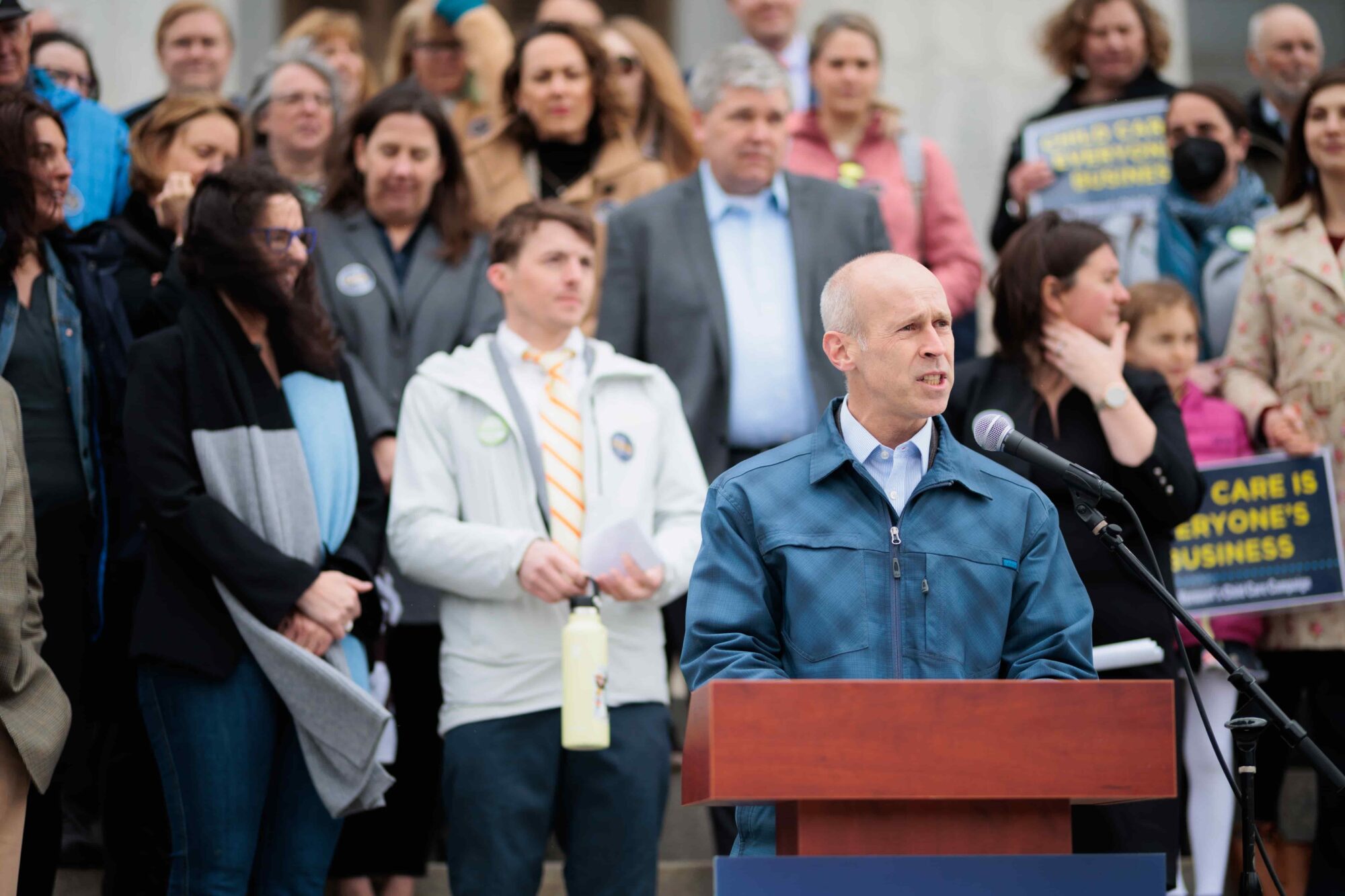
Photo courtesy of Let’s Grow Kids Action Network, used with permission.
One year later, in 2023, as legislation was being considered in the state legislature, that same list of business leaders signed a letter to lawmakers asking that they pass a transformational child care bill and offering their support.
Up until then, a lot of the messaging to build public support had focused on the brain science of young children, said Burnett. But with the business community taking on a larger advocacy role, the messaging began to shift toward building the state’s workforce—with greater access to child care, more parents would have the opportunity to go to work. “Until we got to the ‘what’s in it for me’ for the employers, we didn’t have the firepower to move legislation forward to get the public investment piece,” she said.
Let’s Grow Kids now had a list of two dozen business leaders from all parts of the state willing to testify before the House and Senate. They had raised money effectively, surpassing the fundraising goals that Tere Gade and Scott McArdle had laid out for them back in 2018. They’d maintained strong relationships with the early childhood educators, both those who had worked with Rick Davis on the Permanent Fund for Vermont’s Children and those who had come into the fold when they’d worked with Let’s Grow Kids to stay open during the emergency phase of the pandemic.
What Let’s Grow Kids had, said Phil Baruth, the president pro tempore of the state Senate, was an “avalanche moving forward.” There was support for child care in the state, but it would be up to the legislature to move a bill forward. What they needed now was the political muscle to make that happen.

Vermont Needed Child Care; Here’s How They Got It
- Prelude: What Just Happened in Vermont?
- Looking for Impact, Zeroing in on Early Education
- Building a Legislative Case and Growing Grassroots Support
- Philanthropy: Where to Find $56 Million?
- COVID-19 Shutdown, Support, and Pivot
- Bringing the Business Community on Board
- Getting Political, Giving Endorsements, and Setting the Stage
- Act 76—Child Care or Bust
- Veto Override
- What Comes Next
- Acknowledgments and Methodology
Citations
- No published data exists for this detail, but the City of Winooski’s community services director, Ray Coffey, confirmed that Winooski did receive a Promise Community Grant, and their coalition of partners designated $100,000 of the $200,000 grant award towards trying to bring a child care provider (focused on birth to age 5) to Winooski. “Unfortunately we were unable to identify an operator that was ready to expand services at that time (despite the $100,000 seed money and affordable space in our O’Brien Community Center that was available at the time for fit up). We met with a number of interested parties, several of whom were operating successful programs in the area, and while everyone felt very confident about being able to fill seats (due to a shortage of infant/toddler and pre-K services in the area) the primary concern at the time was related to challenges with recruiting and retaining quality staff for a new program. Sadly, we were not authorized to shift that $100,000 to alternative expenses in the last year of the grant, and were thus required to return $100,000 of grant funds to the funder (we just never drew them down).”
- Or in the case of the metaphorical camel, bursting through the tent once he realized his nose could get inside.