A Chapter of: Vermont Needed Child Care; Here’s How They Got It
Act 76—Child Care or Bust
It was January 2023, and before the bill to create their child care infrastructure could be introduced, it was about to fall apart.
Sarah Kenney, Aly Richards, and Rebecca Ramos came to the Senate Health and Welfare Committee room to hear from their champion legislators—Sens. Virginia “Ginny” Lyons and Ruth Hardy and Reps. Theresa Wood and Jessica Brumsted—all Democrats serving in the state legislature. Voters had just elected a Democratic supermajority to the state legislature, and all parties involved felt that the time was right, politically, to introduce the most ambitious legislation yet: a measure that would create a public funding mechanism to build child care infrastructure in the state of Vermont. No other state had been able to do so thus far.
But Kenney felt uneasy, not jubilant. Ahead of the meeting, the legislators clarified that the Let’s Grow Kids team was invited, but that the purpose of the meeting was to brief them on lawmakers’ intentions, not to solicit their feedback. Whatever changes Let’s Grow Kids wanted, whatever their opinions were, the team was to keep it to themselves.
This is what you do, Kenney recalled, “you hand over what you want to have in the bill, but then you totally lose control of it. We had been waiting and waiting to see about introducing the bill.” The election in 2022 had been the turning point of bringing in a legislature that could sustain a veto-override, but Kenney had been waiting for eight years to be this close to having legislation ready to go.
And then here the legislators were, ready to unveil what they had put together.
Much of the proposed bill was recognizable: Affordability, access, and higher subsidy payments for child care providers were all part of what Let’s Grow Kids had advocated for and prepared to support.
The bill also included language that would move all four-year-olds in the state to a universal pre-K program through Vermont’s public schools. This was something that legislators who felt strongly committed to public schools perceived as a better arrangement that kept more money in the education system.
But for Vermont, where so many child care centers, particularly in rural areas, were home-based, losing the option to care for four-year-olds would be a financial disaster. Home-based providers who accepted kids that age could already receive additional funds from the school district, provided they offered an age-appropriate preschool curriculum with a licensed teacher.39 Four-year-olds also required lower staff-to-student ratios, requiring fewer teachers and therefore lower costs than caring for infants and toddlers. Staffing tends to be the highest cost (between 60–70 percent) that child care providers face; a policy that caused them to lose four-year-olds and only care for children that required much more staff would be ruinous, especially for small providers or those in at-home settings. Support for the mixed delivery system (relying on different types of child care settings) also came from RAND’s Vermont Early Care and Education Financing Study, identifying revenue streams and creating economic models to make child care a more stable and affordable industry in Vermont available to all families.40
It had taken years for Let’s Grow Kids to gain the trust of the child care providers as the group tried to advance ambitious legislation. And it had taken years to get legislators willing to introduce an ambitious bill. And now they were at a point where they’d have to turn back to the providers and say, Sorry, as it stands now, this legislation could be a disaster.
Instead, Kenney, Richards, and Ramos all stayed true to their professionalism. “We’d had a huddle beforehand and agreed that no matter what was [in the bill], we would thank them and not give feedback in the moment,” said Kenney. And so they did, remaining agreeable, gracious, and affable, before leaving the room.
As soon as the door closed behind them, they had their “moment of WTF,” as Kenney described it, before getting right back to work.
A Flawed Bill, Competing Priorities, and a Tight Timeline
Part of the machine of Let’s Grow Kids was having enough supporters who could be called upon to persuade the legislators of the importance of supporting child care. Let’s Grow Kids had a list of over 38,000 people by January 2023, which the team had been growing since 2015.
Following the legislative meeting, supporters got an email communication from Richards, saying this was “an important moment” but that the bill was “by no means a finished product,” specifically citing the concerns of maintaining a mixed delivery system.
The job of the supporters would be to bring their concerns to the legislature in a loud, clear, and unambiguous way. The people who would be most impacted by the proposed change for four-year-olds needed to speak the loudest.
“This bill was complicated from the moment it was introduced,” said Kenney.
Senate President Pro Tempore Phil Baruth felt differently. Sure, there were complications, but Baruth had surveyed the Senate Democratic Caucus after the November election: By his count, of the 23 senators that caucused with Democrats, 22 had described child care as a top issue, and all were prepared to vote in favor of it, even with a possible tax increase. He had done the same temperature-taking on passing paid family leave and came up short, with only 17 or 18 senators in favor, he said. It was a profound time to act, he explained. The pandemic had given the state senators a new appreciation for child care, and it had also created a worker shortage. Child care, Baruth felt, was the issue to pursue at this exact moment in the legislature. But they had to act now, while their veto-proof majority was in lockstep.
Baruth also knew that Speaker of the House Jill Krowinski had declared paid family leave to be a top priority. In January 2020, when Krowinski was the Democratic majority leader in the House, Vermont had passed a paid family leave bill, only to face a veto from Gov. Phil Scott. (Scott had vetoed a paid family leave bill in 2018, too.) In February 2020, the House fell one vote short of overriding the governor’s veto. Krowinski had said she was disappointed and vowed to continue fighting, but in a matter of weeks, the pandemic had shut down the State House and legislative priorities shifted to responding to the pandemic. But now it was 2023, the legislature was convening in person, they had a Democratic supermajority, and Krowinski was ready to forge ahead with paid family leave at the top of her agenda.
So when Baruth saw the child care bill, the same one that caused the Let’s Grow Kids team to blanch, he knew he had his work cut out for him: a flawed bill, competing legislative priorities, and a tight timeline. He insisted the Senate be the first to take it up—and to do so with sufficient time before the “crossover deadline,” the date in mid-March by which one chamber has to send a bill to the other to ensure passage during the legislative session.
Baruth referred the bill to the Senate Health and Welfare Committee, stripped out the language with the pre-K provisions that would have redirected four-year-olds to the public school system, and sent that to the Senate Education Committee, where he asked that it be turned into a study, effectively killing the measure until they could try again next year. If a senator balked, he called in his allies, including Sen. Jane Kitchel, now chair of the Senate Appropriations Committee, to help hammer in the point that these provisions wouldn’t be included at this point in time, and certainly not in a way that wouldn’t support a mixed delivery system where pre-K services could be accessed by private child care providers in addition to public schools.
Then, Baruth assigned himself as the first witness to testify in support of the legislation—a highly unusual move for the Senate Pro Tem. “They don’t typically put their thumb on the scale,” said Baruth. “But this was so clearly the number one priority, I wanted to emphasize by showing up.”
“He set the tone,” said Kenney. For weeks they had expert witnesses, including 10 of Vermont’s business leaders, testify in support of the child care legislation in front of the state’s Senate Committee on Economic Development, Housing, and General Affairs. They spoke of the need for child care to support and recruit employees and showed their willingness to shoulder the payroll tax. Cara Tobin, a chef and mother of two who had opened the restaurant Honey Road in Burlington and become a James Beard finalist, testified that it was “easier to open a restaurant than find child care.”
Baruth argued that with a costly expansion to child care on the agenda, now was not the time to tackle paid leave. The Senate also agreed with the CEO Sprint team that the payroll tax would be the most effective funding mechanism. It was the Senate Finance Committee, said Kitchel, that decided the employer’s and employee’s contributions to the payroll tax should be split 75 percent to 25 percent, with the employers paying the larger share. And Kitchel, knowing that paid parental leave could help ease the first year of child care needs, when infant care is the most expensive and difficult to find kind of child care, included 12 weeks of paid parental leave in the legislation. The proposal fell short of the more comprehensive paid family leave available to all people needing time off work to provide care, not only parents, that the House had wanted, but Kitchel figured “it was a provision that made sense.”
The House disagreed on all of those points. Krowinski felt the House was prepared to support both paid family leave and child care, together, in a package. She didn’t want paid family leave to be limited to new parents only, as Kitchel had offered, and wanted other revenue options than the payroll tax.
Paid family leave had come very close to legislative success twice before—in 2018 and 2020—only to face the governor’s veto, and Scott proposed his own voluntary paid leave system, which businesses and later individuals could pay into. Public polling had indicated that Vermonters wanted a broader paid family leave bill, recalled Michelle Fay, the executive director of Voices for Vermont’s Children, an advocacy group that promotes public policies that enhance the lives of children. Fay acknowledged that the advocacy efforts by the paid family leave coalition were not an equal match for what Let’s Grow Kids had amassed, and Let’s Grow Kids remained laser-focused on child care.
“We didn’t have the same funding, organizing, or sense of urgency,” said Fay of the paid family leave moment. Even Fay’s own leadership had come out of necessity; she’d been the one to step in, out of obligation, as she described it, to head the paid leave movement for the 2023 legislative session when no one else had done so.
If child care had bipartisan and bicameral momentum, Fay hoped that paid family leave would be able to be included as well. “We were watching what was happening in Minnesota, where the advocates were working together to pass a slate of family-friendly policies, and we had hoped to be able to do that in Vermont,” she said. Even within child care advocacy, there is abundant evidence to show that a robust paid family leave program decreases the need for infant care, which can be the costliest to provide and the hardest to find.
In the end, there would only be room for one of the priorities to move forward.
Who Would Be Responsible for “Killing Child Care”?
Mid-March came and so did the crossover deadline, with Baruth’s bill being sent to the House. But the House was unwilling to move on the Senate bill. Krowinski proposed a compromise: What if they did a monthlong conference committee to try and take up both paid leave and child care together?
“We are not ever doing that,” Baruth recalled saying. “I don’t care how long you wait, you are not ever doing that.” Baruth argued that refusing to budge on paid family leave would doom both pieces of legislation, or water them down so much as to lose effectiveness. Baruth and Kitchel took a bill on workers compensation that had been awaiting action in the Senate, copied the entire child care bill onto that, passed it out of committee, and then sent it back to the House, which created enough of a dramatic push that they’d notice.41
“Everyone got the message that we aren’t going to be satisfied,” Baruth said. The House, he felt strongly, would have to take up the Senate’s version of the bill. Or they’d be “the ones responsible for killing child care,” he said.
Baruth had such confidence in the process because, as he described it, he’d seen the “machine” that Let’s Grow Kids had built to garner constituent support. Baruth had worked with Richards when she handled education projects for Gov. Peter Shumlin; he’d also been in government for over a dozen years. He knew when they had sufficient electoral support for issues; he’d surveyed his own caucus and knew the appetite existed for child care at that moment. Baruth believed in paid family leave, and he felt it to be good policy, but he also believed the timing wasn’t right for action. The paid family leave coalition hadn’t built the groundswell of support that Let’s Grow Kids had for child care. If paid family leave were to fail, Baruth reasoned, Krowinski and some Democrats would be disappointed. But if child care were to fail—after all the organizing and campaigning that had motivated thousands of people to contact their representatives—there would be outrage. “It was an avalanche moving forward” is how he described the child care movement.
Krowinski, too, acknowledged that Let’s Grow Kids had built such a supportive machine, from all corners of the state, that far outpaced what the paid family leave movement had. “The case was being made in every corner of the state, which is not typical,” Krowinski said. Let’s Grow Kids had a presence in member districts with families and early childhood educators calling their representatives, and with businesses that argued they couldn’t find workers because of a lack of child care. But her hope remained that even though child care had such strong bipartisan support, paid family leave would also be part of this larger package to help families.
She wasn’t ready to give up on that goal just yet.
“Do It Scared”
On a windy day in April 2023, in the middle of the legislative session still hashing out changes to their child care bill, Let’s Grow Kids organized over a thousand supporters who came to the State House lawn for a “Courage to Care” rally, demanding action on the child care agenda. It was crucial that the voices they uplifted that day weren’t just those heavily involved in the legislative process. Those who were doing the day-to-day work of caring for young children needed to be heard, and so too those who stood to benefit if the legislation passed and created more stable teacher pay.
Caitlin D’Onofrio had spent over a decade working in early childhood education, beginning in summers while she was still in college. After graduation, she opted to go into early childhood education instead of elementary education because that was her true passion—even though elementary education provided better pay and benefits. Her employer, Robin’s Nest Children’s Center, had been providing child care and preschool education in Burlington since 1985.
In the weeks leading up to the rally, D’Onofrio received an email from the founder of Robin’s Nest and longtime member of the Let’s Grow Kids team, LouAnn Beninati, asking if she’d like to be a speaker. “I laughed to myself and put it in the trash,” D’Onofrio recalled. Then Beninati caught up with her in person and asked, “Did you get my email?”
“Oh, that was a real request?” D’Onofrio responded.
It was. Qualified early educators like D’Onofrio would be needed if Vermont were to have a robust child care program, and her story was one the Let’s Grow Kids team wanted to share.
D’Onofrio’s coworkers at Robin’s Nest convinced her to do it. “Do it scared,” she remembered being told. The communications team from Let’s Grow Kids helped her craft a speech. “I spoke to my experience as an early educator,” she said, “and the impact I knew the bill would have if passed.”
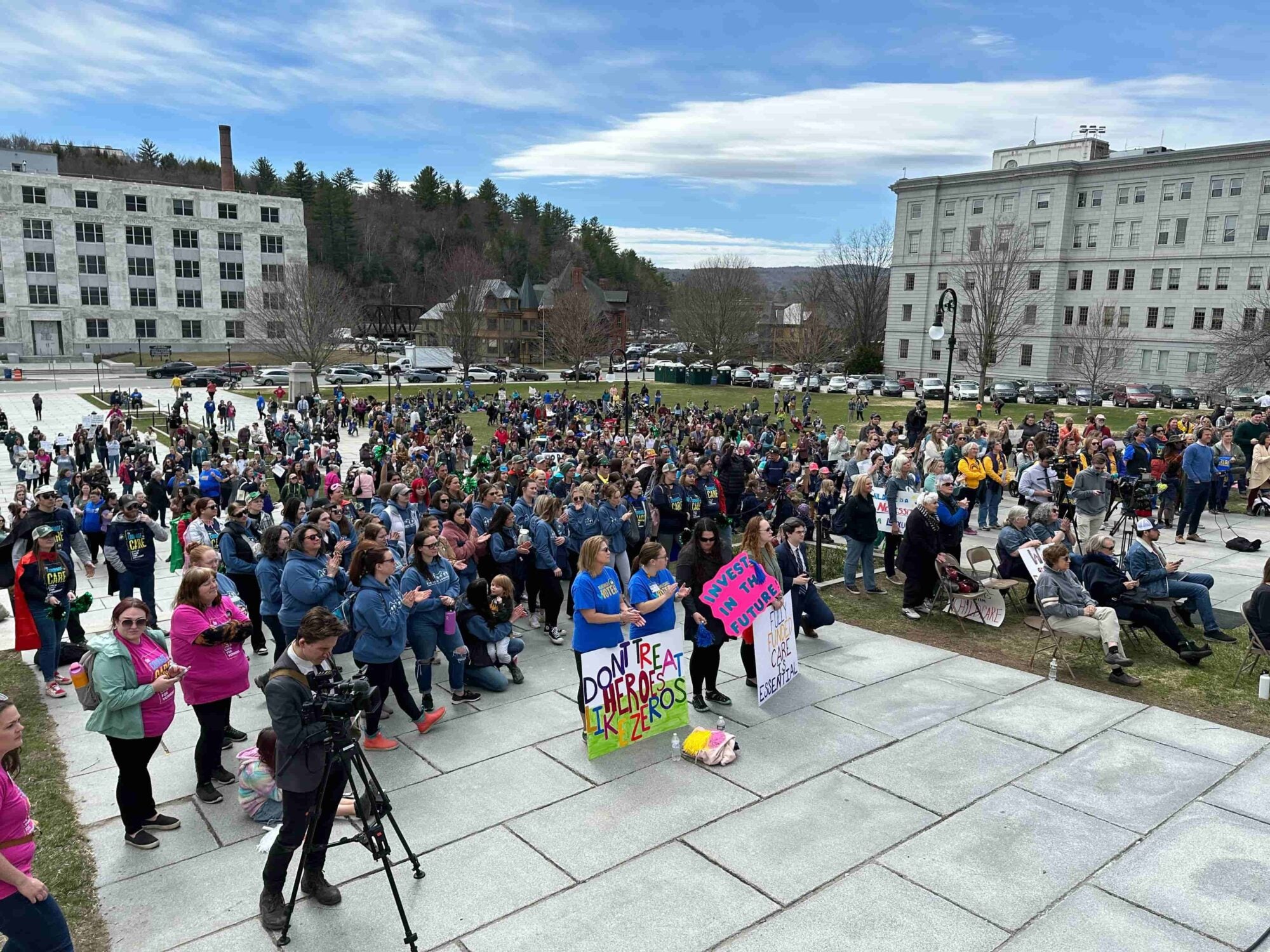
Photo courtesy of Let’s Grow Kids Action Network, used with permission.
On the day of the rally, dozens of child care programs across the state closed early and came to Montpelier. Let’s Grow Kids hired several buses to help with transportation. Across the lawn, a sea of people stood in support, many with young children in tow, wearing blue T-shirts with the phrases “Be a Child Care Voter” or “Courage to Care” imprinted on an outline of the state of Vermont. They held handmade signs emblazoned with slogans like “Child Care Is Everyone’s Business” and “We ALL Benefit from Quality Child Care” and shook green pompoms.
“Shaking in my boots” was how D’Onofrio recalled feeling when she was called to the stage. Except once she got to the podium, she saw familiar faces, as well as strollers, kids, and toys all across the lawn. So many of her early education colleagues were there, and she felt a keen sense of recognition and belonging. Even with people she had not met personally, she knew they had that same shared professional experience. “It was oddly comforting,” she said.
“As early childhood educators, courage is part of our job, but so is sacrifice. My family has had to sacrifice a lot so that I can do what I love,” she said in her speech at the podium. “I just got married. We want to buy a house and start a family. And even though my center pays on the higher end, it is still not a living wage. If it weren’t for the discount I get at my center, we couldn’t consider having kids because we wouldn’t be able to afford our own child care!”
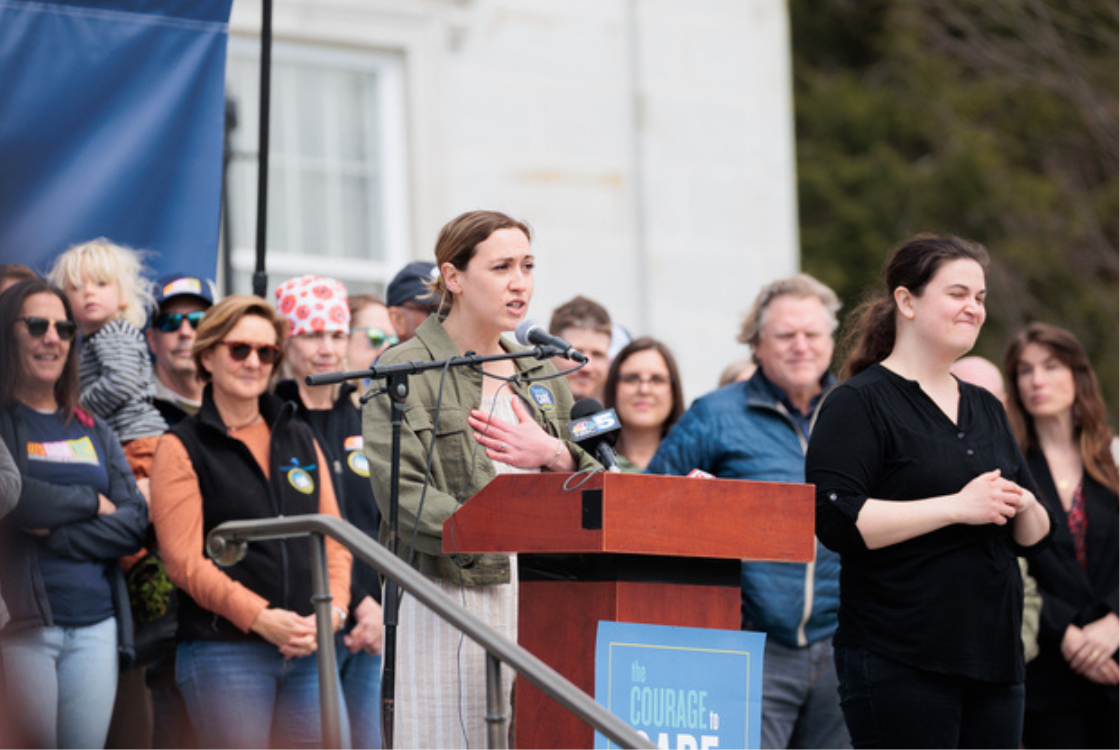
Photo courtesy of Let’s Grow Kids Action Network, used with permission.
“You have this idea of what people in advocacy would look like, but I realize it’s all of us,” she said later, recalling her experience. “It’s just everybody doing this work.”
Speaking up for child care workers at the rally, D’Onofrio said, remains “one of the coolest things she has ever done.”
“Come to the State House Now”
The momentum within the advocacy effort was high, but behind closed doors, the state legislature leaders of both chambers were gathered for what Baruth called a “do or die” meeting. It was late April and the legislature was set to adjourn in May; time was running out for the House to take up the child care bill. House leadership sought a commitment from Baruth to take up paid family leave in a future session, but Baruth balked, refusing to sign a document or issue a formal promise. The best he could offer, he said, was to take a fresh look at the next legislative session in January, poll his caucus, and see if attitudes had shifted.
“Run a Let’s Grow Kids-style campaign,” he recalled saying. “Build that same level of support.”
In early May, Krowinski relented on paid family leave. “With the Senate, we don’t agree on the funding source. We don’t agree on how it’s administered. We don’t agree on who’s covered with it,” Krowinski said in an interview with a local newspaper. “And so at this time, I think it’s best that we continue to work on this over the summer and fall and come back to it in January.” The House opted to forgo the 12 weeks parental leave offered by Kitchel in the original Senate version of the child care bill in the hope that there would be a chance in the future to go after a robust paid family leave policy for more than just new parents.42
But the House still did not have a clear path forward on child care. The House Ways and Means Committee wanted to explore using an income tax or a corporate tax rather than just relying on the payroll tax as the financing mechanism.
“We refused,” said Baruth.
The payroll tax wasn’t the hill Let’s Grow Kids was willing to die on. “We were agnostic about the funding source,” Kenney said, as the legislature had to pass something lawmakers could defend. But they were keenly aware that the payroll tax had been recommended out of the CEO Sprint and sold to the business community, and passing the bill would need strong business support. The Let’s Grow Kids team was less confident businesses would back an income tax, and they’d possibly face other opposition from retirees, who were entirely exempt from the payroll tax.
Whatever funding source would be selected, both the House and Senate would need to be on board.43 And as the days dragged on, they were down to the last two days before the legislature planned to adjourn with no legislation on child care yet to show for it.
“This was the moment we began to panic,” said Adam Necrason, the lobbyist who had been with Let’s Grow Kids since the beginning.
“I didn’t sleep that entire week,” said Kenney. “We could walk away with nothing. They could run out the clock if they didn’t figure this out.”
They were running out of compromises and out of time. It was Wednesday, May 10. They would need 48 hours to pass the bill before adjournment, as each chamber would need 24 hours with the bill before moving to vote.44 If the House wasn’t willing to agree to the Senate version of the bill, they’d wind up with nothing.
Richards, Rebecca Ramos, and the Let’s Grow Kids legislative team huddled for an emergency meeting. They had developed a strong relationship with Speaker Krowinski—she’d been one of their child care champions—and many within the team were sympathetic to her efforts to advance paid family leave. But they would need immediate, decisive action on the child care bill for it to move forward this legislative session.
Ramos had a strong relationship with Conor Kennedy, Krowinski’s chief of staff, from years earlier when he had interned in the Senate Pro Tempore office where Ramos had worked. Ramos reached out to set up a meeting between the Speaker and Richards.
Instead of bringing the legislative team, Let’s Grow Kids decided that Richards should take Emilie Tenenbaum, who’d been heading up the political work and had run the endorsement process. It was Tenenbaum and her team who had been showing up at campaign events and putting in the legwork to get the child care champions reelected.
The message would need to be gentle but direct: Let’s Grow Kids had amassed significant constituent support for this work and we are expecting action on it this legislative session. The legislature could not—should not—adjourn without passing something.
The morning of May 10, Tenenbaum was in her son’s pre-K class as part of a ceremony to prepare him to visit the kindergarten class he’d begin that fall. She received a text from Richards: We need you to come to Montpelier today.
Tenenbaum was planning to come later. Could she finish up the preschool morning?
Just don’t linger was the timeline she was given.
Tenenbaum was ready for this inflection moment when the Let’s Grow Kids Action Network would summon its political muscle. The endorsement cycles had positioned Let’s Grow Kids and child care as very visible to legislators. And the mood in the State House reflected this so far. “That whole week we were getting so many amazing nods from rank-and-file [members] saying, ‘We can’t wait to vote on child care.’” said Tenenbaum. “We knew we had pressure.”
Tenenbaum had a good relationship with the Speaker; they’d crossed paths before on the campaign cycle in 2006. But as soon as Tenenbaum walked into the Speaker’s office, it was clear that managing competing priorities with a looming deadline was taking a toll on her former colleague.
“How are you doing? Are you surviving?” Tenenbaum asked Krowinski. It was hard, she knew. Legislators in Vermont are paid little, and most have other jobs and come to this work as citizen-servants, with few or no staff members to help share the workload.
Krowinski explained she didn’t see a way forward on passing the child care bill in its current form, without paid family leave and with the payroll tax as the funding source. But she fundamentally agreed with the legislation; she knew that this would be beneficial for families, and she knew it was needed in the state.
Tenenbaum reminded her of the Speaker’s role in the process. There are other child care champions out there who want you to do this, and you need to be a leader and lead them there.
“What does that look like?” Krowinski had asked.
The group laid out the options, recalled Tenenbaum. None of us here want to go back to Vermonters with the session ending and having delivered nothing for child care—or anything else. Paid family leave wasn’t a viable option in this session. We could walk away with nothing.
Richards and Tenenbaum also pointed out a discrepancy: The rank-and-file members of Krowinski’s caucus wanted the child care bill to pass and fully expected the Speaker to allow for a vote on it.45 But they didn’t know that the bill was languishing and would need immediate movement to pass this session. “You should talk to them,” Richards recalled, urging Krowinski to connect with her caucus. “More than anything, they want the child care bill to pass.”
Members of the media, who by now were expecting news of when they could report on this big win for child care, were congregated in the cafeteria outside the Speaker’s office. Reporters who had for years received press releases and pitches from Richards and her team, many of which had been ignored until very recently, were now the ones pressing her for details about when child care would come for a vote in the House. They watched as Richards and Tenenbaum went into the Speaker’s office, and they would likely be waiting to ask, when they came out, about the expected timeline.
We will tell them there is trouble with the bill, Tenenbaum said. We have the media and your members asking us what is going to happen. We are going to tell them something by the end of the day. We have been deferring to you.
They left the blame part unstated.
Krowinski said she understood. She’d make a decision at the end of the day.
Baruth, too, felt the time pressure keenly and knew the session would wrap that week. He recalled walking down to the first floor of the State House to speak with Kitchel, whose Senate Committee on Appropriations’ room doubled as her office space, to see what could be done about the House’s unwillingness to compromise about the funding source. He opened the door, and there was Kitchel, at the long oval table. Sitting across from Kitchel, her back toward him, was Rep. Emilie Kornheiser, chair of the House Committee on Ways and Means—the same committee that hadn’t been willing to agree to the payroll tax earlier in the legislative session.
The meeting could only mean one thing. Kitchel raised her eyebrows with a meaningful look. Don’t ruin this, she seemed to tell him. Baruth backed away quickly and ran upstairs to send his aide downstairs to join the meeting in his stead.
He’d come far enough on child care to see that he didn’t need to be in the meeting to have the funding source worked out. It was probably better that way, he admitted, knowing that his own bullish actions both helped the child care bill through but also had rankled House leadership. He was too happy at that moment to care.
After the meeting with the Speaker, Richards and Tenenbaum walked across the street, where Let’s Grow Kids had their office in a converted white brick house on Court Street, catty-corner to the State House. “I felt we had done the best we could. We didn’t leave anything on the table,” said Tenenbaum. But neither was confident, and they began working on their plan B: going to the press with the news that the child care bill was falling apart in the House of Representatives.
They would activate their constituency and launch a pressure campaign to urge the Speaker to take action. They began drafting the email and considering who in the press they would pull aside to tell the news.
Richards, Tenenbaum, and the team walked to a nearby restaurant to grab lunch. In the cafeteria at the State House, Kenney huddled with the government relations director and Ramos.
Then a text came in. First to Richards, then to Kenney.
We found a way forward. Come to the State House now.
Conor Kennedy, the Speaker’s chief of staff, waited for Richards and the Let’s Grow Kids team on the steps. He and Richards shook hands and then hugged. It was happening. The payroll tax was in. They had a veto-proof majority. Paid leave would have to wait, but child care would get its vote.
The bill passed 118–27 in the House at 6:09 p.m., mere hours before the legislative session adjourned that evening.

Vermont Needed Child Care; Here’s How They Got It
- Prelude: What Just Happened in Vermont?
- Looking for Impact, Zeroing in on Early Education
- Building a Legislative Case and Growing Grassroots Support
- Philanthropy: Where to Find $56 Million?
- COVID-19 Shutdown, Support, and Pivot
- Bringing the Business Community on Board
- Getting Political, Giving Endorsements, and Setting the Stage
- Act 76—Child Care or Bust
- Veto Override
- What Comes Next
- Acknowledgments and Methodology
Citations
- For readers who recall Rick Davis’s early efforts to shore up a child care system, the ability of child care providers to receive funding for pre-K students goes back to his efforts with the Vermont Community Preschool Collaborative in the early aughts.
- Using RAND was a particularly effective move, explained Aly Richards, as they had precedence in the state for producing reports that the legislature respected, such as one on tax and regulatory analysis (https://www.rand.org/pubs/research_reports/RR864.html) that led the legislature to create a system for cannabis. Produced by an outside group, the RAND report would be regarded as more objective and free of bias. Its main takeaway, according to Richards, was “that there was a realistic path forward on funding for child care. It opened up the opportunity window.”
- Baruth’s decision to do this is why Act 76 is technically called “an act relating to child care, early education, workers’ compensation, and unemployment insurance.”
- Employment Development Department, Paid Family Leave (PFL) Program Statistics (State of California), reporting State Fiscal Year 2022–23 claims filed and claim-type shares, accessed February 26, 2026, https://edd.ca.gov/siteassets/files/about_edd/quick-stats/qspfl_pfl_program_statistics.pdf.
- Ordinarily, a conference committee would be formed to hash out the differences in the bills between each chamber, but with adjournment looming, a parliamentary procedure allowed the bill to keep moving between chambers in the final days of the session.
- Exceptions could be made to suspend the rules and shorten the time period to under 24 hours, Kenney explained. But at the time the Let’s Grow Kids legislative team, unsure they’d have sufficient votes to suspend the rules, didn’t want to have to rely on that exception to move the bill forward.
- Given that the bill was in negotiations with the Senate and with multiple House Committees, it would be up to the Speaker to decide when to move it to the floor for a vote, and the time available before projected adjournment was running out. If negotiations didn’t wrap up very quickly, the House as a whole would not have time to vote on it.