Looking Ahead to 2020: How the Presidential Candidates Fare on Education Policy Issues
Downloads
Introduction and Candidate Tracker
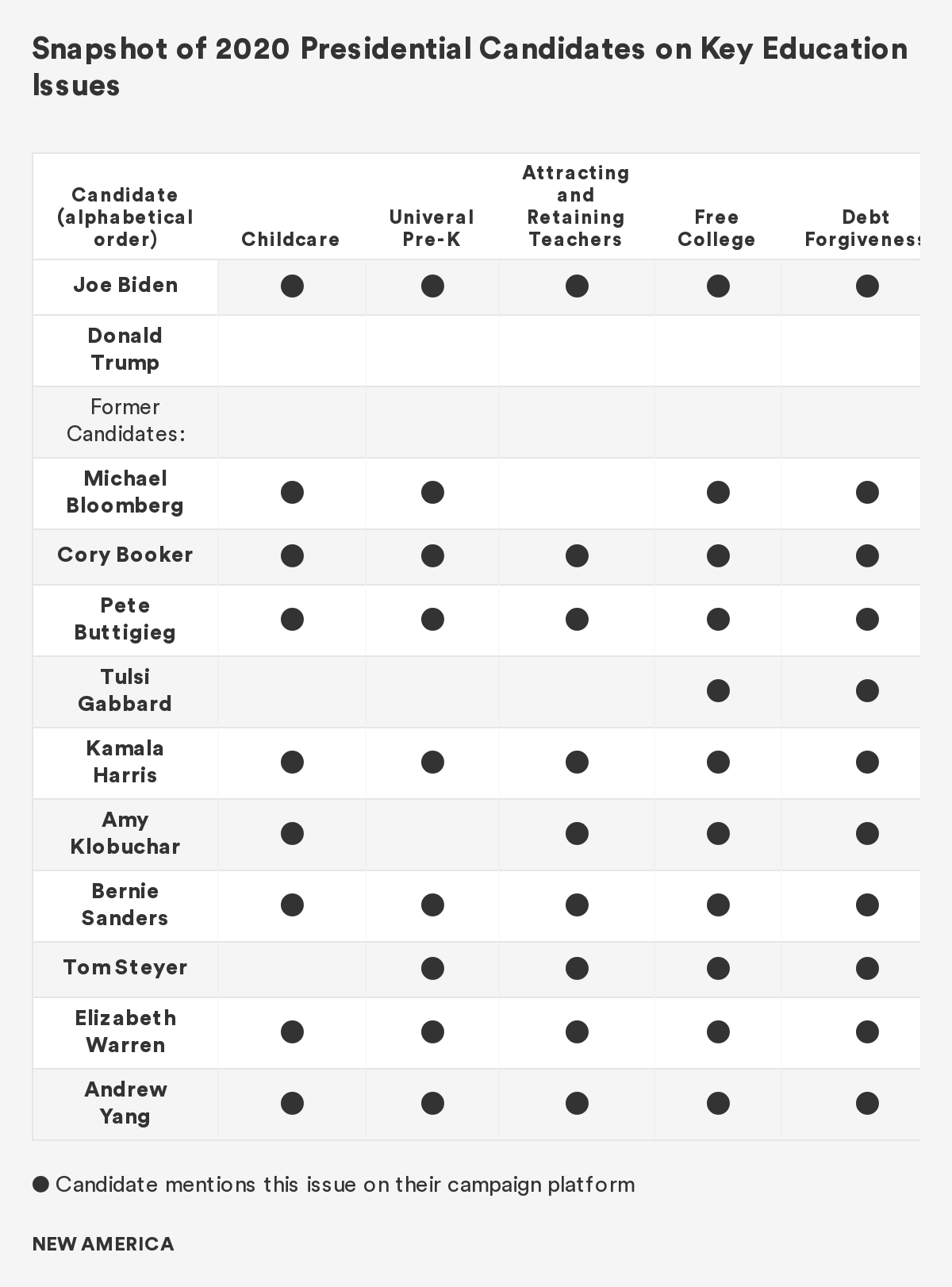
To help the media, advocates, and the public assess where the candidates stand, the Education Policy Program at New America is tracking presidential candidates’ 2020 positions on major education issues.
The Democratic candidates featured here are the 10 candidates who qualified for the November 20th debate, as determined by the rules set by the Democratic National Committee. The only Republican candidate with a sizeable amount of support in high-quality national polls conducted to date is the incumbent, and hence is the only candidate included at this time.
A snapshot of each candidate's platform is presented below, with each dot hyperlinked to the information source. Each issue area heading—child care, universal pre-K, attracting and retaining teachers, free college, debt forgiveness—links to an explanation of the importance of that issue and detailed narrative descriptions of the candidates’ positions. These narrative descriptions are critical, since even on issues where most candidates have voiced support, there is often significant variation in the substance of candidates' positions and depth of plans.
Our analysis does not suggest endorsement, support of, or opposition to any candidate; it is simply a record of whether each candidate has addressed a particular issue.
View our recommendations for candidates here.
This page will be updated as the campaign continues and candidates release more detailed plans. Please direct all inquiries to the Education Policy Program's Communications Manager, Riker Pasterkiewicz at [email protected]
Child Care
It’s no secret that the United States is facing a child care affordability crisis. Center-based infant care costs more than a year of college tuition and fees at a four-year public university in 28 states and the District of Columbia. Nationally, the cost of full-time center-based care is 85 percent of the monthly U.S. median cost of rent. A recent survey found that the high cost of child care was the top reason why some young adults are deciding to have fewer children than they would prefer.
Despite the cost of child care being so high, the child care workforce, overwhelmingly made up of women, is actually paid very little. The average pay for a child care worker (the term used in data collected by the Department of Labor) in all settings is only $10.72/hour compared to $32.98/hour for elementary school teachers. These wages are so low that between 2014 and 2016 over half of child care workers enrolled in at least one public assistance program. And, despite the fact that licensed infant and toddler care is often the most difficult for families to find, workers who care for the youngest children actually make less than their peers who work with children ages three to five. Women of color tend to earn even less than their counterparts since they are underrepresented in leadership roles in the field.
The presidential candidates have put forward a variety of plans in an effort to both reduce the overall cost of child care for families and increase the compensation of a workforce that often earns poverty-level wages.
We believe it’s important that child care plans address quality, access, and affordability. In order to ensure access to early care and education (ECE) for all families that need it, ECE should be free for families living in poverty with all other families paying on a sliding scale based on income. Families should be free to choose the child care setting that best meets their needs, whether that be in a center, family child care home, or with a family, friend, or neighbor. All publicly funded settings should be staffed by educators who earn at least a living wage and benefits and have a pathway to higher wages on par with K-12 educators with similar qualifications and experience. All child care settings should have access to the necessary resources to provide high-quality care for all children in a safe, nurturing environment with an emphasis on ensuring responsive interactions between children and educators. Plans should also emphasize the promotion of whole child, comprehensive approaches and dual generation strategies to better meet the needs of all families. Child care plans should also include additional investment to support construction and renovation of facilities.
Child Care for Working Families Act
Several presidential candidates have named the Child Care for Working Families Act as a model for the type of child care reform they would like to see become reality. The bill significantly increases the amount of funds in the Child Care and Development Block Grant (CCDBG) to allow states to help more people afford child care. No family earning less than 150 percent of their state’s median income would pay more than seven percent of their income on child care. Child care would cost nothing for families earning less than 75 percent of their state’s median income. The bill would also ensure that child care workers are paid at least a living wage and guarantee pay parity with elementary school teachers for workers with similar credentials and experience. It is estimated that under this plan the median family’s child care payment would drop to about $45 per week and the number of children eligible for child care assistance would more than double.
The Senate version of the bill is co-sponsored by the following presidential candidates: Senator Cory Booker (no longer in the race), Senator Kamala Harris (no longer in the race), Senator Amy Klobuchar (no longer in the race), Senator Bernie Sanders, and Senator Elizabeth Warren (no longer in the race), who has also introduced a separate bill, the Universal Child Care and Early Learning Act (see below). Booker unveiled legislation that would establish competitive grants for community colleges and Minority-Serving Institutions to enable them to provide free infant and toddler care to student parents and make investments in infant-toddler educator preparation. For her part, Klobuchar specifically highlighted her efforts to address the challenges of rural child care through increased funding for the Child Care and Development block grant and raising subsidy rates to allow rural providers to meet their operating expenses and raise program quality. And, earlier this year, Klobuchar introduced the Child Care Workforce and Facilities Act in the Senate which would provide competitive grants to states to fund further training for the child care workforce or expansion of child care facilities.
Universal Child Care and Early Learning Act
The Universal Child Care and Early Learning Act introduced by Elizabeth Warren in the Senate and highlighted on her campaign website is one of the more detailed and comprehensive of the child care plans put forward by the candidates. Warren’s plan calls for the federal government to partner with local providers to create a network of child care and early learning options for children from birth to school age that includes centers and in-home care. The plan calls for providers to be held to “high national standards”, such as the Head Start Performance Standards. Significantly, the Universal Child Care and Early Learning Act calls for pay parity between early educators and “similarly-credentialed local public school teachers.”
Under Warren’s plan, child care and early learning would be free for families earning below 200 percent of the federal poverty line and Head Start would be scaled up to enroll children who are not from low-income families. Families with higher incomes would pay a subsidized fee on a sliding scale, but no family would spend more than seven percent of their income on ECE, the affordability standard set by the U.S. Department of Health and Human Services. Warren’s campaign released a child care calculator to allow parents to estimate their potential savings if her plan becomes a reality. Warren planned to pay for her plan through an Ultra-Millionaire Tax on Americans with a net worth of over $50 million which she projects will result in an additional $2.75 trillion in new revenue over ten years, though there is disagreement about just how much revenue the tax would produce. This is the same tax she planned to use to fund her K-12 plan as well as her plans to cancel most college debt and offer free tuition at public colleges. A Moody’s analysis found that the Warren plan would cost about $70 billion per year. The analysis predicted that 8.8 million children in families below 200 percent of the federal poverty line would receive free child care under the plan and the typical American family would see their annual child care costs reduced by 17 percent.
The child care plan released by Bernie Sanders promises to provide at least 10 hours of child care each day for children up to age three. Unlike Warren’s plan in which child care would be free for families earning below 200 percent of the federal poverty line, Sanders’ plan provides free child care for all, regardless of family income. Child care would be funded by the federal government and administered by state agencies and tribal governments. The federal government would set quality standards, including requiring states to pay a living wage for early educators and mandating low adult-child ratios. Any educators working directly with young children would be required to have at least a Child Development Associate (CDA) credential and all assistant teachers would need at least an associate’s degree in ECE or child development. The plan states that lead teachers will earn the same level of compensation as similarly qualified kindergarten teachers. Sanders also promises to improve child care infrastructure by constructing new facilities and renovating existing ones. Additionally, Sanders vows to make it easier for child care workers to unionize. Sanders estimates his child care and pre-K plan will cost a total of $1.5 trillion over ten years and will be paid for by taxing the wealth of people with a net worth of more than $32 million, though the Committee for a Responsible Federal Budget argues that such a tax would raise as much revenue as intended due to high levels of tax avoidance.
The child care plan released by Mayor Pete Buttigieg sounded a lot like the Universal Child Care and Early Learning Act in its vow to build on Head Start, invest in professional development and increase compensation for the ECE workforce, and make early childhood education free for lower-income families and more affordable for all families. Specifically, Buttigieg vowed to invest $700 billion to finance a new universal subsidy program that will provide affordable, universal full-day child care and pre-K for all children from birth to age five. His plan also called for spending $2 billion a year for training, certification, and wage increases for early childhood professionals while defending the right of early educators to form strong unions. Additionally, Buttigieg vowed to eliminate eligibility "cliffs" that can force families to choose between taking better-paying jobs or losing child care benefits.
There are a few key differences between the Child Care and Working Families Act and the Universal Child Care and Early Learning Act. The Child Care and Working Families Act builds on the existing CCDBG program and significantly expands it to help low- and middle-income families afford child care. The Universal Child Care and Early Learning Act, on the other hand, establishes a new network of federally administered, locally-run early learning centers. And while both bills aim to reduce the financial burden on parents paying for child care, there are differences in who exactly would benefit. The Child Care and Working Families Act would ensure no family earning less than 150 percent of their state’s median income (SMI) pays over seven percent of their income on child care and provides free child care for families earning less than 75 percent of SMI, while the Universal Child Care and Early Learning Act caps child care costs for all families, regardless of income, at seven percent of income and provides free child care for families earning less than 200 percent of the federal poverty line.
Michael Bloomberg did not endorse a specific piece of child care legislation, but did introduce his own child care plan, which called for making child care more affordable by doubling annual federal spending. Bloomberg promised to triple the 163,000 infants and toddlers currently being served by Early Head Start (which currently only serves 11 percent of eligible children) and direct more funds to Early Head Start—Child Care Partnerships. He also called for an expansion of Head Start which currently serves about 652,000 three- and four-year-olds at a cost of $10.6 billion. Additionally, Bloomberg’s plan proposed increasing funding to the Child Care and Development Block Grant program (currently funded at $5.8 billion) and new federal investments to upgrade the infrastructure of child care centers and family-based settings.
Several of the other presidential candidates, including former Vice President Joe Biden, Representative Tulsi Gabbard, and President Donald Trump have yet to release detailed child care plans or explicitly express their support for the Child Care for Working Families Act or the Universal Child Care and Early Learning Act. However, as Vice President, Biden expressed support for tripling the child tax credit and paying for it by limiting certain tax deductions, and Andrew Yang’s (no longer in the race) campaign website highlighted tax breaks for child care in an effort to provide support for single parents. In his budget requests, President Trump has generally pushed for maintaining current funding for CCDBG, though his FY2020 request included a one-time $1 billion investment to increase the child care supply. And, in early 2018, as part of a sweeping bipartisan budget bill, Congress passed and President Trump signed a budget deal that included a historic $2.9 billion funding increase for CCDBG.
Universal Pre-K
Pre-K, or the education and care provided to three- to five-year-old children, encompasses a critically important period of early childhood development. Under the guidance of well-trained teachers, children who are in full-day pre-K programs with sustained high-quality learning experiences through elementary school make tremendous gains compared to their peers without such a strong foundation.
Pre-K is a sound investment. Studies have shown that the return on investment for high-quality pre-K programs can be as high as 13 percent, with positive economic and educational outcomes that are multi-generational. A Center for American Progress analysis demonstrated that the United States would see a net benefit of $83.3 billion for each annual cohort of 4-year-olds enrolled in high-quality pre-K and currently experiences a net cost of inaction of $56.2 billion for each year that universal state pre-K is not provided.
Despite its promising outcomes and bipartisan support, the United States is falling behind much of the world in access to public pre-K education. Across all publicly funded pre-K programs, including Head Start, federal and state funded pre-K, and special education programs, only 44 percent of 4-year-olds and 16 percent of 3-year-olds were served in 2018. Broadening that data to include private pre-primary programs, only 68 percent of four-year-olds and 40 percent of three-year-olds were enrolled in an early learning program in 2017. Families paying for private pre-K can pay annual out-of-pocket costs ranging from a high of $18,202 in D.C. to a low of $4,556 in Mississippi.

Whether children have access to tuition-free, universal pre-K depends greatly on their state and locality. Two states, Vermont and Florida, currently offer universal pre-K, which the Education Commission of the States defines as programs which “are not capped by funding amounts, enrollment numbers or enrollment deadlines.” Seven other states have near-universal programs, while six states offer no state-funded pre-K whatsoever. Cities have taken initiatives to establish universal pre-K programs as well, including Washington, DC, San Antonio, and New York City.
Where universal pre-K programs are established, children experience greater academic gains than children in targeted programs, especially children from families with low incomes. Being in a universal, mixed-income setting can also help prevent the racial and economic segregation that’s widespread across many early childhood programs. Universal pre-K often results in pay parity between pre-K teachers and their counterparts in the K-12 system. Additionally, Washington, D.C.’s universal pre-K program has boosted workforce participation for mothers by 10 percent.
We believe universal pre-K proposals should provide all three- and four-year-olds with voluntary access to high-quality, affordable pre-K education through a mixed-delivery system of child care centers, Head Start, public schools, and family child care. High-quality pre-K would include culturally responsive, diverse teachers; a racially and socioeconomically integrated student population; instructional alignment along the early learning continuum; play-based, interactive curricula; thoughtful transitions to kindergarten; and be equivalent in length to the first grade day. The federal government should prioritize investment to make pre-K free for children from low and moderate income families, while state pre-K dollars should expand federal funding to ensure quality as well as provide universal programs. Pre-K educators (directors, lead, and assistant teachers) should be required to have comparable qualifications to their K-12 peers, and receive compensation parity, including benefits, regardless of setting.
Candidate Plans
The phrase, “universal pre-K,” has become ubiquitous on the 2020 presidential campaign trail, but what are the specific candidate plans to create well-funded, sustainable pre-K programs that would educate roughly eight million children each year?
Many candidates have talked about pre-K and some have released detailed plans. Others have signaled their support for pre-K by endorsing either the Child Care for Working Families Act or Senator Elizabeth Warren’s Universal Child Care and Early Learning Act. Both bills aim to increase access to affordable pre-K, but go about it in slightly different ways.
The Child Care for Working Families Act provides formula grants to states to establish free, high-quality, targeted pre-K programs for eligible three-, four-, and five-year-old children from families who earn up to 150 percent of the state median income. It requires states to take steps to improve transitions between pre-K and elementary school and encourages states to increase enrollment in full-day kindergarten. The bill also provides grants to Head Start and Early Head Start programs to help them provide access to a full school year and full school day of services.
The Universal Child Care and Early Learning Act establishes a new network of federally administered, locally-run child care centers. The bill includes pre-K providers and school districts offering pre-K among the newly established network of subsidized child care centers. Warren’s bill includes a tiered system in which the federal government would cover 100 percent of the cost of pre-K for children of migrant and seasonal farmworkers and Native American children, 80 percent of the cost for families earning below 200 percent of the federal poverty line, and 50 percent of the cost for families who are middle- and upper-income. The portion of cost not covered by federal funding would come from family fees and other private and public contributions. Families’ payment would be established on a sliding scale with no family paying more than seven percent of their income on early learning. During her campaign, Warren explained that the act would be funded with one-quarter of the tax revenue collected under her proposed Ultra-Millionaire Tax.
Senator Bernie Sanders, who co-sponsored the Child Care for Working Families Act, announced a universal pre-K plan that would provide federally-funded, locally-administered pre-K for all children at no cost to families, starting at age three. Sanders’ plan goes beyond the Child Care for Working Families Act by including construction of early learning facilities, reduction in pre-K class sizes, free school meals for pre-K students, desegregation of early education, and free pre-K for all children, regardless of family income. Sanders’ plan would require assistant teachers to earn an associate’s degree and lead teachers to obtain a bachelor’s degree, with the promise of compensation commensurate with experience and training, and parity between lead early education teachers and similarly qualified kindergarten teachers.
Other candidates have acknowledged the importance of pre-K but have yet to release specific plans. Former Vice President Joe Biden’s campaign website asserts that, “As President, Biden will work with states to offer pre-K for all three- and four-year-olds. This investment will ease the burden on our families, help close the achievement gap, promote the labor participation of parents who want to work, and lift our critical early childhood education workforce out of poverty.” Representative Tulsi Gabbard has yet to provide any details on her plans for pre-K.
President Donald Trump has consistently put forward budget requests that would eliminate funding for the federal Preschool Development Grant program, which assists states in expanding access and quality, though the program has been spared by Congress each year. Trump’s proposed budget also maintains flat funding for Head Start at $10.6 billion, though the program only serves roughly one in three eligible three-, four-, and five-year-old children. The administration has, however, proposed a $5 billion plan for Education Freedom Scholarships which could be used to enroll children in pre-K, if the participating state categorizes pre-K as part of elementary education.
While campaigning, former Mayor Pete Buttigieg had a plan which called for a $700 billion investment that would make early education free from birth through age five for lower-income families, and require that middle- and upper-income families pay no more than seven percent of their earnings in early learning costs. Buttigieg’s plan also encouraged building on the federal Head Start program and allocating $1 billion in funding for transportation to early learning sites, particularly in rural areas.
During his campaign, former Mayor Michael Bloomberg released an early education plan advocating for universal access to full-day pre-K for all three- and four-year-olds. To achieve this, Bloomberg proposed providing federal grants to states meeting certain criteria, though his plan did not list criteria beyond successful local implementation, nor explain how programmatic success will be defined. His early education platform also promised federal grants for states to close the pay gap between pre-K teachers in low-income areas and their public school counterparts, as well as additional grant funding to expand states’ capacity to “reach the goal of universal access to affordable pre-K.” Similar to Sanders’ plan, all children, regardless of family income, would have access to free early education.
Some campaigns built upon existing legislation. Senator Cory Booker, for example, co-sponsored both the Child Care for Working Families Act and the Universal Child Care and Early Learning Act, and included passing the Child Care for Working Families Act as part of his platform while he was running. Similarly, Senator Kamala Harris, also a co-sponsor of the Child Care for Working Families Act, put forward a Children’s Agenda during her presidential campaign that built on the proposed bill.
Several candidates voiced support for universal pre-K but offered less detail on their approach. Entrepreneur Andrew Yang, while he was campaigning, aimed to direct the Department of Education to partner with states and develop a plan for establishing universal pre-K. During her campaign, Senator Amy Klobuchar’s supported a national pre-K program that would be free for low-income families. Billionaire and investor Tom Steyer included “the right to learn” as one of his five proposed, legally-protected fundamental rights. His website said, “Our government must protect the right to a free, quality, public education from preschool through college and on to skills training.”
Attracting and Retaining Teachers
Since teachers first walked out of their classrooms in West Virginia in February 2018, a wave of teacher protests have hit 15 states. Teachers are striking for a variety of reasons, but most commonly for higher pay, better working conditions, and equitable resources for their students. This movement has launched the issue of teacher pay, along with other K-12 teaching issues, into mainstream media and into the national discourse among most Democratic presidential candidates.
While baseline compensation is one important factor in attracting and retaining strong teachers, other factors can be just as important. Teachers may decide to leave their school or the profession due to things like insufficient initial preparation, lack of meaningful professional development and opportunities for advancement, and poor working conditions such as taking on an overwhelming number non-instructional tasks. Research has found that roughly 30 percent of teachers leave the profession within the first three years and between 40 percent and 50 percent leave within the first five years.
Given the value that teachers provide to their communities and our nation’s civic and economic future, increasing frustration and disillusionment with the teaching profession is cause for concern for all Americans, regardless of whether they have students who are currently attending public schools. Teachers deserve strong preparation, competitive salaries that align with local professional labor markets and cost of living, and school conditions that enable them to focus on continuously improving teaching and learning, and advancing in their careers. Without these elements, many of our teachers, and especially our most motivated and talented ones, will find employment elsewhere or leave the teaching profession altogether. Below is an analysis of where the candidates stand on the critical issues of teacher pay, career advancement, working conditions, preparation, and diversity.
Increasing teachers’ salaries and disposable income
Increasing salaries is the teacher issue that has captured the most media—and presidential candidates’—attention, and for good reason. An Economic Policy Institute analysis finds that teachers earn 21 percent less—11 percent less when considering non-wage benefits—on average, than other college-educated workers, despite earning only 5.3 percent less 25 years ago.
Most candidates have made statements of support for increasing teachers’ salaries, but not all have laid out detailed plans for how to do so. Senator Cory Booker (no longer in the race), Tom Steyer (no longer in the race), and Andrew Yang (no longer in the race) all made statements of support for raising teacher pay, but do not provide details on how they would do so. Senator Amy Klobuchar’s (no longer in the race) “Progress Partnerships” plan would have provided matching federal funds to states that pledge to, or have already, increased teacher pay, but does not explain where the funding would come from.
Senator Kamala Harris (no longer in the race) was the first to put out a comprehensive proposal that focuses on raising teacher pay and improving their working conditions. The plan promised to raise average teacher pay by $13,500—the equivalent of a 23 percent increase in base pay—with teachers in high-need schools receiving an even larger pay increase. Harris planned to pay for that raise by strengthening the estate tax and closing tax loopholes. Harris’ plan stated that the Department of Education would work with state education agencies to set a base salary goal for new teachers in every state, which would account for the average salary of similarly educated professionals in the state. Salary would increase based on years in the classroom and advanced qualifications.
Under the Harris plan, the federal government would invest in public schools to provide the first 10 percent of funding needed to close the teacher pay gap in every state. After that, for every $1 a state contributes to increasing teacher pay, the federal government would invest an additional $3 until the pay gap is closed. Harris would go further for teachers in high-need schools, who would receive an additional federal investment to ensure their pay is even higher. It’s important to note that teacher pay and the cost of living varies widely across, and within, states so the base pay and the investment needed in each state will be different.
A popular approach for increasing teacher salaries provided by other candidates is to increase Title I funding—federal funds that are allocated under the Elementary and Secondary Education Act (ESEA) to schools with a high percentage of students from low-income families. Mayor Pete Buttigieg (no longer in the race), former Vice President Joe Biden, and Senator Elizabeth Warren (no longer in the race) have all stated that they would use this approach. Buttigieg did not specify by how much he would increase Title I funds, or how he would structure the funds so that they were used for teacher salaries as opposed to other purposes. Biden has proposed tripling Title I funding and requiring schools to pay teachers competitive wages and benefits before directing funds to other purposes, although it's unclear how a competitive wage would be defined. Warren’s plan would have quadrupled Title I funding to pay for salary increases for teachers, paraprofessionals, and other education support staff with the goal of closing the pay gap between educators and other professions. Warren stated that federal funding would incentivize states to alter their funding formulas to better support students and teachers, but it’s unclear how that would happen. It’s also not clear how the legislative text of Title I of the ESEA would need to be changed to accomplish the goals in any of these plans, or how realistic that is.
Senator Bernie Sanders has pledged to work with states to set the starting salary for teachers at no less than $60,000 a year, in addition to ending racial and gender disparities in teacher salaries, but he has not explained how he would do that. He has also proposed tripling the tax deduction that teachers receive for out-of-pocket spending on classroom supplies and creating a grant program that would provide teachers with funds for classroom materials.
While some of these proposals target funding for teachers in high-need schools, candidates should also think about how funding should be targeted for high-need subject areas, particularly as states experience teacher shortages in critical subjects and hard-to-staff schools.
More indirectly related, Warren’s plan would have strengthened the ability of teachers, paraprofessionals, and other staff to organize and bargain for better compensation, for a voice in education policy, and for greater investment in public education in order to address pay issues working conditions that are problematic. Warren stated that she wants to make it easier for teachers to join a union and bargain collectively in order for teachers to earn better pay in a sustainable way, and to empower teachers. She would have made eliminating the ability of states to pass anti-union “right to work” laws a top priority. Sanders and Harris also pledged to protect and expand collective bargaining rights.
Like teacher pay, student debt is another factor in the calculus in whether someone decides to become a teacher. The need to take on debt to go into the often low-paying teaching profession may prevent many from entering, particularly students from low-income families. And once in the profession, high student debt can make it hard for teachers to make ends meet. The federal government offers several loan forgiveness programs that are intended to erase some of teachers’ loan debt in return for years of service. However, that goal has largely been unmet, particularly through the TEACH Grant program because of various issues with the administration and design of these programs. Biden, Booker, and Warren all specified debt relief for teachers in their plans in slightly different ways. Biden pledges to fix and simplify the Public Service Loan Forgiveness Program so that teachers can actually have their loans forgiven, but there is no clear plan for how he would do that. Booker also supported eliminating student debt for teachers, as well as providing financial assistance for fulfilling teacher certification and licensing requirements but did not provide details on how he would accomplish these goals. And Warren planned to wipe out student debt for teachers and provide tuition-free public college so many future teachers would not have to take on debt in the first place. In addition, she would have pushed states to offer a pathway for teachers to become fully certified for free.
Representative Tulsi Gabbard (no longer in the race) is the only Democratic candidate that qualified for the November debate whose campaign website did not explicitly mention supporting an increase in teacher pay. Her webpage had a section titled “Invest in public education and our teachers” but the content included was not related to this topic. On the other side of the aisle, President Trump has not released an official policy platform for his 2020 campaign, but his presidential agenda has generally not been supportive of teachers. President Trump has consistently put forward budget requests that would eliminate funding for educators in the Elementary and Secondary Education Act and the Higher Education Act, though the program has ultimately been spared by Congress each year. However, his Secretary of Education, Betsy DeVos, has publicly remarked that teachers deserve to be paid much more, albeit without any details on how she thinks that should occur.
Teacher preparation
A much less talked about issue is teacher preparation. Only two presidential candidates have touched on the need to improve the way that our educators are prepared before they enter the classroom. Effective teacher preparation should provide teacher candidates with the knowledge, skills, and hands-on experience necessary for success in the classroom, to limit the shock new teachers face when taking on their own classroom, and help prevent burnout and attrition. And preparation would be further improved by incentives to create feedback loops between higher education and the schools and districts their graduates serve and to provide better information to prospective teachers about which programs will best meet their needs and the needs of their future students. Unfortunately, this is happening in very few places, but this is one clear way the federal government can play a role in strengthening the teacher pipeline.
Senator Warren’s plan would have pushed to fully fund the Teacher Quality Partnership program—the program is funded at $43 million but authorized at $300 million—in Title II of the Higher Education Act (HEA) to support teacher residency programs in high-need areas, like rural communities, and in areas of expertise like special education and bilingual education. And she would also have added funding for Grow Your Own Teacher programs that provide opportunities for teaching assistants or substitute teachers to become licensed teachers.
Senator Harris’ plan included a multi-billion dollar investment in programs that help better prepare teachers, principals, and other school leaders. This included high-quality teacher and principal residencies, early-career induction programs that pair new teachers with mentors and master teachers, career ladder models that allow for advancement opportunities for teacher leaders, and Grow Your Own programs that help increase teacher diversity. Half of the funding would have been dedicated to programs at Historically Black Colleges and Universities and other Minority Serving Institutions, as almost 40 percent of all Black teachers and 50 percent of all Latinx teachers graduate from MSIs.
Working conditions
Once teachers enter the classroom, overall working conditions play a key role in whether a teacher decides to stay or leave a school. While there are sadly plenty of examples of schools with physical environments that are unappealing or even unsafe, the term “working conditions” includes the non-physical aspects of the school environment as well. For example, if teachers feel overwhelmed by non-instructional responsibilities, they might choose to leave their school, or the profession altogether. School leaders also often expect them to take on other tasks like staffing bus duty, engaging with parents, providing mental health support to students, and supervising students during lunch. And in the case of teachers of color, they may be given further tasks, like serving as the disciplinarian for students of color or as the the language translator between the school and students’ families. These additional responsibilities are often piled on because of insufficient school personnel, such as school counselors and teachers’ aides, which is typically due to a lack of school funding and can cause teachers to burn out and leave the profession.
Research across professions also indicates that people are more likely to experience job satisfaction when they believe that their employer is investing in their professional growth. Unfortunately, while teachers engage in a large quantity of professional development activities over the course of any school year, much research indicates that the quality of those activities are lacking, and often do not substantially impact teacher or student knowledge or practice.
Working environments can be improved by ensuring schools have sufficient support staff (psychologists, guidance counselors, special education teaching aides, etc.) to meet students’ needs, helping principals create more staffing capacity on their administrative and/or instructional teams to fulfill all of their responsibilities, and promoting higher-quality, ongoing professional development that explicitly addresses the individual needs of teachers and the needs of their students and schools. If other staff in the school do not have the support or capacity they need, teachers often have to step in and fill that gap.
Few candidates have talked about these more comprehensive ways to improve teachers’ working conditions and job satisfaction, but Biden’s plan would double the number of psychologists, guidance counselors, nurses, social workers, and other health professionals in schools so that students’ mental health needs are adequately taken care of. And both Senator Sanders and Senator Warren pledged to ensure that teachers receive professional development and mentorship opportunities, which already occurs, but Warren’s plan specified what she would do differently. Warren’s plan specified that she would increase funding for programs that fund professional development and ongoing education for effective instruction, cultural competency, and child development, such as the Supporting Effective Instruction State grants and Supporting Effective Educator Development grants in Title II of ESEA. Warren’s proposal would also have invested in funding for the Institute of Education Sciences research on best practices in professional development.
Career advancement
Another important factor that weighs heavily on whether teachers decide to enter and stay in the teaching profession is whether they have clear career pathways that allow them to grow and advance in their profession.
And, in most professions that require a college degree, employees have multiple opportunities to advance as they demonstrate growth in their professional practice and expertise, which correspond with increasing pay and status. But these types of advancement opportunities are not the norm in teaching, and when teachers’ do receive them, they often come with little to no additional compensation, support, or reduction in current responsibilities, diminishing their status and appeal. And other evidence shows that increasing teacher pay is more effective at retaining teachers when coupled with opportunities to develop and advance professionally. The most common options teachers have to advance involve leaving the teaching profession, often by becoming a school or district administrator, although sometimes by leaving education altogether.
Clear, well-compensated opportunities for growth in expertise and advancement, can raise the appeal of teaching, and can reward our strongest teachers for taking on increasingly challenging roles and responsibilities. But our nation’s students will ultimately reap the largest benefits, as these efforts jointly raise the quality of teaching in schools.
Biden has proposed offering teachers opportunities to be mentors and coaches to other teachers, and to be leaders of professional learning communities, but does not provide details on how the federal government would encourage states and/or districts to do this. His plan states that teachers would be compensated for these additional responsibilities. Biden’s proposal states that the additional funding would also be used to help teachers who want to earn an additional certification in a high-demand teaching area, like special education or bilingual education, so they could do so without accumulating debt.
Teacher Diversity
As the student population in public schools grows more diverse, the teaching workforce is not keeping pace. In 2015–2016, 51 percent of students in public schools were non-White, compared to only 20 percent of teachers. This demographic mismatch between teachers and students is problematic because research demonstrates that students benefit from having teachers that reflect their cultural, racial, and linguistic background. States and districts across the country are making efforts to diversify their teaching workforce, but the federal government can support these efforts, but Buttigieg, Harris, and Warren are the only candidates that have proposed plans to support diversity in our schools.
As stated above, Harris’ plan included a multi-billion dollar investment in programs that would help better prepare teachers, principals, and other school leaders would include funding for Grow Your Own programs that help increase teacher diversity. And half of that funding would have been dedicated to programs at Historically Black Colleges and Universities and other Minority Serving Institutions.
Warren’s plan would have built a more diverse educator pipeline through financial incentives like cancelling student loan debt, providing tuition-free public college, and investing a minimum of $50 billion in Historically Black Colleges and Universities and Minority Serving Institutions. She believed that this strategy would help more Black, Latinx, Native American, Asian American, and Pacific Islander students to become educators and school and district leaders. Warren also committed to increasing Bureau of Indian Education funding so schools can attract and train teachers, particularly those from Native communities. She committed to passing the Equality Act to guarantee workplace protections for LGBTQ+ teachers and staff.
Through federal regulation, Buttigieg planned to require new transparency around teacher hiring procedures: states would have to disaggregate their applicant and hiring by race and document teacher diversity initiatives as part of their Every Student Succeeds Act school improvement plans. A Buttigieg Administration would also have set new guidelines around the use of Title II funds to invest in recruiting, training, and supporting school leaders of color.
Free College
“Free college” has become a popular policy to many on the left, and even some on the right. Senator Bernie Sanders introduced his free college bill in 2015 and made it part of the national conversation in the Democratic presidential primary in 2016. Now, after action in a handful of states, some version of “free college” has become a prong of the policy platforms of at least eight Democratic Presidential candidates in the 2020 race. However, the details of the plans look very different. President Trump has not released a campaign platform related to college affordability.
To understand proposals for free college, it’s important to know how our higher education system is currently funded. What we have today is a mixture of public, for-profit, and private, non-profit institutions. Public institutions are state entities and are financed primarily by a combination of state (and sometimes local) appropriations, donations, and students paying tuition—through family savings, scholarships, grants, and loans. Non-profit institutions are reliant on donations and tuition revenue and for-profits are reliant on the latter. Federal funding for higher education is a voucher system with the federal government primarily providing loans and need-based grants in order to help cover students’ expenses. Grants like the Pell Grant are based on student need, not the price of a given institution. The federal government also provides benefits to veterans and active-duty military through the Department of Defense and the Department of Veterans Affairs. Free college policies writ large are ones that address tuition, and sometimes fees, at public institutions—technical schools, community colleges, and four-year colleges and universities.
The 2020 Democratic Presidential Primary and the policy conversation writ large offer “free college” plans that fall into two main categories: free two-year college and free two- and four-year college. Each of these has its own benefits and drawbacks. Here is what you need to know about free college and how each candidate's plan stacks up.
First- v. Last-Dollar
One of the first design considerations of a free college plan is if it is a first- or last-dollar benefit. A last-dollar approach means that a plan would eliminate tuition after all scholarships and grants. This is the approach many states have chosen which has meant they cover the gap for students and make tuition free. So a student who receives outside scholarships or a Pell Grant would have any remaining tuition covered by the government. A first-dollar approach would eliminate tuition before all grants and scholarships and allow students to use those dollars to pay for books, living expenses, and more. Many criticize last-dollar plans as regressive because they provide more benefit to people who do not qualify for need-based aid programs like the Pell Grant.
Tuition-Free Community College
What started as an initiative in the red state of Tennessee, free community college—also referred to as free public two-year—has become increasingly popular in states and with many in Congress. House Democrats recently included a version in their bill to revamp higher education with the support of Speaker Nancy Pelosi. It is also an idea President Obama championed while in office. Some view this as the more affordable approach and realistic compared to making all college tuition-free. Others see it as universally needed as an extension of high school because 65 percent of jobs will require some education beyond high school, though not all require a four-year degree.
Presidential hopefuls Senator Amy Klobuchar and former Vice President Joe Biden have proposed plans to make tuition-free community college. Klobuchar pitches her plan as “many paths to success” citing numbers showing some of the fastest-growing occupations only require a one-year certificate or a two-year degree. She previously said free four-year college was aspirational, but she wasn’t a genie that could give it to everyone. Biden, whose wife is a community college professor, has been a champion of tuition-free community college since his time in the White House. Biden’s plan also pointed to the large number of quality jobs that pay a good salary, but don’t require a bachelor’s degree. Unlike in Tennessee, both of these plans are first-dollar, allowing low-income students to use Pell Grants for living expenses. Structuring the plan this way is much more beneficial to those students because at community colleges, where tuition is often much lower, Pell Grant recipients often pay little to no tuition at all. While they do not have detailed plans, Senator Cory Booker (no longer a candidate) and Andrew Yang both called for making community colleges tuition-free (or at least nearly-free in Yang’s case).
There are some that express concern with these plans. Community colleges are historically underfunded where appropriations and tuition revenue do not allow for needed supports or cause them to be overly reliant on adjunct faculty. There is a worry that if overall funding isn’t addressed then there will be capacity issues and a risk of schools not being able to support students and ensure they succeed. Some critics say this approach creates an even more stratified system of higher education, where those who can afford a four-year degree will end up with a degree that, on average, pays significantly more than a two-year degree and those who need the most affordable education will end up in lower-paying jobs. Others point to “diversion” effects where those who would otherwise attend a four-year institution are diverted to a community college. Possibly due to the troubles of transferring, research has shown those students are 18 percentage points less likely to end up with a bachelor’s degree than if they enrolled in a four-year from the start—even though that was their original goal. However, many plans say they will work to ensure transferring is made easier.
Tuition-Free Two- and Four-Year College
Other presidential candidates have gone a step further and have said all two- and four-year public colleges and universities should be tuition-free. Senators Elizabeth Warren and Bernie Sanders released detailed proposals and would eliminate tuition and fees for up to a bachelor’s degree at a public institution. Mayor Pete Buttigieg proposed something similar, making public institutions tuition-free for families earning up to $100,000—approximately 80 percent of American families. He would subsidize the tuition of those families making up to $150,000 and would require states to improve affordability for all students. Other candidates have yet to layout details, but have shown support for the policy. Businessman Tom Steyer says everyone should have the “right to a free, quality, public education from universal pre-kindergarten through higher education.” Senator Kamala Harris (no longer a candidate) says she will make community college free and four-year public college debt-free—a phrase usually meaning she would apply income restrictions so that those who can afford to pay without loans will do so. In addition to free community college, Senator Booker (no longer a candidate) says he will create a path to debt-free college. Congresswoman Tulsi Gabbard points to the legislation she co-sponsored in 2017—led by Sanders in the Senate—to make community colleges tuition-free and public four-year schools tuition from for “working- and middle-class students.” (Gabbard also co-sponsored the 2019 House version of the bill, but her website does not mention it.)
Historically Black Colleges and Universities and Minority-Serving Institutions
The vast majority of Historically Black Colleges and Universities (HBCUs) and Minority-Serving Institutions (MSIs) are public institutions and would be included in college affordability plans for public institutions. However, HBCUs and MSIs are historically under-resourced compared to their predominantly White counterparts and while eliminating tuition help students, it doesn’t always address the funding issues that limit the schools’ ability to serve students. In this cycle, a number of candidates provide significant investments to all HBCUs and MSIs. Warren and Buttigieg both call for a $50 billion investment over the next decade. Warren’s investment would allow the private institutions to be included in her tuition-free plan as well to help shore up per-student funding at these institutions. Buttigeg’s investment could be used for student aid, capital and instructional costs, and strategies to support student needs and college completion. Sanders proposed $1.3 billion per year—$13 billion over the decade—to private, non-profit HBCUs and MSIs to “eliminate or significantly reduce tuition and fees for low-income students.” Klobuchar would also direct funding to HBCUs and MSIs to eliminate tuition for the first two years for low-income students. Biden would invest $18 million in grants to them—equal to about two years of tuition per low-income and middle class student—to lower cost, improve graduation rates, and more.
Addressing Non-Tuition Expenses
Plans to address college affordability should consider the full cost of higher education if they are to be effective. Fifty-two percent of the cost of a four-year degree at a public institution is in living costs, not tuition and fees. At community colleges, those living expenses account for 70 percent of cost. That’s why eliminating tuition alone does not guarantee a debt-free education. Of the candidates that have released free college plans—regardless of two- or four-year—all have proposed them as first-dollar plans allowing low-income students to use their Pell Grants to cover at least some of those costs. Additionally, many of the candidates have called for increasing the Pell Grant. Buttigieg called for a $120 billion increase over the next ten years, increasing the maximum grant by $1,000 and tying the grants to inflation. Klobuchar and Biden both specifically called for doubling the maximum amount and expanding who would be eligible. Warren proposed an additional $100 billion over the next decade to increase the maximum award, as well as who would qualify. Sanders says he would continue to provide Pell Grants for living expenses but would require states and tribes to cover the remaining gap for low-income students. Booker (no longer a candidate) has another plan called “Baby Bonds” that would essentially create a savings account at birth, with yearly contributions based on family income for people to use to pay for different expenses, including higher education.
Federal-State Partnership
While eliminating tuition sounds easy on its face, it is more complicated than that. An important component of all federal proposals to make public college tuition-free is the interaction of the federal government with the different states, given that eligible schools are state institutions. Each of the detailed plans put forth by candidates calls for a type of federal-state partnership where the federal government would provide a portion of funds to states to reduce or eliminate tuition. These plans would make federal funding contingent on continued—and in some cases increased—support from the states. Most plans provide few details on how this funding structure would work, but those details are important to ensuring the success and sustainability of such plans. The details that exist outline how much the federal share of costs would be. For example, Biden says the federal government would provide 75 percent of the cost generally and 95 percent for tribes with community colleges serving low-income students—important given the financial struggles of many tribes. Klobuchar would provide $3 for ever $1 from the state.
While it’s not unusual for presidential candidates to have plans without the minute details, if implemented these details will be critical for the success of any tuition-free college. One of the largest drivers of the increase in college tuition is the disinvestment by many states in higher education. Funding cuts have largely been associated with rising costs in states, particularly in the areas of corrections, pension obligations, and in Medicaid. Higher education is one of the largest sources of discretionary spending in state budgets, which has made it more vulnerable to cuts. When these costs increased, they crowded out state spending on higher education. Higher education funding is also unique in that they can easily be passed on to consumers—students and families—through tuition and fees, which they can usually cover from federally backed grants and loans.
To be successful, the federal-state partnership must also take into account the ebbs and flows of the economy. During the Great Recession, states were forced to cut budgets and higher education suffered. Not only did tuition increase, but more people enrolled in college. Some were right out of high school, but others were those who lost jobs and enrolled due to the poor job market. Colleges raised tuition, but many were still stretched too thin and were unable to provide or expand needed support services—some were forced to cut them. That’s why a federal-state partnership must have a stabilizer provision in times of a recession to ensure states, especially those that are cash-strapped, can afford to participate.
Of course, no matter who is elected these plans will have to go through Congress to seek their final approval. House Democrats just approved a version of free community college in committee, but that is the farthest any free college proposal has ever gotten in Congress. If elected, any president will have to decide how much they prioritize making free college a reality. Any plan will have to ensure it is designed to improve student outcomes and guarantee its sustainability.
Debt Forgiveness
The conversation around higher education in the 2020 Presidential campaign has been a robust one. While candidates differ on their stances on tuition-free college, they have also incorporated policy ideas into their platforms on addressing outstanding student debt, many with varying ideas for debt forgiveness. President Trump has not released a campaign platform related to student debt, though he proposed changes to income-driven repayment on the campaign trail in 2016.
Income-based Repayment
Currently, there is one primary path to student loan forgiveness available to student borrowers—income-driven repayment. Income-driven repayment (IDR) plans are meant to protect borrowers from unpredictable income or in the unfortunate chance their education has not yielded an income sufficient to repay. Under these plans, student loan payments are set to a percentage of a borrower’s discretionary income, currently defined as their income above 150 percent of the federal poverty line. Depending on income and family size, borrowers pay 10 percent of their discretionary income (spread across 12 monthly payments) towards their student loan balance. After 20 or 25 years—depending on the specific plan and whether they have debt from graduate school—borrowers who have been unable to fully repay their loans with have their remaining balance forgiven.
There are a few criticisms of these plans currently. One view is that IDR plans are not sufficient to provide necessary relief to borrowers. Another major critique is that even though payments are reduced, interest on the full balance still accrues and can lead to negative amortization. (One plan forgives some interest.) A borrower making a lower-income at the beginning of their career could quickly see their balance balloon because their payments are insufficient to cover interest and make a dent in their principal. This can lead to situations where borrowers in IDR could end up paying significantly more than they would under standard repayment. Research has found some plans are so generous that many borrowers—especially high-debt graduate borrowers—will receive significant benefits under the plans, adding greatly to the costs of the student loan program. And under current law, any amount forgiven under IDR is considered taxable income in contradiction with the intent of the law, to provide struggling borrowers needed relief. A borrower who has had to have reduced payments for 20 or 25 years should not be punished with a massive tax bill, especially struggling borrowers whose income never increased while their balance continued to balloon.
Other candidates want to reform this going forward. Former Vice President Joe Biden would create a new IDR plan that requires payments of 5 percent, not 10 percent, of discretionary income, and would not require payments or allow interest to accrue if a borrower earns $25,000 or less (though it’s unclear whether that income threshold would change with family size, as it does now). If the income threshold doesn’t increase with family size, his plan would provide individuals more relief than borrowers who have families to support. Biden provides for forgiveness after 20 years of repayment (as under some current plans) and, importantly, changes the tax code so forgiveness is not taxable. Former South Bend Mayor Pete Buttigieg would also ensure that forgiveness is not taxable.
Employment-based Forgiveness
Another current type of loan forgiveness offered to borrowers is based on the time a borrower makes payments in a certain type of employment. The first is the Teacher Loan Forgiveness program that provides up to $5,000 to teachers working in low-income schools for five years. Teachers in high-need fields like math, special education, and science can receive up to $17,500 in forgiveness. The other forgiveness program is the Public Service Loan Forgiveness PSLF program. This provides loan forgiveness to people after 10 years of repayment while working full-time in public service—employment by a local, state, or federal government or a non-profit organization—no matter the occupation. However, this program is very complicated with very specific requirements including being enrolled in certain repayment plans and verifying employment. Some borrowers have also been confused thinking their employment qualifies based on their occupation, though their employer does not make them eligible, like a social worker at a for-profit hospital.
Several of the candidates have mentioned fixing and streamlining the PSLF program. Senator Amy Klobuchar says she will overhaul the program to make it easier, but she also says she will expand loan forgiveness in a new program for people employed in “in-demand occupations.” It is unclear from her plan how she would define or identify those occupations or if they are based on local, state, or national needs. The fastest-growing occupations all differ in education levels from home health aides and physical therapist aides to nurse practitioners and software developers, all with wildly different salaries. It is also important to note the difference from the current system with occupation-based forgiveness, rather than employer-based. With a program already overly complicated, this could bring additional complications, as the type of occupation is hard to identify and verify.
Former Vice President Biden would create a new PSLF program where borrowers could get up to $10,000 forgiven annually for up to five years—unlike the current plan, which has no limit on forgiveness. However, this would allow borrowers to see immediate relief in a much shorter time frame. It would also provide borrowers with the flexibility to receive partial forgiveness for a shorter time, allowing them to take a job in the private sector but still benefit from the program. Biden says up to five years of prior public service would qualify under this plan. He also says he would also reform the existing program by adopting the What You Can Do For Your Country Act of 2019 from Senators Gillibrand and Kaine which would fix certain problems of PSLF but allow for forgiveness of half their loan balances after five years. (Senators Booker (no longer a candidate), Harris (no longer a candidate), Klobuchar, Sanders, and Warren are all cosponsors of this legislation.) It is unclear how the two would interact.
Both Mayor Pete Buttigieg and Tom Steyer have suggesting reforming PSLF, but also proposed new National Service plans that would provide for forgiveness. Buttigieg would provide accelerated forgiveness for students in PSLF, providing for 5 percent of balances to be forgiven in each of the first three years, 10 percent in each of the next four, and 15 percent (leading to full forgiveness) in the last three; and would improve the administration of the program. Steyer’s national service plan says people who work in national service jobs for “five years would see all their student loan debt forgiven,” though the plan appears to cap debt forgiveness at “roughly equivalent to the tuition cost of a public in-state college or university” rather than covering borrowers’ full debt loads, including borrowing for living expenses, more expensive institutions, or graduate school.
Related to entrepreneurship rather than public service, Senator Kamala Harris (no longer a candidate) has proposed forgiving up to $20,000 for Pell Grant recipients who start a business in a disadvantaged community and maintain it for three years, though as part of a plan to address the opportunity gap, not student debt broadly. Buttigieg introduced a similar idea as part of his Douglass Plan that would defer and forgive the loans of Pell recipients who start and maintain a business for five years.
Forgiveness Based on Quality and Outcomes
Another path to forgiveness available to students is through the Borrower Defense rule, a regulation that provides relief to borrowers who were defrauded by their school. Under the Trump and DeVos Administration, this rule has been changed to make it harder to provide relief to students seeking forgiveness. Biden’s plan calls for returning to the regulation as written under the Obama administration and Senator Klobuchar calls for restoring and strengthening rules to protect defrauded borrowers. Others, like Senator Harris, call for cracking down on for-profit schools that defraud students, presumably referencing the same rule. Buttigieg calls for the cancellation of “the debts of borrowers in low-quality, overwhelmingly for-profit programs,” namely programs that fail the gainful employment test. He also references loan cancellation for “students whose colleges lied to them” and automatic loan cancellation “for borrowers whose colleges close before they can graduate,” both pieces of the Obama Administration’s rule.
Universal Debt Forgiveness
Just like in the free college space, Senators Bernie Sanders and Elizabeth Warren have proposed much more expansive plans to address student debt. Both have proposed universal or near-universal student debt forgiveness plans. In addition to eliminating undergraduate tuition and fees at public colleges and universities, Sanders called for canceling “the entire $1.6 trillion in outstanding student debt for the 45 million borrowers.”
Warren, though still proposing very generous forgiveness, doesn’t go as far. She would forgive up to $50,000 of student debt for every student borrower. The forgiveness would be reduced for borrowers earning more than $100,000 annually. For every $3 over that income, the forgivable amount would be reduced by $1. That means eligibility is phased out for borrowers ending at $250,000, with the income threshold doubling to $500,000 for families. Warren says her plan would provide some debt cancellation for 95 percent of borrowers. Warren’s maximum forgiveness amount ($50,000) covers more than the average amount graduates borrow for a four-year degree (just under $30,000), and just under the maximum aggregate federal limits on borrowing for undergraduate loans ($31,000 for dependent students and up to $57,500 for independent students). It is important to note that students of color and low-income students often have to borrow more than the typical graduate.
Universal forgiveness would make little sense on its own without pairing it with a plan to address the cost of college, as the candidates do. But neither candidate would end the student loan program, so people can and will still borrow after the one-time forgiveness. Eliminating tuition and fees will mean those who might have borrowed before to cover those costs will not need loans to cover them going forward, but much of this existing debt comes from expenses beyond undergraduate tuition and fees. Living expenses beyond tuition and fees make up 52 percent of the cost of a four-year degree at a public institution and 70 percent at a community college. Sanders says he will provide Pell Grants to low-income people to help cover these costs (as they are today). However, the current Pell Grant has a maximum award of $6,195 and not all students will qualify for the maximum based on their family income, leaving a gap in need to cover the full cost of attendance. Sanders acknowledges that and says states will have to cover the remaining living costs for low-income families, namely those earning under $25,000 a year. This means anyone without a Pell Grant—and many with—will still have to pay something for living costs and many will still borrow to do so, in contrast to his one-time massive forgiveness proposal.
Warren addresses paying for some living costs in her affordability proposal by investing an additional $100 billion in the Pell Grant program over the next 10 years to increase the maximum Pell Grant award amount, as well as expanding who can qualify. This allows more students to cover a larger share of their living costs with Pell Grants, though the platform does not specify what the largest grant would be or how many students would newly qualify for Pell.
Neither candidate would make graduate school tuition-free, although graduate education debt accounts for a significant portion of the cumulative debt—40 percent last year. Sanders’s plan would provide everyone currently with graduate school debt forgiveness, though he does not address the high costs of those programs going forward. Given that, Sanders’ and (to a lesser extent) Warren’s plans for one-time forgiveness that would be a boon to students with graduate debt, particularly those with professional doctorates like those in law school and medical school who have an average debt of over $117,000.
More About the Authors

Elise Franchino
Program Manager, National Commission on Learning Ecosystems

Roxanne Garza
Ivy Love
Senior Policy Analyst, Center on Education & Labor
Wesley Whistle
Project Director, Higher Education

Aaron Loewenberg
Senior Policy Analyst, Early & Elementary Education
Issues
Programs/Projects/Initiatives
Topics
Related
Inside 2025: A Year of Urgency and the Wins That Mattered Most
Reflecting on 2024: The Work and Wins That Drove Us

Ten Education and Work Issues at Stake in the 2024 Election