
Nicholas Mainieri
Fellow, Us@250
A Chapter of: Miles to Go: Stories of Us at 250
How one community hopes the national pastime and a grassroots effort to build a unique ballpark can lead us to a more just future.
Fellow, Us@250
The infield clay is soggy with the thaw, but green creeps into the right-field grass where I stand opposite Donovan Hutchen, a lanky, smiley sixth grader who rifles the baseball back to me with his easy, loose left-handed motion. It’s one of the first nice days of spring in South Bend, Indiana, and we’re catching up (and playing catch) at Foundry Field, the new public ballpark and art project near Donovan’s home. His mother, Philice, snaps a photo while he spins and whips a strike and then executes a celebratory shuffle.
At home, Donovan often entertains his family during televised football games by pretending to be a sideline reporter and then, as the player, answering his own questions in an improvised one-man show. He’s a pretty good athlete himself, playing on multiple basketball and football teams, but his real strengths are in track and field. At the Junior Olympics last summer he finished sixth, nationally, in his age group’s high jump. This winter, he qualified for the Nike Indoor Nationals in New York, but the family couldn’t swing the trip, Philice explains. They should have at least registered, Donovan adds, so he could have gotten the Nike swag.
He likes baseball, too, thanks primarily to YouTube highlights of his favorite player, the Dodgers’ Mookie Betts, but here in the outfield grass Donovan’s smooth actions belie the fact that, until Foundry Field opened last summer, he’d never touched a baseball.
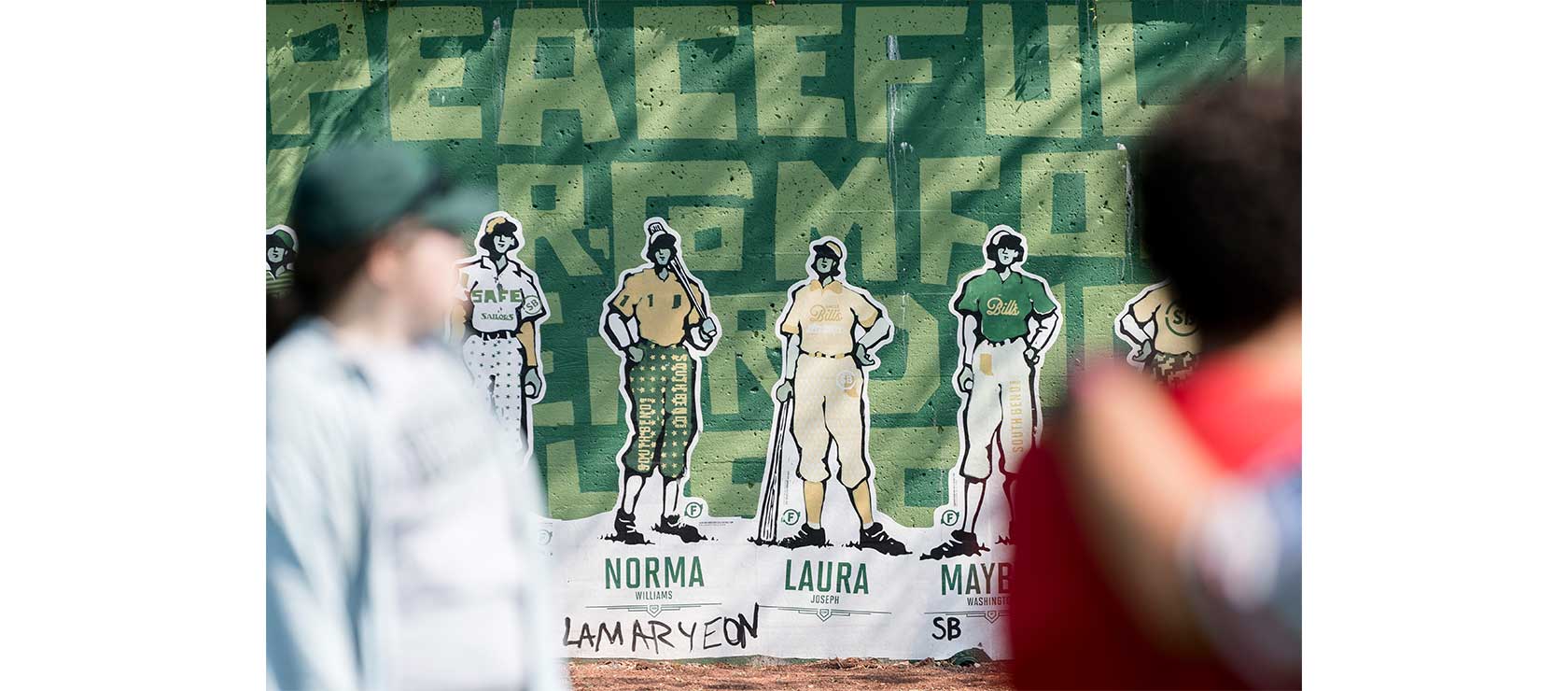
In part, Foundry Field is meant to do exactly this: offer the chance to play baseball in a locale where the once-ubiquitous game has largely faded from everyday life. But the ballpark’s ambitions go even further, as illustrated by the murals taking shape along the concrete left field wall. In neon greens and blues, purples and oranges, ballplayers from earlier eras slide in clouds of dirt, go into their windups, and cross home plate, extending their arms. Safe!
What might as well be Foundry Field’s thesis appears in quotation marks across the upper third of muralist Ashley Nora’s depiction of Uncle Bill’s Team, a group of Black women from South Bend who barnstormed throughout the Midwest during the 1930s and 1940s and, at home, often featured as the opening act when the Negro League’s Kansas City Monarchs, Chicago American Giants, or Detroit Stars came to town. The quote comes from something written by Renelda Robinson, who before becoming a local civic leader had played first base for Uncle Bill’s: “A future with no hope is no future at all.”
And now, ready for its first full season of play, the ballpark means to do nothing less than connect generations across time and space, all while keeping an eye on the future.
Donovan dashes, his basketball sneakers sliding in the grass, as he scoops a grounder and slings it back to me. His signature, too, is scrawled out there on the outfield wall’s artwork.
**
Foundry Field occupies a trapezoidal corner of a public park in a demographically diverse and proudly working-class corridor of South Bend known as the Southeast Neighborhood. The field’s backstop—a wide half-hexagon of horizontal wood slats and netting lashed to 30-foot-tall steel beams—stands in the park’s southwest corner, which means the diamond orients exactly as a ballpark should: A lefty on the mound is, directionally, a southpaw. But beyond this (and the standards of 90 feet and 60-feet-6-inches) idiosyncrasy is the rule, as has been true of urban ballparks since they first appeared during the mid-nineteenth century. Foundry Field—jimmied between neighborhood homes, the brick headquarters of industrial manufacturers, and the retaining wall of the Norfolk Southern Railway—evokes the often romanticized era of baseball long before our time of suburban youth sport complexes, when in its most idealized interpretations the game offered a pastoral refuge from the numbing haste of city life. “The intrinsic and self-evident goodness of baseball is best [recognized] when it occurs within the confines of an enclosed park in the city,” wrote the architect and South Bend resident Philip Bess in his 1989 polemic City Baseball Magic, where he argues that ballpark design should invigorate rather than detract from its urban surroundings. (Two years before, Bess had designed an elegant city ballpark for the Chicago White Sox, which the team rejected in favor of the neighborhood-destroying stadium they’ve inhabited ever since.)
As with most Rust Belt cities, it’s important to know what used to be in South Bend, a small city on the rail lines between Chicago and Detroit. For decades the city’s economy revolved around the Studebaker company, which built upon its wagon contracts with the Union Army to become one of the dominant automakers of the early twentieth century. Other manufacturing companies also called this small city home—Singer and Westinghouse, for example—but it was Studebaker, and the company’s mid-twentieth-century demise, that largely defined South Bend.
Baseball has often followed labor, and during the paradigm-shifting years between the World Wars, so-called industrial leagues proliferated across the smoke-bellowing Midwest. Foundry Field’s core inspiration was a club called the Foundry Giants, a team of Black foundry workers that competed in Studebaker’s mostly white athletic league while also barnstorming through the region under various monikers—the South Bend Colored Giants, the Argos Athletics, the Classy Browns—and competing against anybody who would play against them.
Donovan Hutchen first learned about the Foundry Giants during an arts workshop at a Boys & Girls Club after-school program, while crews put shovel to dirt for the new baseball field just around the corner. The Boys & Girls Club had become one of the field project’s earliest and most essential partners, and the workshop was led by Clinton Carlson, a design professor from nearby Notre Dame and self-described “baseball spiritualist.” With rollers and paintbrushes the kids stenciled posters of nearly life-sized Foundry Giants, designing unique uniforms for each, and they listened while Carlson shared some of the anecdotes he and the new Foundry Field research team had encountered. But many of the names stenciled along the bottom of the posters were total mysteries, surnames gathered from century-old box scores in newspaper archives, where not much more could readily be found. This would be a part of the field’s future, too: What stories would be remembered?
Donovan stenciled the uniform of a man identified only as “Dandridge” in shades of green, and when he was finished, he signed his name beside Dandridge’s spikes.
The kids’ posters were wheatpasted onto the outfield wall, creating a shoulder-to-shoulder row of ballplayers next to the larger Foundry Giants mural. Among the mural’s figures is a 1920s Giant, Alonzo Poindexter, who slides safely into second base against a silhouette of smokestacks, engine parts, and ghostly men pouring molten iron. To paint the mural, Carlson had recruited artist Thomas “Detour” Evans, whose portfolio includes the two-story Jackie Robinson that overlooks the Tulsa Drillers’ ballpark in Tulsa’s Greenwood district, the area that had thrived as “Black Wall Street” before the racist massacre that took place there in 1921.
When Evans’s Giants mural was revealed at Foundry Field’s groundbreaking ceremony in May of 2023, nearly two dozen descendants of Alonzo Poindexter were in attendance. They were familiar with much about their ancestor’s exemplary life, but until one of them had heard his name in a local news brief about the field, few had known that Alonzo had been a great ballplayer. At the groundbreaking the Poindexters met undergraduate student Marc Barnes, who had researched Alonzo for a history course taught by Katherine Walden, a Notre Dame professor who studies baseball and labor histories and who is also part of the field’s research team. In remarks at the ceremony, Alonzo’s great-great-granddaughter Lenisha Lipsey completed the picture for the gathered crowd: Alonzo Poindexter worked in Kentucky coal mines and fought in World War I before migrating north to labor in the Studebaker foundry. He and his brother, Thomas, were both Foundry Giants. After his playing career concluded, Alonzo became the county’s first Black sheriff’s deputy, serving for more than 20 years. Foundry Field, Lipsey said, “has the potential to bridge gaps of past, present, and future,” teaching not only about baseball history but about under-remembered community pillars like her ancestor. After the ceremony, the Poindexters and Barnes gathered for a photo with Detour Evans in front of Alonzo’s portrait. It was an overdue moment of recognition and appreciation, and a poignant glimpse of pride shared across generations.
**
It has taken a broad, grassroots effort to build Foundry Field, but the ballpark originated as the dream of a single individual. Matthew Insley—mid-40s, gray in his beard, perpetually sunbaked neck and arms—is the chief sustainable farmer at nearby St. Mary’s College and a deeply philosophical guy. In the early 2010s, he was fairly new to South Bend, living in the local Catholic Worker house, part of the communitarian movement founded by Dorothy Day nearly a century ago that focuses on voluntary poverty, nonviolence, and service to society’s most marginalized. Insley’s regular bicycle route took him through the Southeast Neighborhood, past the grassy plot cradled between the porches of homes and the railroad’s retaining wall. As others might daydream of magical abilities or future rewards, Matthew Insley daydreams about baseball, and to him this spot looked destined to be a ballpark. The full vision emerged almost immediately: the geometry of clay and grass beneath railroad backdrop, neighbors watching from their porches, children at play in the pavilion behind third.
Insley grew up near Hays, Kansas, among people who taught him how to care for both the land and for people, and how these are often one and the same. His grandfather operated a farm, and his father led the youth group at the family’s Mennonite congregation. “From my dad I learned that if you want to help people and connect with others, you just have to jump in and get involved,” Insley told me. His baseball obsession began in childhood, when teenage youth-group members threw him pop flies in the yard. Next came the symphonic quality of Kirby Puckett of the Minnesota Twins legging out a triple on TV and the feel of tearing open a new pack of Topps cards.
When Insley settled in South Bend as an adult, he made fast friends with Michael Hebbeler, a community organizer and artist who works at Notre Dame’s Institute for Social Concerns. In 2013, they organized a pickup baseball game for grown-ups, real baseball with overhand pitching and wooden bats, for which they commandeered a rocky city field. The game was so much fun that it grew into a DIY recreational league, the Sappy Moffitt Baseball League (SMBL), named after a local professional pitcher from the early 1900s. Today, the league comprises 13 teams, involving approximately 160 men and women each summer, when—like the industrial leagues of the past—they play ball on Sundays. Particularly good skill is not a prerequisite for joining the league; it strives to be less about competition and more about having that beer together in the grass after the game, or maybe the memory of a line drive belted in the sunshine—anything to sustain you through the inevitable dark of the Midwestern winter. SMBL teams are managed by teachers, farmers, nonprofit administrators, construction workers, and graduate students, and you’ll often find newly arrived immigrants, international scholars, and recently welcomed refugees dressing out for league games, where they’re introduced to their new communities through the national pastime.
Over the years, Insley shared his ballpark vision with Hebbeler and other SMBL compatriots, and the dream of building a vintage ballpark of their very own became the SMBL’s primary civic focus. In 2019, they drafted bylaws for a 501(c)(3) organization, the Sappy Moffitt Field Foundation, and sought a meeting with Southeast Organized Area Residents (SOAR), the neighborhood association, to present the idea.
**
The Southeast Neighborhood’s mid-to-late twentieth-century history is like that of many other blue-collar American neighborhoods: blockbusting, redlining, the dual scourges of poverty and the War on Drugs, and throughout it all, community action and self-advocacy in the face of negative stereotypes and underinformed perceptions from outsiders. SOAR had earned its right to be skeptical of groups who came to them with ideas; its members had seen their share of fly-by-night do-gooders and had spent years fending off speculators and gentrification.
“We’re determined to be a working-class neighborhood that remains diverse,” neighborhood leader Conrad Damian told me, “and I think we’ve convinced the city that our future rests in being that kind of neighborhood.” Damian, 80 years old, has lived in the Southeast Neighborhood since 1969, when he arrived as a young United Methodist volunteer and fell in love with the community and the diverse families who had made it their home.
In 1965, when Damian was a junior at Southern Methodist University in Texas, he was one of two undergraduate students there who joined the contingent that bused to Alabama and marched with Martin Luther King Jr. in Montgomery. Damian recalls how, in suits and ties, they joined the procession at a muddy school playground on Montgomery’s outskirts, how they marched into the city holding hands, and how the people lining the streets had sneered, some of them children with family members who waved pistols and Confederate battle flags and shouted foul language. “I can just see the faces still,” he told me, “and I couldn’t understand how people could feel like that about people they didn’t know.” He remembers, too, the high school senior from Montgomery who held his hand on the march—“Oh, how I wish I could remember her name,” he said—and described her kindness and strength as they entered downtown and people threw sandwich wrappers at them from restaurant windows overhead.
In South Bend, Damian became a longtime English teacher in the city schools. In the neighborhood, where he’s lived in the same house since 1969, his advocacy and penchant for local care took the form of letters to the editor in The South Bend Tribune and leadership roles at neighborhood organizations, often representing them in discussions with the city and others. In 2019, when Insley and the field foundation first presented their idea for a brand new baseball field, Damian was the president of SOAR.
Damian knows little about baseball, aside from what he hears from nieces and nephews about the high costs of modern-day travel ball. It was essential to SOAR that the proposed ballpark commit to remaining open, unfenced, and publicly accessible to local children—that intentions for the field would not be co-opted by what, for example, the Regional Chamber of Commerce has defined in its 2025 master plan as priority “investment in youth sports tourism.” Beyond this and a few other details, the thought of having the ballpark in the neighborhood was exciting. Most important, Damian told me, was that the field would become simply “a place that looks like it fits,” where stories could be collected and created, where kids are at play, and where folks from all different walks of life “are working together to take care of the thing.”
After receiving the neighborhood’s blessing, Insley and the field foundation met with leaders of South Bend’s public school district, the Boys & Girls Club, and other area athletics nonprofits to discuss future uses and creative partnerships. Conversations with the city’s history museum and the Civil Rights Heritage Center at Indiana University South Bend led them to underexplored histories, like that of the Foundry Giants and Uncle Bill’s Team. As each new local stakeholder joined the project, the field continued evolving into something that was far more than a place for aging dreamers to play a fading child’s game.
With their expanded vision, the project won support from the city’s parks department, which owned the property, though the eventual memorandum of understanding made it clear that the ballpark depended on the foundation’s ability to raise the construction funds. Clinton Carlson, who plays in the SMBL, worked on grant proposals and devised a plan for residencies that would welcome artists to paint the outfield murals in dialogue with the community, including local youth. Funding for the public arts initiatives became available through Michael Hebbeler’s work in the Institute for Social Concerns. Other faculty and postdocs joined the research team. History curricula took shape and individual research projects were undertaken, including an oral history with Doris Grady, who at 100 years old was the last living member of Uncle Bill’s Team. She features prominently in the field mural. (Disclosure: I also work at Notre Dame, in a capacity that is not formally affiliated with the field project.)
The project launched its funding campaign at a cooperative arts venue in the Southeast Neighborhood in the fall of 2022. There I met Philip Bess, designer of the unbuilt White Sox ballpark and now professor emeritus at Notre Dame’s School of Architecture. I referenced his book City Baseball Magic and the ballpark, and Bess grinned good-naturedly, wryly. A few moments later, he became one of the earliest South Bend community members to make a financial donation to the Foundry Field project.
By the end of 2022, the foundation had raised more than $50,000, primarily through individual contributions, earning a matching grant from the Indiana Housing & Community Development Authority’s CreatINg Places program. Detour Evans’s mural and the groundbreaking the following spring gave way to a year-plus of digging, leveling, grass growing, clay mixing, community engagement, historical research, and fundraising—as well as another two outfield-wall murals and additional posters painted by Boys & Girls Club kids. Much of the physical labor was done by SMBL players and their friends around South Bend.
Foundry Field was finally ready for play by the end of the summer of 2024, and the foundation and its partners planned opening day festivities. The schedule would include a free youth clinic and skills competition, community tours, restorative-justice circles, ballpark concessions, and a three-inning exhibition between South Bend kids and ballplayers visiting from inner-city Chicago, not unlike the barnstorming clubs of a century ago. The game would be called the inaugural South Shore Classic, named after the interurban railway that has connected the two cities since the early twentieth century.
**
In 1924, the Ku Klux Klan organized a parade in downtown South Bend. At the time, the Klan counted about 13 percent of Indiana’s population among its registered members, including high-level government officials, though the Klan had little influence in South Bend, which comprised largely ethnic European and Catholic enclaves and thus drew the group’s ire. The parade was a dud, ending in a running brawl with South Bend residents and Notre Dame students. All the same, this was a period of extraordinary change as thousands of Black families migrated from the South to resettle throughout the industrial Midwest. Those who came to South Bend found work in the foundries and factories, but the city was not free from racism’s irrational contours.
It was still fairly commonplace to read slurs in the city newspapers, for instance, and when South Bend’s first public indoor swimming pool opened in 1922—a taxpayer-funded effort meant to reduce river drownings—it barred Black people from entry. After the Rev. Buford F. Gordon, a scholar and World War I veteran who served as pastor to one of the city’s first Black churches, broke ground on a new building to accommodate his booming flock, the Klan resorted to such intimidation and vandalism that the young preacher began carrying a pistol to and from work. In his writing, Gordon reflected that his congregation had fled “the [Southern] institutions of lynching and wide-spread race hatred,” only to wonder, “Did they escape?”
Baseball was extremely popular during this time, though the professional game had been forcibly segregated since the 1880s, when an owners’ “gentleman’s agreement” banned contracts for people of color and made Moses Fleetwood Walker of the Toledo Blue Stockings the last Black player to appear in the white major leagues. But “the real outcome of segregation,” Gordon wrote in 1922, “is that it says to human nature, black or white, ‘You cannot do this or that,’ and human nature says, ‘I am going to do it anyway.’”
While the Negro National League had been organized in Kansas City two years earlier, Black semipro teams had been traversing the Midwest for decades. By Gordon’s time, a legendary Black club from Chicago called the Union Giants was visiting South Bend five or six times a year to play the Independents, a local white club, bringing together crowds of several thousand people who otherwise would rarely interact. The South Bend Tribune frequently covered the games with racial overtones—the Union Giants were a “colorful club,” and the players were described as “dusky,” for example—but the paper nevertheless acknowledged that the team was “a great draw wherever they play,” exhibiting “a fast article of the national pastime.” The public record contains little with regard to the tenor of the crowds at these games, though a knife fight did break out in the grandstand during a Labor Day game in 1925 when an umpire’s ruling nullified what should have been a late-inning, go-ahead home run for the Union Giants.
Still, the Union Giants kept coming to town, and against this backdrop several of their players joined a fairly new local outfit also called the Giants, founded within the Studebaker foundry. They began to barnstorm on Sundays, advertising in newspapers that they sought “games with first-class clubs,” and the slugfest between the angels of our better nature and the demons of our worst played on throughout the city ballparks of the old Midwest.
**
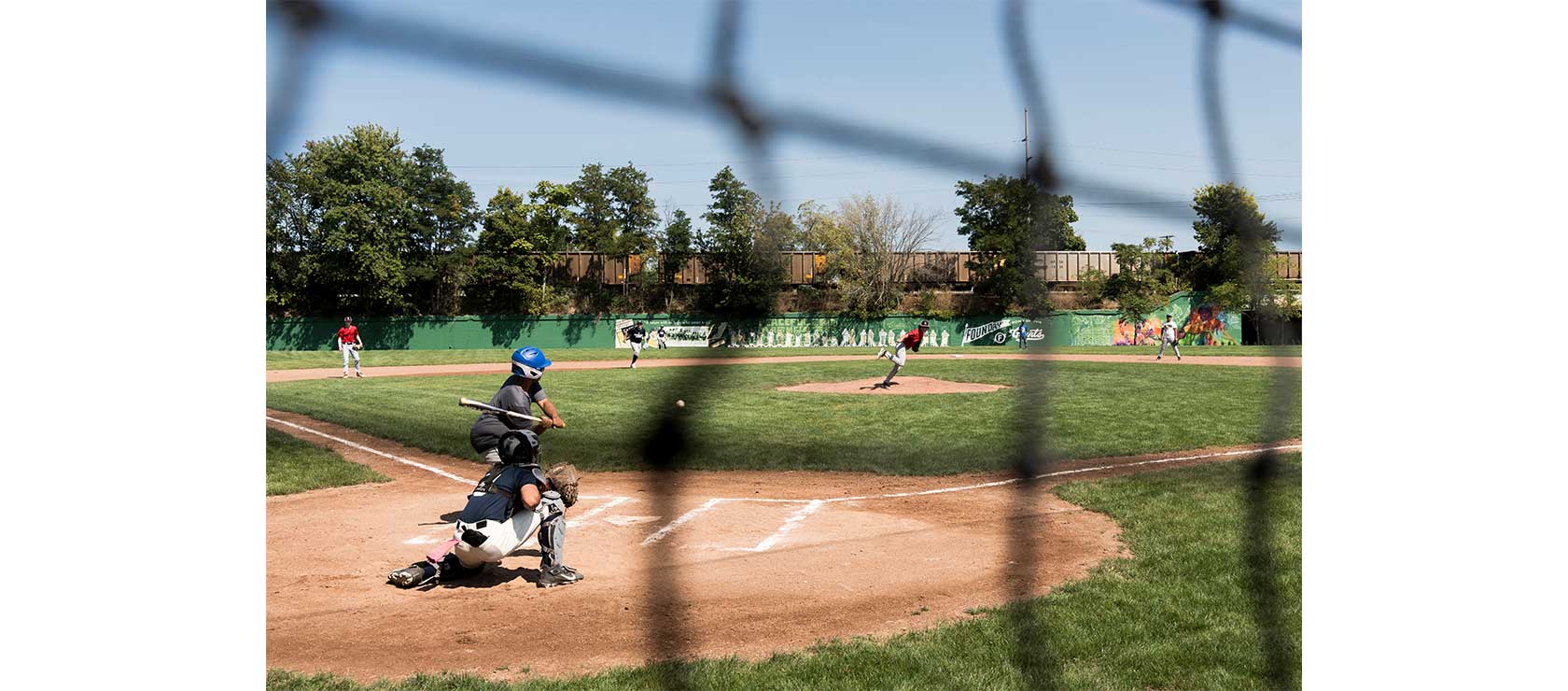
On a clear Saturday in September 2024, the pregame tasks of Foundry Field’s opening day unfolded like ritual—the thudding of the tamp on the mound, the dust unspooling from rakes in the infield clay. Whenever the freight train bellowed past, the field felt like it had always been there.
Still, there was no permanent grandstand nor were there dugouts, so the city had delivered metal bleachers and wooden benches, wrapping them around the backstop. Volunteers from the SMBL and other organizations erected collapsible shelters and a portable public-address system, as well as merchandise tables and a griddle and concession stand. At the city park’s far end, 100 yards or so from third base, music pumped from a car stereo where a family was preparing a weekend barbecue at the pavilion. Nearer to home plate, children played in a new public splash pad, dashing through the geysers and squealing; over the past year, the city had found the money to rebuild the water feature, which Aaron Perri, then director of the parks department, had described as a direct result of the cross-community commitment to Foundry Field, “an impressive gathering in a part of the community that sometimes doesn’t see a lot of investment.”
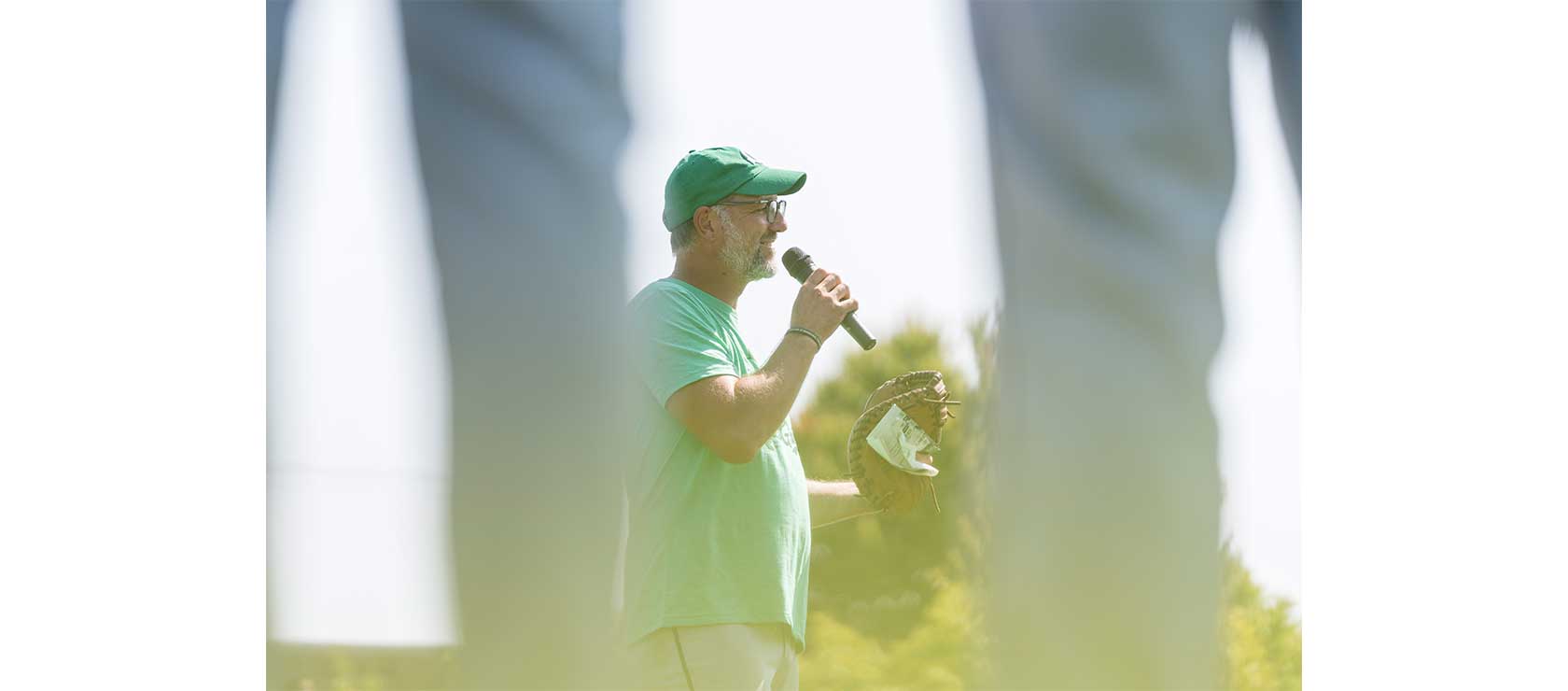
I caught Matthew Insley, the farmer and president of the field foundation, for a moment during a break near the watercooler. He and other SMBL members had been leading a children’s Wiffle ball game in the outfield, within home-run distance of the Foundry Giants mural, where they could teach Donovan Hutchen and the other kids the rules of baseball. Insley wore a green Foundry Field T-shirt and ball cap as well as baseball pants, turf shoes, and a catcher’s mitt. He was sweating and grass-stained and in his element; all morning I’d listened while he’d simultaneously played in and offered commentary on the kids’ game: “Here comes Kennedy to score! Here comes Albarran ’round second; he’ll hold there. It’s an RBI single for One-Way Waymel, the lead now three to one!”
From the watercooler, we could see the children playing and laughing in the outfield. Local middle schoolers had begun warming up along the foul lines, and the Chicago kids were disembarking from their yellow school bus. Neighborhood folk had come out, too, and an elder named Mr. Owensby watched from his porch across the street from home plate. This all seemed to match Insley’s vision from more than a decade before. How did it feel to see it in reality?
“It’s just fun to watch kids enjoy the game. Little by little, it doesn’t take long.”
Out in left-center, Donovan was tossing Wiffle balls to himself, trying to launch them.
“They just want to keep hitting,” Insley continued. “‘Give me one more!’ It’s cool to see the way baseball can be perennially addictive, to every generation.”
I clarified: Did Insley feel any personal accomplishment today? Michael Hebbeler, the foundation’s vice president, had asserted that if not for Insley’s energy and commitment, none of this would have ever come to be. But Insley squirmed; he doesn’t like it when the lens focuses on him.
Just then, 13-year-old Clare Kennedy arrived at the watercooler and saved him. Her father, Sean, is an SMBL manager as well as the marketing and finance director for the field foundation, and Clare had been around the field project for much of her life. Insley deflected: “What do you think, Clare? Do we feel a sense of accomplishment?”
“Yeah,” she answered, duh-like. “What? It’s taken you, like, a million years.”
Now Donovan skipped over to the water station, too. He wore basketball sneakers, sweats, and a T-shirt that read, Due to video games home work is canceled.
He announced, as a dare: “It’s easy to hit home runs on a Wiffle ball field.”
“Oh yeah?” Insley replied. “Show me.”
And they jogged away, escaping further questions for the solace of the game.
**
Beginning with the first Gallup polls in the 1930s, baseball was the most popular spectator sport in America straight through until 1972, when football claimed the top spot and never looked back. Nowadays, according to Gallup, somebody who is 65 or older is more than three times as likely to enjoy watching the game as somebody between 18 and 34. With almost annual regularity, newspapers, magazines, and websites run postmortems for the national pastime, cause of death variable: the technocratic takeover of Major League Baseball (MLB) front offices; the boring nature of the professional game; the allegiance to greed and corporate efficiency at the expense of beloved teams; the skyrocketing costs of youth baseball participation; the game’s increasingly exclusive nature top to bottom; MLB’s unrepresentative demographics. Around Jackie Robinson Day, articles remind us of the dwindling proportion of American-born Black ballplayers on big league teams: In 2025, only 6.2 percent of MLB players on Opening Day rosters were Black Americans.
Still, playing the game continues to be very popular among all age groups. In 2024, the Sport & Fitness Industry Association’s (SFIA) exhaustive U.S. Trends in Team Sports Report found that 16.7 million Americans participated in casual baseball activities, defined as 12 or fewer instances per year. That’s more than for any other sport except basketball, which far outpaces everything else. “Baseball participation nationwide highest since 2008,” proclaimed the headline of one MLB.com article that went on to tout the league’s Play Ball Initiative, which promotes casual engagement with the game at younger ages. Indeed, Chad Hershberger, the athletic director at South Bend’s Boys & Girls Club, held a free “Pitch, Hit & Run!” event at Foundry Field through this initiative.
MLB has sponsored other national efforts, including its long-standing Reviving Baseball in Inner Cities program and the Youth Development Foundation (YDF), the latter a joint project with the Major League Baseball Players Association. According to its website, the YDF has, in its history, awarded more than $31.2 million to community projects around the country; indeed, the Sappy Moffitt Field Foundation had preliminary conversations with YDF leadership about a proposal for a grant that could complete the field’s last bells and whistles— lights, grandstand, vintage scoreboard, pavilion for housing educational materials. (It never materialized.)All of that is well and good, but as others have pointed out, these sorts of top-down efforts tend to be limited by nonlocal organizational structures and an ethos that “tends to be heavy on photo ops,” as John W. Miller put it in an America Magazine piece about Little League’s struggles.
In SFIA’s baseball-specific 2024 report, “core” baseball participation—defined as 13 or more instances per year—fell by 3.3 percent across the previous five years for all age groups. And while 7.7 million Americans were core baseball players in 2023, 70.6 percent of them were white, and only 8.3 percent were Black or African American. Further, someone from a family with an annual household income greater than $100,000 was more than twice as likely to regularly play baseball as someone whose family makes less than that, and more than four times as likely as someone from a household subsisting on less than $25,000.
Over the last 30 years, youth sport has evolved into an industry worth more than $40 billion, according to recent estimates. After all, we want our kids to have access to the best versions of their sports (or at least the most effectively marketed). A couple of weeks before Foundry Field’s opening day, journalist Ira Boudway wrote for Bloomberg News about private equity’s youth-baseball takeover through the lens of the Cooperstown All Star Village, just one of the properties within the youth-athletics portfolio of a pair of billionaires. The complex, as Boudway describes it, hosts more than a dozen tournaments each summer, collectively bringing in more than 12,000 12-year-olds and their families from far and wide to play ball at $1,300 a pop in registration fees. Boudway also highlights the complex’s comfortable lodges where families pay to stay, as well as the restaurant-and-bar where they hang out after hours. The costs would likely exclude many kids from communities like those near Foundry Field, where U.S. Census Bureau data puts the median household income of the ballpark’s zip code at $30,789.
Not all travel-ball circuits are equal, and not every ballplayer of Donovan’s age engages in the type of “youth-sports tourism” experience this upstate New York property represents, but, as others have pointed out, more and more U.S. families seem willing to accept the belief that quality engagement with organized sport can occur only through the privatized and nonlocal milieu of the venture capitalist’s creation. One consequence of this professionalized youth-sports marketplace is an accelerating expectation that children specialize from young ages. Donovan is statistically rare by virtue of the simple fact he’s still playing multiple sports, when—as the Aspen Institute’s 2024 State of Play report points out—kids his age who play sports now participate on average in fewer than two.
Baseball’s issues probably have less to do with the nature of the game itself, and more to do with the social and economic structures we’ve created around it. Given the right circumstances, Insley’s belief that baseball can be “perennially addictive” just might be correct. The discussions Foundry Field invites regarding both history and justice can’t be separated from explorations of the ways in which the national pastime’s reach falls short. In baseball, as with our other bedrock institutions, the fundamental contradictions within the American soul become personified—and whether baseball or anything else realizes the full measure of its promises becomes primarily a function of the values we choose to privilege.
**
For decades, the traditional home for young baseball players in Donovan’s community was Southside Little League, founded in 1958 on property that had once been the site of Studebaker’s Lippincott Park, a 5,000-seat baseball stadium. Much of the region’s baseball took place there for a time, including 16 official games between barnstorming Negro League teams as well as the contests for clubs like Uncle Bill’s Team and the Foundry Giants. Today, if you stand in the entrance to Southside Little League’s gravel parking lot and face north, you’ll see the hulks of the empty factory buildings where many of those ballplayers worked looming in the mile-distant haze over downtown rooftops.
Southside’s complex, three modest diamonds and several cinderblock structures enclosed by a sagging chain-link fence, sits about 1.5 miles from Foundry Field. Mike Genert, a warehouse manager for a local office-supply company, has volunteered as Southside’s chief of baseball operations for 10 years. Now in his late 50s, Genert grew up in South Bend, playing Little League until he aged out as a late teen. “Baseball kept me out of trouble,” he told me with a chuckle. “Without Little League I probably would have taken a visit or two to jail.”
Bare-bones and volunteer-run, Southside needs to make just enough to break even after buying baseballs and mowing the grass. T-ball is free; for each older age division, registration is capped at about $100. Still, Genert estimates that only about 100 kids participate at Southside each summer. This allows just one team at each division in baseball, and some years they don’t have softball at all, meaning that Southside can no longer function as a traditional Little League that hosts regular-season games among their own teams. Instead, they visit or host teams from neighboring leagues dealing with similar dynamics. Sometimes they travel as far as Elkhart, 20 miles to the east. This presents a challenge for Southside’s working families; some parents help carpool, Genert explained, and the rest is up to “Coach Mike’s taxi.” A decade ago, he said, Southside had at least three teams within each age division. Go back further, and the league was even more robust.
Genert told me that Southside Little League competes for attention with travel soccer and basketball organizations, in addition to the several travel-baseball entities around town. But chartered Little Leagues—affiliated with the national nonprofit association founded in 1939 in Pennsylvania—function according to geographical boundaries, drawing their players from the communities immediately surrounding them, and he noted that at least one South Bend Babe Ruth league, which does not depend on geographical districts, seemed to be thriving. That league recently received city approval for a controversial real estate expansion that drew protests from many of its residential neighbors. “Nothing’s neighborhood-oriented anymore,” Genert said, describing the plight of Little Leagues. The word-of-mouth networks and local relationships that would bring families to Southside no longer exist.
Still, Genert was careful to stress that his outlook is not all doom and gloom. He’s able to share the joy of the game with the kids who do come out, and he enjoys seeing them come back time and again. He’s hired several of those kids at his company once they’ve gotten older—if you learned to be a good teammate in Little League, he reasons, then you’ll be a good employee.
Perhaps Foundry Field can be a good thing for Southside: If more kids in the district are introduced to the game through fun, low-stakes play at the new public diamond within walking distance, maybe this could renew interest in the nearby, accessible Little League?
“That would be nice,” Genert said. “It definitely would be.” He paused, reflective. “You know all that Foundry Field history? That’s our history, too.”
**
Back at Foundry Field’s opening day, the PA played ballpark standards while people mingled or listened to the stories of the murals along the warning track, hot dogs in hand. The visitors from Chicago belonged to the two-year-old baseball program at the downtown campus of Intrinsic High School. The team’s founding coach, Paul Julión, had grown up on Chicago’s South Side, every bit as baseball-obsessed as Matthew Insley and the other field foundation members. Julión moonlights with the Society for American Baseball Research, investigating Negro League history. Last summer he presented at a conference in Cooperstown, and he told me that when he heard about Foundry Field, he knew he needed to see it for himself and involve his young team.
Many of Julión’s players were baseball novices themselves, and for the South Shore Classic they formed teams by mixing together with the South Bend middle-schoolers and younger kids like Donovan. The teams stood along the foul lines for the first-pitch ceremony, while dozens of onlookers fanned out in the bleachers behind the backstop or sat on picnic blankets and in folding chairs beneath the shade of the flowering lilacs down the first-base side.
Insley, still wearing his catcher’s mitt, spoke to the crowd about an age when ballparks had been built “wherever the people were.” He thanked the parks department for sanctioning this “crazy idea” and reminded everyone present that they had built something beautiful together. He finished by quoting one of his own heroes, Dorothy Day, who had been quoting one of her own heroes, Dostoyevsky, when she said, “Beauty will save the world.”
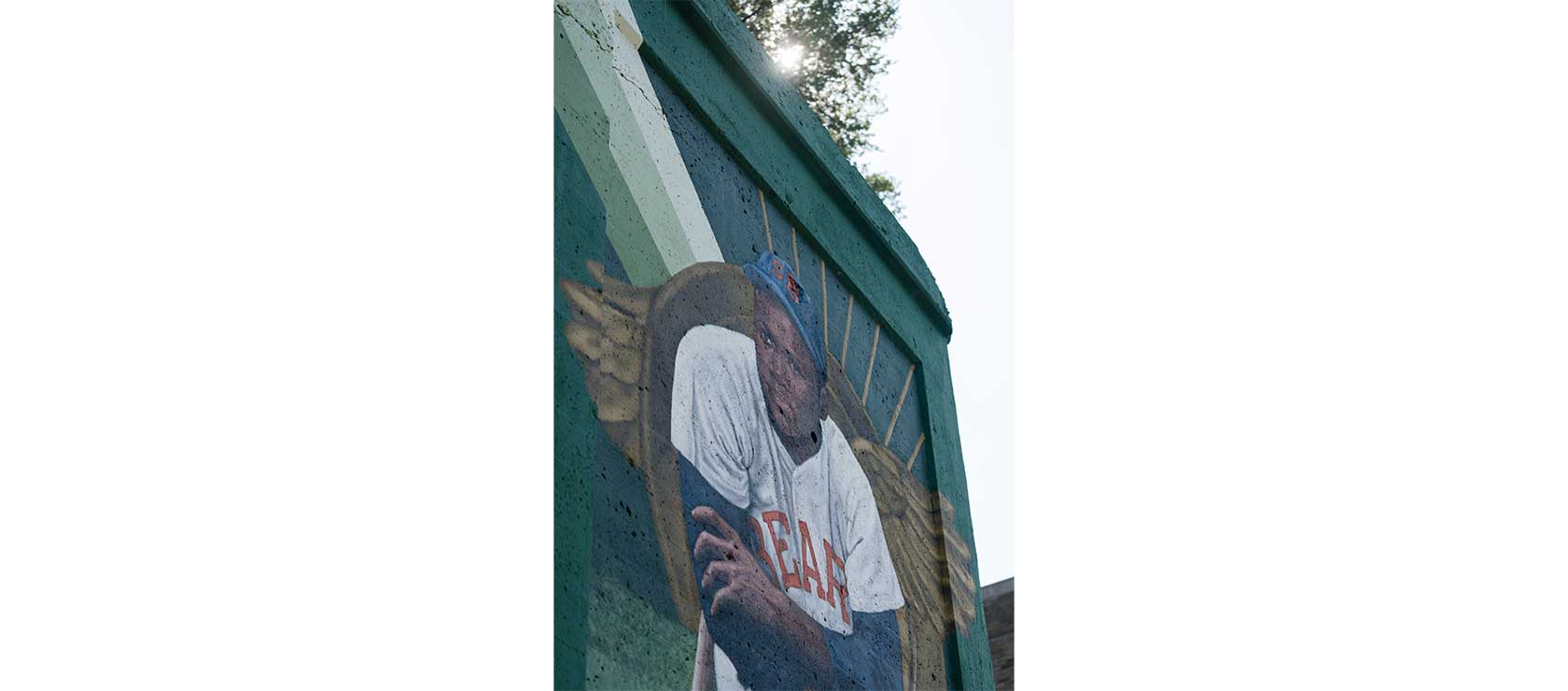
The crowd also heard from Seabe Gavin Jr., the athletic director of a public high school in the Southeast Neighborhood. Over his shoulder, in center field, a mural by artist Waleed Johnson showed Gavin’s father kneeling with his bat. He was a standout player on an integrated South Bend high school team during the 1930s and later a Foundry Giant himself.
Melvenea Hodges, SOAR’s current president, said she’s lived across from the park for 15 years and considers it “an extension of my front yard.” Her young nephew Waymel—whom she raises and who, like Donovan, had never touched a baseball before the project came to life—was now coming out to the field daily. “I’m grateful,” she said, “for all the hands and hearts that have made this possible.”
Hodges, Gavin, Waymel, and Donovan threw simultaneous first pitches to catchers including Insley and Carlson as well as one kid each from Chicago and South Bend.
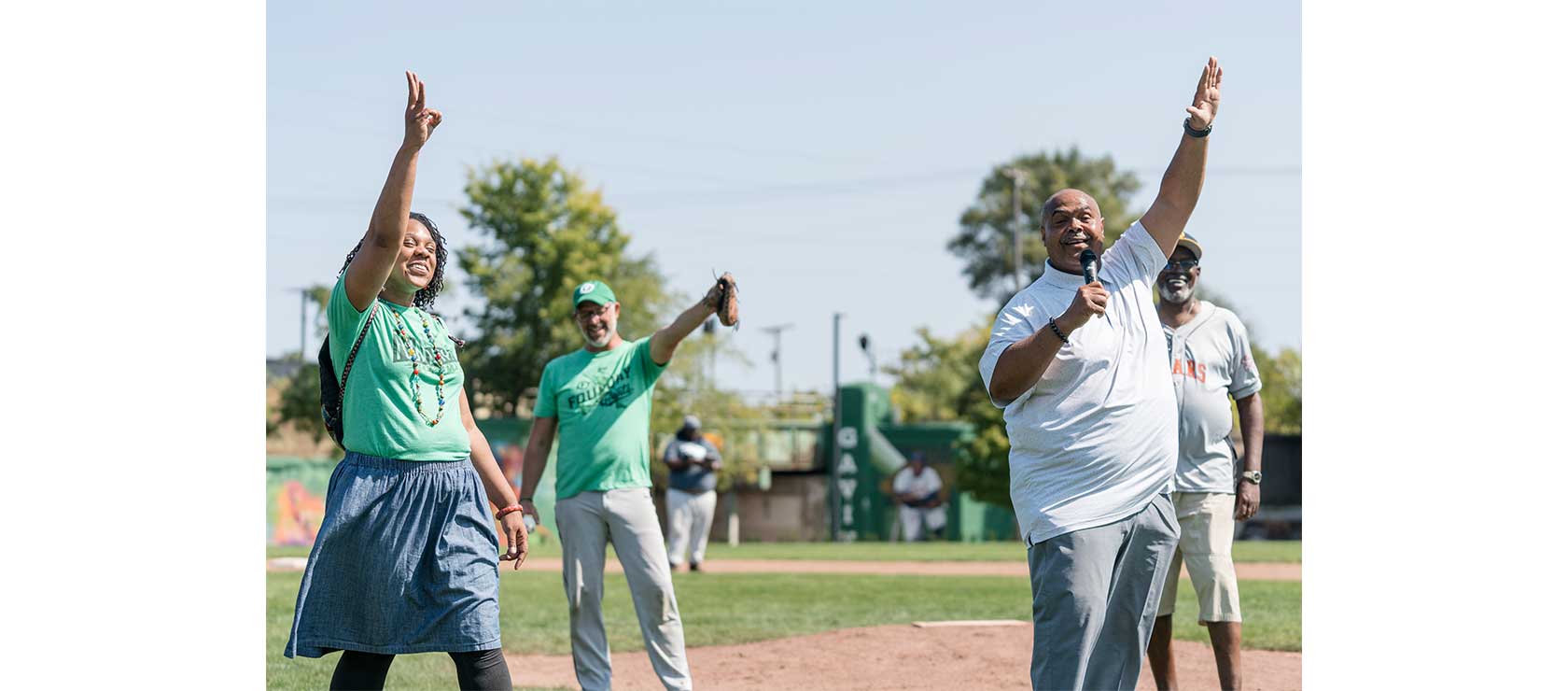
On the microphone, Rickardo Taylor, the pastor from the neighborhood’s Baptist church, led the assembly in “Take Me Out to the Ballgame,” and then shouted, “Let’s play!”
Someone tapped soundbites of ballpark organ music from a smartphone app while Insley called the game on the PA. “The first pitch from Rodriguez is a good one, right down the pike!”
We were into the third and final inning of a tie game when one of the coaches inserted Donovan as a pinch runner. He pulled on a batting helmet and jogged out to first.
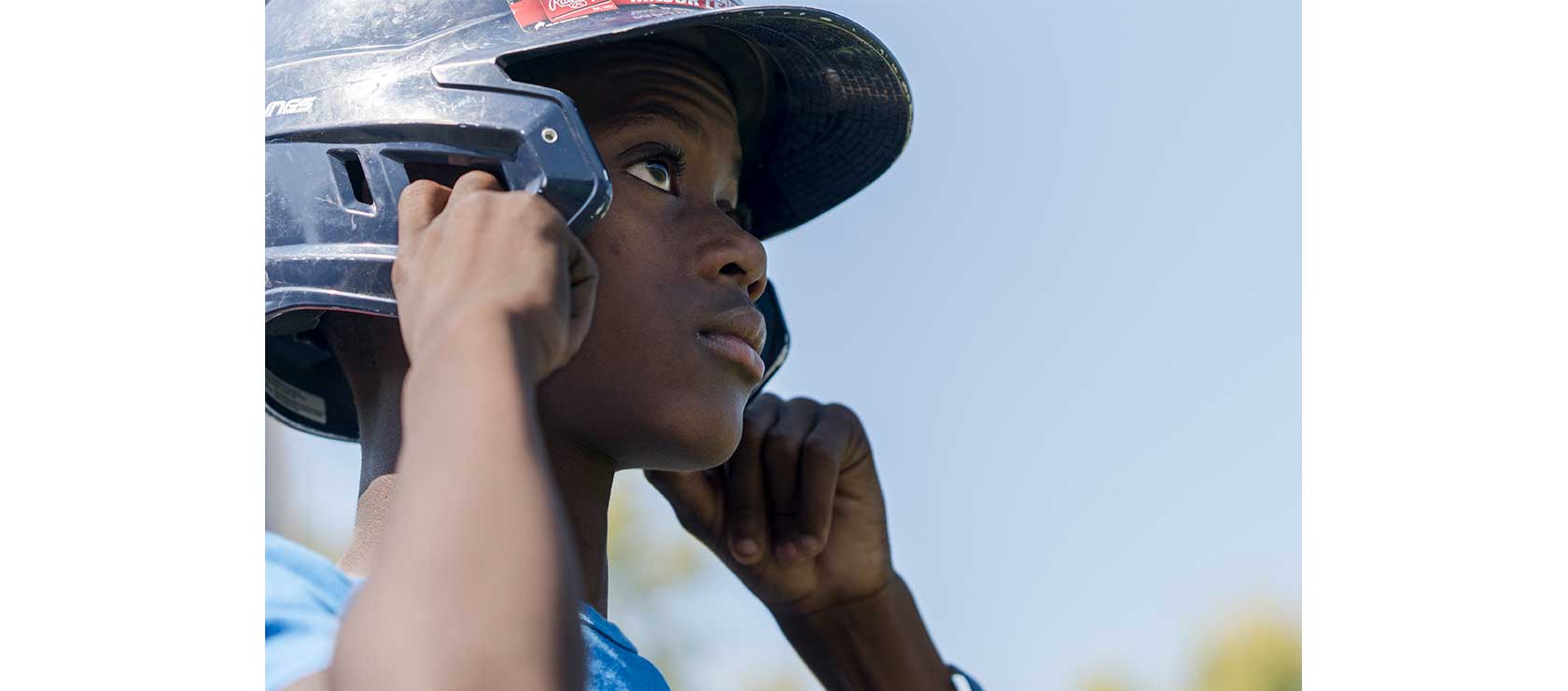
He went on the first pitch, stealing, flying toward second in his basketball sneakers, and from our field-level vantage, Donovan’s feet-first slide, for a moment, left him circumscribed within the frame of Foundry Giant Alonzo Poindexter’s slide on the outfield wall.
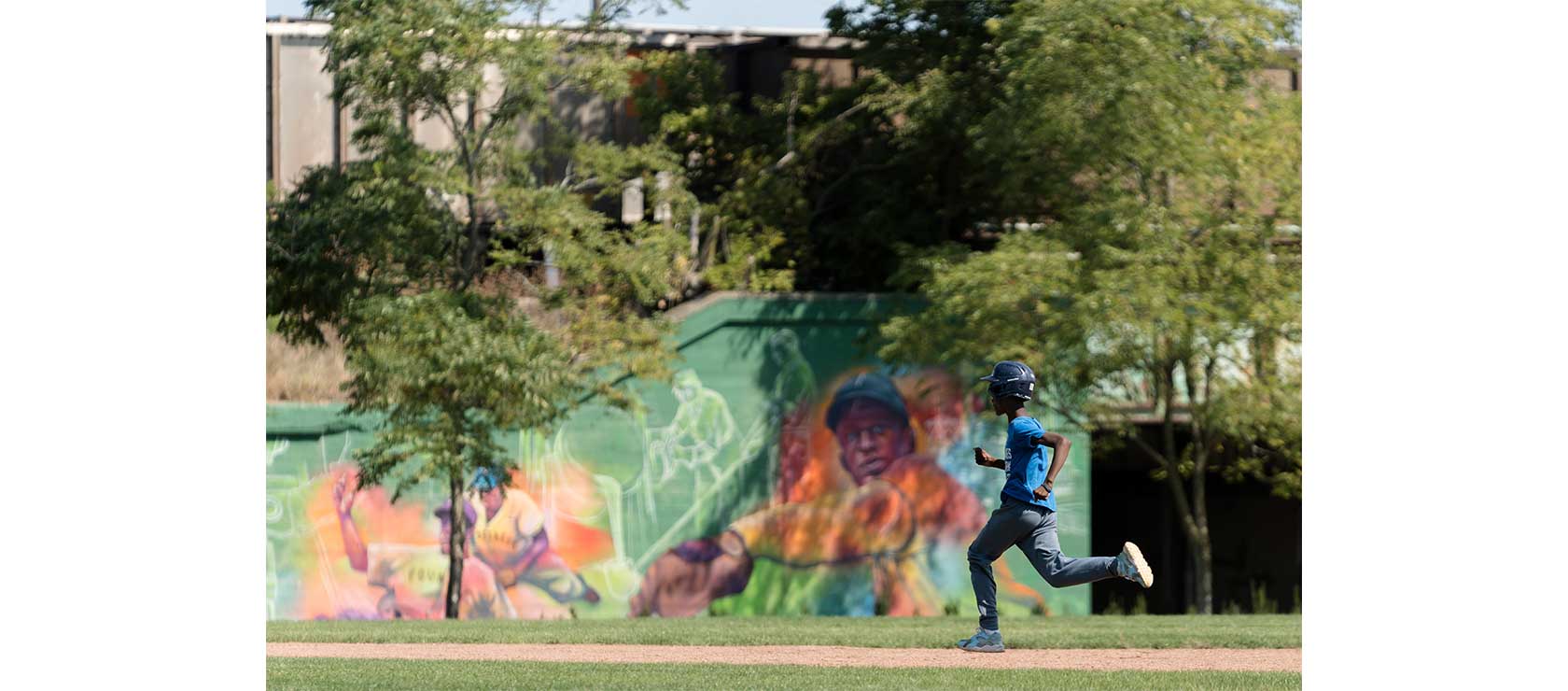
Then, as the catcher’s throw went into center, Donovan popped to his feet and dashed toward third, where he became stuck in a pickle, a strong throw coming in behind him. Voices rose around the backstop and Insley shouted over the PA as Donovan darted back and forth, then somehow evaded the tag and dived into third, a mere 90 feet away from scoring the winning run.
“Ssswing and a miss, a great cut there by Josiah, he was just in front of it,” Insley called a pitch later, the South Bend catcher up to bat. “This guy is lookin’ to do damage and win this baby.”
The ballpark organ music tiptoed through a few anxious notes, and—ping!—Josiah punched one through the infield for a single.
“Donovan Hutchen comes into score,” Insley cried, “and the game is over!”
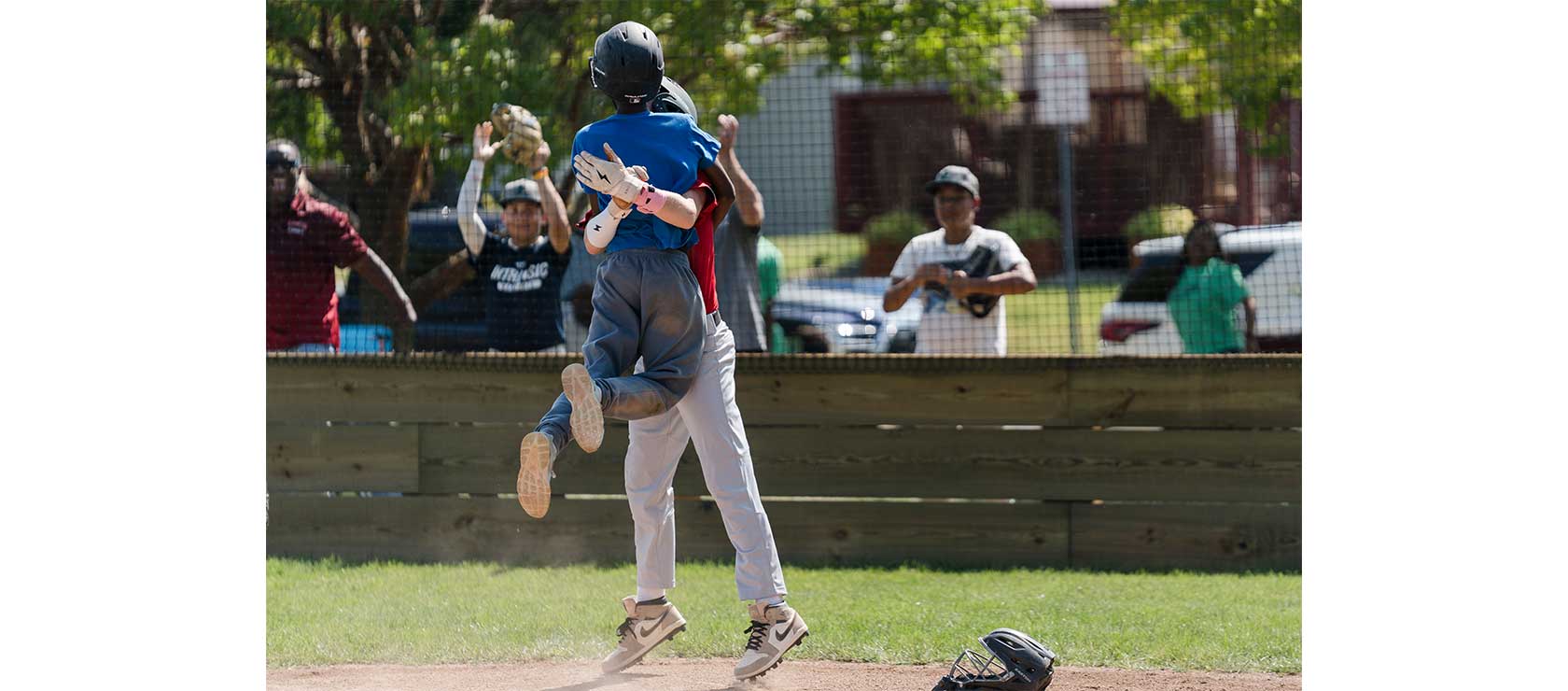
Cheers went up, and Donovan leapt into the on-deck hitter’s arms.
I got to Donovan while he was still breathing heavily and I held my recorder in front of his face, just like he’d seen on TV, just as he’d acted out at home countless times before.
He knew just what to do.
**
In a 1922 sermon entitled “The Quest of Restless Souls,” the Rev. Buford F. Gordon told his South Bend congregation that civilization’s journey “from a less perfect to a more perfect order” was not a direct line but rather “a spiral course around the mountain of opposition.” It moves ever upward and forward, while also alternating between the mountain’s sunny and shady slopes.
Consider: In 2024, about two weeks after the presidential election and a century after the Ku Klux Klan had paraded in downtown South Bend, thousands of families across 11 northern Indiana cities, including South Bend, woke to find the Klan’s anti-immigrant propaganda scattered across lawns, porches, and car windshields. The fliers depicted an Uncle Sam figure kicking a family in the backside, threatening them with the deportations to come.
In May 2025, Foundry Field revealed its fourth mural, a celebration of local Latino baseball history, including that of a Mexican-American semipro league founded in the mid-twentieth century by teenage migrant farmworkers who labored six days a week on South Bend’s outskirts and then played ball on Sundays. One of the league’s pioneers, Chico Rodriguez, described how he and his friends learned about local government by first discovering they needed a permit to use the city fields and subsequently learning that permits were only granted to organized leagues. After his baseball career, Chico went to Vietnam and then, in 1972, he was sworn in as South Bend’s first Latino firefighter. The local artist who painted the mural, Freddy Rodriguez, is Chico’s son. Freddy’s design took shape in dialogue with an after-school program at the local Latino community center, La Casa de Amistad.
South Bend schools hope to reintroduce elementary school baseball through a weekly open baseball clinic, in partnership with local Little Leagues, though how this comes together remains to be seen. In the meantime, the Boys & Girls Club and SMBL volunteers have begun a Friday afternoon Wiffle ball club at Foundry Field. The SMBL games will take place there most summer Sundays, and I wouldn’t be surprised if a few neighborhood kids wander out, only to find themselves invited into lineups. And conversation has begun about the field’s fifth mural, which will tell the story of a nineteenthth-century ball club of the Pokagon Potawatomi, a tribe of Indiana and Michigan.
Insley and the other field foundation members still have big designs for the ballpark’s final flourishes. A local businessman has pledged $125,000 toward completion of the field project, which the foundation hopes to match. One frequently expressed concern is long-term field maintenance, and whether the project’s adherence to beauty is sustainable when city baseball fields are notorious for falling into disrepair. But so far, Foundry Field seems to be evidence for the notion that if you work together to build something nice and invite a wide cross section of citizens to take pride in it with you, then people will want to take care of it.
I think of something said to me by Darrell Pargo, a gregarious group maintenance leader from the parks department, when I met him last fall at the field. Originally from Benton Harbor, Michigan, Pargo was elected in the early 2000s as a city commissioner, but he came away from the experience frustrated with politics, and later moved to South Bend. Now, in his 60s, he’s on the other side of some hard times and has made a new life for himself, caring for South Bend’s parks. He lives near Foundry Field, and he told me it’s the park everybody wants to work on. To him, the field is built to last because of how the people involved listen to each other. He said he’d never seen anything like it.
We were standing in the grass near Foundry Field’s home plate. He held an aluminum frame and pushed a little cart that would dispense the chalk for the lines. “Me right now? I’m gonna go put in this batter’s box, and I’m gonna feel good about it.”
We keep climbing and hoping the sun shines again, just around the next bend.
Stories help us along the way. Here’s a last one, for now:
On a Sunday in August 1925, the Foundry Giants and about 700 of their fans and followers board a special train from South Bend to Benton Harbor, where they’re scheduled to play the vaunted House of David ball club. Among the Giant players on the train that day is their captain, a lithe and 21-year-old shortstop named Troy Dandridge.
Dandridge first came to South Bend as a member of the Chicago Union Giants, but he was born in Memphis, Tennessee, and his family was among the many that had migrated north. The Dandridges settled in Chicago’s Lincoln Park, and Troy married young, to Rose Lee Mitchell. By the time he is playing for the Foundry club in South Bend, they have two children.
This August afternoon the Foundry Giants emerge victorious in an 11-inning battle, beating the House of David team 8 to 7. Dandridge was even required to pitch in the game, where he kept the score close in the late innings. Oh, imagine this train trip home: the team, their hundreds of fans, safe together in triumph.
The following year, Troy Dandridge signs with the Dayton Marcos of the Negro National League. The Marcos, however, plagued by the economic difficulties many Negro League clubs faced, fold before the conclusion of the 1926 season. Dandridge appears in only one game for the Marcos, starting at shortstop in his home city in a loss to no less than the Chicago American Giants. As far as big-league cups of coffee go, his lone box score is especially painful: 0-for-3 at the plate, with two errors in the field. He never appears in another major league game.
He stays close to home. He and Rose have three more children. He plays sparingly for future iterations of the Union Giants. He works in a steam laundry and as a watchman for a steel company. He organizes a baseball league for his church, and he runs the children’s games at parish picnics. In the 1960s, The Chicago Defender describes him as “the genial desk man” at Cascade Lanes, a west Chicago bowling alley that no longer exists. The newspaper credits him as the primary motivator behind the integration of Chicago’s bowling league, resulting in the first integrated state championship of bowling in Illinois. Details are scant, but it’s not a stretch to suppose that the time Troy Dandridge spent in the ballparks of the postwar, industrial Midwest—where our American paradoxes were present on the field of play, in the crowds, and in the streets and the train cars beyond—helped to prepare him for the quietly heroic life he seems to have led after his playing career had ended.
I reached out to several of Dandridge’s probable descendants via Ancestry.com and social media. Those who replied did not know him in life nor know that he had once been a major-league-level ballplayer. While by no means exhaustive, my search underscored a sense that American history is an endless, unruly house, one that has been assembled out of arcane or conflicting or often outright hostile blueprints, its foundation bowing beneath the tangled roots of family trees.
Late in life Troy Dandridge moved to Los Angeles, where he died in 1993.
**
It’s one of the first nice days of spring, and Donovan Hutchen and I are playing catch at Foundry Field. I want to know: Have the Hutchens found a way to incorporate his newfound love of playing ball into his busy athletic schedule? He’d transferred to a new school this year, one that offers a sixth-grade team. He tells me his track season is also about to start, and he doesn’t think he’ll be able to do both. He’s also beginning to play with a new basketball team at the Boys & Girls Club, and he’s excited about that. He loves playing point guard. Still, he says, he now owns a baseball glove and can come down to Foundry Field from time to time with friends.
We take a break and walk with his mother, Philice, to the outfield train wall to look at the poster Donovan had made of the ballplayer previously identified only as “Dandridge.” I tell them everything I can remember about Troy Dandridge, which is not nearly enough to do the man justice, except for the essential facts that he’d been a talented ballplayer and had done good work for others in the places where he lived, and now that we knew this about him we could remember him for it, and this was a good thing, too.
“Cool,” Donovan says. Then he spins toward right field and takes off. “I’m going deep!”
He extends his glove, calling for the ball out in front of him, so I cut loose, heaving it. And there Donovan goes, his legs flashing and a wide smile on his face. Let’s see him there, for a breath—he’s at play, in the sun, in a place that many had built for him and for a moment just like this. He’s flying now, in the way that is his gift, his arm outstretched and reaching forward.
