
Nicholas Mainieri
Fellow, Us@250
A Chapter of: Miles to Go: Stories of Us at 250
From radio and podcasts to live performances, a Louisiana nonprofit provides American art forms for everybody.
Fellow, Us@250
Young artisans set up their wares around the edge of the courtyard while, on the stage, volunteers arrange the last pieces of sound equipment and the house DJ spins beats. The air is rich with the good scent of the lilac that climbs the walls. Guests arrive by the dozens.
Be Loud Studios’ annual Youth Voices Festival begins in a few minutes. This is the courtyard of Baldwin & Co., a Black-owned independent bookshop, coffeehouse, and event space on Elysian Fields Avenue in New Orleans. We’re mere blocks from the spot where, in 1892, Homer Plessy’s courageous civil disobedience found him forcibly removed from a “whites only” train car.
As I pass through, a young man named Marlón (aka DJ Mar) asks to interview me at his video booth, an iPhone on a stand. A high school student, Marlón has worked with Be Loud Studios for about a year. He wears glasses, a smile, and a peace sign pendant. He’s got good questions (“How are you loud?” and “What do you want our community to know?”), but he laughs, slightly nervous, when he initially forgets to hand me the microphone.
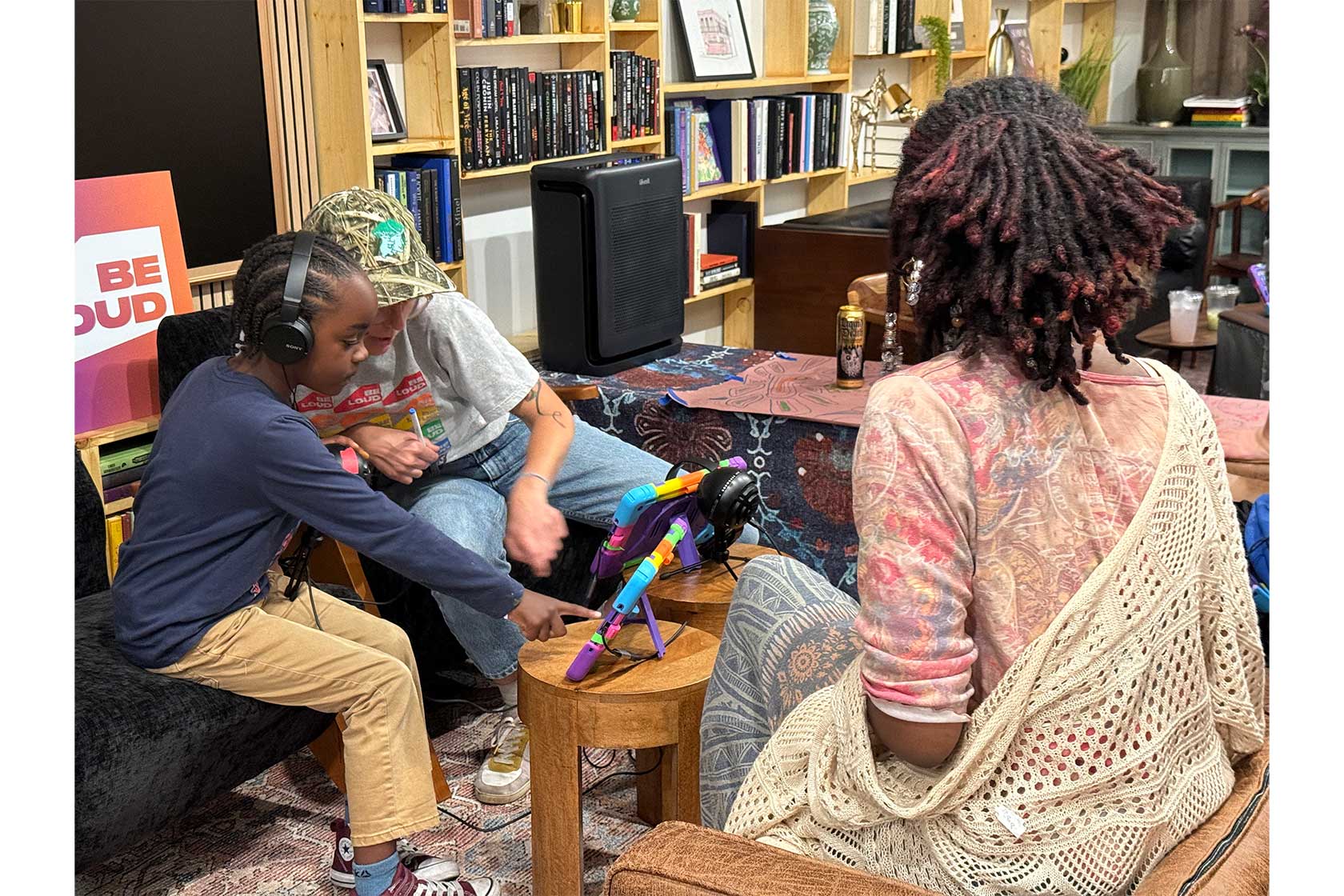
Be Loud Studios, a local nonprofit that uses radio production to foster self-efficacy among the city’s schoolchildren, founded the Youth Voices Festival five years ago as a way to share audio projects made by teachers; over time the event has evolved into a showcase of both youth accomplishment and the wide array of equity work being done with the young people of New Orleans. Alex Owens, Be Loud’s co-founder, was a fellow with New America, which funded this year’s festival in part.
I met Owens and the rest of the Be Loud staff yesterday at their Seventh Ward headquarters. I watched their final prep as they organized auxiliary cables, microphones, iPads, and headphones into piles labeled “Street Interview,” “Listening Lounge,” “Podcast Studio.” They debated whether the planned layout would promote enough interaction between attendees and young people.
Be Loud tries to give kids the space to translate the experience of being young for the rest of us, as Owens told me, “so we can connect to them.”
The festival’s recording stations would be run by kids, and young people would emcee the afternoon show. After all, the festival is about “celebrating youth leadership,” explained Diana Turner, Be Loud’s other co-founder.
I liked watching them work. The Be Loud adults have all been schoolteachers, and they have a roll-up-your-sleeves-and-jump-in ethos about them.
Be Loud’s efforts began about a decade ago when Owens and Turner, teachers in the same school, were trying to reach a second grader named Byron who refused to write. They suggested radio to him, Owens recalled: “If you make a script, we’ll turn it into a radio show.” Energized, Byron got off the bus the next morning with a full script, a story about homemade slime.
“One thing I love about radio,” Owens said, “is that they don’t have to get it right [from the start]. They just need a sense of where they’re going.”
Turner remembers the early days as a pirate radio affair, with second through fourth graders holding antennas outside the school, broadcasting their stories to the carpool line. “We’re not playing at ‘radio station,’” Turner said, describing the kids’ feelings. “We are a radio station.”
Be Loud, organized as a nonprofit in 2019, runs several initiatives now, including after-school programs, summer camps, public radio shows, and a Pass the Mic fellowship for teachers. Last year, their work reached 1,100 schoolchildren, with more than 800 recording something original.
While their work often provides kids the opportunity to be advocates for change, Be Loud doesn’t lead with this. “Part of equity work for us,” Owens said, “is leaving space for joy, leaving space for [students] to talk about things that they truly want to talk about.”
As Turner described it, kids first recognize that they have something to say and, second, realize that people will listen to them.
Be Loud also produces occasional larger projects, including Born After the Storm, a public radio narrative in which teenagers recorded personal stories about the impact of Hurricane Katrina.
In that story, you can hear Marlón, my festival interviewer, consider the startling reality that his parents had been his age when the storm robbed them of the prosaic things that now occupy his life: prom, friends, adolescent anxieties. He offers recognition of how life too easily becomes solipsistic, and how the act of reflecting aloud through public storytelling ties us to a greater thread of human experience, increasing self-awareness and empathy.
And Marlón tells me now, at the festival, how he’s discovered that he loves talking to people. That you can never really know someone until you ask them good questions. He can’t see himself doing anything in the future other than telling stories on screen or radio.
At a vendor table, I talk with Lucas, a sixth grader known as DJ Chalky, who’s selling his beautiful, whimsical ceramics. He participates in the Be Loud summer camps, and after recording a story, he tells me, “I feel very happy, and sometimes proud.”
I speak with Byron, aka DJ Gossip, who is now a high school senior committed to Columbia College in Chicago, where he intends to study comedy and performance. Today, he’ll appear in the festival show as Byroncé, a persona he’s developed through school productions that includes wigs, costumes, and backup dancers. His time with Be Loud has taught him the importance of expressing himself; he enjoys inspiring others to do the same.
In the Listening Lounge, I wear headphones and listen to this year’s Pass the Mic fellowship projects. My favorite is “KINDergarten,” by Savannah Nichols’s class. In the podcast, kindergarteners interview the “kindest people in school,” and at the end remind us to remain kind even after kindergarten.
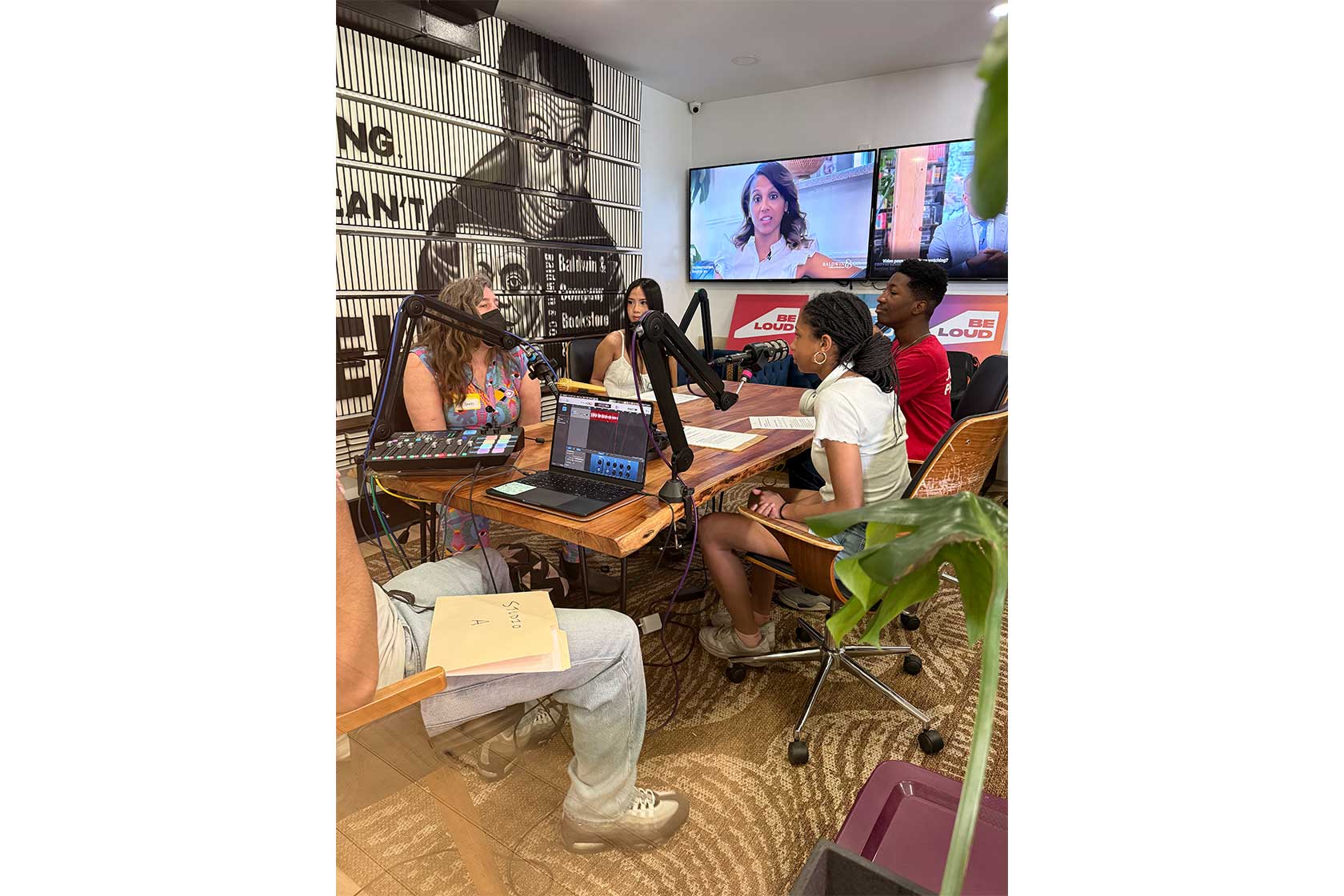
Inside the bookshop, other Be Loud DJs record a live podcast. I listen in as they discuss the paradox of pressuring themselves to complete homework on devices such as iPads that are designed to distract us.
When the performance begins, a couple hundred adult attendees are gathered around the stage. We watch a performance by Dancing Grounds, a youth troupe that builds connection through dance.
We hear from Kai Davis, a young woman on a community reporting fellowship with Lede New Orleans, an organization that supports journalism by young Black and Brown writers and “fosters trusted spaces for civic discussion.” Through a moving personal essay, Davis transports us to the Lower Ninth Ward, where her family’s memories are held.
We float with the New Voices New Orleans choir, made up of third through sixth graders, as they belt out “Be Who You Are,” Jon Batiste’s recent hit: You can only be who you are!
A stunning performance by Girls Play Trumpets Too closes the show. The group is “a program of empowerment,” according to band director and jazz musician Troy Sawyer, whose family’s musical roots stretch back to the advent of the genre in New Orleans.
The girls sit in rows with their trumpets, making jazz standbys their own, reminding us that this American art form is for everybody. By the end of their set, the girls swing with a classic New Orleans groove. The crowd chants along—“Ho na nae…ho na nae!”—a Mardi Gras Indian anthem that ascends straight from this city’s, this country’s, musical DNA. Adults dance, cheer, and clap, honoring the girls, even when they trip over songs they’re still learning.
The youngest members of the band, grade-schoolers, step one-by-one to a microphone out front for solos. The word for it is courage. And as their fearless notes rise through the flowering lilac that climbs these courtyard walls, our feet stomp and our hearts beat in time, beating with hope.
