A Chapter of: Living Up to Its Promise: Three Ways to Make Teacher Degree Apprenticeship Programs Work
The State of K–12 Teacher Degree Apprenticeship
Earlier this year, New America published Mapping the Landscape of Degree Apprenticeship: Expanding a Promising Model for Mobility, the first-ever national survey of degree apprenticeship. The report identified where these programs exist, what they look like, and what makes them high quality. Of about 600 programs nationwide, one-third are in education. The top occupation for degree apprenticeship is preschool, elementary, middle, secondary, and special education teacher, with three times as many programs as the second most common occupation, registered nurse.8 As of summer 2025, when our scan was conducted, we found 157 teacher degree apprenticeships in 44 states plus Washington, DC, shown in Figure 1.
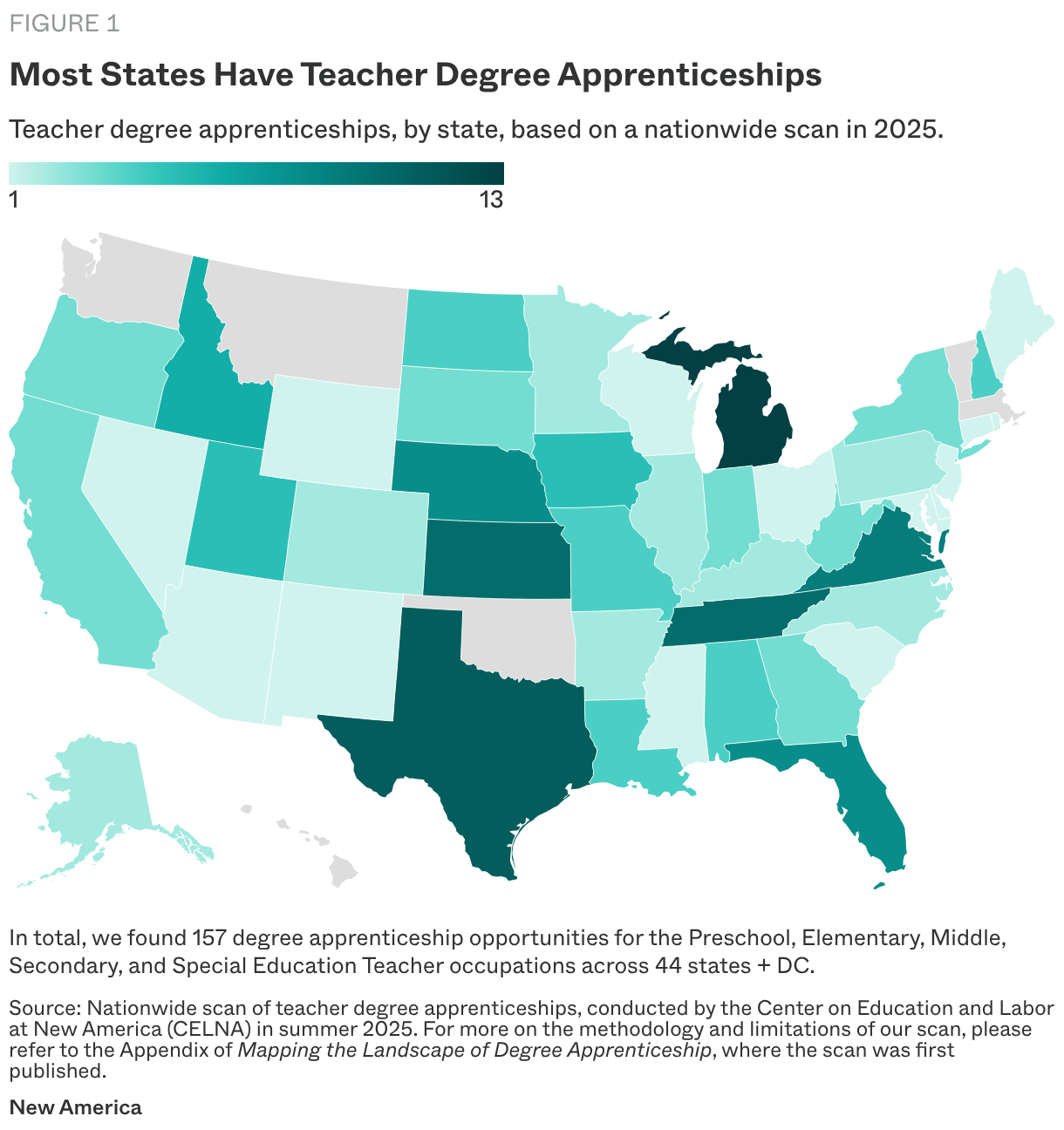
The teacher degree apprenticeship model first emerged in 2021 and 2022 with programs in New York and Tennessee, and other states soon followed.9 At the same time, the Biden administration championed teacher apprenticeships as a strategy for combatting teacher shortages, diversifying the educator workforce, and strengthening teacher preparation through evidence-based practices like robust clinical training paired with strong mentorship.10 Many states that won Biden-era Department of Labor grants for apprenticeship directed some or all of that funding toward teacher apprenticeship programs.11 While not all of these are necessarily degree apprenticeship programs, many are.
While Mapping the Landscape of Degree Apprenticeship identified programs, we did not count participants in these programs. To better understand teacher degree apprenticeship participants, we turned to federal data on K–12 teacher apprentices nationwide. These data aren’t a perfect match with the programs we analyze in this report. Most, but not all, teacher apprenticeships are degree apprenticeships, because not every teacher apprenticeship program culminates in a degree. Some programs allow high school students to earn dual credit, for example, while others offer individuals who already have a bachelor’s degree a path to teacher certification. Unfortunately, we cannot break down the federal data by degree apprenticeships versus nondegree apprenticeships in teaching. The young field of degree apprenticeship lacks detailed data, including on K–12 teacher degree apprenticeship programs.12
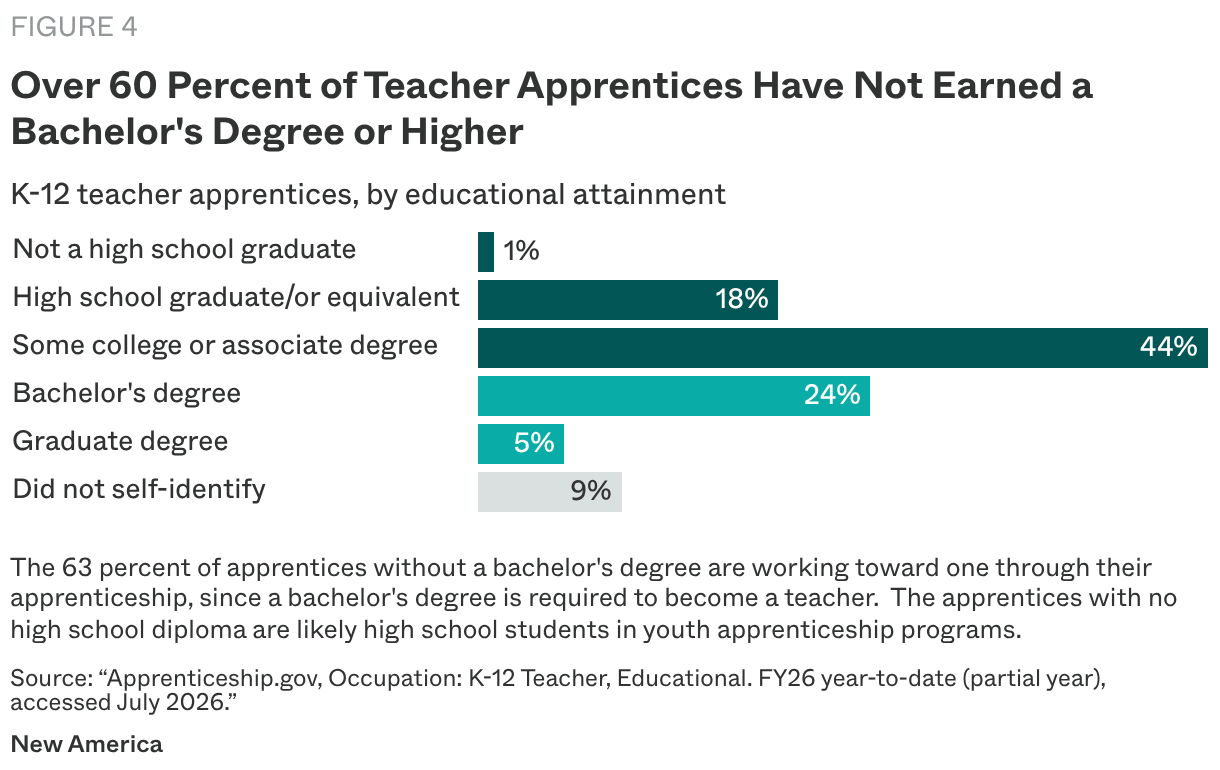
The federal data are still worth considering, however, because the vast majority of apprentices seem to be in degree apprenticeships.13 Teaching jobs require a bachelor’s degree, and at least 63 percent of apprentices do not have one (see Figure 4), indicating they are likely pursuing this degree via apprenticeship.
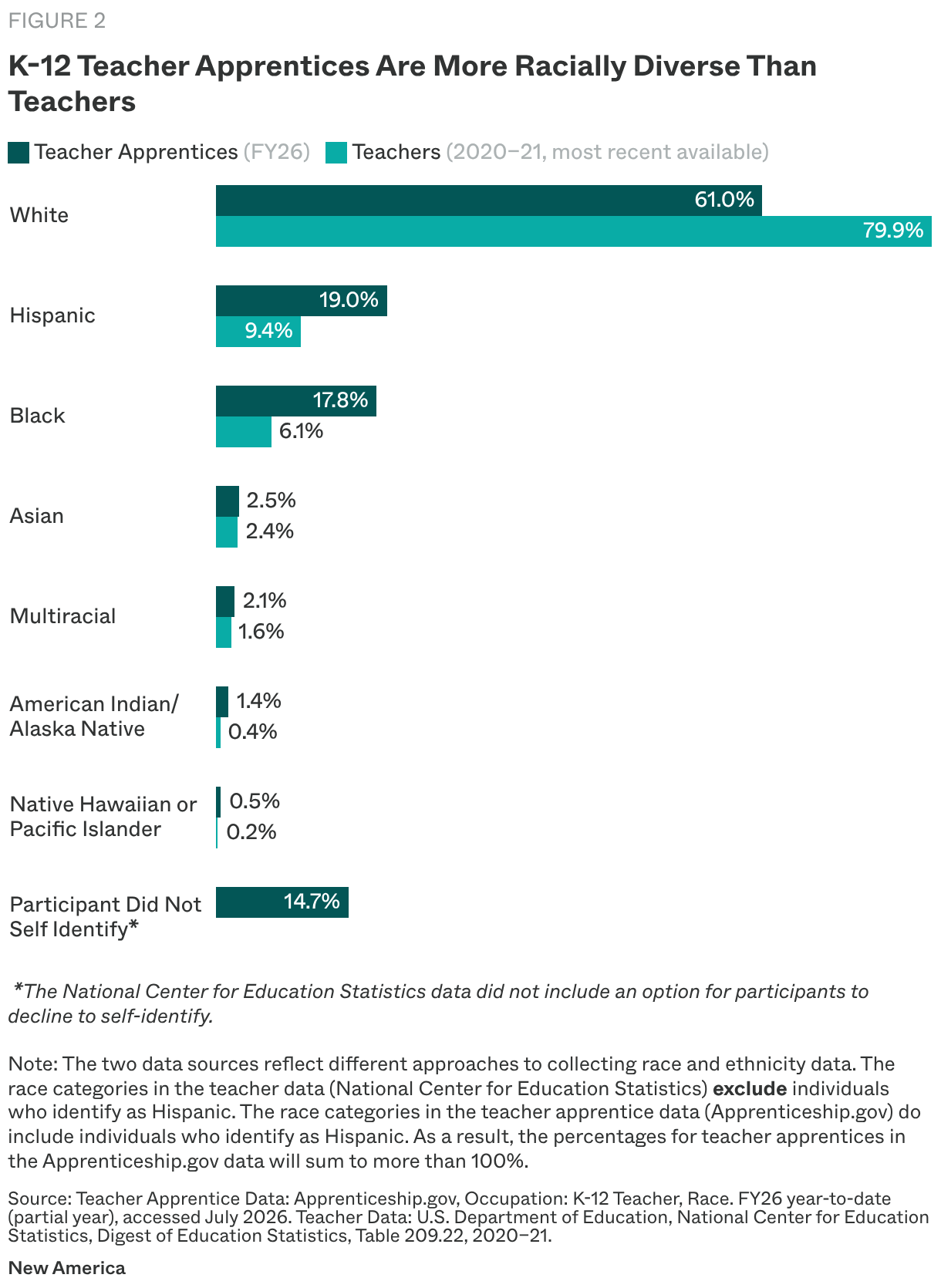
According to the most recent data from the U.S. Department of Labor, there are 6,275 active K–12 teacher apprentices.14 Nevada has the largest number of K–12 teacher apprentices (1,194). A handful of states do not yet have any active teacher apprentices. Teacher apprentices are more racially and ethnically diverse than the K–12 teacher workforce, with 18 percent of apprentices self-identifying as Black and 19 percent self-identifying as Latino, compared to 6 percent and 9 percent of K–12 teachers, respectively (see Figure 2).15 These data suggest that teacher degree apprenticeship may be a potential tool for closing the student-teacher demographic mismatch and increasing access for groups currently underrepresented in teaching. But so far, these programs are not promoting greater gender diversity in the teaching profession—the majority of teacher apprentices are female (78 percent), similar to the K–12 teacher workforce.16
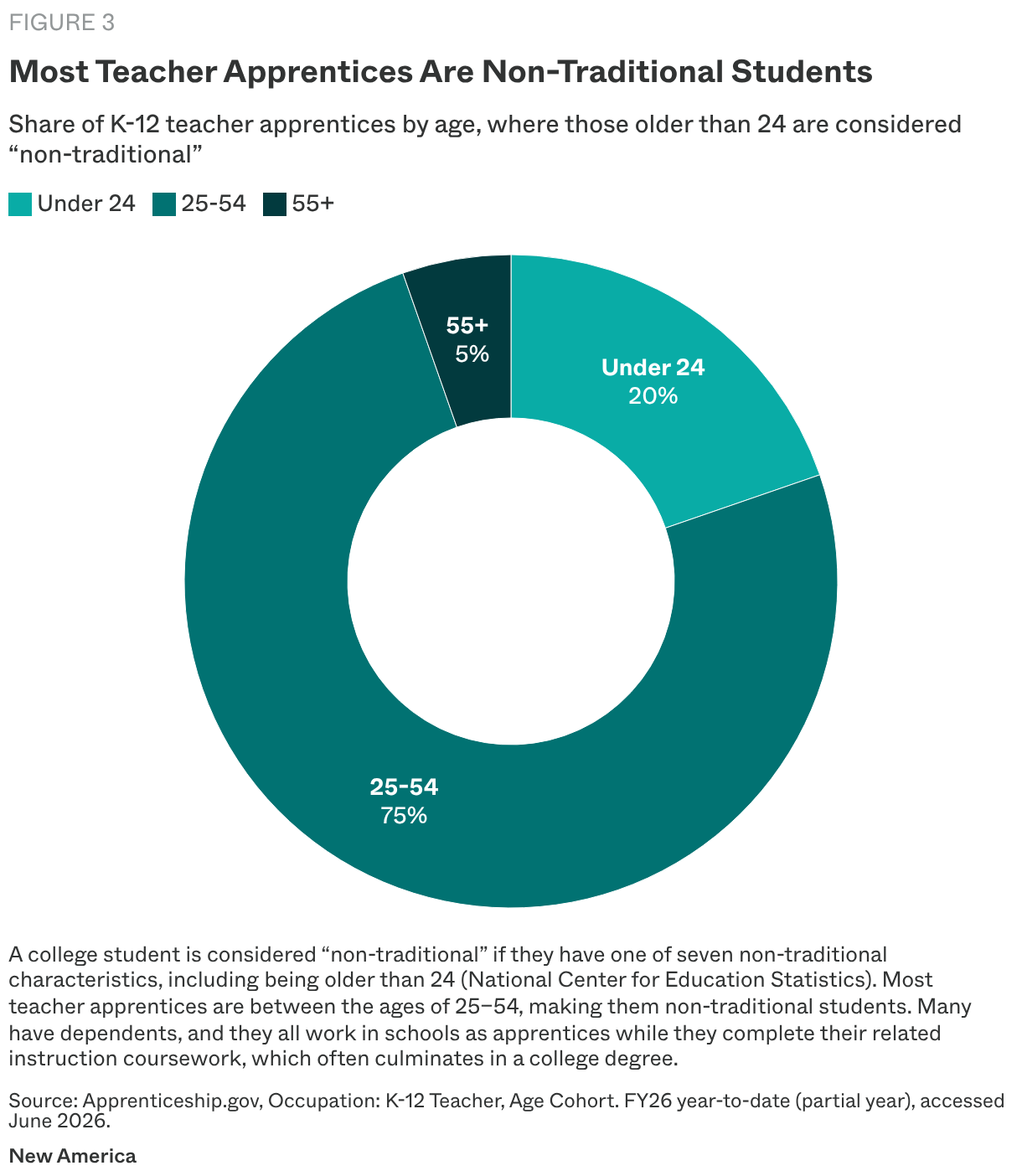
Most teacher apprentices (75 percent) are nontraditional students, meaning they are between the ages of 25 and 54 (see Figure 3), may have dependents, and are working full or part time while attending college. Around two-thirds of K–12 teacher apprentices have not yet earned a bachelor’s degree (see Figure 4). The less than 1 percent with no high school diploma are likely high school students in youth apprenticeship programs.

Citations
- Downs, Goetz, and Love, “II. Landscape Scan,” in Mapping the Landscape of Degree Apprenticeship, https://www.newamerica.org/insights/mapping-the-landscape-of-degree-apprenticeship-expanding-a-promising-model-for-mobility/ii-landscape-scan/.
- Amaya Garcia and Taylor White, “Teacher Apprenticeship: What Is It and Why Now?,” EdCentral (blog), New America, February 8, 2022, https://www.newamerica.org/insights/teacher-apprenticeship-what-is-it-and-why-now/. For an overview of different programs, see the Pathways Alliance Apprenticeship Model Compendium, Building Effective Teaching Apprenticeship Models, https://www.newamerica.org/wp-content/uploads/2026/07/Pathways-Alliance-Apprenticeship-Models-Compendium.pdf. For more on how teacher degree apprenticeship differs from traditional models, see Alex Cortez, Michaela Gaziano, and Alexandria Smith, Best of Both Worlds: Teacher Apprenticeship Degrees (Bellwether, October 2024), https://bellwether.org/wp-content/uploads/2024/10/BestofBothWorlds_Bellwether_October2024.pdf.
- See Martin J. Walsh and Miguel A. Cardona, “Joint Letter with Secretary Martin Walsh of DOL regarding a Sustainable Teacher Workforce,” Dear Colleague Letter, U.S. Department of Education, August 31, 2022, https://www.ed.gov/laws-and-policy/key-policy-letters/joint-letter-secretary-martin-walsh-of-dol-regarding-sustainable-teacher-workforce. For more on how teacher apprenticeship can improve the quality of teacher preparation, see: Phoebe Walendziak and Gretchen Mills, “Aligning Effective Preparation Practices,” in Educator Apprenticeships: On-Ramps to Quality Preparation (Prepared To Teach, July 28, 2026), https://www.preparedtoteach.org/resources/educator-apprenticeships-on-ramps-to-quality-preparation.
- For examples of states that spent Department of Labor grants on teacher apprenticeship, see Lancy Downs, “Key Funding Sources for Educator Registered Apprenticeship Programs,” EdCentral (blog), New America, February 14, 2024, https://www.newamerica.org/insights/key-funding-sources-for-educator-registered-apprenticeship-programs/. For more on program funding, see Erica Mallett Moore, Dana Grayson, and John Diaz, Educator Registered Apprenticeships: Funding Profiles for Five Programs (WestEd, January 2025), https://wested2024.s3.us-west-1.amazonaws.com/wp-content/uploads/2025/05/02113114/ERA-Funding-Report.pdf.
- The lack of detailed data isn’t specific to degree apprenticeship and extends to many types of K–12 teacher preparation programs and certification routes, even longstanding ones. See Melissa Tooley, Taking Aim at Teacher Shortages with Better Data: How Improving HEA Title II Data Can Advance Teacher Quantity, Quality, and Diversity (New America, October 20, 2022), https://www.newamerica.org/insights/taking-aim-at-teacher-shortages-with-better-data/.
- Apprenticeship USA, “Apprentices by State,” https://www.apprenticeship.gov/data-and-statistics/apprentices-by-state-dashboard.
- Data retrieved on July 17, 2026, from https://www.apprenticeship.gov/data-and-statistics/apprentices-by-state-dashboard.
- These figures are the most recent federal data available on teacher characteristics, including race, collected in 2020–21 and published in 2023. See National Center for Education Statistics, “Characteristics of Public School Teachers,” in Condition of Education (U.S. Department of Education, Institute of Education Sciences, 2023), https://nces.ed.gov/programs/coe/indicator/clr/public-school-teachers.
- Teacher apprentices bring significant gender diversity to the Registered Apprenticeship workforce, where only 14 percent of active Registered Apprentices are women. Data retrieved on July 17, 2026, from https://www.apprenticeship.gov/data-and-statistics/apprentices-by-state-dashboard.