
Lancy Downs
Senior Policy Analyst, Center on Education & Labor
This report explores teacher degree apprenticeship programs, an emerging teacher preparation model that has the potential to address long-standing challenges in the workforce, like expensive training programs, teacher shortages, and retention. Teacher degree apprenticeship creates a low-cost, affordable pathway into teaching by integrating paid on-the-job training via a Registered Apprenticeship with college coursework that culminates in a bachelor’s degree and teacher certification.
To deliver on the promise of this model, program leaders and policymakers need to design and implement programs that work for apprentices, districts, and higher education partners. Through interviews with program leaders and technical assistance providers, we identified three design or implementation considerations that matter for program quality: sponsorship types, affordability, and accessibility. This report explains how programs address these three considerations and the challenges they have faced in doing so, highlighting common approaches and themes.
We would like to thank the Strada Education Foundation for its generous support of this research. We appreciate the guidance and expertise of our colleagues Taylor White, Iris Palmer, and Melissa Tooley at every stage of this paper. We are grateful to Ivy Love and Braden Goetz for their collaboration, wisdom, and stellar research chops in our degree apprenticeship work. Thanks to Sabrina Detlef for helping make our work clearer and stronger and to Katherine Portnoy, Mandy Dean, and Liz Cory for their production and dissemination support. The conclusions in this report are those of the authors and do not necessarily reflect positions or policies of the foundation.
We also owe massive thanks to the individuals who shared their experience and expertise with us for this report: Reesha Adamson, Sabrina Baptiste, Hannah Blume, Carolyn Cleveland, Erin Crisp, Sergio De La Rosa, David De Jong, Eric Dunker, Jack Elsey, Laura Ergle, Heather Finley, Dennis George, Joel Gillaspie, Betty Glasgow, Cindy Gutierrez, Casey Kilpatrick, Jen Kral, Colleen McDonald, Jim Meadows, Joyce Milling, Monica Moreno-Martinez, Erin Mote, Courtney Newton, Shelly Ocanas, Liz Qualman, Joshua Quick, Joe E. Ross, Nicole Rudman, Elizabeth Standafer, Kenneth Varner, Anastasia Wickham, and Gina Zuberbier. Their reflections and insights were essential to our analysis.
Particular thanks are due to program leaders and their colleagues at Morgan County School District Re-3, St. Vrain Valley Schools, and the Kennedy Children’s Center, who graciously organized and hosted school site visits for our team. They gave us the opportunity to see their programs in action and to speak to apprentices, mentor teachers, and school administrators. Our report is richer because of their generosity and openness.
Sergio De La Rosa spent his career serving youth, helping undocumented young people as a community organizer and working as a youth corrections officer before eventually becoming the director of his local Boys & Girls Club. He loved being with young people and had a knack for supporting multilingual students in particular. Through the Boys & Girls Club, he got to know Daniel Cooper, a local elementary school principal. Impressed by De La Rosa, Cooper often told him that he wanted to hire him to teach at his school.
But De La Rosa knew a teaching career was out of reach. He didn’t have a bachelor’s degree, plus he was a father to young children. Abandoning his paycheck to go back to school was a nonstarter for his family. Even if he had been able to leave his job, there wasn’t money for tuition, nor would the long commute from his home in rural northeastern Colorado to in-person classes be feasible, given his family commitments.
But one day, Cooper came to De La Rosa with exciting news. Colorado had just created a program designed to train new teachers. De La Rosa could earn a bachelor’s degree in education through remote coursework at Colorado Mountain College while getting paid to work and train at a school in his own town, Fort Morgan. The college would help him find grants and scholarships to cover his tuition, and a veteran teacher would mentor him. Was De La Rosa interested in applying?
He was. Here was an avenue to pursue a career in teaching that didn’t require impossible financial or logistical commitments. “This is the door opening,” he recalled.1
Colorado’s new program was a degree apprenticeship, an emerging training and education model that integrates Registered Apprenticeship with an associate, bachelor’s, or master’s degree. Registered Apprenticeship is a federally defined model that requires apprentices to receive progressive wage increases, structured on-the-job training, instruction from a skilled mentor, related classroom-based education, and an industry-recognized credential. In degree apprenticeship, the classroom-based element culminates in a degree.2
In the field of education, degree apprenticeships have potential to address long-standing challenges in teacher recruitment and preparation. Traditional teacher preparation programs are often long, expensive, and inaccessible to many would-be teachers. They require a major financial investment from trainees: four years of college tuition, plus unpaid student teaching. They’re usually designed for traditional college students, not working adults. As De La Rosa’s experience illustrates, even when people have the passion and talent to become great educators, the path can be prohibitive due to financial, logistical, academic, and other barriers.3
Teacher degree apprenticeships address some of these structural barriers, particularly the financial ones.4 This model makes teacher preparation more affordable by providing both tuition support and wages for teacher trainees, but it also creates a clear pathway to a career since these programs are designed to lead to a permanent role in the district. By reducing barriers to entry, degree apprenticeship can increase the appeal of becoming a teacher and, with time, address teacher shortages and increase teacher diversity.5
These models also have the potential to improve teacher retention by recruiting people who are already familiar with working with students and are invested in and reflect the local community, like De La Rosa, and by providing on-the-job training that better equips apprentices to lead instruction and manage classroom behavior.6 “The most sustainable solution to teacher shortages is not external recruitment, but intentional local development,” said Dennis George of Western Kentucky University, which sponsors teacher degree apprenticeships in several districts. “For smaller and rural districts especially, investing in people who already know and care about the community creates a reliable pathway to a strong, stable teacher workforce.”
Degree apprenticeship promises to be a low-cost and accessible pathway into teaching that can address some of the most pressing challenges the field faces. To deliver on this vision, program leaders and policymakers need to design and implement programs that work for apprentices, for the districts that hire them, and for the colleges and universities that educate them. Our conversations with program leaders and technical assistance providers revealed the following three design or implementation considerations that matter for program quality:7
There is no single approach to implementing these considerations, and programs have deployed different strategies based on their contexts and resources. This has often made it hard to understand the tradeoffs or quality implications of one strategy versus another, leaving leaders unsure about which choices are best for their program or state.
Here, we offer, after a brief overview of the K–12 teacher degree apprenticeship landscape, some basic frameworks for understanding how different sponsorship types and affordability and accessibility strategies factor into teacher degree apprenticeship quality. This report explains how programs are implementing these three considerations and the challenges they have faced in doing so, highlighting common approaches and themes.
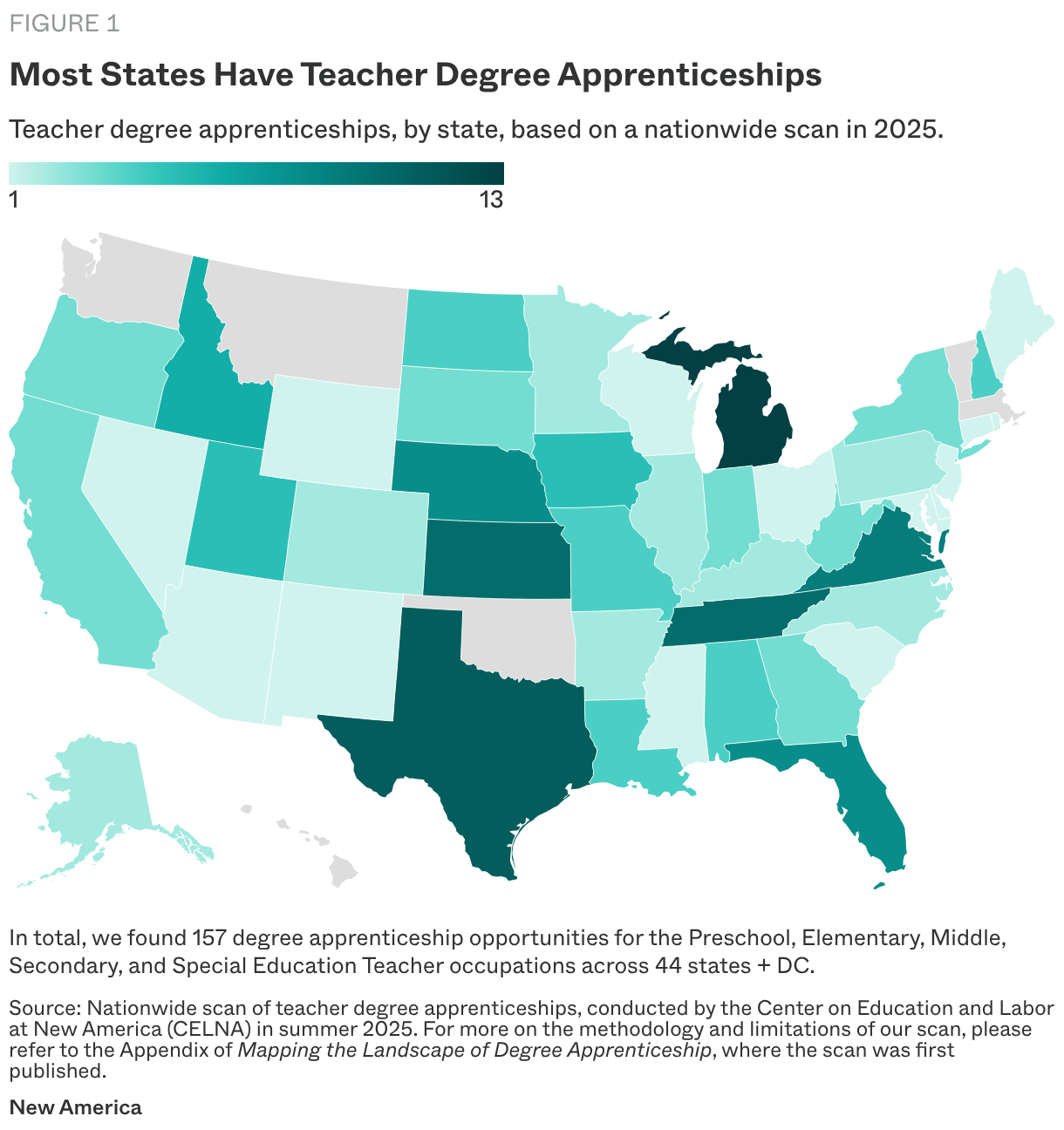
Earlier this year, New America published Mapping the Landscape of Degree Apprenticeship: Expanding a Promising Model for Mobility, the first-ever national survey of degree apprenticeship. The report identified where these programs exist, what they look like, and what makes them high quality. Of about 600 programs nationwide, one-third are in education. The top occupation for degree apprenticeship is preschool, elementary, middle, secondary, and special education teacher, with three times as many programs as the second most common occupation, registered nurse.8 As of summer 2025, when our scan was conducted, we found 157 teacher degree apprenticeships in 44 states plus Washington, DC, shown in Figure 1.
The teacher degree apprenticeship model first emerged in 2021 and 2022 with programs in New York and Tennessee, and other states soon followed.9 At the same time, the Biden administration championed teacher apprenticeships as a strategy for combatting teacher shortages, diversifying the educator workforce, and strengthening teacher preparation through evidence-based practices like robust clinical training paired with strong mentorship.10 Many states that won Biden-era Department of Labor grants for apprenticeship directed some or all of that funding toward teacher apprenticeship programs.11 While not all of these are necessarily degree apprenticeship programs, many are.
While Mapping the Landscape of Degree Apprenticeship identified programs, we did not count participants in these programs. To better understand teacher degree apprenticeship participants, we turned to federal data on K–12 teacher apprentices nationwide. These data aren’t a perfect match with the programs we analyze in this report. Most, but not all, teacher apprenticeships are degree apprenticeships, because not every teacher apprenticeship program culminates in a degree. Some programs allow high school students to earn dual credit, for example, while others offer individuals who already have a bachelor’s degree a path to teacher certification. Unfortunately, we cannot break down the federal data by degree apprenticeships versus nondegree apprenticeships in teaching. The young field of degree apprenticeship lacks detailed data, including on K–12 teacher degree apprenticeship programs.12
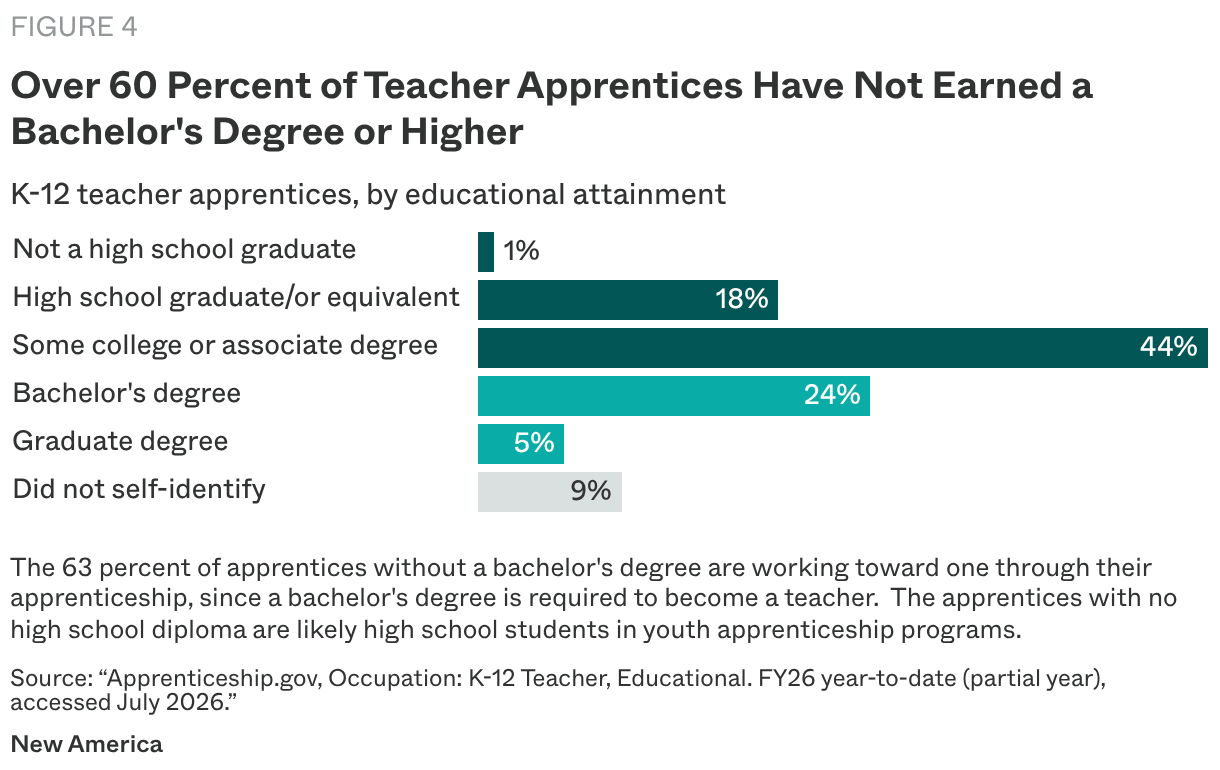
The federal data are still worth considering, however, because the vast majority of apprentices seem to be in degree apprenticeships.13 Teaching jobs require a bachelor’s degree, and at least 63 percent of apprentices do not have one (see Figure 4), indicating they are likely pursuing this degree via apprenticeship.
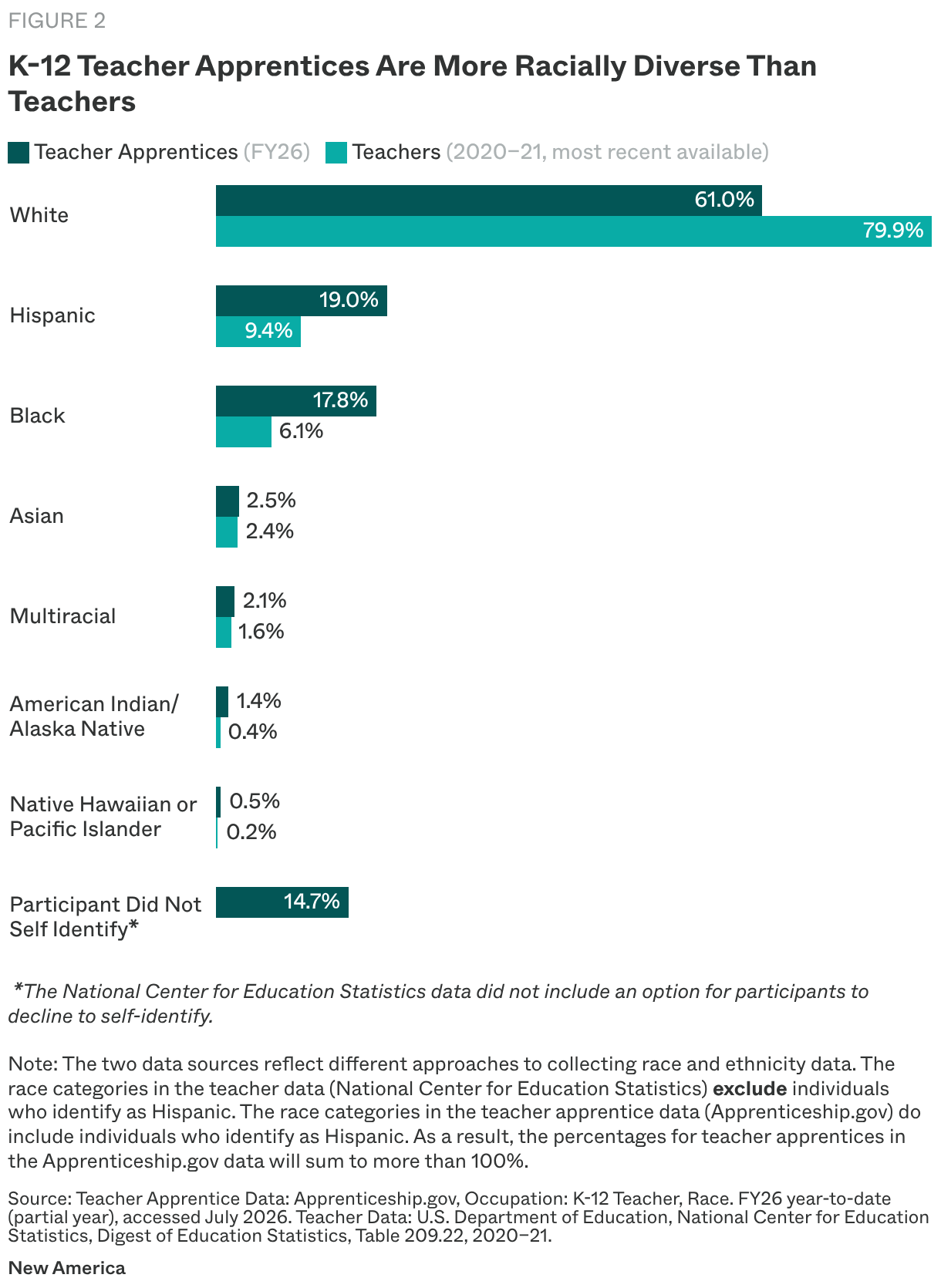
According to the most recent data from the U.S. Department of Labor, there are 6,275 active K–12 teacher apprentices.14 Nevada has the largest number of K–12 teacher apprentices (1,194). A handful of states do not yet have any active teacher apprentices. Teacher apprentices are more racially and ethnically diverse than the K–12 teacher workforce, with 18 percent of apprentices self-identifying as Black and 19 percent self-identifying as Latino, compared to 6 percent and 9 percent of K–12 teachers, respectively (see Figure 2).15 These data suggest that teacher degree apprenticeship may be a potential tool for closing the student-teacher demographic mismatch and increasing access for groups currently underrepresented in teaching. But so far, these programs are not promoting greater gender diversity in the teaching profession—the majority of teacher apprentices are female (78 percent), similar to the K–12 teacher workforce.16
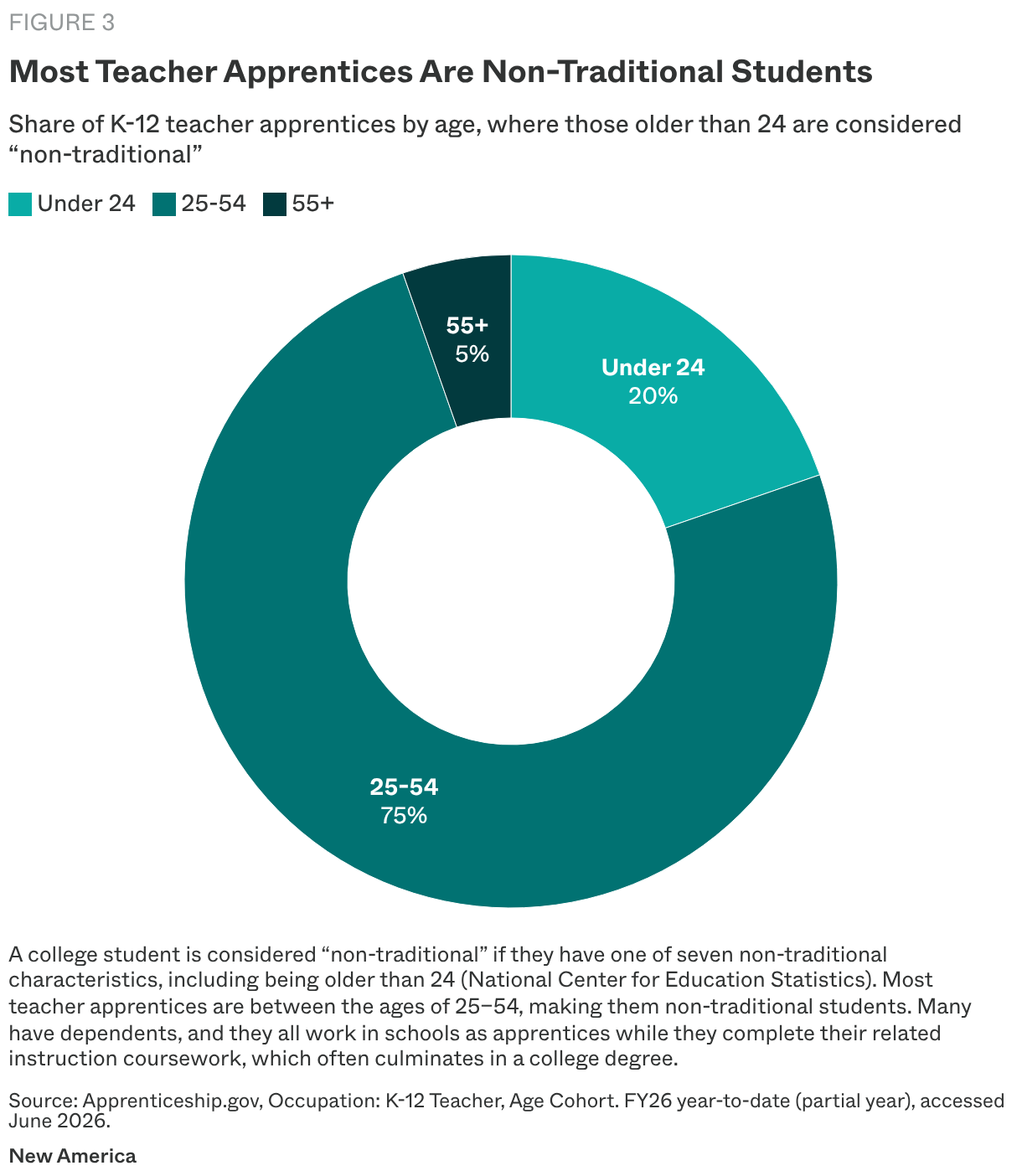
Most teacher apprentices (75 percent) are nontraditional students, meaning they are between the ages of 25 and 54 (see Figure 3), may have dependents, and are working full or part time while attending college. Around two-thirds of K–12 teacher apprentices have not yet earned a bachelor’s degree (see Figure 4). The less than 1 percent with no high school diploma are likely high school students in youth apprenticeship programs.
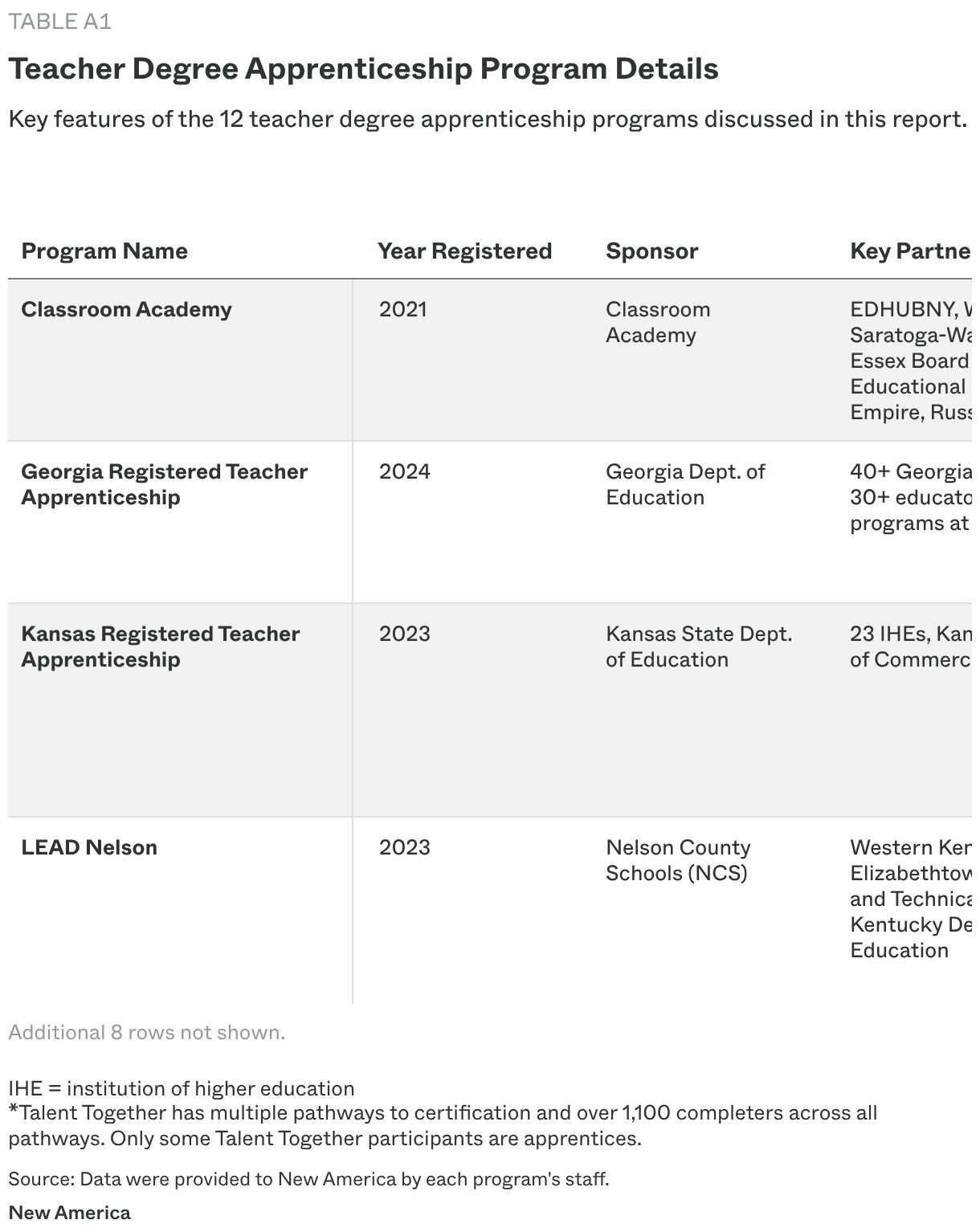
We conducted Zoom interviews with 15 leaders operating programs in 17 states, spoke with five experts with experience providing technical assistance and supporting programs, and visited two teacher degree apprenticeship programs in Colorado, St. Vrain Valley Schools and Morgan County School District Re-3, for one day each (see Appendix for more details on each program we spoke with). At St. Vrain and Morgan County, we saw apprentice teachers in action in the classroom and spoke with nearly two dozen current and former apprentices, higher education leaders, and school district staff, including principals and mentor teachers.
Though there are degree apprenticeships in other education sector occupations, we narrowed our scope just to teacher apprenticeship because it is the most popular degree apprenticeship occupation.
Apprenticeship sponsors are responsible for managing and operating programs. Sponsors take on administrative tasks like completing paperwork, collecting and reporting data, and ensuring compliance with federal and state requirements. They hire apprentices, select and often pay for related technical instruction, may provide on-the-job training, clarify responsibilities, and help coordinate with partners. A variety of entities can serve as a teacher apprenticeship sponsor, including state education agencies (SEAs), school districts (LEAs), institutions of higher education (IHEs), teacher unions, and nonprofit intermediaries.
Determining what entity should serve as a sponsor for a particular teacher degree apprenticeship program depends on capacity, interest, program context, and goals. There are potential advantages and disadvantages to each sponsorship type (see Table 1), and these tradeoffs can impact program quality and partners’ ability to collaborate.
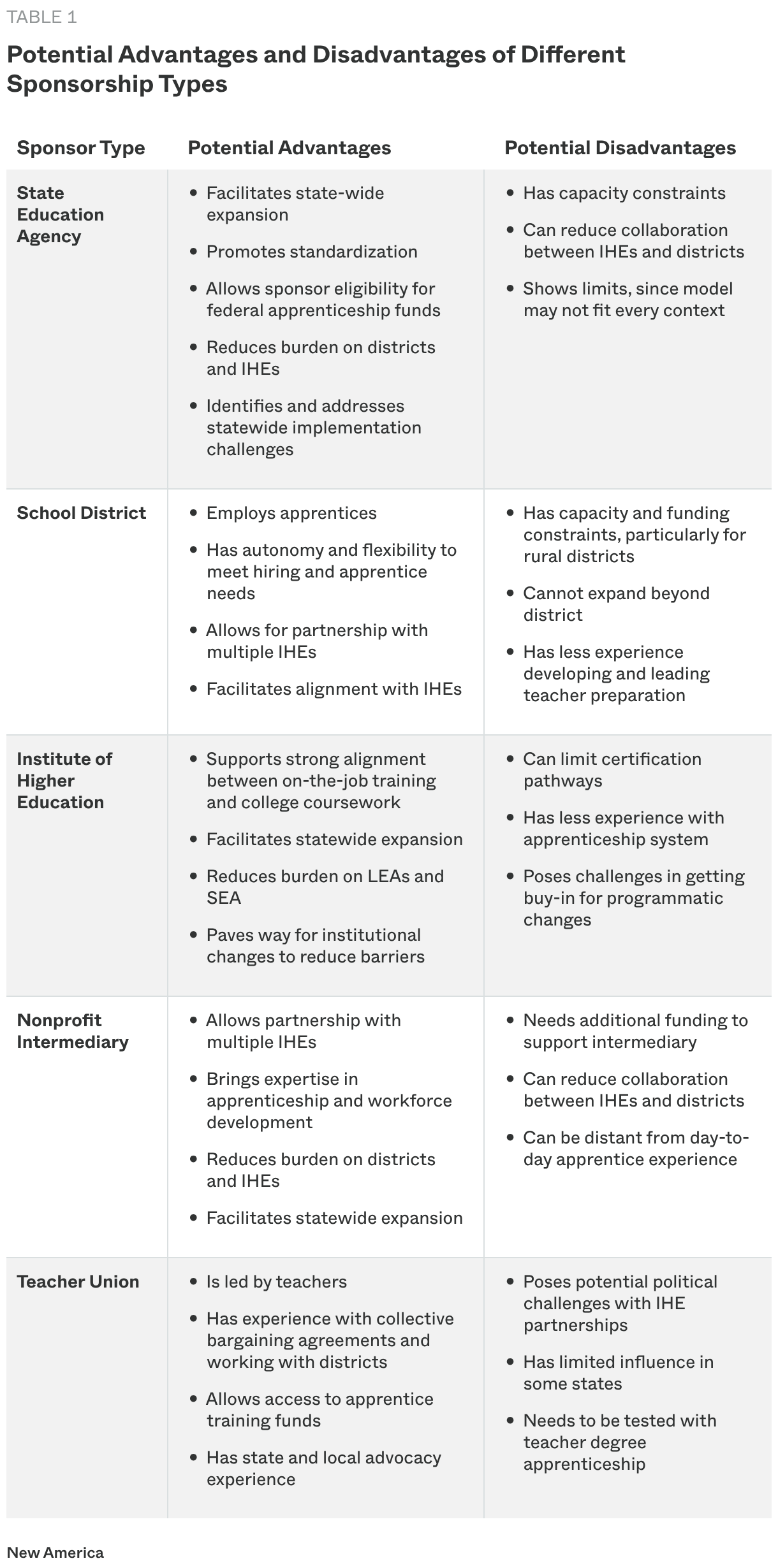
In a brief about Tennessee’s teacher apprenticeship program, author Hanna Melnick highlights the benefits of having an SEA serve as a sponsor.17 These benefits include ensuring quality, integrating with existing teacher pathways, and facilitating statewide expansion.
The state leaders we spoke with agreed that choosing the state department of education as a sponsor can promote uniformity across school districts to ensure a consistent apprentice experience statewide. Joel Gillaspie, coordinator of teacher licensure at the Kansas State Department of Education (KSDE), explained that having KSDE as a sponsor means the initiative has not become something “unmanageable,” where all districts are doing something “wildly different.” This level of oversight is also important when the goals of the program are also driven by the state. KSDE is making a concerted effort to address teacher turnover and views teacher degree apprenticeship as a strategy for increasing retention.
Elizabeth Standafer, who provided technical assistance to help states and districts design and register teacher apprenticeships, said that goal- and vision-setting is a key responsibility of an SEA. The state agency should set the goal and vision for the teacher apprenticeship and then ensure districts understand and implement that vision. Providing this kind of “scaffolding” to districts, she noted, “makes it really easy for an interested district to make it fly.”
SEA sponsorship also relieves smaller and rural districts from the burden of registering and administering a program. In Georgia, the goal was to keep it simple. Heather Finley, teacher retention and recruitment specialist at the Georgia Department of Education, said, “We wanted the smallest of districts to be able to say, ‘we can do this.’ So even if it was someone who had one apprentice, we wanted it to be easy to apply and be able to participate.” Finley believes that this approach has enabled the program to grow statewide, including in small, rural communities.
One downside of state education agency sponsorship is capacity constraints. SEA staff we spoke with described being the only person in their agency—and therefore in the state—charged with designing, implementing, and operating the program or taking on those duties in addition to other responsibilities. Limited staff capacity means SEA sponsors aren’t always able to foster strong partnerships between districts and higher education institutions or provide additional support to high-need districts. Some SEAs have declined to sponsor their state’s teacher apprenticeship, citing lack of capacity; they have turned to institutions of higher education to take on that role.
Educator preparation programs at institutions of higher education can help district employers by tailoring their curriculum to meet their needs and taking on the administrative burden that makes it hard for smaller districts to participate in an apprenticeship program. IHE sponsorship comes with tradeoffs, including less familiarity with workforce development and apprenticeship. Staff members must spend time learning how to navigate these systems.
But IHE sponsors can adapt to meet the needs of employers and apprentices. For example, Missouri State University’s (MSU) program launched in 2022 with a paraeducator-to-special education teacher pathway. It has since expanded to include multiple entry points, from youth to career changers. MSU also updated the curriculum in response to district requests. “We have spent the last year-and-a-half changing all of our instructional programming within our certification area. One, to be more efficient,” said Reesha Adamson, interim associate dean of the Graduate College at MSU, “but also [to address] the direct need that we are hearing from our employers.”
However, when IHE sponsors don’t have this responsive mentality, IHE sponsorship can complicate matters for school districts, as when, for example, the IHE sponsor doesn’t offer a certification that the district needs. In some cases, the sponsor may be able to add that certification to its offerings. If it cannot, districts may need to seek out or sponsor another program with a different higher education partner that does offer the pathway they need.
Like state education agency sponsors, higher education sponsors support district partners by taking on responsibility for program registration and administration. Several individuals we spoke with said school districts, particularly rural and small ones, require technical assistance and other support to engage with teacher apprenticeship. IHE sponsors can provide that support, but they often have to study up first. For example, at Western Kentucky University (WKU), the dean of the College of Education and Behavioral Sciences tasked staff with learning the ins and outs of sponsorship to ensure they could effectively support school districts. WKU fills out the registration paperwork and registers apprentices in the RAPIDs database system. “The registration process is complex and time-intensive, and many districts simply do not have personnel who can dedicate substantial time to navigating it,” said Dennis George at WKU. “As the sponsor, WKU can provide that administrative support so districts can focus on developing and supporting their apprentices.”
Because IHE sponsors can work with multiple districts, they also can help scale up teacher degree apprenticeship. Indeed, two of the largest teacher apprenticeship programs in the nation are sponsored by educator preparation programs at public universities: MSU and the University of Nevada, Las Vegas (UNLV). MSU partners with over 100 school districts and UNLV partners with about two dozen districts and charter school networks, which have helped spread the teacher degree apprenticeship model in both states.
Using IHEs as the teacher apprenticeship sponsor allows for better integration of college and university partners into teacher apprenticeship partnerships, according to Kenneth Varner, professor in the Teaching and Learning Department at UNLV. When IHEs sponsor apprenticeships, they must go beyond simply providing the related instruction. They foster partnerships with districts and work closely with state partners like education and workforce agencies. Varner has heard from peers in other states whose IHEs don’t serve as sponsors, who say that their teams struggle with knowing their role in teacher degree apprenticeship programs and feel like an “add-on” as opposed to a key partner in the work. In other words, IHE sponsorship can produce more collaborative partnerships, which we identified in Mapping the Landscape of Degree Apprenticeship as a key feature of high-quality degree apprenticeship.18
Indeed, collaboration is a core benefit of IHE sponsorship. IHE sponsors are well positioned to work closely with districts to align on-the-job learning with classroom work and ensure district needs are met. Professors know which students are apprentices and can customize coursework and assignments based on what apprentices are learning on the job. In non-IHE-sponsored programs, sponsors often have to work harder to cultivate partnerships between employers and educator preparation programs.
Nonprofit organizations can also serve as sponsors. Often these organizations serve as intermediaries, connecting the players and supporting apprenticeship program development and implementation through monitoring and evaluation, apprentice supports, and field building.19 The advantages of this sponsorship type overlap with those that state education agencies and IHEs provide. Their ability to partner with multiple districts and IHEs can support statewide scale, and they reduce burden on these partners by taking on administrative responsibilities and offering technical assistance and other support. Intermediary staff usually have expertise in apprenticeship and can serve as translators across higher education, K–12 education, and workforce stakeholders.
Michigan’s Talent Together—a partnership of all 56 intermediate school districts and 14 IHEs—serves as a sponsor and intermediary. These dual roles provide Talent Together with a bird’s-eye view of areas where IHEs and districts require more support. In particular, they have leaned into helping districts with the selection and training of mentor teachers. District administrators recommend potential mentors, who then go through a multistep vetting process led by Talent Together staff. Gina Zuberbier, a former program manager at Talent Together, said, “[We are] really working to make sure that we’re tapping mentors who are going to help our apprentices grow and…help that apprentice teacher not look like a first-year teacher the first time they step into their own classroom.”
Talent Together is also able to leverage funding from the state to provide mentor teachers with orientation and ongoing training and professional development, along with a $7,500 stipend. As Zuberbier explained, one hope is that the compensation, training, and support mentor teachers receive will help keep them in the profession. “This could be their opportunity to step into leadership without leaving their classroom,” she said, “and hopefully that helps some of those veteran teachers stick around in their positions a little bit longer, too.” This means that teacher degree apprenticeship programs have the potential to help retain teachers at different stages of their careers.
One potential drawback of intermediary sponsors is that, unlike state education agencies, school districts, and IHEs, they usually don’t have dedicated public funding. While public entities may be able to leverage existing funding to support their sponsorship duties, nonprofit intermediaries must find their own funding from the state, federal government, or private sources like philanthropy. In Michigan, Talent Together has received nearly $80 million from the state legislature,20 which has funded tuition, mentor stipends, and other costs for over 1,150 teacher candidates statewide21—a level of investment that may not be possible in other states.
School districts are strong sponsor candidates due to their central role in apprenticeship, since they employ both apprentice teachers and their mentors. They set wages, determine mentor stipends, offer professional development, and transition apprentices into full-time teaching roles. Serving as a sponsor gives a district flexibility to design, and adapt, the degree apprenticeship program to meet their specific needs.
Nelson County Schools, a small, largely rural school district of 4,000 students 40 miles south of Louisville, Kentucky, is an example of how serving as a sponsor offers districts flexibility and adaptability. Being a sponsor has allowed Nelson County to bring on IHE partners that can accommodate the interests of apprentices. For example, one aspiring apprentice wanted to become a teacher for students who are deaf and hard of hearing, which is a certification area that Nelson County’s current IHE partner does not offer. “We’ve been thinking [that] we will get more of those types of situations. We need the flexibility to partner with another university if needed to best support the apprentice, and we don’t need to be locked into just [one],” said Courtney Newton, director of Next Generation Learning 6–12. Building the apprenticeship program with faculty at Western Kentucky University has given the district a strong understanding of how to effectively partner with education preparation programs.
To be sure, serving as an apprenticeship sponsor requires capacity, resources, and commitment. The K–12 education system is plagued by inequities, with higher-resourced and larger school districts able to offer a variety of specialized programs that are simply not possible in smaller, less-resourced districts. And so, one potential disadvantage of having school districts serve as sponsors is that access to degree apprenticeship programs is limited to communities that have the resources and capacity to lead them. Moreover, districts generally do not serve as sponsors for other districts, and thus don’t support expansion in the way IHE, state education agencies, or intermediary sponsors do. This doesn’t mean district sponsors prevent expansion, but it can mean school districts might not be appropriate sponsors in programs aiming for scale and uniformity.
Teacher unions are another potential sponsor of teacher apprenticeship, but we did not encounter any union-led teacher degree apprenticeships. The only union-led teacher apprenticeship program in the country is the Washington Education Association Residency in Teaching Program (WEA-ART), through which participants who already have bachelor’s degrees earn a teaching certificate.22 As a union, WEA had the flexibility to be creative and design a model that was outside of the traditional structure of higher education. Another strength of union sponsorship is a union’s expertise in collective bargaining and designing agreements with employers. However, not all states have strong teacher unions, and these benefits may not play out in places where unions have less influence.
Every program featured in this report aimed to maximize affordability for apprentices and sustainability for school districts and institutions of higher education (IHEs). Their approaches varied, based on the resources available in their state and local context or their program design, but we found that teacher degree apprenticeship programs in the most stable positions often had two major commonalities. First, they have moved away from the one-time and time-limited funding sources that launched their programs and have begun weaving together ongoing, often smaller, funding streams. Second, they take advantage of their positioning at the locus of workforce development, higher education, and K–12 to access funding from across these systems, at the state and local levels.
Combining relatively small pots of money from different systems can be challenging. For example, eligibility rules or reporting requirements that differ considerably between funding sources can create administrative burden for programs. Moreover, a teacher degree apprenticeship can be more expensive than a traditional apprenticeship because the related instruction component involves two to four years of college coursework. Employers often cover the related instruction costs, and in fact, some states require them to do so.23 School districts, however, do not usually have funds to pay for years of college tuition. And putting full tuition costs on the apprentice would defeat the purpose of apprenticeship as a more accessible, affordable pathway into teaching.
Plus, tuition isn’t the only cost that teacher degree apprenticeship programs need to cover. There are progressively increasing apprentice wages, mentor teacher stipends, staff time to support program implementation and operation, and wraparound services, like transportation and child care.24 These costs can be prohibitive for districts to take on without other sources of funding.
Below, we highlight funding streams that teacher degree apprenticeship programs rely on to ensure their programs are affordable for apprentices, districts, and higher education partners.
As program leaders looked for creative ways to cover apprentice tuition, they often turned to state-based higher education scholarship programs. While these programs generally aren’t designed for teacher apprenticeship specifically, teacher degree apprenticeship participants can usually access them because they are pursuing a bachelor’s degree, if they meet other eligibility criteria. Some are straightforward merit scholarships like Georgia’s HOPE Scholarship.25 Others target specific learner populations, like the Kansas Adult Learner Grant, designed for students over the age of 25 who are pursuing a bachelor’s degree.26 The New York state legislature provides $6,000 to $8,000 per Registered Apprentice in State University of New York programs for related instruction, as well as $500 for emergency supports.27
Many states also provide state or institutional merit-based scholarships and state financial aid programs for students training to become teachers. These include Kentucky’s Teacher Scholarship Program,28 Kansas’s Teacher Service Scholarship,29 or Colorado’s Teacher Recruitment Education and Preparation program.30 While these are not designed specifically for apprentices, teacher degree apprenticeship participants are usually eligible for this funding, provided they meet program criteria.
Youth-serving teacher degree apprenticeship programs often leverage dual credit funding to reduce tuition costs.31 Lower tuition rates negotiated between IHEs and districts, combined with state scholarships for dual credit, can provide significant savings to districts. Moreover, because district budgets often include a line item for dual credit tuition, leveraging these courses for teacher apprenticeship-related instruction doesn’t necessarily create a new or additional expense.
In Nelson County Schools’ youth apprenticeship program, for example, apprentices take dual credit courses through Western Kentucky University or Elizabethtown Community and Technical College. Kentucky’s dual credit scholarships cover up to three dual enrollment courses.32 Since the scholarship doesn’t pay for all the courses apprentices need to take, the district uses its general fund resources to cover remaining dual credit costs. Still, the price the district pays for that coursework is considerably less than normal in-state tuition.
Dual credit agreements aren’t always limited to high school apprentices. St. Vrain Valley Schools in Colorado and the University of Colorado (CU) Denver have an innovative partnership that allows both high school students in the education CTE pathway and adult paraprofessionals in the district’s Registered Apprenticeship program to benefit from the dual credit program. Dual credit courses for high school students are co-located with some courses for adult apprentices. These classes meet in district buildings, for students’ ease of access, and are taught by CU Denver-authorized district instructors. Both high school students and adult apprentices pay a reduced tuition rate and earn the same CU Denver credit.
Teacher degree apprenticeship programs are often eligible for federal higher education, workforce, and K–12 funding.33 Unlike some of the competitive federal grants that jump-started teacher apprenticeship programs, none of the federal funding streams discussed here are dedicated specifically to apprenticeship, yet all of them have been leveraged to support teacher degree apprenticeship, though the ease of doing so varies.
Pell Grants, need-based federal aid, were a popular way to cover tuition, and many interviewees told us that at least half, if not more, of their teacher apprentices are eligible for Pell. Program leaders generally found Pell a relatively straightforward source to access, as long as students filled out their Free Application for Federal Student Aid (FAFSA) form. According to Heather Finley from the Georgia Department of Education, school districts and IHE partners collaborate to provide FAFSA completion support to ensure as many apprentices as possible can take advantage of the Pell awards for which they are eligible.
Federal workforce dollars through the Workforce Innovation and Opportunity Act (WIOA), however, have proved a harder source for teacher degree apprenticeship programs to tap. WIOA can, in theory, cover on-the-job training, related instruction, and wraparound support costs for apprentices who face at least one barrier to employment. One program we looked at had success using WIOA funds: The University of Nevada, Las Vegas (UNLV) sponsors its teacher apprenticeship program and uses WIOA dollars to cover related instruction costs. It’s one of many sources it leverages to pay for apprentice training, which Nevada requires program sponsors or employers to cover.
Other interviewees reported that WIOA dollars were too hard to access and manage in support of apprenticeship. WIOA has significant participant eligibility restrictions, enrollment rules, and allowable uses, and it is underfunded. Missouri State University staff, for example, found WIOA to be “incredibly difficult to implement and support at a higher education level, mainly because of the cost of the reporting process,” and so decided to stop using the funding, according to Adamson. A 2025 WestEd analysis of five teacher apprenticeship funding models found that just two programs regularly accessed WIOA dollars, which they deployed to cover apprentice wages, tuition, and wraparound supports.34
Some federal K–12 dollars can also support teacher degree apprenticeships. For example, in programs where apprentices are hired as paraprofessionals, districts may use federal funding from the Individuals with Disabilities Education Act (IDEA) or Title I of the Elementary and Secondary Education Act (ESEA) to pay their salaries.35 “A Title I district or a Title I building can use Title I dollars to just pay for an instructional aide, and that actually gives them significantly more flexibility because they can do so much with that,” one interviewee said. The interviewee added that this is not yet a universal approach in their state, describing districts that use this funding for apprenticeship as “forward-thinking.”
Some teacher degree apprenticeship programs have also reduced the tuition burden for students by awarding credit for on-the-job learning (OJL) or credit for prior learning (CPL). Students who earn this type of credit usually pay a small fee rather than the regular tuition cost.
Higher education partners are often against CPL because they do not want to lose tuition revenue. But CPL done well can bring more nontraditional students, and their tuition dollars, in the door by making higher education more financially and logistically accessible. Still, IHEs often need technical assistance to build a CPL policy that balances their financial health with affordability for students.
While this section has focused on how programs cover tuition, there are other costs that teacher degree apprenticeship programs need to cover. Below, we highlight two creative ways programs address tuition alongside these other expenses by taking advantage of their state or institutional contexts. Most programs won’t be able to leverage these particular approaches, but they can consider all the potential tools, resources, and advantages available to them based on their own contexts. Can any of them be leveraged in creative, unexpected, or new ways to support affordability? In New York State and at Reach University (in multiple states), the answer was “yes.”
In New York, most school districts outside of the state’s major cities can access a state aid model to pool local funds for shared services and programs, including apprenticeship, through regional education agencies called Boards of Cooperative Educational Services (BOCES).36 The state provides BOCES reimbursement aid to districts of between $.36 and $.90 for every dollar spent in a state-approved contract for shared services. This allows districts to recoup, and reinvest, a significant share of the money they spend on apprentice wages, mentor stipends, human resources support, and general program management for apprentices. EDHUBNY, a nonprofit intermediary and technical assistance provider for teacher apprenticeship in New York, has created a calculator that allows districts to input their budgeted apprentice costs, possible offsets, and the district BOCES reimbursement rate to see the net annual and hourly cost per apprentice.37 “We put it in the hourly rate because that tends to be really impactful for [district leaders],” said Colleen McDonald, director of EDHUBNY. “For some districts, the fact is that they’re paying less than $5 an hour for…an educator-in-training in the classroom.”
Reach University, whose Teachers College degree apprenticeship program is available in nine states, has designed its programs to prioritize affordability for the apprentice, college, and district alike.38 Reach is different from the other IHEs featured in this report, all of which are public colleges or universities. A small nonprofit private institution, Reach doesn’t have to contend with the bureaucracy of state higher education systems. Its leaders have the freedom to make decisions in service of its mission to reimagine the college degree to better serve working adults, and they have.
Reach hires professors of practice—usually superintendents, principals, and teachers who mentor and instruct apprentices on the job and in seminars—which makes staffing more affordable since it does not hire full-time professors and centers the workplace as the central site of learning, a key aspect of Reach’s philosophy. Reach has one master liberal arts curriculum that students follow together as a cohort and treats any prior college credits a student might have as electives. This approach reduces the administrative costs of credit cross-walking and simplifies advising. And since school districts or intermediary partners lead recruitment to bring paraprofessionals, library aides, and other nonteaching school staff into the program, Reach spends relatively little on marketing and recruitment.39
These measures serve a twofold purpose: “They deliver a lot of tremendous cost savings while delivering the high-quality benefits that come from job-embedded, experiential, contextual post-secondary education,” Joe E. Ross, co-founder, president, and CEO of Reach, said during an April 2025 WestEd webinar.40
Teacher degree apprentices have the potential to increase access into the profession for individuals who face barriers to entry. One way that programs are facilitating access is by providing flexibility in traditional higher education structures, including how students earn college credit and take classes. This flexibility allows apprentices to leverage their skills and competencies to show mastery, engage with courses at times that are convenient for them, and earn a degree more efficiently. At the same time, programs are providing wraparound supports that attend to apprentices’ needs beyond their work site and college classroom. This section explores the opportunities and challenges in creating more flexible structures for teacher apprentices.
In Mapping the Landscape of Degree Apprenticeship, we identified flexibility and efficiency as hallmarks of a high-quality degree apprenticeship program.41 Apprentices, we wrote, should not “have to spend time in the classroom to get credit for skills they have already mastered on the job.”
One way to do this is to provide academic credit for prior learning (CPL) or for on-the-job learning (OJL). According to the American Council on Education and the Council for Adult and Experiential Learning, CPL refers to a “wide range of strategies and methods used to…award college credit for skills and knowledge…acquired outside of a formal college setting,” including at work.42 Credit for on-the-job learning is a type of CPL that apprentices earn during their apprenticeship. Methods for awarding this credit vary, but include exams, portfolio assessments, defenses of learning, and on-the-job demonstrations.43
Research suggests that CPL yields particular benefits for low-income students, students of color, and adult students. Awarding CPL saves students both time and money44 and improves college completion rates.45 It is also associated with positive postgraduation outcomes, like higher earnings.46 And in teacher degree apprenticeship, strong CPL and credit for OJL components are a sign that school districts and higher education partners have collaborated closely to ensure aligned learning on the job and in the classroom.
Among our interviewees’ programs, CPL was uneven. Concerns about or a lack of interest from higher education partners often stymied CPL implementation. Higher ed administrators worry that CPL will reduce revenue, since students typically pay a nominal assessment fee for CPL rather than tuition. Faculty do not want to forfeit influence over students’ training and its quality. There are less existential concerns, too. Colleges rarely have access to financial support to design CPL policies in a way that works for their bottom line and strategic support to build CPL assessments that are valid and reliable. And then there’s inertia—some colleges haven’t ever had a robust CPL policy and are not interested in developing one.
For example, in both Kansas and Georgia, where the state department of education is the sponsor, CPL is underused because it is not a priority for the educator preparation programs that apprentices enroll in. One interviewee said that the institution of higher education (IHE) partner has not even tried to develop a CPL policy for the teacher apprenticeship program due to administrator and faculty resistance. The Georgia Department of Education wants its IHE partners to offer more CPL for apprentices and is working with educator preparation programs to implement stronger CPL policies.
In other programs, robust CPL or credit for OJL policies are already in place. Reach University, for example, is the field leader in awarding credit for OJL. Reach apprentices earn up to half of their bachelor’s degree credits through on-the-job learning aligned with academic and occupational competencies.47 Reach collaborates with school districts to ensure learning at work and at school is “inherently integrated, not operating in parallel,” Holly Smith, executive director of the National Center for the Apprenticeship Degree at Reach, previously told New America.48
Other colleges have adopted their own approaches to CPL, like providing it through exams (Dakota State University), designating some lower-level courses eligible for articulated credit if apprentices can demonstrate mastery on the job (Western Kentucky University), or allowing certain district-provided professional development trainings to articulate to CPL credit (Missouri State University).
The state of Colorado requires that OJL count for at least 25 percent of the degree in its teacher degree apprenticeship policy.49 To serve as a higher education partner in a teacher degree apprenticeship, most colleges would need to adapt their traditional educator preparation programs to build in credit for OJL while still meeting their own institutional accreditation requirements. This requires employers to provide a detailed description of the on-the-job training and faculty to review it—a potentially time-intensive process for which faculty need to be compensated.50 Yet, the legislation did not come with funding to help programs make these changes, which may be limiting IHE ability to participate in the teacher apprenticeship program. To date, only two IHEs in Colorado are participating in a teacher degree apprenticeship program as defined by this legislation.51
In addition to more funding, colleges need guidance on how to implement high-quality CPL and credit for OJL. What does quality look like? How can colleges ensure their assessments are valid and reliable? State agencies, along with intermediaries or technical assistance providers, can help develop standards and guidance so that each program does not need to develop its own CPL approach. “This is something we need to get better at,” said Erin Mote, CEO and founder of InnovateEDU. “We’re asking folks to build their own [CPL assessments and policies]. Everybody is doing something different. It doesn’t feel consistent or well articulated.”
Programs have made substantial efforts to make attending classes and engaging in courses more accessible, sometimes at the insistence of program sponsors. Jack Elsey, founder and CEO of the Michigan Educator Workforce Initiative, which supported Talent Together during its start-up phase, said that from the apprenticeship program’s launch, partner universities have been expected to offer all required coursework online. “For some, they already had that, or had started to go in that direction,” he said, but others “had to hurry up the timeline to get there, to serve everyone statewide.” Requiring online courses allowed apprentices across the state to attend the educator preparation program that best met their needs, regardless of where they lived.
This philosophy of flexibility and accessibility plays out at the institutional level too. University of Nevada, Las Vegas (UNLV), for example, allows apprentices who live in Clark County, where UNLV is located, to attend classes in person while those outside of the county can attend fully online. Colorado Mountain College (CMC) similarly offers all coursework for its teacher degree apprenticeship remotely to ensure that apprentices who live far from a CMC campus can still participate. “The fact that I don’t have to drive forever-and-a-half to go to school is a huge plus,” said De La Rosa.
Shifting courses entirely online can be a big change for universities accustomed to the traditional, in-person model. Teacher preparation programs may have effective coursework for face-to-face instruction, but these practices might not translate well into online learning, explained Erin Crisp, assistant vice president for learner success and workforce pathways at the University of Tennessee. This challenge can be exacerbated by a lack of investment in high-quality online curricula, she said.
Transitioning to a fully online model also requires IHEs to collaborate with school district employers in ways that may be new to them. When partnering with Nelson County Schools to design an apprenticeship for high school students, for example, faculty at Western Kentucky University (WKU) had to learn how to deliver a curriculum asynchronously. “We had to learn how to wrap that curriculum around a student in Nelson County, an hour and a half away, who may never come to Bowling Green. It has to [have] complete flexibility…and [requires] much closer coordination with the school districts. So that really challenged us,” said Dennis George, director of Special Projects/Workforce Solutions. When done successfully, however, this collaboration can yield benefits. Through its collaboration with the school district, WKU was able to ensure that class assignments and work products were aligned with students’ clinical experiences. This type of alignment helps prospective teachers apply what they are learning to their work in the classroom.52
Other programs offer in-person courses in locations that are easier for apprentices to get to. For example, in North Carolina, one university offers classes on-site in the school district, which means apprentices learn with their cohort and avoid having to spend all evening on a computer after working all day. A 2012 study by the Center for the Study of Childcare Employment points out a key benefit of the cohort model: it can help teacher candidates persist and build a professional network with which to share best practices and address workplace challenges.53
Educator preparation programs have also made changes to the structure of their coursework. Leaders from Dakota State University and CMC described shortening courses to accommodate the needs of working students. Both institutions have instituted eight-week courses in place of the traditional 15–16 weeks. This structure can promote greater persistence, as David De Jong from Dakota State told us. The abbreviated schedule also allows apprentice teachers to take more courses per academic year. “Our students are taking more courses in a semester than they ever have,” said Liz Qualman at CMC, “and we should see a speed up in completion.” Boosting persistence and completion rates is a win for apprentices, employers, and educator preparation programs.
Teacher degree apprenticeship programs are rigorous. Apprentices work 30 to 40 hours a week and take courses while balancing family and personal obligations. Research on Grow Your Own (GYO), a locally driven teacher recruitment and preparation strategy that is increasingly paired with apprenticeship, finds that individuals benefit from comprehensive supports that help them navigate higher education, reduce financial barriers, prepare for licensure tests, and address challenges along the way.54 Offering comprehensive student support is not a standard practice in higher education—as several interviewees noted—but is often embedded in workforce development programs.
As Adamson at Missouri State University told us, “Workforce development has been able to help us think about… pieces that are important to these individuals.” She said, “Maybe it’s credit counseling, maybe it’s gas cards, maybe it’s transportation, maybe it’s child care—some of those pieces that we don’t always address and can support in higher education.” We heard similar sentiments from others, who view partnering with workforce development as a value-add that helps higher education consider and see the needs of the whole person.
Support also extends to navigating complex higher education systems. At UNLV, participants were clear about the features necessary to keep them in the program. One request was that they did not want to expend energy or time learning how the different offices at the university worked or dealing with burdensome tasks, like figuring out how to pay their bills. There is a whole team in UNLV’s program that handles those issues, which allows apprentices to concentrate on being students. Other services that participants asked for included financial aid, online classes, professional learning opportunities, and three years of post-program support. Varner argues that when programs provide these services, it reduces stress and makes the program doable for nontraditional learners. And UNLV has the results to prove it, with a 92 percent completion rate and over 90 percent retention rate in the first three years of teaching (based on licensing data), according to Varner.
This fall, Sergio De La Rosa begins the third year of his apprenticeship. He now leads a classroom of multilingual learners at Baker Elementary School in Fort Morgan. The days can be long—he stays at school late for his college classes some evenings—but the structure suits him. In his college courses, he learns “new ways to approach or to tackle different situations” in the classroom. “And then I get to implement [them] literally the very next day,” he said.
“It’s not for the faint of heart,” De La Rosa said. But degree apprenticeship made a teaching career possible for him in a way that no other teacher preparation program would have. He doesn’t have to give up a paycheck, take out student loans, or drive hours to a college campus. The program works with his life and his family. “Having all of that wrapped up into the community that I live in and love is amazing,” he said.
The degree apprenticeship has also benefited the school district. When he completes in 2028 with a degree from Colorado Mountain College, he’ll stay on at Baker Elementary. His mentor, Shelly Ocanas, describes him as “phenomenal.” She said, “His hunger for knowledge and his enthusiasm towards [teaching] seem to be on another level.” And his perspective is one the district needs. More than a quarter of the students in Morgan County schools are multilingual learners55 and two-thirds are Hispanic or Latino.56 Ocanas said that De La Rosa’s personal experience—immigrating as a child and being an English learner himself—has made him good at designing lessons for a multilingual, multicultural classroom and understanding his students’ needs.
Teacher degree apprenticeship is young, so it’s too soon to say if it will deliver on some of its longer-term promises. But the early results are encouraging. Degree apprenticeships have offered affordable, accessible avenues into the teaching field for individuals like De La Rosa, who previously had none. It has helped districts like Morgan County address shortages by recruiting teachers who are from the community, who look like their students, and who have a passion for education. And as they’ve evolved from a traditional model of teacher preparation, institutions of higher education (IHEs) like Colorado Mountain College have begun to reach new populations of students and learned how to align their coursework with district partners’ needs.
As new teacher degree apprenticeship programs emerge across the country, we hope this report can help leaders at school districts, IHEs, state education agencies, and apprenticeship agencies to make sense of a promising model. Understanding different strategies for sponsorship, affordability, and accessibility will enable program leaders to develop strong programs that address the needs of apprentices, districts, and higher education partners now and in the long term.
Senior Policy Analyst, Center on Education & Labor

Director, PreK–12 Research and Practice