A Chapter of: Living Up to Its Promise: Three Ways to Make Teacher Degree Apprenticeship Programs Work
Leadership: Sponsorship Type Trade-Offs
Apprenticeship sponsors are responsible for managing and operating programs. Sponsors take on administrative tasks like completing paperwork, collecting and reporting data, and ensuring compliance with federal and state requirements. They hire apprentices, select and often pay for related technical instruction, may provide on-the-job training, clarify responsibilities, and help coordinate with partners. A variety of entities can serve as a teacher apprenticeship sponsor, including state education agencies (SEAs), school districts (LEAs), institutions of higher education (IHEs), teacher unions, and nonprofit intermediaries.
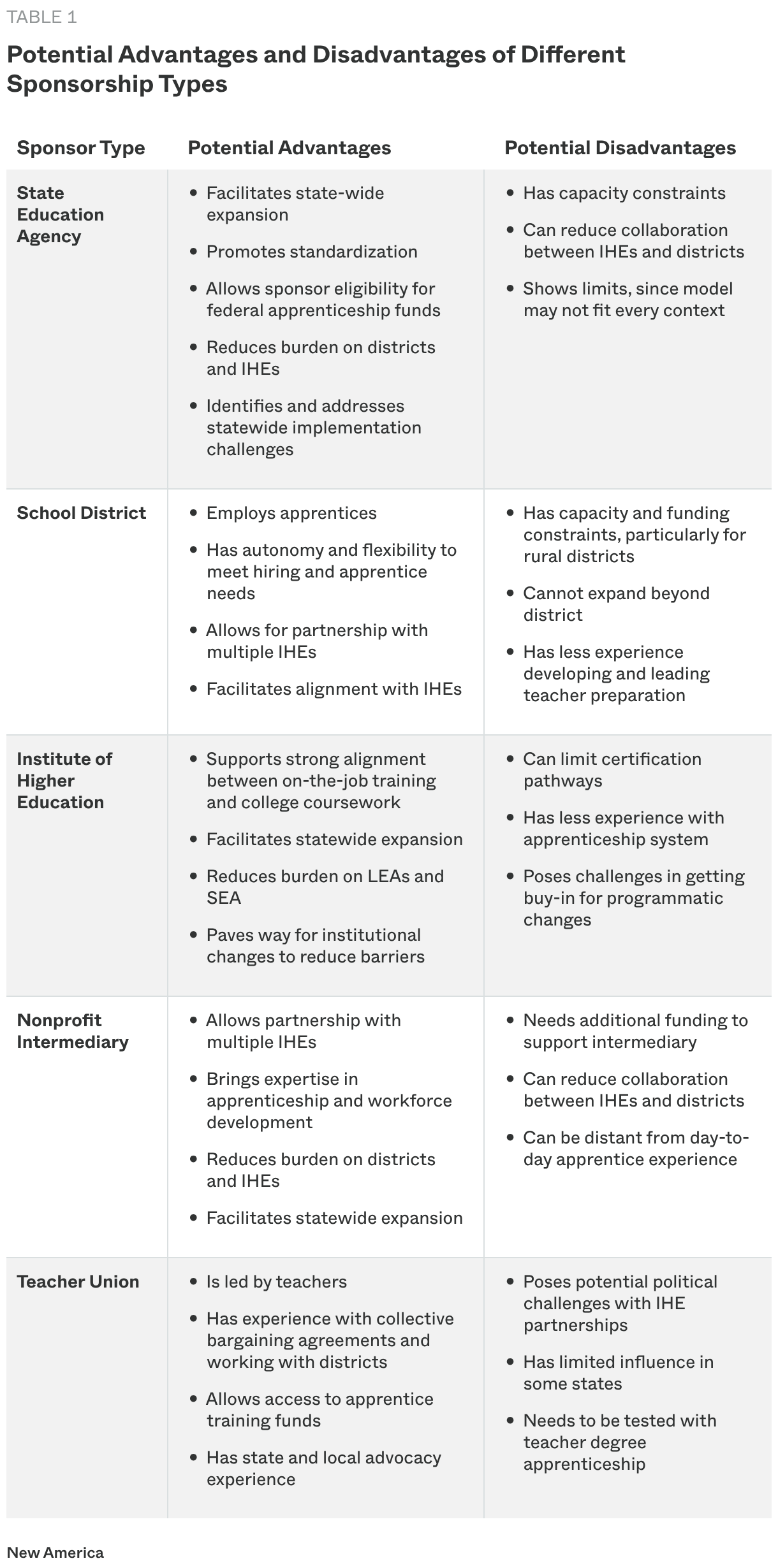
Determining what entity should serve as a sponsor for a particular teacher degree apprenticeship program depends on capacity, interest, program context, and goals. There are potential advantages and disadvantages to each sponsorship type (see Table 1), and these tradeoffs can impact program quality and partners’ ability to collaborate.
State Education Agencies
In a brief about Tennessee’s teacher apprenticeship program, author Hanna Melnick highlights the benefits of having an SEA serve as a sponsor.17 These benefits include ensuring quality, integrating with existing teacher pathways, and facilitating statewide expansion.
The state leaders we spoke with agreed that choosing the state department of education as a sponsor can promote uniformity across school districts to ensure a consistent apprentice experience statewide. Joel Gillaspie, coordinator of teacher licensure at the Kansas State Department of Education (KSDE), explained that having KSDE as a sponsor means the initiative has not become something “unmanageable,” where all districts are doing something “wildly different.” This level of oversight is also important when the goals of the program are also driven by the state. KSDE is making a concerted effort to address teacher turnover and views teacher degree apprenticeship as a strategy for increasing retention.
Elizabeth Standafer, who provided technical assistance to help states and districts design and register teacher apprenticeships, said that goal- and vision-setting is a key responsibility of an SEA. The state agency should set the goal and vision for the teacher apprenticeship and then ensure districts understand and implement that vision. Providing this kind of “scaffolding” to districts, she noted, “makes it really easy for an interested district to make it fly.”
SEA sponsorship also relieves smaller and rural districts from the burden of registering and administering a program. In Georgia, the goal was to keep it simple. Heather Finley, teacher retention and recruitment specialist at the Georgia Department of Education, said, “We wanted the smallest of districts to be able to say, ‘we can do this.’ So even if it was someone who had one apprentice, we wanted it to be easy to apply and be able to participate.” Finley believes that this approach has enabled the program to grow statewide, including in small, rural communities.
One downside of state education agency sponsorship is capacity constraints. SEA staff we spoke with described being the only person in their agency—and therefore in the state—charged with designing, implementing, and operating the program or taking on those duties in addition to other responsibilities. Limited staff capacity means SEA sponsors aren’t always able to foster strong partnerships between districts and higher education institutions or provide additional support to high-need districts. Some SEAs have declined to sponsor their state’s teacher apprenticeship, citing lack of capacity; they have turned to institutions of higher education to take on that role.
Institutions of Higher Education
Educator preparation programs at institutions of higher education can help district employers by tailoring their curriculum to meet their needs and taking on the administrative burden that makes it hard for smaller districts to participate in an apprenticeship program. IHE sponsorship comes with tradeoffs, including less familiarity with workforce development and apprenticeship. Staff members must spend time learning how to navigate these systems.
But IHE sponsors can adapt to meet the needs of employers and apprentices. For example, Missouri State University’s (MSU) program launched in 2022 with a paraeducator-to-special education teacher pathway. It has since expanded to include multiple entry points, from youth to career changers. MSU also updated the curriculum in response to district requests. “We have spent the last year-and-a-half changing all of our instructional programming within our certification area. One, to be more efficient,” said Reesha Adamson, interim associate dean of the Graduate College at MSU, “but also [to address] the direct need that we are hearing from our employers.”
However, when IHE sponsors don’t have this responsive mentality, IHE sponsorship can complicate matters for school districts, as when, for example, the IHE sponsor doesn’t offer a certification that the district needs. In some cases, the sponsor may be able to add that certification to its offerings. If it cannot, districts may need to seek out or sponsor another program with a different higher education partner that does offer the pathway they need.
Like state education agency sponsors, higher education sponsors support district partners by taking on responsibility for program registration and administration. Several individuals we spoke with said school districts, particularly rural and small ones, require technical assistance and other support to engage with teacher apprenticeship. IHE sponsors can provide that support, but they often have to study up first. For example, at Western Kentucky University (WKU), the dean of the College of Education and Behavioral Sciences tasked staff with learning the ins and outs of sponsorship to ensure they could effectively support school districts. WKU fills out the registration paperwork and registers apprentices in the RAPIDs database system. “The registration process is complex and time-intensive, and many districts simply do not have personnel who can dedicate substantial time to navigating it,” said Dennis George at WKU. “As the sponsor, WKU can provide that administrative support so districts can focus on developing and supporting their apprentices.”
Because IHE sponsors can work with multiple districts, they also can help scale up teacher degree apprenticeship. Indeed, two of the largest teacher apprenticeship programs in the nation are sponsored by educator preparation programs at public universities: MSU and the University of Nevada, Las Vegas (UNLV). MSU partners with over 100 school districts and UNLV partners with about two dozen districts and charter school networks, which have helped spread the teacher degree apprenticeship model in both states.
Using IHEs as the teacher apprenticeship sponsor allows for better integration of college and university partners into teacher apprenticeship partnerships, according to Kenneth Varner, professor in the Teaching and Learning Department at UNLV. When IHEs sponsor apprenticeships, they must go beyond simply providing the related instruction. They foster partnerships with districts and work closely with state partners like education and workforce agencies. Varner has heard from peers in other states whose IHEs don’t serve as sponsors, who say that their teams struggle with knowing their role in teacher degree apprenticeship programs and feel like an “add-on” as opposed to a key partner in the work. In other words, IHE sponsorship can produce more collaborative partnerships, which we identified in Mapping the Landscape of Degree Apprenticeship as a key feature of high-quality degree apprenticeship.18
Indeed, collaboration is a core benefit of IHE sponsorship. IHE sponsors are well positioned to work closely with districts to align on-the-job learning with classroom work and ensure district needs are met. Professors know which students are apprentices and can customize coursework and assignments based on what apprentices are learning on the job. In non-IHE-sponsored programs, sponsors often have to work harder to cultivate partnerships between employers and educator preparation programs.
Nonprofit Intermediaries
Nonprofit organizations can also serve as sponsors. Often these organizations serve as intermediaries, connecting the players and supporting apprenticeship program development and implementation through monitoring and evaluation, apprentice supports, and field building.19 The advantages of this sponsorship type overlap with those that state education agencies and IHEs provide. Their ability to partner with multiple districts and IHEs can support statewide scale, and they reduce burden on these partners by taking on administrative responsibilities and offering technical assistance and other support. Intermediary staff usually have expertise in apprenticeship and can serve as translators across higher education, K–12 education, and workforce stakeholders.
Michigan’s Talent Together—a partnership of all 56 intermediate school districts and 14 IHEs—serves as a sponsor and intermediary. These dual roles provide Talent Together with a bird’s-eye view of areas where IHEs and districts require more support. In particular, they have leaned into helping districts with the selection and training of mentor teachers. District administrators recommend potential mentors, who then go through a multistep vetting process led by Talent Together staff. Gina Zuberbier, a former program manager at Talent Together, said, “[We are] really working to make sure that we’re tapping mentors who are going to help our apprentices grow and…help that apprentice teacher not look like a first-year teacher the first time they step into their own classroom.”
Talent Together is also able to leverage funding from the state to provide mentor teachers with orientation and ongoing training and professional development, along with a $7,500 stipend. As Zuberbier explained, one hope is that the compensation, training, and support mentor teachers receive will help keep them in the profession. “This could be their opportunity to step into leadership without leaving their classroom,” she said, “and hopefully that helps some of those veteran teachers stick around in their positions a little bit longer, too.” This means that teacher degree apprenticeship programs have the potential to help retain teachers at different stages of their careers.
One potential drawback of intermediary sponsors is that, unlike state education agencies, school districts, and IHEs, they usually don’t have dedicated public funding. While public entities may be able to leverage existing funding to support their sponsorship duties, nonprofit intermediaries must find their own funding from the state, federal government, or private sources like philanthropy. In Michigan, Talent Together has received nearly $80 million from the state legislature,20 which has funded tuition, mentor stipends, and other costs for over 1,150 teacher candidates statewide21—a level of investment that may not be possible in other states.
School Districts
School districts are strong sponsor candidates due to their central role in apprenticeship, since they employ both apprentice teachers and their mentors. They set wages, determine mentor stipends, offer professional development, and transition apprentices into full-time teaching roles. Serving as a sponsor gives a district flexibility to design, and adapt, the degree apprenticeship program to meet their specific needs.
Nelson County Schools, a small, largely rural school district of 4,000 students 40 miles south of Louisville, Kentucky, is an example of how serving as a sponsor offers districts flexibility and adaptability. Being a sponsor has allowed Nelson County to bring on IHE partners that can accommodate the interests of apprentices. For example, one aspiring apprentice wanted to become a teacher for students who are deaf and hard of hearing, which is a certification area that Nelson County’s current IHE partner does not offer. “We’ve been thinking [that] we will get more of those types of situations. We need the flexibility to partner with another university if needed to best support the apprentice, and we don’t need to be locked into just [one],” said Courtney Newton, director of Next Generation Learning 6–12. Building the apprenticeship program with faculty at Western Kentucky University has given the district a strong understanding of how to effectively partner with education preparation programs.
To be sure, serving as an apprenticeship sponsor requires capacity, resources, and commitment. The K–12 education system is plagued by inequities, with higher-resourced and larger school districts able to offer a variety of specialized programs that are simply not possible in smaller, less-resourced districts. And so, one potential disadvantage of having school districts serve as sponsors is that access to degree apprenticeship programs is limited to communities that have the resources and capacity to lead them. Moreover, districts generally do not serve as sponsors for other districts, and thus don’t support expansion in the way IHE, state education agencies, or intermediary sponsors do. This doesn’t mean district sponsors prevent expansion, but it can mean school districts might not be appropriate sponsors in programs aiming for scale and uniformity.
Teacher Unions
Teacher unions are another potential sponsor of teacher apprenticeship, but we did not encounter any union-led teacher degree apprenticeships. The only union-led teacher apprenticeship program in the country is the Washington Education Association Residency in Teaching Program (WEA-ART), through which participants who already have bachelor’s degrees earn a teaching certificate.22 As a union, WEA had the flexibility to be creative and design a model that was outside of the traditional structure of higher education. Another strength of union sponsorship is a union’s expertise in collective bargaining and designing agreements with employers. However, not all states have strong teacher unions, and these benefits may not play out in places where unions have less influence.

Citations
- Hanna Melnick, How States Can Support Teacher Apprenticeship: The Case of Tennessee (Learning Policy Institute and The Pathways Alliance, March 1, 2024), https://learningpolicyinstitute.org/media/4203/download?inline&file=TN_Teacher_Apprenticeship_BRIEF.pdf.
- For more on what defines collaborative degree apprenticeship programs, see Downs, Goetz, and Love, “III. Quality Principles,” in Mapping the Landscape of Degree Apprenticeship, https://www.newamerica.org/insights/mapping-the-landscape-of-degree-apprenticeship-expanding-a-promising-model-for-mobility/iii-quality-principles/.
- Iris Palmer, Michael Prebil, and Rachel Rush-Marlowe, “What Is an Apprenticeship Intermediary?,” in Community Colleges and Apprenticeship: The Promise, the Challenge (New America, November 6, 2023), https://www.newamerica.org/insights/community-colleges-and-apprenticeship-the-promise-the-challenge/what-is-an-apprenticeship-intermediary/.
- Paula McCambridge, “Talent Together: Addressing Teacher Shortage Across Michigan,” Rural Innovation Exchange, February 20, 2025, https://ruralinnovationexchange.com/teaching-program/?fbclid=IwY2xjawI4KrdleHRuA2FlbQIxMQABHZrnnAgnOMTCeum91VDq2deqO2ufbzJqbElAqOwTMWCfP4o_JtfsJohw0Q_aem_yrfVsUdMpLkopaZEjPy1eg.
- Talent Together has multiple pathways to certification, and not all candidates complete a Registered Apprenticeship.
- Washington Education Association, “By Educators, for Educators: WEA Apprenticeship Residency in Teaching,” https://www.washingtonea.org/events-training/residency/.