
Ivy Love
Senior Policy Analyst, Center on Education & Labor
This report explores the current state of degree apprenticeship programs in nursing and allied health fields and their potential to move the country closer to meeting health care workforce development needs. Degree apprenticeships are emerging as a solution to longstanding challenges in health care education, such as limited capacity in traditional academic programs, unaffordable pathways, and retention within education and in employment. We find that difficulties remain in aligning all partners to launch degree apprenticeships: apprenticeship agencies, program accreditors, employers, and regulatory bodies. However, drawing from desk research and expert interviews, we highlight examples of successful efforts to introduce the degree apprenticeship model in nursing and allied health.
We are grateful to the Strada Education Foundation for generously supporting our work on degree apprenticeships and the insightful conversations we have had with its team over the course of this project. Our report was made stronger by the thoughtful guidance of Taylor White and Iris Palmer. We appreciate our colleagues, Lancy Downs and Amaya Garcia, for their support and feedback. Sabrina Detlef’s editorial comments made our writing sharper, and we thank Katherine Portnoy, Mandy Dean, Liz Cory, Kelley Gardner, and Lillian Castrillon for their production and dissemination support. The findings and conclusions contained in this report are those of the authors and do not necessarily reflect positions or policies of the foundation.
We would also like to thank the 12 members of the advisory committee for this degree apprenticeship project:
Finally, we thank the following individuals who shared their experience and expertise with us during the development of this report: Lesa Allsop, Madeline Boehm, Zach Boren, Rachel Fritz, Sandy Gibson, Caleb Gilley, Charles Henkels, Melana Howe, Jan Karazim, Amy Lee, Donna Meyer, Ruth Patterson, David Polk, Jay Prosser, Melissa Smith, Meredith Smith, Jayson Valerio, Sarah Thoresen, Scott Ward, and Bridgett Willey.
Jan Karazim loved her job as a radiologic technologist at W.A. Foote Memorial Hospital in Jackson, Michigan, but she kept seeing flyers in the break room advertising positions for registered nurses that piqued her interest. She decided to explore her options and see if she could make the leap to nursing. Instead, she ran headlong into a barrier that continues to shape who can and cannot access many well-paying health care careers today. Every nursing program she considered required hundreds of hours of unpaid clinical experience. For Karazim, that wasn’t feasible. “By that time, my new husband and I were 23, and we had bought a house on a land contract. I had a new car, and I had bills to pay,” she recalled. “I couldn’t just quit my job.”
Amy Lee encountered the same challenge while preparing for a career in radiological technology. Completing the required clinical hours while supporting her family meant juggling school, work, and caregiving responsibilities. “I had two children at home,” she said. “I would work the third shift on Christmas Eve and come home just in time to open presents, because I would have to go to school during the day, work the third shift at night, and then try to get up and do it all over again.”
Their experiences illustrate a challenge at the heart of America’s health care workforce crisis. The country faces acute shortages of nurses, allied health professionals, and behavioral health workers, yet many of the pathways into these careers remain difficult to access, particularly for working adults, parents, rural residents, and others who cannot afford costly training programs or to forgo income while completing required clinical components. What is often framed as a workforce shortage is also, in many ways, an equity challenge.
Karazim and Lee ultimately persevered. Both went on to earn doctorates and build careers in health care and academia. But neither forgot how difficult it was to get started. As established leaders in Michigan’s health care industry, they wanted to create better options than they had for getting started in the field. Today, they’re important contributors to Michigan’s emergence as a national leader in degree apprenticeship. Karazim is program manager for the Health Careers Alliance, an employer-led collaborative that helped develop the state’s first degree apprenticeships in registered nursing and surgical technology. In 2026, it convened leaders in respiratory therapy to create a national degree apprenticeship framework approved by the U.S. Department of Labor. Lee, president of the Michigan Workforce Training and Education Collaborative (MWTEC), brought community colleges together to make these opportunities available across the state, including in rural communities.
In a degree apprenticeship, learners are employed and paid as Registered Apprentices while earning a college degree that doubles as their technical training.1 Apprentices complete structured on-the-job learning alongside coursework (often subsidized) that leads to the same credential awarded through traditional academic programs. Rather than forcing learners to choose between earning and learning, degree apprenticeship combines the two.
For Karazim and Lee, degree apprenticeship is more than a workforce strategy. It is the pathway they both wish had existed when they entered the profession.
Its promise extends beyond individual learners. Health systems across the country are struggling to recruit and retain workers in high-demand occupations. Degree apprenticeship offers a way to grow talent from within while reducing many of the financial and logistical barriers that have historically limited access to these careers. By embedding paid work into accredited degree pathways, degree apprenticeships can address both workforce shortages and the equity challenges that exacerbate them.
Interest in the degree apprenticeship model is growing. Our research identified 107 degree apprenticeship programs across 15 health care occupations offered by 93 colleges and universities in 29 states. Yet growth remains uneven, with many occupations facing significant workforce shortages, but few or no degree apprenticeship opportunities.
This report examines the landscape of health care degree apprenticeships and explores both their promise and the factors limiting their expansion. We examine how degree apprenticeships can help address workforce shortages and equity challenges in health care, as well as the policy, accreditation, and implementation barriers that continue to constrain growth.
Any health care employer will tell you that workforce issues—recruiting, retaining, and advancing skilled professionals—present a perennial challenge. An aging U.S. population will require increasing amounts of care, while an aging health care workforce forebodes increasing strain on the system unless new professionals enter, and stay in, the industry. It remains difficult for institutions of higher education and employers to provide education to enough individuals to meet health care workforce needs. And it remains difficult for Americans to enter and progress through nursing and allied health career pathways.
The health care workforce development system has three fundamental challenges: it lacks the capacity to produce the workers we need, is inefficient, and shuts low-income people out from opportunity. Degree apprenticeship cannot solve these complex challenges on its own, but it can mitigate all three.
College and university nursing and allied health programs are not producing enough graduates to meet demand. A 2025 national survey of hospitals estimated that we have a national shortfall of 158,600 registered nurses,2 and the Human Resources and Services Administration projects the shortage will continue through 2038 at the current rate that the country is producing nurses.3 In 2024, nearly one in six jobs for radiographers—the technologists responsible for performing X-rays—was vacant.4 Yet nursing and some allied health degree programs are actually turning prospective students away. The National League for Nursing reported that associate degree nursing programs rejected nearly one in five qualified applicants in 2023.5 The California Board of Nursing reported that registered nursing programs in that state turned away 37,238 qualified applications in 2022–23.6 A survey by the American Society of Radiologic Technologists found that radiography programs turned away an estimated 22,780 qualified applicants in 2024.7 Grand Rapids Community College’s radiologic technology program has a six-year waiting list.8
Programs are restricting enrollment chiefly because there are not enough faculty or trained professionals to serve as preceptors or clinical supervisors. There is also an insufficient number of clinical sites that are used for training. The National League of Nursing reported that about 8 percent of total full-time faculty positions in associate and bachelor’s degree nursing programs were vacant in 2022–23, and that more than three-quarters of programs with vacancies reported they were difficult to fill. The inability to offer competitive salaries was the most commonly cited reason for this difficulty.9 According to the National Advisory Council on Nurse Education and Practice, the number of clinical preceptors needed to supervise nursing students in patient care is also “inadequate to meet the current need.”10 A 2024 survey by the Texas Center for Nursing Workforce Studies found that lack of clinical space was the most commonly ranked reason that nursing programs in that state could not admit all qualified students.11
Degree apprenticeship is emerging as a solution to both the health care workforce shortage and the structural barriers that prevent many prospective health care professionals from entering the field. While the model alone cannot solve the capacity challenge, it is generating some creative solutions and, at a greater scale, has the potential to increase efficiency and opportunity in the American health care sector.
Degree apprenticeship programs face capacity constraints like any other program, but the model is producing some creative solutions with potential for greater scale. For example, as we detail later, one health care system hired more registered nurses, trained them as clinical preceptors, and made them available at no cost to a college, thereby increasing the capacity of its registered nursing degree program and enabling it to add a cohort of apprentices.
With only enough seats to serve a fraction of students who aspire to enroll, many nursing and allied health degree programs have become stiffly competitive, admitting only students who achieve top grades in prerequisite academic courses. Despite this competition, on-time completion is still a challenge for some programs. More than half of associate degree nursing programs had on-time completion rates of less than 70 percent in 2023–24.12 The completion rate for associate degree surgical technology programs was just 72 percent, and the first-time pass rate for the Certified Surgical Technologist exam was 77 percent.13
Even when students can access and complete health care programs, the transition into practice remains inefficient. Attrition of first-year employees accounted for an average of half of the turnover of nursing, allied health, and medical employees at hospitals last year. More than one in five newly hired registered nurses in hospitals leave within their first year.14 In Florida hospitals, more than one-third of new radiologic technologists, respiratory therapists, and surgical technologists leave after their first year.15 Why? Some attribute the high rates of first-year attrition to “transition shock,”16 inadequate preparation for the stress of the health care workplace, and a lack of confidence in their professional knowledge and skills, among other factors.17 School just was not enough preparation for what they encountered after graduation.
Degree apprenticeship could make health care workforce development more efficient because it deepens the learning experience, giving students more time to apply and practice what they are learning in the classroom, labs, and clinical settings. Associate degree nursing students complete an average of 464 hours of clinical experience under the supervision of a preceptor.18 In some nursing apprenticeship models, students gain hundreds of more hours of hands-on work experience across four semesters. In contrast to distracting or irrelevant side jobs in retail or restaurants, every minute students spend at work is time spent learning in an apprenticeship. Apprentices also receive one-on-one guidance from a mentor who works alongside them—someone to ask questions, someone to model and emulate, and someone who offers support during the tough moments that are inevitable in a health care environment. When students complete their apprenticeship, they are prepared for the rigors and demands of the job on day one. There are no surprises.
Because the degree apprenticeship model is still emerging in health care, data on student success and postgraduation attrition is just starting to emerge. Anecdotal evidence from other health care apprenticeships is promising. According to Bridget Willey, executive director and chief operating officer of UW Health WorkForward, for example, the University of Wisconsin Health found that the retention of employees trained through its nondegree health care apprenticeship programs was 22 percent higher, over five years, than external hires who were not apprentices. Nearly all apprentices (99 percent) earned credentials and all graduates transferred into the roles for which they were prepared. Averaged over 17 different UW Health apprenticeship programs, attrition was less than 10 percent.
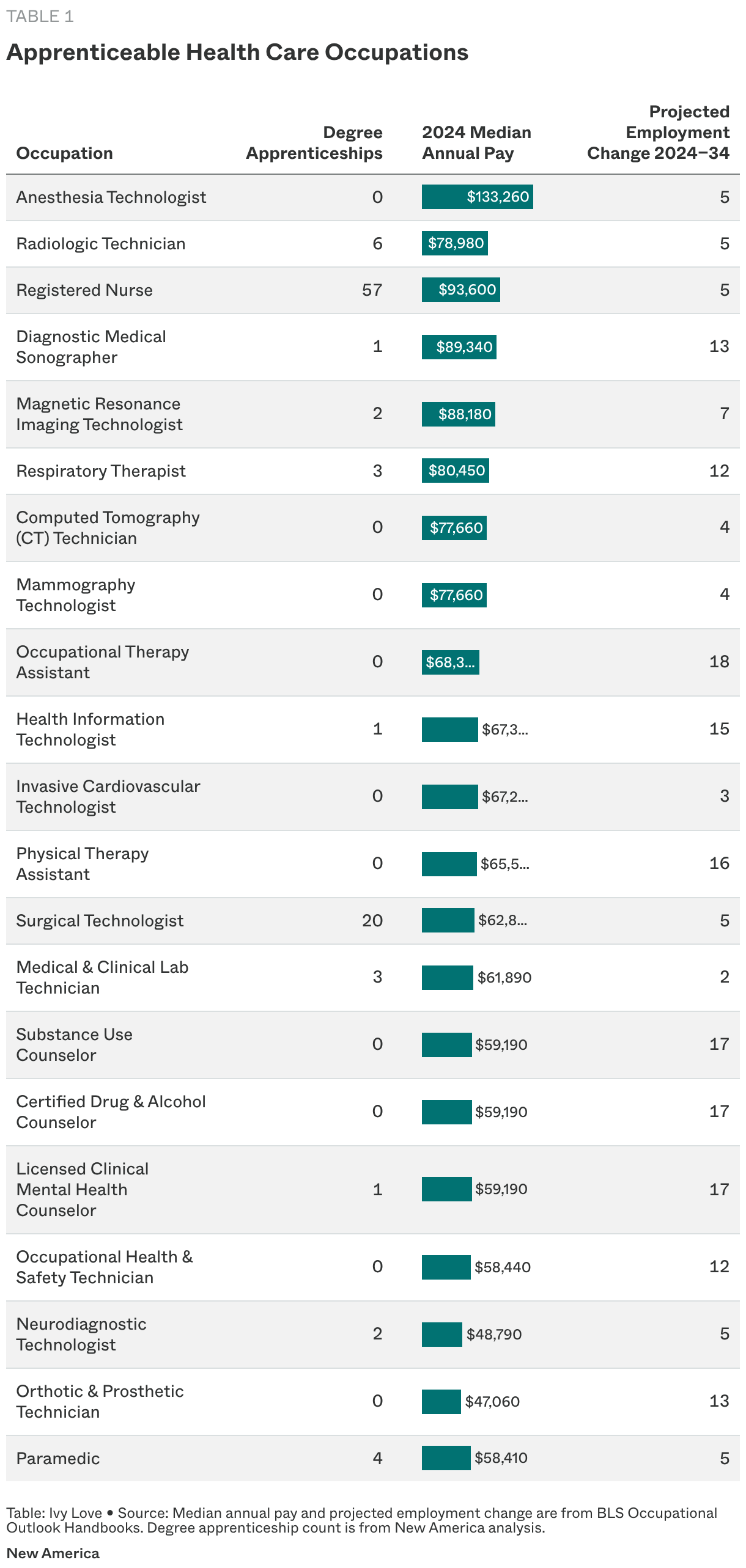
Degree apprenticeships also address a third important challenge in health care workforce development: Low-income people are shut out of good opportunities. Many health care occupations can provide genuine economic mobility for workers and their families because they pay well. The median annual earnings of radiologic technologists, respiratory therapists, and registered nurses are $78,980,19 $80,450,20 and $93,600,21 respectively, all above the national median annual wage. Yet some programs are oriented toward full-time students who are available to attend class during the day, have no caregiving responsibilities, and do not need to work to support themselves. Scanning program catalogs for nursing and allied health degree programs reveals that many are offered only to full-time students on weekdays,22 and that many strongly discourage more than part-time work while enrolled.23 Compounding the problem are the hundreds of hours of clinical experiences that nursing and allied health students must complete as part of their education and preparation for a state license or other credential, on top of their coursework.24 This experience is almost universally unpaid, under the rationale that its exclusive purpose is education,25 though some have noted that students often perform tasks for which other unlicensed employees, like patient care technicians, are compensated.26
Colleges and universities establish full-time requirements and expectations that students will minimize outside work because they know these programs are difficult, and they want students to be successful. Arguably, requiring students to complete clinical experience without pay helps ensure its focus is on learning. But degree apprenticeship offers another way to achieve those goals, and it unlocks opportunities for more people. Paid work, with progressive wage increases, is integrated with learning. As one registered nursing apprentice in Alabama told us, earning while learning makes all the difference: “I have three kids, and I’m a single mom, and I wouldn’t have had time to work on the side. If I had to choose paying my mortgage over nursing school, I’d choose my mortgage. Being paid and having pay raises each semester has helped me to afford nursing school.”
Taken together, these three challenges make a compelling case for degree apprenticeship. By integrating paid work, academic instruction, and structured training, the model has the potential to address many issues that plague health care workforce development. Yet despite this promise, degree apprenticeship remains concentrated in only a handful of health care occupations (see Table 1). Understanding why requires looking beyond the workforce challenges themselves and toward the systems responsible for preparing health care professionals.
To learn more about the availability and characteristics of degree apprenticeships in health occupations in the United States, we supplemented the search we conducted during summer 2025, described in the appendix of Mapping the Landscape of Degree Apprenticeship, with a series of internet searches using Google in March and April 2026.27 We reviewed the first 700 items retrieved using the search terms apprentice and apprenticeship and the title of each occupation determined to be apprenticeable by the Office of Apprenticeship (e.g., “registered nurse”), as well as some variations of the title (e.g., “surgical technologist” and “surgical technician”), and looked for Registered Apprenticeships that were paired with an associate, bachelor’s, or graduate degree. We also reviewed listings in the Partner Finder directory on Apprenticeship.gov,28 as well as directories published on the websites of state apprenticeship agencies. We excluded Registered Nurse Resident apprenticeships from our inventory because the apprenticeship occurs entirely following the award of a nursing degree. We conducted Zoom interviews with 20 leaders of programs we identified through our research, as well as other health care experts who could provide context for the work of the innovators we encountered.
If degree apprenticeship addresses many of health care’s capacity, efficiency, and equity challenges, why has it not spread more quickly? While we identified more than 100 programs nationwide, they are concentrated in just a handful of occupations, leaving many high-demand health care careers with few or no degree apprenticeship options.
Our research suggests the answer lies in the complexity of health care workforce development itself. The infrastructure of health care workforce development involves a number of actors, including employers, colleges and universities; institutional and program-level accreditors; and, for some occupations, state boards and national certification bodies. Degree apprenticeship introduces Registered Apprenticeship, a system with its own rules and actors, into this already complex landscape.
Degree apprenticeship brings these systems together and forces them to question many long-standing structures and practices, sometimes exposing areas of misalignment. Where these can be addressed, degree apprenticeship has begun to flourish, yielding benefits for learners and employers alike. But when they cannot, implementation can stall, even in occupations deemed apprenticeable.
Our interviews revealed that many of the most significant barriers to degree apprenticeship are embedded in the governance structures, accreditation standards, and regulatory requirements that shape health care workforce development.29 Designed over decades to promote quality and protect patients, these systems also shape if and how innovation occurs, and whether new approaches to preparing health care professionals can take root.
By the Numbers: Where Degree Apprenticeship Exists Today
Our scan identified:
Accreditors, professional associations, and state regulatory bodies like state nursing boards are the gatekeepers who determine whether degree apprenticeship is viable. They play an important role in promoting quality in the American health care system, and their concern for assuring that apprenticeship preserves that quality and protects patient safety is well-placed. Apprenticeship also continues to be associated with the skilled trades for many, and that may make it difficult to imagine the model succeeding outside that context. Yet our sense is that a key barrier to wider adoption of degree apprenticeship in some health care occupations is not so much opposition from the gatekeepers than it is the absence of explicit endorsement. We found some higher education leaders almost reflexively certain that accreditation and occupational regulatory requirements make degree apprenticeship impossible. But, as we discuss later, those who sought permission or support and approached gatekeepers in a spirit of collaboration succeeded in creating degree apprenticeships.
When gatekeepers support degree apprenticeship, it thrives. In 2023, for example, the accreditor for surgical technology associate degree programs, the Accreditation Review Council on Education for Surgical Technology and Surgical Assisting, publicly embraced degree apprenticeship as an important strategy to address the severe shortage of surgical technologists and explained to surgical technology educators how apprenticeship can be integrated with an associate degree program that meets its accreditation standards.30 These programs have begun to flourish: Surgical technology programs were the second most common type of degree apprenticeship we identified in our search. Similarly, when the Alabama Board of Nursing enacted rules authorizing registered nursing apprenticeships in 2022, the model took off in that state.31
Disagreement over the purpose of clinical experience and whether it is compensated, as well as differences in its timing, is another barrier. Unpaid clinical experience is a norm in health care occupational preparation that makes it difficult for apprenticeship to get started. While accreditation requirements are commonly cited as the reason clinical experience is often unpaid, we did not find this to be the case. We found only one accreditor of apprenticeable health occupations, the Commission on Accreditation for Respiratory Care, that prohibited payment for clinical experience in its standards for respiratory therapy associate degree programs.32 As we discuss later, however, it removed this requirement earlier this year and clarified that students may receive payment as part of a Registered Apprenticeship.
The unpaid mandate, however, may be a state regulatory requirement or an interpretation of state requirements. (An exhaustive review of state rules for health care occupational preparation was beyond the scope of this paper, but it merits investigation.) In other cases, educators resist paying students out of concern that clinical experience could become “just a job” and lose its educational focus. As Jay Prosser, executive director of the Massachusetts Nursing Council on Workforce Sustainability, put it, educators do not want to “deprive the student of a structured and valuable learning experience.”
The story is different for occupational therapy assistant (OTA) and physical therapy assistant (PTA), both of which were deemed apprenticeable in 2024 as part of the partnership between the U.S. Department of Labor and the Urban Institute to develop National Occupational Frameworks.33 We were unable to locate any current or developing degree apprenticeships in either occupation. Here, the barrier is the expectation for when clinical experience occurs.
The Accreditation Council for Occupational Therapy Education (ACOTE) requires students in OTA programs to complete 16 weeks of full-time “fieldwork,”34 which colleges typically schedule only after students complete their academic coursework. The College of the Canyons’ OTA program, for example, schedules this fieldwork in the final semester.35 This back-loaded clinical experience expectation mirrors ACOTE’s standards for master’s and doctoral degree programs for occupational therapists, which require 24 weeks of full-time “fieldwork,”36 which programs like the University of South Alabama’s schedule after all academic requirements have been completed.37 Similarly, the Commission for Accreditation in Physical Therapy Education’s accreditation standards for PTA associate degree programs require students to complete six weeks of clinical experience at the end of their academic program,38 while requiring physical therapy doctoral programs to include 30 weeks of full-time clinical experience, some of which must occur at the conclusion of the program.39 These expectations effectively prevent apprenticeships that are coterminous with a degree.
This is an American choice. The World Federation of Occupational Therapists’ Minimum Standards for the Education of Occupational Therapists gives programs discretion to determine when fieldwork occurs, indicating “fieldwork placements can be distributed throughout every year of the curriculum as suitable for the culture and context.”40 The United Kingdom’s system of educating occupational therapy professionals does not back-load clinical experience. Preparation for an OTA practitioner, which is the closest equivalent to an occupational therapy assistant in the United States,41 is often an apprenticeship. For example, the University Centre Weston at Weston College’s OTA practitioner foundation degree in science program is an apprenticeship in which students spend one day a week in the classroom and four days at the worksite.42 U.K. preparation for occupational therapy, which is a bachelor’s degree program43 rather than a graduate program as in the United States,44 also integrates clinical experience with academic instruction throughout the program. City St. George’s, University of London’s three-year bachelor’s in science degree program, for example, embeds four full-time supervised clinical experience placements that total 1,000 hours across the three years of the program.45 The Royal College of Occupational Therapists, which accredits occupational therapy bachelor’s of science programs, promotes its delivery as degree apprenticeships.46 In England, 20 universities now offer occupational therapy bachelor’s degree apprenticeships.47
Degree apprenticeship does not simply introduce another training model into health care; it challenges long-standing practices that shape how health care professionals are educated and the roles different system actors play in educating them. In doing so, it functions as a stress test for the health care workforce development system, revealing where policies, regulations, and institutional practices support innovation and where they stand in its way. The most successful programs are not those that avoid these tensions, but those that bring employers, higher education institutions, accreditors, licensing bodies, and apprenticeship leaders together to work through them. The implementation strategies described below illustrate how programs across the United States are doing exactly that in their quest to make degree apprenticeship a more widely used model.
From our research and interviews, we found that five strategies make degree apprenticeship successful for health care careers: (1) collaborating with accreditors and state regulatory bodies; (2) delivering online asynchronous related technical instruction for flexible learning; (3) compensating apprentices for clinical experience; (4) creatively relieving clinical capacity constraints; and (5) recruiting apprentices who are familiar with the health care environment.
One instructive example of the power of working collaboratively with accrediting and regulatory organizations is respiratory therapy. This occupation was deemed apprenticeable by the U.S. Department of Labor (DOL) in January 2026, though some states with state apprenticeship agencies48 have had respiratory therapy apprenticeships in place for some time. A degree is required to work as a respiratory therapist, so apprenticeships in respiratory therapy will, by default, be degree apprenticeships. We heard from several interviewees that employers had been expressing interest in respiratory therapy apprenticeships. However, the paid on-the-job learning essential to Registered Apprenticeship was prohibited by the Commission on Accreditation for Respiratory Care, or CoARC, the national professional body that accredits respiratory therapy programs. CoARC’s 2022 standards, as amended in March 2024, read, “Students must not receive any form of remuneration in exchange for patient care they provide during programmatic clinical coursework.”49 Without occupational consensus and support, there could be no apprentice designation for respiratory therapy.
With this holdup at the federal level, Wisconsin was home to an early degree apprenticeship in respiratory therapy, launched in 2024. This program benefited from an employer and sponsor—UW Health—with apprenticeship experience, sufficient preceptors for apprentices’ clinicals, and a good relationship with Madison College, the technical instruction provider. The three-year program is structured so that apprentices work as respiratory therapy assistants during the first year and then as student respiratory therapists for the next two years. The Wisconsin Department of Workforce Development now has a model for a respiratory therapy apprenticeship available for employers to tailor as needed.50 The program’s related instruction is aligned with associate degree programs within the Wisconsin Technical College System.
Meanwhile, Michigan employers were asking for a respiratory therapy apprenticeship and expressed that to Jan Karazim, program manager for the Health Careers Alliance. She let these employers know that, as an Office of Apprenticeship (OA) state, there was currently a roadblock to apprenticeship because the occupation had not yet been deemed apprenticeable by the DOL. Another group in Michigan had tried unsuccessfully to move the occupation forward, and Karazim decided to try again. She first convened community college faculty and respiratory therapists to get up to speed on the specifics of the profession and to prepare to engage professional associations that had expressed some hesitation around apprenticeship. She then contacted national respiratory therapy organizations to discuss the possibility of apprenticeship and, she emphasized, to inform them that respiratory therapy apprenticeships were already being developed in states with their own apprenticeship agencies. “It’s already happening,” she told them, “and I’ve got this group of employers in Michigan that want to do it. We really need your help. We want you to help us get this occupation approved and be part of it.” Taking time to answer questions from these organizations and build trust paid off, and all three signed off on a letter supporting the apprenticeability of respiratory therapy.
New CoARC accreditation standards taking effect in 2027 acknowledge the place of apprenticeship in entry to the respiratory therapy profession. Regulations continue to emphasize that apprentices cannot take the place of professionals or stand in as backup for regular staff.51 The framing of this clarification makes clear the goal of protecting students from exploitation and makes space for the many ways that apprenticeship is a viable and acknowledged path into a profession, where student-apprentices can have extended on-the-job training while being well-supported and engaged in a rigorous degree program.
As with respiratory therapy, registered nursing degree apprenticeships started in states with State Apprenticeship Agencies (SAAs). Alabama’s student nurse apprentice permit is rightly cited as a successful model of nursing apprenticeship, allowing nursing student-apprentices to be paid wages while completing clinical hours and on-the-job training over the course of their degree program.52 The apprentice permit was facilitated by the Alabama Office of Apprenticeship and close collaboration among a variety of stakeholders, including the Alabama Board of Nursing.53 However, those in OA states only became able to develop prelicensure registered nursing apprenticeships in 2025.
South Texas College faced several barriers to launching an associate degree nursing apprenticeship, but it is now moving forward, with wisdom to share with others. Challenges in its service region drove the college’s interest in apprenticeship: a nursing shortage, a nursing faculty shortage, and a worrying 37 percent of newly licensed nurses leaving their first job. However, it quickly realized that the DOL did not recognize registered nursing as apprenticeable, even though some SAA states had already launched degree apprenticeships in nursing. In other words, there was no federally approved registered nursing apprenticeship that could provide a blueprint for Texas to adopt. Because apprenticeship represented a new approach, the Texas Board of Nursing sought additional information regarding its structure, educational safeguards, clinical requirements, employer responsibilities, and alignment with nursing education regulations. With conversations around the mechanics of apprenticeship, the importance of pay for clinicals, and the promise of meeting crucial workforce needs through apprenticeship, state nursing, higher education, and workforce stakeholders came to an agreement to move forward with an application for apprenticeability, which was approved in 2025.
With registered nurse named as an apprenticeable occupation, the door is wide open for more nursing apprenticeships in OA and SAA states alike. However, there are still some state-specific policies to attend to. The National Council of State Boards of Nursing recommends that state nursing boards set standards for prelicensure nursing educational programs and clinical learning experiences and establish procedures to approve these programs, but states vary in the degree of specificity of their program regulations.54 For example, North Dakota, among other states, has a provision in the state administrative code for the Board of Nursing allowing innovation in nursing education.55 Schools of nursing may apply to implement a change or pilot a program in nursing education that would enhance students’ experiences or learning outcomes. Lake Region State College successfully proposed nursing apprenticeships to the state board of nursing as just that: an innovative practice.
We asked interviewees how they successfully engaged accreditors and regulatory bodies, understanding that they might have had some concerns about Registered Apprenticeship. Several themes emerged clearly around dispelling myths about apprenticeship, working to build trusting relationships with these bodies, and coalescing around the urgency to prepare more people for nursing and allied health professions.
David Polk, director of the Bureau of Apprenticeship Standards at the Wisconsin Department of Workforce Development, shared the importance of engaging with regulatory bodies and considering the expertise each party brings. “I’m not a subject matter expert for the [respiratory therapy] occupation at all,” he said. “I’m a subject matter expert for the Registered Apprenticeship structure. But you all that have been in coordination with these certifying bodies for a very long time, they know you, they know your voice, they know your expertise. You go and advocate for any leeway that we may need in the certification to make this thing an apprenticeship.” The health care degree apprenticeships in Wisconsin suggest this strategy is working.
Other interviewees strongly concurred that those with subject-matter expertise and experience in allied health professions make the best liaisons with state and professional regulatory and accrediting organizations. Melana Howe leads apprenticeship programs at Lake Region State College in North Dakota and has been a registered nurse for 50 years. She said, “We come with credibility, and we come knowing what the scope of nursing is. I recommend you approach the licensing Board [about] becoming a partner in the initiative. The chances of success are always much higher if you don’t go in with a new concept and tell highly educated professionals what to do. Working in partnership with the Board from the start strengthens the concept and builds the shared support needed for successful implementation.”
Across interviews, we heard repeatedly that trusting relationships with licensing boards can prove essential in the face of seemingly fundamentally conflicting requirements between the way things are and the way things could be done in apprenticeship. Jayson Valerio, regional health care liaison at South Texas College, felt that approaching the Texas Board of Nursing with the idea of a registered nursing apprenticeship as an innovative practice was helped along by the fact that the college had previously worked with the board on another innovation in nursing education: a dual credit associate degree for high school students. Building credibility and willingly addressing concerns are not steps one can skip in conversations with accreditors and regulators. Jan Karazim knows this well and shared how jumping directly to seeking support for apprenticeship can derail progress. “You’ve got to engage people so that they understand what [apprenticeship] is,” she said. “I wouldn’t sign a letter of support unless I truly understood what was going on. Especially with Registered Apprenticeship and health care people, because there’s been such long-term assumptions made about what Registered Apprenticeship is.”
Even when there is hesitation around the degree apprenticeship model for nursing and allied health education, numbers do not lie. Accrediting and regulatory bodies are aware of an aging populace and workforce, workforce shortages, and a dearth of clinical placements and faculty. Bringing up the urgency of preparing new professionals well—and expanding pathways into nursing and allied health occupations—may create space for conversation about innovative education and training strategies, to include degree apprenticeship. In the face of workforce shortages, a number of employers approached the National Board of Surgical Technology and Surgical Assisting (NBSTSA) about new strategies. Employers’ enthusiasm for apprenticeship influenced NBSTSA to adapt their rules to make space for this model and for clinicals to count as on-the-job training hours.
Degree apprenticeship can reduce some barriers to earning a degree and entering nursing or an allied health profession through traditional pathways. Some traditional certificate and degree programs require students to attend full time, which is simply untenable for learners who need to continue earning wages while pursuing additional education. We encountered several leaders who employ creative strategies to deploy related technical instruction (RTI) encompassing a full degree in a way that maximizes accessibility for apprentices.
Program leaders can express hesitation around online learning in prelicensure programs, but Amy Lee, president of MWTEC, says the results speak for themselves. “You’ll get a lot of people that say, ‘Well, you can’t really do hybrid or online in these health care programs. It doesn’t work.’ But,” she says, “we have a 90 percent completion rate across all of our programs. Depending on the program, 85 to 90 percent pass their boards on their very first attempt. So that tells you that the model actually works.”
Online and asynchronous RTI can open up time for apprentices to engage in on-site learning, where it is essential to work in person. In Michigan, Lee says delivering RTI in this way allows apprentices to be available to work with mentors for skill assessment and support on the hospital floor during daytime hours, when traditional students might be in class. The College of New Jersey’s clinical mental health counseling master’s degree apprenticeship delivers some classroom instruction asynchronously and then convenes apprentices in class synchronously to practice and apply what they learned. The college accommodates the diverse work schedules of students by offering classes in the morning, at noon, and in the evening. Once established, their class schedule remains the same for the duration of the program so they do not have to rearrange their work hours each semester. Apprentices practice their skills weekly with the support of a workplace mentor outside of class before submitting skills demonstration videos for faculty feedback, creating a structured and responsive feedback loop. Sandy Gibson, chair of the Department of Online Counselor Education, reports that apprentices are demonstrating notably stronger clinical skills in their video submissions than non-apprentice students in comparable programs, suggesting that the integration of online learning with paid workplace practice and the support of a mentor deepens clinical competency in ways that traditional programs do not.
A full day of in-person classes on a college campus is not likely to work well for degree apprentices or employers. Creative approaches like online instruction can reduce commute time, provide access to a simulated learning space, and allow for a work-first schedule integrated with classroom learning at a time that works best for apprentices.
Expanding clinical placement sites is paramount in nursing and allied health, for traditional programs and degree apprenticeships alike. In fact, the issue becomes more challenging in health care, because Registered Apprenticeship requires trained worksite mentors to support on-the-job learning, and health care degrees also require clinical supervisors. However, several of the degree apprenticeship programs we encountered were creative in increasing clinical capacity.
In Wisconsin, employer leadership broke the logjam to create the state’s first registered nursing associate degree program at Madison College. After Madison rebuffed University of Wisconsin Health’s proposal for a nursing apprenticeship because of its capacity constraints, Bridgett Willey, then UW Health’s director of Allied Health Education and Career Pathways, invested in increasing the college’s clinical capacity. She hired four registered nurses who were trained and appointed by the college as clinical preceptors at no cost to Madison. UW Health also built a new simulation center and provided classroom space on its premises, working with the college to obtain its accreditor’s approval of them as satellite instructional sites. With the capacity issues resolved, Madison agreed to launch the apprenticeship that UW Health designed and sponsored. The program is currently serving 64 nursing apprentices.
UW Health’s internal research indicated that a registered nursing apprenticeship had the potential to generate savings that might exceed the costs of the capacity enhancements by reducing attrition. A 2025 survey of hospitals found that the average cost of turnover for each hospital nurse was $60,090 in 2025, and estimated that reducing nurse attrition by just one percentage point could save the average hospital $295,000 annually.56 Two health care organizations also told the Government Accountability Office that they had implemented nursing apprenticeship programs partly because they cost less to develop than to hire traveling nurses,57 whose median hourly wages can be more than 50 percent higher than those paid to regular employees.58 UW Health WorkForward, the organization that Willey now leads, is focused on helping other employers activate the savings possible through apprenticeships.
MWTEC solved the capacity challenge in another way. As a nonprofit consortium of Michigan community colleges and health care employers that work together to deliver online and hybrid degree programs in nursing and allied health occupations—some of which are degree apprenticeships, including magnetic resonance imaging (MRI) technologist, registered nursing, surgical technology, and respiratory therapy—its model allows small and rural colleges to offer highly specialized programs that would be financially unsustainable if they tried to operate them alone. MWTEC designs programs so that students complete their general education coursework at their home institutions while taking coursework in their health discipline online. Student-apprentices complete their hands-on clinical hours and on-the-job learning at hospitals and health systems located near their home communities, unlocking clinical training capacity at smaller and rural facilities that would otherwise go untapped. Through this strategy, MWTEC has dramatically expanded allied health enrollment across Michigan and recently extended its reach to employers in multiple states who cannot find programs willing to train their workforce using an apprenticeship model.
Texas is one state where state higher education regulations proscribed payment for clinical experience for registered nursing students. Here, the collaborative relationship that South Texas College has established with the state nursing board proved vital. The college coordinated with the nursing board in approaching the Texas Higher Education Coordinating Board about removing the prohibition. These discussions contributed to a shared understanding of how the apprenticeship model could move forward while maintaining compliance with nursing education and higher education requirements, and the prohibition on paid clinicals was repealed.
Where apprenticeship proponents have encountered resistance to compensating students for clinical experience, some have turned to offering students stipends, rather than wages, to ensure the program is financially viable for learners. In the emerging registered nursing apprenticeship model in Massachusetts, for example, apprentices will receive stipends for their clinical experiences and regular wages for the on-the-job learning hours of the apprenticeship, which will occur in parallel to their associate degree studies.59 Apprentices in Heartland Community College’s registered nursing associate degree program in Illinois also receive a stipend for their clinical experience. Employers recognized that paying the stipend was critical to keeping students on track to completion.
While degree apprenticeship addresses some important factors that contribute to lower rates of degree completion and early-career attrition in health care occupations, by, for example, providing support from a trained mentor and paying wages for learning, degree apprenticeships in health care remain a challenging pathway. For that reason, the successful programs we encountered were careful in recruitment of apprentices who were already familiar with the health care environment and what it entails.
One North Carolina community college, for example, uses a structured, multistep process to recruit and screen nursing apprentices from current students. Staff visit classrooms to introduce the apprenticeship concept, waiting until the second semester to avoid recruiting students who may drop out in the first semester. Interested students then complete a student interest form, meet with a career navigator for a deeper conversation, and build a résumé before becoming eligible for a hiring event where employer partners select from the pool. South Texas College uses a similar strategy.
For degree apprenticeships, UW Health recruits exclusively from its own workforce, in part because multiyear programs require levels of commitment and familiarity that UW Health has learned are less likely to be found among external hires. External hires, however, are recruited for nondegree apprenticeships. In this way, a degree apprenticeship becomes a powerful upskilling strategy. Bridget Willey, executive director and chief operating officer of UW Health WorkForward, explains, “When you talk with these apprentices and you hear why they’ve applied for these programs, you learn they have wanted to step into these roles forever, and they just have not been able to have that opportunity.”
One of the reasons that employers and several of the colleges in California’s Launch Apprenticeship Network started nursing apprenticeships was because they wanted to strengthen pathways to nursing for incumbent workers who were certified nursing assistants (CNAs) and licensed vocational nurses. That’s also a chief reason that Jay Prosser, executive director of the Massachusetts Nursing Council on Workforce Sustainability, advocates for nursing apprenticeship. He’s looking for funding to develop English literacy bridge programs to strengthen the pathway to nursing for CNAs whose first language is not English. “We offer the Massachusetts CNA examination in four languages—English, Spanish, Chinese, and Haitian Creole—to try to encourage non-native English speakers, [saying] ‘Hey, get into health care.’ The problem is that that’s all we do for them. We do not give them a pathway forward.” For people who are new to the field, Prosser recommends creating pre-apprenticeship programs that are lower cost and lower risk for employers and offer an orientation to careers in health care.
Note: On August 17, 2026, the authors updated David Polk’s title.
The degree apprenticeship is not a miracle cure. It will not create more faculty and preceptors or expand the capacity of the health care workforce development system. But it does promise to make the system more efficient by boosting degree completion rates and reducing early-career attrition. Students benefit from hundreds of hours of paid work-based learning, applying what they’ve been taught in the classroom and deepening their expertise. They’re supported by a trained mentor who can answer questions and offer support during difficult moments. And after the apprenticeship is over, there are no surprises on the first day as an independent professional. They know the job, they’re confident in their knowledge and skills, and they’re ready to work.
At the same time, degree apprenticeship opens doors to well-paying health care jobs to people who are now shut out of them. The certified nursing assistant who has always wanted to become a nurse but cannot stop working. The behavior technician who dreams of being a mental health counselor but cannot afford to take on a second unpaid job. The imaging aide with two children and bills to pay who wants to administer X-rays and not just escort patients to and from the waiting room. Degree apprenticeship is built to meet the needs of these aspiring health professionals.
Through collaboration and innovation, leaders around the country are creating degree apprenticeships for health care careers that are just as rigorous as traditional programs, but that are accessible to low-income people because they pay for the supervised practice hours that traditional programs require them to complete for free. They are implementing strategies that can transform degree apprenticeship from a promising idea into a scalable system. Online instruction allows apprentices to complete the classroom components of their degree programs around their work schedules, eliminating the barriers that have historically confined quality programs to well-resourced urban institutions. Regional employer collaboratives that share clinical training resources across institutions make it possible for smaller hospitals, rural health systems, and community-based behavioral health agencies to participate alongside large academic medical centers. And recruiting apprentices from within the health care system ensures that programs start with motivated participants who understand the demands of health careers, which shortens orientation time, strengthens clinical learning, and produces graduates who need no onboarding because they have been part of their employer’s team throughout their training. By itself, degree apprenticeship will not solve the health care workforce crisis, but it is a powerful tool to widen the pipeline and deliver the diverse, skilled health care workforce that America’s communities urgently need.
Senior Policy Analyst, Center on Education & Labor

Senior Policy Advisor, Center on Education & Labor