Intricacies of the State Fiscal Stabilization Fund for Education
Blog Post
Feb. 23, 2009
States, legislators and the public have engaged in endless speculation about the impact of the federal stimulus bill recently enacted, particularly as it concerns the State Fiscal Stabilization Fund. But the more people speculate, the more it becomes clear that many are misinformed about the purpose of the Stabilization Fund and the mechanics by which it will be distributed. Today we're going to walk you through the mechanics of the Stabilization Fund to help you understand what it really means for states and school districts.
As we've written before, the State Fiscal Stabilization Fund consists of three major parts to be administered by the Department of Education. The first is the State Incentive Grant program - $4.35 billion to be distributed via competitive grants to governors for education purposes. To qualify, each governor must submit their plans to improve the equitable distribution of teachers, the collection and use of data, the quality of standards and assessments, and the support provided for schools identified as in need of improvement under No Child Left Behind.
State Incentive Grants are expected to encourage states to improve their performance in these important academic indicators through extra, targeted boosts in funding. Governors must direct at least 50 percent of the Incentive Grants funds they receive directly to local education agencies (LEAs).
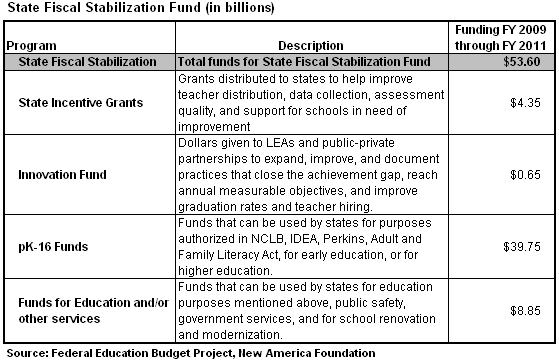
The second part of the State Fiscal Stabilization Fund is the Innovation Fund, a $650 million pot the Secretary can distribute to LEAs, or partnerships between non-profit organizations and LEAs or consortia of schools. To receive funds, LEAs or partnerships must be able to demonstrate progress in closing achievement gaps, exceeding state annual objectives, or improving other related indicators such as graduation rates or recruitment of high quality teachers. Funds can be used to expand current work, encourage partnerships with private and philanthropic organizations, and/or identify and document best practices.
The Innovation Fund is a more focused approach to encouraging new and innovative ideas for improving academic achievement. Rather than direct these funds to states, the Secretary will distribute them directly to LEAs or partnerships in order to support their efforts. Many hope that Innovation Fund dollars will help schools and LEAs identify and develop practices that improve student achievement.
The final, largest part of the Stabilization Fund is the $48.6 billion to help states maintain the higher of 2008 or 2009 funding levels for pK-16 education in 2009, 2010 and 2011. To receive these funds, states must maintain their spending at no lower than 2006 levels over all three years. The funds can be used to fill the gap between 2006 and 2008 or 2009 spending levels. So, if a state spent $200 million on pK-16 education in 2009 and $160 million on pK-16 education in 2006, they could use up to $40 million in state fiscal stabilization funds ($200M-$160M) to restore the lost funding.
States can also use the Stabilization Fund to increase state education funding levels, if a state law requiring such an increase was enacted before October 1, 2008, to improve the equitable and adequate funding of education. In other words, a state can use Stabilization Funds to achieve previously planned equity and adequacy goals that go above and beyond 2008 or 2009 funds levels.
Any remaining Stabilization Funds beyond what is used for these purposes must be distributed directly to LEAs in proportion to the amount of Title I funds they received in the most recent year with data available.
Ultimately, the $48.6 billion will be distributed to states that submit applications based on a formula that takes into account the 5-24 year old population (61 percent) and the total population (39 percent). As a result, states with larger populations will get more funds than states with smaller populations. Similarly, a state with a large school age population (5-24 years) will receive more funding than a state with a relatively smaller school age population but the same overall population.
Of the $48.6 billion, 81.8 percent ($39.75 billion) must be used for K-12 purposes authorized in the No Child Left Behind Act, the Individuals with Disabilities Education Act, the Perkins Career and Vocational Act, or the Adult and Family Literacy Act, for early education purposes, or for higher education purposes including education, general expenditures and efforts to delay tuition increases. This $43.8 billion cannot be used for construction, renovation, or modernization purposes.
For large states, stabilization dollars can amount to a huge sum of money. For example, California is predicted to receive $4.9 billion in Stabilization Funds specifically tagged for education purposes. Texas and New York, two other large states, will receive $3.3 billion and $2.5 billion, respectively. Small states, as a result of the population-based distribution formula, will receive far less. North Dakota will receive approximately $85.6 million, the District of Columbia will receive $73.1 million, and Wyoming will receive $67.6 million.
The remaining 18.2 percent ($8.85 billion) can be used for the above mentioned education purposes, public safety and other government services, or for school renovation and modernization, but not new construction. This pot of money has been particularly scrutinized because it represents the only stimulus funds that states and LEAs can use directly for school modernization.[1]
The amount each state will receive from this pot of funds also varies widely based on population. California, Texas, and New York are estimated to receive $1.1 billion, $723.2 million, and $549.2 million, respectively, in funds that can be used for education, public safety, government services, or school renovation and remodeling. In contrast, North Dakota will receive $19.1 million, DC will receive $16.3 million, and Wyoming will receive $15.0 million.
Although the Congressional Research Service has released estimates of the State Fiscal Stabilization Fund allocations to states, much still needs to happen before any state sees a single dollar. Governors must submit applications including reports of past education expenditures and plans for the use of funds, Secretary Duncan must set up an office to administer the program and distribute funds, and LEAs and schools must begin planning how to most effectively and efficiently use the funds they receive. No doubt, the next couple of months will be consumed with planning the distribution of this massive amount of money.
A spreadsheet containing information on the State Fiscal Stabilization Fund distributions to all 50 states, DC and Puerto Rico can be downloaded here.
[1] The Stimulus legislation also includes $11 billion in tax credit bonds for school construction in both 2009 and 2010 and $1.4 billion in tax credit bonds for Qualified Zone Academies (charter schools). This however, represents a tax credit, not direct usage of funds. So while schools and school districts will be able to take out tax-free construction bonds, they will still have to pay for the face value of the bonds.