New Higher Education Accountability Rules and Early Education: What We Know So Far
ECE-related undergraduate certificate programs could face the highest risks of not meeting the accountability standards, though specific impact still cannot be measured precisely
Blog Post

Shutterstock
March 2, 2026
The rules for federal student aid for higher education are changing significantly due to the implementation of the One Big Beautiful Bill Act (OBBBA). My colleague, Antoinette Flores, recently published a helpful update on what happened during negotiated rulemaking as the U.S. Department of Education worked to harmonize the higher education accountability provisions with a yet-to-be-enforced regulation known as Gainful Employment. The resulting new regulations attempt to stem student loan borrowing to programs whose graduates earn below a certain threshold amount. The goal is to ensure that low earners are not saddled with debt they are unable to repay. Because early educators typically earn low wages, these rules could have real impacts on ECE-related certificate programs in colleges and universities across the country.
New data recently released by the Department of Education, while limited, suggest that ECE-related undergraduate certificate programs could be at a heightened risk of not meeting the accountability standards, while associate and bachelor’s degree programs have a much lower likelihood of failure. Under the recently announced harmonized rules, programs whose graduates do not meet federal earnings benchmarks as measured four years after program completion could lose access to federal loans and, in some cases, Pell Grants.
Programs will be evaluated using the following framework:
- Undergraduate programs (including certificate programs): The median earnings of graduates four years after completion must equal or exceed the median earnings for working adults aged 25 to 34 with only a high school diploma in the same state, or the national median if fewer than 50 percent of students are in-state.
- Graduate programs: The median earnings four years after completion must equal or exceed the lower of either the median earnings for working adults aged 25 to 34 with a bachelor’s degree, working in the same field of study (defined at the two- or four-digit Classification of Instructional Programs (CIP) level as such data is available and statistically reliable) in the state in which the institution is located, or the national median.
The earnings threshold published by the Department in 2024 provides a starting point for estimating the updated threshold that will eventually be used for the earnings test for undergraduate programs. In 2024, the median earnings for adults aged 25 to 34 with only a high school diploma ranged from a low of $26,372 in Mississippi to a high of $37,850 in New Hampshire. With median earnings nationally for the ECE workforce at only about $27,000 as of 2022, it’s understandable that there is concern that some ECE preparation programs might not pass the earnings test.
The Department of Education will calculate the first earnings test in early 2027, with colleges notified of any initial program failures by July 1, 2027 (a detailed timeline is available here). A second round of calculations will occur in 2028, reflecting the second year of results. Under the rule, programs face a loss of access to federal student loans if they fail the earnings test in two out of three consecutive years. Failing programs lose access to federal student loans but can keep drawing on Pell grants. Only if most students at a college are enrolled in failing programs or a majority of a college’s federal aid flows to failing programs does the school lose access to both federal student loans and Pell grants.
While the data released thus far by the Department make it impossible to say exactly which and how many ECE-related programs might be impacted due to privacy suppression, it does offer the first broad estimates of how the regulations may affect ECE programs and related fields. Undergraduate certificate programs undoubtedly face the highest risk of failing the earnings test. About 31 percent of students in undergraduate certificates nationally are enrolled in programs projected to fail the earnings benchmark. Associate degree programs carry much lower risk, with single-digit percentages of students in failing programs failure rates, and bachelor’s degree programs are almost entirely above the threshold, with only one to two percent of students at risk.
Within fields of study, the category of “Human Development, Family Studies, and Related Services,” (CIP code 19.07), which includes many ECE pathways, is more frequently represented among undergraduate certificates that fail. Specifically, the Department estimates that about 77 percent of students enrolled in this field of study attend programs that would fail the modified test. Programs in this category include those focused on child development, family systems, early childhood and family studies, and parent education services. Within the category of “Teacher Education and Professional Development, Specific Methods and Levels,” (CIP code 13.12), another field of study that enrolls future early educators, the Department estimates that about 55 percent of enrolled students attend programs that would fail the modified test (see below table for details).
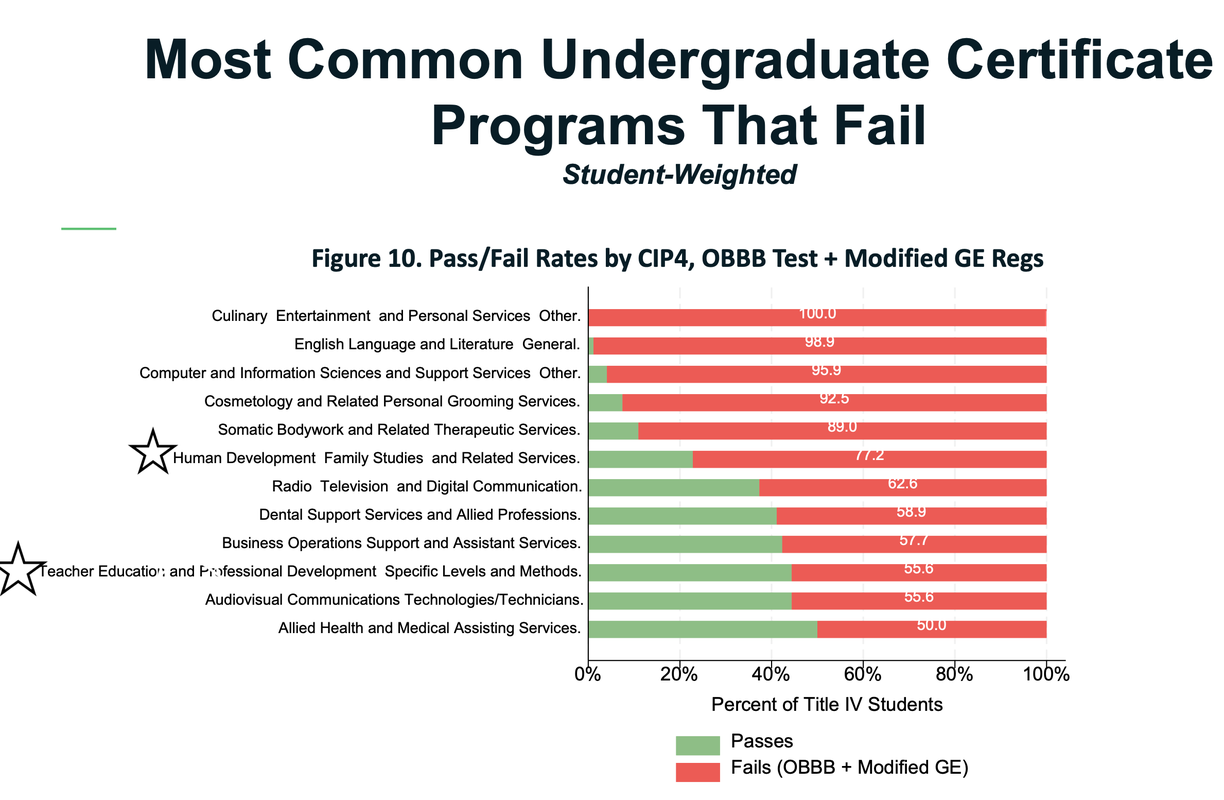
Source: https://www.ed.gov/media/document/2025-ahead-results-of-earnings-test-and-ge-changes-112932.pdf
For decades, the early childhood education workforce has faced a persistent wage crisis that has nothing to do with the quality or value of the programs training them. Rather than treat a failed earnings test as a sign of program failure, we should recognize it for what it is: a reflection of a broken compensation system in a field that society depends on. The real risk is not only to individual programs, but also to the pipeline of trained early childhood educators that communities across the country cannot afford to lose.
To reiterate, it’s impossible at this stage to say exactly how many early education programs will be impacted by the rules. The estimates released by the Department are measured at the four-digit CIP level, but actual earnings tests will be measured at the six-digit CIP level. We should know much more about potential impacts when the Department conducts its first earnings tests for specific programs in 2027.