From 'I' to 'We'
Weekly Article
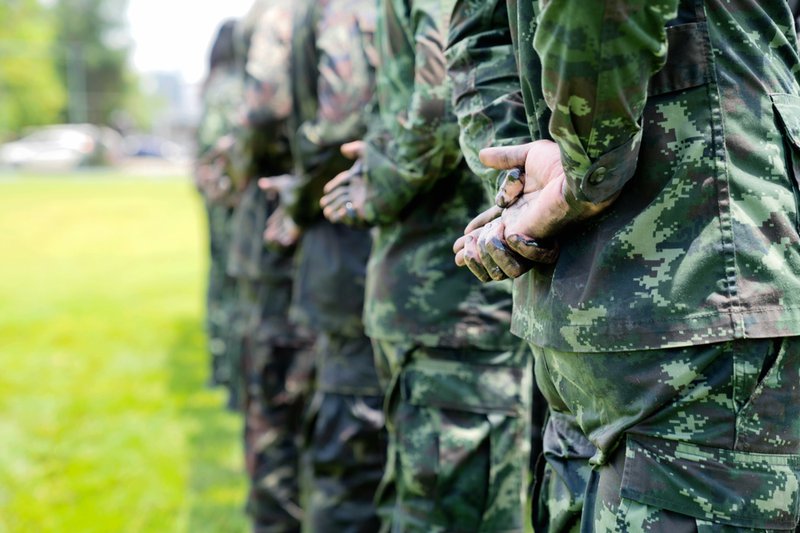
Golffy / Shutterstock.com
Dec. 13, 2018
“I thought about becoming a meteorologist for a while, because Oklahoma gets a lot of tornadoes.”
A young Dennis Wille had considered a career in weather forecasting. But that’s not how things turned out for him. He’s now U.S. Army Col. Dennis Wille, and his two decades in the military have given him lots of opportunities, in places from Berlin to Washington, D.C., from Kuwait to Bosnia. But that diversity of opportunity and location isn’t the most important thing he’s received in his military career: It’s the community of men and women who share his values, and a unique and nurturing support system he knows that he can count on—even long after his formal service ends.
America’s military is so strongly linked to its external mission, to the sharp edge of its foreign policy, that that kind of power can bring attention to its mistakes and issues like the pervasiveness of PTSD and high suicide rates. And yet, there are things it does get right. For one, few institutions are as cohesive and community-oriented as the military. And none are more trusted by the American public—something especially important at a moment of deep division in the United States.
I spoke with Wille, who’s also an Army Fellow at New America, and others about their experiences in and with the military. A common theme throughout our conversations was how the military component of their lives has helped shape them into better members of society.
This has largely been via fostering values that benefit communities by making them stronger and more unified. Or as Col. Timothy Coon, a former Glastonbury, CT, town council-member, once put it, “it subordinates the I to we.”
Wille described to me the radical transformation that ensues when someone joins the Army. “We had to learn a lot. We had to memorize a lot of stuff as freshmen,” he said. One of these things was the plank of plebe knowledge known as, “What is the definition of leather?” which cadets must recite whenever asked. It reads as follows:
If the fresh skin of an animal, cleaned and divested of all hair, fat, and other extraneous matter, be immersed in a dilute solution of tannic acid, a chemical combination ensues; the gelatinous tissue of the skin is converted into a non-putrescible substance, impervious to and insoluble in water; this, sir, is leather.
This process of creating leather, Wille explained, is, in its own way, similar to when a person becomes a soldier—that person is stripped of their possessions and put through both physical and psychological stress—and it’s something he’s “carried with [him] for a very, very long time.”
Of course, this change is the result of a lot of work, time, and discipline, and, in ways, it’s not unlike the sort of community-building that takes place in other parts of society. In churches or at workers’ unions, for instance, members must sometimes let go of certain pre-existing beliefs or doubts in order to fully immerse themselves in the community. And when that change is successful, and when members embrace it, communities can be better off for it.
“Unit cohesion, esprit de corps—all of those terms that you use to talk about groups of people working together—we emphasize that to an extreme, because we need to make sure that our teams work together.”
And yet, the military’s approach is also distinct. An essential component of military bond-building is its unique focus on teamwork. As Wille explained it to me, “Our emphasis on teamwork is to ensure that the human beings that are faced with the most stressful experiences of combat don’t just turn tail and run as individuals, because they would [then] let the team down.” In a similar vein, also integral to creating community is trust. Without trust, failure is likely. And in the case of the military, that lack of trust can be deadly. And as Coon wrote, “cohesion is trust amongst unit members; it is formed in the shifting of individual loyalty to group loyalty.”
Importantly, trust is a crucial component not only of successful missions, but also of strong social capital—or the norms and values of trust and reciprocity among community members. As Maj. Charlie Lewis, an instructor at the U.S. Military Academy at West Point, wrote, social capital strengthens two of the five essential characteristics of the Army profession—trust and esprit de corps: “The Army Culture spurs the growth of social capital within the Army Profession, breeding opportunities to use the norms of reciprocity, trust, pride, and mutual assistance.” Wille echoed this sentiment: “Unit cohesion, esprit de corps—all of those terms that you use to talk about groups of people working together—we emphasize that to an extreme, because we need to make sure that our teams work together.”
With strong teamwork and unwavering trust, thriving communities, like the ones built and bolstered by the military, can be inclusive, and celebrate individuality while also reminding members of their responsibility to one another.
This notion of mutual responsibility can be a grounding force, and enhance people’s sense of belonging. Brandon Tensley, New America’s associate editor, told me, “For lots of people—like my parents, who were in the Army for 20-plus years—joining the military almost immediately out of high school offered them opportunity in ways that weren’t otherwise available to them.” These opportunities can come in a variety of forms, like GI Bill benefits and health care.
In the Army, this feeling of belonging to a particular community happens by virtue of proximity, sure, but also through concerted efforts to ensure that soldiers and their families truly feel like a community. The Army’s Morale, Welfare, and Recreation (MWR) programs, for instance, aim to support readiness and resilience for soldiers and families. Libraries, arts and crafts, sports, and child and youth services are just some of the ways the Army seeks produce bonding social capital, or social capital created between individuals of similar groups. Other services, such as community support, can create bridging social capital, or connections that are cross-cutting, stretching networks of trust and reciprocity between the military and civilians.
For Lewis, the proximity of a military base to a community can be a source of “individuals who broaden perspectives, provide financial benefits, and live among the civilian populace.” These bridging social capital opportunities are important because they tackle the growing disconnect between those who serve and those who don’t, aggravated by geographic sorting, which can leave individuals exposed to little diversity—be that racial, cultural, religious, or something else.
To be sure, there’s still lots of room for growth. Issues like a lack of diversity and inclusion are prevalent in all branches of the military—in some more than others. Plus, work-life balance is hard to strike, and a poor transition into retirement can take men and women to dark places.
But at their core, the values that servicemen and women learn and carry with them, even after they retire, are a testament to how it’s possible to build institutions that foster firm community. Teamwork. Trust. Mutual responsibility. The military, indeed, shines a light on how these values that seek to rein in the more negative and dangerous aspects of individualism can serve as models for how our public and private lives can come together, making us all better.