

Worker Voices: Technology and the Future for Workers
Abstract
Narratives around the future of work often center on the risks to workers in male-dominated and machine-heavy professions like truck driving and manufacturing. But our research and other recent publications suggest that substantive changes are ahead for sectors like food service, retail, and clerical work and have the potential to disproportionately impact women and African American and Hispanic workers. We went directly to a diverse group of workers who are at the forefront of change, but who are all too often absent from these discussions. We asked them about their lives, their experiences with their jobs and their dreams and fears for themselves and for a technology-altered future in general.
For many workers, the future is already here. Food, retail, and grocery workers have witnessed rapid change in recent years, especially in the front end of their stores. Most feel they lack a voice in these changes and feel pessimistic about the future for humans in their stores. Advancing technological change is not occurring in a vacuum, but rather in a time of increasing economic precarity and inequality; unequal care and domestic burdens; and the rootedness, responsibilities, and stories of workers’ lives. Low pay and economic insecurity sharply limit workers’ ability to prepare for—and access—a better future of work, and women face many barriers. Workers are thinking about, and responding to the possibilities of a technologically enabled and dehumanized future in the context of their current situations. The current educational and workforce systems make career transitions extremely difficult, and workers often have trouble acquiring the skills and credentials they desire. Policymakers will improve the odds of building effective programs by paying attention to the wider human context and by addressing the needs of a greater diversity of workers who will shoulder the greatest burden of the change.
Downloads
Executive Summary
“I know technology is changing our world. But people can’t be left behind.” – Legal assistant, 65
The meaning of work is profoundly personal, and deeply felt. When work changes, it is not only jobs that are disrupted. So too are the lives of the people who hold those jobs and the families they support. In recent decades, economic shifts have eroded the stability, financial security and power of many American workers. While fears of a robot apocalypse and mass unemployment are overblown, artificial intelligence and automation can exacerbate the inequality and instability many workers already experience. Technological change will disproportionately affect those who are already struggling to secure a stable foothold in the economy.1 Without concerted effort to redesign the rules of the game, most workers will continue to be excluded from prosperity.
Narratives around the future of work often center on the risks to workers in male-dominated and machine-heavy professions like truck driving and manufacturing. But our research2 and other recent publications3 suggest that substantive changes are ahead for sectors like food service, retail, and clerical work and have the potential to disproportionately impact women and African American and Hispanic workers.4 We went directly to a diverse group of workers who are at the forefront of change, but who are all too often absent from these discussions. We asked them about their lives, their experiences with their jobs and their dreams and fears for themselves and for a technology-altered future in general. Here are our main findings:
The present of work impacts workers’ future. Low pay and economic insecurity sharply limit workers’ ability to prepare for—and access—a better future of work. The layering of burdens on workers through low wages, debt, expensive cost of living, and lack of savings create daunting headwinds for many frontline workers in fast food, grocery, and retail. Many struggle for hours, benefits, and decent pay, and feel their job quality has worsened over time. While technological change is not the direct cause of workers’ precarity, it can add insult to injury. Automation and the adoption of new workplace technologies can exacerbate financial insecurity when jobs change, wages or hours are suppressed, or when workers are displaced altogether. Economic insecurity also limits workers’ resilience to technology changes by undermining their ability to weather a job transition, pay for training or schooling, and move into better paying—and less automatable—work. If workers cannot afford to make ends meet today, they will be ill-equipped to prepare for tomorrow. Raising income, reducing inequality and improving the economic security of workers is key to enabling a better future of work for those at greatest risk of change.
Technological change is at odds with workers’ overwhelming desire for stability. An inadequate social safety net and benefit system makes job disruption worse. More than anything else, workers expressed a desire for stability—and especially benefits—from their job. Most workers, especially older workers, did not want any change at all. This consistent desire of workers for stability is at odds with the changes and instability that technological change will unleash. Artificial intelligence and automation will alter the organization and nature of work, the demand for skills, the tasks involved in existing and new occupations, and the requirements for a good living. Some workers will need to adapt to new job activities and new technologies on the job, while others might need to develop entirely new skills—or change jobs altogether. The workers who will experience these changes will be even more vulnerable to instability because of the connection between employment and benefits and the limitations of the social safety net. The current system of employer-provided benefits and the broader safety net system requires a major overhaul to better meet the needs of low-wage and middle-skilled workers at risk of automation and technological change.
The jobs of the future need to be good jobs. A surprising number of administrative and clerical workers whom we interviewed previously worked in fast-growing care and other “pink-collar” jobs like social work and education, which failed to provide them with the stability and benefits they desired. These workers described finding satisfaction in better quality and more stable clerical and administrative jobs, which are projected to shrink by several hundred thousand positions in the next 10 years alone. In comparison, the care jobs that will grow fastest over the next decade are much lower quality with poor pay, poor working conditions, and less stability. To ensure a better future for workers, and especially for women and workers of color, it is imperative that policymakers prioritize making the fast-growing jobs of the future good jobs.
Technology is already changing jobs and workplaces. Many fast food, grocery and retail workers feel it is change for the worse. Food, retail, and grocery workers have witnessed rapid change in recent years, especially in the front end of their stores. Workers described the recent introduction of a range of technology-enabled innovations, including self-order kiosks, Uber Eats, mobile payment, store apps, curbside pickup, grocery delivery, online shopping, self-checkout lanes, and new scanning technologies. Interviewees expressed sharply negative views about technology like self-checkout, which they view as displacing jobs and contributing to their struggle to secure hours and benefits. Clerical and administrative workers described day-to-day use of software and other workplace technology that is evolving at a more measured pace, and is often accompanied by on-the-job training.
Many workers feel they lack a voice in their employers’ decisions about technology and the quality of their jobs. Often, workers felt that the future of work is happening to them. When decisions are made about technology adoption at work, many workers felt they have little agency or voice in their own future, though workers in unions felt somewhat more empowered to push back against automation that jeopardized jobs. Several workers said they wished their employers would walk in their shoes and better understand what they experience and the unique human skills they bring to the job. Many low-wage workers employed in fast food restaurants and retail outlets lamented their lack of union membership and their weakened ability to advocate for the stability and security they desire. For a better future, workers need greater power in the workplace and more voice in the decisions that impact them.
Many workers are pessimistic about the future for humans in their workplace, fearing their employers view them as a cost they will cut through automation. Nearly every food, grocery, and retail worker predicted a significant increase in technology in the future and a decline in the number of people working in their stores. Some even imagined a future with few—or no—humans working in front-end positions like cashier and fast food server jobs. Many feel that their employers are focused only on maximizing profits and shareholder value. Several workers described feeling like a cost that their employers are trying to cut, pointing to cuts to benefits and hours. Others were skeptical that technology could replace some or all of their jobs, especially those that rely heavily on customer service skills. Clerical and administrative workers envisioned a future with more technology in their jobs, but either a modest impact or no impact on the number of workers. Some predicted that technology will make workers more efficient and quicker but not scarcer, while others imagined that technology will result in fewer administrative workers hired in the future. Several workers doubted the ability of robots and technology to perform core job duties that entail empathy, human connection, and communication.
Women face many barriers. Many women describe working a “second shift” at home, spending much of their non-work time cleaning, cooking, and looking after children and the elderly. Women workers often cited lack of support with these domestic responsibilities, stress, and lack of resources, flexibility and respect from management at work as reasons they were unable to go back to school or accept a promotion. Women were more likely to reject job changes, promotions, or management opportunities that decreased their control or increased work demands on their time, a precious commodity in their lives. Unless policymakers address the structural constraints faced by a large percentage of women in our study, women risk falling behind.
Workers struggle to acquire the skills, degrees and training they desire. College degrees remained elusive for most young workers. For nearly a dozen workers in our study, a range of obstacles and setbacks disrupted their studies. Many faced even greater hurdles going back to school while also working full time, paying off debt, and—for some—juggling care responsibilities. Most mid-career and older workers want opportunities to learn new skills quickly and on the job—rarely do they want to go back to school for a degree. Instead, they expressed an interest in learning opportunities suited to their time and resource constraints, including on-the-job training, employer-provided skill development, professional credentials, short courses, and apprenticeships. Most workers in our study did not want online education.
Career transitions are far too difficult and out of reach for most busy working adults. Far from plotting second careers as coders or nurses, most mid-career and older workers we interviewed were occupied with the present demands of work, life, and family. Often, they preferred stability or new opportunities in their existing workplace. If forced to find new work, they would mostly seek similar roles or roles that used their current (and often automatable) skills. Currently, the workforce development system is fragmented, underfunded, and ill-suited to the needs of the workers in our study and the challenges of technological change. Policymakers should take a human-centered approach to make the workforce development system and the existing infrastructure of America’s job centers more user-friendly, better quality, and more responsive to the needs and preferences of workers.
For many workers, the future is already here.
For many workers, the future is already here. Advancing technological change is not occurring in a vacuum, but rather in a time of increasing economic precarity and inequality; unequal care and domestic burdens; and the rootedness, responsibilities, and stories of workers’ lives. Workers are thinking about, and responding to the possibilities of a technologically enabled and dehumanized future in the context of their current situations. Policymakers will improve the odds of building effective programs by paying attention to the wider human context and by addressing the needs of a greater diversity of workers who will shoulder the greatest burden of the change.
Read more about our conclusions and our recommendations for a human-centered future of work agenda here.
Citations
- Molly Kinder, “Learning to Work with Robots,” Foreign Policy, July 11, 2018, https://foreignpolicy.com/2018/07/11/learning-to-work-with-robots-automation-ai-labor/
- Molly Kinder, “The Future of Work for Women: Technology, Automation & the Overlooked Workforce,” ShiftLabs blog post, New America, February 25, 2019, https://www.newamerica.org/work-workers-technology/shiftlabs/blog/future-work-women/; and Molly Kinder, “Learning to Work with Robots,” Foreign Policy, July 2018, https://foreignpolicy.com/2018/07/11/learning-to-work-with-robots-automation-ai-labor/
- Ariane Hegewisch, Chandra Childers, and Heidi Hartmann, Women, Automation, and the Future of Work (Washington, DC: Institute for Women’s Policy Research, March 13, 2019), https://iwpr.org/publications/women-automation-future-of-work/ and Mark Muro, Robert Maxim, and Jacob Whiton, Automation and Artificial Intelligence: How Machines are Affecting People and Places (Brookings Institution Metropolitan Policy Program, January 2019), https://www.brookings.edu/wp-content/uploads/2019/01/2019.01_BrookingsMetro_Automation-AI_Report_Muro-Maxim-Whiton-FINAL-version.pdf
- For more on the perspectives of people of color on the future of work, see the report by Dr. Ismail White and Harin Contractor,"Racial Differences on the Future of Work: A Survey of the American Workforce" (Joint Center for Political and Economic Studies, July 2019) https://jointcenter.org/research/racial-differences-future-of-work
Acknowledgements
We are grateful to an incredible team of colleagues who helped make this report possible. First and foremost, a huge thank you to our research team which, in addition to ourselves, included Roselyn Miller and Autumn McDonald. They were a “dream team” that brought thoughtful insights, expertise, and passion to the research process, interviews, and synthesis. A special thanks to Roselyn Miller, whose passion, wisdom, and energy improved this report in many ways. Her Spanish language skills and tireless work enabled our discussions with Hispanic workers and her thoughtful feedback is reflected in the forthcoming pages. A big thank you to Molly Martin and Rachel Alexander for their support on the ground in Indianapolis and Oakland, respectively. Also, thank you to Sam Webster brought her photographic skills and enthusiasm for the project on the road.
Maria Elkin, Joanne Zalatoris, Angela Spidalette, and the entire New America communications team were tremendous partners in bringing the report to life. Dana Ju was instrumental in managing relationships with partners and securing the financial resources that made the project possible. Mary Alice McCarthy and Tara McGuiness provided valuable feedback and policy input to our synthesis. Cecilia Muñoz believed in this project from its earliest days and supported us at every turn.
Our team is grateful to the partners, funders, and experts who contributed to this project. We are particularly grateful to Andrew Dunckelman at Google.org and Michele Jawando at Google for their generous support for this project and their enthusiasm for bringing the dignity and voices of workers into the future of work conversation. We are also thankful for their understanding when the project timeline needed to extend several months to accommodate parental leave.
External consultants Emily Tavoulareas and Amber Schleuning provided invaluable expertise, training, and support as we designed the research, executed the field work, and synthesized our findings. Paulina Plata was extremely helpful in our recruitment efforts. We are deeply grateful to Alan Hanson, Jim Araby, Simone Mock-Williams, Tiffany Flowers, and their colleagues at the United Food and Commercial Workers International Union (UFCW), Maria Maldonado at Fight for $15, Wendy Weiner and Leslie Frane at SEIU, and Gina Davis at LISC for their help in introducing us to many of the workers whose voices are documented in the forthcoming pages. We thank Annelies Goger, Cecilia Muñoz, Roselyn Miller, Iris Palmer, Tara McGuinness, and Mary Alice McCarthy for their thoughtful feedback on the report draft. And thanks to Sabrina Detlef for her copyediting of this report.
Above all, the entire team at New America would like to thank the workers who lent their time, candor, and generosity of spirit to this report. We are humbled and grateful that you entrusted us with your stories and personal experiences. We dedicate this report to your hard work and voices.
Introduction

The meaning of work is profoundly personal, and deeply felt. For many people, work means a paycheck to keep them afloat, a roof overhead, and the food they provide their families. For those who have it, a job can mean health insurance. It means stability and peace of mind that many depend on—or struggle to find. It is little wonder that the prospect of work changing is similarly personal and deeply felt. When work changes, it is not only jobs that are disrupted. So too are the lives of the people who hold those jobs and the families they support.
Economic shifts in recent decades have eroded the stability and financial security of many American workers. Earnings for those without a college degree have fallen sharply over the last several decades,5 while costs have risen and fewer workers have access to employer-provided benefits.6 Structural trends such as trade liberalization,7 automation,8 declining unionization,9 growing market concentration and monopsony power,10 the decline in real value of the minimum wage,11 and the fissuring of the workplace12 have contributed to rising inequality, reduced worker power and the hollowing out of the middle class. Given these changes, it is not surprising that nearly half of Americans do not have the financial security to weather an unexpected expense.13
When work changes, it is not only jobs that are disrupted. So too are the lives of the people who hold those jobs and the families they support.
Adding to these headwinds, technological advances have the potential to exacerbate the instability many workers already experience and the inequality that has marked the last three decades. Despite sensational headlines, fears of a robot apocalypse are overblown. Automation and artificial intelligence are unlikely to cause mass unemployment. However, technological change will impact the livelihoods and stability of millions of workers, disproportionately affecting those who are already struggling to secure a stable foothold in the economy.14 Technology has the potential to boost economic growth, create decent paying jobs, and unleash productivity and innovation. Yet the extent to which workers benefit from these gains depends on the institutional, legal, and social context, and the decisions that policymakers and employers will make. Without concerted effort to redesign the rules of the game, most workers will continue to be excluded from prosperity.
Three limitations of the current future of work conversation
Interest in the topic of automation and the future of work has grown significantly in recent years. The prospect of job losses from technological change has captured media headlines and even emerged as a question at an October 2019 debate of Democrat presidential candidates. Consultants, economists, and technical experts have published numerous reports offering predictions of job losses and skill changes.
The media coverage and mainstream discussions of the future of work have been limited in three key ways. Often, the macro analyses and high-level estimates of job impacts miss the important context of workers’ lives and the many obstacles and challenges that undermine their resilience to change. People often consider technological change in isolation from broader structural challenges in the economy when they consider the future of work, apart from the many other factors that contribute to workers’ insecurity, stagnant wages, and poor job quality. To fully understand the impact of technological change and to design solutions to help workers adapt, context is key.
Second, the popular conception of who the workers are in the future of work is at odds with the identity of those at greatest risk of change. Media coverage of automation and the future of work focus on a narrow demographic: (white) men, mainly in manufacturing and blue-collar jobs. This coverage overlooks the women and communities of color who will shoulder a greater burden from the impact of job automation.15 As detailed in our previous research, the costs of displacement and adjustment will fall disproportionately on women, people of color, and workers with less formal education and economic stability.16
Finally, missing from most future of work discussions are the voices of workers themselves. This gap matters. Without a voice in the discussions and decisions that impact them, workers feel that technology change is happening to them and that they lack agency in their own future. Furthermore, if policymakers and practitioners do not understand the perspectives, preferences, and challenges of those whose lives will be most impacted by technological change, they risk putting forward solutions that fail to meet the needs of workers they intend to support.
Giving voice to workers at the front lines of change
We aim, with this report, to bring more context, diversity, and human perspective to the discussions of the future of work and the design of policies and solutions. We want to give voice to the workers who are at the forefront of change, but who are all too often absent from these discussions.
Over the past year, we undertook a human-centered initiative to explore the views and personal experiences of a diverse group of workers who hold some of the jobs most likely to change. We set out to better understand the context of their lives, their hopes and plans for the future, the challenges and struggles they face, their experience with technological change on the job, and their beliefs about what their jobs might look like in the future.
In our approach to the interviews and qualitative research in this report, we drew inspiration from the principles of human-centered design, a process about developing solutions, policies, and products with the individual who experiences the problem in mind. The first step is understanding the people who are most affected and their needs,17 by interviewing them about their perspective, in an open-ended way. By listening and allowing the workers who will experience change to provide the context and challenges of their own lives, we (and experts in general) are less likely to offer solutions that are out of touch with what they want or need.
Through the interviews, we learned about workers’ struggles to get enough hours, their desire for respect from their employers, and the basic challenges of making ends meet in a low-wage job, especially one without benefits. We heard about some workers’ enthusiasm for new career opportunities but also the challenges they face in even imagining what they will do in the future, let alone the hurdles of trying to learn new skills and pay for more education. We learned about the iterative technological change in clerical jobs as well as the more abrupt, and seemingly cataclysmic, change visible to frontline workers. We heard about workers’ appreciation for new technology that works well in their workplaces and their fear for what their role will be in a future with fewer humans in their workplace.
Data, methodology, and limitations
We conducted hour-long, semi-structured interviews with a total of 40 workers in four metropolitan areas—Buffalo, Indianapolis, Oakland, and Washington, DC. While our study represents a diversity of workers across race, age, gender, occupation, employer, immigration status, geography, and union membership, it is not a nationally representative sample and thus the views expressed by workers in our study should not be interpreted as representative of all workers.
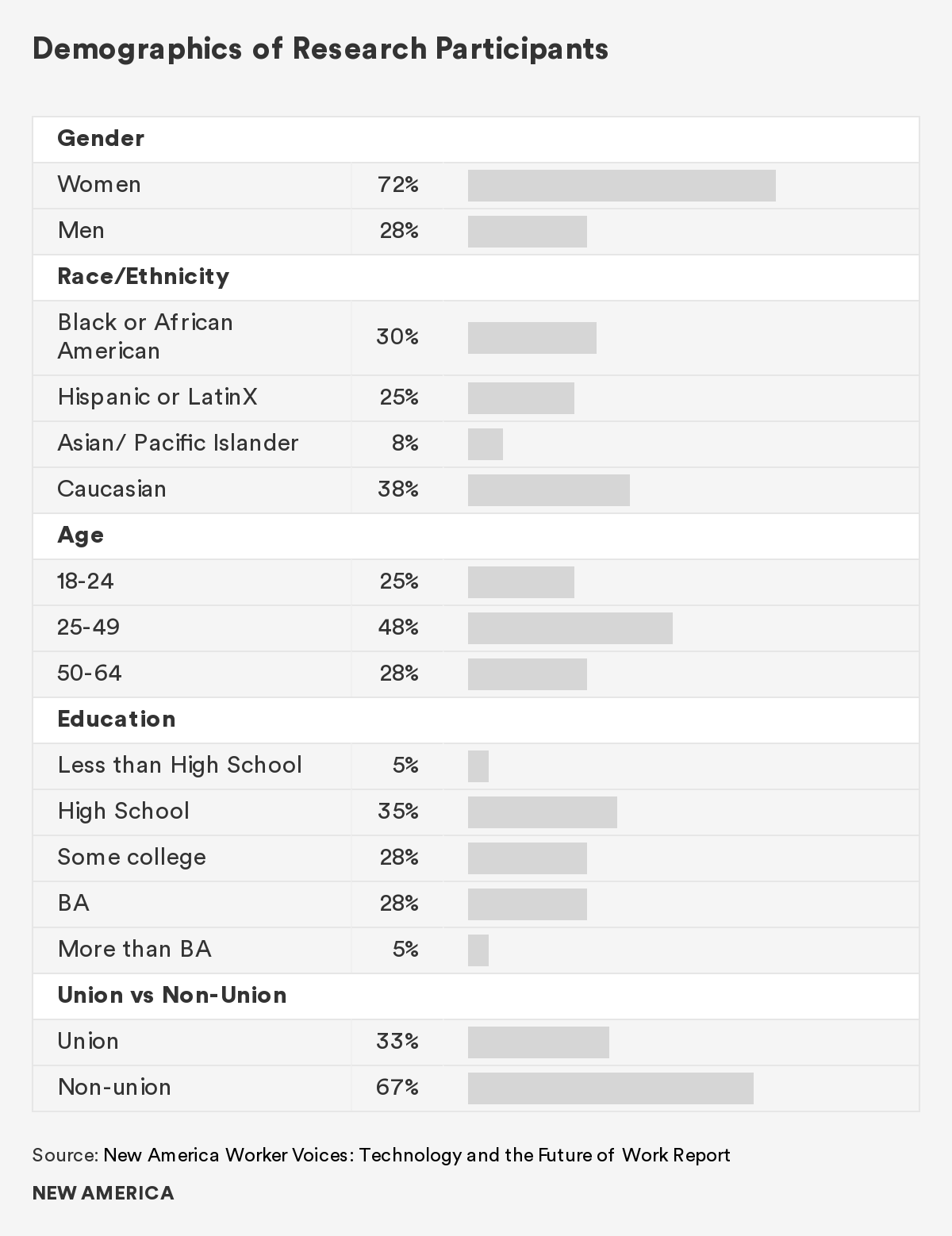
To recruit interviewees, we deployed multiple tactics including partnering with worker organizations, leveraging personal networks, and using online message boards, cold calls, and other “walk up” recruiting. The diversity of these recruitment approaches helped mitigate potential biases in our sample. However, it is possible that the workers we spoke with differed from a more nationally representative sample due to some of their connections to worker groups, their comfort level in speaking with us, the locations we selected for interviews, and their specific employers and occupations.
The Appendix includes a more detailed description of our methodology.
In the interviews, most of our questions centered on the context of the workers’ lives at home and at work, and their hopes and concerns for the future. We were careful not to lead interviewees toward discussions of technology. We did our best to use more general and open-ended questions about the future of jobs to explore the extent to which workers are already thinking about issues like technology and automation. All the questions we asked were open-ended and we gave instructions to our interviewees that there were no right or wrong answers. We took steps to minimize any potential harm to the workers with whom we spoke. To protect the identities of those involved, we use pseudonyms and have changed other personal attributes of the workers featured in the report.
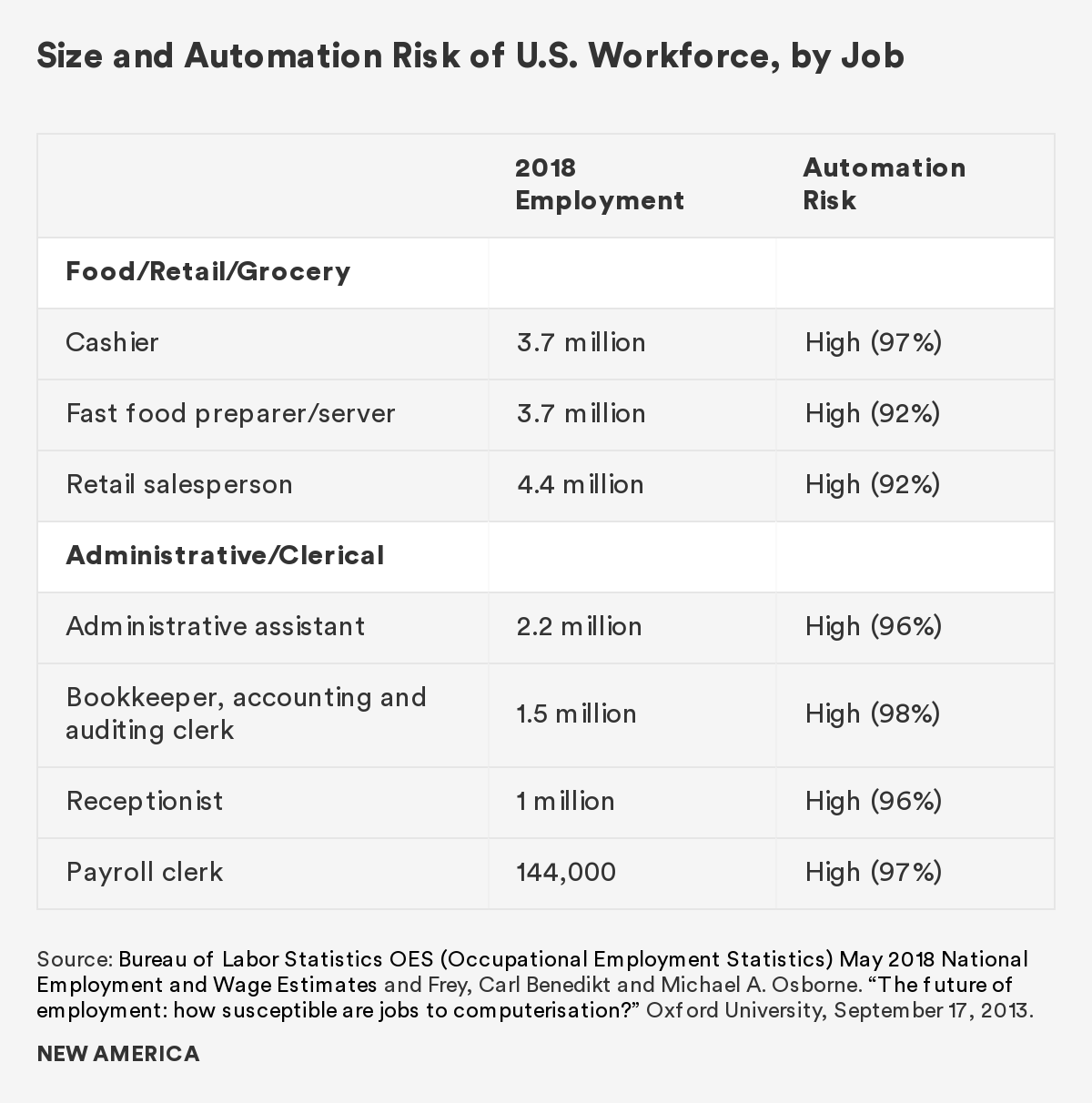
We selected two categories of workers to interview. The first group comprised retail, fast food, and grocery workers, primarily in front-line positions like cashiers and food preparers. The second group comprised non-managerial administrative and clerical workers in roles such as administrative assistants and bookkeepers. We selected these two groups of workers for our study for three reasons: the jobs they hold are at high risk of automation and technological change,18 they employ many workers across the country, and they are frequently overlooked in future of work discussions compared to other types of workers.
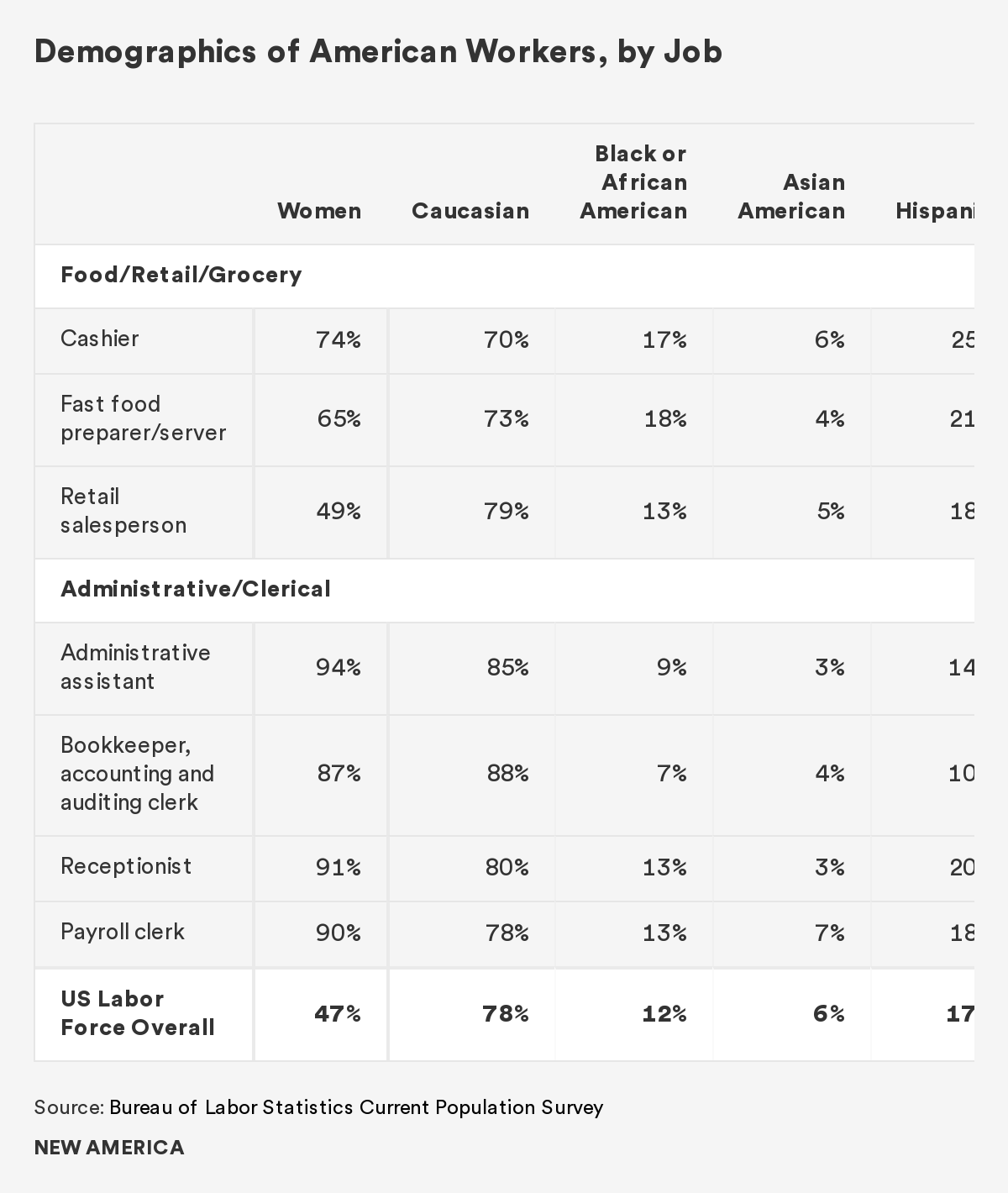
Jobs in retail, fast food, and administrative work are some of the biggest sources of employment in the U.S. overall. Approximately 17 million Americans, or nearly 12 percent of the entire U.S. workforce, are employed in seven of the job titles we interviewed. The high automation risk of these jobs suggest they could change significantly in the future—and the likelihood of this change is higher for these jobs than for most other jobs that American workers hold. To the extent that policymakers and the public are concerned about the potential for technology to displace workers, our data suggest that these occupations should be a key part of that conversation.
Citations
- David Autor, David A. Mindell, and Elisabeth B. Reynolds, The Work of the Future: Shaping Technology and Institutions (Cambridge, MA: MIT Work of the Future, September 2019), https://workofthefuture.mit.edu/sites/default/files/2019-09/WorkoftheFuture_Report_Shaping_Technology_and_Institutions.pdf
- Pamela Loprest and Demetra Nightingale, The Nature of Work and the Social Safety Net (Washington, DC: Urban Institute, July 2018), https://www.urban.org/sites/default/files/publication/98812/the_nature_of_work_adn_the_social_safety_net.pdf
- Ali Alichi, Rodrigo Mariscal, and Daniela Muhai, Hallowing Out: The Channels of Income Polarization in the United States, working paper (Washington, DC: International Monetary Fund, November 15, 2017), https://www.imf.org/en/publications/wp/issues/2017/11/15/hollowing-out-the-channels-of-income-polarization-in-the-united-states-45375
- David Autor, The Polarization of Job Opportunities in the U.S. Labor Market: Implications for Employment and Earnings (Washington, DC: The Center for American Progress and the Hamilton Project, April 2010), https://economics.mit.edu/files/5554
- Jake Rosenfield, Patrick Denice, and Jennifer Laird, Union Lowers Wages of Nonunion Workers: The Overlooked Reason Why Wages are Stuck and Inequality is Growing (Washington, DC: Economic Policy Institute, August 30, 2016), https://www.epi.org/files/pdf/112811.pdf
- David Autor, David Dorn, Lawrence F. Katz, Christina Patterson, and John Van Reenan. Concentrating on the Fall of Labor Share. National Bureau of Economic Research, Working Paper 23108, January 2017. https://www.nber.org/papers/w23108.pdf
- Lawrence Minshel, Declining Value of the Federal Minimum Wage is a Major Factor Driving Inequality (Washington, DC: Economic Policy Institute, February 21, 2013), https://www.epi.org/publication/declining-federal-minimum-wage-inequality/
- David Weil, The Fissured Workplace: Why Work Became So Bad for So Many and What Can Be Done to Improve It (Cambridge, MA: Harvard University Press, 2014).
- Jeff Larrimore, Alex Durante, Kimberly Kreiss, Christina Park, and Claudia Sahm, Report on the Well-Being of U.S. Households in 2017 (Washington, DC: Board of Governors of the Federal Reserve System, May 2018), https://www.federalreserve.gov/publications/2018-economic-well-being-of-us-households-in-2017-dealing-with-unexpected-expenses.htm
- Mark Muro, Robert Maxim, and Jacob Whiton, Automation and Artificial Intelligence: How Machines are Affecting People and Places (Brookings Institution Metropolitan Policy Program, January 2019), https://www.brookings.edu/wp-content/uploads/2019/01/2019.01_BrookingsMetro_Automation-AI_Report_Muro-Maxim-Whiton-FINAL-version.pdf
- Molly Kinder, “The Future of Work for Women: Technology and the Overlooked Workforce,” Work, Workers, and Technology blog post, New America, February 25, 2019, https://www.newamerica.org/work-workers-technology/shiftlabs/blog/future-work-women/
- Molly Kinder, “Learning to Work with Robots,” Foreign Policy, July 11, 2018, https://foreignpolicy.com/2018/07/11/learning-to-work-with-robots-automation-ai-labor/
- The Field Guide to Human-Centered Design (San Francisco, CA: IDEO, 2015), https://bestgraz.org/wp-content/uploads/2015/09/Field-Guide-to-Human-Centered-Design_IDEOorg.pdf
- We used several data sources to identify jobs at high risk of automation, including data from a 2013 study by Oxford researchers Carl Benedikt Frey and Michael A. Osborne, in which they evaluated the technical feasibility of computerizing or automating the underlying tasks of an occupation with technology that exists today. In their analysis, the occupations we focus on in this report each have greater than 90 percent risk of automation, which is within the top quartile of risk among all occupations they studied. See Benedikt Frey and Osborne, The Future of Employment: How Susceptible Are Jobs to Computerisation? working paper (Oxford, U.K.: Oxford Martin School, University of Oxford, September 17, 2013), https://www.oxfordmartin.ox.ac.uk/downloads/academic/The_Future_of_Employment.pdf. Similarly, a recent McKinsey report on automation calculated that office support workers are the highest-risk job category for the potential for total displaced full-time employees by 2030, followed by food service, and customer service. See Susan Lund, James Manyika, Liz Hilton Segel, André Dua, Bryan Hancock, Scott Rutherford, and Brent Macon, The Future of Work in America: People and Places, Today and Tomorrow (New York: McKinsey Global Institute, July 2019), https://www.mckinsey.com/~/media/McKinsey/Featured%20Insights/Future%20of%20Organizations/The%20future%20of%20work%20in%20America%20People%20and%20places%20today%20and%20tomorrow/MGI-The-Future-of-Work-in-America-Report-July-2019.ashx
Economic Insecurity and the Future for Low-Wage Workers

The starting point of our research is the context of workers’ lives. Understanding the constraints and struggles workers face today is critical to anticipating how they will experience technological change tomorrow. This context impacts how workers experience their jobs, their resilience to changes, and their ability to plan for and connect to opportunity.
In our interviews with frontline grocery, retail, and fast food workers, economic precarity emerged as one of the most prominent and important themes. Most of the low-wage workers we spoke with faced financial insecurity, sometimes profoundly. Many struggled to afford the basics, pay off debt, provide for their families, and weather any financial challenges. This economic stress was top of mind and impacted many other aspects of their lives and work, from their career choices to the widespread preference for job stability to their difficulties pursuing higher education and learning.
While technological change was not the direct cause of workers’ precarity, it can add insult to injury. Automation and the adoption of new workplace technology can exacerbate workers’ financial insecurity when jobs change, earnings or hours are cut back, or when workers are displaced altogether. Economic insecurity also limits workers’ resilience to technology changes by undermining their ability to weather a job transition, pay for training or schooling, and connect to a new or better opportunity.
Financial insecurity suppressed upward mobility and limited workers’ ability to get new skills or change jobs
Economic precarity was a major challenge for the workers in our study. The fraught combination of low wages, expensive cost of living, persistent debt, lack of family support and any financial cushion, and—in some cases—the absence of health insurance created daunting headwinds for many of the workers we interviewed. This was especially true of those in the fast food industry, workers living in the Bay Area, undocumented workers, and those carrying student debt without a completed degree.
Many workers reported living paycheck to paycheck and struggling financially. Several people referenced the challenges of carrying debt, including auto loans, credit card debt, student loans, and medical debt. This debt often served as a barrier to upward mobility and to workers’ ability to go back to school or invest in new skills or career changes.
Other interviewees expressed concern about the challenges of establishing financial security and struggling to establish enough savings for the inevitable emergencies and expenses that arise.
A 25-year-old grocery manager acknowledged
I don’t have the greatest car in the world. It is old and it’s probably going to break down on me soon, which would suck because I need it for work. I keep trying to save and then I just can’t. I’m constantly worried about it. That’s pretty much the only thing I worry about. I have some bonds from college that I was supposed to use for college, which I haven't, that I would probably use in the emergency. Otherwise, I don't actually have a plan.
Low pay and insufficient hours added to workers’ financial insecurity and stress
The low wages that employers pay frontline workers is a major factor in their economic insecurity. Many fast food, grocery and retail workers reported frustration with low pay. A grocery manager reported not receiving a pay raise in over a decade despite other living costs rising. One 29-year-old truck driver (see Jasmin’s Profile) described the impossibility of making ends meet with the low compensation from her fast food jobs. Even after her pay rose from $5.35 an hour to $11 an hour a decade later, she explained that “still, it didn’t pay the bills.” A gas station manager, 23, explained a similar frustration: “The pay is not as high as I thought it would be. I tell my husband, ‘I'm working my butt off there and I have to live check by check.’ And then I ask for a raise and they just tell me later on, later on.”
Despite perceptions of a booming economy with low unemployment, many workers voiced frustration about not getting enough hours to pay their bills. A cashier, 55, despaired that he had not been given full-time hours by his grocery employer in the many years he worked there and, as a result, he could not keep up with the expensive cost of living in the Bay Area: “In 18 years, I never got a full-time position, never. You can’t believe it. I’ve always been part-time and looking for hours. Sometimes, they give me 24 hours. I can't survive with 24 hours. I feel stressed out and depressed.” Another grocery manager, 45, explained the struggle that her colleagues faced in trying to get enough hours
Store directors are hiring a lot of young people at minimum wage. To be a 40-hour employee, you have to get into this lottery, which I heard these days doesn’t even exist if you’re just a checker or a bagger. Take that lady who’s been there for 30 years, but she’s never been a 40-hour employee. She makes $22 but they’re giving her the bare minimum hours. I know a baker who’s worked here forever, she’s very much older and comes to me and cries because her hours are being cut so much she doesn’t know how she’s going to make rent this month. I don’t know if they really go and see how it’s being affected by them cutting hours, saving the $10. To [the grocery chain], it’s all money. That’s why you’re constantly seeing “we’re hiring!” and why we are constantly hiring, but you can’t give me 40 hours?
Workers worried about insufficient hours when hours equal benefits
Workers’ desire for hours is especially fraught because of the relationship between hours and benefits. Several grocery and retail workers with longer tenures observed that their employers have made it harder for workers to qualify for benefits. Today, they see their employers denying newer workers the full-time hours required to gain eligibility for health insurance and other benefits. One grocery cashier with a decade of experience contrasted his eligibility for health insurance in just three months when he started his job with the more than three years that new cashiers hired by his employer have to wait for benefits eligibility.
An employee of a different grocery chain described a similar experience: "the people coming in now have to do so many hours to get insurance. The company doesn't make it easy, because they're not giving a lot of hours. You're going to take five years to even get to the point to get insurance, and it used to be 18 months.” This pricing clerk, 55, continued, “once you were an employee, [the grocery chain] gave insurance, health insurance. But now, this depends on how many hours you are doing."
A manager, 45, explained that workers in the retail sector increasingly struggle for benefits and hours as well. While hourly wages have gone up, he sees employers offset the cost of these raises by denying new hires the hours required to qualify for benefits. By 2020, his chain, he said
is working toward $15 an hour and they’re ramping up to that now, even for cashiers and stockers. Each year they’re going up a dollar. At the same time, they’ve cut hours a little bit. A lot of retail is going to that, so they don’t have to pay as much in benefits. So you hear feedback on that from people. The compensation is now a little better for team members, but if you lose your benefits and that is your goal, then I think you’ve lost a little. When I started here, probably half the team members qualified for benefits. And now it’s much less than that. It’s more that we lose the people who had benefits. And with new people, they tell them ahead of time how many hours they’ll get, and it won’t be enough for full time benefits.
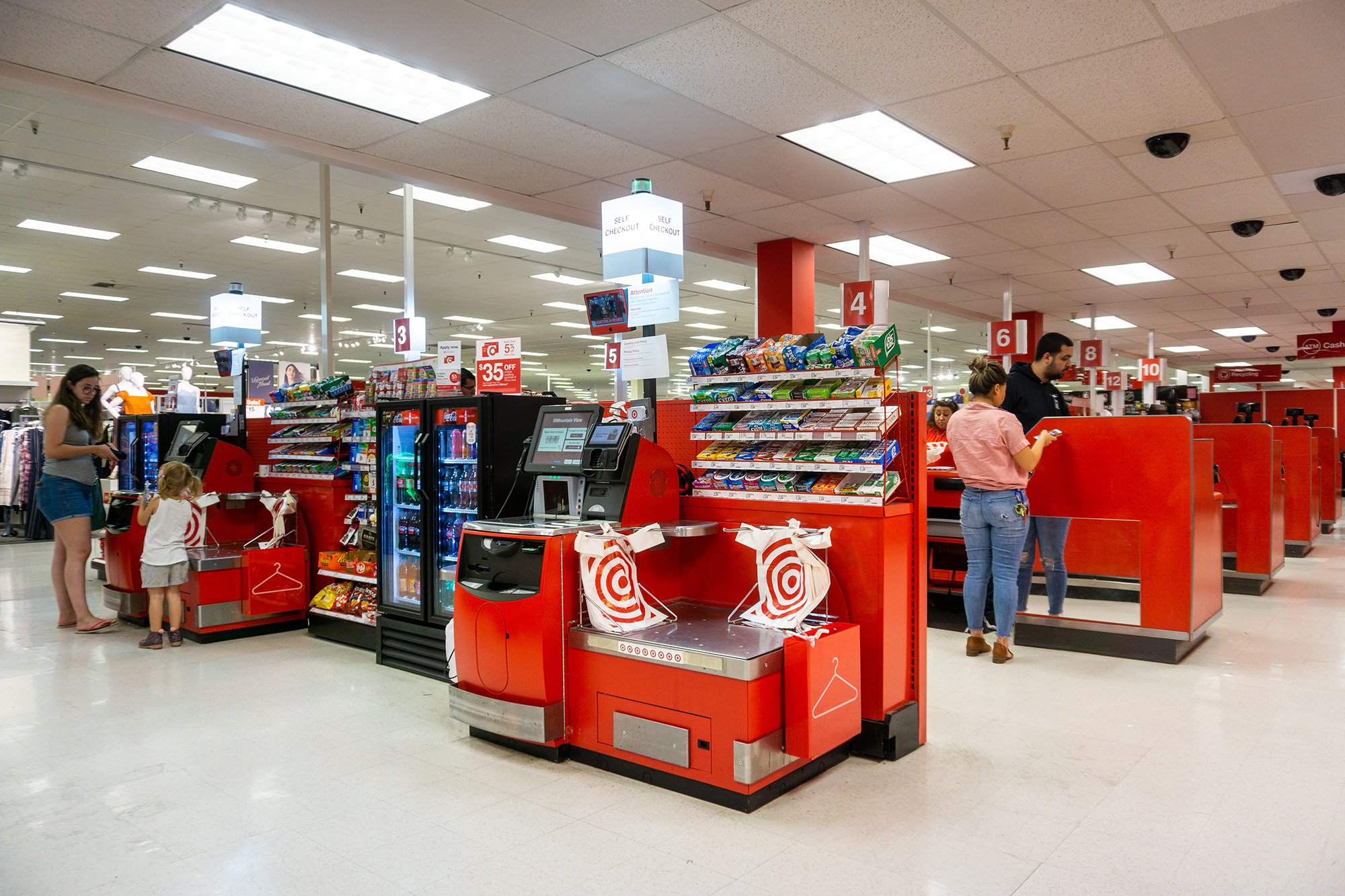
Sundry Photography / Shutterstock
Workers feel it is getting harder to earn a decent living as employers prioritize shareholders and the bottom line
A persistent theme from grocery and retail workers with long tenures was the sense that compensation and work environments have changed for the worse. Numerous interviewees lamented the loss of bygone era when their employers had “family values,” invested in their employees, and created opportunities to earn a decent living.
One grocery employee with 25 years of tenure described the gradual decline in the company’s values and benefits offered to workers: “When I first started, it was a family-oriented business. They gave us stock options. They used to have a staff organization that took a dollar out of our weekly paycheck, and would do things for us: parties, a crab fest, trips to Six Flags. Over the years,” this 47-year-old bookkeeper said, “all that has changed. It’s not family-oriented anymore. They started taking things from you, stock benefits for instance. It makes people not want to be a part of this company.”
Even younger workers with shorter tenures noted a change in values and culture, including when ownership changed hands. A 25-year-old grocery courtesy clerk said
it was a little bit more fun before. They would have more employee appreciation days and fun…gimmick days, like a cowboy day, and stuff like that. And I don't think it has happened since the turnover. The scheduling has gotten worse, and I don’t know if that’s the managers or the people above them. I think it is just penny-pinching. We’ve had less help, and that’s not the store manager’s fault; it’s whoever’s above them.
A grocery department manager, 53, described the positive role that his employer played in his life and his children’s lives, and his frustration in seeing the company’s values and priorities—especially the focus on shareholders’ needs rather than supporting the workers who produce that value—change over time. When he came to the store
it was more of a family-oriented company. The company has been good to me. In a few years, I hope to retire. And the company took care of my family. My oldest son went to college, you know what I mean? So it's been good to me. It means everything to me. And I want to see the company do well, just because I've devoted so much time and years to the company. But now we are caught up in a world that’s just a corporate conglomerate. Everything is about the bottom line and bonuses.…It’s just not what it once was. They’re not interested in how we used to do business. When you have shareholders and people who want to get paid; they aren’t interested in people like myself, who made this company.
Several interviewees expressed disappointment that grocery and retail jobs no longer provide a pathway to the middle class. A grocery cashier, 50, said
it used to be fun. You started at the bottom and you worked your way up. Back then, if you wanted to be a department manager or manager, it was a process and it was a good place to work for. Now,…I would tell young people if they're not going to move into management … to find something else. Because that job is kind of like a dead-end job now, ….It's not like when I came in. Our rate of pay was different, the whole package with benefits was different then. So if they're expecting a lot more [they’re] not gonna get it just staying there.
One grocery manager we interviewed was drawn to the industry after observing her father’s career as a butcher and the way he was able to provide comfortably for her family growing up. She does not feel that the jobs today provide the same middle-class opportunity for those willing to work hard. See Melanie’s Profile, below.
Melanie: Working hard is no longer a path to the middle class
Melanie is a 45-year-old manager at a grocery chain. She is the mother of two children, both of whom graduated from college. Twenty-five years ago, she started as a grocery clerk.
Growing up, Melanie’s father was a meat cutter and in a union. It was a good job that provided well for her family. “When we grew up, my dad was the only provider. We lived very comfortably growing up. So I was like, ‘Wow, this would be a great thing to get into. Look at how we did.’ That was kind of my motivator.” She no longer feels that grocery jobs provide a path to the middle class. “The grocery industry is not like what it was then,” explaining that her company has been cutting everyone’s hours. “It’s a very up-and-down kind of thing; there’s no real guarantees. If you’re not a full-time employee, which very few of us are, then they don’t honestly have to give you more than 24 hours a week. I think it’s hard for people to not always know. So, I think it’s a little scary sometimes, because it can all just be taken away from you without you being able to really do anything about it.”
Melanie feels that the work has become harder over time as her store has cut back on employee hours. “I've basically taken on two people’s jobs because they eliminated the middle person. That's definitely a challenge now, to try to do all that work still in your eight hours.” She is very unhappy at work. “I have gotten to the point where I pretty much hate my job. But it's a job. It has benefits and I have a lot of vacation.” She shared her frustration with the stagnant pay. “We haven't had a raise in 10 years. It’s very challenging.”
Melanie is also frustrated by the lack of appreciation. “Honestly, I don't enjoy it because they don't make it enjoyable, and they don't appreciate you whatsoever. We have a lot of supervisors that come in and no one ever tells you ‘good job,’ no one says thank you. It’s just simple things, I think, that could be done to get morale a whole lot better. Because everybody likes to be told that they did a good job. No matter how big or small the job is.”
Undocumented workers and those with felony convictions struggled with lack of access to services, benefits, or certain types of jobs
Several workers described facing especially precarious circumstances and even greater vulnerability to falling further behind. The workers we interviewed who lack legal immigration status faced the most extreme economic circumstances in our study. A lack of health insurance was a major struggle for this group. Those without legal status reported ineligibility for state healthcare schemes and working for fast food employers who did not provide benefits. Their financial insecurity was further compounded by a lack of a financial cushion and financial support from family members. In fact, all of the undocumented workers we spoke with sent money home to relatives. One fast food worker, 54, said
I worry about getting sick and not being able to help my parents [in Mexico], because I am the one who helps them the most. I am the only one who takes care of them. I don’t want to get sick, because I don’t have benefits, I don’t have medical insurance. In [a fast food chain] we don’t have anything if we get sick….Well, last year I got ill. I made a payment plan, and I am paying off $1,500. They give me about a year.
Another undocumented fast food worker, 21, agreed about the special danger of falling ill: “I worry a lot. I won’t be able to pay my bills, I won’t be the person I want to be, I won’t achieve my dreams. In this country, you need to fight for your dreams. I lost my car. When I got sick, I couldn’t pay for it because I was really sick and couldn’t work. I applied for medical insurance, but I don’t qualify.”
The economic and legal precarity of the undocumented workers in our study severely limited their upward mobility and their ability to prepare themselves for better and less automatable work in the future. Jasmin’s Profile below outlines how workers with felony convictions face additional challenges and obstacles.
Jasmin: Financial challenges, fast food, and felony conviction
Jasmin is a 29-year-old woman and mother of two children. Jasmin has a felony conviction and will be on house arrest for another three and a half years. Since she was 15, Jasmin has worked in fast food restaurants, often working two jobs at once. She started out making $5.35 an hour and after more than a decade, earned $11 an hour. “I wanted to quit because they just don't pay my bills.” Jasmin has been living “paycheck to paycheck forever” and does not have an emergency cushion to pay for unexpected expenses. “I've been trying to save money, but every time, it doesn't work. I increased my credit score in three months and then I didn't pay my bill and it dropped down again. My main goal is to get a high enough paying job so I can save money.”
Jasmin is now starting out as a truck driver, which at $16 an hour, pays more than fast food. She isn’t happy in the job and said it is “scary” to drive. “I do not like trucking. You don't get to be ar