Haley Swenson
Senior Writer and Researcher, Better Life Lab

Most American men believe deeply in caregiving: They see it as valuable, learnable, meaningful, and something to be shared equally, and most fathers say they’d choose to be more involved if they could. But belief hasn’t translated into equal practice. This report, based on a 2026 nationally representative survey by NORC and New America’s Better Life Lab, finds that inflexible workplaces, lack of access to paid leave, and financial strain—more than outdated ideas about masculinity—are barriers keeping men from acting on their desire to be caregivers. Drawing on survey data and original interviews, the report charts what has changed since 2019 and what still stands in men’s way.
The authors wish to thank Melissa Saphir for her expertise and guidance in analyzing and fact-checking the data. They also wish to thank Dan Malato and Semilla Stripp at NORC for their expertise throughout the survey development process. The authors are grateful to Shannon Carpenter, Mohan Sivaloganathan, Mark Attico, and Carlos Olivas, who tested the survey questions during their development. We thank Darby Saxbe, Heejung Chung, Richard Petts, Joanna Pepin, Michael Feigelson, Imran Ahmed, Rae White, Callum Hood, Anders Knospe, Taveeshi Prasad Gupta, David Smith, and Vicki Shabo for their generous comments and suggestions in developing the study. And we’d like to thank our Better Life Lab colleagues, Rebecca Gale, Elliot Haspel, Eve Tahmincioglu, and Haley Farley, and the New America Communications team for helping us bring this report to life.
Editorial disclosure: This report was made possible by support from Pivotal and the Robert Wood Johnson Foundation. The views expressed in this report are solely those of the authors and do not necessarily reflect the views of Pivotal, RWJF, New America, its staff, fellows, funders, or board of directors.
In the past decade, the public interest in men’s attitudes about and involvement in caregiving has swelled. The COVID-19 pandemic exposed the fractures in U.S. workplace and child care and older adult care systems. As schools and care facilities closed and many offices sent employees to work remotely from home, the caregiving that sustains most individuals and families became more visible than ever. Millions of family members were forced to take on unpaid care for older loved ones as the pandemic led to a severe shortage of paid caregivers.1 For many households, the old order of work and care, which has never been easy in the United States, became unsustainable. As Better Life Lab has reported, some men became much more involved in household and child care labor, understanding the power and difficulty of care work in new ways.2 Research found fathers’ shares of housework and child care increased early in the pandemic.3 Analysis of the American Time Use Survey has suggested that some men continue to increase their child care involvement and reduce their paid work time, even several years after the pandemic.4 One economist found that a growing number of men did not work for pay in 2025 because of child care or older age care responsibilities, representing a total of about 3 million men.5
Still, other indicators suggest potential retrenchment regarding gender and caregiving. Men played a deciding role in the 2024 U.S. election, contributing 55 percent of the votes to re-elect Donald J. Trump as president.6 On the campaign trail, Trump vowed to protect women “whether the women like it or not,”7 while close allies at the Heritage Foundation promoted Project 2025’s vision of reinvigorating the “biblically based family.“8 Young men, including young Hispanic men, were more likely to vote Republican than in years past,9 prompting widespread discussion of whether young men are increasingly conservative on a number of issues, including gender roles.
Social media algorithms have given the so-called manosphere outsized reach in promoting misogyny, male supremacy, and rigid views of masculinity tied to “incel” lifestyles and sexual violence.10 Some research finds young men are more likely than older men to believe that the proper place for women and mothers is at home, yet they still approach their own future arrangements of family life with a degree of flexibility.11 Such generational findings have prompted a surge in “heteropessimism,” a skepticism about whether a happy, domestic life between men and women is possible or will be in the future.
The public has also engaged in a more urgent and widespread conversation about findings of loneliness and a lack of purpose among men, despite the fact that men and women self-report similar rates of loneliness. The global nonprofit Equimundo finds that over half of American men say “no one really knows me.”12 The American Enterprise Institute’s American Perspectives Survey finds that while Americans generally report having fewer friends today than in the 1990s, men have experienced a steeper decline. Today, 15 percent of men say they do not have a single close friend.13 More troubling is that men are more likely to feel distressed and isolated, even if they have comparable social networks to women. An analysis of the 2024 Making Caring Common Survey by the American Institute for Boys and Men found men were more likely to say they felt irrelevant or that they lacked meaning or purpose in their lives.14 Men are four times more likely to die by suicide than women.15 Findings that fatherhood and caregiving give men a sense of happiness and mattering16 make it ever more critical to understand the opportunities for, experiences of, and barriers to men giving care.
Adding to these ongoing conversations about the role of men in caregiving is the baseline increase in caregiving needs the United States has experienced in recent years. The U.S. population is aging, with an estimated 7 million more adults ages 64–85 between 2025 and 2030.17 The Department of Health and Human Services estimates that 70 percent of older Americans will need long-term care.18 Even as the demand for home health workers grows, low wages and a lack of investment at the state and federal levels hamper efforts to expand the workforce.19 Furthermore, cuts to long-term care policy and to Medicaid under the Trump administration’s One Big Beautiful Bill Act, or HR1, are expected to place additional pressure on family caregivers as well as on the finances of aging and disabled adults.20
The pressures on and expectations of parents have also increased. Parenting is now more demanding of time, emotional attention, and resources than in past decades.21 Additionally, parents juggle demanding paid work with today’s more intensive parenting. As of 2024, 70 percent of children under the age of six had all available parents in the workforce, a 5 percentage-point increase from 2014.2223 Demand for child care outpaces supply, and the cost of child care continues to outpace inflation.24 A December 2025 working paper published by the Better Life Lab showed aggressive immigration enforcement was shrinking the child care workforce, where one in five workers has been an immigrant.25 That, in turn, has forced tens of thousands of American-born women out of paid work.
Between 2019 and 2021, the Better Life Lab published six reports related to men’s attitudes and experiences of caregiving based on a 2019 nationally representative survey conducted by NORC and supplemented by a series of online focus groups and original reporting. The reports found that:
To understand the current state of caregiving among American men and women, the Better Life Lab has once again partnered with NORC to survey Americans about these critical questions.
In the 2026 follow-up survey, the Better Life Lab sought to examine how its earlier findings were trending seven years later and to offer new insights into the status of men and their relationships to caregiving:
In the 2026 survey, we oversampled young men, men of color, and fathers of young children to better understand differences among men by demographics and the intensity of their caregiving experiences. Unlike the 2019 survey, we did not oversample men in professional caregiving roles.
As in 2019, survey respondents were also asked if they would be willing to speak to a reporter. In this report, we have supplemented these findings with original interviews with willing survey participants to better understand the contexts in which particular beliefs, practices, and desires around caregiving have emerged. Our findings follow.
U.S. culture has moved quite far toward seeing men as caregivers and care as gender-equal and a learnable skill rather than biologically innate. But practice, identity, social trust, and structural barriers haven’t fully caught up with these shifting attitudes.
In the 2019 survey, respondents were identified as caregivers based on whether they reported participating in daily caregiving activities for their own children or actively caring for an adult friend or family member. In 2026, we sought to better understand whether and how these labels match respondents’ own understandings of the word “caregiver” and whether they believe it applies to them.
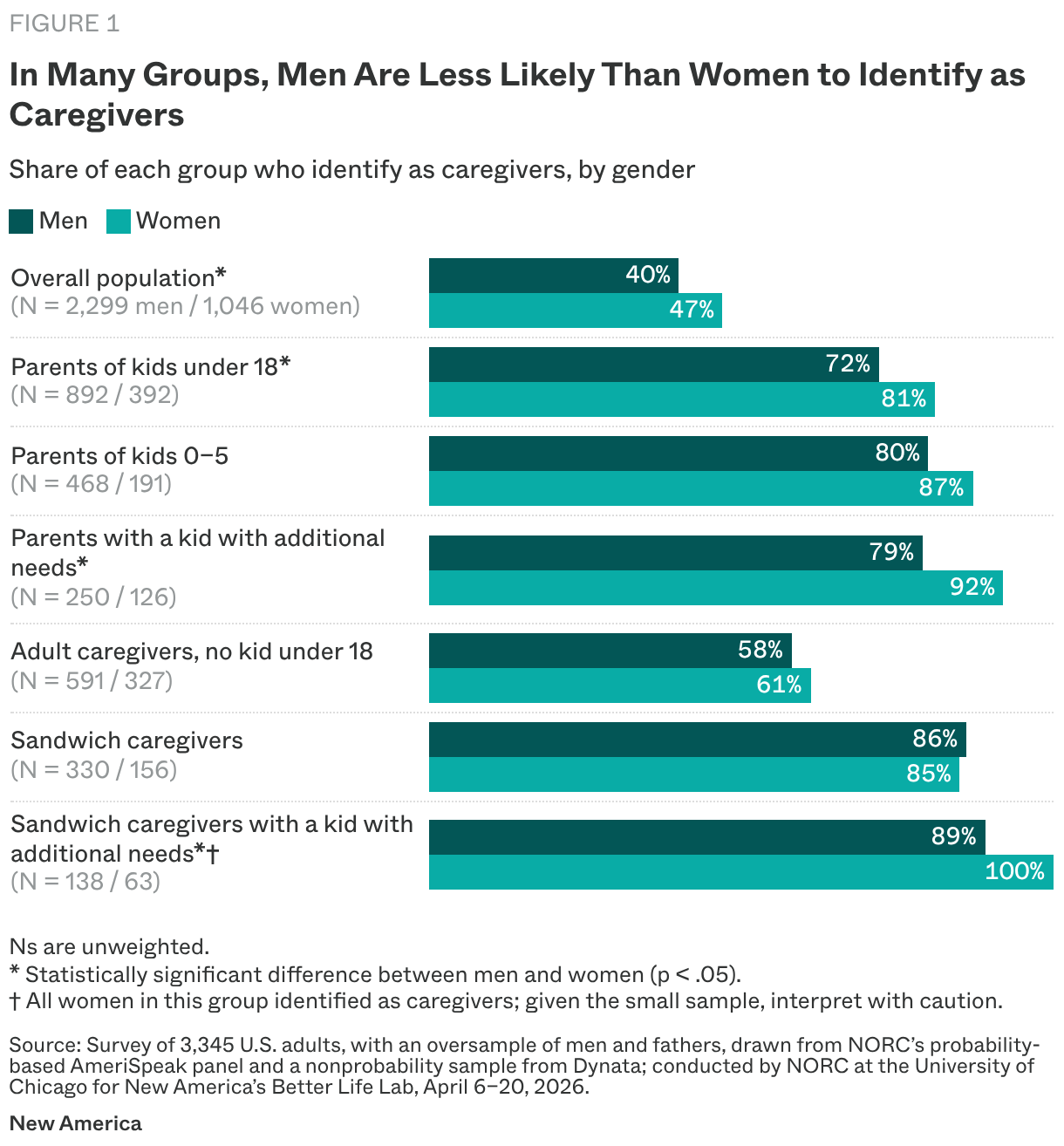
When it comes to identifying as a caregiver, 44 percent of adults overall consider themselves caregivers, with women (as shown in Figure 1) more likely than men to identify as caregivers (47 percent versus 40 percent).
At age 19, Abdul, one of the 2026 survey respondents who requested we only use his first name, became the primary caregiver for his father, who had chronic liver disease, until he passed four years later. A college student at the time, Abdul, now 26, missed classes and was forced to quit his job in order to take his father to doctor appointments or to sit with him in the hospital during one of his many long stays. “I had to do it. There was no one else, so I didn’t have much choice,” he said. Living with his extended immigrant family helped ease the financial strain. And he came to find the time with his father meaningful. “It was always nice to be there for my father, because he was there for me when I was young.” Even though it was a difficult time, he said, “I have no regrets. I would do it again.”
White respondents were less likely than Black and Hispanic respondents to say they identify as caregivers (41 percent of white respondents versus 53 percent of Black respondents and 50 percent of Hispanic respondents).
While the majority of parents of children ages 0–18 believe they are caregivers, not all do, and a significant gender gap remains. Overall, 81 percent of mothers with children 18 and under and 72 percent of fathers with children 18 and under identify as caregivers, a statistically significant difference. Having a child under the age of five increases the likelihood of a parent identifying as a caregiver. Having a child with more medical or educational needs than other children also makes a parent more likely to identify as a caregiver.
Among the general population, 64 percent of those who have been a caregiver for an adult identify as caregivers, as do 79 percent of those who have been a caregiver for a child with extra needs. Parents of children under the age of five are also more likely to identify as caregivers. Just 20 percent of fathers with children ages 5 and under and 14 percent of mothers with children ages 5 and under do not identify as caregivers (a nonsignificant difference).
Two-thirds of those who give care to adults identify as caregivers regardless of gender. Sandwich caregivers—parents of a child under age 18 who also provide care for an adult—are especially likely to describe themselves as caregivers (85 percent). Among sandwich caregivers, men and women are equally likely to identify as caregivers.
To better understand what people think the word “caregiver” connotes, the 2026 survey asked respondents to describe the images or words that come to mind when they think of the word “caregiver.” Respondents provided a diverse array of answers, with no single idea or image shared by a majority.
NORC researchers coded the answers and separated them into a few thematic categories: 36 percent of respondents said they think of providing care or assistance to someone else. Thirteen percent described emotional support or warm attributes (“kindness,” “love,” etc.). Eight percent of respondents mentioned nurses, doctors, or professional care workers, or health care settings. Five percent mentioned parenting, mothers, or fathers. Three percent described care for older age adults, and two percent care for children. Two percent of respondents used explicitly gendered imagery, referencing a mother, a nanny, or a woman. Overall, this question reveals a mix of associations with the term “caregiver,” which may help explain whether one identifies as a caregiver regardless of the behaviors one engages in.
“When I think of a caregiver, I immediately think of someone taking care of an elderly parent,” Tom Capuano, one of the survey respondents, told us in a follow-up interview. “So if someone asked me if I was a caregiver, right off the bat I might have said no, even though I’m taking care of five kids.”
Similarly, Ian Matthew Lima, a father of two children under the age of two, said calling himself a caregiver would feel like “stolen valor.” His mother and brother suffer from a debilitating disease that has left them immobile; the intensive care they require is what he thinks of when he thinks of caregiving. “Being a father is parenting,” he said. “In my mind, those are two completely separate things.”
Overall, 41 percent of men and 48 percent of women say they have, at some point, provided ongoing or periodic care to adults. Adults in lower-income households are more likely to care for an adult (52 percent of those earning less than $30,000 a year versus 38 percent earning $100,000 or more). Parents in lower-income households are also more likely to have cared for a child with extra needs (56 percent versus 36 percent in households with at least $100,000 of annual income). As in 2019, men are less likely than women to engage in adult caregiving, and when they are adult caregivers, they report performing fewer adult caregiving tasks than women do.
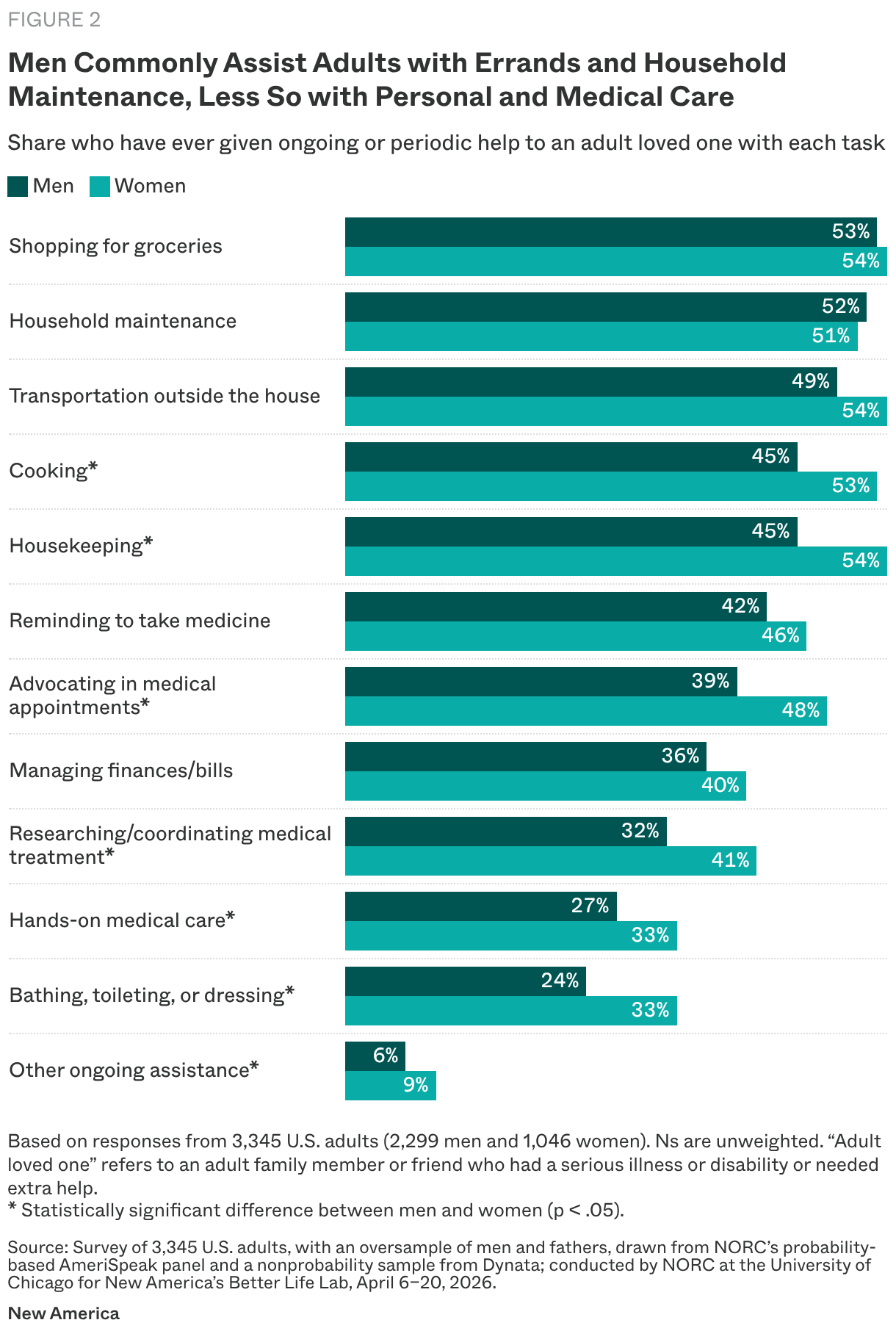
Across the general population, women are more likely than men to perform the more intimate hands-on caregiving tasks like bathing and toileting in adult caregiving (33 percent versus 24 percent). In addition, women are also more likely than men to cook, housekeep, and dress; research, arrange, and coordinate medical or therapeutic treatments; give hands-on medical care; advocate for adults in medical appointments/services; and provide other types of ongoing living assistance. (See Figure 2.)
When it comes to caring for their own children, women and men continue to overlap in terms of the tasks they report doing on a daily basis. Mothers and fathers are equally likely to say they play with their children, clean up after them, provide transportation, and participate in educational activities. The share of Americans who say it is “very important” for fathers to provide direct care to young children rose from 78 percent in 2019 to 84 percent in 2026. In 2026, 82 percent of fathers said providing direct care is “very important.” (See Figure 3.)
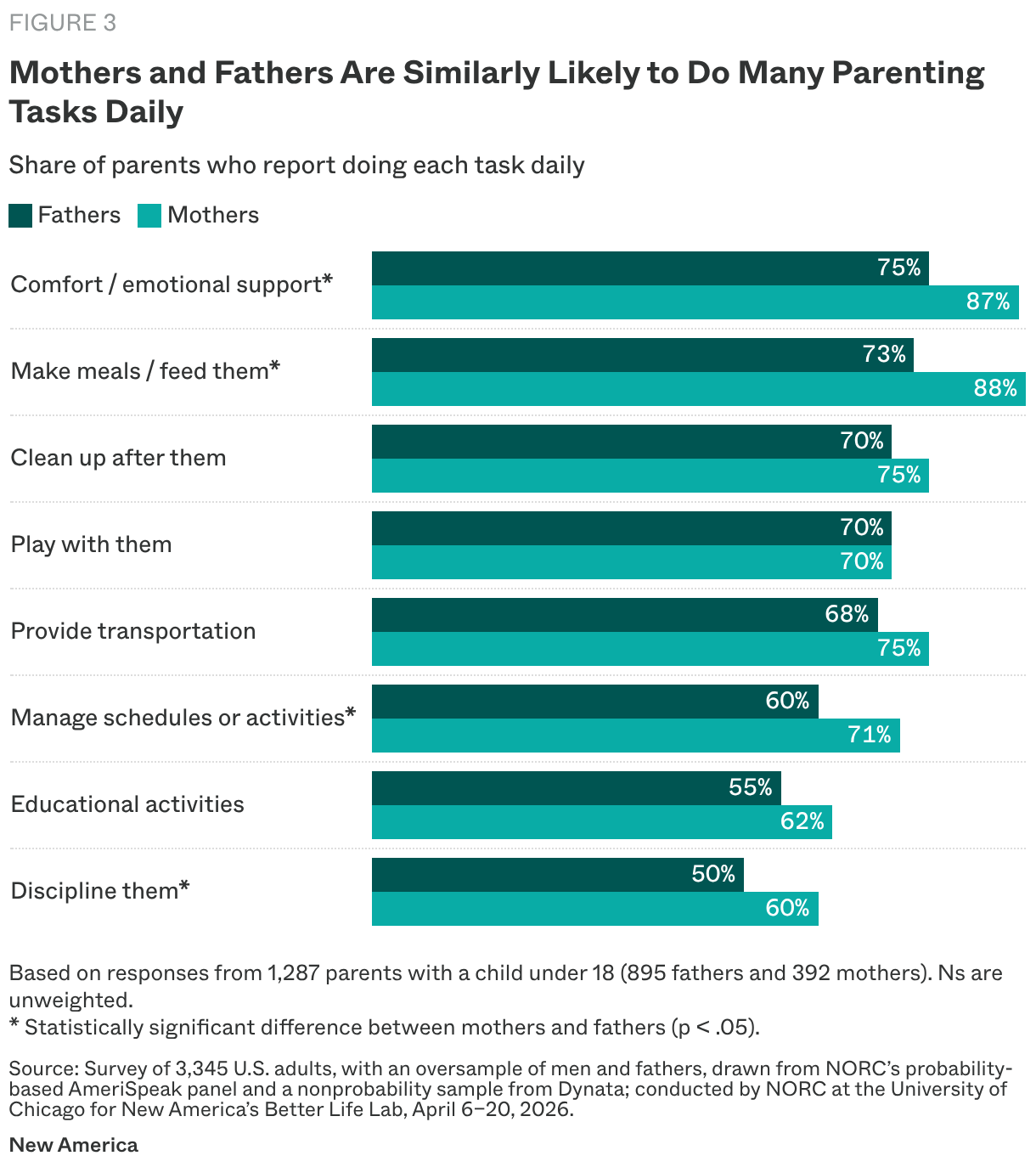
However, as in 2019, mothers are more likely than fathers to manage their child’s schedule, feed their child, and provide emotional support daily. Mothers and fathers perform other tasks at similar rates.
Fathers across the political spectrum report similar rates of engagement with each parenting task except for managing their child’s schedule. Republican (64 percent) and Independent (68 percent) fathers are more likely than Democratic fathers (49 percent) to say they manage their child’s schedules or activities daily.
White fathers are more likely to take part in some child care tasks on a daily basis: 77 percent of white fathers say they clean up after their children daily, compared to 58 percent of Black fathers and 57 percent of Hispanic fathers. Seventy-seven percent of white fathers say they play with their children daily, compared to 63 percent of Black fathers and 61 percent of Hispanic fathers. Seventy-seven percent of white fathers say they make meals for their children daily, compared to 67 percent of Hispanic fathers. Eighty percent of white fathers say they comfort or provide emotional support to their kids on a daily basis, compared to 66 percent of Hispanic fathers. One possible contributor may be Hispanic fathers’ greater likelihood of saying they have no control over the days and hours in which they work (42 percent versus 33 percent of all other fathers), though no significant differences were seen between fathers by racial identity in terms of daily engagement in the other tasks measured by the survey (discipline, transportation, education, and schedule management).
Fathers with children ages 0–5 are more likely than fathers with older children to engage in all care tasks daily. Compared to fathers without a young child, fathers of very young children are 19 percentage points more likely to say they comfort their kids or provide them emotional support, 9 points more likely to make meals or feed them, 30 points more likely to play with them, 14 points more likely to provide transportation, 18 points more likely to take part in educational activities, and 21 points more likely to discipline them.
U.S. adults’ beliefs about gender and caregiving vary not only by demographic group but also, in some cases, by the age of the person needing care. Seventy-one percent of men and 82 percent of women believe caregiving is as valuable as paid work, a nonsignificant difference.
When it comes to beliefs about child care and gender, beliefs are more mixed. Overall, 56 percent say that aside from breastfeeding, mothers and fathers do an equally good job of caring for a newborn baby, a significant increase from 49 percent in 2019. At the same time, 42 percent said mothers do a better job, a significant drop from the 50 percent who said mothers do a better job in 2019. Adults ages 18–29 and Democrats are more likely to think both mothers and fathers do an equally good job (60 percent and 58 percent, respectively), while adults over the age of sixty and Republicans are more likely to say mothers do a better job (47 percent and 48 percent, respectively).
When it comes to caring for children beyond the breastfeeding or bottle feeding stage, there is widespread agreement among U.S. adults that mothers and fathers should care for children equally (89 percent of women and 85 percent of men). Just 10 percent of women and 12 percent of men said this care should fall mostly to mothers. Two percent of men and less than 1 percent of women said this care should be done mostly by fathers. Republicans are more likely than Democrats and Independents to say mothers should do more care for older children. Still, 83 percent of Republicans believe care should be equally shared.
When asked who is best suited to care for an adult family member who needs assistance, three-fourths (74 percent) said, “gender doesn’t play a role.” Twenty-three percent of respondents said “mainly women” are best suited to care for an adult, while 3 percent said “mainly men” are.
Women were more likely than men to say mainly women are suited to this care (26 percent versus 19 percent for men), while men were more likely than women to say men were best suited to this care (5 percent versus 1 percent for women). (Both of these small differences were statistically significant.) This pattern holds among people who are caregivers themselves: 27 percent of female caregivers and just 18 percent of male caregivers say women are better suited to care for adults.
The age group most likely to say gender doesn’t play a role is the 30–44 cohort (80 percent). Republicans are less likely than Democrats and Independents to say gender doesn’t play a role (67 percent) and more likely to say women are more suited to the care (29 percent).
Although there has long been a pervasive and powerful narrative that women are innately better suited to give care, and that it is the result of a biological “maternal instinct,”26 Americans in the survey tended to see caregiving as learned rather than innate and associated with one gender. Roughly two-thirds (68 percent) say that caregiving is a skill that can be learned with time and experience describes their view “extremely” or “very well,” while just 29 percent say the same of the idea that caregiving is a skill people are born with.
When it comes to the experience of parenting, mothers and fathers answered similarly on several questions: The vast majority of parents feel others respect them as parents often or sometimes (94 percent of fathers and 95 percent of mothers) and say they find their parenting meaningful at least often or sometimes (96 percent of fathers and 97 percent of mothers). Majorities of mothers and fathers also agree that parenting can often or sometimes be stressful (81 percent of fathers and 79 percent of mothers).
However, mothers are more likely to report barriers to being the parent they want to be (27 percent of fathers versus 34 percent of mothers), perhaps suggesting less satisfaction with their current status quo. The gap between men and women disappears among parents who have a child with additional medical or educational needs: 46 percent of fathers and 46 percent of mothers of children with additional needs cite barriers to their being the parents they want to be. Among fathers, significantly more of those earning high incomes, $100,000 or more, reported barriers to being the father they wanted to be, compared to those earning less than $30,000 a year, 31 percent versus 16 percent. This could reflect the significant time expectations of long hours and work devotion that high-paying work often can take.
The biggest gap seen in this survey between mothers and fathers in how they feel about parenting is their perception of others’ mistrust of their parenting: Fathers are twice as likely as mothers to say people sometimes or often do not trust them to do their parenting because of their gender (26 percent versus 13 percent). That’s similar to the findings in the 2019 survey on a similar question (“People do not trust me to do my parenting in a safe and caring manner because of my gender”).
Those who provide care for an adult friend or family member were asked a series of questions about their feelings about caregiving. Seventy-nine percent of caregivers say, “The care work people do inside their home is as valuable as the paid work others do outside the home,” and 76 percent of caregivers say, “The care work people do at home is valuable to society.”
Female caregivers are more likely than male caregivers to feel that the care work people do inside the home is as valuable as the paid work others do outside the home (82 percent versus 72 percent) and that men and women should divide caregiving responsibilities equally (77 percent versus 68 percent).
A vast majority of caregivers find their caregiving meaningful (91 percent) and report that people respect them in their role as a caregiver (88 percent). Survey respondent James Matthews, 74, a former Vietnam veteran and law enforcement officer in North Carolina, raised his siblings as a young man, then five children as a single father, and later cared for his dying mother. He even left law enforcement and opened his own floor maintenance company to have a more flexible schedule in order to provide care. “I’ve done a lot of things in life. Taking care of my mother and my children, it’s one of the best things I’ve ever done,” he said.
Care “takes every part of your soul to do,” he continued. “Care is absolutely as important as anything else out there. You’re raising the next generation. What you do and how you handle things in their young lives will make a difference. If you do it wrong, then society has to suffer those consequences. Is care as important as being a police officer? I believe that. Is it as important as going to war and fighting? I believe that. It’s one of the most important things you can ever do.”
While the majority of respondents who care for adults or children with extra needs find giving care meaningful, and some find it joyful, 84 percent also say that the caregiving they do can be stressful at least sometimes, and 15 percent say people don’t trust them to do their caregiving because of their gender. A quarter (24 percent) of male caregivers say that people do not trust them to do their caregiving because of their gender, compared to 8 percent of female caregivers.
When asked how well each of the following statements describes their caregiving, 50 percent of caregivers say “I am proud to talk with friends or family about caregiving” describes them “extremely” or “very well,” and 35 percent say it describes them “somewhat well.”
Overall, just 22 percent of caregivers for adults or children with extra needs say that the phrase, “I would be a full-time caregiver if I had the choice,” describes them “very” or “extremely well,” with another 24 percent saying it describes them “somewhat well.”
More than half of such caregivers (54 percent) say the statement, “I want to share caregiving equally at home, but there are barriers in my way,” captures their views either “extremely,” “very,” or “somewhat well.” Male caregivers are more likely than female caregivers to say that they share caregiving responsibilities equally at home (44 percent versus 33 percent).
Just under one-third (28 percent) say there are barriers standing in their way to becoming the caregiver they want to be, most commonly their own physical health (15 percent), their work situation (15 percent), or their financial situation (14 percent). Compared to 2019, fewer report money and finances as their largest barrier (14 percent in 2026 versus 23 percent in 2019). But today, more cite their own health (15 percent in 2026 versus 8 percent in 2019) or their lack of knowledge or training (3 percent in 2019 versus 9 percent in 2026) as a barrier.
Perhaps one of the clearest trends the 2026 Men and Care survey unearthed is that an overwhelming majority of men have either a desire, or a need, to care for others, and, just as women have long reported, those care responsibilities are colliding with inflexible work cultures and a dearth of supportive policies that would enable them to effectively combine work and care. Although relatively few men said there are barriers to being the caregiver they want to be (25 percent) or father they want to be (27 percent) and approximately 15 percent of those caregivers and 16 percent of those fathers cited the workplace as the barrier in an open-ended question, the data paint a different picture. A growing share of men are missing work to provide care, a statistically significant increase from 2019. And the work disruptions are highest for those men who can least afford them.
What do men need in order to give care? The data show that workplaces that give workers more autonomy, flexibility, and control over their schedules, along with public policies, families, and workplace cultures that support men taking paid time off, are key factors that enable them to be the fathers they want to be and to care for loved ones the way they want to.
“Before a lot of people were working from home, I was one of the only people doing that,” said Tom Capuano, an educational instructional designer and father of five in upstate New York who has worked a flexible schedule for years. “I spent a lot of time taking care of my own kids—changing diapers, feeding them, taking them to appointments, getting them to the bus stop, or waiting for them at the bus stop. I loved doing all that.”
As the social media figure of the “tradwife” dominates discourse and Trump administration officials contemplate “motherhood medals” and other means of encouraging mothers to stay home, men’s choices and interests in stay-at-home parenting have been overlooked.27
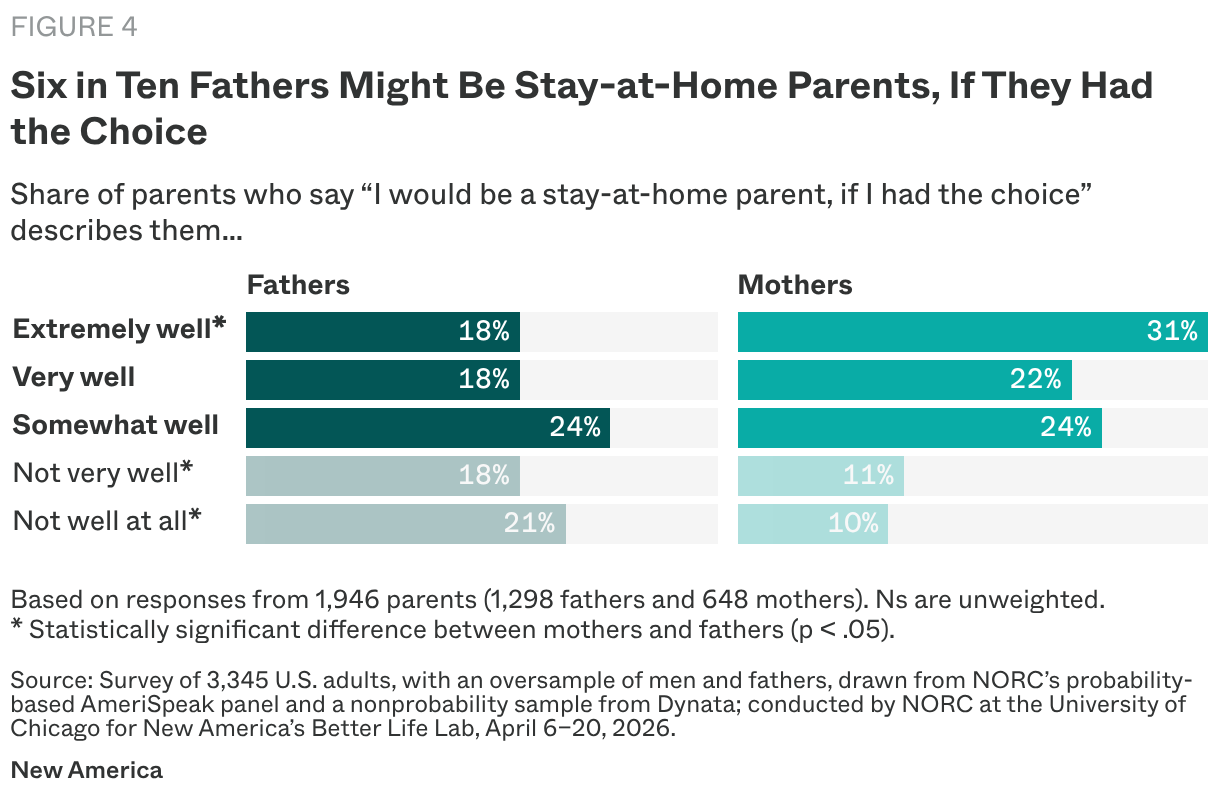
Far from embracing dominant norms such as the “ideal worker” who puts work first or the distant breadwinner caring for his family by providing financial support, we found that six in 10 fathers expressed at least some interest in being a full-time, stay-at-home parent if they had the choice, with 36 percent saying this described them “extremely” or “very well” and an additional 24 percent saying this described them “somewhat well.” (See Figure 4.) More mothers (77 percent) said they’d choose to be stay-at-home parents if they had the choice, with 53 percent saying this described them “extremely” or “very well” and 24 percent “somewhat well.”
The desire to be a full-time stay-at-home father was strongest among fathers of young children (69 percent compared to fathers of older children, 56 percent), non-college-educated fathers (64 percent, compared to 53 percent of fathers with a college degree), and fathers with lower incomes (71 percent for fathers earning $30,000 a year or less, compared to 51 percent for fathers earning $100,000 or more). Otherwise, there were no significant differences across age, political ideology, or race in the desire to be an at-home father.
In contrast to the desire among a majority of fathers to be a full-time, stay-at-home parent, just under half of both men and women expressed at least some interest in being a full-time caregiver to an adult (47 percent each). (See Figure 5.) Fathers of children ages five and under were more likely to report a desire to be a full-time caregiver for an adult (72 percent versus 53 percent of fathers of older children). Among fathers, young fathers—those between the ages of 18 and 29—expressed far more interest in being a full-time caregiver (71 percent) than did those over the age of 60 (47 percent).
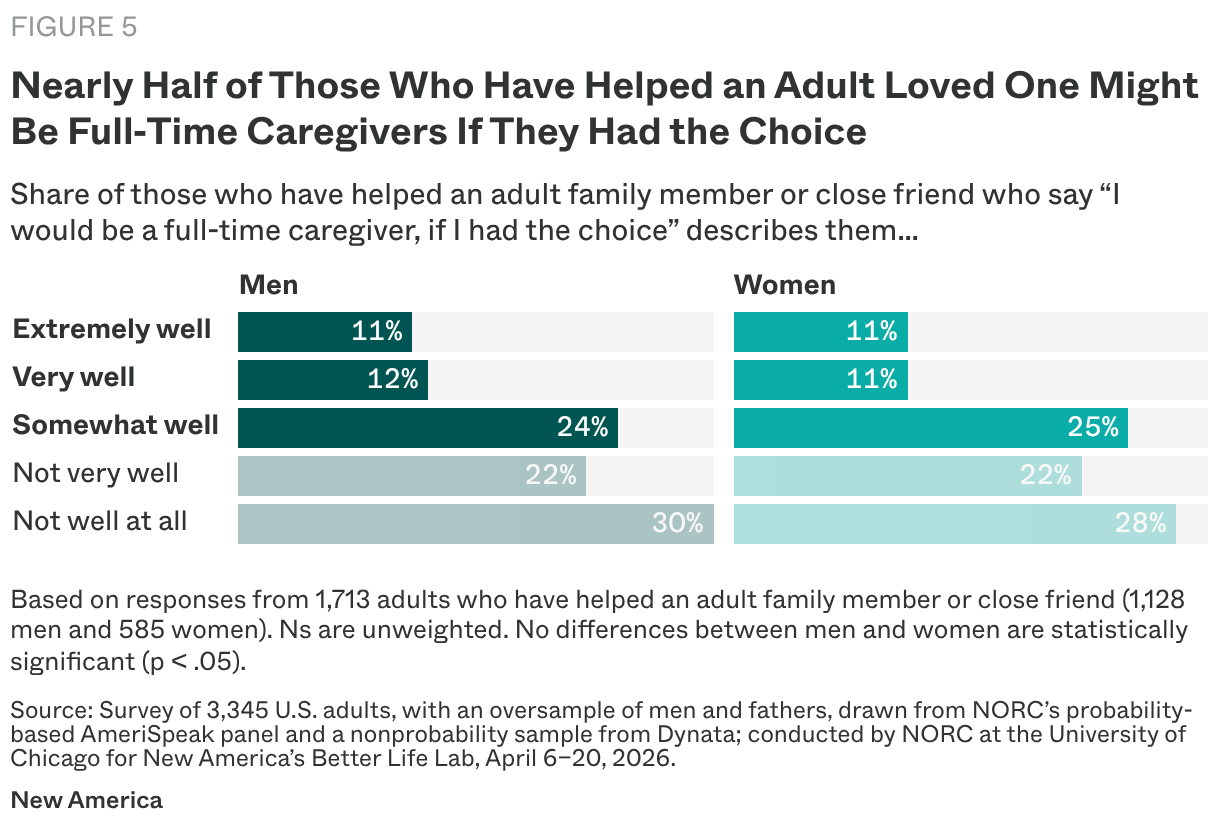
Fathers who identified politically as Democratic or Independent were significantly more likely to report at least some desire to be a full-time caregiver (58 percent and 73 percent, respectively) than Republican fathers (50 percent). Black and Hispanic fathers were also significantly more likely to report a desire to be a full-time caregiver (70 percent and 63 percent, respectively) than white fathers (52 percent). Non-college-educated fathers also showed significantly more of a desire to be a full-time caregiver for an adult (63 percent) than those with college degrees (49 percent).
Sandwich generation caregivers who care for both adults and children with special needs were far more likely than non-sandwich generation survey participants to say they would choose to be both full-time, stay-at-home parents (81 percent versus 65 percent) and full-time, stay-at-home caregivers (67 percent versus 42 percent).
Ian Matthew Lima, 35, works nights for an automotive wholesaler in Rhode Island while his wife works days. That way, he said, they can care for their two children under two at home—a decision sparked in part by how prohibitively expensive child care is. He said he would be a full-time, stay-at-home parent if he had the choice. “I would take staying home with my kids any day of the week,” he said. “I can’t get enough time with them. Even when I’m here at the office, every other minute, I wonder, ‘What’s my daughter doing? I wonder if my son is up yet.’ It’s a lot more rewarding being at home with my kids.”
Another survey respondent, former IT professional Mark Hackl in Oklahoma, who has a stepson and helps care for his aging parents, said the question of full-time caregiving left him feeling torn. He said has always been more career-focused and had “more work than I could do in a week,” so he felt more comfortable being a provider. “I wonder why I want what I want sometimes. Is it instinct? Is it programming?” he said. “Being a better provider makes you feel like you’re being a better protector. And I can see being home, not earning income, being dependent on someone else making me feel more vulnerable, more anxious. Maybe that’s a way that many women feel.”
Men’s desire to care is also apparent in their reports that they anticipate needing to take paid leave to give care. Much like we found in the 2019 survey, similar shares of men and women report that it’s “very” or “somewhat” likely that they’ll need to take paid family leave sometime in the future to care for a child (32 percent men and 28 percent women) or to care for an adult (46 percent men and 50 percent women).
Higher shares of young fathers (18–29 years old) and fathers of young children anticipated needing paid time off to care for a child in the future (58 percent and 51 percent). Noticeable differences among those anticipating leave to care for children included more Hispanic fathers than white fathers (41 percent versus 27 percent) and more fathers earning $30,000 a year or less compared to fathers earning more than $100,000 (40 percent versus 26 percent).
Interestingly, fathers of young children are also seeing more need to prepare for care at the other end of the age spectrum: 57 percent report being “very” or “somewhat” likely to need paid leave to care for an adult compared to 46 percent of other fathers. In this regard, fathers of young children are similar to all mothers, of whom 56 percent expect to need to take leave to care for an adult. More middle-income fathers—those earning between $60,000 and $100,000 a year—anticipate needing paid leave for adult care (55 percent) than those earning less than $30,000 (41 percent). Fully 63 percent of sandwich caregivers anticipate needing time off to care for an adult loved one in the future.
Men’s desire to give care is also clear from the high numbers of respondents who find caregiving to be meaningful and joyful. More than 80 percent of parents and caregivers combined said they found the caregiving they do to be meaningful. Slightly more than half of all fathers and mothers (55 percent) said their caregiving is a source of joy. Among fathers, those with young children were more likely than those with older children to say that their caregiving brought them joy (62 percent versus 52 percent). Fathers with college degrees were also more likely than non-college-educated fathers to say caregiving brought them joy (61 percent versus 52 percent). While fathers with household incomes of more than $100,000 a year were more likely to report joy from their caregiving than fathers earning less income, 60 percent compared to 53 percent for fathers earning less than $30,000 a year, the difference was not statistically significant.
Joy was more associated with caring for children. Among caregivers, those who were parents were significantly more likely to describe their caregiving as a source of joy than caregivers who were not parents (54 percent versus 35 percent)—a reflection, perhaps, that while people find caregiving deeply meaningful, caring for loved ones toward the end of life can also be difficult and emotionally complicated.
A majority of men and women with care responsibilities are also employed: 76 percent of fathers and 65 percent of mothers, with more fathers working as full-time employees (61 percent of fathers versus 42 percent of mothers). Higher shares of fathers ages 30–44 are working (89 percent) compared to fathers of other ages, as are fathers of young children (86 percent). Higher shares of Hispanic fathers are working compared to white fathers (82 percent versus 72 percent). Similarly, more fathers in higher-income households—those with incomes of $100,000 or more a year—are working than fathers earning lower wages (84 percent versus 60 percent of fathers earning less than $30,000 a year). Likewise, college-educated fathers are more likely to be working than non-college-educated fathers (83 percent versus 72 percent).
Fifty-seven percent of those who care for adults or children with extra needs are working, as are 79 percent of sandwich caregivers.
When it comes to organizing work to make time for care, one-quarter of respondents across the board say they have full control over their work schedule. Fully 33 percent of fathers said they had “no control” over their work schedule, as did 30 percent of mothers. Although there was little difference across income, the survey found that more Hispanic fathers reported having no control over their work schedule than white fathers (42 percent versus 30 percent). And for fathers without a college degree, 37 percent said they had no control over their schedules, compared to 28 percent of college-educated fathers. Mothers, however, were significantly more likely to report they had full control over their schedules compared to fathers (29 percent versus 21 percent).
The survey revealed that higher-income and more-educated fathers (like respondents overall) tended to have more control over the hours they worked but not the days—suggesting they have some ability to control job start and end times but not the shape of the work week, which can be inflexible in higher-paying professional or white-collar jobs. One-third (33 percent) of fathers earning $100,000 a year or more said they had some control over the hours they work but not the days, compared to just 12 percent of fathers earning less than $30,000.
On the other hand, young fathers—those 18–29—and Hispanic fathers tended to say they had more control over their days but not their hours, perhaps reflecting hourly, shift-based contract or gig work that can offer some flexibility over which days to work, but often at the cost of stable or predictable income. Twenty-eight percent of young fathers, compared to 17 percent of fathers aged 45–59, said they had some control over the days but not the hours they work, while 27 percent of Hispanic fathers said the same, compared to 17 percent of white fathers.
Many respondents reported substantial gaps between their current work situation and their ideal. Just one-quarter (25 percent) of both parents and caregivers for adults or children with extra needs said they worked from home or a place of their choice, while about twice that (47 percent of both parents and caregivers) would prefer that work arrangement if they could make that choice without facing a career or financial penalty.
The gap is even more pronounced when hybrid work is included. Forty percent of parents and 40 percent of caregivers for adults or children with extra needs currently work from home or in a hybrid setting, while three-fourths (74 percent of both groups) would prefer that arrangement—a 34 percentage point gap between the real and ideal arrangement.
Conversely, 49 percent of parents say they work in an office, while just 21 percent would choose to. About 46 percent of caregivers work in an office, while only 19 percent would choose to. Although the majority of both mothers and fathers prefer to work at home or in a hybrid setting, more mothers (83 percent) said that was their ideal work situation than fathers (65 percent). Nearly one-third (29 percent) of fathers said they’d prefer to work in an office, compared to just 13 percent of mothers.
The desire for flexible work or control over schedules has long been associated with mothers and women with care responsibilities, and, for years, flexible work arrangements were often seen as an accommodation for less-committed workers who were then “mommy-tracked” off the promotion and pay ladders. This survey, however, shows that the lack of schedule control at work and the desire for flexible work is widespread among all workers, regardless of age, gender, income, race and ethnicity, and education levels, and points to a deeper, shared structural problem with the way work is organized rather than a gendered one.
The mismatch between inflexible work and the desire or need to care continues to create work-care conflict and stress, as shown in Figure 6.
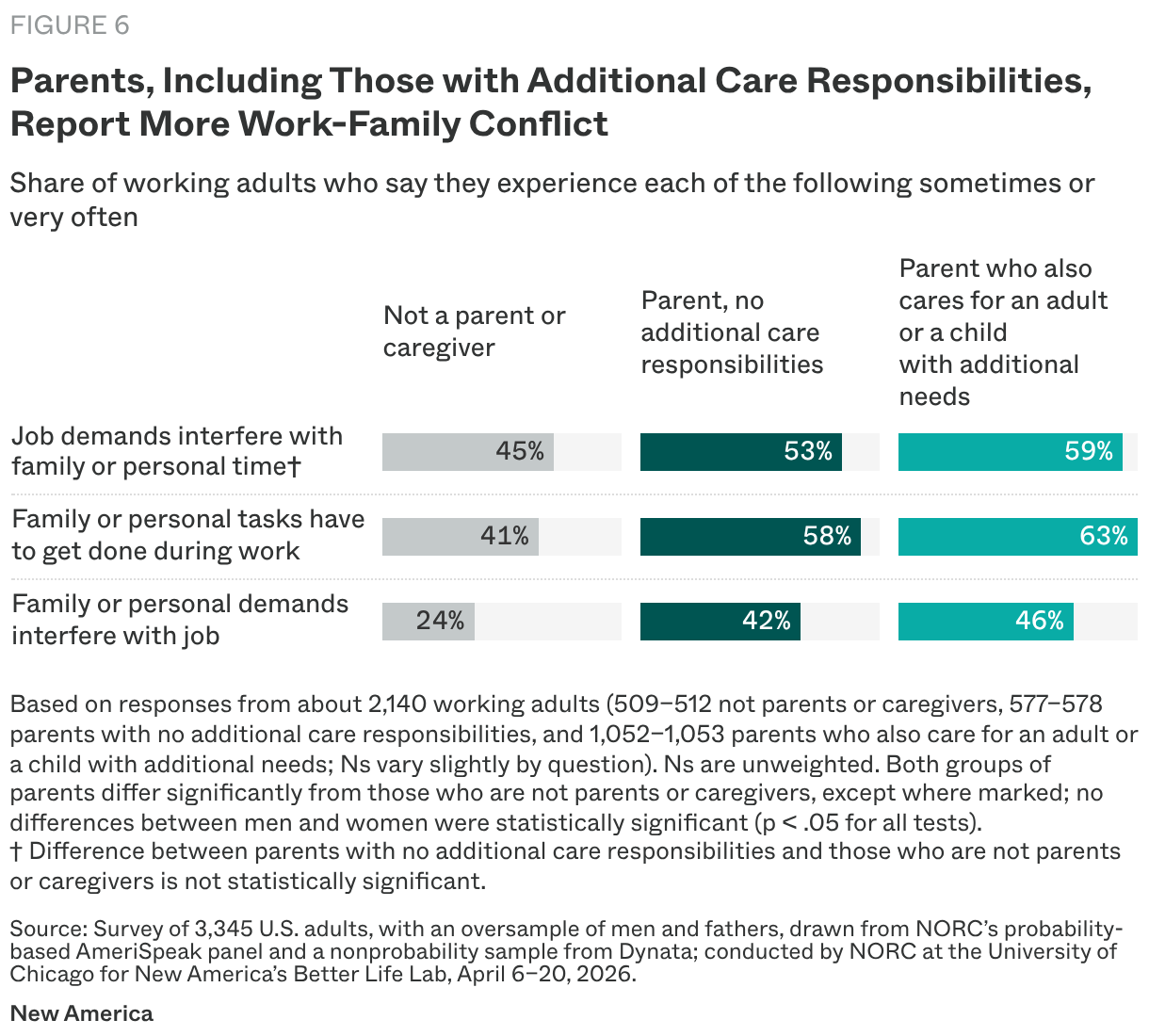
As in the 2019 survey, we found that working parents and caregivers report significantly higher levels of work intruding into family life and family matters spilling into work life. Among those who work, 60 percent of caregivers caring for an adult or child with extra needs said their job demands interfered with family time, compared to 45 percent of those without care responsibilities (parents without caregiving responsibilities for an adult or for a child with special needs fell in between, at 53 percent). Sixty-four percent of working caregivers and 58 percent of working parents “very often” or “sometimes” have to get personal tasks done during work hours, compared to 41 percent of workers who are not parents or caregivers. And 45 percent of working caregivers and 42 percent of working parents reported that their family or personal relationships interfere with their jobs, compared to just 24 percent of workers who are not parents or caregivers.
Among parents, fathers experience similar levels of work-care spillover in both directions, as do mothers: 62 percent of fathers said the demands of their job interfered with their family or personal time, as did 55 percent of mothers; and 48 percent of fathers reported that their family interfered with their job, as did 43 percent of mothers. These differences are not statistically significant.
It’s hardly surprising, then, that 84 percent of survey respondents who had ever given care to a child or adult said they found their caregiving to be stressful, including 80 percent of fathers and 89 percent of mothers. Interestingly, fathers reported that caregiving was stressful, regardless of their income level. That finding is a reminder that work-care stress exists across the income spectrum, even though lower-income caregivers often face greater economic consequences. It’s another indicator that inflexible work is squeezing workers with care responsibilities, regardless of gender or income.
Perhaps one of the most striking findings of the 2026 survey is that care pressure is ratcheting up, as are the penalties. Far more men who care for an adult or for children with extra needs reported missing work or reducing work hours than in 2019. The share of men missing work rose markedly from 64 percent in 2019 to 76 percent in 2026, while the share of women caregivers missing work increased from 71 percent to 78 percent over the same time (though this was not a significant increase).
in 2019
in 2026
When it comes to reducing work hours to provide care, 50 percent of men who care for adults or children with extra needs reported having to do so in 2026, a significant increase from 42 percent in 2019. Women caregivers reducing work hours for care held steady over the years at 45 percent.
More men than women also reported temporarily reducing their work hours by a statistically significant margin, 39 percent versus 30 percent. And among fathers, those earning less than $30,000 a year were more likely than fathers with higher incomes to reduce work hours both temporarily (48 percent versus 27 percent) and permanently (12 percent to 5 percent). Fathers of children under the age of six were twice as likely as other fathers to reduce work hours permanently because of care (12 percent versus 6 percent). And 18 percent of sandwich caregivers reported permanently reducing their work hours, significantly more than the 8 percent of other caregivers.
However, mothers are still significantly more likely to say that caregiving was a major reason they left the workforce, 28 percent, compared to fathers, 10 percent.
Our finding that more men are not working due to care pressure is in line with recent research by Matthew Nestler, senior economist at KPMG, who analyzed data from the Federal Reserve and found that, in 2025, more than 3 million prime-age men (29–54) were not working because of child care and older age care responsibilities.28 And our findings reflect the fact that men make up 40 percent of the 63 million unpaid family caregivers providing care for adults, according to a recent study by AARP and National Alliance for Caregiving.29 That share is only likely to grow as the country continues to age.
In our survey, differences in permanently reducing work hours appear more pronounced by income and intensity of care than by gender. Seven percent of men and 11 percent of women permanently reduced their work hours for care (a nonsignificant difference).
Caregivers of adults or children with extra needs are more likely to report missing a few hours of work to provide care than parents who aren’t caregivers (38 percent versus 29 percent), and they’re more likely to both reduce work hours permanently (11 percent versus 3 percent) or temporarily (37 percent versus 23 percent). Among survey respondents as a whole, more parents than nonparents report taking a full day off of work or more for caregiving (46 percent versus 34 percent), perhaps indicating that parents may need to take entire days off work when children are sick, while people with intensive care responsibilities caring for adults or children with extra needs require more intermittent flexibility to care for medical appointments or ongoing, chronic, complex, or unpredictable care when health or other emergencies arise.
But even while more men are missing or reducing work hours, women are still more likely than men to cite that care was a reason that they retired or left the workforce early (34 percent of women versus 22 percent of men). Among parents, mothers are more likely to say care was a reason they left the workforce (44 percent), compared to 25 percent of fathers. Caring for children also appears to be a factor pushing people out of work: Parents were more likely to say care was a reason they left the workforce than caregivers who provide care for adults or children with extra needs (37 percent versus 28 percent). For young parents, the share rises to nearly half (49 percent).
What the data suggests is that, much as women have for years, fathers and caregiving men are not just experiencing the work-care conflict but are adjusting their employment when work schedules or arrangements fail to accommodate their desire or need to provide care to loved ones.
Survey respondent William Cobb is a case in point. When his mother, a retired hospice worker, became ill, Cobb, who is also a father of three, needed time off work to care for her. He was in charge of administering her medicines, helping her to the bathroom, and managing her day-to-day care. “There were times when I was taking care of my mom that I’d miss all kinds of work,” he said. “Toward the end, when I was her hospice caregiver, she needed intensive care a lot of the time. I wanted to be there for her.”
He wasn’t sleeping. “I was distracted,” he said. “And honestly, I should’ve been on a leave of absence, but I didn’t have anything like that available. So I tried to work because I needed the money.” He made a simple mistake, one dwarfed by his 23-year performance record. “My supervisor gave me an unreasonably hard time for that, given the circumstances.” He wound up moving to a different department.
While his caregiving experience was stressful, it was also deeply important and meaningful, and he was willing to risk his job and career in order to protect time for it, despite an unempathetic boss and a lack of supportive workplace policies.
So what would make combining work and care possible, for men and for women?
The survey unearthed a deep dissatisfaction with the way work is organized that held steady across gender, class, age, race and ethnicity, and type of care. As noted above, nearly three-fourths of parents and caregivers who provide care to adults or extra-needs children said their ideal work arrangement would be from home, a hybrid situation, or a place of their choice. Yet just 40 percent actually worked in their preferred environments.
Similarly, just a quarter of respondents across gender and other demographics reported having full control over their work schedules. Those factors added up to high levels of stress and work-care collision, as noted above.
In interviews with survey respondents, men who were able to effectively combine work and care cited flexible work and control over their schedules as key factors. Paul Bianchi, a retired YMCA executive who lives in Tennessee, said flexible work allowed him to be an engaged parent to his three children and, later, to help care for his mother at the end of her life. “That was a real positive thing about working for the YMCA, it was so flexible,” he said. “If I called my boss and said I had to take a few days off to deal with something for the family, it was never a problem.”
Bianchi said he knowingly chose to make a trade-off of time for money. He knew that working for a nonprofit would mean he wouldn’t be earning a big salary. But having flexibility and time for family made the arrangement worth it. “I counsel people, if you could pick any profession you want, pick one that gives you flexibility,” he said. “When it comes time to be a caregiver or to take care of kids, the most important thing is that you’re available. That’s number one. Finances are number two.”
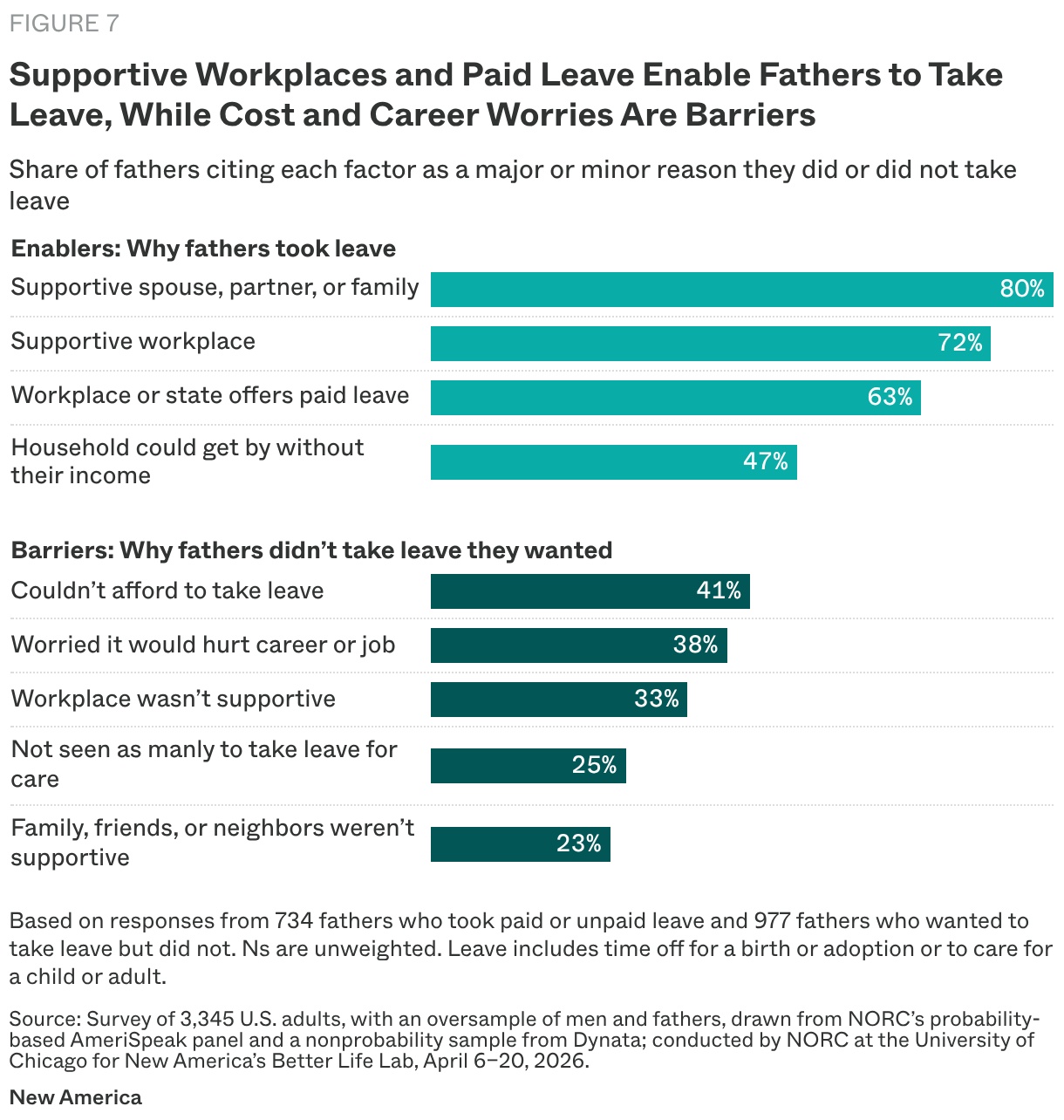
As in 2019, our survey found that paid leave tells a complicated story: Men and women take caregiving leave at similar rates, and they anticipate needing paid caregiving leave in the future at similar rates. But men were much more likely to take fully paid leave, while women were more likely to take partly paid or unpaid leave and to take longer leaves. Affordability remained a major barrier, but supportive workplaces and families and access to paid leave through employers or state policies were important enablers. (See Figure 7.)
As in 2019, half of parents took paid or unpaid leave after the birth or adoption of a child, with mothers and fathers taking leave at similar rates. Nearly one-third (29 percent) covered the cost of their most recent leave (whether after birth or adoption or for adult caregiving) with paid time off, nearly one-third (29 percent) used savings intended for other purposes, and about a quarter (23 percent) limited their spending on basic needs.
One in five adults took paid or unpaid leave to care for a family member with a serious illness, disability, or who is aging, with men and women taking leave at the same rate (21 percent). The share of sandwich generation caregivers was much higher, at 37 percent.
Our survey found that, even as more states have passed state paid family leave laws to make paid leave more accessible, many workers still lack access to paid leave, especially those who earn the lowest wages and those with the most intensive care needs. About half (49 percent) of all sandwich caregivers said they didn’t take leave when they needed it because they couldn’t afford to.
In 2019, four states and the District of Columbia had paid family leave laws. By 2026, that number has risen to fourteen states, plus Washington, DC.30 Though the states that have passed such laws tend to be led by Democrats, the survey found no differences between Republicans or Democrats in opting to take leave: About half each took paid or unpaid leave after the birth or adoption of a child, compared to 42 percent of Independents.
Of the respondents who took leave to care for a loved one, nearly half of those earning $100,000 a year or more (47 percent) were also more likely to take fully paid leave, compared to just 18 percent of those earning $30,000 or less, even though the survey found that those earning the lowest wages tended to do more day-to-day caregiving tasks for both children and adults.
And, as in 2019, when asked about their most recent leaves, men said they were more likely than women to take fully paid caregiving leave after the birth or adoption of a child or to care for a loved one (47 percent for men versus 31 percent for women). Women were still taking more unpaid leave (36 percent versus 23 percent for men), a signal perhaps of how powerful the male breadwinner expectation remains,31 how critical male earnings (which are usually higher than women’s) are to many families’ economic stability, and how women are still expected to be the default caregivers who sacrifice their own careers and even the family’s financial security in order to put care first.
Julio Lopez, 58, a Mexican immigrant who works in a restaurant in Chicago, is a case in point. Lopez didn’t take paid leave when his daughter was born. And while he didn’t provide much hands-on care for her as she grew, he considers himself a caregiver because of his financial providing for his family. “I’m always the one putting the money down,” he said. “I think I inherited that from my own father, my own culture. Men are always the caregivers, willing to listen to you and provide means and money to fix things when someone’s in trouble or give you a shoulder to cry on.”
Among men who wanted to take leave from work for caregiving but didn’t, affordability (37 percent), fears of career penalty (33 percent), and unsupportive workplaces (27 percent) were reasons for this choice, more than worrying that it was not seen as manly (21 percent). The share of fathers reporting they couldn’t afford to take leave was high even for those earning $100,000 a year (35 percent) but rose to 58 percent for fathers earning $30,000 or less. In other words, practical and workplace barriers were more commonly cited than concerns about whether taking leave would be seen as unmanly.
In contrast, people who took leave for care said the reasons they were able to do so were supportive workplaces (64 percent), supportive families or partners (74 percent), and having access to paid leave through their employer or living in states with paid leave policies (55 percent). For fathers specifically, 80 percent said having a supportive family or partner was a reason for being able to take leave, but having a supportive workplace was also a key reason for fathers, with 72 percent of all fathers citing it as a reason and 83 percent of fathers of young children. Sixty-three percent of fathers also cited having access to paid leave through their employer or enabled by state policy, as did 55 percent of all mothers (not a significant difference). For fathers of young children under the age of six, that share rose to 73 percent.
Ian Matthew Lima, the father of two from Massachusetts, said the flexibility he gets from work helps him manage work and care. “I’m fortunate that my boss is the father to young children as well,” Lima said. “He gets what it’s like.” While his wife’s employer provided three months of paid leave, and the state’s paid-leave policy provided her with another three months, Lima took six weeks of “hybrid” leave when each of his children were born, meaning he didn’t stop working completely. “It sucked, but it kept me from having to take a pay cut,” he said. He would have taken more, but because he works in Rhode Island, he didn’t qualify for Massachusetts’s more generous paid leave policy. “I took what I could get,” he said.
As in 2019, the 2026 survey shows the challenge is not persuading men that care matters or is valuable. Many, as noted above, already believe that and want or need to provide care for others. The challenge is whether public policies, norms, and workplace cultures make it possible for them to act on that desire or need without suffering career penalties or economic consequences.
In designing our 2026 Men and Care survey, we sought to answer the question of how young men differed, if at all, from older men and from women of the same age. Recent polling and research have suggested a trend among young men away from gender egalitarianism. The survey included an oversample of men ages 18–29 to enable closer analysis of these claims.
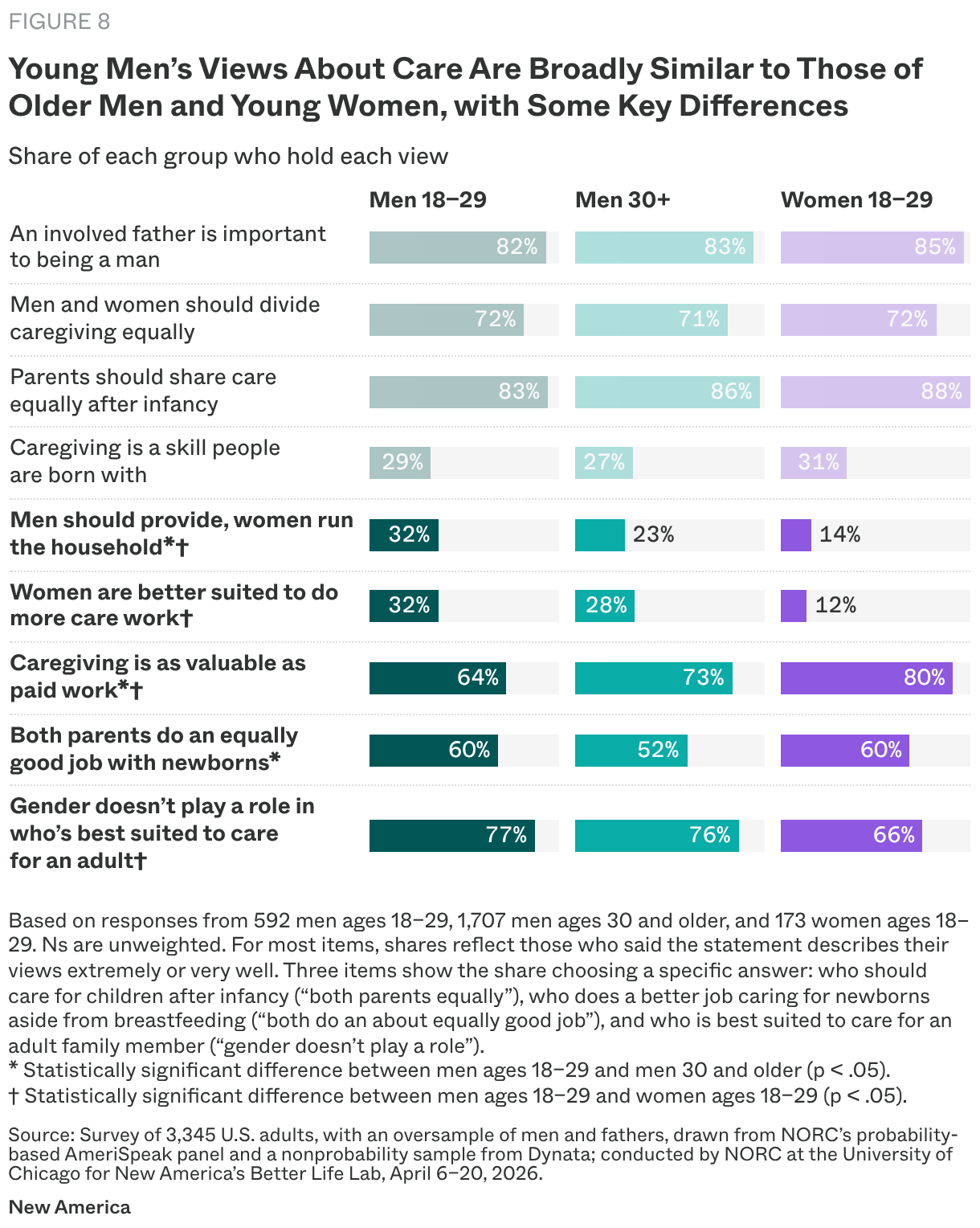
In general, young men’s views about care are broadly similar to those of older men and to young women in their age group. (See Figure 8.) Young men are as likely to say caregiving is meaningful, that they feel respected as caregivers, and that caregiving can be stressful. They are also as likely to say, “Involved fatherhood is central to masculinity,” and “Caregiving should be divided equally.” Like women and older men, fewer than one-third of younger men believe that “caregiving is a skill people are born with.”
On the flip side, 67 percent of non-caregiving young men believe that care is a skill that can be learned with time and experience, a share similar to young women, and significantly higher than young men who care for adults or children with extra needs (52 percent).
About one-third of young men have provided care to an adult or child with extra needs. Seventy-one percent of young fathers expressed at least some interest in being a full-time caregiver to an adult, compared to 47 percent of fathers over the age of 60, a significant gap.
Young men differ from other groups in several important ways, particularly in how many of them value unpaid care relative to paid work and support a traditional male-breadwinner role. But the survey found that the more traditional attitudes are minority views among young men, not majority views. And on some of the most explicitly gendered questions—for example, whether women are naturally suited to caregiving—young men are not particularly traditional, and in some comparisons are less traditional than their women peers.
Young men express more egalitarian views than older men about who should care for babies during the breastfeeding and bottle-feeding stages, when 60 percent of young men say both parents do an equally good job, compared to 52 percent of older men; women fall in between, at 58 percent. Although women overall are more likely than men overall to say that mothers and fathers should share care equally after infancy (89 percent versus 85 percent), young men are just as likely as older men to say so.
On the question of who is best suited to do adult caregiving, young men look more egalitarian than women their own age: Just 15 percent said “mainly women,” while twice as many young women said the same (32 percent), a statistically significant gap. Seventy-seven percent of young men said that “gender doesn’t play a role,” compared to 66 percent of young women, another significant gap.
Yet young men were more than twice as likely as young women to say that men’s primary role should be financial providing while women take care of the household (32 percent versus 14 percent said this described their views “extremely well”). Still, this was a minority point of view among young men: 36 percent said the statement either did not describe their views “very well” or “not at all,” with the remainder falling in the middle. As in the general population, young women were significantly more likely than young men to say the idea that they’d choose to be a stay-at-home parent if there were no financial penalties matches their feelings at least “somewhat well” (89 percent versus 70 percent of young men). That share was also higher than among older men (60 percent).
Young men were no different than women their age to agree that caregiving is valuable to society, but they were less likely to agree on this point than men 30 and older (66 percent versus 76 percent). Just 53 percent of young Black men said care is valuable to society, compared to 70 percent of white men—one of the few instances of statistically significant racial variation among young men in the survey (young Hispanic men fell in between at 66 percent). Young women’s views are similar to young men’s on this question (71 percent), perhaps suggesting that age and caregiving experience may matter alongside gender in attitudes about care’s value to society.
Young men were also less likely than older men to say that care is as valuable as paid work (64 percent versus 73 percent). Unlike the question of care’s value to society, young men also diverge from young women on this question. Eighty percent of young women say care is as valuable as paid work. Still, on both questions, the majority of young men believe care is valuable.
As shown in Figure 9, fewer young men identify as caregivers: Just under one-third (30 percent) of men 18–29 identify as caregivers, significantly fewer than older men (43 percent) but comparable to young women (31 percent). But there are significant racial differences among young men. Young white men in this age group are significantly less likely than young Hispanic men to identify as caregivers (22 percent versus 44 percent), with young Black men falling in between (36 percent).
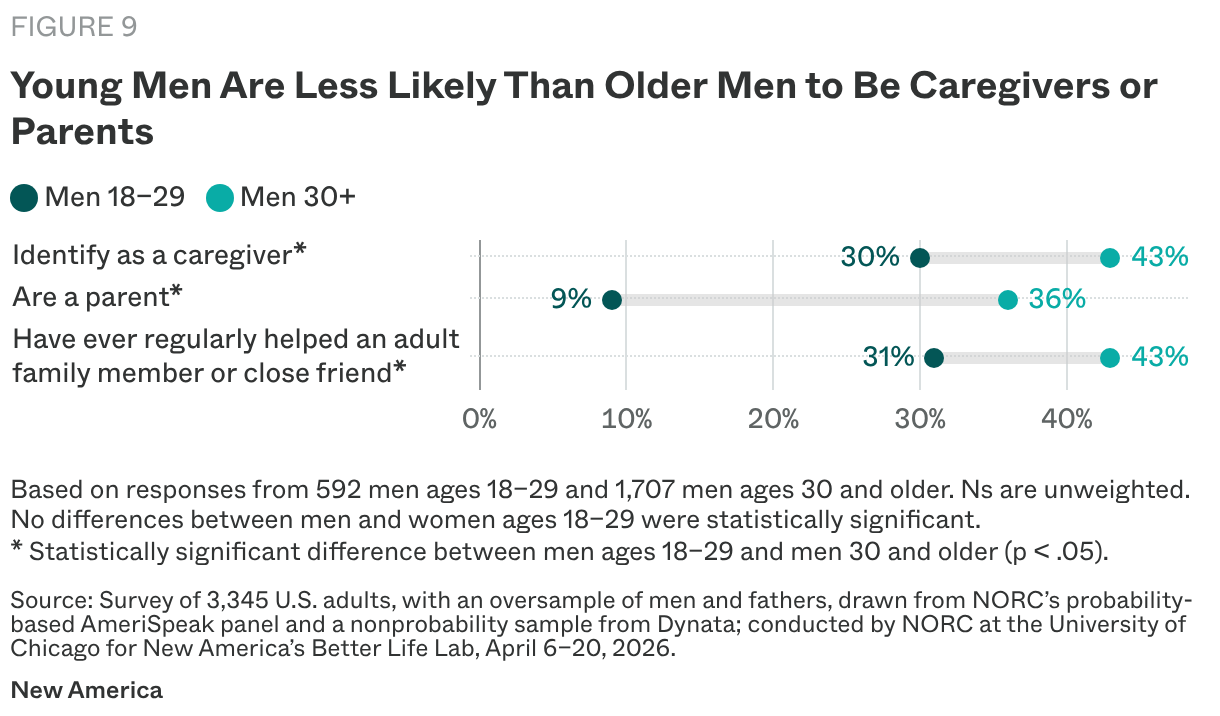
Only 9 percent of young men are fathers. Unsurprisingly, young men are less likely to be fathers than older men (36 percent of men 30 and older). Young fathers are just as likely as older fathers to say they have given care to a child with additional medical or educational needs (37 percent and 39 percent, respectively).
Like other dads, fathers in the 18–29 age group are equally likely to be engaged in parenting tasks such as making meals, comforting their children, providing transportation, managing schedules and activities, disciplining their children, playing with their kids, cleaning up after them, and taking part in educational activities. Not surprisingly, young fathers are more likely to have children ages 0–5 than older fathers (57 percent of young dads have a child two and under and 43 percent have a child ages 3–5, compared to 23 percent of older dads who have a child under two and 24 percent who have a child 3–5).
Younger fathers are the most likely to say they face barriers to being the dads they want to be (33 percent), almost three times more so than the oldest fathers (12 percent of fathers over the age of 60). Young fathers anticipate needing more support to combine work and care: 58 percent say they are “very” or “extremely” likely to need paid leave to care for a child in the future, compared to 42 percent of fathers ages 30–44, and even older fathers (the rate of anticipating needing leave declines with age). In keeping with this finding, as noted above, 70 percent of the young fathers who actually took leave cited access to paid leave policies as an enabler.
In open-ended answers, young men described the barriers they face, especially financial constraints, as reflecting their significantly lower incomes relative to parents in older age brackets (though, in general, young men earn more than young women).32 “I have to work full time, manage 2 households, provide care for my grandmother, and make sure my little sister is working and paying her bills,” wrote one respondent, a married father of two from Texas.
“My own self doubt, stupidity, financial stability, choices,” wrote another young father.
“My financial situation and need for therapy due to my own upbringing,” said a 25-year-old, unmarried father of two children. Mental health was also cited as a barrier by other young fathers: “Breaking down generational trauma,” wrote an unmarried father of one child who has additional needs from Kentucky.
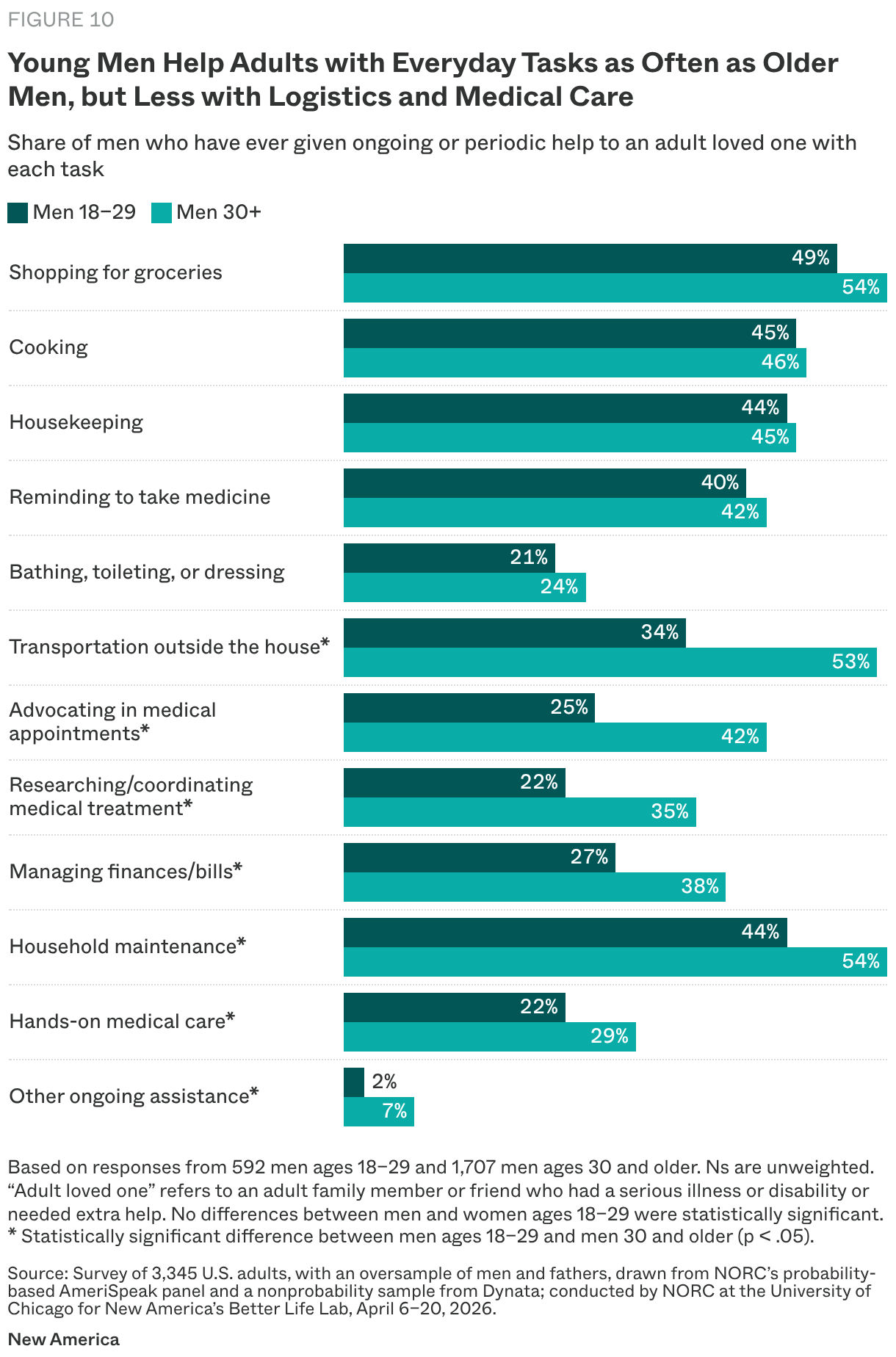
Although few young men identify as caregivers, young men and young women are equally likely to report having ever provided care for an adult friend or family member (31 percent), in contrast to the gender gap among adults ages 30 and over (among whom 51 percent of women and 43 percent of men identify as caregivers). Again, unsurprisingly, young men and women are less likely than older respondents to have cared for an adult (with rates increasing from 40 percent among respondents age 30–44 up to 53 percent of respondents age 60 and older). Young men who are caregivers for adults do many of the same tasks as older caregivers, though they are less likely to take part in administrative or financial caregiving tasks, likely due to their lack of financial resources and experience navigating these institutions. (See Figure 10.)
Young men are as likely as other caregivers to say there are barriers preventing them from being the caregiver they want to be, often suggesting they feel overwhelmed and insufficiently supported. Like young fathers, young male caregivers cite financial barriers to adult caregiving: “Finances, as everything is so expensive these days that a young person cant even consider taking care of someone as they can barely take care of themselves,” wrote a 23-year-old caregiver from Ohio. He elaborated further: “My friend just had a kid and he struggles heavily with paying rent, car payments, and anything financial. This is the biggest problem he faces. Without that, he would be more available to his kid. These necessary expenditures are so high now we can’t even take care of our children the way we want.”
“Financial mostly. It’s hard balancing figuring out my career while also doing all of the cooking, cleaning, maintenance, shopping, and the majority of the transportation,” wrote a 22-year-old man from Colorado. “It’s very overwhelming and money is constantly on my mind.”
Other young men suggested their caregiving was at odds with their need to earn money, citing workplaces and schedules that were incompatible with their caregiving. “[M]ostly my job get at risk because of the time I put in for caregiving,” wrote a 22-year-old carer from Maryland. “I need to work more to contribute to the household,” wrote a 25-year-old man from rural Illinois. “The time, money, and resources. I get very little financial support for the work I do and the time I am expected to give. I need more money,” wrote a 26-year-old man from Kentucky who reduced his work hours because of caregiving. At the conclusion of his survey, when asked if he had anything else to share about caregiving, he wrote, “It’s hard. And you get no thanks for it. You put your life on hold for years, even decades. And no one recognizes or understands the sacrifice. And if you complain, you are branded as heartless.”
The 22-year-old from Colorado felt slightly more positive about his experience but still acknowledged its difficulty: “Everyone should be a caregiver at some point in their life, once they are ready. It’s really helped me in my growth, but on the other hand, I don’t think everyone could be caregivers.”
In sum, young men do not fit into either an egalitarian or traditionalist narrative. While on some questions, young men tend to be more traditional than their peers, they do not do so uniformly or as a majority. Young men’s attitudes about who can care are quite egalitarian: Most support equal caregiving, and young men are even more likely than older men to say fathers and mothers are equally capable of caring for newborns.
At the same time, although a majority (two-thirds) of young men say that they value unpaid care work, this group is still more likely to express traditional views than are older men and women of all ages. Young men are more likely than young women to hold to the traditional male-breadwinner/female-homemaker model of families (32 percent versus 14 percent).
Though young men are less likely to have yet become parents or identify as caregivers, nearly one-third have cared for an adult, and young fathers anticipate substantial care responsibilities in the future. Despite all this, the majority of young men say care is valuable. The father from Texas caring for his grandmother mentioned above closed his survey with this thought: “I don’t think people understand the full picture of what goes into caregiving until they have to do it themselves. In my opinion, awareness needs to be spread so people are more understanding and companies are more willing to work with you.”
Our data from 2019 and 2026 show that the problems of unequal and overwhelming caregiving in the United States no longer primarily stem from a lack of interest or involvement from men, if they ever did. Our surveys have shown that men overwhelmingly value care and caregiving: They not only want to actively engage in it but to share it equally. The real issue, then, is how to ensure that men can act on those beliefs, without workplaces, social judgments, and financial and health constraints stopping them.
In order to be the caregivers they want to be, people need enough income to care without facing a financial crisis, paid time away from work when care demands it, and enough control over their working lives to be present for the people who depend on them. Men also need permission—from workplaces, families, and themselves—to understand that providing care, not just providing income, is part of what it means to provide for a family.
The opportunity is larger than getting men to do more care. When men can care without sacrificing their livelihoods, women are less likely to be pushed into the role of default caregiver—and less likely to absorb the career and economic penalties that come with it. More equitable care at home can create more equitable work outside it.
Based on the data, here are key recommendations to redesign workplaces and shape public policies and cultural attitudes to make both equitable work and equitable care possible:
This survey, funded by New America, was conducted by NORC at the University of Chicago. Staff from NORC and New America collaborated on all aspects of the study. Data were collected using both probability and non-probability sample sources. Interviews for the survey were conducted between April 6 and April 20, 2026, with adults age 18 and over representing the 50 states and the District of Columbia.
The probability sample source is AmeriSpeak®, NORC’s probability-based panel designed to be representative of the U.S. household population. During the initial recruitment phase of the panel, randomly selected U.S. households were sampled with a known, nonzero probability of selection from the NORC National Sample Frame and then contacted by U.S. mail, email, telephone, and field interviewers (face to face). The National Sample Frame provides coverage of approximately 97 percent of the U.S. household population. The U.S. Postal Service Delivery Sequence File (USPS DSF) and National Consumer Address File have been used in a subset of years as a supplemental sample during AmeriSpeak panel recruitment for low-coverage states. Those excluded from the sample include people with P.O. box–only addresses, some addresses not listed in the USPS DSF, and some newly constructed dwellings.
Panel members were randomly drawn from AmeriSpeak, and 2,673 completed the survey—2,627 via the web and 46 via telephone. Panel members were invited by email or by phone by a NORC telephone interviewer. Interviews were conducted in both English and Spanish, depending on respondent preference. Respondents were offered a small monetary incentive ($3) for completing the survey. The weighted household panel recruitment rate is 24.9 percent and the survey completion rate is 40.6 percent, for a weighted cumulative response rate of 10.1 percent.
Dynata provided 672 nonprobability interviews with men age 18–29, men of color, and fathers of children age 0–8. The nonprobability sample was derived based on quotas related to age, race and ethnicity, gender, and education. Interviews were conducted in English and Spanish and via the web only. For panel recruitment, Dynata uses invitations of all types—including email invitations, phone alerts, banners, and messaging on panel community sites—to include people with a diversity of motivations to take part in research. Because nonprobability panels do not start with a frame where there is a known probability of selection, standard measures of sampling error and response rates cannot be calculated.
Quality assurance checks were conducted to ensure data quality. In total, 208 interviews were removed for nonresponse to at least 50 percent of the questions asked of them or for completing the survey in less than one-third the median interview time for the full sample. These interviews were excluded from the data file prior to weighting.
In order to incorporate the nonprobability sample, NORC used TrueNorth calibration, an innovative hybrid calibration approach developed at NORC to explicitly account for potential bias associated with the nonprobability sample. TrueNorth uses a tree-based non-parametric supervised learning algorithm to classify respondents based on their survey responses and apply a ratio adjustment to adjust the weights for the nonprobability sample to bring weighted distributions of the nonprobability sample in line with the population distribution for characteristics correlated with the survey variables. Such calibration adjustments help to reduce potential bias, yielding more accurate population estimates. A raking process is used to adjust for any survey nonresponse as well as any noncoverage or under- and oversampling in both probability and nonprobability samples resulting from the study-specific sample design. Raking variables for both the probability and the nonprobability samples included age, sex, census region, race and ethnicity, education, parental status, and 2024 vote choice. Population control totals for the ranking variables were obtained from the 2020–2024 5-year American Community Survey. For the general population, the weighted data reflect the U.S. population of people age 18 and over. For fathers, the weighted data reflect the U.S. population of fathers age 18 and over.
The overall margin of sampling error for the combined sample of 3,345 completed interviews is +/- 2.8 percentage points at the 95 percent confidence level, including the design effect. Men overall and fathers specifically were sampled at a higher rate than their proportion of the population for reasons of analysis. The overall margin of sampling error for the combined sample of 2,229 completed interviews with men is +/- 3.2 percentage points at the 95 percent confidence level including the design effect. The overall margin of sampling error for the combined sample of 1,298 completed interviews with fathers is +/- 4.0 percentage points at the 95 percent confidence level including the design effect. Sampling error is only one of many potential sources of error and there may be other unmeasured error in this or any other survey.
For the open-ended questions BELIEF1, CGAT8B, and F12, responses were initially classified using Microsoft Copilot. These codes were reviewed, validated, and adjusted as needed by a human coder for reporting.
Additional information on the TrueNorth approach can be found here. For more information, email [email protected].
Better Life Lab staff members supplemented survey data with interviews of select survey respondents who opted in to being contacted by a reporter after their survey completion. Unless otherwise noted, each respondent granted us permission to use their real names. Like most large-scale surveys of this kind, this study measured gender as binary (man/woman). It also found about 1 percent of respondents identify as transgender. We recognize this framing does not reflect the full diversity of gender identity, and we present these findings as a description of the data collected and general trends around caregiving and gender.
Senior Writer and Researcher, Better Life Lab

Director, Better Life Lab