A Chapter of: Sealing the Trapdoors: The State Policies That Matter for Equitable K-12 School Funding
I. How Much Does Each District Have, and Is It Enough for Its Students?
Policy Checklist
State policymakers and advocates should consider:
- State formula structure
- Formula mechanisms accounting for variation in costs (between districts and over time)
- State money distributed outside the funding formula
- Local money outside the formula: district authority over local property tax rates
- Local money outside the formula: district boundaries, local tax bases, and property tax pooling
- Adequacy considerations for equity (state cuts and equitable adequacy targets)
Equity requires that district funding levels be aligned with the needs of students and communities. Efforts to improve the equity of district funding amounts tend to focus on reforming the state funding formula that sets each district’s target funding amount, but this question encompasses several policies. These include not only whether the state formula calculates an appropriate target amount for the district, but also how much local money the district may raise in addition to its share of the formula amount, if any, as well as how much state money is allocated outside the formula.
How Much Money Does the State Formula Calculate for the District, and Does That Align with Its Needs?
Multiple leading education policy organizations have published guides to state school funding formulas (see below), so this report will not offer a comprehensive look at formula elements. Instead, it will discuss selected elements whose equity dimensions are often overlooked or misunderstood.
Additional Reading: Funding Formulas
For more detailed discussions of allocation formula elements, consult these helpful guides:
- Equity-Driven State K–12 Funding: A Policy Guide for Advocates (Bellwether, 2025)
- K–12 Funding Toolkit: A Strategic Guide for States (Education Commission of the States, 2025)
- Common Sense and Fairness: Model Policies for State Education Funding (EdBuild, 2020)
- Essential Building Blocks for State School Finance Systems and Promising State Practices (Learning Policy Institute, 2018)
State Formula Structure
There is broad agreement in the field that states should use a weighted student funding formula (WSFF) to set districts’ target funding amounts. A WSFF is a specific kind of student-based funding formula in which a base (often called a “foundation”) amount of funding is assigned to each student. Then, that amount is weighted—a multiplier is applied—to account for specified student needs and district characteristics. The most common weighted categories include students from low-income households, multilingual learners, and students with disabilities. Weights should be robust and calibrated to the additional cost of serving students in these groups. Weights should also be differentiated within categories (e.g., for multilingual learners with different levels of English proficiency or students with different disability diagnoses). States sometimes also apply weights for students in special academic programs, such as gifted education or career and technical education. Weights may also be applied for students in certain categories of districts, such as those enrolling a high concentration of students in poverty or those that are sparse or geographically isolated.
The WSFF structure lends itself towards equity by making students the primary focus of the calculation and foregrounding their learning needs. Unlike resource-based formulas, in which staff positions and other classroom inputs are funded on the basis of student-to-resource-unit ratios (see below), WSFFs do not presuppose particular classroom arrangements. The funding is meant for the student rather than the teacher or program, offering greater flexibility to practitioners and local decision-makers. Additionally, because WSFFs account for the cost of serving different groups of students with weights rather than specified dollar amounts or separate grant programs, these allocations do not need to be manually adjusted by the legislature. Any increases to the base amount will automatically increase the value of the weights in turn, protecting these supplemental allocations from erosion by inflation.
What If Your State Can’t Quit Teacher Units?
Though student-based funding is recommended, leaders in some states are reluctant to move away from resource-based formulas that include a funding unit for each teacher or classroom. The following are four ways to make such a system more equitable:
- Calibration for Student Needs: The student-to-unit ratios generating resource funding should be lower for students with higher needs, approximating WSFF weights.
- Inclusive Resource Units: Units of funding should be valued to cover a range of resource needs, not just individual teacher positions. This mirrors the WSFF base amount and allows policy discussions to focus broadly on students’ resource needs instead of only on teacher salaries.
- Standard Unit Values: While districts receive different numbers of resource units, each unit generated should be worth the same amount, not vary based on teacher salary level.
- Flexibility: Regardless of the resource need assumptions driving the calculation, districts should be able to decide locally how to spend formula funding.
Whether a district has an appropriate target funding amount is substantially driven by the specific elements of the funding formula: whether its base amount is sufficient and its weights (or other supplemental allocations) reasonably account for the needs of students and school communities.
Formula Mechanisms to Account for Variation in Costs
States use a range of adjustments and mechanisms to account for variation in costs between districts, as well as changes in costs over time. These policies are tricky to get right and must be treated with care to avoid unintended consequences for equity.
Adjustments for Rurality, Sparsity, or Small Size
Sparse, rural, and remote districts face real and distinct budget challenges. Remoteness makes it difficult to attract qualified teachers and staff, which can drive up salary costs. Sparsity and diseconomies of scale can also increase the per-pupil costs of necessities like food service, building maintenance, and, especially, transportation. In states with a lot of variation in the geographic size and density of school districts, it is important to account for these cost drivers. However, states should not provide extra funding to small-enrollment districts simply because they are small. This practice risks rewarding or incentivizing “splinter” districts in dense areas whose size is inefficient and whose narrow borders are drawn around economically and racially homogenous neighborhoods, making for segregated schools. These funding adjustments should focus on sparsity and remoteness rather than small size.
Regional Cost-of-Living Adjustments
In some states, a regional cost-of-living adjustment (COLA) is applied to the funding calculation, usually based on housing costs or wage rates. This is largely meant to help districts compete within their labor markets for teachers and staff, a reasonable goal. However, districts with high costs of living are often ones with high-value local tax bases, and these adjustments have the inequitable effect of sending extra state funding to the districts that have access to the most local revenue. Therefore, COLAs should be used rarely, and they should be carefully evaluated to make sure they are not rewarding wealth with more money. They should only be used in states that have fully eliminated the local funding advantage held by high-wealth school districts (see “District Discretion over Tax Rates” below) or in narrow instances where the cost of living does not correlate with local property values.
Inflation Adjustments
Many school finance experts advise indexing the school funding formula (or, in a WSFF, indexing the base amount) to inflation so that districts’ target funding amounts do not fall behind real costs. There is obvious logic to requiring that state education aid not shrink in real terms. However, where state formulas are indexed to inflation, legislatures can usually override the automatic increases. So, unless the adjustment is constitutionally mandated, it functions more as a norm than a strict requirement.
Because inflation drives up costs but not necessarily state revenues, and because states must balance their budgets, there is an inherent tension between inflation indexing and available resources. Another option is to index the formula to the state budget, in the manner of California’s Proposition 98 (1988), which is meant to ensure that state education spending keeps pace with growth in income tax revenues and does not shrink as a percentage of the state budget.1
One often-overlooked policy that also helps school funding levels keep up with inflation is regular property reassessment. If the local property taxes that contribute to schools are levied on out-of-date valuations, the district’s local revenue will fall behind its real fiscal capacity. This will either suppress overall school funding (if the formula is not indexed to inflation) or will put the onus on the state to fund a larger share of the formula target (if it is indexed to inflation). Regular property reassessment (at least every few years) reduces pressure on the state budget and makes it more likely that legislators will allow the formula to keep pace with inflation.
How Much State Money Is Distributed Outside the Funding Formula, and to Whom?
States often distribute some education aid outside the school funding formula, through grant programs or limited-use categorical funding allocations. Common outside-formula allocations include those for transportation, school safety initiatives, start-up or equipment costs for career and technical education programs, and teacher professional development, among other priorities. These allocations tend to proliferate as more years pass since the last formula reform, since they offer a way to add to the school funding system without overhauling its structure. The key equity problem with these distributions is that, unlike districts’ formula amounts, they are usually funded entirely with state dollars. Since no local contribution is required, even the wealthiest school districts receive the full amount of these state allocations. This can tie up a substantial amount of state money in districts that could fund all of these priorities without the state’s help. To minimize this equity problem, states should fund as many priorities as possible through the core funding formula and have a wealth-sensitive distribution for any education spending outside the funding formula.
How Much Local Money Can the District Collect in Addition to Its Share of the Formula Amount, and Is This Amount Governed by Equity Guardrails?
As discussed below in “State and Local Shares of the Formula Amount,” in most states, the formula target is not meant to be met with state aid alone. Instead, the state has a method for dividing responsibility for funding the formula amount between itself and the local district. This calculation of the district’s formula contribution does not capture the full amount of local funds in the system, however. The district’s authority and willingness to raise more or less than its share of the formula amount, and the tax base it has with which to do so, determine the ultimate amount of local funding it will have. These factors matter enormously. Local revenue outside the funding formula is one of the biggest drivers of inequity in the school funding system.
While the state generally calculates an expected local contribution amount for the formula, about half of states allow districts to raise and contribute less than this amount.2 This is most likely to occur in districts where there is less overlap between the local population of property owners and the families of public school students, such as districts where most families live in rental housing or where much of the high-value property is owned by people who reside elsewhere, as with vacation homes and much corporate and industrial property. In these instances, the families of district students are likely to have lower incomes than the taxpaying population.
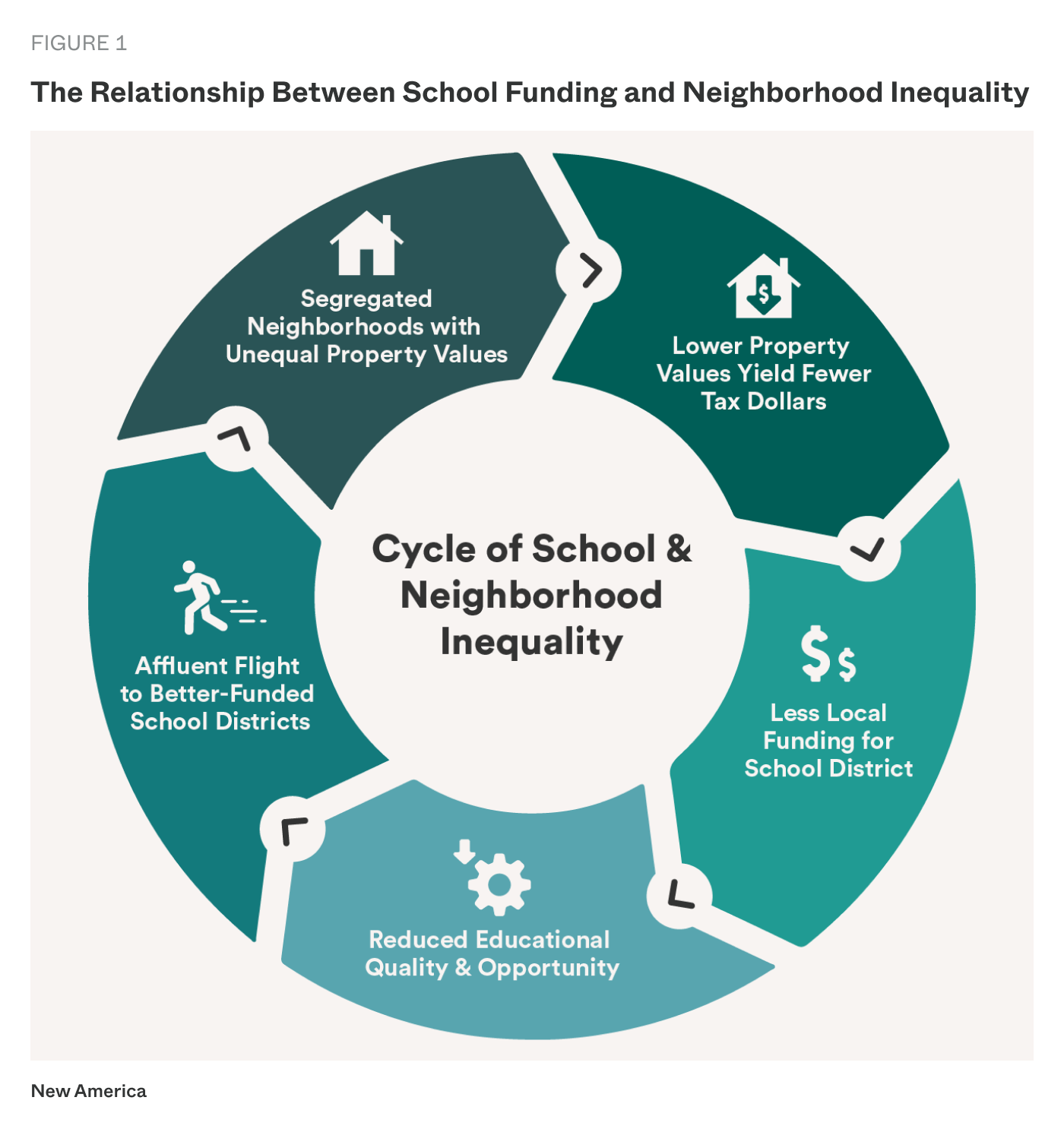
When districts raise the full amount expected by the formula calculation and no more, their core funding equals the formula target. But districts’ local taxes are almost never capped at the amount of the expected local contribution. In most states, districts have substantial room to raise local money over and above the formula amount, either at the discretion of the school board or with voter approval. This money is generally not offset by reductions in state aid. Property-wealthy districts have the easiest time raising extra funding for their schools, while spending in property-poor districts can trail far behind, with severe equity consequences. Students in property-poor districts lose important educational opportunities, and families that can afford to do so leave for districts with better-funded schools. Meanwhile, the clustering of affluent families in districts with high-quality schools drives up home prices—and therefore property values—in those districts, perpetuating the cycle of inequality (Figure 1).
A small number of states, such as Wyoming and Michigan, specify the exact property tax rate that can and must be levied for schools and do not allow either local underfunding or extra local dollars.3 In a handful of other states, tax rates are capped at a level not too far above the expected local contribution, at least limiting the room that property-rich districts have to outspend the formula amount. These policies go a long way to constrain inequity in the school funding system.
District Boundaries, Local Tax Bases, and Property Tax Pooling
School district boundaries not only outline the geography of a school system; they also outline the taxing jurisdiction that supports that school system with local funds. Districts are property-wealthy or property-poor because of the value of the taxable properties within their boundaries. In a system where local property tax revenues are a major contributor to districts’ total funds, states can create much greater equity by drawing school district boundaries to encompass similar levels of per-pupil property wealth (Figure 2).
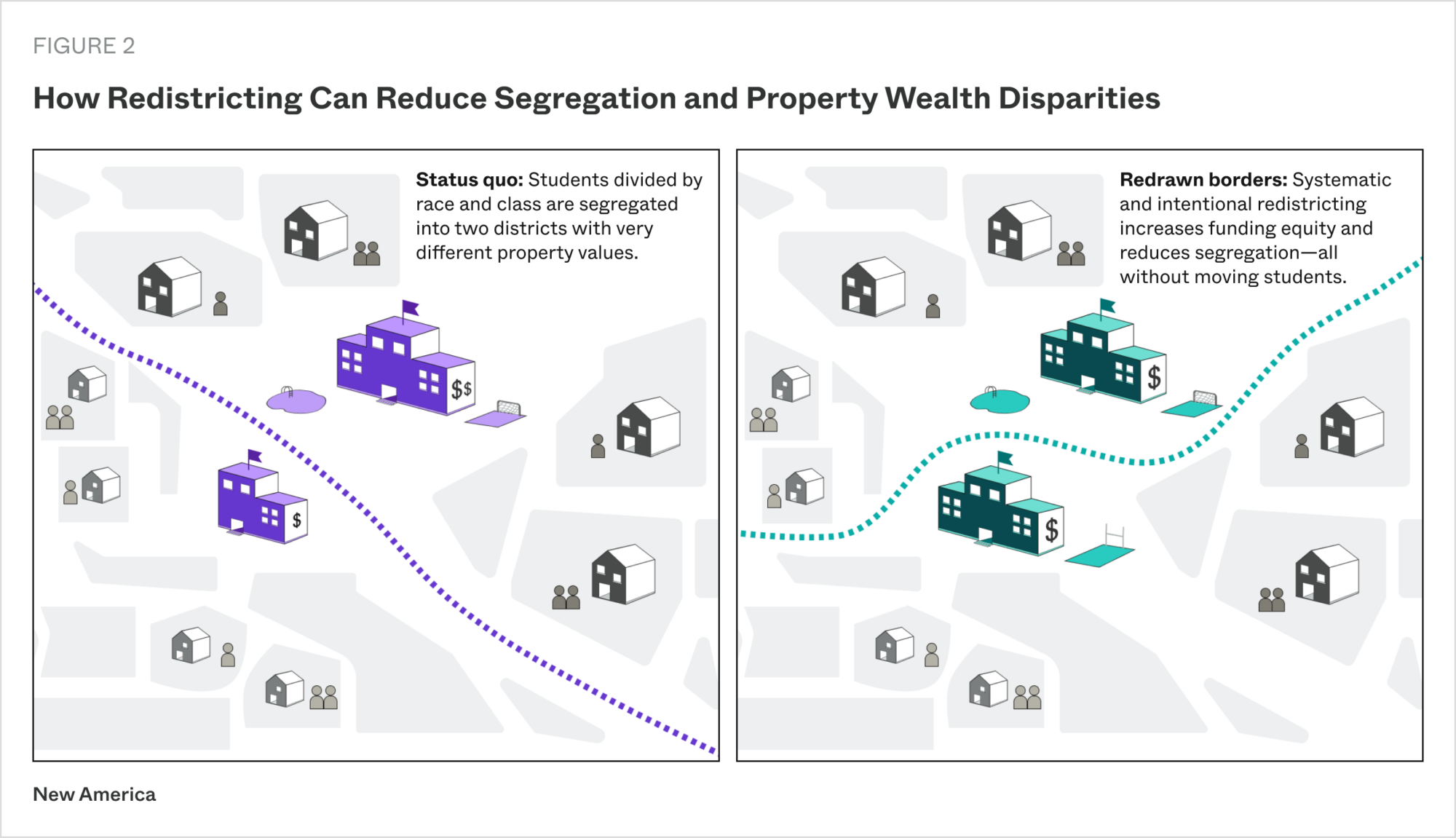
Alternatively, states can make interdistrict differences in property wealth less determinative of districts’ funding levels by pooling some or all property tax revenues at the state level, in the manner of Vermont and Hawaii, so that these dollars can be used to support all students.
Additional Reading: Redistricting for Equity
For a look at how states can draw school district boundaries for greater equity, see Redrawing the Lines: How Purposeful School System Redistricting Can Increase Funding Fairness and Decrease Segregation (New America, 2025). The interactive map included in the report shows multiple redistricting simulations that provide more diverse student populations with much fairer access to local revenue.
Adequacy Considerations for Equity
At the most basic level, adequacy is a distinct priority from funding equity. Adequacy refers to the size of the state’s school funding pie; equity relates to whether that pie is divided in proportion to student and community need. However, there are times when inadequate state funding is itself an equity problem.
State Aid Cuts
As discussed briefly above and in more detail below, states generally provide more formula funding to low-wealth districts and expect higher-wealth districts to rely more on local funds. If an across-the-board cut is made—say, a flat cut of 3 percent to all districts’ state aid amounts—that cut will be larger, and hit harder, in the low-wealth districts that rely the most on the state for their funding. (Multiple studies of Great Recession cuts show exactly this phenomenon.4) When state budgets are tight, it is important to avoid turning an adequacy problem into an equity problem as well. When states cannot avoid budget cuts, they should be more targeted, sparing low-wealth districts and concentrating on the areas that can most easily compensate for a loss of state funding.
Equitable Adequacy Targets
The state’s policies governing local property tax revenue will affect the true definition of adequacy in the state. As explained above, if a state allows districts to raise and keep local revenue over and above the formula amount, property-wealthy districts will have an automatic budgetary advantage. This is an equity problem, to be sure, but it also creates an adequacy challenge. Alumni of all districts go on to apply to the same state colleges, compete for the same jobs, and participate in the same civil society. This means that high-spending districts set the standard for what all districts must be able to provide to their students. If a state permits local funding to boost richer districts’ budgets, it must step in to help low-wealth districts match that spending. The less control the state exerts over local revenue, the more it must invest to ensure that funding is truly adequate for preparing students to participate in adult life on equal terms.
Additional Reading: Understanding Adequacy
For a helpful introduction to the definition and measurement of adequacy in education funding systems, see Costing Out an Adequate Education: A Primer (AIR, 2020). In this policy brief, scholars who have done numerous state adequacy studies provide an overview of the different methods used in the field and their respective strengths and weaknesses.

Citations
- EdSource, “Proposition 98 Sets a Minimum Funding Guarantee for Education,” March 2009, https://edsource.org/wp-content/publications/PolicyBriefR3.pdf.
- EdBuild, FundEd: Property Floors and Ceilings: Policies in Each State (EdBuild, 2022), http://funded.edbuild.org/reports/issue/property-tax-bounds/in-depth.
- Wyo. Stat. Ann. § 21-13-310; and Mich. Comp. Laws Ann. § 388.1211.
- See William N. Evans, Robert M. Schwab, and Kathryn L. Wagner, “The Great Recession and Public Education,” Education Finance and Policy 14, no. 2 (March 2019): 298–326, https://doi.org/10.1162/edfp_a_00245; and David S. Knight, “Are High-Poverty School Districts Disproportionately Impacted by State Funding Cuts? School Finance Equity Following the Great Recession,” Journal of Education Finance 43, no. 2 (September 2017): 169–94, https://muse.jhu.edu/article/688011.