

Zahava Stadler
Director, Education Funding Equity
State policy discussions about school finance usually focus on allocations: appropriations and the formulas that states use to distribute school aid. But many other policies, large and small, influence the equity of school funding. These deserve attention, both as areas of opportunity and because, if neglected, they can become equity trapdoors—places where fairness can fall out of the system.
Three broad questions should have positive answers in an equitable school funding system:
This guide covers the policy factors that determine the answers to these questions—things like states’ use of grants, the amounts districts are expected to raise locally, rules about class size, and how often property values are reassessed. Policy checklists are included to help lawmakers and advocates consider the full range of factors as they work toward fairer school funding.
This report was created with the support of the Resource Equity Funders Collaborative. The opinions and recommendations contained within this report are those of the author and do not necessarily reflect the positions or policies of the members of the Resource Equity Funders Collaborative. The author would like to thank the following colleagues in the school funding field for their expert input: Drew Atchison and Jesse Levin of the American Institutes for Research; Betty Chang and Jess O’Connor of Education Resource Strategies; Christopher Duncombe of the Education Commission of the States; Jess Gartner and Jason Becker of PowerSchool; Mike Griffith of the Learning Policy Institute; Carrie Hahnel and Bonnie O’Keefe of Bellwether; Katie Reed of Afton Partners; and Rebecca Sibilia of EdFund.
When state policymakers and advocates engage on public school finance issues, they most commonly focus on state allocations: either appropriations for public education or the funding formulas that states use to distribute aid for school district operations. These are hugely important for determining how much money goes into the system and whether state support is directed towards the students and communities that need the most help. However, there are numerous other policy factors that influence the equity of school funding in a state. These deserve greater attention, both as areas of opportunity and because, if neglected, they can become equity trapdoors—places where fairness can fall out of the funding system. These trapdoors can affect school districts anywhere, but especially in states where the main funding formula has been recently reformed or is already fairly equitable. The gains made through formula reform can be lost in many small ways, undercutting both the system itself and the political willingness to commit to further investments.
For the purposes of this guide, an equitable school funding system is one in which:
This guide will provide an overview of the state policies that affect school funding equity, providing state policymakers, advocates, and their supporters with a checklist to ensure that they consider the full range of important factors.
Of course, equity is not the only important priority in a funding system. There are also good reasons to value adequacy, reliability, and transparency. This guide focuses specifically on state policy levers for ensuring equity in the funding that states and communities contribute, that districts raise and receive, and that reach students and schools. Other policy aims will be discussed insofar as they contribute to the goal of achieving an equitable school funding system.
This guide is organized according to three main questions that should have positive answers in an equitable school funding system. It lists the policy factors that determine the answer to each question. The three questions are:
This report focuses on state policies. Federal dollars make up only 8–10 percent of the average school district’s funding, but they are very important for the equity of funding systems. This is especially true with regard to the specific federal allocations for the education of students from low-income backgrounds, students with disabilities, and multilingual learners. However, since these funds are not within state control (other than the ways that states may jeopardize their federal funding by failing to comply with grant or matching fund requirements), we consider them outside the scope of this report.
Before readers consider the specific policy factors that contribute to (or detract from) the equity of state school finance systems, they should have a baseline understanding of these systems. The broad strokes of state school finance policy are as follows:
First, each state has a school funding formula. This formula uses the count of students in each district, as well as various other pieces of information about the district’s population and circumstances, to set a target funding amount for the district. This target amount is neither the district’s ultimate state aid amount nor its total amount of funding—it is a starting point for the school funding system, not an end point.
The second important element is that almost every state splits responsibility for funding the target amount between the state and the district. The state sets an expectation for the district’s local revenue contribution using a measure of local wealth that is mostly based on the value of the district’s property tax base. The state calculates the district’s expected local contribution, subtracts that amount from the formula target, and provides the difference as state aid. This step—the use of a local wealth measure to determine the district and state shares of responsibility for the formula target amount—determines the primary state funding allocation to the district.
The third key factor is that districts levy taxes, primarily property taxes, to raise local revenue for their schools. In some states, the expected local contribution in the step above is a minimum required amount. It is only rarely a maximum permitted amount. Districts usually raise enough money to fund their share of the formula target, and many raise extra money as well. The extra local dollars increase the district’s funding amount above the formula target and are usually not offset by reductions in state aid.
Finally, separate from the funding formula, the state may provide funding through grants or other categorical programs that support specific priorities. These funds also increase the district’s funding amount above the formula target and are generally not subject to a local share requirement.
These four steps are composed of many smaller policy decisions: What factors are considered in the funding formula? How is local fiscal capacity measured? What latitude does the district have to set tax rates higher or lower than the formula anticipates? What state money is distributed outside the funding formula? What tax sources contribute to state and local school revenues, and who pays? What rules and conditions affect district costs and spending decisions? Factors like these are the focus of this guide.
State policymakers and advocates should consider:
Equity requires that district funding levels be aligned with the needs of students and communities. Efforts to improve the equity of district funding amounts tend to focus on reforming the state funding formula that sets each district’s target funding amount, but this question encompasses several policies. These include not only whether the state formula calculates an appropriate target amount for the district, but also how much local money the district may raise in addition to its share of the formula amount, if any, as well as how much state money is allocated outside the formula.
Multiple leading education policy organizations have published guides to state school funding formulas (see below), so this report will not offer a comprehensive look at formula elements. Instead, it will discuss selected elements whose equity dimensions are often overlooked or misunderstood.
Additional Reading: Funding Formulas
For more detailed discussions of allocation formula elements, consult these helpful guides:
There is broad agreement in the field that states should use a weighted student funding formula (WSFF) to set districts’ target funding amounts. A WSFF is a specific kind of student-based funding formula in which a base (often called a “foundation”) amount of funding is assigned to each student. Then, that amount is weighted—a multiplier is applied—to account for specified student needs and district characteristics. The most common weighted categories include students from low-income households, multilingual learners, and students with disabilities. Weights should be robust and calibrated to the additional cost of serving students in these groups. Weights should also be differentiated within categories (e.g., for multilingual learners with different levels of English proficiency or students with different disability diagnoses). States sometimes also apply weights for students in special academic programs, such as gifted education or career and technical education. Weights may also be applied for students in certain categories of districts, such as those enrolling a high concentration of students in poverty or those that are sparse or geographically isolated.
The WSFF structure lends itself towards equity by making students the primary focus of the calculation and foregrounding their learning needs. Unlike resource-based formulas, in which staff positions and other classroom inputs are funded on the basis of student-to-resource-unit ratios (see below), WSFFs do not presuppose particular classroom arrangements. The funding is meant for the student rather than the teacher or program, offering greater flexibility to practitioners and local decision-makers. Additionally, because WSFFs account for the cost of serving different groups of students with weights rather than specified dollar amounts or separate grant programs, these allocations do not need to be manually adjusted by the legislature. Any increases to the base amount will automatically increase the value of the weights in turn, protecting these supplemental allocations from erosion by inflation.
Though student-based funding is recommended, leaders in some states are reluctant to move away from resource-based formulas that include a funding unit for each teacher or classroom. The following are four ways to make such a system more equitable:
Whether a district has an appropriate target funding amount is substantially driven by the specific elements of the funding formula: whether its base amount is sufficient and its weights (or other supplemental allocations) reasonably account for the needs of students and school communities.
States use a range of adjustments and mechanisms to account for variation in costs between districts, as well as changes in costs over time. These policies are tricky to get right and must be treated with care to avoid unintended consequences for equity.
Sparse, rural, and remote districts face real and distinct budget challenges. Remoteness makes it difficult to attract qualified teachers and staff, which can drive up salary costs. Sparsity and diseconomies of scale can also increase the per-pupil costs of necessities like food service, building maintenance, and, especially, transportation. In states with a lot of variation in the geographic size and density of school districts, it is important to account for these cost drivers. However, states should not provide extra funding to small-enrollment districts simply because they are small. This practice risks rewarding or incentivizing “splinter” districts in dense areas whose size is inefficient and whose narrow borders are drawn around economically and racially homogenous neighborhoods, making for segregated schools. These funding adjustments should focus on sparsity and remoteness rather than small size.
In some states, a regional cost-of-living adjustment (COLA) is applied to the funding calculation, usually based on housing costs or wage rates. This is largely meant to help districts compete within their labor markets for teachers and staff, a reasonable goal. However, districts with high costs of living are often ones with high-value local tax bases, and these adjustments have the inequitable effect of sending extra state funding to the districts that have access to the most local revenue. Therefore, COLAs should be used rarely, and they should be carefully evaluated to make sure they are not rewarding wealth with more money. They should only be used in states that have fully eliminated the local funding advantage held by high-wealth school districts (see “District Discretion over Tax Rates” below) or in narrow instances where the cost of living does not correlate with local property values.
Many school finance experts advise indexing the school funding formula (or, in a WSFF, indexing the base amount) to inflation so that districts’ target funding amounts do not fall behind real costs. There is obvious logic to requiring that state education aid not shrink in real terms. However, where state formulas are indexed to inflation, legislatures can usually override the automatic increases. So, unless the adjustment is constitutionally mandated, it functions more as a norm than a strict requirement.
Because inflation drives up costs but not necessarily state revenues, and because states must balance their budgets, there is an inherent tension between inflation indexing and available resources. Another option is to index the formula to the state budget, in the manner of California’s Proposition 98 (1988), which is meant to ensure that state education spending keeps pace with growth in income tax revenues and does not shrink as a percentage of the state budget.1
One often-overlooked policy that also helps school funding levels keep up with inflation is regular property reassessment. If the local property taxes that contribute to schools are levied on out-of-date valuations, the district’s local revenue will fall behind its real fiscal capacity. This will either suppress overall school funding (if the formula is not indexed to inflation) or will put the onus on the state to fund a larger share of the formula target (if it is indexed to inflation). Regular property reassessment (at least every few years) reduces pressure on the state budget and makes it more likely that legislators will allow the formula to keep pace with inflation.
States often distribute some education aid outside the school funding formula, through grant programs or limited-use categorical funding allocations. Common outside-formula allocations include those for transportation, school safety initiatives, start-up or equipment costs for career and technical education programs, and teacher professional development, among other priorities. These allocations tend to proliferate as more years pass since the last formula reform, since they offer a way to add to the school funding system without overhauling its structure. The key equity problem with these distributions is that, unlike districts’ formula amounts, they are usually funded entirely with state dollars. Since no local contribution is required, even the wealthiest school districts receive the full amount of these state allocations. This can tie up a substantial amount of state money in districts that could fund all of these priorities without the state’s help. To minimize this equity problem, states should fund as many priorities as possible through the core funding formula and have a wealth-sensitive distribution for any education spending outside the funding formula.
As discussed below in “State and Local Shares of the Formula Amount,” in most states, the formula target is not meant to be met with state aid alone. Instead, the state has a method for dividing responsibility for funding the formula amount between itself and the local district. This calculation of the district’s formula contribution does not capture the full amount of local funds in the system, however. The district’s authority and willingness to raise more or less than its share of the formula amount, and the tax base it has with which to do so, determine the ultimate amount of local funding it will have. These factors matter enormously. Local revenue outside the funding formula is one of the biggest drivers of inequity in the school funding system.
While the state generally calculates an expected local contribution amount for the formula, about half of states allow districts to raise and contribute less than this amount.2 This is most likely to occur in districts where there is less overlap between the local population of property owners and the families of public school students, such as districts where most families live in rental housing or where much of the high-value property is owned by people who reside elsewhere, as with vacation homes and much corporate and industrial property. In these instances, the families of district students are likely to have lower incomes than the taxpaying population.
When districts raise the full amount expected by the formula calculation and no more, their core funding equals the formula target. But districts’ local taxes are almost never capped at the amount of the expected local contribution. In most states, districts have substantial room to raise local money over and above the formula amount, either at the discretion of the school board or with voter approval. This money is generally not offset by reductions in state aid. Property-wealthy districts have the easiest time raising extra funding for their schools, while spending in property-poor districts can trail far behind, with severe equity consequences. Students in property-poor districts lose important educational opportunities, and families that can afford to do so leave for districts with better-funded schools. Meanwhile, the clustering of affluent families in districts with high-quality schools drives up home prices—and therefore property values—in those districts, perpetuating the cycle of inequality (Figure 1).
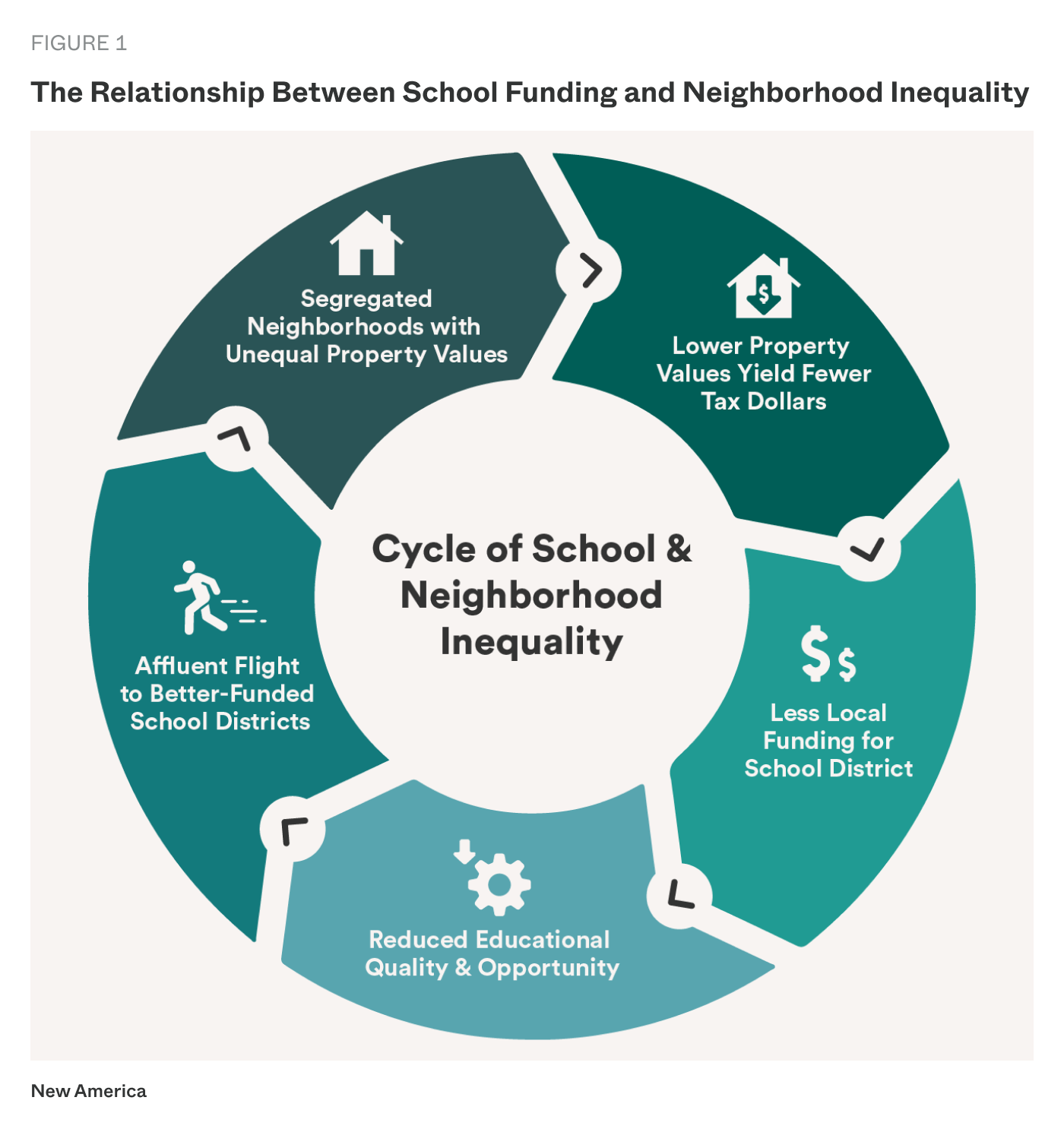
A small number of states, such as Wyoming and Michigan, specify the exact property tax rate that can and must be levied for schools and do not allow either local underfunding or extra local dollars.3 In a handful of other states, tax rates are capped at a level not too far above the expected local contribution, at least limiting the room that property-rich districts have to outspend the formula amount. These policies go a long way to constrain inequity in the school funding system.
School district boundaries not only outline the geography of a school system; they also outline the taxing jurisdiction that supports that school system with local funds. Districts are property-wealthy or property-poor because of the value of the taxable properties within their boundaries. In a system where local property tax revenues are a major contributor to districts’ total funds, states can create much greater equity by drawing school district boundaries to encompass similar levels of per-pupil property wealth (Figure 2).
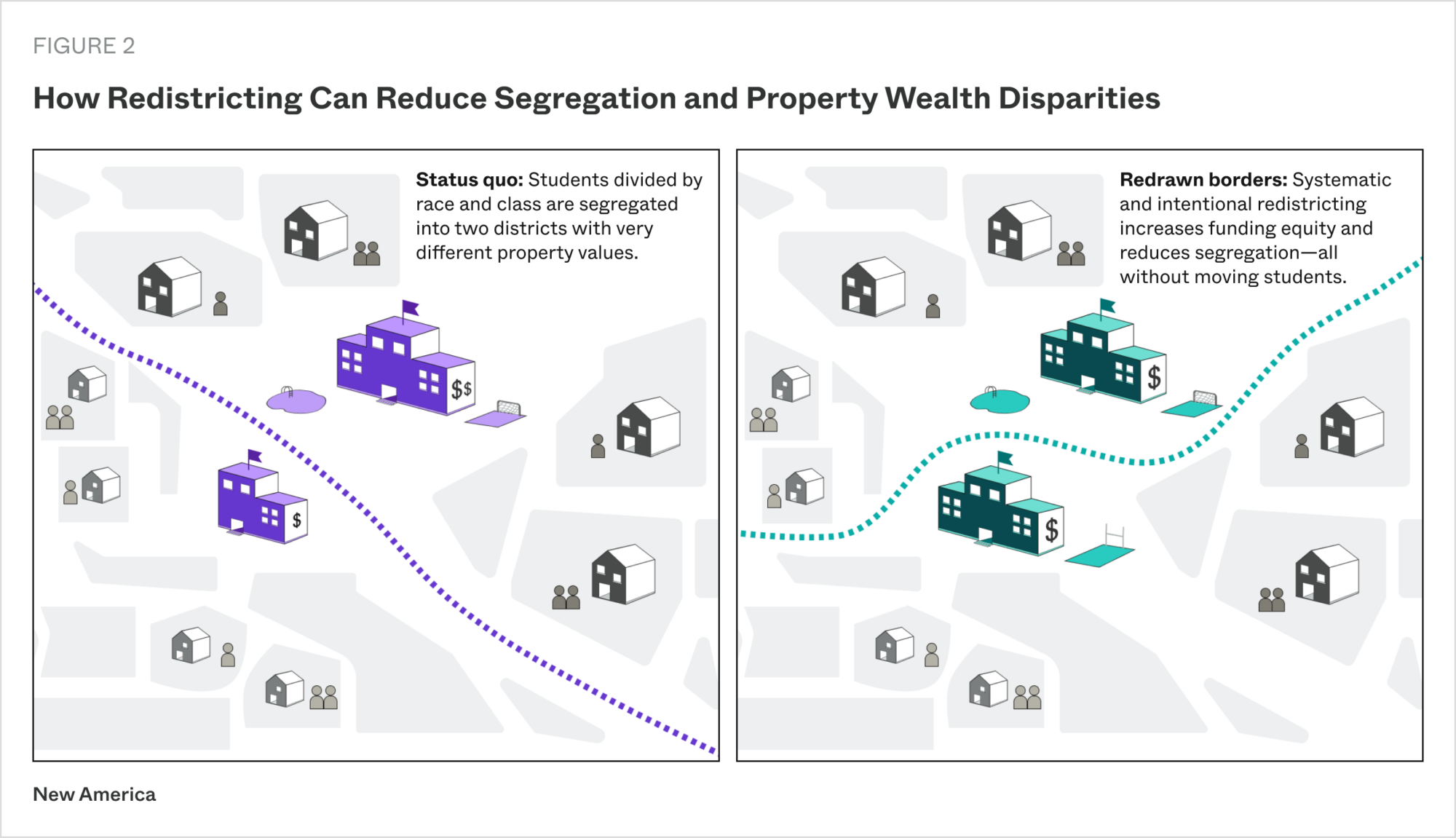
Alternatively, states can make interdistrict differences in property wealth less determinative of districts’ funding levels by pooling some or all property tax revenues at the state level, in the manner of Vermont and Hawaii, so that these dollars can be used to support all students.
Additional Reading: Redistricting for Equity
For a look at how states can draw school district boundaries for greater equity, see Redrawing the Lines: How Purposeful School System Redistricting Can Increase Funding Fairness and Decrease Segregation (New America, 2025). The interactive map included in the report shows multiple redistricting simulations that provide more diverse student populations with much fairer access to local revenue.
At the most basic level, adequacy is a distinct priority from funding equity. Adequacy refers to the size of the state’s school funding pie; equity relates to whether that pie is divided in proportion to student and community need. However, there are times when inadequate state funding is itself an equity problem.
As discussed briefly above and in more detail below, states generally provide more formula funding to low-wealth districts and expect higher-wealth districts to rely more on local funds. If an across-the-board cut is made—say, a flat cut of 3 percent to all districts’ state aid amounts—that cut will be larger, and hit harder, in the low-wealth districts that rely the most on the state for their funding. (Multiple studies of Great Recession cuts show exactly this phenomenon.4) When state budgets are tight, it is important to avoid turning an adequacy problem into an equity problem as well. When states cannot avoid budget cuts, they should be more targeted, sparing low-wealth districts and concentrating on the areas that can most easily compensate for a loss of state funding.
The state’s policies governing local property tax revenue will affect the true definition of adequacy in the state. As explained above, if a state allows districts to raise and keep local revenue over and above the formula amount, property-wealthy districts will have an automatic budgetary advantage. This is an equity problem, to be sure, but it also creates an adequacy challenge. Alumni of all districts go on to apply to the same state colleges, compete for the same jobs, and participate in the same civil society. This means that high-spending districts set the standard for what all districts must be able to provide to their students. If a state permits local funding to boost richer districts’ budgets, it must step in to help low-wealth districts match that spending. The less control the state exerts over local revenue, the more it must invest to ensure that funding is truly adequate for preparing students to participate in adult life on equal terms.
Additional Reading: Understanding Adequacy
For a helpful introduction to the definition and measurement of adequacy in education funding systems, see Costing Out an Adequate Education: A Primer (AIR, 2020). In this policy brief, scholars who have done numerous state adequacy studies provide an overview of the different methods used in the field and their respective strengths and weaknesses.
State policymakers and advocates should consider:
Our definition of an equitable funding system includes both equity in school funding levels and equity in tax burden for payers. Lawmakers sometimes focus on the needs and demands of taxpayers in the school finance system at least as much as they do on the needs of students. But prioritizing tax relief can have the effect of lessening overall school funding, and tax reductions do not always make the tax burden more equitable. In this section, we aim to keep a student and community focus, seeing how each revenue policy affects what students receive while also asking whether the funding responsibility is shared fairly.
After the state funding formula sets a target funding amount for each district, the state will almost always have a way of splitting responsibility for funding that target amount between itself and the district. To assign the district’s share of responsibility, the state will use a measure of local fiscal capacity to determine what the district can reasonably contribute. By subtracting this expected local contribution from the formula target and providing the rest as state aid, the state sends more formula funding to lower-wealth districts and less formula funding to higher-wealth districts. This is called “equalization,” because it is meant to reduce the inequality that comes from districts’ differently sized tax bases. However, as discussed above (“District Authority Over Local Tax Rates”), that inequality reenters the system when districts have the ability to raise extra, local money or when states distribute too much funding outside the equalized funding formula.
The state method for calculating what a district can and should contribute toward the formula amount is tremendously important for equity. A measure that does a poor job of capturing a district’s true wealth level will place too heavy a tax burden on some communities and too light a burden on others.
The most common basis—in many states, the only basis—for the local fiscal capacity calculation is local property values. The simplest approach is for the state to simply set an expected local tax property rate for education (for instance, Alabama expects a 1 percent property tax in all school districts, while Kentucky expects a 0.3 percent property tax5). Such a tax would raise more in a district with high property values and less in a district with lower ones, so the state would cover less of the formula amount in the property-rich districts and more in the property-poor ones (Figure 3).
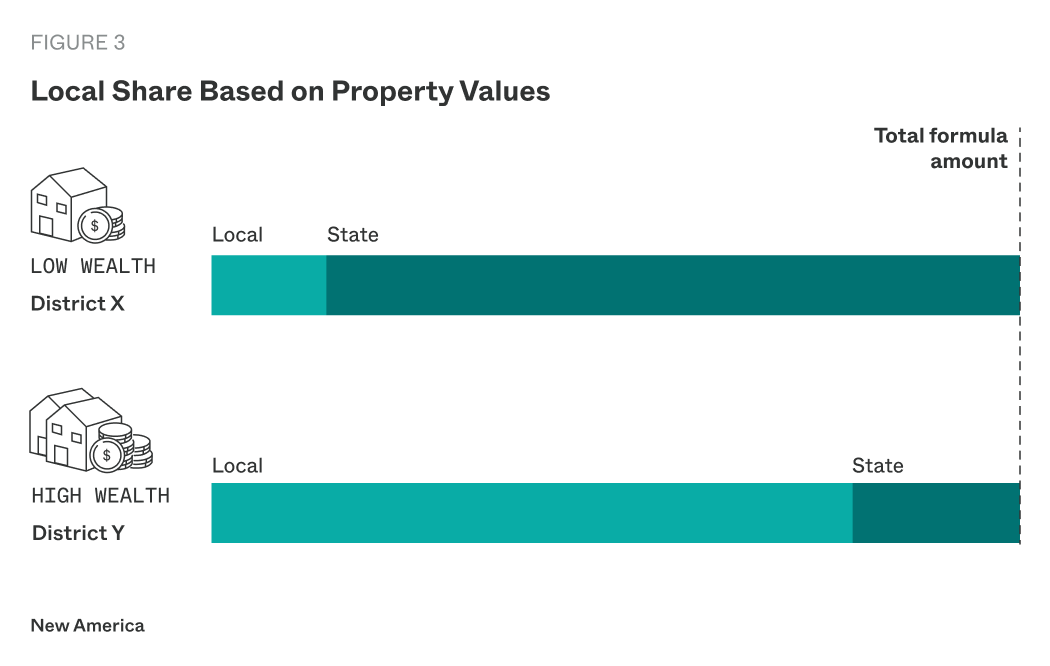
However, property values may not fully reflect the wealth levels of local taxpayers. For instance, the owners of high-value agricultural land are not always high-income. Longtime homeowners in a gentrifying area may have lower incomes than newer residents, even if their homes have increased in value. Property that hasn’t been reassessed in many years may have a much lower taxable valuation than the sale price paid by a high-income buyer. For this reason, some states also factor local income levels into the local fiscal capacity calculation; Connecticut, Massachusetts, and Virginia are among the states that do so.6 In states where property values and taxpayer income are weakly correlated, consideration of income can improve the equity of the local fiscal capacity measure.
States may also expect districts to tap other sources of local revenue for schools. For example, local sales taxes in Arkansas, mineral revenues in North Dakota, and proceeds from public forest lands in Oregon are part of what districts can raise for schools and are included in local fiscal capacity calculations.
When a state relies on property values as the measure of local fiscal capacity, these values must be accurate and incorporated fairly into the expected local contribution calculation. As noted above, regular property reassessment is important for accuracy. However, some states have explicit policies that prevent the use of current data. For example, Missouri calculates local fiscal capacity based on the value of property as assessed in the 2004–05 school year, or the current value only if it has decreased since that year.7 This formula fails to recognize wealth gains in many districts. Texas, meanwhile, uses current valuations in its formula but automatically reduces the property tax rate for education in districts with fast-growing property values so that these gains do not drive up the dollar amount of the expected local contribution.8 These are obvious distortions in the wealth measures used to assign districts a fair amount of funding responsibility. They undermine the equity of their states’ funding systems.
Some states also undercut equity by setting maximum or minimum state or local shares of the formula amount, regardless of local fiscal capacity. For example, Iowa will only fund at most 88.4 percent of the target amount with state dollars, so even the most property-poor districts must cover at least 11.6 percent.9 At the other extreme, Mississippi asks districts to pay for no more than 27 percent of their formula amounts, so the state covers 73 percent even for the highest-wealth districts, taking up state funding that could be used to support students in communities with greater need.10
As noted above, several states set an expected local tax property rate for education and use the amount that would be raised from that tax as the district’s local share of the formula target each year. This method offers predictability and security for the district and its taxpayers: Property owners know the baseline rate for school taxes, and district leaders and staff know that the formula amount will be fully funded as long as the district levies property taxes at the expected rate. In this system, though, the state assumes most of the budget risk. If formula costs rise (e.g., because enrollment increases or because more students qualify for need-based supplemental funding), the state will be responsible for funding up to a higher target amount, but the district’s expected local contribution will not change. This risk may deter legislators from increasing the formula amount (for instance, by increasing the base amount, weight size, or number of weighted student categories in a WSFF), because the state budget would have to cover all of the new costs unless the local share policy were changed as well.
Some states use a different system that is still responsive to differences in districts’ wealth levels but shifts more of the risk onto districts generally, and onto higher-wealth districts in particular. These states set an overall share of formula dollars statewide that will be covered by state funds. For instance, in Louisiana, the state aims to cover 65 percent of districts’ aggregate formula amounts and asks districts, as a group, to cover 35 percent. In Massachusetts, the state provides 41 percent of formula funding statewide and expects districts to collectively pay for 59 percent.11 This general type of policy plays out for individual districts as follows (Figure 4):
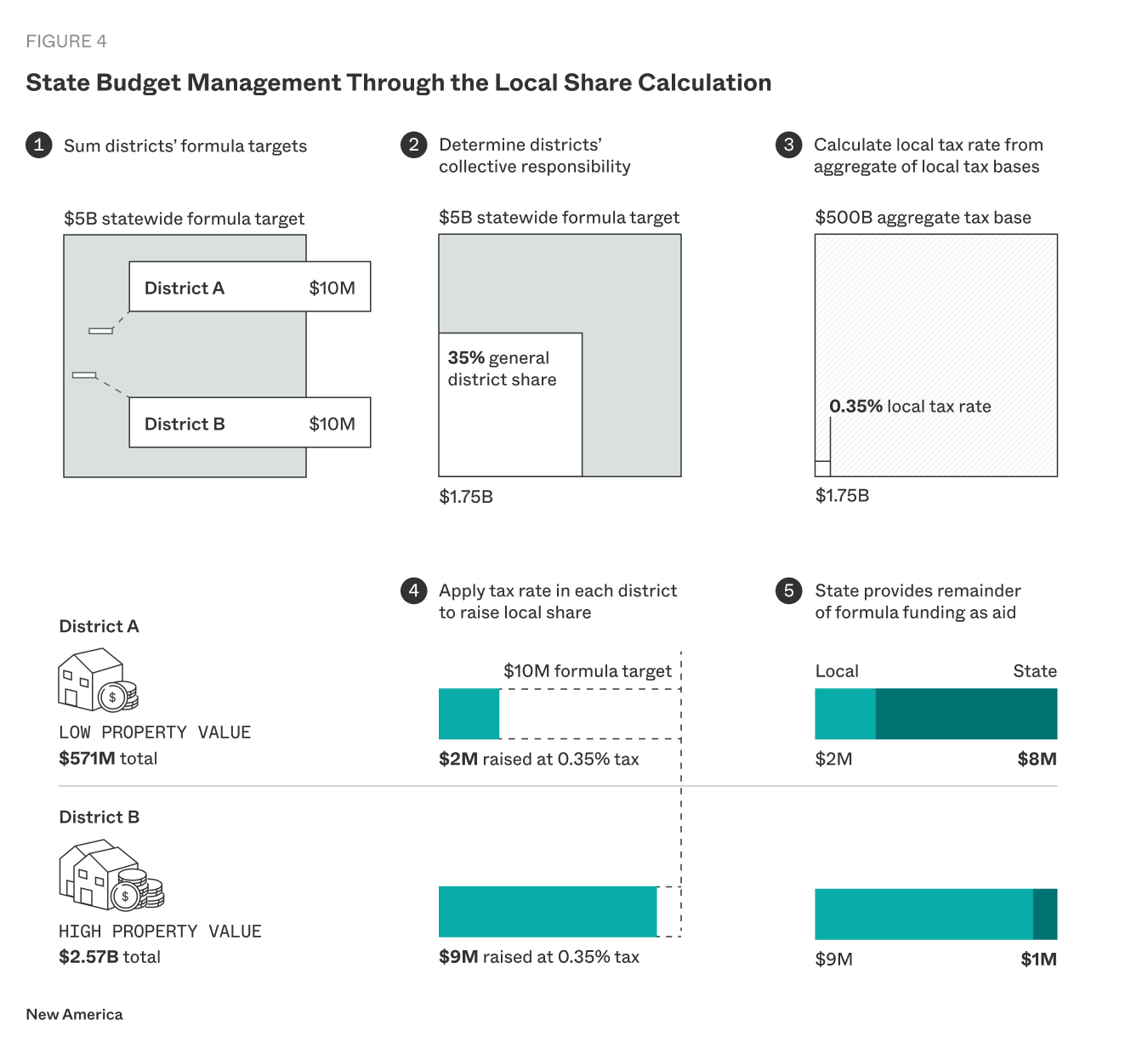
The local tax rate changes from year to year, depending on both taxable valuations and formula targets. This system sacrifices some predictability. Taxpayers do not know in advance what the baseline school tax rate will be, and districts have less security that increases in student need will be fully met with increases in state aid. But this system also asks wealthy districts to pay more into the system when needs increase anywhere in the state, an equitable approach. Meanwhile, increases in formula costs are borne by both districts and the state, so the state budget absorbs less risk, which may reduce legislators’ reluctance to raise formula targets.
Most state education dollars are drawn from the general fund, so there is no guarantee that the legislature will set aside any particular amount of money for public education. (The state funding formula will usually call for a particular amount of state aid, but states can and sometimes do underfund their formulas when budgets are tight.) In states that have designated revenue sources for education, some or all education dollars are protected and cannot easily be repurposed by the legislature for other purposes. Since state budget cuts tend to fall hardest on the school districts with the lowest levels of community wealth, avoiding cuts is important not only for the adequacy of the funding system, but also for equity.
A state’s mix of education tax sources, whether they are earmarked for schools or contribute to the state general fund, is important. Different tax types can be more progressive (with higher-income payers contributing a greater share of income) or regressive (the reverse). Reliance on regressive tax sources makes a state’s education funding system less equitable on the payer side. Additionally, different kinds of taxes are more or less volatile (unpredictable in the amounts of revenue generated). Dependence on volatile tax sources makes a state’s education funding system less reliable and creates more danger that downswings will lead to state aid cuts, which are likely to affect low-wealth school districts the most.
Additional Reading: Evaluating Tax Sources
The Institute on Taxation and Economic Policy (ITEP)’s Who Pays? report (Seventh edition, 2024) explains which tax types tend to be more and less progressive and offers a helpful analysis of the progressivity of state tax systems.
The 2024 Urban Institute report Beyond the Crystal Ball: State Revenue Forecasts Before, During, and After the COVID-19 Pandemic includes a useful section called “State Tax Structures and Revenue Volatility.”
In addition to related policies discussed above (district authority over local tax rates, district boundaries and tax bases, and state and local share policies), there are specific equity considerations regarding the types of taxes that supply local revenue for schools and how they are levied.
Local property taxes are the main source of local funding for schools, providing upwards of two-thirds of local revenue in the average district. The remainder comes from a range of other local taxes and fees. Common types include sales and use taxes, income taxes, hotel and hospitality taxes, motor vehicle registration fees, and severance taxes (taxes on natural resource extraction). As with state taxes, any specific type of tax may be progressive or regressive, with implications for equity on the taxpayer side of the school funding equation. It also may be more or less volatile, which affects the stability of school district budgets.
All local revenues are, to a degree, the wages of good luck: The district benefits from having high-value property, or thriving local retailers, or high-income residents. Equalization policies are important so that districts with more resources pay their fair share and students in low-wealth districts are not left behind. However, it would be far more direct and efficient for the state to treat some taxes, like severance taxes on oil and gas extraction or revenue from energy pipelines, as sources of state revenue rather than allowing districts to collect these funds locally. They are not meaningfully tied to the local jurisdiction and should be used to support students across the state.
Because property taxes are such a significant source of district revenue, the details of property tax policy are important for the equity of the school funding system. As discussed above, regular and accurate property reassessment is important for ensuring that property owners contribute a fair share of school funding. Accuracy in assessment includes eliminating bias. Research using federal data on property appraisal shows that homes in majority-Black neighborhoods are systematically undervalued, reducing tax capacity and the community’s ability to support local schools at reasonable tax rates.12 Bias and dated assessments are pervasive problems in property assessment even though they are not the result of affirmative policies.
Additional Reading: Funding for Capital Projects
Though states offer some limited assistance for capital projects, districts have to cover an average of 80 percent of these costs themselves. These dollars can come from earmarked tax levies, but often, districts fund capital projects by issuing bonds. Low-wealth districts therefore have the hardest time building or renovating school facilities and often assume substantial debt to do so. This part of the school finance system falls far short of any reasonable definition of equity. For more, consult the following resources:
The 21st Century School Fund’s State of Our Schools 2025: America’s K–12 Facilities provides the most detailed and up-to-date look at facility conditions, the rules governing facilities, and the funding of capital projects.
The Education Commission of the States’s 50-State Comparison on K–12 School Construction Funding (2023) reviews state policies in this area.
The Urban Institute’s Assessing the National Landscape of Capital Expenditures for Public School Districts (2023) offers an analysis of the equity consequences of these systems, with students from low-income backgrounds attending schools in worse physical condition.
However, many states have intentional policies to assess property at less than full market value for tax purposes, or to exempt some of a property’s value from taxation. Homestead exemptions reduce the taxable value of owner-occupied homes. Exemptions for seniors, veterans, and disabled property owners reduce the amount of property tax paid by individuals in those categories. States and cities sometimes temporarily exempt certain newly built properties from property taxes to encourage development. And some states assess different types of property at different percentages of actual value, called “assessment ratios” (e.g., commercial and industrial property might be taxed on 75 percent of its full value, while residential and agricultural property might be taxed as though it were only worth 40 percent of its full value), effectively reducing the value of the tax base and differentiating the tax burden for owners of different property types. These policies affect school funding equity, adequacy, and stability, since every exemption changes who pays school taxes, and in what measure. However, they are rarely passed with an eye towards strengthening the school funding system. Education equity advocates should pay close attention to proposed property tax policy changes and consider how they will affect the equity of the system, including equity in who pays and equity in the amount of local tax revenue available to different school districts.
Private contributions play a small role in school finance, but they can be significant in particular schools or districts. These funds come from a range of sources, including incorporated “friends of the district” nonprofit foundations, parent organization fundraisers, in-kind contributions from local businesses, and direct-to-classroom donations on online crowdfunding platforms. These contributions are usually made for specific schools, classrooms, or district initiatives. In a sense, their targeted nature makes them the ultimate local funding. Schools and teachers in high-need districts might use these sources of funding to compensate for inadequate funding levels (for example, some teachers use Amazon wish lists to stock their classrooms). However, high-wealth districts tend to have access to larger amounts of private funding, since parents have the time and flexibility to run fundraisers and can count on local families to make purchases or donations. Additionally, property-wealthy districts sometimes use private fundraising as an end-run around the formal school funding system’s more aggressive equity provisions. This occurred in Vermont when the state first put in place its statewide tax pool and the problem needed to be addressed with further policy changes.13 In another example, the Highland Park Education Foundation raises substantial funding for one of Texas’s wealthiest districts,14 all of which is outside the public system and therefore outside the reach of the state’s equalizing recapture policy. Advocates and lawmakers should keep an eye on the ways in which private funds raised for individual schools and districts may be undermining the equity of the school funding system, and consider policies that limit their role.
State policymakers and advocates should consider:
Lawmakers making investments in education want to know that the state’s equity priorities will be honored in districts’ spending choices. Advocates who have secured equity wins in their state’s allocation policy want to see these funds used to support the students and communities that need the most help. It is no wonder there is so much interest in what tools the state may have to control or guide the use of money at the district level. However, school funding experts are generally skeptical that such policies work as intended. It is important to be clear about the state’s actual sphere of influence, its goals, and whether more restrictive policies actually bring about the desired results. Policy meant to improve the equity of district spending should also include state support for effective practices, as well as recognition of the factors that may constrain district spending choices.
Some states take a prescriptive approach, setting firm rules for the spending of portions of formula funding. Generally, these mandates are not favored by school funding experts. They are more likely to drive the work of bookkeepers than educators. Money is fungible; it does not actually matter which dollar is used for a particular expenditure, so it is misdirected effort to ask districts to prove that they have used specific funds in required ways. Specific outcomes for students are usually better achieved through academic accountability policies than funding policies. However, spending requirements can take different forms, and the specifics of the policy do matter.
States sometimes provide explicit lists of practices, programs, and resources on which money can be spent. The primary concern with these policies is that they hamper innovation and adaptation as districts try to serve students in varied and changing contexts. Directing the spending of individual funding streams can also push the district towards inefficiencies. For instance, funds for multilingual learner education might be spent on discrete translation services instead of on integrating supports into the general education classroom, even if the latter might be more effective, because an isolated expenditure is easier to track for compliance purposes. If the goal is to encourage particular practices, state guidance and support are more likely than spending requirements to bring about strong implementation.
States also sometimes set rules that districts must spend student-based allocations in the schools whose students generated the funding. For example, if a school enrolls 50 multilingual learners who each generate $5,000 in needs-based funding for the district, a pass-through rule might require the district to spend that $250,000 in the school instead of centrally or at other school sites. (Maryland’s school funding system has rules along these lines.15) However, it is not obvious that money for high-need students is always best spent at the school rather than district level. Individual schools (and particular student groups funded within schools) can be small, and they may not have the scale to do cost-effective hiring and purchasing themselves. Many services and programs that are meant for high-need students (e.g., tutoring, therapies and other services for students with disabilities, extended-school-year programs) are often best managed centrally; district-level spending should not be automatically dismissed as “overhead.” So, while it does matter whether students receive the support they need, required distributions to schools don’t ensure that this occurs, and may even dilute vital funds.
However, the funds that are spent at the school level should go to schools based on student need. Too often, schools in wealthier, lower-need neighborhoods receive a disproportionate share of district funding, maybe because of the political power held by these communities within the district. There is also greater risk of disproportionality when districts budget by allocating staff positions to schools rather than set dollar amounts. The lion’s share of any school budget is spent on staff. Schools serving upper-income families have an easier time attracting and retaining experienced teachers who earn higher salaries. Therefore, when districts fund whomever a school ultimately hires for a staff position, they will usually send more staff funding to these schools. This is an equity problem that states should try to address with sensible policy.
Rather than require that specific allocations be spent in particular schools, states could mandate or encourage districts to adopt student-based budgets (much like WSFFs, but at the district level) rather than budgets based on staff positions. Another option is to require that funding for each school generally match the proportional share that its students contribute to the district’s formula amount (Figure 5).
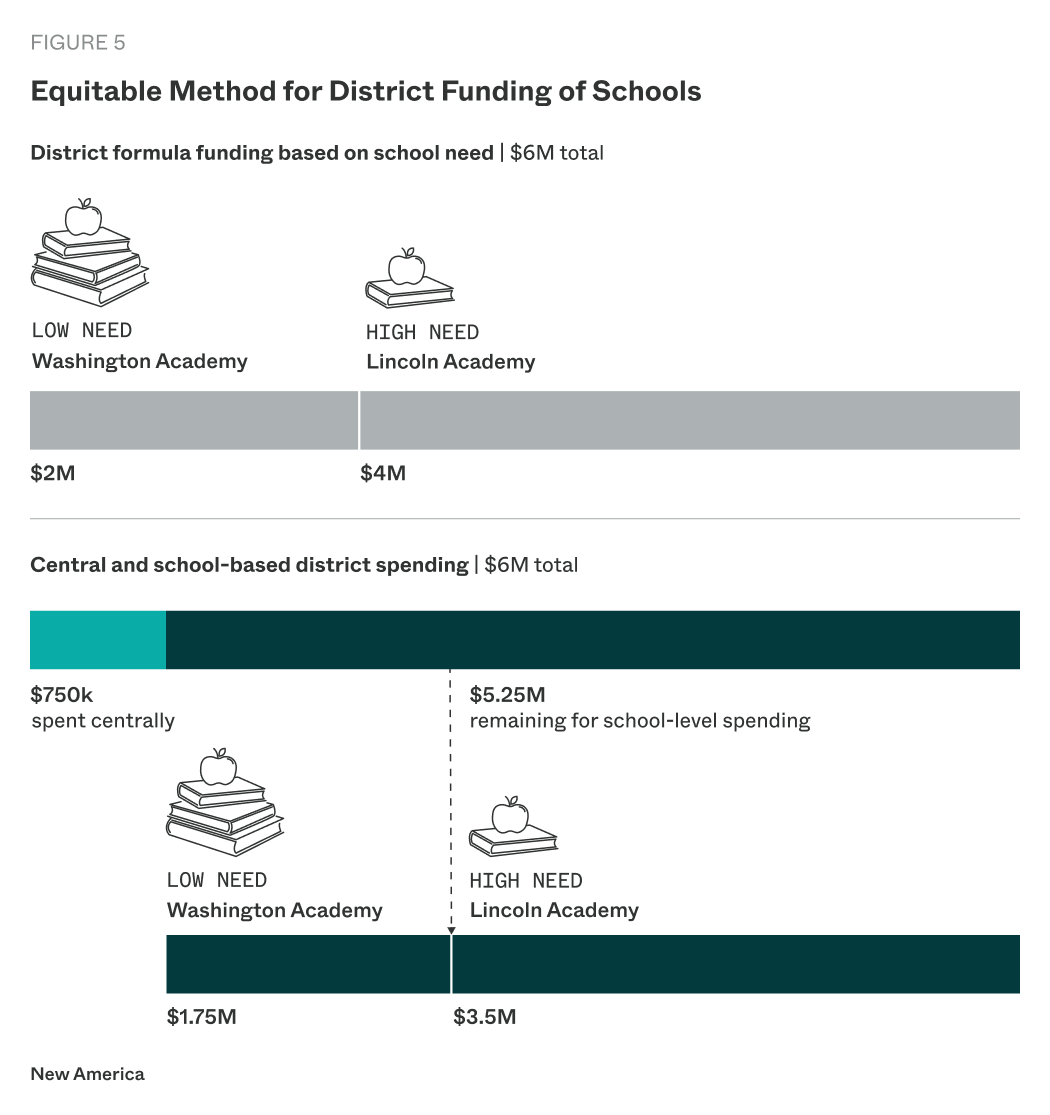
Imagine a district with two schools, low-need Washington Academy and high-need Lincoln Academy. If the state’s WSFF tallies the students in Washington as needing $2 million while the students in Lincoln need $4 million, the district will have $6 million in total formula funding. It may spend some of that money at the district level. But whatever is then spent at the school level should be divided so that about one-third goes to Washington and two-thirds go to Lincoln. Such a system could ensure an equitable division of resources without over-prescribing how the district uses its funding.
Additional Reading: Student-Based Budgeting
For more on this approach to budgeting, see Transforming School Funding for Equity, Transparency, and Flexibility: An Introduction to Student-Based Budgeting (Education Resource Strategies, 2018).
Some states require districts to develop plans for the use of their formula funds or for particular allocations. In general, plan requirements are useful for pushing districts to articulate their goals and theories of change, and to align spending with those ideas. A requirement to engage the community when developing the plan is also valuable, because community members should have input into and understanding of the district’s direction, and because commitments to the community are often the strongest form of accountability for districts. A requirement to evaluate and report on the impact of planned programs and initiatives can also be helpful (and districts should receive both funding and practical support for these evaluations). Not only is it important to know what is and isn’t working, such a requirement signals to districts that effectiveness is the focus, and they should track and attend to the data that will demonstrate impact on students.
However, plans are not very effective tools for holding districts formally accountable for their spending choices. States very rarely withhold funding from districts on the basis of unsatisfactory plans; the stakes are too high for district operations. A district must respond to financial exigencies regardless of what is written in its plan, so fine-grained financial reporting will rarely match the plan exactly (though a skilled bookkeeper can make it come close). The mismatch between the plan requirement and the realities of district financial management can sometimes cause resentment, especially for smaller districts with less administrative capacity, because the planning process can be onerous and they see little concrete benefit. To address these considerations, plan requirements should specify focus areas, to ensure that districts prioritize key state goals and high-need student groups; should involve suggestions and support for meaningful community engagement; should not come with extensive procedural or formatting rules; and should be paired with reporting requirements focused on activities and impact rather than dollar outlays.
Additional Reading: State Support for Effective and Equitable Practices
Experts emphasize that state guidance, implementation support, and capacity building for districts are more likely to drive good practice than mandates.
Beyond the Bottom Line: A New Framework for K–12 Fiscal Accountability (Bellwether, 2025) covers the range of policies and support structures that are helpful in this area.
The State’s Role in Championing District-Level Change and The Shifting Role of State Education Agencies in Supporting District Sustainability (both Education Resource Strategies, 2025) take a closer look at the state role in supporting district success.
Lawmakers and advocates looking to require or encourage the equitable use of funds must remember that funding policy is not the only set of rules constraining district spending choices. Districts are subject to a host of regulations and binding legal commitments, especially those related to personnel and instructional arrangements, that affect district budgets. These factors limit how much funding is truly available for discretionary spending.
First among these are local labor contracts. Approximately 80 percent of school district dollars go to staff salaries and benefits, on average,16 so the contractual rules governing staff time, responsibilities, and compensation have a significant impact on district spending. While these union contracts are specific to the local school district, they are still governed by state law. States require, permit, and prohibit the inclusion of certain topics in collective bargaining.17 Is there a minimum or maximum number of hours per school day or days per year that a staff member can work? Can teachers be required to perform extracurricular duties outside of their regular hours, or be fully exempted from them? Does the state set minimum salary requirements for staff compensation? Are there rules that, in the event of layoffs, workforces must be reduced based on seniority or performance, regardless of the impact that an individual staff position has on the overall budget?18 These rules can predetermine significant parts of district budgets. State policies regarding these contracts are therefore a big factor in how much flexibility local leaders will have to allocate funding across schools and priority areas.
State rules regarding instruction and classroom arrangements are also important for district budgets. For instance, some states set maximum class sizes.19 These rules can constrain district and school decisions about how many teachers to hire and what instructional arrangements to use. So do state “seat time” regulations that require students to complete a certain number of instructional hours to earn course credit, effectively determining the amount of teacher time (and related personnel spending) that must be devoted to each course. And state content requirements—for instance, mandating that high-schoolers take courses in personal finance or computer science in order to graduate20—commit districts to spend time and dollars on these subjects, often at the expense of other instructional priorities.
None of the above is meant as a comment on the wisdom of any of these policies in themselves. But state lawmakers should recognize that each policy and contract governing personnel and instruction effectively directs some district spending. The more rules are in place, the less discretion district leaders will have over their budgets, and therefore less ability to redirect spending in a more equitable way.
The costs of staff pensions and benefits are significant and growing factors in district budgets. While outlays vary from place to place, there are many districts where these obligations are crowding out spending on other priorities.
The pension research organization Equable reports that K–12 retirement costs went up by 220 percent between 2002 and 2020, while public education budgets only rose by 33 percent.21 As a result, pension contributions make up an increasingly large share of district spending. And because teacher pension funds have such large unfunded liabilities, much of this is for debt rather than benefits. In 2024, district pension payments constituted 15 percent of school district payroll spending, while normal costs made up just under 6 percent. One recent analysis of California districts found that 10 percent of school system spending goes to pension contributions, and benefits spending per student has more than doubled in the last 20 years, mostly driven by rising pension costs.22
The increasing cost of health benefits is also a challenge. Premiums for employer-provided health insurance are rising rapidly,23 and coverage for school district employees is no exception. School districts also tend to cover health benefits for retirees, which becomes harder in times of declining student enrollment. These costs must be paid out of current revenues, which are driven in large part by current student counts, but the number of covered retirees is determined by how many staff members the district employed in prior years, when it may have enrolled more students.
When advocates and lawmakers ask about districts’ budget choices, they should take note of how much spending is pre-allocated to these costs. Increases in the costs of benefits can force cuts in other areas, or they can eat up state funding increases, leaving no room to make new equity investments. When states fund a larger portion of pension costs centrally, assume responsibility for pension debt payments, or account for pension and benefit costs in the state education funding formula, district leaders are able to make more targeted choices about the use of their funds.
A fair school funding system is central to making sure all students can get the opportunities and support they need. Policymakers and advocates in many states have prioritized K–12 funding equity in their agendas, focusing mainly on reforming the formulas that set districts’ target funding amounts. These efforts have produced some important wins in recent years, with new funding for multilingual learners, high-poverty districts, and students receiving special education services. But even the best state formula is not enough to ensure equity across the funding system. Many other policy factors affect the fairness of school funding, and when neglected, can become equity trapdoors—places where equity can fall out of the funding system.
Large and small policies can be equity trapdoors. The state allocation formula looms large in policy conversations, but smaller amounts of grant money distributed outside the formula can often create equity problems by tying up state dollars in low-need districts. Advocates may know that pooling property taxes at the state level for redistribution would be a massive policy shift. They may not realize, though, how rules about maximum and minimum permissible local tax rates could be used to rein in the inequity that comes of districts having very different levels of local property wealth. Lower-profile policy issues can matter a great deal for funding equity.
Well-meant policies can become equity trapdoors. Funding for districts with small enrollments might be meant to help rural communities address diseconomies of scale, but it can instead reward splinter districts for remaining separate from larger and more diverse neighbors. Cost-of-living indices in formulas intended to support competitive teacher salaries can have the effect of driving more money to high-wealth places. Requirements to spend formula dollars in specific, recommended ways for high-need students can drive districts to do what they can track rather than what works. Lawmakers must consider the equity consequences of all education policies—intended and unintended.
And many policies important to funding equity are not usually thought of as education policy at all. Regular property reassessment ensures that property owners pay their fair share for public schools and that revenues keep up with inflation. Tax breaks meant to spur economic development and new construction affect what school districts can collect. State pension debt levels, and how states manage associated costs, affect school district budgets. Advocates and lawmakers should consider the education funding equity angle even of policies that seem unrelated to schools.
An equitable school funding system is vital both for today’s students and for our collective future. We want graduates of all districts to thrive in postsecondary education, to succeed in the workforce, and to become participants and leaders in the same civil society. Crucially for our democracy, we want them to be prepared to do so on equal terms with each other, and that begins with fairly resourced K–12 public education. As state lawmakers and advocates engage with this issue, they should attend to the full range of both policy possibilities and equity risks. By broadening their understanding of the policies that matter, they can bring about better, more equitable K–12 school funding systems.
Director, Education Funding Equity