Heela Rasool-Ayub
Co-Director, Power, People, and Planet Initiative
The old multilateral order is under strain, and there is no shortage of ideas for what should come next.
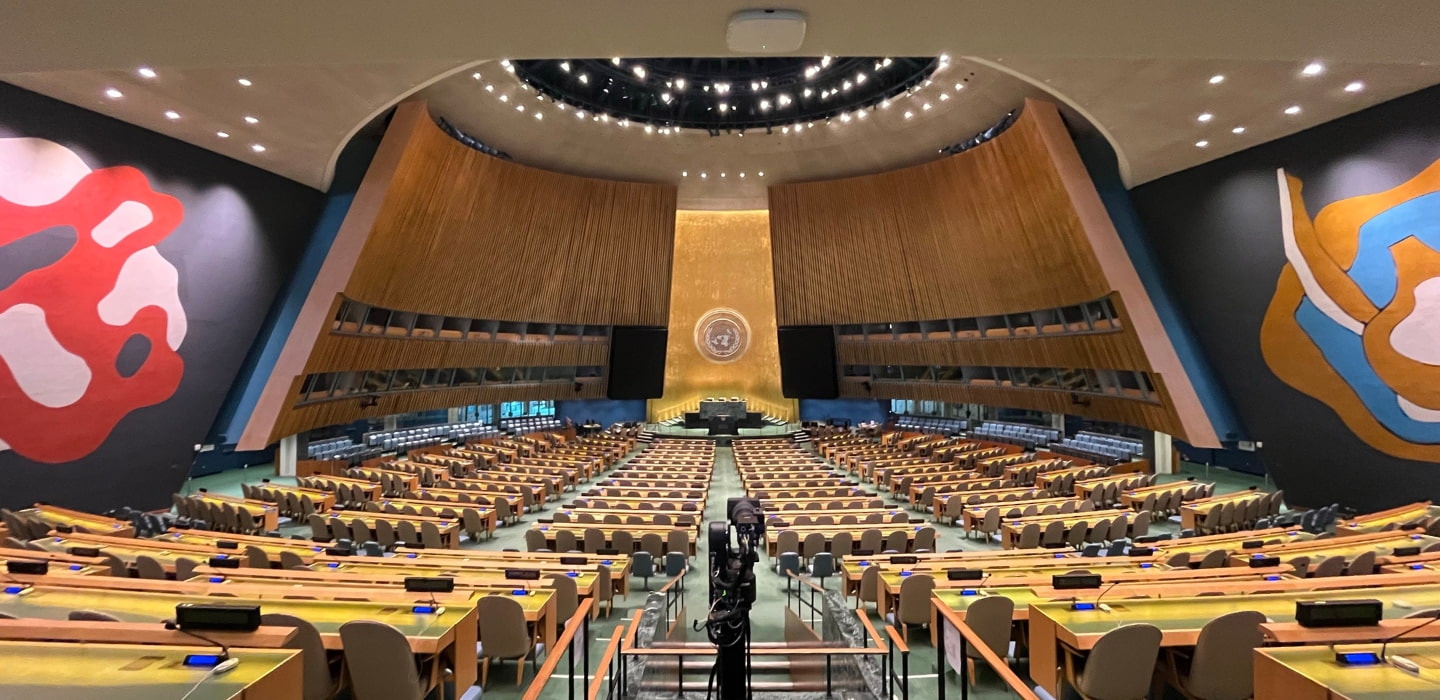
The crisis of multilateralism is primarily a crisis of institutions, not cooperation. People continue to support international cooperation, particularly when it produces results. Confidence has weakened in institutions that fail to deliver or distribute power unevenly.
The formal rules of multilateralism increasingly diverge from how power operates in practice. States may be equal on paper, but powerful countries have far greater ability to shape the rules and avoid their constraints. The same imbalance appears in institutions governing security, finance, climate, and other global problems.
International architecture is more important than ever. Climate, pandemics, artificial intelligence (AI), financial markets, supply chains, and other transnational systems make complete national autonomy impossible. The need for cooperation remains, but the institutions and coalitions through which it happens are changing.
The next order is likely to evolve rather than be designed all at once. The post-war order took shape over time as governments responded to crises, struck bargains, and created institutions. Decisions being made now could prove just as consequential for whatever follows.
Coalitions can help individual reforms add up to something larger. People working on climate finance, sovereign debt, AI, humanitarian reform, and other issues often confront similar concentrations of power. Connecting those efforts can allow the relationships and political leverage built in one fight to carry into the next.
Multilateralism has almost become a dirty word in political discourse. With nationalist governments on the rise around the world, and sovereignty increasingly invoked against the reach of global bodies, criticism of the institutions built to sustain multilateralism has reached a crescendo. The Trump administration, as one of the most vocal critics, maintains a complicated relationship with most multilateral bodies, publicly deriding and scapegoating them while selectively using them to advance American interests.1
But President Trump is not alone in his criticism. The United Nations, as the emblematic multilateral institution, draws fire from nearly every direction, including from ardent supporters of multilateralism, over perceptions of waste, ineffectiveness, elite capture, or infringements on national sovereignty. In 2023, then president of the European Council Charles Michel called the UN “sclerotic and hobbled.”2 UN Secretary-General Antonio Guterres has himself admitted that people are “losing faith in multilateralism.”3 Yet for all the agreement that multilateralism is in trouble, there is far less agreement about what exactly is broken or what should be done to fix or replace it.
What does multilateralism mean, both to those who criticize it and those who defend it? In principle, multilateralism is simply a way of organizing cooperation among states. Countries agree to follow common rules with the expectation that participation will benefit them over time, even if every individual exchange does not.4 International air travel offers a somewhat mundane but important example. Countries accept common rules governing aircraft safety, navigation, and air traffic because the system works only if other countries follow them too. But this basic idea can take many institutional forms. The International Civil Aviation Organization (ICAO) is the institution that was created to establish many of those rules, but it is not synonymous with the underlying need for cooperation.5 You could reform the ICAO, abolish it, replace it, or design a different institution altogether—but the fact would remain that a well-functioning system of international aviation requires countries to cooperate.
The same is true of the multilateral system more broadly. The UN, World Bank, International Monetary Fund (IMF), and the broader architecture they sit within, represent one way of organizing international cooperation, shaped by the distribution of power and the political circumstances in which they were created.6 Yet calls for a “new multilateralism” often treat the institutions we have as synonymous with multilateralism itself. For some, the task is to restore and preserve the institutions we already have. Others want to reform these institutions and redistribute power within them. Some are looking beyond states altogether, toward cities, civil society, and other networks already governing across borders. And there are those who question whether institutions built for a very different world should remain at the center of international cooperation at all. While there is some overlap among these positions, they all start from very different ideas about what has gone wrong and what should come next (see Table 1).
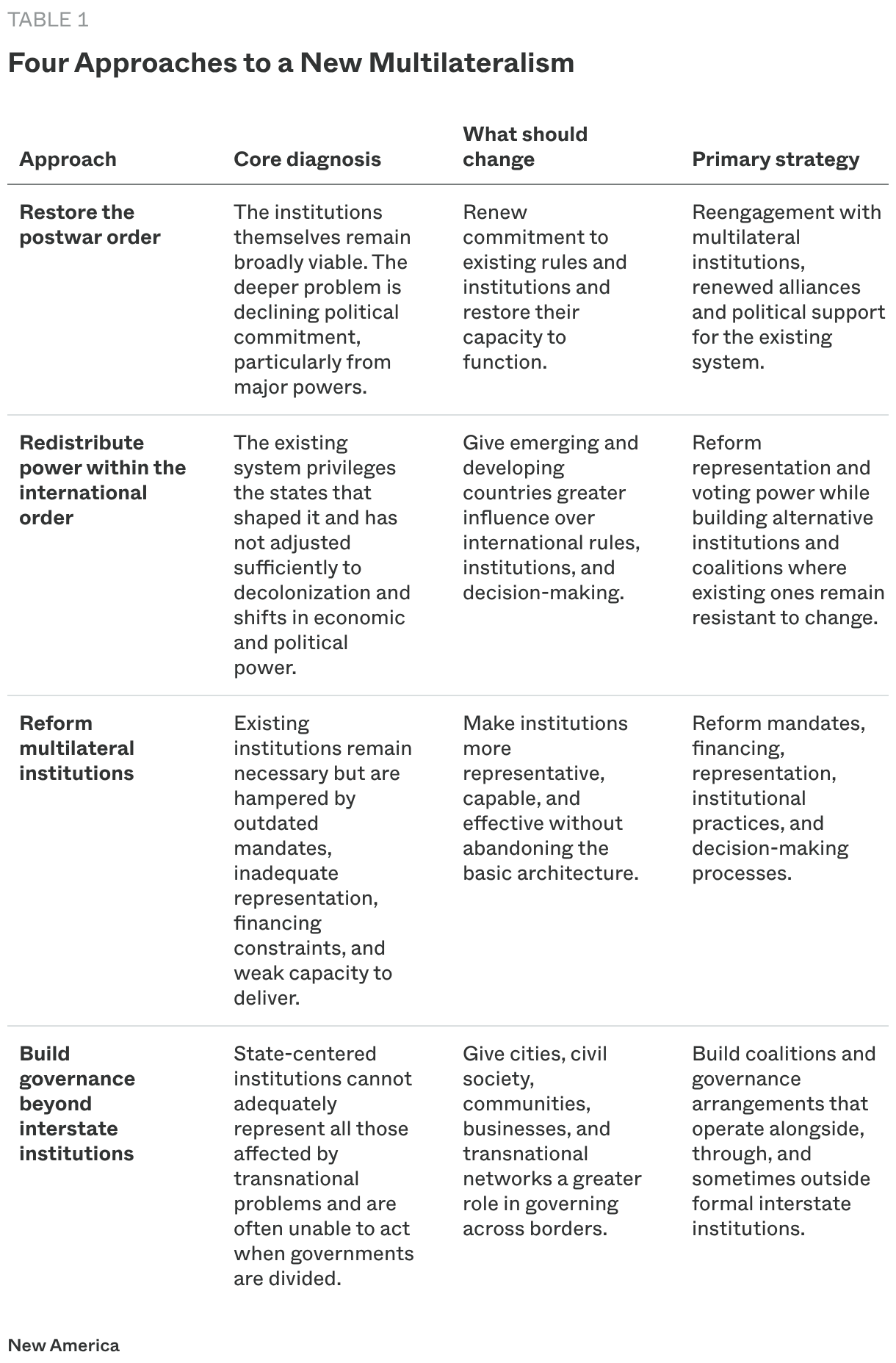
The clearest divide may be between those who believe the post-war system can still be restored and those who think restoration is neither possible nor desirable. The first camp includes much of the European foreign policy establishment and American liberal internationalists, who see the problem less in the institutions themselves than in the political commitment to sustain them, most consequentially from the United States.
It is easy to see why they would think this way: The institutions they built from the ruins of World War II established rules that maintained some order and predictability to international affairs. The world has seen a massive expansion of global trade, the eradication of diseases like smallpox, and newly independent countries gaining standing in the international system. And, whatever else can be said of the post-war order, the major powers have not gone to war with one another for more than 80 years.
But the post-war order looks different depending on where you stand within it. Many of its institutions were built just as decolonization was gathering pace, without making much room for the redistribution of power demanded by the newly independent states. By the 1970s, developing countries were calling for a New International Economic Order that would give them greater control over their natural resources, improve their terms of trade, and change the rules governing development finance.7 The campaign forced questions of economic power and inequality into formal global politics, but the underlying distribution of power barely moved.8 The United States and Europe retained outsized influence.
Those in the second camp responded to these imbalances by building alternatives to institutions they believe still privilege the West. Although Beijing has not rejected the existing multilateral system—it continues to defend the UN Charter, sovereign equality, and what it calls “true multilateralism”—it has been working to reshape the system from within and build alternatives to institutions long dominated by Western powers.9 China has increased its contributions to multilateral institutions and sought senior positions across the UN system, but it has also built new channels of influence outside them, from the Asian Infrastructure Investment Bank and New Development Bank to infrastructure financing through the Belt and Road Initiative.
Russia goes considerably further. It portrays the “rules-based international order” as a Western construct designed to preserve American power, even as it continues to use the institutions of that order when they serve its interests, most notably through its Security Council veto. Other governments, including some within the BRICS group and across the Global South, favor a more multipolar system without necessarily sharing either China’s or Russia’s version of what that system should look like.
Still others share the critique of the post-war system’s concentration of power but are equally wary of an order organized around China, Russia, or the other BRICS. For progressive and decolonial critics, giving China, Russia, India, Brazil, or South Africa more influence does not by itself resolve the deeper problem. A more multipolar order can still concentrate power in states without giving much more voice to the people most affected by the new order’s decisions. This camp’s vision goes beyond redistributing power among countries to ask whose interests those countries represent, whose voices count, and who gets to shape the rules in the first place.
The third camp remains committed to the institutions themselves but believes they need substantial reform. This includes those within the UN system, parts of the Global South’s diplomatic establishment, and many humanitarian and development organizations. Their proposals tend to focus on expanding representation, updating mandates, changing how institutions are financed, and giving less powerful countries greater influence over decisions.10 Secretary-General Guterres’s Our Common Agenda, published in 2021, reflects this position, as does the more recent UN80 reform effort.11 The bet here is that the basic architecture remains viable if power within it is redistributed and the institutions themselves can be made more representative and effective.
The final camp puts less faith in reforming interstate institutions and more emphasis on the governance already happening around them through cities, civil society, businesses, and transnational networks. When the United States announced its withdrawal from the Paris Agreement during President Trump’s first term, hundreds of mayors, governors, and business leaders pledged to pursue its climate goals anyway.12 Companies have also taken on roles once largely reserved for governments. After SpaceX’s Starlink became critical to Ukrainian communications following Russia’s invasion, Elon Musk declined a Ukrainian request to extend coverage for a military operation in Crimea, effectively putting a private CEO in a position to shape the parameters of a war.13 Similar networks have emerged across other areas where national and international institutions have either struggled or refused to act. But this approach can let national governments off the hook and, particularly where companies are involved, put decisions with public consequences in private hands.14
All of this disagreement can be easy to miss under the shared language of a “new multilateralism.” Much of the frustration in these debates comes from people answering different questions while assuming they are having the same argument: What would a legitimate and effective international order look like, and whose interests should it serve? Why is the current system failing, and are those failures fixable? And given the political constraints that exist, what can actually be changed?
In practice, few actors fit neatly into any one camp. But the distinctions matter because the camps are often answering different questions—whether the existing order can be restored, whether its distribution of power was ever legitimate, whether institutions can be reformed from within, or whether governance needs to be built elsewhere.
It is worth starting with how well the current system is actually performing, or not performing.
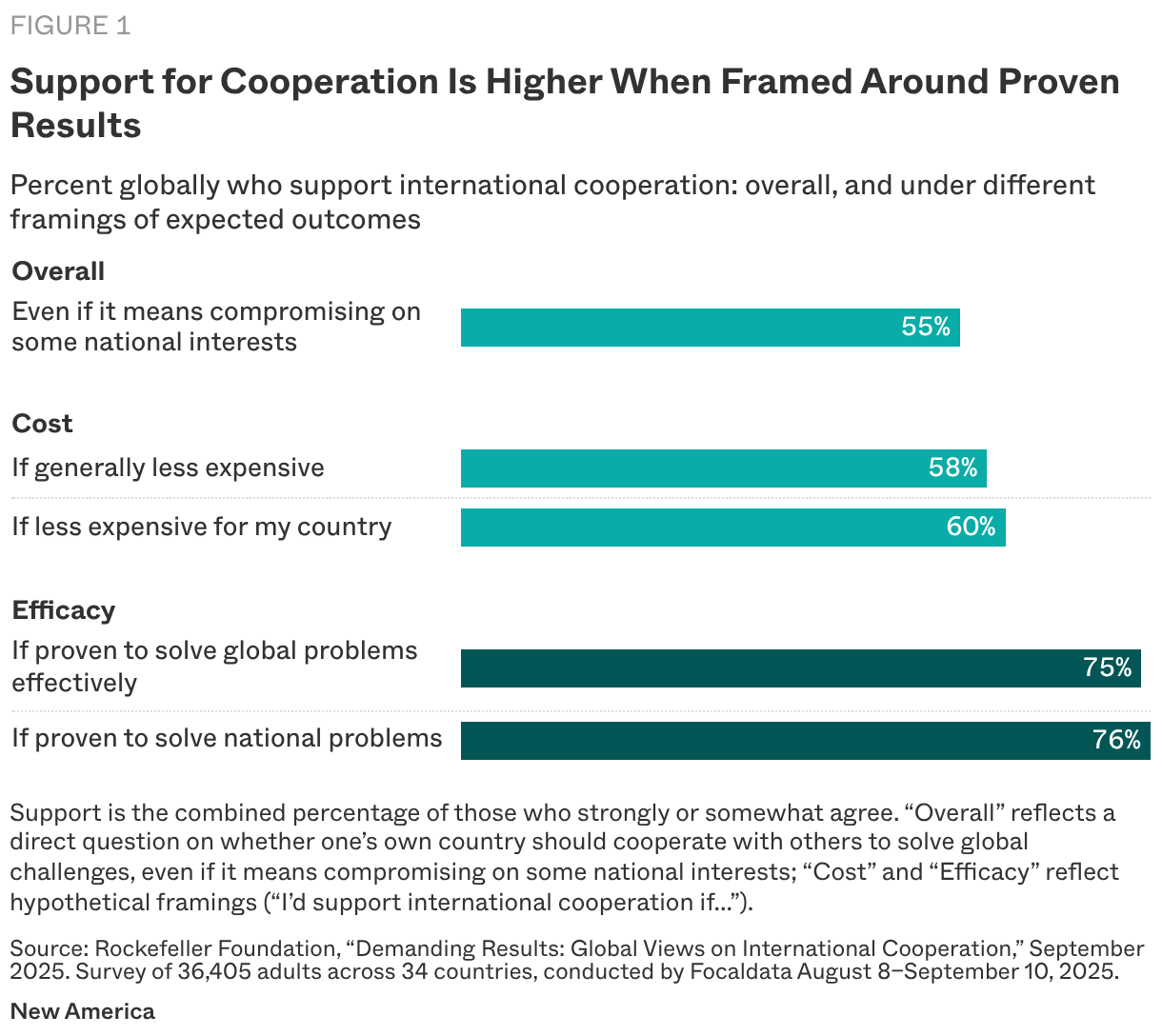
The headlines and political discourse suggest that the UN and multilateralism more broadly face a legitimacy crisis. However, the polling does not quite bear out the “crisis of multilateralism” portrayed in public discourse. According to a 2025 Pew survey, a median of 61 percent of adults across the 25 countries held a favorable view of the UN.15 A separate Rockefeller/Focaldata poll found that 55 percent of respondents supported international cooperation even when it required some compromise of national interests.16 And in several countries, views of the UN became more positive in 2025,17 despite the high pitch of nationalistic rhetoric and the U.S. withdrawal from multiple UN bodies. Whatever problems multilateral institutions face, the public does not appear to have rejected international cooperation itself.
That support, however, is not unconditional. In the Rockefeller/Focaldata survey, support for international cooperation jumps from 55 percent to 75 percent when that cooperation produces results (see Figure 1). That gap suggests that the challenge facing multilateralism is at least partly one of performance. People remain open to countries working together but their support is considerably stronger when they believe multilateralism works. And there is plenty in the record to explain why people might question whether it does.
Ten years after the adoption of the UN’s Sustainable Development Goals, the world’s governments are on track or making moderate progress on only 35 percent of the 137 sustainable development targets while falling below the 2015 baselines on 18 percent of the targets.18 Some of the gravest conflicts of recent years, from Gaza to Sudan to Ukraine, have unfolded while the Security Council remained divided or unable to act. Yet it was the COVID-19 pandemic that really became the defining example of the failure of multilateralism. The Independent Panel for Pandemic Preparedness and Response described the global response as “a sequence of failures.”19 Trust in the UN fell during this period, with 23 of the 27 countries tracked by Edelman Trust Barometer registering lower levels of trust in the UN between the fall of 2021 and the fall of 2024.20
But poor performance is only part of the problem. The architecture of global governance still reflects the distribution of power at the time it was created. The institutions built in San Francisco and Bretton Woods took shape when much of Africa and Asia were still under colonial rule and the United States accounted for roughly half of global GDP.21 Today, European countries still hold roughly a third of IMF voting power, while China, the world’s second-largest economy, holds about 6 percent.22 African countries, home to roughly 1.4 billion people, collectively hold only around 6 percent of voting power at the World Bank’s main lending institution.23 By tradition, an American always leads the World Bank and a European always leads the IMF. In the 80 years since these institutions were created, they have not been updated to reflect the decolonization of most of the world’s people, the rise of new economic powers, or the emergence of entirely new issue areas the original designers never contemplated.
The IMF provides a good example of how this plays out. Access to IMF financing has long come with policy conditions that can reach deeply into the domestic economic choices of borrowing countries. A study of 135 developing countries between 1980 and 2014 found that IMF-mandated reforms increased income inequality in borrowing countries, with the effects extending beyond macroeconomic policy into areas that shape jobs, public services, and social protection.24 By contrast, the fiscal and monetary decisions of the world’s largest economies can have enormous consequences beyond their borders without their governments facing anything comparable.
The same asymmetry is visible in climate policy. G20 countries account for 77 percent of global emissions and are collectively off track on their 2030 commitments to reduce emissions, but the Paris Agreement carries no penalties for countries that miss their targets.25 That was partly the bargain required to bring the largest emitters into the agreement.26 But it also left the system with little leverage over the countries most responsible for the problem. Developing countries need an estimated $310 billion a year by 2035 to adapt to climate impacts they did relatively little to cause.27 The system has considerably more leverage over some countries than others; but, as with the international economic system, it has relatively little leverage over those whose emissions have consequences far beyond their borders.
Do we need any international architecture at all? Across both G7 and BRICS countries, majorities favor multilateral approaches over unilateral ones on peace and security, climate change, pandemics, and human rights, with support reaching about 70 percent on peace and climate.28 A much larger survey by the UN Development Programme found even stronger support for cooperation on climate, with 86 percent of respondents saying countries should set aside geopolitical differences and work together.29
In January 2021, as the first COVID-19 vaccines were being distributed, Guinea managed to vaccinate just 25 of its senior officials with doses of Russia’s Sputnik V vaccine.30 At the same time, about 60 million doses had been administered worldwide, mostly in wealthy countries. High-income countries, representing just 13 percent of the world’s population, had already reserved more than half of the available doses, in some cases five times more than they needed. More than one million lives might have been saved if those vaccines had been shared more equitably.31 But vaccine nationalism also hurt the countries that hoarded. The longer the virus circulated in largely unvaccinated populations, the more opportunities it had to mutate. And once new variants emerged, the borders wealthy countries had tried to protect through their vaccine stockpiles offered little protection.32
While we can draw boundaries on the ground, divert rivers, and divide communities, the atmosphere is impervious to such machinations. A ton of carbon dioxide released in Houston or Shanghai joins the same atmosphere and warms the same planet. Climate is the most classic example of a global common, a shared resource whose condition is determined by the collective behavior of all users, not any single one of them. And the impact of this unmanaged interdependence is that it will hit the most vulnerable first but will eventually come for everyone. In a single week during the June 2026 heat wave, Europe recorded more than 10,000 excess deaths.33 And of the more than 120 million people forcibly displaced worldwide, roughly three-quarters live in countries with high-to-extreme exposure to climate hazards.34
Then there is artificial intelligence, where many of the governance problems seen elsewhere are already reappearing at greater speed. One way to understand AI’s unusual degree of interdependence is its stack, a layered system in which each level depends on the one below it. At the bottom are the raw materials, such as cobalt from the Democratic Republic of Congo (DRC) and lithium from Chile’s Atacama Desert, with China dominating the processing of many of the critical minerals the industry relies on.35 Then come the chips, dominated by American and Taiwanese companies,36 followed by data centers whose electricity consumption is projected to exceed Japan’s current nationwide consumption by 2030.37 At the top are the foundation models on which much of the AI economy is being built, controlled largely by a handful of American companies.38
The sovereignty question is woven through every level of the stack. Most countries cannot control the full stack by themselves. The EU has committed around $200 billion to AI infrastructure, yet European data centers remain largely controlled by U.S. hyperscalers.39 At the other end of the stack, the countries and communities supplying the raw materials have even less say in how the technology is governed. The DRC supplies much of the world’s cobalt, under conditions involving child labor and environmental damage, but has had little presence in the international forums shaping AI governance.40 Indigenous communities in Chile live with the environmental consequences of lithium extraction but have little voice in the bodies writing AI standards.41 For now, many of the decisions about AI’s foundational capabilities are being made by a small number of governments and companies. What they decide will affect who controls the technology, who benefits from it, and who bears its costs, including in countries and communities with very little say over any of it.42
The nationalist instinct is to build more at home and depend less on others. There are good reasons for doing both, but there are limits to how much insulation national policy can provide. States are already interdependent through supply chains, financial markets, energy systems, technology, pathogens, and the atmosphere. The war with Iran in February 2026 showed how quickly those connections can transmit a shock. The disruption of shipping through the Strait of Hormuz sent global fuel and fertilizer prices higher. An analysis by the International Food Policy Research Institute estimated that those price increases could push more than 20 million people into poverty across 20 developing countries and leave 2.5 million more facing undernourishment.43 Even in the United States, farmers faced sharply higher fuel and fertilizer costs.44 Countries can reduce their dependence on others, but they cannot eliminate it.
Some architecture is therefore necessary, even if it is not the system we have now. Countries still need ways to share information before a pathogen spreads, manage shared resources, set standards for technologies and markets that cross borders, and respond when decisions in one place impose costs somewhere else. Those functions are a useful starting point for thinking about what comes next.
For all the disagreement over the current global architecture, there is broad agreement that the old order is no longer fully functional and the new order has not yet taken shape. Some governments and companies are already using this period of uncertainty to shape what comes next. Others look at the same uncertainty with considerable discomfort and are focused on preserving as much of the existing order as possible. Still others see it as an opening to build something different but get caught up in trying to define the destination before the journey has even begun. We have been in such interregnums before.
The post-war order itself was built by people who did not know exactly what it would become. Delegates in San Francisco drafted the UN Charter in nine weeks and left Article 106 as a placeholder to figure out the security arrangements later.45 The officials behind the Marshall Plan had a clearer sense of what they wanted to prevent and the kind of Europe they hoped would emerge than the institutional arrangements that would get them there.46 What we now call the post-war order was not designed all at once. Much of it took shape as governments responded to problems as they arose.
The circumstances today are obviously different. We are not emerging from a singular catastrophe like World War II, but there is a similar lack of certainty about what comes next.
While we cannot know exactly where this period will lead, we can make choices about the direction of travel. Settling on that destination too quickly risks embedding the power distributions and assumptions of this moment in ways that will be very difficult to undo. We do need some agreement on what we are building toward and what we need to build away from.
We can begin by identifying the failures a new system should not reproduce, without pretending we can specify its institutional form in advance. The four criteria below are not a complete architecture. They are a way to identify those failures and evaluate the arrangements already taking shape. They focus primarily on power because its distribution and accountability are among the failures the current system has proved least able to correct.
The future of multilateralism should be:
The absence of a settled new order does not mean that nothing is being built. Choices are already being made about AI governance, climate finance, development institutions, trade, and security. These choices may look piecemeal now, just as many of the arrangements that eventually became the post-war order once did. The question is whether enough actors who share a direction can begin shaping those choices together.
If we cannot yet agree on what the new system looks like, how can we agree on how to work toward it? A new multilateralism can feel daunting and untouchable, which is one reason reform efforts tend to focus on specific objectives within specific institutional venues. Many have produced significant results: The campaign to ban landmines helped produce an international treaty.50 Jubilee 2000 helped push governments toward debt relief that ultimately canceled around $100 billion.51 The campaign to establish the International Criminal Court created a permanent institution to prosecute some of the world’s gravest crimes.52
But campaigns have limits. Even a successful campaign can leave untouched the underlying conditions that produced the problem it set out to solve. Jubilee 2000 helped secure significant debt cancellation, but it did not fundamentally change the architecture that repeatedly produces debt crises in vulnerable countries. Creditors still hold considerable power over the terms of restructuring, while private credit-rating agencies can dramatically alter a country’s borrowing costs.53
Part of the problem is that the communities pursuing these reforms are largely organized around the same issue boundaries as the institutions they are trying to change. Climate finance, AI governance, humanitarian response, sovereign debt, and Security Council reform each have their own institutional venues, civil society networks, policymakers, funders, and theories of what has gone wrong. The institutional architecture itself reinforces these divisions, with different negotiating processes, secretariats, constituencies, and bodies of expertise developing around different issues.
There has been movement toward more structural thinking. The Bridgetown Agenda has connected this thinking to sovereign debt, credit-rating methodologies, and the terms on which climate-vulnerable countries can access capital.54 In the humanitarian system, the Grand Bargain has pushed localization and the transfer of greater decision-making authority and resources to local and national actors.55 But these structural arguments are still largely being made separately and within their own institutional homes.
What is missing is infrastructure that connects these efforts across issues and survives beyond any one campaign. In this sense, infrastructure means the relationships, shared frameworks, and channels of communication that allow people working on different problems to recognize one another as allies and coordinate repeatedly without having to start over each time.56 It does not require climate advocates to become AI experts or humanitarian organizations to take on sovereign debt. The point is to build enough connective tissue between them that political energy generated in one fight does not simply disappear when that fight is over.
The starting point is a shared diagnosis. While it does not require agreement on solutions, it requires enough agreement about the structural conditions producing problems across different fields.57 In many of the examples here, that condition is the accountability inversion: Those with the greatest power to affect outcomes face the least institutional accountability for them, while the communities most exposed to the consequences have the least leverage to demand something different.58 The problem may differ from one field to another, but the distribution of power is essentially the same. Recognizing a common problem gives otherwise disparate communities a basis for working together without requiring them to agree on a single solution.
The coalition that emerges may not look much like a traditional advocacy coalition organized around a single issue or one institutional target. Robert Orr has described “catalytic coalitions” that bring together actors with different forms of power and capacity around a shared problem.59 Depending on the issue, this could mean middle powers working alongside cities, civil society organizations, technical experts, philanthropies, and communities directly affected by the decisions being made. They do not all need to play the same role or even agree on every aspect of the problem.60
Some openings are more useful than others. Wedge issues are places where the accountability failure is visible, responsibility can be identified, an organized constituency already exists, and some change is within reach. Their value is not only that something can be won. The fight can expose a larger structural problem and bring together actors who might otherwise remain in separate issue communities.
Zaid Hassan’s forthcoming “Wedge Framework” offers one way to think about how those openings can produce something larger.61 Hassan describes three interconnected spaces—the front room, middle room, and back room. Applied to multilateral politics, the front room is where institutional failures become visible through crises, journalism, organizing, protest, and political pressure. The back room is where the underlying assumptions about sovereignty, authority, representation, and enforcement shape what the system considers possible in the first place. Between them is the middle room, where pressure can be translated into policy and institutional change through coalitions, negotiations, institutions, and other mechanisms.
The front room is already providing a lot of fodder. Across countries, there is considerable anger over inequality, the concentration of wealth, and the political influence of billionaires. In 2025, billionaire wealth reached $18.3 trillion, growing three times faster than it had over the previous five years. Billionaires are now 4,000 times more likely to hold political office than ordinary citizens, and almost half of people surveyed across 66 countries believe the rich often buy elections in their country.62 The 2025 Edelman Trust Barometer found a similar sense of grievance, with 61 percent of respondents reporting a moderate or high sense of grievance, including a belief that government and business serve narrow interests and that the wealthy benefit while everyone else struggles.63 People may not call this an “accountability inversion,” but the frustration over who holds power, who benefits from it, and who can be held accountable is there.
Behind that anger is a set of rules that has made it increasingly easy for wealth to move across borders, while taxation remains largely organized at the national level. Wealthy individuals can hold assets through multiple jurisdictions, shift where income is reported, and take advantage of differences between national tax systems.64 Governments have spent years trying to close some of those gaps, but the basic mismatch remains.65 The international economy allows wealth to operate globally without creating equally global mechanisms for holding it accountable.
The work, then, is in the middle room. This is where the anger visible in the front room can be connected to a specific change in the rules, and where the assumptions in the back room can actually be challenged. The push for coordinated taxation of extreme wealth is one such opening. Brazil used its G20 presidency to push for coordinated taxation of ultra-high-net-worth individuals, drawing support from governments, economists, civil society groups, and international organizations.66 Getting the proposal adopted would be a significant achievement. But the coalition built around it could do more than deliver a single policy win.
That could mean bringing tax justice advocates into closer alignment with people working on sovereign debt, climate finance, financial secrecy, corruption, and corporate influence over global rulemaking. They do not need to agree on a common policy agenda. They are confronting different versions of the same underlying problem, the ability of wealth to translate into power without comparable accountability. The relationships built through one fight could then carry into the next, whether over financial secrecy, debt restructuring, corporate taxation, or the governance of international financial institutions.
For all the talk of a crisis of multilateralism, there is still considerable appetite for countries and communities to work together. The harder question is whether the institutions we have are capable of meeting that demand. We have spent so much time debating whether the post-war order can be saved that we have sometimes treated the fate of those institutions as synonymous with the fate of international cooperation itself.
It isn’t. The problems that require countries to work together are not going away, even if the institutions built to manage them weaken or fail. If anything, the need for cooperation is becoming even more urgent. The question, then, is what forms that cooperation will take, who gets to shape them, and whether they reproduce the same concentrations of power that have sown dissatisfaction with the current system.
We do not need to know exactly what comes next to begin answering those questions. Much of the next order will be built through the choices we are just now starting to make, often issue by issue and coalition by coalition. The opportunity is to connect enough of those fights that changing one part of the system makes it easier to change the whole.
Co-Director, Power, People, and Planet Initiative