Jeremy Hodge
Research Fellow, Future Security
From 2021 to 2024, Jordan served as the primary corridor through which Iranian forces in Syria exported large quantities of weapons and narcotics to the West Bank, Saudi Arabia, Egypt, and other markets. During this period, Iran cultivated a network of allies and proxies in Jordan despite the country’s overwhelmingly Sunni population and close military ties to the United States. This report provides a granular analysis of these Sunni networks along with the motivations and incentives that drove them to partner with Iran and act as the bridge linking Syria, the West Bank, and Arab Gulf states.
In the early hours of April 15, 2025, units from Jordan’s General Intelligence Directorate (GID) amassed in the suburbs outside Amman to raid a network of makeshift facilities used by arms traffickers to manufacture homemade missiles and drones.1 The facilities had been built by members of the Jordanian Muslim Brotherhood (JMB), the country’s oldest opposition movement, which since 2002 had been controlled to varying degrees by a faction with ties to Hamas. Beginning in mid-2021, JMB members began traveling to Lebanon where Hizbollah and Hamas operatives allegedly trained them in arms production before they returned to Jordan.2 Though the GID claimed that the JMB planned to use the weapons inside Jordan, at least a portion was trafficked to Palestinian militant groups in the West Bank.3
However, the April 15 raid was not merely a law enforcement action against smugglers. One week after the arrests, Jordan’s monarchy formally outlawed the JMB, alleging that the group as a whole posed a threat to Jordan’s national security.4 The allegations were rooted in long-standing charges that the JMB operated as a key node within a broader Iranian-backed network of arms traffickers linking Lebanon, Syria, Jordan, and the West Bank.
Nine months later, the Trump administration took its own action, formally designating the JMB and the Egyptian and Lebanese chapters of the Muslim Brotherhood as Specially Designated Global Terrorists due to all three factions’ ties to Hamas. The Lebanese chapter was also designated as a Foreign Terrorist Organization, a classification that triggers more powerful statutes.5 These designations of Muslim Brotherhood chapters by the Trump administration may have been a prelude to the joint U.S.-Israeli war against Iran that began on February 28, 2026, with Washington aiming to cast as wide a net as possible against Tehran’s proxy network in the lead-up to targeting the Islamic Republic itself.
That said, allegations that the JMB in particular operated as a node within Tehran’s regional proxy network are not without merit. Since 2021, the group has participated in Iranian-led efforts to arm Palestinian militant groups in the West Bank that met with considerable success. Between October 2021 and October 2022, incidents of political violence involving Palestinian militant groups increased by 800 percent, the largest spike in violence in the area since the end of the Second Intifada in 2005.6 The spike was triggered in large part by an influx of arms supplied by the JMB and other groups. In addition to weapons manufactured by the JMB, Iranian proxies in southern Syria trafficked large quantities of arms and explosives to the West Bank through Jordan via a decentralized network of several dozen organized crime groups directed by members of Hizbollah, the Assad regime’s Military Intelligence, and the Syrian Arab Army 4th Division.
By August 2022, these groups increasingly relied on a network of Bedouin tribesmen that maintained a presence in both Syria’s southeastern Suwayda province and Jordan’s northeastern Mafraq province, a remote desert region along both countries’ border with Iraq that has historically been difficult for Jordanian security forces to patrol.7
For Iran, generating violence in the West Bank served as just one component in a broader campaign of escalation against the United States and its allies that began in 2018 following the reimposition of sanctions on Tehran by the Trump administration. That year, Iran renewed efforts to arm and finance its proxies across the Middle East before launching a series of unprecedented attacks on energy infrastructure in the Arab Gulf states throughout 2019.
Around the same time, Iranian operatives working alongside Hizbollah, the 4th Division, and other groups in parts of Syria controlled by the Assad regime began manufacturing large quantities of Captagon—a cheap amphetamine—that was trafficked and supplied a multibillion dollar retail market abroad, in particular to large markets in Egypt and Saudi Arabia.8 In addition to generating revenue, drug trafficking served as a means to establish contact with groups in adversary states that could later be repurposed toward more subversive ends.
For Iran, smugglers and organized crime networks serve as useful proxies in predominantly Sunni areas such as Jordan, southern Syria, and the Palestinian territories.9 These networks are capable of fostering violence that can be exploited to pressure authorities to adopt a pro-Iranian agenda. By helping to facilitate a Palestinian uprising in the West Bank, Iranian-backed smugglers contributed to an increase in popular support for the JMB. The JMB’s rise in popular support from 2021 to 2024—particularly after Hamas’s attack on Israel on October 7, 2023—along with Jordan’s shifting geopolitical alliances with Arab Gulf states, pushed Jordan to tolerate the JMB’s subversive activity and its ties to Iran.
This approach stands in stark contrast to Iran’s strategy in countries with large Shi’a populations, where Tehran often leverages the religious fervor of its proxies to establish de facto enclaves of control and weaken central authorities, as has occurred with Hizbollah in Lebanon, the Houthi movement in Yemen, and in some areas of Iraq controlled by Iranian-backed factions.
In some predominantly Sunni countries, Iran has tried to create Shi’a communities through proselytization.10 However, these efforts have rarely been successful and often produced a violent backlash.
This report aims to shed light on how Iran utilized smuggling to cultivate proxies in Jordan, the key buffer separating Syria, Israel, and the Arab Gulf states. From 2021 to 2024, Jordan served as the main overland transit country for weapons and narcotics being trafficked across the region. As a country with close ties to the United States and a nearly 97 percent Sunni population, Jordan has historically been resistant to Iranian influence operations.11 However, in April 2021, two key developments occurred in Jordan and the West Bank, both predominantly Sunni polities, that created an opening for Iran to expand its footprint.
First, on April 3, Saudi Arabia allegedly backed a failed coup against Jordan’s King Abdullah II, who shortly after rewrote the country’s electoral laws to politically empower the JMB in future elections.12 In so doing, King Abdullah II signaled his discontent with Riyadh, which had proscribed the Muslim Brotherhood and its affiliates as terrorist groups in 2014.13
For the next three years, Jordan’s monarchy granted the JMB unprecedented levels of operational freedom, allowing the group to openly campaign in elections on a platform of explicit radicalism despite its members’ role in trafficking weapons. This stood in stark contrast to earlier periods, when the group’s subversive activities triggered wide-scale crackdowns on JMB leadership, first in 2006 and again in 2014 and 2015. However, tensions between Sunni states enabled the rise of the JMB starting in 2021 and therefore helped enable greater cooperation between hubs of Iran’s broader proxy network in Lebanon, Syria, and the West Bank.
Second, on April 29, Palestinian Authority (PA) President Mahmoud Abbas canceled much-anticipated legislative elections in the West Bank and Gaza Strip—the first since 2006—triggering an explosion of tensions between the PA and rival factions, who increasingly came to view violence as the only means to expand their power in the West Bank.14 This included Hamas but also members of Abbas’s own party, Fatah, which at the time was divided between three rival factions, each of which possessed ties to militant groups and had even clashed with each other over the previous decade. Over the next several months, dissident Palestinian groups increased their attacks against Israeli security forces in an attempt to curry popular support and position themselves as legitimate successors to Abbas.
This competition drove a sudden demand for weapons that could easily be met by Iranian proxies in southern Syria overseen by Hizbollah, with the newly empowered JMB available to bridge the gap between both regions. The influence of Iranian proxies in southern Syria increased following Russia’s February 2022 full-scale invasion of Ukraine, after which Moscow redeployed thousands of troops out of Syria, including units in the south of the country that had collaborated with Jordan to combat weapon and drug smuggling.15
By mid-2022, Jordan’s monarchy found itself threatened by active Iranian proxies on both its northern and western borders aided by groups within Jordan itself. For many, the situation appeared to resemble the events of Black September, when Palestinian militias led by Yasser Arafat and backed by the Ba’athist regime in Syria fought a short civil war against Jordan’s monarchy in September 1970 that left thousands dead.
As a result, from 2021 to 2024, the monarchy largely tolerated the rise of the JMB, whose political arm, the Islamic Action Front, went on to win legislative elections held in September 2024 and become the largest party in parliament. It would not be until after the December 8, 2024, overthrow of President Bashar al-Assad in Syria and the subsequent withdrawal of Iranian forces from the country that Jordan’s security forces cracked down on the JMB, raiding the group’s weapons facilities outside Amman and arresting dozens of its leaders.16 Following the overthrow of Assad, smuggling between Syria and Jordan fell precipitously, as did Palestinian attacks against Israelis in the West Bank.17
Iran’s intervention in Jordan between 2021 and 2024 provides an example of an underappreciated, low-cost tool that the country’s leadership can wield against the United States and its allies during periods of tension. In the context of the current war between Iran and the United States, Tehran can deploy organized crime networks in adversary states as a supplementary facet of a multipronged strategy alongside its use of conventional kinetic strikes and its traditional proxy strategy. Such tactics could heighten the already elevated sense of uncertainty felt by many in the region amid the ongoing, unpredictable behavior of both main parties to the conflict.
Similarly, Iran’s ability to exploit Jordan’s fallout with Saudi Arabia to strengthen its proxy networks carries lessons for today’s geopolitics, particularly in light of the divide that has emerged between Saudi Arabia and the United Arab Emirates (UAE). Since 2023, Saudi Arabia and the UAE have backed rival or opposing sides in the civil wars in Yemen and Sudan. In the latter, this rivalry has pushed Saudi Arabia to increasingly ally itself with the Iranian-backed Sudanese Armed Forces against the UAE-backed Rapid Support Forces, despite the presence of the Muslim Brotherhood and other Islamists within the ranks of the former.18
The Saudi-UAE divide has proven a resilient feature of Middle Eastern geopolitics, even in the wake of the widespread attacks launched by Iran against Arab Gulf states after February 28, 2026. While many presumed that the outbreak of war between the United States, Israel, and Iran could at least temporarily heal intra-Sunni rifts, the UAE’s April 28, 2026, decision to leave OPEC provides further confirmation of the growing divide.19 Should these and other splits between traditional Sunni allies continue, they could create opportunities for Iran to direct greater support to Sunni Islamists.
The rest of this report is divided into five sections. The first will outline the push factors that drove Iran to supply weapons to its proxies and instigate violence against American allies starting in 2018, along with the pull factors that further drew Iranian resources to the West Bank after April 2021—both of which combined to produce a significant increase in violence. The second section will provide an overview of the JMB’s role as an Iranian-backed subversive organization and show how the monarchy afforded the group an unprecedented degree of operational freedom from 2021 through 2024 compared to previous periods of tensions with the group. The third section will provide a detailed look at Bedouin trafficking networks in Suwayda and Mafraq and show how the withdrawal of Jordanian and Russian support to factions in the area served as another pull factor that created space for Iran to present itself as an alternative partner. The fourth section will provide an account of how Jordanian security forces shifted their approach to trafficking after the October 7, 2023, Hamas attacks on Israel along with the current state of smuggling following the overthrow of Assad. Lastly, the conclusion will discuss the lessons that can be learned from Iran’s 2021–2024 intervention in Jordan and their relevance for future scenarios.
On May 8, 2018, the Trump administration withdrew the United States from the Joint Comprehensive Plan of Action (JCPOA), a multilateral deal to remove various sanctions on Iran in exchange for limits on its nuclear program.20 The move was part of the Trump administration’s “maximum pressure” campaign, which aimed to restrict Iran’s influence across the Middle East through sanctions and targeted military operations against high-value assets. Iran responded to the new American strategy by beginning to exceed limits to its nuclear enrichment program mandated by the JCPOA, increasing its attacks on U.S. allies in the Gulf, and expanding its support for proxies across the Middle East, including significantly increasing its support for Hamas starting in July 2019.
Despite Iran’s newly aggressive approach, Palestinian militant groups did not conduct large-scale attacks on Israel from 2019 to 2020, as both Hamas and the Iranian-backed Palestinian Islamic Jihad (PIJ) group favored talks with Palestinian Authority (PA) President Mahmoud Abbas to form a unity government as their preferred means of expanding their footprint in the West Bank.21 Dissident factions within Fatah—the largest Palestinian political party which leads the PA—that opposed Abbas similarly viewed talks positively as a means to gain political representation.22
The prospect of reconciliation between these factions collapsed on April 29, 2021, when Abbas indefinitely canceled parliamentary elections scheduled for May, after which Hamas, PIJ, and dissident Fatah groups resorted to violence to expand their influence in the West Bank.23 The demand for weapons in the West Bank after April 2021 served as a powerful pull factor that further drew Iranian resources to the area and triggered a large-scale uprising against Israel.
Without such a pull factor, patron-client relationships rarely yield successful results in proxy warfare. Except in the most extreme cases, patrons such as Iran can rarely push their clients to engage in widespread and prolonged acts of rebellion without sufficient demand for action among the client’s core constituency. By contrast, sufficient demand or pull factors among a client group can attract support from otherwise unengaged patrons. The conditions driving patrons like Iran to support clients are described in this paper as push factors—that is, the will and capacity of states to direct resources to groups abroad.
For West Bank militants and Iran, the pull and push factors incentivizing both sides to cooperate from 2021 to 2024 were strong and drew in groups in Jordan, which could facilitate weapons shipments. For Iran, the push factors were largely driven by the country’s rivalry with the United States, which spurred Iran to both strengthen its proxy network and reinvest in its conventional military forces.
After Hamas’s October 7, 2023, attack on Israel, Jordan cracked down on smugglers within its borders, separating Iranian operatives in southern Syria from their proxies in the West Bank. The December 8, 2024, overthrow of Syrian President Bashar al-Assad, along with the tightening of U.S. sanctions on Iran in 2025, further limited the push factors enabling Tehran to instigate violence in the West Bank. The joint U.S.-Israeli war in Iran beginning on February 28, 2026, and the subsequent U.S. blockade of Iranian oil exports could reduce Iran’s capacity to support proxies at various points in the short and medium terms. However, despite this, many of the pull factors described in this report remain relevant and, if left unaddressed, could be exploited by other patrons with greater capacity.
The rest of this section is divided into three sub-sections. The first will review the social and political dynamics that led the West Bank toward a political crisis that exploded after April 2021 and created a powerful series of pull factors attracting Iranian resources to the area. The second will describe the push factors that incentivized Iran to reestablish ties to proxy groups across the region beginning in 2018. The last sub-section will provide a detailed account of the Palestinian uprising that occurred in the West Bank from 2021 to 2024 as a result of these factors.
In January 2021, PA President Mahmoud Abbas scheduled new parliamentary elections for May 2021, the first to be held in the West Bank since 2006.24 The move came after a decade of internal fighting within Fatah that had left the group divided between several competing factions. Though Hamas was expected to run and do well in the elections, the race was also contested by three rival Fatah blocs: the first, led by Abbas himself, and two dissident groups led by Mohammed Dahlan and Marwan al-Barghouti.25
The elections were intended to relieve tensions between these factions, which had begun to arm themselves in anticipation of Abbas vacating power. At 85 years old, Abbas had repeatedly been hospitalized for cancer and heart procedures, leading many to suspect that he might die or step down and trigger a succession crisis. This uncertainty pushed Dahlan, al-Barghouti, and Abbas loyalists to arm themselves in anticipation of a violent power struggle.26 However, on April 29, 2021, Abbas indefinitely postponed the elections following polling that showed his ticket stood to win less than a quarter of the total seats. The move triggered new tensions between these factions, each of which represented rival sections of society.27
Backed by the United Arab Emirates (UAE), Mohammed Dahlan was a former member of Fatah’s leadership faction alongside Abbas who lived in exile in Tunisia from 1982 to 1994 before returning to the Palestinian territories following the establishment of the PA.28 After occupying numerous high-level positions in the Gaza Strip, Dahlan was expelled from Fatah in 2011 following allegations that he plotted a coup against Abbas.29 Fighting between Dahlan supporters and PA forces first occurred in August 2016 and then escalated in December 2016, when dozens of Dahlan loyalists were expelled from Fatah’s Revolutionary Council and Central Committee and arrested, prompting clashes in and around Nablus city.30
Seen as close to the United States and Israel, Dahlan was instrumental in organizing the 2020 Abraham Accords, the normalization deal brokered by the Trump administration between Israel and the UAE, Bahrain, and Morocco, which the PA opposed, perceiving it to undermine the organization’s authority. These and other efforts by Dahlan to expand his influence prompted more crackdowns on his supporters in the West Bank, pushing many to take up arms.31
By contrast, Marwan al-Barghouti represented a different social and ideological cohort within Fatah, one that was far more radical and whose membership widely overlapped with Hamas, including within al-Barghouti’s immediate and extended family.32 Originally from the area north of Ramallah around the village of Kobar, the extended al-Barghouti household is part of a collection of wealthy, urban West Bank families known as a’ayan (notables) who had historically governed Palestinian districts on behalf of the Ottomans and owned large plots of land across the Levant. This changed in the 1980s, when Israel carried out seizures of a’ayan landholdings that were either used to construct Israeli settlements or redistributed to second-tier rural tribal elites who were also invested with political power. In 1983, the Israel Land Authority made significant seizures of land in Kobar and the neighboring town of Baytilu that were used to construct the settlement of Nahliel in 1985. As a result of these and other seizures, in 1987 a’ayan families were among the top coordinators of the First Intifada, which lasted until 1993; they later became known as the “intifada elite.”33
Historically, Ramallah was a relatively small West Bank town with a Christian-majority population whose local elite was less influential than their counterparts in larger cities such as Nablus and Hebron.34 However, beginning in 1953, Ramallah and surrounding towns such as al-Bireh, Birzeit, and others grew in importance after the founding of Birzeit University by a local Protestant family who modeled the institution after the Protestant missionary education system.
Soon, Birzeit University became the top college in the West Bank, attracting upper-middle-class a’ayan students from across the region.35 The influx of students made the area a hub for leftist groups, with Ramallah becoming an organizing center for the Palestinian Communist party and Birzeit becoming a hotbed for Ba’ath party activity.36
Following the First Intifada, leftist factions such as the Popular Front for the Liberation of Palestine and the Democratic Front for the Liberation of Palestine expanded their influence in Ramallah via a network of NGOs with ties to similar groups in Europe.37 However, beginning in the 1990s, Islamist groups—in particular Hamas, whose power within Birzeit’s student union grew during this period—began to contest leftists’ dominance over the area’s educated middle class.38
Following the creation of the PA in 1994, Fatah members from the a’ayan intifada elite quickly found themselves at odds with the more moderate Fatah leadership that returned from exile in Tunisia—derisively referred to as “the Tunisians.” With few exceptions, Fatah’s “Tunisian” leadership excluded younger intifada elite cadres from the Fatah Central Committee and PA security forces, partnering instead with rural clan and tribal leaders.39
Following the outbreak of the Second Intifada in 2000, Marwan al-Barghouti emerged as a de facto leader within the intifada elite, becoming a prominent leader within the Fatah Higher Movement Committee, a rival to the Fatah Central Committee. Over the next five years, Fatah militias led by al-Barghouti, in particular Tanzim and the Al-Aqsa Martyrs Brigade (AAMB)—al-Barghouti has denied charges of affiliation with AAMB, though not Tanzim—cooperated with Hamas in attacks against Israel.40 During this period, many of al-Barghouti’s relatives served as Hamas commanders, pushing Israel to arrest al-Barghouti in 2002.41
Hamas’s growing influence within the urban a’ayan cohort became clear during PA municipal and legislative elections held in 2004–2005 and in 2006. In the former, Hamas won control of nearly every urban center except Ramallah, where quotas for Christian candidates forced the group to accept a disproportionately low number of seats compared to its vote share. In these elections, Hamas performed best in Nablus (where it won 73 percent of votes), the Ramallah suburb of al-Bireh (72 percent), and Hebron. Fatah’s victories, by contrast, were concentrated almost exclusively in rural regions home to its traditional tribal allies.42 Later, during the 2006 elections for the Palestinian Legislative Council (PLC), Hamas performed best in Nablus, Hebron, and Ramallah, where it won 80–100 percent of seats.43
Hamas’s influence in the West Bank began to wane in June 2007, after the group seized control of the Gaza Strip from the PA in a weeklong civil war, after which Abbas formally suspended the PLC and arrested hundreds of Hamas operatives.44 In its place, dissident Fatah groups with ties to Dahlan and al-Barghouti gradually emerged to fill the gap. Throughout the 2010s, Dahlan cultivated support in refugee camps and low-income areas of Nablus and Jenin provinces.45 By contrast, in Ramallah and other urban areas, al-Barghouti still retained the support of many a’ayan urbanites who viewed him as a useful bulwark against the PA’s “Tunisian” cohort.46 Since his 2002 arrest, Hamas leaders regularly included al-Barghouti on lists of prisoners it demanded in exchange for Israeli hostages and came to view him as a useful ally within Fatah.47
In 2009, Abbas attempted to co-opt swaths of the urban a’ayan cohort by engineering the election of al-Barghouti to the Fatah Central Committee while al-Barghouti was in prison, in an election that many alleged to have been rigged.48 However, Abbas’s failure to call new PLC elections, along with a general tightening of control over PA courts and security services over the next decade, created dissatisfaction within Fatah ranks that led to the reemergence of divisions more than a decade later.49
Following the cancellation of the PLC elections on April 29, 2021, tensions between these factions escalated as Hamas and dissident Fatah groups increasingly came to view violence as the only means to expand their power in the West Bank.50 In the months leading up to the scheduled elections, Mohammed Dahlan in particular had increased his own financing to allies in the West Bank, including armed groups, while AAMB factions took steps to unify their ranks.51
By this point, Iran had resumed financial assistance to Hamas after having distanced itself from the group in 2012 due to Hamas’s support for Sunni rebels who fought the Assad regime in Syria, a gap that grew wider in 2015 with Hamas’s opposition to the Iranian-backed Houthi rebel group in Yemen.52 In 2021, with the full backing of Iran, Hamas responded to the cancellation of PA elections by initiating its first major war with Israel since 2014, firing hundreds of rockets into Jerusalem on May 10 and triggering 11 days of violence by both sides that left nearly 300 people dead and thousands more wounded.53
During the Gaza fighting, cells affiliated with the Iranian-backed Palestinian Islamic Jihad (PIJ) faction in the West Bank, operating in solidarity with Hamas, carried out attacks against Israel Defense Forces (IDF) forces in Hebron. These attacks provoked a series of tit-for-tat exchanges that led to the largest surge in violence in the West Bank since the “knife intifada” in 2015 and 2016, when hundreds of Palestinians carried out lone-wolf stabbing attacks against Israelis in the West Bank, Jerusalem, and Israel itself.54
AAMB factions quickly joined PIJ to launch attacks against IDF troops across the West Bank, particularly around the northern city of Jenin, with the AAMB Liwa al-Amudi sub-unit backed by Muhammad Dahlan issuing specific calls to members of the PA security forces to defect and help repel “Israeli aggression.”55
For the next two years, PIJ commanders Bassam Sa’adi and Tariq Azz al-Din—the latter based in the Gaza Strip—played an outsized role in coordinating weapons shipments for Palestinian militant groups between Syria and the West Bank.56 At the same time, in mid-2021, members of the Jordanian Muslim Brotherhood began traveling to Lebanon, where they allegedly received training from Hizbollah or Hamas operatives in missile production, knowledge they used to manufacture rockets in Jordan that were also smuggled to Palestinian groups in the West Bank.57
By August 2022 and throughout 2023, this confluence of factors pushed violence in the West Bank to its most lethal point since the Second Intifada, a process that was actively facilitated by Iran, which launched an expanded weapons smuggling campaign from Syria, including large volumes of high-quality explosives used to make IEDs that targeted Israeli convoys.58
Despite its significance, the escalation in the West Bank represented just one theater in a broader Iranian effort to expand its global military footprint in response to real and perceived threats from the United States that began several years earlier in 2018. This change was the latest in a series of shifts in Iran’s strategy to confront the United States since the early 2000s.
After 9/11, Iran interpreted the initial U.S. invasions of Iraq and Afghanistan as attempts to establish a direct Western military presence on its borders, pushing it to cultivate a network of armed proxies—in Iraq in particular—capable of weakening the U.S. position. Following the United States’ failure in both theaters, Iranian leadership embraced a new view that the United States would instead adopt a new “hybrid” warfare strategy to overthrow the regime, using indirect means.59
This position gained powerful currency within Iran following the outbreak of the country’s “Green” protest movement, a series of mass demonstrations by the Iranian opposition following the country’s June 12, 2009, presidential elections that Tehran suspected were organized in Washington. Iran similarly viewed the outbreak of the Arab Spring in 2011 as another U.S.-backed hybrid warfare campaign aimed at overthrowing pro-Iranian governments in Syria and Iraq.60
Tensions waned briefly following the Obama administration’s brokering of the JCPOA in July 2015, after which both American and Iranian military forces and their proxies indirectly coordinated to combat ISIS, expelling the group from most of its territorial holdings in Iraq and Syria by November 2017.61 However, the Trump administration’s abrupt withdrawal from the JCPOA on May 8, 2018, reignited tensions between both countries and pushed Iran to expand its regional military footprint and exceed its JCPOA-mandated limits on nuclear activities.62
For Iran, battles fought against ISIS and Syrian rebel groups from 2015 to 2018 marked a key period of consolidation during which the Islamic Revolutionary Guard Corps (IRGC) managed to coalesce its disparate network of foreign proxies into an organized, structured ground force capable of fighting conventional battles on its behalf.63 This consolidation of forces within its traditional sphere of influence enabled Iran to shift its focus outward and expand operations in more distant theaters, where its operatives had remained dormant or inactive, including in Jordan and the West Bank.
In 2018 and 2019, Iran’s leadership invested new resources in building out Hizbollah’s domestic drone and missile production capacity in Lebanon in order to reduce the group’s dependence on Iranian weapons shipments.64 At the same time, Iran began delivering Fateh-110 and Zolfagher ballistic missiles to Shi’a proxy forces in Iraq and Burkan-3 ballistic missiles to the Houthis in Yemen, intended to create simultaneous threats on Saudi Arabia’s northern and southern borders.65
Iran’s offensive posture toward the Arab Gulf states shifted again following the appointment on April 21, 2019, of Hossein Salami—a military strategist who helped develop Iran’s warfare doctrine and publicly called for new offensive measures against the country’s adversaries—as commander of the IRGC.66
Almost immediately, Salami’s calls manifested in an unprecedented wave of new attacks. Over four months from May to September 2019, Iran and its allies, including the Kata’ib Hizbollah militia in Iraq and the Houthis, carried out four drone, cruise missile, and magnetic mine attacks on shipping, pipelines, and other energy infrastructure in Saudi Arabia and the UAE.67 The final attack, on September 14, targeted Saudi Arabia’s Abqaiq and Khurais oil fields, taking half of Saudi Arabia’s oil production offline and causing a 20 percent spike in world oil prices.68 Both Kata’ib Hizbollah and the Houthis launched additional attacks against Saudi Arabia and the UAE in 2021 and 2022, including an attack on the Saudi royal palace in Riyadh.69
By mid-2019, Iran also began to publicly signal its intent to recommit resources to the Palestinian cause. On July 22, 2019, Iranian Supreme Leader Ayatollah Khamenei hosted a Hamas delegation led by the group’s West Bank commander Saleh al-Arouri, during which Iran pledged to increase its financial support for the group to $30 million per month.70 The move marked a significant shift in Tehran’s stance toward Hamas, following a seven-year period of tension between both parties that began in February 2012 when Hamas declared support for Syria’s opposition against the regime of Bashar al-Assad, a top Iranian client.71
Despite Hamas’s criticism of the Assad regime, Iran continued to supply the group with weapons in the lead-up to the 2014 war in the Gaza Strip, with Ayatollah Khamenei making explicit calls to arm Palestinian armed groups in the West Bank in the days after the war to relieve pressure on Gaza.72 However, tensions between Hamas and Iran increased again in 2015, when Hamas declared its support for Saudi Arabia and the UAE in their war against the Iranian-backed Houthi group in Yemen.73 Though Iran and Hamas formally reestablished ties in August 2017, by August 2018 Iranian support for Hamas did not exceed $6 million per month.74 Khamenei’s public call to expand support for Hamas in July 2019 signaled Iran’s intent to target Israel, a key U.S. ally, at the same time that Iranian operatives and military forces were carrying out unprecedented waves of attacks against the Arab Gulf states.
By late 2019, Iran’s proxies in Iraq and Syria also began directly targeting U.S. forces, prompting a series of tit-for-tat violent exchanges that gradually escalated and resulted in U.S. forces assassinating Qasem Soleimani, commander of the IRGC’s elite Quds Force unit, outside Baghdad on January 3, 2020.75 As one of the leaders of Iran’s external operations since the mid-1990s, Soleimani’s death served as a major blow to Iran’s proxy network, whose coordination relied heavily on Soleimani’s personal connections, charisma, and knowledge of the vast array of actors aligned with Tehran across the region.76
Iran also launched new efforts in 2020 to improve its naval, satellite, missile defense, aerospace, and other conventional military capabilities. In April, Tehran launched its first satellite into low earth orbit, both as cover for a potential ballistic missile development program and to expand its ability to gather intelligence to assist in attacks against adversaries. By 2023, Iran had launched at least three more satellites and purportedly provided aerial photos to its Iraqi proxies to use to target U.S. forces in Iraq and Syria.77 The pace of Iran’s satellite launches increased in 2024 and 2025, including in partnership with Russia, which launched Iranian satellites from its own soil.78
By July 2020, members of Iran’s Armed Forces General Staff began regularly meeting with Syrian officials to discuss the deployment of surface-to-air missiles and air defense systems in the country. Iran sought to deploy similar systems in Lebanon and Iraq as part of a broader effort to create an anti-access/area denial zone extending from Iran to the Mediterranean Sea to prevent U.S. and Israeli aircraft from conducting similar strikes on Iranian assets and personnel.79
Iran also made significant progress in its development of a blue-water navy, expanding the range of Iranian forward base ships that could provide support for ground operations in Yemen and carry out sea-launched strikes, quick-reaction naval missions, and other out-of-area maneuvers. From 2020 to 2022, Iranian naval forces deployed a record number of forward base and freighter ships to the Red Sea and Sea of Oman—a buildup that former Israeli Defense Minister Benny Gantz described in July 2022 as “the most significant Iranian presence in the area in the past decade.”80
Over the next several years, Iran cast its maritime ambitions further afield, deploying the Makran forward base ship—capable of hosting drones, fast attack aircraft, helicopters, and missile launchers—to the Indian and Atlantic Oceans. In February 2023, the Makran sailed from St. Petersburg to Rio de Janeiro, the first Iranian naval vessel to reach South America. Iranian strategy documents published during this period regularly expressed a desire to secure naval access in Madagascar and South Africa (where the Makran successfully docked in April 2023) to establish deterrence against U.S. assets in the Indian Ocean.81
By 2021, Iran had also recommitted resources to strengthen the IRGC, whose share of Iran’s total defense budget increased from its 2013–2020 average of 24 percent to 28 percent in 2021 and 31 percent in 2022.82 This increase in formal allocations coincided with the growth in Captagon trafficking from Syria, whose value between 2020 and 2021 ranged from an estimated $3.5 billion to $5.7 billion.83 Though no formal estimates exist as to what share of this revenue accrued to the IRGC specifically, over the next several years Iran and its proxies, led by Hizbollah, were directly involved in the management, production, and trafficking of Captagon from Syria.
With additional resources at their disposal, both Iran’s and Hizbollah’s military footprints in Syria grew significantly. The total number of military positions manned by both groups increased from 333 in late 2021 to 469 in mid-2022 and 570 in mid-2023.84 With this infrastructure in place, along with a more confident push by Iran’s leadership to expand its global footprint, Iranian-backed groups in the West Bank launched a renewed campaign of violence against Israeli troops.
By May 2021, both the upper tiers of Iran’s military and the leadership of numerous dissident Palestinian armed groups were adequately prepared to carry out and support a new wave of attacks against Israeli troops in the West Bank. For Iran, the campaign served as a natural extension of its 2019 escalation against the Arab Gulf states following the Trump administration’s withdrawal from the JCPOA. For the Palestinians, the desire to rebel was driven by a slower burning series of tensions between the PA leadership and key swaths of West Bank society that began at least a decade prior. Despite their separate motivations, Abbas’s abrupt decision to cancel the PA elections on April 29, 2021, served as a trigger that quickly united both sides toward a common objective.
Initially, attacks in the West Bank rose gradually. From May to August, eight Palestinians were killed in five rounds of clashes with Israeli troops, the first increase in violence in the area in five years.85 Militant activity increased again after September 6, when Zakaria al-Zubeidi, a commander of AAMB forces in Jenin during the Second Intifada, and five PIJ prisoners escaped from Israel’s Gilboa prison.86 Though al-Zubeidi was quickly recaptured, his escape inspired a new generation of fighters to take up arms across the West Bank and solidified a new era of AAMB-PIJ collaboration. Shortly thereafter, the AAMB and PIJ groups announced the formation of the “Jenin Battalion,” which acted as a joint operations room for the next several years.87
By 2022, Nablus overtook Jenin as the most violent city in the West Bank, with a powerful insurgent movement emerging there led by Ibrahim al-Nabulsi, known as the “Lion of Nablus.”88 Al-Nabulsi’s father, Aizzat al-Nabulsi, was a colonel in the PA security forces who had been arrested two decades earlier for his involvement in attacks on IDF troops during the Second Intifada.89 Over the summer of 2022, Israel took steps to address the growing violence, arresting Alam al-Ra’i, commander of an AAMB Liwa al-Amudi’s Nablus faction, on July 21, along with PIJ financier Bassam al-Sa’adi in Jenin, in early August.90
In response to al-Sa’adi’s arrest, PIJ forces in the Gaza Strip planned retaliatory missile strikes against Israel, triggering preemptive Israeli strikes that led to a three-day conflict from August 5 to 7 that left 44 Palestinians dead.91 During the fighting on August 6, PIJ Chairman Ziad al-Nakhala and IRGC Chairman Hossein Salami met in Tehran and signed an agreement to expand weapons trafficking to Palestinian militant groups in the West Bank to create a second front that could relieve pressure on forces fighting in Gaza.92
Shortly after his meeting with al-Nakhala, in an interview published on Iranian Supreme Leader Ayatollah Khamenei’s official website, Salami proclaimed, “The struggle in the occupied territories has expanded to all the arenas. Not only is Gaza engaged in resistance and confrontation, but this struggle has moved to the West Bank as well….The West Bank is arming itself more and more against the Zionists.”93
Over the next several days, Israeli forces arrested dozens of PIJ and Fatah commanders in the West Bank and, on August 9, killed Ibrahim al-Nabulsi in a skirmish in Nablus’s Old City.94 However, rather than stopping militant activity, al-Nabulsi’s killing inspired a wave of mobilization across the West Bank that led to an almost fourfold increase in violence in the area over the next two months.95 In Nablus, local Hamas commander Musa’ab al-Shtayyeh and AAMB leader Wadi al-Houh merged their forces and, by August 15, had begun to operate as the “Lion’s Den” faction, named in honor of Ibrahim al-Nabulsi. Over the next 14 months, the faction carried out nearly half of all violent attacks in the city.96 By October, attacks by Palestinian militant groups against Israeli soldiers had increased 800 percent compared to the same time in 2021.97
The massive explosion of violence in the West Bank after al-Nabulsi’s death was not only driven by a demand for revenge, but also an expanded push by Iran made possible by Russia’s February 2022 invasion of Ukraine. In the five months after the invasion and before the IRGC-PIJ agreement in August, Russia redeployed thousands of troops from Syria to Ukraine, including units in the south of the country that had cooperated with Jordanian-backed factions to stem the flow of arms and narcotics smuggled across the border.98 Following the withdrawal of these forces, Iran’s proxies carried out a wave of assassinations against their rivals in southern Syria, enabling them to consolidate control over territory and infrastructure along the border with Jordan and significantly expand the quantity of arms and narcotics smuggled across the region, including into the West Bank.
The next section of this report will examine the domestic factors within Jordan that enabled the Jordanian Muslim Brotherhood’s rise from 2021 to 2024 and the organization’s role in helping to bridge the gap between Iranian proxies in southern Syria and Palestinian militant groups in the West Bank.
Founded in 1945, the Jordanian Muslim Brotherhood (JMB) is Jordan’s oldest political party. Throughout its existence, the group has undergone profound shifts—from a loyal opposition movement that stood by the monarchy during times of turmoil to a close Iranian partner. The JMB’s own relationship to Iran has largely mirrored that of Hamas, a Palestinian militant group that emerged from Palestinian Muslim Brotherhood networks in 1987 and has exerted varying degrees of control over the JMB since 2002.
In recent years, many Palestinian JMB members have operated as extensions of Hamas in Jordan by smuggling weapons to Hamas cells in the West Bank and by carrying out propaganda efforts in support of the organization. In some cases, JMB weapons smugglers were directly recruited by Saleh al-Arouri, Hamas’s commander for the West Bank based in Turkey and Lebanon, who regularly liaised with Iran and led the Hamas delegation that met with Ayatollah Khamenei in July 2019.99
As Hamas’s relationship with Iran shifted throughout the twenty-first century, so too did the JMB’s, with the group becoming a silent partner in Tehran’s broader regional trafficking networks in the period from 2021 to 2024. However, throughout these shifts, the JMB maintained a large degree of autonomy, operating as an independent node in a decentralized network of actors, which Iran provided material support for but could not exercise direct command and control over, unlike Tehran’s Shi’a proxies in Lebanon, Iraq, and elsewhere.
This section of the report will detail the dynamics that drove the JMB’s shift beginning in 1970 and ending with major crackdowns against its leadership in 2006 and 2014–2015. It will then analyze how emerging rivalries between Jordan and the Arab Gulf states created an opening that the group exploited to reestablish its influence in 2021 and help advance Iranian interests until 2024.
Since 1970, Jordan has viewed the growth of Palestinian militancy within its borders as the top threat to its national security. In September of that year, Palestine Liberation Organization (PLO) militias in Jordan, led by Yasser Arafat and backed by the Ba’athist regime in Syria, fought a short civil war that left thousands dead. Syrian soldiers intervened on the side of the PLO and captured Irbid, Jordan’s second-largest city, before being expelled by a Jordanian counteroffensive.100 The JMB sided with the monarchy during the clashes, later dubbed Black September, and afterwards voluntarily dismantled a network of bases it operated in Jordan that it used to carry out attacks against Israel.101
The events left a permanent stain on the Jordanian consciousness and radically altered the government’s relationship with its citizens, in particular with naturalized Palestinian refugees and their descendants who make up half of Jordan’s population. In the years after Black September, security forces unleashed a wave of repression against Palestinians in Jordan, purging them from the country’s armed forces, intelligence apparatus, and state bureaucracy, all of which came to be staffed almost exclusively by “East Bankers”—native Jordanians whose ancestry hails from areas east of the Jordan River. Over the next several decades, preventing similar uprisings became the top priority for Jordan’s security services and domestic policymakers; as a result, Palestinians remained largely excluded from political life.102
The political fortunes of Palestinian-origin Jordanians changed in the 1990s when the JMB began to absorb a larger number of Palestinian members.103 This demographic change occurred alongside a hard-line ideological shift within the JMB that revived the threat of renewed militancy in Jordan for the first time since 1970. Both shifts were driven by two key developments. The first was the return, starting in 1989, of Jordanian jihadists who had fought the Soviet Union in Afghanistan under the command of Abdullah Azzam, himself a JMB member of Palestinian origin. Throughout the 1980s, Azzam was a major fundraiser and logistical coordinator of Arab mujahideen forces in Afghanistan and a personal mentor to Osama bin Laden.104
Following the launch of the First Intifada in 1987, Azzam became an ideological and financial supporter of Hamas, allowing the group’s fighters to train at mujahideen bases in Afghanistan while promoting Palestine as the next front line for jihadists after the defeat of the Soviet Union.105 Upon returning home, many Jordanian mujahideen who fought under Azzam settled in Zarqa, a large suburb northeast of the capital city Amman, which for decades had served as a center for Salafist scholars and was also home to a large Palestinian refugee population.106
Second, Iraq’s 1990 invasion of Kuwait forced nearly 200,000 Palestinian citizens of Jordan living in Kuwait to flee, with an estimated 160,000 settling in Zarqa.107 Included within this wave were large numbers of Hamas members, including the group’s top leadership, whose Political Bureau was based in Kuwait from 1987 to 1990 and for the next nine years would instead be headquartered in Jordan.108
The influx of Palestinians from Kuwait led to the growth of a Palestinian bloc within the JMB that was significantly more militant than their East Bank counterparts. This in turn led to a discernable hawkish-dovish divide within the JMB along ethnic lines, primarily over the extent to which the organization should openly espouse anti-Israel and anti-American rhetoric and cooperate with the Jordanian state.109 A key leader of the hawkish wing was Ibrahim al-Mashwakhi, the son of a displaced Palestinian Bedouin from the Negev Desert who was born and grew up in the Gaza Strip.
In his later teen years, al-Mashwakhi relocated to Jordan, where he joined the JMB and became close with Abdullah Azzam. Throughout the 1980s, al-Mashwakhi was based in Zarqa and traveled to Afghanistan to liaise with the Afghan mujahideen on behalf of the JMB’s “Jihad Office.”110
The divide between the JMB’s hawkish and dovish wings widened in 1994, when Jordan’s King Hussein signed a formal peace treaty with Israel. The treaty was subsequently ratified by Jordan’s parliament, in which the JMB’s formal political party, the Islamic Action Front (IAF), then held a plurality. The failure of IAF parliamentarians to block the treaty’s passage strengthened the position of the hawkish members within the JMB, many of whom questioned the utility of political participation, called for a boycott of elections, and openly sympathized with jihadist groups that had grown in popularity since the return of Arab mujahideen from Afghanistan.111
From 1991 to 1994, Jordan saw a surge of violent jihadist terrorist attacks, with four newly formed homegrown organizations attempting assassinations of Jordanian officials and bombings of Western targets. During the same time, Abu Musa’ab al-Zarqawi—who later led Al-Qaeda in Iraq (AQI)—became involved with Bayat al-Imam, a loose network of militant Salafists that may have been involved in planning at least one failed violent attack inside Jordan.112
To contain the growing divide between the JMB’s hawkish and dovish wings, a third faction—known as the “Centrist Bloc”—gained prominence in 1994 after performing well in internal JMB elections held that year, winning key seats within the JMB Executive Bureau along with the position of general overseer. Over the next several years, the JMB’s Centrist Bloc leadership worked hard to appease the group’s hawkish wing and, in 1997, boycotted parliamentary elections. This decision angered more dovish East Bank JMB members, who were disproportionately employed in Jordan’s public sector and reliant on connections to political representatives to secure jobs. As a result, over the next several years, many East Bank members defected from the JMB, leaving hard-line members with even greater influence within the organization.113
Radical sentiment within the JMB grew further in 1999, when the newly crowned king, Abdullah II, expelled Hamas’s leadership from Jordan. The group’s leadership relocated to Qatar before reestablishing its headquarters in Syria.114
By 2002, two years after the launch of the Second Intifada, a faction of the JMB openly tied to Hamas and led by Humam Sa’id, Zaki Bani Arshid, and others won partial control of the group’s Executive Bureau and Shura Council during internal elections along with the position of secretary general of the IAF.115 In parliamentary elections held in June 2003, 14 of the 17 IAF candidates who won seats were Palestinian, most of whom came from the JMB’s pro-Hamas wing.116 Among those 14 MPs were Ibrahim al-Mashwakhi, who shortly before being nominated as an IAF candidate had been detained and accused of trafficking weapons to Hamas and helping to finance the group’s weapons purchases, though he was never formally charged.117
Jordan’s monarchy began to view the rise of the JMB’s pro-Hamas faction with particular concern between May 2005 and January 2006 when Islamists—including Hizbollah, the Muslim Brotherhood, and Hamas—performed well in legislative elections in Lebanon, Egypt, and the West Bank and Gaza Strip, respectively.118 In Lebanon and Gaza, these gains failed to moderate the groups’ activity, with Hizbollah provoking a war with Israel in July 2006 and Hamas seizing control of the Gaza Strip in June 2007.119 At the time, both groups maintained a presence in Syria, whose regime, led by Bashar al-Assad, allowed Hizbollah, Hamas, al-Qaeda, and other militant organizations to use the country as a logistical headquarters.120
In the lead-up to Jordanian parliamentary elections in November 2007, JMB and IAF leaders expressed support for Hizbollah’s and Hamas’s 2006–2007 military operations, along with Iran’s and the Assad regime’s broader efforts to confront U.S. power in Lebanon and the Palestinian territories.121 For Jordan’s monarchy, the region suddenly appeared to resemble the period prior to Black September, with the Assad regime in Syria backed by the Islamist regime in Iran serving as patrons that could support a JMB-led uprising in Jordan similar to Ba’athist support for the secular-leftist PLO in 1970.
These fears were exacerbated by an uptick in terror attacks inside Jordan that generated support among some JMB members, including the November 9, 2005, bombings in Amman carried out by AQI that killed 60 people and wounded 115. Dubbed Jordan’s 9/11, these attacks targeted three hotels frequented by Westerners and were masterminded by AQI leader al-Zarqawi.122 Later, on April 18, 2006, security forces arrested 20 Hamas members in possession of IEDs and rockets smuggled into Jordan from Syria, allegedly intended for use against Jordanian intelligence targets in Zarqa’s al-Hashemia district.123
Both events attracted scrutiny onto the JMB due to its ties to Hamas as well as later statements made by its members that appeared supportive of al-Zarqawi after he was killed by U.S. troops in Iraq on June 7, 2006. One such figure was Muhammad Abd al-Qadr Abu Faris, an IAF parliamentarian and prominent JMB Salafist who delivered a sermon three days after al-Zarqawi’s death describing him as a “martyr.”124 That day, four other IAF parliamentarians, including Ibrahim al-Mashwakhi, the party’s representative from Zarqa, attended a funeral for al-Zarqawi held in the city.125
For Jordan’s monarchy, the presence of al-Mashwakhi and other JMB members at the funeral was a watershed moment. For the first time since Black September, there appeared to exist a Palestinian-led movement in the country with access to weapons that openly supported groups committing violence against the state. Within days, security forces launched a major crackdown against the JMB and IAF that aimed to weaken both groups’ ability to compete in elections.
First, just days after the funeral, al-Mashwakhi and other IAF parliamentarians who attended al-Zarqawi’s funeral were arrested.126 Later, in July 2006, authorities seized the Islamic Center Society, the JMB’s largest charity, which generated around a third of the group’s revenue.127 Over the next year, authorities blocked the appointment of JMB members at universities and religious institutions, passed an anti-terror law that expanded their ability to arrest critics, and forced the JMB to divest from Zarqa University, a private college that it controlled.128
Unsurprisingly given the crackdown, in parliamentary elections held in November 2007, the IAF won just six of 110 seats, its worst performance ever. The results served as the death blow for the JMB’s moderate wing, with pro-Hamas leader Humam Sa’id formally taking over the organization in April 2008.129 Under Sa’id’s leadership, the JMB and IAF boycotted parliamentary and municipal elections.130 Following the 2011 Arab Spring, many feared that the group might adopt a transnational jihadist ideology similar to al-Qaeda and, later, ISIS in Syria, particularly in the wake of statements by Sa’id in January 2013 describing Jordan as a “state within the Muslim Caliphate.”131
Jordan’s fears about a transnational threat from the JMB received a boost in November 2014, when security services arrested 31 JMB members accused of trafficking weapons to the West Bank.132 The arrests came three months after Israel arrested 93 individuals in the West Bank. According to Israel, the men were planning armed activity organized by Hamas’s Saleh al-Arouri, received weapons smuggled from Jordan, and were financed by Hamas operatives in Zarqa.133
The arrests in Jordan marked a major political shift for the JMB and gave rise to a second crackdown on the group that began in March 2015.134 That month, Jordanian courts granted operating licenses to the “Muslim Brotherhood Society,” a new group made up of moderate East Bank JMB defectors that was given control of the IAF and began issuing statements using the JMB name and logo.135 Not long after, in July 2015, 12 of the 31 JMB members arrested on weapons trafficking charges were given sentences of up to 15 years, far harsher penalties than those given to traffickers in previous years.136 By February 2016, the JMB organization led by Humam al-Sa’id was declared illegal, and in April 2016, its offices in the capital Amman and several other large cities were raided.137
Under the JMB’s new leadership, the group continued to perform poorly in elections, losing significant votes in Palestinian constituencies.138 However, the events of the 2020s provided the JMB one final opening to assert itself within Jordan’s political sphere.
On April 3, 2021, King Abdullah II’s half-brother and former Crown Prince Hamzah bin Hussein was arrested for allegedly plotting a failed coup to unseat the monarchy in cooperation with Saudi Arabia. According to Jordanian officials, the failed putsch was masterminded by Bassem Awadallah, former chief of the Royal Jordanian Hashemite Court and top economic advisor to King Abdullah II throughout the 2000s. Awadallah had overseen the privatization of numerous public sector assets throughout the decade.139
By the 2010s, Awadallah founded and led the Tomoh Advisory consultancy in Dubai and became a key advisor to Saudi Crown Prince Mohammed bin Salman (MBS), purportedly obtaining Saudi citizenship.140 According to Jordanian officials, in the days leading up to the coup attempt, security services intercepted separate calls between Awadallah, Crown Prince Hamzah, and MBS, in which the participants allegedly discussed exploiting economic dissatisfaction within Jordan to destabilize the country and orchestrate regime change.141
Days after the failed putsch, Saudi Foreign Minister Prince Faisal bin Farhan led a delegation to Jordan and reportedly pressed King Abdullah II for the release of Awadallah, who had been arrested alongside Crown Prince Hamzah on April 3.142
The coup plot was notable in that it purportedly involved high-ranking notables from Jordan’s most prominent East Bank families and tribes with ties to the armed forces, at least a dozen of whom were arrested alongside Hamzah, though later released. In particular, members of the al-Majali and al-Fayez households, two clans that had traditionally been the royal family’s most powerful and loyal supporters since Jordan’s founding in 1921, were among those arrested.143
The coup plot was the most serious challenge to the monarchy’s grip on power since Black September. The fact that it was led by East Bankers also presented a new challenge. Despite East Bankers having served as the regime’s core constituency since its founding, dissent had gradually been brewing since the 1990s due to repeated waves of austerity and privatization that forced Jordan to downsize its public sector, which had served as the largest employer of East Bankers since Black September. Cuts had even been extended to key units of the armed forces and the military pension system, leading to increased poverty and unemployment. By the time of the Arab Spring, East Bankers had become the lead organizers of anti-government “Hirak” (Movement) protests that involved organizations of retired military veterans.144
As of now, claims of Riyadh’s involvement in the coup attempt are unconfirmed, while its potential motivations for supporting regime change remain the subject of speculation. However, by the time of the coup attempt, relations between Saudi Arabia and Jordan had already begun to deteriorate. Tensions first emerged in 2015, when Jordan refused to deploy troops to Yemen to take part in the Saudi-led coalition against the Iranian-backed Houthis.145
In 2016, both countries became bitterly divided over plans by the Trump administration to settle the Israeli-Palestinian conflict that might allow Saudi Arabia and the United Arab Emirates (UAE) to expand their influence in East Jerusalem’s Old City. Jordan’s custodianship of Jerusalem’s Muslim and Christian holy sites—notably the Al-Aqsa Mosque and Dome of the Rock, in addition to the Church of the Holy Sepulchre—not only provided the monarchy a form of religious legitimacy, it served as a pretext for and a means of maintaining significant intelligence and commercial interests in the West Bank, an area crucial for its national security. Starting in 2016 and increasingly in 2019, the monarchy feared that Saudi support for Trump’s peace plan was intended to usurp Jordan’s status as custodian of these locations, adding them to the list of religious pilgrimage sites already overseen by the Saudis in Mecca and Medina.146 Throughout this period, Jordan remained a staunch opponent of the Trump plan, which was never implemented and later unanimously rejected by Arab League states, including Saudi Arabia.147
Around the same time, in April 2016, Saudi Arabia and Jordan announced the creation of the Saudi-Jordanian Coordination Council, a body whose formation was negotiated by Bassem Awadallah, then Jordan’s special envoy to Riyadh. The council aimed to channel billions of dollars of Saudi investment into Aqaba, a Jordanian port city and special economic zone. Located adjacent to Saudi Arabia’s Tabuk province, the proposed site for MBS’s Neom City launched in 2017, many suspected that the Saudi-Jordanian Coordination Council served as a means to integrate Aqaba into the Neom City project as part of Riyadh’s broader Vision 2030 agenda. However, by 2018, investment into the project failed to materialize, and Awadallah was removed as Jordan’s envoy to Saudi Arabia.148
The largest point of contention dividing Saudi Arabia and Jordan in the late 2010s centered around Jordan’s thawing relations with Qatar, Riyadh’s rival and a major backer of the Muslim Brotherhood and Hamas. Jordanian relations with Qatar had been tense since 1999, when the monarchy expelled Hamas’s leadership from the country. During the 2000s, Qatar publicly sentenced a Jordanian to death on charges of espionage and advocated against Jordan in the United Nations and other multilateral institutions. In 2012, Qatar threatened to expel 40,000 Jordanian nationals working in the country unless King Abdullah II agreed to personally meet with and allow the chairman of Hamas’s Political Bureau, Khalid Mesha’al, to travel to Jordan.149
Despite this, in June 2017, when Saudi Arabia, the UAE, Egypt, and Bahrain established a full economic blockade on Qatar, Jordan appeared reluctant to fully participate. Other than revoking Al Jazeera’s broadcasting license and downgrading Qatar’s diplomatic status, little changed between both countries, with bilateral trade, investment, and travel continuing apace.150 Jordan’s hesitancy to fully support the blockade was driven primarily by economic considerations and necessity: Since the Arab Spring, Jordan’s debt-to-GDP ratio has risen significantly, while instability in Syria, Iraq, Egypt, and elsewhere had disrupted Jordanian trade, reduced remittances and tourism, caused an energy crisis, and forced the country to take in millions of Syrian refugees, requiring billions in additional state spending.151
From 2012 to 2016, Jordan weathered these crises in part through a $5 billion aid package provided by Saudi Arabia, the UAE, and Kuwait. However, by 2017, these states refused to renew their aid, forcing Jordan to look elsewhere for financial assistance.152 By June 2018, following the failure of the Saudi-Jordanian Coordination Council to generate investment, Jordan secured its first-ever large aid package from Qatar. The $500 million package also included pledges to provide 10,000 jobs in Qatar for Jordanian citizens.153
By 2019, Jordan had reversed the limited diplomatic sanctions it imposed on Qatar in 2017, with both countries formally exchanging ambassadors and signing several bilateral agreements on military cooperation.154
The April 2021 coup attempt in which Riyadh was allegedly involved accelerated Jordan’s shift away from Saudi Arabia and pushed the monarchy to look for ways to restructure its domestic balance of power, both to marginalize the traditional East Bank elite—parts of which had allegedly participated in the coup plot—and to empower groups associated with Qatar. The monarchy accomplished both in June 2021, when King Abdullah II appointed a committee to draft a new electoral law that was implemented in April 2022 and gave structural advantages to the JMB and IAF in future elections.155
The new law required that 41 of 138 seats in parliament be reserved for a newly created “national electoral district,” a constituency that voters from all over the country could vote in. Prior to the passage of this law, all candidates running for seats in Jordan’s parliament campaigned in local electoral districts whose boundaries corresponded with local municipal borders. The changes further stipulated that the 41 national electoral district seats could only be contested by candidates from political parties, not by independents.156 Though seemingly trivial, this change signaled an unprecedented political shift, as independents had held more than 80 percent of the seats in parliament since 1993, most held by East Bank leaders elected along kinship lines.157
For most of the period prior to April 2022, the IAF was the only large political party in the country and often the only party to contest elections. As a result, the new law gave an extreme advantage to the IAF in elections scheduled for September 2024, because it was the only group in the country with decades of experience appealing to diverse voters in multiple districts on an ideological rather than kinship-based platform.158
That the monarchy would empower the JMB so soon after its 2015 crackdown on the group came as a shock to many. However, Jordan’s domestic balance of power had shifted significantly since then, with the JMB remaining firmly in the hands of loyalist East Bank families that posed less of a threat to the monarchy.159
Strengthening the JMB sent a clear signal to Saudi Arabia, a long-time opponent of the global Muslim Brotherhood and its branches, which Riyadh, with Abu Dhabi, had formally designated as a terrorist organization in 2014.160 Empowering the JMB also sent a clear warning to Israeli Prime Minister Benjamin Netanyahu, whose right-wing coalition regularly called for Israel to annex parts of the West Bank, a move that would likely trigger a new wave of Palestinian refugees into Jordan and destabilize the country’s fragile demographic balance.161 Despite being controlled by a moderate faction, the JMB as an organization had long extended moral support to Palestinian armed groups engaged in violence against Israel. Strengthening the group served as a clear way for Jordan’s monarchy to signal its position toward the Netanyahu government while maintaining plausible deniability.
However, as Jordanian-Israeli tensions over the West Bank increased throughout the 2020s, Jordanian officials would increasingly speak in more direct terms on the subject. In an interview on state television in September 2023, Foreign Minister Ayman Safadi clearly stated that Jordan would consider any attempt by Israel to expel Palestinians from the West Bank as “a declaration of war, and we’ll go to war. We cannot stand idly by and allow certain things to occur, because they undermine the Jordanian state.”162
In the aftermath of the April 2021 failed coup and the passage of the country’s new electoral law, Jordanian authorities granted the JMB, IAF, and even Hamas officials a conspicuous level of impunity to carry out subversive activities and promote an agenda of explicit radicalism that would have been unprecedented during previous crackdowns. That year, JMB members began traveling to Lebanon, where they allegedly received training from Hamas or Hizbollah operatives in missile production, activities that Jordan’s security services were purportedly well aware of.
Speaking on the issue four years later at a press conference following the arrest of JMB weapons manufacturers in April 2025, Jordanian Minister of Communications Muhammad al-Mumani stated, “The General Intelligence Directorate (GID) thwarted plans that aimed to harm Jordanian national security…via a program of surveillance carried out…since 2021. This is an important year, my brothers. In other words, [this matter] began four years ago, with surveillance…carried out [over a span of] four years.”163
Security services further failed to take significant disruptive action against the group in 2022, when trained JMB operatives returned from Lebanon and built two missile production workshops outside Amman.164 Between May 2023 and March 2024, Jordanian security services did arrest 10 JMB-aligned weapons traffickers, although the majority were subsequently released, including Abd al-Rahman al-Mashwakhi, son of former IAF parliamentarian Ibrahim al-Mashwakhi. Of those detained, nearly all were Palestinian-origin JMB members, including an individual with family ties to Hamas militants in the West Bank.165
Amman released these detainees despite a similar uptick in arrests by Israeli security forces of Jordanians who had infiltrated the West Bank during the same period. From December 2023 to March 2024, Israeli security forces arrested six Jordanians, including two confirmed JMB members, on terrorism and weapons trafficking charges. One of them, Abdullah al-Zaytawi, was among the 12 JMB members arrested in November 2014 and sentenced on weapons trafficking charges in July 2015.166
In the years leading up to these arrests, the monarchy’s openness to the JMB also appeared to also extend to Hamas itself. On August 12, 2022, three days before the formation of the Lion’s Den faction by Hamas leaders in Nablus, the former chairman of Hamas’s Political Bureau, Khalid al-Mesha’al, began a two-week tour of Jordan, meeting with leaders of security services and various public figures, many of whom called on the monarchy to reestablish ties with the group.167
The apparent free rein granted to JMB and Hamas operatives during this period emboldened JMB leadership to speak more openly regarding their support for militancy. In January 2023, when interviewed during a pro-Palestine protest, IAF Chairman Murad al-Adhayla openly told cameras, “We [the JMB] call on the Jordanian government to help [arm the resistance]…and facilitate the flow of weapons into the West Bank.”168
Following Hamas’s October 7, 2023, attack and the resultant Israel-Hamas war in the Gaza Strip, the political salience of the JMB’s message in support for Palestinian armed groups grew, driving further support for the IAF in the lead-up to the September 2024 parliamentary elections.169 When formal campaigning for the parliamentary elections began in 2024, IAF candidates adopted Hamas slogans and symbols on billboards and in literature, portraying a vote for the party as support for Hamas.170 Unsurprisingly, the IAF performed extremely well in the September 2024 elections, winning 31 of 138 seats, its best showing ever, becoming the largest party in parliament.171
Rather than moderating the JMB, the IAF’s victory emboldened the group, whose members immediately escalated their militant activities. On October 18, 2024, two days after the death of Yahya Sinwar, Hamas’s commander in Gaza, two JMB members wearing Jordanian army uniforms crossed into Israel and fired on Israeli reservists before being killed.
In the immediate aftermath of the attack, JMB spokesman Moaz al-Khawalda stated that both the attackers were JMB members who regularly took part in “protests in solidarity with Gaza and the resistance.” At the same time, official JMB social media accounts shared a press release in which the group claimed responsibility for the attack and threatened to carry out more if the Jordanian state failed to cut ties with Israel. Hours later, however, following threats from intelligence and state officials, the group issued a second press release walking back their previous statement, claiming the attackers operated alone.172
Though certainly not the first cross-border raid carried out from Jordan, the assault was the first instance of the JMB claiming responsibility for an attack on Israel since 1970 and of an Iranian partner publicly acknowledging having done so from within Jordanian territory.173 Through this attack, Iran and its allies were signaling to Israel that the gap separating its proxies in Syria and the West Bank had begun to be narrow.
The Jordanian Muslim Brotherhood and other Jordanian weapons traffickers would not have been able to arm Palestinian militants in the West Bank if not for the network of organized crime groups backed by Iran in southern Syria who helped traffic weapons and explosives alongside drugs into Jordan. This section will begin by outlining the structure of both Iranian-backed smuggling networks and Russian proxies in the area, along with the incentives driving tensions between both patrons following the Assad regime’s takeover of southern Syria in July 2018.
It will then provide a granular analysis of the Sunni Bedouin trafficking networks in Syria’s southeastern Suwayda province who possess kinship ties in Jordan’s northeastern Mafraq province and who eventually aligned with Iran. Though these groups represent just one node of Iran’s broader trafficking network in southern Syria, Bedouin tribesmen in Suwayda were responsible for smuggling the majority of weapons into Jordan after August 2022, the same month that Iran committed to expand its effort to arm militant groups in the West Bank.174
Lastly, this section will analyze the push and pull factors that enabled Iran to cultivate allies in an overwhelmingly Sunni region. First, it will show how Bedouin tribesmen in Suwayda were drawn to Iranian patronage following disputes with their previous patron, Jordan, which scaled back support for the area’s main Bedouin faction in 2017 and 2018. The need for alternative financing served as a powerful pull factor that lured Suwayda Bedouin groups into taking part in trafficking and eventually partnering with Iran.
Similarly, Russia’s partial withdrawal from the area after Moscow’s full-scale invasion of Ukraine in February 2022 enabled Iran to expand its military footprint and purge figures and groups backed by rival patrons, including Russia, the United States, Jordan, and the Arab Gulf states. With a lack of true competitors, Iran’s capacity to push through its agenda in southern Syria throughout 2022 and 2023 became almost uncontested.
On July 12, 2018, the Assad regime retook southern Syria from rebel forces, capturing Dara’a province, where the country’s revolution had begun in 2011.175 The Syrian regime’s recapture of the region was enabled by support from both Russia and Iran. However, Syria’s two foreign sponsors had distinct visions for the area and different relationships with local organized crime groups.
In southern Syria and across the country, Syria’s Military Intelligence was informally tasked with overseeing the activities of Iranian militias and coordinating their activities with local organized crime groups.176 In Syria’s southwestern Dara’a province, local Military Intelligence Chairman Lu’i al-Ali served as one of the top power brokers following the Assad regime’s capture of southern Syria until its overthrow on December 8, 2024. There, al-Ali coordinated with traffickers led by Aimad Abu Zrayg who smuggled contraband through the Nassib border crossing with Jordan and others who oversaw routes in remote parts of the Dara’a countryside.177
In Suwayda province, the local Military Intelligence branch cycled through five chairmen during the same period.178 As a result, real power lay with Jamil al-Bala’as, the former director of the office of Wafiq al-Nasser, ex-chairman of Suwayda Military Intelligence from 2011 to 2018, who cultivated close ties to national-level Military Intelligence Chairman Kifah al-Mulhim.179 Al-Bala’as is also a leading sheikh of the Jarah clan, a Sunni Bedouin tribe based in Lajat, a volcanic rock field in northern Dara’a and Suwayda provinces. Lajat has long served as a refuge for smugglers who use the area to collect, package, and assemble contraband.180
For years, Lu’i al-Ali, Jamil al-Bala’as, and others from Military Intelligence served as the link between local traffickers on the Syrian-Jordanian border and groups with direct ties to Iran, such as Hizbollah and the Syrian Arab Army (SAA) 4th Division—led by Maher al-Assad, Bashar al-Assad’s brother—who smuggled contraband into southern Syria from other parts of the country.181
From July 2018 until the outbreak of the war in Ukraine in February 2022, Russia and Russian-backed groups in southern Syria cooperated with Jordan to limit the spread of these groups and stem the flow of weapons and narcotics over the border.182 This came as part of a broader initiative pursued by Russia and the United States to ease the concerns of Jordan and Israel, which had long sought to limit the presence of Iranian-backed groups on their borders since the outbreak of the Syrian civil war in 2011.183
However, Russia had its own incentive for limiting Iranian expansion. Despite Russia and Iran both supporting the regime of Bashar al-Assad, their interests in Syria began to diverge following the large-scale defeat of ISIS in late-2017. Beginning in 2018, Moscow led efforts to rehabilitate the Assad regime among the international community in the hopes of lifting UN and Western sanctions on Syria and triggering the release of hundreds of billions of dollars in reconstruction aid that Russian firms were poised to benefit from.184 Iran, by contrast, aimed to continue using the country as a corridor to supply weapons to proscribed terror groups, including Hizbollah in Lebanon and Palestinian militant groups in the West Bank, sabotaging the likelihood of Assad securing sanctions relief.185
Russia led efforts to finance regime forces responsible for preserving security in the area. The majority of the forces it backed were Sunni ex-rebels granted amnesty by Moscow after formally surrendering and reconciling with the regime, becoming official SAA units.186 For Russia, reconciled Sunni rebels could be relied upon to resist Iranian encroachment for ideological and sectarian reasons more so than Syrian security forces, many of which were led by Alawites, a breakaway sect of Shi’a Islam to which the Assad family, Lu’i al-Ali, and others belong.
For the next several years, Russia cooperated closely with Jordan to finance and support reconciled rebels, in particular the SAA 5th Corps’ 8th Brigade in the east Dara’a countryside and a select number of other groups, with the aim of preventing Iranian encroachment.187
However, in the months following Russia’s February 2022 invasion of Ukraine, Moscow withdrew thousands of troops from the country and shut down several forward military positions, including four in Damascus and Suwayda provinces.188 Speaking about the subject in May 2022 in an interview with the Hoover Institution, Jordanian King Abdullah II described the situation by saying, “The presence of the Russians in the south, in Syria, was a source of calm….That vacuum will be filled by the Iranians and their proxies.189
Iran’s efforts to fill the vacuum were already underway. From March to July, Iranian proxies in southern Syria carried out a wave of assassinations aimed at solidifying Tehran’s control of the Syrian-Jordanian border region, beginning with director of the Nassib border crossing, Maher Wasouf.190 By August, weapons trafficking from Syria grew significantly, the majority of which occurred in Syria’s Suwayda province, located adjacent to Jordan’s Mafraq province, a remote desert region along the border with Iraq which Jordanian security forces have traditionally found difficult to patrol.191
This occurred the same month that Iran and Palestinian Islamic Jihad leadership reached a deal to expand arms trafficking to the West Bank on August 6, and that Hamas and the Al-Aqsa Martyrs Brigade militants in the city of Nablus formed the Lion’s Den faction on August 15, suggesting a coordinated effort by Iran to organize the efforts of its proxies across multiple theaters.192 Unsurprisingly, it was also around this time that violence began to spike in the West Bank.
Events in southern Syria, Jordan, and the West Bank reflected a continuing stream of weapons seizures by both Jordan and Israel, with Jordanian security forces making at least seven seizures of heavy weapons on its border with Syria in 2022, followed by nine in the first ten months of 2023.193 On the border with Israel, the Israel Defense Forces (IDF) thwarted at least 22 attempts to smuggle weapons from Jordan in 2022, compared to four in 2021.194
By August 2022, Suwayda province became a more effective location for Iranian-backed weapons traffickers than traditional routes through Dara’a. Understanding this shift requires understanding the demographics of the area and the history of the local forces involved in trafficking. Despite the majority of Suwayda’s population being Druze—a breakaway sect of the Ismaili branch of Shi’a Islam—Suwayda province is also home to a large Sunni Bedouin minority whose members belong to tribes that possess kinship ties in Jordan’s northeastern Mafraq province.
Beginning in October 2015, many of these tribes—in particular the al-Shanabala, al-Masa’id, Bani Khalid, al-Ghiyath, and others—joined the Army of Free Tribes (AFT), a Sunni rebel faction in Syria formed by Jordan and tasked with protecting Jordan’s northeastern border from ISIS. Also known as the “Free Tribes Collective” or “Southern Tribes Collective,” AFT’s connection to related clansmen in towns and villages across Mafraq meant the group was well positioned to work with Jordanian security forces to protect the country from cross-border threats.
As a result, shortly after its founding, AFT began as the Jordanian monarchy’s most important Syrian proxy. Its leader, Rakan al-Khudayr, was granted Jordanian citizenship and developed close ties to some of Jordan’s top leaders.195
Jordan’s reliance on AFT grew as the threat of ISIS began to manifest domestically. As shown in Table 1, from June 2015 to May 2017, at least 59 people were killed and more than 100 injured in 11 violent incidents involving ISIS and other jihadists in Jordan and the Rukban refugee camp, located inside a poorly delineated section of the Syrian-Jordanian border demarked by walls of sand erected by bulldozers known as “the berm.”
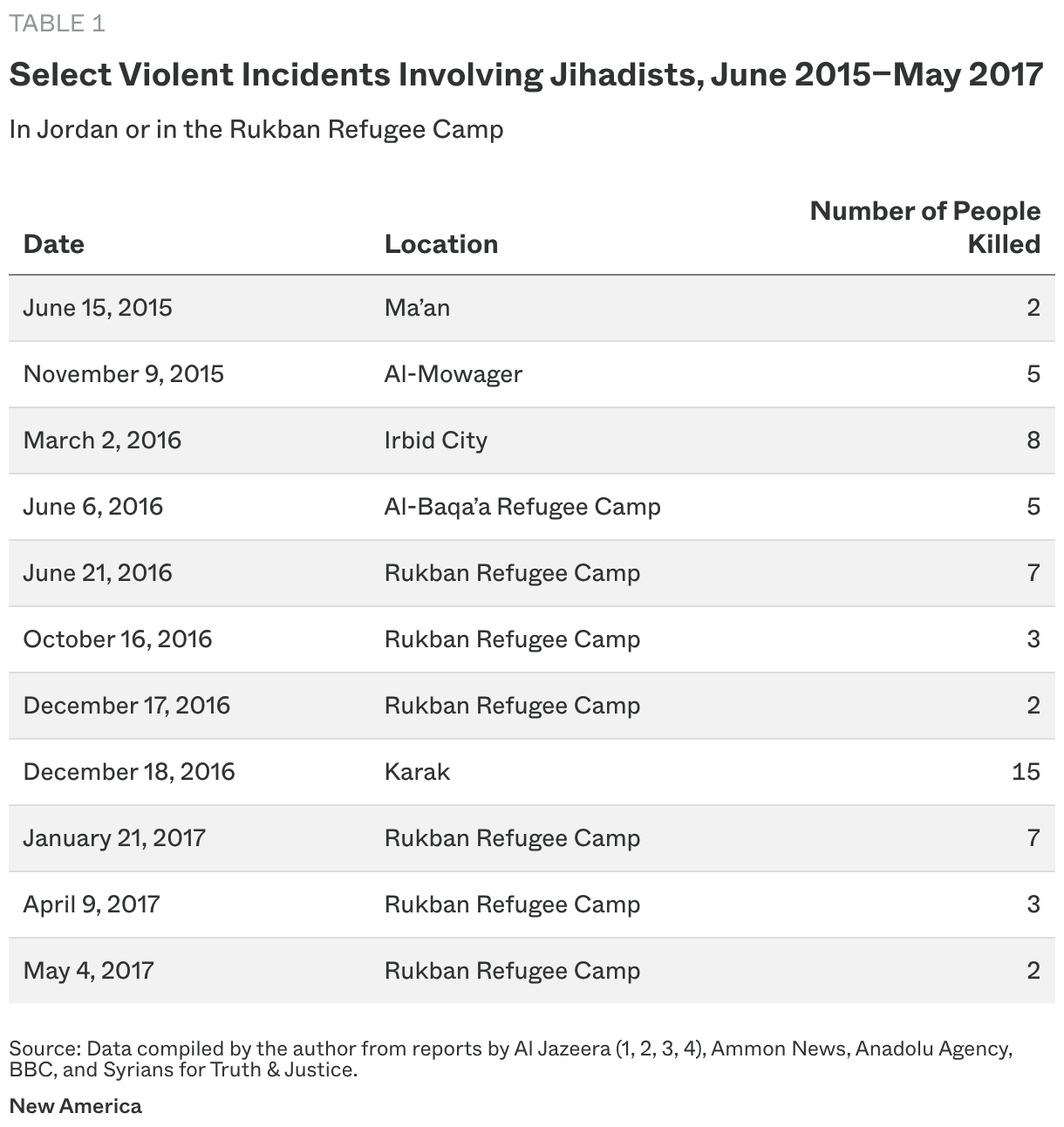
AFT’s presence across southern Syria was key to ensuring that ISIS groups on both sides of the border did not establish direct links or supply lines with one another. However, following the collapse of ISIS in late 2017 and the Assad regime’s takeover of southern Syria in July 2018, AFT quickly reconciled with regime forces and exploited its presence in critical parts of the border to manage and oversee cross-border drug and weapons trafficking networks.
AFT commanders maintained influence along seven key legs of the smuggling route linking southern Syria and Jordan, beginning with the village of al-Mutila, Rakan al-Khudayr’s hometown where Jamil al-Bala’as also maintained a second residence.196 Al-Khudayr is a member of the al-Shanabala tribe, whose members live in several dozen towns in the southeastern Suwayda countryside and 13 villages in Mafraq centered around Um al-Qatin. Though originally from the town of Malah in the southeast Suwayda countryside, al-Khudayr’s family relocated to al-Mutila during his youth.197
Following the outbreak of Syria’s civil war in 2011, al-Mutila became a strategic location as it was the last major population center on the Damascus-Suwayda highway before Lajat, the volcanic rock field home to Jamil al-Bala’as that serves as an assembly point for smugglers before disbursing contraband to traffickers closer to the Syrian-Jordanian border.
Militias that controlled checkpoints in al-Mutila could extort large fees from traffickers or sabotage their shipments further south. Even today, after the overthrow of Assad in December 2024, AFT and other militias in al-Mutila exploit their control over the area to secure concessions from Syria’s interim government, including being merged into the country’s formal security apparatus.198
The second area where AFT enjoyed significant influence was in Lajat itself, alongside the Al-Aumari Brigades (AAB), a tribal militia dominated by members of the al-Jawabara clan and al-Ghiyath tribe’s al-Madalja branch.199 Both AAB and AFT were founded in October 2012 and October 2015, respectively, by Hossam al-Karahsha, an enigmatic rebel leader about whom little is known.200 By 2016, both AAB and AFT occupied territory in the central Lajat villages of Masika, Shiyah, and Jadl and received support from Jordan to combat ISIS in northern Lajat around the village of Hosh Hamad, eventually forming a joint operations room in May 2017.201
By the time of the Assad regime’s takeover of southern Syria in July 2018, Jordan had reduced its support for AFT due to allegations of embezzlement and corruption. This created a gap that was filled by Iran and Hizbollah, which provided support for both AFT and AAB, particularly in Lajat.202 There, AAB commanders Faysal Sabih al-Madalja and Muflih al-Sabra, along with AFT leaders Hassan al-Ruwaydan, Mansur al-Ruwaydan, and Safi al-Khalaf, became the largest drug traffickers in the region, partnering directly with Lu’i al-Ali and Jamil al-Bala’as to smuggle contraband through Dara’a and Suwayda.203 Eventually, AAB became a sub-unit of AFT, with Muflih al-Sabra becoming Rakan al-Khudayr’s top deputy, a position he retains today.204
From Lajat, contraband is smuggled to Bedouin neighborhoods of Suwayda city, in particular the al-Muqawas and al-Shaqrawia neighborhoods—home to al-Shanabala and al-Jawabara tribesmen, respectively—and the al-Musharab district, where AFT partnered with Bedouin organized crime figures affiliated with Jamil al-Bala’as.205
From Suwayda city, contraband is trafficked in two directions. Throughout much of 2022, most contraband was taken south toward al-Shih hill, an elevated mound a mile north of the Jordanian border, and the Jordanian al-Shanabala town of Um al-Qatin. From there, and the nearby village of Khirbat al-Awwad, traffickers conducted cross-border raids or used drones to transport contraband to smugglers in villages around Um al-Qatin.206
However, as Jordanian security forces increased their presence in the area, smugglers increasingly pursued routes farther east, near the villages of Sha’ab and Um Shama in the southeast Suwayda countryside, home to the al-Shanabala tribe’s al-Ramthan and al-Shuwa’ayr clans. Located just east of the al-Khudayr family’s hometown of Malah, trafficking in both villages was led by Mara’i al-Ramthan, a Syrian-Jordanian dual national, and Jihad al-Sa’id, a member of the al-Masa’id tribe whose members live in Um al-Jimal and other north Mafraq towns west of Um al-Qatin.
Because of their cross-border kinship ties, the al-Ramthan and al-Sa’id families have been entrusted with smuggling many of the most sensitive weapons material into Jordan, including C4, TNT, mines, anti-tank mines, RPG launchers, and anti-armor and anti-personnel mines, many of which were sourced from Wafiq Safa, chairman of Hizbollah’s external security office in Lebanon.207 The al-Ramthan and al-Sa’id families’ importance has often made them the target of Jordanian airstrikes, with Mara’i al-Ramthan himself killed in one such strike on May 8, 2023, after which his brother, Muhammad al-Ramthan, took over his role.208 Jordanian airstrikes continue to target the vicinity of the village of al-Sha’ab, including on December 24, 2025.209
From al-Sha’ab, al-Ramthan and al-Sa’id clansmen moved further east across the Safa volcanic zone toward the southern stretches of the Syrian Central Desert in the Damascus countryside province. Along the way, traffickers utilized numerous valleys across the volcanic zone around the informal Sharshuh crossing to transport contraband into Jordan.210 By mid-2023, traffickers increasingly moved into the Central Desert itself, handing contraband to members of the al-Harayra clan, a branch of the larger al-Ghiyath tribe whose members also dominated the ranks of AAB and AFT in Lajat. Perhaps more than any other group, al-Ghiyath tribesmen became critical for the success of Iranian-backed smuggling routes in the area due to the geographic distribution of their members, who are concentrated in border regions in Syria, Jordan, and Saudi Arabia.
After receiving contraband near Safa, al-Ghiyath tribesmen move goods into Mafraq province’s far eastern al-Ruwayshid district via al-Handalat, the site of a former Syrian IDP camp in the southeast Damascus desert that was abandoned when the area was taken over by pro-Assad forces from U.S.-backed rebels. The al-Handalat camp is located adjacent to the al-Handalat dam in Jordan’s al-Ruwayshid district, which are both connected by a valley that provides cover to smugglers to cross the border without being noticed. Despite being abandoned, the tents of the former al-Handalat camp remain in place, providing smugglers cover from aerial surveillance.211
From al-Ruwayshid, traffickers move narcotics south to Saudi Arabia via the al-Haditha crossing, located near the Saudi cities of al-Quryat and Turayf, also home to al-Ghiyath tribesmen. Weapons are moved west to the village of al-Halaywa, one of several towns in al-Mafraq home to members of both the al-Ramthan and al-Sa’id clans, who thereafter move contraband farther west. As in al-Sha’ab, traffickers in this area are allegedly led by Muhammad al-Ramthan and members of the al-Sa’id family.212
At its founding in October 2015, the AFT was tasked by Jordan to protect its border with Syria from penetration by ISIS cells in the desert south and east of Damascus and to oversee aid distribution and security at the Rukban and al-Handalat refugee and IDP camps. However, by late 2016, allegations of embezzlement and extortion involving AFT leaders at Rukban and al-Handalat, together with the group’s failure to prevent ISIS attacks on the border, pushed Jordan to reduce its support for the group, limit AFT’s functions in both camps, and increase funding for other factions.213 Keen to preserve their status, AFT leaders quickly sought new ways to self-finance, with the pull of smuggling presenting itself as the most expedient option.
A leaked copy of a Jordanian State Security Court report reviewed by this author reveals that, in early 2017, Jordan’s General Intelligence Directorate allowed AFT to traffic and resell $21.8 million in low-cost Syrian tobacco into Jordan in order to plug its funding deficits.214 The report, circulated internally within Jordanian institutions on December 3, 2019, was commissioned to investigate allegations that Rakan al-Khudayr and Jordanian military officials embezzled much of the $21.8 million, which was not used to fund AFT.
The report was part of a Jordanian State Security Court crackdown on tobacco smugglers launched in July 2018 in response to large protests that began on May 30, 2018. The protests objected to new sales taxes and austerity measures imposed as part of an IMF reform package and led to the resignation of Prime Minister Hani Mulki less than a week later, on June 4.215 Beginning in January 2018, Jordan’s government imposed a JD0.2 ($0.28) tax on packs of cigarettes, a 10–20 percent tax on carbonated drinks, and a 30 percent tax on 95 and 98 octane gasoline while also reducing bread subsidies, leading to a spike in bread prices for the first time since 1996.216 Throughout the year, new sales taxes were also imposed on more than 160 goods, along with proposed increases of 5 percent and 20–40 percent on income and corporate taxes, respectively.217
The tax on cigarettes proved particularly unpopular in light of allegations that Mulki had turned a blind eye to black market cigarette factories being operated in Jordan’s Zarqa Free Zone by Awni al-Muti’a, a businessman who allegedly had evaded $760 million in taxes since 2006 by smuggling cigarettes meant only for export on to the domestic market.218
The political firestorm over the tobacco tax produced a crackdown on tobacco smuggling. Shortly after taking office, Mulki’s replacement, Omar Razaz, launched a ministerial committee to investigate cigarette smuggling in July 2018, formally charging Awni al-Muti’a with tax evasion and arresting several dozen of his associates.219 Among those arrested was Wadah al-Hamud, Jordan’s former director of customs, who allegedly turned a blind eye to al-Muti’a’s operations in the Zarqa Free Zone and provided him with tip-offs on raids in exchange for bribes.220 The aforementioned Jordanian State Security Court report detailing Rakan al-Khudayr’s tobacco smuggling operations also lists Wadah al-Hamud as al-Khudayr’s chief partner responsible for facilitating the passage of at least 55 illicit tobacco shipments between Syria and Jordan in 2017, seven of which purportedly were intended for the Zarqa Free Zone, home to Awni al-Muti’a’s cigarette production.221
Following three years of trials, the same State Security Court sentenced Awni al-Muti’a in September 2021 to 22 years of prison time; Wadah al-Hamud was given a sentence of 10 months.222 However, at no point did the State Security Court implicate Rakan al-Khudayr in illicit tobacco smuggling, despite repeatedly identifying him as a trafficker in its internal report.
It remains unconfirmed whether AFT ever stopped trafficking tobacco, either after the July 2018 arrest of Awni al-Muti’a or following the December 2019 circulation of the State Security Court report. However, the crackdown, alongside other challenges, likely diminished its available funding. Over the next several years, AFT commanders became heavily involved in Captagon production and smuggling, providing them with an alternative source of funds, albeit one that ran through Iranian and Syrian power brokers, as detailed above.223
While AFT’s need to plug its funding gaps acted as a strong pull factor drawing many of its commanders into Iran’s orbit, Russia’s partial withdrawal from southern Syria, starting in February 2022, and the expansion of Iranian-backed groups along the Syrian-Jordanian border served as powerful push factors that incentivized reconciled rebels across the region to move closer to Tehran to avoid violent reprisals. The set of events that drove this shift began almost immediately.
First, in late February 2022, unknown assailants assassinated Maher Wasouf, director of the Nassib border crossing. Wasouf had been appointed to the position shortly before via a formal order issued by the Office of the Syrian President, which tasked him with curbing Captagon flows in response to complaints received from Jordan. After his assassination, Wasouf was replaced with Yahya Miya, a Syrian with close ties to Hizbollah and Iranian officials. Following Wasouf’s replacement, other security officials in Dara’a aligned with Iran were appointed to lead the area’s three local intelligence bureaus.224
Months later, Hizbollah launched a campaign to eliminate the Anti-Terror Force, a U.S.-backed faction formed a year before to combat ISIS and Iranian influence in Suwayda that was based in the town of Khazma, southwest of al-Sha’ab along the route to al-Handalat. On June 9, 2022, 500 Hizbollah and other pro-Assad troops besieged Khazma and killed the group’s commander, Samir al-Hakim, thereafter forcing the group to dissolve.225 These and other killings led to a new outpouring of contraband into Jordan, with security forces seizing 33 million Captagon pills in the first nine months of 2022, more than twice the 16 million seized in all of 2021.226
In order to address the uptick, representatives from Jordan, Saudi Arabia, the United Arab Emirates, and Egypt met in Abu Dhabi in late June with leaders of five former rebel factions in southern Syria to discuss the formation of a 35-kilometer safe zone in Dara’a province. On July 1, 2022, these five leaders, led by Kanan al-Aid (aka Abu Talib), returned to Syria. Two days later, al-Aid was assassinated.227 These killings marked Iran’s final takeover of large swaths of the Jordanian-Syrian border, just weeks before IDF soldiers killed Palestinian militant leader Ibrahim al-Nabulsi, triggering the formation of the Lion’s Den faction in Nablus.
The pull of a revived Palestinian militant movement in the West Bank, together with the consolidation of Iranian control over the Syrian-Jordanian border, led to an explosion of new weapons being trafficked into Jordan.228 In the six months from October 2022 to March 2023, Syrian smugglers made at least 108 crossings into Jordan, adopting increasingly audacious tactics, often moving in groups of hundreds separated into teams, including drone-equipped units tasked with reconnaissance.229 It was also around this time that JMB members returned to Jordan from Lebanon and began planning to build a missile production factory outside Amman, granting Iran and its proxies their first-ever fixed military position inside the Kingdom and eventually leading to the April 15 arrests.230
The shock caused by Hamas’s October 7, 2023, attack on Israel and the geopolitical shifts it forced across the region lent increased urgency to Iran’s efforts to arm its Palestinian proxies in the West Bank. In the immediate aftermath of the attacks, trafficking between Syria and Jordan increased again, with Syrian smugglers carrying out 282 border crossings into Jordan between October 2023 and March 2024, more than double the rate from the same period the previous year.231
However, this uptick triggered a response by Israel and Jordan, both of which carried out crackdowns on traffickers and armed groups throughout 2024, restricting the flow of weapons between Syria and the West Bank and significantly reducing militant violence in the West Bank in 2025. These efforts were aided by the overthrow of the Assad regime in Syria on December 8, 2024, after which Iran and its proxies withdrew en masse from the country, reducing their capacity to direct arms flows and eliminating a key push factor that drove violence in the West Bank.
Despite this crackdown, by mid-2025, trafficking between Syria and Jordan rose again in parallel with a corresponding increase in weapons seizures on the Jordanian-Israeli border and a renewed uptick in violent attacks by West Bank militant groups beginning in September 2025, in particular by Iran’s proxy Palestinian Islamic Jihad (PIJ).232 These increases can be attributed in part to the persistence of pull factors in the region, in particular a significant uptick in Israeli settler attacks against Palestinians in the West Bank in 2025 that cultivated a growing sense of grievance that PIJ and other militant groups could exploit amid the continued weakness of the PA.233
Similarly, though Iran and its proxies fled Syria after December 8, 2024, many of southern Syria’s largest local traffickers remained in the country and sought to ingratiate themselves to the country’s new authorities, which for most of 2025 lacked the capability to carry out large-scale crackdowns.234 The fragile state of the country after Assad’s overthrow meant that Syria’s interim government often relied on local power brokers, including smugglers, to maintain stability and ensure that state authority extended to remote regions.
As a result, many groups like the Army of Free Tribes (AFT) whose members were involved in trafficking were incorporated into the country’s security forces, while prominent traffickers such as Aimad Abu Zrayg and others were granted meetings with Syrian President Ahmed al-Shara’a early on to discuss the merger of reconciled rebel factions into the country’s new military structure.235 It wouldn’t be until December 19, 2025, about a year after Assad’s overthrow, that Abu Zrayg and his deputies were arrested.236
The outbreak of large-scale violence between Syria’s interim government and armed Druze opposition fighters in Suwayda in July 2025 further destabilized the region and prevented security forces from deploying units to the area to crack down on traffickers, whom some sources have alleged have taken refuge among Suwayda’s Druze fighters.237
Despite the removal of Assad, Captagon production has continued in Hizbollah-controlled parts of Lebanon.238 Though many Western sanctions on Syria have been lifted, the country’s economy remains depressed and has yet to experience large-scale recovery, leaving the country’s black-market economy an attractive option for Syrians with few alternatives. Under these circumstances, drug and weapons smuggling between Lebanon, Syria, Jordan, and the West Bank remains a persistent threat, with sufficient push and pull factors remaining to incentivize Jordanians to participate in these networks.
By December 2023, the threat of spillover posed by the growth in trafficking along the Syrian-Jordanian border pushed Jordanian security forces to launch a final crackdown on traffickers, beginning with a wave of airstrikes targeting smugglers in Syria on December 19 and a widespread campaign of arrests against traffickers in Mafraq province’s eastern al-Ruwayshid district on December 27.239
On December 30, al-Ghiyath notables in al-Ruwayshid filmed a statement from the home of tribal sheikh Ali Ayyad Hamir al-Sakran, stating, “We, notables of the al-Ghiyath tribe, condemn all acts [carried out] over the last several years that threaten…national security, and reiterate our pledge of loyalty to the Hashemite leadership, our dear King His Majesty Abdullah II bin Hussein…and our noble armed forces….We call on our security forces not to tolerate any individual who threatens national security…and we disown [all those who do].”240
Over the next six months, Jordanian security forces continued their campaign of air raids in al-Sha’ab and elsewhere and seized millions of Captagon pills on the border.241 During this period, Jordan’s Public Security Directorate identified and issued arrest warrants for eight of the top traffickers based in the al-Ruwayshid town of Manshiat al-Ghiyath.242 At least three, Abd al-Karim Ghiyath, Ayyad Hussein Ayyad al-Ghiyath, and Saud Ubayd Mukhlif al-Ghiyath were arrested between February and April 2024.243
Jordan’s crackdown also extended to Jordanian Muslim Brotherhood (JMB) cells with direct ties to Iran. Following a major seizure of high-quality explosives in March 2024, Jordanian security forces claimed to Reuters that the traffickers were Palestinian-origin JMB members who had been recruited by Saleh al-Arouri, Hamas’s West Bank commander based in Lebanon, who had long served as the main conduit between the organization and Tehran. Commenting on the seizure, a former commander in the General Intelligence Directorate told Reuters, “The Iranians have instructions to recruit Jordanians and penetrate the Jordan arena through agents….Their recruitment efforts span all segments of society.”244
Later, in June 2024, security services made two more large seizures of explosives, at least one of which occurred in the Amman neighborhood of South Marka, a JMB stronghold.245 Israeli forces announced a fourth seizure of a similarly large shipment of explosives on November 27. The shipment was allegedly directed by Islamic Revolutionary Guard Corps-Quds Force (IRGC-QF) commanders Jawad Ghafari and Asghar Bagheri.246
These seizures contributed to a significant reduction in violence in the West Bank, as Palestinian militant groups now lacked the materials necessary to make IEDs that had increasingly been used to target Israeli troops. Without these weapons, both Israel and the Palestinian Authority were able to more easily pursue militant groups, launching three separate crackdowns in and around Jenin, Nablus, Tulkarem, and other cities between August 2024 and January 2025.247 In the aftermath of these crackdowns, throughout 2025, attacks by Palestinian armed factions dropped 78 percent compared to 2024 and 93 percent from 2023, according to official Israel Defense Forces data.248
This drop in violence was not met by a comparable reduction in Israeli settler attacks against Palestinians in the West Bank, a persistent driver of tensions since Israel’s occupation of the territory in 1967. In 2025, attacks by Israeli settlers in the West Bank increased 25 percent from 2024, representing 15 percent of all attacks recorded since 2006.249 Such trends have likely fueled growing resentment among Palestinians, which could create long-term pull factors that fuel West Bank militant groups and their interest in obtaining foreign support.
As Palestinian militant violence in the West Bank began to subside, the December 8, 2024, overthrow of Bashar al-Assad in Syria upended regional dynamics and led to a collapse in trafficking between Syria and Jordan from January to April in 2025.250 Assad’s removal also emboldened Jordan’s monarchy to finally crackdown on the JMB, beginning with the mid-April raids and arrests of JMB members involved in drone and missile production. One week later, authorities issued their final decree to outlaw the JMB.251
Despite the post-Assad decline, persistent instability in Syria’s southeast Suwayda province has allowed for a resurgence in cross-border trafficking, with at least 39 smuggling attempts between Syria and Jordan over the 110 days between April 4 and July 22, 2025—one every 2.8 days. That rate more than doubled between July 30 and December 13, 2025, when at least 102 cross-border attempts were made over 137 days—one every 1.34 days.252 Since January 2025, Jordanian security forces have killed at least 16 traffickers attempting to cross the border from Syria (see Table 2). Similar to the period before Assad’s overthrow, many of those killed have been al-Ghiyath tribesmen.253
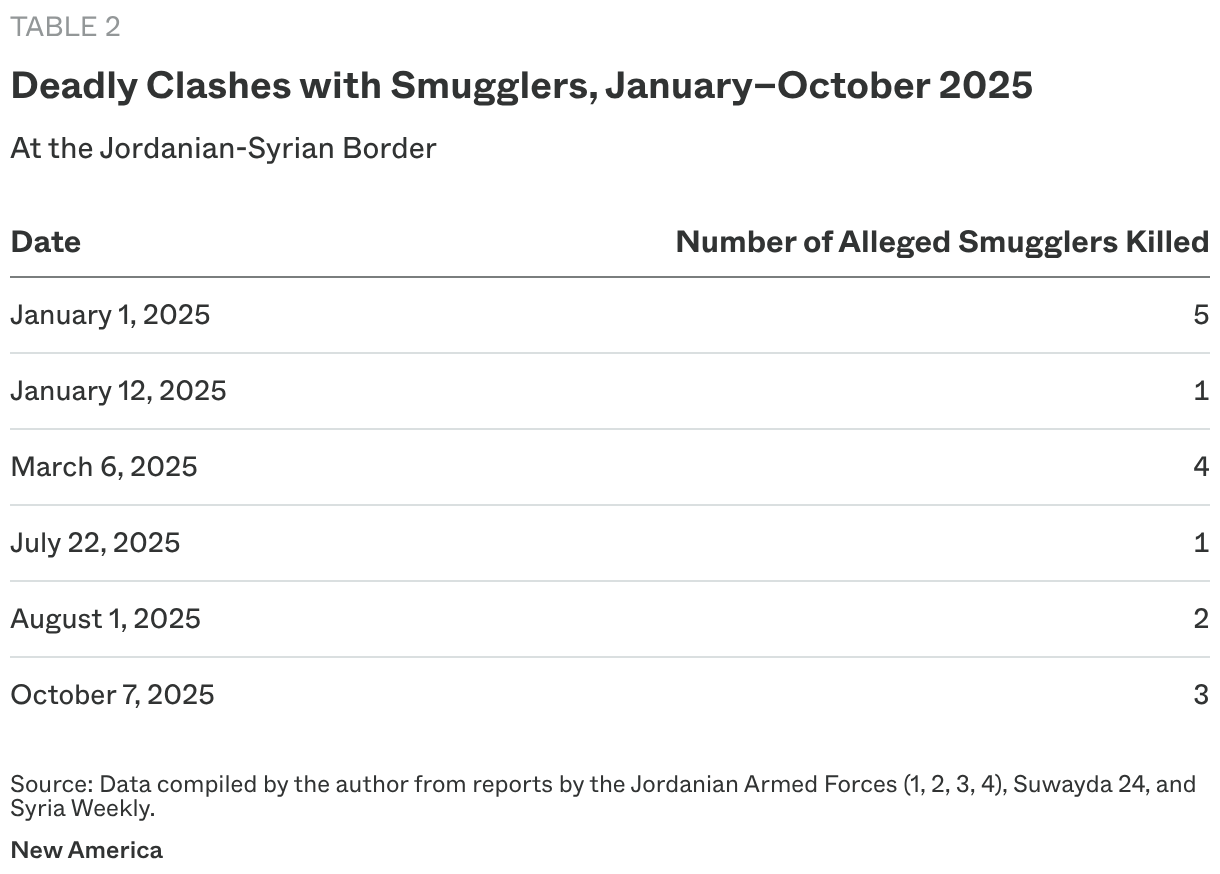
The second increase in smuggling beginning in July 2025 came after a week of clashes in Suwayda province in mid-July between Bedouin tribesmen and the Druze religious community, during which as many as 2,000 people were killed.254 The clashes followed four other rounds of Bedouin-Druze clashes in Suwayda and Damascus provinces, largely the result of disputes over land or local feuds.255
Tensions in the area have been exacerbated by the Druze community’s reluctance to recognize the legitimacy of Syria’s interim government led by Ahmed al-Shara’a, who previously commanded the Salafi-Jihadist group Hay’at Tahrir al-Sham (HTS), formerly known as Jabhat al-Nusra, then al-Qaeda’s Syrian branch. Despite having split from al-Qaeda in 2016–2017, many in HTS continued to view the Druze minority as a heretical cult and a legitimate target for ethno-sectarian cleansing.256 Following the overthrow of Assad, HTS formally dissolved itself, but much of the organization’s former leadership and rank and file retain de facto control of the Syrian state and its institutions. As a result, Druze militias have refused to allow the interim government’s military forces or police to enter Druze parts of the province. On August 6, 2025, Druze spiritual leader Hikmat al-Hajari went so far as to declare an autonomous republic in Druze parts of Suwayda, with security provided by a new Druze “National Guard.”257
Due to limited state capacity in the months since the overthrow of Assad, the interim government relied on a number of nonstate armed groups to help confront Druze forces during the mid-July 2025 fighting, in particular factions of Bedouin tribesmen from provinces outside Suwayda who quickly mobilized thousands of troops that deployed to the front line.258 These factions possessed no formal mandate and were commanded by tribal leaders, many of whom possess their own sordid history of trafficking.259
Since the fighting ended, many of these factions remain stationed on the front line and have become one of the de facto powers enforcing the interim government’s control over Bedouin parts of Suwayda. Even prior to the fighting, Rakan al-Khudayr’s AFT had become a formal arm of the interim government: In February 2025, the AFT became a faction of the General Security Service, a militarized police unit under the country’s Ministry of Interior.260
In the aftermath of Assad’s overthrow, many observers proclaimed that the era of Iran’s influence in Syria had ended, as Tehran’s capacity to project its influence and create push factors had been dealt a huge blow by its loss of Syria as a link between its proxies in Iraq, Lebanon, and elsewhere. However, lingering pull factors in both the West Bank and southern Syria have been sufficient over the last year to ensure that a steady supply of arms and narcotics continue to flow across both the Syrian-Jordanian and Jordanian-Israeli borders.
In October 2025, Israeli security forces made another large seizure of high-quality explosives—equivalent in size of those in March, June, and November 2024. Like those previous busts, this seizure was allegedly overseen by IRGC-QF commander Asghar Bagheri.261 Should the various pull factors persist in the West Bank, Jordan, and southern Syria, reports of similar seizures of comparable size may continue into the future.
Jordan provides a useful case study into Iranian proxy warfare strategy due to the significant constraints Tehran operates under inside the country. Understanding how Iran can successfully operate under such constraints is especially relevant today following the joint U.S.-Israeli war in Iran that began on February 28, 2026.
Despite suffering significant military setbacks in the war, Tehran has responded by cleaving harder to a high-risk, high-reward strategy, pursuing more audacious and aggressive action. Such behavior suggests that Iran may be willing to lean further into supporting subversive activity in adversary states like Jordan, despite the challenges involved.
As an overwhelmingly Sunni nation, Jordan offers Iran few opportunities to cultivate ties to ideologically aligned groups capable of seizing or holding territory. The monarchy’s historic ties to the United States similarly prevent Jordanian leaders from seeking ties with Iran on mutually beneficial grounds.
As a result, Iran’s strategy for winning influence in Jordan is limited to exploiting gaps within Jordanian society brought about by foreign and domestic disputes that Iran can leverage to cultivate allies. In Jordan, smugglers and organized crime proved to be one of Iran’s top tools to achieve this end. By helping to smuggle arms between southern Syria and the West Bank between 2021 and 2024, Jordanian weapons traffickers helped initiate an uprising among Palestinian militants that amplified popular support for the Jordanian Muslim Brotherhood (JMB), a Sunni group with ties to Hamas.
To carry out this smuggling, Iran relied on a network of Bedouin tribes in Syria’s southeastern Suwayda province who possessed cross-border kinship ties in Jordan’s northeast Mafraq province. Following Russia’s February 2022 invasion of Ukraine, Moscow redeployed thousands of troops out of Syria, including in the south of the country, which afforded smugglers significantly greater freedom of movement in and around the Syrian-Jordanian border.
By mid-2022, Jordan faced Iranian-backed proxies along both its northern and western borders, a scenario reminiscent of the instability witnessed during Black September in 1970, when Palestinian militias backed by the Ba’athist regime in Syria tried to overthrow the monarchy, leading to a brief civil war that left thousands dead.
All this occurred as Jordan experienced a major fallout with Saudi Arabia following the latter’s alleged involvement in the failed April 3, 2021, coup against Jordanian King Abdullah II, along with major disagreements between Amman and Riyadh over solutions to the Israeli-Palestinian conflict. The rift between Jordan and Saudi Arabia—Iran’s top rival in the region—played to Tehran’s advantage and presaged a shift in Jordan’s regional posture toward groups like the JMB and the global Muslim Brotherhood, which Riyadh, along with Abu Dhabi, opposed and proscribed as terrorist organizations in 2014.
Within months of the attempted coup, Jordanian authorities carried out an overhaul of the country’s electoral system that guaranteed the JMB greater influence in the country’s politics and within society. Though primarily an intra-Sunni affair, this rift between allies played to Iran’s advantage, creating further space for the JMB to integrate itself into Iranian-backed trafficking networks linking Lebanon, Syria, Jordan, and the West Bank.
As a result, from 2021 to 2024, Jordan’s monarchy tolerated the JMB, allowing the group to take part in subversive activities that in previous years would have triggered major crackdowns on the organization’s leadership, and allowing its members to promote radical discourse that threatened and undermined the Jordanian state, a key Iranian objective. This effort served as a piece of Iran’s strategy adopted to impose costs on the United States and its regional allies in response to the reimposition of American sanctions on Iran in 2018 by the Trump administration.
The lesson posed by Jordan’s fallout with Saudi Arabia, in particular, carries importance for the future, as a similar fallout between Saudi Arabia and the United Arab Emirates (UAE) has further upended regional alliances and led to open war between the countries’ proxies in Yemen.262 Though the joint U.S.-Israeli war in Iran has shifted focus away from this intra-Gulf rivalry, the UAE’s April 28, 2026, decision to leave OPEC suggests that Abu Dhabi’s rivalry with Riyadh will likely remain a feature of regional geopolitics for the foreseeable future. While the Saudi-UAE dispute stems from a number of issues, as occurred in Jordan, differences between both states over the Israeli-Palestinian conflict and relations with Israel more generally since October 7, 2023, have been a key source of tension.
Analysis of Iran’s actions in Jordan also reveals the importance of client agency in determining the scope and success of Tehran’s ability to intervene abroad. Almost all of the Sunni groups that Iran partnered with in the West Bank, Jordan, and southern Syria—including Hamas, the JMB, AFT, and others—at times opposed Iran’s objectives domestically and in more distant theaters, allying themselves with rival patrons that worked to limit rather than facilitate Tehran’s regional expansion.
Even after Iran began to redirect money to Hamas in 2019 in the hopes of instigating new waves of violence in the West Bank, the group’s leadership instead elected to pursue talks with Palestinian Authority (PA) President Mahmoud Abbas to form a unity government as their preferred means of expanding their influence, efforts which for two years helped keep the level of violence low.
It wasn’t until Abbas canceled PA legislative elections in April 2021 that Hamas, Palestinian Islamic Jihad, and dissident Fatah factions came to view violence as the most effective means of achieving political power, creating significant demand for weapons that served as a pull factor drawing Iranian resources into the area.
West Bank violence remained at high levels until a major direct conflict between Israel and Iran’s top proxy Hizbollah in September–November 2024 changed the dynamic. The war significantly weakened Hizbollah and its ability to defend the regime of Bashar al-Assad, which was overthrown by rebels in December after 13 years of punishing civil war. Iran lost the most critical piece of its network infrastructure linking its proxies in Iraq, Lebanon, and elsewhere, dealing an unprecedented blow to its ability to coordinate the activity of its proxies across the Levant and create push factors capable of influencing dynamics in the region.
In this new environment, Jordanian security forces were free to crack down on the JMB. They arrested dozens of the group’s leaders in April 2025 and formally outlawed the organization, paving the way for a formal designation of the JMB by the United States as a terrorist group in January 2026.
Iran’s adversaries in turn should take advantage of this opportunity to address unresolved pull factors which throughout the second half of 2025 proved sufficient to resuscitate Iranian-backed smuggling networks across the Levant and trigger a small uptick in West Bank violence. This includes dedicating more resources and focus to reduce Israeli settler attacks against Palestinians in the West Bank, creating alternatives to the black market economy for Syrians in the south and elsewhere, and providing an outlet for JMB remnants seeking to reconcile with the state while ensuring that militant factions remain under surveillance.
So long as these and other pull factors continue to exist, hostile actors—including Palestinian armed groups, Syrian smugglers, and dissatisfied Islamists across the region—will continue to seek support from Iran and potentially other patrons with sufficient will and capacity to influence events in these and other theaters.
Research Fellow, Future Security