Gordon LaForge
Co-Director, Power, People, and Planet Initiative

This blog emerged from a meeting hosted by New America at the Doris Duke Shangri La Center for Culture and Ideas from May 26-29, 2026, titled “What Is the Third Path for AI?” Participants included 21 researchers, policymakers, and leaders from 10 countries.
Generative AI has been adopted faster than any major technology in history. Just three years after the release of ChatGPT, more than half the world is using applications built atop language models. Those models—along with the compute that underpins them—are overwhelmingly emanating from a handful of companies in the United States and China.
For the rest of the world, this concentration presents a set of dilemmas. Countries want access to capable AI but also autonomy—to avoid being either locked in to terms set by a foreign firm or locked out of the latest and greatest new tech. They want to quickly deploy AI to improve business productivity, healthcare, and education—yet without inflicting new harms on their societies. They want the agency to determine norms and standards that preserve culture and protect societal interests—but, individually, they lack the leverage to challenge the preferences and pathways set by large powers.
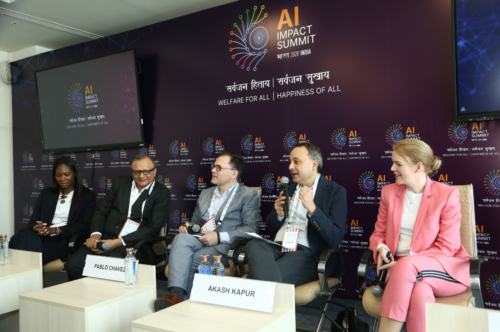
As tech policy analyst Pablo Chavez writes, the question policymakers everywhere are facing is “whether they can craft partnerships, deploy technologies, and implement governance frameworks” that afford them “meaningful agency over AI within their borders.” But what does this mean in practice? What prospects do countries that are not the US and China have to shape the norms and standards driving AI development, deployment, and use?
Those advocating for a revived set of international rules or alternative paths for AI development are naturally looking to the so-called “middle powers”—an imprecise label denoting countries with enough population, resources, or capability to have influence. For middle powers to actually shape AI, however, they will need to band together around shared interests, priorities, and values when they’re able.
Many middle powers are individually attempting to deploy AI in ways that reduce their dependence on US and Chinese companies. Several, especially in the Middle East and East Asia, are investing in “sovereign AI” projects, such as high-performance GPU clusters and AI-specific supercomputers. For resource-constrained contexts, especially, the diffusion of open-source models, low-cost modular forms of compute, and task-specific AI models offer the possibility of deploying AI without relying on the infrastructure of U.S. and Chinese mega-firms.
Access to frontier capability, however, remains, for now, under U.S. and Chinese control. According to Epoch AI, a research firm, 86 percent of the notable AI models released in 2025 came out of the two superpowers. The U.S. and Chinese governments can deny access to frontier models, as the White House has recently done with Anthropic’s Fable and Mythos models. Moreover, any AI deployment depends on American or Chinese chips, the export of which can be restricted at will.
Some middle powers hold strategic specializations in the AI value chain—Taiwan’s dominance of advanced chip manufacturing, the Netherlands’ monopoly on EUV lithography machines, the Gulf states’ glut of energy and capital. Specialization does not automatically confer leverage, however. Taiwan may dominate fabrication, but it depends on Dutch machines and American designs. Aside from the U.S. and China, no country on its own controls enough of the inputs to have systemic influence.
The most promising place for middle powers to shape the AI ecosystem is downstream, in the application, policy, and regulation layers of the stack. Despite dependencies baked into foundation models from pre-training and reinforcement learning from human feedback, countries can largely set their own rules for applications. If middle powers were to harmonize or align certain AI policies, there’s a chance they could influence global norms. For instance, many have a shared interest in greater safety and reliability standards, not least because durable adoption and impact depend on trust. One could imagine a group of middle powers uniting to develop an assurance ecosystem, using collective market size to demand foreign companies provide certain safeguards, remedies, or proofs.
This kind of multilateral alignment is difficult, especially in a time of geopolitical fragmentation. Collaboration works best if it is demand-driven and organized around shared problems that jurisdictions would benefit from solving jointly rather than individually. One example is the development of more robust, context-specific frameworks for continuous post-deployment evaluation of societal impacts. Another is public procurement, and the pooling of technical expertise to create templates that would yield safer, more reliable tools for high-impact public sector use cases.
Less than some sort of static, “middle power order,” one could envision what former UN Assistant Secretary General Robert Orr dubbed “catalytic coalitions”—eclectic mixes of countries (North and South, big and small) and other actors (civil society, private sector) that align on a particular issue or value and have some capability or leverage—whether market size, a technological specialization, resources, regional leadership, or governance capacity. Such coalitions have had systemic impact before—in the 1990s, a group of middle powers and civil society organizations overcame great power resistance to create the Ottawa Treaty banning anti-personnel landmines.
One of several possible third paths for AI, then, might be a method—issue-by-issue coalitions aimed at generating collective leverage that can influence the rules of AI. Coalition-building is not easy. But it is urgent. The norms around generative AI are still molten; soon they will set. Whether they harden around the interests of the few or the many depends on who bands together to shape them.
Co-Director, Power, People, and Planet Initiative