The Future of Homeowners Insurance: Q&A with Alice Hill
Blog Post
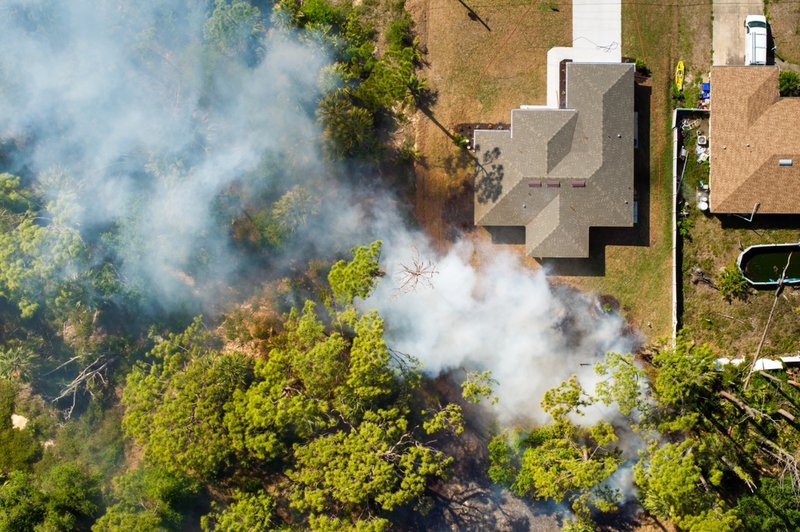
Source: Bilanol / Shutterstock.com
Feb. 24, 2026
This article is part of The Rooftop, a blog and multimedia series from New America’s Future of Land and Housing program. Featuring insights from experts across diverse fields, the series is a home for bold ideas to improve housing in the United States and globally.
New America's Yuliya Panfil sat down with climate risk expert Alice Hill to discuss housing affordability, homeowners insurance, and climate change. This interview has been edited for length and clarity.
Yuliya Panfil: Hi everyone, welcome to The Rooftop. My name is Yuliya Panfil, and I'm the director of New America's Future of Land and Housing program. The Rooftop is a housing blog and multimedia series hosted by the Future of Land and Housing program and it's shaped entirely by its contributors. It's a forum for individuals and organizations across the housing sector to share innovative ideas, big or small in scale, public or private, well-trodden or experimental. And today we are so excited to be joined by Alice Hill to discuss a very hot topic: the fate of homeowners insurance.
Alice is the David M. Rubenstein senior fellow for energy and the environment at the Council on Foreign Relations. She is an expert on the risks, consequences, and responses associated with climate change and author of The Fight for Climate after COVID-19 and co-author of Building a Resilient Tomorrow. During the Obama administration, Alice served as a Special Assistant to the President and Senior Director for Resilience Policy at the National Security Council, where she led the development of policy addressing national security and climate change, including the first federal flood risk standard and national wildlife standard for federal buildings.
So Alice, let's dive in. In the last five years or so, we have seen a significant worsening of the state of homeowners insurance nationwide. Can you briefly bring us up to speed and frame up the mess that we find ourselves in?
Alice Hill: Sure. Thanks so much for having me, Yuliya. You know, we have seen a dramatic increase in activity over property insurance since 2021. Really, the market has deteriorated sharply, and there are a variety of reasons. One is climate-driven catastrophe losses. Think the wildfires that California has suffered in recent years. There's also construction cost inflation. So when homeowners go back to build, they discover that it costs a lot more and to the extent they have replacement coverage in their policy, that costs the homeowners, excuse me, the property insurance companies a lot more and then they want to raise their premiums. And then we just have a lot of aging properties that have old roofs on them, aren't properly fire-proofed, may not be flood-proofed, and so when things occur that are worsened by climate change, like wildfires or extreme heat, or other disasters, there can be greater damage.
Panfil: And so last time we spoke about this topic, you said something provocative to me. You said, we can't really look to the insurance companies to get us out of this mess. Can you tell me a little bit more about that statement? What did you mean?
Hill: Well, we need to think about property insurers and the role they play. They play a very important role in society. They are the backstop. When catastrophe does strike, they provide funds for recovery. But it's a for-profit industry. We'll put aside flood insurance because that has a heavy footprint from the federal government. But for most other hazards that buildings suffer, it's from the private sector and the private sector, the way our insurance markets have risen in the United States, they write policies on a one-year basis. That means if in a contained geographic area, say California or Florida, they suffer a lot of losses, the insurance companies realize: We're not going to make a lot of profit here. We've suffered losses. So, we have [three] choices. We can either, in anticipation of future damage, raise the premiums, or reduce our coverage, or leave altogether. And we have seen those responses. Insurance companies are, by their nature, conservative. They are looking at risk. That is their job.
Our primary insurers, so think of a State Farm or Progressive, they are insuring across the nation, but they do buy reinsurance from companies that operate in Europe and to some extent in the Caribbean. And why do they buy reinsurance? That is the insurance these primary insurers get in case they get a really bad hit in some area. And the reinsurers spread their risk across the globe.
But what we're seeing is even the reinsurers are saying: This is a big risk and we're not sure we can cover it. So they raised their rates. There is a little fluctuation occurring right now, but the reinsurers have raised their rates. That puts more pressure on the primary insurers. And then the reaction of those primary insurers is this risk is too big and we don't need to cover it. There are plenty of other risks for insurance companies to cover. You can just think of AI, cyber, and other threats that are emerging daily for companies.
Panfil: So this leads to the sort of inevitable question of, do you think property insurance as we know it will still be around ten or 20 years from now?
Hill: I don't have a crystal ball as to the date, but I think we will see ever greater pressure on government-sponsored backup systems to private property insurance. In fact, you can just look to the flood insurance program that we talked about.
The National Flood Insurance Program, or NFIP, was started in the 1960s and it followed a number of floods where private insurers expressed dismay about the losses. And over time, there was discussion that the federal government should get into the business of backstopping flood insurance, and it now is in a program. But it's revealed how difficult it is to have a government program. The program is bankrupt, well over $20 billion in debt, as well as the fact that it's very difficult to politically manage it and get to what they call actuarially sound pricing, which would mean that the prices truly reflect the risk.
In our other examples, the private insurers are seeking to charge actuarially sound prices, and that's why it becomes so unattractive or it's just not offered at all.
Over time—and we saw it with flooding—and now we're seeing it with the backup plans. Many states have backup plans that are created by the state to provide insurance when private insurance isn't available. And in California, there’s very dramatic pressure on that backup system, even as California has adopted different measures to reduce the strain on private insurers. That backup system has continued to balloon. So in ten to 20 years, there could be some federal rescue that's put forward. We see bills already in Congress for backup reinsurance. I don't know, but I will share a conversation I had in 2016 with the CEO of a reinsurance company, and he told me at the end of the day, it'll be the government that will pick this up, because it's just going to get too difficult for private insurers to continue to make a profit in this market.
"It'll be the government that will pick this up, because it's just going to get too difficult for private insurers to continue to make a profit in this market."
Panfil: So what would the implications of that be, if the government is sort of picking up this huge risk? How does that play out if we end up with a property insurance scheme that's similar to the National Flood Insurance Program? Or do you see a different reality where homes just become an asset that are not commonly insured and people sort of adjust to that reality?
Hill: Well, if the federal government takes it over, I think it will add even more to our debt. I am not a proponent of the federal government assuming this, other than some kind of very basic insurance to make sure that people aren't completely destitute, but not necessarily one that protects their homes.
We do have a system where homeowners, if they get a federally insured mortgage, need to have homeowners insurance. And what we are seeing in some instances is that homeowners conclude that this private insurance is too expensive. They drop it. But then if the mortgage lender is on top of it, they can force place insurance on that home, and that forced-placed insurance is generally much more expensive and doesn't cover as much. But the percentage of the cost of a home that comes from homeowners insurance has risen dramatically in recent years. It's up to about nine percent nationwide. And that's a much higher cost than someone who's owned their home for a long time and is well into their mortgage was anticipating paying.
So we're seeing a lot of crunch here. We're also seeing crunch in real estate transactions for the sale of properties because people aren't able to get insurance and then the deal falls through. The prospective homeowner just can't acquire insurance at the price they want and therefore they won't buy [at] the price. For the average American, average homeowner, it's a very big deal. This is their primary asset and if they lose it, it will be very serious. So we have this tension right now. You need insurance to have the mortgage, but it's becoming too expensive. So what we'll see are the real estate markets roiled in these very high-risk areas. And I think that's beginning to happen. Certainly in wildfire-prone California. Many people can only get the backup plan that's offered by the state.
"For the average American, average homeowner, it's a very big deal. This is their primary asset and if they lose it, it will be very serious."
Panfil: To contextualize, about 80 percent of all home buyers rely on a mortgage, on mortgage financing, and 97 percent of first-time home buyers. So the inability to get insurance has extreme impacts. I didn't know about the nine percent number. That is just a huge number and something that will only probably continue to rise. So I'll end with this question: When we spoke [last], you mentioned that building codes are a bright spot, and one of the most promising tools that we can bring to bear in ensuring that properties remain insurable, and that a property insurance paradigm remains. Tell us about that.
Hill: Well, building codes provide safety. There are current building codes primarily focused on life safety. That means that you can get out of the building and still be alive. It's not going to collapse on you. But there is a movement for performance-based building codes, which means that the building continues to perform after a bad event. And if that occurs, then the value of the asset is still there even though there's been a significant catastrophe.
We're not there in the United States. However, we do know a lot more about building more safely. If you just simply elevate homes to allow flood waters to wash through underneath the home or the building, that building, in all likelihood, will remain standing and that's a sound way to protect the asset. With wildfire, it's a little more complicated, but one thing that we know is removing vegetation—and we know this from studies done by an institute funded by the insurance industry—that if you remove the vegetation five feet around the house, that will reduce the risk of ignition of the home and therefore the loss of the home.
The challenge is that the developers don't like these building codes because they believe that they increase the cost and therefore make homes less affordable. But I will quote the former head of FEMA during President Obama's administration, Craig Fugate, who told me, “a home is not affordable if it gets destroyed.” So there is the question whether that makes sense to just build homes that likely will collapse in the face of stronger winds, or more extreme rains, or a wildfire.
And, of course, then you need to have enforcement if you do in fact have stronger building codes. We're seeing right now in California this in real time. California has adopted a building code that would require this removal of the vegetation from five feet around the house. But they haven't implemented it yet. Even after the catastrophic fires in January 2025. Why not? A lot of pushback from homeowners. They don't like the aesthetics of it. They don't like to lose the plantings around their home. They think that's not pretty. And ultimately, as I've looked at this over the years, these building codes assume that we're all rational decision-makers. But when you start talking about people's homes, we don't necessarily make rational decisions. We think it's not going to happen to us. We think that it'll never get that big or that bad, even though Los Angeles has already experienced it.
So I'm told that the community adjoining the Palisades, the Brentwood community, which is beautifully landscaped, huge trees. They don't want anything to do with the five-foot setback. So it will be a hard row to hoe with just relying on building codes.
And then to be honest, even if there's strong building codes, it doesn't necessarily translate directly to a reduced premium, particularly in the wildfire context, which is highly dependent on the dynamics of fire as to whether a house is ignited or not.
"These building codes assume that we're all rational decision-makers. But when you start talking about people's homes, we don't necessarily make rational decisions."
Panfil: It's a complicated picture and it seems as though multiple policy, financing, behavioral levers will need to be brought to bear in order to sort of bend the curve on this trend.
Thank you, Alice, so much for taking the time to be with us to explain some of the dynamics at play here. It's always such a pleasure and an honor. And thank you, everyone, for listening.
Hill: Thank you, Yuliya. What a pleasure.
Editor’s note: The views expressed in the articles on The Rooftop are those of the authors alone and do not necessarily reflect the opinions or policy positions of New America.