New Head Start Findings and Updated Background Pages on Early Learning
Blog Post
April 24, 2013
Correction: An earlier version of this post erroneously reported the total number of Head Start teachers with bachelor's degrees as 44 percent. Of the Head Start teachers subject to a 2007 requirement that half earn bachelor's degrees, 62 percent of Head Start teachers have bachelor's degrees as of 2013.
In addition to the president’s fiscal year 2014 budget request, released earlier this month, information on the administration’s education agenda can be gleaned from the new Congressional Justifications documents from the Departments of Education and Health & Human Services.
The Congressional Justifications typically contain details on the president’s latest proposals, but they also include a wealth of information about existing programs. According to the documents, Head Start and Early Head Start declined in enrollment between 2012 and 2013, before an across-the-board budgetary cut resulted in the elimination of seats in some centers around the country. Meanwhile, funding for each program increased slightly before the implementation of this year’s federal sequester.
The following tables are from the Federal Education Budget Project’s Background & Analysis pages. For more on the website, see below.
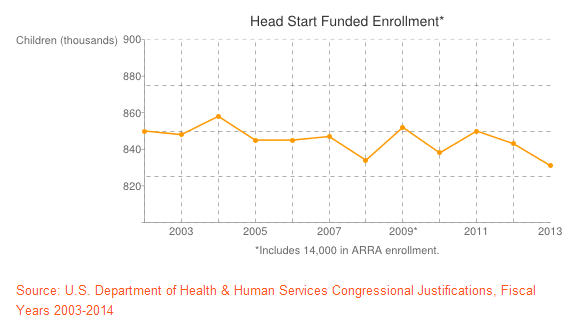
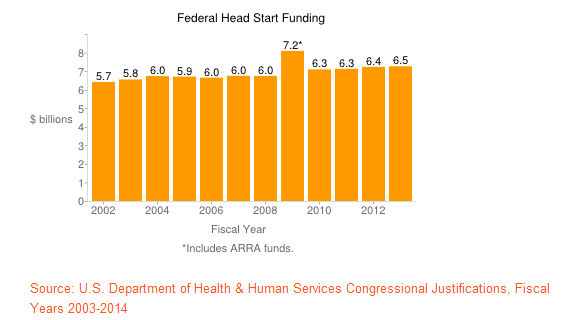
NOTE: Funding and enrollment are for Head Start only, and do not include Early Head Start.
Also worth noting: in both 2012 and 2013, 62 percent of Head Start teachers had bachelor's degrees (44 percent of all Head Start teachers had bachelor's degrees, including Early Head Start and Migrant and Seasonal Head Start teachers). That exceeds a requirement put in place by Congress during the 2007 Head Start reauthorization that at least half of Head Start teachers must have bachelor’s degrees by Sept. 30, 2013.
Here at the New America Foundation, we compile and maintain the Federal Education Budget Project database. It includes demographic, funding and outcomes data for every state, school district and institution of higher education in the country, as well as an array of background pages that provide basic information on education finance and early learning. There you can find more information on pre-K data, sources of funding for pre-K programs (including Title I), special education services for preschoolers and Head Start, and check out your local state or school district.