A Chapter of: Sealing the Trapdoors: The State Policies That Matter for Equitable K-12 School Funding
III. How Are Funds Used, and Do State Policies Promote Equitable Use Within Districts?
Policy Checklist
State policymakers and advocates should consider:
- Spending requirements: on what and where money must be spent
- Plans and reporting requirements
- Rules that constrain district spending choices
Lawmakers making investments in education want to know that the state’s equity priorities will be honored in districts’ spending choices. Advocates who have secured equity wins in their state’s allocation policy want to see these funds used to support the students and communities that need the most help. It is no wonder there is so much interest in what tools the state may have to control or guide the use of money at the district level. However, school funding experts are generally skeptical that such policies work as intended. It is important to be clear about the state’s actual sphere of influence, its goals, and whether more restrictive policies actually bring about the desired results. Policy meant to improve the equity of district spending should also include state support for effective practices, as well as recognition of the factors that may constrain district spending choices.
Spending Requirements
Some states take a prescriptive approach, setting firm rules for the spending of portions of formula funding. Generally, these mandates are not favored by school funding experts. They are more likely to drive the work of bookkeepers than educators. Money is fungible; it does not actually matter which dollar is used for a particular expenditure, so it is misdirected effort to ask districts to prove that they have used specific funds in required ways. Specific outcomes for students are usually better achieved through academic accountability policies than funding policies. However, spending requirements can take different forms, and the specifics of the policy do matter.
“On What” Rules
States sometimes provide explicit lists of practices, programs, and resources on which money can be spent. The primary concern with these policies is that they hamper innovation and adaptation as districts try to serve students in varied and changing contexts. Directing the spending of individual funding streams can also push the district towards inefficiencies. For instance, funds for multilingual learner education might be spent on discrete translation services instead of on integrating supports into the general education classroom, even if the latter might be more effective, because an isolated expenditure is easier to track for compliance purposes. If the goal is to encourage particular practices, state guidance and support are more likely than spending requirements to bring about strong implementation.
“Where” Rules
States also sometimes set rules that districts must spend student-based allocations in the schools whose students generated the funding. For example, if a school enrolls 50 multilingual learners who each generate $5,000 in needs-based funding for the district, a pass-through rule might require the district to spend that $250,000 in the school instead of centrally or at other school sites. (Maryland’s school funding system has rules along these lines.15) However, it is not obvious that money for high-need students is always best spent at the school rather than district level. Individual schools (and particular student groups funded within schools) can be small, and they may not have the scale to do cost-effective hiring and purchasing themselves. Many services and programs that are meant for high-need students (e.g., tutoring, therapies and other services for students with disabilities, extended-school-year programs) are often best managed centrally; district-level spending should not be automatically dismissed as “overhead.” So, while it does matter whether students receive the support they need, required distributions to schools don’t ensure that this occurs, and may even dilute vital funds.
However, the funds that are spent at the school level should go to schools based on student need. Too often, schools in wealthier, lower-need neighborhoods receive a disproportionate share of district funding, maybe because of the political power held by these communities within the district. There is also greater risk of disproportionality when districts budget by allocating staff positions to schools rather than set dollar amounts. The lion’s share of any school budget is spent on staff. Schools serving upper-income families have an easier time attracting and retaining experienced teachers who earn higher salaries. Therefore, when districts fund whomever a school ultimately hires for a staff position, they will usually send more staff funding to these schools. This is an equity problem that states should try to address with sensible policy.
Rather than require that specific allocations be spent in particular schools, states could mandate or encourage districts to adopt student-based budgets (much like WSFFs, but at the district level) rather than budgets based on staff positions. Another option is to require that funding for each school generally match the proportional share that its students contribute to the district’s formula amount (Figure 5).
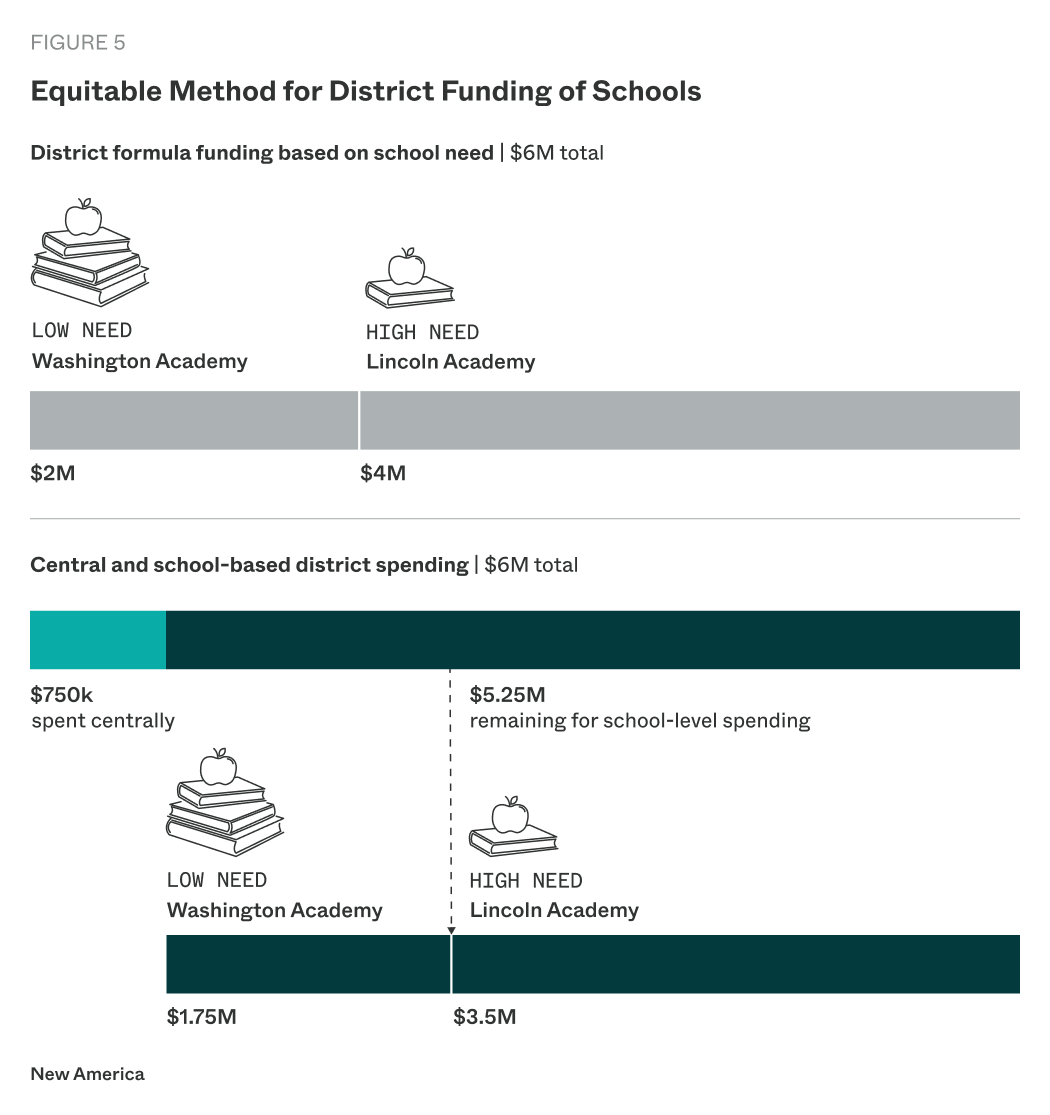
Imagine a district with two schools, low-need Washington Academy and high-need Lincoln Academy. If the state’s WSFF tallies the students in Washington as needing $2 million while the students in Lincoln need $4 million, the district will have $6 million in total formula funding. It may spend some of that money at the district level. But whatever is then spent at the school level should be divided so that about one-third goes to Washington and two-thirds go to Lincoln. Such a system could ensure an equitable division of resources without over-prescribing how the district uses its funding.
Additional Reading: Student-Based Budgeting
For more on this approach to budgeting, see Transforming School Funding for Equity, Transparency, and Flexibility: An Introduction to Student-Based Budgeting (Education Resource Strategies, 2018).
Planning and Reporting Requirements
Some states require districts to develop plans for the use of their formula funds or for particular allocations. In general, plan requirements are useful for pushing districts to articulate their goals and theories of change, and to align spending with those ideas. A requirement to engage the community when developing the plan is also valuable, because community members should have input into and understanding of the district’s direction, and because commitments to the community are often the strongest form of accountability for districts. A requirement to evaluate and report on the impact of planned programs and initiatives can also be helpful (and districts should receive both funding and practical support for these evaluations). Not only is it important to know what is and isn’t working, such a requirement signals to districts that effectiveness is the focus, and they should track and attend to the data that will demonstrate impact on students.
However, plans are not very effective tools for holding districts formally accountable for their spending choices. States very rarely withhold funding from districts on the basis of unsatisfactory plans; the stakes are too high for district operations. A district must respond to financial exigencies regardless of what is written in its plan, so fine-grained financial reporting will rarely match the plan exactly (though a skilled bookkeeper can make it come close). The mismatch between the plan requirement and the realities of district financial management can sometimes cause resentment, especially for smaller districts with less administrative capacity, because the planning process can be onerous and they see little concrete benefit. To address these considerations, plan requirements should specify focus areas, to ensure that districts prioritize key state goals and high-need student groups; should involve suggestions and support for meaningful community engagement; should not come with extensive procedural or formatting rules; and should be paired with reporting requirements focused on activities and impact rather than dollar outlays.
Additional Reading: State Support for Effective and Equitable Practices
Experts emphasize that state guidance, implementation support, and capacity building for districts are more likely to drive good practice than mandates.
Beyond the Bottom Line: A New Framework for K–12 Fiscal Accountability (Bellwether, 2025) covers the range of policies and support structures that are helpful in this area.
The State’s Role in Championing District-Level Change and The Shifting Role of State Education Agencies in Supporting District Sustainability (both Education Resource Strategies, 2025) take a closer look at the state role in supporting district success.
Rules That Constrain District Spending Choices
Lawmakers and advocates looking to require or encourage the equitable use of funds must remember that funding policy is not the only set of rules constraining district spending choices. Districts are subject to a host of regulations and binding legal commitments, especially those related to personnel and instructional arrangements, that affect district budgets. These factors limit how much funding is truly available for discretionary spending.
Rules That Constrain Instructional Spending
First among these are local labor contracts. Approximately 80 percent of school district dollars go to staff salaries and benefits, on average,16 so the contractual rules governing staff time, responsibilities, and compensation have a significant impact on district spending. While these union contracts are specific to the local school district, they are still governed by state law. States require, permit, and prohibit the inclusion of certain topics in collective bargaining.17 Is there a minimum or maximum number of hours per school day or days per year that a staff member can work? Can teachers be required to perform extracurricular duties outside of their regular hours, or be fully exempted from them? Does the state set minimum salary requirements for staff compensation? Are there rules that, in the event of layoffs, workforces must be reduced based on seniority or performance, regardless of the impact that an individual staff position has on the overall budget?18 These rules can predetermine significant parts of district budgets. State policies regarding these contracts are therefore a big factor in how much flexibility local leaders will have to allocate funding across schools and priority areas.
State rules regarding instruction and classroom arrangements are also important for district budgets. For instance, some states set maximum class sizes.19 These rules can constrain district and school decisions about how many teachers to hire and what instructional arrangements to use. So do state “seat time” regulations that require students to complete a certain number of instructional hours to earn course credit, effectively determining the amount of teacher time (and related personnel spending) that must be devoted to each course. And state content requirements—for instance, mandating that high-schoolers take courses in personal finance or computer science in order to graduate20—commit districts to spend time and dollars on these subjects, often at the expense of other instructional priorities.
None of the above is meant as a comment on the wisdom of any of these policies in themselves. But state lawmakers should recognize that each policy and contract governing personnel and instruction effectively directs some district spending. The more rules are in place, the less discretion district leaders will have over their budgets, and therefore less ability to redirect spending in a more equitable way.
Pension and Benefits Costs
The costs of staff pensions and benefits are significant and growing factors in district budgets. While outlays vary from place to place, there are many districts where these obligations are crowding out spending on other priorities.
The pension research organization Equable reports that K–12 retirement costs went up by 220 percent between 2002 and 2020, while public education budgets only rose by 33 percent.21 As a result, pension contributions make up an increasingly large share of district spending. And because teacher pension funds have such large unfunded liabilities, much of this is for debt rather than benefits. In 2024, district pension payments constituted 15 percent of school district payroll spending, while normal costs made up just under 6 percent. One recent analysis of California districts found that 10 percent of school system spending goes to pension contributions, and benefits spending per student has more than doubled in the last 20 years, mostly driven by rising pension costs.22
The increasing cost of health benefits is also a challenge. Premiums for employer-provided health insurance are rising rapidly,23 and coverage for school district employees is no exception. School districts also tend to cover health benefits for retirees, which becomes harder in times of declining student enrollment. These costs must be paid out of current revenues, which are driven in large part by current student counts, but the number of covered retirees is determined by how many staff members the district employed in prior years, when it may have enrolled more students.
When advocates and lawmakers ask about districts’ budget choices, they should take note of how much spending is pre-allocated to these costs. Increases in the costs of benefits can force cuts in other areas, or they can eat up state funding increases, leaving no room to make new equity investments. When states fund a larger portion of pension costs centrally, assume responsibility for pension debt payments, or account for pension and benefit costs in the state education funding formula, district leaders are able to make more targeted choices about the use of their funds.

Citations
- Krishna Tallur and Donna Gunning, "Overview and Update on Minimum School Funding," presentation, Maryland State Department of Education, Baltimore, MD, April 15, 2025, slide 4, https://marylandpublicschools.org/stateboard/Documents/EduTransformCommittee/2025/Overviewand-Update-On-Minimum-School-Funding-A.pdf.
- National Center for Education Statistics, "Fast Facts: Expenditures (66)," U.S. Department of Education, Institute of Education Sciences, last modified May 30, 2024, https://nces.ed.gov/fastfacts/display.asp?id=66.
- Michael Sheehy, "What's Actually on the Table When Teachers Collectively Bargain?" National Council on Teacher Quality, June 11, 2026, https://www.nctq.org/research-insights/whats-actually-on-the-table-when-teachers-collectively-bargain/.
- Heather Peske, "Raising a Red Flag: LIFO Policies Harm Teacher Diversity, Teacher Quality, and Student Learning," National Council on Teacher Quality, April 25, 2024, https://www.nctq.org/research-insights/raising-a-red-flag-lifo-policies-harm-teacher-diversity-teache r-quality-and-student-learning/.
- Kyle Zinth, State Notes: Class Size: Maximum P–12 Class-Size Policies (Education Commission of the States, November 2009), https://www.ecs.org/wp-content/uploads/state-notes-class-size.pdf.
- For state policies in this area, see: Education Commission of the States, "50-State Comparison: High School Graduation Requirements 2023," May 2023, https://reports.ecs.org/comparisons/high-school-graduation-requirements-2023/.
- Anthony Randazzo and Max Marchitello, "Hidden Cuts and Pension Funding Formulas," Equable Institute, June 2025, https://equable.org/wp-content/uploads/2025/06/Equable-Institute_Issue-Brief_Hidden-Cuts-and-Pension-Funding-Formulas_Final.pdf.
- Paul Bruno, Recent Patterns in California School District Finances, Trends in Teacher Compensation, and Within-District, Between-School Spending, Getting Down to Facts series (Stanford University SCALE Initiative, May 2026), 1–2, https://gettingdowntofacts.com/sites/default/files/District%20Dollars%203.pdf.
- KFF, “2025 Employer Health Benefits Survey,” October 22, 2025, https://www.kff.org/health-costs/2025-employer-health-benefits-survey/.