Worker Voices: Technology and the Future for Workers
Table of Contents
- Executive Summary
- Acknowledgements
- Introduction
- Economic Insecurity and the Future for Low-Wage Workers
- The Search for Stability While Work is Changing
- Workers Want to Feel Respected and That They Matter
- Technology on the Job Today
- How Workers Imagine Their Jobs in the Future
- Barriers to a Better Future for Workers, Especially Women
- Obstacles to Obtaining Skills and Degrees
- Career Transitions are Difficult and Often Out of Reach
- Conclusion and a Human-Centered Agenda for the Future of Work
- Appendix: Study Methodology
Abstract
Narratives around the future of work often center on the risks to workers in male-dominated and machine-heavy professions like truck driving and manufacturing. But our research and other recent publications suggest that substantive changes are ahead for sectors like food service, retail, and clerical work and have the potential to disproportionately impact women and African American and Hispanic workers. We went directly to a diverse group of workers who are at the forefront of change, but who are all too often absent from these discussions. We asked them about their lives, their experiences with their jobs and their dreams and fears for themselves and for a technology-altered future in general.
For many workers, the future is already here. Food, retail, and grocery workers have witnessed rapid change in recent years, especially in the front end of their stores. Most feel they lack a voice in these changes and feel pessimistic about the future for humans in their stores. Advancing technological change is not occurring in a vacuum, but rather in a time of increasing economic precarity and inequality; unequal care and domestic burdens; and the rootedness, responsibilities, and stories of workers’ lives. Low pay and economic insecurity sharply limit workers’ ability to prepare for—and access—a better future of work, and women face many barriers. Workers are thinking about, and responding to the possibilities of a technologically enabled and dehumanized future in the context of their current situations. The current educational and workforce systems make career transitions extremely difficult, and workers often have trouble acquiring the skills and credentials they desire. Policymakers will improve the odds of building effective programs by paying attention to the wider human context and by addressing the needs of a greater diversity of workers who will shoulder the greatest burden of the change.
Downloads
Executive Summary
“I know technology is changing our world. But people can’t be left behind.” – Legal assistant, 65
The meaning of work is profoundly personal, and deeply felt. When work changes, it is not only jobs that are disrupted. So too are the lives of the people who hold those jobs and the families they support. In recent decades, economic shifts have eroded the stability, financial security and power of many American workers. While fears of a robot apocalypse and mass unemployment are overblown, artificial intelligence and automation can exacerbate the inequality and instability many workers already experience. Technological change will disproportionately affect those who are already struggling to secure a stable foothold in the economy.1 Without concerted effort to redesign the rules of the game, most workers will continue to be excluded from prosperity.
Narratives around the future of work often center on the risks to workers in male-dominated and machine-heavy professions like truck driving and manufacturing. But our research2 and other recent publications3 suggest that substantive changes are ahead for sectors like food service, retail, and clerical work and have the potential to disproportionately impact women and African American and Hispanic workers.4 We went directly to a diverse group of workers who are at the forefront of change, but who are all too often absent from these discussions. We asked them about their lives, their experiences with their jobs and their dreams and fears for themselves and for a technology-altered future in general. Here are our main findings:
The present of work impacts workers’ future. Low pay and economic insecurity sharply limit workers’ ability to prepare for—and access—a better future of work. The layering of burdens on workers through low wages, debt, expensive cost of living, and lack of savings create daunting headwinds for many frontline workers in fast food, grocery, and retail. Many struggle for hours, benefits, and decent pay, and feel their job quality has worsened over time. While technological change is not the direct cause of workers’ precarity, it can add insult to injury. Automation and the adoption of new workplace technologies can exacerbate financial insecurity when jobs change, wages or hours are suppressed, or when workers are displaced altogether. Economic insecurity also limits workers’ resilience to technology changes by undermining their ability to weather a job transition, pay for training or schooling, and move into better paying—and less automatable—work. If workers cannot afford to make ends meet today, they will be ill-equipped to prepare for tomorrow. Raising income, reducing inequality and improving the economic security of workers is key to enabling a better future of work for those at greatest risk of change.
Technological change is at odds with workers’ overwhelming desire for stability. An inadequate social safety net and benefit system makes job disruption worse. More than anything else, workers expressed a desire for stability—and especially benefits—from their job. Most workers, especially older workers, did not want any change at all. This consistent desire of workers for stability is at odds with the changes and instability that technological change will unleash. Artificial intelligence and automation will alter the organization and nature of work, the demand for skills, the tasks involved in existing and new occupations, and the requirements for a good living. Some workers will need to adapt to new job activities and new technologies on the job, while others might need to develop entirely new skills—or change jobs altogether. The workers who will experience these changes will be even more vulnerable to instability because of the connection between employment and benefits and the limitations of the social safety net. The current system of employer-provided benefits and the broader safety net system requires a major overhaul to better meet the needs of low-wage and middle-skilled workers at risk of automation and technological change.
The jobs of the future need to be good jobs. A surprising number of administrative and clerical workers whom we interviewed previously worked in fast-growing care and other “pink-collar” jobs like social work and education, which failed to provide them with the stability and benefits they desired. These workers described finding satisfaction in better quality and more stable clerical and administrative jobs, which are projected to shrink by several hundred thousand positions in the next 10 years alone. In comparison, the care jobs that will grow fastest over the next decade are much lower quality with poor pay, poor working conditions, and less stability. To ensure a better future for workers, and especially for women and workers of color, it is imperative that policymakers prioritize making the fast-growing jobs of the future good jobs.
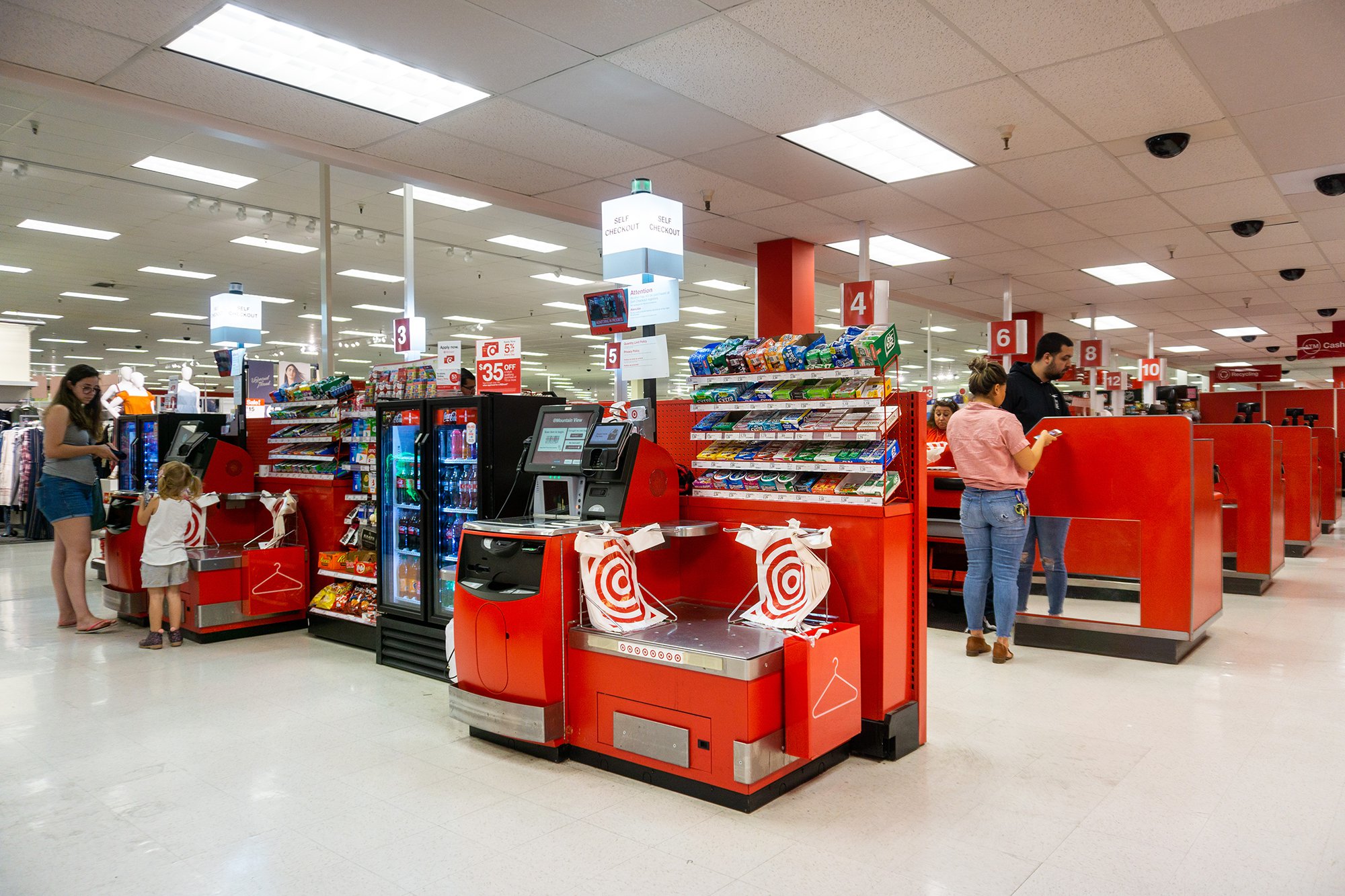
Technology is already changing jobs and workplaces. Many fast food, grocery and retail workers feel it is change for the worse. Food, retail, and grocery workers have witnessed rapid change in recent years, especially in the front end of their stores. Workers described the recent introduction of a range of technology-enabled innovations, including self-order kiosks, Uber Eats, mobile payment, store apps, curbside pickup, grocery delivery, online shopping, self-checkout lanes, and new scanning technologies. Interviewees expressed sharply negative views about technology like self-checkout, which they view as displacing jobs and contributing to their struggle to secure hours and benefits. Clerical and administrative workers described day-to-day use of software and other workplace technology that is evolving at a more measured pace, and is often accompanied by on-the-job training.
Many workers feel they lack a voice in their employers’ decisions about technology and the quality of their jobs. Often, workers felt that the future of work is happening to them. When decisions are made about technology adoption at work, many workers felt they have little agency or voice in their own future, though workers in unions felt somewhat more empowered to push back against automation that jeopardized jobs. Several workers said they wished their employers would walk in their shoes and better understand what they experience and the unique human skills they bring to the job. Many low-wage workers employed in fast food restaurants and retail outlets lamented their lack of union membership and their weakened ability to advocate for the stability and security they desire. For a better future, workers need greater power in the workplace and more voice in the decisions that impact them.
Many workers are pessimistic about the future for humans in their workplace, fearing their employers view them as a cost they will cut through automation. Nearly every food, grocery, and retail worker predicted a significant increase in technology in the future and a decline in the number of people working in their stores. Some even imagined a future with few—or no—humans working in front-end positions like cashier and fast food server jobs. Many feel that their employers are focused only on maximizing profits and shareholder value. Several workers described feeling like a cost that their employers are trying to cut, pointing to cuts to benefits and hours. Others were skeptical that technology could replace some or all of their jobs, especially those that rely heavily on customer service skills. Clerical and administrative workers envisioned a future with more technology in their jobs, but either a modest impact or no impact on the number of workers. Some predicted that technology will make workers more efficient and quicker but not scarcer, while others imagined that technology will result in fewer administrative workers hired in the future. Several workers doubted the ability of robots and technology to perform core job duties that entail empathy, human connection, and communication.
Women face many barriers. Many women describe working a “second shift” at home, spending much of their non-work time cleaning, cooking, and looking after children and the elderly. Women workers often cited lack of support with these domestic responsibilities, stress, and lack of resources, flexibility and respect from management at work as reasons they were unable to go back to school or accept a promotion. Women were more likely to reject job changes, promotions, or management opportunities that decreased their control or increased work demands on their time, a precious commodity in their lives. Unless policymakers address the structural constraints faced by a large percentage of women in our study, women risk falling behind.
Workers struggle to acquire the skills, degrees and training they desire. College degrees remained elusive for most young workers. For nearly a dozen workers in our study, a range of obstacles and setbacks disrupted their studies. Many faced even greater hurdles going back to school while also working full time, paying off debt, and—for some—juggling care responsibilities. Most mid-career and older workers want opportunities to learn new skills quickly and on the job—rarely do they want to go back to school for a degree. Instead, they expressed an interest in learning opportunities suited to their time and resource constraints, including on-the-job training, employer-provided skill development, professional credentials, short courses, and apprenticeships. Most workers in our study did not want online education.
Career transitions are far too difficult and out of reach for most busy working adults. Far from plotting second careers as coders or nurses, most mid-career and older workers we interviewed were occupied with the present demands of work, life, and family. Often, they preferred stability or new opportunities in their existing workplace. If forced to find new work, they would mostly seek similar roles or roles that used their current (and often automatable) skills. Currently, the workforce development system is fragmented, underfunded, and ill-suited to the needs of the workers in our study and the challenges of technological change. Policymakers should take a human-centered approach to make the workforce development system and the existing infrastructure of America’s job centers more user-friendly, better quality, and more responsive to the needs and preferences of workers.
For many workers, the future is already here.
For many workers, the future is already here. Advancing technological change is not occurring in a vacuum, but rather in a time of increasing economic precarity and inequality; unequal care and domestic burdens; and the rootedness, responsibilities, and stories of workers’ lives. Workers are thinking about, and responding to the possibilities of a technologically enabled and dehumanized future in the context of their current situations. Policymakers will improve the odds of building effective programs by paying attention to the wider human context and by addressing the needs of a greater diversity of workers who will shoulder the greatest burden of the change.
Read more about our conclusions and our recommendations for a human-centered future of work agenda here.
Citations
- Molly Kinder, “Learning to Work with Robots,” Foreign Policy, July 11, 2018, source
- Molly Kinder, “The Future of Work for Women: Technology, Automation & the Overlooked Workforce,” ShiftLabs blog post, New America, February 25, 2019, source; and Molly Kinder, “Learning to Work with Robots,” Foreign Policy, July 2018, source
- Ariane Hegewisch, Chandra Childers, and Heidi Hartmann, Women, Automation, and the Future of Work (Washington, DC: Institute for Women’s Policy Research, March 13, 2019), source and Mark Muro, Robert Maxim, and Jacob Whiton, Automation and Artificial Intelligence: How Machines are Affecting People and Places (Brookings Institution Metropolitan Policy Program, January 2019), source
- For more on the perspectives of people of color on the future of work, see the report by Dr. Ismail White and Harin Contractor,"source">Racial Differences on the Future of Work: A Survey of the American Workforce" (Joint Center for Political and Economic Studies, July 2019) source">source
Acknowledgements
We are grateful to an incredible team of colleagues who helped make this report possible. First and foremost, a huge thank you to our research team which, in addition to ourselves, included Roselyn Miller and Autumn McDonald. They were a “dream team” that brought thoughtful insights, expertise, and passion to the research process, interviews, and synthesis. A special thanks to Roselyn Miller, whose passion, wisdom, and energy improved this report in many ways. Her Spanish language skills and tireless work enabled our discussions with Hispanic workers and her thoughtful feedback is reflected in the forthcoming pages. A big thank you to Molly Martin and Rachel Alexander for their support on the ground in Indianapolis and Oakland, respectively. Also, thank you to Sam Webster brought her photographic skills and enthusiasm for the project on the road.
Maria Elkin, Joanne Zalatoris, Angela Spidalette, and the entire New America communications team were tremendous partners in bringing the report to life. Dana Ju was instrumental in managing relationships with partners and securing the financial resources that made the project possible. Mary Alice McCarthy and Tara McGuiness provided valuable feedback and policy input to our synthesis. Cecilia Muñoz believed in this project from its earliest days and supported us at every turn.
Our team is grateful to the partners, funders, and experts who contributed to this project. We are particularly grateful to Andrew Dunckelman at Google.org and Michele Jawando at Google for their generous support for this project and their enthusiasm for bringing the dignity and voices of workers into the future of work conversation. We are also thankful for their understanding when the project timeline needed to extend several months to accommodate parental leave.
External consultants Emily Tavoulareas and Amber Schleuning provided invaluable expertise, training, and support as we designed the research, executed the field work, and synthesized our findings. Paulina Plata was extremely helpful in our recruitment efforts. We are deeply grateful to Alan Hanson, Jim Araby, Simone Mock-Williams, Tiffany Flowers, and their colleagues at the United Food and Commercial Workers International Union (UFCW), Maria Maldonado at Fight for $15, Wendy Weiner and Leslie Frane at SEIU, and Gina Davis at LISC for their help in introducing us to many of the workers whose voices are documented in the forthcoming pages. We thank Annelies Goger, Cecilia Muñoz, Roselyn Miller, Iris Palmer, Tara McGuinness, and Mary Alice McCarthy for their thoughtful feedback on the report draft. And thanks to Sabrina Detlef for her copyediting of this report.
Above all, the entire team at New America would like to thank the workers who lent their time, candor, and generosity of spirit to this report. We are humbled and grateful that you entrusted us with your stories and personal experiences. We dedicate this report to your hard work and voices.
Introduction

The meaning of work is profoundly personal, and deeply felt. For many people, work means a paycheck to keep them afloat, a roof overhead, and the food they provide their families. For those who have it, a job can mean health insurance. It means stability and peace of mind that many depend on—or struggle to find. It is little wonder that the prospect of work changing is similarly personal and deeply felt. When work changes, it is not only jobs that are disrupted. So too are the lives of the people who hold those jobs and the families they support.
Economic shifts in recent decades have eroded the stability and financial security of many American workers. Earnings for those without a college degree have fallen sharply over the last several decades,1 while costs have risen and fewer workers have access to employer-provided benefits.2 Structural trends such as trade liberalization,3 automation,4 declining unionization,5 growing market concentration and monopsony power,6 the decline in real value of the minimum wage,7 and the fissuring of the workplace8 have contributed to rising inequality, reduced worker power and the hollowing out of the middle class. Given these changes, it is not surprising that nearly half of Americans do not have the financial security to weather an unexpected expense.9
When work changes, it is not only jobs that are disrupted. So too are the lives of the people who hold those jobs and the families they support.
Adding to these headwinds, technological advances have the potential to exacerbate the instability many workers already experience and the inequality that has marked the last three decades. Despite sensational headlines, fears of a robot apocalypse are overblown. Automation and artificial intelligence are unlikely to cause mass unemployment. However, technological change will impact the livelihoods and stability of millions of workers, disproportionately affecting those who are already struggling to secure a stable foothold in the economy.10 Technology has the potential to boost economic growth, create decent paying jobs, and unleash productivity and innovation. Yet the extent to which workers benefit from these gains depends on the institutional, legal, and social context, and the decisions that policymakers and employers will make. Without concerted effort to redesign the rules of the game, most workers will continue to be excluded from prosperity.
Three limitations of the current future of work conversation
Interest in the topic of automation and the future of work has grown significantly in recent years. The prospect of job losses from technological change has captured media headlines and even emerged as a question at an October 2019 debate of Democrat presidential candidates. Consultants, economists, and technical experts have published numerous reports offering predictions of job losses and skill changes.
The media coverage and mainstream discussions of the future of work have been limited in three key ways. Often, the macro analyses and high-level estimates of job impacts miss the important context of workers’ lives and the many obstacles and challenges that undermine their resilience to change. People often consider technological change in isolation from broader structural challenges in the economy when they consider the future of work, apart from the many other factors that contribute to workers’ insecurity, stagnant wages, and poor job quality. To fully understand the impact of technological change and to design solutions to help workers adapt, context is key.
Second, the popular conception of who the workers are in the future of work is at odds with the identity of those at greatest risk of change. Media coverage of automation and the future of work focus on a narrow demographic: (white) men, mainly in manufacturing and blue-collar jobs. This coverage overlooks the women and communities of color who will shoulder a greater burden from the impact of job automation.11 As detailed in our previous research, the costs of displacement and adjustment will fall disproportionately on women, people of color, and workers with less formal education and economic stability.12
Finally, missing from most future of work discussions are the voices of workers themselves. This gap matters. Without a voice in the discussions and decisions that impact them, workers feel that technology change is happening to them and that they lack agency in their own future. Furthermore, if policymakers and practitioners do not understand the perspectives, preferences, and challenges of those whose lives will be most impacted by technological change, they risk putting forward solutions that fail to meet the needs of workers they intend to support.
Giving voice to workers at the front lines of change
We aim, with this report, to bring more context, diversity, and human perspective to the discussions of the future of work and the design of policies and solutions. We want to give voice to the workers who are at the forefront of change, but who are all too often absent from these discussions.
Over the past year, we undertook a human-centered initiative to explore the views and personal experiences of a diverse group of workers who hold some of the jobs most likely to change. We set out to better understand the context of their lives, their hopes and plans for the future, the challenges and struggles they face, their experience with technological change on the job, and their beliefs about what their jobs might look like in the future.
In our approach to the interviews and qualitative research in this report, we drew inspiration from the principles of human-centered design, a process about developing solutions, policies, and products with the individual who experiences the problem in mind. The first step is understanding the people who are most affected and their needs,13 by interviewing them about their perspective, in an open-ended way. By listening and allowing the workers who will experience change to provide the context and challenges of their own lives, we (and experts in general) are less likely to offer solutions that are out of touch with what they want or need.
Through the interviews, we learned about workers’ struggles to get enough hours, their desire for respect from their employers, and the basic challenges of making ends meet in a low-wage job, especially one without benefits. We heard about some workers’ enthusiasm for new career opportunities but also the challenges they face in even imagining what they will do in the future, let alone the hurdles of trying to learn new skills and pay for more education. We learned about the iterative technological change in clerical jobs as well as the more abrupt, and seemingly cataclysmic, change visible to frontline workers. We heard about workers’ appreciation for new technology that works well in their workplaces and their fear for what their role will be in a future with fewer humans in their workplace.
Data, methodology, and limitations
We conducted hour-long, semi-structured interviews with a total of 40 workers in four metropolitan areas—Buffalo, Indianapolis, Oakland, and Washington, DC. While our study represents a diversity of workers across race, age, gender, occupation, employer, immigration status, geography, and union membership, it is not a nationally representative sample and thus the views expressed by workers in our study should not be interpreted as representative of all workers.
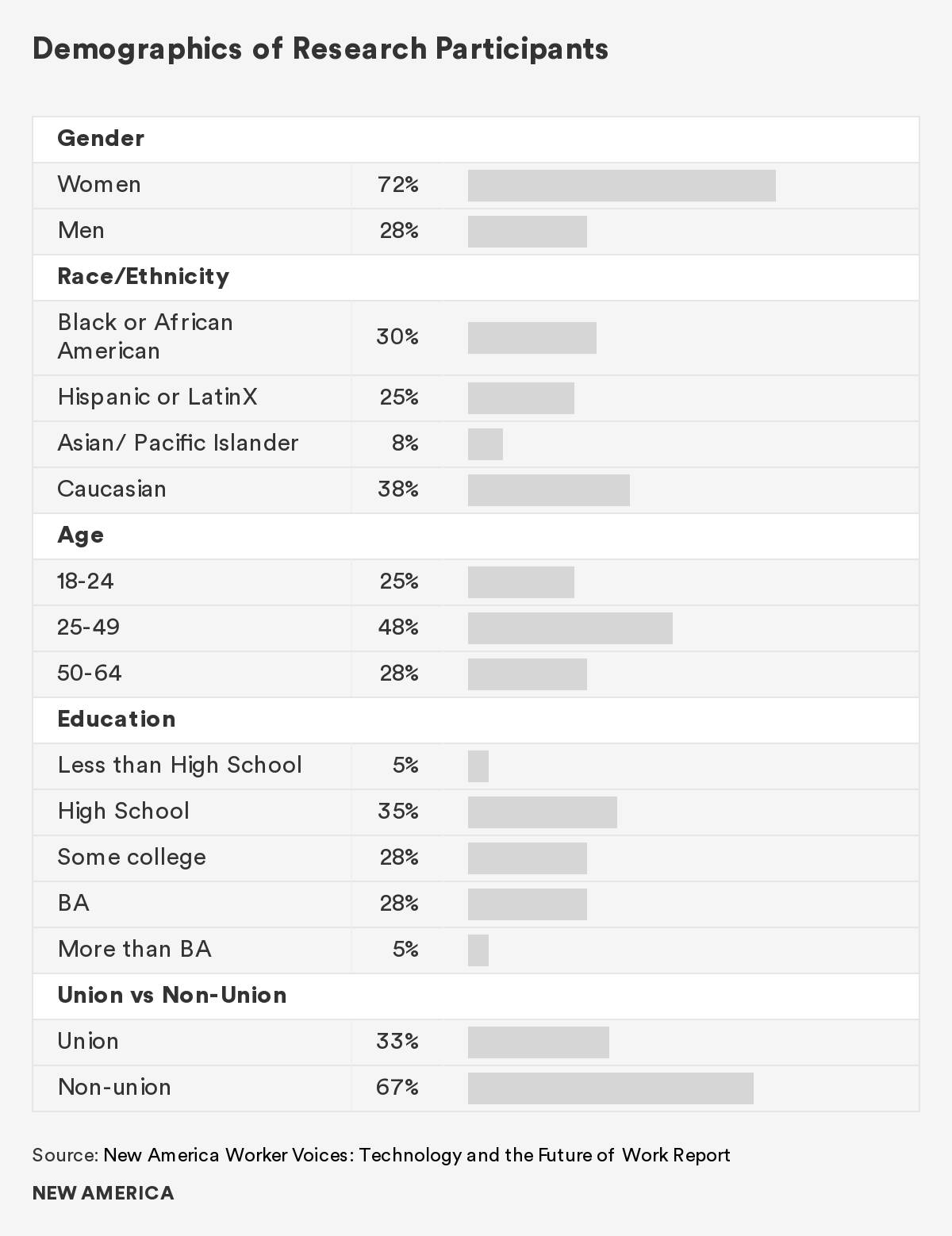
To recruit interviewees, we deployed multiple tactics including partnering with worker organizations, leveraging personal networks, and using online message boards, cold calls, and other “walk up” recruiting. The diversity of these recruitment approaches helped mitigate potential biases in our sample. However, it is possible that the workers we spoke with differed from a more nationally representative sample due to some of their connections to worker groups, their comfort level in speaking with us, the locations we selected for interviews, and their specific employers and occupations.
The Appendix includes a more detailed description of our methodology.
In the interviews, most of our questions centered on the context of the workers’ lives at home and at work, and their hopes and concerns for the future. We were careful not to lead interviewees toward discussions of technology. We did our best to use more general and open-ended questions about the future of jobs to explore the extent to which workers are already thinking about issues like technology and automation. All the questions we asked were open-ended and we gave instructions to our interviewees that there were no right or wrong answers. We took steps to minimize any potential harm to the workers with whom we spoke. To protect the identities of those involved, we use pseudonyms and have changed other personal attributes of the workers featured in the report.
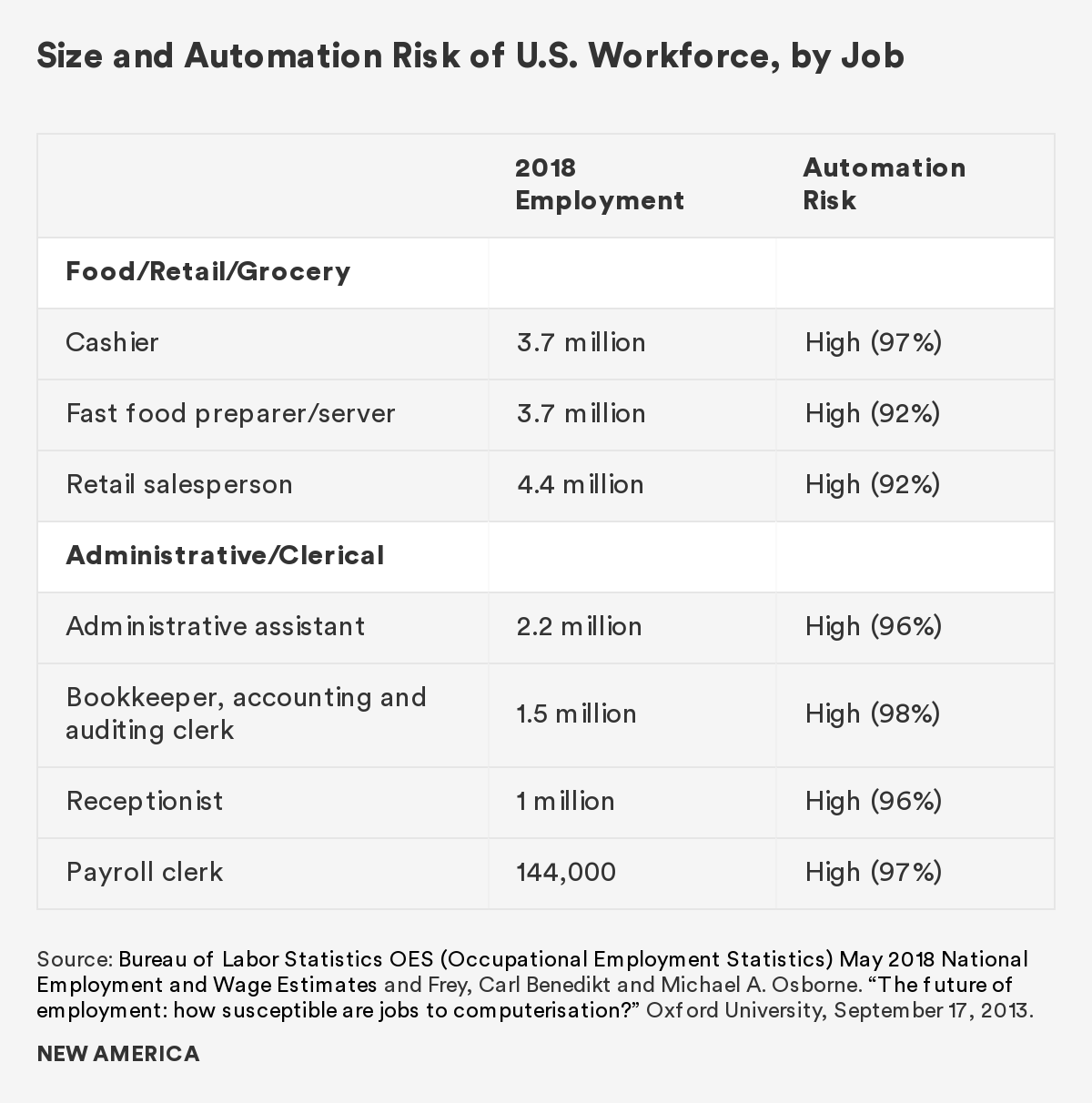
We selected two categories of workers to interview. The first group comprised retail, fast food, and grocery workers, primarily in front-line positions like cashiers and food preparers. The second group comprised non-managerial administrative and clerical workers in roles such as administrative assistants and bookkeepers. We selected these two groups of workers for our study for three reasons: the jobs they hold are at high risk of automation and technological change,14 they employ many workers across the country, and they are frequently overlooked in future of work discussions compared to other types of workers.
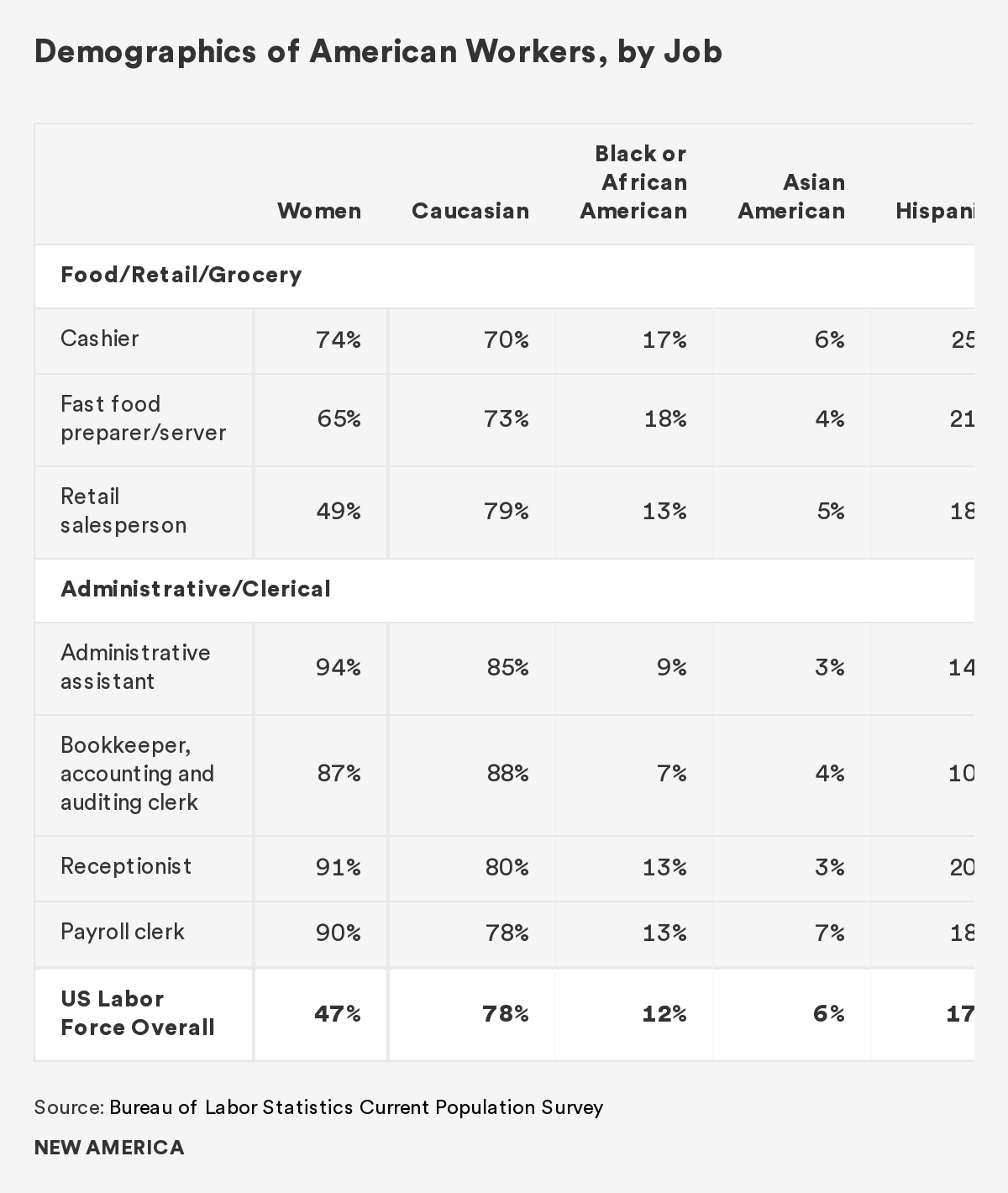
Jobs in retail, fast food, and administrative work are some of the biggest sources of employment in the U.S. overall. Approximately 17 million Americans, or nearly 12 percent of the entire U.S. workforce, are employed in seven of the job titles we interviewed. The high automation risk of these jobs suggest they could change significantly in the future—and the likelihood of this change is higher for these jobs than for most other jobs that American workers hold. To the extent that policymakers and the public are concerned about the potential for technology to displace workers, our data suggest that these occupations should be a key part of that conversation.
Citations
- David Autor, David A. Mindell, and Elisabeth B. Reynolds, The Work of the Future: Shaping Technology and Institutions (Cambridge, MA: MIT Work of the Future, September 2019), source
- Pamela Loprest and Demetra Nightingale, The Nature of Work and the Social Safety Net (Washington, DC: Urban Institute, July 2018), source
- Ali Alichi, Rodrigo Mariscal, and Daniela Muhai, Hallowing Out: The Channels of Income Polarization in the United States, working paper (Washington, DC: International Monetary Fund, November 15, 2017), source
- David Autor, The Polarization of Job Opportunities in the U.S. Labor Market: Implications for Employment and Earnings (Washington, DC: The Center for American Progress and the Hamilton Project, April 2010), source
- Jake Rosenfield, Patrick Denice, and Jennifer Laird, Union Lowers Wages of Nonunion Workers: The Overlooked Reason Why Wages are Stuck and Inequality is Growing (Washington, DC: Economic Policy Institute, August 30, 2016), source
- David Autor, David Dorn, Lawrence F. Katz, Christina Patterson, and John Van Reenan. Concentrating on the Fall of Labor Share. National Bureau of Economic Research, Working Paper 23108, January 2017. source
- Lawrence Minshel, Declining Value of the Federal Minimum Wage is a Major Factor Driving Inequality (Washington, DC: Economic Policy Institute, February 21, 2013), source
- David Weil, The Fissured Workplace: Why Work Became So Bad for So Many and What Can Be Done to Improve It (Cambridge, MA: Harvard University Press, 2014).
- Jeff Larrimore, Alex Durante, Kimberly Kreiss, Christina Park, and Claudia Sahm, Report on the Well-Being of U.S. Households in 2017 (Washington, DC: Board of Governors of the Federal Reserve System, May 2018), source
- Mark Muro, Robert Maxim, and Jacob Whiton, Automation and Artificial Intelligence: How Machines are Affecting People and Places (Brookings Institution Metropolitan Policy Program, January 2019), source
- Molly Kinder, “The Future of Work for Women: Technology and the Overlooked Workforce,” Work, Workers, and Technology blog post, New America, February 25, 2019, source
- Molly Kinder, “Learning to Work with Robots,” Foreign Policy, July 11, 2018, source
- The Field Guide to Human-Centered Design (San Francisco, CA: IDEO, 2015), source
- We used several data sources to identify jobs at high risk of automation, including data from a 2013 study by Oxford researchers Carl Benedikt Frey and Michael A. Osborne, in which they evaluated the technical feasibility of computerizing or automating the underlying tasks of an occupation with technology that exists today. In their analysis, the occupations we focus on in this report each have greater than 90 percent risk of automation, which is within the top quartile of risk among all occupations they studied. See Benedikt Frey and Osborne, The Future of Employment: How Susceptible Are Jobs to Computerisation? working paper (Oxford, U.K.: Oxford Martin School, University of Oxford, September 17, 2013), source. Similarly, a recent McKinsey report on automation calculated that office support workers are the highest-risk job category for the potential for total displaced full-time employees by 2030, followed by food service, and customer service. See Susan Lund, James Manyika, Liz Hilton Segel, André Dua, Bryan Hancock, Scott Rutherford, and Brent Macon, The Future of Work in America: People and Places, Today and Tomorrow (New York: McKinsey Global Institute, July 2019), source
Economic Insecurity and the Future for Low-Wage Workers

The starting point of our research is the context of workers’ lives. Understanding the constraints and struggles workers face today is critical to anticipating how they will experience technological change tomorrow. This context impacts how workers experience their jobs, their resilience to changes, and their ability to plan for and connect to opportunity.
In our interviews with frontline grocery, retail, and fast food workers, economic precarity emerged as one of the most prominent and important themes. Most of the low-wage workers we spoke with faced financial insecurity, sometimes profoundly. Many struggled to afford the basics, pay off debt, provide for their families, and weather any financial challenges. This economic stress was top of mind and impacted many other aspects of their lives and work, from their career choices to the widespread preference for job stability to their difficulties pursuing higher education and learning.
While technological change was not the direct cause of workers’ precarity, it can add insult to injury. Automation and the adoption of new workplace technology can exacerbate workers’ financial insecurity when jobs change, earnings or hours are cut back, or when workers are displaced altogether. Economic insecurity also limits workers’ resilience to technology changes by undermining their ability to weather a job transition, pay for training or schooling, and connect to a new or better opportunity.
Financial insecurity suppressed upward mobility and limited workers’ ability to get new skills or change jobs
Economic precarity was a major challenge for the workers in our study. The fraught combination of low wages, expensive cost of living, persistent debt, lack of family support and any financial cushion, and—in some cases—the absence of health insurance created daunting headwinds for many of the workers we interviewed. This was especially true of those in the fast food industry, workers living in the Bay Area, undocumented workers, and those carrying student debt without a completed degree.
Many workers reported living paycheck to paycheck and struggling financially. Several people referenced the challenges of carrying debt, including auto loans, credit card debt, student loans, and medical debt. This debt often served as a barrier to upward mobility and to workers’ ability to go back to school or invest in new skills or career changes.
Other interviewees expressed concern about the challenges of establishing financial security and struggling to establish enough savings for the inevitable emergencies and expenses that arise.
A 25-year-old grocery manager acknowledged
I don’t have the greatest car in the world. It is old and it’s probably going to break down on me soon, which would suck because I need it for work. I keep trying to save and then I just can’t. I’m constantly worried about it. That’s pretty much the only thing I worry about. I have some bonds from college that I was supposed to use for college, which I haven't, that I would probably use in the emergency. Otherwise, I don't actually have a plan.
Low pay and insufficient hours added to workers’ financial insecurity and stress
The low wages that employers pay frontline workers is a major factor in their economic insecurity. Many fast food, grocery and retail workers reported frustration with low pay. A grocery manager reported not receiving a pay raise in over a decade despite other living costs rising. One 29-year-old truck driver (see Jasmin’s Profile) described the impossibility of making ends meet with the low compensation from her fast food jobs. Even after her pay rose from $5.35 an hour to $11 an hour a decade later, she explained that “still, it didn’t pay the bills.” A gas station manager, 23, explained a similar frustration: “The pay is not as high as I thought it would be. I tell my husband, ‘I'm working my butt off there and I have to live check by check.’ And then I ask for a raise and they just tell me later on, later on.”
Despite perceptions of a booming economy with low unemployment, many workers voiced frustration about not getting enough hours to pay their bills. A cashier, 55, despaired that he had not been given full-time hours by his grocery employer in the many years he worked there and, as a result, he could not keep up with the expensive cost of living in the Bay Area: “In 18 years, I never got a full-time position, never. You can’t believe it. I’ve always been part-time and looking for hours. Sometimes, they give me 24 hours. I can't survive with 24 hours. I feel stressed out and depressed.” Another grocery manager, 45, explained the struggle that her colleagues faced in trying to get enough hours
Store directors are hiring a lot of young people at minimum wage. To be a 40-hour employee, you have to get into this lottery, which I heard these days doesn’t even exist if you’re just a checker or a bagger. Take that lady who’s been there for 30 years, but she’s never been a 40-hour employee. She makes $22 but they’re giving her the bare minimum hours. I know a baker who’s worked here forever, she’s very much older and comes to me and cries because her hours are being cut so much she doesn’t know how she’s going to make rent this month. I don’t know if they really go and see how it’s being affected by them cutting hours, saving the $10. To [the grocery chain], it’s all money. That’s why you’re constantly seeing “we’re hiring!” and why we are constantly hiring, but you can’t give me 40 hours?
Workers worried about insufficient hours when hours equal benefits
Workers’ desire for hours is especially fraught because of the relationship between hours and benefits. Several grocery and retail workers with longer tenures observed that their employers have made it harder for workers to qualify for benefits. Today, they see their employers denying newer workers the full-time hours required to gain eligibility for health insurance and other benefits. One grocery cashier with a decade of experience contrasted his eligibility for health insurance in just three months when he started his job with the more than three years that new cashiers hired by his employer have to wait for benefits eligibility.
An employee of a different grocery chain described a similar experience: "the people coming in now have to do so many hours to get insurance. The company doesn't make it easy, because they're not giving a lot of hours. You're going to take five years to even get to the point to get insurance, and it used to be 18 months.” This pricing clerk, 55, continued, “once you were an employee, [the grocery chain] gave insurance, health insurance. But now, this depends on how many hours you are doing."
A manager, 45, explained that workers in the retail sector increasingly struggle for benefits and hours as well. While hourly wages have gone up, he sees employers offset the cost of these raises by denying new hires the hours required to qualify for benefits. By 2020, his chain, he said
is working toward $15 an hour and they’re ramping up to that now, even for cashiers and stockers. Each year they’re going up a dollar. At the same time, they’ve cut hours a little bit. A lot of retail is going to that, so they don’t have to pay as much in benefits. So you hear feedback on that from people. The compensation is now a little better for team members, but if you lose your benefits and that is your goal, then I think you’ve lost a little. When I started here, probably half the team members qualified for benefits. And now it’s much less than that. It’s more that we lose the people who had benefits. And with new people, they tell them ahead of time how many hours they’ll get, and it won’t be enough for full time benefits.
Sundry Photography / Shutterstock
Workers feel it is getting harder to earn a decent living as employers prioritize shareholders and the bottom line
A persistent theme from grocery and retail workers with long tenures was the sense that compensation and work environments have changed for the worse. Numerous interviewees lamented the loss of bygone era when their employers had “family values,” invested in their employees, and created opportunities to earn a decent living.
One grocery employee with 25 years of tenure described the gradual decline in the company’s values and benefits offered to workers: “When I first started, it was a family-oriented business. They gave us stock options. They used to have a staff organization that took a dollar out of our weekly paycheck, and would do things for us: parties, a crab fest, trips to Six Flags. Over the years,” this 47-year-old bookkeeper said, “all that has changed. It’s not family-oriented anymore. They started taking things from you, stock benefits for instance. It makes people not want to be a part of this company.”
Even younger workers with shorter tenures noted a change in values and culture, including when ownership changed hands. A 25-year-old grocery courtesy clerk said
it was a little bit more fun before. They would have more employee appreciation days and fun…gimmick days, like a cowboy day, and stuff like that. And I don't think it has happened since the turnover. The scheduling has gotten worse, and I don’t know if that’s the managers or the people above them. I think it is just penny-pinching. We’ve had less help, and that’s not the store manager’s fault; it’s whoever’s above them.
A grocery department manager, 53, described the positive role that his employer played in his life and his children’s lives, and his frustration in seeing the company’s values and priorities—especially the focus on shareholders’ needs rather than supporting the workers who produce that value—change over time. When he came to the store
it was more of a family-oriented company. The company has been good to me. In a few years, I hope to retire. And the company took care of my family. My oldest son went to college, you know what I mean? So it's been good to me. It means everything to me. And I want to see the company do well, just because I've devoted so much time and years to the company. But now we are caught up in a world that’s just a corporate conglomerate. Everything is about the bottom line and bonuses.…It’s just not what it once was. They’re not interested in how we used to do business. When you have shareholders and people who want to get paid; they aren’t interested in people like myself, who made this company.
Several interviewees expressed disappointment that grocery and retail jobs no longer provide a pathway to the middle class. A grocery cashier, 50, said
it used to be fun. You started at the bottom and you worked your way up. Back then, if you wanted to be a department manager or manager, it was a process and it was a good place to work for. Now,…I would tell young people if they're not going to move into management … to find something else. Because that job is kind of like a dead-end job now, ….It's not like when I came in. Our rate of pay was different, the whole package with benefits was different then. So if they're expecting a lot more [they’re] not gonna get it just staying there.
One grocery manager we interviewed was drawn to the industry after observing her father’s career as a butcher and the way he was able to provide comfortably for her family growing up. She does not feel that the jobs today provide the same middle-class opportunity for those willing to work hard. See Melanie’s Profile, below.
Melanie: Working hard is no longer a path to the middle class
Melanie is a 45-year-old manager at a grocery chain. She is the mother of two children, both of whom graduated from college. Twenty-five years ago, she started as a grocery clerk.
Growing up, Melanie’s father was a meat cutter and in a union. It was a good job that provided well for her family. “When we grew up, my dad was the only provider. We lived very comfortably growing up. So I was like, ‘Wow, this would be a great thing to get into. Look at how we did.’ That was kind of my motivator.” She no longer feels that grocery jobs provide a path to the middle class. “The grocery industry is not like what it was then,” explaining that her company has been cutting everyone’s hours. “It’s a very up-and-down kind of thing; there’s no real guarantees. If you’re not a full-time employee, which very few of us are, then they don’t honestly have to give you more than 24 hours a week. I think it’s hard for people to not always know. So, I think it’s a little scary sometimes, because it can all just be taken away from you without you being able to really do anything about it.”
Melanie feels that the work has become harder over time as her store has cut back on employee hours. “I've basically taken on two people’s jobs because they eliminated the middle person. That's definitely a challenge now, to try to do all that work still in your eight hours.” She is very unhappy at work. “I have gotten to the point where I pretty much hate my job. But it's a job. It has benefits and I have a lot of vacation.” She shared her frustration with the stagnant pay. “We haven't had a raise in 10 years. It’s very challenging.”
Melanie is also frustrated by the lack of appreciation. “Honestly, I don't enjoy it because they don't make it enjoyable, and they don't appreciate you whatsoever. We have a lot of supervisors that come in and no one ever tells you ‘good job,’ no one says thank you. It’s just simple things, I think, that could be done to get morale a whole lot better. Because everybody likes to be told that they did a good job. No matter how big or small the job is.”
Undocumented workers and those with felony convictions struggled with lack of access to services, benefits, or certain types of jobs
Several workers described facing especially precarious circumstances and even greater vulnerability to falling further behind. The workers we interviewed who lack legal immigration status faced the most extreme economic circumstances in our study. A lack of health insurance was a major struggle for this group. Those without legal status reported ineligibility for state healthcare schemes and working for fast food employers who did not provide benefits. Their financial insecurity was further compounded by a lack of a financial cushion and financial support from family members. In fact, all of the undocumented workers we spoke with sent money home to relatives. One fast food worker, 54, said
I worry about getting sick and not being able to help my parents [in Mexico], because I am the one who helps them the most. I am the only one who takes care of them. I don’t want to get sick, because I don’t have benefits, I don’t have medical insurance. In [a fast food chain] we don’t have anything if we get sick….Well, last year I got ill. I made a payment plan, and I am paying off $1,500. They give me about a year.
Another undocumented fast food worker, 21, agreed about the special danger of falling ill: “I worry a lot. I won’t be able to pay my bills, I won’t be the person I want to be, I won’t achieve my dreams. In this country, you need to fight for your dreams. I lost my car. When I got sick, I couldn’t pay for it because I was really sick and couldn’t work. I applied for medical insurance, but I don’t qualify.”
The economic and legal precarity of the undocumented workers in our study severely limited their upward mobility and their ability to prepare themselves for better and less automatable work in the future. Jasmin’s Profile below outlines how workers with felony convictions face additional challenges and obstacles.
Jasmin: Financial challenges, fast food, and felony conviction
Jasmin is a 29-year-old woman and mother of two children. Jasmin has a felony conviction and will be on house arrest for another three and a half years. Since she was 15, Jasmin has worked in fast food restaurants, often working two jobs at once. She started out making $5.35 an hour and after more than a decade, earned $11 an hour. “I wanted to quit because they just don't pay my bills.” Jasmin has been living “paycheck to paycheck forever” and does not have an emergency cushion to pay for unexpected expenses. “I've been trying to save money, but every time, it doesn't work. I increased my credit score in three months and then I didn't pay my bill and it dropped down again. My main goal is to get a high enough paying job so I can save money.”
Jasmin is now starting out as a truck driver, which at $16 an hour, pays more than fast food. She isn’t happy in the job and said it is “scary” to drive. “I do not like trucking. You don't get to be around customers. It's depressing. My customers are what drives me.” Her entire focus is to become more financially secure. “This job is just to save money. Save, save, save. When I get financially where I want to be, then I will make a career. That's why my case manager, she is always like, ‘You sure want to do this? Because this ain't you.’ I'm like, ‘I don't care, I need money right now. This job is not my career.’” Jasmin has a lot of career dreams, but her felony conviction limits her ability to be promoted to manager or to consider specific types of jobs. “I really, really, really want to own a day care. That was my ultimate dream, but my background won’t let me do anything with customers or kids.”
Jasmin doesn’t want her daughters to go into fast food when they get older. “I don't want them struggling like I struggled. Living paycheck to paycheck. I tell them all the time, ‘You have to get some type of education or trade.’ You've got to do something besides fast food. Fast food is not it. Hopefully I can be stable enough that they can maintain until they can get a good job. Because when you're young, you just take whatever job.”
The high cost of living in the Bay Area made economic concerns especially acute
The high cost of living in the Bay Area contributed to especially acute feelings of economic insecurity for workers in that region. The fast food, grocery, and retail workers living there reported feeling squeezed financially. Many struggled to keep up with the high cost of rent and felt that they could not get ahead. Some interviewees reported renting out rooms or living with roommates and extended family as a way to manage the burdensome cost of housing. One retail assistant manager said, “I enjoy living here, but it's kind of getting expensive here. Sometimes we're just like, I can't do it no more. You're just living check by check by check.” A grocery cashier, 55, fleshed out these burdens
I live in a small room in a house. They made the living room of the house a small studio where we live, with a bedroom, a small kitchen and bathroom. I pay $1,000 a month. Living in the Bay Area is expensive. A room with no kitchen is $800! It’s not healthy for me and my daughter. Our beds are right next to each other. She…needs her own privacy. I've been trying to afford that, but with the hours I'm getting right now, I can't afford an apartment. My daughter is working two jobs and going to school at community college. She was taken off my insurance because she is 26. She has a medical problem with her kidneys. She needs her medical care, but I can't afford to pay her insurance. I can't. And that's the reason she's working for [fast food chain that offers health insurance to all workers], to try to get insurance with them.
Administrative workers, managers, and unionized workers reported more financial security
Not everyone we interviewed reported financial insecurity. Overall, clerical and administrative workers describe substantially more economic security than the retail, fast food, and grocery workers. This difference is not surprising. On average, clerical jobs are middle-wage positions with greater access to benefits, while entry-level workers in food, retail, and grocery earn low pay and have uneven access to employer-provided benefits. Many of the administrative and clerical workers we spoke with had more solid financial cushions and reported fewer financial worries.
Among food, retail, and grocery workers, several factors were associated with greater financial security among the minority of workers who reported stable economic footing. These factors include holding higher paid management positions; sharing expenses with partners, spouses, or children earning middle-class wages (such as plumbers and pharmacists); union membership; and, among younger workers, having financial support and/or health insurance from parents.
Technology and economic insecurity: adding insult to injury
These near-term economic pressures were more on the minds of workers than longer-term questions around technological change. One grocery manager, 45, explained that conversations with colleagues at work focused mostly on the present-day challenges of securing hours and pay, instead of possible future risks from technology. “I mean, I never hear about the future, or anything like that. I think it’s more conversations like ‘what’s going on? Why are our hours being cut right now?’ That kind of stuff. I don’t think people think past today to think ‘oh my God, in 20 years will this job still be here for me?”
Technology was not the cause of the insecurity that workers felt, but can act as a force multiplier.1 Many workers today experience deep precarity, to which technology is a force with which some will also need to contend, whether in the form of reduced hours or wages, displacement from a job, greater stress, and lower job quality,2 or even increased surveillance.3 Without concerted policies to mitigate these trends, technological advancement will further widen inequality and exert additional downward pressure on wages.
Furthermore, the present of work matters to workers’ future. The low wages and economic precarity that many workers experience today undermine their ability to be resilient tomorrow. The personal stories of those we interviewed spotlight the many ways that financial insecurity limits economic mobility and undermines workers’ adaptability to shifting labor market trends. If workers cannot afford to make ends meet and feel a basic level of security today, they will be ill-equipped to prepare for tomorrow.
As the present and future of work are inextricably linked for many low-wage workers, the future of work discussion would benefit from a greater emphasis on enhancing the financial security, compensation, and job quality of low-wage workers today. Too often, policy discussions around issues such as the minimum wage, collective bargaining, and job quality are siloed and set apart from the future of work. Reducing inequality and improving the economic security of workers is key to ensuring a better future of work for those at greatest risk of change. Moreover, compensation is a critical consideration for companies who employ fast food, grocery, and retail workers and other low-wage workers in industries likely to experience technological change. Educational benefits are often cited by large companies as their contribution to preparing their workforce for technological change and automation. However, these benefits are insufficient and underutilized when employers do not pay workers enough to secure a stable living.
Citations
- Jason Furman and Robert Seamans, AI and the Economy, NBER working paper no. 24689 (Cambridge, MA: National Bureau of Economic Research, June 2018), source
- Beth Gutelius and Nik Theodore, The Future of Warehouse Work: Technological Change in the U.S. Logistics Industry (Berkeley, CA: UC Berkeley Labor Center, October 2019).
- Brishen Rogers, Beyond Automation: The Law & Political Economy of Workplace Technological Change, working paper (New York: Roosevelt Institute, June 2019), source
The Search for Stability While Work is Changing

The second contextual theme that emerged in interviews was a near-universal quest for stability. When we asked workers what they most wanted from their work, the most common answer was stability. The workers seeking stability through their jobs overwhelmingly desired employer-provided benefits like health insurance and paid time off. They often viewed the prospect of a job change through the lens of access to benefits, with a job loss equating to a (potentially catastrophic) loss of stability and benefits. Most mid-career and older workers desired job security and few wanted any job change at all.
This consistent desire of workers for stability is at odds with the changes that technology will propel. Technological change is the opposite of stability. Workplace technology like artificial intelligence and automation will alter the organization and nature of work, the demand for skills, the tasks involved in existing and new occupations, and the requirements for a good living. Some workers will need to adapt to new job activities and new technologies on the job, while others might need to develop entirely new skills—or change jobs altogether. The workers who will experience these changes will be even more vulnerable to instability because of the connection between employment and benefits and the limitations of the social safety net.
The looming displacement of administrative and clerical jobs also present a threat to workers’ stability. A surprising number of administrative and clerical workers whom we interviewed previously worked in fast-growing care and other “pink-collar” jobs like social work and education, which failed to provide them with the stability and benefits they desired. These workers described finding satisfaction in better quality and more stable clerical and administrative jobs, which are projected to shrink by several hundred thousand positions in the next 10 years alone. In comparison, the care jobs that will grow fastest over the next decade are much lower quality with poor pay, working conditions, and stability. Much greater attention is required from policymakers to ensure the jobs of the future—like care jobs—are good jobs that provide workers with the security and stability they desire.
Workers looked to jobs as a route to security, stability, and benefits
When we asked what workers want from their jobs, stability was the dominant theme. Most often, workers said they wanted security, a stable paycheck, and benefits. Often, workers reported that there were other career options that held more appeal to them, but they valued stability and benefits more. Most interviewees said that they did not want any job change at all.
Job security and the ability to count on a consistent paycheck was especially important to many of the workers we interviewed who faced precarious economic circumstances. One grocery manager, 25, “wanted to be a game developer for a long time,” but “I started looking” into it “and learning the coding and everything. It’s just that the industry is very fluctuating. One day, you’ll work on a game, the next day, we’ll it’s sold, we’re done, laid off and it just doesn’t seem a very stable place.” This manager knew that "I need something that I know is going to be there.”
The connection between jobs and benefits exposes workers to even greater instability when jobs change or are displaced
The structural constraints facing workers shape this overriding concern for stability. Today, the safety net for American workers and their families is tied to employer-provided benefits. A job is not just a paycheck for workers whose employers provide these benefits—it is also their security and their access to life-saving benefits that they count on for their families.
Overwhelmingly, workers expressed a desire for—and a reliance on—employer-provided benefits like health insurance, paid time off, unemployment and disability benefits, and retirement contributions. A retail cashier, 39, summed up this connection: the job "pays my mortgage and keeps my daughter in day care. It is insurance, so my kids can get their health exams. It is a 401(k) so when I retire at 80, there is something there. This job is a steady paycheck, a 401(k), health insurance.”
The reliance on employer-provided benefits also locks workers into jobs and limits workers’ ability to connect to new and potentially better opportunities. Several workers expressed dissatisfaction in their jobs but felt they could not leave their positions because of their need for health insurance. This was especially true for workers who were providing for children. A grocery courtesy clerk, 25, said that the “great” benefits are “one of the reasons I’ve stayed there so long….When morale was low, when I wasn’t comfortable doing my own thing, I wanted to leave but the insurance kept me there.” A grocery manager, 45, put it more bluntly: “I pretty much hate my job, more or less. But it is a job, and it has benefits; I have a lot of vacation.”
The connection between jobs, stability, and benefits makes potential job changes and disruptions even more destabilizing for workers. This is true for any job disruptions, including those caused by automation and technological change. A retail cashier, 39, discussed this reality and the decisions she faced when her job was automated. “I was told I could either severance out, because I have more than five years with the company or take another position. I can’t severance. I need health insurance and 401(k), I have kids. I have paid time off. I am full time.”
Older workers express the greatest desire for stability and aversion to change
Older workers expressed the greatest desire for stability and staying in their jobs, saying that they had a lot to lose in benefits, compensation, stability, and autonomy if they had to change jobs. Several older workers said they would not be able to get a better pay and benefits package elsewhere given their current seniority. A 55-year-old pricing clerk said
Please don’t make me find something new all over again. It has crossed my mind that I could do something different, but I took a couple of college classes but never finished my two-year degree….I think a lot of people at my age are comfortable where they’re at and they don’t want to make a life change. Because you are ready for retirement, you’re secure in what you are doing. I don’t usually make change myself unless I absolutely have to change. If I lost my job, that would force me to, but right now, I get a paycheck, I’m close to work. I have security, absolutely.
And an administrative assistant, 58, told us
I can tell you right now that at my rate, I couldn't find anything better in the city just because they have been so good to me over the years. We have a lot of young people who come in and they learn but to go somewhere else. Whereas I came in and said, “We’ll just see how long this lasts.” A lot of things have happened. My house got done. My mother passed away.…[The company was] with me every step of the way. For me, I’m getting too old to move. I know this job.…Why would I move? Nothing closer to home is going to pay me what they pay me here. I don’t know what else I would do.
A fast food worker, 54, with two decades of experience said she hopes to stay in her job until she retires. Her job consists of preparing the vegetables and meat and making sandwiches. She says she enjoys it and does not want to change, even to other roles in the fast food outlet outside of the kitchen. If she had to find other work, she would return to work in the agriculture field or cleaning houses, but this work is harder on her and she prefers to stay in her current job. She said, “I like it. When you begin it is hard. But once you start cooking, you know about everything. It’s easy. I hope to be in the same job in five years.”
Given this preference for stability and the prospect for losing pay, benefits and seniority in a job transition, older workers face costly adjustments to technological change. Older workers that are displaced have higher rates of leaving the labor force altogether.1 Greater policy attention is required to address the risks that older workers face.
Administrative and clerical workers found the stability and benefits they desire, but in the future, technology will eliminate many of these jobs
Overall, the administrative and clerical workers expressed positive views about the benefits and stability of their jobs. Some even reported loving their job. Most of the older administrative workers were especially satisfied and expressed a strong desire to remain in their positions. They also frequently noted that the work is hard and the pay is not considerable.
One assistant, 58, said, “I love this job. It’s not like I have to be an admin. I mean, I would now. But I just like doing. I think I found my place. I just feel like I’ve found my place.” A legal assistant, 65, said, "I like the work that I do. But, it's just that it's very challenging, you know? Generally, I like the firm. I like the attorneys. I like the staff here. People are willing to help each other, which is great. It's great for your brain, it fuels your thinking processes and stuff. It doesn't pay the best." And a medical secretary, 32, told us, "there's parts of my job that I don't love, but I appreciate my job a lot. I'm really happy that I have it.”
Most of the clerical and administrative workers we interviewed pointed to generous benefits and decent—but not especially high—pay as a draw of the job. For instance, a 58-year-old administrative assistant at a corporate headquarters with 23 years of tenure explained
We get medical benefits, dental, and half-day Fridays during the summer, which is an amazing benefit for us. We have a 401(k), and in February they give you a 6 percent dump of whatever you're making at that time. So, it's significant. And then they give us a bonus in September. They’ve given me the opportunity to make enough money to do what I have to do to have a better life, not just pinching pennies. So I can’t complain about the benefits, [or] anything.
The views shared by administrative and clerical workers suggest that administrative and clerical jobs are an important source of good quality, middle-paying jobs that offer the stability that many workers desire. National data on these positions reflect the positive reviews of the workers in our study. Overall, administrative and clerical jobs are higher-paid positions than frontline fast food, grocery, and retail positions and are more likely to offer stability, benefits and predictable hours. In 2018, the median salary for an administrative assistant was $38,800, compared to $23,700 for a food preparation worker.2 Many administrative roles are considered a middle-skilled and middle-paying job, much like production work.
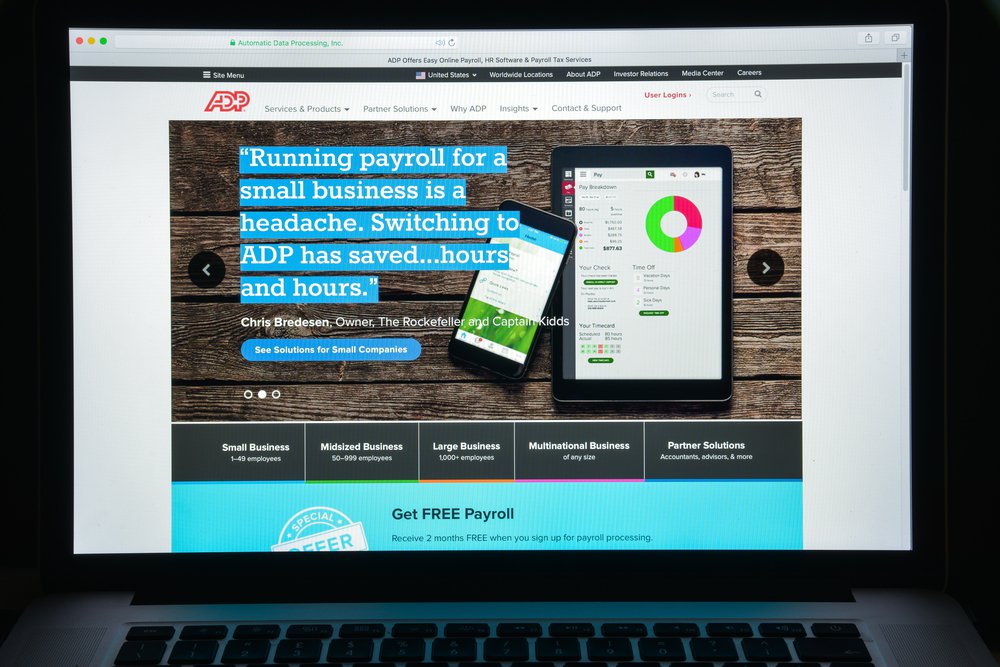
Automation and artificial intelligence are already changing the nature and number of these jobs. The Bureau of Labor Statistics projects that between 2018 and 2028, administrative and clerical jobs will shrink by 4 percent, shedding hundreds of thousands of jobs held by administrative assistants and bookkeeping and accounting clerks. Longer-term estimates of the automation potential of these jobs suggest even more scope for job displacement in the decades ahead. In a 2019 report, the McKinsey Global Institute identified office support jobs as the largest source of projected displacement through 2030 of the occupational categories they examined. In their estimates, technology could replace more than a third of all hours worked by office support staff, which equals 8.1 million displaced full-time workers.3 These changes are not expected to happen abruptly, like the sudden laying off of manufacturing workers. But even a gradual decline in the number of workers across the economy who are hired into these middle-paying, good jobs represents a loss of a source of stability and opportunity for American workers.
A key question for policymakers and employers is what good jobs will be created to replace the lost jobs in administrative and clerical work, especially those that do not require an advanced degree to earn a family-sustaining wage. Additional research should be done to find out how clerical workers weathered transitions and job dislocation during the last several decades, when automation shrank the number of administrative jobs. What lessons can be learned for connecting this workforce to new opportunities and helping administrative workers keep pace with technological changes?
Casimiro PT / Shutterstock
Many administrative workers previously worked in care and other “pink-collar” jobs that offer little stability and are projected to grow in the future
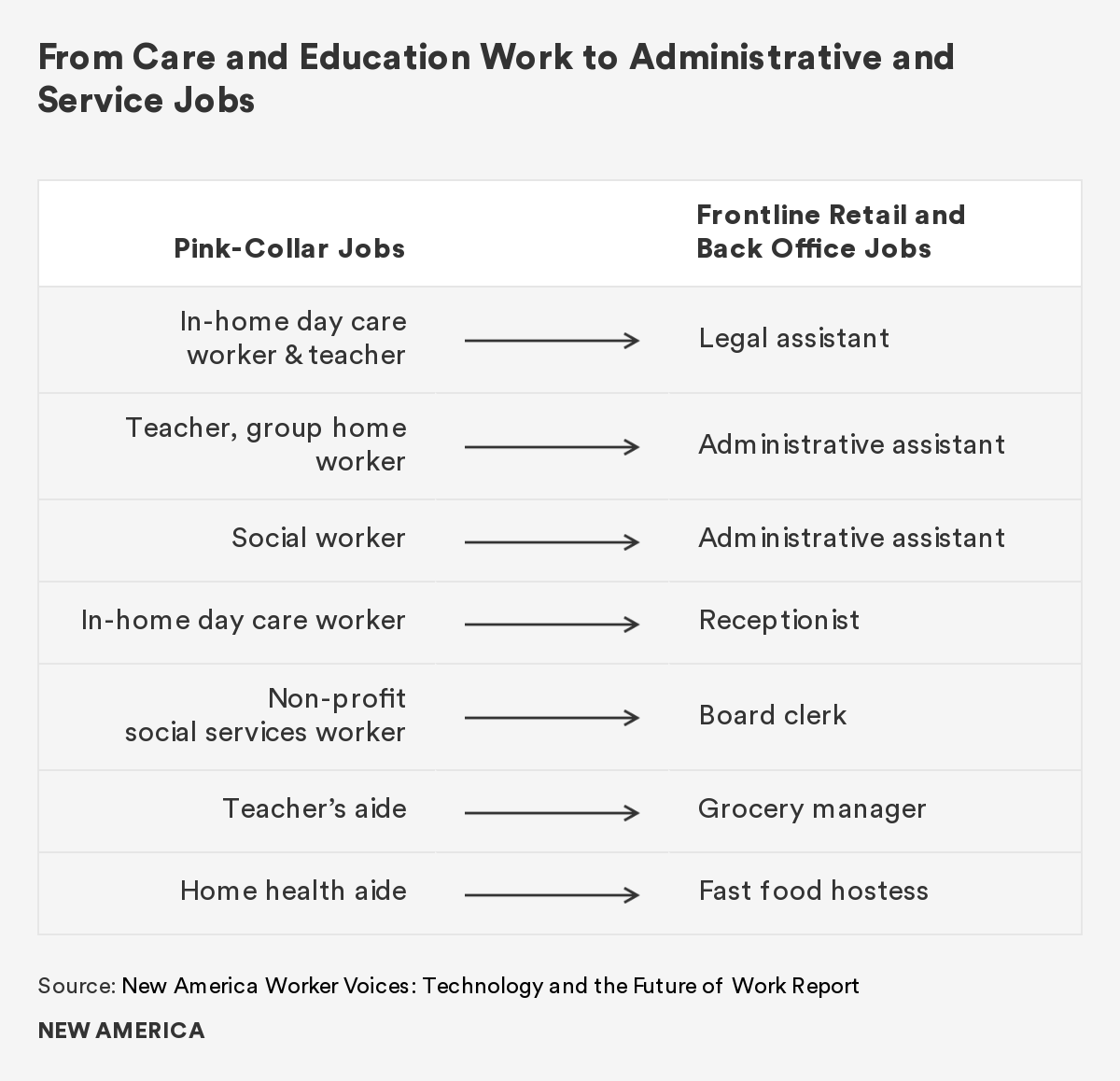
One of the surprising trends we encountered in our interviews was the striking number of administrative and clerical workers who had previously worked in “pink-collar” and care-oriented jobs. Nearly half of the administrative and clerical workers we interviewed worked previously in jobs like social work, teaching, child care, and social services. Additionally, several food, grocery, and retail workers had previous experience in education or in home healthcare before switching careers. All of these former care workers reported a high degree of satisfaction in their new administrative, food, or retail roles. (See box below, Moving Away from “Pink-Collar” Jobs to read about their experiences.)
For nearly all of these women, their earlier care-based work was a source of passion and meaning—but not stability. Often, interviewees spoke movingly about the meaning they found in their jobs and their love for working with children or vulnerable populations. But they left these jobs because the work failed to provide the schedules, compensation, benefits, safety, and balance that they desired and ultimately found in their administrative or service roles. They explained that their need for benefits like health insurance, their preference for work/life balance and family-friendly or age-friendly jobs, and their desire for less physically and emotionally demanding work became more important than emotional fulfillment.
Moving Away from Fast-Growing Care and other “Pink-Collar” Jobs
The following stories describe the career decisions that five interviewees made in moving from care-oriented and education roles into clerical, administrative, fast food, and grocery jobs:
1) From education to administrative support: Tara is a 56-year-old immigrant. She has worked as an administrative support staff for the same private sector employer for 20 years. Earlier in her career, she worked as an elementary school teacher and at a group home with children who suffered abuse. “They just wanted more love. It was heartbreaking.” At the time, she said she “wanted to move on to something more. I used to work night shifts at the group home, and that was not for me. I wanted a different schedule.” To make herself more marketable, Tara paid for a computer course to learn the basics of programs like Word, Excel, and Photoshop. A contact Tara met through the computer class helped her find her first administrative assignment as a short-term temp. This assignment led to a year-and-a-half placement before she was offered her current full-time administrative job.
Two decades later, Tara is very satisfied with her work. She is especially pleased with the generous benefits, her work/life balance, the respect she gets from her manager and her peers, and the autonomy she enjoys as a long-time employee. When she was diagnosed with cancer in 2002, she said the company took very good care of her and she has been “comfortable” ever since. Today, Tara lives in a house that she owns with her siblings and she enjoys gardening and traveling. She expressed an interest in finding opportunities to work with children again. “I want to volunteer. I feel like I’m missing something.”
2) From social work to entry-level administrative work: Nicole is a 27-year-old administrative assistant. Several years ago, she graduated from a private college with a bachelor’s degree in sociology. After college, she held social work positions working with children with autism and ADHD. She liked the work, even though it was exhausting. But she was frustrated with the low pay while struggling to pay back $40,000 in student loans. She had another social work opportunity with slightly higher pay but the requirements to work at night scared her. Nicole expressed frustration that she felt “stuck” at a certain income unless she went back to school for a master’s degree, and even then, the salary is not much higher despite the cost of the additional schooling. She is loath to take on even more debt and is “very against” more schooling at this point.
Nicole never envisioned herself working in an administrative role, but overall, she likes the stability and work-life balance that her job affords. She and her fiancé are thinking ahead to family-friendly considerations. “That's one reason I took an admin role, because of work-life balance. When I go home, I don't have to do too much with my job. I feel like one day when I have kids, that'll be a benefit of staying in this role. There's always the potential of maybe working remotely eventually.” Because her fiancé does not have benefits, she described the employer-provided health benefits of her job as “huge” to her. If money were not a consideration, Nicole said, “I'd probably go back to school. I probably wouldn't stay in the admin role, to be honest. I'd probably go back into social work or counseling, or maybe do sociology research. In college, my dream job was to be a sociology professor.” For now, Nicole is content in her job and has her eye on possible internal promotions within the company over the next few years.
3) From schools to grocery: Sofía is 45 year-old married mother of five. She works full time as a manager at a grocery store. When her children were young, she stayed home to care for them. After 10 years, she decided to look for paid work, but she was “a little bit scared because I stayed home right after high school.” At the time, she was volunteering so much in her children’s school that the principal encouraged her to apply for a paid position. “I started working with lunch recess, helping out with the little ones at my kid's school. Then I moved on to special education and being a teacher assistant, which I loved.” She also worked for the school district as an interpreter. She really enjoyed the jobs in the school, but her needs changed. “By then, we needed health insurance. I decided to go and try [national grocery chain], just so that I could get benefits for the children, for my family. And here I am.”
Sofía has worked full-time at the grocery chain for 11 years and was promoted to a manager position. She enjoys her job, describing it as “exciting and never boring” and part of who she is. She appreciates that her employer is flexible. “What I like about [grocery chain] is that it works with you and your family. It flexes, which was always very important to us.” To Sofía, her family comes first. She tried a corporate job with the company in money management, but “it was taking over my family life.” So she quit and now just works for one store only. When she clocks out of work, she said, “I want to go home and be a mom. I don't want to get calls on my phone.”
4) From education to administrative work: Donna is a 55-year-old mother of four. She works as an administrative assistant in a private company. She graduated with a degree in education and has held several teaching jobs. Throughout her career, she has moved between jobs in teaching, child care, and administrative work. When her children were very little, she worked in home day care so that she could be with them. A few times, she found that she could make more money in administrative and secretarial roles than in teaching.
Donna enjoys her administrative role. “I’m happy to be here,” she reported. She likes the people she works with and says that they all work together as a team. She also values the work/life balance it provides. “At my age, I do appreciate a lot being able to walk out the door and not worry about taking work home.” At this point, she said she would prefer not to do child care for a living, beyond caring for her grandchildren. Day care work is tiring and “it’s a lot of work.” Donna loves children but is no longer interested in teaching. “I did enjoy teaching a lot, but it has changed through the years as well; it's not something that I would want to do full time anymore, unfortunately. I love doing the educating part, but I don't enjoy grading papers as much. They take a ton of time. Back when I was a full-time teacher, I would be grading papers till 11:00 p.m. or midnight and then I’d get up at 5:00 a.m. It's a very, very difficult job. Dealing with parents nowadays is just kind of ridiculous sometimes. There was a day when parents would back up teachers, but they don't anymore. They want you to make it easy for their kids, so that's frustrating. Even some administrators don't back up their teachers because they're afraid of the parents. It's a different world out there.”
5) From home health aide to hostess: Tanya is a 52-year-old hostess at a fast food restaurant and mother of three. Early in her career, she worked at fast food chains and restaurants. About a decade ago, she needed to earn more money, so she started a new career as a home health aide. She took a two-month course and passed a series of CNA certification tests. She did this work for five or six years. She said, “that was my thing, that is what I liked to do.” But then a back injury changed her career direction. “You have to roll your patients, and sometimes they don’t want to help you and my back did something. It was my back that stitched me up.” Due to her back injury, she returned to food service.
Tanya has been in her current fast food job for two years. She said it is not a career move beyond sustaining her for the moment. “For right now it’s paying the bills, keeping the roof over our heads. It’s not a bad place to work, the people are great, the customers are even better. This is definitely not something I’m going to stick with. I’ll probably go back into nursing or retire. I enjoy nursing.”
Job quality and the future of work
These career transitions illustrate how important job quality is to workers. However, the movement from jobs that are at very low risk of automation to higher-risk jobs is the exact opposite of trends for the future. As the U.S. population ages, care-oriented jobs like home health aide and personal care aide are some of the fastest growing jobs, projected to grow by more than a million jobs by 2028. In many ways, these jobs are the future of work for many women. These jobs have few of the positive job quality attributes of the administrative jobs that are on the decline. Median pay is barely $24,000, compared to $38,800 for secretaries and administrative assistants. In addition to low pay, care jobs offer workers little scheduling control and poor working conditions. According to researchers at the Institute for Women’s Policy Research, fewer than half provide benefits like health insurance and pension plans. Often, the work is physically demanding and injury-inducing, and conditions are at times unsafe for the workers.4
To ensure a better future for workers, and especially for women and workers of color, it is imperative that policymakers prioritize making the fast-growing jobs of the future good jobs. There are clear steps they can enact that will improve the quality of these jobs, such as raising wages, improving working conditions and safety, and enhancing opportunities for upward mobility and training. It is not enough to move workers out of these jobs. With an aging populace we will continue to need people to fulfill these care roles and we must make these jobs better. Much greater political will is needed for policymakers to prioritize the needs of a workforce that is disproportionately comprised of African American and Latina women, who are far less visible in future of work discussions and policymaking processes than white male workers.
Work is changing so the safety net and benefits system should change too
The views expressed by workers illustrate the mismatch between workers’ desire for stability and the instability caused by the changing nature of work. The current system of employer-provided benefits and the broader safety net system require a major overhaul to better meet the needs of low-wage and middle-skilled workers at risk of automation and technological change. A more responsive social safety net would include new models for workers to access key benefits outside of the workplace and that meet the needs of low-wage and older workers. Fresh thinking and new policies are needed to help older workers weather displacement and job loss and adjust to technology on the job.
Citations
- Harry J. Holzer, “The Robots Are Coming. Let’s Help the Middle Class Get Ready,” Up Front (blog), Brookings Institution, December 13, 2018, source
- U.S. Department of Labor, Bureau of Labor Statistics (website), “Occupational Outlook Handbook: Secretaries and Administrative Assistants,” last modified September 4, 2019, source
- Susan Lund, James Manyika, Liz Hilton Segel, André Dua, Bryan Hancock, Scott Rutherford, and Brent Macon, The Future of Work in America: People and Places, Today and Tomorrow (New York: McKinsey Global Institute, July 2019), source source
- Cynthia Hess and Ariane Hegewisch, The Future of Care Work: Improving the Quality of America’s Fastest-Growing Jobs (Washington, DC: Institute for Women’s Policy Research, 2019), source
Workers Want to Feel Respected and That They Matter

Across all of the interviews, workers expressed a deep desire for respect, appreciation, and feeling valued at work. Many frontline workers in fast food, grocery and retail expressed strong dissatisfaction with the way they and their colleagues were treated by their employers, citing a lack of respect and responsiveness to their needs. Some even felt unsafe at work and their managers did not care enough to address their concerns. For the most part, administrative and clerical workers were satisfied with the respect and support on the job.
This desire for respect and feeling valued often clashed with workers’ views about how their employers’ made decisions about technology. Many frontline workers in fast food, grocery and retail described feeling like a cost that their employers wanted to cut. Often, they viewed their employers’ decisions about technology through this lens, predicting that companies will make decisions to maximize profits without concern for the impact on employees like them. Many administrative workers saw technology as helping them do their jobs, with support from their employers to learn how to use new technology.
Workers expressed a strong, human desire to feel respected, valued and appreciated at work.
Regardless of job seniority or occupation, workers throughout our interviews described a longing for respect and appreciation at work. A legal assistant, 65, said, "I want to be valued. And I need for somebody to appreciate what I'm doing. Like thank me. You know? But, value, everyone needs to feel valued. And that you matter in the role that you're doing, no matter what you're doing."
They described a preference for managers who listen to them, respond to their needs, show respect, and recognize their hard work. Interviewees want to know they matter. They want to feel that employers care about them—not just the bottom line—and that employers understand and value their contributions.
We heard from workers who wished their employers would walk in their shoes for a day and take their perspectives and preferences into consideration when they make decisions. A cashier and customer service associate, 39, said, “what I want from my employer is respect,” and provided a vivid example. “For instance,” the cashier said, “on Easter Sunday, I went outside after I finished work. I watched as the store manager we have now pulled in carts. He did—he pulled in carts. And that's the kind of management you want—someone who's willing to go out there and do the same thing you do.”
Fast food, grocery, and retail workers see a lack of respect, support, and appreciation
Many food, grocery, and retail workers were frustrated that they are not getting the respect they desire. Even among interviewees who were content with their jobs, many disliked how their employers treated them and other colleagues. We heard many versions of this statement, from a 38-year-old retail cashier, “My employer doesn’t care about [the employee].”
One grocery pricing clerk, 55, with a long tenure described the disrespectful attitude of her employer, which has worsened over time: “I feel like they don't support their employees. It has changed a lot through the years. Now they just want bodies there to do what they need to get done. Bodies—they've used that term plenty of times. It doesn't make me very happy. I mean, we're more than bodies. We're individuals and a lot of us work very hard. Of course, some don't, but we used to be a team” who “worked together.”
Another grocery employee, a 47-year-old bookkeeper, described the lack of respect from bosses and employers: when "bosses come through. They don’t speak to you; they think they’re better than you. You don’t speak. You don’t acknowledge us. We are the ones that are helping you make this money. Without us, you wouldn’t be getting what you’re getting."
A lack of appreciation was also a common theme. A grocery teller, 59, explained how rare it is to hear any recognition or thanks: “I just told another employee, ‘Great job,’ and he was like, ‘I never heard that before. Nobody ever told me that before.’" A grocery courtesy clerk, 25, felt “unappreciated because I would do a lot of work and that would go unnoticed,” and “then when I'm on my break, it would be taken as me not doing anything. And that's pretty frustrating.” A gas station assistant manager, 23, said cashiers sometimes "feel like they work hard but they don’t feel appreciated in the company. We don’t get rewarded. They want to feel like they’re doing a great job.”
Some workers feel unsafe at work and feel their managers do not care
Many workers directed their frustration at managers who did not respect or support them. Even in extreme cases, when several interviewees reported safety concerns, they felt their employers did not support them and address their needs. This was especially true of workers in fast food restaurants and gas stations who felt unsafe at work. One assistant gas station manager, 23, said that it can get “pretty wild” at her store, with fighting, theft, and assaults on cashiers. Despite the safety risks, her employer only provides security during certain hours.
Our employers actually need to pay more attention to us. Not just to us, but also to our cashiers. Because sometimes our regional manager would stop by on weekends, and the cashiers would say, "Oh hey, this just happened. Sometimes I don't feel safe in this place." And then the regional manager would be like, "Be strong.” The cashiers were like, “well, he doesn’t really care.” Sometimes my cashiers will talk to me in private and say, "Sometimes I feel that our regional manager doesn’t care, like all he cares about is money, money, money to the store."
An entry-level fast food worker, 21, described quitting his previous job after his manager failed to respond adequately to a troubling incident at work that made him feel unsafe.
One night, two guys got into the store to destroy everything. They didn't attack me, but a lot of people were scared. Everything was thrown. The company didn't provide us security, they didn't care about us. I had to close the store on my own and I told the supervisor, “I closed it for my security and everyone else's security. Because anything could happen….Everyone was very scared; we didn't want to die.” The first thing that she said was, “You don't have permission to close the store.” She didn't provide us security, she didn't attach importance to us, she didn't care. So I gave my three weeks’ notice and I got out.
Many administrative workers feel supported, respected, and appreciated
The administrative and clerical workers in our study expressed a desire to be respected and valued at work—and for the most part, they felt they were.
Several interviewees described bosses sharing positive feedback and giving glowing performance reviews. A medical secretary described receiving a lot of appreciation from the patients she helps. An administrative assistant, 58, described her new boss’s reaction after she executed her first assignments: “She came in the next morning and went, ‘Whoa. You know, actually—I have been stunned by you.’ I was like, ‘It’s what I’m supposed to be doing.’” Another administrative worker, 56, with 20 years of tenure described her satisfaction with the benefits, pay, and autonomy provided in her job. She was especially pleased with her employer’s support when she sought medical treatment over a dozen years ago.
In 2005, I got cancer. I got three months off at full pay, because of my tenure and because of the bosses at the time. We have good benefits—we have two weeks of sick leave, they match our 401(k), paid time off earned every pay period. Health insurance, vision and hearing. Every year, they do a [performance] review. Everyone was very nice and very positive; I got excellent everything. And they give you an increase. It’s just a few dollars more, but a few dollars is better than nothing. I have so much freedom here. I get my increase every year, the district director has my back; you couldn't ask for more.
An administrative assistant, 61, described the support she received when she inherited an old house that needed expensive roof repairs. It meant a lot, she said, “for people who’d worked with me and respected me enough to be, like, ‘Hey, here. Here’s some money. Let’s get you started.’ The CEO was one of them. It’s a big part of my life.”
Older workers with a long tenure reported especially high satisfaction. They pointed to the autonomy they enjoyed and the space given by employers for doing their job without interference. Two administrative assistants described the respectful way their bosses treat them. One, 56, said, “it’s not like, ‘You do this.’ It’s like, ‘Can you do this?’ Nobody’s breathing down your neck to get your work done. As long as you’re doing your job, they're gonna work with you on that so I think that's a total plus.” The other, 58, said, “they told me if I wasn’t around, they’d die. I tell them what I need. And they don’t mess with me because I have a very good relationship with the district director. I want work-life balance. 4:30, I’m out the door. I like structure. I know what my job is, let me do my job….For me, because of my tenure, I get a lot of stuff.”
Technology on the Job Today

From the vantage point of the workers we interviewed, the future is already here. In the front-end of grocery, food, and retail stores, workers see new and immediately visible technology like mobile payment, self-checkout lanes, ordering kiosks, and food and grocery delivery. Often, workers viewed these technological shifts through the lens of stability and financial security. Many were resentful of labor-displacing technologies like self-checkout machines, which they viewed as taking away hours, jobs, and benefits from workers, while offering little or negative value to customers.
The changes noted by clerical and administrative workers were often more gradual in nature, including mainly software-based technology. Frequently, they described these technologies as complementing, rather than substituting, their labor, and helping them do their jobs more quickly or more effectively. Other times, administrative workers highlighted instances when technology automated their jobs and displaced either all or part of the activities they had previously performed.
Several workers lamented that their employer failed to consider the impact on workers in the design and deployment of technology. Older workers struggled to adapt to technological changes.
Food, retail, and grocery workers weather rapid technological change
The food, retail, and grocery workers we interviewed reported rapid change in recent years at the front end of stores, and to a lesser extent, in the back. The changes they pointed to were often visible hardware and physical infrastructure like self-order kiosks, grocery self-checkout lanes, and curbside pickup lanes. In several instances, workers described their stores temporarily closing to undergo renovations to introduce new technological innovations and hardware—technology changes were literally happening before their eyes. One retail cashier, 18, said, “things are changing every day. There are new things on the app, a new mobile device at self-checkouts that gets lines moving faster.”
Other changes that workers noted were software innovations, new business models, and a move to online shopping. Several workers described rapid changes in the ways customers are shopping or dining, with sweeping implications for the stability of their jobs and the nature of their interactions with customers.
In addition to the ubiquitous self-checkout lanes and self-ordering kiosks, Uber Eats, mobile payment, store apps, online shopping, curbside pickup and grocery delivery are among the many new technology-enabled innovations that workers highlighted as driving changes in the way their workplaces operate. Retail and grocery workers noted a sharp increase in their online sales. One retail chain team manager, 45, told us, “internet sales have drastically changed our sales model and the way we work, so I have less control now….Online ordering has changed our stores so that it's more like a fulfillment store now. We get more freight and product in the store, so maybe 10 percent of our sales are solely online. We ship them directly from the store.” A retail cashier, 39, agreed, saying, “online shopping is a big thing. We have pickup today, where you can order online and then go to the store and pick it up. Our grocery pickup doubled just in the last year. I know that the company needs more people for those positions. They absolutely hate to pay unemployment, so they’ll reposition workers in things like grocery pickup and online ordering, because that’s huge.” This worker added, “I absolutely love that work; it doesn’t seem like it’s going to be that hard of a job.”
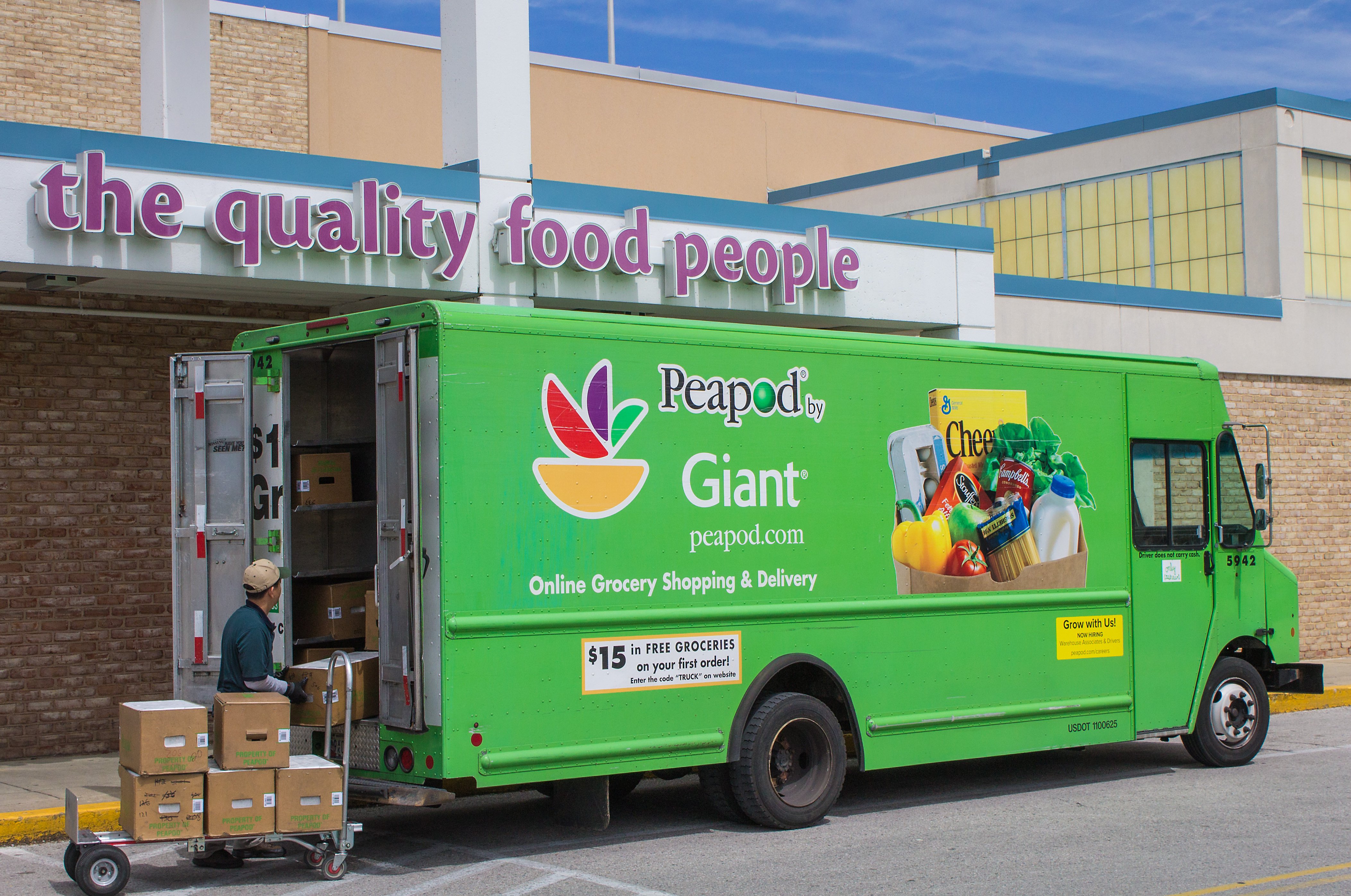
Country Gate Productions / Shutterstock
The individuals we interviewed who work in fashion stores described the shifts to online sales occurring alongside the shuttering of shopping malls and the closing of other store locations. Other workers discussed technological changes that have been introduced in the back of stores. An employee of a major retailer described new technology that helps unload and sort products from trucks in the back of the store. Other retail workers described scanning technology that aided them in tasks involving inventory and stocking.
Often, workers spoke with amazement at the scope and pace of change. A 29-year-old fast food veteran (featured in Jasmin’s Profile) described her reaction to discovering Apple Pay. After three years of incarceration, she visited the fast food chain downtown where she had previously worked. “The first time I saw that I was like, ‘Wait, what?’ The technology is crazy. There isn't going to be any more fast food.” She described the introduction of ordering kiosks: “Now you can mobile order on the phone. Now the [fast food chain] has a computer; you don’t go to the cashier to order at the computer. We used to have three cashiers there; now there’s computers and one cashier. That’s the busiest [fast food chain outlet] in the city. But the computer makes the order more accurate….In 20 years, I don’t think they’ll have cashiers.”
Many clerical and administrative workers described an incremental transition where technology complements their work and is accompanied by training
The clerical and administrative workers we interviewed described a workplace where technology is always evolving, generally incrementally, and often accompanied by on-the-job training. This incremental change, especially for long-tenured workers, normalized technological advances and rendered it less threatening. A legal assistant, 65, described the changes over her career. "When I first started, I was typing on a typewriter. So that has been a revolution all in itself, going from a typewriter to working on computers and then all these different (software) applications. It's a whole new universe.”
A 32-year-old administrative assistant in a medical office explained the move from paper to electronic records: “When I first started working, I noticed there were still paper charts in some places. It’s totally different now. We had to file…and that just doesn't happen anymore. Everything now is electronic, in pretty much every office I've been to. So it requires learning the medical software systems. There's a bunch of different medical software systems and we get to learn different programs, which is good for any job placement if you're going to move.”
Several workers described how technology has assisted them in doing their jobs. “Technology has made life a lot easier for us,” an administrative assistant, 58, said. “In real time, we send documents and it tells us when they’ve viewed the documents. If they don’t view it, it expires within 14 days, and we get a notification that its expired. It’s made life a lot easier for us.”
One legal assistant, 59, saw technology as a mixed blessing and said, “IT changes so fast it's crazy. To me it's good and bad. You just finally figure out how to do Word whatever version and they come up with an updated one and everything's changed. So then it's like OK, this used to work but now it doesn't. Email is wonderful because you can pretty much get answers quickly, but in other ways it's a lot more work. IT continually changes and it has changed our lives so much. Hopefully it makes our lives better.”
Automation has already impacted clerical and administrative work, displacing some jobs
Sometimes, the introduction of a new technology raises fears of job dislocation. An administrative assistant, 28, noted several recent changes in her work. She and her colleagues were in the midst of adapting to a new software system that shifts from producing manual reports for headquarters to partially automated reports. Adjusting to the new automated system was challenging for a lot of her colleagues. Her company is also introducing a new app that will use push notifications. She noted that her colleagues were concerned about this news, “but when you hear stuff about all this new technology, my bosses are always like, ‘Don't worry, no one’s losing their job.’” The boss “always says that, because people are like, ‘Oh, what am I going to do?’"
These fears can be well founded. As described in the box below, Three Examples of Labor-Displacing Automation, several administrative workers with whom we spoke have already experienced automation in their current or previous roles.
Three Examples of Labor-Displacing Automation
1) Partial automation: software replaced the HR functions of a job. Naomi is a 27-year old assistant manager of an apartment complex. She has been in the position for four years. Her role is a mix of administrative work, accounting, answering phones, human resources, and property maintenance. When she was hired, HR activities were a large part of her job. She was responsible for onboarding, training, documentation, and some recruiting.
This portion of her job has changed dramatically with the introduction of software programs that automate several functions. “When I first started, the company just moved into ADP. At first, we started out with the basic. We moved up to starting adding packages, so now it includes my whole job on the HR side. We switched over so the full HR and onboarding process is automated, where it used to be actual paperwork. We used to have the person come in, but now they can do it from home and if they need help, they can call ADP. The onboarding process pretty much disappeared. They won’t come to me for benefit questions anymore because it’s all there through ADP.”
Naomi finds the technological changes worrying and threatening to her job. “This is not a great thing because it means one person can do it. They could get rid of me and eliminate my job. The most annoying thing is that your fate is in someone else’s hands. If technology or AI comes in, your job can be lost just like that.”
2) Gradual automation: automated technology reduced the number of payroll clerks through attrition. Gabriela is a 27-year-old administrative assistant. Before she began her current role, she worked for several years as a payroll clerk, which required her to manually enter employees’ hours and codes from paper timesheets into QuickBooks and resolve any discrepancies that arose. As she was leaving the company, her job was in the process of being automated and the company was downsizing from employing three people in her role to two. “They were transitioning out of having paper timesheets into the scanned ones. Coworkers would just get in, swipe, and then that's it. So at one point they did tell us that they weren't going to hire another payroll clerk. And then it was just two of us and things would be smoother, which meant that there wasn't going to be a lot of work.”
3) Full automation: a machine replaced an accounting position in the back office. Rebecca is a 36-year-old retail cashier. Previously, she held an accounting and bookkeeping position in the same store. Her job entailed “counting out the money that came in the store and making sure all the tills came out fine. If anybody had any charges on their receipts, looking for money that was supposed to be there.” When she started the position, it was a two-person job to count the cash and coins, research discrepancies, record the information in the computer, refill the tills, and bag up the remaining money for the bank.
She did this role full time for several months. Then one day, her boss notified her that role was changing. The store would bring in a new machine that takes all the money and coins from the tills each night and automatically counts everything and prints out a report. Initially, the introduction of the machine reduced her hours in that role but did not eliminate the accounting position altogether. Her boss explained, “‘instead of having two people, we will have one and then a part-time one two days a week. You're going to be the two-day-a-week person, and the other three days you're going to be on the sales floor doing whatever we tell you to do.’” For two years, Rebecca worked this part-time role alongside other work as a cashier. Then the company eliminated the accounting role altogether, shifting the few remaining hours of work to the responsibilities of a manager.
Rebecca resents the machine that replaced her role. She calls the new machine “Irma,” and says, “I'm not friends with Irma.” She really enjoyed the accounting work that was eliminated. “I absolutely loved the work—I loved looking through transactions to try to figure out where the money went and doing the research of it. It was fun, it was a mystery. It was like, ‘Oh, we have these three transactions that could possibly be it, but maybe it's not. So let's look at the videotape and see what happened.’"
Rebecca was repositioned to a customer-facing cashier role. She misses the quiet and solitude of the position that was eliminated. “Before, I got less than 1 percent interaction with customers. They might call and say, "Hey, I lost my credit card," or "Hey, I'm double charged for this.” Looking into all of that, that was the only customer transaction or stuff I had to deal with. You are away from everybody; it was quiet and you did your thing. And now that I'm on the floor, it's noisy and it's loud, and there's customers everywhere. Some of them are awesome and I have this one old guy who I absolutely adore. But there are some that are just ridiculous. There are days where you're like, ‘Really?’’”
The stories and experiences of Naomi, Gabriela, and Rebecca illustrate the varied nature of the impact of technology on work. In some instances, a specific set of activities and roles were automated, but the job was not eliminated. In other cases, the entire position was eliminated. And in still other instances, the number of employees was reduced through attrition.
More research is needed to better understand the specific ways automation and technology are changing jobs, including in administrative and low-wage service jobs. More granular and specific insights into the intersection of automation, technology, and jobs will move the future of work conversations beyond high-level, abstract discussions of automation.
Workers are frustrated by technologies like self-checkout that reduce hours and sometimes eliminate whole jobs but offer little or negative value to customers
The fast food, grocery, and retail workers we interviewed expressed negative views about technology that could replace humans. They strongly disliked self-checkout technology and felt it was already displacing jobs and hours from workers. These perceptions were influenced by the frustration that workers felt with their struggle to get enough hours to pay bills and meet hours-related eligibility requirements for benefits.
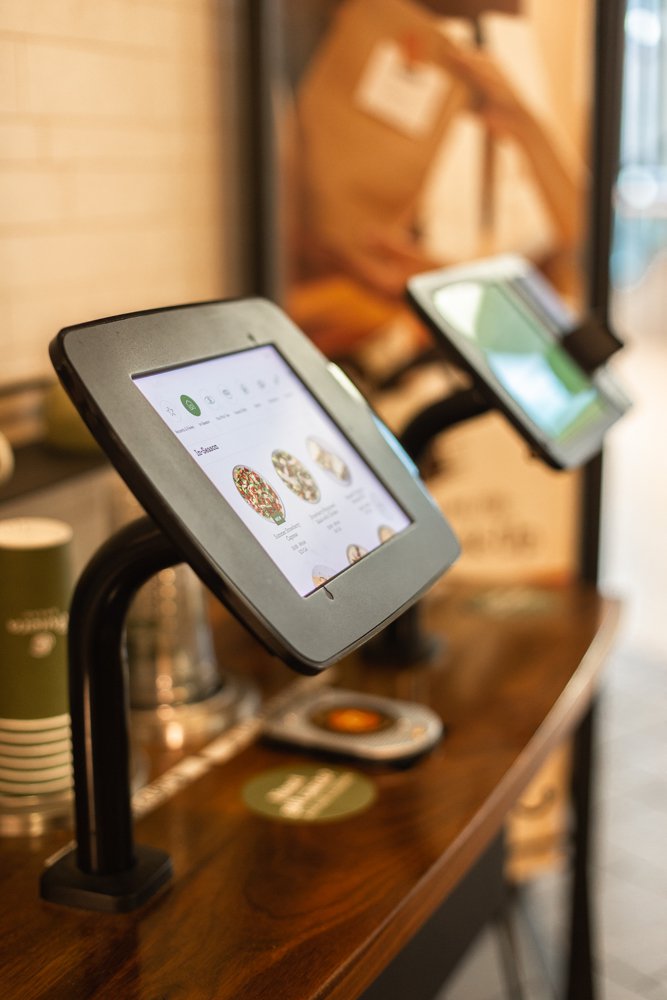
Samantha Webster / New America
Against this backdrop, the introduction of labor-displacing technology like self-checkout lanes was perceived as exacerbating an ongoing struggle to secure sufficient hours and was met with strong resistance. One manager, 45, did not mince words: “We have self-checkout. I despise it. You’ve eliminated four jobs.” A front-end supervisor, 29, said, "I could be coming in at 6:30, but they have those self-checkouts, so they don’t schedule me until 9. I think that we all wish they weren’t there. It takes away from us." A 55-year-old cashier said the same thing: “It’s sad; it takes away jobs. It’s hard enough to find jobs as it is….If it’s not broken don’t fix it. It’s just another way to cut costs without having to pay people. If they can cut a cost, they will.” Finally, a 41-year-old cashier said, “We have eight self-checkouts at our store, and a lot of people use them there. They use them because they cut us out. Cut our hours, cut our manpower."
Many grocery and retail workers also felt that self-checkout is a technology that is bad for customers and ultimately for their employer’s business. A retail cashier, 39, said
The customers hate self-checkout. I was on one of the registers and a customer said to me, “Well, I don't work here, so I don't want to ring my own stuff up.” I was working in the self-checkout another day and a guy told me, “Hey, give me your discount card. I rang my own stuff up, so I work here. I should use your discount card.” I walked away.
The company doesn't realize that what they're doing doesn't work for every store. My store is a high-theft and high-risk store. You can see YouTube videos of things that have happened in our store. So putting in more self-checkouts is not the answer for a high-theft store like mine. But for other stores, for a little podunk town store, they'll be like, “Hey, this is awesome. This is perfect.” But for something like us, no.
The strong negative feelings workers expressed about self-checkout machines reflect concerns raised by prominent MIT economists Daron Acemoglu and Pascual Restrepo. In a recent paper, they describe “so-so” technology like self-checkout machines, which displace workers but offer limited productivity gains and low quality.1 A report from an MIT taskforce echoed the customer quoted above, describing self-checkout as a “so-so” technology that simply passes the checkout tasks from the trained cashier to the “amateur” customer.2 Unlike other automated technologies, which raise productivity and deliver economic benefits that can help offset the impacts of displacement, “so-so” technology may deliver limited benefit while adversely impacting workers.
More nuanced discussion is needed about the merits of specific types of automation and technology, such as self-checkout. Can we define “good” and “bad”—or, perhaps, “worse”—automation? How should we evaluate companies’ choices for technology adoption, the impact of the technology on their workforce, and their process for decision-making? How do incentives and policies encourage adoption of different types of automation?
Workers resent poorly designed technology that creates extra work
Workers also expressed frustration when new technologies in the workplace were poorly designed, made jobs harder, and inconvenienced customers. A grocery cashier, 55, said
I'm going to be honest, the machines don't work well. The screen gets frozen. One day we stopped for two hours and the store couldn't sell anything because the whole thing came down. The self-checkout machines are the worst. The company decided to go the cheapest software for the machines. Every time the machine goes down, you need to turn it off and wait like 15, 30 minutes for the machine to recover and come back again. Sometimes the items are not in the right position, and it won’t work. The customers get mad at us. I saw [another company] and they have really good machines; they don’t have the problems with self-checkout that we have.
Other times, poorly designed technology created a lot of extra work for the interviewees. One administrative assistant, 54, described a new document management system that was so hated by other assistants that they considered buying t-shirts with quotes printed on them that expressed their frustration.
We were told the new document management system would be much easier. Well that's not the case, unfortunately. I mean, I hate it. So many parts of the system don't work the way we were told they would. It sounded great, but once we got it and those people who have worked with document management systems that were really good have said, “Oh, we had this system and it was awesome and it saved us so much time and this one does not.”
A legal assistant, 59, echoed this feeling: “Coming here the biggest change was everything is supposed to be paperless, but it's not. It's twice as much work to be paperless. When I first started here, I dreamt all the time about saving emails. It was horrible. It was really horrible.”
On the flip side, many workers appreciated and positively embraced technologies that made their jobs better or easier. A retail cashier, 39, told us, “our store app is actually really cool. You can scan the barcode of any item and it will show you which aisle has that item. It even has a store map to show you exactly where that aisle is. Whenever you pass customers in the store, they're always asking, ‘Excuse me, do you know where this is?’ Before, I'd be like, ‘Oh, it's in the hardware section by the paint,’ but I don't know where that is. I love being able to tell a customer, ‘this is exactly where it is. Would you like me to take you to it?’ When I can tell them exactly where it is, that's been awesome.”
The co-manager of a clothing retail store, 22, agreed, saying, “in the last year, they gave us iPads. We can scan items in the store and it gives us all the inventory details. When a new shipment comes in, it will tell us what is in the boxes….The new technology has made it more interactive and easier.” Furthermore, “the store is introducing an app. If you want an item, if they have the item in the store, we can hold it for them. I think it is a good thing, I really do. We need to be more technology savvy—we are kind of behind. Technology is great, it makes life easier.”
Older workers report difficulty adapting to technological change
Several interviewees in the retail and grocery industry expressed their concern that older colleagues face the most difficulty adapting to technology. A grocery pricing clerk, 55, said
Technology with self-checkout has eliminated a bunch of jobs. I know some older people whose jobs were affected. They retired. It ends up being their choice to retire early because they can’t learn to adapt with the technology. It’s too hard or too frustrating for them. Absolutely. I mean, what do you do when a self-checkout replaces your job, where do you go? What if that happened to you? If that happened to me, being older, it would be harder to find another job. I probably would try to find something within the company. That’s the problem with being forced to retire earlier than what they are supposed to or want to.
Similarly, an administrative assistant in a medical office, 32, described how some of the older workers who had to make the transition from paper found it challenging, saying, “I think the people who used to work in the offices back when it was paper, they had a really hard time. Like my mom. She had an awful time. She's not a technology person anyway.” An older administrative assistant, 58, agreed: “The young people pick up these new tech things so quickly. They are tech-savvy. Not me—give me a book to read. Older people, like me, some of them are like, ‘what’s the use of this? Prove its useful.’”
Some interviewees contrasted their own ease in picking up new technologies with the struggles of older workers around them. A pricing clerk, 55, admitted
I use computers a lot more now than I did before. If you aren’t tech savvy, you’re kind of in trouble. I love it, and I’ve been fine. I adapt to technology pretty well, but that’s who I am. A lot of people can’t. A lot of the older people can’t grasp a lot of the technology. For instance, we use computers for online grocery order and pickup. It’s not so simple for somebody who’s older to go and figure out how to track the customers’ online orders, figure out how to get their order and make sure they’re billing them right. For years, I have been training colleagues in other stores on new technology and how to use our technical equipment. It was a lot harder for some people to learn what I taught. A lot of the people that were older had a bit of a hard time. I had to adjust how I taught them, with a little more patience, so they can absorb it.
It is not only older workers who struggle to adapt. An administrative assistant, 25, described how her young colleagues have had a hard time adapting to a new digital system: “People are really bad at adapting to change, even if they're young. The people on my team are not that old, 23, one's 32. They should be able to adapt to it, but they weren't logging their information correctly. So sometimes the new technology also makes my job harder but also easier at the same time.”
Many workers are nostalgic for the human connection they had with customers before technology changed their work
For the most part, interviewees lamented that technology replaces or greatly reduces human interactions. Especially for those workers who possess strong customer service skills and who enjoy the social components of their jobs, the introduction of mobile apps and payment, grocery pickup, and self-checkout and self-ordering kiosks were viewed negatively. One fast food worker, 28, said, “with computers, you don’t get to talk to customers, but that is what I like.”
Other interviewees highlighted the value that their customer service and human interaction brings to customers, and the ways technology lacks human connection. An experienced grocery cashier, 60, said, “little by little, you see them cutting us out a bit. The way I try to keep my job is I still have some of my same customers, so I can call them by name and remember their kids. There’s things we talk about that the machine can’t talk to them about. Whereas the new people in jobs that are automated, they’re not intimate as I would be with people.”
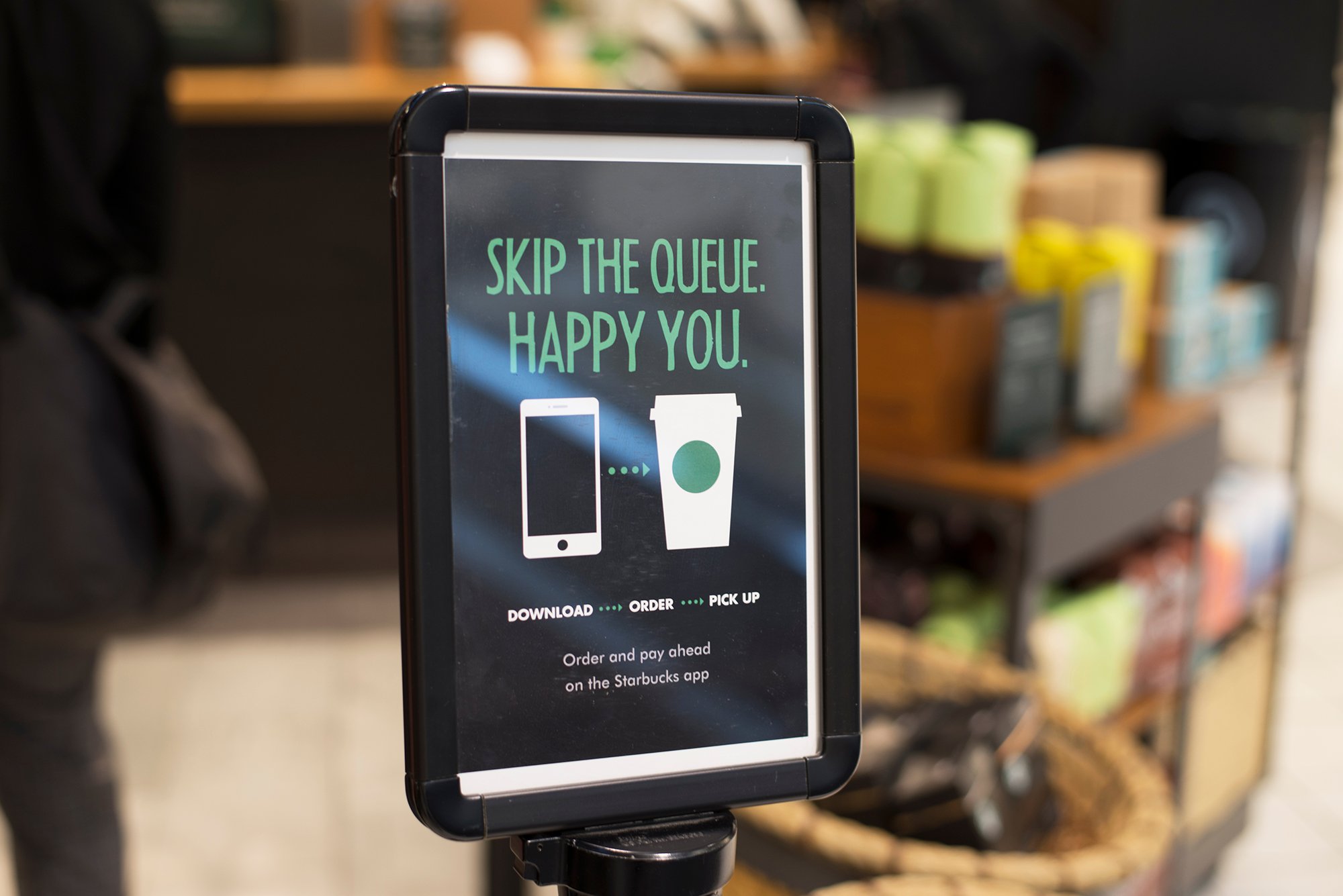
Yulia Vizel / Shutterstock
A younger worker agreed: “With retail, I love when I go to a store, I love the human interaction. That is really important. With online, you don’t get to talk to a real person. When you go into a boutique, you get to see the person who owns that place, learn their story, and talk to them.” This fashion retail chain co-manager, 21, continued: “With online, you miss that. You just see that thing that you want to buy. You don’t get to see the story behind it. You don’t get to feel it. With fashion, you need to feel what you are going to buy and put it on. It is different online."
But sometimes the feelings expressed were more ambivalent, reflecting mixed feelings about customer service. Often, interviewees with front-end jobs identified dealing with customers as both the best and worst parts of their job. Negative interactions with difficult or rude customers was frequently cited as a demanding aspect of their job. A young retail cashier summarized these mixed feelings
I don’t like to work self-checkout. It is boring. Not a lot of interaction. But sometimes I like it because I don’t want to interact with people. [Retail chain] is changing to all self-checkout. I’m just an 18-year-old kid, but I don’t think it will be good. People will get laid off and other companies will follow. They don’t need as many people to watch lanes. It will all be electronic, you won’t be getting that human interaction—that is the part that it is frustrating, but sometimes it isn’t. I can fix your coupon problem and will keep your kids from crying by giving them a sticker. There are good people who won’t get to work here because the company won’t need them.
David, a 26-year-old barista, described the negative impact that these new technologies can have on his interactions with customers
Technology can be good, it can be bad. It can change the interactions between people and in the long term, the personal connections can be severed. At our store, when technology comes in, people start walking in and out of the store using mobile orders. We won’t even know they came in; they will just slide in and slide out. “Hey, you didn’t say hi or good morning!”
Right now, there are guides everywhere to encourage everyone to use mobile order or Uber Eats. This is the first thing you see when you come into our store. The company wants a few more minutes back of my time. You can now order ahead of time, so you don’t have to wait in line, which saves time for the customer. I still try to make a personal connection with customers before they leave, but they are on the go. Maybe 60–70 percent of the time, people won’t say good morning. They have music in their ears, they are trying to make it to the office on time. They are on their phones and they skip the line.
It is different from when I started. Now we print out a sticker with the order. Before we would write their name out personally with a pen, which was more interaction. Now we have Uber Eats and people don’t want to leave their house. It makes me feel bad. I don’t get to see the people I used to interact with years ago. It makes you wish the technology wasn’t there. I have big people skills and it makes me wonder, if the technology wasn’t in place, we would have to give people the bathroom code, write their order. Technology is cutting down on the interaction. It is making it bad, at least for me.

CatwalkPhotos / Shutterstock
Employers should understand the value of their employees and the shortcomings of technology—and give more voice to the workers in their decisions
Several workers emphasized that if their employers spent time empathizing with workers, they would recognize that workers actually do a better job than the technology the company adopts. "I would hate to see any new technology come in and take jobs from people,” a grocery bookkeeper, 47, told us. “If they can come in and spend some time seeing what we see. Just spend a week in there with us, doing what we do. See how we are treated and how the equipment is no good. They wouldn’t need no technology. A robot can’t do what we can do. They can’t give that service to the customers that we do."
A young retail cashier, 18, agreed. “Self-checkout is the worst. It is a super picky machine. Sometimes I have to put in the numbers four times. Do you know the show Undercover Boss? It would be cool if our corporate people did that.” The cashier added, “visiting isn’t the same as working here. If every time they went through self-checkout and something bad happened, they wouldn’t want to come here anymore. Especially when our competition is cheaper.”
The workers’ statements echo a common theme: they did not feel they had voice or agency in the decisions that impact them, including around technology design and adoption. To give more voice to workers, employers should engage more directly in the design of technology and empower workers to be involved in decision-making around their adoption. While unions can be an important voice for workers in decisions around technology, many of those who will be impacted by technology lack any union representation. Additional forms of worker representation and ways to enhance worker voice are required.
Citations
- Daron Acemoglu and Pascual Restrepo. “Automation and New Tasks: How Technology Displaces and Reinstates Labor,” Journal of Economic Perspectives 33, no. 2 (Spring 2019): 3–30, source
- David Autor, David A. Mindell, and Elisabeth B. Reynolds, The Work of the Future: Shaping Technology and Institutions (Cambridge, MA: MIT Work of the Future, September 2019), source
How Workers Imagine Their Jobs in the Future
We asked interviewees open-ended questions about how they think their jobs and their workplaces will look in 20 years. Without prompting, workers painted a deeply pessimistic picture of the future of grocery, retail, and fast food work. Most envisioned far fewer people working in the front end of retail, fast food, and grocery stores in the future, and some even predicted that there will be no humans at all. Clerical and administrative workers were more measured, predicting an increase in technology and automation in the future with a less dramatic impact on jobs.
Food, grocery, and retail workers are pessimistic about the future for humans in their stores
Nearly unanimously, these workers were pessimistic about the future of human labor in their stores. Often, they described doomsday scenarios of a future with few—or even no—humans working in front-end jobs like cashiers and servers. A mid-career fast-food worker, 44, said, “robots, we know it is coming. I don’t know how exactly, but it will change. The people know it will change. Robots and machines will be doing the work, not people. They will not need people in those jobs.” A 59-year-old grocery cashier saw the same thing: “I think robots and computers are going to do everything. I think it's gonna be robots that pack your order and you pay over the telephone and just go pick it up. I’m not even sure you would go into the store. I see that with the self-checkout now—it’s less people, and they don’t need them anymore. I have no idea where all the grocery workers would go. It’s sad if that happens, because they’d have no use for people anymore.”
Workers in clothing retail also expressed pessimism about the future of jobs in retail and stores. A young co-manager in a clothing store, 22, said
in 20 years, I don’t think the mall will be here. In the last year, there has been a decline in the number of stores here in the mall—one store will close, then another will close. Everyone is shopping online and not coming in. I see the shifts. We get so many online orders sent to our store. In the future, the people who keep coming in will be the people that didn’t grow up with technology. The younger generation won’t come in, unless it was a cool experience. For instance, our company is talking about wanting to make our store more interactive in the next 10 years—using technology when people try on our merchandise, or holograms so customers can see what an item looks like if we don’t have it in the store. In the future, I think there will be a cut in stores and there won’t be as many of our store around. There will be fewer jobs for people like us, who have a love for fashion. People do this job for the love of fashion.
Workers in grocery, retail, and fast food feel they are a cost that employers will try to eliminate with technology
Often, interviewees framed the job risk from technology as a choice by companies to prioritize making money. Many workers assumed their employers would make technology decisions with a focus on their bottom line—as they feel they do today on issues ranging from compensation to hours and benefits eligibility. Many interviewees said that their employers did not care about them and they felt that they represent a cost that their employer would eagerly cut if technology made it possible to replace them. A manager, 40, told us that in “the grocery store of the future, I say you’ll see a lot less employees. Because everything will be the machines, like self-checkout. They’ll try to save as much money as they can, and that’s the way they probably see it. One checker for six self-checkouts, that saves money. More computers, less people. Back in the day, you would think in grocery business, you're set, you'll have a job forever. I don't see it like that anymore. I see it as it's not safe and you don't know how things are gonna be run.”
Younger workers agree. "In the future, I see a lot of technology in fast food. Now there are people who will be able to help you. In the future, there will be more machines, but it will be terrible,” a fast food worker, 21, said, continuing, “machines don’t get sick and you don’t have to pay them. Employees are replaceable. Technology can help the workers, but instead they replace workers." A 25-year-old courtesy clerk said, "who knows if we'll have checkers because everything is self-served. I think it's just sad because it just takes away jobs. It's hard enough now to find a job as it is, and then there's just one specific field just completely being wiped out,” in the grocery business. “Of course, you always want to advance things. But people need jobs too. I think it's just another way to cut cost without having to pay people."
An older worker recognized how expensive he was to his company, admitting, “technology is just going. They're trying to figure out different things to cut cost. And so I'm the most costly thing there, because they have to pay my benefits.” This grocery cashier, 60, continued: “if it's all automated, all they have to do is keep up with the machines. So it's inevitable. I don't know how far it will go. Maybe we'll have two people there, I don't know.”
Clerical and administrative workers imagine more technology in the future and gradual or limited job loss
Nearly all of the clerical and administrative workers we spoke with envisioned more technology in their future roles. They held mixed views about the impact of this technology on the quantity of administrative jobs. Some interviewees anticipated that technology would create less demand for humans, resulting in fewer administrative workers hired in the future. Others predicted that their roles would still require human labor and that technology will help them do their jobs quicker and more efficiently but not reducing the number of people employed. Others imagined that technology would evolve in the future but were not sure what it might look like or what the impact will be on the humans in the role.
One administrative assistant, 58, with several decades of experience predicts that her job will look quite different in the future, but that it will still exist. She anticipates more technology in the role enabling administrative assistants like her to work faster and support more senior managers than they do now, including those who previously did not have admin support. But she envisions the core duties of scheduling, meals, meetings, and travel will stay the same.
My job in 20 years will be a lot different. I'm going to guess that we'll advance a lot because of all the new technology. We usually pick right up on that. Our senior managers are always trying new things, like, ‘‘OK, let's go do this. OK, that's not working anymore, let's go move to this and go get something else." So yeah, I can definitely see it being more advanced and quicker. And admins having more people they support. I'm kind of an exception of having so many people. I think it's gonna be more the norm in 20 years.
Similarly, another administrative assistant, also 58, in a different company predicted more technology but the same number of administrative professionals performing her role in the future. “I imagine there will be a lot of growth in tech use on the job. I don’t think the number of people will change, though, because we need the people to drive the business,” she said. “Technology can only do so much. We have so many websites we can use for our business, but people in our company have to talk to clients. You will need a person supporting the people to do that work.”
A legal assistant, 59, imagines that evolving technology in her law firm could pose a risk to her position in the future. She would not necessarily advise a younger person to pursue the role.
I don't know that legal assistants will be around forever. I don't know if I would encourage someone young to go this route. I think more and more, the younger attorneys type most of their own stuff whereas the older ones dictate. So that has changed. If you work for a younger attorney who likes to be self-sufficient and do their own work, then really all you're doing is making coffees, folding papers, putting them in an envelope, and sending them out. Even the envelopes you can print from the program. Those of us who are good typists, I don't know, is that going? That may not even be necessary down the road if everything is swiped. So in 15 years, I'm sure it'll change. How it'll change, I don't know.
A younger administrative assistant sees technology as a key part of her role. She predicts that some of the routine work in her job could be automated, requiring fewer people overall and allowing administrative assistants to take on more work. Given all the technology changes in her job, one administrative assistant, 25, suggested that the person doing her job in the future should be tech savvy. “They're going to need someone that's really good at computer stuff, because you have to learn how to navigate the stuff all the time,” she said. “I think they could automate some of what I do with reporting and other stuff. There has to be a way to automatically send a document. I will say it seems like I could support two teams, instead of one, especially when I stop doing some of the reports that get automated. So maybe you would need less admin.” She added, “I definitely see the role changing,” though “it is hard to imagine.”
Workers see technology changing around them at work, in life, and in popular culture, fueling their pessimism
The views of workers we interviewed were informed by the technology they see all around them—in their own workplaces, at other stores, and in TV and movies. Predicting the future of their job with fewer humans, many food, grocery, and retail workers frequently pointed to technology changes at competitor stores or other workplaces. Several interviewees referenced Amazon Go’s cashier-less convenience store as a harbinger of the changes ahead. A grocery cashier, 60, said, “In 20 years, I think the number of humans with my cashier job will be limited. You see right now where Amazon’s got it where there is no cashier, right? You just have your card or whatever it is and it rings everything up as you go out the door and it takes the money out of your card.” A younger customer service employee, 39, agreed that "in 5–10 years, [retail chain] will eliminate a lot more cashier positions. They have this thing at [another retail store], where they use artificial intelligence to scan the shelves to count inventory. I think we are going to get those too. Twenty years from now, there will just be maybe one or two cashiers to handle age-restricted items, that’s it." A 26-year-old fast food server was philosophical about this change: “We're moving into that technology age. Technology is always evolving and people are getting replaced with computers. If you ever walk into [a grocery chain], you'll see the self-checkouts get bigger, and bigger, and bigger and you'll see less employees working on the floor. Computers move a lot faster than we do as humans.”

Arne Beruldsen / Shutterstock
An older grocery pricing clerk, 55, saw this happening already in other places
I don’t think that they will have a person doing my job in 20 years. I see them going to pricing being computerized. That’s already happening in Europe and in Japan. I know even with the New England area, they’re using robots to stock the shelves so they won’t need as many bodies. The robots are actually taking items out of the box and putting them on the shelf. Maybe we will only need a couple people just to manage things. The company’s motivation is saving lots of money by not having to pay people.
Often, workers pointed to broader technology changes and futuristic images that they have seen in television and movies. Popular culture contributed to their views of a robotic future. Tangible hardware, futuristic robots, and human-less stores and machines in the news have left an impression on many of our interviewees. On television and in movies, they see glimpses of robots and autonomous vehicles. A bookkeeper for a grocery, 29, said that in 20 years, “I really don't feel like the grocery store will need humans to operate the register and do things of that sort.” The bookkeeper added
When you watch stuff on TV, you wonder where people get these ideas from. I just truly believe that they are already working on technology and they're just now showing us that this is what it's going to be in the next 10 years or so. We might not even have to go shopping in 20 years! They might have robots go pick up all our groceries and drive it to us….You've seen the commercial with the Domino's machine where it drives the pizza to you? Everything will be this way soon. And for retail, as far as grocery stores, they won't need cashiers, they'll have self-checkouts. All 20 registers will be self-checkouts.
Occasionally, interviewees pivoted from the specifics of their own job to reflect more broadly on the prospects of a robotic future. Often, they expressed concerns about the risks to society from these changes, but not about any specific technology risks that they imagine playing out in their own jobs. For example, a retail cashier, 18, said, “human labor is a dying commodity. Now there are some jobs that robots just can’t do, but eventually no, not really. I see the dystopian books, artificial intelligence, and RoboCop.” This was not a cheerful picture: “My brain hurts. We’re just going to be lazy. It is going to be like WALL-E. We’ll order our items online, it will read our eyes. I guess they don’t need a human to do that either? I am scared. I couldn’t tell you what will happen. How is everyone going to make money? Will everything be free?” A 65-year-old legal assistant agreed in more general terms
I just hope it doesn't evolve to the point where there's a computer robot sitting at my desk. I hope that a human being is still going to be the person…sitting here. That's what worries me, because when you look at the auto industry, where the robots are there, people are getting replaced. I think anybody anywhere would be concerned now…Food service, don't they have little robots too, that are serving up meals, taking orders, and giving you your food order? So, it's kind of scary. Where are people going to fit in? People need jobs. Well, what jobs are going to be there, if we have computers filling them and computer robots everywhere? I don't know. It could be like a science fiction movie, very futuristic.
Workers doubt that technology can replace humans in jobs that require customer service, empathy, and communication
The workers we interviewed were quick to dismiss the risk of automation to job tasks and roles that entail extensive person-to-person engagement, empathy, communication, and excellent customer service. Many doubted the ability of robots and computers to effectively perform these duties and felt their own roles were therefore safe. An administrative assistant, 25, said, “right now, we still have people answering our phones. I don’t know if they would ever change that because we have a lot of people and clients calling in, and people definitely have to answer those.” A retail cashier, 39, agreed: “People will never have their life together, so customer service is not going to change.”
Their skepticism is often well-founded. Skills like empathy and persuasion are among those that existing technology is least capable of automating. A 32-year-old administrative assistant in a medical office working with high-risk obstetrics patients reflected on the need for humans to provide empathy and good customer service, even despite the push to save money by automating systems.
They're trying to get away from people doing as much hands-on work. They just don't want to pay staff. But then if the patient has questions, or they don’t understand, or they're trying to get something that is a special case, you need a person for that. I really don’t know how they can have an automated robo thing for the job that I do. It's just a sensitive thing if you're having surgery because you have cancer. You don't want to talk to a computer. You would like someone to call you to say, “your surgery is going to be this day. Please do this as the prep and this is what you have to do.” Because you are scared.
A young fast food worker, 18, made a similar point about his interest in studying mortuary science, as this field “also requires human to human contact. You don’t want a computer buying caskets.”
A 40-year-old public sector information clerk with a large administrative component in her county job does not feel that her job can be automated because it requires communication, political sensitivity, and adapting to changing circumstances
I don't anticipate my job being automated. I don't work on a factory assembly line. There's too much communication that needs to happen. There's also political ramifications—and a machine isn't going to know what that even looks like. I don't even know how you would program a machine to do that. Twenty years from now, I still expect a physical person will be sitting at a desk with a computer. I think it comes down to communication—you can't automate that.…I just feel like there are multiple layers of communication that have to happen and in person and verbally, so I don’t see that being automated or going away.
An assistant manager at a clothing retail store, 22, predicts that shoppers will increasingly buy merchandise online. But stores still need some humans to serve customers who need extra help, don’t know their size, or have specific questions.
Employees would be needed in the store for helping customers with fittings. A lot of people come into our store if they lose weight, or they're just not fully confident, and they'll ask you for help to find their right size. That’s one of the most rewarding ways I guess you can help. So in the future, the sales staff would probably still be working but probably focusing a lot more on the measuring and fittings for customers, rather than selling all the merchandise or clothes that we sell now.
Workers worry about what technology means for their counterparts in the future
Many interviewees expressed concern for how workers will fare with technological change in the future. Here are three examples:
“I am kind of worried about the future. A lot of my friends in retail didn’t go to school, and they are still managers of companies and make more money than I am and having great careers. But they never went to college. They walked into a mall and started at the bottom as a sales associate and worked themselves up. In 20 years, you won’t be able to do that. You are going to have to go to school and have something to back up what you want to do.” —co-manager, clothing retail, 22
“They’re gonna have to just go find something else, which is scary. For a lot of people, that’s all they’ve done.” —grocery manager, 45
"Everything's going to come down to technology; more people would probably be forced to try to get computers to do everything…If you're not going to get in that type of field, I really don't know what's going to be left for you to do." —grocery courtesy clerk, 25
Workers are most pessimistic about jobs where technology already plays a central role and are often more concerned about the risk to jobs other than their own
The workers we interviewed were universally pessimistic about the future of work like cashier jobs, where they have already observed self-checkout machines replace humans. It was harder for workers to anticipate risks to other jobs where they had not already seen visible automation. This was true even of their own roles. Often, the workers we interviewed who did not work at the front of the store were more worried about the future for cashiers than they were about their own jobs and did not necessarily perceive risks, even as other interviewees who held similar roles described having already experienced automation.
For example, a bakery manager, 45, is very pessimistic about job losses in the front of the store but is less worried about her role.
For my department, you are always going to physically need a body, because we’re baking everything and decorating cakes. I don’t feel that these jobs could necessarily be eliminated, unless they bring in all frozen product and you just thaw and sell them and don’t have to package or bake anything.…They have gone back and forth with cakes coming in already decorated. And there’s been small things they’ve done with us, but overall not as big as I feel it could be with the outer side of the grocery department.
Two workers we spoke with who had bookkeeping roles at grocery stores expressed a strongly pessimistic view of the future, with few humans employed as cashiers and other front-end roles. In contrast, both felt that their own roles could not be eliminated by technology, as machines were not capable of the duties they perform. The first, 47, said, “if the company is still around in 20 years, there might be a bookkeeper. Everyone else will be a robot. They are going to need someone in there to count the money, do bookwork, and deposit the money. You need to be able to find solutions to problems. Is the robot going to be able to find the money you’re looking for?” The second, 29, agreed
I think that you will always need a person for bookkeeping. Is the robot going to count the money for the machine? I think you will need a person for that. Same with customer services. If I needed to come and return something, is the robot going to come and pick it up from my house, take it back and return it and then bring me my money back? It's a lot. The receiver, who sits in the back to bring the products in. The baker who bakes the cakes, because will the robot be baking the cake? But you never know, they're doing everything else, so…I don't know. I think certain positions will still be needed. But cashiers, I don't think so.
Their views contrast with the experience of Rebecca, a 36-year-old retail cashier from Three Examples of Labor-Displacing Automation who described how her employer automated her bookkeeping position with a cash-sorting machine. Several interviewees acknowledged considering the potential impact of new technologies and automation on their job and dismissing concerns. For instance, a legal assistant, 59, said, "with the dictation that can be transcripted through voice recognition, I thought of that.” She added, “but I still think you need a human being around. They've got to at least proof it, if nothing else, and I am a good proofreader."
Barriers to a Better Future for Workers, Especially Women

Many women described how their considerable domestic burdens and care responsibilities limited their ability to pursue opportunities and studies, impacting their future of work. Historically, domestic work has fallen disproportionately on women. Even as notions of more equal divisions of labor between the sexes is codified in law and the workplace, the home remains a more stubborn site of unequal work for many Americans. And the home continues to be considered a private space, free from government meddling, which in practice means more limited structural support for the particular care burdens of women, especially around child care. The domestic burdens create additional demands on women’s time, placing them in a bind—often better (and more automation-proof) jobs come with more demands on their time and with less control over those time demands, neither of which is compatible with their care responsibilities.
Domestic responsibilities create a “second job” for many women and limit career advancement and training opportunities
The considerable burden of domestic duties like cleaning, cooking, and child care informed decision-making for many of the women interviewees in particular. Many women described starting their days very early and working long hours at grocery stores, gas stations, and fast food restaurants. When they returned home, they began what amounted to a “second shift”—spending hours caring for family members, driving children to activities, helping with homework, cooking, and cleaning. Often, these domestic responsibilities leave little time for any other activities.
A bookkeeper, 47, told us, “I am a struggling working mom, trying to take care of other people’s children. I’m a single black mother raising one child, one stepchild (my daughters’ best friend), and a godson, because his mother didn’t want him.” She said, “I wake up at 3 a.m. and leave for work by 4 a.m. When I go home, I shower and change. Then I have to take care of whatever everyone else needs: school meetings, laundry, package pickups. I hate grocery shopping because that is where I work.” A grocery customer service manager, 40, sketched out a similarly busy day
My day starts at around 3:30 in the morning. I jump in the shower, get going to start work at five. There's so much at work, it's not the same every day. I'm off by 2:30 in the afternoon and I go home. I have stuff that I pulled out in the morning that I can cook for dinner. I make dinner for the family and help with homework, as by then the little ones have come home from school. So then after doing dinner and helping out my kindergartener with homework, I go to a boot camp class on Mondays, Wednesdays, and Fridays, for about an hour, and then I come home. By then my husband's already home. He helps out a lot with the little ones. We'll have the kids ready, showered and ready to go to bed and hopefully we're all in bed by 8, 9. And then I start the next day again.
A 23-year-old gas station assistant manager said, “At home, I'm a housewife. I'm just there cooking, cleaning. Sometimes we go out to the park. Just me and my daughter just basically go out—to the park, the mall, or shopping. It's just us two because my husband's always working.”
Several women laughed at the question of what they do for fun outside of work, answering that their “fun” was domestic labor. One woman, 44, said that when she is not at her job in a fast food chain or the gas station where she works long hours as a cashier, she is at home fixing the house, cooking for the children, and walking the dog. “Yes, cooking is work. You have to clean, wash the dishes, clean the kitchen. It’s work. It’s always working, and working at the house.”
Kathryn: Care responsibilities, family, and stability
Kathryn is a 41-year-old woman working as a cashier at a retail chain. She lives with her husband and two young children. Kathryn has a bachelor’s degree. Most of her career has been in retail.
Caring for her family is a huge part of Kathryn’s routine and dictates her availability for work. “I'm limited because of my husband's work. He doesn't get home until 6:30 in the morning, so I can't go until 7. And I don't go past 5 because my daughter's day care closes at 5:30. To make sure he gets what he needs for his job, I try to take the majority of the role of child everything.” Kathryn lives close to her ailing mother and spends 20 hours a week caring for her when she is not at her retail job. “So, beyond taking care of my husband and the kids, I also take care of my mom. That's why we're a mile away, so I can go over there as often as I need to.”
Her retail job means stability for her family and, crucially, health insurance for her children. “Last year, my daughter spent two nights at the hospital. It was the worst moment in my life, watching my baby in what was essentially a cage. My insurance from work paid for most of that. I saw how much that bill was, with the specialty pediatric surgeons. Without that insurance, we would have lost our house. And so yes, this job is insurance.” There are job options that Kathryn would enjoy more than her retail career, but stability and benefits for her family are the most important things right now for her. She is considering a promotion but needs her husband’s buy-in first. “I have a chance to be a customer service manager. I might do it depending on my husband, because it would mean later hours for me. And if he's willing to help with home, help with dishes, help with dinner, help with all that, I might be doing that.”
She is not interested in a bigger promotion to assistant manager. “There are lots of opportunities for assistant managers, but I see how assistant managers have to work 12-hour days, and I'm not going to be there. I made sure that I was in a position where I was not working 12–14-hour days, because I don't want to be gone that long from my children and my house.”
Family considerations and domestic responsibilities impact work trajectory and opportunities
The care responsibilities and domestic work that many of our interviewees managed had a direct impact on their career decisions and trajectory. Many with families expressed that what they wanted from their jobs was the ability to provide financially and to secure benefits like health insurance for their children—even at the cost of remaining in less professionally fulfilling roles. (See Care responsibilities, family, and stability) A female grocery manager, 45, said
The benefits were always good. I was a single parent, so I had to always have insurance for the kids, so that was a huge thing. And the flexibility, too, is nice because I write my own schedule, so I could obviously accommodate if I need to do other things. Some of the times, not all the time, but a lot of the time, that works for me too. So it did have perks, but now that I feel I don’t need so much flexibility because now that my kids are grown and gone…I look at it now a little differently than I did when they were younger.
A male retail manager, also 45, said, "I enjoy my job. I’m not excited to go to work, but also not upset. It’s more of a providing role for me for benefits, and obviously pay. My schedule for the most part works out well,…[since] I have a day off during the week so I can be with the kids on that day.…is there something I would have rather done? Maybe.”
We also heard from many workers—mostly, but not exclusively women—about their preferences for control over their time through stable schedules, manageable responsibilities, as well as flexibility and hours that can accommodate their care responsibilities. Family-focused priorities directly impacted job decisions, sometimes significantly. Several women we interviewed described making major career shifts due to their caring responsibilities and family considerations.
Other women changed careers entirely to stable jobs that allowed them time to care for children, even at the expense of higher salaries and more professionally fulfilling work. A bakery manager, 45, said, “what I like about [national grocery chain] is that it worked with you and your family. It flexes, which was very, very, always very important to us.”
A mid-career administrative professional, 44, reflected on the career tradeoff she made to care for her daughter
My belief is that you can have it all—you just can't have it all at once….I went to school and studied information systems, but yet I'm a secretary in a clerical role. I made the decision not to go into the computer field and be attached to a pager, a phone, and a laptop. I made the decision to go into something that was less demanding. I knew my secretary role was not going to be as sexy as what I went to school for. But then I could devote more time to my child, especially since I was a single mom and I didn't depend on her father to play a role. I knew that I had to be at school for all the meetings….My daughter is now graduating from college and will begin a PhD program this fall. A lot of people are like, ‘well, how did you do that?’ I answer, ‘sacrifice, sacrifice.’ I sacrificed many, many nights. I was willing to sacrifice a part of my life for her. I would do it all again if I had to.
Camila’s Profile describes how care commitments and financial shocks impact decisions around career changes and higher education.
Camila: A second shift, debt, and career dreams
Camila is a 29-year-old Latina manager at a gas station and mother of a 10-year-old son. Camila works long days. “I spend most of my time at work. I will come in at 6, and as a manager, we have to work nine hours, plus an hour lunch.” Afterwards, “I have to go pick up my son on the other side of town. I take him to boxing class and then I have an hour to cook before I go pick him up again. And then I just come home, serve dinner, clean up, and sleep. And then the next day, the same thing. It's a routine. I'm so used to working every day, that when I'm just at home, all I do is clean. It's just: get home and start cleaning the kitchen, the living room, the den, do the washing.”
Previously, Camila worked full-time at the gas station while she went to school to be a medical assistant. She completed more than 100 hours of training when the father of her son got laid off, creating extra financial pressure that caused her to quit the program. “So I kinda had to leave school, because it was too hard to do full-time work and then go to school. I did do my community hours, but I just couldn't pay my certificate.” Paying off her debts is a priority before she could entertain going back to school. “Because of that school, I wasn't able to pay the loan, so when it came to tax season, they took all my taxes. So now paying off my credit cards and my car is helpful, because I wouldn't want to go into school and then get another loan without paying off my other debt.”
Camila is still drawn to a career as a medical assistant. “I think if it wouldn't interfere with my [child care] schedule and stuff like that, I would probably be back to the medical field. I liked helping out and dealing with people, especially because there's not a lot of bilingual people.” But she is wary about changing careers to a job that is not family-friendly. “I have thought about it. But to be honest, I think I like where I'm at. Here, with this company, they're very flexible. If I can't go in early or if I need a day off, they're OK with it. In other places, especially in the medical field, they're really strict on attendance and stuff like that. And they're not gonna understand that you have a son and you need to leave. So that's why I don’t think I would go back to that field.”
Internal promotions create opportunities but are less accessible and/or attractive to women
While it was rare for workers to discuss plans for a major career change, we commonly heard an interest in internal promotions and pathways to management. The workers we spoke with mostly commented on the immediate benefits of promotions in terms of higher pay, access to better benefits, and/or more scheduling control. Management pathways are not only instrumental in raising standards of living. Moving into higher management positions can also reduce exposure to automation risk. For instance, a cashier is in the highest category of automation risk, while a front-line retail or fast food manager is low risk.
One of the most striking gender differences in the interview responses was the sharp differences of views among men and women in their desire for management opportunities. Many men we spoke with expressed an interest in moving up into management positions, without reservations. In contrast, somewhat under half of the women we interviewed said they were not interested in management promotions at all, while others expressed a desire for management or an internal promotion, or had mixed feelings.
This gender gap can negatively impact the ability of female workers to adapt to technology changes at work and to be resilient in the face of automation. Given the difficulties identified by the workers in our study in changing careers altogether, internal pathways to management provide an accessible path toward greater economic stability and resilience to automation. Unless the concerns raised by female workers are addressed and management opportunities are made both attractive and possible for them, women workers risk falling behind.
Several young men working in entry-level grocery and fast food positions expressed a desire to be promoted to manager positions, including department manager. They said they envisioned making a career in this way. A 25-year-old seafood manager said, “I wouldn’t mind being a meat manager at some point, actually running the department. That’s probably the next step.” An 18-year-old fast food worker said he “could see” himself “forming a career at his chain, and “becoming a manager.”
The views expressed by women in our interviews shed light on the many factors influencing the gender differences in attitudes toward management. These views echo a larger body of research that examines why women are less satisfied with management positions than men and are more reluctant to pursue management.1,2 In the context of the future of work, this disparity can contribute further to gender inequality by limiting the resilience of women workers to automation risk. Below are several themes that they raised in explaining their negative views on management opportunities.
1) Bad experiences in management positions. Several women described how being female caused problems when they became managers, and that colleagues disliked their management approach. Several suggested that negative experiences during previous management positions caused them to think twice about any promotions in the future.
One bookkeeper and floor supervisor, 31, said, "I don't really run the floor much anymore, which is okay with me because of course, you have your colleagues who think you want to be above them. And that's not necessarily the case. You're just doing what is asked of you and you're asking them to do what is asked of them…I don't want to be part of management, so I think I am done with that.…I don't [think] there is any reason why. I just don't—I'm not interested.”
A gas station assistant manager, 23, said, “after a year, I got promoted to [present position], which was very surprising. I took the offer; I thought, ‘maybe I just need it to make me feel that I can do it.’ I took it and then it was a bad idea because everybody was like, ‘now you think you're all that because you're an assistant manager, when I've been here longer than you and they gave it to you.’ I'm here now, it's getting kind of easier now. Then they offered me a store to run on my own. But I told them, ‘I'm not ready for that.’ I can barely handle this store. I see how other managers are struggling with the company and struggling with their cashiers—that they’re calling off, that they have to do overtime, they have to work two shifts in a row. And they tell me, ‘if you become a manager, there is basically no day off. It's like a 24/7 hour job. If somebody calls off, and you don't have coverage, then you have to go.’ But that’s the only reason I was like, ‘no.’”
A retail cashier and customer service worker, 39, told us, “I started as a health and beauty and cosmetics manager and had to do all the department work and stocking. Then [the] pets manager and the pharmacy department manager left, and I had to take it up. Every day my job was threatened. ‘You need to get this all done; there's other people who can do this if you can't keep up.’ During that time, my husband and I were trying to have another baby, but the stress of everything, it wasn't happening. So I quit.”
2) Lack of support for managers. Frequently, women cited observing other managers in the workplace and being put off by their stress levels and the lack of support they received from more senior managers. A grocery bookkeeper, 47, said
"I wouldn’t want the headache. I’ve seen how managers are STRESSED OUT. They have so much on their plate, and then big bosses come in and if the schedule is too heavy…it’s just too much."
The 23-year-old gas station assistant manager said, “my schedule would consist of traveling and going to other places, and I'm not interested. I wouldn’t want to do that [be a regional manager]. This store is already a lot of work, I can't imagine being the manager of six times more stores. It’s too much stress if the office does not help you figure stuff out. They only care about your money, not if the employees are okay.” A slightly older worker, 30, with the same job, agreed. Higher management jobs are “too stressful,” she said. “I think if being a manager of this store is already a lot of work, I can't imagine being a general manager, being a manager of six, ten stores. I think it's too much of a headache, too much stress, especially if bosses don’t help you as much as they should. They only care about their money, not about ‘are your employees okay?’”
3) Stress and responsibility. Several women shared that they were not interested in the responsibility and stress of management roles, preferring to stay in entry-level, non-supervisory positions. A fast food worker, 54, said management was not for her “because it’s too much responsibility. I like the kitchen." A 21-year-old receptionist said
“I'm having a hard time thinking if a promotion is something that I would really want to do or not. Do I really want to give up all the simplicity of my job? Because it's super simple. I don't have a lot of responsibility for things that I have to get done. If I do have responsibility, I get really stressed out that I’m not going to finish it and that I'm going to disappoint someone.”
4) Travel and hours. Other women were put off by the travel requirements and/or longer hours required with a promotion. For instance, an assistant gas station manager, 29 (See Camila’s Profile), was encouraged by her boss to apply for a new position as a trainer. “He said that I was ‘fit for it.’ I applied for it, but only because he told me to apply for it. But I wasn't really looking forward to it, I didn't really insist on it, because I'm just really used to where I'm at right now. It's convenient to my house and has a flexible schedule. Being a trainer would consist of traveling and going to different places and I'm not ready for that.”
5) Domestic responsibilities. Other women we spoke with felt constrained by domestic responsibilities and family considerations. For instance, a retail cashier with two children and a considerable commitment of caring for her aging mother (featured in Kathryn’s Profile), told us that she was not interested in the stress and long hours of higher management roles that would limit her time to care for her children and add even more to her very full plate.
For several women who are now in management positions, confidence and experience played an important role in increasing their comfort level. Some women reported having more ambition for management after already serving in management roles. The experience of doing the job allowed them to gain confidence. One manager, 45, told the story of her reluctant transition
I had been working there for about three months when I got promoted to a customer service manager, which needs a bookkeeper running their books. I went from doing little jobs to jumping into a [national grocery chain] job. And it was very, very scary at first. I remember coming home to my ex-husband and saying, “oh my gosh, I can't, it is way too much. Like, definitely, I can't do it. I wanna quit, you know, I can't do it. It's a lot of numbers. It's so stressful and so many people.” And he said, “you're not a quitter, you know, you don't quit because things get difficult. Just go back and learn day by day.” And I'm very, very grateful that he…didn't say, “you know, that's fine, stay home with the kids, we'll find something else.” He pushed me to go back, which is good because I did, I learned. And like I said, then I got promoted into being their manager and have been ever since.
A medical secretary, 32, told us about learning how to manage on the job. "I want to do a management position. Before, the manager we had…was with the company a long time. When the managers left, there was an interim period where we didn't have anyone. So, I basically did all the management stuff. And it was a lot of work: I managed the staff, I did everything. But, now that I've done those six months of basically being a manager, I was like, ‘I can definitely do this.’ And I know that's a step up financially and more responsibility. And that's probably what I'll look for next."
Better Policies to Support Women
Our interviews highlighted why it is important for policymakers to ensure that the needs and preferences of women are central to policy development. To help women out of the time bind of ever-more demanding management jobs and the needs of their children and adult dependents, policymakers need to enact family-supportive policies to help with the caregiving. These policies should include generous federal paid family and medical leave that enables care for new babies and adult family members, universal pre-K, and more robust subsidies of child care to enhance quality and access and which will allow providers to pay child care workers a living wage.
Citations
- Francesca Gino, “Women May Find Management Positions Less Desirable,” Scientific American, May 16, 2017, source
- Hilke Brockmann, Anne-Maren Koch, Adele Diederich, and Christofer Edling, “Why Managerial Women Are Less Happy than Managerial Men,” Journal of Happiness Studies 19, no. 3 (March 2018): 755–779, source
Obstacles to Obtaining Skills and Degrees

As technology changes jobs, workers’ ability to acquire new qualifications and in-demand skills can strengthen their resilience to job disruptions and help them connect to new opportunity. We set out to understand what kind of learning opportunities and new skills workers desire as they prepare for the future—and what limits their ability to acquire them. Their experiences indicate that their workplaces, the higher education system, and the overall training ecosystem often fail to meet their needs and preferences.
Workers value education and many are eager to continue learning and acquiring professionally relevant skills, but find it difficult to do so. Most young workers aspired to complete a degree and begin a new career, but setbacks and obstacles disrupted their education. Mid-career and older workers rarely wanted to go back to school for a formal degree or to study online. Instead, they expressed a desire for on-the-job training, employer-provided skill-development, apprenticeships, and affordable, short-duration training for professional credentials. Few had access to these opportunities. Our economic, education, and workforce development ecosystems must provide more of what adult workers want: affordable, quality, targeted skills training and work-based learning opportunities that suit their busy lives.
Many young workers aspire to a college degree but are undermined by setbacks and obstacles
Most young people we interviewed set out to earn a postsecondary degree when they finished high school. For nearly a dozen workers, a range of setbacks in four rough categories disrupted their studies in both community colleges and four-year schools:
1) Financial shocks and difficulties. Financial setbacks were the most frequent reason young workers cited for disrupted studies. A 29-year-old assistant gas station manager (described in Camila’s Profile) completed most of her training for an associate degree to be a medical assistant when her partner lost his job. This financial pressure added to what was already a difficult juggle managing full-time work, school, and child care. She dropped out of the course and was unable to pay the cost of her certification. If she returns to school, she thinks she will need to redo her coursework and field work. Right now, she is focused on paying off her debts. Similarly, a 20-year-old entry level retail stock clerk explained that he could not get to his college classes without a car: “I dropped out and waited until I had enough money to get a car. And I got a car, so now I'm planning to go back to school.…And yeah, I’m just following my goals in life and just step by step….I just tackled one with the car, so now I just got to do the next.”
2) School and financial aid challenges. Several interviewees faced setbacks due to problems at their schools. One retail worker attended a for-profit college that abruptly closed down, leaving her with “huge debt” and without a degree. Another young retail manager explained that the financial aid office messed up his aid. He was unable to take classes for nearly a year as a result.
3) Various school struggles. Others described struggling while in school, including mentally, financially, and academically. A young fast food worker, 18, described a very difficult first year of college without the support system he needs
Throughout school, it was really rough. I was struggling with depression and anxiety, and I’m not good at school in general. It was hard to motivate myself to do stuff. I need some kind of support—being around people I trust, like my family, or knowing I can talk to them if I need them and that they’ll help me or catch me if I fall hard. There was no one like that at school, so I fell hard. I learned from that and came back home and decided to get my stuff together and work.
4) Unclear academic and career direction. Not knowing what you want to study or what goals you are striving toward makes it difficult to pursue more education and see the value in finishing. Several interviewees were unsure of what they wanted to study, even as they took classes. They took classes for a semester or two and dropped out. One young grocery worker described switching majors twice and even changing schools before ultimately leaving altogether. An administrative assistant, 23, enrolled part-time in a community college after high school to take courses in psychology, but “it really didn't grab my attention. I didn't feel connected, so I immediately dropped it. Afterwards, I did some of my general classes the following semester. Eventually I left. For a good period of time I just stopped going to school until I decided to settle on something that I really wanted to do.” A cashier, 29, said something similar: “I'm not sure what I want to do. And that's probably why I haven't gone back to school yet, because I would like to go back…but I don't want to waste time…for something that I will come out of school and not be interested in doing.”
In each of these examples, the career dreams and education aspirations of young workers become the collateral damage of a higher education system that is failing too many people. These failures will have an outsize impact on the future of work for millions. Educational attainment is positively correlated to long-term earning potential and upward mobility. Less well known, education is inversely correlated to automation risk. According to the McKinsey Global Institute, workers with a high school degree or less face an automation risk four times as high as workers with a bachelor’s degree. When a degree remains out of reach, young workers are more likely to find lower quality jobs at high risk of automation not by choice, but by default. Much more work is needed for the higher education system to better meet the needs of students and workers with few financial resources and limited support, and especially for those workers balancing work with study.
Most mid-career and older adults expressed little interest in going back to school for a formal degree
While younger workers face hurdles to completing their degrees, mid-career and older workers described being consumed with the pressures of work and family and demonstrated little interest in going back to school. Interviewees cited a number of different factors limiting their demand for formal schooling, including time and resource constraints, aversion to debt, struggles with earlier education and a perception that additional training is for the benefit of their employer and not for them.
Several women with care responsibilities expressed reluctance to add additional demands to their schedule outside of their working hours. “I was thinking about going back to school, but maybe later on when my daughter’s older and I can. I’m thinking about sending her to an early start program, so that way I could go to school. I go to work and she goes to her babysitter, and I pick her up then when I’m off,” said a gas station assistant manager, 23. But “I don't want to leave my daughter alone a lot of time,” she said, “because I only see her like a little bit of hours in the morning, and then when I get home she is already sleeping.”
Many workers said they needed to rest and recover when they get home after a long day at work, before working again the next day. Frequently, grocery, retail, and fast food employees woke up as early as 2 or 3 in the morning. Often, they worked on their feet all day. Many workers described their days as long, tiring, and demanding. A 65-year-old administrative professional described her reluctance to take weekend classes in addition to her stressful job in the office. “A while ago, I actually did look into a training program” at a local college, she said. “They did offer classes but on Saturdays and Sundays, full time. And I thought, ‘I don't know if I could do that.’ You know, when I work full time here, I need a break on weekends. So unless I just rethink and revisit that, I'm not sure.”
Some workers expressed reluctance to go back to school and change careers because they did not complete their degree in the first place. A grocery manager, 45, told us that she asks herself, “what would you like to do?” He said, “my friends and I joke around because we're all big foodies and my friend says, ‘We need to start a catering truck.’ But honestly, I don't know what I would want to do. And then I didn't go to school. As far as education goes, it’s not that I can't, but I never did, so I would just kind of feel like, ‘OK, so….’” She admits that she “probably put limits on myself, too. I kind of feel like I don't have an education, so I'll just keep doing this.”
In addition, aversion to debt, often because workers were already struggling to free themselves from debt they have previously acquired, came up frequently as a deterrent to further studies.
Workers are lukewarm about online education and users give mixed reviews
We asked workers whether taking online classes appealed to them. The responses suggested tepid demand for online education, including from workers whose employers offered access to online classes for free or at a steep discount. All of the workers we spoke to who work for employers who offer online courses did not take advantage of this benefit, citing lack of time or interest, a sense that they did not know what they would study, or a lack of the computer infrastructure necessary to take the courses.
Younger workers who took online courses in the past offered mixed reviews of their experience. For example, a 22-year-old receptionist (described in Laura’s Profile), attempted to do an online degree in early childhood education while working full time. She found the online structure very challenging and she ultimately dropped out after a semester and a half. She said
You had to have a super strict schedule and that’s just something—I mean like, after I got home from work, I wanted to go to bed. I wanted to chill. And so it was really hard to get myself to do it. Really super hard. I had to take like one big test every two weeks and then we had a quiz every week. We never really had homework. We just had small things we had to fill out and then we had a quiz over all that. And it had to be done by Sunday at like 12 p.m. or something.…And I tried to dedicate Sundays to it but it’s hard. It’s so hard. And then I was like, this is not worth it. So I quit. I was really disappointed with myself.
An administrative assistant, 23 (described in Isabella’s Profile), cautioned that the online format will only work for certain people. She explained that online courses were initially difficult to navigate. To set herself up for success, she was able to leverage the organizational and professional skills she had developed in her administrative jobs but does not think her experience is applicable to all students.
When I first started taking them, the online classes were super confusing and I didn't know where to go or how to keep up. Eventually, I got it in my head that if I wanted to do it, I'd have to be on top of it and be very organized. Having those skills from work and knowing that things are pending without having someone to remind you helped me. As soon as I figured out that's how I had to work through those classes, I became more organized. I would set a specific schedule at home where I would need to sit down at my desk and have everything out and open. If I didn't have that schedule on my phone, I would just forget about it and it would be another Tuesday. I think online classes are very useful for those that are organized and want to get organized. I know if you're very independent and you like to work alone, it’s definitely a great thing to have. I do like to work alone and I don’t like working in groups…so whenever I had an assignment, it’s just me online.
Other workers we interviewed who had not taken online courses stated explicitly that they are not interested in them. A 25-year-old grocery manager minced no words: “I never wanted to take online classes. No. Nothing like that. I don't want to waste time going to take classes just to take classes.” The online format clashes with the social experience that many workers preferred with more traditional learning. A 20-year-old retail store stocker said he did not like the remote format and lack of engagement. “I wouldn’t take online classes if that were an opportunity for me, because it wouldn't be the same. You wouldn't be able to ask a question.…I think it would be a lot more interesting if you had your peers around you. And I'm more of a visual learner, so I would feel that would be better for me.”
Lack of access to computer hardware or robust internet access is a major barrier for some workers who want to take online classes, especially those who primarily access the internet through their smartphones. A 65-year old administrative assistant, said she "did look into a program that was offered through the local college. But I didn't have a laptop at the time. So I thought, well, because it's primarily offered that way, I couldn't do that.”
A handful of younger workers expressed interest in online classes if they were offered to them, especially if they were free. A gas station assistant manager, 23, “would be interested in online classes through my work. I hear that another fast food chain offers free classes,” she said. “My cousin works for that company, and they offered her scholarships and well, she gets good money to go to school, so I’m just like, ‘maybe I need to look for a company that does that too.’” A 25-year-old grocery clerk was actively exploring taking free online classes
I don't know if my employer offers online courses specifically, but the union does. I'm actively trying to apply through the union to get into healthcare management. That's one of the things that they offer and that's something that I look forward to getting it into.…I believe you just go to their website, you sign up online, and then you just type the courses. It's just as simple as that. It's supposed to be free through them as well. So that's a great perk. For me, personally, I think it's going to be a tremendous help. I kind of messed up going to these community colleges out here, and didn’t perform as well as I should have, and I didn't discipline myself enough. I think a decent and fresh start with something new to really get into it and start from scratch would be good for me.
Workers are interested in on-the-job training, credentials, and professional skills
The mid-career and mature workers we interviewed expressed a clear preference for professionally oriented skills and credentials that can be learned relatively quickly. They showed far less interest in pursuing formal academic training and degrees.
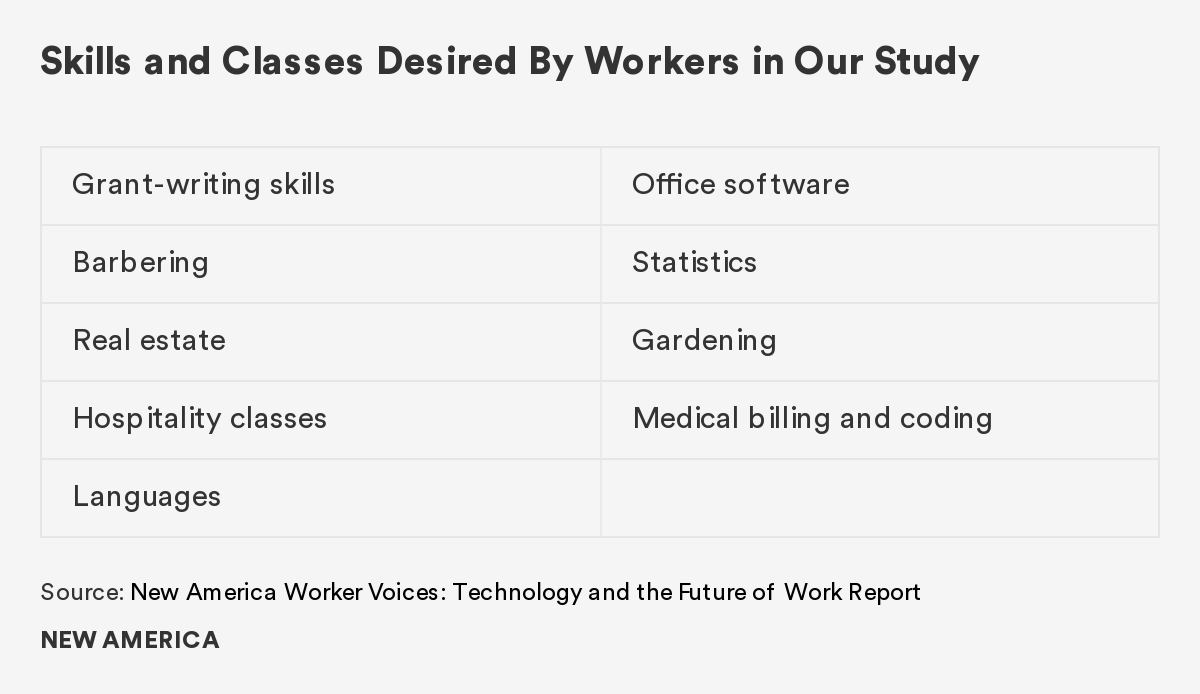
This preference for professionally-oriented training over academic study was explained by a 29-year-old former fast food worker (featured in Jasmin’s Profile) who is interested in a short course for a commercial drivers’ license certification: “I just want to take trades. Because in my opinion, people with master's degrees can get the same job we can get through the trades. So I'm not gonna waste all my time. The more trades I have, then I can secure a good position somewhere down the line. So I'm just working on getting trades.”
Interviewees often stated a desire to acquire skills that are relevant to their jobs and allow them to keep pace with new technologies or new job responsibilities. For instance, a 32-year-old administrative assistant in a medical office shared her desire to take classes in medical billing and coding, which she finds “hard” and that are an important part of her job. She has access to these courses for free through her employer. “I think it would be beneficial to take classes, just because I know it is hard,” she said. “I have to do tons of billing and coding. They have tons of stuff like that I can take."
Most often, interviewees desire new professional skills and credentials that position them for promotions, new jobs, or income generating opportunities—in their own workplace, or elsewhere. For instance, two separate grocery workers expressed an interest in a career change to real estate. They described the change as a relatively straightforward transition, requiring learning from personal networks and connections and taking short courses to become certified. A fast food hostess described her interest in taking hospitality courses, while a young retail manager said she would like to take language classes to become more marketable for the event planning career she aspires to. A young retail manager who makes money on the side as a barber indicated an interest in training in barbering.
Financial barriers can limit access to training and credentials. Employers can help
Workers identified cost as a barrier to earning credentials that can advance their careers. Several workers expressed a desire for employers to help finance the cost of training. For instance, the 29-year-old worker training as a truck driver (featured in Jasmin’s Profile) described her strong interest in obtaining a specific type of commercial driver’s license to qualify for higher paying positions. She aspires to a job similar to that of her boyfriend’s brother, who earns $25 an hour with his license—more than twice what she earned recently in the fast food industry. With little financial stability and no savings, she does not have the means to afford the $1,700 tuition. She is trying hard to get a job at a trucking company that offers tuition benefits to cover the costs of the license. “I’ve been trying to get a job with them forever,” she said. “I call them all the time and I keep on filling out applications for different positions.”
Tuition is just one type of financial barrier that limits the pursuit of credentials and skills training. The opportunity cost of not working while training can be an even bigger obstacle than the training fees. A 55-year-old administrative assistant and former teacher described facing financial barriers when she moved to another state: “I couldn't find a teaching job. I knew everybody wanted you state certified and I was not and that would mean going back to school. And it's like I need a job, I can't afford to go to school, I need a job. So I went back to doing secretarial work.”
Work-based apprenticeships offer workers training and economic security at the same time
Some workers accessed financial support through their employers for training through workplace-sponsored apprenticeships. The experience of two workers with a butcher apprenticeship program illustrates the benefits to workers of training full time in the workplace while maintaining financial stability by earning a salary (see box below).
Nathan and Tyler: A Tale of Two Apprenticeships
The draw of an apprenticeship opportunity: Nathan is a 25-year-old manager at a grocery store. He began at his store seven years ago, right after high school. Nathan is working with the HR department at his work in the hopes of entering a butcher apprenticeship program. For Nathan, becoming a butcher would be a promotion and would come with more money and responsibility, as well as the stability he desires. “There'll be a pay raise…because I'm topped out currently.…Also, it's a trade that isn't going to go anywhere anytime soon, hopefully. It’s just more security I guess.”
To become a butcher, Nathan first needs to train as an apprentice through a program organized by his employer. “It would require about 4,000 hours once I become an apprentice. Then I'll become a journeyman and I’d have a trade that I can take anywhere. If I need another job, I could go to any other grocery store or butcher shop…because it's such a trade job.” Once he finishes the apprenticeship program, he is interested in becoming a meat manager and running the department. “That's probably the next step.” He also considers moving to another store where butchers earn more money.
The apprenticeship route appeals to him more than other educational opportunities and online courses. “I never took online classes or anything like that.…I don't want to waste time going to take classes just to take classes.” With the apprenticeship training, he likes that he can learn new skills right on the job. “In a way, it’s because I'm already in the area where I can learn it. It's not like I have to go anywhere extra to learn. It's already in the job that I'm at, so it's just continuing up the ladder basically. They actually offer [that] they'll pay for the schooling and stuff and then I do all the training on the job.”
Nathan does not anticipate that the job will change much over the next 20 years. “From what I can tell, it's not going to change much. I keep seeing things online for buying prepackaged meat over the internet and having it sent to your house. That might be a thing in the future, but I hope not while I'm at the job. I also always hear about pre-packaged meat. It just comes in, you put a tag on it, and you put it out. That would eliminate the job, at least at the store level. Somebody still has to cut the meat down the line somewhere, but I don't see it changing all that much.”
From apprentice to manager on a path that no longer exists: Tyler is a 53-year-old meat manager at a different grocery store. He has been with his company for over two decades and hopes to retire in five years. When he started out with the company, he learned of a new meat cutting apprenticeship program that was just beginning. “I said, ‘well, that sounds interesting.’ And then he told me what the money was and I said, ‘yeah, that definitely sounds interesting.’ So I went onto the apprenticeship program for two years. I did that, became a journeyman meat cutter, stayed in that role for five years, and now have been a meat manager for over 12 years.”
When he was an apprentice, he learned under a trained journeyman. He would follow the day-to-day operations: “he would show you how to cut stuff. A whole hindquarter of meat would come in and you actually had to break it down right there in the shop.” The apprentices would move around to different stores filling in for journeymen and gaining experience. “Once you learn all of that, you have a block test at the end of two years. Once you do that, you are considered a journeyman meat cutter.” During the training, Tyler continued to earn a salary. He is grateful for the opportunities that his employer has given him. He pointed out that the company has also been good to his two children, who are now in college. He is proud of the example he has set of career success without having gone to college. He recently told students at his high school, “you don't have to go to college to be successful,’ and I just pointed to myself as a story.”
Tyler is dismayed that his company no longer provides the apprenticeship opportunity to young people coming up behind him. Several years ago, the company moved to precut meat, halted the apprenticeship program and stopped training a pipeline of skilled butchers. The younger clerks who work with him have no knowledge of meat. “They couldn't tell you a sirloin from a T-bone, what is tender, what comes from this part of the cow.” He doesn’t blame them. “They can say, here take somebody and in three days, he should know this. It took me three years to know what I know so how am I going to teach somebody in three days what it took me three years to know? Business now is, everything is, trying to get more with less. I think you end up paying for it in the long run.” In 20 years, Tyler isn’t convinced that his job will still exist. As the job is de-skilled with precut meat and labeled containers, he said, “I can see the management role in meat to be abolished in a few years just because it's so simplified.” If a customer comes in with a specific question, though, “then you're in trouble.”
Tyler wishes that young people starting out in grocery today could have the same opportunities he enjoyed. “I wish everybody underneath me could get the same thing that I have. It's different now. If I could change one thing, I would wish that all the other employees could get the same things I had, including the money and everything that I got when I started. Today, a new hire only gets a dollar more on Sunday, whereas I get time and a half on Sunday and some people still get double time. I just wish that a lot of people could make a career out of it, as I did. Unless you're in management—I think that's the only way that you could make a career out of it.”
Apprenticeships like the ones described by Nathan and Tyler offer a workforce approach with proven results that can simultaneously address workers’ need for economic stability and enhanced access to opportunity and skills. Combining paid, on-the-job training with structured learning, apprenticeships have been successfully deployed in skilled trades and are expanding to other industries.1 Our colleagues in the Center for Education and Skills have identified community colleges as especially well positioned to increase the number of high-quality apprenticeship opportunities and to scale them to growing industries like healthcare, IT, advanced manufacturing and business.2 But despite their proven benefits and strong bipartisan support for expanding their numbers,3 apprenticeships today bring opportunity to a small fraction of the workforce. In 2018, there were 585,000 apprenticeships.4
Workers reported uneven access to learning opportunities at work
Work-based learning and employer-funded training match many workers’ preference for convenient, affordable and quick learning opportunities. However, workers reported uneven access to learning opportunities at work.
The clerical and administrative workers we interviewed pointed to substantial training resources at their disposal while on the job that helps them learn and keep pace with new technology and software programs introduced at work. A 58-year-old administrative assistant said, “there’s lots of training. Every time they upgrade the system to something new, we get training. Everything is from video. They might have a half hour get together with everyone to explain things, but all the training is online.” A county information clerk, 40, said, “I’ve enjoyed our internal class offerings. They are web-based and we have some in person. If you complete a track you’ll get a certification.”
While many clerical and administrative workers described access to job-related trainings, fewer workers had access through their employer to training and studies for professional development that is not directly related to their jobs. An administrative assistant, 58, said, “they don’t provide us with anything for general or personal growth, but if you want to improve your skills on different software and it’s related to work, we get that for free.”
When fast food, grocery, and retail workers described training in their workplaces, they typically referred to training for new positions as they were moving into a different role. For instance, an employee might undergo training to start a job as a bookkeeper or become a manager or learn how to work the cash register or fulfill online orders. Few described resources for continuous learning and digital skill development. Several workers had access to inexpensive or free online classes through their employer, but none of the workers used them. They shared that this educational benefit did not match their needs or preferences.
Meeting the learning and training needs of workers will require fresh thinking
The preferences of many mid-career and older working adults are clear: they want more specific, job-relevant skills, and not a college degree. While workers say they want short-term training targeted toward specific employment, traditional higher education still captures the lion’s share of funding and resources. Short-term credentials and offerings have proliferated, but without consistent quality assurances and accountability, and less clear outcomes compared to traditional higher education.5
The question for policymakers is how to deliver the kind of training that meets the needs, preferences, and constraints of students, but also with sufficient quality to deliver learning and employment outcomes for the workers who need them. Also, how should this training be financed? Several states are experimenting with “lifelong learning accounts” to help workers fund training throughout their careers,6 where tax-free contributions from individuals are matched by government contributions and could also include employer contributions.
Meeting the learning and training needs of low-wage workers facing economic precarity and time constraints requires fresh thinking, systemic reform and more funding. Practitioners and policymakers should consider these constraints when designing training and learning opportunities. Policymakers should explore incentives for business to expand and improve training and learning opportunities for workers on the job, especially for lower-wage workers who often benefit least from investments in employer training.
Citations
- Center for Education and Skills, “Building Strong and Inclusive Economies through Apprenticeship,” New America, updated February 27, 2019, source
- Lul Tesfai, “Creating Pathways to College Degrees Through Apprenticeships,” New America, updated September 19, 2019, source
- Alastair Fitzpayne, “Apprenticeships Serve as Model of Skills-Based Training for Jobs of the Future,” Opportunity & Development (blog), Aspen Institute, November 16, 2018, source
- U.S. Department of Labor, Employment and Training Administration (website), “Registered Apprenticeship National Results: Fiscal Year (FY) 2018 (10/01/2017 to 9/30/2018),” updated September 3, 2019, source
- Testimony of Anthony Carnevale to the U.S. Senate Committee on Health, Education, Labor and Pensions (Washington, DC: Georgetown University Center on Education and the Workforce, January 30, 2018), source
- Alastair Fitzpayne and Ethan Pollack, Lifelong Learning and Training Accounts: Helping Workers Adapt and Succeed in a Changing Economy (Washington, DC: Aspen Institute, May 2018), source
Career Transitions are Difficult and Often Out of Reach

According to most experts, technology changes in the workplace will require millions of people to change jobs in the years ahead.1 To mitigate the negative impact of displacement, policymakers and experts have highlighted the need to re-skill workers from jobs that are declining, such as those described in this report, and position them for those jobs that are on the rise. A partner at the consulting firm McKinsey summarized this challenge when he said, “we should be worrying about mass redeployment rather than mass unemployment.”2
Our conversations revealed a disconnect between the need for a mass redeployment of talent and the ability of workers at the front lines of technological change to redeploy and adapt. The workers we interviewed faced many constraints that undermine their ability to react quickly to job changes, reposition themselves, and proactively change their career trajectory. Most lacked financial savings to weather a job transition or to forgo a salary or benefits while training for a new career. Moreover, neither the education and workforce systems nor the employment policies in the U.S. are set up to redeploy adult talent. In the absence of a talent and workforce system that is structured for this purpose, career transitions for workers are overwhelming and extremely difficult.
Younger workers had the biggest dreams for careers outside of retail, grocery, fast food, and administrative work but often put these dreams on hold
The boldest career dreams came from workers in their late teens and early 20s. They discussed their aspirations of entering fields ranging from skilled trades to fast-growing health careers and the social sciences. Nearly all of the jobs that these young workers aspired to require additional postsecondary education. In a few exceptional cases, young workers in retail and clerical roles were building towards those dreams by studying while working full time. More often than not, the dreams of young workers were put on hold by a range of challenges and setbacks.
The most common career preference of the young workers we interviewed was in the health sector, including interest in several fast-growing occupations like medical assistant, healthcare management, and nurse. A 25-year-old entry-level grocery worker explained his draw to the medical field: “my mom was a nurse and my girlfriend’s mother is schizophrenic. I have a real sympathy for people that go through things like that. Ideally, I'd like to work in that type of environment dealing with patients.”
Several other young retail workers were drawn to trades that require associate degrees. A 21-year-old manager shared with us his dream of becoming an automotive technician. He is a “car fanatic, and a workaholic.” He was one of the two interviewees who was working full time and studying part time. He is studying at a community college towards his associate degree in automotive science, with an ultimate plan to enter the military to be a car mechanic. A young fast food worker, 18, explained his exploration of mortuary science as a possible career
I could also see myself going to trade school for something that would help people. I’ve been doing a lot of research in the mortuary sciences because I'm good with people and those jobs involve a lot of having to be good with people. My grandmother died when I was young….Everyone experiences grief in different ways, and when it happens to you, it’s a lot. My mom and I were really close with my grandmother. When you lose someone close to you, it’s shell shock, no matter the warning signs.
The second of our two interviewees who was working full time and taking classes part time is described in Isabella’s Profile, below.
Isabella: Working while studying toward a dream career
Isabella* is a 23-year old working full time as an administrative assistant and studying graphic design part time at community college. Graphic design seemed practical. “For me it felt like the safest option financially that I would prefer the most. I know that if I just go into strictly fine arts it's going to be a tough road for me. I'm a very tech-savvy person so as soon as I figured I can mix these two together, I decided on graphic design.”
To achieve her goal of becoming a creative director, Isabella plans to transfer to a four-year college to complete her BA in graphic design after she completes her associate degree. Isabella needs to work full time as she studies. Financing her degree is challenging and creates delays. “It's really hard just paying out of pocket. Sometimes there is money, sometimes there isn't any money. I'm not sure when I'll graduate.”
Right now, she is able to fit classes in around her full-time work schedule. “The majority of the classes that I'm taking now are online because I'd rather get those out of the way now.” She hopes that her employer will allow her the scheduling flexibility she needs to complete the remaining courses on campus. “As soon as I'm finished with all the possible online courses, I do want a schedule where I have that time in the morning to attend school.” She is optimistic that she’ll be able to work something out with her employer.
In the meantime, she has asked her managers for internal opportunities that use her creative talents and is excited about the possibilities. “That is something that I'm hoping that I get the chance to do. I feel very lucky there and I feel like there's the potential to grow. For now, I see myself staying there and going to school.”
Challenges and obstacles undermined young workers’ career goals
The experience of Isabella, in the profile above, stands out as the exception. Most of the young workers we interviewed faced financial hurdles, practical constraints, family commitments, and setbacks with their education that undermined their career goals. Often, these challenges resulted in workers ending up in careers they had never planned to be in. Frequently, the younger workers we interviewed lamented that progress toward their desired career had been derailed or put on hold. A variety of obstacles stood in their way, ranging from economic insecurity to care responsibilities, school debt, and the immense challenges of juggling full-time work and school. Laura, in the profile below, faces multiple obstacles.
Laura: Obstacles to a dream career
Laura is a 22-year-old receptionist. Growing up, she dreamed of a career working with children, such as opening her own day care or becoming a preschool teacher. After high school, she worked in an in-home day care and loved it. “The job was my life. Those kids were like my family. I did not care about anything, just because I loved it.” But after several years in the job, Laura grew frustrated with the lack of benefits. Without employer-provided health insurance, she had to be on her mother’s insurance. “And that was one thing I was really struggling with, because my mom has to work so many hours to get benefits and she didn’t want to work those hours anymore.’”
A few months ago, she started a new job as a receptionist in a private company. Her job provides the benefits that her day care position lacked: health insurance, a 401(k), paid time off, and parental leave. Her salary nearly doubled overnight. “My first check, I was like, ‘what’? And obviously the benefits, those are huge.” The pay and benefits have brought her relief. “Now that I've made the change, I feel so different. I feel happier. I sleep better. I sleep harder, if that makes any sense.”
One of the biggest perks of her job is that it is family-friendly. “I've always wanted to have kids and I want to have them within the next few years. At the day care, I would have only had a two week maternity leave, and that’s not what I want. With this job, I will get eight weeks or more, which is huge for me. Also, this job is super lenient. In my other job, if I had an appointment or something, my boss would tell me I need to hurry back, and I just always felt rushed. And with this job they're like, ‘you have an appointment at 1:00? leave at 11:00.’ They are also talking about potentially changing our phone system to Skype so then we could possibly work remotely. That'll be awesome to be able to work from home maybe two days a week.”
She still has dreams of a career caring for others. “About a year ago, I looked into trying to get grants to go back to school to be a labor and delivery nurse. That’s something I still am super interested in. I just don't foresee it happening. I don't have time, I don't have the money to do it. But if there was something that I ever wanted to do, that would 100 percent be it.”
Most workers viewed dream jobs as impractical
Interviewees of all ages and occupations shared with us dream jobs that they would love to hold if they could wave a magic wand and put aside practicalities (see Dream Jobs, below). None of the interviewees seriously considered these jobs. The language they used to describe these dreams suggested they were fantasies. For the workers we interviewed, stability, benefits, and practicalities took priority. A retail cashier, 41, put it this way: "It's one of those things, where you get drunk and you talk about what you want to do in life. ‘We're going to open a bed and breakfast.’ ‘No, honey, it's Jack Daniels that's talking, not us.’ There's no way that that can work in where my life is right now. I need steady and I need secure….Because I got little people that rely on me.” Another mid-career professional said the same thing: “I really did think about what if I just kind of like pitched it all to the wind and said, ‘I'm just going to go where the wind blows me.’ But ultimately,” said this 40-year-old county information clerk, “I came back to stability. I think because I value stability, it was sort of always a pipe dream.”
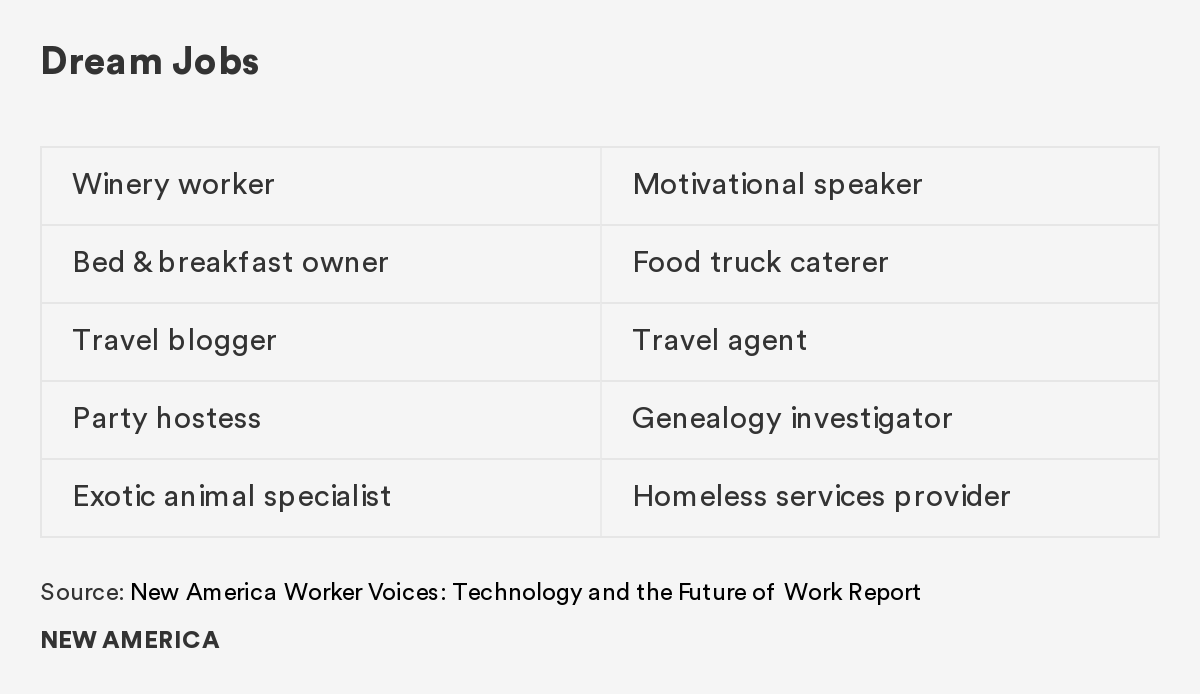
If needing a job quickly, most would rapidly redeploy to a similar job
We asked what type of work interviewees would seek if for any reason, their job did not exist and they needed to find other work. Unsurprisingly, most responded that they would look for the quickest path to a new job by leveraging their existing skills and experience. This might mean returning to previous work—such as care jobs, education, or retail—or finding another position similar to the one they currently hold in food, grocery, retail or clerical work. If they faced a disruption to their work, most interviewees said they would connect to a job for which they are already qualified for and that is relatively easy to access. A few people even said they would take any opportunity, even if it was worse, just to make sure they could continue paying their bills. “If I had to do something now, what would likely be the easiest for me to secure?” asked a grocery bookkeeper, 31. “I would do something similar, because I already have a lot of experience there."
The approach of rapid redeployment to a similar job maximizes economic security in the short-term, but not necessarily in the medium- or long-term. The jobs identified by workers that are similar to the ones they now hold also face a high risk of automation. Moving from one retail job to another, from bookkeeper to teller, or from an administrative role to a secretarial role results in a shift from one high-risk job to another.
In contrast, several of the fallback jobs that interviewees identified were considerably less at risk for automation. Jobs in day care, education, social work, and healthcare, for instance, are all low risk of automation. However, the workers who had left those jobs for what they considered better ones in administrative and retail work signaled that they were dissatisfied with the benefits, hours, pay, respect, and stability of these positions. Thus, while a move back to these jobs may reduce overall automation risk, they may also result in a decline in the workers’ quality and standard of living.
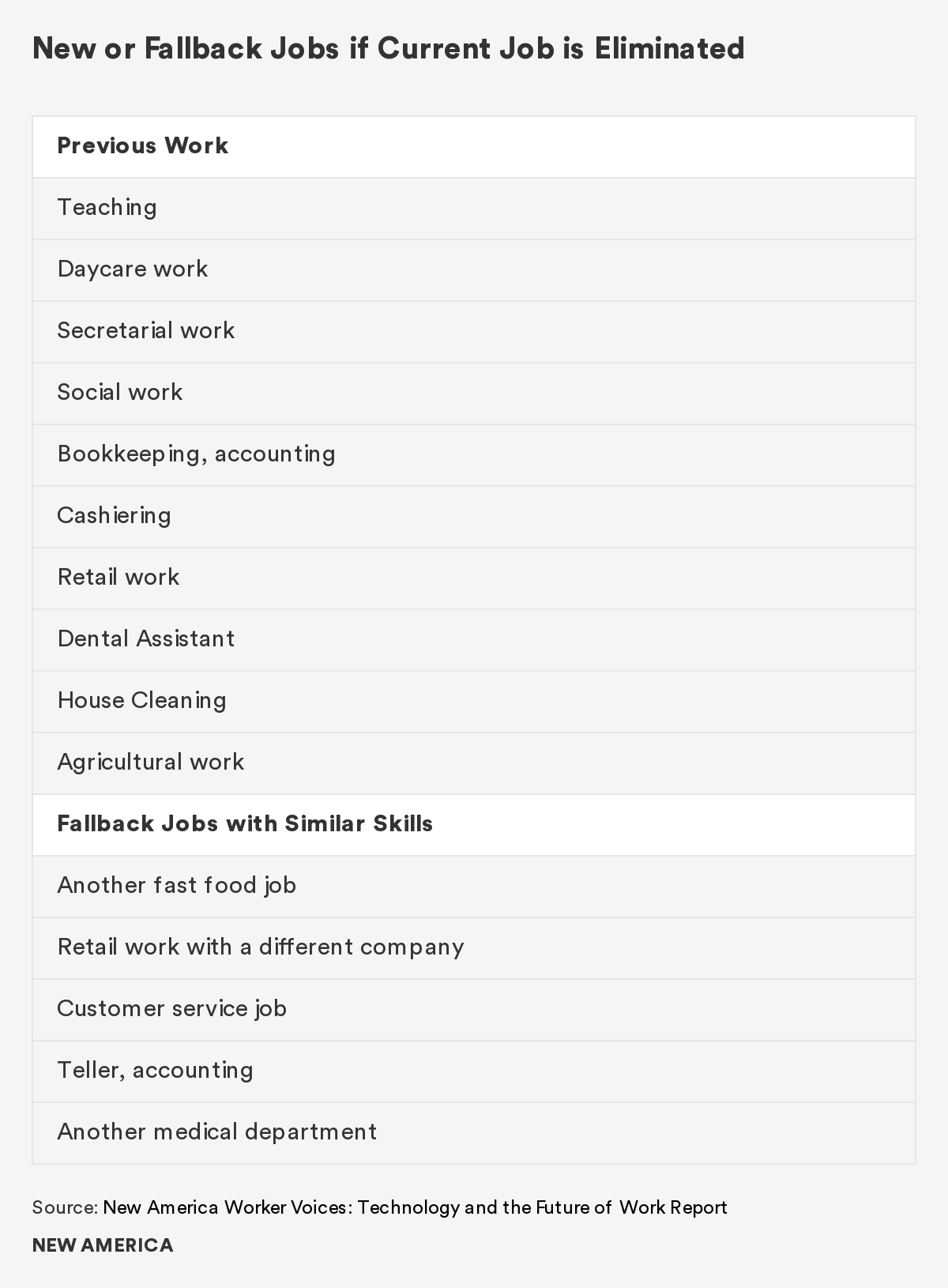
Career transitions are out of reach for most busy adults, and older workers prefer no change at all
Rarely did busy working adults in our study have explicit plans to change careers—or even ideas for what they would want to do. Unlike some of the younger workers, mid-career and older workers were mostly focused on the present, juggling busy lives and busy jobs, with limited bandwidth, time, and resources to plan major career changes.
Just a few older workers identified alternative careers that they were actively considering. None of these career plans required additional formal, postsecondary education toward a degree. Real estate came up several times as a career interest. Workers pointed out that changing to this career would be a relatively quick and easy transition and would require minimal schooling and training. A retail cashier, 41, considered a new position in her children’s school system as an advocate working one-on-one with autistic children. To qualify for the job, she would just need to take an online course and a test, since she already has a college degree. She is drawn to the job, but frets that educators are “totally underpaid and underappreciated” and wonders if her family could afford a pay cut. "Do I have the patience for that because that sounds fulfilling and exciting? But I'd have to talk to my husband because it'd be like,…‘if I quit my job and get a job where it's going to pay a dollar an hour less, how do you feel about that?’"
For the most part, workers beyond the earliest part of their careers were not plotting major shifts. Several workers said they struggled to imagine doing another job and didn’t know what else they would want to do. A grocery cashier, 29, invoked a higher power, musing
Honestly, I am not sure. I just know that He didn't put me here to just run a register. I mean, I get it, that job really helped me. It has already helped me meet good people. But I just feel like I am here for a better purpose, a higher purpose. My mom, she says…all the time, “You can't help everybody.” [But] it would be that much better if somebody was paying me to do it. So, I don't know, its' just—I really feel like I'm here to help, but just…haven't quite figured it out.
A medical secretary, 32, said,
It’s funny, a couple of my coworkers and I were talking about our dream jobs the other day. We’re always saying we want to travel, do all these things, but what’s a profession that you can, like, travel? One girl said, “I’m going to become a flight attendant.” I was like, “I don’t think I’d like doing that, my whole family is here.” I don’t know about another job, or what I really want to be doing. I feel like I have been doing the medical stuff for so long now.
Making Career Transitions Easier for Workers
Career transitions are overwhelming for low wage workers with limited financial resources, time, and professional networks. It is clear that the workers we interviewed lacked the support and resources that could make career transitions easier and less destabilizing. Many workers we spoke with would benefit from high-quality career guidance. Frequently, we heard from workers that they lacked a clear idea of what they wanted to do in the future and lacked models of friends, family, or community members engaged in work that seemed appealing. Most workers found jobs and discovered their career interests through personal connections, and only a small minority connected to jobs through online platforms or searches. Quality career guidance can help them expand their career possibilities and navigate change.
Currently, the workforce system is fragmented, underfunded, and ill-suited to the needs of the workers in our study and the challenges of technological change. Policymakers should take a human-centered approach to make the workforce system and the existing infrastructure of America’s job centers more user-friendly, better quality, and more responsive to the needs and preferences of workers.
Citations
- James Manyika, Susan Lund, Michael Chui, Jacques Bughin, Jonathan Woetzel, Parul Batra, Ryan Ko, and Saurabh Sanghvi, Jobs Lost, Jobs Gained: Workforce Transitions in a Time of Automation (New York: McKinsey Global Institute, December 2017), source
- Susan Lund, James Manyika, Liz Hilton Segel, André Dua, Bryan Hancock, Scott Rutherford, and Brent Macon, The Future of Work in America: People and Places, Today and Tomorrow (New York: McKinsey Global Institute, July 2019), source source
Conclusion and a Human-Centered Agenda for the Future of Work

Our research shows that automation is not an abstract concept. For many workers, the future is already here. Most workers already saw technology changes all around them and often they perceived these changes at work as contributing to their struggle for hours, stability, and benefits, which were their main worries. Many expressed concern about what might lie ahead.
The following eight recommendations comprise our suggestions for a human-centered agenda for a future of work that better meets the needs of workers.
A future of work agenda must include a greater diversity of workers
A policy agenda to prepare workers for the future needs to reflect the diversity of those who will shoulder the greatest burden of the changes. Currently, the focus of most media coverage and policy discussion is on a narrow demographic of mainly white men, often in blue-collar jobs like manufacturing and truck driving. Yet technological changes will have a profound impact on women—perhaps even more than men—and will disproportionately impact African American and Hispanic workers. We set out to capture the stories and voices of workers who reflect the true diversity of the workforce that will be impacted by the shifting nature of work. We spoke with workers across a wide age spectrum, in different locations, and with varied demographic and socioeconomic characteristics. More than half of the workers we interviewed were Hispanic or African American and nearly three-quarters were women. We urge policymakers, thought leaders, and the media to incorporate the articulated needs of these groups in their thinking, storytelling, and policymaking, and to consider the ideas and recommendations that follow.
Worker power, corporate governance, and employer decision-making must be part of the agenda
In future of work discussions, experts and technocrats often discuss automation as though technology were an unstoppable force in the workplace. They depict automation as an inevitable wave of change that will seep into workplaces and, in many cases, leave workers to manage the fallout. In this narrative, it is the workers who shoulder the responsibility to adapt. Rarely do future of work discussions depict corporations as central actor in this narrative, making decisions that impact workers’ lives and bearing responsibility for their choices.
In talking with the workers who are at the forefront of these changes, we heard a different story altogether. Frontline workers in retail, fast food, and grocery repeatedly raised the issue of corporate governance and decision-making when they described technological change in their workplace. Many workers see automation as an extension of their employers’ overwhelming focus on short-term profits, at the expense of workers like them. Workers with long tenures at grocery stores and retail chains described a deterioration of their employers’ values over time, as companies have put ever-greater emphasis on shareholder value and their bottom line while eroding the benefits, opportunities, and stability these jobs provide their workers. The workers we spoke with had a nuanced view of technology: employers can adopt technology that helps them do their jobs, or makes their jobs harder, or that replaces them altogether. Ultimately, how technology impacts workers depends critically on the choices made by employers and the incentives to which they respond.
Meanwhile, workers felt that they lack a say in decisions that impact them at work. Often, they feel that the future of work is happening to them. When decisions are made about technology adoption at work, many workers feel they have little agency or voice in their own future, though workers in unions felt somewhat more empowered to push back against automation that jeopardized jobs. Several workers said they wished their employers would walk in their shoes and better understand what they experience and the unique human skills they bring to the job. Many low-wage workers employed in fast food restaurants and retail outlets lamented their lack of union membership and their weakened ability to advocate for the stability and security they desire.
For a better future, workers need greater power in the workplace and more voice in the decisions that impact them, including through union representation—but also through greater respect from employers, and through non-profit, worker-serving organizations and other opportunities to coordinate energy and action. In a country where the social safety net is firmly attached to jobs and the dignity of work, employers need to provide sufficient compensation and benefits to give workers the basic stability they need to position themselves for the future and meet their needs today. Workers in our study made clear that unions matter. Several non-union fast food and retail workers expressed a desire for union membership, which they feel would help them secure better compensation, protection, and benefits like health insurance and paid time off.
The fast-growing care jobs of the future need to be good jobs, or many more workers will fall behind
For workers, job quality is a bigger priority for the foreseeable future than overall job quantity. Overwhelmingly, the workers we interviewed desire good-quality jobs with benefits, stability, decent pay, and respect. When previous jobs lacked these qualities, many workers in our study left them, even when they provided emotional fulfillment. This is especially true for those who previously worked in care and other “pink-collar” jobs, who left these (often fast-growing and less automatable, but poorly paid, unstable, and physically and emotionally demanding) positions to seek the benefits and stability they desire in administrative and clerical jobs, as well as some food and retail jobs.
Unless policymakers do more to ensure higher job quality, more workers will likely be moving in the other direction in the future—from higher job quality to lower-quality jobs, or from one low-quality job to another. Looking ahead to the next few years, the Bureau of Labor Statistics predicts a significant reduction in the number of administrative and clerical work jobs, which many workers in our study rated favorably. By 2028, BLS projects hundreds of thousands fewer jobs like secretaries and administrative assistants; legal secretaries; and bookkeeping, accounting, and auditing clerks. Longer-term estimates of the automation potential of these jobs suggest even more scope for job displacement in the decades ahead. As the number of middle-skilled and middle-paying jobs decline in the years ahead, other jobs like home health aides and personal care aides are projected to grow at an even faster pace.
Despite their growth in number, care jobs rank very poorly on the characteristics that the workers in our study consider most important for job quality. Care jobs offer low pay, little scheduling control, and poor working conditions. Fewer than half provide employer-provided benefits like health insurance and pension plans. Often, the work is physically and emotionally demanding, with the specter of injury and often unsafe working conditions compromising the health and security of the workers.
To ensure a better future for workers, and especially for women and workers of color, it is imperative that policymakers prioritize making the fast-growing jobs of the future good jobs. There are clear steps they can enact that will improve the quality of these jobs, such as raising wages, improving working conditions and safety, and enhancing opportunities for upward mobility and training. It is not enough to move workers out of these jobs. With an aging populace we will continue to need people to fulfill these care roles and we must make these jobs better. Much greater political will is needed for policymakers to prioritize the needs of a workforce that is disproportionately comprised of Black and Latina women, who are far less visible in future of work discussions and policymaking processes than white male workers.
Reimagine safety nets and improve benefits for workers
As healthcare costs continue to increase and access to employer-provided benefits remains uneven, health insurance is top of mind for most workers. Most workers built their safety net for their families around employer-provided benefits, and especially health insurance—making them even more vulnerable to instability if their job changes. Our interviewees described how health insurance is a major factor in their career mobility and decisions, their job satisfaction and in their ability to pursue studies because it insulates them from the financial shocks of major medical bills and helps them maintain a baseline level of health. Many workers felt locked into jobs due to their reliance on the health insurance provided by their employers, even when more rewarding opportunities existed. Several young workers nurtured dreams of other careers but could not afford to lose their health insurance if they left their jobs to study. Meanwhile, workers in more precarious positions without health insurance lacked the stability they needed to be able to invest in and plan for the future and suffered economic hardships and job loss when they became ill. In the near term, employers should enhance the stabiliity of workers by expanding access to health insurance. Policymakers need to rethink and improve the safety net system overall and the connection between benefits and jobs.
Help women address unique obstacles in adapting to the future of work
In this study, we found that women are not only at high risk of automation, but they also face barriers to adjusting. Yet too often, future of work discussions remain overwhelmingly focused on the needs and concerns of male workers. Our interviews highlighted why it is important for policymakers to ensure that the needs and preferences of women are central to policy development. The themes that emerged in our interviews with women in retail, fast food, grocery and clerical jobs suggest that they experience challenges that impact their career mobility and resilience to changes. Many women described domestic responsibilities and care burdens that created what is essentially a second shift at home. These responsibilities leave many women with limited time and ability to invest in skill development or education outside of their job. They also constrain their availability for work and ability to accept promotions and new roles that offer greater earnings and reduce their exposure to automation risk. Unless policymakers address the constraints faced by a large percentage of women in our study, women risk falling behind. Policies that help families find and afford high-quality child care—more costly than average in-state university tuition—at times and locations that support those with 9 to 5 jobs and those with non-traditional hours or unstable schedules, would be a good start.
Higher education must better serve young workers
Most young workers in our study have big dreams of rewarding careers in jobs that provide a decent, stable living. Many of these sought-after jobs are also relatively safe from the risk of automation. They aspire to careers in fast-growing sectors like healthcare, or jobs like graphic designer and mortician. More often than not, however, their efforts to earn the degrees or certifications required for these dream careers are met with disappointment. During their stints at two- and four-year colleges, many encountered a range of obstacles that ultimately put an early end to their studies. The challenges they met included for-profit college and financial aid failures, economic struggles, difficulty juggling full-time work and study, lack of structure and human contact in online classes, unclear academic direction, and mental health struggles. The debt accumulated along the way further contributes to their economic insecurity and makes it even harder for them to invest in further education.
The career dreams of young workers become the collateral damage of a higher education system that is failing too many people. These failures matter immensely to the future of work. It is well known that educational attainment is positively correlated to long-term earning potential and upward mobility, but it is also inversely correlated to automation risk. According to the McKinsey Global Institute, workers with a high school degree or less face an automation risk four times as high as workers with a bachelor’s degree. The higher education system needs to better meet the needs of younger workers with few financial resources, limited support, and jobs to balance with study.
Rethink reliance on online classes, training, and credentials for reskilling and worker growth
Often online courses or classes are held out as a solution for busy workers in need of opportunities to retrain and sharpen their skills or move on to better jobs. Workers in our study had mixed experiences with online offerings. Those who took classes online struggled with isolation, a lack of structure, and uncertainty about their career path or a sense that they were engaged in study that would lead to appealing or meaningful work. All of the workers we spoke to who work for employers who offer online courses did not take advantage of this benefit, citing lack of time or interest, a sense that they did not know what they would study, or a lack of the computer infrastructure necessary to take the courses. Providing better on-ramps to help workers know what to study, more support for those pursuing degrees long term, and more short-duration credential opportunities could better meet the needs and preferences of low-wage and clerical workers.
The education, workforce development, and training ecosystems must make career transitions easier for workers
While younger workers struggle to achieve their career dreams through postsecondary education, most mid-career and older workers have different learning and training needs. Few workers above the age of 30 expressed a desire to return to formal schooling in an academic setting. Their busy lives, tiring jobs, family commitments, and limited financial resources leave working adults with little time and money to dedicate to a formal degree. Instead, many older workers share an interest in acquiring professionally relevant skills and credentials quickly, cheaply, and, ideally, on the job or through the financial support of an employer. Yet few workers in our study have access to the type of learning opportunities that match their interests and constraints. Much more needs to be done to make the ecosystem of higher education, workforce development, training, and on-the-job learning worker-friendly to adequately prepare the workers at the forefront of change for a better future.
And beyond workers we spoke with who have an idea for a future credential or career path, a subset of workers lack a clear idea of what they wanted to do in the future and lack models of friends, family, or community members engaged in work that seems appealing. They consequently struggle to see the value in pursuing further education. Investing in programs that engage workers to help them identify appealing paths and ways to start out upon them, could help those who struggle to identify a goal or imagine a different future for themselves.
Appendix: Study Methodology
Our qualitative methodology entailed hour-long, semi-structured interviews with a total of 40 workers in four cities or regions across the country: Buffalo, N.Y.; Washington, D.C.; the Bay Area, Calif.; and Indianapolis, Ind. With the help of external consultant Emily Tavoulareas of the Mosaik Collective, our research team developed an interview guide covering a range of topics. Through the interviews, we set out to better understand the context of workers’ lives, their hopes and plans for the future, their experience with technological change on the job, and their beliefs and concerns about what their jobs might look like in the future. We explored the following questions:
- What is the context of interviewees’ lives outside of work—their families, responsibilities, living situation, daily routine, hobbies? Who, if anyone, do they support financially?
- What does work mean to them? What do they want out of their jobs and from their employers?
- What do they worry about? What are the struggles and challenges that occupy them?
- How would they handle an unexpected financial expense?
- What is the background to their current job? What is their job history and how did they connect to this work?
- How do they feel about their job?
- How has their job changed over time? What role does technology play in their work now, and over time?
- If they were not doing this job, what else would they do? If they could do anything, what would they do for work? What would help them get there? If for some reason they had to find another job in short order, what would they do?
- Are they interested in learning anything? If so, what?
- What does their job look like in 20 years?
- What would they want to see their employer or government do to help prepare the workers of the future?
- What is their advice to a young person starting out today in their role?
To recruit interviewees for the project, we deployed four tactics. A primary method was the snowball method. Through this approach, we leveraged our personal networks and enlisted our contacts to help identify recruits. We approached both our close contacts—friends, relatives, neighbors, colleagues, classmates—as well as distant contacts we have encountered in retail stores, medical offices, schools, and in our previous work. These contacts, in turn, leveraged their own networks to identify additional candidates for interviews, “snowballing” into an ever-expanding pool of potential interviewees. Several of our interviewees also connected us to additional contacts. A second tactic involved partnering with worker organizations to identify recruits from their membership and networks. We collaborated with the United Food and Commercial Workers (UFCW) union to identify grocery and retail workers; with the Fight for $15 campaign to recruit several fast food workers; and the nonprofit LISC (Local Initiatives Support Corporation) to be connected with several individuals in low-income communities. Third, we recruited through online message boards such as Craigslist. And finally, we engaged in “walk up” recruitment for a subset of interviews, approaching retail and fast food workers in their stores and in the mall. We also walked into several offices and cold called businesses to recruit administrative workers.
Who we interviewed, by sector and job type
Fast Food
The fast food workers we interviewed typically held entry-level positions such as food preparers, cashiers, servers, baristas, hosts and crew members. We spoke to employees of six of the top 10 largest fast food and beverage chains in America, as ranked by volume of sales.1 The fast food workers in our study skewed young, with relatively short tenures, along with a few older workers with 15 years or more on the job. Just over half were women. They were nearly evenly split between African American workers and undocumented workers from Mexico and Central America, in addition to one Caucasian interviewee. Of all of the groups of workers we interviewed, the fast food workers were the least likely to have access to employer-provided benefits. None belonged to a union.
Grocery
The grocery workers we interviewed held a range of positions, from entry-level to management: cashier, bookkeeper, customer service representative, courtesy clerk, price adjuster, head teller, customer service manager, and seafood, meat, and bakery manager. We spoke with workers at four different companies, including those owned by two of the top three supermarkets nationwide.2 Most of the workers we spoke with held union membership. Compared with the fast food and other retail workers we interviewed, these workers had significantly longer job tenure. Everyone we interviewed had tenures of at least five years and about half had tenures of more than 20 years. Slightly more than half were African American and nearly two-thirds were women, including all of those with clerical and bookkeeping roles. The majority of grocery workers reported having employer-provided benefits like health insurance. Many of the grocery workers with union membership earned wages that exceeded minimum wage.
Other Retailers
The retail workers in our study held a mix of entry-level, first-line supervisor, and management positions. Common job titles included cashier, stocker, assistant manager, engagement manager, and department manager. Many of the young retail workers had recently been promoted from entry-level positions to a first-line managerial position. Employers included several of the largest national retail chains, including two of the top 10 retailers in the country.3 Other employers included gas station chains, a home furnishing retailer, and two fashion retail chains. The retail workers included several current or recent college students. The rest were men and women of prime working age, with no workers above the age of 50. None of the retail workers we spoke with belonged to a union. Nearly half reported having employer-provided benefits like health insurance, while a few of the younger workers reported being on their parents’ insurance. Two-thirds were women.
Clerical and Administrative Work
The clerical and administrative workers we interviewed represented a wide range of roles, types of employers, and job duties. Jobs included administrative assistant, receptionist, support, and legal assistant. These interviewees worked in a variety of workplaces, from the headquarters of a Fortune 500 company to medium-sized law offices, a medical office, and large private companies employing thousands of people. All of the interviewees in these roles were women, half were over the age of 50, and a little more than three-quarters were Caucasian. A third had tenures of more than 15 years in their job and none reported belonging to a union.
In addition to these women in clerical roles, we also interviewed an additional four people for whom clerical and administrative duties constituted a portion of their job, alongside other responsibilities: a property manager, therapist, county board clerk, and public-sector employment program representative. These workers had significantly more formal education than the rest of our interview population, including postgraduate degrees. Through these interviews, we gained valuable insights into the way that partial automation of clerical tasks is changing the nature of these jobs. For the purposes of analysis, however, we considered these four interviews separate from the more traditional clerical and administrative work that was our primary focus.
Our approach and field methods
Our approach during the interviews allowed for flexibility. While guided by our list of questions, interviewers were free to go off script, follow up on specific answers, and explore themes more deeply. All the questions we asked were open-ended and we gave instructions to our interviewees that there were no right or wrong answers. We were careful not to lead interviewees toward discussions of technology and did our best to use general and open-ended questions about the future of jobs to explore the extent to which workers are already thinking about issues like technology and automation.
Our field team included New America staff—Molly Kinder, Amanda Lenhart, Autumn McDonald, and Roselyn Miller, with support from Rachel Alexander in the Bay Area—and two external consultants with extensive experience in human-centered design, Amber Schleuning and Emily Tavoulareas. Each interview was conducted by two or more members of the field team, including one person responsible for taking notes. With permission from the interviewees, the conversations were recorded and subsequently transcribed for the purpose of analysis and identification of quotes used in the report. Most of the interviews were held in public places like coffee shops and libraries, and several were held in union facilities. We compensated each interviewee $60 for his or her time. To enable frank conversation and reduce any unintended risk to interviewees, we assumed each person’s identity would be withheld from the report, with the option of using a first name if a worker so chose. We have erred on the side of caution in protecting identities.
Analysis
After each interview, members of the field team conducted individual synthesis and documented key themes that emerged during the interviewees and marked relevant quotes. At the end of the field work, the team convened for three days of intense group discussion. Consultant Amber Schleuning led the team through a structured process in which we clustered the individual synthesis points into themes, made connections across themes, and explored initial conclusions. Several New America colleagues offered comments and feedback at this stage, including Mary Alice McCarthy, Tara McGuinness, Vicki Shabo, and Cecilia Muñoz. Molly Kinder then spent several months reviewing the interview transcripts, conducting further analysis, and writing this final report.
Citations
- QSR Magazine (website), “Ranking the Top 50 Fast-Food Chains in America,” August 2019, source
- National Retail Federation (NRF), STORES Magazine (website), “2019 Top 100 Retailers Power Players: Supermarkets,” July 2019, source
- National Retail Federation (NRF), STORES Magazine (website), “The Top 100 Retailers,” 2018, source
More About the Authors

Molly Kinder

Amanda Lenhart
Deputy Director, Better Life Lab