America’s Endless Counterterrorism War in Yemen
Table of Contents
- Executive Summary
- 1. Introduction
- 2. A Theory of Endless War and its Applicability in Yemen
- 3. Evaluating the Threat from AQAP
- 4. Assessing the Clarity and Character of American Objectives
- 5. Assessing the Achievability of American Objectives
- 6. Assessing the Level of War Termination Planning
- 7. Conclusion: Towards A Path Out of Endlessness
- Appendix 1: U.S. Intelligence Community Threat Assessments
- Appendix 2: Presence of Unlimited Objectives in CENTCOM Press Releases Under the Trump Administration
Abstract
In the aftermath of the 9/11 attacks, the United States embarked upon multiple counterterrorism wars embedded within a larger frame of a global war on terror. More than two decades on, these wars seem endless. In particular, America’s war in Yemen against Al-Qaeda in the Arabian Peninsula (AQAP) and later, the fight against the Islamic State in Yemen has taken on an endless character. The United States has conducted counterterrorism strikes in Yemen for more than a decade. Yet many continue to deny that “endless war” has meaning. Despite such denial, the United States’ war in Yemen has trapped it in a deteriorating situation that requires recognition and naming. The U.S. commitment to eliminating a terrorist threat that is already quite degraded exacerbates the larger crisis in Yemen, risks escalation, and militarizes American politics.
Rather than embracing endlessness under the name “sustainable counterterrorism” or chasing the mirage that the United States can defeat AQAP, the United States should build a full policy platform to end its endless wars. It is possible that there will be situations where the American people determine that military action is needed, but those decisions should be made with an eye to how such wars will end.
Acknowledgments
Thanks are due to Adam Baron and Luke Hartig for reviewing this report. Thanks also to Alexandra Stark who read various versions of this argument and was supremely generous with her time and Nate Rosenblatt who prior to entering public service, provided comments on forms of this argument going back years. Many others spoke to me or read parts of this report, and their assistance is deeply appreciated. Particular thanks are due to those who took the time to discuss their views with me even when their assessments and recommendations differ drastically from those presented here. Hopefully I have done their stances justice. As always, all errors of fact and interpretation are mine alone while credit for the best insights is widely shared. Finally thanks to Hugo Kirk, Jerrod Laber, and the Charles Koch Institute for their support of this research.
Downloads
Executive Summary
In the aftermath of the 9/11 attacks, the United States embarked upon multiple counterterrorism wars embedded within a larger frame of a global war on terror. More than two decades on, these wars seem endless. In particular, America’s war in Yemen against Al-Qaeda in the Arabian Peninsula (AQAP) and later, the fight against the Islamic State in Yemen has taken on an endless character. The United States has conducted counterterrorism strikes in Yemen for more than a decade.
Yet many continue to deny that “endless war” has meaning. Despite such denial, the United States’ war in Yemen has trapped it in a deteriorating situation that requires recognition and naming. The U.S. commitment to eliminating a terrorist threat that is already quite degraded exacerbates the larger crisis in Yemen, risks escalation, and militarizes American politics. Continuing the counterterrorism war while denying its endlessness and the unachievable character of the objective of defeating AQAP constrains American strategic thinking.
Some argue that the United States should abandon the binary of a decisive victory over or defeat at the hands of AQAP, and instead establish a framework of “sustainable counterterrorism” that includes open-ended military deployments, and constant monitoring tied to the use of air strikes to disrupt threats.
The binary of decisive victory or defeat is dangerous and part of how the war in Yemen became endless. However, the war’s history also reveals the dangers of adopting a framework of sustainable counterterrorism. Endlessness in Yemen has not been produced only by the adoption of unlimited objectives of defeating AQAP, but also by the failure to clearly specify and analyze the achievability of limited objectives that seek aims short of AQAP’s total defeat. Abandoning the mirage of defeating AQAP should not mean abandoning strategic thinking regarding ends short of decisive victory.
Rather than embracing endlessness under the name “sustainable counterterrorism” or chasing the mirage that the United States can defeat AQAP, the United States should build a full policy platform to end its endless wars. It is possible that there will be situations where the American people determine that military action is needed, but those decisions should be made with an eye to how such wars will end. Sustainable counterterrorism—insofar as it retains an open-ended state of war—prevents the strategic thinking that the project requires.
Key Findings
- The American counterterrorism war in Yemen has taken on an endless character in which the United States pursues objectives it cannot achieve. Yet, at the same time, the United States is not at risk of decisively losing the war by being defeated or denied access to the battlefield.
- The 2001 Authorization for the Use of Military Force ensures that the state of war persists even when strikes are paused.
- The history of pausing and resuming strikes in Yemen warns against interpreting a prolonged pause as ending the war.
- Unclear and shifting objectives contribute to the counterterrorism war’s endless character.
- The war in Yemen was initially covert, preventing public evaluation of its justification and objectives.
- The United States alternated between limited objectives of degrading or disrupting AQAP’s capabilities and unlimited objectives of destroying the group.
- The United States rarely stated its limited objectives in measurable, positive terms. It instead presented objectives other than the destruction of AQAP as gerunds or processes without providing details regarding the conditions under which the objective would be achieved.
- Substantial escalations and de-escalations in the pace of strikes have occurred without public explanation, making it difficult to evaluate the current state of the war and how tactics relate to strategic ends.
- The decision to rhetorically commit to the unlimited objective of destroying AQAP contributed to the war’s endless character.
- Unlimited objectives may not be coherent when it comes to movements and decentralized non-state organizations.
- AQAP and jihadism more broadly on the Arabian Peninsula are characterized by a long history of activity, ties to elites and local politics, and decentralization that make their destruction or defeat difficult and likely impossible.
- Socio-economic conditions in Yemen make it difficult to eliminate AQAP over the long term.
- Yemen’s internationalized civil war means the kind of deployment necessary to eliminate AQAP would likely escalate regional conflicts.
- Some limited objectives in Yemen may be achievable, but the United States has failed to analyze them in a way that would enable effective war termination planning.
- The United States has demonstrated its ability to successfully kill key targets and to assist partners in denying AQAP territory. It has also arguably degraded AQAP’s external attack capabilities.
- Maintaining the unlimited objective of destroying AQAP, even as pure rhetoric, obscures potential tradeoffs between limited objectives by presenting a mirage of a future in which the destruction of AQAP resolves all strategic tensions.
- Beguiled by the unlimited objective, the United States has not fully assessed the potential that apparent successes regarding limited objectives may not be sustainable or are the result of factors other than U.S. military action.
- The emerging framework of “sustainable counterterrorism” risks institutionalizing endless war rather than providing an exit. It tends to presume that unexpected events will improve conditions while underplaying the risk that they will result in sudden escalations.
- Sustainable counterterrorism fails to address the hole in American doctrine and theory when it comes to strategic ends to war other than decisive victory or defeat. In eliding the question of ends, sustainable counterterrorism can maintain unlimited objectives but in a more hidden fashion.
- Sustainable counterterrorism mirrors the logic of “mowing the grass,” replacing strategic thinking with a focus on tactics that are easily overwhelmed by shifts in systemic risk. This approach risks fueling preventive war logic.
- Sustainable counterterrorism’s emphasis on enabling partners risks over-identifying with them and losing the ability to exert pressure for needed governance reforms.
- AQAP’s threat to the United States is limited. The war has been conducted under conditions of extreme asymmetry of capabilities and violence.
- AQAP has failed to mount a successful campaign of repeated attacks in the United States. Over almost two decades, al-Qaeda in Yemen has carried out and directed at most two attacks in the United States, killing three people.
- Separated from the United States by oceans and about 8,000 miles, and unable to expand territory over the long term in Yemen itself, AQAP’s violence against the U.S. homeland is restricted to occasional raiding.
- AQAP also struggles to target American forces in Yemen due to the United States’ use of drones and partner forces to remove American soldiers from the battlefield and insulate them from risk.
- In contrast, the United States has killed more than 1,300 people in Yemen, demonstrating its ability to access the battlefield.
- Despite these limitations, AQAP demonstrated an ability to conduct significant raids on the U.S. homeland, and in the absence of military action, there is a reasonable case it would have carried out a campaign of repeated attacks. As a result, the U.S. decision to wage war in Yemen was made in a starker strategic context, regarding homeland security, than the decision to wage war against ISIS.
- In 2009, AQAP almost brought down an airliner, which would have killed hundreds of people. AQAP followed its 2009 attack with two further plots targeting U.S. aviation.
- U.S. government statements regarding the threat from AQAP portrayed it as posing credible, specific, and direct threats to the U.S. homeland while statements regarding ISIS portrayed it as a potential threat that might grow rather than an already existing one.
- The threat of AQAP and other foreign terrorist organization-directed attacks on the U.S. homeland has declined since the 2009-2012 period. Today, AQAP relies primarily upon its ability to inspire and advise potential attackers via the Internet. The degraded and decentralized threat raises doubts about the effectiveness and legitimacy of war as a response.
- Government assessments and administration statements from 2009-2012 emphasized direct, existing, and credible threats to the United States.
- More recent statements discuss potential threats and suggest a decline in capability.
- The ability of potential attackers to travel to Yemen, receive material aid, and then enter the United States collapsed as a result of Yemen’s civil war.
- AQAP’s recent propaganda has deemphasized the importance of travel to Yemen (an important step for directed attacks) in favor of inspiring attackers, who often act alone and lack material ties to the group.
- In order to end its endless war in Yemen, the United States must commit to clarifying its objectives while expanding transparency regarding the war AND abandon the objective of destroying AQAP or al-Qaeda more broadly.
- A focus on clarifying the objectives and conduct of the war risks diverting needed critiques of whether the stated objectives are coherent and achievable to begin with.
- An agenda that improves transparency without ensuring that U.S. objectives are achievable is likely to collapse over the long term.
- Abandoning the unlimited objective of defeating AQAP without clarifying the United States’ other objectives risks generating an endless series of wars for shifting purposes.
- To sustainably end its counterterrorism war, the United States should further develop its planning for war termination and expand its set of non-militarized tools for addressing the variety of crises in Yemen.
- Even restraint-oriented policymakers cannot be trusted to refrain from re-escalating the war in times of crisis, making efforts to address systemic sources of risk essential.
- The collapse of the Yemeni government and fragmentation of Yemeni politics poses a major challenge to efforts to end the U.S. war and increases the risk of re-escalation and/or a renewed AQAP threat.
- Due to its prior actions and ongoing relationships in the region, the United States cannot avoid responsibility for conditions in Yemen. Attempts to simply wash its hands of the country, viewing Yemeni suffering as acceptable or even beneficial in strategic terms, will likely fuel anti-American views.
- Continuing the state of war in Yemen is not low risk.
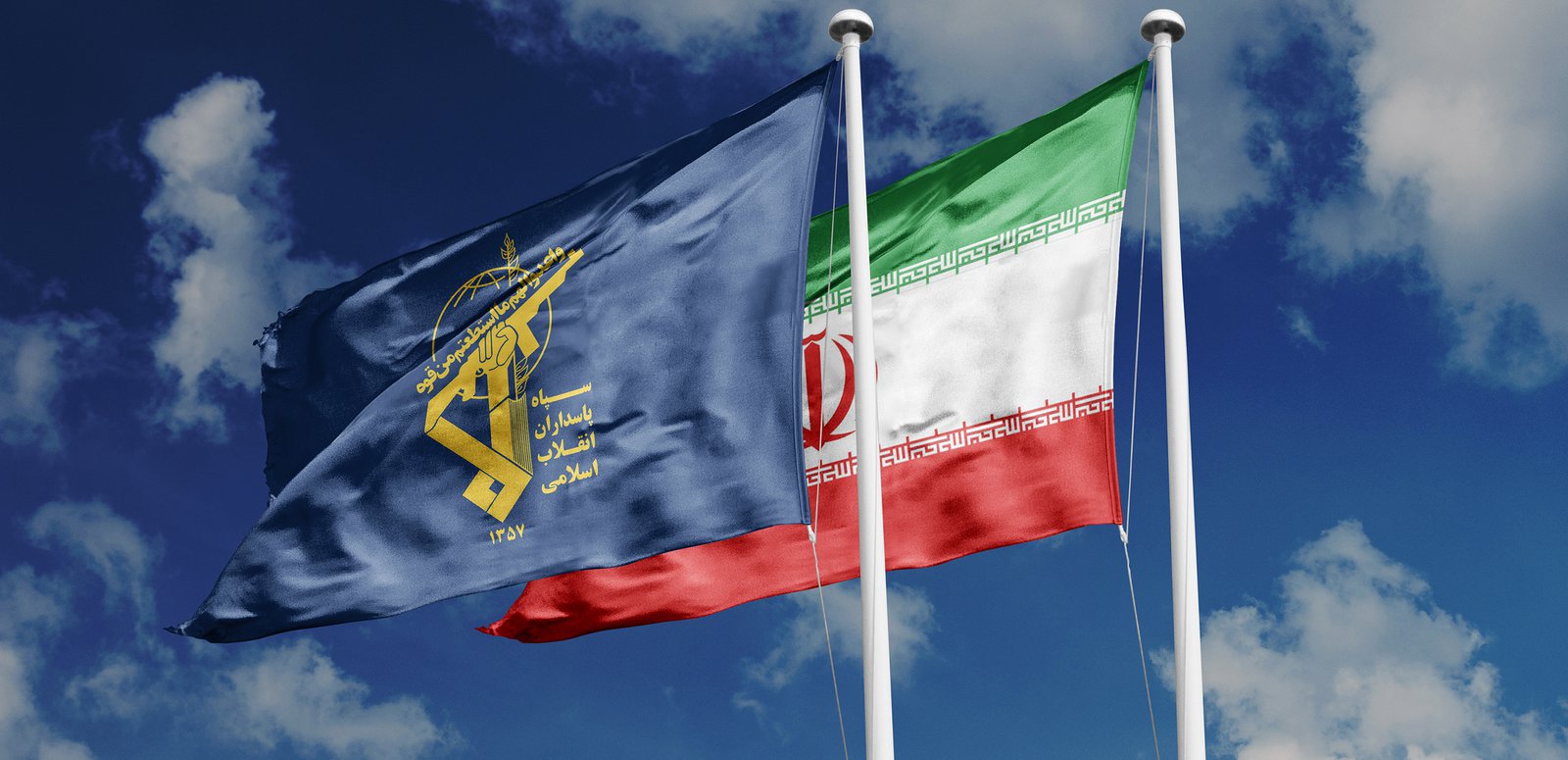
- The U.S. strike on Islamic Revolutionary Guard Corps (IRGC) personnel in Yemen in 2020 illustrates the potential for U.S. action to become intertwined with other conflicts and escalate.
- Continuing an endless state of war warps American politics, setting the United States up as a dominating power over Yemenis and militarizing domestic American politics—even in the absence of ongoing strikes.
- The counterterrorism war in Yemen holds severe risks for American democracy and the moral underpinnings of American warfare precisely because of the radical asymmetry between the violence the U.S. carries out or is capable of carrying out in Yemen, and the violence AQAP is capable of carrying out against Americans.
- The United States should develop a full policy platform to end its endless counterterrorism war in Yemen. This should include:
- Repealing the 2001 AUMF.
- Strict oversight of counterterrorism operations.
- A thorough, public review of U.S. strikes and objectives in the war in Yemen.
- A public, detailed assessment of AQAP’s structure and threat.
- A presidential speech and strategy document addressing the history of the U.S. war and abandoning unlimited objectives while explaining how any retained limited objectives can be achieved.
- Efforts to improve American war termination planning and capabilities to respond to the multiple socio-economic, humanitarian, and political crises facing Yemenis.
1. Introduction
In the wake of the September 11 attacks, the United States embarked on a global war on terrorism. As part of this global war, the United States also initiated a series of wars in countries across the Greater Middle East. Twenty years later, many of these wars continue with no end in sight. Among the wars the United States initiated as part of its larger war on terror was its war on al-Qaeda in Yemen, which would later brand itself as Al-Qaeda in the Arabian Peninsula (AQAP).
This report argues that “endless war” is a meaningful concept that is useful for understanding the counterterrorism war in Yemen. It defines endless war as a war in which a belligerent is pursuing objectives it cannot achieve but is also not at risk of being defeated or denied access to the battlefield. The U.S. record across three administrations suggests that the United States’ war in Yemen meets these criteria. The United States has too often sought unlimited objectives, seeking the complete destruction and defeat of AQAP or the al-Qaeda network more broadly.1 Even if references to defeat are mere political rhetoric, such commitments have warped American strategy. On the other hand, when the United States has sought objectives short of AQAP’s destruction, it has failed to publicly describe the supposedly limited objectives in a clear and stable manner.
While there may have been a legitimate case for U.S. military action in Yemen in 2009, when AQAP almost brought down an airliner, nearly killing hundreds of people, the threat to the United States homeland from AQAP is substantially lower today. Continuing to wage war on AQAP in these circumstances risks embracing a military posture increasingly driven by preventive war logic in which war is justified based on the belief that war now is preferable to other options as a way of preventing growth in a rival’s capabilities that would pose a greater threat in a future war.2
Meanwhile, conditions in Yemen have deteriorated precipitously since 2009. Yemen faces an enormous humanitarian crisis while an internationalized civil war rages. This deterioration is rooted in local Yemeni political disputes and regional dynamics that cannot be reduced to the war on terror. However, pursuing a preventively framed counterterrorism war in such an environment is likely to further entangle the United States in local conflicts, constrain U.S. strategic options, and exacerbate the ongoing crises while also militarizing American politics.
Facing this situation, some analysts argue for greater commitment to the unlimited objective of defeating AQAP and the movements from which it arises.3 Others argue for the development of a sustainable counterterrorism strategy that acknowledges the problems with the objective of defeating AQAP but which seeks to maintain the ability to use military force for limited objectives in an open-ended manner.4 Both of these approaches are likely to backfire. Instead, the United States should define achievable limited objectives, where the accomplishment of an objective means an end to the war footing.
The U.S. counterterrorism war in Yemen has a long history. On November 3, 2002, the United States conducted its first drone strike in Yemen, killing six people as they drove across the desert of Yemen’s Marib province. The strike killed its target, Qaed Salim Sinan Al-Harithi, who was believed to have devised the 2000 attack on the USS Cole.5 It also killed an American citizen, Kamal Derwish, who allegedly recruited a group of Yemeni-Americans to train in camps in Afghanistan, where they met Osama bin Laden.6
The strike demonstrated that Yemen would, at times, be a battlefield in the larger global war on terror. However, facing backlash over the strike, the Bush administration tended to treat Yemen not as a battlefield but as a partner in the war on terror, focusing on advising and cooperating with the Yemeni government rather than directly carrying out strikes.7 The 2002 strike is the only one Bush is known to have conducted in Yemen.
In 2009, the Obama administration perceived an increasing threat from al-Qaeda in Yemen. As Obama took office, AQAP announced its formation via a merger of previously existing networks in Saudi Arabia and Yemen.8 Over the course of that year, Americans inspired in part, but not directed, by AQAP or by the propaganda of Anwar Awlaki, an American involved in AQAP’s attack plotting, killed 14 people in two attacks inside the United States.9 AQAP also conducted attacks in Yemen and Saudi Arabia. Over this same period, the United States prepared to carry out a campaign of direct, unilateral strikes against AQAP and to encourage the Yemeni government to escalate its own actions.10
The United States began carrying out a small number of strikes in December 2009 and early 2010. On December 25, 2009, Umar Farouk Abdulmuttalab, a Nigerian trained and directed by AQAP and Awlaki, attempted but failed to bring down a civilian flight over Detroit, using an innovative bomb designed to circumvent airport security. The attack sparked significant concern about AQAP as a global threat.11 Over the next three years, that concern was amplified by two other, foiled plots to attack American aviation.
As a result, Yemen increasingly became the site of its own specific war between the United States and AQAP.12 The war was embedded within the war against al-Qaeda, but also had its own identity. It combined direct U.S. air strikes with ramped-up efforts to train and equip the Yemeni government’s forces as well as other assistance. In 2011, the pace of U.S. strikes increased, reaching its peak under the Obama administration in 2012 amid AQAP’s territorial gains in the aftermath of the Arab Spring.13
In 2014 and 2015, conditions in Yemen worsened as a civil war between Yemen’s Houthi rebels and the Yemeni government broke out, leading to the functional collapse of the Yemeni government, and a Saudi and Emirati intervention backed by the United States. Initially, AQAP appeared to benefit from this instability, once again seizing territory.14 The Obama administration continued its strikes during this period. The Trump administration further escalated the pace of strikes to an unprecedented extent in 2017. Even as it escalated its own strikes, the United States sought to enable the counterterrorism efforts of its Saudi and Emirati partners.15
In the final years of the Trump administration, and as the Biden administration took office, the pace of strikes substantially declined and potentially halted.16 United States Central Command has not acknowledged conducting any strikes in Yemen in 2020 or 2021.17 However, that does not rule out covert strikes, and the U.S. government has more broadly acknowledged conducting strikes in Yemen in 2020.18 Reporting regarding the Biden administration’s review of counterterrorism strikes suggests a near total pause in 2021, although there are contested reports of U.S. strikes.19 Even with a possible pause, the U.S. counterterrorism war in Yemen has taken on an endless character rooted in a lack of clear and stable American objectives and the United States’ long-standing maintenance of an unlimited and likely impossible objective of destroying al-Qaeda. While the United States may have halted its strikes in Yemen, the state of war against AQAP continues. The United States has neither abandoned nor fully achieved its objectives. Nor has any administration declared the counterterrorism war in Yemen over.
The Biden administration’s move towards a vision of sustainable counterterrorism further institutionalizes this situation.20 Even though the Biden administration appears to have abandoned unlimited objectives, it has not replaced them with clear statements of alternative achievable ends. The unlimited objectives that defined prior strategies can come to fill in as a projected end point, even if the administration remains largely silent about them.
As the United States claims to be adopting sustainable counterterrorism, the broader situation in Yemen remains a political and humanitarian disaster. The war has shown signs that it could escalate with the U.S. strike on an IRGC official in Yemen in 2020, and Houthi rebels firing ballistic missiles at the UAE in 2022, implicating American forces, being two examples.21 At the same time, the posture of endless war for rationales rooted in the futurology of preventive war logic undermines American democracy and the traditional moral restraints on warfare. Promulgating a vision of sustainable counterterrorism that retains the state of war underrates the potential for crises to collapse such a strategy and prevents the kind of strategic analysis of ends needed to navigate these treacherous conditions. Instead, the United States should develop a full policy platform aimed at ending its endless counterterrorism war—not sustaining it.
This report is divided into seven sections, including this introduction. The next section defines endless war and describes the dynamics that have made the U.S. war in Yemen endless. The third section assesses the threat that AQAP poses. The fourth section identifies the objectives the United States pursued in its war in Yemen and examines how a combination of expansive and unclear objectives helped generate the war’s endlessness. The fifth section analyzes whether U.S. objectives in Yemen are achievable. The sixth section analyzes the level of war termination planning. The concluding section discusses what it would take to sustainably end the war.
Citations
- See for example: “National Security Strategy” (The White House, May 2010), 1, 4, 21, source; “National Strategy for Counterterrorism” (The White House, June 28, 2011), 14, source; “National Strategy for Counterterrorism of the United States of America” (The White House, October 2018), 1, 11, source; “Summary of the 2018 National Defense Strategy of the United States of America” (Department of Defense, 2018), 4, 9, source.
- On defining preventive war logic see: David Sterman, “Decision-Making in the Counter-ISIS War: Assessing the Role of Preventive War Logic” (New America, November 15, 2019), source; Jack S. Levy, “Preventive War and Democratic Politics.: Presidential Address to the International Studies Association March 1, 2007, Chicago,” International Studies Quarterly 52, no. 1 (March 2008): 1–24, source; Colin Gray, “The Implications of Preemptive and Preventive War Doctrines: A Reconsideration” (Strategic Studies Institute, July 2007), source.
- Katherine Zimmerman, “Beyond Counterterrorism: Defeating the Salafi-Jihadi Movement” (American Enterprise Institute, October 2019), source; Daniel Green, “Defeating Al-Qaeda’s Shadow Government in Yemen: The Need for Local Governance Reform” (Washington Institute for Near East Policy, September 19, 2019), source; Katherine Zimmerman, “A New Model for Defeating al Qaeda in Yemen” (AEI, September 2015), source.
- Matthew Levitt, “Rethinking U.S. Efforts on Counterterrorism: Toward a Sustainable Plan Two Decades After 9/11,” National Security Law & Policy 12, no. 2 (June 11, 2021), source.
- Peter Bergen, David Sterman, and Melissa Salyk-Virk, “America’s Counterterrorism Wars: The War in Yemen” (New America), accessed February 18, 2022, source; Chris Woods, Sudden Justice: America’s Secret Drone Wars (New York, NY: Oxford University Press, 2015), 51, 55–61; Gregory D. Johnsen, The Last Refuge: Yemen, al-Qaeda, and America’s War in Arabia, 1st ed (New York: W.W. Norton & Co, 2013), 121–23; David Johnston and David E. Sanger, “THREATS AND RESPONSES: HUNT FOR SUSPECTS; Fatal Strike in Yemen Was Based on Rules Set Out by Bush,” New York Times, November 6, 2002, source.
- Woods, Sudden Justice, 58–61; Dina Temple-Raston, The Jihad Next Door: The Lackawanna Six and Rough Justice in an Age of Terror, 1st ed (New York: Public Affairs, 2007); Matthew Purdy and Lowell Bergman, “WHERE THE TRAIL LED: Between Evidence and Suspicion; Unclear Danger: Inside the Lackawanna Terror Case,” New York Times, October 12, 2003, source.
- For discussion of U.S. policy during this period see: Eli Berman, David A. Lake, and Julia Macdonald, eds., “Yemen 2001-11: Building on Unstable Ground,” in Proxy Wars: Suppressing Violence through Local Agents (Ithaca: Cornell University Press, 2019); Stephen Tankel, With Us and Against Us: How America’s Partners Help and Hinder the War on Terror (New York: Columbia University Press, 2018); Jack Watling and Namir Shabibi, “Defining Remote Warfare: British Training and Assistance Programmes in Yemen, 2004-2015” (Oxford Research Group Remote Warfare Program, June 2018), source; Woods, Sudden Justice, 55–61; Edmund J. Hull, High-Value Target: Countering al Qaeda in Yemen, 1st ed, ADST-DACOR Diplomats and Diplomacy Series (Washington, D.C: Potomac Books, 2011).
- “AL-QA’IDA IN THE ARABIAN PENINSULA (AQAP),” National Counter Terrorism Center, accessed November 23, 2021, source; Tankel, With Us and Against Us, 220.
- On June 1, 2009, Abdulhakim Mujahid Muhammad (Carlos Bledsoe) killed one person in an attack on a military recruiting station in Little Rock Arkansas. He had traveled to Yemen and later claimed to be affiliated with AQAP. On November 5, 2009, Maj. Nidal Hasan, who was inspired by and communicated with Anwar al-Awlaki, killed 13 people in an attack at Fort Hood Texas. James Dao, “Man Claims Terror Ties in Little Rock Shooting,” New York Times, January 21, 2010, source; “Fort Hood Suspect Charged with Murder,” CNN, November 12, 2009, source.
- Jeremy Scahill, Dirty Wars: The World Is a Battlefield (New York: Nation Books, 2013), 254–64.
- Woods, Sudden Justice, 197.
- On counterterrorism broadly under the Obama administration in Yemen see: Luke Hartig, “U.S. Counterterrorism Policy in Yemen: 2010-2020” in Michael A. Sheehan, Erich Marquardt, and Liam Collins, eds., Routledge Handbook of U.S. Counterterrorism and Irregular Warfare Operations (Abingdon, Oxon; New York, NY: Routledge, 2022).
- This is based on New America’s tracking. Exact counts of strikes and death tolls vary. Non-governmental trackers of U.S. strikes are limited by the covert nature of many strikes. However, broad trends in activity show up in the data of multiple groups tracking U.S. strikes. See: Bergen, Sterman, and Salyk-Virk, “America’s Counterterrorism Wars: The War in Yemen”; “US Airstrikes in Yemen,” Long War Journal, accessed September 24, 2021, source; “Bureau of Investigative Journalism – The Covert Drone Wars Archive,” Airwars, accessed September 24, 2021, source.
- “Yemen’s al-Qaeda: Expanding the Base” (International Crisis Group, February 2, 2017), source.
- For an illustration of how U.S. military actions enabled Emirati efforts see: James Mattis, “Memorandum for Assistant to the President for National Security Affairs Subject: Department of Defense Support to UAE Shabwah Offensive in Yemen” (Department of Defense (Released via ACLU FOIA), January 24, 2017), source; James N Mattis, “Memorandum for Assistant to the President for National Security Affairs. Subject: Department of Defense Request to Extend the Authorization for DoD Support to UAE in Yemen” (Department of Defense (Released via ACLU FOIA), April 28, 2017), source. See also: Luke Hartig, “Full Accounting Needed of US-UAE Counterterrorism Partnership in Yemen,” Just Security, December 7, 2018, source.
- Bergen, Sterman, and Salyk-Virk, “America’s Counterterrorism Wars: The War in Yemen”; “US Airstrikes in Yemen”; “Bureau of Investigative Journalism – The Covert Drone Wars Archive”; Gregory D. Johnsen, “Trump and Counterterrorism in Yemen: The First Two Years” (Sana’a Center for Strategic Studies, February 2019), source.
- CENTCOM told the author that there were no strikes in 2021. On November 18, 2021, CENTCOM told Airwars that “CENTCOM conducted its last counterterror strike in Yemen on June 24, 2019. CENTCOM has not conducted any new counterterror strikes in Yemen since.” Author’s Email Correspondence with CENTCOM, February 8, 2022; “Airwars Assessment: USYEMBi004-C,” Airwars, accessed February 18, 2022, source.
- See: “Attorney General William P. Barr and FBI Director Christopher Wray Announce Significant Developments in the Investigation of the Naval Air Station Pensacola Shooting” (Department of Justice Office of Public Affairs, May 18, 2020), source; Katie Benner and Adam Goldman, “F.B.I. Finds Links Between Pensacola Gunman and Al Qaeda,” New York Times, May 18, 2020, source; “Country Reports on Terrorism 2020” (United States Department of State Bureau of Counterterrorism, December 2021), 2, source.
- For reports regarding the review see: Spencer Ackerman, “The Peril and the Promise of Biden’s Drone Review,” Forever Wars, December 6, 2021, source; Charlie Savage and Eric Schmitt, “Biden Secretly Limits Counterterrorism Drone Strikes Away From War Zones,” New York Times, March 3, 2021, source. For reports of U.S. strikes in Yemen in 2021 see: “Two Qaeda Suspects among Three Killed in Yemen Drone Strike,” Ahram Online (AFP), November 14, 2021, source. United States Central Command denied conducting such a strike. Author’s phone inquiry to CENTCOM Public Affairs, November 15, 2021. Airwars has tracked other alleged U.S. strikes in 2021 reported by local news sources or on social media but which have not been reported by wire services or Western news sources. See: “US Forces in Yemen,” Airwars, accessed December 9, 2021, source. In early 2022, AQAP released a eulogy for a senior figure that it said was killed in a U.S. air strike. It did not provide a location or date though. “Intelligence Group Says AQAP Announces Death of Former Bin Laden Associate in U.S. Strike in Yemen,” Reuters, January 20, 2022, source.
- On the Biden administration’s embrace of “sustainable counterterrorism” see: Liz Sherwood-Randall, “Remarks as Prepared for Delivery by Assistant to the President for Homeland Security, Dr. Liz Sherwood-Randall on the Future of the U.S. Counterterrorism Mission: Aligning Strategy, Policy, and Resources” (White House, September 8, 2021), source; Levitt, “Rethinking U.S. Efforts on Counterterrorism: Toward a Sustainable Plan Two Decades After 9/11.”
- Kareem Fahim and Sarah Dadouch, “Yemen’s Houthi Militants Launch New Attack on UAE as Conflict Widens,” Washington Post, January 24, 2022, source; John Hudson, Missy Ryan, and Josh Dawsey, “On the Day U.S. Forces Killed Soleimani, They Targeted a Senior Iranian Official in Yemen,” Washington Post, January 10, 2020, source.
2. A Theory of Endless War and its Applicability in Yemen
Labeling the counterterrorism war in Yemen an endless war requires defining endlessness. This section defines “endless war” and presents a framework for the analysis that follows. It defines key terms used throughout this report and explains why the combination of jihadist weakness, expansive and/or unclear American objectives, and poor war termination planning promoted endlessness in the war in Yemen and America’s counterterrorism wars more broadly. The definitions and framework used here were first presented and are described in greater detail in the author’s prior report, Defining Endless Wars. 22
The Counterterrorism War in Yemen as an Endless War
Some commentators argue that “endless war” is a meaningless political talking point, a conclusion this report rejects.23 This report defines war as having an endless character when two conditions exist: The first condition is that a belligerent adopts objectives that it lacks the capability to achieve; the second condition is that despite the inability to achieve its objectives, the belligerent is also not at risk of being defeated or otherwise denied access to the battlefield and thus the ability to pursue its objectives remains.
Endlessness is best assessed by evaluating objectives and the balance of power in a war—the two core facets of its definition. However, other, more easily compared markers can inform assessments of whether a war has taken on an endless character. War duration is a particularly useful marker. But because duration is not dispositive as to whether a war is an endless war, it must be followed up with further analysis to determine whether a war has an endless character or is simply lengthy in duration.24
The counterterrorism war in Yemen has taken on an endless character. While the United States’ objectives have varied over time, the United States has sought objectives like the defeat and destruction of al-Qaeda in Yemen, eventually known as Al-Qaeda in the Arabian Peninsula, that appear to be beyond the capability of the United States to achieve. At the same time, AQAP is not capable of defeating the United States. Nor can AQAP deny the United States the capability to conduct strikes inside Yemen. There is little evidence that these conditions will soon change.25
When not pursuing unlimited objectives of defeating and destroying AQAP, the United States has sought to degrade and disrupt AQAP’s activities, particularly, to deny it territory, but it has rarely framed its limited objectives in a way that envisions and prepares for an end to the war. As a result, objectives that might have been achievable, have also proven beyond the United States’ capabilities.
The war’s long duration bolsters the claim that it has taken on an endless character. The United States has waged its counterterrorism war in Yemen for more than 12 years; more than 19 years, if one begins counting with the first strike in 2002.26 This means the war has gone on for about as long as the U.S. war in Vietnam, a case that was described as endless in contemporaneous discussions.27
While there has been some discussion of the war in Yemen as an endless or forever war, debate has focused primarily upon the U.S. support for the Saudi-led war against the Houthis and not the counterterrorism war. Legislative efforts to end U.S. support for the Saudi-led coalition’s war against Houthi rebels in Yemen have tended to exclude America’s counterterrorism strikes from their purview.28 Although the two wars are intertwined, this report focuses upon the U.S. counterterrorism war on AQAP and other jihadist groups.
What Drives Endlessness in American Counterterrorism Warfare?
Four factors have been particularly important in generating endlessness in the United States’ counterterrorism wars.29 They are:
1. The weakness of jihadist groups. Jihadist groups are incapable of militarily defeating the United States, either by destroying it, or by denying it access to the battlefield. Were jihadists capable of posing such a threat, America’s wars might end with jihadists achieving victory against American wishes.30 As the United States’ jihadist enemies lack such capabilities, the United States is the primary power capable of determining the location and character of its wars. Jihadists can use violence to influence and coerce that decision process but cannot militarily defeat the United States.
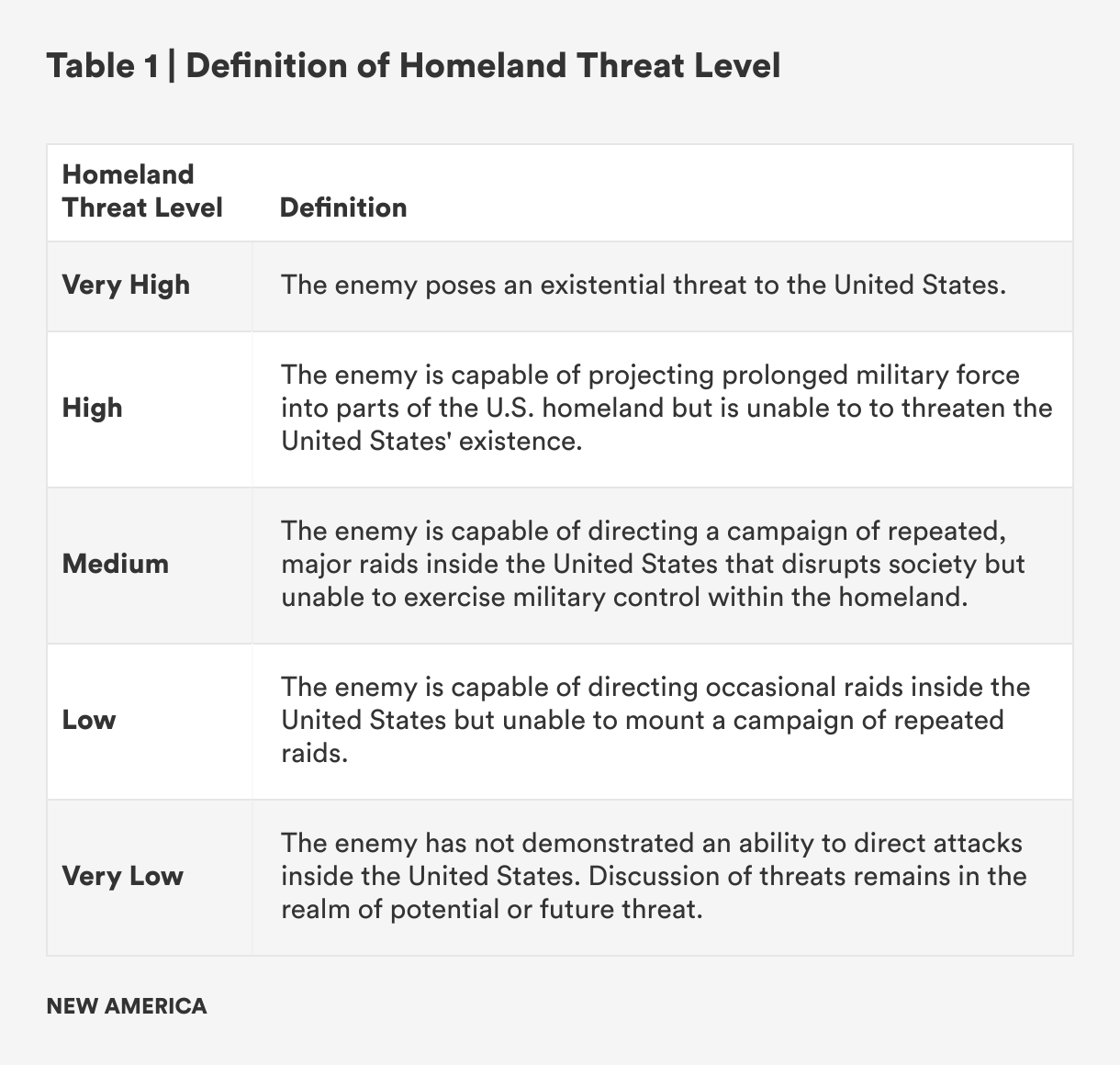
Moreover, most jihadist groups do not pose threats that force stark choices for the United States.31 Instead, the threat has tended to be similar to such accepted risks as industrial accidents or people dying in bathtubs.32 Even on the battlefield far from the United States, the U.S. way of war insulates the American military from violence, imposing a radical asymmetry.33 The level of threat that jihadist groups pose to the U.S. homeland can be placed on a spectrum ranging from a very high level of an existential threat through a medium level of a group incapable of taking territory but capable of highly disruptive campaigns of repeated attacks to a very low level where a group has not demonstrated a capability to direct attacks inside the United States (See Table 1).
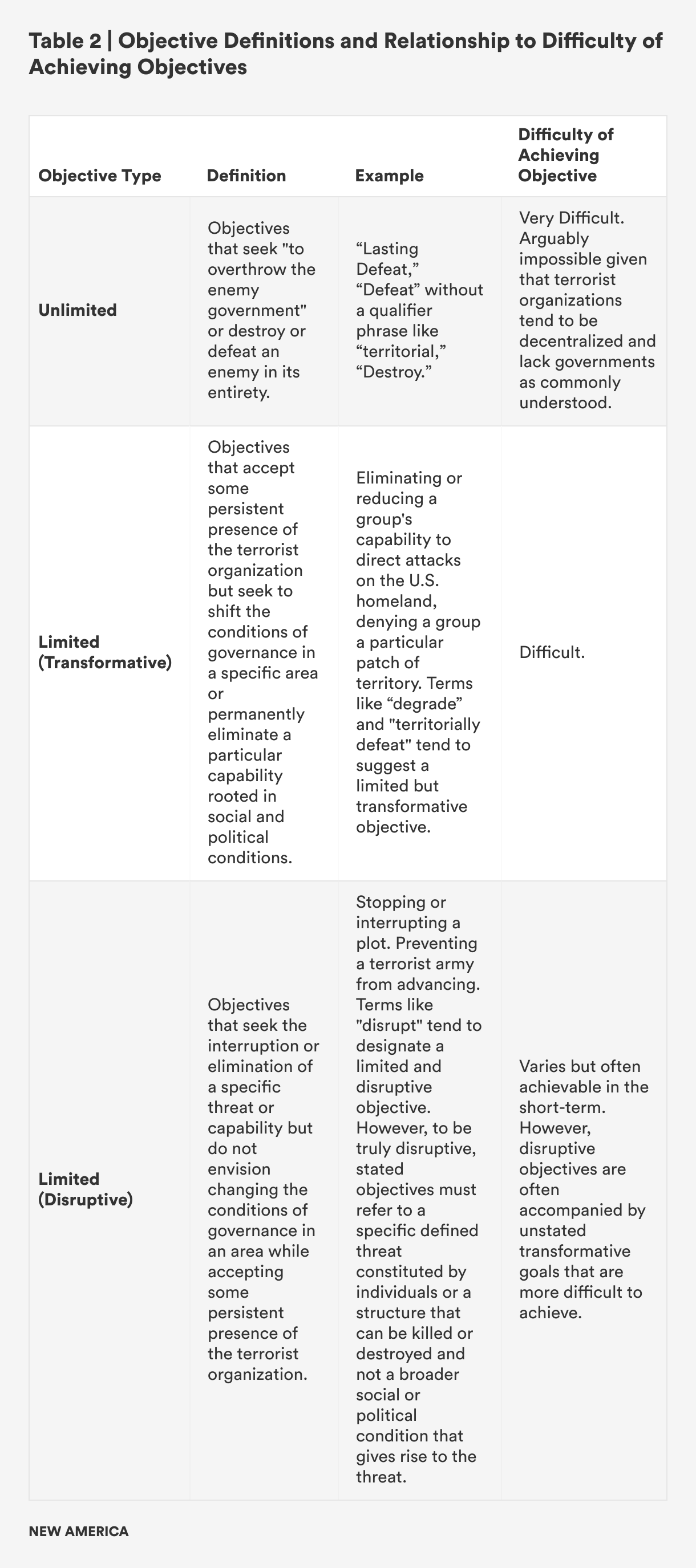
2. The United States’ expansive and often unlimited objectives. The United States has tended to select expansive objectives—most notably, unlimited objectives (objectives that seek the total destruction and defeat of the enemy).34 Even where the United States has chosen limited objectives (objectives that pursue something other than total defeat), it has often selected difficult-to-achieve objectives that still involve expansive visions of transforming governance. Where the United States has selected limited and disruptive objectives regarding specific threats, it has often found its objectives achievable but unsatisfying, revealing the continued existence of limited but transformative or unlimited objectives. In evaluating the existence of this factor, it is useful to identify whether a war’s objectives are unlimited, limited and transformative, or limited and disruptive, which tend to vary in their difficulty (See Table 2).
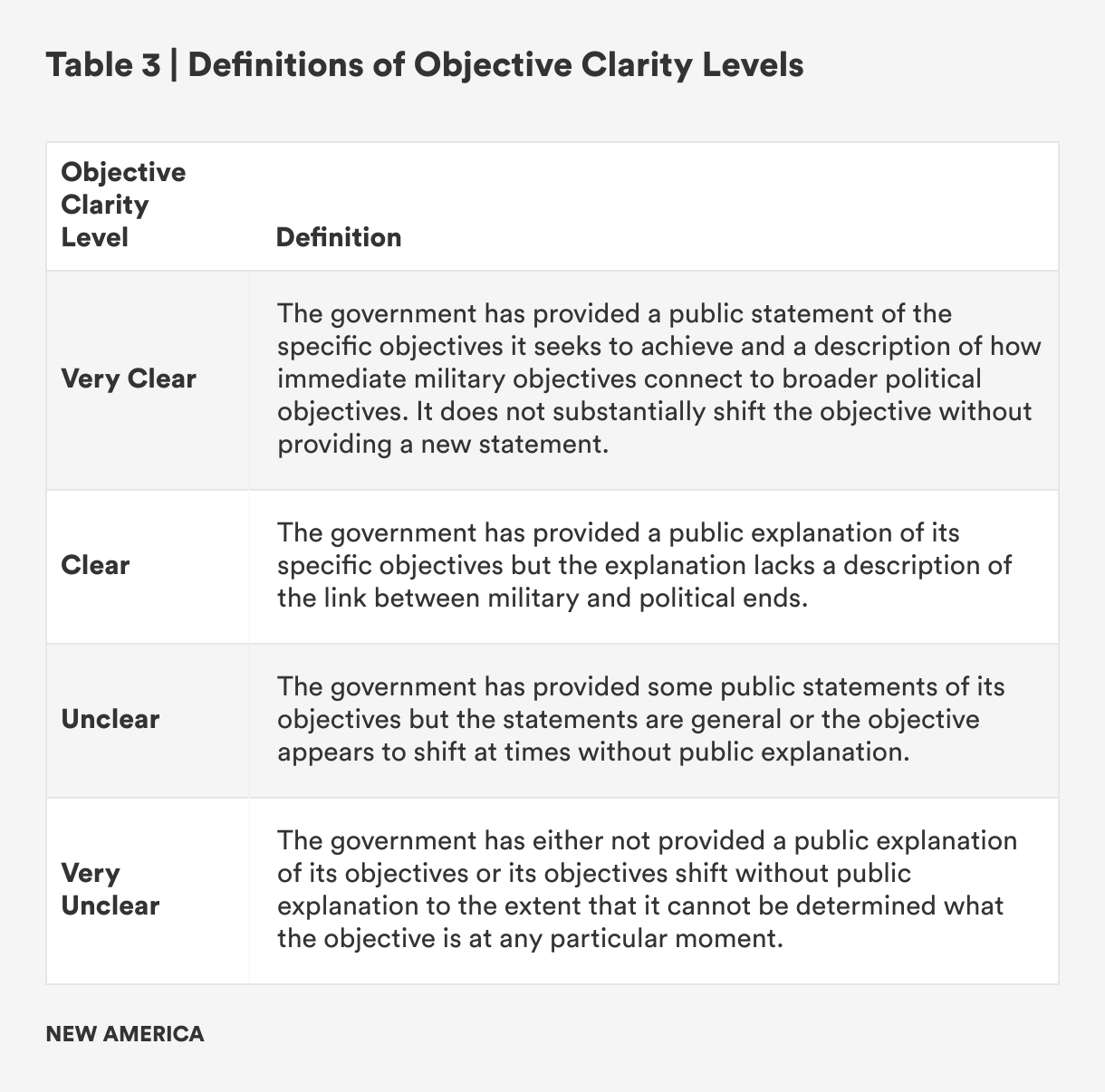
3. The United States’ pursuit of unclear or unstable objectives. The United States has failed to maintain stable and clear objectives in its wars. It is difficult to end a war if one cannot determine whether one’s objectives were accomplished because they were never clearly stated or because new objectives emerge as older objectives are accomplished.35 One way to measure the extent to which a war’s objectives are clear and stable is to look at whether the government provides a consistent public explanation of what it desires the war to produce, which can be evaluated on a spectrum from Very Clear to Very Unclear (See Table 3).
4. The United States’ lack of preparation and planning for war termination. The United States has also often failed to plan for war termination.36 As a result, the U.S. may appear to have achieved its objectives, but only insofar as the U.S. continues to apply military force. A failure to adequately develop plans for war termination can result in the U.S. failing to exit or exiting only to return later.37
Efforts to terminate the United States’ counterterrorism wars pose a particular set of challenges. A belief in the importance of achieving unlimited or decisive military defeat of enemies has stunted planning for war termination.38 Christopher Kolenda argues that the Department of Defense “has no definition or doctrine for this seemingly critical aspect of war. Options other than decisive victory do not exist in the national security lexicon.”39 Traditionally, a peace agreement is the gold-standard of war termination whether achieved after a decisive military triumph or as a result of negotiation.40 This is for good reason, and the United States should not automatically dismiss negotiation with even its most radical terrorist enemies.41
However, governments are loathe to negotiate peace agreements with groups that embrace terrorism as a tactic, in part because the tactic contributes to a perception—one that is not necessarily false—that such groups have maximal aims and won’t actually end their use of violence.42 Moreover, the decentralized character of many of the United States’ current rivals means that, even if a deal were struck, it might not be enforceable. War termination via a peace deal between the United States and al-Qaeda is thus unlikely.
This does not mean war termination is impossible. The extensive focus on a peace agreement as the only way to terminate a war reflects the peculiar role that wars between continental European states, who could not effectively deny their rivals access to the battlefield, played in generating conceptions of war termination.43 In contrast, the United States, like many other maritime powers, is capable of effectively denying an enemy the ability to turn its own territory into a battlefield. Kolenda terms such an approach transition as contraposed to decisive victory, in which the enemy is either militarily annihilated or surrenders, and negotiated outcome, in which no power surrenders but both come to an agreement to end the war (or at least direct hostilities).44 In the absence of a peace agreement, the United States can terminate a war by handing responsibility for security over to a partner or other authority.45
Some contend that such a handover is not a true end to the war, arguing that al-Qaeda will continue to pursue its “endless jihad” regardless of U.S. action.46 This, however, is a misreading of what war is. War, at least in most Western philosophical traditions, requires some level of reciprocal threat or implied agreement to combat in the form of war.47 If one side does not fight and another does, that is traditionally viewed as murder, massacre, or other forms of one-sided violence.48 The United States can also bolster its war termination capabilities by improving its already strong defensive measures, including law enforcement and intelligence work, and its efforts to address the systemic crises and grievances that empower jihadist groups.49
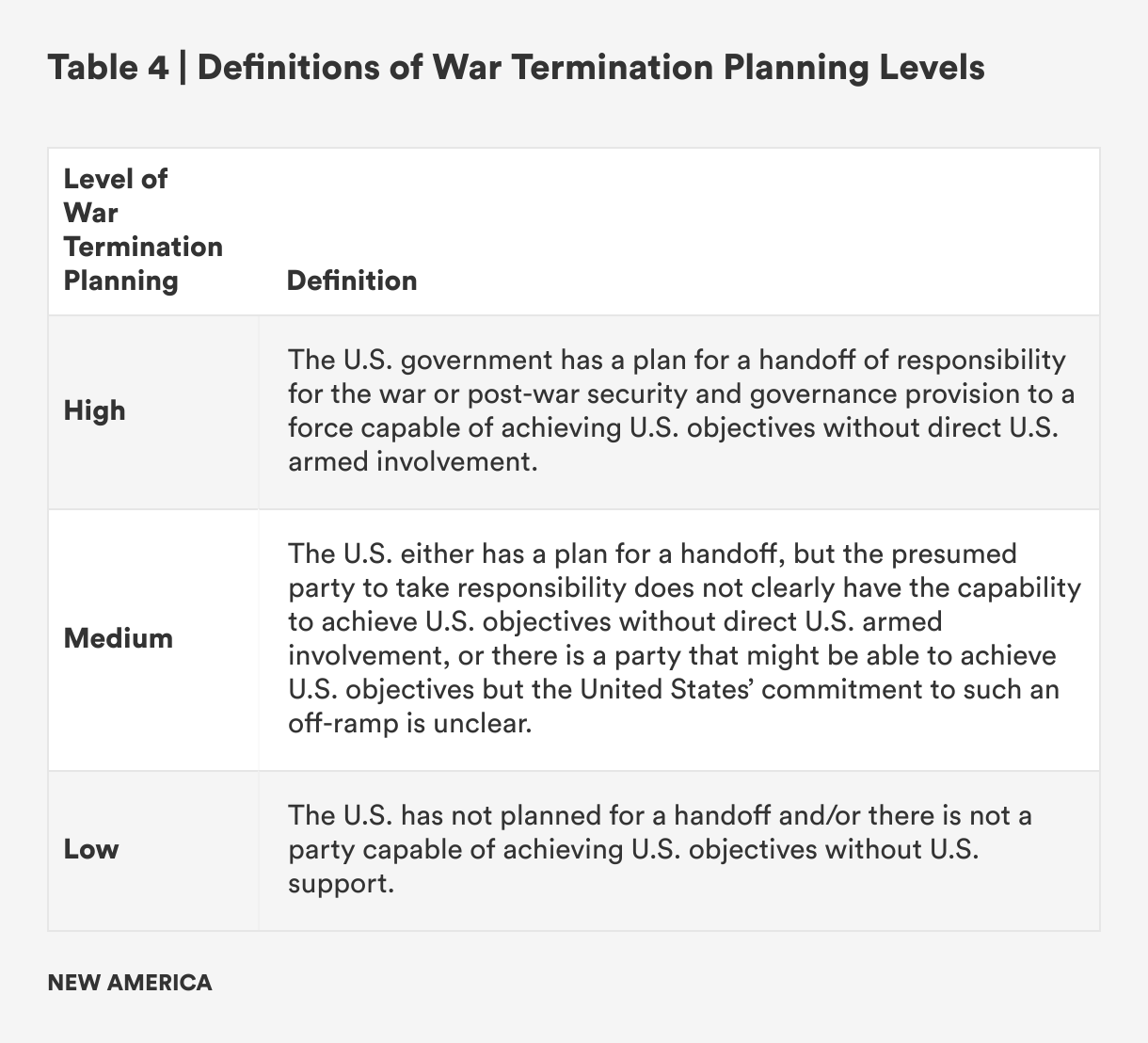
A handover of responsibility combined with clear renunciation of a war footing is likely to be the nature of war termination in the United States’ counterterrorism wars. The extent of development of war termination plans can thus be assessed as being at a low, medium, or high level depending on the amount of preparation for such a handover and the ability of the newly responsible actor to maintain a level of security that does not depend on the continued use of direct American force or a continued war-footing that enables rapid re-escalation without renewed debate and the authorization of a new war (See Table 4).
Four Types of Endless War: Why the Factors Driving Endlessness Matter
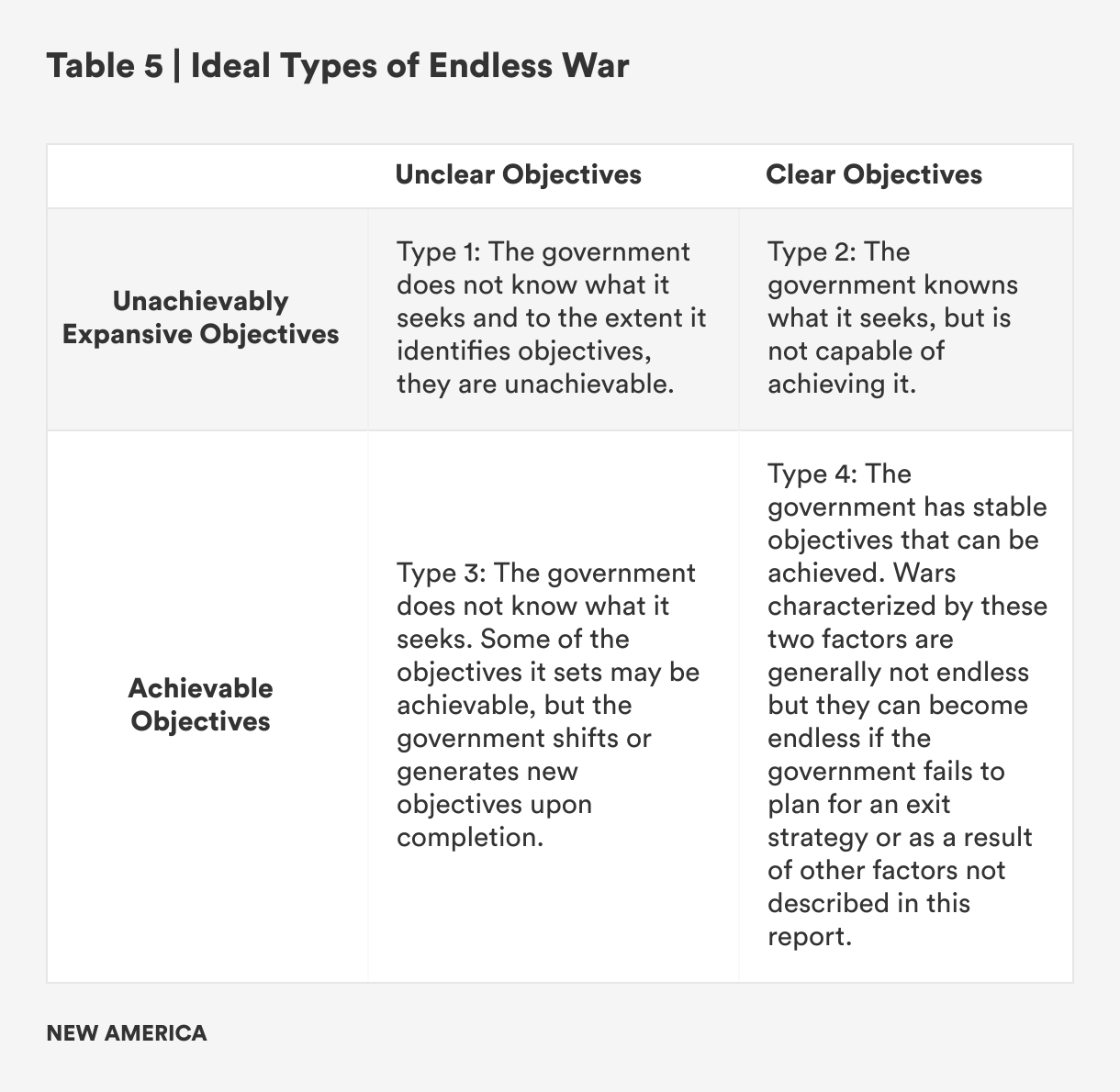
By focusing on the interaction between achievability and clarity of objectives while assuming a context in which the enemy is incapable of ending the war on its own terms, we can identify four distinct types of endless war (See Table 5). No war is likely to fall entirely within any of these types. However, positing these types warns against an overemphasis on any single policy approach that might be useful in ending some wars but not others.
Type 1: The first type are wars that take on an endless character because the government does not set stable and clear objectives and is also not capable of achieving the objectives it sets out because they are so expansive. Efforts to bring such wars to an end require both clarifying the objectives and ensuring that the newly clarified objectives are achievable. Efforts that prioritize only one strand of policy will simply move the war into a different type of endlessness.
Type 2: The second type are wars where the government is clear about what objective it seeks but has selected an objective that is so expansive as to be unachievable. In these wars, endlessness is primarily driven by expansive objectives, requiring the government to limit what it seeks in order to end the war. In contrast, efforts to improve the clarity of objectives, for example by expanding transparency, will have little success as a tool for bringing such wars to an end because their endlessness is not rooted in unclear or opaque objectives but in the willful decision to pursue difficult-to-achieve objectives. A focus on increasing transparency and clarity as the leverage point in such wars risks undermining efforts to end the war by deemphasizing questions about the political objective in favor of legalistic criticism.50
Type 3: The third type are wars where the government does not know what its objectives are and often shifts objectives, but those shifting objectives are achievable. In such a war, the key leverage point for ending the war is clarifying what the United States’ true objectives are. Whereas in a Type 2 endless war, a focus on transparency is unlikely to bring an end to war and can risk prolonging it, in this kind of endless war, it is essential while focusing criticism on the achievability of specific ends is likely to lead to poor analysis.
Type 4: The fourth type occurs when the government has achievable and clear objectives. Under such conditions, endless war should be rare. However, endlessness may still emerge for other reasons. For example, the war might take on an endless character if the government fails to adequately prepare for and develop war termination plans.51
What Type of Endless War is the War in Yemen?
This report assesses the Yemen war to be somewhere between a Type 1 endless war (with endlessness driven both by a failure to clearly define objectives and by the presence of unachievable expansive objectives) and a Type 3 endless war (with endlessness driven by a lack of clear and stable objectives but where objectives—when stated—tend to be achievable).
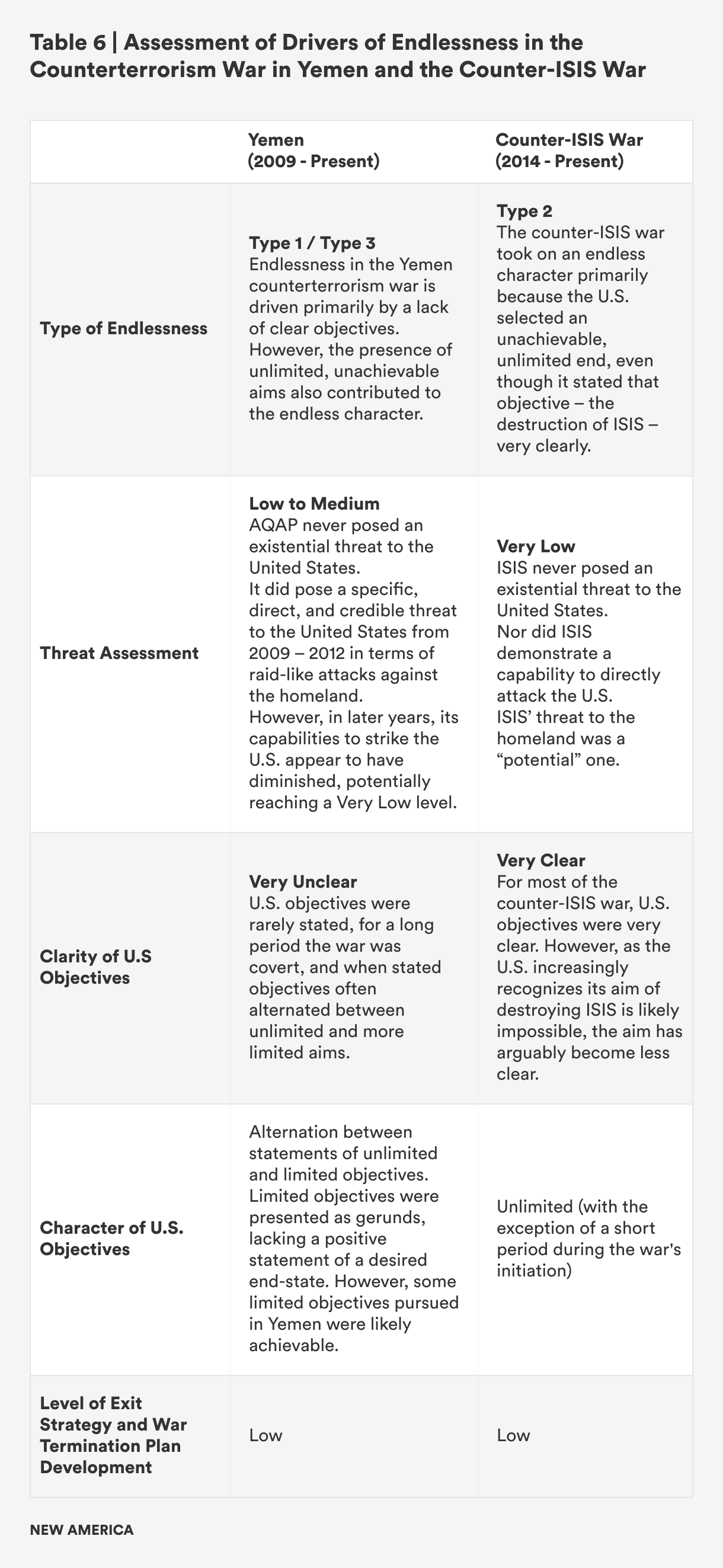
The character of endlessness in Yemen can be illuminated by comparison with the counter-ISIS war (See Table 6). The counter-ISIS war is best understood as Type 2 endless war driven by the pursuit of an unlimited and unachievable objective that was stated very clearly.
For most of the counter-ISIS war, the United States clearly and publicly explained its objective. For example, on September 10, 2014, Obama described the objective in the counter-ISIS war, saying: “Our objective is clear: We will degrade, and ultimately destroy, ISIL through a comprehensive and sustained counterterrorism strategy.”52
In contrast, the counterterrorism war in Yemen was born in secrecy. The United States denied it was even waging a war. Once the United States acknowledged it was waging a war in Yemen, it did not provide a specific explanation of the objective in the way that Obama did as he initiated the war against ISIS. Instead, the United States alternated between a range of objectives.
In the counter-ISIS war, the unlimited objective of destroying ISIS has proven unachievable. The United States destroyed ISIS’s territorial expression in Syria and Iraq (best understood as a limited but transformative objective of denying ISIS territory), but the group continues to operate.53
In contrast, the United States often embraced limited objectives in its counterterrorism war in Yemen, including killing specific AQAP operatives and disrupting external attack plotting. The United States at times, has contended that it is not pursuing a larger military campaign to transform governance in Yemen or destroy AQAP. Many of the limited objectives in Yemen were, at least theoretically, achievable. Some, like killing Anwar Awlaki, were achieved. Yet the United States also maintained a broader and unstable definition of what else it was pursuing, including an unlimited objective of destroying AQAP.
The distinction between the two wars’ objectives is not a bright line. As the United States finds itself stuck in Syria and Iraq unable to fully destroy ISIS as a movement or group, the counter-ISIS war may be moving towards a confused jumble of re-defined objectives that may be more limited but that are not as clearly stated.54 This is a shift from a Type 2 endless war to a Type 1 or 3 endless war, depending on the extent to which “defeat” remains an objective. In essence, it has come to look more like the war in Yemen.
Regarding the level of threat, the counter-ISIS war and the war in Yemen also had important similarities. Neither ISIS nor AQAP held the capability to defeat the United States or deny it military access to the battlefield. Thus, both wars held the potential for endlessness, assuming the United States did not carefully define achievable objectives.
However, unlike ISIS, whose threat to the homeland was very low and framed in terms of preventive war logic, AQAP demonstrated an existing capability to directly attack the United States. The strategic context of U.S. choices—in terms of homeland security—was thus starker than it was during the initiation of the war against ISIS.
In both wars the United States also showed a low level of preparation and planning for war termination. In the counter-ISIS war, the United States eventually developed effective partnerships with the Iraqi government and the largely Kurdish Syrian Democratic Forces (SDF) while mitigating many of the technical challenges of these partnerships.55 Yet these mitigation strategies often relied on close U.S. involvement. In particular, the United States has struggled to develop a clear vision of how the SDF will fit into Syrian politics in the absence of a protective U.S. shield.56
In Yemen, the United States has had little success managing tensions with and among its partners, saw its Yemeni-government partner collapse, and today relies largely upon the Saudis and Emiratis, whose efforts face substantial limitations. In both wars, the United States demonstrated only limited efforts and capability to resolve underlying systemic socio-economic crises that hold the potential to fuel resurgences in the threat to U.S. interests that could shift policymaker and public perceptions and motivate a return to war.
It is important to identify the roots of the Yemen war’s endlessness because it involves more than just the adoption of expansive objectives. In addition to abandoning the mirage of destroying AQAP, the United States will also need to clarify its limited objectives and improve war termination planning processes. Restraint-oriented policymakers should take heed that only embracing parts of this agenda could merely shift the war in Yemen into a different type of endlessness.
Citations
- See for example: “National Security Strategy” (The White House, May 2010), 1, 4, 21, source">source; “National Strategy for Counterterrorism” (The White House, June 28, 2011), 14, source">source; “National Strategy for Counterterrorism of the United States of America” (The White House, October 2018), 1, 11, source">source; “Summary of the 2018 National Defense Strategy of the United States of America” (Department of Defense, 2018), 4, 9, source">source.
- On defining preventive war logic see: David Sterman, “Decision-Making in the Counter-ISIS War: Assessing the Role of Preventive War Logic” (New America, November 15, 2019), source">source; Jack S. Levy, “Preventive War and Democratic Politics.: Presidential Address to the International Studies Association March 1, 2007, Chicago,” International Studies Quarterly 52, no. 1 (March 2008): 1–24, source">source; Colin Gray, “The Implications of Preemptive and Preventive War Doctrines: A Reconsideration” (Strategic Studies Institute, July 2007), source">source.
- Katherine Zimmerman, “Beyond Counterterrorism: Defeating the Salafi-Jihadi Movement” (American Enterprise Institute, October 2019), source">source; Daniel Green, “Defeating Al-Qaeda’s Shadow Government in Yemen: The Need for Local Governance Reform” (Washington Institute for Near East Policy, September 19, 2019), source">source; Katherine Zimmerman, “A New Model for Defeating al Qaeda in Yemen” (AEI, September 2015), source">source.
- Matthew Levitt, “Rethinking U.S. Efforts on Counterterrorism: Toward a Sustainable Plan Two Decades After 9/11,” National Security Law & Policy 12, no. 2 (June 11, 2021), source">source.
- Peter Bergen, David Sterman, and Melissa Salyk-Virk, “America’s Counterterrorism Wars: The War in Yemen” (New America), accessed February 18, 2022, source">source; Chris Woods, Sudden Justice: America’s Secret Drone Wars (New York, NY: Oxford University Press, 2015), 51, 55–61; Gregory D. Johnsen, The Last Refuge: Yemen, al-Qaeda, and America’s War in Arabia, 1st ed (New York: W.W. Norton & Co, 2013), 121–23; David Johnston and David E. Sanger, “THREATS AND RESPONSES: HUNT FOR SUSPECTS; Fatal Strike in Yemen Was Based on Rules Set Out by Bush,” New York Times, November 6, 2002, source">source.
- Woods, Sudden Justice, 58–61; Dina Temple-Raston, The Jihad Next Door: The Lackawanna Six and Rough Justice in an Age of Terror, 1st ed (New York: Public Affairs, 2007); Matthew Purdy and Lowell Bergman, “WHERE THE TRAIL LED: Between Evidence and Suspicion; Unclear Danger: Inside the Lackawanna Terror Case,” New York Times, October 12, 2003, source">source.
- For discussion of U.S. policy during this period see: Eli Berman, David A. Lake, and Julia Macdonald, eds., “Yemen 2001-11: Building on Unstable Ground,” in Proxy Wars: Suppressing Violence through Local Agents (Ithaca: Cornell University Press, 2019); Stephen Tankel, With Us and Against Us: How America’s Partners Help and Hinder the War on Terror (New York: Columbia University Press, 2018); Jack Watling and Namir Shabibi, “Defining Remote Warfare: British Training and Assistance Programmes in Yemen, 2004-2015” (Oxford Research Group Remote Warfare Program, June 2018), source">source; Woods, Sudden Justice, 55–61; Edmund J. Hull, High-Value Target: Countering al Qaeda in Yemen, 1st ed, ADST-DACOR Diplomats and Diplomacy Series (Washington, D.C: Potomac Books, 2011).
- “AL-QA’IDA IN THE ARABIAN PENINSULA (AQAP),” National Counter Terrorism Center, accessed November 23, 2021, source">source; Tankel, With Us and Against Us, 220.
- On June 1, 2009, Abdulhakim Mujahid Muhammad (Carlos Bledsoe) killed one person in an attack on a military recruiting station in Little Rock Arkansas. He had traveled to Yemen and later claimed to be affiliated with AQAP. On November 5, 2009, Maj. Nidal Hasan, who was inspired by and communicated with Anwar al-Awlaki, killed 13 people in an attack at Fort Hood Texas. James Dao, “Man Claims Terror Ties in Little Rock Shooting,” New York Times, January 21, 2010, source">source; “Fort Hood Suspect Charged with Murder,” CNN, November 12, 2009, source">source.
- Jeremy Scahill, Dirty Wars: The World Is a Battlefield (New York: Nation Books, 2013), 254–64.
- Woods, Sudden Justice, 197.
- On counterterrorism broadly under the Obama administration in Yemen see: Luke Hartig, “U.S. Counterterrorism Policy in Yemen: 2010-2020” in Michael A. Sheehan, Erich Marquardt, and Liam Collins, eds., Routledge Handbook of U.S. Counterterrorism and Irregular Warfare Operations (Abingdon, Oxon; New York, NY: Routledge, 2022).
- This is based on New America’s tracking. Exact counts of strikes and death tolls vary. Non-governmental trackers of U.S. strikes are limited by the covert nature of many strikes. However, broad trends in activity show up in the data of multiple groups tracking U.S. strikes. See: Bergen, Sterman, and Salyk-Virk, “America’s Counterterrorism Wars: The War in Yemen”; “US Airstrikes in Yemen,” Long War Journal, accessed September 24, 2021, source">source; “Bureau of Investigative Journalism – The Covert Drone Wars Archive,” Airwars, accessed September 24, 2021, source">source.
- “Yemen’s al-Qaeda: Expanding the Base” (International Crisis Group, February 2, 2017), source">source.
- For an illustration of how U.S. military actions enabled Emirati efforts see: James Mattis, “Memorandum for Assistant to the President for National Security Affairs Subject: Department of Defense Support to UAE Shabwah Offensive in Yemen” (Department of Defense (Released via ACLU FOIA), January 24, 2017), source">source; James N Mattis, “Memorandum for Assistant to the President for National Security Affairs. Subject: Department of Defense Request to Extend the Authorization for DoD Support to UAE in Yemen” (Department of Defense (Released via ACLU FOIA), April 28, 2017), source">source. See also: Luke Hartig, “Full Accounting Needed of US-UAE Counterterrorism Partnership in Yemen,” Just Security, December 7, 2018, source">source.
- Bergen, Sterman, and Salyk-Virk, “America’s Counterterrorism Wars: The War in Yemen”; “US Airstrikes in Yemen”; “Bureau of Investigative Journalism – The Covert Drone Wars Archive”; Gregory D. Johnsen, “Trump and Counterterrorism in Yemen: The First Two Years” (Sana’a Center for Strategic Studies, February 2019), source">source.
- CENTCOM told the author that there were no strikes in 2021. On November 18, 2021, CENTCOM told Airwars that “CENTCOM conducted its last counterterror strike in Yemen on June 24, 2019. CENTCOM has not conducted any new counterterror strikes in Yemen since.” Author’s Email Correspondence with CENTCOM, February 8, 2022; “Airwars Assessment: USYEMBi004-C,” Airwars, accessed February 18, 2022, source">source.
- See: “Attorney General William P. Barr and FBI Director Christopher Wray Announce Significant Developments in the Investigation of the Naval Air Station Pensacola Shooting” (Department of Justice Office of Public Affairs, May 18, 2020), source">source; Katie Benner and Adam Goldman, “F.B.I. Finds Links Between Pensacola Gunman and Al Qaeda,” New York Times, May 18, 2020, source">source; “Country Reports on Terrorism 2020” (United States Department of State Bureau of Counterterrorism, December 2021), 2, source">source.
- For reports regarding the review see: Spencer Ackerman, “The Peril and the Promise of Biden’s Drone Review,” Forever Wars, December 6, 2021, source">source; Charlie Savage and Eric Schmitt, “Biden Secretly Limits Counterterrorism Drone Strikes Away From War Zones,” New York Times, March 3, 2021, source">source. For reports of U.S. strikes in Yemen in 2021 see: “Two Qaeda Suspects among Three Killed in Yemen Drone Strike,” Ahram Online (AFP), November 14, 2021, source">source. United States Central Command denied conducting such a strike. Author’s phone inquiry to CENTCOM Public Affairs, November 15, 2021. Airwars has tracked other alleged U.S. strikes in 2021 reported by local news sources or on social media but which have not been reported by wire services or Western news sources. See: “US Forces in Yemen,” Airwars, accessed December 9, 2021, source">source. In early 2022, AQAP released a eulogy for a senior figure that it said was killed in a U.S. air strike. It did not provide a location or date though. “Intelligence Group Says AQAP Announces Death of Former Bin Laden Associate in U.S. Strike in Yemen,” Reuters, January 20, 2022, source">source.
- On the Biden administration’s embrace of “sustainable counterterrorism” see: Liz Sherwood-Randall, “Remarks as Prepared for Delivery by Assistant to the President for Homeland Security, Dr. Liz Sherwood-Randall on the Future of the U.S. Counterterrorism Mission: Aligning Strategy, Policy, and Resources” (White House, September 8, 2021), source">source; Levitt, “Rethinking U.S. Efforts on Counterterrorism: Toward a Sustainable Plan Two Decades After 9/11.”
- Kareem Fahim and Sarah Dadouch, “Yemen’s Houthi Militants Launch New Attack on UAE as Conflict Widens,” Washington Post, January 24, 2022, source">source; John Hudson, Missy Ryan, and Josh Dawsey, “On the Day U.S. Forces Killed Soleimani, They Targeted a Senior Iranian Official in Yemen,” Washington Post, January 10, 2020, source">source.
- See: David Sterman, “Defining Endless Wars: The First Step Towards Ending Them” (New America, January 26, 2021), source.
- Noah Rothman, “Can We Dispense with the Childish ‘Forever Wars’ Nonsense Now?,” June 28, 2021, source; Steven Cook, “End the ‘Forever War’ Cliché,” Foreign Policy, April 22, 2021, source; Kori Schake et al., “Defense in Depth,” Foreign Affairs, November 23, 2020, source; Thomas Joscelyn, “Endless Jihad: The Problem with Pledging to End Our ‘Endless Wars,’” The Dispatch, August 20, 2020, source; Paul Miller, “Ending the ‘Endless War’ Trope,” Atlantic Council, March 26, 2020, source; Dakota Wood, “The Myth of Endless Wars,” The National Interest, October 31, 2020, source; Max Molot, “Bad Idea: Calling U.S. Operations in Afghanistan, Iraq, and Syria ‘Endless Wars,’” CSIS Defense360, January 7, 2020, source.
- On the problems with equating endlessness and duration see: Jonah Schulhofer-Wohl, Quagmire in Civil War, 2020, Kindle Location 444. Also see: David Sterman, “Avoiding the Time Trap,” Fellow Travelers, December 6, 2021, source; Sterman, “Defining Endless Wars: The First Step Towards Ending Them.”
- Even analysts who are skeptical of critics of endless war acknowledge the basic character of American counterterrorism warfare as stuck with the United States unable to be defeated but also not able to achieve all of its objectives and declare victory. For example, Hal Brands and Michael O’Hanlon write, “the strategy remains an intuitively unsatisfying ‘mowing the grass’ approach,” adding, “By design, it must therefore be continued indefinitely, until local politics or other indigenous factors deprive future terrorists of the ability to train, recruit and organise.” They also write, “America is nowhere close to achieving the objective that key policymakers identified early on: pushing terrorism to the margins, cutting off the flow of recruits, and otherwise creating conditions that would allow Washington to declare victory and come home.” Hal Brands and Michael O’Hanlon, “The War on Terror Has Not Yet Failed: A Net Assessment After 20 Years,” Survival 63, no. 4 (July 4, 2021): 33–54, source. See also: Michael O’Hanlon, “Resigned to Endless War,” Wall Street Journal, July 27, 2018, source.
- Whether one views the 2002 to late 2009 period as a period of war is a complex question reflecting the issues that arise in wars carried out under open-ended, non-geographically limited authorizations as well as the general challenge of defining and dating when a war begins. The U.S. asserted authority to carry out strikes, and it acted upon that authority in 2002, but the U.S.-Yemeni relationship was largely of one assistance and cooperation without direct U.S. military action in the following years with the 2009 escalation constituting a real shift. Helen Lackner suggests that many Yemenis did not see the 2002-2009 period as continuous with the late 2009 escalation, writing, “having considered the 2002 airstrike a unique event, a repetition of direct US attacks aroused considerable anger throughout Yemen due to the large number of civilians killed.” Helen Lackner, Yemen in Crisis: The Road to War, U.S. edition (London; New York: Verso, 2019), 140. In its propaganda, al-Qaeda emphasizes the continuity of a longer war, presenting the Yemeni government as an agent of the United States. However, al-Qaeda still notes a shift in the overtness of the war. See: “Abu-Yahya Al-Libi Condemns US Involvement in Yemen, Yemeni Government,” February 23, 2010, Al Qaeda Statements Index, source; “Al-Qa’ida in Arab Peninsula Secretary General Calls For Attacks in Yemen, Somalia,” April 19, 2009, Al Qaeda Statements Index, source; “Al-Qai’da in Arabian Peninsula Leader Urges Yemeni Tribes to Fight Government,” February 20, 2009, Al Qaeda Statements Index, source.
- Establishing the beginning of the U.S. war in Vietnam is difficult. For example, one might date the war to the U.S. assumption of responsibility from France and the Department of Defense’s earliest date for inclusion in the Vietnam Veterans Memorial (November 1955), or the first U.S. death (June 1956), or North Vietnam’s declaration of war on the South (January 1959), or the Gulf of Tonkin resolution (August 1964) or the first arrival of official U.S. combat troops (March 1965). If one begins with the earliest date for inclusion on the memorial, that would constitute a little over 19 years between the war’s start and the fall of Saigon. If one begins with the Gulf of Tonkin resolution it would be about eleven years. On this range of possible dates and discussion of comparisons of length to America’s counterterrorism wars see: Daniel DeFraia, “Which Is America’s Longest War, Afghanistan or Vietnam?,” GlobalPost, October 19, 2012, source; Adam Taylor, “These Are America’s 9 Longest Foreign Wars,” Washington Post, May 29, 2014, source. On the difficulty of dating the beginning and endings of wars generally see: Mary L. Dudziak, War Time: An Idea, Its History, Its Consequences (Oxford: Oxford Univ. Press, 2012). On contemporaneous descriptions of the Vietnam war as endless see: Leslie H. Gelb, “Causes, Origins, and Lessons of the Vietnam War,” § Senate Committee on Foreign Relations (1972), source; Paul M. Sweezy, “Vietnam: Endless War,” Monthly Review 20, no. 11 (April 1, 1969): 1, source.
- “Congress and the War in Yemen: Oversight and Legislation 2015-2020” (Congressional Research Service, June 19, 2020), 12, source; William Roberts, “US House Approves Resolution to End US Role in Yemen War,” Al Jazeera, April 4, 2019, source; Lackner, Yemen in Crisis, xxv–xxvi.
- For more detail see: Sterman, “Defining Endless Wars: The First Step Towards Ending Them.”
- On the general inability of jihadists to pose such a threat see: Peter L. Bergen, United States of Jihad: Investigating America’s Homegrown Terrorists, First edition (New York: Crown Publishers, 2016); John E. Mueller and Mark G. Stewart, Chasing Ghosts: The Policing of Terrorism (Oxford ; New York: Oxford University Press, 2016); John Mueller and Mark G. Stewart, “Misoverestimating ISIS: Comparisons with Al-Qaeda,” Perspectives on Terrorism 10, no. 4 (August 2016), source; “Remarks by National Security Advisor Susan Rice on the 2015 National Security Strategy” (White House Office of the Press Secretary, February 6, 2015), source.
- Lawrence Freedman, “On War and Choice,” The National Interest, May/June, 2010, source.
- John Mueller and Mark G. Stewart, “Terrorism and Bathtubs: Comparing and Assessing the Risks,” Terrorism and Political Violence, October 29, 2018, 1–26, source.
- Neil C. Renic, Asymmetric Killing: Risk Avoidance, Just War, and the Warrior Ethos (New York, NY: Oxford University Press, 2020).
- On defining unlimited vs. limited objectives, see: Donald J. Stoker, Why America Loses Wars: Limited War and US Strategy from the Korean War to the Present (Cambridge, United Kingdom; New York, NY, USA: Cambridge University Press, 2019).
- See for an example: Craig Whitlock, “Stranded Without a Strategy,” Washington Post, December 9, 2019, source.
- Stoker, Why America Loses Wars, 173; Nate Rosenblatt and David Kilcullen, “The Tweet of Damocles: Lessons for U.S. Proxy Warfare” (New America, April 6, 2020), source.
- David Sterman, “Decision-Making in the Counter-ISIS War: Assessing the Role of Preventive War Logic” (New America, November 15, 2019), source; Mary L. Dudziak, “This War Is Not Over Yet,” New York Times, February 15, 2012, source.
- These two concepts are similar but not necessarily the same. One could envision a decisive military defeat in the context of objectives that are limited, where the enemy loses the ability to continue to fight in a particular area and is unable to escalate in other areas but whose government persists undefeated. Though perhaps unlikely, one could also imagine a government choosing to dissolve itself (thus achieving an unlimited objective of its enemy) despite being militarily capable of continuing to resist because it determined the costs of war were not worth it.
- Christopher D. Kolenda, Zero-Sum Victory: What We’re Getting Wrong about War (Lexington, Kentucky: The University Press of Kentucky, 2021), 23.
- Carl von Clausewitz, Michael Eliot Howard, and Peter Paret, On War, First paperback printing (Princeton, N.J: Princeton University Press, 1989), 90.
- Jonathan Powell, Terrorists at the Table: Why Negotiating Is the Only Way to Peace, First Palgrave Macmillan Trade edition (New York: Palgrave Macmillan Trade, 2015).
- For discussion of the importance of and challenges to negotiated ends to conflicts with terrorist groups see: Stoker, Why America Loses Wars; Powell, Terrorists at the Table; Max Abrahms, “The Political Effectiveness of Terrorism Revisited,” Comparative Political Studies 45, no. 3 (March 2012): 366–93, source; Erica Chenoweth et al., “What Makes Terrorists Tick,” International Security 33, no. 4 (April 2009): 180–202, source; Max Abrahms, “Why Terrorism Does Not Work,” International Security 31, no. 2 (Fall 2006), source.
- Julian Stafford Corbett, Principles of Maritime Strategy (Project Gutenberg, 2005), source. Kolenda makes a similar argument, drawing from Clausewitz. Kolenda, Zero-Sum Victory, 25, 52.
- Kolenda, Zero-Sum Victory, 52–54.
- Stoker, Why America Loses Wars, 170. Such a conception has its own Eurocentric biases, rooted in part in the challenges of defining what constitutes war and the tendency to divide its participants into clearly delineated nation-states. The endless and global character of the war on terror itself points to the dangers of putting too much confidence in the strength of such separations. For argument along these lines see: Tarak Barkawi, “Decolonising War,” European Journal of International Security 1, no. 2 (July 2016): 199–214, source.
- Joscelyn, “Endless Jihad: The Problem with Pledging to End Our ‘Endless Wars.’”
- Renic, Asymmetric Killing.
- Renic, 37.
- Jennifer Walkup Jayes, “Beyond the War Paradigm: What History Tells Us About How Terror Campaigns End” (Costs of War Project, February 8, 2022), source; Luke Hartig, “Playing Defense Is Totally Fine,” Atlantic, September 26, 2021, source.
- Samuel Moyn, Humane: How the United States Abandoned Peace and Reinvented War, First edition (New York: Farrar, Straus and Giroux, 2021); Samuel Moyn, “Beyond Humanity: How to Control America’s Use of Force” (Quincy Institute, July 2020), source; Anand Gopal, “America’s War on Syrian Civilians,” New Yorker, December 14, 2020, source. This is not, however, to contend that transparency is not important in its own right and to avoid reversion to the first type of endlessness.
- Kolenda, Zero-Sum Victory.
- “Statement by the President on ISIL,” White House Office of the Press Secretary, September 10, 2014, source.
- “Lead Inspector General for Operation Inherent Resolve Quarterly Report to the United States Congress | July 1, 2021 – September 30, 2021” (Department of Defense Office of the Inspector General, November 3, 2021), source.
- For a useful discussion of the lack of clarity and the problems deriving from it beyond the stated objective of defeating ISIS see: Mark Kimmit, “Clarity on Afghanistan, Confusion on Iraq,” Defense One, July 19, 2021, source.
- Rosenblatt and Kilcullen, “The Tweet of Damocles: Lessons for U.S. Proxy Warfare.”
- Rosenblatt and Kilcullen.
3. Evaluating the Threat from AQAP
When the United States re-initiated direct U.S. strikes in Yemen in December 2009, AQAP posed a low-to-medium level of threat to the United States. It proved capable of conducting a major attack inside the United States and there’s a case that it would have successfully mounted a campaign of repeated attacks in the absence of the U.S. war.
Yet, even in 2009, AQAP never threatened to destroy the United States or seize its territory. Nor has AQAP ever proven capable of denying the U.S. military access to the battlefield. Thus, the stage was set for the war to take on an endless character if the United States did not carefully define and limit its objectives.
Today, in 2022, the threat from AQAP has been substantially diminished, yet the U.S. war continues. Whatever justifications for war might have existed in 2009 are increasingly being replaced by preventive war logic. Continuing the war under these conditions raises substantial moral and strategic issues.
AQAP’s Inability to Militarily Defeat the United States
AQAP is incapable of destroying the United States or denying it access to the battlefield. As Helen Lackner emphasizes, “While AQAP is widely described as a major threat to civilization as we know it, however awful, occasional terrorist incidents do not constitute an existential threat.”57 Located some 8,000 miles away from the United States, al-Qaeda in Yemen has carried out or coordinated two attacks in the United States over the span of almost two decades, only one of which was deadly—the attack in Pensacola that killed three people. AQAP has never managed to send more than a single individual at a time to conduct an attack inside the United States. AQAP has even struggled to exert territorial control within Yemen itself, let alone extend such power thousands of miles across oceans.
The United States conducted strikes in Yemen every year between 2009 and 2020, killing more than 1,300 people.58 While it is possible that it conducted no strikes in 2021, that should not be interpreted as a sign the United States could not conduct a strike if it chose to.
When AQAP succeeded in taking territory, rather than enhancing its ability to deny the United States access to the battlefield, it opened itself up to deadly strikes that ripped holes in its leadership.59 AQAP eventually withdrew from its territorial gains in Yemen.60 The Islamic State in Yemen had even less success in establishing a strong presence in Yemen.61
AQAP’s violence may be able to raise the cost of U.S. warfare with the aim of coercing the United States to exit the war. However, such an outcome does not constitute a decisive military defeat. Moreover, the United States’ adoption of drone warfare limits AQAP’s coercive power by removing the Americans who it could target from the battlefield.
AQAP’s Low-to-Medium Level of Threat at the War’s Initiation
AQAP did prove itself capable of conducting occasional attacks inside the United States in 2009. It therefore posed at least a low-level threat and arguably could have posed a medium-level threat capable of maintaining a campaign of repeated attacks inside the United States in the absence of military action.
On Christmas Day 2009, Umar Farouk Abdulmuttalab detonated a bomb he was carrying aboard a flight over Detroit; luckily the bomb did not explode properly, so the attack did not kill anyone. If it had succeeded, it would have killed more than 200 people. Abdulmuttalab had been radicalized in Nigeria and Britain but had spent time in Yemen in 2004 and 2005. In late 2009, he again traveled to Yemen where he sought out Anwar Awlaki, a Yemeni-American cleric who had returned to Yemen and joined with AQAP. Awlaki helped prepare him to conduct the attack and connected him to others in AQAP’s external attack apparatus.62
In the wake of the Christmas Day attack, AQAP mounted two similar attempts to attack the United States. In October 2010, AQAP placed bombs hidden in printer cartridges on flights with the packages addressed to locations in Chicago.63 Saudi intelligence reportedly learned of the plot as it went into motion and provided the tracking numbers of the packages to the United States a day after they shipped, leading to a scramble to locate and retrieve the bombs.
The administration perceived the plot as a close call.64 On October 29, 2010, the day after the Saudi tip, Obama gave a press briefing in which he provided an update on what he called “a credible terrorist threat against our country,” a phrasing that Obama, Trump, and Biden have not used to describe ISIS plotting against the United States.65 Obama’s counterterrorism adviser John Brennan wrote that the Saudis described the October intelligence as “100 percent reliable about an imminent attack against America.”66
In 2012, AQAP plotted to replicate the Christmas Day bombing, but the selected bomber was a Saudi informant.67
U.S. government assessments suggest that AQAP posed a direct, imminent threat to the U.S. homeland in a way that ISIS did not. For example, as the counter-ISIS war began in August 2014, then-Chairman of the Joint Chiefs of Staff General Martin E. Dempsey, stated that there had not yet been evidence that ISIS was engaged in “active plotting against the homeland, so it’s different than that which we see in Yemen.”68 The U.S. government repeatedly asserted it had no specific evidence of credible ISIS plots against the U.S. homeland.69
In contrast, in a September 2010 statement on U.S. strategy in Yemen, Aaron W. Jost, director for Arabian Peninsula Affairs for the National Security Council, stated, “There is no doubt AQAP is a serious threat to Yemen, the United States, and our allies. This was vividly demonstrated by the attempted bombing of Northwest Airlines Flight 253 on December 25, 2009,” adding that the group “continues to plot additional attacks against the United States.”70 In October 2010, Obama gave his briefing on the “credible” October 2010 plot.71 In 2011, then-FBI Director Robert Mueller stated, “AQAP has proven its capability to direct attacks into the United States, and a strike against its leadership, even a significant one, does not eliminate the potential for retaliation or other action by AQAP.”72 Also in 2011, John Brennan, Obama’s counterterrorism adviser, stated, “AQAP remains the most operationally active affiliate in the network and poses a direct threat to the United States.”73
The intelligence community’s Worldwide Threat Assessment testimony reveals the extent to which the United States perceived AQAP to be a major threat, particularly in the 2009-2012 period (See Appendix 1) and shows that the above remarks are not comparable to the occasional overheated remark in media interviews by administration figures about the threat posed by ISIS. Already in early 2009 before the Christmas Day attack, the intelligence community assessed that “Yemen is reemerging as a jihadist battleground and potential base of operations for al Qa’ida to plan internal and external attacks.”74 In 2010, the assessment called AQAP the “foremost concern,” discussed the need to “monitor the group’s capabilities, intentions, and recruitment of Westerners or other individuals with access to the US homeland.”75 In 2011, the assessment discussed AQAP as “energized,” “increasingly devoted to directing and inspiring attacks on the US homeland,” and likely to grow in strength without disruption while also mentioning specific past attack plots.76
The United States also perceived a direct threat from al-Qaeda in South Asia that heightened the concern regarding AQAP. In 2009, the intelligence community assessed that “al-Qa’ida continues to pursue plans for homeland attacks.”77 In 2010, it stated, “al-Qa’ida also retains the capability to recruit, train, and deploy operatives to mount some kind of an attack against the Homeland.”78
In a December 2009 speech, Obama called Afghanistan and Pakistan, “the epicenter of violent extremism practiced by al-Qaeda,” adding, “new attacks are being plotted as I speak. This is no idle danger; no hypothetical threat. In the last few months alone, we have apprehended extremists within our borders who were sent here from the border region of Afghanistan and Pakistan to commit new acts of terror.”79
In addition to the known attack plots for which there is no ISIS equivalent, a letter addressed to al-Qaeda figures in Yemen and recovered during the raid that killed Bin Laden suggests al-Qaeda core was in communication with AQAP about further developing direct plots against the U.S. homeland. The letter notes, “If the government does not agree on a truce, concentrate on the Yemeni emigrants who come back to visit Yemen and have American visas or citizenship and would be able to conduct operations inside America as long as they have not given their promises not to harm America. We need to extend and develop our operations in America and not keep it limited to blowing up airplanes.”80
Court cases suggest that AQAP was working on developing such a capability. Lawal Babafemi, a 35-year-old Nigerian, was sentenced to 22 years in prison in August 2015 after pleading guilty to providing material support to AQAP.81 According to the court records, between January 2010 and August 2011, Babafemi made two trips to Yemen, during which he trained with AQAP and worked with its English language media operatives, including Samir Khan, an American citizen, and received money and directions from Awlaki to recruit more English-speaking Nigerians.82 The government’s sentencing letter contended:
It is difficult to imagine that Awlaki saw Babafemi as nothing other than a useful recruiter for the group, since the last Nigerian citizen committed to jihad who had traveled to Yemen and joined AQAP had successfully—per Awlaki’s direction—obtained a visa to travel to the United States and boarded an airliner bound for Detroit with a bomb sewn into his underwear. Awlaki was well aware of the fact that Nigerian citizens have more connections in, and readier access to, the United States than non-English speaking citizens of various Middle Eastern countries.83
The letter notes that Babafemi met Minh Quang Pham, a British citizen who had joined AQAP, in Yemen in 2010.84 Pham was arrested after returning to the United Kingdom, in part, as a result of informants in AQAP’s networks.85 Pham pled guilty in January 2016 to providing material support to AQAP.86 The Department of Justice press release on the plea states that “Aulaqi personally taught Pham how to create a lethal explosive device using household chemicals and directed Pham to detonate such an explosive device at the arrivals area of London’s Heathrow International Airport following Pham’s return to the United Kingdom in 2011.”87 During the sentencing process, Pham contested parts of these claims, and his plea was vacated on constitutional grounds. His trial is ongoing as of this writing.88
The January 2015 attack on the offices of the satirical newspaper Charlie Hebdo in France provides another warning against viewing Abdulmuttalab’s attack as a rare exception. Chérif Kouachi, one of the perpetrators of the attack, reportedly traveled to Yemen in the summer of 2011, and received training and money from AQAP.89 During the attack, Chérif Kouachi told a news station, “I was sent, me, Cherif Kouachi, by Al Qaeda of Yemen. I went over there and it was Anwar al Awlaki who financed me.”90 AQAP claimed the attack, saying it financed and directed it and cited Awlaki as having a role in its preparation.91
According to Pro-Publica reporter Sebastian Rotella, French and U.S. intelligence sources believe that Kouachi met with Peter Cherif, another French militant active in AQAP, whom the Kouachis were previously connected to through a larger French jihadist network.92 They contend that Peter Cherif provided Kouachi with funding from AQAP, general instructions to carry out attacks in France focused on retaliating for the alleged desecration of the Prophet, and arranged for him to receive “brief” training from AQAP.93 While Peter Cherif was later captured and extradited to face terrorism charges in France, he was not charged in relation to the Charlie Hebdo attack.94
An examination of U.S. terrorism cases also confirms the government’s assessment that al-Qaeda core posed a direct threat. On September 9, 2009, Najibullah Zazi, an American citizen, who received training from al-Qaeda in Pakistan alongside two others, began a drive from Colorado to New York where he planned to bomb the New York subway; luckily, Zazi’s communications with his al-Qaeda handlers were intercepted, leading to his arrest.95
Why the Distinction Between Threat Levels Matters
Whether AQAP demonstrated a sustainable capability to plot and attempt major attacks inside the United States is a key question. As a Congressional Research Service report put it in January 2010, less than a month after the Christmas Day bombing, “Many analysts suggest that policymakers focus on whether or not terrorist groups in Yemen, such as Al Qaeda in the Arabian Peninsula (AQAP), have a sustainable ability to directly threaten U.S. homeland security. Such a determination, some argue, should dictate the extent of U.S. resources committed to counterterrorism and stabilization efforts there.”96
Pursuing war as a response to low- or very low-level threats is likely to lead to the adoption of preventive war logic in which war is motivated by a desire to keep a rival from growing its capabilities. In the case of a very low threat level, where the enemy lacks the capability to conduct attacks in the United States, preventive war logic is already present. Where a group can conduct occasional attacks but lacks the capability to mount a sustained campaign, military action is likely to quickly lead to a situation with a lack of targets posing imminent threats and then devolve into preventive war logic.
It is difficult to establish clear limits and markers of when a preventively framed objective might be achieved.97 In addition, rationales for military action that are preventive or only loosely tied to imminent threats generate security dilemmas regarding powers other than those initially targeted by suggesting that the United States may have aggressive motives beyond self-defense. This “preventive war paradox” tends to increase threats, missing the forest of the broader socio-political environment that it undermines for the trees of specific capabilities that might be eliminated or reduced.98
On the other hand, downplaying the importance of threats that are short of existential brings its own risks for those who wish to end endless war. If AQAP’s external attack capability was sustainable, representing not just a failure of U.S. protective measures but an adaptable enemy with the capability to repeatedly exploit and create vulnerabilities in the U.S. defense system, failing to disrupt the capability would eventually result in successful, deadly attacks on the homeland. Analysts and advocates should be wary of presuming that stated commitments to end endless war would survive a campaign of attacks.99
Waging war when the threat level is low or very low also raises moral issues. The United States’ current way of warfare—waged primarily by drones and proxy forces—has radically insulated the U.S. military from danger (at least from non-state groups like AQAP).100 The death of Chief Petty Officer William Ryan Owens in the botched January 2017 ground raid in the Yakla area of Yemen’s centrally located al Bayda governorate is the exception that proves the rule regarding the isolation of American forces from battlefield risk.101
The asymmetry on the battlefield combines with the asymmetry that arises when the United States can choose the location of the battlefield because its enemies are unable to project power into the United States on more than an occasional basis. American use of military force in such a context begins to look like one-sided forms of violence rather than war. This does not mean U.S. strikes are necessarily unjustifiable, but it raises moral concerns regarding the permissibility of targeting even those who belong to an enemy force.102
Had the Christmas Day attack succeeded, it would have killed hundreds of people and there is a case it was part of a larger set of attack plots that were disrupted through the use of military force. However, the presence of occasional attacks does not eliminate the moral problem. As Neil Renic argues, “one of the most important tasks of the Just War Tradition is the creation and maintenance of a stark demarcation between the zone of war and zone of peace.”103 Equating a low level of violence of the sort that AQAP or the al-Qaeda network as a whole has managed to carry out in the United States in recent years with the level of violence that is traditionally seen in war undermines that separation.104 Given that U.S. counterterrorism is partially a response to groups that seek to eliminate that demarcation, this is a strategic as well as moral problem.
Military action may have been justifiable in 2009. But in 2022, the counterterrorism war in Yemen—insofar as it is pursued based on American homeland security—looks ever more like the application of one-sided violence grounded in preventive war logic. The roots of that moral problem lie not merely with today’s decisions regarding how to wage the war, but also with the failure to define and limit the objectives of military action at the initiation of the war in order to account for the level of threat and how it might decline in the future.
Is There a Sustainable AQAP Threat to the Homeland Today?
This report assesses that there was a reasonable case that AQAP posed a medium level threat to the U.S. homeland between 2009 and 2012. However, the further one moves from the 2009-2012 period, the weaker the case becomes, even when accounting for the deadly 2019 attack in Pensacola, Florida.
A full assessment of the extent of AQAP’s threat to the U.S. homeland requires more information regarding the group’s activities than is publicly available. The United States should make increasing transparency regarding its assessment of that threat and what it knows about AQAP external attack structures a priority.
The Pensacola Attack: Evidence for a Continued Threat?
AQAP’s actions and propaganda suggest it has not abandoned its desire to promote attacks on the United States and other Western states.105 On December 6, 2019, Mohammed al-Shamrani shot and killed three people at Naval Air Station Pensacola in Florida. The attack was coordinated and potentially directed by AQAP.106
Yet, there is no public evidence that AQAP provided any form of material assistance to the perpetrator or actually contributed to the plot beyond branding it as an AQAP attack by communicating with the plotter and providing evidence of that communication. In addition, the plot was not particularly sophisticated, despite the involvement of a foreign terrorist organization.107 The attack involved a single individual who infiltrated the United States, and that individual killed three people in an attack not dissimilar from the attacks that Americans inspired by jihadist ideology—or other ideologies—have conducted without foreign terrorist organization support.108
If the Pensacola attack does not represent evidence of a sustained AQAP external attack capability, and did not require a material contribution from AQAP, citing the prevention of such an attack as a military objective is a recipe for endless war. There is little reason to believe such an attack would not be resilient to AQAP’s loss of territory—it appears to have taken shape while AQAP was struggling to hold its own in Yemen’s complex civil war.109 Nor is it clear why the plot would not be resilient to the killing of specific operational figures in AQAP. The attacker could have connected with another operative inside Yemen or even outside Yemen. Moreover, it is difficult to see how a vision that justifies war against a group as a response to an enabled attack that killed three people can meaningfully separate conditions of peace from conditions of war given a death toll that was similar to any number of criminal acts of violence.110
This would mean that, in the absence of the total and complete defeat of not just AQAP but the jihadist movement it emerges from in Yemen and outside of it, which is an implausible objective, preventing similar attacks over the long term is not an achievable objective (see Table 7). If the plot is shown to not be resilient to these factors, achievable limited objectives might be available.
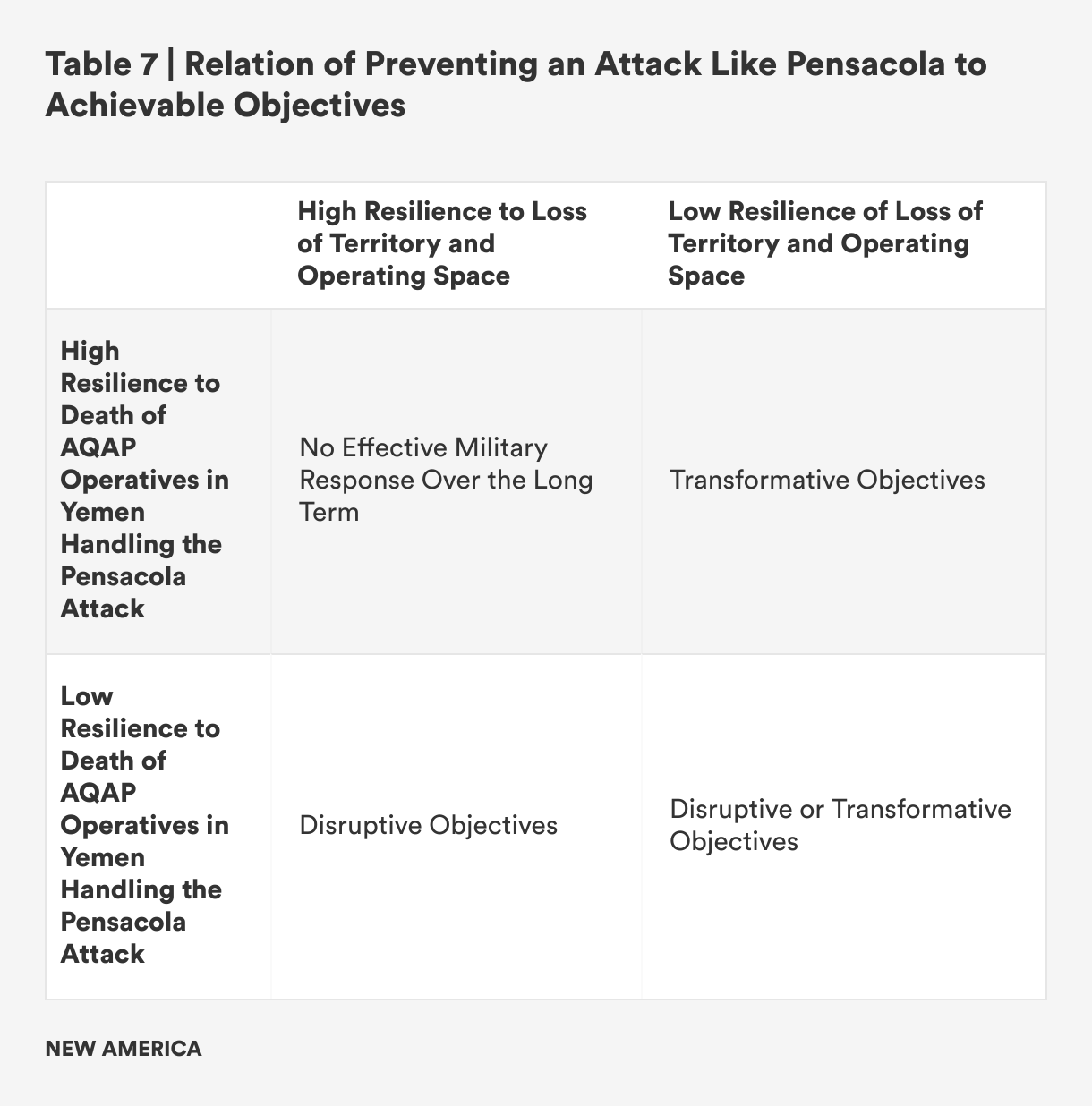
The three deaths in Pensacola are a tragedy and the role of AQAP in the attack requires close study. However, the attack should not overshadow the evidence that the AQAP threat to the homeland has declined since 2009.
Drone Strikes and Skilled Operative Losses as Evidence of a Reduced Threat
That evidence includes how U.S. strikes have killed many of the skilled operatives that staffed the external attack apparatus, suggesting the threat has declined. U.S. drone strikes have killed tens of AQAP commanders over the course of the campaign, including twice killing the group’s overall leader: first in 2015 when the United States killed Nasir al-Wuhayshi, and then in 2020 when the United States killed Qasim al-Raymi.111 In September 2011, the United States killed Anwar Awlaki, the subject of a long manhunt that defined much of the early phases of the U.S. counterterrorism war.112
Gregory Johnsen writes that AQAP’s external attack capability has, as a result, “atrophied.”113 Elisabeth Kendall writes, “It is unlikely that AQAP is currently in a position to exercise direct command and control over attacks in the West. But it can certainly still inspire, and possibly even provide some direction,” and notes the rapidity with which operatives tied to the attack in Pensacola were killed.114
The killing of AQAP’s leaders and operatives has not defeated the organization. Awlaki’s inspirational role arguably grew after his death.115 Some analysts conclude that the drone campaign has been counterproductive overall, helping to drive Yemeni support for AQAP and encouraging the group to view its role in more global terms.116
However, policymakers should not conflate the question of whether drones helped or harmed American objectives of destroying AQAP with the question of whether strikes disrupted specific plotting activity or degraded the capability to plot such attacks. A focus on the allegedly counterproductive impact of drone strikes on the conflict as a whole can—if not carefully applied—end up replicating the myth that AQAP is defeatable, fueling the dangerous obsession with unlimited ends and its tendency to obscure tradeoffs between more achievable, limited objectives.
Thomas Hegghammer argued in 2010 that AQAP’s foreign operations efforts are not the same as the group as whole and deliberately kept small and isolated from the group’s larger force structure, adding “if protecting the homeland is a priority, then dismantling AQAP’s Foreign Operations Unit should be at the top of America’s counterterrorism agenda in Yemen. Chasing the rest of AQAP is important, but should come second on the list of priorities. Of course, a strong core organization helps the Foreign Operations Unit, but the terrorist threat to the West from Yemen is by no means directly proportional to the overall strength of AQAP.”117 In the case of Awlaki, the stated reason the United States targeted him for assassination was his role in organizing direct attacks on the United States not his propaganda role.118 The intelligence community assessed that the loss of Awlaki likely partially disrupted AQAP’s external operations.119
In 2018, Johnsen, who was a subject of Hegghammer’s critique, acknowledged the distinction between AQAP’s external and internal capabilities, writing, regarding Yemen’s civil war, “When the war started, many outside observers—myself included—believed that the longer the fighting lasted, the more recruits AQAP would gain and the greater a threat it would become. We were half-right. The fighting has increased AQAP’s numbers but hasn’t made the group more of a threat to the West.”120
U.S. and European Statements as Evidence of a Reduced Threat
Recent U.S. government assessments, in contrast to the 2009-2012 period, also suggest AQAP’s threat to the homeland has declined. The government has repeatedly assessed that it lacks evidence of specific foreign terrorist organization plots targeting the homeland.
In April 2011, the United States replaced its infamous color-coded terrorism warning system with the National Terrorism Advisory System (NTAS), which would send out an alert in the case of important information regarding threats to the United States, distinguishing between either an “elevated” threat with no specific information on timing or location or an “imminent” threat where such information did exist.121 NTAS provided its first bulletin in December 2015, reading, “We know of no intelligence that is both specific and credible at this time of a plot by terrorist organizations to attack the homeland.”122 Further bulletins in June and November 2016 made similar assessments.123
While NTAS ceased using that language in May 2017, it provided no alerts regarding credible foreign terrorist organization plots.124 While the change in language emphasized the danger of encrypted communication, which played a role in the Pensacola attack, they did not specifically note any growing threat from AQAP. In the wake of the Pensacola attack, NTAS released two bulletins, but these focused on Iran and its proxies in the context of the assassination of Soleimani and not Pensacola or AQAP.
Further bulletins in 2021 generally focused on the domestic violent-extremist threat and provide no evidence for an increased threat of directed attacks by AQAP or any other foreign terrorist organization. A November 2021 bulletin stated, “As of November 10, 2021, DHS is not aware of an imminent and credible threat to a specific location in the United States.”125
The intelligence community’s Worldwide Threat Assessments paint a more complicated picture, with repeated assessments that suggest a persistent AQAP threat, but over time the specificity and urgency of the assessment declined (See Appendix 1).126
By 2012, the intelligence community also assessed that it had effectively degraded al-Qaeda core’s threat to the homeland.127 In 2013, the intelligence community assessed that “the group is probably unable to carry out complex, large-scale attacks in the West.”128 In October 2021, Undersecretary of Defense for Policy Colin Kahl told the Senate Armed Services Committee, “I think the intelligence community assesses that the overall risk to the homeland across the world is at its lowest point since 9/11.”129
In 2014, the intelligence community began to portray homegrown violent extremists rather than foreign terrorist organizations as the primary threat to the United States (See Appendix 1). For example, in 2014 the intelligence community assessed: “US-based extremists will likely continue to pose the most frequent threat to the US Homeland.”130 The 2015 assessment emphasized the importance of shortened distance, implying that distance posed a major obstacle to foreign terrorist organizations: “Homegrown violent extremists… will probably remain the most likely Sunni violent extremist threat to the US homeland because of their immediate and direct access.”131 This emphasis on homegrown threats suggests that the U.S. intelligence community viewed the threat from AQAP and other foreign terrorist groups by 2014 to be of a different kind than it did in 2009-2012.
In 2019, EUROPOL’s Terrorism Situation and Trend Report stated, “Despite the high numbers of AQAP fighters, however, the group’s wing specialising in attacks on Western targets has reportedly been significantly reduced in recent years, probably as a result of both military action targeting its members and the competition with local IS affiliates. As a result, in 2018, the threat from AQAP to Western interests seemed diminished.”132
Expanded Strategic Distance as Evidence of a Reduced Threat
The directed attack plots of the 2009-2012 period reflected conditions in Yemen that no longer exist. These plots relied upon the ease of travel to and from Yemen during the 1990s and 2000s.133 Increasing connections between Yemen and the West helped al-Qaeda shrink the strategic distance between its operatives capable of organizing major attacks and their targets in the United States and Europe.134
The plots of 2009-2012 took advantage of these conditions. For example, Abdulmuttalab was a Nigerian who had been living in Britain, previously traveled to the United States and Yemen, and returned to Yemen in 2009, ostensibly to study but really to seek out Awlaki. He was then able to exit the country, easily connecting to the international flight system. Carlos Bledsoe, an African-American convert from Tennessee, who does not appear to have actually joined AQAP but cited them as an inspiration for his deadly 2009 attack on a military recruiting station in Arkansas, had traveled to Yemen to study.135 Minh Quang Pham similarly entered Yemen as a tourist, according to court documents.136
Today, attack plots that rely upon such travel patterns are extremely unlikely. The strategic distance between AQAP and the United States expanded in 2015 as the growing Houthi rebellion and civil war cratered Yemen’s tourism industry and the number of flights to and from the country.137 According to Adam Baron, a researcher who has traveled in Yemen since the civil war, “in Yemen’s recent history, it has never been more difficult for non-Yemenis to enter Yemen. The war has effectively eliminated things like tourism and Arabic study programs.”138
More than a million tourists entered Yemen every year from 2010 through 2014, in 2015 that fell to 398,000.139 Similarly, the number of passengers on international or domestic flights by air carriers registered in Yemen cratered from 1.6 million in 2014, to about 443,000 in 2015, then bottoming out at 132,571 in 2017.140 In 2016, the FAA restricted U.S. flights transiting Yemeni airspace, due to the security situation.141 In 2021, the State Department maintained a Level 4 Travel Advisory for Yemen, its highest level, writing, “Do not travel to Yemen due to COVID-19, terrorism, civil unrest, health risks, kidnapping, armed conflict, and landmines.”142 Over the years, such warnings have become more explicit.143 The pandemic has also expanded the strategic distance between Yemen and the United States.144
Even before the civil war, travel to and from Yemen saw increased surveillance as a result of the Christmas Day attack.145 According to Adam Baron, there was a “steady decline in ease that followed that was itself followed by a cratering after the flight of the internationally recognized government and the subsequent launch of Operation Decisive Storm.”146 Law enforcement and immigration officials also began to treat travel to Yemen as a potential indicator for terrorist activity.147
Policymakers should not assume that the decline in Yemen’s interactions with other countries will be permanent.148 Refugee flows also continue along age-old routes of Yemeni interaction with the world, although these routes are heavily policed, often dangerous, and unreliable.149 Moreover, to the extent that any counterterrorism strategy’s calculation of success relies on the constraints on travel imposed by the civil war, it raises moral questions about that strategy as well as practical ones. However, it is critical to recognize that it is now extremely difficult for people to enter Yemen, receive training, and then enter the United States to conduct an attack.
AQAP appears to have recognized the difficulty of conducting directed attacks and has emphasized inspiring lone-actor attacks in the West instead. In 2017, AQAP told a Norwegian paper that it had only recruited five foreigners in the past five years, and that foreigners were not welcome given the role they had played in ISIS and the security difficulties they bring.150
While the claim about the specific number of foreigners may not be credible, a look at AQAP’s English language propaganda suggests that AQAP is no longer encouraging people to travel to Yemen in the same way that it was in 2011.151 The 17th issue of AQAP’s English language magazine Inspire (published in 2017) carried an article attributed to Hamza Bin Laden that encouraged Westerners to carry out attacks where they were rather than traveling to participate in jihad. It stated: “Inflicting punishment on Jews and Crusaders where you are present is more vexing and severe for the enemy” and “don’t underestimate yourself, nor belittle your work, for how many professionally executed individual operations in the West outweighed numerous operations in the East.”152 The issue also included numerous articles promoting lone-actor attacks in the West and explicitly placing equal or greater value on it compared to foreign fighting.153 In contrast, none of the articles listed in the issue’s table of contents called for people to travel to Yemen. The 16th issue of the magazine (published in 2016) likewise promoted lone-actor jihad but made no call for and provided no advice on travel to Yemen.154
AQAP has long-promoted lone-actor attacks in the West without travel even as it prepared directed attacks from Yemen. However, the first issue of Inspire (published in 2011) included explicit calls and advice for people to travel to Yemen.155 The second issue of Inspire reprised a section that appeared in the first issue providing advice for people coming to Yemen, and though it emphasized the value of attacks in the West and said some jihadists might ask why Westerners do not carry out attacks at home, it added, “Nevertheless, they’ll be exceptionally happy to have you in their ranks.”156 In the more recent issues, this language does not appear, leaving only an emphasis on attacks in the West without travel.
Even if jihadist groups have not shifted their strategic approach, it is not clear they are capable of recruiting people who are able to travel to Yemen and then carry out attacks in the West. The Islamic State in Yemen failed to attract foreign fighters despite its propaganda suggesting that it sought Western recruits.157 Multiple reviews of American terrorism cases suggest that there is little interest or ability on the part of Americans to join jihadist groups in Yemen today.158
In 2010, assessments that Yemen, along with Somalia, might be “a preferred destination for non-Yemeni converts or foreign fighters” played an important role in the American decision to wage war.159 Regardless of whether or not such an assessment was valid then, it is not valid today.
Contrary Evidence Pointing to a Sustained Threat
Two data points suggest AQAP may retain a sustainable capability to directly strike the U.S. homeland. They are the January 2015 Charlie Hebdo attack and reports of a connection between AQAP and plots against aviation out of Syria.
The Charlie Hebdo attack does provide reason to be wary of AQAP’s threat given AQAP’s claim of responsibility and reporting that Chérif Kouachi received training and financing from the group in Yemen in 2011. While the attack occurred in 2015, it may be better understood as an expression of the dying gasp of the 2009-2012 era, when the threat was higher. Seven years later, AQAP has not demonstrated the capability to follow up with a sustained campaign of violence in Europe (11 years if you start the clock with Kouachi’s Yemen trip). This failure warns against viewing the attack as strong evidence of a sustained external attack capability today.
Moreover, it is unclear how substantial a role AQAP actually had in directing the attack.160 If AQAP’s role in the attack consisted of training and financing but not a more specific direction, it raises questions about the effectiveness of military counterterrorism as a response. Even if Kouachi received general instructions regarding the target in 2011, as U.S. and French officials appear to believe, it can still raise questions about how essential those aspects were to an attack embedded in a larger, French network that had previously been involved in terrorist activity.
Even if the attack is judged to demonstrate a sustained AQAP capability to direct attacks in Europe, analysts should still be wary of assuming that means a similar threat in the United States. Europe provides an easier context within which to organize large scale jihadist attacks than the United States does.161
Possible AQAP ties to plots originating in Syria against aviation targets provide another argument for assessing that AQAP maintains a sustained external attack capability. As the United States escalated its war against ISIS into Syria, the United States also targeted what it called the Khorasan Group with air strikes saying that the group of senior al-Qaeda figures posed an imminent threat in large part through the development of sophisticated explosives that could be smuggled past airport security.162 Reportedly behind this fear was intelligence that suggested AQAP’s master bomb-maker, Ibrahim al-Asiri, who built the Christmas Day attack bomb, was part of the group’s network. Further, the group’s reported leader, Mohsen al-Fadhli, allegedly tied to the attack on the oil tanker MV Limburg off of Yemen’s coast, was believed to be well placed to connect al-Qaeda’s networks, including AQAP, with its efforts in Syria.163
The possible AQAP ties to plotting by the Khorasan Group provide a weak justification for war in Yemen. Despite initial claims that the 2014 aviation threat was imminent, later reporting suggested that it was more of an aspirational threat.164 Asiri was killed in 2017, and while he likely passed along bomb-making knowledge to others, the diffusion of such knowledge raises serious questions about how war in Yemen would meaningfully respond to such a resilient threat, particularly if the fear was that the threat was now coming from an entirely different country.165
The AQAP Threat Beyond the U.S. Homeland
Threats to the U.S. homeland are not the only threats that can motivate American military action. Many Americans live, work, and have families in areas threatened by jihadist groups. The United States has historically taken military action to protect those Americans, to defend particular societal arrangements in the Middle East perceived as being in the U.S. interest, and to fulfill humanitarian objectives, for example stopping ISIS’s genocidal advance.
AQAP certainly posed threats beyond the U.S. homeland although these threats tended to be less significant than those posed by ISIS. As noted above, AQAP plotted attacks outside of the United States, and claimed the January 2015 attack on Charlie Hebdo. Yet the scale of AQAP’s European efforts pale in comparison with ISIS’ campaign of terror in Europe from Syria.166 AQAP took hostages, including Americans, and filled its coffers using the ransoms it obtained. However, hostage taking in Yemen rarely involved the murder of hostages and the propagandistic use of brutal violence that characterized the hostage crisis in Syria, although that may have been changing by 2014.167 AQAP has also targeted Americans within Yemen for sophisticated attacks as well as for kidnapping.168
AQAP seized territory and provided some level of governance amid the Arab Spring’s aftermath and the renewed civil war with the Houthis.169 The most significant of these gains occurred in 2011, when AQAP took the cities of Jaar and Zinjibar in Yemen’s Abyan governorate, and in 2015 when AQAP took the port city of Mukalla in Yemen’s Hadramawt governorate and retook control in parts of Abyan.
However, AQAP’s ability to hold territory has been inconsistent and it has struggled to maintain its strength.170 In 2020, ACLED researchers wrote that AQAP “currently operates in isolated pockets of territory along with a variety of anti-Houthi forces.”171 AQAP’s struggles—particularly on the territorial front—do not only come from competition with non-jihadist forces, but also from the way that holding territory increases tensions within the group over its stance regarding ISIS.172 Though the group has found a niche for itself in Yemen’s politics and proven at times adept (or at least sufficiently adept to ensure its survival) at navigating the complexities of Yemeni politics, it is a relatively minor player and should not be portrayed as a mass movement similar in scale to other political forces active in the country or as fundamentally intertwined with Yemen’s tribes.173 That said, the polarization generated by the civil war and Houthi advances and the ongoing fragmentation of Yemeni politics may reshape political conditions, and open space for AQAP to overcome constraints on its growth.
In 2011 when AQAP governed territory in Abyan, it committed human rights abuses.174 However, when AQAP seized Mukalla, it was somewhat tempered by its earlier experience and sought to avoid oppressive actions that might alienate the population.175 AQAP and al-Qaeda more generally have avoided the kind of systematic large-scale atrocities that characterized ISIS governance, although this may be the result of temporary tactical factors.176
Even if AQAP’s efforts to limit atrocities are purely a temporary tactical choice, it shapes the conditions of the war, and poses challenges for war rationales based on humanitarian grounds. Amid the enormous humanitarian crisis and the clash of far more powerful and entrenched factions of Yemeni politics, jihadists are far from the greatest or primary threat to the ability of Yemenis to live full and secure lives.177 Importantly, the United States’ partners in Yemen also do not have clean hands when it comes to human rights violations in Yemen.178 For some Yemenis, this can encourage acquiescence to AQAP governance, particularly if the U.S. war appears to pose a choice between a harsh stability and an unaccountable, chaotic, and foreign imposed governance justified via the rhetoric of human rights, or if the difference is sufficiently blurred to discourage risking action.179
AQAP also played an important role in the broader al-Qaeda network, the elimination of which may have been a core objective of a larger strategy of disaggregating al-Qaeda’s threat. The group held close ties to al-Qaeda’s core. Nasir al-Wuhayshi, AQAP’s top leader until his death in a 2015 drone strike, served as a close secretary to Bin Laden in Afghanistan for years and was named al-Qaeda’s second in command when Ayman al-Zawahiri took over the organization in the wake of Bin Laden’s death.180 At the same time, AQAP had ties to al-Qaeda-affiliated groups in North Africa, the Middle East, and Somalia, while al-Qaeda’s leadership in South Asia was somewhat cut off from its network’s activities in the region due to counterterrorism strikes and other pressure in Pakistan.181
AQAP’s effectiveness in this role should not be exaggerated. The documents that were recovered during the raid that killed Bin Laden showed that while bin Laden was in touch with AQAP’s leadership over key details of strategy, there were also tensions between al-Qaeda core and its Yemeni affiliate.182 More recently, while AQAP remained loyal to Zawahiri and al-Qaeda as ISIS challenged al-Qaeda’s claim to leadership of the jihadist movement, its stance was more equivocal than Zawahiri might have hoped, and internal rifts over how to respond to the rise of ISIS had a significant impact on the group’s lower-levels.183 Similarly, AQAP’s historical ties to al-Shabaab are clear.184 Yet cooperation between AQAP and al-Shabaab is constrained by local tribal opposition.185
Threats beyond the U.S. homeland may have provided important rationales for the U.S. war in Yemen. Yet, at the time of the war’s initiation, American and Yemeni decision-makers held views that warn against over-emphasizing the role of local threats. The Obama administration repeatedly expressed an intent to stay aloof from the localized business of waging a counterinsurgency campaign in Yemen.186 The Yemeni government in turn viewed AQAP as a lesser threat than the Houthi rebels.187 American concerns about its own homeland security played a central role in motivating the war. To the extent that regional security or humanitarian rationales played a role, they were rarely analyzed in isolation from the presumed threat to the homeland.
The constraints on AQAP’s local power—particularly in comparison to other more powerful factions in Yemen—should lead analysts to be wary of their use to justify the continuation of the U.S. war. Analysts should also be wary of the way that preventive homeland security rationales can hide tradeoffs and overshadow cost-benefit assessments regarding other rationales, functioning as an excuse to justify continued military action when the United States fails to achieve regional security objectives.
Citations
- See for example: “National Security Strategy” (The White House, May 2010), 1, 4, 21, <a href="source">source">source; “National Strategy for Counterterrorism” (The White House, June 28, 2011), 14, <a href="source">source">source; “National Strategy for Counterterrorism of the United States of America” (The White House, October 2018), 1, 11, <a href="source">source">source; “Summary of the 2018 National Defense Strategy of the United States of America” (Department of Defense, 2018), 4, 9, <a href="source">source">source.
- On defining preventive war logic see: David Sterman, “Decision-Making in the Counter-ISIS War: Assessing the Role of Preventive War Logic” (New America, November 15, 2019), <a href="source">source">source; Jack S. Levy, “Preventive War and Democratic Politics.: Presidential Address to the International Studies Association March 1, 2007, Chicago,” International Studies Quarterly 52, no. 1 (March 2008): 1–24, <a href="source">source">source; Colin Gray, “The Implications of Preemptive and Preventive War Doctrines: A Reconsideration” (Strategic Studies Institute, July 2007), <a href="source">source">source.
- Katherine Zimmerman, “Beyond Counterterrorism: Defeating the Salafi-Jihadi Movement” (American Enterprise Institute, October 2019), <a href="source">source">source; Daniel Green, “Defeating Al-Qaeda’s Shadow Government in Yemen: The Need for Local Governance Reform” (Washington Institute for Near East Policy, September 19, 2019), <a href="source">source">source; Katherine Zimmerman, “A New Model for Defeating al Qaeda in Yemen” (AEI, September 2015), <a href="source">source">source.
- Matthew Levitt, “Rethinking U.S. Efforts on Counterterrorism: Toward a Sustainable Plan Two Decades After 9/11,” National Security Law & Policy 12, no. 2 (June 11, 2021), <a href="source">source">source.
- Peter Bergen, David Sterman, and Melissa Salyk-Virk, “America’s Counterterrorism Wars: The War in Yemen” (New America), accessed February 18, 2022, <a href="source">source">source; Chris Woods, Sudden Justice: America’s Secret Drone Wars (New York, NY: Oxford University Press, 2015), 51, 55–61; Gregory D. Johnsen, The Last Refuge: Yemen, al-Qaeda, and America’s War in Arabia, 1st ed (New York: W.W. Norton & Co, 2013), 121–23; David Johnston and David E. Sanger, “THREATS AND RESPONSES: HUNT FOR SUSPECTS; Fatal Strike in Yemen Was Based on Rules Set Out by Bush,” New York Times, November 6, 2002, <a href="source">source">source.
- Woods, Sudden Justice, 58–61; Dina Temple-Raston, The Jihad Next Door: The Lackawanna Six and Rough Justice in an Age of Terror, 1st ed (New York: Public Affairs, 2007); Matthew Purdy and Lowell Bergman, “WHERE THE TRAIL LED: Between Evidence and Suspicion; Unclear Danger: Inside the Lackawanna Terror Case,” New York Times, October 12, 2003, <a href="source">source">source.
- For discussion of U.S. policy during this period see: Eli Berman, David A. Lake, and Julia Macdonald, eds., “Yemen 2001-11: Building on Unstable Ground,” in Proxy Wars: Suppressing Violence through Local Agents (Ithaca: Cornell University Press, 2019); Stephen Tankel, With Us and Against Us: How America’s Partners Help and Hinder the War on Terror (New York: Columbia University Press, 2018); Jack Watling and Namir Shabibi, “Defining Remote Warfare: British Training and Assistance Programmes in Yemen, 2004-2015” (Oxford Research Group Remote Warfare Program, June 2018), <a href="source">source">source; Woods, Sudden Justice, 55–61; Edmund J. Hull, High-Value Target: Countering al Qaeda in Yemen, 1st ed, ADST-DACOR Diplomats and Diplomacy Series (Washington, D.C: Potomac Books, 2011).
- “AL-QA’IDA IN THE ARABIAN PENINSULA (AQAP),” National Counter Terrorism Center, accessed November 23, 2021, <a href="source">source">source; Tankel, With Us and Against Us, 220.
- On June 1, 2009, Abdulhakim Mujahid Muhammad (Carlos Bledsoe) killed one person in an attack on a military recruiting station in Little Rock Arkansas. He had traveled to Yemen and later claimed to be affiliated with AQAP. On November 5, 2009, Maj. Nidal Hasan, who was inspired by and communicated with Anwar al-Awlaki, killed 13 people in an attack at Fort Hood Texas. James Dao, “Man Claims Terror Ties in Little Rock Shooting,” New York Times, January 21, 2010, <a href="source">source">source; “Fort Hood Suspect Charged with Murder,” CNN, November 12, 2009, <a href="source">source">source.
- Jeremy Scahill, Dirty Wars: The World Is a Battlefield (New York: Nation Books, 2013), 254–64.
- Woods, Sudden Justice, 197.
- On counterterrorism broadly under the Obama administration in Yemen see: Luke Hartig, “U.S. Counterterrorism Policy in Yemen: 2010-2020” in Michael A. Sheehan, Erich Marquardt, and Liam Collins, eds., Routledge Handbook of U.S. Counterterrorism and Irregular Warfare Operations (Abingdon, Oxon; New York, NY: Routledge, 2022).
- This is based on New America’s tracking. Exact counts of strikes and death tolls vary. Non-governmental trackers of U.S. strikes are limited by the covert nature of many strikes. However, broad trends in activity show up in the data of multiple groups tracking U.S. strikes. See: Bergen, Sterman, and Salyk-Virk, “America’s Counterterrorism Wars: The War in Yemen”; “US Airstrikes in Yemen,” Long War Journal, accessed September 24, 2021, <a href="source">source">source; “Bureau of Investigative Journalism – The Covert Drone Wars Archive,” Airwars, accessed September 24, 2021, <a href="source">source">source.
- “Yemen’s al-Qaeda: Expanding the Base” (International Crisis Group, February 2, 2017), <a href="source">source">source.
- For an illustration of how U.S. military actions enabled Emirati efforts see: James Mattis, “Memorandum for Assistant to the President for National Security Affairs Subject: Department of Defense Support to UAE Shabwah Offensive in Yemen” (Department of Defense (Released via ACLU FOIA), January 24, 2017), <a href="source">source">source; James N Mattis, “Memorandum for Assistant to the President for National Security Affairs. Subject: Department of Defense Request to Extend the Authorization for DoD Support to UAE in Yemen” (Department of Defense (Released via ACLU FOIA), April 28, 2017), <a href="source">source">source. See also: Luke Hartig, “Full Accounting Needed of US-UAE Counterterrorism Partnership in Yemen,” Just Security, December 7, 2018, <a href="source">source">source.
- Bergen, Sterman, and Salyk-Virk, “America’s Counterterrorism Wars: The War in Yemen”; “US Airstrikes in Yemen”; “Bureau of Investigative Journalism – The Covert Drone Wars Archive”; Gregory D. Johnsen, “Trump and Counterterrorism in Yemen: The First Two Years” (Sana’a Center for Strategic Studies, February 2019), <a href="source">source">source.
- CENTCOM told the author that there were no strikes in 2021. On November 18, 2021, CENTCOM told Airwars that “CENTCOM conducted its last counterterror strike in Yemen on June 24, 2019. CENTCOM has not conducted any new counterterror strikes in Yemen since.” Author’s Email Correspondence with CENTCOM, February 8, 2022; “Airwars Assessment: USYEMBi004-C,” Airwars, accessed February 18, 2022, <a href="source">source">source.
- See: “Attorney General William P. Barr and FBI Director Christopher Wray Announce Significant Developments in the Investigation of the Naval Air Station Pensacola Shooting” (Department of Justice Office of Public Affairs, May 18, 2020), <a href="source">source">source; Katie Benner and Adam Goldman, “F.B.I. Finds Links Between Pensacola Gunman and Al Qaeda,” New York Times, May 18, 2020, <a href="source">source">source; “Country Reports on Terrorism 2020” (United States Department of State Bureau of Counterterrorism, December 2021), 2, <a href="source">source">source.
- For reports regarding the review see: Spencer Ackerman, “The Peril and the Promise of Biden’s Drone Review,” Forever Wars, December 6, 2021, <a href="source">source">source; Charlie Savage and Eric Schmitt, “Biden Secretly Limits Counterterrorism Drone Strikes Away From War Zones,” New York Times, March 3, 2021, <a href="source">source">source. For reports of U.S. strikes in Yemen in 2021 see: “Two Qaeda Suspects among Three Killed in Yemen Drone Strike,” Ahram Online (AFP), November 14, 2021, <a href="source">source">source. United States Central Command denied conducting such a strike. Author’s phone inquiry to CENTCOM Public Affairs, November 15, 2021. Airwars has tracked other alleged U.S. strikes in 2021 reported by local news sources or on social media but which have not been reported by wire services or Western news sources. See: “US Forces in Yemen,” Airwars, accessed December 9, 2021, <a href="source">source">source. In early 2022, AQAP released a eulogy for a senior figure that it said was killed in a U.S. air strike. It did not provide a location or date though. “Intelligence Group Says AQAP Announces Death of Former Bin Laden Associate in U.S. Strike in Yemen,” Reuters, January 20, 2022, <a href="source">source">source.
- On the Biden administration’s embrace of “sustainable counterterrorism” see: Liz Sherwood-Randall, “Remarks as Prepared for Delivery by Assistant to the President for Homeland Security, Dr. Liz Sherwood-Randall on the Future of the U.S. Counterterrorism Mission: Aligning Strategy, Policy, and Resources” (White House, September 8, 2021), <a href="source">source">source; Levitt, “Rethinking U.S. Efforts on Counterterrorism: Toward a Sustainable Plan Two Decades After 9/11.”
- Kareem Fahim and Sarah Dadouch, “Yemen’s Houthi Militants Launch New Attack on UAE as Conflict Widens,” Washington Post, January 24, 2022, <a href="source">source">source; John Hudson, Missy Ryan, and Josh Dawsey, “On the Day U.S. Forces Killed Soleimani, They Targeted a Senior Iranian Official in Yemen,” Washington Post, January 10, 2020, <a href="source">source">source.
- See: David Sterman, “Defining Endless Wars: The First Step Towards Ending Them” (New America, January 26, 2021), source">source.
- Noah Rothman, “Can We Dispense with the Childish ‘Forever Wars’ Nonsense Now?,” June 28, 2021, source">source; Steven Cook, “End the ‘Forever War’ Cliché,” Foreign Policy, April 22, 2021, source">source; Kori Schake et al., “Defense in Depth,” Foreign Affairs, November 23, 2020, source">source; Thomas Joscelyn, “Endless Jihad: The Problem with Pledging to End Our ‘Endless Wars,’” The Dispatch, August 20, 2020, source">source; Paul Miller, “Ending the ‘Endless War’ Trope,” Atlantic Council, March 26, 2020, source">source; Dakota Wood, “The Myth of Endless Wars,” The National Interest, October 31, 2020, source">source; Max Molot, “Bad Idea: Calling U.S. Operations in Afghanistan, Iraq, and Syria ‘Endless Wars,’” CSIS Defense360, January 7, 2020, source">source.
- On the problems with equating endlessness and duration see: Jonah Schulhofer-Wohl, Quagmire in Civil War, 2020, Kindle Location 444. Also see: David Sterman, “Avoiding the Time Trap,” Fellow Travelers, December 6, 2021, source">source; Sterman, “Defining Endless Wars: The First Step Towards Ending Them.”
- Even analysts who are skeptical of critics of endless war acknowledge the basic character of American counterterrorism warfare as stuck with the United States unable to be defeated but also not able to achieve all of its objectives and declare victory. For example, Hal Brands and Michael O’Hanlon write, “the strategy remains an intuitively unsatisfying ‘mowing the grass’ approach,” adding, “By design, it must therefore be continued indefinitely, until local politics or other indigenous factors deprive future terrorists of the ability to train, recruit and organise.” They also write, “America is nowhere close to achieving the objective that key policymakers identified early on: pushing terrorism to the margins, cutting off the flow of recruits, and otherwise creating conditions that would allow Washington to declare victory and come home.” Hal Brands and Michael O’Hanlon, “The War on Terror Has Not Yet Failed: A Net Assessment After 20 Years,” Survival 63, no. 4 (July 4, 2021): 33–54, source">source. See also: Michael O’Hanlon, “Resigned to Endless War,” Wall Street Journal, July 27, 2018, source">source.
- Whether one views the 2002 to late 2009 period as a period of war is a complex question reflecting the issues that arise in wars carried out under open-ended, non-geographically limited authorizations as well as the general challenge of defining and dating when a war begins. The U.S. asserted authority to carry out strikes, and it acted upon that authority in 2002, but the U.S.-Yemeni relationship was largely of one assistance and cooperation without direct U.S. military action in the following years with the 2009 escalation constituting a real shift. Helen Lackner suggests that many Yemenis did not see the 2002-2009 period as continuous with the late 2009 escalation, writing, “having considered the 2002 airstrike a unique event, a repetition of direct US attacks aroused considerable anger throughout Yemen due to the large number of civilians killed.” Helen Lackner, Yemen in Crisis: The Road to War, U.S. edition (London; New York: Verso, 2019), 140. In its propaganda, al-Qaeda emphasizes the continuity of a longer war, presenting the Yemeni government as an agent of the United States. However, al-Qaeda still notes a shift in the overtness of the war. See: “Abu-Yahya Al-Libi Condemns US Involvement in Yemen, Yemeni Government,” February 23, 2010, Al Qaeda Statements Index, source">source; “Al-Qa’ida in Arab Peninsula Secretary General Calls For Attacks in Yemen, Somalia,” April 19, 2009, Al Qaeda Statements Index, source">source; “Al-Qai’da in Arabian Peninsula Leader Urges Yemeni Tribes to Fight Government,” February 20, 2009, Al Qaeda Statements Index, source">source.
- Establishing the beginning of the U.S. war in Vietnam is difficult. For example, one might date the war to the U.S. assumption of responsibility from France and the Department of Defense’s earliest date for inclusion in the Vietnam Veterans Memorial (November 1955), or the first U.S. death (June 1956), or North Vietnam’s declaration of war on the South (January 1959), or the Gulf of Tonkin resolution (August 1964) or the first arrival of official U.S. combat troops (March 1965). If one begins with the earliest date for inclusion on the memorial, that would constitute a little over 19 years between the war’s start and the fall of Saigon. If one begins with the Gulf of Tonkin resolution it would be about eleven years. On this range of possible dates and discussion of comparisons of length to America’s counterterrorism wars see: Daniel DeFraia, “Which Is America’s Longest War, Afghanistan or Vietnam?,” GlobalPost, October 19, 2012, source">source; Adam Taylor, “These Are America’s 9 Longest Foreign Wars,” Washington Post, May 29, 2014, source">source. On the difficulty of dating the beginning and endings of wars generally see: Mary L. Dudziak, War Time: An Idea, Its History, Its Consequences (Oxford: Oxford Univ. Press, 2012). On contemporaneous descriptions of the Vietnam war as endless see: Leslie H. Gelb, “Causes, Origins, and Lessons of the Vietnam War,” § Senate Committee on Foreign Relations (1972), source">source; Paul M. Sweezy, “Vietnam: Endless War,” Monthly Review 20, no. 11 (April 1, 1969): 1, source">source.
- “Congress and the War in Yemen: Oversight and Legislation 2015-2020” (Congressional Research Service, June 19, 2020), 12, source">source; William Roberts, “US House Approves Resolution to End US Role in Yemen War,” Al Jazeera, April 4, 2019, source">source; Lackner, Yemen in Crisis, xxv–xxvi.
- For more detail see: Sterman, “Defining Endless Wars: The First Step Towards Ending Them.”
- On the general inability of jihadists to pose such a threat see: Peter L. Bergen, United States of Jihad: Investigating America’s Homegrown Terrorists, First edition (New York: Crown Publishers, 2016); John E. Mueller and Mark G. Stewart, Chasing Ghosts: The Policing of Terrorism (Oxford ; New York: Oxford University Press, 2016); John Mueller and Mark G. Stewart, “Misoverestimating ISIS: Comparisons with Al-Qaeda,” Perspectives on Terrorism 10, no. 4 (August 2016), source">source; “Remarks by National Security Advisor Susan Rice on the 2015 National Security Strategy” (White House Office of the Press Secretary, February 6, 2015), source">source.
- Lawrence Freedman, “On War and Choice,” The National Interest, May/June, 2010, source">source.
- John Mueller and Mark G. Stewart, “Terrorism and Bathtubs: Comparing and Assessing the Risks,” Terrorism and Political Violence, October 29, 2018, 1–26, source">source.
- Neil C. Renic, Asymmetric Killing: Risk Avoidance, Just War, and the Warrior Ethos (New York, NY: Oxford University Press, 2020).
- On defining unlimited vs. limited objectives, see: Donald J. Stoker, Why America Loses Wars: Limited War and US Strategy from the Korean War to the Present (Cambridge, United Kingdom; New York, NY, USA: Cambridge University Press, 2019).
- See for an example: Craig Whitlock, “Stranded Without a Strategy,” Washington Post, December 9, 2019, source">source.
- Stoker, Why America Loses Wars, 173; Nate Rosenblatt and David Kilcullen, “The Tweet of Damocles: Lessons for U.S. Proxy Warfare” (New America, April 6, 2020), source">source.
- David Sterman, “Decision-Making in the Counter-ISIS War: Assessing the Role of Preventive War Logic” (New America, November 15, 2019), source">source; Mary L. Dudziak, “This War Is Not Over Yet,” New York Times, February 15, 2012, source">source.
- These two concepts are similar but not necessarily the same. One could envision a decisive military defeat in the context of objectives that are limited, where the enemy loses the ability to continue to fight in a particular area and is unable to escalate in other areas but whose government persists undefeated. Though perhaps unlikely, one could also imagine a government choosing to dissolve itself (thus achieving an unlimited objective of its enemy) despite being militarily capable of continuing to resist because it determined the costs of war were not worth it.
- Christopher D. Kolenda, Zero-Sum Victory: What We’re Getting Wrong about War (Lexington, Kentucky: The University Press of Kentucky, 2021), 23.
- Carl von Clausewitz, Michael Eliot Howard, and Peter Paret, On War, First paperback printing (Princeton, N.J: Princeton University Press, 1989), 90.
- Jonathan Powell, Terrorists at the Table: Why Negotiating Is the Only Way to Peace, First Palgrave Macmillan Trade edition (New York: Palgrave Macmillan Trade, 2015).
- For discussion of the importance of and challenges to negotiated ends to conflicts with terrorist groups see: Stoker, Why America Loses Wars; Powell, Terrorists at the Table; Max Abrahms, “The Political Effectiveness of Terrorism Revisited,” Comparative Political Studies 45, no. 3 (March 2012): 366–93, source">source; Erica Chenoweth et al., “What Makes Terrorists Tick,” International Security 33, no. 4 (April 2009): 180–202, source">source; Max Abrahms, “Why Terrorism Does Not Work,” International Security 31, no. 2 (Fall 2006), source">source.
- Julian Stafford Corbett, Principles of Maritime Strategy (Project Gutenberg, 2005), source">source. Kolenda makes a similar argument, drawing from Clausewitz. Kolenda, Zero-Sum Victory, 25, 52.
- Kolenda, Zero-Sum Victory, 52–54.
- Stoker, Why America Loses Wars, 170. Such a conception has its own Eurocentric biases, rooted in part in the challenges of defining what constitutes war and the tendency to divide its participants into clearly delineated nation-states. The endless and global character of the war on terror itself points to the dangers of putting too much confidence in the strength of such separations. For argument along these lines see: Tarak Barkawi, “Decolonising War,” European Journal of International Security 1, no. 2 (July 2016): 199–214, source">source.
- Joscelyn, “Endless Jihad: The Problem with Pledging to End Our ‘Endless Wars.’”
- Renic, Asymmetric Killing.
- Renic, 37.
- Jennifer Walkup Jayes, “Beyond the War Paradigm: What History Tells Us About How Terror Campaigns End” (Costs of War Project, February 8, 2022), source">source; Luke Hartig, “Playing Defense Is Totally Fine,” Atlantic, September 26, 2021, source">source.
- Samuel Moyn, Humane: How the United States Abandoned Peace and Reinvented War, First edition (New York: Farrar, Straus and Giroux, 2021); Samuel Moyn, “Beyond Humanity: How to Control America’s Use of Force” (Quincy Institute, July 2020), source">source; Anand Gopal, “America’s War on Syrian Civilians,” New Yorker, December 14, 2020, source">source. This is not, however, to contend that transparency is not important in its own right and to avoid reversion to the first type of endlessness.
- Kolenda, Zero-Sum Victory.
- “Statement by the President on ISIL,” White House Office of the Press Secretary, September 10, 2014, source">source.
- “Lead Inspector General for Operation Inherent Resolve Quarterly Report to the United States Congress | July 1, 2021 – September 30, 2021” (Department of Defense Office of the Inspector General, November 3, 2021), source">source.
- For a useful discussion of the lack of clarity and the problems deriving from it beyond the stated objective of defeating ISIS see: Mark Kimmit, “Clarity on Afghanistan, Confusion on Iraq,” Defense One, July 19, 2021, source">source.
- Rosenblatt and Kilcullen, “The Tweet of Damocles: Lessons for U.S. Proxy Warfare.”
- Rosenblatt and Kilcullen.
- Lackner, Yemen in Crisis, 144.
- Bergen, Sterman, and Salyk-Virk, “America’s Counterterrorism Wars: The War in Yemen.”
- David Sterman, “A Death Trap for Al Qaeda Leaders?,” CNN, June 16, 2015, source.
- AQAP’s withdrawal is generally viewed as having been a negotiated withdrawal. Therefore, while it does show AQAP’s inability to deny the U.S. access to the battlefield, it does not demonstrate that the group would be incapable of making any operation to retake territory in the absence of an al-Qaeda decision to withdraw from a bloody battle. “Yemen’s al-Qaeda: Expanding the Base,” 26.
- Elisabeth Kendall, “The Failing Islamic State Within the Failed State of Yemen,” Perspectives on Terrorism 13, no. 1 (February 2019), source.
- Alexander Meleagrou-Hitchens, Incitement: Anwar al-Awlaki’s Western Jihad (Cambridge, Massachusetts: Harvard University Press, 2020), 165–88. Also see the FBI’s notes from their interviews of Abdulmutallab after his arrest available at: source.
- Scott Shane, Objective Troy: A Terrorist, a President, and the Rise of the Drone, First Edition (New York: Tim Duggan Books, 2015), 256.
- Shane, 259.
- Jesse Lee, “President Obama: ‘A Credible Terrorist Threat Against Our Country, and the Actions That We’re Taking’” (The White House, October 29, 2010), source.
- John O. Brennan, Undaunted: My Fight against America’s Enemies, at Home and Abroad, First edition (New York: Celadon Books, 2020), 205.
- Sudarsan Raghavan, Peter Finn, and Greg Miller, “In Foiled Bomb Plot, AQAP Took Bait Dangled by Saudi Informant,” Washington Post, May 9, 2012, source.
- “Dempsey: We Will Act If Islamic Group Threatens U.S.,” AP, August 25, 2014, source.
- Sterman, “Decision-Making in the Counter-ISIS War: Assessing the Role of Preventive War Logic.”
- Aaron W. Jost, “A Comprehensive Approach to Yemen,” The White House, September 24, 2010, source.
- Lee, “President Obama: ‘A Credible Terrorist Threat Against Our Country, and the Actions That We’re Taking.’”
- Tabassum Zakaria, “U.S. Monitors Effect of Awlaki Death on Qaeda Branch,” Reuters, October 6, 2011, source.
- John O. Brennan, “Remarks of John O. Brennan, Assistant to the President for Homeland Security and Counterterrorism, on Ensuring al-Qa’ida’s Demise — As Prepared for Delivery” (The White House Office of the Press Secretary, June 29, 2011), source.
- Dennis C. Blair, “Annual Threat Assessment of the Intelligence Community for the Senate Select Committee on Intelligence,” February 2009, 7, source.
- Dennis C. Blair, “Annual Threat Assessment of the US Intelligence Community for the Senate Select Committee on Intelligence,” February 2, 2010, 10, source.
- James R. Clapper, “Statement for the Record on the Worldwide Threat Assessment of the U.S. Intelligence Community for the Senate Committee on Armed Services,” March 10, 2011, 2, source.
- Blair, “Annual Threat Assessment of the Intelligence Community for the Senate Select Committee on Intelligence,” 6.
- Blair, “Annual Threat Assessment of the US Intelligence Community for the Senate Select Committee on Intelligence,” 8.
- “Remarks by the President in Address to the Nation on the Way Forward in Afghanistan and Pakistan” (White House, December 1, 2009), source.
- “Letter to Nasir Al-Wuhayshi” (Combatting Terrorism Center, n.d.), SOCOM-2012-0000016, source.
- “Terrorist Sentenced to 22 Years for Providing Material Support to Al-Qaeda in the Arabian Peninsula” (Department of Justice Office of Public Affairs, August 12, 2015), source.
- “Terrorist Sentenced to 22 Years for Providing Material Support to Al-Qaeda in the Arabian Peninsula.”
- United States Attorney Eastern District of New York, “Re: United States v. Lawal Babafemi Criminal Docket No. 13-109 (JG),” April 24, 2015, 11, source.
- United States Attorney Eastern District of New York, 3.
- “Member of Al Qaeda in the Arabian Peninsula Pleads Guilty to Terrorism Charges” (Department of Justice Office of Public Affairs, January 8, 2016), source.
- “Member of Al Qaeda in the Arabian Peninsula Pleads Guilty to Terrorism Charges.”
- Details on the docket and recent filings can be found here: source. On the dispute over factual claims see for example: “SENTENCING SUBMISSION by Minh Quang Pham” (Law Offices of Bobbi C. Sternheim, May 9, 2016), Document 110, Case 1:12-cr-00423-AJN, source; “SENTENCING SUBMISSION by USA as to Minh Quang Pham” (United States Attorney Southern District of New York, May 11, 2016), Document 114, Case 1:12-cr-00423-AJN, source; “TRANSCRIPT of Proceedings as to Minh Quang Pham Re: Sentence Held on 5/16/16” (United States District Court Southern District of New York, June 3, 2016), Document 123, Case 1:12-cr-00423-AJN, source.
- Initial reports suggested that Said Kouachi or both Kouachi brothers traveled to Yemen, but later reporting suggested that it was Chérif Kouachi traveling on his brother’s passport. Rukmini Callimachi and Jim Yardley, “From Amateur to Ruthless Jihadist in France,” New York Times, January 17, 2015, source.
- “Charlie Hebdo Shooter Says Financed by Qaeda Preacher in Yemen,” Reuters, January 9, 2015, source.
- Maria Abi-Habib, Margaret Coker, and Hakim AlMasmari, “Al Qaeda in Yemen Claims Responsibility for Charlie Hebdo Attack,” Wall Street Journal, January 14, 2015, source; Jeremy Scahill, “Al Qaeda Source: AQAP Directed Paris Attack,” Intercept, January 9, 2015, source.
- Sebastian Rotella, “How France Let the Charlie Hebdo Killers Go Free,” Daily Beast, July 12, 2017, source; Sebastian Rotella, Dan Edge, and Ricardo Pollack, “Transcript: Terror in Europe,” Frontline, October 18, 2016, source. On Peter Cherif see also: “Peter Cherif” (United Nations Security Council, September 29, 2015), source; “Charlie Hebdo Attack Suspect Arrested, French Officials Say,” AP, December 21, 2018, source.
- Rotella, “How France Let the Charlie Hebdo Killers Go Free.”
- Willy Le Devin, “Peter Cherif, Superviseur Des Attaques de Janvier?,” Liberation, September 1, 2020, source.
- Jonathan Dienst, “Man Who Plotted to Blow up NYC Subway May Soon Walk Free,” NBC, May 2, 2019, source.
- Jeremy M. Sharp, “Yemen: Background and U.S. Relations” (Congressional Research Service, January 13, 2010), 3, source.
- Scott A. Silverstone, From Hitler’s Germany to Saddam’s Iraq: The Enduring False Promise of Preventive War (Lanham, MD: Rowman & Littlefield, 2019), 269; Charles S. Maier, Among Empires: American Ascendancy and Its Predecessors (Cambridge, Mass.: Harvard Univ. Press, 2006), 61; Jack Snyder, “Imperial Temptations,” The National Interest, Spring 2003, source.
- Silverstone, From Hitler’s Germany to Saddam’s Iraq, 77, 80–91.
- Ben Rhodes, “The 9/11 Era Is Over,” Atlantic, April 6, 2020, source.
- Renic, Asymmetric Killing; Gopal, “America’s War on Syrian Civilians.”
- Dave Philipps, “Special Operations Troops Top Casualty List as U.S. Relies More on Elite Forces,” New York Times, February 4, 2017, source; Vera Bergengruen, “These US Troops Were Killed In Combat During Trump’s First Year In Office,” BuzzFeed, December 28, 2017, source.
- Renic, Asymmetric Killing.
- Renic, 185, 174.
- See Neil Renic’s discussion of this issue specifically mentioning the war in Yemen: Renic, 174fn24.
- Elisabeth Kendall, “Twenty Years After 9/11: The Jihadi Threat in the Arabian Peninsula,” CTC Sentinel 14, no. 7 (September 2021), source.
- David Sterman, “We Need More Oversight on US Counterterrorism Policy in the Wake of AQAP’s Confirmed Involvement in the Pensacola Attack,” Responsible Statecraft, May 22, 2020, source; “Attorney General William P. Barr and FBI Director Christopher Wray Announce Significant Developments in the Investigation of the Naval Air Station Pensacola Shooting”; David Sterman, Peter Bergen, and Melissa Salyk-Virk, “Terrorism in America 19 Years After 9/11” (New America, September 11, 2020), source.
- Kendall, “Twenty Years After 9/11: The Jihadi Threat in the Arabian Peninsula.”
- This lack of sophistication reflects the larger failure of virtually coached plotters to demonstrate a greater threat than those merely inspired by propaganda. John Mueller, “The Cybercoaching of Terrorists: Cause for Alarm?,” CTC Sentinel 10, no. 9 (October 2017), source.
- “Letter Dated 15 January 2019 from the Chair of the Security Council Committee Pursuant to Resolutions 1267 (1999), 1989 (2011) and 2253 (2015) Concerning Islamic State in Iraq and the Levant (Da’esh), Al-Qaida and Associated Individuals, Groups, Undertakings and Entities Addressed to the President of the Security Council” (United Nations Security Council, January 15, 2019), 8–9, source.
- Renic, Asymmetric Killing, 185.
- “Yemen Al-Qaeda Leader al-Raymi Killed by US Strike,” BBC, February 7, 2020, source; Sterman, “A Death Trap for Al Qaeda Leaders?”; Bergen, Sterman, and Salyk-Virk, “America’s Counterterrorism Wars: The War in Yemen.”
- Shane, Objective Troy.
- Gregory D. Johnsen, “Khalid Batarfi and the Future of AQAP,” Lawfare, March 22, 2020, source; Gregory D. Johnsen, “The End of AQAP as a Global Threat” (Sana’a Center for Strategic Studies, March 5, 2020), source; Gregory D. Johnsen, “The Two Faces of Al-Qaeda in the Arabian Peninsula,” War on the Rocks, October 11, 2018, source.
- Kendall, “Twenty Years After 9/11: The Jihadi Threat in the Arabian Peninsula.”
- On Awlaki’s posthumous impact see: Meleagrou-Hitchens, Incitement, 236–74; Thomas Hegghammer, “The Last Jihadi Superstar,” War on the Rocks, October 30, 2020, source; Shane, Objective Troy, 302; Peter Bergen et al., “Terrorism in America After 9/11” (New America), accessed August 1, 2019, source.
- Jillian Schwedler, “Is the U.S. Drone Program in Yemen Working?,” Lawfare, September 27, 2015, source.
- Thomas Hegghammer, “The Case for Chasing Al-Awlaki,” Foreign Policy, November 24, 2010, source.
- Eric. H. Holder Jr., Letter to Patrick J. Leahy, Chairman Committee on the Judiciary, United States Senate Regarding Americans Killed in Counterterrorism Operations, May 22, 2013, source. This is not to suggest that these reasons were fully separable, well explained at the time, or that there are not real questions about the process behind the targeted killings. However, the foundation of the stated theory for why Awlaki could and should be targeted did not rest on his inspirational power but on allegations that he was plotting attacks. For discussion of ongoing questions regarding the killing of Awlaki and Samir Khan, another American killed in the same strike who worked on AQAP’s Inspire magazine and whom the government says was not targeted, see: Scahill, Dirty Wars; Jason Leopold, “The FBI Discussed an ‘End-Game’ for a US Citizen Killed in a Drone Strike,” Vice, June 8, 2015, source. In his memoir, Leon Panetta, who had just moved from being Director of Central Intelligence to Secretary of Defense at the time of the strike that killed Awlaki, said that the U.S. did not even know Khan was present when it conducted the strike. Leon E Panetta and Jim Newton, Worthy Fights: A Memoir of Leadership in War and Peace, 2015, 386, source.
- James R. Clapper, “Unclassified Statement for the Record on the Worldwide Threat Assessment of the US Intelligence Community for the Senate Select Committee on Intelligence” (Office of the Director of National Intelligence, January 31, 2012), 3, source.
- Johnsen, “The Two Faces of Al-Qaeda in the Arabian Peninsula.”
- “Terror Alert Systems Fast Facts,” CNN, November 2, 2018, source; John Hudson, “Obama’s Terrorism Alert System Has Never Issued a Public Warning — Ever,” Foreign Policy, September 29, 2014, source; “National Terrorism Advisory System (NTAS),” Department of Homeland Security, accessed August 13, 2019, source.
- “National Terrorism Advisory System Bulletin” (Department of Homeland Security, December 16, 2015), source.
- “National Terrorism Advisory System Bulletin” (Department of Homeland Security, June 15, 2016), source; “National Terrorism Advisory System Bulletin” (Department of Homeland Security, November 15, 2016), source.
- “National Terrorism Advisory System (NTAS).”
- “National Terrorism Advisory System (NTAS)”; “National Terrorism Advisory System Bulletin” (Department of Homeland Security, November 10, 2021), source.
- Hartig, “Full Accounting Needed of US-UAE Counterterrorism Partnership in Yemen,” December 7, 2018.
- Clapper, “Unclassified Statement for the Record on the Worldwide Threat Assessment of the US Intelligence Community for the Senate Select Committee on Intelligence,” 2–3.
- James R. Clapper, “Statement for the Record Worldwide Threat Assessment of the US Intelligence Community” (Office of the Director of National Intelligence, March 12, 2013), 4, source.
- “Stenographic Transcript of Hearing to Receive Testimony on Security in Afghanistan and in the Regions of South and Central Asia” (Senate Committee on Armed Services (Transcript by Alderson Court Reporting), October 26, 2021), 50, source; Jeff Seldin, “Timeline for Potential Attacks by Islamic State, Al-Qaida Getting Shorter,” Voice of America, October 26, 2021, source.
- James R. Clapper, “Statement for the Record Worldwide Threat Assessment of the US Intelligence Community” (Office of the Director of National Intelligence, January 29, 2014), 4, source.
- James R. Clapper, “Statement for the Record Worldwide Threat Assessment of the US Intelligence Community,” § Senate Armed Services Committee (2015), 5, source.
- “Terrorism Situation and Trend Report 2019 (TE-SAT)” (EUROPOL, 2019), 47, source. The report, however, does warn of the potential that AQAP could reconstitute such capabilities if pressure lessened.
- For a broad discussion of travel patterns and tourism in Yemen and its complex interactions with Islamist militancy see: Laurent Bonnefoy and Cynthia Schoch, Yemen and the World: Beyond Insecurity, Comparative Politics and International Studies Series (Oxford ; New York, NY: Oxford University Press, 2018), 135–48. For one account of foreign tourism and religious study in Yemen that helps illustrate the relative ease of travel between the West and Yemen in the mid-2000s compared to today see: Theo Padnos, Undercover Muslim: A Journey into Yemen (London: Bodley Head, 2011). Another account of the Salafi scene in Yemen as well as travel between the West and Yemen more generally from the 1990s through the mid-2000s and how it sometimes connected with al-Qaeda’s networks comes from Morten Storm, who according to his account turned double agent, infiltrating the AQAP circles around Awlaki. Storm also discusses his later travels to Yemen, though given his work for Western intelligence services, caution is required in interpreting that travel’s meaning for questions of strategic distance. Morten Storm, Paul Cruickshank, and Tim Lister, Agent Storm: My Life Inside Al Qaeda and the CIA (New York, NY: Atlantic Monthly Press, 2014), 33-45,48, 55, 90–91.
- On strategic distance see: Patrick Porter, The Global Village Myth: Distance, War and the Limits of Power (Washington, DC: Georgetown University Press, 2015). The argument presented here is not reliant on a claim that links Salafism in Yemen to radicalization. For criticism of representations of the Salafi scene in Yemen as radicalizing based on individual cases of connection between the scene and participants in al-Qaeda’s violence see: Laurent Bonnefoy, Salafism in Yemen: Transnationalism and Religious Identity (New York: Columbia University Press, 2011), 94–95.
- On Bledsoe generally and his travel, see: Daveed Gartenstein-Ross, “Lone Wolf Islamic Terrorism: Abdulhakim Mujahid Muhammad (Carlos Bledsoe) Case Study,” Terrorism and Political Violence 26, no. 1 (January 2014): 110–28, source; Dina Temple-Raston, “FBI Encountered Accused Ark. Shooter In Yemen,” NPR, June 8, 2009, source.
- “Government’s Sentencing Memorandum (United States of America v.Minh Quang Pham)” (United States District Court Southern District of New York, May 10, 2016), 8, 22, source.
- On the war’s impact on connections between Yemen and other countries – other than in the form of bombs and mercenaries see: Bonnefoy and Schoch, Yemen and the World, 139, 152–53.
- Author’s email correspondence with Adam Baron, November 15, 2021.
- This data can be found at: source.
- This data can be found at: source .
- “Extension of the Prohibition Against Certain Flights in Specified Areas of the Sanaa Flight Information Region (FIR) (OYSC)” (Federal Aviation Administration, December 11, 2019), source.
- “Yemen Travel Advisory,” U.S. Department of State, June 28, 2021, source.
- “Travel Warnings,” Expat Exchange, accessed October 17, 2021, source.
- “COVID-19 Movement Restrictions: Yemen Mobility Restriction Dashboard #28” (International Organization for Migration Yemen, September 6, 2021), source; “Yemen Suspends All Flights for Two Weeks over Coronavirus,” Reuters, March 14, 2020, source.
- In 2010 Yemen tightened its admission policies, preventing people from obtaining a visa at the airport. Bonnefoy and Schoch, Yemen and the World, 143.
- Author’s email correspondence with Adam Baron, November 2021 and January 2022.
- “DHS Announces Further Travel Restrictions for the Visa Waiver Program” (DHS Press Office, February 18, 2016), source; Mark Mazzetti, “Detained American Says He Was Beaten in Kuwait,” New York Times, January 5, 2011, source.
- Bonnefoy and Schoch, Yemen and the World, 154.
- Bogumila Hall, “Yemeni Freedom and Mobility Dreams,” Middle East Research and Information Project, August 11, 2021, source.
- Erlend Ofte Arntsen, “Yemen’s al-Qaida: Entered Agreement with Tribal Leaders Not to Attack the West,” Verdens Gang, April 16, 2017, source. Even foreign fighters from Somalia have reportedly complicated AQAP’s tribal outreach. Michael Horton, “Fighting the Long War: The Evolution of al-Qaida in the Arabian Peninsula,” CTC Sentinel 10, no. 1 (2017).
- See Elisabeth Kendall’s discussion of her assessment of the claim’s validity in Arntsen, “Yemen’s al-Qaida: Entered Agreement with Tribal Leaders Not to Attack the West.”
- Hamza Usama Bin Laden, “Advice for Martyrdom Seekers in the West,” Inspire, Summer 2017, 14–16, source.
- For example, in an interview supposedly with then-AQIM leader Abdelmalek Droukdel, Droukdel stated, “the reward and station of such an individual is no less than the reward of those who migrate to the theaters of Jihad.” “Inspire Interview – Sheikh Abu Mus’ab Abdul Wadood -,” Inspire, Summer 2017, 50, source.
- Inspire Magazine, Issue 16, Autumn 2016, source.
- Inspire Magazine, Issue 1, Summer 2010, source
- “What to Expect in Jihad,” Inspire, Autumn 2010, 24, source.
- Kendall, “The Failing Islamic State Within The Failed State of Yemen,” 78.
- For a sense of the number of attempts see: “Overview: Profiles of Individual Radicalization in the United States-Foreign Fighters (PIRUS-FF)” (National Consortium for the Study of Terrorism and Responses to Terrorism, October 19, 2016), source; Seamus Hughes, Emily Blackburn, and Andrew Mines, “The Other Travelers: American Jihadists Beyond Syria and Iraq” (George Washington University Program on Extremism, August 2019), source.
- Alistair Harris, “Exploiting Grievances: Al-Qaeda in the Arabian Peninsula,” in Yemen on the Brink (Carnegie Endowment for International Peace, 2010), 39.
- Gregory D. Johnsen, “5 Questions About Al-Qaeda’s Claim of Responsibility For The Paris Attack,” Buzzfeed, January 14, 2015, source. For more discussion of AQAP’s role in the specific attack beyond reportedly training the attackers see: “Charlie Hebdo: 14 Suspects on Trial over Paris Massacre,” BBC, September 2, 2020, source; Thomas Joscelyn, “AQAP’s Inspire Magazine Contains ‘Military Analysis’ of Charlie Hebdo Massacre,” Long War Journal, September 11, 2015, source; Scahill, “Al Qaeda Source: AQAP Directed Paris Attack.”
- Peter Bergen and David Sterman, “Is the U.S. at Risk of a Paris-like Attack?,” CNN, January 16, 2015, source; Peter Bergen, Courtney Schuster, and David Sterman, “ISIS in the West” (New America, November 2015), source.
- Zachary Roth and Jane C. Timm, “Admin: Strikes on Khorasan Group Aimed to Avert Imminent Threat,” MSNBC, September 23, 2014, source; Matt Spetalnick, “Shadowy al Qaeda Cell, Hit by U.S. in Syria, Seen as ‘Imminent’ Threat,” Reuters, September 23, 2014, source.
- Matthew Levitt, “The Khorasan Group Should Scare Us,” Politico, September 24, 2014, source.
- Spencer Ackerman, “US Officials Unclear on Threat Posed by Obscure Al-Qaida Cell in Syria,” Guardian, September 25, 2014, source; Glenn Greenwald and Murtaza Hussain, “The Fake Terror Threat Used to Justify Bombing Syria,” The Intercept, September 28, 2014, source; Shane Harris, John Hudson, and Justine Drennan, “‘We’re Not Sure Their Capabilities Match Their Desire,’” Foreign Policy, September 23, 2014, source.
- Zachary Cohen and Allie Malloy, “Trump Confirms al Qaeda Underwear Bomb Maker Killed Two Years Ago,” CNN, October 10, 2019, source.
- ISIS’ attacks in Paris in November 2015 and then in Brussels in 2016 involved a large cell with direct ties to ISIS, a demonstrated ability to strike more than once in a short time period, and came amid evidence of other ISIS-connected plotting. This stands in contrast to AQAP’s role in the Charlie Hebdo attack. Even so, the strength of ISIS’s campaign of directed attacks in Europe should not be exaggerated. On the limits of jihadist violence even in the European context see: Thomas Hegghammer, “Resistance Is Futile,” Foreign Affairs, October 2021, source.
- Katherine Zimmerman, “AQAP Hostage Somers Is a Symptom of Yemen Model Problems,” AEIdeas, December 4, 2014, source.
- James Gordon Meek and Rhonda Schwartz, “Al Qaeda Group Threatens American Hostage Luke Somers in New Video,” ABC, December 4, 2014, source; Shane Bauer, “U.S. Embassy Hit in Yemen, Raising Militancy Concerns,” Christian Science Monitor, September 18, 2008, source.
- Joana Cook, “‘Their Fate Is Tied to Ours’ Assessing AQAP Governance and Implications for Security in Yemen” (ICSR, October 2019), source; “Yemen’s al-Qaeda: Expanding the Base”; Bridget Moreng and Daveed Gartenstein-Ross, “Al Qaeda Is Beating the Islamic State,” Politico, April 14, 2015, source.
- Johnsen, “Khalid Batarfi and the Future of AQAP”; Adam Baron and Raiman Al-Hamdani, “The ‘Proxy War’ Prism on Yemen: View from the City of Taiz” (New America, December 10, 2019), source; “Letter Dated 15 January 2019 from the Chair of the Security Council Committee Pursuant to Resolutions 1267 (1999), 1989 (2011) and 2253 (2015) Concerning Islamic State in Iraq and the Levant (Da’esh), Al-Qaida and Associated Individuals, Groups, Undertakings and Entities Addressed to the President of the Security Council.”
- Andrea Carboni and Matthias Sulz, “The Wartime Transformation of AQAP in Yemen,” ACLED, December 14, 2020, source.
- Abdelrazzaq al-Jamal, “Al-Qaeda’s Decline in Yemen: An Abandonment of Ideology Amid a Crisis of Leadership” (Sana’a Center for Strategic Studies, September 29, 2021), source.
- Nadwa Al-Dawsari, “Foe Not Friend: Yemeni Tribes and Al-Qaeda in the Arabian Peninsula” (Project on Middle East Democracy, February 2018), source; Sarah Phillips, “What Comes Next in Yemen?,” Middle East Program (Carnegie Endowment for International Peace, March 2010), source.
- “Conflict in Yemen: Abyan’s Darkest Hour” (Amnesty International, 2012), source.
- Tawfeek Al-Ganad, Gregory D. Johnsen, and Mohammed Al-Katheri, “387 Days of Power: How Al-Qaeda Seized, Held and Ultimately Surrendered a Yemeni City” (Sana’a Center for Strategic Studies, January 5, 2021), source.
- Daveed Gartenstein-Ross et al., “Islamic State vs. Al Qaeda: Strategic Dimensions of a Patricidal Conflict” (New America, December 2015), source.
- Peter Salisbury, “Misunderstanding Yemen,” International Crisis Group, September 20, 2021, source; Lackner, Yemen in Crisis, 25–26, 135.
- Maggie Michael, “In Yemen’s Secret Prisons, UAE Tortures and US Interrogates,” AP, June 22, 2017, source.
- Al-Ganad, Johnsen, and Al-Katheri, “387 Days of Power: How Al-Qaeda Seized, Held and Ultimately Surrendered a Yemeni City”; Al-Dawsari, “Foe Not Friend: Yemeni Tribes and Al-Qaeda in the Arabian Peninsula,” 32–34; Faisal Edroos and Saleh Al Batati, “After Al-Qaeda: No Signs of Recovery in Yemen’s Mukalla,” Al Jazeera, January 11, 2018, source.
- “Obituary: Yemen al-Qaeda Leader Nasser al-Wuhayshi,” BBC, June 16, 2015, source.
- Katherine Zimmerman, “A New Model for Defeating al Qaeda in Yemen” (AEI, September 2015), source.
- For a detailed look at the communications between AQAP and the core as well as the tensions and disagreements revealed by those communications see: Nelly Lahoud et al., “Letters from Abbottabad: Bin Ladin Sidelined?” (Combating Terrorism Center Harmony Program, May 3, 2012), 29–35, source.
- al-Jamal, “Al-Qaeda’s Decline in Yemen: An Abandonment of Ideology Amid a Crisis of Leadership.”
- See for examples of ties: Horton, “Fighting the Long War: The Evolution of al-Qaida in the Arabian Peninsula”; “Manhattan U.S. Attorney Announces Guilty Plea Of Ahmed Warsame, A Senior Terrorist Leader And Liaison Between Al Shabaab And Al Qaeda In The Arabian Peninsula For Providing Material Support To Both Terrorist Organizations” (U.S. Attorney’s Office Southern District of New York, March 25, 2013), source.
- Horton, “Fighting the Long War: The Evolution of al-Qaida in the Arabian Peninsula.”
- Robert F. Worth and Eric Schmitt, “Qaeda Ally Says Yemen Bomb Was Payback for Attacks,” New York Times, May 22, 2012, source; Ken Dilanian and David S. Cloud, “U.S. Escalates Clandestine War in Yemen,” Los Angeles Times, May 16, 2012, source.
- Tankel, With Us and Against Us, 203–37.
4. Assessing the Clarity and Character of American Objectives
The United States failed to define clear objectives for the war, setting the stage for its endlessness. The initial decision to wage the war covertly contributed to this failure. When the United States did state its objectives, they alternated between unlimited and limited aims. Because the United States failed to clearly name and establish its limited objectives in a measurable and achievable manner, the war tended to move towards the unlimited objectives.
These dynamics found expression in both the Obama and Trump administrations. While the Biden administration may have halted strikes in Yemen for the time being, it has not resolved the issues that plagued the two prior administrations’ approaches to the counterterrorism war in Yemen, and its adoption of the concept of sustainable counterterrorism risks further muddling the ends of American counterterrorism warfare.
Objectives and their Clarity Under the Obama Administration
When the Obama administration took office, security conditions in Yemen were already deteriorating. The Obama administration also inherited the framework of a global war on terror from the Bush administration. Obama’s decisions within this context solidified Yemen’s location as a distinct battlefield in the war on terror, and arguably initiated a new war (or at least a new stage), as the administration expanded the legal interpretation of what constituted an associated force of al-Qaeda, designated AQAP as a foreign terrorist organization, stated objectives regarding that entity, and began carrying out direct U.S. strikes in Yemen, moving well beyond an assistance paradigm.188
Despite the solidification of Yemen as a battlefield and the decision to wage war against AQAP, the Obama administration failed to provide a clear and stable public explanation of its objectives. Instead, the administration alternated between unlimited objectives, shaped in part by the framework bequeathed by the Bush administration, and limited objectives without resolving the tensions.
Secrecy, Lies, and Silence: Very Unclear Objectives at the War’s Initiation
The initial decision to wage the war covertly contributed in a significant manner to the very unclear character of American counterterrorism objectives in Yemen. Until 2013, there were no open hearings on the drone wars, and despite public knowledge and reporting, those directing and carrying out the wars were not allowed to discuss them publicly.189 Scott Shane, who reported on the U.S. hunt for Awlaki for the New York Times, writes, “The people who really mattered – President Obama and top counterterrorism officials – remained silent on the subject, Congress held no hearings on the contentious and critical questions it raised… as so often in the post-9/11 era, government secrecy rules that were supposed to make the country safer were undermining democratic decision-making.”190
In the first years of the war, the United States simply lied about its role in strikes, pretending that American actions were actually Yemeni ones. Notably, in one exchange revealed by Wikileaks, Yemeni President Ali Abdullah Saleh assured then-commander of CENTCOM David Petraeus: “We’ll continue saying the bombs are ours, not yours.”191
Nor did the Obama administration view the war in Yemen as requiring specific authorization.192 As Obama’s counterterrorism adviser, John Brennan, put it in an April 2012 speech, “There is nothing in the AUMF that restricts the use of military force against al-Qa’ida to Afghanistan.”193
In contrast, in the counter-ISIS war, Obama repeatedly made public statements that addressed what actions he had authorized and for what purpose.194 While the administration did not obtain a specific congressional authorization for that war either, the discussion of objectives and the means being used was far greater and more public than it was in Yemen.
There’s a telling silence about the Yemen war in the memoirs of former officials. In his memoir, President Obama does not provide a detailed explanation of his decision to escalate the counterterrorism war in Yemen.195 The index includes only one entry for Anwar Awlaki, the American citizen, who the Obama administration targeted and killed in Yemen. That entry only discusses him in passing relation to the Fort Hood attack.196 The index includes two entries for the Underwear Bomber—both are in the context of the political fallout of the attack.197 Obama’s broader discussion of the drone war briefly name-checks Yemen but does little to explain the strategy or decision-making process behind the wars beyond a moral rumination and a brief description of the bureaucracy behind the strikes.198
Obama’s Deputy National Security Adviser Ben Rhodes’s 2018 memoir, The World as It Is, includes only six references to Yemen and of these references, five feature the word Yemen as part of a broader list of countries or issues with the focus on an overarching theme.199 In contrast, the word ISIL appears more than 50 times, including detailed recounting of the decision points in the move towards war.
Rhodes’s 2021 follow up memoir, After the Fall, does discuss the counterterrorism war in Yemen by placing it within a broader criticism of the war on terror as a “forever war.”200 However, his discussion of the case provides little purchase for understanding what U.S. objectives were or particular decision-making processes, instead focusing on a critique of the broader war on terror as conceptualized by George W. Bush.
Rhodes discusses the political challenges that arose regarding attacks tied to AQAP, and the realness of specific attacks, and amid his critique suggests that “killing people in Yemen could at times be necessary to protect American lives” and that “Americans could defend individual measures at a given time, as I often did in government,” mentioning “the use of drone strikes.”201 Yet, he then downplays the importance of specific policy debates to emphasize the broader conceptual problem of the war on terror.202 In doing so, he misses the type of endlessness that emerged in Yemen—produced not just by the adoption of an expansive or unlimited objective but also by a lack of clarity or stability in its limited objectives.
Rhodes’s criticism aligns with parts of this report’s argument. He rightly points to Bush’s unlimited objectives and contends that “defeating every terrorist group of global reach was an impossibility, a recipe for forever war.”203 Yet this formulation is unsatisfying—it criticizes the breadth of the defeat objective when applied to terrorism in general but retains defeat as a possible objective for specific groups and the value of military action in the case of vaguely defined defendable “individual measures.” It also elides the extent to which President Obama reproduced and extended unlimited objectives even if restricting them to specific groups.
It’s not just Rhodes who avoids detailed discussion of the Yemen counterterrorism war and its objectives. U.S. Ambassador to the United Nations under Obama, Samantha Power, only includes two mentions of Yemen in her memoir, neither of those mentions are in the context of America’s war there.204 Former Secretary of State John Kerry’s memoir has only one small reference to Yemen while devoting multiple pages to discussion of ISIS and the counter-ISIS war.205 Hillary Clinton, who was secretary of state when the Obama administration began its campaign of drone strikes in Yemen, discusses a range of issues that can help shed light on the drone war in Yemen but does not devote space to a discussion of the U.S. decisions regarding the war.206 In contrast, Clinton devotes substantial space to detailed discussions of the U.S. decision-making process and strategy in the war in Afghanistan.207 Similarly, Susan Rice, who served as Obama’s national security adviser, rarely mentions Yemen, though to her credit she discusses U.S. support of the Saudi-led coalition as a failure for the administration.208
There are exceptions to the general silence. Former Obama Counterterrorism Adviser and former CIA Director John Brennan discusses the use of drone strikes, including in Yemen, in his memoir, although he tends to discuss them in terms of specific strikes and procedures rather than the overall strategic objectives.209 Former Director of Central Intelligence Leon Panetta also discusses the decision-making process regarding the war in Yemen in his memoir.210 Michael Morell, who served as deputy director of the CIA and as Acting Director for large portions of the Obama administration also provides some discussion of counterterrorism warfare in Yemen in his memoir.211
The exceptions tend to come out of the intelligence community, further illustrating the difference between the counter-ISIS war, which saw more public discussion from across the government and the war in Yemen, where decision-making was shrouded in secrecy.
Unlimited Objectives in Yemen Under Obama
The Obama administration sought unlimited objectives in its counterterrorism war in Yemen. It repeatedly stated that it sought the defeat and destruction of al-Qaeda, including its affiliate AQAP. For example, the Obama administration’s May 2010 National Security Strategy states, “We are fighting a war against a far-reaching network of hatred and violence. We will disrupt, dismantle, and defeat al-Qa’ida and its affiliates through a comprehensive strategy that denies them safe haven, strengthens front-line partners, secures our homeland, pursues justice through durable legal approaches, and counters a bankrupt agenda of extremism and murder with an agenda of hope and opportunity.”212 Though the strategy views Afghanistan and Pakistan as the focus of that effort, it states, “Wherever al-Qa’ida or its terrorist affiliates attempt to establish a safe haven—as they have in Yemen, Somalia, the Maghreb, and the Sahel—we will meet them with growing pressure.”213 Obama’s Counterterrorism Adviser John Brennan said during a press conference following the October 2010 AQAP cargo bomb plot, “If anything, this just demonstrates to us, and I think to the Yemenis as well, that we need to redouble our efforts so that we’re able to destroy al Qaeda. And we will.”214
The Obama administration’s 2011 National Counterterrorism Strategy described one overarching goal as “Disrupt, Degrade, Dismantle, and Defeat al-Qa‘ida and Its Affiliates and Adherents.”215 Regarding AQAP specifically, the strategy stated, “The defeat of AQAP will remain our CT priority in the region, and we will continue to leverage and strengthen our partnerships to achieve this end.”216
In June 2011, Brennan stated during a speech on the release of the strategy, “This is a war—a broad, sustained, integrated and relentless campaign that harnesses every element of American power. And we seek nothing less than the utter destruction of this evil that calls itself al-Qa’ida.”217 He added, “We are taking the fight to wherever the cancer of al-Qa’ida manifests itself, degrading its capabilities and disrupting its operations” as part of a list of objectives leading up to the objective of destroying al-Qaeda.218
In his January 2011 State of the Union speech, Obama stated, “And we’ve sent a message from the Afghan border to the Arabian Peninsula to all parts of the globe: We will not relent, we will not waver, and we will defeat you.”219 In March 2011, then-Deputy National Security Adviser Dennis McDonough referenced a “strategy to decisively defeat al Qaeda” in remarks addressed to American Muslims on countering violent extremism efforts.220
These strategy documents and major speeches provide the primary window into the Obama administration’s objectives. However, other sources help reveal the extent to which unlimited objectives were more than an occasional bit of overheated rhetoric but framed how key participants viewed the war.
The embassy cables released by Wikileaks suggest that rhetoric regarding unlimited objectives was not merely for public, domestic consumption. The cable dated December 21, 2009, discussing the Yemeni reaction to the U.S. strike on December 17, 2009, conveyed comments from the Yemen’s Deputy Prime Minister Rashad al-Alimi, reading: “Alimi assured the Ambassador that Saleh wants these operations against AQAP to continue ‘non-stop until we eradicate this disease.’”221 It is possible the phrasing might reflect Saleh’s desire to appeal to U.S. decision-makers, who controlled aid money, through exaggerated statements of commitment. But this would still suggest that Saleh viewed expressing unlimited objectives as a way to appeal to American decision-makers, which in turn suggests that American claims of unlimited objectives had impact. A September 2009 cable similarly says that in a meeting with Brennan, Saleh offered open access to carry out direct strikes, saying the United States would thus take responsibility for “efforts to neutralize AQAP.”222
Key figures continued to list unlimited objectives in post-facto discussion of the war. For example, in his memoir, Leon Panetta, who served as director of central intelligence and secretary of defense under Obama, wrote, “If we were going to dismantle and defeat Al Qaeda, we needed to conquer it not just in Afghanistan and Pakistan, but in Yemen as well.”223
By the end of the Obama administration, objectives like defeat received less prominence and were often replaced by or coexisted with warnings about the danger of overreach. In December 2016, Obama gave remarks on his administration’s approach to counterterrorism saying that “a sustainable counterterrorism strategy depends on keeping the threat in perspective,” and adding, “we cannot follow the path of previous great powers who sometimes defeated themselves through over-reach.”224 The speech did make a reference to defeating terrorists, but when he turned specifically to Yemen, he spoke of how “years of targeted strikes have degraded al Qaeda in the Peninsula” without referencing defeat.225
The objective of defeat did not entirely disappear. In September 2016, CENTCOM issued a press release on U.S. strikes in Yemen that stated, “The U.S. will not relent in its mission to degrade, disrupt and destroy al-Qa'ida and its remnants. We remain committed to defeating AQAP and denying it safe haven regardless of its location.”226
The Department of Defense’s Exit Memo from the end of the Obama administration illustrates the lack of clarity regarding the place of unlimited objectives. It has an overall section titled, “Countering Terrorists and Other Violent Extremists,” and within that there’s a subsection titled, “Defeating the Global Terrorist Threat” and within that subsection there’s a line reading, “In Yemen, we have conducted counterterrorism strikes against Al Qaeda in the Arabian Peninsula (AQAP), in order to protect Americans, thwart its destabilizing effect on Yemen and deny it a haven from which to plan future attacks on the United States and our allies.”227 The final line would appear to list limited but transformative objectives while the fact that it is included in a sub-section seems to signal a larger unlimited objective, which is itself within a section whose name could allow either unlimited or limited objectives.
In addition, by the end of the Obama administration, the government had set “defeat” as the objective for the counter-ISIS war. As ISIS had developed an affiliate in Yemen, this choice raises questions about whether the rhetoric regarding defeating ISIS, which does appear in the administration’s Department of Defense exit memo, applied to the Yemen war.228
Limited Objectives in Yemen Under Obama
Despite statements of unlimited objectives, in practice the United States often sought limited objectives of both the transformational and disruptive kind. Reporting on the Obama administration’s initial decisions regarding drone warfare and the war in Yemen suggests that Obama was reticent to pursue unlimited objectives in Yemen. Yet such reporting sits uneasily alongside the aforementioned references to unlimited objectives. Unlimited objectives may have been in some sense more rhetorical than real, but the administration’s claims to be pursuing limited objectives had a similar sense of unreality to them.
Obama and his Counterterrorism Adviser John Brennan reportedly preferred a “more surgical strategy.”229 During a March 2009 discussion regarding whether to authorize a drone strike in Somalia, the Vice Chairman of the Joint Chiefs of Staff, James “Hoss” Cartwright, said, “In these places where they have not attacked us, we are looking for a person, not a country” and Obama commented, “That’s where I am,” creating what Daniel Klaidman describes in his book on the decision-making around the drone war as “a new litmus test for military operations outside conventional theaters of war, like Somalia and Yemen, that would single out targets as true threats to the United States.”230
Klaidman suggests that some of the references to defeating al-Qaeda may have just been rhetoric, writing that while advisers like Brennan emphasized that drone strikes in Pakistan could dismantle the organization: “People who have spoken to Obama about the drone program say he was under no ‘illusion’ that it would ‘win’ the war on al-Qaeda. But Obama believed he had to stay focused not only on the big picture but also on the individual terrorist who might slip US defenses and attack the homeland.”231 Klaidman cites an anonymous counterterrorism adviser, as saying, “The president is skeptical that kinetic strikes will end the war on terror,” adding, “But he is not skeptical that they can stop a terrorist who is planning to kill Americans in Times Square.”232
Even as the Arab Spring helped enable AQAP’s expansion as an insurgency and its territorial threat to the Yemeni cities of Zinjibar and Jaar, Obama emphasized limited objectives of protecting the homeland over calls from the military led by General James Mattis, then the combatant commander for CENTCOM, for a broader campaign of air strikes aimed at more unlimited objectives, according to Klaidman.233 Klaidman describes a series of discussions over May and June 2011. As Klaidman describes it, the administration was discussing “by far the largest targeting request since it had stepped up operations in Yemen.”234 In a June 11, 2011 meeting on the proposed strike, Brennan expressed concern the strike would be a “slippery slope” that would lead to counterinsurgency.235 Then in a mid-June meeting on drone targeting in Yemen, a military adviser, according to Klaidman, “made a reference to the ongoing ‘campaign’ in Yemen” and “Obama abruptly cut him off. There’s no ‘campaign’ in Yemen, he said sharply. ‘We’re not in Yemen to get involved in some domestic conflict. We’re going to continue to stay focused on threats to the homeland – that’s where the real priority is.’”236
The administration also expressed such limited objectives publicly. In 2012, National Security Council spokesman Tommy Vietor stated, “We’re pursuing a focused counter-terrorism campaign in Yemen designed to prevent and deter terrorist plots that directly threaten U.S. interests at home and abroad,” adding, “We have not, and will not, get involved in a broader counterinsurgency effort. That would not serve our long-term interests and runs counter to the desires of the Yemeni government and its people.”237
Obama and Brennan’s repeated description of unlimited objectives of destroying AQAP and transformational objectives of denying AQAP territory challenge claims that the administration was committed to avoiding involvement in a counterinsurgency campaign. There may have been impulses towards limited objectives, but the administration never took the step to clearly define and impose those limitations at the level of the war’s overall objective.
Even so, the emphasis on limited means possibly reflecting the presence of limited objectives was further formalized in the Presidential Policy Guidance (PPG) released in 2013, which publicly provided and codified the procedures the administration would use for kinetic counterterrorism action outside areas of active hostilities, a category that included Yemen. The PPG stated, “The most important policy objective. particularly informing consideration of lethal action, is to protect American lives.”238 The basic standard was that to merit U.S. direct action, a target should pose a “continuing, imminent threat to U.S. persons.”239
While this standard was consistent with the reported emphasis on limited objectives in the Obama administration, it focused its limitation on means not necessarily objectives. The PPG held out the possibility of direct action to protect non-Americans in “extraordinary cases” that would justify variation from its regulation—though such deviations required legal review.240 Some former officials have argued that the military and intelligence services gamed the limitations to continue their prior practices by shaping the intelligence provided to decision-makers.241
In announcing the PPG, Obama appeared to explicitly refuse unlimited objectives, warning that they would generate permanent warfare and undermine American democracy. He stated, “We must define the nature and scope of this struggle, or else it will define us. We have to be mindful of James Madison’s warning that ‘No nation could preserve its freedom in the midst of continual warfare.’”242 He then continued to say, “Neither I, nor any President, can promise the total defeat of terror. We will never erase the evil that lies in the hearts of some human beings, nor stamp out every danger to our open society.”243
In a briefing before the speech, a senior administration official explained the PPG’s restrictions, saying, “we only take action against terrorists who pose a continuing and imminent threat to the American people, and when there are no other governments capable of effectively addressing the threat.”244
However, Obama directed his criticism only at the inability to achieve unlimited objectives with regard to defeating terrorism as a tactic. He retained defeat as an achievable objective for organizations and networks. In the very same speech, he touted defeat not only as an achievable objective but one being achieved in Afghanistan and Pakistan, saying, “The core of al Qaeda in Afghanistan and Pakistan is on the path to defeat.”245 He then proceeded to discuss the need for such action outside of Afghanistan and Pakistan, specifically mentioning military efforts in Yemen.246
As a result of the reticence to embrace unlimited objectives, a series of limited objectives can be found in statements regarding the U.S. strategy in Yemen alongside unlimited ones. The aforementioned September 2016 CENTCOM press release provides a perfect example stating: “The U.S. will not relent in its mission to degrade, disrupt and destroy al-Qa'ida and its remnants. We remain committed to defeating AQAP and denying it safe haven regardless of its location.”247 Here, we can identify two limited and transformational objectives in Yemen: degrading al-Qaeda and its remnants and “denying it safe haven.” We can also identify a limited and disruptive objective, where the press release says disrupt al-Qaeda. And finally. there’s the continued citation of an unlimited objective of destroying al-Qaeda and defeating AQAP.
In his memoir, Michael Morell ties “a flurry of drone strikes in Yemen” in 2013 to intelligence regarding an AQAP plot targeting U.S. diplomats in Yemen, which he writes led President Obama to make “decisions to protect our diplomats and disrupt the terrorists.”248 Furthermore, much of the early war sought to kill Awlaki and thus disrupt his role in staging attacks on the United States.
However, the Obama administration failed to present its limited objectives in specific, positive terms that imagined an end state and thus they were not truly objectives. Instead, gerunds such as denying safe haven and degrading capabilities prevailed. Without an imagined end state expressed in measurable terms, such limited objectives formed an endorsement of endless war. Because safe haven is relative it is insufficient to establish an achievable limited objective to simply state an intent to deny safe haven without providing a sense of what level of safe-haven constitutes an acceptable risk not requiring war. 249
Given the unclear end-points of America’s potentially limited objectives, the oft-stated unlimited objectives of destroying al-Qaeda filled in as the projected end-state of the strategy. Even if administration officials viewed them as mere political rhetoric, unlimited objectives ended up defining the war. Limited objectives ended up confined to a question of sub-objectives and means.
Objectives and their Clarity Under the Trump Administration
Under the Trump administration, American objectives continued to alternate between an objective of defeat and more limited objectives with little clarity. As the Foundation for the Defense of Democracies’ Thomas Joscelyn has noted, in comparison to Trump’s trumpeting of military actions against ISIS, “Trump’s silence on al-Qaeda was deafening. You’d never know that his administration is still engaged in a worldwide campaign against the group.”250
In his first year, Trump massively escalated the war in Yemen, conducting 131 air strikes and multiple raids according to U.S. Central Command.251 Yet the next year, the number of strikes declined to 42, according to New America’s tracking, of which CENTCOM acknowledged 36.252 In Trump’s final two years, strikes declined further.
There are few public statements to explain either the massive escalation or the de-escalation. The changes could be the result of policy decisions, changes in target availability, or conditions in Yemen that constrained or promoted strikes.253 The Trump administration eroded the limited transparency regarding the policies governing strikes that the Obama administration established.254 This contributed to the difficulty of determining the objectives behind the U.S. war. Further clouding the public’s ability to understand the war’s conduct and objectives, the Trump administration appears to have conducted at least some covert strikes in Yemen.255
Meanwhile, the Trump administration’s 2018 National Strategy for Counterterrorism, while not addressing the war in Yemen in detail, emphasized a general counterterrorism objective of defeat. In the introductory letter, Trump stated, “We must defeat the terrorists who threaten America’s safety, prevent future attacks, and protect our national interests.”256 At the same time, a page with a graphic on objectives and end states in the strategy did not use the language of “defeat” or other unlimited objectives even as it put forward end states that are likely impossible to achieve or which lack specificity like “the terrorist threat to the United States is eliminated.”257
The unclassified summary of the 2018 National Defense Strategy also does not specifically mention the counterterrorism war in Yemen but suggests that the Trump administration sought unlimited or at least transformative objectives. It states, for example, “We will develop enduring coalitions to consolidate gains we have made in Afghanistan, Iraq, Syria, and elsewhere, to support the lasting defeat of terrorists as we sever their sources of strength and counterbalance Iran.”258
However, even as the strategy referenced unlimited or at least transformative objectives of lasting defeat, the emphasis appears to have shifted away from defeat conceived of as total destruction as the primary objective towards a greater emphasis on denial and deterrence. A bulleted list of “defense objectives” includes such limited objectives as “defending the homeland from attack,” “deterring adversaries from aggression against our vital interests,” and “preventing terrorists from directing or supporting external operations against the United States homeland and our citizens, allies, and partners overseas” but does not include a bullet for destroying al-Qaeda.259
In contrast, the 2008 National Defense Strategy’s bulleted list of objective lists “defend the homeland” first followed immediately by “win the long war."260 The 2008 strategy further explicated, “For the foreseeable future, winning the Long War against violent extremist movements will be the central objective of the U.S.,” adding, “We face an extended series of campaigns to defeat violent extremist groups presently led by al-Qaeda and its associates.”261 The difference in the level of emphasis between the strategy set out a year before the United States decided to escalate in Yemen and the 2018 strategy on defeat is clear.262 Still, defeat as an objective has not entirely disappeared even as its importance has been downgraded.
Former Trump officials’ memoirs do little to clarify the reasoning for the war. John Bolton, who served as Trump’s national security adviser for much of 2018 and 2019 when the United States reduced the pace of strikes in Yemen from the unprecedented peak of 2017, has little to say on the decisions around the war against AQAP.263 On the other hand, he devotes chapters to discussing the 2018 strike in reaction to Syria’s use of chemical weapons and the wars in Afghanistan and against ISIS in Syria. LTG (ret.) H.R. McMaster, who served as Trump’s National Security Adviser prior to Bolton, likewise does not provide any detailed description of the decision process regarding the war in Yemen, although this is in part a result of McMaster’s self-proclaimed refusal to write a tell-all.264 McMaster does mention Yemen while explicating his view of the importance of a long-term counterterrorism strategy with the seemingly unlimited objective of “defeating” jihadist terrorist organizations and the transformative objective of “denying terrorist organizations safe havens and support bases” interpreted expansively.265 Trump’s Secretary of Defense James Mattis, who also was CENTCOM commander for a period under the Obama administration, similarly does not discuss the war in Yemen in any detail in his memoir.266
The record that can be pieced together regarding U.S. objectives in Yemen under Trump suggests that the government continued to simultaneously hold limited and unlimited objectives without clearly resolving the tension between them. For example, in a War Powers Resolution letter sent to Speaker of the House Nancy Pelosi, Trump described the mission in Yemen as working with partner forces “to degrade the terrorist threat posed by” AQAP and ISIS.267 This would appear to be a limited objective—albeit one that fails to explain what level of degradation would justify an end to the war. Notably, the letter does state an unlimited objective of “defeat” when discussing the campaign against ISIS. Tellingly, the letter also states, “It is not possible to know at this time the precise scope or the duration of the deployments of United States Armed Forces that are or will be necessary to counter terrorist threats to the United States.”268
Documents released under an ACLU Freedom of Information Act request269 regarding the January 2017 U.S. raid in the Yakla area of Yemen’s al-Bayda governorate describe transformative objectives of “degrading AQAP’s ability to operate openly” and a “policy to disrupt and degrade AQAP’s external operations capability.”270 They also point to close cooperation and support for Emirati counterterrorism efforts.
An examination of CENTCOM press releases regarding strikes in Yemen under Trump shows that the military continued to cite an objective of destroying and defeating AQAP (See Appendix 2).271 In other cases CENTCOM referenced what could be limited objectives, but their presence alongside the continued citation of unlimited objectives suggest they were either operational objectives nested in a broader strategy of destroying AQAP or evidence that U.S. objectives were not stable.
Of eight CENTCOM press releases regarding U.S. counterterrorism operations in Yemen in 2017, two explicitly discussed unlimited objectives while six discussed objectives without explicitly naming unlimited objectives.
Of five CENTCOM press releases in 2018, two used explicit language regarding an unlimited objective, three did not explicitly use such language. Of the two press releases in 2019, one did not use explicit language regarding unlimited objectives though its phrasing of the objectives of strikes as “disrupt and destroy militants' attack-plotting efforts, networks, and freedom of maneuver within the region” could be read as an explicit adoption of an unlimited objective depending on how one interprets what is meant by “networks.” The other did not discuss objectives.
Far from clarifying the objectives of the counterterrorism war in Yemen, the Trump administration further muddled them while backtracking on transparency.
The Twilight War Under Biden—A Tense and Unclear Pause?
American objectives remain unclear under the Biden administration. Upon taking office, Biden quickly instituted a review of U.S. counterterrorism strikes.272 That review appears to have paused strikes in Yemen, which had already slowed prior to Biden taking office.273
However, the pause cannot be equated with an end to the war. In July 2021, the United States again conducted strikes in Somalia after an apparent six-month pause related to the review.274 The United States also previously paused strikes in Yemen to evaluate procedures only to return to carrying out strikes. For example, in May 2010, the United States paused its strikes for about a year after a strike killed Jabir al-Shabwani, the popular deputy governor of Yemen’s Marib province.275 Yet the strikes resumed in May 2011, when the United States saw an opportunity to kill Awlaki.276
The Biden administration has not renounced the authorities under which the United States has waged its war in Yemen. Even if air strikes have paused, the United States appears to have troops in Yemen, conducting operations tied to those authorities. According to the Biden administration’s June 2021 War Powers Resolution Letter, “A small number of United States military personnel are deployed to Yemen to conduct operations against al-Qa’ida in the Arabian Peninsula and ISIS.”277 This is the same language used in Trump’s aforementioned 2020 War Powers Resolution Letter.
As Biden withdrew U.S. forces from Afghanistan, framing the withdrawal as ending an endless war, he made clear that the United States would remain on a war footing more broadly while simply emphasizing air strikes over the deployment of large ground forces. In his August 31 speech on the Afghanistan withdrawal, Biden said, “We will maintain the fight against terrorism in Afghanistan and other countries. We just don’t need to fight a ground war to do it.”278
Biden has repeatedly represented Yemen as a potential site of terrorist threats and future military action in his speeches on Afghanistan. For example, in his August 31 speech, Biden stated, “I respectfully suggest you ask yourself this question: If we had been attacked on Sept. 11, 2001, from Yemen instead of Afghanistan, would we have ever gone to war in Afghanistan,” and added, “The terror threat has metastasized across the world, well beyond Afghanistan. We face threats from Al Shabab in Somalia, Al Qaeda affiliates in Syria and the Arabian Peninsula, and ISIS attempting to create a caliphate in Syria and Iraq and establishing affiliates across Africa and Asia.”279 Biden asked a similar question in his August 26 remarks on Afghanistan.280 He said, “We have greater threats coming out of other countries a heck of a lot closer to the United States. We don’t have military encampments there; we don’t keep people there. We have over-the-horizon capability to keep them from going after us.”281 He made the same point in remarks about Afghanistan on August 20.282
What may be emerging is a commitment to a vision of sustainable counterterrorism that eschews the objective of “defeat” and reduces the emphasis upon military approaches without bringing them to an end. Such a vision seeks to nest military efforts to degrade and disrupt terrorist activity within a larger effort to respond to the roots of terrorism without envisioning a final day of victory.
This vision was partly articulated in a September 2021 speech by Dr. Liz Sherwood-Randall, assistant to the President for Homeland Security.283 In that speech, she emphasized that the government views itself as having succeeded at some limited objectives. For example, she states, “We have degraded Al-Qa’ida and ISIS and reduced the threat of large-scale attacks on the Homeland directed by foreign terrorist organizations.” Given this claimed success, she then emphasizes the importance of limiting the role of military counterterrorism, stating, “Though the military will remain an important tool, it should not be the option of first resort,” adding, “we must expand our use of the full range of non-kinetic tools and capabilities to accomplish our counterterrorism objectives.”
Notably, in that speech she uses phrases characteristic of limited objectives like “disrupt” and “degrade,” while words characteristic of unlimited objectives like “destroy” or “defeat” are absent. This absence goes beyond the one speech. The administration’s Interim National Security Strategic Guidance also largely avoided the language of defeat.284 Similarly, Biden’s June 2021 War Powers Resolution Letter notes that the United States continues operations against AQAP and ISIS in the Arabian Peninsula but does not tie them to an unlimited objective of defeat.285 Regarding the Arabian Peninsula, the letter references efforts “to work closely with the Government of the Republic of Yemen and regional partner forces to degrade the terrorist threat posed by those groups.”286
Instead of embracing unlimited objectives, Sherwood-Randall emphasizes limited objectives. She states, “President Biden, at the outset of the Administration, directed a review of the policies governing the use of force in counterterrorism operations to ensure it is generally employed only when necessary to disrupt imminent threats to our nation and our people and, moreover, wielded in a manner that is consistent with our values.”
However, sustainable counterterrorism is neither a clear statement of limited objectives nor a turn away from the vague alternating frames of the Obama administration. The broad strokes of the policy are apparent in prior administrations, for example, in his 2016 speech, Obama used the phrase “sustainable counterterrorism strategy” and called the threat to the United States “degraded.”287 Yet, only months after giving that speech, Obama handed an already-escalating war over to the Trump administration, which then escalated it further.
Sherwood-Randall’s speech is full of words that avoid a complete renunciation of objectives beyond disruption of specific imminent threats. For example, the speech discusses when force should be “generally employed,” and says the military should not be the “first resort.” The speech also reiterates Biden’s call for continuing the broader state of war just with fewer or no U.S. troops on the ground.
Aside from Afghanistan, Sherwood-Randall’s speech does not address specific wars or the history of American objectives.288 It does not define how degraded AQAP needs to be in order to declare the war over. Nor does it directly reference or renounce CENTCOM’s statements of objectives of denying AQAP territory or the 2021 War Powers Resolution Letter’s discussion of ongoing operations to degrade AQAP. By not discussing prior objectives, the speech obscures whether limited objectives are resilient to increases in threat and risks blaming the personalities of prior leaders for their escalations rather than recognizing the continuities across administrations and role of conditions on the ground in escalatory moments.289
The speech also calls for a greater emphasis on the role of U.S. partners, who will help “maintain the fight against terrorism.”290 Supposed limitations on objectives may thus be as restricted in meaning as the claim to have ended a war while continuing the fight by air.
That the strategy was not set out in a presidential speech is worrisome. Also concerning is the lack of the AUMF reforms necessary for institutionalizing changes as more than a temporary decision about means. While the Biden administration has suggested that it might be willing to reform the AUMF, it has not put forward a specific plan to do so, and Congress remains split on the issue.291 Tellingly, the administration continues to invoke the AUMF, including to justify strikes in Somalia over the summer of 2021.292
Language about defeat has not entirely disappeared. The Biden administration has toned down such references even compared to Obama’s 2016 speech on sustainable counterterrorism. Yet, during the presidential campaign, Biden called for the destruction of al-Qaeda and ISIS.293 The language of defeat also continues in descriptions of the counter-ISIS war.294
It is possible that Biden will halt U.S. strikes in Yemen over the long term. It is also possible that the rhetoric of sustainable counterterrorism is the beginning of a move towards a fuller clarification of U.S. objectives. However, the United States could still settle into a dynamic like that in Pakistan, where there have been no reported U.S. strikes in more than three years, but where there is also no official statement that the U.S. war there is over.295
Alternatively, the continued contemplation of military action, persistence of authorizing authorities, and lack of clarity about objectives could simply be a less bombastic version of the alternation between limited and unlimited objectives that characterized the war in Yemen under the Obama/Biden administration when U.S. strikes escalated. It is premature to state that the Biden administration has adopted a policy of ending the endless counterterrorism war in Yemen even if strikes remain paused for the foreseeable future.
Citations
- See for example: “National Security Strategy” (The White House, May 2010), 1, 4, 21, <a href="<a href="source">source">source">source; “National Strategy for Counterterrorism” (The White House, June 28, 2011), 14, <a href="<a href="source">source">source">source; “National Strategy for Counterterrorism of the United States of America” (The White House, October 2018), 1, 11, <a href="<a href="source">source">source">source; “Summary of the 2018 National Defense Strategy of the United States of America” (Department of Defense, 2018), 4, 9, <a href="<a href="source">source">source">source.
- On defining preventive war logic see: David Sterman, “Decision-Making in the Counter-ISIS War: Assessing the Role of Preventive War Logic” (New America, November 15, 2019), <a href="<a href="source">source">source">source; Jack S. Levy, “Preventive War and Democratic Politics.: Presidential Address to the International Studies Association March 1, 2007, Chicago,” International Studies Quarterly 52, no. 1 (March 2008): 1–24, <a href="<a href="source">source">source">source; Colin Gray, “The Implications of Preemptive and Preventive War Doctrines: A Reconsideration” (Strategic Studies Institute, July 2007), <a href="<a href="source">source">source">source.
- Katherine Zimmerman, “Beyond Counterterrorism: Defeating the Salafi-Jihadi Movement” (American Enterprise Institute, October 2019), <a href="<a href="source">source">source">source; Daniel Green, “Defeating Al-Qaeda’s Shadow Government in Yemen: The Need for Local Governance Reform” (Washington Institute for Near East Policy, September 19, 2019), <a href="<a href="source">source">source">source; Katherine Zimmerman, “A New Model for Defeating al Qaeda in Yemen” (AEI, September 2015), <a href="<a href="source">source">source">source.
- Matthew Levitt, “Rethinking U.S. Efforts on Counterterrorism: Toward a Sustainable Plan Two Decades After 9/11,” National Security Law & Policy 12, no. 2 (June 11, 2021), <a href="<a href="source">source">source">source.
- Peter Bergen, David Sterman, and Melissa Salyk-Virk, “America’s Counterterrorism Wars: The War in Yemen” (New America), accessed February 18, 2022, <a href="<a href="source">source">source">source; Chris Woods, Sudden Justice: America’s Secret Drone Wars (New York, NY: Oxford University Press, 2015), 51, 55–61; Gregory D. Johnsen, The Last Refuge: Yemen, al-Qaeda, and America’s War in Arabia, 1st ed (New York: W.W. Norton & Co, 2013), 121–23; David Johnston and David E. Sanger, “THREATS AND RESPONSES: HUNT FOR SUSPECTS; Fatal Strike in Yemen Was Based on Rules Set Out by Bush,” New York Times, November 6, 2002, <a href="<a href="source">source">source">source.
- Woods, Sudden Justice, 58–61; Dina Temple-Raston, The Jihad Next Door: The Lackawanna Six and Rough Justice in an Age of Terror, 1st ed (New York: Public Affairs, 2007); Matthew Purdy and Lowell Bergman, “WHERE THE TRAIL LED: Between Evidence and Suspicion; Unclear Danger: Inside the Lackawanna Terror Case,” New York Times, October 12, 2003, <a href="<a href="source">source">source">source.
- For discussion of U.S. policy during this period see: Eli Berman, David A. Lake, and Julia Macdonald, eds., “Yemen 2001-11: Building on Unstable Ground,” in Proxy Wars: Suppressing Violence through Local Agents (Ithaca: Cornell University Press, 2019); Stephen Tankel, With Us and Against Us: How America’s Partners Help and Hinder the War on Terror (New York: Columbia University Press, 2018); Jack Watling and Namir Shabibi, “Defining Remote Warfare: British Training and Assistance Programmes in Yemen, 2004-2015” (Oxford Research Group Remote Warfare Program, June 2018), <a href="<a href="source">source">source">source; Woods, Sudden Justice, 55–61; Edmund J. Hull, High-Value Target: Countering al Qaeda in Yemen, 1st ed, ADST-DACOR Diplomats and Diplomacy Series (Washington, D.C: Potomac Books, 2011).
- “AL-QA’IDA IN THE ARABIAN PENINSULA (AQAP),” National Counter Terrorism Center, accessed November 23, 2021, <a href="<a href="source">source">source">source; Tankel, With Us and Against Us, 220.
- On June 1, 2009, Abdulhakim Mujahid Muhammad (Carlos Bledsoe) killed one person in an attack on a military recruiting station in Little Rock Arkansas. He had traveled to Yemen and later claimed to be affiliated with AQAP. On November 5, 2009, Maj. Nidal Hasan, who was inspired by and communicated with Anwar al-Awlaki, killed 13 people in an attack at Fort Hood Texas. James Dao, “Man Claims Terror Ties in Little Rock Shooting,” New York Times, January 21, 2010, <a href="<a href="source">source">source">source; “Fort Hood Suspect Charged with Murder,” CNN, November 12, 2009, <a href="<a href="source">source">source">source.
- Jeremy Scahill, Dirty Wars: The World Is a Battlefield (New York: Nation Books, 2013), 254–64.
- Woods, Sudden Justice, 197.
- On counterterrorism broadly under the Obama administration in Yemen see: Luke Hartig, “U.S. Counterterrorism Policy in Yemen: 2010-2020” in Michael A. Sheehan, Erich Marquardt, and Liam Collins, eds., Routledge Handbook of U.S. Counterterrorism and Irregular Warfare Operations (Abingdon, Oxon; New York, NY: Routledge, 2022).
- This is based on New America’s tracking. Exact counts of strikes and death tolls vary. Non-governmental trackers of U.S. strikes are limited by the covert nature of many strikes. However, broad trends in activity show up in the data of multiple groups tracking U.S. strikes. See: Bergen, Sterman, and Salyk-Virk, “America’s Counterterrorism Wars: The War in Yemen”; “US Airstrikes in Yemen,” Long War Journal, accessed September 24, 2021, <a href="<a href="source">source">source">source; “Bureau of Investigative Journalism – The Covert Drone Wars Archive,” Airwars, accessed September 24, 2021, <a href="<a href="source">source">source">source.
- “Yemen’s al-Qaeda: Expanding the Base” (International Crisis Group, February 2, 2017), <a href="<a href="source">source">source">source.
- For an illustration of how U.S. military actions enabled Emirati efforts see: James Mattis, “Memorandum for Assistant to the President for National Security Affairs Subject: Department of Defense Support to UAE Shabwah Offensive in Yemen” (Department of Defense (Released via ACLU FOIA), January 24, 2017), <a href="<a href="source">source">source">source; James N Mattis, “Memorandum for Assistant to the President for National Security Affairs. Subject: Department of Defense Request to Extend the Authorization for DoD Support to UAE in Yemen” (Department of Defense (Released via ACLU FOIA), April 28, 2017), <a href="<a href="source">source">source">source. See also: Luke Hartig, “Full Accounting Needed of US-UAE Counterterrorism Partnership in Yemen,” Just Security, December 7, 2018, <a href="<a href="source">source">source">source.
- Bergen, Sterman, and Salyk-Virk, “America’s Counterterrorism Wars: The War in Yemen”; “US Airstrikes in Yemen”; “Bureau of Investigative Journalism – The Covert Drone Wars Archive”; Gregory D. Johnsen, “Trump and Counterterrorism in Yemen: The First Two Years” (Sana’a Center for Strategic Studies, February 2019), <a href="<a href="source">source">source">source.
- CENTCOM told the author that there were no strikes in 2021. On November 18, 2021, CENTCOM told Airwars that “CENTCOM conducted its last counterterror strike in Yemen on June 24, 2019. CENTCOM has not conducted any new counterterror strikes in Yemen since.” Author’s Email Correspondence with CENTCOM, February 8, 2022; “Airwars Assessment: USYEMBi004-C,” Airwars, accessed February 18, 2022, <a href="<a href="source">source">source">source.
- See: “Attorney General William P. Barr and FBI Director Christopher Wray Announce Significant Developments in the Investigation of the Naval Air Station Pensacola Shooting” (Department of Justice Office of Public Affairs, May 18, 2020), <a href="<a href="source">source">source">source; Katie Benner and Adam Goldman, “F.B.I. Finds Links Between Pensacola Gunman and Al Qaeda,” New York Times, May 18, 2020, <a href="<a href="source">source">source">source; “Country Reports on Terrorism 2020” (United States Department of State Bureau of Counterterrorism, December 2021), 2, <a href="<a href="source">source">source">source.
- For reports regarding the review see: Spencer Ackerman, “The Peril and the Promise of Biden’s Drone Review,” Forever Wars, December 6, 2021, <a href="<a href="source">source">source">source; Charlie Savage and Eric Schmitt, “Biden Secretly Limits Counterterrorism Drone Strikes Away From War Zones,” New York Times, March 3, 2021, <a href="<a href="source">source">source">source. For reports of U.S. strikes in Yemen in 2021 see: “Two Qaeda Suspects among Three Killed in Yemen Drone Strike,” Ahram Online (AFP), November 14, 2021, <a href="<a href="source">source">source">source. United States Central Command denied conducting such a strike. Author’s phone inquiry to CENTCOM Public Affairs, November 15, 2021. Airwars has tracked other alleged U.S. strikes in 2021 reported by local news sources or on social media but which have not been reported by wire services or Western news sources. See: “US Forces in Yemen,” Airwars, accessed December 9, 2021, <a href="<a href="source">source">source">source. In early 2022, AQAP released a eulogy for a senior figure that it said was killed in a U.S. air strike. It did not provide a location or date though. “Intelligence Group Says AQAP Announces Death of Former Bin Laden Associate in U.S. Strike in Yemen,” Reuters, January 20, 2022, <a href="<a href="source">source">source">source.
- On the Biden administration’s embrace of “sustainable counterterrorism” see: Liz Sherwood-Randall, “Remarks as Prepared for Delivery by Assistant to the President for Homeland Security, Dr. Liz Sherwood-Randall on the Future of the U.S. Counterterrorism Mission: Aligning Strategy, Policy, and Resources” (White House, September 8, 2021), <a href="<a href="source">source">source">source; Levitt, “Rethinking U.S. Efforts on Counterterrorism: Toward a Sustainable Plan Two Decades After 9/11.”
- Kareem Fahim and Sarah Dadouch, “Yemen’s Houthi Militants Launch New Attack on UAE as Conflict Widens,” Washington Post, January 24, 2022, <a href="<a href="source">source">source">source; John Hudson, Missy Ryan, and Josh Dawsey, “On the Day U.S. Forces Killed Soleimani, They Targeted a Senior Iranian Official in Yemen,” Washington Post, January 10, 2020, <a href="<a href="source">source">source">source.
- See: David Sterman, “Defining Endless Wars: The First Step Towards Ending Them” (New America, January 26, 2021), <a href="source">source">source.
- Noah Rothman, “Can We Dispense with the Childish ‘Forever Wars’ Nonsense Now?,” June 28, 2021, <a href="source">source">source; Steven Cook, “End the ‘Forever War’ Cliché,” Foreign Policy, April 22, 2021, <a href="source">source">source; Kori Schake et al., “Defense in Depth,” Foreign Affairs, November 23, 2020, <a href="source">source">source; Thomas Joscelyn, “Endless Jihad: The Problem with Pledging to End Our ‘Endless Wars,’” The Dispatch, August 20, 2020, <a href="source">source">source; Paul Miller, “Ending the ‘Endless War’ Trope,” Atlantic Council, March 26, 2020, <a href="source">source">source; Dakota Wood, “The Myth of Endless Wars,” The National Interest, October 31, 2020, <a href="source">source">source; Max Molot, “Bad Idea: Calling U.S. Operations in Afghanistan, Iraq, and Syria ‘Endless Wars,’” CSIS Defense360, January 7, 2020, <a href="source">source">source.
- On the problems with equating endlessness and duration see: Jonah Schulhofer-Wohl, Quagmire in Civil War, 2020, Kindle Location 444. Also see: David Sterman, “Avoiding the Time Trap,” Fellow Travelers, December 6, 2021, <a href="source">source">source; Sterman, “Defining Endless Wars: The First Step Towards Ending Them.”
- Even analysts who are skeptical of critics of endless war acknowledge the basic character of American counterterrorism warfare as stuck with the United States unable to be defeated but also not able to achieve all of its objectives and declare victory. For example, Hal Brands and Michael O’Hanlon write, “the strategy remains an intuitively unsatisfying ‘mowing the grass’ approach,” adding, “By design, it must therefore be continued indefinitely, until local politics or other indigenous factors deprive future terrorists of the ability to train, recruit and organise.” They also write, “America is nowhere close to achieving the objective that key policymakers identified early on: pushing terrorism to the margins, cutting off the flow of recruits, and otherwise creating conditions that would allow Washington to declare victory and come home.” Hal Brands and Michael O’Hanlon, “The War on Terror Has Not Yet Failed: A Net Assessment After 20 Years,” Survival 63, no. 4 (July 4, 2021): 33–54, <a href="source">source">source. See also: Michael O’Hanlon, “Resigned to Endless War,” Wall Street Journal, July 27, 2018, <a href="source">source">source.
- Whether one views the 2002 to late 2009 period as a period of war is a complex question reflecting the issues that arise in wars carried out under open-ended, non-geographically limited authorizations as well as the general challenge of defining and dating when a war begins. The U.S. asserted authority to carry out strikes, and it acted upon that authority in 2002, but the U.S.-Yemeni relationship was largely of one assistance and cooperation without direct U.S. military action in the following years with the 2009 escalation constituting a real shift. Helen Lackner suggests that many Yemenis did not see the 2002-2009 period as continuous with the late 2009 escalation, writing, “having considered the 2002 airstrike a unique event, a repetition of direct US attacks aroused considerable anger throughout Yemen due to the large number of civilians killed.” Helen Lackner, Yemen in Crisis: The Road to War, U.S. edition (London; New York: Verso, 2019), 140. In its propaganda, al-Qaeda emphasizes the continuity of a longer war, presenting the Yemeni government as an agent of the United States. However, al-Qaeda still notes a shift in the overtness of the war. See: “Abu-Yahya Al-Libi Condemns US Involvement in Yemen, Yemeni Government,” February 23, 2010, Al Qaeda Statements Index, <a href="source">source">source; “Al-Qa’ida in Arab Peninsula Secretary General Calls For Attacks in Yemen, Somalia,” April 19, 2009, Al Qaeda Statements Index, <a href="source">source">source; “Al-Qai’da in Arabian Peninsula Leader Urges Yemeni Tribes to Fight Government,” February 20, 2009, Al Qaeda Statements Index, <a href="source">source">source.
- Establishing the beginning of the U.S. war in Vietnam is difficult. For example, one might date the war to the U.S. assumption of responsibility from France and the Department of Defense’s earliest date for inclusion in the Vietnam Veterans Memorial (November 1955), or the first U.S. death (June 1956), or North Vietnam’s declaration of war on the South (January 1959), or the Gulf of Tonkin resolution (August 1964) or the first arrival of official U.S. combat troops (March 1965). If one begins with the earliest date for inclusion on the memorial, that would constitute a little over 19 years between the war’s start and the fall of Saigon. If one begins with the Gulf of Tonkin resolution it would be about eleven years. On this range of possible dates and discussion of comparisons of length to America’s counterterrorism wars see: Daniel DeFraia, “Which Is America’s Longest War, Afghanistan or Vietnam?,” GlobalPost, October 19, 2012, <a href="source">source">source; Adam Taylor, “These Are America’s 9 Longest Foreign Wars,” Washington Post, May 29, 2014, <a href="source">source">source. On the difficulty of dating the beginning and endings of wars generally see: Mary L. Dudziak, War Time: An Idea, Its History, Its Consequences (Oxford: Oxford Univ. Press, 2012). On contemporaneous descriptions of the Vietnam war as endless see: Leslie H. Gelb, “Causes, Origins, and Lessons of the Vietnam War,” § Senate Committee on Foreign Relations (1972), <a href="source">source">source; Paul M. Sweezy, “Vietnam: Endless War,” Monthly Review 20, no. 11 (April 1, 1969): 1, <a href="source">source">source.
- “Congress and the War in Yemen: Oversight and Legislation 2015-2020” (Congressional Research Service, June 19, 2020), 12, <a href="source">source">source; William Roberts, “US House Approves Resolution to End US Role in Yemen War,” Al Jazeera, April 4, 2019, <a href="source">source">source; Lackner, Yemen in Crisis, xxv–xxvi.
- For more detail see: Sterman, “Defining Endless Wars: The First Step Towards Ending Them.”
- On the general inability of jihadists to pose such a threat see: Peter L. Bergen, United States of Jihad: Investigating America’s Homegrown Terrorists, First edition (New York: Crown Publishers, 2016); John E. Mueller and Mark G. Stewart, Chasing Ghosts: The Policing of Terrorism (Oxford ; New York: Oxford University Press, 2016); John Mueller and Mark G. Stewart, “Misoverestimating ISIS: Comparisons with Al-Qaeda,” Perspectives on Terrorism 10, no. 4 (August 2016), <a href="source">source">source; “Remarks by National Security Advisor Susan Rice on the 2015 National Security Strategy” (White House Office of the Press Secretary, February 6, 2015), <a href="source">source">source.
- Lawrence Freedman, “On War and Choice,” The National Interest, May/June, 2010, <a href="source">source">source.
- John Mueller and Mark G. Stewart, “Terrorism and Bathtubs: Comparing and Assessing the Risks,” Terrorism and Political Violence, October 29, 2018, 1–26, <a href="source">source">source.
- Neil C. Renic, Asymmetric Killing: Risk Avoidance, Just War, and the Warrior Ethos (New York, NY: Oxford University Press, 2020).
- On defining unlimited vs. limited objectives, see: Donald J. Stoker, Why America Loses Wars: Limited War and US Strategy from the Korean War to the Present (Cambridge, United Kingdom; New York, NY, USA: Cambridge University Press, 2019).
- See for an example: Craig Whitlock, “Stranded Without a Strategy,” Washington Post, December 9, 2019, <a href="source">source">source.
- Stoker, Why America Loses Wars, 173; Nate Rosenblatt and David Kilcullen, “The Tweet of Damocles: Lessons for U.S. Proxy Warfare” (New America, April 6, 2020), <a href="source">source">source.
- David Sterman, “Decision-Making in the Counter-ISIS War: Assessing the Role of Preventive War Logic” (New America, November 15, 2019), <a href="source">source">source; Mary L. Dudziak, “This War Is Not Over Yet,” New York Times, February 15, 2012, <a href="source">source">source.
- These two concepts are similar but not necessarily the same. One could envision a decisive military defeat in the context of objectives that are limited, where the enemy loses the ability to continue to fight in a particular area and is unable to escalate in other areas but whose government persists undefeated. Though perhaps unlikely, one could also imagine a government choosing to dissolve itself (thus achieving an unlimited objective of its enemy) despite being militarily capable of continuing to resist because it determined the costs of war were not worth it.
- Christopher D. Kolenda, Zero-Sum Victory: What We’re Getting Wrong about War (Lexington, Kentucky: The University Press of Kentucky, 2021), 23.
- Carl von Clausewitz, Michael Eliot Howard, and Peter Paret, On War, First paperback printing (Princeton, N.J: Princeton University Press, 1989), 90.
- Jonathan Powell, Terrorists at the Table: Why Negotiating Is the Only Way to Peace, First Palgrave Macmillan Trade edition (New York: Palgrave Macmillan Trade, 2015).
- For discussion of the importance of and challenges to negotiated ends to conflicts with terrorist groups see: Stoker, Why America Loses Wars; Powell, Terrorists at the Table; Max Abrahms, “The Political Effectiveness of Terrorism Revisited,” Comparative Political Studies 45, no. 3 (March 2012): 366–93, <a href="source">source">source; Erica Chenoweth et al., “What Makes Terrorists Tick,” International Security 33, no. 4 (April 2009): 180–202, <a href="source">source">source; Max Abrahms, “Why Terrorism Does Not Work,” International Security 31, no. 2 (Fall 2006), <a href="source">source">source.
- Julian Stafford Corbett, Principles of Maritime Strategy (Project Gutenberg, 2005), <a href="source">source">source. Kolenda makes a similar argument, drawing from Clausewitz. Kolenda, Zero-Sum Victory, 25, 52.
- Kolenda, Zero-Sum Victory, 52–54.
- Stoker, Why America Loses Wars, 170. Such a conception has its own Eurocentric biases, rooted in part in the challenges of defining what constitutes war and the tendency to divide its participants into clearly delineated nation-states. The endless and global character of the war on terror itself points to the dangers of putting too much confidence in the strength of such separations. For argument along these lines see: Tarak Barkawi, “Decolonising War,” European Journal of International Security 1, no. 2 (July 2016): 199–214, <a href="source">source">source.
- Joscelyn, “Endless Jihad: The Problem with Pledging to End Our ‘Endless Wars.’”
- Renic, Asymmetric Killing.
- Renic, 37.
- Jennifer Walkup Jayes, “Beyond the War Paradigm: What History Tells Us About How Terror Campaigns End” (Costs of War Project, February 8, 2022), <a href="source">source">source; Luke Hartig, “Playing Defense Is Totally Fine,” Atlantic, September 26, 2021, <a href="source">source">source.
- Samuel Moyn, Humane: How the United States Abandoned Peace and Reinvented War, First edition (New York: Farrar, Straus and Giroux, 2021); Samuel Moyn, “Beyond Humanity: How to Control America’s Use of Force” (Quincy Institute, July 2020), <a href="source">source">source; Anand Gopal, “America’s War on Syrian Civilians,” New Yorker, December 14, 2020, <a href="source">source">source. This is not, however, to contend that transparency is not important in its own right and to avoid reversion to the first type of endlessness.
- Kolenda, Zero-Sum Victory.
- “Statement by the President on ISIL,” White House Office of the Press Secretary, September 10, 2014, <a href="source">source">source.
- “Lead Inspector General for Operation Inherent Resolve Quarterly Report to the United States Congress | July 1, 2021 – September 30, 2021” (Department of Defense Office of the Inspector General, November 3, 2021), <a href="source">source">source.
- For a useful discussion of the lack of clarity and the problems deriving from it beyond the stated objective of defeating ISIS see: Mark Kimmit, “Clarity on Afghanistan, Confusion on Iraq,” Defense One, July 19, 2021, <a href="source">source">source.
- Rosenblatt and Kilcullen, “The Tweet of Damocles: Lessons for U.S. Proxy Warfare.”
- Rosenblatt and Kilcullen.
- Lackner, Yemen in Crisis, 144.
- Bergen, Sterman, and Salyk-Virk, “America’s Counterterrorism Wars: The War in Yemen.”
- David Sterman, “A Death Trap for Al Qaeda Leaders?,” CNN, June 16, 2015, source">source.
- AQAP’s withdrawal is generally viewed as having been a negotiated withdrawal. Therefore, while it does show AQAP’s inability to deny the U.S. access to the battlefield, it does not demonstrate that the group would be incapable of making any operation to retake territory in the absence of an al-Qaeda decision to withdraw from a bloody battle. “Yemen’s al-Qaeda: Expanding the Base,” 26.
- Elisabeth Kendall, “The Failing Islamic State Within the Failed State of Yemen,” Perspectives on Terrorism 13, no. 1 (February 2019), source">source.
- Alexander Meleagrou-Hitchens, Incitement: Anwar al-Awlaki’s Western Jihad (Cambridge, Massachusetts: Harvard University Press, 2020), 165–88. Also see the FBI’s notes from their interviews of Abdulmutallab after his arrest available at: source">source.
- Scott Shane, Objective Troy: A Terrorist, a President, and the Rise of the Drone, First Edition (New York: Tim Duggan Books, 2015), 256.
- Shane, 259.
- Jesse Lee, “President Obama: ‘A Credible Terrorist Threat Against Our Country, and the Actions That We’re Taking’” (The White House, October 29, 2010), source">source.
- John O. Brennan, Undaunted: My Fight against America’s Enemies, at Home and Abroad, First edition (New York: Celadon Books, 2020), 205.
- Sudarsan Raghavan, Peter Finn, and Greg Miller, “In Foiled Bomb Plot, AQAP Took Bait Dangled by Saudi Informant,” Washington Post, May 9, 2012, source">source.
- “Dempsey: We Will Act If Islamic Group Threatens U.S.,” AP, August 25, 2014, source">source.
- Sterman, “Decision-Making in the Counter-ISIS War: Assessing the Role of Preventive War Logic.”
- Aaron W. Jost, “A Comprehensive Approach to Yemen,” The White House, September 24, 2010, source">source.
- Lee, “President Obama: ‘A Credible Terrorist Threat Against Our Country, and the Actions That We’re Taking.’”
- Tabassum Zakaria, “U.S. Monitors Effect of Awlaki Death on Qaeda Branch,” Reuters, October 6, 2011, source">source.
- John O. Brennan, “Remarks of John O. Brennan, Assistant to the President for Homeland Security and Counterterrorism, on Ensuring al-Qa’ida’s Demise — As Prepared for Delivery” (The White House Office of the Press Secretary, June 29, 2011), source">source.
- Dennis C. Blair, “Annual Threat Assessment of the Intelligence Community for the Senate Select Committee on Intelligence,” February 2009, 7, source">source.
- Dennis C. Blair, “Annual Threat Assessment of the US Intelligence Community for the Senate Select Committee on Intelligence,” February 2, 2010, 10, source">source.
- James R. Clapper, “Statement for the Record on the Worldwide Threat Assessment of the U.S. Intelligence Community for the Senate Committee on Armed Services,” March 10, 2011, 2, source">source.
- Blair, “Annual Threat Assessment of the Intelligence Community for the Senate Select Committee on Intelligence,” 6.
- Blair, “Annual Threat Assessment of the US Intelligence Community for the Senate Select Committee on Intelligence,” 8.
- “Remarks by the President in Address to the Nation on the Way Forward in Afghanistan and Pakistan” (White House, December 1, 2009), source">source.
- “Letter to Nasir Al-Wuhayshi” (Combatting Terrorism Center, n.d.), SOCOM-2012-0000016, source">source.
- “Terrorist Sentenced to 22 Years for Providing Material Support to Al-Qaeda in the Arabian Peninsula” (Department of Justice Office of Public Affairs, August 12, 2015), source">source.
- “Terrorist Sentenced to 22 Years for Providing Material Support to Al-Qaeda in the Arabian Peninsula.”
- United States Attorney Eastern District of New York, “Re: United States v. Lawal Babafemi Criminal Docket No. 13-109 (JG),” April 24, 2015, 11, source">source.
- United States Attorney Eastern District of New York, 3.
- “Member of Al Qaeda in the Arabian Peninsula Pleads Guilty to Terrorism Charges” (Department of Justice Office of Public Affairs, January 8, 2016), source">source.
- “Member of Al Qaeda in the Arabian Peninsula Pleads Guilty to Terrorism Charges.”
- Details on the docket and recent filings can be found here: source">source. On the dispute over factual claims see for example: “SENTENCING SUBMISSION by Minh Quang Pham” (Law Offices of Bobbi C. Sternheim, May 9, 2016), Document 110, Case 1:12-cr-00423-AJN, source">source; “SENTENCING SUBMISSION by USA as to Minh Quang Pham” (United States Attorney Southern District of New York, May 11, 2016), Document 114, Case 1:12-cr-00423-AJN, source">source; “TRANSCRIPT of Proceedings as to Minh Quang Pham Re: Sentence Held on 5/16/16” (United States District Court Southern District of New York, June 3, 2016), Document 123, Case 1:12-cr-00423-AJN, source">source.
- Initial reports suggested that Said Kouachi or both Kouachi brothers traveled to Yemen, but later reporting suggested that it was Chérif Kouachi traveling on his brother’s passport. Rukmini Callimachi and Jim Yardley, “From Amateur to Ruthless Jihadist in France,” New York Times, January 17, 2015, source">source.
- “Charlie Hebdo Shooter Says Financed by Qaeda Preacher in Yemen,” Reuters, January 9, 2015, source">source.
- Maria Abi-Habib, Margaret Coker, and Hakim AlMasmari, “Al Qaeda in Yemen Claims Responsibility for Charlie Hebdo Attack,” Wall Street Journal, January 14, 2015, source">source; Jeremy Scahill, “Al Qaeda Source: AQAP Directed Paris Attack,” Intercept, January 9, 2015, source">source.
- Sebastian Rotella, “How France Let the Charlie Hebdo Killers Go Free,” Daily Beast, July 12, 2017, source">source; Sebastian Rotella, Dan Edge, and Ricardo Pollack, “Transcript: Terror in Europe,” Frontline, October 18, 2016, source">source. On Peter Cherif see also: “Peter Cherif” (United Nations Security Council, September 29, 2015), source">source; “Charlie Hebdo Attack Suspect Arrested, French Officials Say,” AP, December 21, 2018, source">source.
- Rotella, “How France Let the Charlie Hebdo Killers Go Free.”
- Willy Le Devin, “Peter Cherif, Superviseur Des Attaques de Janvier?,” Liberation, September 1, 2020, source">source.
- Jonathan Dienst, “Man Who Plotted to Blow up NYC Subway May Soon Walk Free,” NBC, May 2, 2019, source">source.
- Jeremy M. Sharp, “Yemen: Background and U.S. Relations” (Congressional Research Service, January 13, 2010), 3, source">source.
- Scott A. Silverstone, From Hitler’s Germany to Saddam’s Iraq: The Enduring False Promise of Preventive War (Lanham, MD: Rowman & Littlefield, 2019), 269; Charles S. Maier, Among Empires: American Ascendancy and Its Predecessors (Cambridge, Mass.: Harvard Univ. Press, 2006), 61; Jack Snyder, “Imperial Temptations,” The National Interest, Spring 2003, source">source.
- Silverstone, From Hitler’s Germany to Saddam’s Iraq, 77, 80–91.
- Ben Rhodes, “The 9/11 Era Is Over,” Atlantic, April 6, 2020, source">source.
- Renic, Asymmetric Killing; Gopal, “America’s War on Syrian Civilians.”
- Dave Philipps, “Special Operations Troops Top Casualty List as U.S. Relies More on Elite Forces,” New York Times, February 4, 2017, source">source; Vera Bergengruen, “These US Troops Were Killed In Combat During Trump’s First Year In Office,” BuzzFeed, December 28, 2017, source">source.
- Renic, Asymmetric Killing.
- Renic, 185, 174.
- See Neil Renic’s discussion of this issue specifically mentioning the war in Yemen: Renic, 174fn24.
- Elisabeth Kendall, “Twenty Years After 9/11: The Jihadi Threat in the Arabian Peninsula,” CTC Sentinel 14, no. 7 (September 2021), source">source.
- David Sterman, “We Need More Oversight on US Counterterrorism Policy in the Wake of AQAP’s Confirmed Involvement in the Pensacola Attack,” Responsible Statecraft, May 22, 2020, source">source; “Attorney General William P. Barr and FBI Director Christopher Wray Announce Significant Developments in the Investigation of the Naval Air Station Pensacola Shooting”; David Sterman, Peter Bergen, and Melissa Salyk-Virk, “Terrorism in America 19 Years After 9/11” (New America, September 11, 2020), source">source.
- Kendall, “Twenty Years After 9/11: The Jihadi Threat in the Arabian Peninsula.”
- This lack of sophistication reflects the larger failure of virtually coached plotters to demonstrate a greater threat than those merely inspired by propaganda. John Mueller, “The Cybercoaching of Terrorists: Cause for Alarm?,” CTC Sentinel 10, no. 9 (October 2017), source">source.
- “Letter Dated 15 January 2019 from the Chair of the Security Council Committee Pursuant to Resolutions 1267 (1999), 1989 (2011) and 2253 (2015) Concerning Islamic State in Iraq and the Levant (Da’esh), Al-Qaida and Associated Individuals, Groups, Undertakings and Entities Addressed to the President of the Security Council” (United Nations Security Council, January 15, 2019), 8–9, source">source.
- Renic, Asymmetric Killing, 185.
- “Yemen Al-Qaeda Leader al-Raymi Killed by US Strike,” BBC, February 7, 2020, source">source; Sterman, “A Death Trap for Al Qaeda Leaders?”; Bergen, Sterman, and Salyk-Virk, “America’s Counterterrorism Wars: The War in Yemen.”
- Shane, Objective Troy.
- Gregory D. Johnsen, “Khalid Batarfi and the Future of AQAP,” Lawfare, March 22, 2020, source">source; Gregory D. Johnsen, “The End of AQAP as a Global Threat” (Sana’a Center for Strategic Studies, March 5, 2020), source">source; Gregory D. Johnsen, “The Two Faces of Al-Qaeda in the Arabian Peninsula,” War on the Rocks, October 11, 2018, source">source.
- Kendall, “Twenty Years After 9/11: The Jihadi Threat in the Arabian Peninsula.”
- On Awlaki’s posthumous impact see: Meleagrou-Hitchens, Incitement, 236–74; Thomas Hegghammer, “The Last Jihadi Superstar,” War on the Rocks, October 30, 2020, source">source; Shane, Objective Troy, 302; Peter Bergen et al., “Terrorism in America After 9/11” (New America), accessed August 1, 2019, source">source.
- Jillian Schwedler, “Is the U.S. Drone Program in Yemen Working?,” Lawfare, September 27, 2015, source">source.
- Thomas Hegghammer, “The Case for Chasing Al-Awlaki,” Foreign Policy, November 24, 2010, source">source.
- Eric. H. Holder Jr., Letter to Patrick J. Leahy, Chairman Committee on the Judiciary, United States Senate Regarding Americans Killed in Counterterrorism Operations, May 22, 2013, source">source. This is not to suggest that these reasons were fully separable, well explained at the time, or that there are not real questions about the process behind the targeted killings. However, the foundation of the stated theory for why Awlaki could and should be targeted did not rest on his inspirational power but on allegations that he was plotting attacks. For discussion of ongoing questions regarding the killing of Awlaki and Samir Khan, another American killed in the same strike who worked on AQAP’s Inspire magazine and whom the government says was not targeted, see: Scahill, Dirty Wars; Jason Leopold, “The FBI Discussed an ‘End-Game’ for a US Citizen Killed in a Drone Strike,” Vice, June 8, 2015, source">source. In his memoir, Leon Panetta, who had just moved from being Director of Central Intelligence to Secretary of Defense at the time of the strike that killed Awlaki, said that the U.S. did not even know Khan was present when it conducted the strike. Leon E Panetta and Jim Newton, Worthy Fights: A Memoir of Leadership in War and Peace, 2015, 386, source">source.
- James R. Clapper, “Unclassified Statement for the Record on the Worldwide Threat Assessment of the US Intelligence Community for the Senate Select Committee on Intelligence” (Office of the Director of National Intelligence, January 31, 2012), 3, source">source.
- Johnsen, “The Two Faces of Al-Qaeda in the Arabian Peninsula.”
- “Terror Alert Systems Fast Facts,” CNN, November 2, 2018, source">source; John Hudson, “Obama’s Terrorism Alert System Has Never Issued a Public Warning — Ever,” Foreign Policy, September 29, 2014, source">source; “National Terrorism Advisory System (NTAS),” Department of Homeland Security, accessed August 13, 2019, source">source.
- “National Terrorism Advisory System Bulletin” (Department of Homeland Security, December 16, 2015), source">source.
- “National Terrorism Advisory System Bulletin” (Department of Homeland Security, June 15, 2016), source">source; “National Terrorism Advisory System Bulletin” (Department of Homeland Security, November 15, 2016), source">source.
- “National Terrorism Advisory System (NTAS).”
- “National Terrorism Advisory System (NTAS)”; “National Terrorism Advisory System Bulletin” (Department of Homeland Security, November 10, 2021), source">source.
- Hartig, “Full Accounting Needed of US-UAE Counterterrorism Partnership in Yemen,” December 7, 2018.
- Clapper, “Unclassified Statement for the Record on the Worldwide Threat Assessment of the US Intelligence Community for the Senate Select Committee on Intelligence,” 2–3.
- James R. Clapper, “Statement for the Record Worldwide Threat Assessment of the US Intelligence Community” (Office of the Director of National Intelligence, March 12, 2013), 4, source">source.
- “Stenographic Transcript of Hearing to Receive Testimony on Security in Afghanistan and in the Regions of South and Central Asia” (Senate Committee on Armed Services (Transcript by Alderson Court Reporting), October 26, 2021), 50, source">source; Jeff Seldin, “Timeline for Potential Attacks by Islamic State, Al-Qaida Getting Shorter,” Voice of America, October 26, 2021, source">source.
- James R. Clapper, “Statement for the Record Worldwide Threat Assessment of the US Intelligence Community” (Office of the Director of National Intelligence, January 29, 2014), 4, source">source.
- James R. Clapper, “Statement for the Record Worldwide Threat Assessment of the US Intelligence Community,” § Senate Armed Services Committee (2015), 5, source">source.
- “Terrorism Situation and Trend Report 2019 (TE-SAT)” (EUROPOL, 2019), 47, source">source. The report, however, does warn of the potential that AQAP could reconstitute such capabilities if pressure lessened.
- For a broad discussion of travel patterns and tourism in Yemen and its complex interactions with Islamist militancy see: Laurent Bonnefoy and Cynthia Schoch, Yemen and the World: Beyond Insecurity, Comparative Politics and International Studies Series (Oxford ; New York, NY: Oxford University Press, 2018), 135–48. For one account of foreign tourism and religious study in Yemen that helps illustrate the relative ease of travel between the West and Yemen in the mid-2000s compared to today see: Theo Padnos, Undercover Muslim: A Journey into Yemen (London: Bodley Head, 2011). Another account of the Salafi scene in Yemen as well as travel between the West and Yemen more generally from the 1990s through the mid-2000s and how it sometimes connected with al-Qaeda’s networks comes from Morten Storm, who according to his account turned double agent, infiltrating the AQAP circles around Awlaki. Storm also discusses his later travels to Yemen, though given his work for Western intelligence services, caution is required in interpreting that travel’s meaning for questions of strategic distance. Morten Storm, Paul Cruickshank, and Tim Lister, Agent Storm: My Life Inside Al Qaeda and the CIA (New York, NY: Atlantic Monthly Press, 2014), 33-45,48, 55, 90–91.
- On strategic distance see: Patrick Porter, The Global Village Myth: Distance, War and the Limits of Power (Washington, DC: Georgetown University Press, 2015). The argument presented here is not reliant on a claim that links Salafism in Yemen to radicalization. For criticism of representations of the Salafi scene in Yemen as radicalizing based on individual cases of connection between the scene and participants in al-Qaeda’s violence see: Laurent Bonnefoy, Salafism in Yemen: Transnationalism and Religious Identity (New York: Columbia University Press, 2011), 94–95.
- On Bledsoe generally and his travel, see: Daveed Gartenstein-Ross, “Lone Wolf Islamic Terrorism: Abdulhakim Mujahid Muhammad (Carlos Bledsoe) Case Study,” Terrorism and Political Violence 26, no. 1 (January 2014): 110–28, source">source; Dina Temple-Raston, “FBI Encountered Accused Ark. Shooter In Yemen,” NPR, June 8, 2009, source">source.
- “Government’s Sentencing Memorandum (United States of America v.Minh Quang Pham)” (United States District Court Southern District of New York, May 10, 2016), 8, 22, source">source.
- On the war’s impact on connections between Yemen and other countries – other than in the form of bombs and mercenaries see: Bonnefoy and Schoch, Yemen and the World, 139, 152–53.
- Author’s email correspondence with Adam Baron, November 15, 2021.
- This data can be found at: source">source.
- This data can be found at: source">source .
- “Extension of the Prohibition Against Certain Flights in Specified Areas of the Sanaa Flight Information Region (FIR) (OYSC)” (Federal Aviation Administration, December 11, 2019), source">source.
- “Yemen Travel Advisory,” U.S. Department of State, June 28, 2021, source">source.
- “Travel Warnings,” Expat Exchange, accessed October 17, 2021, source">source.
- “COVID-19 Movement Restrictions: Yemen Mobility Restriction Dashboard #28” (International Organization for Migration Yemen, September 6, 2021), source">source; “Yemen Suspends All Flights for Two Weeks over Coronavirus,” Reuters, March 14, 2020, source">source.
- In 2010 Yemen tightened its admission policies, preventing people from obtaining a visa at the airport. Bonnefoy and Schoch, Yemen and the World, 143.
- Author’s email correspondence with Adam Baron, November 2021 and January 2022.
- “DHS Announces Further Travel Restrictions for the Visa Waiver Program” (DHS Press Office, February 18, 2016), source">source; Mark Mazzetti, “Detained American Says He Was Beaten in Kuwait,” New York Times, January 5, 2011, source">source.
- Bonnefoy and Schoch, Yemen and the World, 154.
- Bogumila Hall, “Yemeni Freedom and Mobility Dreams,” Middle East Research and Information Project, August 11, 2021, source">source.
- Erlend Ofte Arntsen, “Yemen’s al-Qaida: Entered Agreement with Tribal Leaders Not to Attack the West,” Verdens Gang, April 16, 2017, source">source. Even foreign fighters from Somalia have reportedly complicated AQAP’s tribal outreach. Michael Horton, “Fighting the Long War: The Evolution of al-Qaida in the Arabian Peninsula,” CTC Sentinel 10, no. 1 (2017).
- See Elisabeth Kendall’s discussion of her assessment of the claim’s validity in Arntsen, “Yemen’s al-Qaida: Entered Agreement with Tribal Leaders Not to Attack the West.”
- Hamza Usama Bin Laden, “Advice for Martyrdom Seekers in the West,” Inspire, Summer 2017, 14–16, source">source.
- For example, in an interview supposedly with then-AQIM leader Abdelmalek Droukdel, Droukdel stated, “the reward and station of such an individual is no less than the reward of those who migrate to the theaters of Jihad.” “Inspire Interview – Sheikh Abu Mus’ab Abdul Wadood -,” Inspire, Summer 2017, 50, source">source.
- Inspire Magazine, Issue 16, Autumn 2016, source">source.
- Inspire Magazine, Issue 1, Summer 2010, source">source
- “What to Expect in Jihad,” Inspire, Autumn 2010, 24, source">source.
- Kendall, “The Failing Islamic State Within The Failed State of Yemen,” 78.
- For a sense of the number of attempts see: “Overview: Profiles of Individual Radicalization in the United States-Foreign Fighters (PIRUS-FF)” (National Consortium for the Study of Terrorism and Responses to Terrorism, October 19, 2016), source">source; Seamus Hughes, Emily Blackburn, and Andrew Mines, “The Other Travelers: American Jihadists Beyond Syria and Iraq” (George Washington University Program on Extremism, August 2019), source">source.
- Alistair Harris, “Exploiting Grievances: Al-Qaeda in the Arabian Peninsula,” in Yemen on the Brink (Carnegie Endowment for International Peace, 2010), 39.
- Gregory D. Johnsen, “5 Questions About Al-Qaeda’s Claim of Responsibility For The Paris Attack,” Buzzfeed, January 14, 2015, source">source. For more discussion of AQAP’s role in the specific attack beyond reportedly training the attackers see: “Charlie Hebdo: 14 Suspects on Trial over Paris Massacre,” BBC, September 2, 2020, source">source; Thomas Joscelyn, “AQAP’s Inspire Magazine Contains ‘Military Analysis’ of Charlie Hebdo Massacre,” Long War Journal, September 11, 2015, source">source; Scahill, “Al Qaeda Source: AQAP Directed Paris Attack.”
- Peter Bergen and David Sterman, “Is the U.S. at Risk of a Paris-like Attack?,” CNN, January 16, 2015, source">source; Peter Bergen, Courtney Schuster, and David Sterman, “ISIS in the West” (New America, November 2015), source">source.
- Zachary Roth and Jane C. Timm, “Admin: Strikes on Khorasan Group Aimed to Avert Imminent Threat,” MSNBC, September 23, 2014, source">source; Matt Spetalnick, “Shadowy al Qaeda Cell, Hit by U.S. in Syria, Seen as ‘Imminent’ Threat,” Reuters, September 23, 2014, source">source.
- Matthew Levitt, “The Khorasan Group Should Scare Us,” Politico, September 24, 2014, source">source.
- Spencer Ackerman, “US Officials Unclear on Threat Posed by Obscure Al-Qaida Cell in Syria,” Guardian, September 25, 2014, source">source; Glenn Greenwald and Murtaza Hussain, “The Fake Terror Threat Used to Justify Bombing Syria,” The Intercept, September 28, 2014, source">source; Shane Harris, John Hudson, and Justine Drennan, “‘We’re Not Sure Their Capabilities Match Their Desire,’” Foreign Policy, September 23, 2014, source">source.
- Zachary Cohen and Allie Malloy, “Trump Confirms al Qaeda Underwear Bomb Maker Killed Two Years Ago,” CNN, October 10, 2019, source">source.
- ISIS’ attacks in Paris in November 2015 and then in Brussels in 2016 involved a large cell with direct ties to ISIS, a demonstrated ability to strike more than once in a short time period, and came amid evidence of other ISIS-connected plotting. This stands in contrast to AQAP’s role in the Charlie Hebdo attack. Even so, the strength of ISIS’s campaign of directed attacks in Europe should not be exaggerated. On the limits of jihadist violence even in the European context see: Thomas Hegghammer, “Resistance Is Futile,” Foreign Affairs, October 2021, source">source.
- Katherine Zimmerman, “AQAP Hostage Somers Is a Symptom of Yemen Model Problems,” AEIdeas, December 4, 2014, source">source.
- James Gordon Meek and Rhonda Schwartz, “Al Qaeda Group Threatens American Hostage Luke Somers in New Video,” ABC, December 4, 2014, source">source; Shane Bauer, “U.S. Embassy Hit in Yemen, Raising Militancy Concerns,” Christian Science Monitor, September 18, 2008, source">source.
- Joana Cook, “‘Their Fate Is Tied to Ours’ Assessing AQAP Governance and Implications for Security in Yemen” (ICSR, October 2019), source">source; “Yemen’s al-Qaeda: Expanding the Base”; Bridget Moreng and Daveed Gartenstein-Ross, “Al Qaeda Is Beating the Islamic State,” Politico, April 14, 2015, source">source.
- Johnsen, “Khalid Batarfi and the Future of AQAP”; Adam Baron and Raiman Al-Hamdani, “The ‘Proxy War’ Prism on Yemen: View from the City of Taiz” (New America, December 10, 2019), source">source; “Letter Dated 15 January 2019 from the Chair of the Security Council Committee Pursuant to Resolutions 1267 (1999), 1989 (2011) and 2253 (2015) Concerning Islamic State in Iraq and the Levant (Da’esh), Al-Qaida and Associated Individuals, Groups, Undertakings and Entities Addressed to the President of the Security Council.”
- Andrea Carboni and Matthias Sulz, “The Wartime Transformation of AQAP in Yemen,” ACLED, December 14, 2020, source">source.
- Abdelrazzaq al-Jamal, “Al-Qaeda’s Decline in Yemen: An Abandonment of Ideology Amid a Crisis of Leadership” (Sana’a Center for Strategic Studies, September 29, 2021), source">source.
- Nadwa Al-Dawsari, “Foe Not Friend: Yemeni Tribes and Al-Qaeda in the Arabian Peninsula” (Project on Middle East Democracy, February 2018), source">source; Sarah Phillips, “What Comes Next in Yemen?,” Middle East Program (Carnegie Endowment for International Peace, March 2010), source">source.
- “Conflict in Yemen: Abyan’s Darkest Hour” (Amnesty International, 2012), source">source.
- Tawfeek Al-Ganad, Gregory D. Johnsen, and Mohammed Al-Katheri, “387 Days of Power: How Al-Qaeda Seized, Held and Ultimately Surrendered a Yemeni City” (Sana’a Center for Strategic Studies, January 5, 2021), source">source.
- Daveed Gartenstein-Ross et al., “Islamic State vs. Al Qaeda: Strategic Dimensions of a Patricidal Conflict” (New America, December 2015), source">source.
- Peter Salisbury, “Misunderstanding Yemen,” International Crisis Group, September 20, 2021, source">source; Lackner, Yemen in Crisis, 25–26, 135.
- Maggie Michael, “In Yemen’s Secret Prisons, UAE Tortures and US Interrogates,” AP, June 22, 2017, source">source.
- Al-Ganad, Johnsen, and Al-Katheri, “387 Days of Power: How Al-Qaeda Seized, Held and Ultimately Surrendered a Yemeni City”; Al-Dawsari, “Foe Not Friend: Yemeni Tribes and Al-Qaeda in the Arabian Peninsula,” 32–34; Faisal Edroos and Saleh Al Batati, “After Al-Qaeda: No Signs of Recovery in Yemen’s Mukalla,” Al Jazeera, January 11, 2018, source">source.
- “Obituary: Yemen al-Qaeda Leader Nasser al-Wuhayshi,” BBC, June 16, 2015, source">source.
- Katherine Zimmerman, “A New Model for Defeating al Qaeda in Yemen” (AEI, September 2015), source">source.
- For a detailed look at the communications between AQAP and the core as well as the tensions and disagreements revealed by those communications see: Nelly Lahoud et al., “Letters from Abbottabad: Bin Ladin Sidelined?” (Combating Terrorism Center Harmony Program, May 3, 2012), 29–35, source">source.
- al-Jamal, “Al-Qaeda’s Decline in Yemen: An Abandonment of Ideology Amid a Crisis of Leadership.”
- See for examples of ties: Horton, “Fighting the Long War: The Evolution of al-Qaida in the Arabian Peninsula”; “Manhattan U.S. Attorney Announces Guilty Plea Of Ahmed Warsame, A Senior Terrorist Leader And Liaison Between Al Shabaab And Al Qaeda In The Arabian Peninsula For Providing Material Support To Both Terrorist Organizations” (U.S. Attorney’s Office Southern District of New York, March 25, 2013), source">source.
- Horton, “Fighting the Long War: The Evolution of al-Qaida in the Arabian Peninsula.”
- Robert F. Worth and Eric Schmitt, “Qaeda Ally Says Yemen Bomb Was Payback for Attacks,” New York Times, May 22, 2012, source">source; Ken Dilanian and David S. Cloud, “U.S. Escalates Clandestine War in Yemen,” Los Angeles Times, May 16, 2012, source">source.
- Tankel, With Us and Against Us, 203–37.
- “Overkill: Reforming the Legal Basis for the U.S. War on Terror,” United States Report (International Crisis Group, September 17, 2021), i, 4, source; “Foreign Terrorist Organizations,” U.S. Department of State Bureau of Counterterrorism, accessed January 11, 2021, source.
- Shane, Objective Troy, 80. In her memoir, former Secretary of State Hillary Clinton notes in the context of debate over drones, primarily in Pakistan, “I also heard a lot of questions about drones,” adding, “in 2009 all I could say was ‘No comment’ whenever the subject came up.” Hillary Rodham Clinton, Hard Choices, First Simon & Schuster hardcover edition (New York: Simon & Schuster, 2014), 183.
- Shane, Objective Troy, 285.
- Shane, 207.
- Woods, Sudden Justice, 207.
- “Remarks of John O. Brennan – As Prepared for Delivery Assistant to the President for Homeland Security and Counterterrorism Woodrow Wilson International Center for Scholars” (White House Office of the Press Secretary, April 30, 2012), source.
- For a list of more than 20 such statements during the early months of the counter-ISIS war see: “Appendix” in Sterman, “Decision-Making in the Counter-ISIS War: Assessing the Role of Preventive War Logic.”
- The index of Obama’s memoir includes only two entries for Yemen. One (p581) is in the context of Yemeni detainees at Guantanamo with Obama noting their large number and calling Yemen a “dirt-poor country with a barely functioning government, deep tribal conflicts, and the single most active al-Qaeda chapter outside Pakistan’s Federally Administered Tribal Areas.” The other (p623) is a similar brief mention of Yemen as a “hard-luck case” with an active al-Qaeda affiliate in the context of a list of Middle East crises. Neither of these discuss the decision process behind the war. Barack Obama, A Promised Land, First edition (New York: Crown, 2020).
- Obama, 441.
- One of the entries includes a small reference to the use of drones but is a rejoinder to former Vice President Dick Cheney’s criticism of supposed weakness on terrorism not an explanation of the strategy. Obama, 520, 583–84.
- Obama, 353–54. For examples of commentary on the limited discussion of drone warfare in Obama’s memoir ranging from highly critical to more understanding see: Edward Ongweso Jr, “Obama’s Memoir Glosses Over His Horrific Drone War,” VICE, November 20, 2020, source; Daniel Bessner, “The Barack Obama Memoir: Don’t Trust the Process,” Jacobin, February 8, 2021, source; Jennifer Szalai, “In ‘A Promised Land,’ Barack Obama Thinks — and Thinks Some More — Over His First Term,” New York Times, November 15, 2020, source.
- Benjamin Rhodes, The World as It Is: A Memoir of the Obama White House, First edition (New York: Random House, 2018), 89, 121, 156, 235, 242, 274.
- Ben Rhodes, After the Fall: Being American in the World We’ve Made, First edition (New York: Random House, 2021), 266–86, 290, 301–2.
- Rhodes, 270–71, 274.
- Rhodes, 290.
- Rhodes, 270.
- Samantha Power, The Education of an Idealist: A Mem66oir, 2019, 276, 467. On the absence of America’s wars in Yemen in Power’s memoir see also: Patrick Porter, “Speaking Power to Truth,” The Critic, February 2020, source; Shireen Al-Ademi, “How Dare Samantha Power Scrub the Yemen War from Her Memoir,” In These Times, September 18, 2019, source.
- John Kerry, Every Day Is Extra, First Simon & Schuster hardcover edition (New York: Simon & Schuster, 2018), 485.
- Clinton mentions Al-Qaeda in the Arabian Peninsula by name once in a list of affiliates of al-Qaeda as part of a broader discussion of the state of al-Qaeda in the wake of Bin Laden’s death (p199-200) and how “faced with this evolving challenge, I felt even more certain that we needed to pursue the smart power approach to counterterrorism” and “bulk up the civilian side of counterterrorism.” Other relevant mentions appear on pages 189 (amid a longer discussion of the smart power approach’s specifics), 334-335, and 386. Clinton does discuss the use of drones more generally in a chapter focused on Pakistan (see p183-185). Clinton, Hard Choices.
- Clinton devotes two chapters to discussion of Afghanistan policy. No chapters focus on Yemen in a similar way. Clinton, 129–50, 150–70.
- The index includes two entries for Yemen. Susan E. Rice, Tough Love: My Story of the Things Worth Fighting For, First Simon & Schuster hardcover edition (New York: Simon & Schuster, 2019), 279, 450.
- John O. Brennan, Undaunted: My Fight Against America’s Enemies At Home and Abroad (Celadon Books, 2020), 200, 209–24, 342.
- Leon E Panetta and Jim Newton, Worthy Fights: A Memoir of Leadership in War and Peace, 2015, 242–45, 257, 385–87.
- Michael J. Morell and Bill Harlow, The Great War of Our Time: The CIA’s Fight against Terrorism–from al Qa’ida to ISIS, First edition (New York: Twelve, 2015).
- "National Security Strategy” (The White House, May 2010), 4, source.
- “National Security Strategy,” 21.
- “Press Briefing by Press Secretary Robert Gibbs and Assistant to the President for Homeland Security and Counterterrorism John Brennan” (The White House Office of the Press Secretary, October 29, 2010), source.
- “National Strategy for Counterterrorism” (The White House, June 28, 2011), 8, source.
- “National Strategy for Counterterrorism,” 14.
- Brennan, “Remarks of John O. Brennan, Assistant to the President for Homeland Security and Counterterrorism, on Ensuring al-Qa’ida’s Demise — As Prepared for Delivery.”
- Brennan.
- “Remarks by the President in State of Union Address” (The White House Office of the Press Secretary, January 25, 2011), source.
- “Remarks of Denis McDonough Deputy National Security Advisor to the President–As Prepared for Delivery” (The White House Office of the Press Secretary, March 6, 2011), source.
- Robert Booth and Ian Black, “WikiLeaks Cables: Yemen Offered US ‘open Door’ to Attack al-Qaida on Its Soil,” Guardian, December 3, 2010, source.
- Booth and Black.
- Leon E Panetta and Jim Newton, Worthy Fights: A Memoir of Leadership in War and Peace, 2015, 245.
- “Remarks by the President on the Administration’s Approach to Counterterrorism” (The White House Office of the Press Secretary, December 6, 2016), source.
- “Remarks by the President on the Administration’s Approach to Counterterrorism.”
- “September 6: U.S. Central Command Announces Yemen Counterterrorism Strikes” (U.S. Central Command, September 6, 2016), source.
- Ashton Carter, “Exit Memo: Department of Defense” (The White House, January 5, 2017), source.
- Shuaib Almosawa, Kareem Fahim, and Eric Schmitt, “Islamic State Gains Strength in Yemen, Challenging Al Qaeda,” New York Times, December 14, 2015, source.
- Daniel Klaidman, Kill or Capture: The War on Terror and the Soul of the Obama Presidency, First Mariner Books edition (Boston: Mariner Books, Houghton Mifflin Harcourt, 2013), 23.
- Klaidman, 51.
- Klaidman, 118.
- Klaidman, 118. The reference to Times Square is a reference to the May 2010 attack in which Faisal Shahzad left a car bomb in Times Square, having trained with the Pakistani Taliban, but the car bomb failed to detonate.
- Klaidman, 253–56.
- Klaidman, 253.
- Klaidman, 255.
- Klaidman, 256.
- Worth and Schmitt, “Qaeda Ally Says Yemen Bomb Was Payback for Attacks”; Dilanian and Cloud, “U.S. Escalates Clandestine War in Yemen.”
- “Procedures for Approving Direct Action Against Terrorist Targets Located Outside the United States and Areas of Active Hostilities” (Department of Justice, May 22, 2013), source.
- “Procedures for Approving Direct Action Against Terrorist Targets Located Outside the United States and Areas of Active Hostilities”; Luke Hartig, “The Drone Playbook: An Essay on the Obama Legacy and Policy Recommendations for the Next President” (New America, August 2016), source.
- “Procedures for Approving Direct Action Against Terrorist Targets Located Outside the United States and Areas of Active Hostilities,” 17.
- “Overkill: Reforming the Legal Basis for the U.S. War on Terror,” 9.
- Barack Obama, “Remarks by the President at the National Defense University” (The White House Office of the Press Secretary, May 23, 2013), source.
- Obama.
- “Background Briefing by Senior Administration Officials on the President’s Speech on Counterterrorism” (White House Office of the Press Secretary, May 23, 2013), source.
- Obama, “Remarks by the President at the National Defense University.”
- Obama.
- “September 6: U.S. Central Command Announces Yemen Counterterrorism Strikes.”
- Morell and Harlow, The Great War of Our Time, xv–xvi. Details regarding these conditions are sparse. For more detail see: Elise Labott and Mohammad Tawfeeq, “Drone Strikes Kill Militants in Yemen; Americans Urged to Leave,” CNN, August 7, 2013, source; Spencer Ackerman, “Barrage of Drone Strikes in Yemen Show Flaws of US Counter-Terrorism Strategy,” Guardian, August 12, 2013, source.
- Hull, High-Value Target, Kindle Location 235. For a broader critique of the importance of safe haven to terrorists and the value of safe haven as a concept see: Paul Pillar, “The Safe Haven Notion,” The National Interest, August 29, 2017, source.
- Thomas Joscelyn, “Donald Trump’s Silence on Al-Qaeda Is Deafening,” The Dispatch, June 25, 2020, source.
- Johnsen, “Trump and Counterterrorism in Yemen: The First Two Years.”
- Johnsen; Bergen, Sterman, and Salyk-Virk, “America’s Counterterrorism Wars: The War in Yemen”; Author’s Email Correspondence with CENTCOM, February 8, 2022.
- Johnsen, “Trump and Counterterrorism in Yemen: The First Two Years.”
- Kelsey Atherton, “Trump Inherited the Drone War but Ditched Accountability,” Foreign Policy, May 22, 2020, source.
- Sterman, Bergen, and Salyk-Virk, “Terrorism in America 19 Years After 9/11”; David Sterman, “CENTCOM Improves Transparency of Yemen War Civilian Casualties, But Gaps Remain,” Just Security, January 28, 2019, source.
- “National Strategy for Counterterrorism of the United States of America” (The White House, October 2018), source.
- “National Strategy for Counterterrorism of the United States of America,” 5. See also: Levitt, “Rethinking U.S. Efforts on Counterterrorism: Toward a Sustainable Plan Two Decades After 9/11,” 6.
- “Summary of the 2018 National Defense Strategy of the United States of America” (Department of Defense, 2018), 49, source.
- “Summary of the 2018 National Defense Strategy of the United States of America,” 4.
- “National Defense Strategy June 2008” (Department of Defense, June 2008), 6, source.
- “National Defense Strategy June 2008,” 7–8.
- On the downgrading of terrorism’s importance in the 2018 National Defense Strategy see: Levitt, “Rethinking U.S. Efforts on Counterterrorism: Toward a Sustainable Plan Two Decades After 9/11,” 5.
- Bolton mostly refers to Yemen in terms of its place within the U.S. conflict with Iran or in broad lists of areas of instability. He does not describe discussions about what U.S. policy regarding its counterterrorism war in Yemen should be nor does he provide an explanation for the increases and decreases in the pace of strikes under Trump. John Bolton, The Room Where It Happened: A White House Memoir (New York London Toronto Sydney New Delhi: Simon & Schuster, 2020).
- H. R. McMaster, Battlegrounds: The Fight to Defend the Free World, First edition (New York, NY: Harper, 2020), ix.
- McMaster, 279–84.
- The memoir has only two one-page index entries for Yemen. Neither provide a detailed description of decision-making. James N Mattis and Francis J West, Call Sign Chaos: Learning to Lead, 2019, 195, 225.
- “Text of a Letter from the President to the Speaker of the House of Representatives and the President pro Tempore of the Senate” (The White House, June 9, 2020), source. The letter is archived here: source.
- “Text of a Letter from the President to the Speaker of the House of Representatives and the President pro Tempore of the Senate.”
- “ACLU v. DOD – FOIA on Yemen Raid,” American Civil Liberties Union, June 27, 2018, source.
- Mattis, “Memorandum for Assistant to the President for National Security Affairs Subject: Department of Defense Support to UAE Shabwah Offensive in Yemen”; Mattis, “Memorandum for Assistant to the President for National Security Affairs. Subject: Department of Defense Request to Extend the Authorization for DoD Support to UAE in Yemen.”
- In this analysis of CENTCOM press releases, explicit language regarding unlimited objectives is defined as a reference to an intention to “destroy” or “defeat” AQAP or other terrorists. Language regarding degrading the organization or degrading or destroying AQAP’s capabilities, networks, denying its freedom of movement or ability to hold territory is categorized as falling short of such an explicit statement though it does not necessarily mean that the objective being stated is truly held as a limited objective rather than as one part of the broader unlimited objective.
- Savage and Schmitt, “Biden Secretly Limits Counterterrorism Drone Strikes Away From War Zones.”
- Michael Hirsh, “Why U.S. Drone Strikes Are at an All-Time Low,” Foreign Policy, July 1, 2021, source; Savage and Schmitt, “Biden Secretly Limits Counterterrorism Drone Strikes Away From War Zones”; Bergen, Sterman, and Salyk-Virk, “America’s Counterterrorism Wars: The War in Yemen.”
- Eric Schmitt, “The U.S. Military Strikes a Qaeda Affiliate in Somalia for the Second Time in a Week.,” New York Times, July 23, 2021, source; Peter Bergen, Melissa Salyk-Virk, and David Sterman, “America’s Counterterrorism Wars: The War in Somalia” (New America), accessed February 18, 2022, source.
- Shane, Objective Troy, 227–28.
- Shane, 281–82.
- “Letter to the Speaker of the House and President Pro Tempore of the Senate Regarding the War Powers Report” (White House, June 8, 2021), source.
- Joe Biden, “Remarks by President Biden on the End of the War in Afghanistan” (White House, August 31, 2021), source.
- Biden.
- Joe Biden, “Remarks by President Biden on the Terror Attack at Hamid Karzai International Airport” (White House, August 26, 2021), source.
- Biden.
- Joe Biden, “Remarks by President Biden on Evacuations in Afghanistan” (White House, August 20, 2021), source.
- Sherwood-Randall, “Remarks as Prepared for Delivery by Assistant to the President for Homeland Security, Dr. Liz Sherwood-Randall on the Future of the U.S. Counterterrorism Mission: Aligning Strategy, Policy, and Resources”; Spencer Ackerman, “‘A More Sustainable and Agile Counterterrorism Approach,’” Forever Wars, September 28, 2021, source.
- David Sterman, “Is the New National Security Strategy Ending or Merely Pausing ‘Forever Wars’?,” Responsible Statecraft, March 9, 2021, source; Levitt, “Rethinking U.S. Efforts on Counterterrorism: Toward a Sustainable Plan Two Decades After 9/11,” 6; “Interim National Security Strategic Guidance” (The White House, March 2021), source.
- “Letter to the Speaker of the House and President Pro Tempore of the Senate Regarding the War Powers Report.”
- “Remarks by the President on the Administration’s Approach to Counterterrorism”; Levitt, “Rethinking U.S. Efforts on Counterterrorism: Toward a Sustainable Plan Two Decades After 9/11.”
- The words Yemen and Somalia do not appear in the speech.
- David Sterman, “Can the Next President Dismantle an Inherited Drone War,” Fellow Travelers, April 4, 2019, source.
- Sherwood-Randall, “Remarks as Prepared for Delivery by Assistant to the President for Homeland Security, Dr. Liz Sherwood-Randall on the Future of the U.S. Counterterrorism Mission: Aligning Strategy, Policy, and Resources.”
- Charlie Savage, “Biden Seeks Update for a Much-Stretched Law That Authorizes the War on Terrorism,” New York Times, March 5, 2021, source.
- Andrew Desiderio and Lara Seligman, “‘A Very Dangerous Precedent’: Democrats Take Aim at Biden’s Somalia Airstrikes,” Politico, July 27, 2021, source
- Joseph R. Biden Jr., “Why America Must Lead Again,” Foreign Affairs, April 2020, source.
- “Letter to the Speaker of the House and President Pro Tempore of the Senate Regarding the War Powers Report.”
- Peter Bergen, David Sterman, and Melissa Salyk-Virk, “America’s Counterterrorism Wars: The Drone War in Pakistan” (New America, February 18, 2022), source; David Sterman, “Pakistan Set to Mark One Year with No U.S. Drone Strikes: Is the War Over?,” New America, July 3, 2019, source.
5. Assessing the Achievability of American Objectives
The United States’ oft-claimed unlimited objectives of destroying AQAP and al-Qaeda are likely impossible to achieve. The Obama administration initially believed that it could pursue unlimited objectives with limited means, but this rested on an overly optimistic assessment of AQAP’s weakness and the stability of the Middle East. Greater commitment to unlimited objectives is likely to escalate the broader crisis in Yemen while failing to end the war.
Some U.S. limited objectives may be achievable. However, the citation of unlimited objectives has stymied strategic analysis of whether they are achievable and of potential tradeoffs. Visions of sustainable counterterrorism underestimate the dangers of continuing the war and risk a return to the failed approach of the Obama administration.
The Assumption Behind the Obama Administration’s Failed Synthesis of Limited and Unlimited Objectives
The alternation between unlimited and limited objectives, identified in the prior section, was derived in part from an overly optimistic assessment of al-Qaeda’s weakness. The Obama administration did not view the use of limited means alongside unlimited objectives as a problem because it believed that al-Qaeda was weak and separable from the broader contested politics of the Middle East.296
The Arab Spring and its aftermath revealed the problems with this view. The Obama administration’s restrictions regarding the importance of imminence and the existence of a threat to U.S. persons to justify strikes began to fall by the wayside within a year of their development. Luke Hartig and Stephen Tankel, write, “The ink had barely dried on President Barack Obama’s 2013 Presidential Policy Guidance (PPG) establishing a separate set of operating procedures for direct military action against terrorist targets outside of areas of active hostilities, when the distinctions between those and areas where active hostilities were taking place began to blur even more than in the text itself.”297
At the time of the PPG’s publication, the United States was coming off a wave of seeming successes including the decline in the threat posed by AQAP, the disruption of the external plot apparatus operating out of Pakistan, and the assassination of significant figures including Bin Laden and Awlaki.298 These successes likely contributed to the willingness to maintain—or at least not clearly renounce—unlimited objectives.
However, by late 2013 and early 2014 jihadist insurgencies were demonstrating their resilience and making advances.299 This occurred in Yemen, where the Arab Spring and Houthi advances enabled AQAP to gain territory for a time. It was also the period that saw al Shabaab in Somalia conduct the deadly attack on the Westgate Mall as the campaign against the group stumbled, and AQIM (Al-Qa'ida in the Lands of the Islamic Maghreb) made gains in Mali.300 Over the summer and fall of 2014, the counter-ISIS war began, furthering the already existent shift in which “the United States ratcheted up air strikes and expanded its deployments of embedded advisors in response” to these threats in regions previously understood as being outside areas of active hostilities.301 Hartig and Tankel write, “The differences between the use of force in traditional and non-traditional battlefields were less and less oriented around a bright line. Rather they existed on a continuum informed by the intensity of the threat, the operating environment, and the capabilities of partners, with U.S. efforts throttled up or down accordingly.”302
The Obama administration often portrayed AQAP as an instance of al-Qaeda’s core in Pakistan reaching out and developing weak and early structures in Yemen. This interpretation held out the possibility that al-Qaeda in Yemen might require only limited military action because the accomplishment of unlimited objectives of defeating the core in Afghanistan and Pakistan would also destroy the network’s outlying tentacles. In this vision, eliminating the al-Qaeda presence in Yemen would require only minimal military action aimed at limited objectives of disrupting specific threats.
The counterinsurgency theorist David Kilcullen, who helped develop this overall strategy, which he terms “disaggregation” writes, “We did focus on destroying the core of al-Qaeda (AQ) in Afghanistan-Pakistan… the goal was to dismantle AQ, breaking it apart into a series of smaller, regional groups that could then be dealt with by local governments, assisted by the international community through training, equipment, advisory efforts and targeted strikes.”303 This strategy, which maintained an unlimited objective, rested on the assumption that “to succeed, bin Laden’s people had to inject themselves into others’ conflicts on a global scale, twist local grievances and exploit them for their own transnational ends… Take away its ability to aggregate the effects of such groups, and AQ’s threat would be hugely diminished.”304
As Kilcullen explains it, the strategy envisioned an unlimited objective regarding al-Qaeda as a whole and groups beyond its core in South Asia but maintained that if the core were to be destroyed, the outlying aspects would be defeated by local powers with American assistance that was short of direct U.S. military intervention beyond the pursuit of limited objectives of preventing the groups from posing threats beyond their localities. Kilcullen, for example, writes, “It was an attempt to… target the central players’ ability to control their franchises, and partner with local governments to defeat threats in their own jurisdictions.”305
The growing threat regionally in 2013 and 2014 revealed major problems with this assessment of al-Qaeda and the achievability of defeat as an objective, let alone one achievable with limited means, just as it undermined the PPG’s restrictions. Kilcullen writes, “The first part of Disaggregation (dismantle core AQ) was working, the second (help regional partners defeat the local threat and address its causes) was not. If anything, we’d become addicted to killing terrorist leaders, using drones and unilateral special forces raids, as a tacit recognition that partnerships with local governments were not succeeding.”306
It might be argued that the stated unlimited objective of defeating and destroying al-Qaeda as part of a disaggregation strategy was merely a rhetorical flourish upon a transformative but limited objective of destroying al-Qaeda’s ability to threaten the United States. Even if this is true, it reveals how using the rhetoric of unlimited objectives opens policymakers up to criticism for having not actually destroyed the group in question. This increases the risk of re-escalation or continuation of war and enables jihadist groups to portray even minimal evidence of staying power as a victory.
Is Defeat an Achievable Objective in Yemen?
The unlimited defeat of AQAP constituted a near impossible objective to achieve. AQAP is characterized by factors that make it difficult to defeat: a long history of activity on the part of the organization and other jihadists, decentralization, and a rootedness in societal factors.
AQAP was not a recent and or easily defeated extension of al-Qaeda’s core. It built upon a pre-existing Yemeni hub of the network and a long history of Yemeni involvement in the jihadist movement more broadly. These continuities should not be overemphasized—there have been changes over time in the character of the jihadist networks active in Yemen. However, the long history of activity suggests significant constraints upon unlimited objectives of extirpating AQAP or other movements from the country.
During the war in Afghanistan in the 1980s, Yemen encouraged its young men to fight against the Soviets—in contrast to the more circumspect support of other Arab states at the time.307 When the Soviets withdrew from Afghanistan, many of these fighters returned to Yemen and became part of its political environment, playing a role in Yemeni President Ali Abdullah Saleh’s unification of the country under one government and his rule.308 As Yemen scholar Elisabeth Kendall notes, these ties between jihadists and the Yemeni political structure have not disappeared and partially explain recent signs that there may be “possible tacit alliances between AQAP and parts of the Saudi backed Yemeni military fighting in the current war against Houthi rebels.”309
As foreign fighters were returning to Yemen and taking up roles in the country’s political structure, Bin Laden funded efforts in Yemen against the communist rulers of South Yemen.310 During this period, al-Qaeda financed what is generally considered its first attack against U.S. interests in the Middle East with a failed set of bombings targeting U.S. military personnel in the country.311 In the late 1990s al-Qaeda continued to pursue the goal of implanting itself in Yemen in a context marked by a wide variety of Islamist and jihadist politics, some of which embraced violence and some of which did not.312 Former U.S. Ambassador to Yemen Barbara Bodine, for example, stated, “When I got there in 1997, there was already an Al Qaeda presence. We knew about it. The Yemenis knew about it. Everyone knew about it,” though she notes that the presence was mostly low-level personnel.313
In the 2000s, al-Qaeda struck repeatedly against Western interests in Yemen notably carrying out the USS Cole bombing that killed 17 sailors in October 2000 along with two other attacks on ships off of the coast of Yemen: the failed targeting of the USS The Sullivans prior to the Cole bombing and the bombing of the MV Limburg in 2002.314
The strength of jihadism generally and in particular of al-Qaeda in Yemen during this period should not be exaggerated. In the mid-2000s, there was a short period where it looked like al-Qaeda’s network in Yemen might have been defeated, but it was never destroyed, and kept organizing in Yemen’s prisons until a 2006 prison break helped resuscitate the network, setting the stage for the January 2009 declaration of the formation of AQAP merging al-Qaeda’s hubs in Yemen and Saudi Arabia.315
Meanwhile, the Iraq war supercharged al-Qaeda and jihadist influence across the Middle East, including in Yemen. 316 The importance of this dynamic in Yemen may have been underestimated because the Yemeni government arrested many supporters of jihadist causes making it appear that the threat was low, but radicalization and organization continued in Yemen’s prisons, setting the groundwork for what is often represented as a sudden surge of strength following a prison break in 2006.317 As the terrorism scholar Audrey Kurth Cronin writes, “Those of us pleading in 2002 that the invasion was a boneheaded counterterrorism move, that it would unite our enemies and alter the regional balance in favour of Iran, were basically stuck with it afterwards. A strategy must take current facts into account and proceed from there.”318 AQAP’s reemergence following the supposed counterterrorism victory of the early/mid 2000s warns against dreams of achieving a lasting defeat against AQAP let alone jihadism more broadly in Yemen.
The prospect that AQAP might be defeated as a whole, rather than simply disrupted or denied specific capabilities or objectives, has become more remote over time. AQAP has restructured in important ways, increasingly taking the form of an insurgency capable of holding territory for at least short periods during crises. As it has done so, it has also proliferated front groups and intertwined itself with other militias.319
Some analysts have raised the specter of AQAP’s defeat as a possibility given the right circumstances. Gregory Johnsen, for example, wrote in March 2020, “AQAP is on the verge of defeat for the first time since the group was founded in 2009. Should Batarfi’s time in charge prove short, or should he turn out to be an ineffective leader in the mold of Raymi, AQAP will most likely fragment into regional pieces that are more criminal than terrorist. However, if he is given time and space to rebuild the organization, AQAP could once again emerge as an international threat.”320 It is conceivable that if the United States holds out long enough, and if AQAP fails to either increase its capabilities or rejuvenate its ideological brand, the group could eventually fade away. However, other analysts view AQAP’s recent troubles as more in line with a strategic decision to limit its activity, and do not see recent leadership troubles as presaging an organizational collapse. 321
Not only does a vision of potential defeat require the right set of circumstances, but the understanding of defeat includes groups that continue to exist albeit in more fragmented form. Viewing such a situation as a lasting defeat in the sense that U.S. statements about objectives seem to use is questionable. As Johnsen emphasized in his 2010 testimony before the Senate Foreign Relations Committee, during the 2004 – 2006 period, al-Qaeda in Yemen “appeared as though al-Qaeda had largely been defeated in Yemen” but “both the US and Yemeni governments treated the victory as absolute, failing to realize that a defeated enemy is not a vanquished one.”322
Fragmentation is best analyzed in terms of what specific American objectives and desired end states are rather than utilizing the slippery language of defeat, a language that replicates the issues with the disaggregation strategy broadly when events enable groups to reorganize. As Yemen scholar Elizabeth Kendall notes, “The gradual decentralization and/or fragmentation of Yemen’s jihad movements have made the labels AQAP and ISY no longer as relevant. This does not mean the terrorist threat is diminishing, but rather that it is evolving.”323
AQAP also built upon a tradition of jihadism in Saudi Arabia. That history includes pan-Islamist militancy dating to at least the 1970s; transnational but not global revolutionary jihadism dating to the mid-1980s; a significant global, revolutionary jihadist movement along the lines of Bin Laden’s ideology dating from the mid-1990s; and an actual al-Qaeda organization that carried out a terrorist campaign in the 2000s.324
It is important not to overstate the extent of continuity between the prior group named al-Qaeda in the Arabian Peninsula that carried out the terror campaign in Saudi Arabia and today’s AQAP. To some extent, the merger was a propagandistic effort to cover for the demise of the group in Saudi Arabia.325 Whatever the extent of continuity, the merger shows that, because of its propagandistic attempt to demonstrate continuity, al-Qaeda had already taken on a decentralized form that allowed it to resist defeat. Thomas Hegghammer, a critic of theories of continuity, writes, “By adopting the name AQAP in 2009, Yemeni militants sought to create an impression of continuity where there was none. It was an attempt to gloss over the very real defeat suffered by al-Qa’ida in Saudi Arabia in the mid 2000s. Judging by the media coverage following the 2009 Detroit incident, this public-relations ploy largely succeeded.”326
Al-Qaeda’s history in Saudi Arabia—and the history of Saudi jihadism more broadly—is relevant as the 2019 attack in Pensacola, while coordinated and claimed by AQAP, was also rooted in the continuing traditions of jihadism in Saudi Arabia, where the perpetrator came from. Arguments that military action can destroy the external capability that gave rise to the Pensacola attack by destroying the organization have to wrestle with the rootedness of jihadism in Saudi society and not just the dynamics in Yemen.
While the seeming success in Saudi Arabia may have suggested to some that al-Qaeda could be defeated, the Saudi case is a weak example. For one thing, Saudi Arabia was and is in a far better position in terms of state capacity while economic and social conditions in Yemen provided strong opportunities for AQAP to grow and resurge even were it disrupted or organizationally destroyed.327
Even so, Saudi Arabia has shown little capacity to eliminate the jihadist movement and al-Qaeda and ISIS organizing despite its relative success in ending the original Saudi-based Al-Qaeda in the Arabian Peninsula’s campaign of terror.328 Saudi Arabia was a major source for fighters traveling to Syria and suffered a campaign of domestic terrorist attacks in 2015 and 2016.329
AQAP’s targeting of the West further reveals the extent to which decentralization had already given rise to a resilient and difficult to defeat threat at the time the United States initiated its direct counterterrorism war in Yemen. This is visible in the story of Anwar Awlaki, who played a major role in hastening the decentralization of global jihadism.330
Awlaki’s role in helping to decentralize jihadism was itself rooted in the continuity of the global jihadist movement on the Arabian Peninsula. Awlaki was heavily influenced by the work of the late Yusuf al-Uyayree, a Saudi who became involved in jihadist organizing in the 1990s, trained in Afghanistan, and was the founding leader of al-Qaeda’s organization in Saudi Arabia. Awlaki translated his Constants on the Path of Jihad into English and praised his work highly.331 The work, which went on to be cited by many who engaged in terrorist activity globally likely would not have been available in English were it not for Awlaki.332
One of the important points made by Uyayree was a theological argument that as Alexander Meleagrou-Hitchens describes it in his analysis of Uyayree’s influence on Awlaki, “Jihad was not dependent upon a single individual or organization.”333 As Meleagrou-Hitchens writes, “Because the global jihad is a movement that transcends formal groups and personalities, al-Uyayree also argued that it is not subject to formal understandings of victory and defeat.”334
Similar arguments have appeared in more recent AQAP propaganda. For example, a 2021 AQAP video titled “A Message to the American People” stated, “Even if you eliminate the last man in al-Qaeda and smash it, do not think that you will enjoy peace and security,” adding, “your security is still at risk as long as you fight Islam and Muslims under different names, including ‘counterterrorism.’”335
AQAP’s presentation of itself as decentralized and fluid aligns with broader Yemeni interpretations of al-Qaeda’s nature. This decentralization poses a challenge to any objective of defeating AQAP. As Sarah Phillips argues, American counterterrorism policy in Yemen truncates the local, more fluid understanding of what al-Qaeda is (including the view that there are multiple al-Qaedas and it is an appendage of elite politics) in order to make it legible as a rational and bounded organization and thus targetable by counterterrorism methods.336 As Phillips argues, this dynamic—regardless of whether the claims about al-Qaeda’s nature are true or not—means that strategies focused on disrupting the organization and reducing its appeal among the population cannot provide the type of defeat the United States is seeking. This is because “destroying one of its coexisting meanings will not defeat the group because other opaque relationships inevitably survive it.”337 This issue intersects with the problem that the general understanding of unlimited objectives is tied to the defeat of governments in wars between states, and it is arguably not possible to formulate coherent concepts of unlimited objectives when it comes to non-state movements that lack the structure of a state.338
Finally, AQAP’s and the jihadist movement’s resilience in Yemen must be analyzed not just in terms of individual or organizational continuities but also as a symptom of broader conditions in Yemen. A focus on individual stories of continuity can overemphasize the ability of military force to achieve victories by artificially separating individuals from the context that led them to engage in violence and tie it to the jihadist movement in the first place.339 It can also situate too much importance in the organizational form while obscuring broader patterns of militancy.
Islamism and politics generally in Yemen are highly fluid, and important figures often move between or hold simultaneous ties to different movements.340 This is particularly true in the current context of ongoing civil war. While many tribal figures and others are wary of AQAP and its broader agenda, Houthi advances have at times generated support for the group as a bulwark against what many perceive as a greater enemy.341 Hussam Radman, a researcher fellow with the Sana’a Center for Strategic Studies and correspondent for Dubai TV, writes, “Local relations with and attitudes toward AQAP in Yemen should thus be understood as complex dynamics largely based on pragmatic considerations. These include developments in local security, political and social circumstances, and shifts in the prevailing balance of power, with unwavering ideological support for AQAP held by few.”342 The complex web of relations that do not fully align with Western counterterrorism objectives—particularly unlimited objectives—also extends to the Houthis’ interactions with AQAP.343
Under such conditions, assessments of AQAP’s position and resilience that focus on the group’s history or level of activity can miss how the broader war shapes the group’s reach and the decision of individuals to connect with or participate in the movement.344 To make matters even more complex, Elisabeth Kendall notes, “It is possible that some of the fighters themselves are unsure precisely whose grand design they are part of, and they may not even care, as long as they are fighting their immediate enemies and earning a wage.”345
Yemen also faces multiple socio-economic crises that make it difficult to sustainably defeat jihadists in the country. Even before the current bout of civil war, 47 percent of Yemen’s population lived in poverty—a number that spiked to more than 74 percent by the end of 2019.346 Yemen’s latest bout of civil war added to the country’s humanitarian and economic problems while generating ever more complex power relations involving an array of military groups and thus challenging the ability of governance institutions to function.347 Much of the economic disruption has the potential to persist even if the civil war ends.348 Environmental crises exacerbate Yemen’s political and socio-economic crises, and climate change is likely to increase their salience over time.349
Yemen’s many socio-economic crises help generate grievances that jihadists and other armed factions can appeal to while undermining competing political frames, making it unlikely that a group like al-Qaeda can be fully eliminated. A survey of Yemeni religious actors identified by researchers as Salafi, suggested that they “overwhelmingly felt that violence and terrorism in Yemen are more directly related to endemic, structural concerns – including lawlessness, corruption, unemployment, and lack of basic resources – rather than religious, cultural, or ideological factors.”350 AQAP’s activities in the past suggest that the group is aware of these crises and seeks to use them to their advantage in recruitment and in gaining support or tolerance from other political powers in Yemen.351
Are Limited Objectives Achievable in Yemen?
Some limited objectives that motivated the U.S. counterterrorism war in Yemen may be achievable. The limited and disruptive objective of killing Anwar Awlaki was achieved with his assassination on September 30, 2011. Former Deputy CIA Director Michael Morell similarly argued that a series of drone strikes in 2013 successfully disrupted a plot against U.S. diplomats in Yemen.352
The tougher questions involve whether such disruption is sufficient to sate U.S. policymakers’ desires in the absence of broader transformation and whether limited but transformational objectives including the objectives of degrading AQAP’s capability to strike the United States homeland and denying AQAP territory are achievable.
Certain formulations of transformative limited objectives are likely achievable and may already have been achieved. As discussed in the section assessing the threat to the homeland from AQAP, the threat appears to have declined in part due to U.S. strikes. Similarly, AQAP has struggled to hold territory in Yemen, losing its gains in Abyan and Mukalla, in part due to military action by the United States and its partners.
However, caution is required. First, assessments of the degradation of AQAP’s capabilities to carry out external attacks or take territory may be exaggerated. While most analysts agree that AQAP’s capabilities have declined to some extent, and this report assesses that AQAP’s external attack capabilities have markedly declined, there is far more work to be done in studying the group’s capabilities and providing greater transparency on the government’s assessments.
Second, even if limited objectives are achievable, the United States has not defined its limited but transformational objectives in ways that would allow their success to be measured. Instead, the objective has been stated as “degrade” without explanation of what the capabilities should be degraded to—unless the assumed end is 100 percent security from external attack and 100 percent denial of AQAP’s capability to resurge as a territorial power in Yemen, both of which are likely impossible to achieve.
Third, there are potential explanations for the decline in AQAP’s capabilities that do not derive from America’s counterterrorism strikes. These include the rise of ISIS, which may have deprived AQAP of recruits and support.353 While ISIS has not developed a strong foothold in Yemen, according to Abderazzaq al-Jamal, who interviewed former AQAP members, ISIS’s rise along with other factors severely damaged AQAP’s legitimacy and brand, an important factor in the group’s recent struggles.354 Another possible explanation is that the latest bout of civil war in Yemen collapsed the connections to the West that AQAP relied upon for its external attack capability. Yet another possible explanation is that law enforcement and intelligence efforts short of warfare were the primary factor in the decline in AQAP’s capabilities.
In terms of AQAP’s local capabilities, their decline may have more to do with the vagaries of the larger civil war than it does with a relatively low number of American air strikes. If these factors are the primary cause of AQAP’s decline, it is an error for American strategists to cite them to demonstrate that the American strategy made sense and was not an embrace of endless war.
Fourth, even if strikes diminished AQAP’s capabilities, it is possible that such declines are not maintainable without continued application of American military force. AQAP has a history of intentionally withdrawing from territory under pressure and then resurging when the pressure eases.355
The question of whether the United States developed plans for war termination and exit options, and the difficulties of turning the Yemen war over to a partner to secure U.S. interests without direct U.S. involvement is examined in the next section. The potential that there are not good options for war termination in Yemen produces a risk that pursuing limited objectives rather than accepting some level of inevitable threat might produce a “mowing the grass” strategy of repeated raiding. Counterterrorism analysts, officials, and drone pilots have all described the U.S. drone war generally—inclusive of that in Yemen—as having already taken on the character of a mowing the grass strategy.356
By not framing its war in terms of specific limited objectives, the United States has avoided the task of determining whether its limited objectives are just and achievable. It has also avoided resolving questions about tradeoffs between different limited objectives. A similar failure to specify and analyze objectives contributed to the U.S. policy failure in the early phases of the Syrian civil war, even as the United States sought to limit its involvement.357 The seeming separation of the strength of AQAP’s external attack apparatus from its domestic strength, and allegations that U.S. partners have negotiated with and relied upon militias with ties to al-Qaeda, suggest that limited objectives in Yemen may pose significant trade offs rather than easily aligning.
The Yemen war’s twists and turns provide a warning against assuming that temporary successes, whether in denying AQAP territory or degrading particular capabilities, will last. War, once started, is unpredictable and destructive. It is one of the reasons that decisions to initiate such wars should involve far greater public deliberation than they have.
Was Abandoning Unlimited Objectives the True Root of Endlessness?
Some analysts view jihadist groups as a persistent threat to the United States and its vital interests that requires transformative steps. While acknowledging AQAP’s recent setbacks, they argue that these and the lower level of threat to the United States are the product of ongoing military pressure from the United States.
These analysts thus attribute the seeming endlessness of the war in Yemen (or at least its lack of resolution) to the failure to pursue transformative and unlimited objectives. Daniel Green, who served as deputy assistant secretary of defense for strategy and force development and was a fellow with the Washington Institute, argued in 2019 that a strategy focused on counterterrorism strikes would fail, advocating instead that the United States should adopt governance-focused counterinsurgency methods with the objective of defeating AQAP.358 The American Enterprise Institute’s Katherine Zimmerman similarly warns that “chasing down terrorist leaders without helping the communities they prey on is a recipe for prolonging, not ending, the war on terror.”359 She adds, “The global war on terror has become an endless war because the U.S. has yet to adopt an approach that will defeat the Salafi-jihadi groups at the heart of this terror threat. The cycle of military deployments—costly in both American blood and treasure—will not end so long as the conditions remain.”360
Zimmerman argued that a new model was necessary in Yemen. In a September 2015 report, published during the period in which AQAP had seized territory including the port city of Mukalla but before the group withdrew from those holdings, she pointed to the collapse of the Yemeni government as counterterrorism partner and the challenges that presented to argue in favor of a strategy that replaced targeted killing of key figures with a course of action that involves “multiple lines of effort, working with regional and local partners, to defeat AQAP and negotiate a political solution to the Yemen crisis.”361 She framed the argument as a case for the pursuit of unlimited and transformational objectives, writing, “The United States has never fully taken on the challenge that Yemen presents. American strategic interests in Yemen remain limited: prevent al Qaeda in the Arabian Peninsula (AQAP) or any other group from targeting the American homeland, people, and regional infrastructure, and prevent regional instability.”362
Such arguments deserve attention. There is a real risk that efforts to end America’s endless war in Yemen by simply halting the use of force could result in not an end to America’s war but in a strategy of repeated raids and wars, each portrayed as a separate war for specific limited objectives, the accomplishment of which never proves satisfying, recreating an endless state of war in another guise.363 One of the core lessons that comes from defining endless war is that it is not defined by troop numbers and that pursuing transformative or unlimited objectives with limited means is likely to backfire catastrophically.364
To some extent, the United States appears to have moved towards the approach described by Zimmerman with the result of AQAP being pushed out of its territorial holdings. This was not a small thing. However, that partial success also illustrates the limits of the strategy. Insofar as transformative objectives are tied into the unlimited objective of defeat, the United States is likely to eventually find itself in a situation where it has reduced the threat from AQAP without destroying it.365 At that point, the desire to find a permanent solution to the potential challenge of AQAP’s resurgence is a route to preventive war logic and permanent war. There may be reasonable debate over whether the threat from Yemen is sufficiently degraded to halt U.S. activity or about whether gains have been sustainably achieved. But holding to unlimited objectives kicks the can of decision down the road and discourages the needed development of war termination plans.
Because transformative objectives of degrading AQAP and retaking territory were tied to an unlimited objective, it was insufficient to end the U.S. war. Thus in 2019, after AQAP’s withdrawals, Zimmerman warned that recent successes in minimizing the strength of AQAP, particularly via direct U.S. strikes and support for the Emiratis, might be transitory, having been composed of reversing recent AQAP territorial gains rather than uprooting their base of support while contending that in the absence of broader transformation, noting, they are “unlikely to yield permanent success.”366 This led her to urge a policy approach that “helps shape Emirati operations in Yemen and nests the counterterrorism effort into a larger effort to resolve the underlying drivers of instability in the country.”367
Yet there is little reason to believe that governance efforts provide a real exit out of the conflict or ensure permanent safety from an AQAP resurgence. For some, the emphasis on governance as an alternative may be appealing in part because it speaks to a real need for transformation, but in practice governance-focused military strategies rarely resolve the challenges that face a strategy focused on air strikes. Air strikes and governance focused counterinsurgency, often seen as opposed to each other, can easily co-exist in practice.368 In addition, representations of governance-focused counterinsurgency as separate and effective in the absence of substantial coercion supported by violence can misread the history of cases of counterinsurgent success, as well as the broader history of state-building’s relationship to violence.369
Tying U.S. efforts to address systemic issues to a constant war footing in pursuit of an unlimited objective of destroying AQAP is likely to be counterproductive. There is little evidence that the United States is capable of achieving expansive, transformational objectives via military force.370 Moreover, pursuing such objectives risks generating new resentments and leading to resistance.371 Such resistance may take the form of new social bases for jihadism rooted in the losers of the transformation, or it may take other forms.
Tying state building to U.S. military efforts (particularly when the objective is as far-off and difficult to envision as the total defeat of AQAP) is particularly risky in Yemen because of the ongoing civil war. Attempts at rapid centralization of power are likely to contribute to the conflict, and thus would be self-defeating.372 Meanwhile, the limits of the United States’ partners, whose strategic approaches in Yemen and whose own partners are not entirely separable from AQAP, pose the risk that the pursuit of transformative objectives could further splinter partnerships in ways the United States will find hard to control.373 There is also a risk that transformative objectives could become further intertwined with the U.S. and Saudi competition with Iran.
For these reasons, the best approach is to clearly define limited objectives for the American counterterrorism war while committing to the importance of transformation in Yemen directed at bringing the civil war to an end, addressing the larger societal crises that face Yemen, and creating infrastructure for counterterrorism cooperation, preferably via non-militarized means but, if need be, via further limited military action with specifically defined authorizations and ends.
Advocates of strategies that maintain unlimited objectives are not wrong to criticize the dangers of the counterterrorism strategy that has long predominated in Yemen and may even be right to emphasize the need for transformative objectives of denying specific territories or degrading AQAP’s organizational capabilities. They are certainly right to warn of the risks of pursuing limited objectives while failing to resolve systemic political crises. However, rather than a route out of the endlessness, the continued connection of such arguments to the mirage of an unlimited defeat of AQAP misses how such a vision was present in the earlier phases of the war. It therefore also misses how unlimited objectives contributed and will likely continue to contribute to policy failure and endlessness.
Is Sustainable Counterterrorism the Answer?: The Risk of Embracing Endlessness
Other experts have embraced the emerging frame of sustainable counterterrorism. The Washington Institute’s Matthew Levitt presents one vision of what sustainable counterterrorism might mean. He argues, “Counterterrorism efforts should not be viewed in terms of victory or defeat, but rather as an ongoing effort—short of both war and peace.”374 Under Levitt’s strategy, “the U.S. military will still play critical counterterrorism roles, both leading in cases where terrorism threatens the homeland or American interests abroad and supporting partner-led efforts elsewhere around the world.”375 The deployments would be restricted to particular situations and small although they could still be “open-ended.”376 Such military approaches would be combined with greater emphasis on diplomacy and other tools. Levitt suggests the “goal of counterterrorism” in such an approach would be to “to transform the problem from a national security priority to a law enforcement issue.”377
Levitt contends that the few open-ended commitments his approach would allow, would be the “polar opposite of ‘forever wars’ in their size, cost, and risk.”378 This echoes similar arguments about defense in depth from critics of the concept of endless war, including former Secretary of Defense James Mattis.379 Levitt is right that not all open-ended military presences necessarily constitute forever wars, but the kinds of offensive missions and support activity the United States is carrying out in places like Yemen certainly meet the bill.
To the extent that Levitt is not just wrongly equating size of commitment with endlessness, it is by making a case that the open-ended commitments are not endless because they would come to an end when the United States succeeds in the global transformative goal he lays out. The wars might be long, and some presence may be permanent, but the war would not be endless.
However, sustainable counterterrorism retains too many of the problems that faced prior approaches and is prone to institutionalizing endless war. When it is framed as continuous pursuit of limited objectives via the ongoing monitoring and military disruption of threats it mirrors the strategic concept of “mowing the grass.”380 Such an approach is less a strategy than an admission of strategic incoherence, vulnerable to disruption by systemic shifts in context.381 It also risks misdiagnosing the type of endlessness in the wars it continues, presuming the roots of endless war lie mainly in unachievable, expansive objectives—and not also in the unclear and unstable selection of limited objectives that may themselves be unachievable.
The posture of monitoring and disruption even amid degraded threats easily gives rise to preventive war logic. Sustainable counterterrorism thus risks generating preventive war paradoxes that promote further destabilization. This is particularly dangerous if the United States is nesting its open-ended preventive counterterrorism actions within a strategic doctrine of great power competition or with partners engaged in escalating regional rivalries.
Viewing sustainable counterterrorism as a way of transforming the war back into a law enforcement issue is risky. It puts forward a global transformative objective, and thus re-globalizes and re-aggregates the war. It also leaves the details of how much the threat needs to be degraded to justify an end under-addressed, allowing unlimited objectives to fill in as the end point.382
Sustainable counterterrorism also downplays the risk that unexpected changes will bring escalation rather than a trend towards reduced threats. The way the 2014 PPG was quickly overtaken by events illustrates this danger. Sustainable counterterrorism risks replaying the failed Obama synthesis of unlimited and limited objectives, which saw the United States become addicted to targeted killing as its broader approach was overwhelmed by changing systemic conditions. The United States failed to resolve the conflicts that it sought to localize and often made them more intractable.
Sustainable counterterrorism also risks a return to unlimited objectives when conditions worsen. Limited objectives can quickly turn into unlimited ones, as the counter-ISIS war showed.383 Maintaining multiple open-ended commitments tied to an ongoing state of war increases the chance of such a reversion.
Sustainable counterterrorism’s approach to partners can also further institutionalize endlessness. Rather than handing off responsibility and ending wars, it tends to nest small U.S. forces with restricted rules of engagement within a larger outsourced military effort. Such nesting can lead to an over-identification with and reliance on American partners, limiting the United States’ ability to demand strategically important governance reforms.384
Sustainable counterterrorism may prove to be a stepping stone to ending endless counterterrorism war. However, it risks deepening the endlessness. Rather than seeking a sustainable counterterrorism posture with an ongoing military aspect, the United States should prioritize ending its endless wars while acknowledging that immediate disengagement may not be the best approach in all cases.
Citations
- See for example: “National Security Strategy” (The White House, May 2010), 1, 4, 21, <a href="<a href="<a href="source">source">source">source">source; “National Strategy for Counterterrorism” (The White House, June 28, 2011), 14, <a href="<a href="<a href="source">source">source">source">source; “National Strategy for Counterterrorism of the United States of America” (The White House, October 2018), 1, 11, <a href="<a href="<a href="source">source">source">source">source; “Summary of the 2018 National Defense Strategy of the United States of America” (Department of Defense, 2018), 4, 9, <a href="<a href="<a href="source">source">source">source">source.
- On defining preventive war logic see: David Sterman, “Decision-Making in the Counter-ISIS War: Assessing the Role of Preventive War Logic” (New America, November 15, 2019), <a href="<a href="<a href="source">source">source">source">source; Jack S. Levy, “Preventive War and Democratic Politics.: Presidential Address to the International Studies Association March 1, 2007, Chicago,” International Studies Quarterly 52, no. 1 (March 2008): 1–24, <a href="<a href="<a href="source">source">source">source">source; Colin Gray, “The Implications of Preemptive and Preventive War Doctrines: A Reconsideration” (Strategic Studies Institute, July 2007), <a href="<a href="<a href="source">source">source">source">source.
- Katherine Zimmerman, “Beyond Counterterrorism: Defeating the Salafi-Jihadi Movement” (American Enterprise Institute, October 2019), <a href="<a href="<a href="source">source">source">source">source; Daniel Green, “Defeating Al-Qaeda’s Shadow Government in Yemen: The Need for Local Governance Reform” (Washington Institute for Near East Policy, September 19, 2019), <a href="<a href="<a href="source">source">source">source">source; Katherine Zimmerman, “A New Model for Defeating al Qaeda in Yemen” (AEI, September 2015), <a href="<a href="<a href="source">source">source">source">source.
- Matthew Levitt, “Rethinking U.S. Efforts on Counterterrorism: Toward a Sustainable Plan Two Decades After 9/11,” National Security Law & Policy 12, no. 2 (June 11, 2021), <a href="<a href="<a href="source">source">source">source">source.
- Peter Bergen, David Sterman, and Melissa Salyk-Virk, “America’s Counterterrorism Wars: The War in Yemen” (New America), accessed February 18, 2022, <a href="<a href="<a href="source">source">source">source">source; Chris Woods, Sudden Justice: America’s Secret Drone Wars (New York, NY: Oxford University Press, 2015), 51, 55–61; Gregory D. Johnsen, The Last Refuge: Yemen, al-Qaeda, and America’s War in Arabia, 1st ed (New York: W.W. Norton & Co, 2013), 121–23; David Johnston and David E. Sanger, “THREATS AND RESPONSES: HUNT FOR SUSPECTS; Fatal Strike in Yemen Was Based on Rules Set Out by Bush,” New York Times, November 6, 2002, <a href="<a href="<a href="source">source">source">source">source.
- Woods, Sudden Justice, 58–61; Dina Temple-Raston, The Jihad Next Door: The Lackawanna Six and Rough Justice in an Age of Terror, 1st ed (New York: Public Affairs, 2007); Matthew Purdy and Lowell Bergman, “WHERE THE TRAIL LED: Between Evidence and Suspicion; Unclear Danger: Inside the Lackawanna Terror Case,” New York Times, October 12, 2003, <a href="<a href="<a href="source">source">source">source">source.
- For discussion of U.S. policy during this period see: Eli Berman, David A. Lake, and Julia Macdonald, eds., “Yemen 2001-11: Building on Unstable Ground,” in Proxy Wars: Suppressing Violence through Local Agents (Ithaca: Cornell University Press, 2019); Stephen Tankel, With Us and Against Us: How America’s Partners Help and Hinder the War on Terror (New York: Columbia University Press, 2018); Jack Watling and Namir Shabibi, “Defining Remote Warfare: British Training and Assistance Programmes in Yemen, 2004-2015” (Oxford Research Group Remote Warfare Program, June 2018), <a href="<a href="<a href="source">source">source">source">source; Woods, Sudden Justice, 55–61; Edmund J. Hull, High-Value Target: Countering al Qaeda in Yemen, 1st ed, ADST-DACOR Diplomats and Diplomacy Series (Washington, D.C: Potomac Books, 2011).
- “AL-QA’IDA IN THE ARABIAN PENINSULA (AQAP),” National Counter Terrorism Center, accessed November 23, 2021, <a href="<a href="<a href="source">source">source">source">source; Tankel, With Us and Against Us, 220.
- On June 1, 2009, Abdulhakim Mujahid Muhammad (Carlos Bledsoe) killed one person in an attack on a military recruiting station in Little Rock Arkansas. He had traveled to Yemen and later claimed to be affiliated with AQAP. On November 5, 2009, Maj. Nidal Hasan, who was inspired by and communicated with Anwar al-Awlaki, killed 13 people in an attack at Fort Hood Texas. James Dao, “Man Claims Terror Ties in Little Rock Shooting,” New York Times, January 21, 2010, <a href="<a href="<a href="source">source">source">source">source; “Fort Hood Suspect Charged with Murder,” CNN, November 12, 2009, <a href="<a href="<a href="source">source">source">source">source.
- Jeremy Scahill, Dirty Wars: The World Is a Battlefield (New York: Nation Books, 2013), 254–64.
- Woods, Sudden Justice, 197.
- On counterterrorism broadly under the Obama administration in Yemen see: Luke Hartig, “U.S. Counterterrorism Policy in Yemen: 2010-2020” in Michael A. Sheehan, Erich Marquardt, and Liam Collins, eds., Routledge Handbook of U.S. Counterterrorism and Irregular Warfare Operations (Abingdon, Oxon; New York, NY: Routledge, 2022).
- This is based on New America’s tracking. Exact counts of strikes and death tolls vary. Non-governmental trackers of U.S. strikes are limited by the covert nature of many strikes. However, broad trends in activity show up in the data of multiple groups tracking U.S. strikes. See: Bergen, Sterman, and Salyk-Virk, “America’s Counterterrorism Wars: The War in Yemen”; “US Airstrikes in Yemen,” Long War Journal, accessed September 24, 2021, <a href="<a href="<a href="source">source">source">source">source; “Bureau of Investigative Journalism – The Covert Drone Wars Archive,” Airwars, accessed September 24, 2021, <a href="<a href="<a href="source">source">source">source">source.
- “Yemen’s al-Qaeda: Expanding the Base” (International Crisis Group, February 2, 2017), <a href="<a href="<a href="source">source">source">source">source.
- For an illustration of how U.S. military actions enabled Emirati efforts see: James Mattis, “Memorandum for Assistant to the President for National Security Affairs Subject: Department of Defense Support to UAE Shabwah Offensive in Yemen” (Department of Defense (Released via ACLU FOIA), January 24, 2017), <a href="<a href="<a href="source">source">source">source">source; James N Mattis, “Memorandum for Assistant to the President for National Security Affairs. Subject: Department of Defense Request to Extend the Authorization for DoD Support to UAE in Yemen” (Department of Defense (Released via ACLU FOIA), April 28, 2017), <a href="<a href="<a href="source">source">source">source">source. See also: Luke Hartig, “Full Accounting Needed of US-UAE Counterterrorism Partnership in Yemen,” Just Security, December 7, 2018, <a href="<a href="<a href="source">source">source">source">source.
- Bergen, Sterman, and Salyk-Virk, “America’s Counterterrorism Wars: The War in Yemen”; “US Airstrikes in Yemen”; “Bureau of Investigative Journalism – The Covert Drone Wars Archive”; Gregory D. Johnsen, “Trump and Counterterrorism in Yemen: The First Two Years” (Sana’a Center for Strategic Studies, February 2019), <a href="<a href="<a href="source">source">source">source">source.
- CENTCOM told the author that there were no strikes in 2021. On November 18, 2021, CENTCOM told Airwars that “CENTCOM conducted its last counterterror strike in Yemen on June 24, 2019. CENTCOM has not conducted any new counterterror strikes in Yemen since.” Author’s Email Correspondence with CENTCOM, February 8, 2022; “Airwars Assessment: USYEMBi004-C,” Airwars, accessed February 18, 2022, <a href="<a href="<a href="source">source">source">source">source.
- See: “Attorney General William P. Barr and FBI Director Christopher Wray Announce Significant Developments in the Investigation of the Naval Air Station Pensacola Shooting” (Department of Justice Office of Public Affairs, May 18, 2020), <a href="<a href="<a href="source">source">source">source">source; Katie Benner and Adam Goldman, “F.B.I. Finds Links Between Pensacola Gunman and Al Qaeda,” New York Times, May 18, 2020, <a href="<a href="<a href="source">source">source">source">source; “Country Reports on Terrorism 2020” (United States Department of State Bureau of Counterterrorism, December 2021), 2, <a href="<a href="<a href="source">source">source">source">source.
- For reports regarding the review see: Spencer Ackerman, “The Peril and the Promise of Biden’s Drone Review,” Forever Wars, December 6, 2021, <a href="<a href="<a href="source">source">source">source">source; Charlie Savage and Eric Schmitt, “Biden Secretly Limits Counterterrorism Drone Strikes Away From War Zones,” New York Times, March 3, 2021, <a href="<a href="<a href="source">source">source">source">source. For reports of U.S. strikes in Yemen in 2021 see: “Two Qaeda Suspects among Three Killed in Yemen Drone Strike,” Ahram Online (AFP), November 14, 2021, <a href="<a href="<a href="source">source">source">source">source. United States Central Command denied conducting such a strike. Author’s phone inquiry to CENTCOM Public Affairs, November 15, 2021. Airwars has tracked other alleged U.S. strikes in 2021 reported by local news sources or on social media but which have not been reported by wire services or Western news sources. See: “US Forces in Yemen,” Airwars, accessed December 9, 2021, <a href="<a href="<a href="source">source">source">source">source. In early 2022, AQAP released a eulogy for a senior figure that it said was killed in a U.S. air strike. It did not provide a location or date though. “Intelligence Group Says AQAP Announces Death of Former Bin Laden Associate in U.S. Strike in Yemen,” Reuters, January 20, 2022, <a href="<a href="<a href="source">source">source">source">source.
- On the Biden administration’s embrace of “sustainable counterterrorism” see: Liz Sherwood-Randall, “Remarks as Prepared for Delivery by Assistant to the President for Homeland Security, Dr. Liz Sherwood-Randall on the Future of the U.S. Counterterrorism Mission: Aligning Strategy, Policy, and Resources” (White House, September 8, 2021), <a href="<a href="<a href="source">source">source">source">source; Levitt, “Rethinking U.S. Efforts on Counterterrorism: Toward a Sustainable Plan Two Decades After 9/11.”
- Kareem Fahim and Sarah Dadouch, “Yemen’s Houthi Militants Launch New Attack on UAE as Conflict Widens,” Washington Post, January 24, 2022, <a href="<a href="<a href="source">source">source">source">source; John Hudson, Missy Ryan, and Josh Dawsey, “On the Day U.S. Forces Killed Soleimani, They Targeted a Senior Iranian Official in Yemen,” Washington Post, January 10, 2020, <a href="<a href="<a href="source">source">source">source">source.
- See: David Sterman, “Defining Endless Wars: The First Step Towards Ending Them” (New America, January 26, 2021), <a href="<a href="source">source">source">source.
- Noah Rothman, “Can We Dispense with the Childish ‘Forever Wars’ Nonsense Now?,” June 28, 2021, <a href="<a href="source">source">source">source; Steven Cook, “End the ‘Forever War’ Cliché,” Foreign Policy, April 22, 2021, <a href="<a href="source">source">source">source; Kori Schake et al., “Defense in Depth,” Foreign Affairs, November 23, 2020, <a href="<a href="source">source">source">source; Thomas Joscelyn, “Endless Jihad: The Problem with Pledging to End Our ‘Endless Wars,’” The Dispatch, August 20, 2020, <a href="<a href="source">source">source">source; Paul Miller, “Ending the ‘Endless War’ Trope,” Atlantic Council, March 26, 2020, <a href="<a href="source">source">source">source; Dakota Wood, “The Myth of Endless Wars,” The National Interest, October 31, 2020, <a href="<a href="source">source">source">source; Max Molot, “Bad Idea: Calling U.S. Operations in Afghanistan, Iraq, and Syria ‘Endless Wars,’” CSIS Defense360, January 7, 2020, <a href="<a href="source">source">source">source.
- On the problems with equating endlessness and duration see: Jonah Schulhofer-Wohl, Quagmire in Civil War, 2020, Kindle Location 444. Also see: David Sterman, “Avoiding the Time Trap,” Fellow Travelers, December 6, 2021, <a href="<a href="source">source">source">source; Sterman, “Defining Endless Wars: The First Step Towards Ending Them.”
- Even analysts who are skeptical of critics of endless war acknowledge the basic character of American counterterrorism warfare as stuck with the United States unable to be defeated but also not able to achieve all of its objectives and declare victory. For example, Hal Brands and Michael O’Hanlon write, “the strategy remains an intuitively unsatisfying ‘mowing the grass’ approach,” adding, “By design, it must therefore be continued indefinitely, until local politics or other indigenous factors deprive future terrorists of the ability to train, recruit and organise.” They also write, “America is nowhere close to achieving the objective that key policymakers identified early on: pushing terrorism to the margins, cutting off the flow of recruits, and otherwise creating conditions that would allow Washington to declare victory and come home.” Hal Brands and Michael O’Hanlon, “The War on Terror Has Not Yet Failed: A Net Assessment After 20 Years,” Survival 63, no. 4 (July 4, 2021): 33–54, <a href="<a href="source">source">source">source. See also: Michael O’Hanlon, “Resigned to Endless War,” Wall Street Journal, July 27, 2018, <a href="<a href="source">source">source">source.
- Whether one views the 2002 to late 2009 period as a period of war is a complex question reflecting the issues that arise in wars carried out under open-ended, non-geographically limited authorizations as well as the general challenge of defining and dating when a war begins. The U.S. asserted authority to carry out strikes, and it acted upon that authority in 2002, but the U.S.-Yemeni relationship was largely of one assistance and cooperation without direct U.S. military action in the following years with the 2009 escalation constituting a real shift. Helen Lackner suggests that many Yemenis did not see the 2002-2009 period as continuous with the late 2009 escalation, writing, “having considered the 2002 airstrike a unique event, a repetition of direct US attacks aroused considerable anger throughout Yemen due to the large number of civilians killed.” Helen Lackner, Yemen in Crisis: The Road to War, U.S. edition (London; New York: Verso, 2019), 140. In its propaganda, al-Qaeda emphasizes the continuity of a longer war, presenting the Yemeni government as an agent of the United States. However, al-Qaeda still notes a shift in the overtness of the war. See: “Abu-Yahya Al-Libi Condemns US Involvement in Yemen, Yemeni Government,” February 23, 2010, Al Qaeda Statements Index, <a href="<a href="source">source">source">source; “Al-Qa’ida in Arab Peninsula Secretary General Calls For Attacks in Yemen, Somalia,” April 19, 2009, Al Qaeda Statements Index, <a href="<a href="source">source">source">source; “Al-Qai’da in Arabian Peninsula Leader Urges Yemeni Tribes to Fight Government,” February 20, 2009, Al Qaeda Statements Index, <a href="<a href="source">source">source">source.
- Establishing the beginning of the U.S. war in Vietnam is difficult. For example, one might date the war to the U.S. assumption of responsibility from France and the Department of Defense’s earliest date for inclusion in the Vietnam Veterans Memorial (November 1955), or the first U.S. death (June 1956), or North Vietnam’s declaration of war on the South (January 1959), or the Gulf of Tonkin resolution (August 1964) or the first arrival of official U.S. combat troops (March 1965). If one begins with the earliest date for inclusion on the memorial, that would constitute a little over 19 years between the war’s start and the fall of Saigon. If one begins with the Gulf of Tonkin resolution it would be about eleven years. On this range of possible dates and discussion of comparisons of length to America’s counterterrorism wars see: Daniel DeFraia, “Which Is America’s Longest War, Afghanistan or Vietnam?,” GlobalPost, October 19, 2012, <a href="<a href="source">source">source">source; Adam Taylor, “These Are America’s 9 Longest Foreign Wars,” Washington Post, May 29, 2014, <a href="<a href="source">source">source">source. On the difficulty of dating the beginning and endings of wars generally see: Mary L. Dudziak, War Time: An Idea, Its History, Its Consequences (Oxford: Oxford Univ. Press, 2012). On contemporaneous descriptions of the Vietnam war as endless see: Leslie H. Gelb, “Causes, Origins, and Lessons of the Vietnam War,” § Senate Committee on Foreign Relations (1972), <a href="<a href="source">source">source">source; Paul M. Sweezy, “Vietnam: Endless War,” Monthly Review 20, no. 11 (April 1, 1969): 1, <a href="<a href="source">source">source">source.
- “Congress and the War in Yemen: Oversight and Legislation 2015-2020” (Congressional Research Service, June 19, 2020), 12, <a href="<a href="source">source">source">source; William Roberts, “US House Approves Resolution to End US Role in Yemen War,” Al Jazeera, April 4, 2019, <a href="<a href="source">source">source">source; Lackner, Yemen in Crisis, xxv–xxvi.
- For more detail see: Sterman, “Defining Endless Wars: The First Step Towards Ending Them.”
- On the general inability of jihadists to pose such a threat see: Peter L. Bergen, United States of Jihad: Investigating America’s Homegrown Terrorists, First edition (New York: Crown Publishers, 2016); John E. Mueller and Mark G. Stewart, Chasing Ghosts: The Policing of Terrorism (Oxford ; New York: Oxford University Press, 2016); John Mueller and Mark G. Stewart, “Misoverestimating ISIS: Comparisons with Al-Qaeda,” Perspectives on Terrorism 10, no. 4 (August 2016), <a href="<a href="source">source">source">source; “Remarks by National Security Advisor Susan Rice on the 2015 National Security Strategy” (White House Office of the Press Secretary, February 6, 2015), <a href="<a href="source">source">source">source.
- Lawrence Freedman, “On War and Choice,” The National Interest, May/June, 2010, <a href="<a href="source">source">source">source.
- John Mueller and Mark G. Stewart, “Terrorism and Bathtubs: Comparing and Assessing the Risks,” Terrorism and Political Violence, October 29, 2018, 1–26, <a href="<a href="source">source">source">source.
- Neil C. Renic, Asymmetric Killing: Risk Avoidance, Just War, and the Warrior Ethos (New York, NY: Oxford University Press, 2020).
- On defining unlimited vs. limited objectives, see: Donald J. Stoker, Why America Loses Wars: Limited War and US Strategy from the Korean War to the Present (Cambridge, United Kingdom; New York, NY, USA: Cambridge University Press, 2019).
- See for an example: Craig Whitlock, “Stranded Without a Strategy,” Washington Post, December 9, 2019, <a href="<a href="source">source">source">source.
- Stoker, Why America Loses Wars, 173; Nate Rosenblatt and David Kilcullen, “The Tweet of Damocles: Lessons for U.S. Proxy Warfare” (New America, April 6, 2020), <a href="<a href="source">source">source">source.
- David Sterman, “Decision-Making in the Counter-ISIS War: Assessing the Role of Preventive War Logic” (New America, November 15, 2019), <a href="<a href="source">source">source">source; Mary L. Dudziak, “This War Is Not Over Yet,” New York Times, February 15, 2012, <a href="<a href="source">source">source">source.
- These two concepts are similar but not necessarily the same. One could envision a decisive military defeat in the context of objectives that are limited, where the enemy loses the ability to continue to fight in a particular area and is unable to escalate in other areas but whose government persists undefeated. Though perhaps unlikely, one could also imagine a government choosing to dissolve itself (thus achieving an unlimited objective of its enemy) despite being militarily capable of continuing to resist because it determined the costs of war were not worth it.
- Christopher D. Kolenda, Zero-Sum Victory: What We’re Getting Wrong about War (Lexington, Kentucky: The University Press of Kentucky, 2021), 23.
- Carl von Clausewitz, Michael Eliot Howard, and Peter Paret, On War, First paperback printing (Princeton, N.J: Princeton University Press, 1989), 90.
- Jonathan Powell, Terrorists at the Table: Why Negotiating Is the Only Way to Peace, First Palgrave Macmillan Trade edition (New York: Palgrave Macmillan Trade, 2015).
- For discussion of the importance of and challenges to negotiated ends to conflicts with terrorist groups see: Stoker, Why America Loses Wars; Powell, Terrorists at the Table; Max Abrahms, “The Political Effectiveness of Terrorism Revisited,” Comparative Political Studies 45, no. 3 (March 2012): 366–93, <a href="<a href="source">source">source">source; Erica Chenoweth et al., “What Makes Terrorists Tick,” International Security 33, no. 4 (April 2009): 180–202, <a href="<a href="source">source">source">source; Max Abrahms, “Why Terrorism Does Not Work,” International Security 31, no. 2 (Fall 2006), <a href="<a href="source">source">source">source.
- Julian Stafford Corbett, Principles of Maritime Strategy (Project Gutenberg, 2005), <a href="<a href="source">source">source">source. Kolenda makes a similar argument, drawing from Clausewitz. Kolenda, Zero-Sum Victory, 25, 52.
- Kolenda, Zero-Sum Victory, 52–54.
- Stoker, Why America Loses Wars, 170. Such a conception has its own Eurocentric biases, rooted in part in the challenges of defining what constitutes war and the tendency to divide its participants into clearly delineated nation-states. The endless and global character of the war on terror itself points to the dangers of putting too much confidence in the strength of such separations. For argument along these lines see: Tarak Barkawi, “Decolonising War,” European Journal of International Security 1, no. 2 (July 2016): 199–214, <a href="<a href="source">source">source">source.
- Joscelyn, “Endless Jihad: The Problem with Pledging to End Our ‘Endless Wars.’”
- Renic, Asymmetric Killing.
- Renic, 37.
- Jennifer Walkup Jayes, “Beyond the War Paradigm: What History Tells Us About How Terror Campaigns End” (Costs of War Project, February 8, 2022), <a href="<a href="source">source">source">source; Luke Hartig, “Playing Defense Is Totally Fine,” Atlantic, September 26, 2021, <a href="<a href="source">source">source">source.
- Samuel Moyn, Humane: How the United States Abandoned Peace and Reinvented War, First edition (New York: Farrar, Straus and Giroux, 2021); Samuel Moyn, “Beyond Humanity: How to Control America’s Use of Force” (Quincy Institute, July 2020), <a href="<a href="source">source">source">source; Anand Gopal, “America’s War on Syrian Civilians,” New Yorker, December 14, 2020, <a href="<a href="source">source">source">source. This is not, however, to contend that transparency is not important in its own right and to avoid reversion to the first type of endlessness.
- Kolenda, Zero-Sum Victory.
- “Statement by the President on ISIL,” White House Office of the Press Secretary, September 10, 2014, <a href="<a href="source">source">source">source.
- “Lead Inspector General for Operation Inherent Resolve Quarterly Report to the United States Congress | July 1, 2021 – September 30, 2021” (Department of Defense Office of the Inspector General, November 3, 2021), <a href="<a href="source">source">source">source.
- For a useful discussion of the lack of clarity and the problems deriving from it beyond the stated objective of defeating ISIS see: Mark Kimmit, “Clarity on Afghanistan, Confusion on Iraq,” Defense One, July 19, 2021, <a href="<a href="source">source">source">source.
- Rosenblatt and Kilcullen, “The Tweet of Damocles: Lessons for U.S. Proxy Warfare.”
- Rosenblatt and Kilcullen.
- Lackner, Yemen in Crisis, 144.
- Bergen, Sterman, and Salyk-Virk, “America’s Counterterrorism Wars: The War in Yemen.”
- David Sterman, “A Death Trap for Al Qaeda Leaders?,” CNN, June 16, 2015, <a href="source">source">source.
- AQAP’s withdrawal is generally viewed as having been a negotiated withdrawal. Therefore, while it does show AQAP’s inability to deny the U.S. access to the battlefield, it does not demonstrate that the group would be incapable of making any operation to retake territory in the absence of an al-Qaeda decision to withdraw from a bloody battle. “Yemen’s al-Qaeda: Expanding the Base,” 26.
- Elisabeth Kendall, “The Failing Islamic State Within the Failed State of Yemen,” Perspectives on Terrorism 13, no. 1 (February 2019), <a href="source">source">source.
- Alexander Meleagrou-Hitchens, Incitement: Anwar al-Awlaki’s Western Jihad (Cambridge, Massachusetts: Harvard University Press, 2020), 165–88. Also see the FBI’s notes from their interviews of Abdulmutallab after his arrest available at: <a href="source">source">source.
- Scott Shane, Objective Troy: A Terrorist, a President, and the Rise of the Drone, First Edition (New York: Tim Duggan Books, 2015), 256.
- Shane, 259.
- Jesse Lee, “President Obama: ‘A Credible Terrorist Threat Against Our Country, and the Actions That We’re Taking’” (The White House, October 29, 2010), <a href="source">source">source.
- John O. Brennan, Undaunted: My Fight against America’s Enemies, at Home and Abroad, First edition (New York: Celadon Books, 2020), 205.
- Sudarsan Raghavan, Peter Finn, and Greg Miller, “In Foiled Bomb Plot, AQAP Took Bait Dangled by Saudi Informant,” Washington Post, May 9, 2012, <a href="source">source">source.
- “Dempsey: We Will Act If Islamic Group Threatens U.S.,” AP, August 25, 2014, <a href="source">source">source.
- Sterman, “Decision-Making in the Counter-ISIS War: Assessing the Role of Preventive War Logic.”
- Aaron W. Jost, “A Comprehensive Approach to Yemen,” The White House, September 24, 2010, <a href="source">source">source.
- Lee, “President Obama: ‘A Credible Terrorist Threat Against Our Country, and the Actions That We’re Taking.’”
- Tabassum Zakaria, “U.S. Monitors Effect of Awlaki Death on Qaeda Branch,” Reuters, October 6, 2011, <a href="source">source">source.
- John O. Brennan, “Remarks of John O. Brennan, Assistant to the President for Homeland Security and Counterterrorism, on Ensuring al-Qa’ida’s Demise — As Prepared for Delivery” (The White House Office of the Press Secretary, June 29, 2011), <a href="source">source">source.
- Dennis C. Blair, “Annual Threat Assessment of the Intelligence Community for the Senate Select Committee on Intelligence,” February 2009, 7, <a href="source">source">source.
- Dennis C. Blair, “Annual Threat Assessment of the US Intelligence Community for the Senate Select Committee on Intelligence,” February 2, 2010, 10, <a href="source">source">source.
- James R. Clapper, “Statement for the Record on the Worldwide Threat Assessment of the U.S. Intelligence Community for the Senate Committee on Armed Services,” March 10, 2011, 2, <a href="source">source">source.
- Blair, “Annual Threat Assessment of the Intelligence Community for the Senate Select Committee on Intelligence,” 6.
- Blair, “Annual Threat Assessment of the US Intelligence Community for the Senate Select Committee on Intelligence,” 8.
- “Remarks by the President in Address to the Nation on the Way Forward in Afghanistan and Pakistan” (White House, December 1, 2009), <a href="source">source">source.
- “Letter to Nasir Al-Wuhayshi” (Combatting Terrorism Center, n.d.), SOCOM-2012-0000016, <a href="source">source">source.
- “Terrorist Sentenced to 22 Years for Providing Material Support to Al-Qaeda in the Arabian Peninsula” (Department of Justice Office of Public Affairs, August 12, 2015), <a href="source">source">source.
- “Terrorist Sentenced to 22 Years for Providing Material Support to Al-Qaeda in the Arabian Peninsula.”
- United States Attorney Eastern District of New York, “Re: United States v. Lawal Babafemi Criminal Docket No. 13-109 (JG),” April 24, 2015, 11, <a href="source">source">source.
- United States Attorney Eastern District of New York, 3.
- “Member of Al Qaeda in the Arabian Peninsula Pleads Guilty to Terrorism Charges” (Department of Justice Office of Public Affairs, January 8, 2016), <a href="source">source">source.
- “Member of Al Qaeda in the Arabian Peninsula Pleads Guilty to Terrorism Charges.”
- Details on the docket and recent filings can be found here: <a href="source">source">source. On the dispute over factual claims see for example: “SENTENCING SUBMISSION by Minh Quang Pham” (Law Offices of Bobbi C. Sternheim, May 9, 2016), Document 110, Case 1:12-cr-00423-AJN, <a href="source">source">source; “SENTENCING SUBMISSION by USA as to Minh Quang Pham” (United States Attorney Southern District of New York, May 11, 2016), Document 114, Case 1:12-cr-00423-AJN, <a href="source">source">source; “TRANSCRIPT of Proceedings as to Minh Quang Pham Re: Sentence Held on 5/16/16” (United States District Court Southern District of New York, June 3, 2016), Document 123, Case 1:12-cr-00423-AJN, <a href="source">source">source.
- Initial reports suggested that Said Kouachi or both Kouachi brothers traveled to Yemen, but later reporting suggested that it was Chérif Kouachi traveling on his brother’s passport. Rukmini Callimachi and Jim Yardley, “From Amateur to Ruthless Jihadist in France,” New York Times, January 17, 2015, <a href="source">source">source.
- “Charlie Hebdo Shooter Says Financed by Qaeda Preacher in Yemen,” Reuters, January 9, 2015, <a href="source">source">source.
- Maria Abi-Habib, Margaret Coker, and Hakim AlMasmari, “Al Qaeda in Yemen Claims Responsibility for Charlie Hebdo Attack,” Wall Street Journal, January 14, 2015, <a href="source">source">source; Jeremy Scahill, “Al Qaeda Source: AQAP Directed Paris Attack,” Intercept, January 9, 2015, <a href="source">source">source.
- Sebastian Rotella, “How France Let the Charlie Hebdo Killers Go Free,” Daily Beast, July 12, 2017, <a href="source">source">source; Sebastian Rotella, Dan Edge, and Ricardo Pollack, “Transcript: Terror in Europe,” Frontline, October 18, 2016, <a href="source">source">source. On Peter Cherif see also: “Peter Cherif” (United Nations Security Council, September 29, 2015), <a href="source">source">source; “Charlie Hebdo Attack Suspect Arrested, French Officials Say,” AP, December 21, 2018, <a href="source">source">source.
- Rotella, “How France Let the Charlie Hebdo Killers Go Free.”
- Willy Le Devin, “Peter Cherif, Superviseur Des Attaques de Janvier?,” Liberation, September 1, 2020, <a href="source">source">source.
- Jonathan Dienst, “Man Who Plotted to Blow up NYC Subway May Soon Walk Free,” NBC, May 2, 2019, <a href="source">source">source.
- Jeremy M. Sharp, “Yemen: Background and U.S. Relations” (Congressional Research Service, January 13, 2010), 3, <a href="source">source">source.
- Scott A. Silverstone, From Hitler’s Germany to Saddam’s Iraq: The Enduring False Promise of Preventive War (Lanham, MD: Rowman & Littlefield, 2019), 269; Charles S. Maier, Among Empires: American Ascendancy and Its Predecessors (Cambridge, Mass.: Harvard Univ. Press, 2006), 61; Jack Snyder, “Imperial Temptations,” The National Interest, Spring 2003, <a href="source">source">source.
- Silverstone, From Hitler’s Germany to Saddam’s Iraq, 77, 80–91.
- Ben Rhodes, “The 9/11 Era Is Over,” Atlantic, April 6, 2020, <a href="source">source">source.
- Renic, Asymmetric Killing; Gopal, “America’s War on Syrian Civilians.”
- Dave Philipps, “Special Operations Troops Top Casualty List as U.S. Relies More on Elite Forces,” New York Times, February 4, 2017, <a href="source">source">source; Vera Bergengruen, “These US Troops Were Killed In Combat During Trump’s First Year In Office,” BuzzFeed, December 28, 2017, <a href="source">source">source.
- Renic, Asymmetric Killing.
- Renic, 185, 174.
- See Neil Renic’s discussion of this issue specifically mentioning the war in Yemen: Renic, 174fn24.
- Elisabeth Kendall, “Twenty Years After 9/11: The Jihadi Threat in the Arabian Peninsula,” CTC Sentinel 14, no. 7 (September 2021), <a href="source">source">source.
- David Sterman, “We Need More Oversight on US Counterterrorism Policy in the Wake of AQAP’s Confirmed Involvement in the Pensacola Attack,” Responsible Statecraft, May 22, 2020, <a href="source">source">source; “Attorney General William P. Barr and FBI Director Christopher Wray Announce Significant Developments in the Investigation of the Naval Air Station Pensacola Shooting”; David Sterman, Peter Bergen, and Melissa Salyk-Virk, “Terrorism in America 19 Years After 9/11” (New America, September 11, 2020), <a href="source">source">source.
- Kendall, “Twenty Years After 9/11: The Jihadi Threat in the Arabian Peninsula.”
- This lack of sophistication reflects the larger failure of virtually coached plotters to demonstrate a greater threat than those merely inspired by propaganda. John Mueller, “The Cybercoaching of Terrorists: Cause for Alarm?,” CTC Sentinel 10, no. 9 (October 2017), <a href="source">source">source.
- “Letter Dated 15 January 2019 from the Chair of the Security Council Committee Pursuant to Resolutions 1267 (1999), 1989 (2011) and 2253 (2015) Concerning Islamic State in Iraq and the Levant (Da’esh), Al-Qaida and Associated Individuals, Groups, Undertakings and Entities Addressed to the President of the Security Council” (United Nations Security Council, January 15, 2019), 8–9, <a href="source">source">source.
- Renic, Asymmetric Killing, 185.
- “Yemen Al-Qaeda Leader al-Raymi Killed by US Strike,” BBC, February 7, 2020, <a href="source">source">source; Sterman, “A Death Trap for Al Qaeda Leaders?”; Bergen, Sterman, and Salyk-Virk, “America’s Counterterrorism Wars: The War in Yemen.”
- Shane, Objective Troy.
- Gregory D. Johnsen, “Khalid Batarfi and the Future of AQAP,” Lawfare, March 22, 2020, <a href="source">source">source; Gregory D. Johnsen, “The End of AQAP as a Global Threat” (Sana’a Center for Strategic Studies, March 5, 2020), <a href="source">source">source; Gregory D. Johnsen, “The Two Faces of Al-Qaeda in the Arabian Peninsula,” War on the Rocks, October 11, 2018, <a href="source">source">source.
- Kendall, “Twenty Years After 9/11: The Jihadi Threat in the Arabian Peninsula.”
- On Awlaki’s posthumous impact see: Meleagrou-Hitchens, Incitement, 236–74; Thomas Hegghammer, “The Last Jihadi Superstar,” War on the Rocks, October 30, 2020, <a href="source">source">source; Shane, Objective Troy, 302; Peter Bergen et al., “Terrorism in America After 9/11” (New America), accessed August 1, 2019, <a href="source">source">source.
- Jillian Schwedler, “Is the U.S. Drone Program in Yemen Working?,” Lawfare, September 27, 2015, <a href="source">source">source.
- Thomas Hegghammer, “The Case for Chasing Al-Awlaki,” Foreign Policy, November 24, 2010, <a href="source">source">source.
- Eric. H. Holder Jr., Letter to Patrick J. Leahy, Chairman Committee on the Judiciary, United States Senate Regarding Americans Killed in Counterterrorism Operations, May 22, 2013, <a href="source">source">source. This is not to suggest that these reasons were fully separable, well explained at the time, or that there are not real questions about the process behind the targeted killings. However, the foundation of the stated theory for why Awlaki could and should be targeted did not rest on his inspirational power but on allegations that he was plotting attacks. For discussion of ongoing questions regarding the killing of Awlaki and Samir Khan, another American killed in the same strike who worked on AQAP’s Inspire magazine and whom the government says was not targeted, see: Scahill, Dirty Wars; Jason Leopold, “The FBI Discussed an ‘End-Game’ for a US Citizen Killed in a Drone Strike,” Vice, June 8, 2015, <a href="source">source">source. In his memoir, Leon Panetta, who had just moved from being Director of Central Intelligence to Secretary of Defense at the time of the strike that killed Awlaki, said that the U.S. did not even know Khan was present when it conducted the strike. Leon E Panetta and Jim Newton, Worthy Fights: A Memoir of Leadership in War and Peace, 2015, 386, <a href="source">source">source.
- James R. Clapper, “Unclassified Statement for the Record on the Worldwide Threat Assessment of the US Intelligence Community for the Senate Select Committee on Intelligence” (Office of the Director of National Intelligence, January 31, 2012), 3, <a href="source">source">source.
- Johnsen, “The Two Faces of Al-Qaeda in the Arabian Peninsula.”
- “Terror Alert Systems Fast Facts,” CNN, November 2, 2018, <a href="source">source">source; John Hudson, “Obama’s Terrorism Alert System Has Never Issued a Public Warning — Ever,” Foreign Policy, September 29, 2014, <a href="source">source">source; “National Terrorism Advisory System (NTAS),” Department of Homeland Security, accessed August 13, 2019, <a href="source">source">source.
- “National Terrorism Advisory System Bulletin” (Department of Homeland Security, December 16, 2015), <a href="source">source">source.
- “National Terrorism Advisory System Bulletin” (Department of Homeland Security, June 15, 2016), <a href="source">source">source; “National Terrorism Advisory System Bulletin” (Department of Homeland Security, November 15, 2016), <a href="source">source">source.
- “National Terrorism Advisory System (NTAS).”
- “National Terrorism Advisory System (NTAS)”; “National Terrorism Advisory System Bulletin” (Department of Homeland Security, November 10, 2021), <a href="source">source">source.
- Hartig, “Full Accounting Needed of US-UAE Counterterrorism Partnership in Yemen,” December 7, 2018.
- Clapper, “Unclassified Statement for the Record on the Worldwide Threat Assessment of the US Intelligence Community for the Senate Select Committee on Intelligence,” 2–3.
- James R. Clapper, “Statement for the Record Worldwide Threat Assessment of the US Intelligence Community” (Office of the Director of National Intelligence, March 12, 2013), 4, <a href="source">source">source.
- “Stenographic Transcript of Hearing to Receive Testimony on Security in Afghanistan and in the Regions of South and Central Asia” (Senate Committee on Armed Services (Transcript by Alderson Court Reporting), October 26, 2021), 50, <a href="source">source">source; Jeff Seldin, “Timeline for Potential Attacks by Islamic State, Al-Qaida Getting Shorter,” Voice of America, October 26, 2021, <a href="source">source">source.
- James R. Clapper, “Statement for the Record Worldwide Threat Assessment of the US Intelligence Community” (Office of the Director of National Intelligence, January 29, 2014), 4, <a href="source">source">source.
- James R. Clapper, “Statement for the Record Worldwide Threat Assessment of the US Intelligence Community,” § Senate Armed Services Committee (2015), 5, <a href="source">source">source.
- “Terrorism Situation and Trend Report 2019 (TE-SAT)” (EUROPOL, 2019), 47, <a href="source">source">source. The report, however, does warn of the potential that AQAP could reconstitute such capabilities if pressure lessened.
- For a broad discussion of travel patterns and tourism in Yemen and its complex interactions with Islamist militancy see: Laurent Bonnefoy and Cynthia Schoch, Yemen and the World: Beyond Insecurity, Comparative Politics and International Studies Series (Oxford ; New York, NY: Oxford University Press, 2018), 135–48. For one account of foreign tourism and religious study in Yemen that helps illustrate the relative ease of travel between the West and Yemen in the mid-2000s compared to today see: Theo Padnos, Undercover Muslim: A Journey into Yemen (London: Bodley Head, 2011). Another account of the Salafi scene in Yemen as well as travel between the West and Yemen more generally from the 1990s through the mid-2000s and how it sometimes connected with al-Qaeda’s networks comes from Morten Storm, who according to his account turned double agent, infiltrating the AQAP circles around Awlaki. Storm also discusses his later travels to Yemen, though given his work for Western intelligence services, caution is required in interpreting that travel’s meaning for questions of strategic distance. Morten Storm, Paul Cruickshank, and Tim Lister, Agent Storm: My Life Inside Al Qaeda and the CIA (New York, NY: Atlantic Monthly Press, 2014), 33-45,48, 55, 90–91.
- On strategic distance see: Patrick Porter, The Global Village Myth: Distance, War and the Limits of Power (Washington, DC: Georgetown University Press, 2015). The argument presented here is not reliant on a claim that links Salafism in Yemen to radicalization. For criticism of representations of the Salafi scene in Yemen as radicalizing based on individual cases of connection between the scene and participants in al-Qaeda’s violence see: Laurent Bonnefoy, Salafism in Yemen: Transnationalism and Religious Identity (New York: Columbia University Press, 2011), 94–95.
- On Bledsoe generally and his travel, see: Daveed Gartenstein-Ross, “Lone Wolf Islamic Terrorism: Abdulhakim Mujahid Muhammad (Carlos Bledsoe) Case Study,” Terrorism and Political Violence 26, no. 1 (January 2014): 110–28, <a href="source">source">source; Dina Temple-Raston, “FBI Encountered Accused Ark. Shooter In Yemen,” NPR, June 8, 2009, <a href="source">source">source.
- “Government’s Sentencing Memorandum (United States of America v.Minh Quang Pham)” (United States District Court Southern District of New York, May 10, 2016), 8, 22, <a href="source">source">source.
- On the war’s impact on connections between Yemen and other countries – other than in the form of bombs and mercenaries see: Bonnefoy and Schoch, Yemen and the World, 139, 152–53.
- Author’s email correspondence with Adam Baron, November 15, 2021.
- This data can be found at: <a href="source">source">source.
- This data can be found at: <a href="source">source">source .
- “Extension of the Prohibition Against Certain Flights in Specified Areas of the Sanaa Flight Information Region (FIR) (OYSC)” (Federal Aviation Administration, December 11, 2019), <a href="source">source">source.
- “Yemen Travel Advisory,” U.S. Department of State, June 28, 2021, <a href="source">source">source.
- “Travel Warnings,” Expat Exchange, accessed October 17, 2021, <a href="source">source">source.
- “COVID-19 Movement Restrictions: Yemen Mobility Restriction Dashboard #28” (International Organization for Migration Yemen, September 6, 2021), <a href="source">source">source; “Yemen Suspends All Flights for Two Weeks over Coronavirus,” Reuters, March 14, 2020, <a href="source">source">source.
- In 2010 Yemen tightened its admission policies, preventing people from obtaining a visa at the airport. Bonnefoy and Schoch, Yemen and the World, 143.
- Author’s email correspondence with Adam Baron, November 2021 and January 2022.
- “DHS Announces Further Travel Restrictions for the Visa Waiver Program” (DHS Press Office, February 18, 2016), <a href="source">source">source; Mark Mazzetti, “Detained American Says He Was Beaten in Kuwait,” New York Times, January 5, 2011, <a href="source">source">source.
- Bonnefoy and Schoch, Yemen and the World, 154.
- Bogumila Hall, “Yemeni Freedom and Mobility Dreams,” Middle East Research and Information Project, August 11, 2021, <a href="source">source">source.
- Erlend Ofte Arntsen, “Yemen’s al-Qaida: Entered Agreement with Tribal Leaders Not to Attack the West,” Verdens Gang, April 16, 2017, <a href="source">source">source. Even foreign fighters from Somalia have reportedly complicated AQAP’s tribal outreach. Michael Horton, “Fighting the Long War: The Evolution of al-Qaida in the Arabian Peninsula,” CTC Sentinel 10, no. 1 (2017).
- See Elisabeth Kendall’s discussion of her assessment of the claim’s validity in Arntsen, “Yemen’s al-Qaida: Entered Agreement with Tribal Leaders Not to Attack the West.”
- Hamza Usama Bin Laden, “Advice for Martyrdom Seekers in the West,” Inspire, Summer 2017, 14–16, <a href="source">source">source.
- For example, in an interview supposedly with then-AQIM leader Abdelmalek Droukdel, Droukdel stated, “the reward and station of such an individual is no less than the reward of those who migrate to the theaters of Jihad.” “Inspire Interview – Sheikh Abu Mus’ab Abdul Wadood -,” Inspire, Summer 2017, 50, <a href="source">source">source.
- Inspire Magazine, Issue 16, Autumn 2016, <a href="source">source">source.
- Inspire Magazine, Issue 1, Summer 2010, <a href="source">source">source
- “What to Expect in Jihad,” Inspire, Autumn 2010, 24, <a href="source">source">source.
- Kendall, “The Failing Islamic State Within The Failed State of Yemen,” 78.
- For a sense of the number of attempts see: “Overview: Profiles of Individual Radicalization in the United States-Foreign Fighters (PIRUS-FF)” (National Consortium for the Study of Terrorism and Responses to Terrorism, October 19, 2016), <a href="source">source">source; Seamus Hughes, Emily Blackburn, and Andrew Mines, “The Other Travelers: American Jihadists Beyond Syria and Iraq” (George Washington University Program on Extremism, August 2019), <a href="source">source">source.
- Alistair Harris, “Exploiting Grievances: Al-Qaeda in the Arabian Peninsula,” in Yemen on the Brink (Carnegie Endowment for International Peace, 2010), 39.
- Gregory D. Johnsen, “5 Questions About Al-Qaeda’s Claim of Responsibility For The Paris Attack,” Buzzfeed, January 14, 2015, <a href="source">source">source. For more discussion of AQAP’s role in the specific attack beyond reportedly training the attackers see: “Charlie Hebdo: 14 Suspects on Trial over Paris Massacre,” BBC, September 2, 2020, <a href="source">source">source; Thomas Joscelyn, “AQAP’s Inspire Magazine Contains ‘Military Analysis’ of Charlie Hebdo Massacre,” Long War Journal, September 11, 2015, <a href="source">source">source; Scahill, “Al Qaeda Source: AQAP Directed Paris Attack.”
- Peter Bergen and David Sterman, “Is the U.S. at Risk of a Paris-like Attack?,” CNN, January 16, 2015, <a href="source">source">source; Peter Bergen, Courtney Schuster, and David Sterman, “ISIS in the West” (New America, November 2015), <a href="source">source">source.
- Zachary Roth and Jane C. Timm, “Admin: Strikes on Khorasan Group Aimed to Avert Imminent Threat,” MSNBC, September 23, 2014, <a href="source">source">source; Matt Spetalnick, “Shadowy al Qaeda Cell, Hit by U.S. in Syria, Seen as ‘Imminent’ Threat,” Reuters, September 23, 2014, <a href="source">source">source.
- Matthew Levitt, “The Khorasan Group Should Scare Us,” Politico, September 24, 2014, <a href="source">source">source.
- Spencer Ackerman, “US Officials Unclear on Threat Posed by Obscure Al-Qaida Cell in Syria,” Guardian, September 25, 2014, <a href="source">source">source; Glenn Greenwald and Murtaza Hussain, “The Fake Terror Threat Used to Justify Bombing Syria,” The Intercept, September 28, 2014, <a href="source">source">source; Shane Harris, John Hudson, and Justine Drennan, “‘We’re Not Sure Their Capabilities Match Their Desire,’” Foreign Policy, September 23, 2014, <a href="source">source">source.
- Zachary Cohen and Allie Malloy, “Trump Confirms al Qaeda Underwear Bomb Maker Killed Two Years Ago,” CNN, October 10, 2019, <a href="source">source">source.
- ISIS’ attacks in Paris in November 2015 and then in Brussels in 2016 involved a large cell with direct ties to ISIS, a demonstrated ability to strike more than once in a short time period, and came amid evidence of other ISIS-connected plotting. This stands in contrast to AQAP’s role in the Charlie Hebdo attack. Even so, the strength of ISIS’s campaign of directed attacks in Europe should not be exaggerated. On the limits of jihadist violence even in the European context see: Thomas Hegghammer, “Resistance Is Futile,” Foreign Affairs, October 2021, <a href="source">source">source.
- Katherine Zimmerman, “AQAP Hostage Somers Is a Symptom of Yemen Model Problems,” AEIdeas, December 4, 2014, <a href="source">source">source.
- James Gordon Meek and Rhonda Schwartz, “Al Qaeda Group Threatens American Hostage Luke Somers in New Video,” ABC, December 4, 2014, <a href="source">source">source; Shane Bauer, “U.S. Embassy Hit in Yemen, Raising Militancy Concerns,” Christian Science Monitor, September 18, 2008, <a href="source">source">source.
- Joana Cook, “‘Their Fate Is Tied to Ours’ Assessing AQAP Governance and Implications for Security in Yemen” (ICSR, October 2019), <a href="source">source">source; “Yemen’s al-Qaeda: Expanding the Base”; Bridget Moreng and Daveed Gartenstein-Ross, “Al Qaeda Is Beating the Islamic State,” Politico, April 14, 2015, <a href="source">source">source.
- Johnsen, “Khalid Batarfi and the Future of AQAP”; Adam Baron and Raiman Al-Hamdani, “The ‘Proxy War’ Prism on Yemen: View from the City of Taiz” (New America, December 10, 2019), <a href="source">source">source; “Letter Dated 15 January 2019 from the Chair of the Security Council Committee Pursuant to Resolutions 1267 (1999), 1989 (2011) and 2253 (2015) Concerning Islamic State in Iraq and the Levant (Da’esh), Al-Qaida and Associated Individuals, Groups, Undertakings and Entities Addressed to the President of the Security Council.”
- Andrea Carboni and Matthias Sulz, “The Wartime Transformation of AQAP in Yemen,” ACLED, December 14, 2020, <a href="source">source">source.
- Abdelrazzaq al-Jamal, “Al-Qaeda’s Decline in Yemen: An Abandonment of Ideology Amid a Crisis of Leadership” (Sana’a Center for Strategic Studies, September 29, 2021), <a href="source">source">source.
- Nadwa Al-Dawsari, “Foe Not Friend: Yemeni Tribes and Al-Qaeda in the Arabian Peninsula” (Project on Middle East Democracy, February 2018), <a href="source">source">source; Sarah Phillips, “What Comes Next in Yemen?,” Middle East Program (Carnegie Endowment for International Peace, March 2010), <a href="source">source">source.
- “Conflict in Yemen: Abyan’s Darkest Hour” (Amnesty International, 2012), <a href="source">source">source.
- Tawfeek Al-Ganad, Gregory D. Johnsen, and Mohammed Al-Katheri, “387 Days of Power: How Al-Qaeda Seized, Held and Ultimately Surrendered a Yemeni City” (Sana’a Center for Strategic Studies, January 5, 2021), <a href="source">source">source.
- Daveed Gartenstein-Ross et al., “Islamic State vs. Al Qaeda: Strategic Dimensions of a Patricidal Conflict” (New America, December 2015), <a href="source">source">source.
- Peter Salisbury, “Misunderstanding Yemen,” International Crisis Group, September 20, 2021, <a href="source">source">source; Lackner, Yemen in Crisis, 25–26, 135.
- Maggie Michael, “In Yemen’s Secret Prisons, UAE Tortures and US Interrogates,” AP, June 22, 2017, <a href="source">source">source.
- Al-Ganad, Johnsen, and Al-Katheri, “387 Days of Power: How Al-Qaeda Seized, Held and Ultimately Surrendered a Yemeni City”; Al-Dawsari, “Foe Not Friend: Yemeni Tribes and Al-Qaeda in the Arabian Peninsula,” 32–34; Faisal Edroos and Saleh Al Batati, “After Al-Qaeda: No Signs of Recovery in Yemen’s Mukalla,” Al Jazeera, January 11, 2018, <a href="source">source">source.
- “Obituary: Yemen al-Qaeda Leader Nasser al-Wuhayshi,” BBC, June 16, 2015, <a href="source">source">source.
- Katherine Zimmerman, “A New Model for Defeating al Qaeda in Yemen” (AEI, September 2015), <a href="source">source">source.
- For a detailed look at the communications between AQAP and the core as well as the tensions and disagreements revealed by those communications see: Nelly Lahoud et al., “Letters from Abbottabad: Bin Ladin Sidelined?” (Combating Terrorism Center Harmony Program, May 3, 2012), 29–35, <a href="source">source">source.
- al-Jamal, “Al-Qaeda’s Decline in Yemen: An Abandonment of Ideology Amid a Crisis of Leadership.”
- See for examples of ties: Horton, “Fighting the Long War: The Evolution of al-Qaida in the Arabian Peninsula”; “Manhattan U.S. Attorney Announces Guilty Plea Of Ahmed Warsame, A Senior Terrorist Leader And Liaison Between Al Shabaab And Al Qaeda In The Arabian Peninsula For Providing Material Support To Both Terrorist Organizations” (U.S. Attorney’s Office Southern District of New York, March 25, 2013), <a href="source">source">source.
- Horton, “Fighting the Long War: The Evolution of al-Qaida in the Arabian Peninsula.”
- Robert F. Worth and Eric Schmitt, “Qaeda Ally Says Yemen Bomb Was Payback for Attacks,” New York Times, May 22, 2012, <a href="source">source">source; Ken Dilanian and David S. Cloud, “U.S. Escalates Clandestine War in Yemen,” Los Angeles Times, May 16, 2012, <a href="source">source">source.
- Tankel, With Us and Against Us, 203–37.
- “Overkill: Reforming the Legal Basis for the U.S. War on Terror,” United States Report (International Crisis Group, September 17, 2021), i, 4, source">source; “Foreign Terrorist Organizations,” U.S. Department of State Bureau of Counterterrorism, accessed January 11, 2021, source">source.
- Shane, Objective Troy, 80. In her memoir, former Secretary of State Hillary Clinton notes in the context of debate over drones, primarily in Pakistan, “I also heard a lot of questions about drones,” adding, “in 2009 all I could say was ‘No comment’ whenever the subject came up.” Hillary Rodham Clinton, Hard Choices, First Simon & Schuster hardcover edition (New York: Simon & Schuster, 2014), 183.
- Shane, Objective Troy, 285.
- Shane, 207.
- Woods, Sudden Justice, 207.
- “Remarks of John O. Brennan – As Prepared for Delivery Assistant to the President for Homeland Security and Counterterrorism Woodrow Wilson International Center for Scholars” (White House Office of the Press Secretary, April 30, 2012), source">source.
- For a list of more than 20 such statements during the early months of the counter-ISIS war see: “Appendix” in Sterman, “Decision-Making in the Counter-ISIS War: Assessing the Role of Preventive War Logic.”
- The index of Obama’s memoir includes only two entries for Yemen. One (p581) is in the context of Yemeni detainees at Guantanamo with Obama noting their large number and calling Yemen a “dirt-poor country with a barely functioning government, deep tribal conflicts, and the single most active al-Qaeda chapter outside Pakistan’s Federally Administered Tribal Areas.” The other (p623) is a similar brief mention of Yemen as a “hard-luck case” with an active al-Qaeda affiliate in the context of a list of Middle East crises. Neither of these discuss the decision process behind the war. Barack Obama, A Promised Land, First edition (New York: Crown, 2020).
- Obama, 441.
- One of the entries includes a small reference to the use of drones but is a rejoinder to former Vice President Dick Cheney’s criticism of supposed weakness on terrorism not an explanation of the strategy. Obama, 520, 583–84.
- Obama, 353–54. For examples of commentary on the limited discussion of drone warfare in Obama’s memoir ranging from highly critical to more understanding see: Edward Ongweso Jr, “Obama’s Memoir Glosses Over His Horrific Drone War,” VICE, November 20, 2020, source">source; Daniel Bessner, “The Barack Obama Memoir: Don’t Trust the Process,” Jacobin, February 8, 2021, source">source; Jennifer Szalai, “In ‘A Promised Land,’ Barack Obama Thinks — and Thinks Some More — Over His First Term,” New York Times, November 15, 2020, source">source.
- Benjamin Rhodes, The World as It Is: A Memoir of the Obama White House, First edition (New York: Random House, 2018), 89, 121, 156, 235, 242, 274.
- Ben Rhodes, After the Fall: Being American in the World We’ve Made, First edition (New York: Random House, 2021), 266–86, 290, 301–2.
- Rhodes, 270–71, 274.
- Rhodes, 290.
- Rhodes, 270.
- Samantha Power, The Education of an Idealist: A Mem66oir, 2019, 276, 467. On the absence of America’s wars in Yemen in Power’s memoir see also: Patrick Porter, “Speaking Power to Truth,” The Critic, February 2020, source">source; Shireen Al-Ademi, “How Dare Samantha Power Scrub the Yemen War from Her Memoir,” In These Times, September 18, 2019, source">source.
- John Kerry, Every Day Is Extra, First Simon & Schuster hardcover edition (New York: Simon & Schuster, 2018), 485.
- Clinton mentions Al-Qaeda in the Arabian Peninsula by name once in a list of affiliates of al-Qaeda as part of a broader discussion of the state of al-Qaeda in the wake of Bin Laden’s death (p199-200) and how “faced with this evolving challenge, I felt even more certain that we needed to pursue the smart power approach to counterterrorism” and “bulk up the civilian side of counterterrorism.” Other relevant mentions appear on pages 189 (amid a longer discussion of the smart power approach’s specifics), 334-335, and 386. Clinton does discuss the use of drones more generally in a chapter focused on Pakistan (see p183-185). Clinton, Hard Choices.
- Clinton devotes two chapters to discussion of Afghanistan policy. No chapters focus on Yemen in a similar way. Clinton, 129–50, 150–70.
- The index includes two entries for Yemen. Susan E. Rice, Tough Love: My Story of the Things Worth Fighting For, First Simon & Schuster hardcover edition (New York: Simon & Schuster, 2019), 279, 450.
- John O. Brennan, Undaunted: My Fight Against America’s Enemies At Home and Abroad (Celadon Books, 2020), 200, 209–24, 342.
- Leon E Panetta and Jim Newton, Worthy Fights: A Memoir of Leadership in War and Peace, 2015, 242–45, 257, 385–87.
- Michael J. Morell and Bill Harlow, The Great War of Our Time: The CIA’s Fight against Terrorism–from al Qa’ida to ISIS, First edition (New York: Twelve, 2015).
- "National Security Strategy” (The White House, May 2010), 4, source">source.
- “National Security Strategy,” 21.
- “Press Briefing by Press Secretary Robert Gibbs and Assistant to the President for Homeland Security and Counterterrorism John Brennan” (The White House Office of the Press Secretary, October 29, 2010), source">source.
- “National Strategy for Counterterrorism” (The White House, June 28, 2011), 8, source">source.
- “National Strategy for Counterterrorism,” 14.
- Brennan, “Remarks of John O. Brennan, Assistant to the President for Homeland Security and Counterterrorism, on Ensuring al-Qa’ida’s Demise — As Prepared for Delivery.”
- Brennan.
- “Remarks by the President in State of Union Address” (The White House Office of the Press Secretary, January 25, 2011), source">source.
- “Remarks of Denis McDonough Deputy National Security Advisor to the President–As Prepared for Delivery” (The White House Office of the Press Secretary, March 6, 2011), source">source.
- Robert Booth and Ian Black, “WikiLeaks Cables: Yemen Offered US ‘open Door’ to Attack al-Qaida on Its Soil,” Guardian, December 3, 2010, source">source.
- Booth and Black.
- Leon E Panetta and Jim Newton, Worthy Fights: A Memoir of Leadership in War and Peace, 2015, 245.
- “Remarks by the President on the Administration’s Approach to Counterterrorism” (The White House Office of the Press Secretary, December 6, 2016), source">source.
- “Remarks by the President on the Administration’s Approach to Counterterrorism.”
- “September 6: U.S. Central Command Announces Yemen Counterterrorism Strikes” (U.S. Central Command, September 6, 2016), source">source.
- Ashton Carter, “Exit Memo: Department of Defense” (The White House, January 5, 2017), source">source.
- Shuaib Almosawa, Kareem Fahim, and Eric Schmitt, “Islamic State Gains Strength in Yemen, Challenging Al Qaeda,” New York Times, December 14, 2015, source">source.
- Daniel Klaidman, Kill or Capture: The War on Terror and the Soul of the Obama Presidency, First Mariner Books edition (Boston: Mariner Books, Houghton Mifflin Harcourt, 2013), 23.
- Klaidman, 51.
- Klaidman, 118.
- Klaidman, 118. The reference to Times Square is a reference to the May 2010 attack in which Faisal Shahzad left a car bomb in Times Square, having trained with the Pakistani Taliban, but the car bomb failed to detonate.
- Klaidman, 253–56.
- Klaidman, 253.
- Klaidman, 255.
- Klaidman, 256.
- Worth and Schmitt, “Qaeda Ally Says Yemen Bomb Was Payback for Attacks”; Dilanian and Cloud, “U.S. Escalates Clandestine War in Yemen.”
- “Procedures for Approving Direct Action Against Terrorist Targets Located Outside the United States and Areas of Active Hostilities” (Department of Justice, May 22, 2013), source">source.
- “Procedures for Approving Direct Action Against Terrorist Targets Located Outside the United States and Areas of Active Hostilities”; Luke Hartig, “The Drone Playbook: An Essay on the Obama Legacy and Policy Recommendations for the Next President” (New America, August 2016), source">source.
- “Procedures for Approving Direct Action Against Terrorist Targets Located Outside the United States and Areas of Active Hostilities,” 17.
- “Overkill: Reforming the Legal Basis for the U.S. War on Terror,” 9.
- Barack Obama, “Remarks by the President at the National Defense University” (The White House Office of the Press Secretary, May 23, 2013), source">source.
- Obama.
- “Background Briefing by Senior Administration Officials on the President’s Speech on Counterterrorism” (White House Office of the Press Secretary, May 23, 2013), source">source.
- Obama, “Remarks by the President at the National Defense University.”
- Obama.
- “September 6: U.S. Central Command Announces Yemen Counterterrorism Strikes.”
- Morell and Harlow, The Great War of Our Time, xv–xvi. Details regarding these conditions are sparse. For more detail see: Elise Labott and Mohammad Tawfeeq, “Drone Strikes Kill Militants in Yemen; Americans Urged to Leave,” CNN, August 7, 2013, source">source; Spencer Ackerman, “Barrage of Drone Strikes in Yemen Show Flaws of US Counter-Terrorism Strategy,” Guardian, August 12, 2013, source">source.
- Hull, High-Value Target, Kindle Location 235. For a broader critique of the importance of safe haven to terrorists and the value of safe haven as a concept see: Paul Pillar, “The Safe Haven Notion,” The National Interest, August 29, 2017, source">source.
- Thomas Joscelyn, “Donald Trump’s Silence on Al-Qaeda Is Deafening,” The Dispatch, June 25, 2020, source">source.
- Johnsen, “Trump and Counterterrorism in Yemen: The First Two Years.”
- Johnsen; Bergen, Sterman, and Salyk-Virk, “America’s Counterterrorism Wars: The War in Yemen”; Author’s Email Correspondence with CENTCOM, February 8, 2022.
- Johnsen, “Trump and Counterterrorism in Yemen: The First Two Years.”
- Kelsey Atherton, “Trump Inherited the Drone War but Ditched Accountability,” Foreign Policy, May 22, 2020, source">source.
- Sterman, Bergen, and Salyk-Virk, “Terrorism in America 19 Years After 9/11”; David Sterman, “CENTCOM Improves Transparency of Yemen War Civilian Casualties, But Gaps Remain,” Just Security, January 28, 2019, source">source.
- “National Strategy for Counterterrorism of the United States of America” (The White House, October 2018), source">source.
- “National Strategy for Counterterrorism of the United States of America,” 5. See also: Levitt, “Rethinking U.S. Efforts on Counterterrorism: Toward a Sustainable Plan Two Decades After 9/11,” 6.
- “Summary of the 2018 National Defense Strategy of the United States of America” (Department of Defense, 2018), 49, source">source.
- “Summary of the 2018 National Defense Strategy of the United States of America,” 4.
- “National Defense Strategy June 2008” (Department of Defense, June 2008), 6, source">source.
- “National Defense Strategy June 2008,” 7–8.
- On the downgrading of terrorism’s importance in the 2018 National Defense Strategy see: Levitt, “Rethinking U.S. Efforts on Counterterrorism: Toward a Sustainable Plan Two Decades After 9/11,” 5.
- Bolton mostly refers to Yemen in terms of its place within the U.S. conflict with Iran or in broad lists of areas of instability. He does not describe discussions about what U.S. policy regarding its counterterrorism war in Yemen should be nor does he provide an explanation for the increases and decreases in the pace of strikes under Trump. John Bolton, The Room Where It Happened: A White House Memoir (New York London Toronto Sydney New Delhi: Simon & Schuster, 2020).
- H. R. McMaster, Battlegrounds: The Fight to Defend the Free World, First edition (New York, NY: Harper, 2020), ix.
- McMaster, 279–84.
- The memoir has only two one-page index entries for Yemen. Neither provide a detailed description of decision-making. James N Mattis and Francis J West, Call Sign Chaos: Learning to Lead, 2019, 195, 225.
- “Text of a Letter from the President to the Speaker of the House of Representatives and the President pro Tempore of the Senate” (The White House, June 9, 2020), source">source. The letter is archived here: source">source.
- “Text of a Letter from the President to the Speaker of the House of Representatives and the President pro Tempore of the Senate.”
- “ACLU v. DOD – FOIA on Yemen Raid,” American Civil Liberties Union, June 27, 2018, source">source.
- Mattis, “Memorandum for Assistant to the President for National Security Affairs Subject: Department of Defense Support to UAE Shabwah Offensive in Yemen”; Mattis, “Memorandum for Assistant to the President for National Security Affairs. Subject: Department of Defense Request to Extend the Authorization for DoD Support to UAE in Yemen.”
- In this analysis of CENTCOM press releases, explicit language regarding unlimited objectives is defined as a reference to an intention to “destroy” or “defeat” AQAP or other terrorists. Language regarding degrading the organization or degrading or destroying AQAP’s capabilities, networks, denying its freedom of movement or ability to hold territory is categorized as falling short of such an explicit statement though it does not necessarily mean that the objective being stated is truly held as a limited objective rather than as one part of the broader unlimited objective.
- Savage and Schmitt, “Biden Secretly Limits Counterterrorism Drone Strikes Away From War Zones.”
- Michael Hirsh, “Why U.S. Drone Strikes Are at an All-Time Low,” Foreign Policy, July 1, 2021, source">source; Savage and Schmitt, “Biden Secretly Limits Counterterrorism Drone Strikes Away From War Zones”; Bergen, Sterman, and Salyk-Virk, “America’s Counterterrorism Wars: The War in Yemen.”
- Eric Schmitt, “The U.S. Military Strikes a Qaeda Affiliate in Somalia for the Second Time in a Week.,” New York Times, July 23, 2021, source">source; Peter Bergen, Melissa Salyk-Virk, and David Sterman, “America’s Counterterrorism Wars: The War in Somalia” (New America), accessed February 18, 2022, source">source.
- Shane, Objective Troy, 227–28.
- Shane, 281–82.
- “Letter to the Speaker of the House and President Pro Tempore of the Senate Regarding the War Powers Report” (White House, June 8, 2021), source">source.
- Joe Biden, “Remarks by President Biden on the End of the War in Afghanistan” (White House, August 31, 2021), source">source.
- Biden.
- Joe Biden, “Remarks by President Biden on the Terror Attack at Hamid Karzai International Airport” (White House, August 26, 2021), source">source.
- Biden.
- Joe Biden, “Remarks by President Biden on Evacuations in Afghanistan” (White House, August 20, 2021), source">source.
- Sherwood-Randall, “Remarks as Prepared for Delivery by Assistant to the President for Homeland Security, Dr. Liz Sherwood-Randall on the Future of the U.S. Counterterrorism Mission: Aligning Strategy, Policy, and Resources”; Spencer Ackerman, “‘A More Sustainable and Agile Counterterrorism Approach,’” Forever Wars, September 28, 2021, source">source.
- David Sterman, “Is the New National Security Strategy Ending or Merely Pausing ‘Forever Wars’?,” Responsible Statecraft, March 9, 2021, source">source; Levitt, “Rethinking U.S. Efforts on Counterterrorism: Toward a Sustainable Plan Two Decades After 9/11,” 6; “Interim National Security Strategic Guidance” (The White House, March 2021), source">source.
- “Letter to the Speaker of the House and President Pro Tempore of the Senate Regarding the War Powers Report.”
- “Remarks by the President on the Administration’s Approach to Counterterrorism”; Levitt, “Rethinking U.S. Efforts on Counterterrorism: Toward a Sustainable Plan Two Decades After 9/11.”
- The words Yemen and Somalia do not appear in the speech.
- David Sterman, “Can the Next President Dismantle an Inherited Drone War,” Fellow Travelers, April 4, 2019, source">source.
- Sherwood-Randall, “Remarks as Prepared for Delivery by Assistant to the President for Homeland Security, Dr. Liz Sherwood-Randall on the Future of the U.S. Counterterrorism Mission: Aligning Strategy, Policy, and Resources.”
- Charlie Savage, “Biden Seeks Update for a Much-Stretched Law That Authorizes the War on Terrorism,” New York Times, March 5, 2021, source">source.
- Andrew Desiderio and Lara Seligman, “‘A Very Dangerous Precedent’: Democrats Take Aim at Biden’s Somalia Airstrikes,” Politico, July 27, 2021, source">source
- Joseph R. Biden Jr., “Why America Must Lead Again,” Foreign Affairs, April 2020, source">source.
- “Letter to the Speaker of the House and President Pro Tempore of the Senate Regarding the War Powers Report.”
- Peter Bergen, David Sterman, and Melissa Salyk-Virk, “America’s Counterterrorism Wars: The Drone War in Pakistan” (New America, February 18, 2022), source">source; David Sterman, “Pakistan Set to Mark One Year with No U.S. Drone Strikes: Is the War Over?,” New America, July 3, 2019, source">source.
- Woods, Sudden Justice, 194–95.
- Luke Hartig and Stephen Tankel, “Part II: The Muddy Middle: Challenges of Applying Use of Force Policy Guidance in Practice,” Just Security, August 15, 2019, source.
- Hartig and Tankel.
- David Kilcullen, Blood Year: The Unraveling of Western Counterterrorism (New York: Oxford University Press, 2016), 4–5.
- Kilcullen, 8.
- Kilcullen, 11.
- Kilcullen, 56–57. The documents recovered from the Abbottabad compound following the killing of Bin Laden provide evidence that the first part of the strategy had some success in cutting material ties between al-Qaeda core and its affiliates. One letter to Nasir al-Wuhayshi, the head of AQAP at the time, says that the core was unable to send someone to help AQAP due to the pressure from drone strikes. “Letter to Nasir Al-Wuhayshi,” 2. For a broader review of the documents see: Bryce Loidolt, “Were Drone Strikes Effective? Evaluating the Drone Campaign in Pakistan Through Captured al-Qaeda Documents,” Texas National Security Review 5, no. 2 (Spring 2022), source.
- Johnsen, The Last Refuge, 1–18.
- Elisabeth Kendall, “Contemporary Jihadi Militancy in Yemen” (Middle East Institute, July 2018), source; Johnsen, The Last Refuge. Care is required in analyzing the impact of the Afghanistan war of the 1980s, which saw support from across the Islamist spectrum. See: Bonnefoy, Salafism in Yemen, 95–96.
- Kendall, “Contemporary Jihadi Militancy in Yemen.” For one analysis of the character of recent Saudi-AQAP relations see: al-Jamal, “Al-Qaeda’s Decline in Yemen: An Abandonment of Ideology Amid a Crisis of Leadership.”
- Johnsen, The Last Refuge, 19–34; Nassar al-Bahri, Guarding Bin Laden: My Life in al-Qaeda (Great Britain: TMP, 2013), Kindle Location 332-338. For discussion of Bin Laden’s early views of the potential for activity in Yemen see: Mustafa Hamid and Leah Farrall, The Arabs at War in Afghanistan (London: Hurst & Company, 2015), 118, 185–88.
- Johnsen, The Last Refuge, 32; “Yemen’s al-Qaeda: Expanding the Base,” 3.
- On such efforts see for example: Bahri, Guarding Bin Laden, Kindle Location 2127.
- Azmat Khan, “Understanding Yemen’s Al Qaeda Threat,” Frontline, May 29, 2012, source.
- Johnsen, The Last Refuge, 64-80,118; Steven Lee Myers, “Failed Plan To Bomb A U.S. Ship Is Reported,” New York Times, November 10, 2000, source.
- Johnsen, The Last Refuge; Gregory D. Johnsen, “Testimony of Gregory D. Johnsen Ph.D. Candidate Near Eastern Studies Princeton University Before the Senate Foreign Relations Committee,” January 20, 2010, source.
- Kendall, “Contemporary Jihadi Militancy in Yemen.” For one perspective on the impact of the Iraq war on Yemeni politics generally see the post-facto comments of U.S. Ambassador to Yemen at the time Edmund J. Hull: Hull, High-Value Target, Kindle Location 1605. Also see: Lackner, Yemen in Crisis, 136; Bahri, Guarding Bin Laden, Kindle Location 2828. Counterterrorism efforts in Yemen may also have suffered due to a lack of attention as focus shifted to Iraq. See former Ambassador to Yemen Barbara Bodine’s comments in: Khan, “Understanding Yemen’s Al Qaeda Threat.”
- Kendall, “Contemporary Jihadi Militancy in Yemen.”
- Audrey Kurth Cronin, “Blood Year: Correspondence,” Quarterly Essay, 2015, source.
- “Yemen’s al-Qaeda: Expanding the Base.”
- Johnsen, “Khalid Batarfi and the Future of AQAP.”
- Hussam Radman, “Founder’s Death a Blow to AQAP, but Not Fatal,” Sana’a Center for Strategic Studies, March 5, 2020, source; Hussam Radman, “Al-Qaeda’s Strategic Retreat in Yemen” (Sana’a Center for Strategic Studies, April 17, 2019), source.
- Johnsen, “Testimony of Gregory D. Johnsen Ph.D. Candidate Near Eastern Studies Princeton University Before the Senate Foreign Relations Committee,” 6.
- Kendall, “Contemporary Jihadi Militancy in Yemen,” 1.
- Thomas Hegghammer, Jihad in Saudi Arabia: Violence and Pan-Islamism since 1979, Cambridge Middle East Studies 33 (Cambridge, UK; New York: Cambridge University Press, 2010); Thomas Hegghammer, The Caravan: Abdallah Azzam and the Rise of Global Jihad, 2020, 107–18.
- Thomas Hegghammer, “The Failure of Jihad in Saudi Arabia” (Combating Terrorism Center, February 25, 2010), source.
- Hegghammer, 27.
- Christopher Boucek, “Yemen’s Forever War: Al-Qaeda in the Arabian Peninsula,” Washington Institute for Near East Policy, July 21, 2010, source.
- Angela Gendron, “Confronting Terrorism in Saudi Arabia,” International Journal of Intelligence and Counterintelligence 23, no. 3 (June 8, 2010): 487–508, source.
- Abdullah bin Khaled Al-Saud, “Saudi Foreign Fighters: Analysis of Leaked Islamic State Entry Documents” (ICSR, February 2019), source; David Sterman and Nate Rosenblatt, “All Jihad Is Local: Volume II ISIS in North Africa and the Arabian Peninsula” (New America, April 5, 2018), source.
- For detailed examinations of Awlaki’s own trajectory of radicalization and his role in the decentralization of global jihadism see: Meleagrou-Hitchens, Incitement; Shane, Objective Troy.
- Meleagrou-Hitchens, Incitement, 100–101; Shane, Objective Troy, 159–61.
- Meleagrou-Hitchens, Incitement, 100–101.
- Meleagrou-Hitchens, 110–12; Shane, Objective Troy, 159–61.
- Meleagrou-Hitchens, Incitement, 111.
- Al-Mahalem Media, “New Video Message from Al-Qaidah in the Arabian Peninsula’s Shaykh Ibrahim al-Quṣi (Khubayb al-Sudani): ‘A Message to the American People: You Have Yet To Understand the Lesson,’” Jihadology, October 6, 2021, source.
- Sarah G. Phillips, “Making Al-Qa’ida Legible: Counter-Terrorism and the Reproduction of Terrorism,” European Journal of International Relations 25, no. 4 (December 2019): 1132–56, source.
- Phillips, 1146.
- For more detail see: Sterman, “Defining Endless Wars: The First Step Towards Ending Them.”
- See Laurent Bonnefoy’s critique of analytic approaches that focus upon tracing stories of continuity in individuals and organizations that single out jihadist violence. Bonnefoy criticizes Johnsen’s Last Refuge, cited above, on these grounds. Bonnefoy and Schoch, Yemen and the World, 76–77.
- Asher Orkaby, “Yemen 2021: Islah, the Houthis & Jihadis,” Wilson Center, March 17, 2021, source.
- al-Jamal, “Al-Qaeda’s Decline in Yemen: An Abandonment of Ideology Amid a Crisis of Leadership.”
- Radman, “Al-Qaeda’s Strategic Retreat in Yemen.”
- For one discussion of Houthi relations with AQAP see: Sana’a Center Staff, “The Curious Tale of Houthi-AQAP Prisoner Exchanges in Yemen” (Sana’a Center for Strategic Studies, December 17, 2021), source.
- On the importance of such factors to any measurement of AQAP’s strength see: Andrew McDonnell, Henry Burbridge, and Yara Zgheib Salloum, “Addressing Jihadi-Salafism in Yemen: The Role of Religion and Community in the Midst of Civil War” (International Center for Religion & Diplomacy, August 2017), 7, source.
- Kendall, “Twenty Years After 9/11: The Jihadi Threat in the Arabian Peninsula.”
- “Yemen War: Facts, FAQs, and How to Help,” World Vision, accessed September 30, 2020, source.
- See Adam Baron and Raiman al-Hamdani’s examination of the war in the city of Taiz: Baron and Al-Hamdani, “The ‘Proxy War’ Prism on Yemen: View from the City of Taiz.”
- Rafat Al-Akhali, “Yemen’s Most Pressing Problem Isn’t War. It’s the Economy.,” Foreign Policy, October 8, 2021, source.
- Helen Lackner and Abdulrahman Al-Eryani, “Yemen’s Environmental Crisis Is the Biggest Risk for Its Future” (The Century Foundation, December 14, 2020), source.
- McDonnell, Burbridge, and Salloum, “Addressing Jihadi-Salafism in Yemen: The Role of Religion and Community in the Midst of Civil War,” 8. For an argument on the importance of systemic factors that weaken competitors and generate indifference in enabling AQAP’s gains in the past in contrast to military strength or the appeal of its ideology see: Andrew Michaels and Sakhr Ayyash, “AQAP’s Resilience in Yemen,” CTC Sentinel 6, no. 9 (September 2013), source.
- Elisabeth Kendall, “How Can Al-Qaeda in the Arabian Peninsula Be Defeated?,” Washington Post, May 3, 2016, source.
- Morell and Harlow, The Great War of Our Time, xv–xvi.
- Johnsen, “The Two Faces of Al-Qaeda in the Arabian Peninsula.”
- al-Jamal, “Al-Qaeda’s Decline in Yemen: An Abandonment of Ideology Amid a Crisis of Leadership.”
- Elisabeth Kendall, “Where Is AQAP Now?,” Sana’a Center for Strategic Studies, October 21, 2021, source; Radman, “Al-Qaeda’s Strategic Retreat in Yemen”; Katherine Zimmerman, “Al Mukalla Is Not Raqqa,” AEIdeas, May 3, 2016, source; Gartenstein-Ross et al., “Islamic State vs. Al Qaeda: Strategic Dimensions of a Patricidal Conflict.”
- “Overkill: Reforming the Legal Basis for the U.S. War on Terror,” 9; Vegas Tenold, “The Untold Casualties of the Drone War,” Rolling Stone, February 18, 2016, source; Greg Miller, “Plan for Hunting Terrorists Signals U.S. Intents to Keep Adding Names to Kill List,” October 23, 2012, source.
- Rosenblatt and Kilcullen, “The Tweet of Damocles: Lessons for U.S. Proxy Warfare”; Radha Iyengar and Brian Fishman, “The Conflict in Syria: An Assessment of US Strategic Interests” (New America, March 2013), source.
- Daniel Green, “Defeating Al-Qaeda’s Shadow Government in Yemen: The Need for Local Governance Reform” (Washington Institute for Near East Policy, September 19, 2019), source;
- Katherine Zimmerman, “The Current US Approach to Terror Is a Recipe for Forever War,” Defense One, October 30, 2019, source; Katherine Zimmerman, “Beyond Counterterrorism: Defeating the Salafi-Jihadi Movement” (American Enterprise Institute, October 2019), source.
- Zimmerman, “The Current US Approach to Terror Is a Recipe for Forever War.”
- Katherine Zimmerman, “A New Model for Defeating al Qaeda in Yemen” (AEI, September 2015), 40, source.
- Zimmerman, 5.
- This is arguably already the character of the war in Yemen. However, as described earlier there has been a history of explicit statements of unlimited objectives. In this author’s view, it is valuable to differentiate the current condition of alternation between unlimited and limited objectives and lack of clarity from the risk of endlessness via repeated wars where the United States maintains robust procedures to separate each of its military actions while clearly adopting limited objectives.
- For examples and discussion of this issue see: Frederic M. Wehrey, “‘This War Is Out of Our Hands’ The Internationalization of Libya’s Post-2011 Conflicts from Proxies to Boots on the Ground” (New America, September 14, 2020), source; Stoker, Why America Loses Wars; Brad Stapleton, “The Problem with the Light Footprint: Shifting Tactics in Lieu of Strategy” (CATO, June 7, 2016), source.
- See Zimmerman’s discussion of threat assessment and its relation to objectives: Zimmerman, “Beyond Counterterrorism: Defeating the Salafi-Jihadi Movement,” 9–10.
- Katherine Zimmerman, “Taking the Lead Back in Yemen: Statement before the House Committee on Foreign Affairs Subcommittee on Middle East, North Africa, and International Terrorism on ‘The Humanitarian Crisis in Yemen: Addressing Current Political and Humanitarian Challenges’” (American Enterprise Institute, March 6, 2019), 4, source.
- Zimmerman, 5.
- For one critique of framings that contrast drones and governance focused counterinsurgency see: Laleh Khalili, “Fighting Over Drones,” Middle East Research and Information Project, Fall 2012, source.
- Jacqueline L. Hazelton, Bullets Not Ballots: Success in Counterinsurgency Warfare, Cornell Studies in Security Affairs (Ithaca, [New York]: Cornell University Press, 2021).
- On cautions regarding the United States’ ability to impose transformative change see: Patrick Porter, The False Promise of Liberal Order: Nostalgia, Delusion and the Rise of Trump (Cambridge ; Medford, MA: Polity, 2020); Philip H. Gordon, Losing the Long Game: The False Promise of Regime Change in the Middle East, First edition (New York: St. Martin’s Press, 2020); Lindsey A. O’Rourke, Covert Regime Change: America’s Secret Cold War, Cornell Studies in Security Affairs (Ithaca: Cornell University Press, 2018).
- On the tendency of transformative objectives to generate resistance see: Porter, The False Promise of Liberal Order.
- “Rethinking Peace in Yemen,” Middle East Report (International Crisis Group, July 2, 2020), source.
- For examples of the interconnections see: al-Jamal, “Al-Qaeda’s Decline in Yemen: An Abandonment of Ideology Amid a Crisis of Leadership.”
- Matthew Levitt, “Rethinking U.S. Efforts on Counterterrorism: Toward a Sustainable Plan Two Decades After 9/11,” National Security Law & Policy 12, no. 2 (June 11, 2021), 24, source.
- Levitt, 24.
- Levitt, 24.
- Levitt, 3.
- Levitt, 9.
- Schake et al., “Defense in Depth.”
- Efraim Inbar and Eitan Shamir, “‘Mowing the Grass’: Israel’s Strategy for Protracted Intractable Conflict,” Journal of Strategic Studies 37, no. 1 (January 2, 2014): 65–90, source.
- T.X. Hammes, “Israel and the Demise of ‘Mowing the Grass,’” War on the Rocks, August 19, 2014, source.
- See Levitt’s citation of Katherine Zimmerman’s report “Beyond Counterterrorism: Defeating the Salafi-Jihadi Movement.” Levitt, “Rethinking U.S. Efforts on Counterterrorism: Toward a Sustainable Plan Two Decades After 9/11,” 6fn26.
- Sterman, “Decision-Making in the Counter-ISIS War: Assessing the Role of Preventive War Logic.”
- Walter C. Ladwig, The Forgotten Front: Patron-Client Relationships in Counterinsurgency (Cambridge New York Port Melbourne Delhi Singapore: Cambridge University Press, 2017).
6. Assessing the Level of War Termination Planning
Even were the United States to clarify its objectives and put forward objectives that are achievable, the United States could fail to end the war’s endless character due to a lack of effective planning and capacity for war termination. This section will focus on three factors that have contributed to a low level of war termination plan development: the lack of an authorization structure that would draw a clear line between re-escalation and a new war, the lack of an effective partner capable of maintaining security without direct U.S. involvement, and the poor state of efforts aimed at resolving underlying societal crises.
Open-ended Authorization as a Failure of War Termination Planning
A major problem with U.S. planning for war termination in Yemen is that the United States has waged its war under an authorization structure that does not establish a strong basis for differentiating a re-escalation of the existing war from a decision to wage a new one.
On September 14, 2001, Congress passed an Authorization for Use of Military Force, authorizing the president “to use all necessary and appropriate force against those nations, organizations, or persons he determines planned, authorized, committed, or aided the terrorist attacks that occurred on September 11, 2001, or harbored such organizations or persons, in order to prevent any future acts of international terrorism against the United States by such nations, organizations or persons.”385 The AUMF provides for an open-ended war that is neither temporally nor geographically bound.386 The continued reference to an ever-retreating mirage of al-Qaeda’s unlimited defeat serves to obscure this failure of war termination planning encapsulated in the AUMF and undermines planning for more achievable objectives.
A vision of sustainable counterterrorism that retains the AUMF is likewise a failure of war termination. While seemingly abandoning the binary between decisively defeating al-Qaeda and losing, it chooses to ignore the question of ends and war termination short of decisive victory rather than filling the doctrinal hole identified by Christopher Kolenda and discussed above.387
Even if a president announces that the United States has achieved its objectives in Yemen, and even if that is an accurate representation of the state of U.S. objectives at the time, in the absence of changes to the authorization structure, the larger war footing in Yemen will continue.388 As former Deputy National Security Adviser under Obama, Ben Rhodes, stated, “The reality is this is going to be a long process of essentially unwinding a series of wars and authorities, and I would argue excesses, that date all the way back to those early months after 9/11 that have shaped American foreign policy,” adding, “I don't even think a president alone could end the forever war. It would take Congress. It would take a shift in prioritization from the American public.”389
Because war termination via a peace treaty between the United States and AQAP is unlikely, war termination will almost certainly revolve around the United States’ own legal interpretation of its authority. The failure to repeal, reform, or even slightly update the 2001 AUMF is a failure of war termination planning, as it demonstrates the United States does not intend to fully hand over responsibility for security to another actor.
Limited Partner Capacity in Yemen
This problem with the authorization structure is compounded by constraints on the capabilities of the United States’ partners in Yemen to secure U.S. interests over the long term. Always a challenge, this has become a major barrier to ending the counterterrorism war as a result of Yemen’s fragmentation and civil war. As a result, even in the wake of seemingly accomplished objectives, U.S. partners may fail to manage crises, potentially generating pressure for a return to war.
Prior to the most recent bout of civil war and the effective collapse of the Yemeni government, the United States already faced challenges in relying upon the Yemeni government to provide security. The escalation of the direct U.S. counterterrorism war in Yemen originated in the perceived inability or unwillingness of the Yemeni government to sustainably guarantee U.S. interests in the absence of direct American action.390 State Department cables released by Wikileaks provide a warning sign, showing Yemen’s then-president President Ali Abdullah Saleh saying that his approval for U.S. strikes constituted a renunciation of the Yemeni government’s responsibility on the issue, placing success or failure in American hands.391 The U.S. war began under conditions that undermined the possibility of a future handoff of responsibility, and the United States struggled to improve the Saleh government’s capacity.392
The United States saw Saleh’s successor Abdu Rabbu Mansour Hadi (who took office in 2012) as a more promising partner, in particular because of his greater support for U.S. drone strikes.393 However, challenges continued under Hadi due to constraints imposed by public opposition to strikes and ongoing tensions within Yemen’s government.394 The 2013 State Department Country Reports on Terrorism called Hadi’s government a “strong counterterrorism partner,” but also wrote:
The Government of Yemen struggled to maintain momentum against a resilient al-Qa’ida in the Arabian Peninsula (AQAP) in 2013, while facing multiple challenges from former regime elements, southern secessionists, Houthi rebels, and tribal adversaries. The military and security restructuring process, intended to unify the command structure of the armed forces, remained incomplete, with front-line units often poorly trained or poorly equipped to counter the threat posed by AQAP. The Yemeni military did not undertake major counterterrorism operations through most of 2013; instead, they primarily assumed a defensive posture, while relying on small-scale operations, including air strikes and raids, in response to AQAP attacks.395
These challenges have grown since Houthi rebels advanced and the Yemeni government effectively collapsed. The U.S. State Department has repeatedly assessed that the Yemeni government lacks the ability to pursue counterterrorism efforts throughout the country.396 In addition, representations of the conflict as dividing the country between the Houthis and the Saudi-led coalition misses the extent of fragmentation within the coalition.397 Beyond limits on military and policing activity, “Yemen does not have comprehensive CT legislation,” a problem exacerbated by political instability.398
The United States has, to some extent, replaced its Yemeni government partner by cooperating with the Saudis and the Emiratis in Yemen.399 The Gulf states, riven by infighting, leave a lot to be desired as a stabilizing force.400 Competition between U.S. partners could escalate existing conflicts or create new ones, hampering any U.S. effort to end its war. Moreover, the Emiratis in particular have a wider interpretation of who is a terrorist than the United States does, particularly when it comes to the Muslim Brotherhood, and as a result, relying upon the Emiratis has the potential to harm U.S. counterterrorism efforts, relations with others who don’t share the Emirati view, and human rights.401
Many of the United States’ potential partners over the course of its war in Yemen, including the Yemeni government and later the Saudis, also have elite-level ties to jihadism within their societies, and struggle with their own issues with persistent jihadist organizing.402 Both the Saudis and the Emiratis have been accused of funneling support to militias tied to al-Qaeda.403
This is not to suggest that Saudi Arabia and the UAE do not view AQAP as a threat and haven’t waged a significant campaign to disrupt the group with real successes.404 However, their ability to achieve transformational objectives, and especially unlimited objectives, is constrained. The challenge is further exacerbated by the growing evidence that the Houthis, a group the United States has almost no leverage over, are capable of militarily overcoming the United States’ chosen partners.405
Failure to Address Sources of Systemic Crisis
War termination planning is also challenged by the difficulty of resolving the wide range of underlying crises that contribute to AQAP’s resilience and increase the risk of sudden shifts in the character of the threat.
The United States might have been able to improve the capacity of its partners in Yemen, particularly before the government’s collapse. However, arguments that such efforts alone could have provided an exit from endlessness are challenged by the failure to manage systemic political crises. According to Luke Hartig, former senior director for counterterrorism at the National Security Council, the “Yemeni security sector needed a decade-plus uninterrupted commitment. For political and security reasons, the United States was never able to provide that.”406 Despite some efforts, the United States and its partners failed to provide the Yemeni government the broader aid it needed while also failing to manage tensions and fragmentation within Yemeni politics. At the end of the day, these failures overcame the limited advances in building capacity.407
Yemenis are now in the midst of one of the world’s worst humanitarian catastrophes. In addition, the broader internationalized militarization of the Middle East, its reflection in Yemen, and the actions of Yemenis themselves, have created a situation that holds great potential for sudden shifts in power and threat.
A vision of war termination in which the United States simply washes its hands of responsibility while presuming that a fragmented and chaotic Yemen will never pose a major threat again is untenable. First, even if such a stance were sustainable, it would be immoral given the humanitarian crisis and America’s contributions to it. The United States cannot credibly claim to hold no responsibility for conditions, even in the absence of U.S. strikes, having actively structured U.S.-Yemeni relations for two decades around the counterterrorism issue and having strongly supported the Saudi-led coalition.
Second, it is a policy primed for failure. The ongoing civil war will limit the ability of the United States to count on the kinds of less-militarized cooperation that undergird many of the defensive measures that make the homeland so secure. Moreover, a policy in which the United States simply washes its hands of Yemen while choosing to view continuing instability and humanitarian crisis as acceptable conditions would risk providing confirming evidence for al-Qaeda’s arguments that the United States seeks to keep Yemen weak and disempowered from afar.408
Currently, the threat to the U.S. homeland from AQAP has declined. However, AQAP’s proven capability to attack the U.S. homeland in the 2009-2012 period warns against assuming that such a condition will be permanent, particularly if broader tensions and grievances are not addressed. Today’s decision-makers, however restraint-oriented, cannot credibly guarantee that the United States would not return to military action were conditions to worsen. Therefore, it is essential that an end to military action be combined with other forms of engagement that create conditions for non-militarized responses in the case of a future crisis and address the underlying conditions that make such crises possible.409
The need for continued U.S. engagement in Yemen, however, does not provide a defense of the endless counterterrorism war. Framing transformation as a counterterrorism objective requiring war is at odds with the kind of transformation needed. The war on terror does not address the core humanitarian and socio-economic issues facing most Yemenis.410 By filtering the need for transformation through the lens of the war on terror, American policymakers risk missing the broader security threats to Yemenis from the civil war and the growing fragmentation and militarization of Yemeni politics, especially when war rationales increasingly rely on preventive war logic.411 As International Crisis Group Yemen Analyst Peter Salisbury writes, “These developments raise the question of whether continued focus on the hollowed-out AQAP brand and a largely defunct transnational threat is a distraction from a real problem being stored up for Yemen’s future: the tens of thousands of religiously motivated fighters on both sides of the civil war.”412
While historically, the securitization that comes with a war framing in Yemen has sometimes coexisted with funding aimed at resolving systemic issues, it has also meant that assistance can be unpredictable and tied to the ups and downs of the immediate security threat rather than societal improvement.413 In addition, an overarching war framing can lead the United States to over identify with its partners, limiting its ability to press for changes that systemic transformation might require.414
Efforts to end the United States’ counterterrorism war in Yemen should be realistic about what potential partners are capable of offering and the need for continued diplomatic efforts to manage partners and prevent infighting and governance failures from giving al-Qaeda new openings for growth and disruption. Simply abandoning Yemen to its current woes is unlikely to sustainably end the endless war, but framing systemic change as justification for governance-based counterinsurgency in a war with no end in sight is likely to exacerbate rather than resolve the underlying systemic crises that make sustainably ending the war so difficult.
Citations
- See for example: “National Security Strategy” (The White House, May 2010), 1, 4, 21, <a href="<a href="<a href="<a href="source">source">source">source">source">source; “National Strategy for Counterterrorism” (The White House, June 28, 2011), 14, <a href="<a href="<a href="<a href="source">source">source">source">source">source; “National Strategy for Counterterrorism of the United States of America” (The White House, October 2018), 1, 11, <a href="<a href="<a href="<a href="source">source">source">source">source">source; “Summary of the 2018 National Defense Strategy of the United States of America” (Department of Defense, 2018), 4, 9, <a href="<a href="<a href="<a href="source">source">source">source">source">source.
- On defining preventive war logic see: David Sterman, “Decision-Making in the Counter-ISIS War: Assessing the Role of Preventive War Logic” (New America, November 15, 2019), <a href="<a href="<a href="<a href="source">source">source">source">source">source; Jack S. Levy, “Preventive War and Democratic Politics.: Presidential Address to the International Studies Association March 1, 2007, Chicago,” International Studies Quarterly 52, no. 1 (March 2008): 1–24, <a href="<a href="<a href="<a href="source">source">source">source">source">source; Colin Gray, “The Implications of Preemptive and Preventive War Doctrines: A Reconsideration” (Strategic Studies Institute, July 2007), <a href="<a href="<a href="<a href="source">source">source">source">source">source.
- Katherine Zimmerman, “Beyond Counterterrorism: Defeating the Salafi-Jihadi Movement” (American Enterprise Institute, October 2019), <a href="<a href="<a href="<a href="source">source">source">source">source">source; Daniel Green, “Defeating Al-Qaeda’s Shadow Government in Yemen: The Need for Local Governance Reform” (Washington Institute for Near East Policy, September 19, 2019), <a href="<a href="<a href="<a href="source">source">source">source">source">source; Katherine Zimmerman, “A New Model for Defeating al Qaeda in Yemen” (AEI, September 2015), <a href="<a href="<a href="<a href="source">source">source">source">source">source.
- Matthew Levitt, “Rethinking U.S. Efforts on Counterterrorism: Toward a Sustainable Plan Two Decades After 9/11,” National Security Law & Policy 12, no. 2 (June 11, 2021), <a href="<a href="<a href="<a href="source">source">source">source">source">source.
- Peter Bergen, David Sterman, and Melissa Salyk-Virk, “America’s Counterterrorism Wars: The War in Yemen” (New America), accessed February 18, 2022, <a href="<a href="<a href="<a href="source">source">source">source">source">source; Chris Woods, Sudden Justice: America’s Secret Drone Wars (New York, NY: Oxford University Press, 2015), 51, 55–61; Gregory D. Johnsen, The Last Refuge: Yemen, al-Qaeda, and America’s War in Arabia, 1st ed (New York: W.W. Norton & Co, 2013), 121–23; David Johnston and David E. Sanger, “THREATS AND RESPONSES: HUNT FOR SUSPECTS; Fatal Strike in Yemen Was Based on Rules Set Out by Bush,” New York Times, November 6, 2002, <a href="<a href="<a href="<a href="source">source">source">source">source">source.
- Woods, Sudden Justice, 58–61; Dina Temple-Raston, The Jihad Next Door: The Lackawanna Six and Rough Justice in an Age of Terror, 1st ed (New York: Public Affairs, 2007); Matthew Purdy and Lowell Bergman, “WHERE THE TRAIL LED: Between Evidence and Suspicion; Unclear Danger: Inside the Lackawanna Terror Case,” New York Times, October 12, 2003, <a href="<a href="<a href="<a href="source">source">source">source">source">source.
- For discussion of U.S. policy during this period see: Eli Berman, David A. Lake, and Julia Macdonald, eds., “Yemen 2001-11: Building on Unstable Ground,” in Proxy Wars: Suppressing Violence through Local Agents (Ithaca: Cornell University Press, 2019); Stephen Tankel, With Us and Against Us: How America’s Partners Help and Hinder the War on Terror (New York: Columbia University Press, 2018); Jack Watling and Namir Shabibi, “Defining Remote Warfare: British Training and Assistance Programmes in Yemen, 2004-2015” (Oxford Research Group Remote Warfare Program, June 2018), <a href="<a href="<a href="<a href="source">source">source">source">source">source; Woods, Sudden Justice, 55–61; Edmund J. Hull, High-Value Target: Countering al Qaeda in Yemen, 1st ed, ADST-DACOR Diplomats and Diplomacy Series (Washington, D.C: Potomac Books, 2011).
- “AL-QA’IDA IN THE ARABIAN PENINSULA (AQAP),” National Counter Terrorism Center, accessed November 23, 2021, <a href="<a href="<a href="<a href="source">source">source">source">source">source; Tankel, With Us and Against Us, 220.
- On June 1, 2009, Abdulhakim Mujahid Muhammad (Carlos Bledsoe) killed one person in an attack on a military recruiting station in Little Rock Arkansas. He had traveled to Yemen and later claimed to be affiliated with AQAP. On November 5, 2009, Maj. Nidal Hasan, who was inspired by and communicated with Anwar al-Awlaki, killed 13 people in an attack at Fort Hood Texas. James Dao, “Man Claims Terror Ties in Little Rock Shooting,” New York Times, January 21, 2010, <a href="<a href="<a href="<a href="source">source">source">source">source">source; “Fort Hood Suspect Charged with Murder,” CNN, November 12, 2009, <a href="<a href="<a href="<a href="source">source">source">source">source">source.
- Jeremy Scahill, Dirty Wars: The World Is a Battlefield (New York: Nation Books, 2013), 254–64.
- Woods, Sudden Justice, 197.
- On counterterrorism broadly under the Obama administration in Yemen see: Luke Hartig, “U.S. Counterterrorism Policy in Yemen: 2010-2020” in Michael A. Sheehan, Erich Marquardt, and Liam Collins, eds., Routledge Handbook of U.S. Counterterrorism and Irregular Warfare Operations (Abingdon, Oxon; New York, NY: Routledge, 2022).
- This is based on New America’s tracking. Exact counts of strikes and death tolls vary. Non-governmental trackers of U.S. strikes are limited by the covert nature of many strikes. However, broad trends in activity show up in the data of multiple groups tracking U.S. strikes. See: Bergen, Sterman, and Salyk-Virk, “America’s Counterterrorism Wars: The War in Yemen”; “US Airstrikes in Yemen,” Long War Journal, accessed September 24, 2021, <a href="<a href="<a href="<a href="source">source">source">source">source">source; “Bureau of Investigative Journalism – The Covert Drone Wars Archive,” Airwars, accessed September 24, 2021, <a href="<a href="<a href="<a href="source">source">source">source">source">source.
- “Yemen’s al-Qaeda: Expanding the Base” (International Crisis Group, February 2, 2017), <a href="<a href="<a href="<a href="source">source">source">source">source">source.
- For an illustration of how U.S. military actions enabled Emirati efforts see: James Mattis, “Memorandum for Assistant to the President for National Security Affairs Subject: Department of Defense Support to UAE Shabwah Offensive in Yemen” (Department of Defense (Released via ACLU FOIA), January 24, 2017), <a href="<a href="<a href="<a href="source">source">source">source">source">source; James N Mattis, “Memorandum for Assistant to the President for National Security Affairs. Subject: Department of Defense Request to Extend the Authorization for DoD Support to UAE in Yemen” (Department of Defense (Released via ACLU FOIA), April 28, 2017), <a href="<a href="<a href="<a href="source">source">source">source">source">source. See also: Luke Hartig, “Full Accounting Needed of US-UAE Counterterrorism Partnership in Yemen,” Just Security, December 7, 2018, <a href="<a href="<a href="<a href="source">source">source">source">source">source.
- Bergen, Sterman, and Salyk-Virk, “America’s Counterterrorism Wars: The War in Yemen”; “US Airstrikes in Yemen”; “Bureau of Investigative Journalism – The Covert Drone Wars Archive”; Gregory D. Johnsen, “Trump and Counterterrorism in Yemen: The First Two Years” (Sana’a Center for Strategic Studies, February 2019), <a href="<a href="<a href="<a href="source">source">source">source">source">source.
- CENTCOM told the author that there were no strikes in 2021. On November 18, 2021, CENTCOM told Airwars that “CENTCOM conducted its last counterterror strike in Yemen on June 24, 2019. CENTCOM has not conducted any new counterterror strikes in Yemen since.” Author’s Email Correspondence with CENTCOM, February 8, 2022; “Airwars Assessment: USYEMBi004-C,” Airwars, accessed February 18, 2022, <a href="<a href="<a href="<a href="source">source">source">source">source">source.
- See: “Attorney General William P. Barr and FBI Director Christopher Wray Announce Significant Developments in the Investigation of the Naval Air Station Pensacola Shooting” (Department of Justice Office of Public Affairs, May 18, 2020), <a href="<a href="<a href="<a href="source">source">source">source">source">source; Katie Benner and Adam Goldman, “F.B.I. Finds Links Between Pensacola Gunman and Al Qaeda,” New York Times, May 18, 2020, <a href="<a href="<a href="<a href="source">source">source">source">source">source; “Country Reports on Terrorism 2020” (United States Department of State Bureau of Counterterrorism, December 2021), 2, <a href="<a href="<a href="<a href="source">source">source">source">source">source.
- For reports regarding the review see: Spencer Ackerman, “The Peril and the Promise of Biden’s Drone Review,” Forever Wars, December 6, 2021, <a href="<a href="<a href="<a href="source">source">source">source">source">source; Charlie Savage and Eric Schmitt, “Biden Secretly Limits Counterterrorism Drone Strikes Away From War Zones,” New York Times, March 3, 2021, <a href="<a href="<a href="<a href="source">source">source">source">source">source. For reports of U.S. strikes in Yemen in 2021 see: “Two Qaeda Suspects among Three Killed in Yemen Drone Strike,” Ahram Online (AFP), November 14, 2021, <a href="<a href="<a href="<a href="source">source">source">source">source">source. United States Central Command denied conducting such a strike. Author’s phone inquiry to CENTCOM Public Affairs, November 15, 2021. Airwars has tracked other alleged U.S. strikes in 2021 reported by local news sources or on social media but which have not been reported by wire services or Western news sources. See: “US Forces in Yemen,” Airwars, accessed December 9, 2021, <a href="<a href="<a href="<a href="source">source">source">source">source">source. In early 2022, AQAP released a eulogy for a senior figure that it said was killed in a U.S. air strike. It did not provide a location or date though. “Intelligence Group Says AQAP Announces Death of Former Bin Laden Associate in U.S. Strike in Yemen,” Reuters, January 20, 2022, <a href="<a href="<a href="<a href="source">source">source">source">source">source.
- On the Biden administration’s embrace of “sustainable counterterrorism” see: Liz Sherwood-Randall, “Remarks as Prepared for Delivery by Assistant to the President for Homeland Security, Dr. Liz Sherwood-Randall on the Future of the U.S. Counterterrorism Mission: Aligning Strategy, Policy, and Resources” (White House, September 8, 2021), <a href="<a href="<a href="<a href="source">source">source">source">source">source; Levitt, “Rethinking U.S. Efforts on Counterterrorism: Toward a Sustainable Plan Two Decades After 9/11.”
- Kareem Fahim and Sarah Dadouch, “Yemen’s Houthi Militants Launch New Attack on UAE as Conflict Widens,” Washington Post, January 24, 2022, <a href="<a href="<a href="<a href="source">source">source">source">source">source; John Hudson, Missy Ryan, and Josh Dawsey, “On the Day U.S. Forces Killed Soleimani, They Targeted a Senior Iranian Official in Yemen,” Washington Post, January 10, 2020, <a href="<a href="<a href="<a href="source">source">source">source">source">source.
- See: David Sterman, “Defining Endless Wars: The First Step Towards Ending Them” (New America, January 26, 2021), <a href="<a href="<a href="source">source">source">source">source.
- Noah Rothman, “Can We Dispense with the Childish ‘Forever Wars’ Nonsense Now?,” June 28, 2021, <a href="<a href="<a href="source">source">source">source">source; Steven Cook, “End the ‘Forever War’ Cliché,” Foreign Policy, April 22, 2021, <a href="<a href="<a href="source">source">source">source">source; Kori Schake et al., “Defense in Depth,” Foreign Affairs, November 23, 2020, <a href="<a href="<a href="source">source">source">source">source; Thomas Joscelyn, “Endless Jihad: The Problem with Pledging to End Our ‘Endless Wars,’” The Dispatch, August 20, 2020, <a href="<a href="<a href="source">source">source">source">source; Paul Miller, “Ending the ‘Endless War’ Trope,” Atlantic Council, March 26, 2020, <a href="<a href="<a href="source">source">source">source">source; Dakota Wood, “The Myth of Endless Wars,” The National Interest, October 31, 2020, <a href="<a href="<a href="source">source">source">source">source; Max Molot, “Bad Idea: Calling U.S. Operations in Afghanistan, Iraq, and Syria ‘Endless Wars,’” CSIS Defense360, January 7, 2020, <a href="<a href="<a href="source">source">source">source">source.
- On the problems with equating endlessness and duration see: Jonah Schulhofer-Wohl, Quagmire in Civil War, 2020, Kindle Location 444. Also see: David Sterman, “Avoiding the Time Trap,” Fellow Travelers, December 6, 2021, <a href="<a href="<a href="source">source">source">source">source; Sterman, “Defining Endless Wars: The First Step Towards Ending Them.”
- Even analysts who are skeptical of critics of endless war acknowledge the basic character of American counterterrorism warfare as stuck with the United States unable to be defeated but also not able to achieve all of its objectives and declare victory. For example, Hal Brands and Michael O’Hanlon write, “the strategy remains an intuitively unsatisfying ‘mowing the grass’ approach,” adding, “By design, it must therefore be continued indefinitely, until local politics or other indigenous factors deprive future terrorists of the ability to train, recruit and organise.” They also write, “America is nowhere close to achieving the objective that key policymakers identified early on: pushing terrorism to the margins, cutting off the flow of recruits, and otherwise creating conditions that would allow Washington to declare victory and come home.” Hal Brands and Michael O’Hanlon, “The War on Terror Has Not Yet Failed: A Net Assessment After 20 Years,” Survival 63, no. 4 (July 4, 2021): 33–54, <a href="<a href="<a href="source">source">source">source">source. See also: Michael O’Hanlon, “Resigned to Endless War,” Wall Street Journal, July 27, 2018, <a href="<a href="<a href="source">source">source">source">source.
- Whether one views the 2002 to late 2009 period as a period of war is a complex question reflecting the issues that arise in wars carried out under open-ended, non-geographically limited authorizations as well as the general challenge of defining and dating when a war begins. The U.S. asserted authority to carry out strikes, and it acted upon that authority in 2002, but the U.S.-Yemeni relationship was largely of one assistance and cooperation without direct U.S. military action in the following years with the 2009 escalation constituting a real shift. Helen Lackner suggests that many Yemenis did not see the 2002-2009 period as continuous with the late 2009 escalation, writing, “having considered the 2002 airstrike a unique event, a repetition of direct US attacks aroused considerable anger throughout Yemen due to the large number of civilians killed.” Helen Lackner, Yemen in Crisis: The Road to War, U.S. edition (London; New York: Verso, 2019), 140. In its propaganda, al-Qaeda emphasizes the continuity of a longer war, presenting the Yemeni government as an agent of the United States. However, al-Qaeda still notes a shift in the overtness of the war. See: “Abu-Yahya Al-Libi Condemns US Involvement in Yemen, Yemeni Government,” February 23, 2010, Al Qaeda Statements Index, <a href="<a href="<a href="source">source">source">source">source; “Al-Qa’ida in Arab Peninsula Secretary General Calls For Attacks in Yemen, Somalia,” April 19, 2009, Al Qaeda Statements Index, <a href="<a href="<a href="source">source">source">source">source; “Al-Qai’da in Arabian Peninsula Leader Urges Yemeni Tribes to Fight Government,” February 20, 2009, Al Qaeda Statements Index, <a href="<a href="<a href="source">source">source">source">source.
- Establishing the beginning of the U.S. war in Vietnam is difficult. For example, one might date the war to the U.S. assumption of responsibility from France and the Department of Defense’s earliest date for inclusion in the Vietnam Veterans Memorial (November 1955), or the first U.S. death (June 1956), or North Vietnam’s declaration of war on the South (January 1959), or the Gulf of Tonkin resolution (August 1964) or the first arrival of official U.S. combat troops (March 1965). If one begins with the earliest date for inclusion on the memorial, that would constitute a little over 19 years between the war’s start and the fall of Saigon. If one begins with the Gulf of Tonkin resolution it would be about eleven years. On this range of possible dates and discussion of comparisons of length to America’s counterterrorism wars see: Daniel DeFraia, “Which Is America’s Longest War, Afghanistan or Vietnam?,” GlobalPost, October 19, 2012, <a href="<a href="<a href="source">source">source">source">source; Adam Taylor, “These Are America’s 9 Longest Foreign Wars,” Washington Post, May 29, 2014, <a href="<a href="<a href="source">source">source">source">source. On the difficulty of dating the beginning and endings of wars generally see: Mary L. Dudziak, War Time: An Idea, Its History, Its Consequences (Oxford: Oxford Univ. Press, 2012). On contemporaneous descriptions of the Vietnam war as endless see: Leslie H. Gelb, “Causes, Origins, and Lessons of the Vietnam War,” § Senate Committee on Foreign Relations (1972), <a href="<a href="<a href="source">source">source">source">source; Paul M. Sweezy, “Vietnam: Endless War,” Monthly Review 20, no. 11 (April 1, 1969): 1, <a href="<a href="<a href="source">source">source">source">source.
- “Congress and the War in Yemen: Oversight and Legislation 2015-2020” (Congressional Research Service, June 19, 2020), 12, <a href="<a href="<a href="source">source">source">source">source; William Roberts, “US House Approves Resolution to End US Role in Yemen War,” Al Jazeera, April 4, 2019, <a href="<a href="<a href="source">source">source">source">source; Lackner, Yemen in Crisis, xxv–xxvi.
- For more detail see: Sterman, “Defining Endless Wars: The First Step Towards Ending Them.”
- On the general inability of jihadists to pose such a threat see: Peter L. Bergen, United States of Jihad: Investigating America’s Homegrown Terrorists, First edition (New York: Crown Publishers, 2016); John E. Mueller and Mark G. Stewart, Chasing Ghosts: The Policing of Terrorism (Oxford ; New York: Oxford University Press, 2016); John Mueller and Mark G. Stewart, “Misoverestimating ISIS: Comparisons with Al-Qaeda,” Perspectives on Terrorism 10, no. 4 (August 2016), <a href="<a href="<a href="source">source">source">source">source; “Remarks by National Security Advisor Susan Rice on the 2015 National Security Strategy” (White House Office of the Press Secretary, February 6, 2015), <a href="<a href="<a href="source">source">source">source">source.
- Lawrence Freedman, “On War and Choice,” The National Interest, May/June, 2010, <a href="<a href="<a href="source">source">source">source">source.
- John Mueller and Mark G. Stewart, “Terrorism and Bathtubs: Comparing and Assessing the Risks,” Terrorism and Political Violence, October 29, 2018, 1–26, <a href="<a href="<a href="source">source">source">source">source.
- Neil C. Renic, Asymmetric Killing: Risk Avoidance, Just War, and the Warrior Ethos (New York, NY: Oxford University Press, 2020).
- On defining unlimited vs. limited objectives, see: Donald J. Stoker, Why America Loses Wars: Limited War and US Strategy from the Korean War to the Present (Cambridge, United Kingdom; New York, NY, USA: Cambridge University Press, 2019).
- See for an example: Craig Whitlock, “Stranded Without a Strategy,” Washington Post, December 9, 2019, <a href="<a href="<a href="source">source">source">source">source.
- Stoker, Why America Loses Wars, 173; Nate Rosenblatt and David Kilcullen, “The Tweet of Damocles: Lessons for U.S. Proxy Warfare” (New America, April 6, 2020), <a href="<a href="<a href="source">source">source">source">source.
- David Sterman, “Decision-Making in the Counter-ISIS War: Assessing the Role of Preventive War Logic” (New America, November 15, 2019), <a href="<a href="<a href="source">source">source">source">source; Mary L. Dudziak, “This War Is Not Over Yet,” New York Times, February 15, 2012, <a href="<a href="<a href="source">source">source">source">source.
- These two concepts are similar but not necessarily the same. One could envision a decisive military defeat in the context of objectives that are limited, where the enemy loses the ability to continue to fight in a particular area and is unable to escalate in other areas but whose government persists undefeated. Though perhaps unlikely, one could also imagine a government choosing to dissolve itself (thus achieving an unlimited objective of its enemy) despite being militarily capable of continuing to resist because it determined the costs of war were not worth it.
- Christopher D. Kolenda, Zero-Sum Victory: What We’re Getting Wrong about War (Lexington, Kentucky: The University Press of Kentucky, 2021), 23.
- Carl von Clausewitz, Michael Eliot Howard, and Peter Paret, On War, First paperback printing (Princeton, N.J: Princeton University Press, 1989), 90.
- Jonathan Powell, Terrorists at the Table: Why Negotiating Is the Only Way to Peace, First Palgrave Macmillan Trade edition (New York: Palgrave Macmillan Trade, 2015).
- For discussion of the importance of and challenges to negotiated ends to conflicts with terrorist groups see: Stoker, Why America Loses Wars; Powell, Terrorists at the Table; Max Abrahms, “The Political Effectiveness of Terrorism Revisited,” Comparative Political Studies 45, no. 3 (March 2012): 366–93, <a href="<a href="<a href="source">source">source">source">source; Erica Chenoweth et al., “What Makes Terrorists Tick,” International Security 33, no. 4 (April 2009): 180–202, <a href="<a href="<a href="source">source">source">source">source; Max Abrahms, “Why Terrorism Does Not Work,” International Security 31, no. 2 (Fall 2006), <a href="<a href="<a href="source">source">source">source">source.
- Julian Stafford Corbett, Principles of Maritime Strategy (Project Gutenberg, 2005), <a href="<a href="<a href="source">source">source">source">source. Kolenda makes a similar argument, drawing from Clausewitz. Kolenda, Zero-Sum Victory, 25, 52.
- Kolenda, Zero-Sum Victory, 52–54.
- Stoker, Why America Loses Wars, 170. Such a conception has its own Eurocentric biases, rooted in part in the challenges of defining what constitutes war and the tendency to divide its participants into clearly delineated nation-states. The endless and global character of the war on terror itself points to the dangers of putting too much confidence in the strength of such separations. For argument along these lines see: Tarak Barkawi, “Decolonising War,” European Journal of International Security 1, no. 2 (July 2016): 199–214, <a href="<a href="<a href="source">source">source">source">source.
- Joscelyn, “Endless Jihad: The Problem with Pledging to End Our ‘Endless Wars.’”
- Renic, Asymmetric Killing.
- Renic, 37.
- Jennifer Walkup Jayes, “Beyond the War Paradigm: What History Tells Us About How Terror Campaigns End” (Costs of War Project, February 8, 2022), <a href="<a href="<a href="source">source">source">source">source; Luke Hartig, “Playing Defense Is Totally Fine,” Atlantic, September 26, 2021, <a href="<a href="<a href="source">source">source">source">source.
- Samuel Moyn, Humane: How the United States Abandoned Peace and Reinvented War, First edition (New York: Farrar, Straus and Giroux, 2021); Samuel Moyn, “Beyond Humanity: How to Control America’s Use of Force” (Quincy Institute, July 2020), <a href="<a href="<a href="source">source">source">source">source; Anand Gopal, “America’s War on Syrian Civilians,” New Yorker, December 14, 2020, <a href="<a href="<a href="source">source">source">source">source. This is not, however, to contend that transparency is not important in its own right and to avoid reversion to the first type of endlessness.
- Kolenda, Zero-Sum Victory.
- “Statement by the President on ISIL,” White House Office of the Press Secretary, September 10, 2014, <a href="<a href="<a href="source">source">source">source">source.
- “Lead Inspector General for Operation Inherent Resolve Quarterly Report to the United States Congress | July 1, 2021 – September 30, 2021” (Department of Defense Office of the Inspector General, November 3, 2021), <a href="<a href="<a href="source">source">source">source">source.
- For a useful discussion of the lack of clarity and the problems deriving from it beyond the stated objective of defeating ISIS see: Mark Kimmit, “Clarity on Afghanistan, Confusion on Iraq,” Defense One, July 19, 2021, <a href="<a href="<a href="source">source">source">source">source.
- Rosenblatt and Kilcullen, “The Tweet of Damocles: Lessons for U.S. Proxy Warfare.”
- Rosenblatt and Kilcullen.
- Lackner, Yemen in Crisis, 144.
- Bergen, Sterman, and Salyk-Virk, “America’s Counterterrorism Wars: The War in Yemen.”
- David Sterman, “A Death Trap for Al Qaeda Leaders?,” CNN, June 16, 2015, <a href="<a href="source">source">source">source.
- AQAP’s withdrawal is generally viewed as having been a negotiated withdrawal. Therefore, while it does show AQAP’s inability to deny the U.S. access to the battlefield, it does not demonstrate that the group would be incapable of making any operation to retake territory in the absence of an al-Qaeda decision to withdraw from a bloody battle. “Yemen’s al-Qaeda: Expanding the Base,” 26.
- Elisabeth Kendall, “The Failing Islamic State Within the Failed State of Yemen,” Perspectives on Terrorism 13, no. 1 (February 2019), <a href="<a href="source">source">source">source.
- Alexander Meleagrou-Hitchens, Incitement: Anwar al-Awlaki’s Western Jihad (Cambridge, Massachusetts: Harvard University Press, 2020), 165–88. Also see the FBI’s notes from their interviews of Abdulmutallab after his arrest available at: <a href="<a href="source">source">source">source.
- Scott Shane, Objective Troy: A Terrorist, a President, and the Rise of the Drone, First Edition (New York: Tim Duggan Books, 2015), 256.
- Shane, 259.
- Jesse Lee, “President Obama: ‘A Credible Terrorist Threat Against Our Country, and the Actions That We’re Taking’” (The White House, October 29, 2010), <a href="<a href="source">source">source">source.
- John O. Brennan, Undaunted: My Fight against America’s Enemies, at Home and Abroad, First edition (New York: Celadon Books, 2020), 205.
- Sudarsan Raghavan, Peter Finn, and Greg Miller, “In Foiled Bomb Plot, AQAP Took Bait Dangled by Saudi Informant,” Washington Post, May 9, 2012, <a href="<a href="source">source">source">source.
- “Dempsey: We Will Act If Islamic Group Threatens U.S.,” AP, August 25, 2014, <a href="<a href="source">source">source">source.
- Sterman, “Decision-Making in the Counter-ISIS War: Assessing the Role of Preventive War Logic.”
- Aaron W. Jost, “A Comprehensive Approach to Yemen,” The White House, September 24, 2010, <a href="<a href="source">source">source">source.
- Lee, “President Obama: ‘A Credible Terrorist Threat Against Our Country, and the Actions That We’re Taking.’”
- Tabassum Zakaria, “U.S. Monitors Effect of Awlaki Death on Qaeda Branch,” Reuters, October 6, 2011, <a href="<a href="source">source">source">source.
- John O. Brennan, “Remarks of John O. Brennan, Assistant to the President for Homeland Security and Counterterrorism, on Ensuring al-Qa’ida’s Demise — As Prepared for Delivery” (The White House Office of the Press Secretary, June 29, 2011), <a href="<a href="source">source">source">source.
- Dennis C. Blair, “Annual Threat Assessment of the Intelligence Community for the Senate Select Committee on Intelligence,” February 2009, 7, <a href="<a href="source">source">source">source.
- Dennis C. Blair, “Annual Threat Assessment of the US Intelligence Community for the Senate Select Committee on Intelligence,” February 2, 2010, 10, <a href="<a href="source">source">source">source.
- James R. Clapper, “Statement for the Record on the Worldwide Threat Assessment of the U.S. Intelligence Community for the Senate Committee on Armed Services,” March 10, 2011, 2, <a href="<a href="source">source">source">source.
- Blair, “Annual Threat Assessment of the Intelligence Community for the Senate Select Committee on Intelligence,” 6.
- Blair, “Annual Threat Assessment of the US Intelligence Community for the Senate Select Committee on Intelligence,” 8.
- “Remarks by the President in Address to the Nation on the Way Forward in Afghanistan and Pakistan” (White House, December 1, 2009), <a href="<a href="source">source">source">source.
- “Letter to Nasir Al-Wuhayshi” (Combatting Terrorism Center, n.d.), SOCOM-2012-0000016, <a href="<a href="source">source">source">source.
- “Terrorist Sentenced to 22 Years for Providing Material Support to Al-Qaeda in the Arabian Peninsula” (Department of Justice Office of Public Affairs, August 12, 2015), <a href="<a href="source">source">source">source.
- “Terrorist Sentenced to 22 Years for Providing Material Support to Al-Qaeda in the Arabian Peninsula.”
- United States Attorney Eastern District of New York, “Re: United States v. Lawal Babafemi Criminal Docket No. 13-109 (JG),” April 24, 2015, 11, <a href="<a href="source">source">source">source.
- United States Attorney Eastern District of New York, 3.
- “Member of Al Qaeda in the Arabian Peninsula Pleads Guilty to Terrorism Charges” (Department of Justice Office of Public Affairs, January 8, 2016), <a href="<a href="source">source">source">source.
- “Member of Al Qaeda in the Arabian Peninsula Pleads Guilty to Terrorism Charges.”
- Details on the docket and recent filings can be found here: <a href="<a href="source">source">source">source. On the dispute over factual claims see for example: “SENTENCING SUBMISSION by Minh Quang Pham” (Law Offices of Bobbi C. Sternheim, May 9, 2016), Document 110, Case 1:12-cr-00423-AJN, <a href="<a href="source">source">source">source; “SENTENCING SUBMISSION by USA as to Minh Quang Pham” (United States Attorney Southern District of New York, May 11, 2016), Document 114, Case 1:12-cr-00423-AJN, <a href="<a href="source">source">source">source; “TRANSCRIPT of Proceedings as to Minh Quang Pham Re: Sentence Held on 5/16/16” (United States District Court Southern District of New York, June 3, 2016), Document 123, Case 1:12-cr-00423-AJN, <a href="<a href="source">source">source">source.
- Initial reports suggested that Said Kouachi or both Kouachi brothers traveled to Yemen, but later reporting suggested that it was Chérif Kouachi traveling on his brother’s passport. Rukmini Callimachi and Jim Yardley, “From Amateur to Ruthless Jihadist in France,” New York Times, January 17, 2015, <a href="<a href="source">source">source">source.
- “Charlie Hebdo Shooter Says Financed by Qaeda Preacher in Yemen,” Reuters, January 9, 2015, <a href="<a href="source">source">source">source.
- Maria Abi-Habib, Margaret Coker, and Hakim AlMasmari, “Al Qaeda in Yemen Claims Responsibility for Charlie Hebdo Attack,” Wall Street Journal, January 14, 2015, <a href="<a href="source">source">source">source; Jeremy Scahill, “Al Qaeda Source: AQAP Directed Paris Attack,” Intercept, January 9, 2015, <a href="<a href="source">source">source">source.
- Sebastian Rotella, “How France Let the Charlie Hebdo Killers Go Free,” Daily Beast, July 12, 2017, <a href="<a href="source">source">source">source; Sebastian Rotella, Dan Edge, and Ricardo Pollack, “Transcript: Terror in Europe,” Frontline, October 18, 2016, <a href="<a href="source">source">source">source. On Peter Cherif see also: “Peter Cherif” (United Nations Security Council, September 29, 2015), <a href="<a href="source">source">source">source; “Charlie Hebdo Attack Suspect Arrested, French Officials Say,” AP, December 21, 2018, <a href="<a href="source">source">source">source.
- Rotella, “How France Let the Charlie Hebdo Killers Go Free.”
- Willy Le Devin, “Peter Cherif, Superviseur Des Attaques de Janvier?,” Liberation, September 1, 2020, <a href="<a href="source">source">source">source.
- Jonathan Dienst, “Man Who Plotted to Blow up NYC Subway May Soon Walk Free,” NBC, May 2, 2019, <a href="<a href="source">source">source">source.
- Jeremy M. Sharp, “Yemen: Background and U.S. Relations” (Congressional Research Service, January 13, 2010), 3, <a href="<a href="source">source">source">source.
- Scott A. Silverstone, From Hitler’s Germany to Saddam’s Iraq: The Enduring False Promise of Preventive War (Lanham, MD: Rowman & Littlefield, 2019), 269; Charles S. Maier, Among Empires: American Ascendancy and Its Predecessors (Cambridge, Mass.: Harvard Univ. Press, 2006), 61; Jack Snyder, “Imperial Temptations,” The National Interest, Spring 2003, <a href="<a href="source">source">source">source.
- Silverstone, From Hitler’s Germany to Saddam’s Iraq, 77, 80–91.
- Ben Rhodes, “The 9/11 Era Is Over,” Atlantic, April 6, 2020, <a href="<a href="source">source">source">source.
- Renic, Asymmetric Killing; Gopal, “America’s War on Syrian Civilians.”
- Dave Philipps, “Special Operations Troops Top Casualty List as U.S. Relies More on Elite Forces,” New York Times, February 4, 2017, <a href="<a href="source">source">source">source; Vera Bergengruen, “These US Troops Were Killed In Combat During Trump’s First Year In Office,” BuzzFeed, December 28, 2017, <a href="<a href="source">source">source">source.
- Renic, Asymmetric Killing.
- Renic, 185, 174.
- See Neil Renic’s discussion of this issue specifically mentioning the war in Yemen: Renic, 174fn24.
- Elisabeth Kendall, “Twenty Years After 9/11: The Jihadi Threat in the Arabian Peninsula,” CTC Sentinel 14, no. 7 (September 2021), <a href="<a href="source">source">source">source.
- David Sterman, “We Need More Oversight on US Counterterrorism Policy in the Wake of AQAP’s Confirmed Involvement in the Pensacola Attack,” Responsible Statecraft, May 22, 2020, <a href="<a href="source">source">source">source; “Attorney General William P. Barr and FBI Director Christopher Wray Announce Significant Developments in the Investigation of the Naval Air Station Pensacola Shooting”; David Sterman, Peter Bergen, and Melissa Salyk-Virk, “Terrorism in America 19 Years After 9/11” (New America, September 11, 2020), <a href="<a href="source">source">source">source.
- Kendall, “Twenty Years After 9/11: The Jihadi Threat in the Arabian Peninsula.”
- This lack of sophistication reflects the larger failure of virtually coached plotters to demonstrate a greater threat than those merely inspired by propaganda. John Mueller, “The Cybercoaching of Terrorists: Cause for Alarm?,” CTC Sentinel 10, no. 9 (October 2017), <a href="<a href="source">source">source">source.
- “Letter Dated 15 January 2019 from the Chair of the Security Council Committee Pursuant to Resolutions 1267 (1999), 1989 (2011) and 2253 (2015) Concerning Islamic State in Iraq and the Levant (Da’esh), Al-Qaida and Associated Individuals, Groups, Undertakings and Entities Addressed to the President of the Security Council” (United Nations Security Council, January 15, 2019), 8–9, <a href="<a href="source">source">source">source.
- Renic, Asymmetric Killing, 185.
- “Yemen Al-Qaeda Leader al-Raymi Killed by US Strike,” BBC, February 7, 2020, <a href="<a href="source">source">source">source; Sterman, “A Death Trap for Al Qaeda Leaders?”; Bergen, Sterman, and Salyk-Virk, “America’s Counterterrorism Wars: The War in Yemen.”
- Shane, Objective Troy.
- Gregory D. Johnsen, “Khalid Batarfi and the Future of AQAP,” Lawfare, March 22, 2020, <a href="<a href="source">source">source">source; Gregory D. Johnsen, “The End of AQAP as a Global Threat” (Sana’a Center for Strategic Studies, March 5, 2020), <a href="<a href="source">source">source">source; Gregory D. Johnsen, “The Two Faces of Al-Qaeda in the Arabian Peninsula,” War on the Rocks, October 11, 2018, <a href="<a href="source">source">source">source.
- Kendall, “Twenty Years After 9/11: The Jihadi Threat in the Arabian Peninsula.”
- On Awlaki’s posthumous impact see: Meleagrou-Hitchens, Incitement, 236–74; Thomas Hegghammer, “The Last Jihadi Superstar,” War on the Rocks, October 30, 2020, <a href="<a href="source">source">source">source; Shane, Objective Troy, 302; Peter Bergen et al., “Terrorism in America After 9/11” (New America), accessed August 1, 2019, <a href="<a href="source">source">source">source.
- Jillian Schwedler, “Is the U.S. Drone Program in Yemen Working?,” Lawfare, September 27, 2015, <a href="<a href="source">source">source">source.
- Thomas Hegghammer, “The Case for Chasing Al-Awlaki,” Foreign Policy, November 24, 2010, <a href="<a href="source">source">source">source.
- Eric. H. Holder Jr., Letter to Patrick J. Leahy, Chairman Committee on the Judiciary, United States Senate Regarding Americans Killed in Counterterrorism Operations, May 22, 2013, <a href="<a href="source">source">source">source. This is not to suggest that these reasons were fully separable, well explained at the time, or that there are not real questions about the process behind the targeted killings. However, the foundation of the stated theory for why Awlaki could and should be targeted did not rest on his inspirational power but on allegations that he was plotting attacks. For discussion of ongoing questions regarding the killing of Awlaki and Samir Khan, another American killed in the same strike who worked on AQAP’s Inspire magazine and whom the government says was not targeted, see: Scahill, Dirty Wars; Jason Leopold, “The FBI Discussed an ‘End-Game’ for a US Citizen Killed in a Drone Strike,” Vice, June 8, 2015, <a href="<a href="source">source">source">source. In his memoir, Leon Panetta, who had just moved from being Director of Central Intelligence to Secretary of Defense at the time of the strike that killed Awlaki, said that the U.S. did not even know Khan was present when it conducted the strike. Leon E Panetta and Jim Newton, Worthy Fights: A Memoir of Leadership in War and Peace, 2015, 386, <a href="<a href="source">source">source">source.
- James R. Clapper, “Unclassified Statement for the Record on the Worldwide Threat Assessment of the US Intelligence Community for the Senate Select Committee on Intelligence” (Office of the Director of National Intelligence, January 31, 2012), 3, <a href="<a href="source">source">source">source.
- Johnsen, “The Two Faces of Al-Qaeda in the Arabian Peninsula.”
- “Terror Alert Systems Fast Facts,” CNN, November 2, 2018, <a href="<a href="source">source">source">source; John Hudson, “Obama’s Terrorism Alert System Has Never Issued a Public Warning — Ever,” Foreign Policy, September 29, 2014, <a href="<a href="source">source">source">source; “National Terrorism Advisory System (NTAS),” Department of Homeland Security, accessed August 13, 2019, <a href="<a href="source">source">source">source.
- “National Terrorism Advisory System Bulletin” (Department of Homeland Security, December 16, 2015), <a href="<a href="source">source">source">source.
- “National Terrorism Advisory System Bulletin” (Department of Homeland Security, June 15, 2016), <a href="<a href="source">source">source">source; “National Terrorism Advisory System Bulletin” (Department of Homeland Security, November 15, 2016), <a href="<a href="source">source">source">source.
- “National Terrorism Advisory System (NTAS).”
- “National Terrorism Advisory System (NTAS)”; “National Terrorism Advisory System Bulletin” (Department of Homeland Security, November 10, 2021), <a href="<a href="source">source">source">source.
- Hartig, “Full Accounting Needed of US-UAE Counterterrorism Partnership in Yemen,” December 7, 2018.
- Clapper, “Unclassified Statement for the Record on the Worldwide Threat Assessment of the US Intelligence Community for the Senate Select Committee on Intelligence,” 2–3.
- James R. Clapper, “Statement for the Record Worldwide Threat Assessment of the US Intelligence Community” (Office of the Director of National Intelligence, March 12, 2013), 4, <a href="<a href="source">source">source">source.
- “Stenographic Transcript of Hearing to Receive Testimony on Security in Afghanistan and in the Regions of South and Central Asia” (Senate Committee on Armed Services (Transcript by Alderson Court Reporting), October 26, 2021), 50, <a href="<a href="source">source">source">source; Jeff Seldin, “Timeline for Potential Attacks by Islamic State, Al-Qaida Getting Shorter,” Voice of America, October 26, 2021, <a href="<a href="source">source">source">source.
- James R. Clapper, “Statement for the Record Worldwide Threat Assessment of the US Intelligence Community” (Office of the Director of National Intelligence, January 29, 2014), 4, <a href="<a href="source">source">source">source.
- James R. Clapper, “Statement for the Record Worldwide Threat Assessment of the US Intelligence Community,” § Senate Armed Services Committee (2015), 5, <a href="<a href="source">source">source">source.
- “Terrorism Situation and Trend Report 2019 (TE-SAT)” (EUROPOL, 2019), 47, <a href="<a href="source">source">source">source. The report, however, does warn of the potential that AQAP could reconstitute such capabilities if pressure lessened.
- For a broad discussion of travel patterns and tourism in Yemen and its complex interactions with Islamist militancy see: Laurent Bonnefoy and Cynthia Schoch, Yemen and the World: Beyond Insecurity, Comparative Politics and International Studies Series (Oxford ; New York, NY: Oxford University Press, 2018), 135–48. For one account of foreign tourism and religious study in Yemen that helps illustrate the relative ease of travel between the West and Yemen in the mid-2000s compared to today see: Theo Padnos, Undercover Muslim: A Journey into Yemen (London: Bodley Head, 2011). Another account of the Salafi scene in Yemen as well as travel between the West and Yemen more generally from the 1990s through the mid-2000s and how it sometimes connected with al-Qaeda’s networks comes from Morten Storm, who according to his account turned double agent, infiltrating the AQAP circles around Awlaki. Storm also discusses his later travels to Yemen, though given his work for Western intelligence services, caution is required in interpreting that travel’s meaning for questions of strategic distance. Morten Storm, Paul Cruickshank, and Tim Lister, Agent Storm: My Life Inside Al Qaeda and the CIA (New York, NY: Atlantic Monthly Press, 2014), 33-45,48, 55, 90–91.
- On strategic distance see: Patrick Porter, The Global Village Myth: Distance, War and the Limits of Power (Washington, DC: Georgetown University Press, 2015). The argument presented here is not reliant on a claim that links Salafism in Yemen to radicalization. For criticism of representations of the Salafi scene in Yemen as radicalizing based on individual cases of connection between the scene and participants in al-Qaeda’s violence see: Laurent Bonnefoy, Salafism in Yemen: Transnationalism and Religious Identity (New York: Columbia University Press, 2011), 94–95.
- On Bledsoe generally and his travel, see: Daveed Gartenstein-Ross, “Lone Wolf Islamic Terrorism: Abdulhakim Mujahid Muhammad (Carlos Bledsoe) Case Study,” Terrorism and Political Violence 26, no. 1 (January 2014): 110–28, <a href="<a href="source">source">source">source; Dina Temple-Raston, “FBI Encountered Accused Ark. Shooter In Yemen,” NPR, June 8, 2009, <a href="<a href="source">source">source">source.
- “Government’s Sentencing Memorandum (United States of America v.Minh Quang Pham)” (United States District Court Southern District of New York, May 10, 2016), 8, 22, <a href="<a href="source">source">source">source.
- On the war’s impact on connections between Yemen and other countries – other than in the form of bombs and mercenaries see: Bonnefoy and Schoch, Yemen and the World, 139, 152–53.
- Author’s email correspondence with Adam Baron, November 15, 2021.
- This data can be found at: <a href="<a href="source">source">source">source.
- This data can be found at: <a href="<a href="source">source">source">source .
- “Extension of the Prohibition Against Certain Flights in Specified Areas of the Sanaa Flight Information Region (FIR) (OYSC)” (Federal Aviation Administration, December 11, 2019), <a href="<a href="source">source">source">source.
- “Yemen Travel Advisory,” U.S. Department of State, June 28, 2021, <a href="<a href="source">source">source">source.
- “Travel Warnings,” Expat Exchange, accessed October 17, 2021, <a href="<a href="source">source">source">source.
- “COVID-19 Movement Restrictions: Yemen Mobility Restriction Dashboard #28” (International Organization for Migration Yemen, September 6, 2021), <a href="<a href="source">source">source">source; “Yemen Suspends All Flights for Two Weeks over Coronavirus,” Reuters, March 14, 2020, <a href="<a href="source">source">source">source.
- In 2010 Yemen tightened its admission policies, preventing people from obtaining a visa at the airport. Bonnefoy and Schoch, Yemen and the World, 143.
- Author’s email correspondence with Adam Baron, November 2021 and January 2022.
- “DHS Announces Further Travel Restrictions for the Visa Waiver Program” (DHS Press Office, February 18, 2016), <a href="<a href="source">source">source">source; Mark Mazzetti, “Detained American Says He Was Beaten in Kuwait,” New York Times, January 5, 2011, <a href="<a href="source">source">source">source.
- Bonnefoy and Schoch, Yemen and the World, 154.
- Bogumila Hall, “Yemeni Freedom and Mobility Dreams,” Middle East Research and Information Project, August 11, 2021, <a href="<a href="source">source">source">source.
- Erlend Ofte Arntsen, “Yemen’s al-Qaida: Entered Agreement with Tribal Leaders Not to Attack the West,” Verdens Gang, April 16, 2017, <a href="<a href="source">source">source">source. Even foreign fighters from Somalia have reportedly complicated AQAP’s tribal outreach. Michael Horton, “Fighting the Long War: The Evolution of al-Qaida in the Arabian Peninsula,” CTC Sentinel 10, no. 1 (2017).
- See Elisabeth Kendall’s discussion of her assessment of the claim’s validity in Arntsen, “Yemen’s al-Qaida: Entered Agreement with Tribal Leaders Not to Attack the West.”
- Hamza Usama Bin Laden, “Advice for Martyrdom Seekers in the West,” Inspire, Summer 2017, 14–16, <a href="<a href="source">source">source">source.
- For example, in an interview supposedly with then-AQIM leader Abdelmalek Droukdel, Droukdel stated, “the reward and station of such an individual is no less than the reward of those who migrate to the theaters of Jihad.” “Inspire Interview – Sheikh Abu Mus’ab Abdul Wadood -,” Inspire, Summer 2017, 50, <a href="<a href="source">source">source">source.
- Inspire Magazine, Issue 16, Autumn 2016, <a href="<a href="source">source">source">source.
- Inspire Magazine, Issue 1, Summer 2010, <a href="<a href="source">source">source">source
- “What to Expect in Jihad,” Inspire, Autumn 2010, 24, <a href="<a href="source">source">source">source.
- Kendall, “The Failing Islamic State Within The Failed State of Yemen,” 78.
- For a sense of the number of attempts see: “Overview: Profiles of Individual Radicalization in the United States-Foreign Fighters (PIRUS-FF)” (National Consortium for the Study of Terrorism and Responses to Terrorism, October 19, 2016), <a href="<a href="source">source">source">source; Seamus Hughes, Emily Blackburn, and Andrew Mines, “The Other Travelers: American Jihadists Beyond Syria and Iraq” (George Washington University Program on Extremism, August 2019), <a href="<a href="source">source">source">source.
- Alistair Harris, “Exploiting Grievances: Al-Qaeda in the Arabian Peninsula,” in Yemen on the Brink (Carnegie Endowment for International Peace, 2010), 39.
- Gregory D. Johnsen, “5 Questions About Al-Qaeda’s Claim of Responsibility For The Paris Attack,” Buzzfeed, January 14, 2015, <a href="<a href="source">source">source">source. For more discussion of AQAP’s role in the specific attack beyond reportedly training the attackers see: “Charlie Hebdo: 14 Suspects on Trial over Paris Massacre,” BBC, September 2, 2020, <a href="<a href="source">source">source">source; Thomas Joscelyn, “AQAP’s Inspire Magazine Contains ‘Military Analysis’ of Charlie Hebdo Massacre,” Long War Journal, September 11, 2015, <a href="<a href="source">source">source">source; Scahill, “Al Qaeda Source: AQAP Directed Paris Attack.”
- Peter Bergen and David Sterman, “Is the U.S. at Risk of a Paris-like Attack?,” CNN, January 16, 2015, <a href="<a href="source">source">source">source; Peter Bergen, Courtney Schuster, and David Sterman, “ISIS in the West” (New America, November 2015), <a href="<a href="source">source">source">source.
- Zachary Roth and Jane C. Timm, “Admin: Strikes on Khorasan Group Aimed to Avert Imminent Threat,” MSNBC, September 23, 2014, <a href="<a href="source">source">source">source; Matt Spetalnick, “Shadowy al Qaeda Cell, Hit by U.S. in Syria, Seen as ‘Imminent’ Threat,” Reuters, September 23, 2014, <a href="<a href="source">source">source">source.
- Matthew Levitt, “The Khorasan Group Should Scare Us,” Politico, September 24, 2014, <a href="<a href="source">source">source">source.
- Spencer Ackerman, “US Officials Unclear on Threat Posed by Obscure Al-Qaida Cell in Syria,” Guardian, September 25, 2014, <a href="<a href="source">source">source">source; Glenn Greenwald and Murtaza Hussain, “The Fake Terror Threat Used to Justify Bombing Syria,” The Intercept, September 28, 2014, <a href="<a href="source">source">source">source; Shane Harris, John Hudson, and Justine Drennan, “‘We’re Not Sure Their Capabilities Match Their Desire,’” Foreign Policy, September 23, 2014, <a href="<a href="source">source">source">source.
- Zachary Cohen and Allie Malloy, “Trump Confirms al Qaeda Underwear Bomb Maker Killed Two Years Ago,” CNN, October 10, 2019, <a href="<a href="source">source">source">source.
- ISIS’ attacks in Paris in November 2015 and then in Brussels in 2016 involved a large cell with direct ties to ISIS, a demonstrated ability to strike more than once in a short time period, and came amid evidence of other ISIS-connected plotting. This stands in contrast to AQAP’s role in the Charlie Hebdo attack. Even so, the strength of ISIS’s campaign of directed attacks in Europe should not be exaggerated. On the limits of jihadist violence even in the European context see: Thomas Hegghammer, “Resistance Is Futile,” Foreign Affairs, October 2021, <a href="<a href="source">source">source">source.
- Katherine Zimmerman, “AQAP Hostage Somers Is a Symptom of Yemen Model Problems,” AEIdeas, December 4, 2014, <a href="<a href="source">source">source">source.
- James Gordon Meek and Rhonda Schwartz, “Al Qaeda Group Threatens American Hostage Luke Somers in New Video,” ABC, December 4, 2014, <a href="<a href="source">source">source">source; Shane Bauer, “U.S. Embassy Hit in Yemen, Raising Militancy Concerns,” Christian Science Monitor, September 18, 2008, <a href="<a href="source">source">source">source.
- Joana Cook, “‘Their Fate Is Tied to Ours’ Assessing AQAP Governance and Implications for Security in Yemen” (ICSR, October 2019), <a href="<a href="source">source">source">source; “Yemen’s al-Qaeda: Expanding the Base”; Bridget Moreng and Daveed Gartenstein-Ross, “Al Qaeda Is Beating the Islamic State,” Politico, April 14, 2015, <a href="<a href="source">source">source">source.
- Johnsen, “Khalid Batarfi and the Future of AQAP”; Adam Baron and Raiman Al-Hamdani, “The ‘Proxy War’ Prism on Yemen: View from the City of Taiz” (New America, December 10, 2019), <a href="<a href="source">source">source">source; “Letter Dated 15 January 2019 from the Chair of the Security Council Committee Pursuant to Resolutions 1267 (1999), 1989 (2011) and 2253 (2015) Concerning Islamic State in Iraq and the Levant (Da’esh), Al-Qaida and Associated Individuals, Groups, Undertakings and Entities Addressed to the President of the Security Council.”
- Andrea Carboni and Matthias Sulz, “The Wartime Transformation of AQAP in Yemen,” ACLED, December 14, 2020, <a href="<a href="source">source">source">source.
- Abdelrazzaq al-Jamal, “Al-Qaeda’s Decline in Yemen: An Abandonment of Ideology Amid a Crisis of Leadership” (Sana’a Center for Strategic Studies, September 29, 2021), <a href="<a href="source">source">source">source.
- Nadwa Al-Dawsari, “Foe Not Friend: Yemeni Tribes and Al-Qaeda in the Arabian Peninsula” (Project on Middle East Democracy, February 2018), <a href="<a href="source">source">source">source; Sarah Phillips, “What Comes Next in Yemen?,” Middle East Program (Carnegie Endowment for International Peace, March 2010), <a href="<a href="source">source">source">source.
- “Conflict in Yemen: Abyan’s Darkest Hour” (Amnesty International, 2012), <a href="<a href="source">source">source">source.
- Tawfeek Al-Ganad, Gregory D. Johnsen, and Mohammed Al-Katheri, “387 Days of Power: How Al-Qaeda Seized, Held and Ultimately Surrendered a Yemeni City” (Sana’a Center for Strategic Studies, January 5, 2021), <a href="<a href="source">source">source">source.
- Daveed Gartenstein-Ross et al., “Islamic State vs. Al Qaeda: Strategic Dimensions of a Patricidal Conflict” (New America, December 2015), <a href="<a href="source">source">source">source.
- Peter Salisbury, “Misunderstanding Yemen,” International Crisis Group, September 20, 2021, <a href="<a href="source">source">source">source; Lackner, Yemen in Crisis, 25–26, 135.
- Maggie Michael, “In Yemen’s Secret Prisons, UAE Tortures and US Interrogates,” AP, June 22, 2017, <a href="<a href="source">source">source">source.
- Al-Ganad, Johnsen, and Al-Katheri, “387 Days of Power: How Al-Qaeda Seized, Held and Ultimately Surrendered a Yemeni City”; Al-Dawsari, “Foe Not Friend: Yemeni Tribes and Al-Qaeda in the Arabian Peninsula,” 32–34; Faisal Edroos and Saleh Al Batati, “After Al-Qaeda: No Signs of Recovery in Yemen’s Mukalla,” Al Jazeera, January 11, 2018, <a href="<a href="source">source">source">source.
- “Obituary: Yemen al-Qaeda Leader Nasser al-Wuhayshi,” BBC, June 16, 2015, <a href="<a href="source">source">source">source.
- Katherine Zimmerman, “A New Model for Defeating al Qaeda in Yemen” (AEI, September 2015), <a href="<a href="source">source">source">source.
- For a detailed look at the communications between AQAP and the core as well as the tensions and disagreements revealed by those communications see: Nelly Lahoud et al., “Letters from Abbottabad: Bin Ladin Sidelined?” (Combating Terrorism Center Harmony Program, May 3, 2012), 29–35, <a href="<a href="source">source">source">source.
- al-Jamal, “Al-Qaeda’s Decline in Yemen: An Abandonment of Ideology Amid a Crisis of Leadership.”
- See for examples of ties: Horton, “Fighting the Long War: The Evolution of al-Qaida in the Arabian Peninsula”; “Manhattan U.S. Attorney Announces Guilty Plea Of Ahmed Warsame, A Senior Terrorist Leader And Liaison Between Al Shabaab And Al Qaeda In The Arabian Peninsula For Providing Material Support To Both Terrorist Organizations” (U.S. Attorney’s Office Southern District of New York, March 25, 2013), <a href="<a href="source">source">source">source.
- Horton, “Fighting the Long War: The Evolution of al-Qaida in the Arabian Peninsula.”
- Robert F. Worth and Eric Schmitt, “Qaeda Ally Says Yemen Bomb Was Payback for Attacks,” New York Times, May 22, 2012, <a href="<a href="source">source">source">source; Ken Dilanian and David S. Cloud, “U.S. Escalates Clandestine War in Yemen,” Los Angeles Times, May 16, 2012, <a href="<a href="source">source">source">source.
- Tankel, With Us and Against Us, 203–37.
- “Overkill: Reforming the Legal Basis for the U.S. War on Terror,” United States Report (International Crisis Group, September 17, 2021), i, 4, <a href="source">source">source; “Foreign Terrorist Organizations,” U.S. Department of State Bureau of Counterterrorism, accessed January 11, 2021, <a href="source">source">source.
- Shane, Objective Troy, 80. In her memoir, former Secretary of State Hillary Clinton notes in the context of debate over drones, primarily in Pakistan, “I also heard a lot of questions about drones,” adding, “in 2009 all I could say was ‘No comment’ whenever the subject came up.” Hillary Rodham Clinton, Hard Choices, First Simon & Schuster hardcover edition (New York: Simon & Schuster, 2014), 183.
- Shane, Objective Troy, 285.
- Shane, 207.
- Woods, Sudden Justice, 207.
- “Remarks of John O. Brennan – As Prepared for Delivery Assistant to the President for Homeland Security and Counterterrorism Woodrow Wilson International Center for Scholars” (White House Office of the Press Secretary, April 30, 2012), <a href="source">source">source.
- For a list of more than 20 such statements during the early months of the counter-ISIS war see: “Appendix” in Sterman, “Decision-Making in the Counter-ISIS War: Assessing the Role of Preventive War Logic.”
- The index of Obama’s memoir includes only two entries for Yemen. One (p581) is in the context of Yemeni detainees at Guantanamo with Obama noting their large number and calling Yemen a “dirt-poor country with a barely functioning government, deep tribal conflicts, and the single most active al-Qaeda chapter outside Pakistan’s Federally Administered Tribal Areas.” The other (p623) is a similar brief mention of Yemen as a “hard-luck case” with an active al-Qaeda affiliate in the context of a list of Middle East crises. Neither of these discuss the decision process behind the war. Barack Obama, A Promised Land, First edition (New York: Crown, 2020).
- Obama, 441.
- One of the entries includes a small reference to the use of drones but is a rejoinder to former Vice President Dick Cheney’s criticism of supposed weakness on terrorism not an explanation of the strategy. Obama, 520, 583–84.
- Obama, 353–54. For examples of commentary on the limited discussion of drone warfare in Obama’s memoir ranging from highly critical to more understanding see: Edward Ongweso Jr, “Obama’s Memoir Glosses Over His Horrific Drone War,” VICE, November 20, 2020, <a href="source">source">source; Daniel Bessner, “The Barack Obama Memoir: Don’t Trust the Process,” Jacobin, February 8, 2021, <a href="source">source">source; Jennifer Szalai, “In ‘A Promised Land,’ Barack Obama Thinks — and Thinks Some More — Over His First Term,” New York Times, November 15, 2020, <a href="source">source">source.
- Benjamin Rhodes, The World as It Is: A Memoir of the Obama White House, First edition (New York: Random House, 2018), 89, 121, 156, 235, 242, 274.
- Ben Rhodes, After the Fall: Being American in the World We’ve Made, First edition (New York: Random House, 2021), 266–86, 290, 301–2.
- Rhodes, 270–71, 274.
- Rhodes, 290.
- Rhodes, 270.
- Samantha Power, The Education of an Idealist: A Mem66oir, 2019, 276, 467. On the absence of America’s wars in Yemen in Power’s memoir see also: Patrick Porter, “Speaking Power to Truth,” The Critic, February 2020, <a href="source">source">source; Shireen Al-Ademi, “How Dare Samantha Power Scrub the Yemen War from Her Memoir,” In These Times, September 18, 2019, <a href="source">source">source.
- John Kerry, Every Day Is Extra, First Simon & Schuster hardcover edition (New York: Simon & Schuster, 2018), 485.
- Clinton mentions Al-Qaeda in the Arabian Peninsula by name once in a list of affiliates of al-Qaeda as part of a broader discussion of the state of al-Qaeda in the wake of Bin Laden’s death (p199-200) and how “faced with this evolving challenge, I felt even more certain that we needed to pursue the smart power approach to counterterrorism” and “bulk up the civilian side of counterterrorism.” Other relevant mentions appear on pages 189 (amid a longer discussion of the smart power approach’s specifics), 334-335, and 386. Clinton does discuss the use of drones more generally in a chapter focused on Pakistan (see p183-185). Clinton, Hard Choices.
- Clinton devotes two chapters to discussion of Afghanistan policy. No chapters focus on Yemen in a similar way. Clinton, 129–50, 150–70.
- The index includes two entries for Yemen. Susan E. Rice, Tough Love: My Story of the Things Worth Fighting For, First Simon & Schuster hardcover edition (New York: Simon & Schuster, 2019), 279, 450.
- John O. Brennan, Undaunted: My Fight Against America’s Enemies At Home and Abroad (Celadon Books, 2020), 200, 209–24, 342.
- Leon E Panetta and Jim Newton, Worthy Fights: A Memoir of Leadership in War and Peace, 2015, 242–45, 257, 385–87.
- Michael J. Morell and Bill Harlow, The Great War of Our Time: The CIA’s Fight against Terrorism–from al Qa’ida to ISIS, First edition (New York: Twelve, 2015).
- "National Security Strategy” (The White House, May 2010), 4, <a href="source">source">source.
- “National Security Strategy,” 21.
- “Press Briefing by Press Secretary Robert Gibbs and Assistant to the President for Homeland Security and Counterterrorism John Brennan” (The White House Office of the Press Secretary, October 29, 2010), <a href="source">source">source.
- “National Strategy for Counterterrorism” (The White House, June 28, 2011), 8, <a href="source">source">source.
- “National Strategy for Counterterrorism,” 14.
- Brennan, “Remarks of John O. Brennan, Assistant to the President for Homeland Security and Counterterrorism, on Ensuring al-Qa’ida’s Demise — As Prepared for Delivery.”
- Brennan.
- “Remarks by the President in State of Union Address” (The White House Office of the Press Secretary, January 25, 2011), <a href="source">source">source.
- “Remarks of Denis McDonough Deputy National Security Advisor to the President–As Prepared for Delivery” (The White House Office of the Press Secretary, March 6, 2011), <a href="source">source">source.
- Robert Booth and Ian Black, “WikiLeaks Cables: Yemen Offered US ‘open Door’ to Attack al-Qaida on Its Soil,” Guardian, December 3, 2010, <a href="source">source">source.
- Booth and Black.
- Leon E Panetta and Jim Newton, Worthy Fights: A Memoir of Leadership in War and Peace, 2015, 245.
- “Remarks by the President on the Administration’s Approach to Counterterrorism” (The White House Office of the Press Secretary, December 6, 2016), <a href="source">source">source.
- “Remarks by the President on the Administration’s Approach to Counterterrorism.”
- “September 6: U.S. Central Command Announces Yemen Counterterrorism Strikes” (U.S. Central Command, September 6, 2016), <a href="source">source">source.
- Ashton Carter, “Exit Memo: Department of Defense” (The White House, January 5, 2017), <a href="source">source">source.
- Shuaib Almosawa, Kareem Fahim, and Eric Schmitt, “Islamic State Gains Strength in Yemen, Challenging Al Qaeda,” New York Times, December 14, 2015, <a href="source">source">source.
- Daniel Klaidman, Kill or Capture: The War on Terror and the Soul of the Obama Presidency, First Mariner Books edition (Boston: Mariner Books, Houghton Mifflin Harcourt, 2013), 23.
- Klaidman, 51.
- Klaidman, 118.
- Klaidman, 118. The reference to Times Square is a reference to the May 2010 attack in which Faisal Shahzad left a car bomb in Times Square, having trained with the Pakistani Taliban, but the car bomb failed to detonate.
- Klaidman, 253–56.
- Klaidman, 253.
- Klaidman, 255.
- Klaidman, 256.
- Worth and Schmitt, “Qaeda Ally Says Yemen Bomb Was Payback for Attacks”; Dilanian and Cloud, “U.S. Escalates Clandestine War in Yemen.”
- “Procedures for Approving Direct Action Against Terrorist Targets Located Outside the United States and Areas of Active Hostilities” (Department of Justice, May 22, 2013), <a href="source">source">source.
- “Procedures for Approving Direct Action Against Terrorist Targets Located Outside the United States and Areas of Active Hostilities”; Luke Hartig, “The Drone Playbook: An Essay on the Obama Legacy and Policy Recommendations for the Next President” (New America, August 2016), <a href="source">source">source.
- “Procedures for Approving Direct Action Against Terrorist Targets Located Outside the United States and Areas of Active Hostilities,” 17.
- “Overkill: Reforming the Legal Basis for the U.S. War on Terror,” 9.
- Barack Obama, “Remarks by the President at the National Defense University” (The White House Office of the Press Secretary, May 23, 2013), <a href="source">source">source.
- Obama.
- “Background Briefing by Senior Administration Officials on the President’s Speech on Counterterrorism” (White House Office of the Press Secretary, May 23, 2013), <a href="source">source">source.
- Obama, “Remarks by the President at the National Defense University.”
- Obama.
- “September 6: U.S. Central Command Announces Yemen Counterterrorism Strikes.”
- Morell and Harlow, The Great War of Our Time, xv–xvi. Details regarding these conditions are sparse. For more detail see: Elise Labott and Mohammad Tawfeeq, “Drone Strikes Kill Militants in Yemen; Americans Urged to Leave,” CNN, August 7, 2013, <a href="source">source">source; Spencer Ackerman, “Barrage of Drone Strikes in Yemen Show Flaws of US Counter-Terrorism Strategy,” Guardian, August 12, 2013, <a href="source">source">source.
- Hull, High-Value Target, Kindle Location 235. For a broader critique of the importance of safe haven to terrorists and the value of safe haven as a concept see: Paul Pillar, “The Safe Haven Notion,” The National Interest, August 29, 2017, <a href="source">source">source.
- Thomas Joscelyn, “Donald Trump’s Silence on Al-Qaeda Is Deafening,” The Dispatch, June 25, 2020, <a href="source">source">source.
- Johnsen, “Trump and Counterterrorism in Yemen: The First Two Years.”
- Johnsen; Bergen, Sterman, and Salyk-Virk, “America’s Counterterrorism Wars: The War in Yemen”; Author’s Email Correspondence with CENTCOM, February 8, 2022.
- Johnsen, “Trump and Counterterrorism in Yemen: The First Two Years.”
- Kelsey Atherton, “Trump Inherited the Drone War but Ditched Accountability,” Foreign Policy, May 22, 2020, <a href="source">source">source.
- Sterman, Bergen, and Salyk-Virk, “Terrorism in America 19 Years After 9/11”; David Sterman, “CENTCOM Improves Transparency of Yemen War Civilian Casualties, But Gaps Remain,” Just Security, January 28, 2019, <a href="source">source">source.
- “National Strategy for Counterterrorism of the United States of America” (The White House, October 2018), <a href="source">source">source.
- “National Strategy for Counterterrorism of the United States of America,” 5. See also: Levitt, “Rethinking U.S. Efforts on Counterterrorism: Toward a Sustainable Plan Two Decades After 9/11,” 6.
- “Summary of the 2018 National Defense Strategy of the United States of America” (Department of Defense, 2018), 49, <a href="source">source">source.
- “Summary of the 2018 National Defense Strategy of the United States of America,” 4.
- “National Defense Strategy June 2008” (Department of Defense, June 2008), 6, <a href="source">source">source.
- “National Defense Strategy June 2008,” 7–8.
- On the downgrading of terrorism’s importance in the 2018 National Defense Strategy see: Levitt, “Rethinking U.S. Efforts on Counterterrorism: Toward a Sustainable Plan Two Decades After 9/11,” 5.
- Bolton mostly refers to Yemen in terms of its place within the U.S. conflict with Iran or in broad lists of areas of instability. He does not describe discussions about what U.S. policy regarding its counterterrorism war in Yemen should be nor does he provide an explanation for the increases and decreases in the pace of strikes under Trump. John Bolton, The Room Where It Happened: A White House Memoir (New York London Toronto Sydney New Delhi: Simon & Schuster, 2020).
- H. R. McMaster, Battlegrounds: The Fight to Defend the Free World, First edition (New York, NY: Harper, 2020), ix.
- McMaster, 279–84.
- The memoir has only two one-page index entries for Yemen. Neither provide a detailed description of decision-making. James N Mattis and Francis J West, Call Sign Chaos: Learning to Lead, 2019, 195, 225.
- “Text of a Letter from the President to the Speaker of the House of Representatives and the President pro Tempore of the Senate” (The White House, June 9, 2020), <a href="source">source">source. The letter is archived here: <a href="source">source">source.
- “Text of a Letter from the President to the Speaker of the House of Representatives and the President pro Tempore of the Senate.”
- “ACLU v. DOD – FOIA on Yemen Raid,” American Civil Liberties Union, June 27, 2018, <a href="source">source">source.
- Mattis, “Memorandum for Assistant to the President for National Security Affairs Subject: Department of Defense Support to UAE Shabwah Offensive in Yemen”; Mattis, “Memorandum for Assistant to the President for National Security Affairs. Subject: Department of Defense Request to Extend the Authorization for DoD Support to UAE in Yemen.”
- In this analysis of CENTCOM press releases, explicit language regarding unlimited objectives is defined as a reference to an intention to “destroy” or “defeat” AQAP or other terrorists. Language regarding degrading the organization or degrading or destroying AQAP’s capabilities, networks, denying its freedom of movement or ability to hold territory is categorized as falling short of such an explicit statement though it does not necessarily mean that the objective being stated is truly held as a limited objective rather than as one part of the broader unlimited objective.
- Savage and Schmitt, “Biden Secretly Limits Counterterrorism Drone Strikes Away From War Zones.”
- Michael Hirsh, “Why U.S. Drone Strikes Are at an All-Time Low,” Foreign Policy, July 1, 2021, <a href="source">source">source; Savage and Schmitt, “Biden Secretly Limits Counterterrorism Drone Strikes Away From War Zones”; Bergen, Sterman, and Salyk-Virk, “America’s Counterterrorism Wars: The War in Yemen.”
- Eric Schmitt, “The U.S. Military Strikes a Qaeda Affiliate in Somalia for the Second Time in a Week.,” New York Times, July 23, 2021, <a href="source">source">source; Peter Bergen, Melissa Salyk-Virk, and David Sterman, “America’s Counterterrorism Wars: The War in Somalia” (New America), accessed February 18, 2022, <a href="source">source">source.
- Shane, Objective Troy, 227–28.
- Shane, 281–82.
- “Letter to the Speaker of the House and President Pro Tempore of the Senate Regarding the War Powers Report” (White House, June 8, 2021), <a href="source">source">source.
- Joe Biden, “Remarks by President Biden on the End of the War in Afghanistan” (White House, August 31, 2021), <a href="source">source">source.
- Biden.
- Joe Biden, “Remarks by President Biden on the Terror Attack at Hamid Karzai International Airport” (White House, August 26, 2021), <a href="source">source">source.
- Biden.
- Joe Biden, “Remarks by President Biden on Evacuations in Afghanistan” (White House, August 20, 2021), <a href="source">source">source.
- Sherwood-Randall, “Remarks as Prepared for Delivery by Assistant to the President for Homeland Security, Dr. Liz Sherwood-Randall on the Future of the U.S. Counterterrorism Mission: Aligning Strategy, Policy, and Resources”; Spencer Ackerman, “‘A More Sustainable and Agile Counterterrorism Approach,’” Forever Wars, September 28, 2021, <a href="source">source">source.
- David Sterman, “Is the New National Security Strategy Ending or Merely Pausing ‘Forever Wars’?,” Responsible Statecraft, March 9, 2021, <a href="source">source">source; Levitt, “Rethinking U.S. Efforts on Counterterrorism: Toward a Sustainable Plan Two Decades After 9/11,” 6; “Interim National Security Strategic Guidance” (The White House, March 2021), <a href="source">source">source.
- “Letter to the Speaker of the House and President Pro Tempore of the Senate Regarding the War Powers Report.”
- “Remarks by the President on the Administration’s Approach to Counterterrorism”; Levitt, “Rethinking U.S. Efforts on Counterterrorism: Toward a Sustainable Plan Two Decades After 9/11.”
- The words Yemen and Somalia do not appear in the speech.
- David Sterman, “Can the Next President Dismantle an Inherited Drone War,” Fellow Travelers, April 4, 2019, <a href="source">source">source.
- Sherwood-Randall, “Remarks as Prepared for Delivery by Assistant to the President for Homeland Security, Dr. Liz Sherwood-Randall on the Future of the U.S. Counterterrorism Mission: Aligning Strategy, Policy, and Resources.”
- Charlie Savage, “Biden Seeks Update for a Much-Stretched Law That Authorizes the War on Terrorism,” New York Times, March 5, 2021, <a href="source">source">source.
- Andrew Desiderio and Lara Seligman, “‘A Very Dangerous Precedent’: Democrats Take Aim at Biden’s Somalia Airstrikes,” Politico, July 27, 2021, <a href="source">source">source
- Joseph R. Biden Jr., “Why America Must Lead Again,” Foreign Affairs, April 2020, <a href="source">source">source.
- “Letter to the Speaker of the House and President Pro Tempore of the Senate Regarding the War Powers Report.”
- Peter Bergen, David Sterman, and Melissa Salyk-Virk, “America’s Counterterrorism Wars: The Drone War in Pakistan” (New America, February 18, 2022), <a href="source">source">source; David Sterman, “Pakistan Set to Mark One Year with No U.S. Drone Strikes: Is the War Over?,” New America, July 3, 2019, <a href="source">source">source.
- Woods, Sudden Justice, 194–95.
- Luke Hartig and Stephen Tankel, “Part II: The Muddy Middle: Challenges of Applying Use of Force Policy Guidance in Practice,” Just Security, August 15, 2019, source">source.
- Hartig and Tankel.
- David Kilcullen, Blood Year: The Unraveling of Western Counterterrorism (New York: Oxford University Press, 2016), 4–5.
- Kilcullen, 8.
- Kilcullen, 11.
- Kilcullen, 56–57. The documents recovered from the Abbottabad compound following the killing of Bin Laden provide evidence that the first part of the strategy had some success in cutting material ties between al-Qaeda core and its affiliates. One letter to Nasir al-Wuhayshi, the head of AQAP at the time, says that the core was unable to send someone to help AQAP due to the pressure from drone strikes. “Letter to Nasir Al-Wuhayshi,” 2. For a broader review of the documents see: Bryce Loidolt, “Were Drone Strikes Effective? Evaluating the Drone Campaign in Pakistan Through Captured al-Qaeda Documents,” Texas National Security Review 5, no. 2 (Spring 2022), source">source.
- Johnsen, The Last Refuge, 1–18.
- Elisabeth Kendall, “Contemporary Jihadi Militancy in Yemen” (Middle East Institute, July 2018), source">source; Johnsen, The Last Refuge. Care is required in analyzing the impact of the Afghanistan war of the 1980s, which saw support from across the Islamist spectrum. See: Bonnefoy, Salafism in Yemen, 95–96.
- Kendall, “Contemporary Jihadi Militancy in Yemen.” For one analysis of the character of recent Saudi-AQAP relations see: al-Jamal, “Al-Qaeda’s Decline in Yemen: An Abandonment of Ideology Amid a Crisis of Leadership.”
- Johnsen, The Last Refuge, 19–34; Nassar al-Bahri, Guarding Bin Laden: My Life in al-Qaeda (Great Britain: TMP, 2013), Kindle Location 332-338. For discussion of Bin Laden’s early views of the potential for activity in Yemen see: Mustafa Hamid and Leah Farrall, The Arabs at War in Afghanistan (London: Hurst & Company, 2015), 118, 185–88.
- Johnsen, The Last Refuge, 32; “Yemen’s al-Qaeda: Expanding the Base,” 3.
- On such efforts see for example: Bahri, Guarding Bin Laden, Kindle Location 2127.
- Azmat Khan, “Understanding Yemen’s Al Qaeda Threat,” Frontline, May 29, 2012, source">source.
- Johnsen, The Last Refuge, 64-80,118; Steven Lee Myers, “Failed Plan To Bomb A U.S. Ship Is Reported,” New York Times, November 10, 2000, source">source.
- Johnsen, The Last Refuge; Gregory D. Johnsen, “Testimony of Gregory D. Johnsen Ph.D. Candidate Near Eastern Studies Princeton University Before the Senate Foreign Relations Committee,” January 20, 2010, source">source.
- Kendall, “Contemporary Jihadi Militancy in Yemen.” For one perspective on the impact of the Iraq war on Yemeni politics generally see the post-facto comments of U.S. Ambassador to Yemen at the time Edmund J. Hull: Hull, High-Value Target, Kindle Location 1605. Also see: Lackner, Yemen in Crisis, 136; Bahri, Guarding Bin Laden, Kindle Location 2828. Counterterrorism efforts in Yemen may also have suffered due to a lack of attention as focus shifted to Iraq. See former Ambassador to Yemen Barbara Bodine’s comments in: Khan, “Understanding Yemen’s Al Qaeda Threat.”
- Kendall, “Contemporary Jihadi Militancy in Yemen.”
- Audrey Kurth Cronin, “Blood Year: Correspondence,” Quarterly Essay, 2015, source">source.
- “Yemen’s al-Qaeda: Expanding the Base.”
- Johnsen, “Khalid Batarfi and the Future of AQAP.”
- Hussam Radman, “Founder’s Death a Blow to AQAP, but Not Fatal,” Sana’a Center for Strategic Studies, March 5, 2020, source">source; Hussam Radman, “Al-Qaeda’s Strategic Retreat in Yemen” (Sana’a Center for Strategic Studies, April 17, 2019), source">source.
- Johnsen, “Testimony of Gregory D. Johnsen Ph.D. Candidate Near Eastern Studies Princeton University Before the Senate Foreign Relations Committee,” 6.
- Kendall, “Contemporary Jihadi Militancy in Yemen,” 1.
- Thomas Hegghammer, Jihad in Saudi Arabia: Violence and Pan-Islamism since 1979, Cambridge Middle East Studies 33 (Cambridge, UK; New York: Cambridge University Press, 2010); Thomas Hegghammer, The Caravan: Abdallah Azzam and the Rise of Global Jihad, 2020, 107–18.
- Thomas Hegghammer, “The Failure of Jihad in Saudi Arabia” (Combating Terrorism Center, February 25, 2010), source">source.
- Hegghammer, 27.
- Christopher Boucek, “Yemen’s Forever War: Al-Qaeda in the Arabian Peninsula,” Washington Institute for Near East Policy, July 21, 2010, source">source.
- Angela Gendron, “Confronting Terrorism in Saudi Arabia,” International Journal of Intelligence and Counterintelligence 23, no. 3 (June 8, 2010): 487–508, source">source.
- Abdullah bin Khaled Al-Saud, “Saudi Foreign Fighters: Analysis of Leaked Islamic State Entry Documents” (ICSR, February 2019), source">source; David Sterman and Nate Rosenblatt, “All Jihad Is Local: Volume II ISIS in North Africa and the Arabian Peninsula” (New America, April 5, 2018), source">source.
- For detailed examinations of Awlaki’s own trajectory of radicalization and his role in the decentralization of global jihadism see: Meleagrou-Hitchens, Incitement; Shane, Objective Troy.
- Meleagrou-Hitchens, Incitement, 100–101; Shane, Objective Troy, 159–61.
- Meleagrou-Hitchens, Incitement, 100–101.
- Meleagrou-Hitchens, 110–12; Shane, Objective Troy, 159–61.
- Meleagrou-Hitchens, Incitement, 111.
- Al-Mahalem Media, “New Video Message from Al-Qaidah in the Arabian Peninsula’s Shaykh Ibrahim al-Quṣi (Khubayb al-Sudani): ‘A Message to the American People: You Have Yet To Understand the Lesson,’” Jihadology, October 6, 2021, source">source.
- Sarah G. Phillips, “Making Al-Qa’ida Legible: Counter-Terrorism and the Reproduction of Terrorism,” European Journal of International Relations 25, no. 4 (December 2019): 1132–56, source">source.
- Phillips, 1146.
- For more detail see: Sterman, “Defining Endless Wars: The First Step Towards Ending Them.”
- See Laurent Bonnefoy’s critique of analytic approaches that focus upon tracing stories of continuity in individuals and organizations that single out jihadist violence. Bonnefoy criticizes Johnsen’s Last Refuge, cited above, on these grounds. Bonnefoy and Schoch, Yemen and the World, 76–77.
- Asher Orkaby, “Yemen 2021: Islah, the Houthis & Jihadis,” Wilson Center, March 17, 2021, source">source.
- al-Jamal, “Al-Qaeda’s Decline in Yemen: An Abandonment of Ideology Amid a Crisis of Leadership.”
- Radman, “Al-Qaeda’s Strategic Retreat in Yemen.”
- For one discussion of Houthi relations with AQAP see: Sana’a Center Staff, “The Curious Tale of Houthi-AQAP Prisoner Exchanges in Yemen” (Sana’a Center for Strategic Studies, December 17, 2021), source">source.
- On the importance of such factors to any measurement of AQAP’s strength see: Andrew McDonnell, Henry Burbridge, and Yara Zgheib Salloum, “Addressing Jihadi-Salafism in Yemen: The Role of Religion and Community in the Midst of Civil War” (International Center for Religion & Diplomacy, August 2017), 7, source">source.
- Kendall, “Twenty Years After 9/11: The Jihadi Threat in the Arabian Peninsula.”
- “Yemen War: Facts, FAQs, and How to Help,” World Vision, accessed September 30, 2020, source">source.
- See Adam Baron and Raiman al-Hamdani’s examination of the war in the city of Taiz: Baron and Al-Hamdani, “The ‘Proxy War’ Prism on Yemen: View from the City of Taiz.”
- Rafat Al-Akhali, “Yemen’s Most Pressing Problem Isn’t War. It’s the Economy.,” Foreign Policy, October 8, 2021, source">source.
- Helen Lackner and Abdulrahman Al-Eryani, “Yemen’s Environmental Crisis Is the Biggest Risk for Its Future” (The Century Foundation, December 14, 2020), source">source.
- McDonnell, Burbridge, and Salloum, “Addressing Jihadi-Salafism in Yemen: The Role of Religion and Community in the Midst of Civil War,” 8. For an argument on the importance of systemic factors that weaken competitors and generate indifference in enabling AQAP’s gains in the past in contrast to military strength or the appeal of its ideology see: Andrew Michaels and Sakhr Ayyash, “AQAP’s Resilience in Yemen,” CTC Sentinel 6, no. 9 (September 2013), source">source.
- Elisabeth Kendall, “How Can Al-Qaeda in the Arabian Peninsula Be Defeated?,” Washington Post, May 3, 2016, source">source.
- Morell and Harlow, The Great War of Our Time, xv–xvi.
- Johnsen, “The Two Faces of Al-Qaeda in the Arabian Peninsula.”
- al-Jamal, “Al-Qaeda’s Decline in Yemen: An Abandonment of Ideology Amid a Crisis of Leadership.”
- Elisabeth Kendall, “Where Is AQAP Now?,” Sana’a Center for Strategic Studies, October 21, 2021, source">source; Radman, “Al-Qaeda’s Strategic Retreat in Yemen”; Katherine Zimmerman, “Al Mukalla Is Not Raqqa,” AEIdeas, May 3, 2016, source">source; Gartenstein-Ross et al., “Islamic State vs. Al Qaeda: Strategic Dimensions of a Patricidal Conflict.”
- “Overkill: Reforming the Legal Basis for the U.S. War on Terror,” 9; Vegas Tenold, “The Untold Casualties of the Drone War,” Rolling Stone, February 18, 2016, source">source; Greg Miller, “Plan for Hunting Terrorists Signals U.S. Intents to Keep Adding Names to Kill List,” October 23, 2012, source">source.
- Rosenblatt and Kilcullen, “The Tweet of Damocles: Lessons for U.S. Proxy Warfare”; Radha Iyengar and Brian Fishman, “The Conflict in Syria: An Assessment of US Strategic Interests” (New America, March 2013), source">source.
- Daniel Green, “Defeating Al-Qaeda’s Shadow Government in Yemen: The Need for Local Governance Reform” (Washington Institute for Near East Policy, September 19, 2019), source">source;
- Katherine Zimmerman, “The Current US Approach to Terror Is a Recipe for Forever War,” Defense One, October 30, 2019, source">source; Katherine Zimmerman, “Beyond Counterterrorism: Defeating the Salafi-Jihadi Movement” (American Enterprise Institute, October 2019), source">source.
- Zimmerman, “The Current US Approach to Terror Is a Recipe for Forever War.”
- Katherine Zimmerman, “A New Model for Defeating al Qaeda in Yemen” (AEI, September 2015), 40, source">source.
- Zimmerman, 5.
- This is arguably already the character of the war in Yemen. However, as described earlier there has been a history of explicit statements of unlimited objectives. In this author’s view, it is valuable to differentiate the current condition of alternation between unlimited and limited objectives and lack of clarity from the risk of endlessness via repeated wars where the United States maintains robust procedures to separate each of its military actions while clearly adopting limited objectives.
- For examples and discussion of this issue see: Frederic M. Wehrey, “‘This War Is Out of Our Hands’ The Internationalization of Libya’s Post-2011 Conflicts from Proxies to Boots on the Ground” (New America, September 14, 2020), source">source; Stoker, Why America Loses Wars; Brad Stapleton, “The Problem with the Light Footprint: Shifting Tactics in Lieu of Strategy” (CATO, June 7, 2016), source">source.
- See Zimmerman’s discussion of threat assessment and its relation to objectives: Zimmerman, “Beyond Counterterrorism: Defeating the Salafi-Jihadi Movement,” 9–10.
- Katherine Zimmerman, “Taking the Lead Back in Yemen: Statement before the House Committee on Foreign Affairs Subcommittee on Middle East, North Africa, and International Terrorism on ‘The Humanitarian Crisis in Yemen: Addressing Current Political and Humanitarian Challenges’” (American Enterprise Institute, March 6, 2019), 4, source">source.
- Zimmerman, 5.
- For one critique of framings that contrast drones and governance focused counterinsurgency see: Laleh Khalili, “Fighting Over Drones,” Middle East Research and Information Project, Fall 2012, source">source.
- Jacqueline L. Hazelton, Bullets Not Ballots: Success in Counterinsurgency Warfare, Cornell Studies in Security Affairs (Ithaca, [New York]: Cornell University Press, 2021).
- On cautions regarding the United States’ ability to impose transformative change see: Patrick Porter, The False Promise of Liberal Order: Nostalgia, Delusion and the Rise of Trump (Cambridge ; Medford, MA: Polity, 2020); Philip H. Gordon, Losing the Long Game: The False Promise of Regime Change in the Middle East, First edition (New York: St. Martin’s Press, 2020); Lindsey A. O’Rourke, Covert Regime Change: America’s Secret Cold War, Cornell Studies in Security Affairs (Ithaca: Cornell University Press, 2018).
- On the tendency of transformative objectives to generate resistance see: Porter, The False Promise of Liberal Order.
- “Rethinking Peace in Yemen,” Middle East Report (International Crisis Group, July 2, 2020), source">source.
- For examples of the interconnections see: al-Jamal, “Al-Qaeda’s Decline in Yemen: An Abandonment of Ideology Amid a Crisis of Leadership.”
- Matthew Levitt, “Rethinking U.S. Efforts on Counterterrorism: Toward a Sustainable Plan Two Decades After 9/11,” National Security Law & Policy 12, no. 2 (June 11, 2021), 24, source">source.
- Levitt, 24.
- Levitt, 24.
- Levitt, 3.
- Levitt, 9.
- Schake et al., “Defense in Depth.”
- Efraim Inbar and Eitan Shamir, “‘Mowing the Grass’: Israel’s Strategy for Protracted Intractable Conflict,” Journal of Strategic Studies 37, no. 1 (January 2, 2014): 65–90, source">source.
- T.X. Hammes, “Israel and the Demise of ‘Mowing the Grass,’” War on the Rocks, August 19, 2014, source">source.
- See Levitt’s citation of Katherine Zimmerman’s report “Beyond Counterterrorism: Defeating the Salafi-Jihadi Movement.” Levitt, “Rethinking U.S. Efforts on Counterterrorism: Toward a Sustainable Plan Two Decades After 9/11,” 6fn26.
- Sterman, “Decision-Making in the Counter-ISIS War: Assessing the Role of Preventive War Logic.”
- Walter C. Ladwig, The Forgotten Front: Patron-Client Relationships in Counterinsurgency (Cambridge New York Port Melbourne Delhi Singapore: Cambridge University Press, 2017).
- Name Redacted, “Authorization for Use of Military Force in Response to the 9/11 Attacks (P.L. 107-40): Legislative History” (Congressional Research Service, January 16, 2007), source.
- “Overkill: Reforming the Legal Basis for the U.S. War on Terror”; Gregory D. Johnsen, “60 Words And A War Without End: The Untold Story Of The Most Dangerous Sentence In U.S. History,” BuzzFeed, January 16, 2014, source.
- On the doctrinal hole see: Kolenda, Zero-Sum Victory.
- Phil Klay, “Leaving Afghanistan Isn’t Enough to End America’s Forever Wars,” TIME, April 23, 2021, source; Joshua Keating, “The Forever War Won’t End Until Congress Ends It,” Slate, May 5, 2021, source.
- Asma Khalid, “Biden Pledged to End The Forever Wars, But He Might Just Be Shrinking Them,” NPR, September 8, 2021, source. See on the range of authorities: Stephanie Savell, “The 2001 Authorization for the Use of Military Force: A Comprehensive Look at Where and How It Has Been Used” (Costs of War Project, December 14, 2021), source; Alexandra Stark, “Managing U.S. Security Partnerships: A Toolkit for Congress” (New America, October 26, 2020), source; Wesley Morgan, “Behind the Secret U.S. War in Africa,” Politico, July 2, 2018, source.
- Berman, Lake, and Macdonald, “Yemen 2001-11: Building on Unstable Ground”; Tankel, With Us and Against Us. For one insider perspective on early debates over Yemeni capacity see: Hull, High-Value Target.
- Booth and Black, “WikiLeaks Cables: Yemen Offered US ‘open Door’ to Attack al-Qaida on Its Soil.”
- Hartig, “U.S. Counterterrorism Policy in Yemen From 2010 – 2020,” 308-309.
- Scott Shane, “Yemen’s Leader Praises U.S. Drone Strikes,” New York Times, September 29, 2012, source. Hartig, “U.S. Counterterrorism Policy in Yemen From 2010 – 2020,” 310-312.
- Helene Cooper, “In Yemen, a Counterterrorism Challenge,” New York Times, May 10, 2014, source.
- “Country Reports on Terrorism 2013” (United States Department of State Bureau of Counterterrorism, April 2014), 240, 175, source.
- “Country Reports on Terrorism 2020: Yemen” (United States Department of State Bureau of Counterterrorism, December 2021), source; “Country Reports on Terrorism 2019: Yemen” (United States Department of State Bureau of Counterterrorism, June 2020), source; “Country Reports on Terrorism 2018” (United States Department of State Bureau of Counterterrorism, October 2019), 158, source.
- Baron and Al-Hamdani, “The ‘Proxy War’ Prism on Yemen: View from the City of Taiz.”
- “Country Reports on Terrorism 2020: Yemen.”
- Zimmerman, “A New Model for Defeating al Qaeda in Yemen”; Luke Hartig, “Full Accounting Needed of US-UAE Counterterrorism Partnership in Yemen,” Just Security, December 7, 2018, source.
- Alexandra Stark, “The Monarchs’ Pawns?: Gulf State Proxy Warfare 2011-Today” (New America, June 15, 2020), source.
- David D. Kirkpatrick, “Trump Considers Them Terrorists, but Some Are Allies,” New York Times, May 10, 2019, source; Adam Taylor, “Why the U.A.E. Is Calling 2 American Groups Terrorists,” Washington Post, November 17, 2014, source.
- Kendall, “Contemporary Jihadi Militancy in Yemen”; Robert F. Worth, “Yemen’s Deals With Jihadists Unsettle the U.S.,” New York Times, January 28, 2008, source; Sterman and Rosenblatt, “All Jihad Is Local: Volume II ISIS in North Africa and the Arabian Peninsula.”
- Nima Elbagir et al., “Sold to an Ally, Lost to an Enemy,” CNN, February 2019, source. For discussion of the complexity of the forces and relationships involved see: Baron and Al-Hamdani, “The ‘Proxy War’ Prism on Yemen: View from the City of Taiz”; al-Jamal, “Al-Qaeda’s Decline in Yemen: An Abandonment of Ideology Amid a Crisis of Leadership.”
- On the Emirati effort see: Michael Knights, “Lessons from the UAE War in Yemen,” Lawfare, August 18, 2019, source; Adam Baron, “The Gulf Country That Will Shape the Future of Yemen,” The Atlantic, September 22, 2018, source.
- Gregory D. Johnsen, “The United States’ Empty Toolbox in Yemen,” The Arab Gulf States Institute in Washington, October 22, 2021, source; David Schenker, “Biden Needs a Plan B for Yemen If Houthis Win,” Foreign Policy, November 4, 2021, source.
- Hartig, “U.S. Counterterrorism Policy in Yemen from 2010 – 2020,” 317.
- Salisbury, “Misunderstanding Yemen.”
- Sterman, “Decision-Making in the Counter-ISIS War: Assessing the Role of Preventive War Logic.”
- Salisbury, “Misunderstanding Yemen”; Lackner, Yemen in Crisis, 25–26, 135.
- Silverstone, From Hitler’s Germany to Saddam’s Iraq, 77, 80–91.
- Salisbury, “Misunderstanding Yemen.”
- Larry Attree, “Blown Back: Lessons from Counter-Terror, Stabilisation and Statebuilding in Yemen” (Saferworld, January 2016), 22, source.
- Attree, “Blown Back: Lessons from Counter-Terror, Stabilisation and Statebuilding in Yemen.” On this as a broader flaw in American counterinsurgency theory see: Ladwig, The Forgotten Front.
7. Conclusion: Towards A Path Out of Endlessness
In May 2013, more than three years and dozens of strikes into the escalation of the U.S. counterterrorism war in Yemen, President Obama spoke at National Defense University laying out his counterterrorism strategy and the place of drone strikes within it.415 In that speech, he took pains to argue that America’s counterterrorism war should not be endless. He stated, “Unless we discipline our thinking, our definitions, our actions, we may be drawn into more wars we don’t need to fight, or continue to grant Presidents unbound powers more suited for traditional armed conflicts between nation states,” adding “this war, like all wars, must end. That’s what history advises. That’s what our democracy demands.”416 Obama promised to engage Congress on the AUMF to help bring a close to the state of war.
And yet, more than eight years later, the United States has not meaningfully brought its state of war to an end. While many commentators have denied that the concept of “endless war” has meaning, every president who has waged the war on terror has taken pains to assure the American people that though the war might be long, it won’t be endless. Even George W. Bush, in his notorious 2003 “Mission Accomplished” speech, stated, “The war on terror is not over; yet it is not endless. We do not know the day of final victory, but we have seen the turning of the tide.”417 Two decades into the overarching war, such assurances ring hollow.
America’s war in Yemen poses a hard test for advocates of ending America’s endless counterterrorism wars and the policymakers who have adopted some of their rhetoric. The war—or at least its escalation—was born in secrecy. Unlike the wars in Afghanistan and Iraq, the war in Yemen has never involved large numbers of American troops on the ground. It has thus tended to draw far less public discussion and scrutiny.418
Policymakers may be tempted to take advantage of the lower level of attention to wind down less scrutinized wars like the war in Yemen without publicly addressing American objectives or renouncing the authority to use force without new authorization.
Today, there are signs that the pace of U.S. strikes in Yemen may be slowing or even coming to a prolonged halt. Yet the United States has neither declared its objectives in Yemen achieved and its war over nor has it publicly renounced its objectives. The war has thus entered a twilight condition in which the state of war and threat of a return to strikes continues alongside pauses in actual strikes and a premature rhetoric of having ended America’s wars.
One source of the temptation to quietly limit the use of force instead of truly ending the war is that embracing the twilight character appears to hold the promise of flexibility in the event that terrorist threats increase. By maintaining the broader state of war and its authorization, an administration can seek to reassure the American public that it will take threats seriously—in so far as seriousness has unfortunately become equated with military action. Policymakers may also see the flexibility as important for signaling to hostile groups that the United States remains capable and willing of using force against those who threaten it.
This flexibility is a mirage that produces its own constraints in the form of pressure to escalate war in times of crisis when policymakers might prefer to have room to maneuver. In absolving Congress of responsibility for authorizing war, the mirage can incentivize political potshots unconstrained by the need to justify one’s own position or demonstrate consistency. It can also lock in unwise strategies and promote overconfidence by missing how authorization is an important forcing mechanism for informing the American people of what specific objectives will require and determining whether they are willing to make that commitment.419
While flexibility may arguably signal resolve to hostile groups, it can also undermine such signaling by blurring the difference between an America at war and one that is not. A constant state of war with few or no strikes risks bolstering al-Qaeda’s argument that jihadist groups should target the far-enemy—because any Islamist or jihadist project that doesn’t will eventually face U.S. military action no matter how restrained they are.420
To truly end the endless character of the United States’ counterterrorism wars, and in particular its counterterrorism war in Yemen, the United States cannot play rhetorical games that take advantage of the twilight character of today’s counterterrorism wars. Instead, the United States should publicly address the war and align U.S. objectives with what is achievable. The United States should heed President Obama’s call to “discipline our thinking, our definitions, our actions.”421
Implementing such a policy requires progress on three fronts:
- First, the United States should clarify what its objectives in Yemen are and increase transparency about how the United States has waged its war.
- Second, the United States should abandon its unlimited and likely unachievable objective of destroying AQAP or the jihadist movement more broadly in Yemen and define limited objectives that enable the termination of U.S. military action.
- Third, the United States should strengthen its war termination planning and support non-militarized ways of addressing the broader conflicts and humanitarian crises that Yemenis face.
An essential step is repealing the 2001 AUMF and reforming the authorization structure for America’s wars. This is critical for providing stability for American objectives. In the absence of reforms to the authorization structure that require new public debate to re-initiate the use of force, even major withdrawals or pauses in strikes will institutionalize endlessness by eroding the barriers to shifting conceptions of what a war is about and its limits.
Numerous reform proposals exist regarding the 2001 AUMF ranging from straight repeal to the addition of various restrictions and reporting requirements.422 Any revised or new AUMF should include a sunset clause that forces Congress to go through the process of reauthorizing wars after a set period of time, limits on the regions in which force is authorized, detail on who force is authorized against, and strong requirements regarding the reporting of where and against who force is used under the authorization.423
The United States should also institutionalize greater transparency around U.S. drone and air strikes and refuse to wage secret wars. The United States should require that all strikes be accompanied by a public press release as soon as possible after the strike. Press releases should include civilian casualty assessments as well as assessments of the total number of people killed and injured.424
The United States should initiate a thorough review and audit of the strikes that it has conducted over the past two decades in Yemen. Preferably, this review would be tied to a broader, independent, and public review of American practices regarding air strikes and civilian casualties. At its best, a review would be part of a much broader effort to review and analyze the costs and benefits of America’s wars on terror and counterterrorism strategy.425
The United States should also initiate a public review of and provide greater transparency regarding the U.S. assessment of the organizational structure and continuity of AQAP and the character of the threat it poses to the United States.426
Changes in American objectives to align them with achievable ends are also necessary. In their absence, advances in clarity regarding objectives and in transparency risk fueling endlessness by shifting debate from questions of whether the war is justified and effective to questions of how it is conducted.427
A policy agenda that fails to adjust American objectives is likely to eventually revert to unclear and non-transparent objectives. The unlimited objective of defeating and destroying al-Qaeda carries within it an unresolved tension and incoherency regarding what defeat or destruction means in the context of a non-state group or movement with a somewhat decentralized character.428
As part of the process of abandoning unlimited objectives, the president should give a speech clearly laying out what objectives the United States will pursue via war and why they are achievable. That speech should correspond to a strategy document that describes American counterterrorism policy. The speech and strategy document should clearly differentiate between the likelihood that the United States will face a persistent, even multi-generational threat from and competition with individuals and groups tied to jihadist movements, and the notion that such competition should be understood as a war. The speech should make clear that while future resurgences in AQAP’s threat may require military action, the decision to wage war in such a crisis will be publicly debated and assessed on its own terms and not treated as a mere toggling up or down of an existing war. Decision-makers should put military action back in its place as a tool for specific ends not as the overarching frame for the persistent challenges of terrorism tied to jihadist ideology.
The United States should reemphasize the role of defensive measures in preventing attacks on the homeland.429 The United States should also maintain and strengthen those capabilities and processes necessary for effective warning of rising threats.430 In the absence of an effective warning system, policymakers will find themselves surprised and wrestling with surges in public and elite demand for military action during crises.
The United States must also strengthen its war termination planning efforts and expand its toolset of non-militarized means for addressing the underlying conditions that enable terrorism. The United States has systematically undercut its broader leverage in the Middle East and surrounding regions by pursuing an unlimited war on terrorism, overly funding the military, and underfunding the State Department and other less militarized organs of U.S. foreign policy.431
Limiting American objectives and expectations while clarifying the objectives and authorization structure for America’s counterterrorism wars is the necessary first step for effective war termination, but it is not sufficient on its own.432 The United States cannot simply assert that it will not use force in the future and trust that doing so will establish a fundamental change in Americans’ vision of their role or security needs. Sustainable war termination will require strengthening other foreign policy tools and sustained work on rethinking the U.S. role in the world beyond simple expressions of sudden change. It will also require efforts to improve the lives of Yemenis. Ending America’s war by condemning Yemenis to an endless war of their own is neither a moral exit nor likely to truly remove the U.S. role, which may instead become more privatized, delegated, and hidden.
Finally, some may argue that a seemingly endless state of war is acceptable given the low costs of waging the war and what they assess to be a very real and significant threat from AQAP.433 Such an argument requires response because it is not inherently irrational or immoral to wage war without a clear end in sight.434
Calculating that a war with an endless character is sustainable and low-cost makes an analytical error in confidently calculating a war’s outcome before the war is over. While it is possible that unexpected structural changes will eventually bring the war to an end on favorable terms, it is also possible that unexpected changes will bring escalation. The partial collapse of American counterterrorism strategy in 2014 amid highly internationalized conflicts—and the way that year’s setbacks posed problems for the newly promulgated Presidential Policy Guidance on the use of drone strikes should provide sufficient warning of this possibility.435 An embrace of endless war as a low-cost approach in the face of the difficulty of actually ending wars avoids addressing these issues by replacing strategic thinking with operational thinking and thus courts disaster when conditions do change.436
Analysts should not be confident the counterterrorism war in Yemen will not escalate into a larger and more costly war. Yemen may not have the same level of escalatory potential as some other locations, notably Syria and Iraq, and the level of Iranian control and presence in Yemen has often been exaggerated.437 Yet, Yemen is engulfed in an internationalized civil conflict.
Waging an unlimited war on an already devastated AQAP has the potential to deepen and escalate that conflict.438 Crises in Yemen have the potential to become tied to broader regional conflicts. When the United States and Iran engaged in an escalatory spiral centered in Iraq that involved the assassination of Qassem Soleimani leading to the direct targeting of U.S. forces in Iraq by Iran, the United States has also conducted a strike targeting an IRGC official in Yemen.439 In 2022, the Houthis fired ballistic missiles at the UAE, which made U.S. forces based in the UAE take cover.440
Neither can the potential for escalation be analyzed on the basis of conditions in Yemen alone. U.S. government officials from the Obama administration to the Biden administration have explicitly connected the war in Yemen to other conflict areas.441 Embracing the logic of endlessness in one case thus tends to promote its adoption in other locations because it becomes difficult to explain why Yemen requires an endless war footing but any one of the vast range of other places that al-Qaeda or ISIS has a foothold does not. Strategies that accept endlessness promote the circulation of theories and personnel structures built around that acceptance in other wars. The history of aerial bombing suggests that it is not so easy to geographically cordon off such violence in one part of the world.442
Even if the counterterrorism war in Yemen does not produce escalation, the pursuit of an endless war brings other costs. Beyond the cost to non-American life (which is too often obscured in calculations of cost), a persistent war footing can promote the development of new racial structures and forms rooted in the very theories that supposedly keep the war and its explanations as to why endlessness is acceptable from circulating beyond the specific geography of the war.443 It can also militarize American society and harm American democracy.444 These systems of domination, and their racial dynamics, can exist even if the war is conducted in a manner that limits the death of civilians. Samuel Moyn, for example, argues that death and violence may not be the “elemental face of war” but rather “control by domination and surveillance”445 George Orwell’s writing on permanent war warns of the possibility of a war primarily defined by domination rather than inhumane violence.446
The lack of direct costs to the United States produces its own danger in committing the United States to a seemingly endless war conducted in a context of radical asymmetry, where AQAP and other targets of the U.S. war are incapable of posing a major threat to the United States and its military while the United States is capable of extensive violence via drone strikes.447 As Neil Renic argues, this radical asymmetry undermines the basic moral frameworks that differentiate war from forms of one-side violence, potentially creating dehumanizing visions of war that can promote massacre.448
Waging war over a long period in a structurally asymmetric fashion is likely to prove self-defeating for American counterterrorism because radical asymmetry on the battlefield encourages a shift to terrorism on the part of the weaker party for strategic reasons while also undermining the influence of moral restraints on the use of terrorism.449
Policymakers may not feel an urgent need to bring the counterterrorism war in Yemen to a close but maintaining a war without a foreseeable end in sight is akin to keeping a loaded weapon ready for any crisis to set it off. Moreover, the weapon’s presence can be its own form of violent coercion even in the seeming pauses between its firings. Rather than waiting for one of the many tensions to explode in even-greater catastrophe, policymakers should work to bring the war to a close.
Citations
- See for example: “National Security Strategy” (The White House, May 2010), 1, 4, 21, <a href="<a href="<a href="<a href="<a href="source">source">source">source">source">source">source; “National Strategy for Counterterrorism” (The White House, June 28, 2011), 14, <a href="<a href="<a href="<a href="<a href="source">source">source">source">source">source">source; “National Strategy for Counterterrorism of the United States of America” (The White House, October 2018), 1, 11, <a href="<a href="<a href="<a href="<a href="source">source">source">source">source">source">source; “Summary of the 2018 National Defense Strategy of the United States of America” (Department of Defense, 2018), 4, 9, <a href="<a href="<a href="<a href="<a href="source">source">source">source">source">source">source.
- On defining preventive war logic see: David Sterman, “Decision-Making in the Counter-ISIS War: Assessing the Role of Preventive War Logic” (New America, November 15, 2019), <a href="<a href="<a href="<a href="<a href="source">source">source">source">source">source">source; Jack S. Levy, “Preventive War and Democratic Politics.: Presidential Address to the International Studies Association March 1, 2007, Chicago,” International Studies Quarterly 52, no. 1 (March 2008): 1–24, <a href="<a href="<a href="<a href="<a href="source">source">source">source">source">source">source; Colin Gray, “The Implications of Preemptive and Preventive War Doctrines: A Reconsideration” (Strategic Studies Institute, July 2007), <a href="<a href="<a href="<a href="<a href="source">source">source">source">source">source">source.
- Katherine Zimmerman, “Beyond Counterterrorism: Defeating the Salafi-Jihadi Movement” (American Enterprise Institute, October 2019), <a href="<a href="<a href="<a href="<a href="source">source">source">source">source">source">source; Daniel Green, “Defeating Al-Qaeda’s Shadow Government in Yemen: The Need for Local Governance Reform” (Washington Institute for Near East Policy, September 19, 2019), <a href="<a href="<a href="<a href="<a href="source">source">source">source">source">source">source; Katherine Zimmerman, “A New Model for Defeating al Qaeda in Yemen” (AEI, September 2015), <a href="<a href="<a href="<a href="<a href="source">source">source">source">source">source">source.
- Matthew Levitt, “Rethinking U.S. Efforts on Counterterrorism: Toward a Sustainable Plan Two Decades After 9/11,” National Security Law & Policy 12, no. 2 (June 11, 2021), <a href="<a href="<a href="<a href="<a href="source">source">source">source">source">source">source.
- Peter Bergen, David Sterman, and Melissa Salyk-Virk, “America’s Counterterrorism Wars: The War in Yemen” (New America), accessed February 18, 2022, <a href="<a href="<a href="<a href="<a href="source">source">source">source">source">source">source; Chris Woods, Sudden Justice: America’s Secret Drone Wars (New York, NY: Oxford University Press, 2015), 51, 55–61; Gregory D. Johnsen, The Last Refuge: Yemen, al-Qaeda, and America’s War in Arabia, 1st ed (New York: W.W. Norton & Co, 2013), 121–23; David Johnston and David E. Sanger, “THREATS AND RESPONSES: HUNT FOR SUSPECTS; Fatal Strike in Yemen Was Based on Rules Set Out by Bush,” New York Times, November 6, 2002, <a href="<a href="<a href="<a href="<a href="source">source">source">source">source">source">source.
- Woods, Sudden Justice, 58–61; Dina Temple-Raston, The Jihad Next Door: The Lackawanna Six and Rough Justice in an Age of Terror, 1st ed (New York: Public Affairs, 2007); Matthew Purdy and Lowell Bergman, “WHERE THE TRAIL LED: Between Evidence and Suspicion; Unclear Danger: Inside the Lackawanna Terror Case,” New York Times, October 12, 2003, <a href="<a href="<a href="<a href="<a href="source">source">source">source">source">source">source.
- For discussion of U.S. policy during this period see: Eli Berman, David A. Lake, and Julia Macdonald, eds., “Yemen 2001-11: Building on Unstable Ground,” in Proxy Wars: Suppressing Violence through Local Agents (Ithaca: Cornell University Press, 2019); Stephen Tankel, With Us and Against Us: How America’s Partners Help and Hinder the War on Terror (New York: Columbia University Press, 2018); Jack Watling and Namir Shabibi, “Defining Remote Warfare: British Training and Assistance Programmes in Yemen, 2004-2015” (Oxford Research Group Remote Warfare Program, June 2018), <a href="<a href="<a href="<a href="<a href="source">source">source">source">source">source">source; Woods, Sudden Justice, 55–61; Edmund J. Hull, High-Value Target: Countering al Qaeda in Yemen, 1st ed, ADST-DACOR Diplomats and Diplomacy Series (Washington, D.C: Potomac Books, 2011).
- “AL-QA’IDA IN THE ARABIAN PENINSULA (AQAP),” National Counter Terrorism Center, accessed November 23, 2021, <a href="<a href="<a href="<a href="<a href="source">source">source">source">source">source">source; Tankel, With Us and Against Us, 220.
- On June 1, 2009, Abdulhakim Mujahid Muhammad (Carlos Bledsoe) killed one person in an attack on a military recruiting station in Little Rock Arkansas. He had traveled to Yemen and later claimed to be affiliated with AQAP. On November 5, 2009, Maj. Nidal Hasan, who was inspired by and communicated with Anwar al-Awlaki, killed 13 people in an attack at Fort Hood Texas. James Dao, “Man Claims Terror Ties in Little Rock Shooting,” New York Times, January 21, 2010, <a href="<a href="<a href="<a href="<a href="source">source">source">source">source">source">source; “Fort Hood Suspect Charged with Murder,” CNN, November 12, 2009, <a href="<a href="<a href="<a href="<a href="source">source">source">source">source">source">source.
- Jeremy Scahill, Dirty Wars: The World Is a Battlefield (New York: Nation Books, 2013), 254–64.
- Woods, Sudden Justice, 197.
- On counterterrorism broadly under the Obama administration in Yemen see: Luke Hartig, “U.S. Counterterrorism Policy in Yemen: 2010-2020” in Michael A. Sheehan, Erich Marquardt, and Liam Collins, eds., Routledge Handbook of U.S. Counterterrorism and Irregular Warfare Operations (Abingdon, Oxon; New York, NY: Routledge, 2022).
- This is based on New America’s tracking. Exact counts of strikes and death tolls vary. Non-governmental trackers of U.S. strikes are limited by the covert nature of many strikes. However, broad trends in activity show up in the data of multiple groups tracking U.S. strikes. See: Bergen, Sterman, and Salyk-Virk, “America’s Counterterrorism Wars: The War in Yemen”; “US Airstrikes in Yemen,” Long War Journal, accessed September 24, 2021, <a href="<a href="<a href="<a href="<a href="source">source">source">source">source">source">source; “Bureau of Investigative Journalism – The Covert Drone Wars Archive,” Airwars, accessed September 24, 2021, <a href="<a href="<a href="<a href="<a href="source">source">source">source">source">source">source.
- “Yemen’s al-Qaeda: Expanding the Base” (International Crisis Group, February 2, 2017), <a href="<a href="<a href="<a href="<a href="source">source">source">source">source">source">source.
- For an illustration of how U.S. military actions enabled Emirati efforts see: James Mattis, “Memorandum for Assistant to the President for National Security Affairs Subject: Department of Defense Support to UAE Shabwah Offensive in Yemen” (Department of Defense (Released via ACLU FOIA), January 24, 2017), <a href="<a href="<a href="<a href="<a href="source">source">source">source">source">source">source; James N Mattis, “Memorandum for Assistant to the President for National Security Affairs. Subject: Department of Defense Request to Extend the Authorization for DoD Support to UAE in Yemen” (Department of Defense (Released via ACLU FOIA), April 28, 2017), <a href="<a href="<a href="<a href="<a href="source">source">source">source">source">source">source. See also: Luke Hartig, “Full Accounting Needed of US-UAE Counterterrorism Partnership in Yemen,” Just Security, December 7, 2018, <a href="<a href="<a href="<a href="<a href="source">source">source">source">source">source">source.
- Bergen, Sterman, and Salyk-Virk, “America’s Counterterrorism Wars: The War in Yemen”; “US Airstrikes in Yemen”; “Bureau of Investigative Journalism – The Covert Drone Wars Archive”; Gregory D. Johnsen, “Trump and Counterterrorism in Yemen: The First Two Years” (Sana’a Center for Strategic Studies, February 2019), <a href="<a href="<a href="<a href="<a href="source">source">source">source">source">source">source.
- CENTCOM told the author that there were no strikes in 2021. On November 18, 2021, CENTCOM told Airwars that “CENTCOM conducted its last counterterror strike in Yemen on June 24, 2019. CENTCOM has not conducted any new counterterror strikes in Yemen since.” Author’s Email Correspondence with CENTCOM, February 8, 2022; “Airwars Assessment: USYEMBi004-C,” Airwars, accessed February 18, 2022, <a href="<a href="<a href="<a href="<a href="source">source">source">source">source">source">source.
- See: “Attorney General William P. Barr and FBI Director Christopher Wray Announce Significant Developments in the Investigation of the Naval Air Station Pensacola Shooting” (Department of Justice Office of Public Affairs, May 18, 2020), <a href="<a href="<a href="<a href="<a href="source">source">source">source">source">source">source; Katie Benner and Adam Goldman, “F.B.I. Finds Links Between Pensacola Gunman and Al Qaeda,” New York Times, May 18, 2020, <a href="<a href="<a href="<a href="<a href="source">source">source">source">source">source">source; “Country Reports on Terrorism 2020” (United States Department of State Bureau of Counterterrorism, December 2021), 2, <a href="<a href="<a href="<a href="<a href="source">source">source">source">source">source">source.
- For reports regarding the review see: Spencer Ackerman, “The Peril and the Promise of Biden’s Drone Review,” Forever Wars, December 6, 2021, <a href="<a href="<a href="<a href="<a href="source">source">source">source">source">source">source; Charlie Savage and Eric Schmitt, “Biden Secretly Limits Counterterrorism Drone Strikes Away From War Zones,” New York Times, March 3, 2021, <a href="<a href="<a href="<a href="<a href="source">source">source">source">source">source">source. For reports of U.S. strikes in Yemen in 2021 see: “Two Qaeda Suspects among Three Killed in Yemen Drone Strike,” Ahram Online (AFP), November 14, 2021, <a href="<a href="<a href="<a href="<a href="source">source">source">source">source">source">source. United States Central Command denied conducting such a strike. Author’s phone inquiry to CENTCOM Public Affairs, November 15, 2021. Airwars has tracked other alleged U.S. strikes in 2021 reported by local news sources or on social media but which have not been reported by wire services or Western news sources. See: “US Forces in Yemen,” Airwars, accessed December 9, 2021, <a href="<a href="<a href="<a href="<a href="source">source">source">source">source">source">source. In early 2022, AQAP released a eulogy for a senior figure that it said was killed in a U.S. air strike. It did not provide a location or date though. “Intelligence Group Says AQAP Announces Death of Former Bin Laden Associate in U.S. Strike in Yemen,” Reuters, January 20, 2022, <a href="<a href="<a href="<a href="<a href="source">source">source">source">source">source">source.
- On the Biden administration’s embrace of “sustainable counterterrorism” see: Liz Sherwood-Randall, “Remarks as Prepared for Delivery by Assistant to the President for Homeland Security, Dr. Liz Sherwood-Randall on the Future of the U.S. Counterterrorism Mission: Aligning Strategy, Policy, and Resources” (White House, September 8, 2021), <a href="<a href="<a href="<a href="<a href="source">source">source">source">source">source">source; Levitt, “Rethinking U.S. Efforts on Counterterrorism: Toward a Sustainable Plan Two Decades After 9/11.”
- Kareem Fahim and Sarah Dadouch, “Yemen’s Houthi Militants Launch New Attack on UAE as Conflict Widens,” Washington Post, January 24, 2022, <a href="<a href="<a href="<a href="<a href="source">source">source">source">source">source">source; John Hudson, Missy Ryan, and Josh Dawsey, “On the Day U.S. Forces Killed Soleimani, They Targeted a Senior Iranian Official in Yemen,” Washington Post, January 10, 2020, <a href="<a href="<a href="<a href="<a href="source">source">source">source">source">source">source.
- See: David Sterman, “Defining Endless Wars: The First Step Towards Ending Them” (New America, January 26, 2021), <a href="<a href="<a href="<a href="source">source">source">source">source">source.
- Noah Rothman, “Can We Dispense with the Childish ‘Forever Wars’ Nonsense Now?,” June 28, 2021, <a href="<a href="<a href="<a href="source">source">source">source">source">source; Steven Cook, “End the ‘Forever War’ Cliché,” Foreign Policy, April 22, 2021, <a href="<a href="<a href="<a href="source">source">source">source">source">source; Kori Schake et al., “Defense in Depth,” Foreign Affairs, November 23, 2020, <a href="<a href="<a href="<a href="source">source">source">source">source">source; Thomas Joscelyn, “Endless Jihad: The Problem with Pledging to End Our ‘Endless Wars,’” The Dispatch, August 20, 2020, <a href="<a href="<a href="<a href="source">source">source">source">source">source; Paul Miller, “Ending the ‘Endless War’ Trope,” Atlantic Council, March 26, 2020, <a href="<a href="<a href="<a href="source">source">source">source">source">source; Dakota Wood, “The Myth of Endless Wars,” The National Interest, October 31, 2020, <a href="<a href="<a href="<a href="source">source">source">source">source">source; Max Molot, “Bad Idea: Calling U.S. Operations in Afghanistan, Iraq, and Syria ‘Endless Wars,’” CSIS Defense360, January 7, 2020, <a href="<a href="<a href="<a href="source">source">source">source">source">source.
- On the problems with equating endlessness and duration see: Jonah Schulhofer-Wohl, Quagmire in Civil War, 2020, Kindle Location 444. Also see: David Sterman, “Avoiding the Time Trap,” Fellow Travelers, December 6, 2021, <a href="<a href="<a href="<a href="source">source">source">source">source">source; Sterman, “Defining Endless Wars: The First Step Towards Ending Them.”
- Even analysts who are skeptical of critics of endless war acknowledge the basic character of American counterterrorism warfare as stuck with the United States unable to be defeated but also not able to achieve all of its objectives and declare victory. For example, Hal Brands and Michael O’Hanlon write, “the strategy remains an intuitively unsatisfying ‘mowing the grass’ approach,” adding, “By design, it must therefore be continued indefinitely, until local politics or other indigenous factors deprive future terrorists of the ability to train, recruit and organise.” They also write, “America is nowhere close to achieving the objective that key policymakers identified early on: pushing terrorism to the margins, cutting off the flow of recruits, and otherwise creating conditions that would allow Washington to declare victory and come home.” Hal Brands and Michael O’Hanlon, “The War on Terror Has Not Yet Failed: A Net Assessment After 20 Years,” Survival 63, no. 4 (July 4, 2021): 33–54, <a href="<a href="<a href="<a href="source">source">source">source">source">source. See also: Michael O’Hanlon, “Resigned to Endless War,” Wall Street Journal, July 27, 2018, <a href="<a href="<a href="<a href="source">source">source">source">source">source.
- Whether one views the 2002 to late 2009 period as a period of war is a complex question reflecting the issues that arise in wars carried out under open-ended, non-geographically limited authorizations as well as the general challenge of defining and dating when a war begins. The U.S. asserted authority to carry out strikes, and it acted upon that authority in 2002, but the U.S.-Yemeni relationship was largely of one assistance and cooperation without direct U.S. military action in the following years with the 2009 escalation constituting a real shift. Helen Lackner suggests that many Yemenis did not see the 2002-2009 period as continuous with the late 2009 escalation, writing, “having considered the 2002 airstrike a unique event, a repetition of direct US attacks aroused considerable anger throughout Yemen due to the large number of civilians killed.” Helen Lackner, Yemen in Crisis: The Road to War, U.S. edition (London; New York: Verso, 2019), 140. In its propaganda, al-Qaeda emphasizes the continuity of a longer war, presenting the Yemeni government as an agent of the United States. However, al-Qaeda still notes a shift in the overtness of the war. See: “Abu-Yahya Al-Libi Condemns US Involvement in Yemen, Yemeni Government,” February 23, 2010, Al Qaeda Statements Index, <a href="<a href="<a href="<a href="source">source">source">source">source">source; “Al-Qa’ida in Arab Peninsula Secretary General Calls For Attacks in Yemen, Somalia,” April 19, 2009, Al Qaeda Statements Index, <a href="<a href="<a href="<a href="source">source">source">source">source">source; “Al-Qai’da in Arabian Peninsula Leader Urges Yemeni Tribes to Fight Government,” February 20, 2009, Al Qaeda Statements Index, <a href="<a href="<a href="<a href="source">source">source">source">source">source.
- Establishing the beginning of the U.S. war in Vietnam is difficult. For example, one might date the war to the U.S. assumption of responsibility from France and the Department of Defense’s earliest date for inclusion in the Vietnam Veterans Memorial (November 1955), or the first U.S. death (June 1956), or North Vietnam’s declaration of war on the South (January 1959), or the Gulf of Tonkin resolution (August 1964) or the first arrival of official U.S. combat troops (March 1965). If one begins with the earliest date for inclusion on the memorial, that would constitute a little over 19 years between the war’s start and the fall of Saigon. If one begins with the Gulf of Tonkin resolution it would be about eleven years. On this range of possible dates and discussion of comparisons of length to America’s counterterrorism wars see: Daniel DeFraia, “Which Is America’s Longest War, Afghanistan or Vietnam?,” GlobalPost, October 19, 2012, <a href="<a href="<a href="<a href="source">source">source">source">source">source; Adam Taylor, “These Are America’s 9 Longest Foreign Wars,” Washington Post, May 29, 2014, <a href="<a href="<a href="<a href="source">source">source">source">source">source. On the difficulty of dating the beginning and endings of wars generally see: Mary L. Dudziak, War Time: An Idea, Its History, Its Consequences (Oxford: Oxford Univ. Press, 2012). On contemporaneous descriptions of the Vietnam war as endless see: Leslie H. Gelb, “Causes, Origins, and Lessons of the Vietnam War,” § Senate Committee on Foreign Relations (1972), <a href="<a href="<a href="<a href="source">source">source">source">source">source; Paul M. Sweezy, “Vietnam: Endless War,” Monthly Review 20, no. 11 (April 1, 1969): 1, <a href="<a href="<a href="<a href="source">source">source">source">source">source.
- “Congress and the War in Yemen: Oversight and Legislation 2015-2020” (Congressional Research Service, June 19, 2020), 12, <a href="<a href="<a href="<a href="source">source">source">source">source">source; William Roberts, “US House Approves Resolution to End US Role in Yemen War,” Al Jazeera, April 4, 2019, <a href="<a href="<a href="<a href="source">source">source">source">source">source; Lackner, Yemen in Crisis, xxv–xxvi.
- For more detail see: Sterman, “Defining Endless Wars: The First Step Towards Ending Them.”
- On the general inability of jihadists to pose such a threat see: Peter L. Bergen, United States of Jihad: Investigating America’s Homegrown Terrorists, First edition (New York: Crown Publishers, 2016); John E. Mueller and Mark G. Stewart, Chasing Ghosts: The Policing of Terrorism (Oxford ; New York: Oxford University Press, 2016); John Mueller and Mark G. Stewart, “Misoverestimating ISIS: Comparisons with Al-Qaeda,” Perspectives on Terrorism 10, no. 4 (August 2016), <a href="<a href="<a href="<a href="source">source">source">source">source">source; “Remarks by National Security Advisor Susan Rice on the 2015 National Security Strategy” (White House Office of the Press Secretary, February 6, 2015), <a href="<a href="<a href="<a href="source">source">source">source">source">source.
- Lawrence Freedman, “On War and Choice,” The National Interest, May/June, 2010, <a href="<a href="<a href="<a href="source">source">source">source">source">source.
- John Mueller and Mark G. Stewart, “Terrorism and Bathtubs: Comparing and Assessing the Risks,” Terrorism and Political Violence, October 29, 2018, 1–26, <a href="<a href="<a href="<a href="source">source">source">source">source">source.
- Neil C. Renic, Asymmetric Killing: Risk Avoidance, Just War, and the Warrior Ethos (New York, NY: Oxford University Press, 2020).
- On defining unlimited vs. limited objectives, see: Donald J. Stoker, Why America Loses Wars: Limited War and US Strategy from the Korean War to the Present (Cambridge, United Kingdom; New York, NY, USA: Cambridge University Press, 2019).
- See for an example: Craig Whitlock, “Stranded Without a Strategy,” Washington Post, December 9, 2019, <a href="<a href="<a href="<a href="source">source">source">source">source">source.
- Stoker, Why America Loses Wars, 173; Nate Rosenblatt and David Kilcullen, “The Tweet of Damocles: Lessons for U.S. Proxy Warfare” (New America, April 6, 2020), <a href="<a href="<a href="<a href="source">source">source">source">source">source.
- David Sterman, “Decision-Making in the Counter-ISIS War: Assessing the Role of Preventive War Logic” (New America, November 15, 2019), <a href="<a href="<a href="<a href="source">source">source">source">source">source; Mary L. Dudziak, “This War Is Not Over Yet,” New York Times, February 15, 2012, <a href="<a href="<a href="<a href="source">source">source">source">source">source.
- These two concepts are similar but not necessarily the same. One could envision a decisive military defeat in the context of objectives that are limited, where the enemy loses the ability to continue to fight in a particular area and is unable to escalate in other areas but whose government persists undefeated. Though perhaps unlikely, one could also imagine a government choosing to dissolve itself (thus achieving an unlimited objective of its enemy) despite being militarily capable of continuing to resist because it determined the costs of war were not worth it.
- Christopher D. Kolenda, Zero-Sum Victory: What We’re Getting Wrong about War (Lexington, Kentucky: The University Press of Kentucky, 2021), 23.
- Carl von Clausewitz, Michael Eliot Howard, and Peter Paret, On War, First paperback printing (Princeton, N.J: Princeton University Press, 1989), 90.
- Jonathan Powell, Terrorists at the Table: Why Negotiating Is the Only Way to Peace, First Palgrave Macmillan Trade edition (New York: Palgrave Macmillan Trade, 2015).
- For discussion of the importance of and challenges to negotiated ends to conflicts with terrorist groups see: Stoker, Why America Loses Wars; Powell, Terrorists at the Table; Max Abrahms, “The Political Effectiveness of Terrorism Revisited,” Comparative Political Studies 45, no. 3 (March 2012): 366–93, <a href="<a href="<a href="<a href="source">source">source">source">source">source; Erica Chenoweth et al., “What Makes Terrorists Tick,” International Security 33, no. 4 (April 2009): 180–202, <a href="<a href="<a href="<a href="source">source">source">source">source">source; Max Abrahms, “Why Terrorism Does Not Work,” International Security 31, no. 2 (Fall 2006), <a href="<a href="<a href="<a href="source">source">source">source">source">source.
- Julian Stafford Corbett, Principles of Maritime Strategy (Project Gutenberg, 2005), <a href="<a href="<a href="<a href="source">source">source">source">source">source. Kolenda makes a similar argument, drawing from Clausewitz. Kolenda, Zero-Sum Victory, 25, 52.
- Kolenda, Zero-Sum Victory, 52–54.
- Stoker, Why America Loses Wars, 170. Such a conception has its own Eurocentric biases, rooted in part in the challenges of defining what constitutes war and the tendency to divide its participants into clearly delineated nation-states. The endless and global character of the war on terror itself points to the dangers of putting too much confidence in the strength of such separations. For argument along these lines see: Tarak Barkawi, “Decolonising War,” European Journal of International Security 1, no. 2 (July 2016): 199–214, <a href="<a href="<a href="<a href="source">source">source">source">source">source.
- Joscelyn, “Endless Jihad: The Problem with Pledging to End Our ‘Endless Wars.’”
- Renic, Asymmetric Killing.
- Renic, 37.
- Jennifer Walkup Jayes, “Beyond the War Paradigm: What History Tells Us About How Terror Campaigns End” (Costs of War Project, February 8, 2022), <a href="<a href="<a href="<a href="source">source">source">source">source">source; Luke Hartig, “Playing Defense Is Totally Fine,” Atlantic, September 26, 2021, <a href="<a href="<a href="<a href="source">source">source">source">source">source.
- Samuel Moyn, Humane: How the United States Abandoned Peace and Reinvented War, First edition (New York: Farrar, Straus and Giroux, 2021); Samuel Moyn, “Beyond Humanity: How to Control America’s Use of Force” (Quincy Institute, July 2020), <a href="<a href="<a href="<a href="source">source">source">source">source">source; Anand Gopal, “America’s War on Syrian Civilians,” New Yorker, December 14, 2020, <a href="<a href="<a href="<a href="source">source">source">source">source">source. This is not, however, to contend that transparency is not important in its own right and to avoid reversion to the first type of endlessness.
- Kolenda, Zero-Sum Victory.
- “Statement by the President on ISIL,” White House Office of the Press Secretary, September 10, 2014, <a href="<a href="<a href="<a href="source">source">source">source">source">source.
- “Lead Inspector General for Operation Inherent Resolve Quarterly Report to the United States Congress | July 1, 2021 – September 30, 2021” (Department of Defense Office of the Inspector General, November 3, 2021), <a href="<a href="<a href="<a href="source">source">source">source">source">source.
- For a useful discussion of the lack of clarity and the problems deriving from it beyond the stated objective of defeating ISIS see: Mark Kimmit, “Clarity on Afghanistan, Confusion on Iraq,” Defense One, July 19, 2021, <a href="<a href="<a href="<a href="source">source">source">source">source">source.
- Rosenblatt and Kilcullen, “The Tweet of Damocles: Lessons for U.S. Proxy Warfare.”
- Rosenblatt and Kilcullen.
- Lackner, Yemen in Crisis, 144.
- Bergen, Sterman, and Salyk-Virk, “America’s Counterterrorism Wars: The War in Yemen.”
- David Sterman, “A Death Trap for Al Qaeda Leaders?,” CNN, June 16, 2015, <a href="<a href="<a href="source">source">source">source">source.
- AQAP’s withdrawal is generally viewed as having been a negotiated withdrawal. Therefore, while it does show AQAP’s inability to deny the U.S. access to the battlefield, it does not demonstrate that the group would be incapable of making any operation to retake territory in the absence of an al-Qaeda decision to withdraw from a bloody battle. “Yemen’s al-Qaeda: Expanding the Base,” 26.
- Elisabeth Kendall, “The Failing Islamic State Within the Failed State of Yemen,” Perspectives on Terrorism 13, no. 1 (February 2019), <a href="<a href="<a href="source">source">source">source">source.
- Alexander Meleagrou-Hitchens, Incitement: Anwar al-Awlaki’s Western Jihad (Cambridge, Massachusetts: Harvard University Press, 2020), 165–88. Also see the FBI’s notes from their interviews of Abdulmutallab after his arrest available at: <a href="<a href="<a href="source">source">source">source">source.
- Scott Shane, Objective Troy: A Terrorist, a President, and the Rise of the Drone, First Edition (New York: Tim Duggan Books, 2015), 256.
- Shane, 259.
- Jesse Lee, “President Obama: ‘A Credible Terrorist Threat Against Our Country, and the Actions That We’re Taking’” (The White House, October 29, 2010), <a href="<a href="<a href="source">source">source">source">source.
- John O. Brennan, Undaunted: My Fight against America’s Enemies, at Home and Abroad, First edition (New York: Celadon Books, 2020), 205.
- Sudarsan Raghavan, Peter Finn, and Greg Miller, “In Foiled Bomb Plot, AQAP Took Bait Dangled by Saudi Informant,” Washington Post, May 9, 2012, <a href="<a href="<a href="source">source">source">source">source.
- “Dempsey: We Will Act If Islamic Group Threatens U.S.,” AP, August 25, 2014, <a href="<a href="<a href="source">source">source">source">source.
- Sterman, “Decision-Making in the Counter-ISIS War: Assessing the Role of Preventive War Logic.”
- Aaron W. Jost, “A Comprehensive Approach to Yemen,” The White House, September 24, 2010, <a href="<a href="<a href="source">source">source">source">source.
- Lee, “President Obama: ‘A Credible Terrorist Threat Against Our Country, and the Actions That We’re Taking.’”
- Tabassum Zakaria, “U.S. Monitors Effect of Awlaki Death on Qaeda Branch,” Reuters, October 6, 2011, <a href="<a href="<a href="source">source">source">source">source.
- John O. Brennan, “Remarks of John O. Brennan, Assistant to the President for Homeland Security and Counterterrorism, on Ensuring al-Qa’ida’s Demise — As Prepared for Delivery” (The White House Office of the Press Secretary, June 29, 2011), <a href="<a href="<a href="source">source">source">source">source.
- Dennis C. Blair, “Annual Threat Assessment of the Intelligence Community for the Senate Select Committee on Intelligence,” February 2009, 7, <a href="<a href="<a href="source">source">source">source">source.
- Dennis C. Blair, “Annual Threat Assessment of the US Intelligence Community for the Senate Select Committee on Intelligence,” February 2, 2010, 10, <a href="<a href="<a href="source">source">source">source">source.
- James R. Clapper, “Statement for the Record on the Worldwide Threat Assessment of the U.S. Intelligence Community for the Senate Committee on Armed Services,” March 10, 2011, 2, <a href="<a href="<a href="source">source">source">source">source.
- Blair, “Annual Threat Assessment of the Intelligence Community for the Senate Select Committee on Intelligence,” 6.
- Blair, “Annual Threat Assessment of the US Intelligence Community for the Senate Select Committee on Intelligence,” 8.
- “Remarks by the President in Address to the Nation on the Way Forward in Afghanistan and Pakistan” (White House, December 1, 2009), <a href="<a href="<a href="source">source">source">source">source.
- “Letter to Nasir Al-Wuhayshi” (Combatting Terrorism Center, n.d.), SOCOM-2012-0000016, <a href="<a href="<a href="source">source">source">source">source.
- “Terrorist Sentenced to 22 Years for Providing Material Support to Al-Qaeda in the Arabian Peninsula” (Department of Justice Office of Public Affairs, August 12, 2015), <a href="<a href="<a href="source">source">source">source">source.
- “Terrorist Sentenced to 22 Years for Providing Material Support to Al-Qaeda in the Arabian Peninsula.”
- United States Attorney Eastern District of New York, “Re: United States v. Lawal Babafemi Criminal Docket No. 13-109 (JG),” April 24, 2015, 11, <a href="<a href="<a href="source">source">source">source">source.
- United States Attorney Eastern District of New York, 3.
- “Member of Al Qaeda in the Arabian Peninsula Pleads Guilty to Terrorism Charges” (Department of Justice Office of Public Affairs, January 8, 2016), <a href="<a href="<a href="source">source">source">source">source.
- “Member of Al Qaeda in the Arabian Peninsula Pleads Guilty to Terrorism Charges.”
- Details on the docket and recent filings can be found here: <a href="<a href="<a href="source">source">source">source">source. On the dispute over factual claims see for example: “SENTENCING SUBMISSION by Minh Quang Pham” (Law Offices of Bobbi C. Sternheim, May 9, 2016), Document 110, Case 1:12-cr-00423-AJN, <a href="<a href="<a href="source">source">source">source">source; “SENTENCING SUBMISSION by USA as to Minh Quang Pham” (United States Attorney Southern District of New York, May 11, 2016), Document 114, Case 1:12-cr-00423-AJN, <a href="<a href="<a href="source">source">source">source">source; “TRANSCRIPT of Proceedings as to Minh Quang Pham Re: Sentence Held on 5/16/16” (United States District Court Southern District of New York, June 3, 2016), Document 123, Case 1:12-cr-00423-AJN, <a href="<a href="<a href="source">source">source">source">source.
- Initial reports suggested that Said Kouachi or both Kouachi brothers traveled to Yemen, but later reporting suggested that it was Chérif Kouachi traveling on his brother’s passport. Rukmini Callimachi and Jim Yardley, “From Amateur to Ruthless Jihadist in France,” New York Times, January 17, 2015, <a href="<a href="<a href="source">source">source">source">source.
- “Charlie Hebdo Shooter Says Financed by Qaeda Preacher in Yemen,” Reuters, January 9, 2015, <a href="<a href="<a href="source">source">source">source">source.
- Maria Abi-Habib, Margaret Coker, and Hakim AlMasmari, “Al Qaeda in Yemen Claims Responsibility for Charlie Hebdo Attack,” Wall Street Journal, January 14, 2015, <a href="<a href="<a href="source">source">source">source">source; Jeremy Scahill, “Al Qaeda Source: AQAP Directed Paris Attack,” Intercept, January 9, 2015, <a href="<a href="<a href="source">source">source">source">source.
- Sebastian Rotella, “How France Let the Charlie Hebdo Killers Go Free,” Daily Beast, July 12, 2017, <a href="<a href="<a href="source">source">source">source">source; Sebastian Rotella, Dan Edge, and Ricardo Pollack, “Transcript: Terror in Europe,” Frontline, October 18, 2016, <a href="<a href="<a href="source">source">source">source">source. On Peter Cherif see also: “Peter Cherif” (United Nations Security Council, September 29, 2015), <a href="<a href="<a href="source">source">source">source">source; “Charlie Hebdo Attack Suspect Arrested, French Officials Say,” AP, December 21, 2018, <a href="<a href="<a href="source">source">source">source">source.
- Rotella, “How France Let the Charlie Hebdo Killers Go Free.”
- Willy Le Devin, “Peter Cherif, Superviseur Des Attaques de Janvier?,” Liberation, September 1, 2020, <a href="<a href="<a href="source">source">source">source">source.
- Jonathan Dienst, “Man Who Plotted to Blow up NYC Subway May Soon Walk Free,” NBC, May 2, 2019, <a href="<a href="<a href="source">source">source">source">source.
- Jeremy M. Sharp, “Yemen: Background and U.S. Relations” (Congressional Research Service, January 13, 2010), 3, <a href="<a href="<a href="source">source">source">source">source.
- Scott A. Silverstone, From Hitler’s Germany to Saddam’s Iraq: The Enduring False Promise of Preventive War (Lanham, MD: Rowman & Littlefield, 2019), 269; Charles S. Maier, Among Empires: American Ascendancy and Its Predecessors (Cambridge, Mass.: Harvard Univ. Press, 2006), 61; Jack Snyder, “Imperial Temptations,” The National Interest, Spring 2003, <a href="<a href="<a href="source">source">source">source">source.
- Silverstone, From Hitler’s Germany to Saddam’s Iraq, 77, 80–91.
- Ben Rhodes, “The 9/11 Era Is Over,” Atlantic, April 6, 2020, <a href="<a href="<a href="source">source">source">source">source.
- Renic, Asymmetric Killing; Gopal, “America’s War on Syrian Civilians.”
- Dave Philipps, “Special Operations Troops Top Casualty List as U.S. Relies More on Elite Forces,” New York Times, February 4, 2017, <a href="<a href="<a href="source">source">source">source">source; Vera Bergengruen, “These US Troops Were Killed In Combat During Trump’s First Year In Office,” BuzzFeed, December 28, 2017, <a href="<a href="<a href="source">source">source">source">source.
- Renic, Asymmetric Killing.
- Renic, 185, 174.
- See Neil Renic’s discussion of this issue specifically mentioning the war in Yemen: Renic, 174fn24.
- Elisabeth Kendall, “Twenty Years After 9/11: The Jihadi Threat in the Arabian Peninsula,” CTC Sentinel 14, no. 7 (September 2021), <a href="<a href="<a href="source">source">source">source">source.
- David Sterman, “We Need More Oversight on US Counterterrorism Policy in the Wake of AQAP’s Confirmed Involvement in the Pensacola Attack,” Responsible Statecraft, May 22, 2020, <a href="<a href="<a href="source">source">source">source">source; “Attorney General William P. Barr and FBI Director Christopher Wray Announce Significant Developments in the Investigation of the Naval Air Station Pensacola Shooting”; David Sterman, Peter Bergen, and Melissa Salyk-Virk, “Terrorism in America 19 Years After 9/11” (New America, September 11, 2020), <a href="<a href="<a href="source">source">source">source">source.
- Kendall, “Twenty Years After 9/11: The Jihadi Threat in the Arabian Peninsula.”
- This lack of sophistication reflects the larger failure of virtually coached plotters to demonstrate a greater threat than those merely inspired by propaganda. John Mueller, “The Cybercoaching of Terrorists: Cause for Alarm?,” CTC Sentinel 10, no. 9 (October 2017), <a href="<a href="<a href="source">source">source">source">source.
- “Letter Dated 15 January 2019 from the Chair of the Security Council Committee Pursuant to Resolutions 1267 (1999), 1989 (2011) and 2253 (2015) Concerning Islamic State in Iraq and the Levant (Da’esh), Al-Qaida and Associated Individuals, Groups, Undertakings and Entities Addressed to the President of the Security Council” (United Nations Security Council, January 15, 2019), 8–9, <a href="<a href="<a href="source">source">source">source">source.
- Renic, Asymmetric Killing, 185.
- “Yemen Al-Qaeda Leader al-Raymi Killed by US Strike,” BBC, February 7, 2020, <a href="<a href="<a href="source">source">source">source">source; Sterman, “A Death Trap for Al Qaeda Leaders?”; Bergen, Sterman, and Salyk-Virk, “America’s Counterterrorism Wars: The War in Yemen.”
- Shane, Objective Troy.
- Gregory D. Johnsen, “Khalid Batarfi and the Future of AQAP,” Lawfare, March 22, 2020, <a href="<a href="<a href="source">source">source">source">source; Gregory D. Johnsen, “The End of AQAP as a Global Threat” (Sana’a Center for Strategic Studies, March 5, 2020), <a href="<a href="<a href="source">source">source">source">source; Gregory D. Johnsen, “The Two Faces of Al-Qaeda in the Arabian Peninsula,” War on the Rocks, October 11, 2018, <a href="<a href="<a href="source">source">source">source">source.
- Kendall, “Twenty Years After 9/11: The Jihadi Threat in the Arabian Peninsula.”
- On Awlaki’s posthumous impact see: Meleagrou-Hitchens, Incitement, 236–74; Thomas Hegghammer, “The Last Jihadi Superstar,” War on the Rocks, October 30, 2020, <a href="<a href="<a href="source">source">source">source">source; Shane, Objective Troy, 302; Peter Bergen et al., “Terrorism in America After 9/11” (New America), accessed August 1, 2019, <a href="<a href="<a href="source">source">source">source">source.
- Jillian Schwedler, “Is the U.S. Drone Program in Yemen Working?,” Lawfare, September 27, 2015, <a href="<a href="<a href="source">source">source">source">source.
- Thomas Hegghammer, “The Case for Chasing Al-Awlaki,” Foreign Policy, November 24, 2010, <a href="<a href="<a href="source">source">source">source">source.
- Eric. H. Holder Jr., Letter to Patrick J. Leahy, Chairman Committee on the Judiciary, United States Senate Regarding Americans Killed in Counterterrorism Operations, May 22, 2013, <a href="<a href="<a href="source">source">source">source">source. This is not to suggest that these reasons were fully separable, well explained at the time, or that there are not real questions about the process behind the targeted killings. However, the foundation of the stated theory for why Awlaki could and should be targeted did not rest on his inspirational power but on allegations that he was plotting attacks. For discussion of ongoing questions regarding the killing of Awlaki and Samir Khan, another American killed in the same strike who worked on AQAP’s Inspire magazine and whom the government says was not targeted, see: Scahill, Dirty Wars; Jason Leopold, “The FBI Discussed an ‘End-Game’ for a US Citizen Killed in a Drone Strike,” Vice, June 8, 2015, <a href="<a href="<a href="source">source">source">source">source. In his memoir, Leon Panetta, who had just moved from being Director of Central Intelligence to Secretary of Defense at the time of the strike that killed Awlaki, said that the U.S. did not even know Khan was present when it conducted the strike. Leon E Panetta and Jim Newton, Worthy Fights: A Memoir of Leadership in War and Peace, 2015, 386, <a href="<a href="<a href="source">source">source">source">source.
- James R. Clapper, “Unclassified Statement for the Record on the Worldwide Threat Assessment of the US Intelligence Community for the Senate Select Committee on Intelligence” (Office of the Director of National Intelligence, January 31, 2012), 3, <a href="<a href="<a href="source">source">source">source">source.
- Johnsen, “The Two Faces of Al-Qaeda in the Arabian Peninsula.”
- “Terror Alert Systems Fast Facts,” CNN, November 2, 2018, <a href="<a href="<a href="source">source">source">source">source; John Hudson, “Obama’s Terrorism Alert System Has Never Issued a Public Warning — Ever,” Foreign Policy, September 29, 2014, <a href="<a href="<a href="source">source">source">source">source; “National Terrorism Advisory System (NTAS),” Department of Homeland Security, accessed August 13, 2019, <a href="<a href="<a href="source">source">source">source">source.
- “National Terrorism Advisory System Bulletin” (Department of Homeland Security, December 16, 2015), <a href="<a href="<a href="source">source">source">source">source.
- “National Terrorism Advisory System Bulletin” (Department of Homeland Security, June 15, 2016), <a href="<a href="<a href="source">source">source">source">source; “National Terrorism Advisory System Bulletin” (Department of Homeland Security, November 15, 2016), <a href="<a href="<a href="source">source">source">source">source.
- “National Terrorism Advisory System (NTAS).”
- “National Terrorism Advisory System (NTAS)”; “National Terrorism Advisory System Bulletin” (Department of Homeland Security, November 10, 2021), <a href="<a href="<a href="source">source">source">source">source.
- Hartig, “Full Accounting Needed of US-UAE Counterterrorism Partnership in Yemen,” December 7, 2018.
- Clapper, “Unclassified Statement for the Record on the Worldwide Threat Assessment of the US Intelligence Community for the Senate Select Committee on Intelligence,” 2–3.
- James R. Clapper, “Statement for the Record Worldwide Threat Assessment of the US Intelligence Community” (Office of the Director of National Intelligence, March 12, 2013), 4, <a href="<a href="<a href="source">source">source">source">source.
- “Stenographic Transcript of Hearing to Receive Testimony on Security in Afghanistan and in the Regions of South and Central Asia” (Senate Committee on Armed Services (Transcript by Alderson Court Reporting), October 26, 2021), 50, <a href="<a href="<a href="source">source">source">source">source; Jeff Seldin, “Timeline for Potential Attacks by Islamic State, Al-Qaida Getting Shorter,” Voice of America, October 26, 2021, <a href="<a href="<a href="source">source">source">source">source.
- James R. Clapper, “Statement for the Record Worldwide Threat Assessment of the US Intelligence Community” (Office of the Director of National Intelligence, January 29, 2014), 4, <a href="<a href="<a href="source">source">source">source">source.
- James R. Clapper, “Statement for the Record Worldwide Threat Assessment of the US Intelligence Community,” § Senate Armed Services Committee (2015), 5, <a href="<a href="<a href="source">source">source">source">source.
- “Terrorism Situation and Trend Report 2019 (TE-SAT)” (EUROPOL, 2019), 47, <a href="<a href="<a href="source">source">source">source">source. The report, however, does warn of the potential that AQAP could reconstitute such capabilities if pressure lessened.
- For a broad discussion of travel patterns and tourism in Yemen and its complex interactions with Islamist militancy see: Laurent Bonnefoy and Cynthia Schoch, Yemen and the World: Beyond Insecurity, Comparative Politics and International Studies Series (Oxford ; New York, NY: Oxford University Press, 2018), 135–48. For one account of foreign tourism and religious study in Yemen that helps illustrate the relative ease of travel between the West and Yemen in the mid-2000s compared to today see: Theo Padnos, Undercover Muslim: A Journey into Yemen (London: Bodley Head, 2011). Another account of the Salafi scene in Yemen as well as travel between the West and Yemen more generally from the 1990s through the mid-2000s and how it sometimes connected with al-Qaeda’s networks comes from Morten Storm, who according to his account turned double agent, infiltrating the AQAP circles around Awlaki. Storm also discusses his later travels to Yemen, though given his work for Western intelligence services, caution is required in interpreting that travel’s meaning for questions of strategic distance. Morten Storm, Paul Cruickshank, and Tim Lister, Agent Storm: My Life Inside Al Qaeda and the CIA (New York, NY: Atlantic Monthly Press, 2014), 33-45,48, 55, 90–91.
- On strategic distance see: Patrick Porter, The Global Village Myth: Distance, War and the Limits of Power (Washington, DC: Georgetown University Press, 2015). The argument presented here is not reliant on a claim that links Salafism in Yemen to radicalization. For criticism of representations of the Salafi scene in Yemen as radicalizing based on individual cases of connection between the scene and participants in al-Qaeda’s violence see: Laurent Bonnefoy, Salafism in Yemen: Transnationalism and Religious Identity (New York: Columbia University Press, 2011), 94–95.
- On Bledsoe generally and his travel, see: Daveed Gartenstein-Ross, “Lone Wolf Islamic Terrorism: Abdulhakim Mujahid Muhammad (Carlos Bledsoe) Case Study,” Terrorism and Political Violence 26, no. 1 (January 2014): 110–28, <a href="<a href="<a href="source">source">source">source">source; Dina Temple-Raston, “FBI Encountered Accused Ark. Shooter In Yemen,” NPR, June 8, 2009, <a href="<a href="<a href="source">source">source">source">source.
- “Government’s Sentencing Memorandum (United States of America v.Minh Quang Pham)” (United States District Court Southern District of New York, May 10, 2016), 8, 22, <a href="<a href="<a href="source">source">source">source">source.
- On the war’s impact on connections between Yemen and other countries – other than in the form of bombs and mercenaries see: Bonnefoy and Schoch, Yemen and the World, 139, 152–53.
- Author’s email correspondence with Adam Baron, November 15, 2021.
- This data can be found at: <a href="<a href="<a href="source">source">source">source">source.
- This data can be found at: <a href="<a href="<a href="source">source">source">source">source .
- “Extension of the Prohibition Against Certain Flights in Specified Areas of the Sanaa Flight Information Region (FIR) (OYSC)” (Federal Aviation Administration, December 11, 2019), <a href="<a href="<a href="source">source">source">source">source.
- “Yemen Travel Advisory,” U.S. Department of State, June 28, 2021, <a href="<a href="<a href="source">source">source">source">source.
- “Travel Warnings,” Expat Exchange, accessed October 17, 2021, <a href="<a href="<a href="source">source">source">source">source.
- “COVID-19 Movement Restrictions: Yemen Mobility Restriction Dashboard #28” (International Organization for Migration Yemen, September 6, 2021), <a href="<a href="<a href="source">source">source">source">source; “Yemen Suspends All Flights for Two Weeks over Coronavirus,” Reuters, March 14, 2020, <a href="<a href="<a href="source">source">source">source">source.
- In 2010 Yemen tightened its admission policies, preventing people from obtaining a visa at the airport. Bonnefoy and Schoch, Yemen and the World, 143.
- Author’s email correspondence with Adam Baron, November 2021 and January 2022.
- “DHS Announces Further Travel Restrictions for the Visa Waiver Program” (DHS Press Office, February 18, 2016), <a href="<a href="<a href="source">source">source">source">source; Mark Mazzetti, “Detained American Says He Was Beaten in Kuwait,” New York Times, January 5, 2011, <a href="<a href="<a href="source">source">source">source">source.
- Bonnefoy and Schoch, Yemen and the World, 154.
- Bogumila Hall, “Yemeni Freedom and Mobility Dreams,” Middle East Research and Information Project, August 11, 2021, <a href="<a href="<a href="source">source">source">source">source.
- Erlend Ofte Arntsen, “Yemen’s al-Qaida: Entered Agreement with Tribal Leaders Not to Attack the West,” Verdens Gang, April 16, 2017, <a href="<a href="<a href="source">source">source">source">source. Even foreign fighters from Somalia have reportedly complicated AQAP’s tribal outreach. Michael Horton, “Fighting the Long War: The Evolution of al-Qaida in the Arabian Peninsula,” CTC Sentinel 10, no. 1 (2017).
- See Elisabeth Kendall’s discussion of her assessment of the claim’s validity in Arntsen, “Yemen’s al-Qaida: Entered Agreement with Tribal Leaders Not to Attack the West.”
- Hamza Usama Bin Laden, “Advice for Martyrdom Seekers in the West,” Inspire, Summer 2017, 14–16, <a href="<a href="<a href="source">source">source">source">source.
- For example, in an interview supposedly with then-AQIM leader Abdelmalek Droukdel, Droukdel stated, “the reward and station of such an individual is no less than the reward of those who migrate to the theaters of Jihad.” “Inspire Interview – Sheikh Abu Mus’ab Abdul Wadood -,” Inspire, Summer 2017, 50, <a href="<a href="<a href="source">source">source">source">source.
- Inspire Magazine, Issue 16, Autumn 2016, <a href="<a href="<a href="source">source">source">source">source.
- Inspire Magazine, Issue 1, Summer 2010, <a href="<a href="<a href="source">source">source">source">source
- “What to Expect in Jihad,” Inspire, Autumn 2010, 24, <a href="<a href="<a href="source">source">source">source">source.
- Kendall, “The Failing Islamic State Within The Failed State of Yemen,” 78.
- For a sense of the number of attempts see: “Overview: Profiles of Individual Radicalization in the United States-Foreign Fighters (PIRUS-FF)” (National Consortium for the Study of Terrorism and Responses to Terrorism, October 19, 2016), <a href="<a href="<a href="source">source">source">source">source; Seamus Hughes, Emily Blackburn, and Andrew Mines, “The Other Travelers: American Jihadists Beyond Syria and Iraq” (George Washington University Program on Extremism, August 2019), <a href="<a href="<a href="source">source">source">source">source.
- Alistair Harris, “Exploiting Grievances: Al-Qaeda in the Arabian Peninsula,” in Yemen on the Brink (Carnegie Endowment for International Peace, 2010), 39.
- Gregory D. Johnsen, “5 Questions About Al-Qaeda’s Claim of Responsibility For The Paris Attack,” Buzzfeed, January 14, 2015, <a href="<a href="<a href="source">source">source">source">source. For more discussion of AQAP’s role in the specific attack beyond reportedly training the attackers see: “Charlie Hebdo: 14 Suspects on Trial over Paris Massacre,” BBC, September 2, 2020, <a href="<a href="<a href="source">source">source">source">source; Thomas Joscelyn, “AQAP’s Inspire Magazine Contains ‘Military Analysis’ of Charlie Hebdo Massacre,” Long War Journal, September 11, 2015, <a href="<a href="<a href="source">source">source">source">source; Scahill, “Al Qaeda Source: AQAP Directed Paris Attack.”
- Peter Bergen and David Sterman, “Is the U.S. at Risk of a Paris-like Attack?,” CNN, January 16, 2015, <a href="<a href="<a href="source">source">source">source">source; Peter Bergen, Courtney Schuster, and David Sterman, “ISIS in the West” (New America, November 2015), <a href="<a href="<a href="source">source">source">source">source.
- Zachary Roth and Jane C. Timm, “Admin: Strikes on Khorasan Group Aimed to Avert Imminent Threat,” MSNBC, September 23, 2014, <a href="<a href="<a href="source">source">source">source">source; Matt Spetalnick, “Shadowy al Qaeda Cell, Hit by U.S. in Syria, Seen as ‘Imminent’ Threat,” Reuters, September 23, 2014, <a href="<a href="<a href="source">source">source">source">source.
- Matthew Levitt, “The Khorasan Group Should Scare Us,” Politico, September 24, 2014, <a href="<a href="<a href="source">source">source">source">source.
- Spencer Ackerman, “US Officials Unclear on Threat Posed by Obscure Al-Qaida Cell in Syria,” Guardian, September 25, 2014, <a href="<a href="<a href="source">source">source">source">source; Glenn Greenwald and Murtaza Hussain, “The Fake Terror Threat Used to Justify Bombing Syria,” The Intercept, September 28, 2014, <a href="<a href="<a href="source">source">source">source">source; Shane Harris, John Hudson, and Justine Drennan, “‘We’re Not Sure Their Capabilities Match Their Desire,’” Foreign Policy, September 23, 2014, <a href="<a href="<a href="source">source">source">source">source.
- Zachary Cohen and Allie Malloy, “Trump Confirms al Qaeda Underwear Bomb Maker Killed Two Years Ago,” CNN, October 10, 2019, <a href="<a href="<a href="source">source">source">source">source.
- ISIS’ attacks in Paris in November 2015 and then in Brussels in 2016 involved a large cell with direct ties to ISIS, a demonstrated ability to strike more than once in a short time period, and came amid evidence of other ISIS-connected plotting. This stands in contrast to AQAP’s role in the Charlie Hebdo attack. Even so, the strength of ISIS’s campaign of directed attacks in Europe should not be exaggerated. On the limits of jihadist violence even in the European context see: Thomas Hegghammer, “Resistance Is Futile,” Foreign Affairs, October 2021, <a href="<a href="<a href="source">source">source">source">source.
- Katherine Zimmerman, “AQAP Hostage Somers Is a Symptom of Yemen Model Problems,” AEIdeas, December 4, 2014, <a href="<a href="<a href="source">source">source">source">source.
- James Gordon Meek and Rhonda Schwartz, “Al Qaeda Group Threatens American Hostage Luke Somers in New Video,” ABC, December 4, 2014, <a href="<a href="<a href="source">source">source">source">source; Shane Bauer, “U.S. Embassy Hit in Yemen, Raising Militancy Concerns,” Christian Science Monitor, September 18, 2008, <a href="<a href="<a href="source">source">source">source">source.
- Joana Cook, “‘Their Fate Is Tied to Ours’ Assessing AQAP Governance and Implications for Security in Yemen” (ICSR, October 2019), <a href="<a href="<a href="source">source">source">source">source; “Yemen’s al-Qaeda: Expanding the Base”; Bridget Moreng and Daveed Gartenstein-Ross, “Al Qaeda Is Beating the Islamic State,” Politico, April 14, 2015, <a href="<a href="<a href="source">source">source">source">source.
- Johnsen, “Khalid Batarfi and the Future of AQAP”; Adam Baron and Raiman Al-Hamdani, “The ‘Proxy War’ Prism on Yemen: View from the City of Taiz” (New America, December 10, 2019), <a href="<a href="<a href="source">source">source">source">source; “Letter Dated 15 January 2019 from the Chair of the Security Council Committee Pursuant to Resolutions 1267 (1999), 1989 (2011) and 2253 (2015) Concerning Islamic State in Iraq and the Levant (Da’esh), Al-Qaida and Associated Individuals, Groups, Undertakings and Entities Addressed to the President of the Security Council.”
- Andrea Carboni and Matthias Sulz, “The Wartime Transformation of AQAP in Yemen,” ACLED, December 14, 2020, <a href="<a href="<a href="source">source">source">source">source.
- Abdelrazzaq al-Jamal, “Al-Qaeda’s Decline in Yemen: An Abandonment of Ideology Amid a Crisis of Leadership” (Sana’a Center for Strategic Studies, September 29, 2021), <a href="<a href="<a href="source">source">source">source">source.
- Nadwa Al-Dawsari, “Foe Not Friend: Yemeni Tribes and Al-Qaeda in the Arabian Peninsula” (Project on Middle East Democracy, February 2018), <a href="<a href="<a href="source">source">source">source">source; Sarah Phillips, “What Comes Next in Yemen?,” Middle East Program (Carnegie Endowment for International Peace, March 2010), <a href="<a href="<a href="source">source">source">source">source.
- “Conflict in Yemen: Abyan’s Darkest Hour” (Amnesty International, 2012), <a href="<a href="<a href="source">source">source">source">source.
- Tawfeek Al-Ganad, Gregory D. Johnsen, and Mohammed Al-Katheri, “387 Days of Power: How Al-Qaeda Seized, Held and Ultimately Surrendered a Yemeni City” (Sana’a Center for Strategic Studies, January 5, 2021), <a href="<a href="<a href="source">source">source">source">source.
- Daveed Gartenstein-Ross et al., “Islamic State vs. Al Qaeda: Strategic Dimensions of a Patricidal Conflict” (New America, December 2015), <a href="<a href="<a href="source">source">source">source">source.
- Peter Salisbury, “Misunderstanding Yemen,” International Crisis Group, September 20, 2021, <a href="<a href="<a href="source">source">source">source">source; Lackner, Yemen in Crisis, 25–26, 135.
- Maggie Michael, “In Yemen’s Secret Prisons, UAE Tortures and US Interrogates,” AP, June 22, 2017, <a href="<a href="<a href="source">source">source">source">source.
- Al-Ganad, Johnsen, and Al-Katheri, “387 Days of Power: How Al-Qaeda Seized, Held and Ultimately Surrendered a Yemeni City”; Al-Dawsari, “Foe Not Friend: Yemeni Tribes and Al-Qaeda in the Arabian Peninsula,” 32–34; Faisal Edroos and Saleh Al Batati, “After Al-Qaeda: No Signs of Recovery in Yemen’s Mukalla,” Al Jazeera, January 11, 2018, <a href="<a href="<a href="source">source">source">source">source.
- “Obituary: Yemen al-Qaeda Leader Nasser al-Wuhayshi,” BBC, June 16, 2015, <a href="<a href="<a href="source">source">source">source">source.
- Katherine Zimmerman, “A New Model for Defeating al Qaeda in Yemen” (AEI, September 2015), <a href="<a href="<a href="source">source">source">source">source.
- For a detailed look at the communications between AQAP and the core as well as the tensions and disagreements revealed by those communications see: Nelly Lahoud et al., “Letters from Abbottabad: Bin Ladin Sidelined?” (Combating Terrorism Center Harmony Program, May 3, 2012), 29–35, <a href="<a href="<a href="source">source">source">source">source.
- al-Jamal, “Al-Qaeda’s Decline in Yemen: An Abandonment of Ideology Amid a Crisis of Leadership.”
- See for examples of ties: Horton, “Fighting the Long War: The Evolution of al-Qaida in the Arabian Peninsula”; “Manhattan U.S. Attorney Announces Guilty Plea Of Ahmed Warsame, A Senior Terrorist Leader And Liaison Between Al Shabaab And Al Qaeda In The Arabian Peninsula For Providing Material Support To Both Terrorist Organizations” (U.S. Attorney’s Office Southern District of New York, March 25, 2013), <a href="<a href="<a href="source">source">source">source">source.
- Horton, “Fighting the Long War: The Evolution of al-Qaida in the Arabian Peninsula.”
- Robert F. Worth and Eric Schmitt, “Qaeda Ally Says Yemen Bomb Was Payback for Attacks,” New York Times, May 22, 2012, <a href="<a href="<a href="source">source">source">source">source; Ken Dilanian and David S. Cloud, “U.S. Escalates Clandestine War in Yemen,” Los Angeles Times, May 16, 2012, <a href="<a href="<a href="source">source">source">source">source.
- Tankel, With Us and Against Us, 203–37.
- “Overkill: Reforming the Legal Basis for the U.S. War on Terror,” United States Report (International Crisis Group, September 17, 2021), i, 4, <a href="<a href="source">source">source">source; “Foreign Terrorist Organizations,” U.S. Department of State Bureau of Counterterrorism, accessed January 11, 2021, <a href="<a href="source">source">source">source.
- Shane, Objective Troy, 80. In her memoir, former Secretary of State Hillary Clinton notes in the context of debate over drones, primarily in Pakistan, “I also heard a lot of questions about drones,” adding, “in 2009 all I could say was ‘No comment’ whenever the subject came up.” Hillary Rodham Clinton, Hard Choices, First Simon & Schuster hardcover edition (New York: Simon & Schuster, 2014), 183.
- Shane, Objective Troy, 285.
- Shane, 207.
- Woods, Sudden Justice, 207.
- “Remarks of John O. Brennan – As Prepared for Delivery Assistant to the President for Homeland Security and Counterterrorism Woodrow Wilson International Center for Scholars” (White House Office of the Press Secretary, April 30, 2012), <a href="<a href="source">source">source">source.
- For a list of more than 20 such statements during the early months of the counter-ISIS war see: “Appendix” in Sterman, “Decision-Making in the Counter-ISIS War: Assessing the Role of Preventive War Logic.”
- The index of Obama’s memoir includes only two entries for Yemen. One (p581) is in the context of Yemeni detainees at Guantanamo with Obama noting their large number and calling Yemen a “dirt-poor country with a barely functioning government, deep tribal conflicts, and the single most active al-Qaeda chapter outside Pakistan’s Federally Administered Tribal Areas.” The other (p623) is a similar brief mention of Yemen as a “hard-luck case” with an active al-Qaeda affiliate in the context of a list of Middle East crises. Neither of these discuss the decision process behind the war. Barack Obama, A Promised Land, First edition (New York: Crown, 2020).
- Obama, 441.
- One of the entries includes a small reference to the use of drones but is a rejoinder to former Vice President Dick Cheney’s criticism of supposed weakness on terrorism not an explanation of the strategy. Obama, 520, 583–84.
- Obama, 353–54. For examples of commentary on the limited discussion of drone warfare in Obama’s memoir ranging from highly critical to more understanding see: Edward Ongweso Jr, “Obama’s Memoir Glosses Over His Horrific Drone War,” VICE, November 20, 2020, <a href="<a href="source">source">source">source; Daniel Bessner, “The Barack Obama Memoir: Don’t Trust the Process,” Jacobin, February 8, 2021, <a href="<a href="source">source">source">source; Jennifer Szalai, “In ‘A Promised Land,’ Barack Obama Thinks — and Thinks Some More — Over His First Term,” New York Times, November 15, 2020, <a href="<a href="source">source">source">source.
- Benjamin Rhodes, The World as It Is: A Memoir of the Obama White House, First edition (New York: Random House, 2018), 89, 121, 156, 235, 242, 274.
- Ben Rhodes, After the Fall: Being American in the World We’ve Made, First edition (New York: Random House, 2021), 266–86, 290, 301–2.
- Rhodes, 270–71, 274.
- Rhodes, 290.
- Rhodes, 270.
- Samantha Power, The Education of an Idealist: A Mem66oir, 2019, 276, 467. On the absence of America’s wars in Yemen in Power’s memoir see also: Patrick Porter, “Speaking Power to Truth,” The Critic, February 2020, <a href="<a href="source">source">source">source; Shireen Al-Ademi, “How Dare Samantha Power Scrub the Yemen War from Her Memoir,” In These Times, September 18, 2019, <a href="<a href="source">source">source">source.
- John Kerry, Every Day Is Extra, First Simon & Schuster hardcover edition (New York: Simon & Schuster, 2018), 485.
- Clinton mentions Al-Qaeda in the Arabian Peninsula by name once in a list of affiliates of al-Qaeda as part of a broader discussion of the state of al-Qaeda in the wake of Bin Laden’s death (p199-200) and how “faced with this evolving challenge, I felt even more certain that we needed to pursue the smart power approach to counterterrorism” and “bulk up the civilian side of counterterrorism.” Other relevant mentions appear on pages 189 (amid a longer discussion of the smart power approach’s specifics), 334-335, and 386. Clinton does discuss the use of drones more generally in a chapter focused on Pakistan (see p183-185). Clinton, Hard Choices.
- Clinton devotes two chapters to discussion of Afghanistan policy. No chapters focus on Yemen in a similar way. Clinton, 129–50, 150–70.
- The index includes two entries for Yemen. Susan E. Rice, Tough Love: My Story of the Things Worth Fighting For, First Simon & Schuster hardcover edition (New York: Simon & Schuster, 2019), 279, 450.
- John O. Brennan, Undaunted: My Fight Against America’s Enemies At Home and Abroad (Celadon Books, 2020), 200, 209–24, 342.
- Leon E Panetta and Jim Newton, Worthy Fights: A Memoir of Leadership in War and Peace, 2015, 242–45, 257, 385–87.
- Michael J. Morell and Bill Harlow, The Great War of Our Time: The CIA’s Fight against Terrorism–from al Qa’ida to ISIS, First edition (New York: Twelve, 2015).
- "National Security Strategy” (The White House, May 2010), 4, <a href="<a href="source">source">source">source.
- “National Security Strategy,” 21.
- “Press Briefing by Press Secretary Robert Gibbs and Assistant to the President for Homeland Security and Counterterrorism John Brennan” (The White House Office of the Press Secretary, October 29, 2010), <a href="<a href="source">source">source">source.
- “National Strategy for Counterterrorism” (The White House, June 28, 2011), 8, <a href="<a href="source">source">source">source.
- “National Strategy for Counterterrorism,” 14.
- Brennan, “Remarks of John O. Brennan, Assistant to the President for Homeland Security and Counterterrorism, on Ensuring al-Qa’ida’s Demise — As Prepared for Delivery.”
- Brennan.
- “Remarks by the President in State of Union Address” (The White House Office of the Press Secretary, January 25, 2011), <a href="<a href="source">source">source">source.
- “Remarks of Denis McDonough Deputy National Security Advisor to the President–As Prepared for Delivery” (The White House Office of the Press Secretary, March 6, 2011), <a href="<a href="source">source">source">source.
- Robert Booth and Ian Black, “WikiLeaks Cables: Yemen Offered US ‘open Door’ to Attack al-Qaida on Its Soil,” Guardian, December 3, 2010, <a href="<a href="source">source">source">source.
- Booth and Black.
- Leon E Panetta and Jim Newton, Worthy Fights: A Memoir of Leadership in War and Peace, 2015, 245.
- “Remarks by the President on the Administration’s Approach to Counterterrorism” (The White House Office of the Press Secretary, December 6, 2016), <a href="<a href="source">source">source">source.
- “Remarks by the President on the Administration’s Approach to Counterterrorism.”
- “September 6: U.S. Central Command Announces Yemen Counterterrorism Strikes” (U.S. Central Command, September 6, 2016), <a href="<a href="source">source">source">source.
- Ashton Carter, “Exit Memo: Department of Defense” (The White House, January 5, 2017), <a href="<a href="source">source">source">source.
- Shuaib Almosawa, Kareem Fahim, and Eric Schmitt, “Islamic State Gains Strength in Yemen, Challenging Al Qaeda,” New York Times, December 14, 2015, <a href="<a href="source">source">source">source.
- Daniel Klaidman, Kill or Capture: The War on Terror and the Soul of the Obama Presidency, First Mariner Books edition (Boston: Mariner Books, Houghton Mifflin Harcourt, 2013), 23.
- Klaidman, 51.
- Klaidman, 118.
- Klaidman, 118. The reference to Times Square is a reference to the May 2010 attack in which Faisal Shahzad left a car bomb in Times Square, having trained with the Pakistani Taliban, but the car bomb failed to detonate.
- Klaidman, 253–56.
- Klaidman, 253.
- Klaidman, 255.
- Klaidman, 256.
- Worth and Schmitt, “Qaeda Ally Says Yemen Bomb Was Payback for Attacks”; Dilanian and Cloud, “U.S. Escalates Clandestine War in Yemen.”
- “Procedures for Approving Direct Action Against Terrorist Targets Located Outside the United States and Areas of Active Hostilities” (Department of Justice, May 22, 2013), <a href="<a href="source">source">source">source.
- “Procedures for Approving Direct Action Against Terrorist Targets Located Outside the United States and Areas of Active Hostilities”; Luke Hartig, “The Drone Playbook: An Essay on the Obama Legacy and Policy Recommendations for the Next President” (New America, August 2016), <a href="<a href="source">source">source">source.
- “Procedures for Approving Direct Action Against Terrorist Targets Located Outside the United States and Areas of Active Hostilities,” 17.
- “Overkill: Reforming the Legal Basis for the U.S. War on Terror,” 9.
- Barack Obama, “Remarks by the President at the National Defense University” (The White House Office of the Press Secretary, May 23, 2013), <a href="<a href="source">source">source">source.
- Obama.
- “Background Briefing by Senior Administration Officials on the President’s Speech on Counterterrorism” (White House Office of the Press Secretary, May 23, 2013), <a href="<a href="source">source">source">source.
- Obama, “Remarks by the President at the National Defense University.”
- Obama.
- “September 6: U.S. Central Command Announces Yemen Counterterrorism Strikes.”
- Morell and Harlow, The Great War of Our Time, xv–xvi. Details regarding these conditions are sparse. For more detail see: Elise Labott and Mohammad Tawfeeq, “Drone Strikes Kill Militants in Yemen; Americans Urged to Leave,” CNN, August 7, 2013, <a href="<a href="source">source">source">source; Spencer Ackerman, “Barrage of Drone Strikes in Yemen Show Flaws of US Counter-Terrorism Strategy,” Guardian, August 12, 2013, <a href="<a href="source">source">source">source.
- Hull, High-Value Target, Kindle Location 235. For a broader critique of the importance of safe haven to terrorists and the value of safe haven as a concept see: Paul Pillar, “The Safe Haven Notion,” The National Interest, August 29, 2017, <a href="<a href="source">source">source">source.
- Thomas Joscelyn, “Donald Trump’s Silence on Al-Qaeda Is Deafening,” The Dispatch, June 25, 2020, <a href="<a href="source">source">source">source.
- Johnsen, “Trump and Counterterrorism in Yemen: The First Two Years.”
- Johnsen; Bergen, Sterman, and Salyk-Virk, “America’s Counterterrorism Wars: The War in Yemen”; Author’s Email Correspondence with CENTCOM, February 8, 2022.
- Johnsen, “Trump and Counterterrorism in Yemen: The First Two Years.”
- Kelsey Atherton, “Trump Inherited the Drone War but Ditched Accountability,” Foreign Policy, May 22, 2020, <a href="<a href="source">source">source">source.
- Sterman, Bergen, and Salyk-Virk, “Terrorism in America 19 Years After 9/11”; David Sterman, “CENTCOM Improves Transparency of Yemen War Civilian Casualties, But Gaps Remain,” Just Security, January 28, 2019, <a href="<a href="source">source">source">source.
- “National Strategy for Counterterrorism of the United States of America” (The White House, October 2018), <a href="<a href="source">source">source">source.
- “National Strategy for Counterterrorism of the United States of America,” 5. See also: Levitt, “Rethinking U.S. Efforts on Counterterrorism: Toward a Sustainable Plan Two Decades After 9/11,” 6.
- “Summary of the 2018 National Defense Strategy of the United States of America” (Department of Defense, 2018), 49, <a href="<a href="source">source">source">source.
- “Summary of the 2018 National Defense Strategy of the United States of America,” 4.
- “National Defense Strategy June 2008” (Department of Defense, June 2008), 6, <a href="<a href="source">source">source">source.
- “National Defense Strategy June 2008,” 7–8.
- On the downgrading of terrorism’s importance in the 2018 National Defense Strategy see: Levitt, “Rethinking U.S. Efforts on Counterterrorism: Toward a Sustainable Plan Two Decades After 9/11,” 5.
- Bolton mostly refers to Yemen in terms of its place within the U.S. conflict with Iran or in broad lists of areas of instability. He does not describe discussions about what U.S. policy regarding its counterterrorism war in Yemen should be nor does he provide an explanation for the increases and decreases in the pace of strikes under Trump. John Bolton, The Room Where It Happened: A White House Memoir (New York London Toronto Sydney New Delhi: Simon & Schuster, 2020).
- H. R. McMaster, Battlegrounds: The Fight to Defend the Free World, First edition (New York, NY: Harper, 2020), ix.
- McMaster, 279–84.
- The memoir has only two one-page index entries for Yemen. Neither provide a detailed description of decision-making. James N Mattis and Francis J West, Call Sign Chaos: Learning to Lead, 2019, 195, 225.
- “Text of a Letter from the President to the Speaker of the House of Representatives and the President pro Tempore of the Senate” (The White House, June 9, 2020), <a href="<a href="source">source">source">source. The letter is archived here: <a href="<a href="source">source">source">source.
- “Text of a Letter from the President to the Speaker of the House of Representatives and the President pro Tempore of the Senate.”
- “ACLU v. DOD – FOIA on Yemen Raid,” American Civil Liberties Union, June 27, 2018, <a href="<a href="source">source">source">source.
- Mattis, “Memorandum for Assistant to the President for National Security Affairs Subject: Department of Defense Support to UAE Shabwah Offensive in Yemen”; Mattis, “Memorandum for Assistant to the President for National Security Affairs. Subject: Department of Defense Request to Extend the Authorization for DoD Support to UAE in Yemen.”
- In this analysis of CENTCOM press releases, explicit language regarding unlimited objectives is defined as a reference to an intention to “destroy” or “defeat” AQAP or other terrorists. Language regarding degrading the organization or degrading or destroying AQAP’s capabilities, networks, denying its freedom of movement or ability to hold territory is categorized as falling short of such an explicit statement though it does not necessarily mean that the objective being stated is truly held as a limited objective rather than as one part of the broader unlimited objective.
- Savage and Schmitt, “Biden Secretly Limits Counterterrorism Drone Strikes Away From War Zones.”
- Michael Hirsh, “Why U.S. Drone Strikes Are at an All-Time Low,” Foreign Policy, July 1, 2021, <a href="<a href="source">source">source">source; Savage and Schmitt, “Biden Secretly Limits Counterterrorism Drone Strikes Away From War Zones”; Bergen, Sterman, and Salyk-Virk, “America’s Counterterrorism Wars: The War in Yemen.”
- Eric Schmitt, “The U.S. Military Strikes a Qaeda Affiliate in Somalia for the Second Time in a Week.,” New York Times, July 23, 2021, <a href="<a href="source">source">source">source; Peter Bergen, Melissa Salyk-Virk, and David Sterman, “America’s Counterterrorism Wars: The War in Somalia” (New America), accessed February 18, 2022, <a href="<a href="source">source">source">source.
- Shane, Objective Troy, 227–28.
- Shane, 281–82.
- “Letter to the Speaker of the House and President Pro Tempore of the Senate Regarding the War Powers Report” (White House, June 8, 2021), <a href="<a href="source">source">source">source.
- Joe Biden, “Remarks by President Biden on the End of the War in Afghanistan” (White House, August 31, 2021), <a href="<a href="source">source">source">source.
- Biden.
- Joe Biden, “Remarks by President Biden on the Terror Attack at Hamid Karzai International Airport” (White House, August 26, 2021), <a href="<a href="source">source">source">source.
- Biden.
- Joe Biden, “Remarks by President Biden on Evacuations in Afghanistan” (White House, August 20, 2021), <a href="<a href="source">source">source">source.
- Sherwood-Randall, “Remarks as Prepared for Delivery by Assistant to the President for Homeland Security, Dr. Liz Sherwood-Randall on the Future of the U.S. Counterterrorism Mission: Aligning Strategy, Policy, and Resources”; Spencer Ackerman, “‘A More Sustainable and Agile Counterterrorism Approach,’” Forever Wars, September 28, 2021, <a href="<a href="source">source">source">source.
- David Sterman, “Is the New National Security Strategy Ending or Merely Pausing ‘Forever Wars’?,” Responsible Statecraft, March 9, 2021, <a href="<a href="source">source">source">source; Levitt, “Rethinking U.S. Efforts on Counterterrorism: Toward a Sustainable Plan Two Decades After 9/11,” 6; “Interim National Security Strategic Guidance” (The White House, March 2021), <a href="<a href="source">source">source">source.
- “Letter to the Speaker of the House and President Pro Tempore of the Senate Regarding the War Powers Report.”
- “Remarks by the President on the Administration’s Approach to Counterterrorism”; Levitt, “Rethinking U.S. Efforts on Counterterrorism: Toward a Sustainable Plan Two Decades After 9/11.”
- The words Yemen and Somalia do not appear in the speech.
- David Sterman, “Can the Next President Dismantle an Inherited Drone War,” Fellow Travelers, April 4, 2019, <a href="<a href="source">source">source">source.
- Sherwood-Randall, “Remarks as Prepared for Delivery by Assistant to the President for Homeland Security, Dr. Liz Sherwood-Randall on the Future of the U.S. Counterterrorism Mission: Aligning Strategy, Policy, and Resources.”
- Charlie Savage, “Biden Seeks Update for a Much-Stretched Law That Authorizes the War on Terrorism,” New York Times, March 5, 2021, <a href="<a href="source">source">source">source.
- Andrew Desiderio and Lara Seligman, “‘A Very Dangerous Precedent’: Democrats Take Aim at Biden’s Somalia Airstrikes,” Politico, July 27, 2021, <a href="<a href="source">source">source">source
- Joseph R. Biden Jr., “Why America Must Lead Again,” Foreign Affairs, April 2020, <a href="<a href="source">source">source">source.
- “Letter to the Speaker of the House and President Pro Tempore of the Senate Regarding the War Powers Report.”
- Peter Bergen, David Sterman, and Melissa Salyk-Virk, “America’s Counterterrorism Wars: The Drone War in Pakistan” (New America, February 18, 2022), <a href="<a href="source">source">source">source; David Sterman, “Pakistan Set to Mark One Year with No U.S. Drone Strikes: Is the War Over?,” New America, July 3, 2019, <a href="<a href="source">source">source">source.
- Woods, Sudden Justice, 194–95.
- Luke Hartig and Stephen Tankel, “Part II: The Muddy Middle: Challenges of Applying Use of Force Policy Guidance in Practice,” Just Security, August 15, 2019, <a href="source">source">source.
- Hartig and Tankel.
- David Kilcullen, Blood Year: The Unraveling of Western Counterterrorism (New York: Oxford University Press, 2016), 4–5.
- Kilcullen, 8.
- Kilcullen, 11.
- Kilcullen, 56–57. The documents recovered from the Abbottabad compound following the killing of Bin Laden provide evidence that the first part of the strategy had some success in cutting material ties between al-Qaeda core and its affiliates. One letter to Nasir al-Wuhayshi, the head of AQAP at the time, says that the core was unable to send someone to help AQAP due to the pressure from drone strikes. “Letter to Nasir Al-Wuhayshi,” 2. For a broader review of the documents see: Bryce Loidolt, “Were Drone Strikes Effective? Evaluating the Drone Campaign in Pakistan Through Captured al-Qaeda Documents,” Texas National Security Review 5, no. 2 (Spring 2022), <a href="source">source">source.
- Johnsen, The Last Refuge, 1–18.
- Elisabeth Kendall, “Contemporary Jihadi Militancy in Yemen” (Middle East Institute, July 2018), <a href="source">source">source; Johnsen, The Last Refuge. Care is required in analyzing the impact of the Afghanistan war of the 1980s, which saw support from across the Islamist spectrum. See: Bonnefoy, Salafism in Yemen, 95–96.
- Kendall, “Contemporary Jihadi Militancy in Yemen.” For one analysis of the character of recent Saudi-AQAP relations see: al-Jamal, “Al-Qaeda’s Decline in Yemen: An Abandonment of Ideology Amid a Crisis of Leadership.”
- Johnsen, The Last Refuge, 19–34; Nassar al-Bahri, Guarding Bin Laden: My Life in al-Qaeda (Great Britain: TMP, 2013), Kindle Location 332-338. For discussion of Bin Laden’s early views of the potential for activity in Yemen see: Mustafa Hamid and Leah Farrall, The Arabs at War in Afghanistan (London: Hurst & Company, 2015), 118, 185–88.
- Johnsen, The Last Refuge, 32; “Yemen’s al-Qaeda: Expanding the Base,” 3.
- On such efforts see for example: Bahri, Guarding Bin Laden, Kindle Location 2127.
- Azmat Khan, “Understanding Yemen’s Al Qaeda Threat,” Frontline, May 29, 2012, <a href="source">source">source.
- Johnsen, The Last Refuge, 64-80,118; Steven Lee Myers, “Failed Plan To Bomb A U.S. Ship Is Reported,” New York Times, November 10, 2000, <a href="source">source">source.
- Johnsen, The Last Refuge; Gregory D. Johnsen, “Testimony of Gregory D. Johnsen Ph.D. Candidate Near Eastern Studies Princeton University Before the Senate Foreign Relations Committee,” January 20, 2010, <a href="source">source">source.
- Kendall, “Contemporary Jihadi Militancy in Yemen.” For one perspective on the impact of the Iraq war on Yemeni politics generally see the post-facto comments of U.S. Ambassador to Yemen at the time Edmund J. Hull: Hull, High-Value Target, Kindle Location 1605. Also see: Lackner, Yemen in Crisis, 136; Bahri, Guarding Bin Laden, Kindle Location 2828. Counterterrorism efforts in Yemen may also have suffered due to a lack of attention as focus shifted to Iraq. See former Ambassador to Yemen Barbara Bodine’s comments in: Khan, “Understanding Yemen’s Al Qaeda Threat.”
- Kendall, “Contemporary Jihadi Militancy in Yemen.”
- Audrey Kurth Cronin, “Blood Year: Correspondence,” Quarterly Essay, 2015, <a href="source">source">source.
- “Yemen’s al-Qaeda: Expanding the Base.”
- Johnsen, “Khalid Batarfi and the Future of AQAP.”
- Hussam Radman, “Founder’s Death a Blow to AQAP, but Not Fatal,” Sana’a Center for Strategic Studies, March 5, 2020, <a href="source">source">source; Hussam Radman, “Al-Qaeda’s Strategic Retreat in Yemen” (Sana’a Center for Strategic Studies, April 17, 2019), <a href="source">source">source.
- Johnsen, “Testimony of Gregory D. Johnsen Ph.D. Candidate Near Eastern Studies Princeton University Before the Senate Foreign Relations Committee,” 6.
- Kendall, “Contemporary Jihadi Militancy in Yemen,” 1.
- Thomas Hegghammer, Jihad in Saudi Arabia: Violence and Pan-Islamism since 1979, Cambridge Middle East Studies 33 (Cambridge, UK; New York: Cambridge University Press, 2010); Thomas Hegghammer, The Caravan: Abdallah Azzam and the Rise of Global Jihad, 2020, 107–18.
- Thomas Hegghammer, “The Failure of Jihad in Saudi Arabia” (Combating Terrorism Center, February 25, 2010), <a href="source">source">source.
- Hegghammer, 27.
- Christopher Boucek, “Yemen’s Forever War: Al-Qaeda in the Arabian Peninsula,” Washington Institute for Near East Policy, July 21, 2010, <a href="source">source">source.
- Angela Gendron, “Confronting Terrorism in Saudi Arabia,” International Journal of Intelligence and Counterintelligence 23, no. 3 (June 8, 2010): 487–508, <a href="source">source">source.
- Abdullah bin Khaled Al-Saud, “Saudi Foreign Fighters: Analysis of Leaked Islamic State Entry Documents” (ICSR, February 2019), <a href="source">source">source; David Sterman and Nate Rosenblatt, “All Jihad Is Local: Volume II ISIS in North Africa and the Arabian Peninsula” (New America, April 5, 2018), <a href="source">source">source.
- For detailed examinations of Awlaki’s own trajectory of radicalization and his role in the decentralization of global jihadism see: Meleagrou-Hitchens, Incitement; Shane, Objective Troy.
- Meleagrou-Hitchens, Incitement, 100–101; Shane, Objective Troy, 159–61.
- Meleagrou-Hitchens, Incitement, 100–101.
- Meleagrou-Hitchens, 110–12; Shane, Objective Troy, 159–61.
- Meleagrou-Hitchens, Incitement, 111.
- Al-Mahalem Media, “New Video Message from Al-Qaidah in the Arabian Peninsula’s Shaykh Ibrahim al-Quṣi (Khubayb al-Sudani): ‘A Message to the American People: You Have Yet To Understand the Lesson,’” Jihadology, October 6, 2021, <a href="source">source">source.
- Sarah G. Phillips, “Making Al-Qa’ida Legible: Counter-Terrorism and the Reproduction of Terrorism,” European Journal of International Relations 25, no. 4 (December 2019): 1132–56, <a href="source">source">source.
- Phillips, 1146.
- For more detail see: Sterman, “Defining Endless Wars: The First Step Towards Ending Them.”
- See Laurent Bonnefoy’s critique of analytic approaches that focus upon tracing stories of continuity in individuals and organizations that single out jihadist violence. Bonnefoy criticizes Johnsen’s Last Refuge, cited above, on these grounds. Bonnefoy and Schoch, Yemen and the World, 76–77.
- Asher Orkaby, “Yemen 2021: Islah, the Houthis & Jihadis,” Wilson Center, March 17, 2021, <a href="source">source">source.
- al-Jamal, “Al-Qaeda’s Decline in Yemen: An Abandonment of Ideology Amid a Crisis of Leadership.”
- Radman, “Al-Qaeda’s Strategic Retreat in Yemen.”
- For one discussion of Houthi relations with AQAP see: Sana’a Center Staff, “The Curious Tale of Houthi-AQAP Prisoner Exchanges in Yemen” (Sana’a Center for Strategic Studies, December 17, 2021), <a href="source">source">source.
- On the importance of such factors to any measurement of AQAP’s strength see: Andrew McDonnell, Henry Burbridge, and Yara Zgheib Salloum, “Addressing Jihadi-Salafism in Yemen: The Role of Religion and Community in the Midst of Civil War” (International Center for Religion & Diplomacy, August 2017), 7, <a href="source">source">source.
- Kendall, “Twenty Years After 9/11: The Jihadi Threat in the Arabian Peninsula.”
- “Yemen War: Facts, FAQs, and How to Help,” World Vision, accessed September 30, 2020, <a href="source">source">source.
- See Adam Baron and Raiman al-Hamdani’s examination of the war in the city of Taiz: Baron and Al-Hamdani, “The ‘Proxy War’ Prism on Yemen: View from the City of Taiz.”
- Rafat Al-Akhali, “Yemen’s Most Pressing Problem Isn’t War. It’s the Economy.,” Foreign Policy, October 8, 2021, <a href="source">source">source.
- Helen Lackner and Abdulrahman Al-Eryani, “Yemen’s Environmental Crisis Is the Biggest Risk for Its Future” (The Century Foundation, December 14, 2020), <a href="source">source">source.
- McDonnell, Burbridge, and Salloum, “Addressing Jihadi-Salafism in Yemen: The Role of Religion and Community in the Midst of Civil War,” 8. For an argument on the importance of systemic factors that weaken competitors and generate indifference in enabling AQAP’s gains in the past in contrast to military strength or the appeal of its ideology see: Andrew Michaels and Sakhr Ayyash, “AQAP’s Resilience in Yemen,” CTC Sentinel 6, no. 9 (September 2013), <a href="source">source">source.
- Elisabeth Kendall, “How Can Al-Qaeda in the Arabian Peninsula Be Defeated?,” Washington Post, May 3, 2016, <a href="source">source">source.
- Morell and Harlow, The Great War of Our Time, xv–xvi.
- Johnsen, “The Two Faces of Al-Qaeda in the Arabian Peninsula.”
- al-Jamal, “Al-Qaeda’s Decline in Yemen: An Abandonment of Ideology Amid a Crisis of Leadership.”
- Elisabeth Kendall, “Where Is AQAP Now?,” Sana’a Center for Strategic Studies, October 21, 2021, <a href="source">source">source; Radman, “Al-Qaeda’s Strategic Retreat in Yemen”; Katherine Zimmerman, “Al Mukalla Is Not Raqqa,” AEIdeas, May 3, 2016, <a href="source">source">source; Gartenstein-Ross et al., “Islamic State vs. Al Qaeda: Strategic Dimensions of a Patricidal Conflict.”
- “Overkill: Reforming the Legal Basis for the U.S. War on Terror,” 9; Vegas Tenold, “The Untold Casualties of the Drone War,” Rolling Stone, February 18, 2016, <a href="source">source">source; Greg Miller, “Plan for Hunting Terrorists Signals U.S. Intents to Keep Adding Names to Kill List,” October 23, 2012, <a href="source">source">source.
- Rosenblatt and Kilcullen, “The Tweet of Damocles: Lessons for U.S. Proxy Warfare”; Radha Iyengar and Brian Fishman, “The Conflict in Syria: An Assessment of US Strategic Interests” (New America, March 2013), <a href="source">source">source.
- Daniel Green, “Defeating Al-Qaeda’s Shadow Government in Yemen: The Need for Local Governance Reform” (Washington Institute for Near East Policy, September 19, 2019), <a href="source">source">source;
- Katherine Zimmerman, “The Current US Approach to Terror Is a Recipe for Forever War,” Defense One, October 30, 2019, <a href="source">source">source; Katherine Zimmerman, “Beyond Counterterrorism: Defeating the Salafi-Jihadi Movement” (American Enterprise Institute, October 2019), <a href="source">source">source.
- Zimmerman, “The Current US Approach to Terror Is a Recipe for Forever War.”
- Katherine Zimmerman, “A New Model for Defeating al Qaeda in Yemen” (AEI, September 2015), 40, <a href="source">source">source.
- Zimmerman, 5.
- This is arguably already the character of the war in Yemen. However, as described earlier there has been a history of explicit statements of unlimited objectives. In this author’s view, it is valuable to differentiate the current condition of alternation between unlimited and limited objectives and lack of clarity from the risk of endlessness via repeated wars where the United States maintains robust procedures to separate each of its military actions while clearly adopting limited objectives.
- For examples and discussion of this issue see: Frederic M. Wehrey, “‘This War Is Out of Our Hands’ The Internationalization of Libya’s Post-2011 Conflicts from Proxies to Boots on the Ground” (New America, September 14, 2020), <a href="source">source">source; Stoker, Why America Loses Wars; Brad Stapleton, “The Problem with the Light Footprint: Shifting Tactics in Lieu of Strategy” (CATO, June 7, 2016), <a href="source">source">source.
- See Zimmerman’s discussion of threat assessment and its relation to objectives: Zimmerman, “Beyond Counterterrorism: Defeating the Salafi-Jihadi Movement,” 9–10.
- Katherine Zimmerman, “Taking the Lead Back in Yemen: Statement before the House Committee on Foreign Affairs Subcommittee on Middle East, North Africa, and International Terrorism on ‘The Humanitarian Crisis in Yemen: Addressing Current Political and Humanitarian Challenges’” (American Enterprise Institute, March 6, 2019), 4, <a href="source">source">source.
- Zimmerman, 5.
- For one critique of framings that contrast drones and governance focused counterinsurgency see: Laleh Khalili, “Fighting Over Drones,” Middle East Research and Information Project, Fall 2012, <a href="source">source">source.
- Jacqueline L. Hazelton, Bullets Not Ballots: Success in Counterinsurgency Warfare, Cornell Studies in Security Affairs (Ithaca, [New York]: Cornell University Press, 2021).
- On cautions regarding the United States’ ability to impose transformative change see: Patrick Porter, The False Promise of Liberal Order: Nostalgia, Delusion and the Rise of Trump (Cambridge ; Medford, MA: Polity, 2020); Philip H. Gordon, Losing the Long Game: The False Promise of Regime Change in the Middle East, First edition (New York: St. Martin’s Press, 2020); Lindsey A. O’Rourke, Covert Regime Change: America’s Secret Cold War, Cornell Studies in Security Affairs (Ithaca: Cornell University Press, 2018).
- On the tendency of transformative objectives to generate resistance see: Porter, The False Promise of Liberal Order.
- “Rethinking Peace in Yemen,” Middle East Report (International Crisis Group, July 2, 2020), <a href="source">source">source.
- For examples of the interconnections see: al-Jamal, “Al-Qaeda’s Decline in Yemen: An Abandonment of Ideology Amid a Crisis of Leadership.”
- Matthew Levitt, “Rethinking U.S. Efforts on Counterterrorism: Toward a Sustainable Plan Two Decades After 9/11,” National Security Law & Policy 12, no. 2 (June 11, 2021), 24, <a href="source">source">source.
- Levitt, 24.
- Levitt, 24.
- Levitt, 3.
- Levitt, 9.
- Schake et al., “Defense in Depth.”
- Efraim Inbar and Eitan Shamir, “‘Mowing the Grass’: Israel’s Strategy for Protracted Intractable Conflict,” Journal of Strategic Studies 37, no. 1 (January 2, 2014): 65–90, <a href="source">source">source.
- T.X. Hammes, “Israel and the Demise of ‘Mowing the Grass,’” War on the Rocks, August 19, 2014, <a href="source">source">source.
- See Levitt’s citation of Katherine Zimmerman’s report “Beyond Counterterrorism: Defeating the Salafi-Jihadi Movement.” Levitt, “Rethinking U.S. Efforts on Counterterrorism: Toward a Sustainable Plan Two Decades After 9/11,” 6fn26.
- Sterman, “Decision-Making in the Counter-ISIS War: Assessing the Role of Preventive War Logic.”
- Walter C. Ladwig, The Forgotten Front: Patron-Client Relationships in Counterinsurgency (Cambridge New York Port Melbourne Delhi Singapore: Cambridge University Press, 2017).
- Name Redacted, “Authorization for Use of Military Force in Response to the 9/11 Attacks (P.L. 107-40): Legislative History” (Congressional Research Service, January 16, 2007), source">source.
- “Overkill: Reforming the Legal Basis for the U.S. War on Terror”; Gregory D. Johnsen, “60 Words And A War Without End: The Untold Story Of The Most Dangerous Sentence In U.S. History,” BuzzFeed, January 16, 2014, source">source.
- On the doctrinal hole see: Kolenda, Zero-Sum Victory.
- Phil Klay, “Leaving Afghanistan Isn’t Enough to End America’s Forever Wars,” TIME, April 23, 2021, source">source; Joshua Keating, “The Forever War Won’t End Until Congress Ends It,” Slate, May 5, 2021, source">source.
- Asma Khalid, “Biden Pledged to End The Forever Wars, But He Might Just Be Shrinking Them,” NPR, September 8, 2021, source">source. See on the range of authorities: Stephanie Savell, “The 2001 Authorization for the Use of Military Force: A Comprehensive Look at Where and How It Has Been Used” (Costs of War Project, December 14, 2021), source">source; Alexandra Stark, “Managing U.S. Security Partnerships: A Toolkit for Congress” (New America, October 26, 2020), source">source; Wesley Morgan, “Behind the Secret U.S. War in Africa,” Politico, July 2, 2018, source">source.
- Berman, Lake, and Macdonald, “Yemen 2001-11: Building on Unstable Ground”; Tankel, With Us and Against Us. For one insider perspective on early debates over Yemeni capacity see: Hull, High-Value Target.
- Booth and Black, “WikiLeaks Cables: Yemen Offered US ‘open Door’ to Attack al-Qaida on Its Soil.”
- Hartig, “U.S. Counterterrorism Policy in Yemen From 2010 – 2020,” 308-309.
- Scott Shane, “Yemen’s Leader Praises U.S. Drone Strikes,” New York Times, September 29, 2012, source">source. Hartig, “U.S. Counterterrorism Policy in Yemen From 2010 – 2020,” 310-312.
- Helene Cooper, “In Yemen, a Counterterrorism Challenge,” New York Times, May 10, 2014, source">source.
- “Country Reports on Terrorism 2013” (United States Department of State Bureau of Counterterrorism, April 2014), 240, 175, source">source.
- “Country Reports on Terrorism 2020: Yemen” (United States Department of State Bureau of Counterterrorism, December 2021), source">source; “Country Reports on Terrorism 2019: Yemen” (United States Department of State Bureau of Counterterrorism, June 2020), source">source; “Country Reports on Terrorism 2018” (United States Department of State Bureau of Counterterrorism, October 2019), 158, source">source.
- Baron and Al-Hamdani, “The ‘Proxy War’ Prism on Yemen: View from the City of Taiz.”
- “Country Reports on Terrorism 2020: Yemen.”
- Zimmerman, “A New Model for Defeating al Qaeda in Yemen”; Luke Hartig, “Full Accounting Needed of US-UAE Counterterrorism Partnership in Yemen,” Just Security, December 7, 2018, source">source.
- Alexandra Stark, “The Monarchs’ Pawns?: Gulf State Proxy Warfare 2011-Today” (New America, June 15, 2020), source">source.
- David D. Kirkpatrick, “Trump Considers Them Terrorists, but Some Are Allies,” New York Times, May 10, 2019, source">source; Adam Taylor, “Why the U.A.E. Is Calling 2 American Groups Terrorists,” Washington Post, November 17, 2014, source">source.
- Kendall, “Contemporary Jihadi Militancy in Yemen”; Robert F. Worth, “Yemen’s Deals With Jihadists Unsettle the U.S.,” New York Times, January 28, 2008, source">source; Sterman and Rosenblatt, “All Jihad Is Local: Volume II ISIS in North Africa and the Arabian Peninsula.”
- Nima Elbagir et al., “Sold to an Ally, Lost to an Enemy,” CNN, February 2019, source">source. For discussion of the complexity of the forces and relationships involved see: Baron and Al-Hamdani, “The ‘Proxy War’ Prism on Yemen: View from the City of Taiz”; al-Jamal, “Al-Qaeda’s Decline in Yemen: An Abandonment of Ideology Amid a Crisis of Leadership.”
- On the Emirati effort see: Michael Knights, “Lessons from the UAE War in Yemen,” Lawfare, August 18, 2019, source">source; Adam Baron, “The Gulf Country That Will Shape the Future of Yemen,” The Atlantic, September 22, 2018, source">source.
- Gregory D. Johnsen, “The United States’ Empty Toolbox in Yemen,” The Arab Gulf States Institute in Washington, October 22, 2021, source">source; David Schenker, “Biden Needs a Plan B for Yemen If Houthis Win,” Foreign Policy, November 4, 2021, source">source.
- Hartig, “U.S. Counterterrorism Policy in Yemen from 2010 – 2020,” 317.
- Salisbury, “Misunderstanding Yemen.”
- Sterman, “Decision-Making in the Counter-ISIS War: Assessing the Role of Preventive War Logic.”
- Salisbury, “Misunderstanding Yemen”; Lackner, Yemen in Crisis, 25–26, 135.
- Silverstone, From Hitler’s Germany to Saddam’s Iraq, 77, 80–91.
- Salisbury, “Misunderstanding Yemen.”
- Larry Attree, “Blown Back: Lessons from Counter-Terror, Stabilisation and Statebuilding in Yemen” (Saferworld, January 2016), 22, source">source.
- Attree, “Blown Back: Lessons from Counter-Terror, Stabilisation and Statebuilding in Yemen.” On this as a broader flaw in American counterinsurgency theory see: Ladwig, The Forgotten Front.
- Bergen, Sterman, and Salyk-Virk, “America’s Counterterrorism Wars: The War in Yemen.”
- Obama, “Remarks by the President at the National Defense University.”
- George W. Bush, “President Bush Announces Major Combat Operations in Iraq Have Ended” (The White House Office of the Press Secretary, May 1, 2003), source.
- Stephanie Savell, “Opinion: Democratic Candidates Are Ignoring the 'Endless War’ beyond Afghanistan,” Military Times, August 11, 2019, source. Even with the escalation of the civil war in Yemen, the coverage of the country has been limited due to a range of factors. See: Zainab Sultan, “Why the Press Struggles to Cover the War in Yemen,” Columbia Journalism Review, September 2, 2019, source; Bonnefoy and Schoch, Yemen and the World, 153; Hartig, “Full Accounting Needed of US-UAE Counterterrorism Partnership in Yemen,” December 7, 2018; Gouri Sharma, “Yemen Conflict All but Ignored by the West,” Deutsche Welle, January 17, 2017, source. See also the prior discussion of the absence of the U.S. counterterrorism war in Yemen in the memoirs of U.S. officials.
- Brian Fishman, “Don’t BS the American People About Iraq, Syria, and ISIL,” War on the Rocks, August 20, 2014, source.
- Salisbury, “Misunderstanding Yemen”; Hassan Hassan, “What the Global War on Terror Really Accomplished,” Newlines Magazine, September 9, 2021, source.
- Obama, “Remarks by the President at the National Defense University.”
- Stark, “Managing U.S. Security Partnerships: A Toolkit for Congress”; John Glaser and Gene Healy, “Repeal, Don’t Replace, the AUMF” (CATO Institute, August 2018), source; “Comparison Chart of ISIS AUMF Proposals: October 2017” (Human Rights First, October 2017), source. One recent proposal worthy of particular note is the National Security Powers Act. On that proposal see: Andrew Desiderio, “Unlikely Senate Alliance Aims to Claw Back Congress’ Foreign Policy Powers ‘before It’s Too Late,’” Politico, July 20, 2021, source; Christopher Murphy, Mike Lee, and Bernard (Bernie) Sanders, “S. 2391: National Security Powers Act of 2021,” Pub. L. No. S.2391 (2021), source. Also see Senator Murphy’s op-ed in support of the act: Chris Murphy, “National Security Is Stronger When Congress Is Involved. Here’s How We Get Back to the Table,” War on the Rocks, July 20, 2021, source.
- Tess Bridgeman et al., “Principles for a 2021 Authorization for Use of Military Force,” Just Security, March 5, 2021, source.
- David Sterman, “Is the US Military Backtracking on Airstrikes Transparency,” Responsible Statecraft, August 11, 2021, source.
- On the need for a comprehensive review of counterterrorism policy see: Matt Duss, “U.S. Foreign Policy Never Recovered From the War on Terror,” Foreign Affairs, October 22, 2020, source.
- Sterman, “We Need More Oversight on US Counterterrorism Policy in the Wake of AQAP’s Confirmed Involvement in the Pensacola Attack.”
- Moyn, Humane; Moyn, “Beyond Humanity: How to Control America’s Use of Force”; Gopal, “America’s War on Syrian Civilians.”
- Sterman, “Defining Endless Wars: The First Step Towards Ending Them”; David Sterman, “For Effective Counterterrorism, Abandon the Language of Defeat,” Responsible Statecraft, February 7, 2020, source.
- Hartig, “Playing Defense Is Totally Fine.”
- The Biden administration has rightly recognized the importance of a strong warning structure. See: Sherwood-Randall, “Remarks as Prepared for Delivery by Assistant to the President for Homeland Security, Dr. Liz Sherwood-Randall on the Future of the U.S. Counterterrorism Mission: Aligning Strategy, Policy, and Resources.”
- Luke Hartig, “Letting Diplomacy Lead US Counterterrorism: What Would That Look Like?,” Just Security, March 1, 2021, source.
- On the importance of changes in American perception of security needs and the U.S. role in the world see: Stephen Wertheim, “The Only Way to End ‘Endless War,’” New York Times, September 14, 2019, source.
- For such an argument regarding counterterrorism warfare more broadly see: Max Boot, “Why Winning and Losing Are Irrelevant in Syria and Afghanistan,” Washington Post, January 30, 2019, source.
- This point is explored in Sterman, “Defining Endless Wars: The First Step Towards Ending Them.”
- Kilcullen, Blood Year; Hartig and Tankel, “Part II: The Muddy Middle: Challenges of Applying Use of Force Policy Guidance in Practice.”
- Hammes, “Israel and the Demise of ‘Mowing the Grass.’”
- See Katherine Zimmerman’s point in her 2015 report calling for a strategy that would emphasize transformative and unlimited objectives that “An assumption behind the campaign plan is that there is no IRGC ground presence in Yemen.” Zimmerman, “A New Model for Defeating al Qaeda in Yemen,” 44.
- Salisbury, “Misunderstanding Yemen.”
- Hudson, Ryan, and Dawsey, “On the Day U.S. Forces Killed Soleimani, They Targeted a Senior Iranian Official in Yemen”; Alex Emmons, “U.S. Strike on Iranian Commander in Yemen the Night of Suleimani’s Assassination Killed the Wrong Man,” Intercept, January 10, 2020, source; Katherine Zimmerman, “Iran’s Man in Yemen and the al Houthis,” AEIdeas, January 16, 2020, source.
- Fahim and Dadouch, “Yemen’s Houthi Militants Launch New Attack on UAE as Conflict Widens.”
- For examples of statements drawing links between the strategy in Yemen and in other sites of the war on terror see: Biden, “Remarks by President Biden on the End of the War in Afghanistan”; “Remarks of John O. Brennan – As Prepared for Delivery Assistant to the President for Homeland Security and Counterterrorism Woodrow Wilson International Center for Scholars”; “Remarks by the President in State of Union Address.”
- Thomas Hippler and David Fernbach, Governing from the Skies: A Global History of Aerial Bombing, English language edition (London: Verso, 2017).
- Nikhil Pal Singh, Race and America’s Long War (Oakland, California: University of California Press, 2017).
- Asli Bâli, “Defund America’s Endless Wars,” Just Security, July 29, 2020, source; Nikil Pal Singh, “Enough Toxic Militarism” (Quincy Institute, November 2019), source; Singh, Race and America’s Long War.
- Moyn, Humane, 7.
- George Orwell, “You and the Atom Bomb,” Tribune (as Reproduced by the Orwell Foundation), October 19, 1945, source; George Orwell, Nineteen Eighty-Four (Boston: Houghton Mifflin Harcourt, 2008), 189.
- Renic, Asymmetric Killing.
- Renic.
- Renic, 54–55.
Appendix 1: U.S. Intelligence Community Threat Assessments

Citations
- See for example: “National Security Strategy” (The White House, May 2010), 1, 4, 21, <a href="<a href="<a href="<a href="<a href="<a href="source">source">source">source">source">source">source">source; “National Strategy for Counterterrorism” (The White House, June 28, 2011), 14, <a href="<a href="<a href="<a href="<a href="<a href="source">source">source">source">source">source">source">source; “National Strategy for Counterterrorism of the United States of America” (The White House, October 2018), 1, 11, <a href="<a href="<a href="<a href="<a href="<a href="source">source">source">source">source">source">source">source; “Summary of the 2018 National Defense Strategy of the United States of America” (Department of Defense, 2018), 4, 9, <a href="<a href="<a href="<a href="<a href="<a href="source">source">source">source">source">source">source">source.
- On defining preventive war logic see: David Sterman, “Decision-Making in the Counter-ISIS War: Assessing the Role of Preventive War Logic” (New America, November 15, 2019), <a href="<a href="<a href="<a href="<a href="<a href="source">source">source">source">source">source">source">source; Jack S. Levy, “Preventive War and Democratic Politics.: Presidential Address to the International Studies Association March 1, 2007, Chicago,” International Studies Quarterly 52, no. 1 (March 2008): 1–24, <a href="<a href="<a href="<a href="<a href="<a href="source">source">source">source">source">source">source">source; Colin Gray, “The Implications of Preemptive and Preventive War Doctrines: A Reconsideration” (Strategic Studies Institute, July 2007), <a href="<a href="<a href="<a href="<a href="<a href="source">source">source">source">source">source">source">source.
- Katherine Zimmerman, “Beyond Counterterrorism: Defeating the Salafi-Jihadi Movement” (American Enterprise Institute, October 2019), <a href="<a href="<a href="<a href="<a href="<a href="source">source">source">source">source">source">source">source; Daniel Green, “Defeating Al-Qaeda’s Shadow Government in Yemen: The Need for Local Governance Reform” (Washington Institute for Near East Policy, September 19, 2019), <a href="<a href="<a href="<a href="<a href="<a href="source">source">source">source">source">source">source">source; Katherine Zimmerman, “A New Model for Defeating al Qaeda in Yemen” (AEI, September 2015), <a href="<a href="<a href="<a href="<a href="<a href="source">source">source">source">source">source">source">source.
- Matthew Levitt, “Rethinking U.S. Efforts on Counterterrorism: Toward a Sustainable Plan Two Decades After 9/11,” National Security Law & Policy 12, no. 2 (June 11, 2021), <a href="<a href="<a href="<a href="<a href="<a href="source">source">source">source">source">source">source">source.
- Peter Bergen, David Sterman, and Melissa Salyk-Virk, “America’s Counterterrorism Wars: The War in Yemen” (New America), accessed February 18, 2022, <a href="<a href="<a href="<a href="<a href="<a href="source">source">source">source">source">source">source">source; Chris Woods, Sudden Justice: America’s Secret Drone Wars (New York, NY: Oxford University Press, 2015), 51, 55–61; Gregory D. Johnsen, The Last Refuge: Yemen, al-Qaeda, and America’s War in Arabia, 1st ed (New York: W.W. Norton & Co, 2013), 121–23; David Johnston and David E. Sanger, “THREATS AND RESPONSES: HUNT FOR SUSPECTS; Fatal Strike in Yemen Was Based on Rules Set Out by Bush,” New York Times, November 6, 2002, <a href="<a href="<a href="<a href="<a href="<a href="source">source">source">source">source">source">source">source.
- Woods, Sudden Justice, 58–61; Dina Temple-Raston, The Jihad Next Door: The Lackawanna Six and Rough Justice in an Age of Terror, 1st ed (New York: Public Affairs, 2007); Matthew Purdy and Lowell Bergman, “WHERE THE TRAIL LED: Between Evidence and Suspicion; Unclear Danger: Inside the Lackawanna Terror Case,” New York Times, October 12, 2003, <a href="<a href="<a href="<a href="<a href="<a href="source">source">source">source">source">source">source">source.
- For discussion of U.S. policy during this period see: Eli Berman, David A. Lake, and Julia Macdonald, eds., “Yemen 2001-11: Building on Unstable Ground,” in Proxy Wars: Suppressing Violence through Local Agents (Ithaca: Cornell University Press, 2019); Stephen Tankel, With Us and Against Us: How America’s Partners Help and Hinder the War on Terror (New York: Columbia University Press, 2018); Jack Watling and Namir Shabibi, “Defining Remote Warfare: British Training and Assistance Programmes in Yemen, 2004-2015” (Oxford Research Group Remote Warfare Program, June 2018), <a href="<a href="<a href="<a href="<a href="<a href="source">source">source">source">source">source">source">source; Woods, Sudden Justice, 55–61; Edmund J. Hull, High-Value Target: Countering al Qaeda in Yemen, 1st ed, ADST-DACOR Diplomats and Diplomacy Series (Washington, D.C: Potomac Books, 2011).
- “AL-QA’IDA IN THE ARABIAN PENINSULA (AQAP),” National Counter Terrorism Center, accessed November 23, 2021, <a href="<a href="<a href="<a href="<a href="<a href="source">source">source">source">source">source">source">source; Tankel, With Us and Against Us, 220.
- On June 1, 2009, Abdulhakim Mujahid Muhammad (Carlos Bledsoe) killed one person in an attack on a military recruiting station in Little Rock Arkansas. He had traveled to Yemen and later claimed to be affiliated with AQAP. On November 5, 2009, Maj. Nidal Hasan, who was inspired by and communicated with Anwar al-Awlaki, killed 13 people in an attack at Fort Hood Texas. James Dao, “Man Claims Terror Ties in Little Rock Shooting,” New York Times, January 21, 2010, <a href="<a href="<a href="<a href="<a href="<a href="source">source">source">source">source">source">source">source; “Fort Hood Suspect Charged with Murder,” CNN, November 12, 2009, <a href="<a href="<a href="<a href="<a href="<a href="source">source">source">source">source">source">source">source.
- Jeremy Scahill, Dirty Wars: The World Is a Battlefield (New York: Nation Books, 2013), 254–64.
- Woods, Sudden Justice, 197.
- On counterterrorism broadly under the Obama administration in Yemen see: Luke Hartig, “U.S. Counterterrorism Policy in Yemen: 2010-2020” in Michael A. Sheehan, Erich Marquardt, and Liam Collins, eds., Routledge Handbook of U.S. Counterterrorism and Irregular Warfare Operations (Abingdon, Oxon; New York, NY: Routledge, 2022).
- This is based on New America’s tracking. Exact counts of strikes and death tolls vary. Non-governmental trackers of U.S. strikes are limited by the covert nature of many strikes. However, broad trends in activity show up in the data of multiple groups tracking U.S. strikes. See: Bergen, Sterman, and Salyk-Virk, “America’s Counterterrorism Wars: The War in Yemen”; “US Airstrikes in Yemen,” Long War Journal, accessed September 24, 2021, <a href="<a href="<a href="<a href="<a href="<a href="source">source">source">source">source">source">source">source; “Bureau of Investigative Journalism – The Covert Drone Wars Archive,” Airwars, accessed September 24, 2021, <a href="<a href="<a href="<a href="<a href="<a href="source">source">source">source">source">source">source">source.
- “Yemen’s al-Qaeda: Expanding the Base” (International Crisis Group, February 2, 2017), <a href="<a href="<a href="<a href="<a href="<a href="source">source">source">source">source">source">source">source.
- For an illustration of how U.S. military actions enabled Emirati efforts see: James Mattis, “Memorandum for Assistant to the President for National Security Affairs Subject: Department of Defense Support to UAE Shabwah Offensive in Yemen” (Department of Defense (Released via ACLU FOIA), January 24, 2017), <a href="<a href="<a href="<a href="<a href="<a href="source">source">source">source">source">source">source">source; James N Mattis, “Memorandum for Assistant to the President for National Security Affairs. Subject: Department of Defense Request to Extend the Authorization for DoD Support to UAE in Yemen” (Department of Defense (Released via ACLU FOIA), April 28, 2017), <a href="<a href="<a href="<a href="<a href="<a href="source">source">source">source">source">source">source">source. See also: Luke Hartig, “Full Accounting Needed of US-UAE Counterterrorism Partnership in Yemen,” Just Security, December 7, 2018, <a href="<a href="<a href="<a href="<a href="<a href="source">source">source">source">source">source">source">source.
- Bergen, Sterman, and Salyk-Virk, “America’s Counterterrorism Wars: The War in Yemen”; “US Airstrikes in Yemen”; “Bureau of Investigative Journalism – The Covert Drone Wars Archive”; Gregory D. Johnsen, “Trump and Counterterrorism in Yemen: The First Two Years” (Sana’a Center for Strategic Studies, February 2019), <a href="<a href="<a href="<a href="<a href="<a href="source">source">source">source">source">source">source">source.
- CENTCOM told the author that there were no strikes in 2021. On November 18, 2021, CENTCOM told Airwars that “CENTCOM conducted its last counterterror strike in Yemen on June 24, 2019. CENTCOM has not conducted any new counterterror strikes in Yemen since.” Author’s Email Correspondence with CENTCOM, February 8, 2022; “Airwars Assessment: USYEMBi004-C,” Airwars, accessed February 18, 2022, <a href="<a href="<a href="<a href="<a href="<a href="source">source">source">source">source">source">source">source.
- See: “Attorney General William P. Barr and FBI Director Christopher Wray Announce Significant Developments in the Investigation of the Naval Air Station Pensacola Shooting” (Department of Justice Office of Public Affairs, May 18, 2020), <a href="<a href="<a href="<a href="<a href="<a href="source">source">source">source">source">source">source">source; Katie Benner and Adam Goldman, “F.B.I. Finds Links Between Pensacola Gunman and Al Qaeda,” New York Times, May 18, 2020, <a href="<a href="<a href="<a href="<a href="<a href="source">source">source">source">source">source">source">source; “Country Reports on Terrorism 2020” (United States Department of State Bureau of Counterterrorism, December 2021), 2, <a href="<a href="<a href="<a href="<a href="<a href="source">source">source">source">source">source">source">source.
- For reports regarding the review see: Spencer Ackerman, “The Peril and the Promise of Biden’s Drone Review,” Forever Wars, December 6, 2021, <a href="<a href="<a href="<a href="<a href="<a href="source">source">source">source">source">source">source">source; Charlie Savage and Eric Schmitt, “Biden Secretly Limits Counterterrorism Drone Strikes Away From War Zones,” New York Times, March 3, 2021, <a href="<a href="<a href="<a href="<a href="<a href="source">source">source">source">source">source">source">source. For reports of U.S. strikes in Yemen in 2021 see: “Two Qaeda Suspects among Three Killed in Yemen Drone Strike,” Ahram Online (AFP), November 14, 2021, <a href="<a href="<a href="<a href="<a href="<a href="source">source">source">source">source">source">source">source. United States Central Command denied conducting such a strike. Author’s phone inquiry to CENTCOM Public Affairs, November 15, 2021. Airwars has tracked other alleged U.S. strikes in 2021 reported by local news sources or on social media but which have not been reported by wire services or Western news sources. See: “US Forces in Yemen,” Airwars, accessed December 9, 2021, <a href="<a href="<a href="<a href="<a href="<a href="source">source">source">source">source">source">source">source. In early 2022, AQAP released a eulogy for a senior figure that it said was killed in a U.S. air strike. It did not provide a location or date though. “Intelligence Group Says AQAP Announces Death of Former Bin Laden Associate in U.S. Strike in Yemen,” Reuters, January 20, 2022, <a href="<a href="<a href="<a href="<a href="<a href="source">source">source">source">source">source">source">source.
- On the Biden administration’s embrace of “sustainable counterterrorism” see: Liz Sherwood-Randall, “Remarks as Prepared for Delivery by Assistant to the President for Homeland Security, Dr. Liz Sherwood-Randall on the Future of the U.S. Counterterrorism Mission: Aligning Strategy, Policy, and Resources” (White House, September 8, 2021), <a href="<a href="<a href="<a href="<a href="<a href="source">source">source">source">source">source">source">source; Levitt, “Rethinking U.S. Efforts on Counterterrorism: Toward a Sustainable Plan Two Decades After 9/11.”
- Kareem Fahim and Sarah Dadouch, “Yemen’s Houthi Militants Launch New Attack on UAE as Conflict Widens,” Washington Post, January 24, 2022, <a href="<a href="<a href="<a href="<a href="<a href="source">source">source">source">source">source">source">source; John Hudson, Missy Ryan, and Josh Dawsey, “On the Day U.S. Forces Killed Soleimani, They Targeted a Senior Iranian Official in Yemen,” Washington Post, January 10, 2020, <a href="<a href="<a href="<a href="<a href="<a href="source">source">source">source">source">source">source">source.
- See: David Sterman, “Defining Endless Wars: The First Step Towards Ending Them” (New America, January 26, 2021), <a href="<a href="<a href="<a href="<a href="source">source">source">source">source">source">source.
- Noah Rothman, “Can We Dispense with the Childish ‘Forever Wars’ Nonsense Now?,” June 28, 2021, <a href="<a href="<a href="<a href="<a href="source">source">source">source">source">source">source; Steven Cook, “End the ‘Forever War’ Cliché,” Foreign Policy, April 22, 2021, <a href="<a href="<a href="<a href="<a href="source">source">source">source">source">source">source; Kori Schake et al., “Defense in Depth,” Foreign Affairs, November 23, 2020, <a href="<a href="<a href="<a href="<a href="source">source">source">source">source">source">source; Thomas Joscelyn, “Endless Jihad: The Problem with Pledging to End Our ‘Endless Wars,’” The Dispatch, August 20, 2020, <a href="<a href="<a href="<a href="<a href="source">source">source">source">source">source">source; Paul Miller, “Ending the ‘Endless War’ Trope,” Atlantic Council, March 26, 2020, <a href="<a href="<a href="<a href="<a href="source">source">source">source">source">source">source; Dakota Wood, “The Myth of Endless Wars,” The National Interest, October 31, 2020, <a href="<a href="<a href="<a href="<a href="source">source">source">source">source">source">source; Max Molot, “Bad Idea: Calling U.S. Operations in Afghanistan, Iraq, and Syria ‘Endless Wars,’” CSIS Defense360, January 7, 2020, <a href="<a href="<a href="<a href="<a href="source">source">source">source">source">source">source.
- On the problems with equating endlessness and duration see: Jonah Schulhofer-Wohl, Quagmire in Civil War, 2020, Kindle Location 444. Also see: David Sterman, “Avoiding the Time Trap,” Fellow Travelers, December 6, 2021, <a href="<a href="<a href="<a href="<a href="source">source">source">source">source">source">source; Sterman, “Defining Endless Wars: The First Step Towards Ending Them.”
- Even analysts who are skeptical of critics of endless war acknowledge the basic character of American counterterrorism warfare as stuck with the United States unable to be defeated but also not able to achieve all of its objectives and declare victory. For example, Hal Brands and Michael O’Hanlon write, “the strategy remains an intuitively unsatisfying ‘mowing the grass’ approach,” adding, “By design, it must therefore be continued indefinitely, until local politics or other indigenous factors deprive future terrorists of the ability to train, recruit and organise.” They also write, “America is nowhere close to achieving the objective that key policymakers identified early on: pushing terrorism to the margins, cutting off the flow of recruits, and otherwise creating conditions that would allow Washington to declare victory and come home.” Hal Brands and Michael O’Hanlon, “The War on Terror Has Not Yet Failed: A Net Assessment After 20 Years,” Survival 63, no. 4 (July 4, 2021): 33–54, <a href="<a href="<a href="<a href="<a href="source">source">source">source">source">source">source. See also: Michael O’Hanlon, “Resigned to Endless War,” Wall Street Journal, July 27, 2018, <a href="<a href="<a href="<a href="<a href="source">source">source">source">source">source">source.
- Whether one views the 2002 to late 2009 period as a period of war is a complex question reflecting the issues that arise in wars carried out under open-ended, non-geographically limited authorizations as well as the general challenge of defining and dating when a war begins. The U.S. asserted authority to carry out strikes, and it acted upon that authority in 2002, but the U.S.-Yemeni relationship was largely of one assistance and cooperation without direct U.S. military action in the following years with the 2009 escalation constituting a real shift. Helen Lackner suggests that many Yemenis did not see the 2002-2009 period as continuous with the late 2009 escalation, writing, “having considered the 2002 airstrike a unique event, a repetition of direct US attacks aroused considerable anger throughout Yemen due to the large number of civilians killed.” Helen Lackner, Yemen in Crisis: The Road to War, U.S. edition (London; New York: Verso, 2019), 140. In its propaganda, al-Qaeda emphasizes the continuity of a longer war, presenting the Yemeni government as an agent of the United States. However, al-Qaeda still notes a shift in the overtness of the war. See: “Abu-Yahya Al-Libi Condemns US Involvement in Yemen, Yemeni Government,” February 23, 2010, Al Qaeda Statements Index, <a href="<a href="<a href="<a href="<a href="source">source">source">source">source">source">source; “Al-Qa’ida in Arab Peninsula Secretary General Calls For Attacks in Yemen, Somalia,” April 19, 2009, Al Qaeda Statements Index, <a href="<a href="<a href="<a href="<a href="source">source">source">source">source">source">source; “Al-Qai’da in Arabian Peninsula Leader Urges Yemeni Tribes to Fight Government,” February 20, 2009, Al Qaeda Statements Index, <a href="<a href="<a href="<a href="<a href="source">source">source">source">source">source">source.
- Establishing the beginning of the U.S. war in Vietnam is difficult. For example, one might date the war to the U.S. assumption of responsibility from France and the Department of Defense’s earliest date for inclusion in the Vietnam Veterans Memorial (November 1955), or the first U.S. death (June 1956), or North Vietnam’s declaration of war on the South (January 1959), or the Gulf of Tonkin resolution (August 1964) or the first arrival of official U.S. combat troops (March 1965). If one begins with the earliest date for inclusion on the memorial, that would constitute a little over 19 years between the war’s start and the fall of Saigon. If one begins with the Gulf of Tonkin resolution it would be about eleven years. On this range of possible dates and discussion of comparisons of length to America’s counterterrorism wars see: Daniel DeFraia, “Which Is America’s Longest War, Afghanistan or Vietnam?,” GlobalPost, October 19, 2012, <a href="<a href="<a href="<a href="<a href="source">source">source">source">source">source">source; Adam Taylor, “These Are America’s 9 Longest Foreign Wars,” Washington Post, May 29, 2014, <a href="<a href="<a href="<a href="<a href="source">source">source">source">source">source">source. On the difficulty of dating the beginning and endings of wars generally see: Mary L. Dudziak, War Time: An Idea, Its History, Its Consequences (Oxford: Oxford Univ. Press, 2012). On contemporaneous descriptions of the Vietnam war as endless see: Leslie H. Gelb, “Causes, Origins, and Lessons of the Vietnam War,” § Senate Committee on Foreign Relations (1972), <a href="<a href="<a href="<a href="<a href="source">source">source">source">source">source">source; Paul M. Sweezy, “Vietnam: Endless War,” Monthly Review 20, no. 11 (April 1, 1969): 1, <a href="<a href="<a href="<a href="<a href="source">source">source">source">source">source">source.
- “Congress and the War in Yemen: Oversight and Legislation 2015-2020” (Congressional Research Service, June 19, 2020), 12, <a href="<a href="<a href="<a href="<a href="source">source">source">source">source">source">source; William Roberts, “US House Approves Resolution to End US Role in Yemen War,” Al Jazeera, April 4, 2019, <a href="<a href="<a href="<a href="<a href="source">source">source">source">source">source">source; Lackner, Yemen in Crisis, xxv–xxvi.
- For more detail see: Sterman, “Defining Endless Wars: The First Step Towards Ending Them.”
- On the general inability of jihadists to pose such a threat see: Peter L. Bergen, United States of Jihad: Investigating America’s Homegrown Terrorists, First edition (New York: Crown Publishers, 2016); John E. Mueller and Mark G. Stewart, Chasing Ghosts: The Policing of Terrorism (Oxford ; New York: Oxford University Press, 2016); John Mueller and Mark G. Stewart, “Misoverestimating ISIS: Comparisons with Al-Qaeda,” Perspectives on Terrorism 10, no. 4 (August 2016), <a href="<a href="<a href="<a href="<a href="source">source">source">source">source">source">source; “Remarks by National Security Advisor Susan Rice on the 2015 National Security Strategy” (White House Office of the Press Secretary, February 6, 2015), <a href="<a href="<a href="<a href="<a href="source">source">source">source">source">source">source.
- Lawrence Freedman, “On War and Choice,” The National Interest, May/June, 2010, <a href="<a href="<a href="<a href="<a href="source">source">source">source">source">source">source.
- John Mueller and Mark G. Stewart, “Terrorism and Bathtubs: Comparing and Assessing the Risks,” Terrorism and Political Violence, October 29, 2018, 1–26, <a href="<a href="<a href="<a href="<a href="source">source">source">source">source">source">source.
- Neil C. Renic, Asymmetric Killing: Risk Avoidance, Just War, and the Warrior Ethos (New York, NY: Oxford University Press, 2020).
- On defining unlimited vs. limited objectives, see: Donald J. Stoker, Why America Loses Wars: Limited War and US Strategy from the Korean War to the Present (Cambridge, United Kingdom; New York, NY, USA: Cambridge University Press, 2019).
- See for an example: Craig Whitlock, “Stranded Without a Strategy,” Washington Post, December 9, 2019, <a href="<a href="<a href="<a href="<a href="source">source">source">source">source">source">source.
- Stoker, Why America Loses Wars, 173; Nate Rosenblatt and David Kilcullen, “The Tweet of Damocles: Lessons for U.S. Proxy Warfare” (New America, April 6, 2020), <a href="<a href="<a href="<a href="<a href="source">source">source">source">source">source">source.
- David Sterman, “Decision-Making in the Counter-ISIS War: Assessing the Role of Preventive War Logic” (New America, November 15, 2019), <a href="<a href="<a href="<a href="<a href="source">source">source">source">source">source">source; Mary L. Dudziak, “This War Is Not Over Yet,” New York Times, February 15, 2012, <a href="<a href="<a href="<a href="<a href="source">source">source">source">source">source">source.
- These two concepts are similar but not necessarily the same. One could envision a decisive military defeat in the context of objectives that are limited, where the enemy loses the ability to continue to fight in a particular area and is unable to escalate in other areas but whose government persists undefeated. Though perhaps unlikely, one could also imagine a government choosing to dissolve itself (thus achieving an unlimited objective of its enemy) despite being militarily capable of continuing to resist because it determined the costs of war were not worth it.
- Christopher D. Kolenda, Zero-Sum Victory: What We’re Getting Wrong about War (Lexington, Kentucky: The University Press of Kentucky, 2021), 23.
- Carl von Clausewitz, Michael Eliot Howard, and Peter Paret, On War, First paperback printing (Princeton, N.J: Princeton University Press, 1989), 90.
- Jonathan Powell, Terrorists at the Table: Why Negotiating Is the Only Way to Peace, First Palgrave Macmillan Trade edition (New York: Palgrave Macmillan Trade, 2015).
- For discussion of the importance of and challenges to negotiated ends to conflicts with terrorist groups see: Stoker, Why America Loses Wars; Powell, Terrorists at the Table; Max Abrahms, “The Political Effectiveness of Terrorism Revisited,” Comparative Political Studies 45, no. 3 (March 2012): 366–93, <a href="<a href="<a href="<a href="<a href="source">source">source">source">source">source">source; Erica Chenoweth et al., “What Makes Terrorists Tick,” International Security 33, no. 4 (April 2009): 180–202, <a href="<a href="<a href="<a href="<a href="source">source">source">source">source">source">source; Max Abrahms, “Why Terrorism Does Not Work,” International Security 31, no. 2 (Fall 2006), <a href="<a href="<a href="<a href="<a href="source">source">source">source">source">source">source.
- Julian Stafford Corbett, Principles of Maritime Strategy (Project Gutenberg, 2005), <a href="<a href="<a href="<a href="<a href="source">source">source">source">source">source">source. Kolenda makes a similar argument, drawing from Clausewitz. Kolenda, Zero-Sum Victory, 25, 52.
- Kolenda, Zero-Sum Victory, 52–54.
- Stoker, Why America Loses Wars, 170. Such a conception has its own Eurocentric biases, rooted in part in the challenges of defining what constitutes war and the tendency to divide its participants into clearly delineated nation-states. The endless and global character of the war on terror itself points to the dangers of putting too much confidence in the strength of such separations. For argument along these lines see: Tarak Barkawi, “Decolonising War,” European Journal of International Security 1, no. 2 (July 2016): 199–214, <a href="<a href="<a href="<a href="<a href="source">source">source">source">source">source">source.
- Joscelyn, “Endless Jihad: The Problem with Pledging to End Our ‘Endless Wars.’”
- Renic, Asymmetric Killing.
- Renic, 37.
- Jennifer Walkup Jayes, “Beyond the War Paradigm: What History Tells Us About How Terror Campaigns End” (Costs of War Project, February 8, 2022), <a href="<a href="<a href="<a href="<a href="source">source">source">source">source">source">source; Luke Hartig, “Playing Defense Is Totally Fine,” Atlantic, September 26, 2021, <a href="<a href="<a href="<a href="<a href="source">source">source">source">source">source">source.
- Samuel Moyn, Humane: How the United States Abandoned Peace and Reinvented War, First edition (New York: Farrar, Straus and Giroux, 2021); Samuel Moyn, “Beyond Humanity: How to Control America’s Use of Force” (Quincy Institute, July 2020), <a href="<a href="<a href="<a href="<a href="source">source">source">source">source">source">source; Anand Gopal, “America’s War on Syrian Civilians,” New Yorker, December 14, 2020, <a href="<a href="<a href="<a href="<a href="source">source">source">source">source">source">source. This is not, however, to contend that transparency is not important in its own right and to avoid reversion to the first type of endlessness.
- Kolenda, Zero-Sum Victory.
- “Statement by the President on ISIL,” White House Office of the Press Secretary, September 10, 2014, <a href="<a href="<a href="<a href="<a href="source">source">source">source">source">source">source.
- “Lead Inspector General for Operation Inherent Resolve Quarterly Report to the United States Congress | July 1, 2021 – September 30, 2021” (Department of Defense Office of the Inspector General, November 3, 2021), <a href="<a href="<a href="<a href="<a href="source">source">source">source">source">source">source.
- For a useful discussion of the lack of clarity and the problems deriving from it beyond the stated objective of defeating ISIS see: Mark Kimmit, “Clarity on Afghanistan, Confusion on Iraq,” Defense One, July 19, 2021, <a href="<a href="<a href="<a href="<a href="source">source">source">source">source">source">source.
- Rosenblatt and Kilcullen, “The Tweet of Damocles: Lessons for U.S. Proxy Warfare.”
- Rosenblatt and Kilcullen.
- Lackner, Yemen in Crisis, 144.
- Bergen, Sterman, and Salyk-Virk, “America’s Counterterrorism Wars: The War in Yemen.”
- David Sterman, “A Death Trap for Al Qaeda Leaders?,” CNN, June 16, 2015, <a href="<a href="<a href="<a href="source">source">source">source">source">source.
- AQAP’s withdrawal is generally viewed as having been a negotiated withdrawal. Therefore, while it does show AQAP’s inability to deny the U.S. access to the battlefield, it does not demonstrate that the group would be incapable of making any operation to retake territory in the absence of an al-Qaeda decision to withdraw from a bloody battle. “Yemen’s al-Qaeda: Expanding the Base,” 26.
- Elisabeth Kendall, “The Failing Islamic State Within the Failed State of Yemen,” Perspectives on Terrorism 13, no. 1 (February 2019), <a href="<a href="<a href="<a href="source">source">source">source">source">source.
- Alexander Meleagrou-Hitchens, Incitement: Anwar al-Awlaki’s Western Jihad (Cambridge, Massachusetts: Harvard University Press, 2020), 165–88. Also see the FBI’s notes from their interviews of Abdulmutallab after his arrest available at: <a href="<a href="<a href="<a href="source">source">source">source">source">source.
- Scott Shane, Objective Troy: A Terrorist, a President, and the Rise of the Drone, First Edition (New York: Tim Duggan Books, 2015), 256.
- Shane, 259.
- Jesse Lee, “President Obama: ‘A Credible Terrorist Threat Against Our Country, and the Actions That We’re Taking’” (The White House, October 29, 2010), <a href="<a href="<a href="<a href="source">source">source">source">source">source.
- John O. Brennan, Undaunted: My Fight against America’s Enemies, at Home and Abroad, First edition (New York: Celadon Books, 2020), 205.
- Sudarsan Raghavan, Peter Finn, and Greg Miller, “In Foiled Bomb Plot, AQAP Took Bait Dangled by Saudi Informant,” Washington Post, May 9, 2012, <a href="<a href="<a href="<a href="source">source">source">source">source">source.
- “Dempsey: We Will Act If Islamic Group Threatens U.S.,” AP, August 25, 2014, <a href="<a href="<a href="<a href="source">source">source">source">source">source.
- Sterman, “Decision-Making in the Counter-ISIS War: Assessing the Role of Preventive War Logic.”
- Aaron W. Jost, “A Comprehensive Approach to Yemen,” The White House, September 24, 2010, <a href="<a href="<a href="<a href="source">source">source">source">source">source.
- Lee, “President Obama: ‘A Credible Terrorist Threat Against Our Country, and the Actions That We’re Taking.’”
- Tabassum Zakaria, “U.S. Monitors Effect of Awlaki Death on Qaeda Branch,” Reuters, October 6, 2011, <a href="<a href="<a href="<a href="source">source">source">source">source">source.
- John O. Brennan, “Remarks of John O. Brennan, Assistant to the President for Homeland Security and Counterterrorism, on Ensuring al-Qa’ida’s Demise — As Prepared for Delivery” (The White House Office of the Press Secretary, June 29, 2011), <a href="<a href="<a href="<a href="source">source">source">source">source">source.
- Dennis C. Blair, “Annual Threat Assessment of the Intelligence Community for the Senate Select Committee on Intelligence,” February 2009, 7, <a href="<a href="<a href="<a href="source">source">source">source">source">source.
- Dennis C. Blair, “Annual Threat Assessment of the US Intelligence Community for the Senate Select Committee on Intelligence,” February 2, 2010, 10, <a href="<a href="<a href="<a href="source">source">source">source">source">source.
- James R. Clapper, “Statement for the Record on the Worldwide Threat Assessment of the U.S. Intelligence Community for the Senate Committee on Armed Services,” March 10, 2011, 2, <a href="<a href="<a href="<a href="source">source">source">source">source">source.
- Blair, “Annual Threat Assessment of the Intelligence Community for the Senate Select Committee on Intelligence,” 6.
- Blair, “Annual Threat Assessment of the US Intelligence Community for the Senate Select Committee on Intelligence,” 8.
- “Remarks by the President in Address to the Nation on the Way Forward in Afghanistan and Pakistan” (White House, December 1, 2009), <a href="<a href="<a href="<a href="source">source">source">source">source">source.
- “Letter to Nasir Al-Wuhayshi” (Combatting Terrorism Center, n.d.), SOCOM-2012-0000016, <a href="<a href="<a href="<a href="source">source">source">source">source">source.
- “Terrorist Sentenced to 22 Years for Providing Material Support to Al-Qaeda in the Arabian Peninsula” (Department of Justice Office of Public Affairs, August 12, 2015), <a href="<a href="<a href="<a href="source">source">source">source">source">source.
- “Terrorist Sentenced to 22 Years for Providing Material Support to Al-Qaeda in the Arabian Peninsula.”
- United States Attorney Eastern District of New York, “Re: United States v. Lawal Babafemi Criminal Docket No. 13-109 (JG),” April 24, 2015, 11, <a href="<a href="<a href="<a href="source">source">source">source">source">source.
- United States Attorney Eastern District of New York, 3.
- “Member of Al Qaeda in the Arabian Peninsula Pleads Guilty to Terrorism Charges” (Department of Justice Office of Public Affairs, January 8, 2016), <a href="<a href="<a href="<a href="source">source">source">source">source">source.
- “Member of Al Qaeda in the Arabian Peninsula Pleads Guilty to Terrorism Charges.”
- Details on the docket and recent filings can be found here: <a href="<a href="<a href="<a href="source">source">source">source">source">source. On the dispute over factual claims see for example: “SENTENCING SUBMISSION by Minh Quang Pham” (Law Offices of Bobbi C. Sternheim, May 9, 2016), Document 110, Case 1:12-cr-00423-AJN, <a href="<a href="<a href="<a href="source">source">source">source">source">source; “SENTENCING SUBMISSION by USA as to Minh Quang Pham” (United States Attorney Southern District of New York, May 11, 2016), Document 114, Case 1:12-cr-00423-AJN, <a href="<a href="<a href="<a href="source">source">source">source">source">source; “TRANSCRIPT of Proceedings as to Minh Quang Pham Re: Sentence Held on 5/16/16” (United States District Court Southern District of New York, June 3, 2016), Document 123, Case 1:12-cr-00423-AJN, <a href="<a href="<a href="<a href="source">source">source">source">source">source.
- Initial reports suggested that Said Kouachi or both Kouachi brothers traveled to Yemen, but later reporting suggested that it was Chérif Kouachi traveling on his brother’s passport. Rukmini Callimachi and Jim Yardley, “From Amateur to Ruthless Jihadist in France,” New York Times, January 17, 2015, <a href="<a href="<a href="<a href="source">source">source">source">source">source.
- “Charlie Hebdo Shooter Says Financed by Qaeda Preacher in Yemen,” Reuters, January 9, 2015, <a href="<a href="<a href="<a href="source">source">source">source">source">source.
- Maria Abi-Habib, Margaret Coker, and Hakim AlMasmari, “Al Qaeda in Yemen Claims Responsibility for Charlie Hebdo Attack,” Wall Street Journal, January 14, 2015, <a href="<a href="<a href="<a href="source">source">source">source">source">source; Jeremy Scahill, “Al Qaeda Source: AQAP Directed Paris Attack,” Intercept, January 9, 2015, <a href="<a href="<a href="<a href="source">source">source">source">source">source.
- Sebastian Rotella, “How France Let the Charlie Hebdo Killers Go Free,” Daily Beast, July 12, 2017, <a href="<a href="<a href="<a href="source">source">source">source">source">source; Sebastian Rotella, Dan Edge, and Ricardo Pollack, “Transcript: Terror in Europe,” Frontline, October 18, 2016, <a href="<a href="<a href="<a href="source">source">source">source">source">source. On Peter Cherif see also: “Peter Cherif” (United Nations Security Council, September 29, 2015), <a href="<a href="<a href="<a href="source">source">source">source">source">source; “Charlie Hebdo Attack Suspect Arrested, French Officials Say,” AP, December 21, 2018, <a href="<a href="<a href="<a href="source">source">source">source">source">source.
- Rotella, “How France Let the Charlie Hebdo Killers Go Free.”
- Willy Le Devin, “Peter Cherif, Superviseur Des Attaques de Janvier?,” Liberation, September 1, 2020, <a href="<a href="<a href="<a href="source">source">source">source">source">source.
- Jonathan Dienst, “Man Who Plotted to Blow up NYC Subway May Soon Walk Free,” NBC, May 2, 2019, <a href="<a href="<a href="<a href="source">source">source">source">source">source.
- Jeremy M. Sharp, “Yemen: Background and U.S. Relations” (Congressional Research Service, January 13, 2010), 3, <a href="<a href="<a href="<a href="source">source">source">source">source">source.
- Scott A. Silverstone, From Hitler’s Germany to Saddam’s Iraq: The Enduring False Promise of Preventive War (Lanham, MD: Rowman & Littlefield, 2019), 269; Charles S. Maier, Among Empires: American Ascendancy and Its Predecessors (Cambridge, Mass.: Harvard Univ. Press, 2006), 61; Jack Snyder, “Imperial Temptations,” The National Interest, Spring 2003, <a href="<a href="<a href="<a href="source">source">source">source">source">source.
- Silverstone, From Hitler’s Germany to Saddam’s Iraq, 77, 80–91.
- Ben Rhodes, “The 9/11 Era Is Over,” Atlantic, April 6, 2020, <a href="<a href="<a href="<a href="source">source">source">source">source">source.
- Renic, Asymmetric Killing; Gopal, “America’s War on Syrian Civilians.”
- Dave Philipps, “Special Operations Troops Top Casualty List as U.S. Relies More on Elite Forces,” New York Times, February 4, 2017, <a href="<a href="<a href="<a href="source">source">source">source">source">source; Vera Bergengruen, “These US Troops Were Killed In Combat During Trump’s First Year In Office,” BuzzFeed, December 28, 2017, <a href="<a href="<a href="<a href="source">source">source">source">source">source.
- Renic, Asymmetric Killing.
- Renic, 185, 174.
- See Neil Renic’s discussion of this issue specifically mentioning the war in Yemen: Renic, 174fn24.
- Elisabeth Kendall, “Twenty Years After 9/11: The Jihadi Threat in the Arabian Peninsula,” CTC Sentinel 14, no. 7 (September 2021), <a href="<a href="<a href="<a href="source">source">source">source">source">source.
- David Sterman, “We Need More Oversight on US Counterterrorism Policy in the Wake of AQAP’s Confirmed Involvement in the Pensacola Attack,” Responsible Statecraft, May 22, 2020, <a href="<a href="<a href="<a href="source">source">source">source">source">source; “Attorney General William P. Barr and FBI Director Christopher Wray Announce Significant Developments in the Investigation of the Naval Air Station Pensacola Shooting”; David Sterman, Peter Bergen, and Melissa Salyk-Virk, “Terrorism in America 19 Years After 9/11” (New America, September 11, 2020), <a href="<a href="<a href="<a href="source">source">source">source">source">source.
- Kendall, “Twenty Years After 9/11: The Jihadi Threat in the Arabian Peninsula.”
- This lack of sophistication reflects the larger failure of virtually coached plotters to demonstrate a greater threat than those merely inspired by propaganda. John Mueller, “The Cybercoaching of Terrorists: Cause for Alarm?,” CTC Sentinel 10, no. 9 (October 2017), <a href="<a href="<a href="<a href="source">source">source">source">source">source.
- “Letter Dated 15 January 2019 from the Chair of the Security Council Committee Pursuant to Resolutions 1267 (1999), 1989 (2011) and 2253 (2015) Concerning Islamic State in Iraq and the Levant (Da’esh), Al-Qaida and Associated Individuals, Groups, Undertakings and Entities Addressed to the President of the Security Council” (United Nations Security Council, January 15, 2019), 8–9, <a href="<a href="<a href="<a href="source">source">source">source">source">source.
- Renic, Asymmetric Killing, 185.
- “Yemen Al-Qaeda Leader al-Raymi Killed by US Strike,” BBC, February 7, 2020, <a href="<a href="<a href="<a href="source">source">source">source">source">source; Sterman, “A Death Trap for Al Qaeda Leaders?”; Bergen, Sterman, and Salyk-Virk, “America’s Counterterrorism Wars: The War in Yemen.”
- Shane, Objective Troy.
- Gregory D. Johnsen, “Khalid Batarfi and the Future of AQAP,” Lawfare, March 22, 2020, <a href="<a href="<a href="<a href="source">source">source">source">source">source; Gregory D. Johnsen, “The End of AQAP as a Global Threat” (Sana’a Center for Strategic Studies, March 5, 2020), <a href="<a href="<a href="<a href="source">source">source">source">source">source; Gregory D. Johnsen, “The Two Faces of Al-Qaeda in the Arabian Peninsula,” War on the Rocks, October 11, 2018, <a href="<a href="<a href="<a href="source">source">source">source">source">source.
- Kendall, “Twenty Years After 9/11: The Jihadi Threat in the Arabian Peninsula.”
- On Awlaki’s posthumous impact see: Meleagrou-Hitchens, Incitement, 236–74; Thomas Hegghammer, “The Last Jihadi Superstar,” War on the Rocks, October 30, 2020, <a href="<a href="<a href="<a href="source">source">source">source">source">source; Shane, Objective Troy, 302; Peter Bergen et al., “Terrorism in America After 9/11” (New America), accessed August 1, 2019, <a href="<a href="<a href="<a href="source">source">source">source">source">source.
- Jillian Schwedler, “Is the U.S. Drone Program in Yemen Working?,” Lawfare, September 27, 2015, <a href="<a href="<a href="<a href="source">source">source">source">source">source.
- Thomas Hegghammer, “The Case for Chasing Al-Awlaki,” Foreign Policy, November 24, 2010, <a href="<a href="<a href="<a href="source">source">source">source">source">source.
- Eric. H. Holder Jr., Letter to Patrick J. Leahy, Chairman Committee on the Judiciary, United States Senate Regarding Americans Killed in Counterterrorism Operations, May 22, 2013, <a href="<a href="<a href="<a href="source">source">source">source">source">source. This is not to suggest that these reasons were fully separable, well explained at the time, or that there are not real questions about the process behind the targeted killings. However, the foundation of the stated theory for why Awlaki could and should be targeted did not rest on his inspirational power but on allegations that he was plotting attacks. For discussion of ongoing questions regarding the killing of Awlaki and Samir Khan, another American killed in the same strike who worked on AQAP’s Inspire magazine and whom the government says was not targeted, see: Scahill, Dirty Wars; Jason Leopold, “The FBI Discussed an ‘End-Game’ for a US Citizen Killed in a Drone Strike,” Vice, June 8, 2015, <a href="<a href="<a href="<a href="source">source">source">source">source">source. In his memoir, Leon Panetta, who had just moved from being Director of Central Intelligence to Secretary of Defense at the time of the strike that killed Awlaki, said that the U.S. did not even know Khan was present when it conducted the strike. Leon E Panetta and Jim Newton, Worthy Fights: A Memoir of Leadership in War and Peace, 2015, 386, <a href="<a href="<a href="<a href="source">source">source">source">source">source.
- James R. Clapper, “Unclassified Statement for the Record on the Worldwide Threat Assessment of the US Intelligence Community for the Senate Select Committee on Intelligence” (Office of the Director of National Intelligence, January 31, 2012), 3, <a href="<a href="<a href="<a href="source">source">source">source">source">source.
- Johnsen, “The Two Faces of Al-Qaeda in the Arabian Peninsula.”
- “Terror Alert Systems Fast Facts,” CNN, November 2, 2018, <a href="<a href="<a href="<a href="source">source">source">source">source">source; John Hudson, “Obama’s Terrorism Alert System Has Never Issued a Public Warning — Ever,” Foreign Policy, September 29, 2014, <a href="<a href="<a href="<a href="source">source">source">source">source">source; “National Terrorism Advisory System (NTAS),” Department of Homeland Security, accessed August 13, 2019, <a href="<a href="<a href="<a href="source">source">source">source">source">source.
- “National Terrorism Advisory System Bulletin” (Department of Homeland Security, December 16, 2015), <a href="<a href="<a href="<a href="source">source">source">source">source">source.
- “National Terrorism Advisory System Bulletin” (Department of Homeland Security, June 15, 2016), <a href="<a href="<a href="<a href="source">source">source">source">source">source; “National Terrorism Advisory System Bulletin” (Department of Homeland Security, November 15, 2016), <a href="<a href="<a href="<a href="source">source">source">source">source">source.
- “National Terrorism Advisory System (NTAS).”
- “National Terrorism Advisory System (NTAS)”; “National Terrorism Advisory System Bulletin” (Department of Homeland Security, November 10, 2021), <a href="<a href="<a href="<a href="source">source">source">source">source">source.
- Hartig, “Full Accounting Needed of US-UAE Counterterrorism Partnership in Yemen,” December 7, 2018.
- Clapper, “Unclassified Statement for the Record on the Worldwide Threat Assessment of the US Intelligence Community for the Senate Select Committee on Intelligence,” 2–3.
- James R. Clapper, “Statement for the Record Worldwide Threat Assessment of the US Intelligence Community” (Office of the Director of National Intelligence, March 12, 2013), 4, <a href="<a href="<a href="<a href="source">source">source">source">source">source.
- “Stenographic Transcript of Hearing to Receive Testimony on Security in Afghanistan and in the Regions of South and Central Asia” (Senate Committee on Armed Services (Transcript by Alderson Court Reporting), October 26, 2021), 50, <a href="<a href="<a href="<a href="source">source">source">source">source">source; Jeff Seldin, “Timeline for Potential Attacks by Islamic State, Al-Qaida Getting Shorter,” Voice of America, October 26, 2021, <a href="<a href="<a href="<a href="source">source">source">source">source">source.
- James R. Clapper, “Statement for the Record Worldwide Threat Assessment of the US Intelligence Community” (Office of the Director of National Intelligence, January 29, 2014), 4, <a href="<a href="<a href="<a href="source">source">source">source">source">source.
- James R. Clapper, “Statement for the Record Worldwide Threat Assessment of the US Intelligence Community,” § Senate Armed Services Committee (2015), 5, <a href="<a href="<a href="<a href="source">source">source">source">source">source.
- “Terrorism Situation and Trend Report 2019 (TE-SAT)” (EUROPOL, 2019), 47, <a href="<a href="<a href="<a href="source">source">source">source">source">source. The report, however, does warn of the potential that AQAP could reconstitute such capabilities if pressure lessened.
- For a broad discussion of travel patterns and tourism in Yemen and its complex interactions with Islamist militancy see: Laurent Bonnefoy and Cynthia Schoch, Yemen and the World: Beyond Insecurity, Comparative Politics and International Studies Series (Oxford ; New York, NY: Oxford University Press, 2018), 135–48. For one account of foreign tourism and religious study in Yemen that helps illustrate the relative ease of travel between the West and Yemen in the mid-2000s compared to today see: Theo Padnos, Undercover Muslim: A Journey into Yemen (London: Bodley Head, 2011). Another account of the Salafi scene in Yemen as well as travel between the West and Yemen more generally from the 1990s through the mid-2000s and how it sometimes connected with al-Qaeda’s networks comes from Morten Storm, who according to his account turned double agent, infiltrating the AQAP circles around Awlaki. Storm also discusses his later travels to Yemen, though given his work for Western intelligence services, caution is required in interpreting that travel’s meaning for questions of strategic distance. Morten Storm, Paul Cruickshank, and Tim Lister, Agent Storm: My Life Inside Al Qaeda and the CIA (New York, NY: Atlantic Monthly Press, 2014), 33-45,48, 55, 90–91.
- On strategic distance see: Patrick Porter, The Global Village Myth: Distance, War and the Limits of Power (Washington, DC: Georgetown University Press, 2015). The argument presented here is not reliant on a claim that links Salafism in Yemen to radicalization. For criticism of representations of the Salafi scene in Yemen as radicalizing based on individual cases of connection between the scene and participants in al-Qaeda’s violence see: Laurent Bonnefoy, Salafism in Yemen: Transnationalism and Religious Identity (New York: Columbia University Press, 2011), 94–95.
- On Bledsoe generally and his travel, see: Daveed Gartenstein-Ross, “Lone Wolf Islamic Terrorism: Abdulhakim Mujahid Muhammad (Carlos Bledsoe) Case Study,” Terrorism and Political Violence 26, no. 1 (January 2014): 110–28, <a href="<a href="<a href="<a href="source">source">source">source">source">source; Dina Temple-Raston, “FBI Encountered Accused Ark. Shooter In Yemen,” NPR, June 8, 2009, <a href="<a href="<a href="<a href="source">source">source">source">source">source.
- “Government’s Sentencing Memorandum (United States of America v.Minh Quang Pham)” (United States District Court Southern District of New York, May 10, 2016), 8, 22, <a href="<a href="<a href="<a href="source">source">source">source">source">source.
- On the war’s impact on connections between Yemen and other countries – other than in the form of bombs and mercenaries see: Bonnefoy and Schoch, Yemen and the World, 139, 152–53.
- Author’s email correspondence with Adam Baron, November 15, 2021.
- This data can be found at: <a href="<a href="<a href="<a href="source">source">source">source">source">source.
- This data can be found at: <a href="<a href="<a href="<a href="source">source">source">source">source">source .
- “Extension of the Prohibition Against Certain Flights in Specified Areas of the Sanaa Flight Information Region (FIR) (OYSC)” (Federal Aviation Administration, December 11, 2019), <a href="<a href="<a href="<a href="source">source">source">source">source">source.
- “Yemen Travel Advisory,” U.S. Department of State, June 28, 2021, <a href="<a href="<a href="<a href="source">source">source">source">source">source.
- “Travel Warnings,” Expat Exchange, accessed October 17, 2021, <a href="<a href="<a href="<a href="source">source">source">source">source">source.
- “COVID-19 Movement Restrictions: Yemen Mobility Restriction Dashboard #28” (International Organization for Migration Yemen, September 6, 2021), <a href="<a href="<a href="<a href="source">source">source">source">source">source; “Yemen Suspends All Flights for Two Weeks over Coronavirus,” Reuters, March 14, 2020, <a href="<a href="<a href="<a href="source">source">source">source">source">source.
- In 2010 Yemen tightened its admission policies, preventing people from obtaining a visa at the airport. Bonnefoy and Schoch, Yemen and the World, 143.
- Author’s email correspondence with Adam Baron, November 2021 and January 2022.
- “DHS Announces Further Travel Restrictions for the Visa Waiver Program” (DHS Press Office, February 18, 2016), <a href="<a href="<a href="<a href="source">source">source">source">source">source; Mark Mazzetti, “Detained American Says He Was Beaten in Kuwait,” New York Times, January 5, 2011, <a href="<a href="<a href="<a href="source">source">source">source">source">source.
- Bonnefoy and Schoch, Yemen and the World, 154.
- Bogumila Hall, “Yemeni Freedom and Mobility Dreams,” Middle East Research and Information Project, August 11, 2021, <a href="<a href="<a href="<a href="source">source">source">source">source">source.
- Erlend Ofte Arntsen, “Yemen’s al-Qaida: Entered Agreement with Tribal Leaders Not to Attack the West,” Verdens Gang, April 16, 2017, <a href="<a href="<a href="<a href="source">source">source">source">source">source. Even foreign fighters from Somalia have reportedly complicated AQAP’s tribal outreach. Michael Horton, “Fighting the Long War: The Evolution of al-Qaida in the Arabian Peninsula,” CTC Sentinel 10, no. 1 (2017).
- See Elisabeth Kendall’s discussion of her assessment of the claim’s validity in Arntsen, “Yemen’s al-Qaida: Entered Agreement with Tribal Leaders Not to Attack the West.”
- Hamza Usama Bin Laden, “Advice for Martyrdom Seekers in the West,” Inspire, Summer 2017, 14–16, <a href="<a href="<a href="<a href="source">source">source">source">source">source.
- For example, in an interview supposedly with then-AQIM leader Abdelmalek Droukdel, Droukdel stated, “the reward and station of such an individual is no less than the reward of those who migrate to the theaters of Jihad.” “Inspire Interview – Sheikh Abu Mus’ab Abdul Wadood -,” Inspire, Summer 2017, 50, <a href="<a href="<a href="<a href="source">source">source">source">source">source.
- Inspire Magazine, Issue 16, Autumn 2016, <a href="<a href="<a href="<a href="source">source">source">source">source">source.
- Inspire Magazine, Issue 1, Summer 2010, <a href="<a href="<a href="<a href="source">source">source">source">source">source
- “What to Expect in Jihad,” Inspire, Autumn 2010, 24, <a href="<a href="<a href="<a href="source">source">source">source">source">source.
- Kendall, “The Failing Islamic State Within The Failed State of Yemen,” 78.
- For a sense of the number of attempts see: “Overview: Profiles of Individual Radicalization in the United States-Foreign Fighters (PIRUS-FF)” (National Consortium for the Study of Terrorism and Responses to Terrorism, October 19, 2016), <a href="<a href="<a href="<a href="source">source">source">source">source">source; Seamus Hughes, Emily Blackburn, and Andrew Mines, “The Other Travelers: American Jihadists Beyond Syria and Iraq” (George Washington University Program on Extremism, August 2019), <a href="<a href="<a href="<a href="source">source">source">source">source">source.
- Alistair Harris, “Exploiting Grievances: Al-Qaeda in the Arabian Peninsula,” in Yemen on the Brink (Carnegie Endowment for International Peace, 2010), 39.
- Gregory D. Johnsen, “5 Questions About Al-Qaeda’s Claim of Responsibility For The Paris Attack,” Buzzfeed, January 14, 2015, <a href="<a href="<a href="<a href="source">source">source">source">source">source. For more discussion of AQAP’s role in the specific attack beyond reportedly training the attackers see: “Charlie Hebdo: 14 Suspects on Trial over Paris Massacre,” BBC, September 2, 2020, <a href="<a href="<a href="<a href="source">source">source">source">source">source; Thomas Joscelyn, “AQAP’s Inspire Magazine Contains ‘Military Analysis’ of Charlie Hebdo Massacre,” Long War Journal, September 11, 2015, <a href="<a href="<a href="<a href="source">source">source">source">source">source; Scahill, “Al Qaeda Source: AQAP Directed Paris Attack.”
- Peter Bergen and David Sterman, “Is the U.S. at Risk of a Paris-like Attack?,” CNN, January 16, 2015, <a href="<a href="<a href="<a href="source">source">source">source">source">source; Peter Bergen, Courtney Schuster, and David Sterman, “ISIS in the West” (New America, November 2015), <a href="<a href="<a href="<a href="source">source">source">source">source">source.
- Zachary Roth and Jane C. Timm, “Admin: Strikes on Khorasan Group Aimed to Avert Imminent Threat,” MSNBC, September 23, 2014, <a href="<a href="<a href="<a href="source">source">source">source">source">source; Matt Spetalnick, “Shadowy al Qaeda Cell, Hit by U.S. in Syria, Seen as ‘Imminent’ Threat,” Reuters, September 23, 2014, <a href="<a href="<a href="<a href="source">source">source">source">source">source.
- Matthew Levitt, “The Khorasan Group Should Scare Us,” Politico, September 24, 2014, <a href="<a href="<a href="<a href="source">source">source">source">source">source.
- Spencer Ackerman, “US Officials Unclear on Threat Posed by Obscure Al-Qaida Cell in Syria,” Guardian, September 25, 2014, <a href="<a href="<a href="<a href="source">source">source">source">source">source; Glenn Greenwald and Murtaza Hussain, “The Fake Terror Threat Used to Justify Bombing Syria,” The Intercept, September 28, 2014, <a href="<a href="<a href="<a href="source">source">source">source">source">source; Shane Harris, John Hudson, and Justine Drennan, “‘We’re Not Sure Their Capabilities Match Their Desire,’” Foreign Policy, September 23, 2014, <a href="<a href="<a href="<a href="source">source">source">source">source">source.
- Zachary Cohen and Allie Malloy, “Trump Confirms al Qaeda Underwear Bomb Maker Killed Two Years Ago,” CNN, October 10, 2019, <a href="<a href="<a href="<a href="source">source">source">source">source">source.
- ISIS’ attacks in Paris in November 2015 and then in Brussels in 2016 involved a large cell with direct ties to ISIS, a demonstrated ability to strike more than once in a short time period, and came amid evidence of other ISIS-connected plotting. This stands in contrast to AQAP’s role in the Charlie Hebdo attack. Even so, the strength of ISIS’s campaign of directed attacks in Europe should not be exaggerated. On the limits of jihadist violence even in the European context see: Thomas Hegghammer, “Resistance Is Futile,” Foreign Affairs, October 2021, <a href="<a href="<a href="<a href="source">source">source">source">source">source.
- Katherine Zimmerman, “AQAP Hostage Somers Is a Symptom of Yemen Model Problems,” AEIdeas, December 4, 2014, <a href="<a href="<a href="<a href="source">source">source">source">source">source.
- James Gordon Meek and Rhonda Schwartz, “Al Qaeda Group Threatens American Hostage Luke Somers in New Video,” ABC, December 4, 2014, <a href="<a href="<a href="<a href="source">source">source">source">source">source; Shane Bauer, “U.S. Embassy Hit in Yemen, Raising Militancy Concerns,” Christian Science Monitor, September 18, 2008, <a href="<a href="<a href="<a href="source">source">source">source">source">source.
- Joana Cook, “‘Their Fate Is Tied to Ours’ Assessing AQAP Governance and Implications for Security in Yemen” (ICSR, October 2019), <a href="<a href="<a href="<a href="source">source">source">source">source">source; “Yemen’s al-Qaeda: Expanding the Base”; Bridget Moreng and Daveed Gartenstein-Ross, “Al Qaeda Is Beating the Islamic State,” Politico, April 14, 2015, <a href="<a href="<a href="<a href="source">source">source">source">source">source.
- Johnsen, “Khalid Batarfi and the Future of AQAP”; Adam Baron and Raiman Al-Hamdani, “The ‘Proxy War’ Prism on Yemen: View from the City of Taiz” (New America, December 10, 2019), <a href="<a href="<a href="<a href="source">source">source">source">source">source; “Letter Dated 15 January 2019 from the Chair of the Security Council Committee Pursuant to Resolutions 1267 (1999), 1989 (2011) and 2253 (2015) Concerning Islamic State in Iraq and the Levant (Da’esh), Al-Qaida and Associated Individuals, Groups, Undertakings and Entities Addressed to the President of the Security Council.”
- Andrea Carboni and Matthias Sulz, “The Wartime Transformation of AQAP in Yemen,” ACLED, December 14, 2020, <a href="<a href="<a href="<a href="source">source">source">source">source">source.
- Abdelrazzaq al-Jamal, “Al-Qaeda’s Decline in Yemen: An Abandonment of Ideology Amid a Crisis of Leadership” (Sana’a Center for Strategic Studies, September 29, 2021), <a href="<a href="<a href="<a href="source">source">source">source">source">source.
- Nadwa Al-Dawsari, “Foe Not Friend: Yemeni Tribes and Al-Qaeda in the Arabian Peninsula” (Project on Middle East Democracy, February 2018), <a href="<a href="<a href="<a href="source">source">source">source">source">source; Sarah Phillips, “What Comes Next in Yemen?,” Middle East Program (Carnegie Endowment for International Peace, March 2010), <a href="<a href="<a href="<a href="source">source">source">source">source">source.
- “Conflict in Yemen: Abyan’s Darkest Hour” (Amnesty International, 2012), <a href="<a href="<a href="<a href="source">source">source">source">source">source.
- Tawfeek Al-Ganad, Gregory D. Johnsen, and Mohammed Al-Katheri, “387 Days of Power: How Al-Qaeda Seized, Held and Ultimately Surrendered a Yemeni City” (Sana’a Center for Strategic Studies, January 5, 2021), <a href="<a href="<a href="<a href="source">source">source">source">source">source.
- Daveed Gartenstein-Ross et al., “Islamic State vs. Al Qaeda: Strategic Dimensions of a Patricidal Conflict” (New America, December 2015), <a href="<a href="<a href="<a href="source">source">source">source">source">source.
- Peter Salisbury, “Misunderstanding Yemen,” International Crisis Group, September 20, 2021, <a href="<a href="<a href="<a href="source">source">source">source">source">source; Lackner, Yemen in Crisis, 25–26, 135.
- Maggie Michael, “In Yemen’s Secret Prisons, UAE Tortures and US Interrogates,” AP, June 22, 2017, <a href="<a href="<a href="<a href="source">source">source">source">source">source.
- Al-Ganad, Johnsen, and Al-Katheri, “387 Days of Power: How Al-Qaeda Seized, Held and Ultimately Surrendered a Yemeni City”; Al-Dawsari, “Foe Not Friend: Yemeni Tribes and Al-Qaeda in the Arabian Peninsula,” 32–34; Faisal Edroos and Saleh Al Batati, “After Al-Qaeda: No Signs of Recovery in Yemen’s Mukalla,” Al Jazeera, January 11, 2018, <a href="<a href="<a href="<a href="source">source">source">source">source">source.
- “Obituary: Yemen al-Qaeda Leader Nasser al-Wuhayshi,” BBC, June 16, 2015, <a href="<a href="<a href="<a href="source">source">source">source">source">source.
- Katherine Zimmerman, “A New Model for Defeating al Qaeda in Yemen” (AEI, September 2015), <a href="<a href="<a href="<a href="source">source">source">source">source">source.
- For a detailed look at the communications between AQAP and the core as well as the tensions and disagreements revealed by those communications see: Nelly Lahoud et al., “Letters from Abbottabad: Bin Ladin Sidelined?” (Combating Terrorism Center Harmony Program, May 3, 2012), 29–35, <a href="<a href="<a href="<a href="source">source">source">source">source">source.
- al-Jamal, “Al-Qaeda’s Decline in Yemen: An Abandonment of Ideology Amid a Crisis of Leadership.”
- See for examples of ties: Horton, “Fighting the Long War: The Evolution of al-Qaida in the Arabian Peninsula”; “Manhattan U.S. Attorney Announces Guilty Plea Of Ahmed Warsame, A Senior Terrorist Leader And Liaison Between Al Shabaab And Al Qaeda In The Arabian Peninsula For Providing Material Support To Both Terrorist Organizations” (U.S. Attorney’s Office Southern District of New York, March 25, 2013), <a href="<a href="<a href="<a href="source">source">source">source">source">source.
- Horton, “Fighting the Long War: The Evolution of al-Qaida in the Arabian Peninsula.”
- Robert F. Worth and Eric Schmitt, “Qaeda Ally Says Yemen Bomb Was Payback for Attacks,” New York Times, May 22, 2012, <a href="<a href="<a href="<a href="source">source">source">source">source">source; Ken Dilanian and David S. Cloud, “U.S. Escalates Clandestine War in Yemen,” Los Angeles Times, May 16, 2012, <a href="<a href="<a href="<a href="source">source">source">source">source">source.
- Tankel, With Us and Against Us, 203–37.
- “Overkill: Reforming the Legal Basis for the U.S. War on Terror,” United States Report (International Crisis Group, September 17, 2021), i, 4, <a href="<a href="<a href="source">source">source">source">source; “Foreign Terrorist Organizations,” U.S. Department of State Bureau of Counterterrorism, accessed January 11, 2021, <a href="<a href="<a href="source">source">source">source">source.
- Shane, Objective Troy, 80. In her memoir, former Secretary of State Hillary Clinton notes in the context of debate over drones, primarily in Pakistan, “I also heard a lot of questions about drones,” adding, “in 2009 all I could say was ‘No comment’ whenever the subject came up.” Hillary Rodham Clinton, Hard Choices, First Simon & Schuster hardcover edition (New York: Simon & Schuster, 2014), 183.
- Shane, Objective Troy, 285.
- Shane, 207.
- Woods, Sudden Justice, 207.
- “Remarks of John O. Brennan – As Prepared for Delivery Assistant to the President for Homeland Security and Counterterrorism Woodrow Wilson International Center for Scholars” (White House Office of the Press Secretary, April 30, 2012), <a href="<a href="<a href="source">source">source">source">source.
- For a list of more than 20 such statements during the early months of the counter-ISIS war see: “Appendix” in Sterman, “Decision-Making in the Counter-ISIS War: Assessing the Role of Preventive War Logic.”
- The index of Obama’s memoir includes only two entries for Yemen. One (p581) is in the context of Yemeni detainees at Guantanamo with Obama noting their large number and calling Yemen a “dirt-poor country with a barely functioning government, deep tribal conflicts, and the single most active al-Qaeda chapter outside Pakistan’s Federally Administered Tribal Areas.” The other (p623) is a similar brief mention of Yemen as a “hard-luck case” with an active al-Qaeda affiliate in the context of a list of Middle East crises. Neither of these discuss the decision process behind the war. Barack Obama, A Promised Land, First edition (New York: Crown, 2020).
- Obama, 441.
- One of the entries includes a small reference to the use of drones but is a rejoinder to former Vice President Dick Cheney’s criticism of supposed weakness on terrorism not an explanation of the strategy. Obama, 520, 583–84.
- Obama, 353–54. For examples of commentary on the limited discussion of drone warfare in Obama’s memoir ranging from highly critical to more understanding see: Edward Ongweso Jr, “Obama’s Memoir Glosses Over His Horrific Drone War,” VICE, November 20, 2020, <a href="<a href="<a href="source">source">source">source">source; Daniel Bessner, “The Barack Obama Memoir: Don’t Trust the Process,” Jacobin, February 8, 2021, <a href="<a href="<a href="source">source">source">source">source; Jennifer Szalai, “In ‘A Promised Land,’ Barack Obama Thinks — and Thinks Some More — Over His First Term,” New York Times, November 15, 2020, <a href="<a href="<a href="source">source">source">source">source.
- Benjamin Rhodes, The World as It Is: A Memoir of the Obama White House, First edition (New York: Random House, 2018), 89, 121, 156, 235, 242, 274.
- Ben Rhodes, After the Fall: Being American in the World We’ve Made, First edition (New York: Random House, 2021), 266–86, 290, 301–2.
- Rhodes, 270–71, 274.
- Rhodes, 290.
- Rhodes, 270.
- Samantha Power, The Education of an Idealist: A Mem66oir, 2019, 276, 467. On the absence of America’s wars in Yemen in Power’s memoir see also: Patrick Porter, “Speaking Power to Truth,” The Critic, February 2020, <a href="<a href="<a href="source">source">source">source">source; Shireen Al-Ademi, “How Dare Samantha Power Scrub the Yemen War from Her Memoir,” In These Times, September 18, 2019, <a href="<a href="<a href="source">source">source">source">source.
- John Kerry, Every Day Is Extra, First Simon & Schuster hardcover edition (New York: Simon & Schuster, 2018), 485.
- Clinton mentions Al-Qaeda in the Arabian Peninsula by name once in a list of affiliates of al-Qaeda as part of a broader discussion of the state of al-Qaeda in the wake of Bin Laden’s death (p199-200) and how “faced with this evolving challenge, I felt even more certain that we needed to pursue the smart power approach to counterterrorism” and “bulk up the civilian side of counterterrorism.” Other relevant mentions appear on pages 189 (amid a longer discussion of the smart power approach’s specifics), 334-335, and 386. Clinton does discuss the use of drones more generally in a chapter focused on Pakistan (see p183-185). Clinton, Hard Choices.
- Clinton devotes two chapters to discussion of Afghanistan policy. No chapters focus on Yemen in a similar way. Clinton, 129–50, 150–70.
- The index includes two entries for Yemen. Susan E. Rice, Tough Love: My Story of the Things Worth Fighting For, First Simon & Schuster hardcover edition (New York: Simon & Schuster, 2019), 279, 450.
- John O. Brennan, Undaunted: My Fight Against America’s Enemies At Home and Abroad (Celadon Books, 2020), 200, 209–24, 342.
- Leon E Panetta and Jim Newton, Worthy Fights: A Memoir of Leadership in War and Peace, 2015, 242–45, 257, 385–87.
- Michael J. Morell and Bill Harlow, The Great War of Our Time: The CIA’s Fight against Terrorism–from al Qa’ida to ISIS, First edition (New York: Twelve, 2015).
- "National Security Strategy” (The White House, May 2010), 4, <a href="<a href="<a href="source">source">source">source">source.
- “National Security Strategy,” 21.
- “Press Briefing by Press Secretary Robert Gibbs and Assistant to the President for Homeland Security and Counterterrorism John Brennan” (The White House Office of the Press Secretary, October 29, 2010), <a href="<a href="<a href="source">source">source">source">source.
- “National Strategy for Counterterrorism” (The White House, June 28, 2011), 8, <a href="<a href="<a href="source">source">source">source">source.
- “National Strategy for Counterterrorism,” 14.
- Brennan, “Remarks of John O. Brennan, Assistant to the President for Homeland Security and Counterterrorism, on Ensuring al-Qa’ida’s Demise — As Prepared for Delivery.”
- Brennan.
- “Remarks by the President in State of Union Address” (The White House Office of the Press Secretary, January 25, 2011), <a href="<a href="<a href="source">source">source">source">source.
- “Remarks of Denis McDonough Deputy National Security Advisor to the President–As Prepared for Delivery” (The White House Office of the Press Secretary, March 6, 2011), <a href="<a href="<a href="source">source">source">source">source.
- Robert Booth and Ian Black, “WikiLeaks Cables: Yemen Offered US ‘open Door’ to Attack al-Qaida on Its Soil,” Guardian, December 3, 2010, <a href="<a href="<a href="source">source">source">source">source.
- Booth and Black.
- Leon E Panetta and Jim Newton, Worthy Fights: A Memoir of Leadership in War and Peace, 2015, 245.
- “Remarks by the President on the Administration’s Approach to Counterterrorism” (The White House Office of the Press Secretary, December 6, 2016), <a href="<a href="<a href="source">source">source">source">source.
- “Remarks by the President on the Administration’s Approach to Counterterrorism.”
- “September 6: U.S. Central Command Announces Yemen Counterterrorism Strikes” (U.S. Central Command, September 6, 2016), <a href="<a href="<a href="source">source">source">source">source.
- Ashton Carter, “Exit Memo: Department of Defense” (The White House, January 5, 2017), <a href="<a href="<a href="source">source">source">source">source.
- Shuaib Almosawa, Kareem Fahim, and Eric Schmitt, “Islamic State Gains Strength in Yemen, Challenging Al Qaeda,” New York Times, December 14, 2015, <a href="<a href="<a href="source">source">source">source">source.
- Daniel Klaidman, Kill or Capture: The War on Terror and the Soul of the Obama Presidency, First Mariner Books edition (Boston: Mariner Books, Houghton Mifflin Harcourt, 2013), 23.
- Klaidman, 51.
- Klaidman, 118.
- Klaidman, 118. The reference to Times Square is a reference to the May 2010 attack in which Faisal Shahzad left a car bomb in Times Square, having trained with the Pakistani Taliban, but the car bomb failed to detonate.
- Klaidman, 253–56.
- Klaidman, 253.
- Klaidman, 255.
- Klaidman, 256.
- Worth and Schmitt, “Qaeda Ally Says Yemen Bomb Was Payback for Attacks”; Dilanian and Cloud, “U.S. Escalates Clandestine War in Yemen.”
- “Procedures for Approving Direct Action Against Terrorist Targets Located Outside the United States and Areas of Active Hostilities” (Department of Justice, May 22, 2013), <a href="<a href="<a href="source">source">source">source">source.
- “Procedures for Approving Direct Action Against Terrorist Targets Located Outside the United States and Areas of Active Hostilities”; Luke Hartig, “The Drone Playbook: An Essay on the Obama Legacy and Policy Recommendations for the Next President” (New America, August 2016), <a href="<a href="<a href="source">source">source">source">source.
- “Procedures for Approving Direct Action Against Terrorist Targets Located Outside the United States and Areas of Active Hostilities,” 17.
- “Overkill: Reforming the Legal Basis for the U.S. War on Terror,” 9.
- Barack Obama, “Remarks by the President at the National Defense University” (The White House Office of the Press Secretary, May 23, 2013), <a href="<a href="<a href="source">source">source">source">source.
- Obama.
- “Background Briefing by Senior Administration Officials on the President’s Speech on Counterterrorism” (White House Office of the Press Secretary, May 23, 2013), <a href="<a href="<a href="source">source">source">source">source.
- Obama, “Remarks by the President at the National Defense University.”
- Obama.
- “September 6: U.S. Central Command Announces Yemen Counterterrorism Strikes.”
- Morell and Harlow, The Great War of Our Time, xv–xvi. Details regarding these conditions are sparse. For more detail see: Elise Labott and Mohammad Tawfeeq, “Drone Strikes Kill Militants in Yemen; Americans Urged to Leave,” CNN, August 7, 2013, <a href="<a href="<a href="source">source">source">source">source; Spencer Ackerman, “Barrage of Drone Strikes in Yemen Show Flaws of US Counter-Terrorism Strategy,” Guardian, August 12, 2013, <a href="<a href="<a href="source">source">source">source">source.
- Hull, High-Value Target, Kindle Location 235. For a broader critique of the importance of safe haven to terrorists and the value of safe haven as a concept see: Paul Pillar, “The Safe Haven Notion,” The National Interest, August 29, 2017, <a href="<a href="<a href="source">source">source">source">source.
- Thomas Joscelyn, “Donald Trump’s Silence on Al-Qaeda Is Deafening,” The Dispatch, June 25, 2020, <a href="<a href="<a href="source">source">source">source">source.
- Johnsen, “Trump and Counterterrorism in Yemen: The First Two Years.”
- Johnsen; Bergen, Sterman, and Salyk-Virk, “America’s Counterterrorism Wars: The War in Yemen”; Author’s Email Correspondence with CENTCOM, February 8, 2022.
- Johnsen, “Trump and Counterterrorism in Yemen: The First Two Years.”
- Kelsey Atherton, “Trump Inherited the Drone War but Ditched Accountability,” Foreign Policy, May 22, 2020, <a href="<a href="<a href="source">source">source">source">source.
- Sterman, Bergen, and Salyk-Virk, “Terrorism in America 19 Years After 9/11”; David Sterman, “CENTCOM Improves Transparency of Yemen War Civilian Casualties, But Gaps Remain,” Just Security, January 28, 2019, <a href="<a href="<a href="source">source">source">source">source.
- “National Strategy for Counterterrorism of the United States of America” (The White House, October 2018), <a href="<a href="<a href="source">source">source">source">source.
- “National Strategy for Counterterrorism of the United States of America,” 5. See also: Levitt, “Rethinking U.S. Efforts on Counterterrorism: Toward a Sustainable Plan Two Decades After 9/11,” 6.
- “Summary of the 2018 National Defense Strategy of the United States of America” (Department of Defense, 2018), 49, <a href="<a href="<a href="source">source">source">source">source.
- “Summary of the 2018 National Defense Strategy of the United States of America,” 4.
- “National Defense Strategy June 2008” (Department of Defense, June 2008), 6, <a href="<a href="<a href="source">source">source">source">source.
- “National Defense Strategy June 2008,” 7–8.
- On the downgrading of terrorism’s importance in the 2018 National Defense Strategy see: Levitt, “Rethinking U.S. Efforts on Counterterrorism: Toward a Sustainable Plan Two Decades After 9/11,” 5.
- Bolton mostly refers to Yemen in terms of its place within the U.S. conflict with Iran or in broad lists of areas of instability. He does not describe discussions about what U.S. policy regarding its counterterrorism war in Yemen should be nor does he provide an explanation for the increases and decreases in the pace of strikes under Trump. John Bolton, The Room Where It Happened: A White House Memoir (New York London Toronto Sydney New Delhi: Simon & Schuster, 2020).
- H. R. McMaster, Battlegrounds: The Fight to Defend the Free World, First edition (New York, NY: Harper, 2020), ix.
- McMaster, 279–84.
- The memoir has only two one-page index entries for Yemen. Neither provide a detailed description of decision-making. James N Mattis and Francis J West, Call Sign Chaos: Learning to Lead, 2019, 195, 225.
- “Text of a Letter from the President to the Speaker of the House of Representatives and the President pro Tempore of the Senate” (The White House, June 9, 2020), <a href="<a href="<a href="source">source">source">source">source. The letter is archived here: <a href="<a href="<a href="source">source">source">source">source.
- “Text of a Letter from the President to the Speaker of the House of Representatives and the President pro Tempore of the Senate.”
- “ACLU v. DOD – FOIA on Yemen Raid,” American Civil Liberties Union, June 27, 2018, <a href="<a href="<a href="source">source">source">source">source.
- Mattis, “Memorandum for Assistant to the President for National Security Affairs Subject: Department of Defense Support to UAE Shabwah Offensive in Yemen”; Mattis, “Memorandum for Assistant to the President for National Security Affairs. Subject: Department of Defense Request to Extend the Authorization for DoD Support to UAE in Yemen.”
- In this analysis of CENTCOM press releases, explicit language regarding unlimited objectives is defined as a reference to an intention to “destroy” or “defeat” AQAP or other terrorists. Language regarding degrading the organization or degrading or destroying AQAP’s capabilities, networks, denying its freedom of movement or ability to hold territory is categorized as falling short of such an explicit statement though it does not necessarily mean that the objective being stated is truly held as a limited objective rather than as one part of the broader unlimited objective.
- Savage and Schmitt, “Biden Secretly Limits Counterterrorism Drone Strikes Away From War Zones.”
- Michael Hirsh, “Why U.S. Drone Strikes Are at an All-Time Low,” Foreign Policy, July 1, 2021, <a href="<a href="<a href="source">source">source">source">source; Savage and Schmitt, “Biden Secretly Limits Counterterrorism Drone Strikes Away From War Zones”; Bergen, Sterman, and Salyk-Virk, “America’s Counterterrorism Wars: The War in Yemen.”
- Eric Schmitt, “The U.S. Military Strikes a Qaeda Affiliate in Somalia for the Second Time in a Week.,” New York Times, July 23, 2021, <a href="<a href="<a href="source">source">source">source">source; Peter Bergen, Melissa Salyk-Virk, and David Sterman, “America’s Counterterrorism Wars: The War in Somalia” (New America), accessed February 18, 2022, <a href="<a href="<a href="source">source">source">source">source.
- Shane, Objective Troy, 227–28.
- Shane, 281–82.
- “Letter to the Speaker of the House and President Pro Tempore of the Senate Regarding the War Powers Report” (White House, June 8, 2021), <a href="<a href="<a href="source">source">source">source">source.
- Joe Biden, “Remarks by President Biden on the End of the War in Afghanistan” (White House, August 31, 2021), <a href="<a href="<a href="source">source">source">source">source.
- Biden.
- Joe Biden, “Remarks by President Biden on the Terror Attack at Hamid Karzai International Airport” (White House, August 26, 2021), <a href="<a href="<a href="source">source">source">source">source.
- Biden.
- Joe Biden, “Remarks by President Biden on Evacuations in Afghanistan” (White House, August 20, 2021), <a href="<a href="<a href="source">source">source">source">source.
- Sherwood-Randall, “Remarks as Prepared for Delivery by Assistant to the President for Homeland Security, Dr. Liz Sherwood-Randall on the Future of the U.S. Counterterrorism Mission: Aligning Strategy, Policy, and Resources”; Spencer Ackerman, “‘A More Sustainable and Agile Counterterrorism Approach,’” Forever Wars, September 28, 2021, <a href="<a href="<a href="source">source">source">source">source.
- David Sterman, “Is the New National Security Strategy Ending or Merely Pausing ‘Forever Wars’?,” Responsible Statecraft, March 9, 2021, <a href="<a href="<a href="source">source">source">source">source; Levitt, “Rethinking U.S. Efforts on Counterterrorism: Toward a Sustainable Plan Two Decades After 9/11,” 6; “Interim National Security Strategic Guidance” (The White House, March 2021), <a href="<a href="<a href="source">source">source">source">source.
- “Letter to the Speaker of the House and President Pro Tempore of the Senate Regarding the War Powers Report.”
- “Remarks by the President on the Administration’s Approach to Counterterrorism”; Levitt, “Rethinking U.S. Efforts on Counterterrorism: Toward a Sustainable Plan Two Decades After 9/11.”
- The words Yemen and Somalia do not appear in the speech.
- David Sterman, “Can the Next President Dismantle an Inherited Drone War,” Fellow Travelers, April 4, 2019, <a href="<a href="<a href="source">source">source">source">source.
- Sherwood-Randall, “Remarks as Prepared for Delivery by Assistant to the President for Homeland Security, Dr. Liz Sherwood-Randall on the Future of the U.S. Counterterrorism Mission: Aligning Strategy, Policy, and Resources.”
- Charlie Savage, “Biden Seeks Update for a Much-Stretched Law That Authorizes the War on Terrorism,” New York Times, March 5, 2021, <a href="<a href="<a href="source">source">source">source">source.
- Andrew Desiderio and Lara Seligman, “‘A Very Dangerous Precedent’: Democrats Take Aim at Biden’s Somalia Airstrikes,” Politico, July 27, 2021, <a href="<a href="<a href="source">source">source">source">source
- Joseph R. Biden Jr., “Why America Must Lead Again,” Foreign Affairs, April 2020, <a href="<a href="<a href="source">source">source">source">source.
- “Letter to the Speaker of the House and President Pro Tempore of the Senate Regarding the War Powers Report.”
- Peter Bergen, David Sterman, and Melissa Salyk-Virk, “America’s Counterterrorism Wars: The Drone War in Pakistan” (New America, February 18, 2022), <a href="<a href="<a href="source">source">source">source">source; David Sterman, “Pakistan Set to Mark One Year with No U.S. Drone Strikes: Is the War Over?,” New America, July 3, 2019, <a href="<a href="<a href="source">source">source">source">source.
- Woods, Sudden Justice, 194–95.
- Luke Hartig and Stephen Tankel, “Part II: The Muddy Middle: Challenges of Applying Use of Force Policy Guidance in Practice,” Just Security, August 15, 2019, <a href="<a href="source">source">source">source.
- Hartig and Tankel.
- David Kilcullen, Blood Year: The Unraveling of Western Counterterrorism (New York: Oxford University Press, 2016), 4–5.
- Kilcullen, 8.
- Kilcullen, 11.
- Kilcullen, 56–57. The documents recovered from the Abbottabad compound following the killing of Bin Laden provide evidence that the first part of the strategy had some success in cutting material ties between al-Qaeda core and its affiliates. One letter to Nasir al-Wuhayshi, the head of AQAP at the time, says that the core was unable to send someone to help AQAP due to the pressure from drone strikes. “Letter to Nasir Al-Wuhayshi,” 2. For a broader review of the documents see: Bryce Loidolt, “Were Drone Strikes Effective? Evaluating the Drone Campaign in Pakistan Through Captured al-Qaeda Documents,” Texas National Security Review 5, no. 2 (Spring 2022), <a href="<a href="source">source">source">source.
- Johnsen, The Last Refuge, 1–18.
- Elisabeth Kendall, “Contemporary Jihadi Militancy in Yemen” (Middle East Institute, July 2018), <a href="<a href="source">source">source">source; Johnsen, The Last Refuge. Care is required in analyzing the impact of the Afghanistan war of the 1980s, which saw support from across the Islamist spectrum. See: Bonnefoy, Salafism in Yemen, 95–96.
- Kendall, “Contemporary Jihadi Militancy in Yemen.” For one analysis of the character of recent Saudi-AQAP relations see: al-Jamal, “Al-Qaeda’s Decline in Yemen: An Abandonment of Ideology Amid a Crisis of Leadership.”
- Johnsen, The Last Refuge, 19–34; Nassar al-Bahri, Guarding Bin Laden: My Life in al-Qaeda (Great Britain: TMP, 2013), Kindle Location 332-338. For discussion of Bin Laden’s early views of the potential for activity in Yemen see: Mustafa Hamid and Leah Farrall, The Arabs at War in Afghanistan (London: Hurst & Company, 2015), 118, 185–88.
- Johnsen, The Last Refuge, 32; “Yemen’s al-Qaeda: Expanding the Base,” 3.
- On such efforts see for example: Bahri, Guarding Bin Laden, Kindle Location 2127.
- Azmat Khan, “Understanding Yemen’s Al Qaeda Threat,” Frontline, May 29, 2012, <a href="<a href="source">source">source">source.
- Johnsen, The Last Refuge, 64-80,118; Steven Lee Myers, “Failed Plan To Bomb A U.S. Ship Is Reported,” New York Times, November 10, 2000, <a href="<a href="source">source">source">source.
- Johnsen, The Last Refuge; Gregory D. Johnsen, “Testimony of Gregory D. Johnsen Ph.D. Candidate Near Eastern Studies Princeton University Before the Senate Foreign Relations Committee,” January 20, 2010, <a href="<a href="source">source">source">source.
- Kendall, “Contemporary Jihadi Militancy in Yemen.” For one perspective on the impact of the Iraq war on Yemeni politics generally see the post-facto comments of U.S. Ambassador to Yemen at the time Edmund J. Hull: Hull, High-Value Target, Kindle Location 1605. Also see: Lackner, Yemen in Crisis, 136; Bahri, Guarding Bin Laden, Kindle Location 2828. Counterterrorism efforts in Yemen may also have suffered due to a lack of attention as focus shifted to Iraq. See former Ambassador to Yemen Barbara Bodine’s comments in: Khan, “Understanding Yemen’s Al Qaeda Threat.”
- Kendall, “Contemporary Jihadi Militancy in Yemen.”
- Audrey Kurth Cronin, “Blood Year: Correspondence,” Quarterly Essay, 2015, <a href="<a href="source">source">source">source.
- “Yemen’s al-Qaeda: Expanding the Base.”
- Johnsen, “Khalid Batarfi and the Future of AQAP.”
- Hussam Radman, “Founder’s Death a Blow to AQAP, but Not Fatal,” Sana’a Center for Strategic Studies, March 5, 2020, <a href="<a href="source">source">source">source; Hussam Radman, “Al-Qaeda’s Strategic Retreat in Yemen” (Sana’a Center for Strategic Studies, April 17, 2019), <a href="<a href="source">source">source">source.
- Johnsen, “Testimony of Gregory D. Johnsen Ph.D. Candidate Near Eastern Studies Princeton University Before the Senate Foreign Relations Committee,” 6.
- Kendall, “Contemporary Jihadi Militancy in Yemen,” 1.
- Thomas Hegghammer, Jihad in Saudi Arabia: Violence and Pan-Islamism since 1979, Cambridge Middle East Studies 33 (Cambridge, UK; New York: Cambridge University Press, 2010); Thomas Hegghammer, The Caravan: Abdallah Azzam and the Rise of Global Jihad, 2020, 107–18.
- Thomas Hegghammer, “The Failure of Jihad in Saudi Arabia” (Combating Terrorism Center, February 25, 2010), <a href="<a href="source">source">source">source.
- Hegghammer, 27.
- Christopher Boucek, “Yemen’s Forever War: Al-Qaeda in the Arabian Peninsula,” Washington Institute for Near East Policy, July 21, 2010, <a href="<a href="source">source">source">source.
- Angela Gendron, “Confronting Terrorism in Saudi Arabia,” International Journal of Intelligence and Counterintelligence 23, no. 3 (June 8, 2010): 487–508, <a href="<a href="source">source">source">source.
- Abdullah bin Khaled Al-Saud, “Saudi Foreign Fighters: Analysis of Leaked Islamic State Entry Documents” (ICSR, February 2019), <a href="<a href="source">source">source">source; David Sterman and Nate Rosenblatt, “All Jihad Is Local: Volume II ISIS in North Africa and the Arabian Peninsula” (New America, April 5, 2018), <a href="<a href="source">source">source">source.
- For detailed examinations of Awlaki’s own trajectory of radicalization and his role in the decentralization of global jihadism see: Meleagrou-Hitchens, Incitement; Shane, Objective Troy.
- Meleagrou-Hitchens, Incitement, 100–101; Shane, Objective Troy, 159–61.
- Meleagrou-Hitchens, Incitement, 100–101.
- Meleagrou-Hitchens, 110–12; Shane, Objective Troy, 159–61.
- Meleagrou-Hitchens, Incitement, 111.
- Al-Mahalem Media, “New Video Message from Al-Qaidah in the Arabian Peninsula’s Shaykh Ibrahim al-Quṣi (Khubayb al-Sudani): ‘A Message to the American People: You Have Yet To Understand the Lesson,’” Jihadology, October 6, 2021, <a href="<a href="source">source">source">source.
- Sarah G. Phillips, “Making Al-Qa’ida Legible: Counter-Terrorism and the Reproduction of Terrorism,” European Journal of International Relations 25, no. 4 (December 2019): 1132–56, <a href="<a href="source">source">source">source.
- Phillips, 1146.
- For more detail see: Sterman, “Defining Endless Wars: The First Step Towards Ending Them.”
- See Laurent Bonnefoy’s critique of analytic approaches that focus upon tracing stories of continuity in individuals and organizations that single out jihadist violence. Bonnefoy criticizes Johnsen’s Last Refuge, cited above, on these grounds. Bonnefoy and Schoch, Yemen and the World, 76–77.
- Asher Orkaby, “Yemen 2021: Islah, the Houthis & Jihadis,” Wilson Center, March 17, 2021, <a href="<a href="source">source">source">source.
- al-Jamal, “Al-Qaeda’s Decline in Yemen: An Abandonment of Ideology Amid a Crisis of Leadership.”
- Radman, “Al-Qaeda’s Strategic Retreat in Yemen.”
- For one discussion of Houthi relations with AQAP see: Sana’a Center Staff, “The Curious Tale of Houthi-AQAP Prisoner Exchanges in Yemen” (Sana’a Center for Strategic Studies, December 17, 2021), <a href="<a href="source">source">source">source.
- On the importance of such factors to any measurement of AQAP’s strength see: Andrew McDonnell, Henry Burbridge, and Yara Zgheib Salloum, “Addressing Jihadi-Salafism in Yemen: The Role of Religion and Community in the Midst of Civil War” (International Center for Religion & Diplomacy, August 2017), 7, <a href="<a href="source">source">source">source.
- Kendall, “Twenty Years After 9/11: The Jihadi Threat in the Arabian Peninsula.”
- “Yemen War: Facts, FAQs, and How to Help,” World Vision, accessed September 30, 2020, <a href="<a href="source">source">source">source.
- See Adam Baron and Raiman al-Hamdani’s examination of the war in the city of Taiz: Baron and Al-Hamdani, “The ‘Proxy War’ Prism on Yemen: View from the City of Taiz.”
- Rafat Al-Akhali, “Yemen’s Most Pressing Problem Isn’t War. It’s the Economy.,” Foreign Policy, October 8, 2021, <a href="<a href="source">source">source">source.
- Helen Lackner and Abdulrahman Al-Eryani, “Yemen’s Environmental Crisis Is the Biggest Risk for Its Future” (The Century Foundation, December 14, 2020), <a href="<a href="source">source">source">source.
- McDonnell, Burbridge, and Salloum, “Addressing Jihadi-Salafism in Yemen: The Role of Religion and Community in the Midst of Civil War,” 8. For an argument on the importance of systemic factors that weaken competitors and generate indifference in enabling AQAP’s gains in the past in contrast to military strength or the appeal of its ideology see: Andrew Michaels and Sakhr Ayyash, “AQAP’s Resilience in Yemen,” CTC Sentinel 6, no. 9 (September 2013), <a href="<a href="source">source">source">source.
- Elisabeth Kendall, “How Can Al-Qaeda in the Arabian Peninsula Be Defeated?,” Washington Post, May 3, 2016, <a href="<a href="source">source">source">source.
- Morell and Harlow, The Great War of Our Time, xv–xvi.
- Johnsen, “The Two Faces of Al-Qaeda in the Arabian Peninsula.”
- al-Jamal, “Al-Qaeda’s Decline in Yemen: An Abandonment of Ideology Amid a Crisis of Leadership.”
- Elisabeth Kendall, “Where Is AQAP Now?,” Sana’a Center for Strategic Studies, October 21, 2021, <a href="<a href="source">source">source">source; Radman, “Al-Qaeda’s Strategic Retreat in Yemen”; Katherine Zimmerman, “Al Mukalla Is Not Raqqa,” AEIdeas, May 3, 2016, <a href="<a href="source">source">source">source; Gartenstein-Ross et al., “Islamic State vs. Al Qaeda: Strategic Dimensions of a Patricidal Conflict.”
- “Overkill: Reforming the Legal Basis for the U.S. War on Terror,” 9; Vegas Tenold, “The Untold Casualties of the Drone War,” Rolling Stone, February 18, 2016, <a href="<a href="source">source">source">source; Greg Miller, “Plan for Hunting Terrorists Signals U.S. Intents to Keep Adding Names to Kill List,” October 23, 2012, <a href="<a href="source">source">source">source.
- Rosenblatt and Kilcullen, “The Tweet of Damocles: Lessons for U.S. Proxy Warfare”; Radha Iyengar and Brian Fishman, “The Conflict in Syria: An Assessment of US Strategic Interests” (New America, March 2013), <a href="<a href="source">source">source">source.
- Daniel Green, “Defeating Al-Qaeda’s Shadow Government in Yemen: The Need for Local Governance Reform” (Washington Institute for Near East Policy, September 19, 2019), <a href="<a href="source">source">source">source;
- Katherine Zimmerman, “The Current US Approach to Terror Is a Recipe for Forever War,” Defense One, October 30, 2019, <a href="<a href="source">source">source">source; Katherine Zimmerman, “Beyond Counterterrorism: Defeating the Salafi-Jihadi Movement” (American Enterprise Institute, October 2019), <a href="<a href="source">source">source">source.
- Zimmerman, “The Current US Approach to Terror Is a Recipe for Forever War.”
- Katherine Zimmerman, “A New Model for Defeating al Qaeda in Yemen” (AEI, September 2015), 40, <a href="<a href="source">source">source">source.
- Zimmerman, 5.
- This is arguably already the character of the war in Yemen. However, as described earlier there has been a history of explicit statements of unlimited objectives. In this author’s view, it is valuable to differentiate the current condition of alternation between unlimited and limited objectives and lack of clarity from the risk of endlessness via repeated wars where the United States maintains robust procedures to separate each of its military actions while clearly adopting limited objectives.
- For examples and discussion of this issue see: Frederic M. Wehrey, “‘This War Is Out of Our Hands’ The Internationalization of Libya’s Post-2011 Conflicts from Proxies to Boots on the Ground” (New America, September 14, 2020), <a href="<a href="source">source">source">source; Stoker, Why America Loses Wars; Brad Stapleton, “The Problem with the Light Footprint: Shifting Tactics in Lieu of Strategy” (CATO, June 7, 2016), <a href="<a href="source">source">source">source.
- See Zimmerman’s discussion of threat assessment and its relation to objectives: Zimmerman, “Beyond Counterterrorism: Defeating the Salafi-Jihadi Movement,” 9–10.
- Katherine Zimmerman, “Taking the Lead Back in Yemen: Statement before the House Committee on Foreign Affairs Subcommittee on Middle East, North Africa, and International Terrorism on ‘The Humanitarian Crisis in Yemen: Addressing Current Political and Humanitarian Challenges’” (American Enterprise Institute, March 6, 2019), 4, <a href="<a href="source">source">source">source.
- Zimmerman, 5.
- For one critique of framings that contrast drones and governance focused counterinsurgency see: Laleh Khalili, “Fighting Over Drones,” Middle East Research and Information Project, Fall 2012, <a href="<a href="source">source">source">source.
- Jacqueline L. Hazelton, Bullets Not Ballots: Success in Counterinsurgency Warfare, Cornell Studies in Security Affairs (Ithaca, [New York]: Cornell University Press, 2021).
- On cautions regarding the United States’ ability to impose transformative change see: Patrick Porter, The False Promise of Liberal Order: Nostalgia, Delusion and the Rise of Trump (Cambridge ; Medford, MA: Polity, 2020); Philip H. Gordon, Losing the Long Game: The False Promise of Regime Change in the Middle East, First edition (New York: St. Martin’s Press, 2020); Lindsey A. O’Rourke, Covert Regime Change: America’s Secret Cold War, Cornell Studies in Security Affairs (Ithaca: Cornell University Press, 2018).
- On the tendency of transformative objectives to generate resistance see: Porter, The False Promise of Liberal Order.
- “Rethinking Peace in Yemen,” Middle East Report (International Crisis Group, July 2, 2020), <a href="<a href="source">source">source">source.
- For examples of the interconnections see: al-Jamal, “Al-Qaeda’s Decline in Yemen: An Abandonment of Ideology Amid a Crisis of Leadership.”
- Matthew Levitt, “Rethinking U.S. Efforts on Counterterrorism: Toward a Sustainable Plan Two Decades After 9/11,” National Security Law & Policy 12, no. 2 (June 11, 2021), 24, <a href="<a href="source">source">source">source.
- Levitt, 24.
- Levitt, 24.
- Levitt, 3.
- Levitt, 9.
- Schake et al., “Defense in Depth.”
- Efraim Inbar and Eitan Shamir, “‘Mowing the Grass’: Israel’s Strategy for Protracted Intractable Conflict,” Journal of Strategic Studies 37, no. 1 (January 2, 2014): 65–90, <a href="<a href="source">source">source">source.
- T.X. Hammes, “Israel and the Demise of ‘Mowing the Grass,’” War on the Rocks, August 19, 2014, <a href="<a href="source">source">source">source.
- See Levitt’s citation of Katherine Zimmerman’s report “Beyond Counterterrorism: Defeating the Salafi-Jihadi Movement.” Levitt, “Rethinking U.S. Efforts on Counterterrorism: Toward a Sustainable Plan Two Decades After 9/11,” 6fn26.
- Sterman, “Decision-Making in the Counter-ISIS War: Assessing the Role of Preventive War Logic.”
- Walter C. Ladwig, The Forgotten Front: Patron-Client Relationships in Counterinsurgency (Cambridge New York Port Melbourne Delhi Singapore: Cambridge University Press, 2017).
- Name Redacted, “Authorization for Use of Military Force in Response to the 9/11 Attacks (P.L. 107-40): Legislative History” (Congressional Research Service, January 16, 2007), <a href="source">source">source.
- “Overkill: Reforming the Legal Basis for the U.S. War on Terror”; Gregory D. Johnsen, “60 Words And A War Without End: The Untold Story Of The Most Dangerous Sentence In U.S. History,” BuzzFeed, January 16, 2014, <a href="source">source">source.
- On the doctrinal hole see: Kolenda, Zero-Sum Victory.
- Phil Klay, “Leaving Afghanistan Isn’t Enough to End America’s Forever Wars,” TIME, April 23, 2021, <a href="source">source">source; Joshua Keating, “The Forever War Won’t End Until Congress Ends It,” Slate, May 5, 2021, <a href="source">source">source.
- Asma Khalid, “Biden Pledged to End The Forever Wars, But He Might Just Be Shrinking Them,” NPR, September 8, 2021, <a href="source">source">source. See on the range of authorities: Stephanie Savell, “The 2001 Authorization for the Use of Military Force: A Comprehensive Look at Where and How It Has Been Used” (Costs of War Project, December 14, 2021), <a href="source">source">source; Alexandra Stark, “Managing U.S. Security Partnerships: A Toolkit for Congress” (New America, October 26, 2020), <a href="source">source">source; Wesley Morgan, “Behind the Secret U.S. War in Africa,” Politico, July 2, 2018, <a href="source">source">source.
- Berman, Lake, and Macdonald, “Yemen 2001-11: Building on Unstable Ground”; Tankel, With Us and Against Us. For one insider perspective on early debates over Yemeni capacity see: Hull, High-Value Target.
- Booth and Black, “WikiLeaks Cables: Yemen Offered US ‘open Door’ to Attack al-Qaida on Its Soil.”
- Hartig, “U.S. Counterterrorism Policy in Yemen From 2010 – 2020,” 308-309.
- Scott Shane, “Yemen’s Leader Praises U.S. Drone Strikes,” New York Times, September 29, 2012, <a href="source">source">source. Hartig, “U.S. Counterterrorism Policy in Yemen From 2010 – 2020,” 310-312.
- Helene Cooper, “In Yemen, a Counterterrorism Challenge,” New York Times, May 10, 2014, <a href="source">source">source.
- “Country Reports on Terrorism 2013” (United States Department of State Bureau of Counterterrorism, April 2014), 240, 175, <a href="source">source">source.
- “Country Reports on Terrorism 2020: Yemen” (United States Department of State Bureau of Counterterrorism, December 2021), <a href="source">source">source; “Country Reports on Terrorism 2019: Yemen” (United States Department of State Bureau of Counterterrorism, June 2020), <a href="source">source">source; “Country Reports on Terrorism 2018” (United States Department of State Bureau of Counterterrorism, October 2019), 158, <a href="source">source">source.
- Baron and Al-Hamdani, “The ‘Proxy War’ Prism on Yemen: View from the City of Taiz.”
- “Country Reports on Terrorism 2020: Yemen.”
- Zimmerman, “A New Model for Defeating al Qaeda in Yemen”; Luke Hartig, “Full Accounting Needed of US-UAE Counterterrorism Partnership in Yemen,” Just Security, December 7, 2018, <a href="source">source">source.
- Alexandra Stark, “The Monarchs’ Pawns?: Gulf State Proxy Warfare 2011-Today” (New America, June 15, 2020), <a href="source">source">source.
- David D. Kirkpatrick, “Trump Considers Them Terrorists, but Some Are Allies,” New York Times, May 10, 2019, <a href="source">source">source; Adam Taylor, “Why the U.A.E. Is Calling 2 American Groups Terrorists,” Washington Post, November 17, 2014, <a href="source">source">source.
- Kendall, “Contemporary Jihadi Militancy in Yemen”; Robert F. Worth, “Yemen’s Deals With Jihadists Unsettle the U.S.,” New York Times, January 28, 2008, <a href="source">source">source; Sterman and Rosenblatt, “All Jihad Is Local: Volume II ISIS in North Africa and the Arabian Peninsula.”
- Nima Elbagir et al., “Sold to an Ally, Lost to an Enemy,” CNN, February 2019, <a href="source">source">source. For discussion of the complexity of the forces and relationships involved see: Baron and Al-Hamdani, “The ‘Proxy War’ Prism on Yemen: View from the City of Taiz”; al-Jamal, “Al-Qaeda’s Decline in Yemen: An Abandonment of Ideology Amid a Crisis of Leadership.”
- On the Emirati effort see: Michael Knights, “Lessons from the UAE War in Yemen,” Lawfare, August 18, 2019, <a href="source">source">source; Adam Baron, “The Gulf Country That Will Shape the Future of Yemen,” The Atlantic, September 22, 2018, <a href="source">source">source.
- Gregory D. Johnsen, “The United States’ Empty Toolbox in Yemen,” The Arab Gulf States Institute in Washington, October 22, 2021, <a href="source">source">source; David Schenker, “Biden Needs a Plan B for Yemen If Houthis Win,” Foreign Policy, November 4, 2021, <a href="source">source">source.
- Hartig, “U.S. Counterterrorism Policy in Yemen from 2010 – 2020,” 317.
- Salisbury, “Misunderstanding Yemen.”
- Sterman, “Decision-Making in the Counter-ISIS War: Assessing the Role of Preventive War Logic.”
- Salisbury, “Misunderstanding Yemen”; Lackner, Yemen in Crisis, 25–26, 135.
- Silverstone, From Hitler’s Germany to Saddam’s Iraq, 77, 80–91.
- Salisbury, “Misunderstanding Yemen.”
- Larry Attree, “Blown Back: Lessons from Counter-Terror, Stabilisation and Statebuilding in Yemen” (Saferworld, January 2016), 22, <a href="source">source">source.
- Attree, “Blown Back: Lessons from Counter-Terror, Stabilisation and Statebuilding in Yemen.” On this as a broader flaw in American counterinsurgency theory see: Ladwig, The Forgotten Front.
- Bergen, Sterman, and Salyk-Virk, “America’s Counterterrorism Wars: The War in Yemen.”
- Obama, “Remarks by the President at the National Defense University.”
- George W. Bush, “President Bush Announces Major Combat Operations in Iraq Have Ended” (The White House Office of the Press Secretary, May 1, 2003), source">source.
- Stephanie Savell, “Opinion: Democratic Candidates Are Ignoring the 'Endless War’ beyond Afghanistan,” Military Times, August 11, 2019, source">source. Even with the escalation of the civil war in Yemen, the coverage of the country has been limited due to a range of factors. See: Zainab Sultan, “Why the Press Struggles to Cover the War in Yemen,” Columbia Journalism Review, September 2, 2019, source">source; Bonnefoy and Schoch, Yemen and the World, 153; Hartig, “Full Accounting Needed of US-UAE Counterterrorism Partnership in Yemen,” December 7, 2018; Gouri Sharma, “Yemen Conflict All but Ignored by the West,” Deutsche Welle, January 17, 2017, source">source. See also the prior discussion of the absence of the U.S. counterterrorism war in Yemen in the memoirs of U.S. officials.
- Brian Fishman, “Don’t BS the American People About Iraq, Syria, and ISIL,” War on the Rocks, August 20, 2014, source">source.
- Salisbury, “Misunderstanding Yemen”; Hassan Hassan, “What the Global War on Terror Really Accomplished,” Newlines Magazine, September 9, 2021, source">source.
- Obama, “Remarks by the President at the National Defense University.”
- Stark, “Managing U.S. Security Partnerships: A Toolkit for Congress”; John Glaser and Gene Healy, “Repeal, Don’t Replace, the AUMF” (CATO Institute, August 2018), source">source; “Comparison Chart of ISIS AUMF Proposals: October 2017” (Human Rights First, October 2017), source">source. One recent proposal worthy of particular note is the National Security Powers Act. On that proposal see: Andrew Desiderio, “Unlikely Senate Alliance Aims to Claw Back Congress’ Foreign Policy Powers ‘before It’s Too Late,’” Politico, July 20, 2021, source">source; Christopher Murphy, Mike Lee, and Bernard (Bernie) Sanders, “S. 2391: National Security Powers Act of 2021,” Pub. L. No. S.2391 (2021), source">source. Also see Senator Murphy’s op-ed in support of the act: Chris Murphy, “National Security Is Stronger When Congress Is Involved. Here’s How We Get Back to the Table,” War on the Rocks, July 20, 2021, source">source.
- Tess Bridgeman et al., “Principles for a 2021 Authorization for Use of Military Force,” Just Security, March 5, 2021, source">source.
- David Sterman, “Is the US Military Backtracking on Airstrikes Transparency,” Responsible Statecraft, August 11, 2021, source">source.
- On the need for a comprehensive review of counterterrorism policy see: Matt Duss, “U.S. Foreign Policy Never Recovered From the War on Terror,” Foreign Affairs, October 22, 2020, source">source.
- Sterman, “We Need More Oversight on US Counterterrorism Policy in the Wake of AQAP’s Confirmed Involvement in the Pensacola Attack.”
- Moyn, Humane; Moyn, “Beyond Humanity: How to Control America’s Use of Force”; Gopal, “America’s War on Syrian Civilians.”
- Sterman, “Defining Endless Wars: The First Step Towards Ending Them”; David Sterman, “For Effective Counterterrorism, Abandon the Language of Defeat,” Responsible Statecraft, February 7, 2020, source">source.
- Hartig, “Playing Defense Is Totally Fine.”
- The Biden administration has rightly recognized the importance of a strong warning structure. See: Sherwood-Randall, “Remarks as Prepared for Delivery by Assistant to the President for Homeland Security, Dr. Liz Sherwood-Randall on the Future of the U.S. Counterterrorism Mission: Aligning Strategy, Policy, and Resources.”
- Luke Hartig, “Letting Diplomacy Lead US Counterterrorism: What Would That Look Like?,” Just Security, March 1, 2021, source">source.
- On the importance of changes in American perception of security needs and the U.S. role in the world see: Stephen Wertheim, “The Only Way to End ‘Endless War,’” New York Times, September 14, 2019, source">source.
- For such an argument regarding counterterrorism warfare more broadly see: Max Boot, “Why Winning and Losing Are Irrelevant in Syria and Afghanistan,” Washington Post, January 30, 2019, source">source.
- This point is explored in Sterman, “Defining Endless Wars: The First Step Towards Ending Them.”
- Kilcullen, Blood Year; Hartig and Tankel, “Part II: The Muddy Middle: Challenges of Applying Use of Force Policy Guidance in Practice.”
- Hammes, “Israel and the Demise of ‘Mowing the Grass.’”
- See Katherine Zimmerman’s point in her 2015 report calling for a strategy that would emphasize transformative and unlimited objectives that “An assumption behind the campaign plan is that there is no IRGC ground presence in Yemen.” Zimmerman, “A New Model for Defeating al Qaeda in Yemen,” 44.
- Salisbury, “Misunderstanding Yemen.”
- Hudson, Ryan, and Dawsey, “On the Day U.S. Forces Killed Soleimani, They Targeted a Senior Iranian Official in Yemen”; Alex Emmons, “U.S. Strike on Iranian Commander in Yemen the Night of Suleimani’s Assassination Killed the Wrong Man,” Intercept, January 10, 2020, source">source; Katherine Zimmerman, “Iran’s Man in Yemen and the al Houthis,” AEIdeas, January 16, 2020, source">source.
- Fahim and Dadouch, “Yemen’s Houthi Militants Launch New Attack on UAE as Conflict Widens.”
- For examples of statements drawing links between the strategy in Yemen and in other sites of the war on terror see: Biden, “Remarks by President Biden on the End of the War in Afghanistan”; “Remarks of John O. Brennan – As Prepared for Delivery Assistant to the President for Homeland Security and Counterterrorism Woodrow Wilson International Center for Scholars”; “Remarks by the President in State of Union Address.”
- Thomas Hippler and David Fernbach, Governing from the Skies: A Global History of Aerial Bombing, English language edition (London: Verso, 2017).
- Nikhil Pal Singh, Race and America’s Long War (Oakland, California: University of California Press, 2017).
- Asli Bâli, “Defund America’s Endless Wars,” Just Security, July 29, 2020, source">source; Nikil Pal Singh, “Enough Toxic Militarism” (Quincy Institute, November 2019), source">source; Singh, Race and America’s Long War.
- Moyn, Humane, 7.
- George Orwell, “You and the Atom Bomb,” Tribune (as Reproduced by the Orwell Foundation), October 19, 1945, source">source; George Orwell, Nineteen Eighty-Four (Boston: Houghton Mifflin Harcourt, 2008), 189.
- Renic, Asymmetric Killing.
- Renic.
- Renic, 54–55.
Appendix 2: Presence of Unlimited Objectives in CENTCOM Press Releases Under the Trump Administration
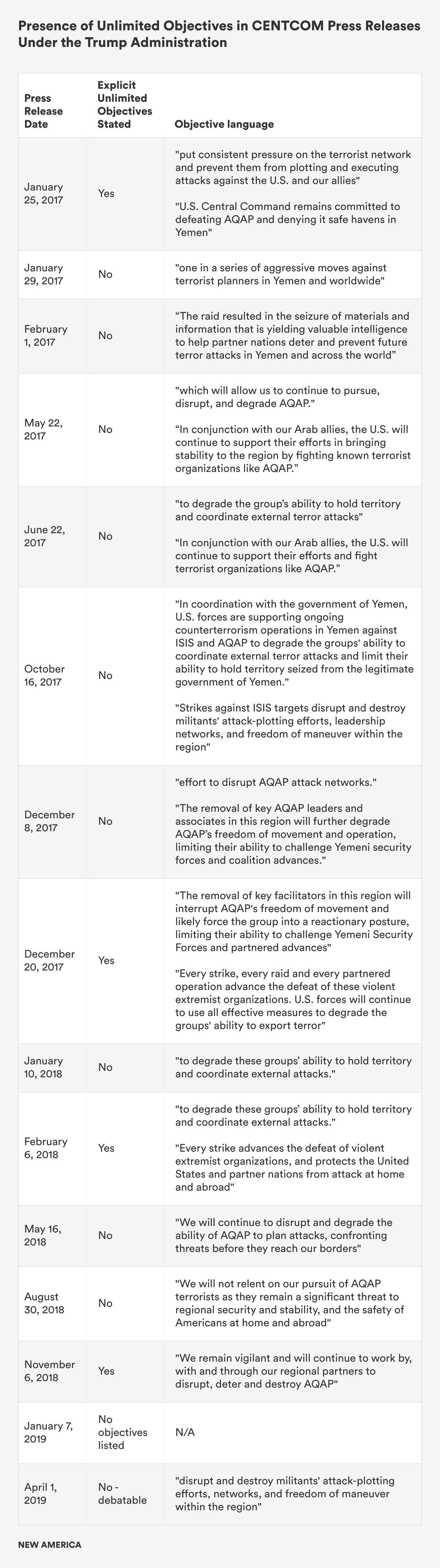
Citations
- See for example: “National Security Strategy” (The White House, May 2010), 1, 4, 21, <a href="<a href="<a href="<a href="<a href="<a href="<a href="source">source">source">source">source">source">source">source">source; “National Strategy for Counterterrorism” (The White House, June 28, 2011), 14, <a href="<a href="<a href="<a href="<a href="<a href="<a href="source">source">source">source">source">source">source">source">source; “National Strategy for Counterterrorism of the United States of America” (The White House, October 2018), 1, 11, <a href="<a href="<a href="<a href="<a href="<a href="<a href="source">source">source">source">source">source">source">source">source; “Summary of the 2018 National Defense Strategy of the United States of America” (Department of Defense, 2018), 4, 9, <a href="<a href="<a href="<a href="<a href="<a href="<a href="source">source">source">source">source">source">source">source">source.
- On defining preventive war logic see: David Sterman, “Decision-Making in the Counter-ISIS War: Assessing the Role of Preventive War Logic” (New America, November 15, 2019), <a href="<a href="<a href="<a href="<a href="<a href="<a href="source">source">source">source">source">source">source">source">source; Jack S. Levy, “Preventive War and Democratic Politics.: Presidential Address to the International Studies Association March 1, 2007, Chicago,” International Studies Quarterly 52, no. 1 (March 2008): 1–24, <a href="<a href="<a href="<a href="<a href="<a href="<a href="source">source">source">source">source">source">source">source">source; Colin Gray, “The Implications of Preemptive and Preventive War Doctrines: A Reconsideration” (Strategic Studies Institute, July 2007), <a href="<a href="<a href="<a href="<a href="<a href="<a href="source">source">source">source">source">source">source">source">source.
- Katherine Zimmerman, “Beyond Counterterrorism: Defeating the Salafi-Jihadi Movement” (American Enterprise Institute, October 2019), <a href="<a href="<a href="<a href="<a href="<a href="<a href="source">source">source">source">source">source">source">source">source; Daniel Green, “Defeating Al-Qaeda’s Shadow Government in Yemen: The Need for Local Governance Reform” (Washington Institute for Near East Policy, September 19, 2019), <a href="<a href="<a href="<a href="<a href="<a href="<a href="source">source">source">source">source">source">source">source">source; Katherine Zimmerman, “A New Model for Defeating al Qaeda in Yemen” (AEI, September 2015), <a href="<a href="<a href="<a href="<a href="<a href="<a href="source">source">source">source">source">source">source">source">source.
- Matthew Levitt, “Rethinking U.S. Efforts on Counterterrorism: Toward a Sustainable Plan Two Decades After 9/11,” National Security Law & Policy 12, no. 2 (June 11, 2021), <a href="<a href="<a href="<a href="<a href="<a href="<a href="source">source">source">source">source">source">source">source">source.
- Peter Bergen, David Sterman, and Melissa Salyk-Virk, “America’s Counterterrorism Wars: The War in Yemen” (New America), accessed February 18, 2022, <a href="<a href="<a href="<a href="<a href="<a href="<a href="source">source">source">source">source">source">source">source">source; Chris Woods, Sudden Justice: America’s Secret Drone Wars (New York, NY: Oxford University Press, 2015), 51, 55–61; Gregory D. Johnsen, The Last Refuge: Yemen, al-Qaeda, and America’s War in Arabia, 1st ed (New York: W.W. Norton & Co, 2013), 121–23; David Johnston and David E. Sanger, “THREATS AND RESPONSES: HUNT FOR SUSPECTS; Fatal Strike in Yemen Was Based on Rules Set Out by Bush,” New York Times, November 6, 2002, <a href="<a href="<a href="<a href="<a href="<a href="<a href="source">source">source">source">source">source">source">source">source.
- Woods, Sudden Justice, 58–61; Dina Temple-Raston, The Jihad Next Door: The Lackawanna Six and Rough Justice in an Age of Terror, 1st ed (New York: Public Affairs, 2007); Matthew Purdy and Lowell Bergman, “WHERE THE TRAIL LED: Between Evidence and Suspicion; Unclear Danger: Inside the Lackawanna Terror Case,” New York Times, October 12, 2003, <a href="<a href="<a href="<a href="<a href="<a href="<a href="source">source">source">source">source">source">source">source">source.
- For discussion of U.S. policy during this period see: Eli Berman, David A. Lake, and Julia Macdonald, eds., “Yemen 2001-11: Building on Unstable Ground,” in Proxy Wars: Suppressing Violence through Local Agents (Ithaca: Cornell University Press, 2019); Stephen Tankel, With Us and Against Us: How America’s Partners Help and Hinder the War on Terror (New York: Columbia University Press, 2018); Jack Watling and Namir Shabibi, “Defining Remote Warfare: British Training and Assistance Programmes in Yemen, 2004-2015” (Oxford Research Group Remote Warfare Program, June 2018), <a href="<a href="<a href="<a href="<a href="<a href="<a href="source">source">source">source">source">source">source">source">source; Woods, Sudden Justice, 55–61; Edmund J. Hull, High-Value Target: Countering al Qaeda in Yemen, 1st ed, ADST-DACOR Diplomats and Diplomacy Series (Washington, D.C: Potomac Books, 2011).
- “AL-QA’IDA IN THE ARABIAN PENINSULA (AQAP),” National Counter Terrorism Center, accessed November 23, 2021, <a href="<a href="<a href="<a href="<a href="<a href="<a href="source">source">source">source">source">source">source">source">source; Tankel, With Us and Against Us, 220.
- On June 1, 2009, Abdulhakim Mujahid Muhammad (Carlos Bledsoe) killed one person in an attack on a military recruiting station in Little Rock Arkansas. He had traveled to Yemen and later claimed to be affiliated with AQAP. On November 5, 2009, Maj. Nidal Hasan, who was inspired by and communicated with Anwar al-Awlaki, killed 13 people in an attack at Fort Hood Texas. James Dao, “Man Claims Terror Ties in Little Rock Shooting,” New York Times, January 21, 2010, <a href="<a href="<a href="<a href="<a href="<a href="<a href="source">source">source">source">source">source">source">source">source; “Fort Hood Suspect Charged with Murder,” CNN, November 12, 2009, <a href="<a href="<a href="<a href="<a href="<a href="<a href="source">source">source">source">source">source">source">source">source.
- Jeremy Scahill, Dirty Wars: The World Is a Battlefield (New York: Nation Books, 2013), 254–64.
- Woods, Sudden Justice, 197.
- On counterterrorism broadly under the Obama administration in Yemen see: Luke Hartig, “U.S. Counterterrorism Policy in Yemen: 2010-2020” in Michael A. Sheehan, Erich Marquardt, and Liam Collins, eds., Routledge Handbook of U.S. Counterterrorism and Irregular Warfare Operations (Abingdon, Oxon; New York, NY: Routledge, 2022).
- This is based on New America’s tracking. Exact counts of strikes and death tolls vary. Non-governmental trackers of U.S. strikes are limited by the covert nature of many strikes. However, broad trends in activity show up in the data of multiple groups tracking U.S. strikes. See: Bergen, Sterman, and Salyk-Virk, “America’s Counterterrorism Wars: The War in Yemen”; “US Airstrikes in Yemen,” Long War Journal, accessed September 24, 2021, <a href="<a href="<a href="<a href="<a href="<a href="<a href="source">source">source">source">source">source">source">source">source; “Bureau of Investigative Journalism – The Covert Drone Wars Archive,” Airwars, accessed September 24, 2021, <a href="<a href="<a href="<a href="<a href="<a href="<a href="source">source">source">source">source">source">source">source">source.
- “Yemen’s al-Qaeda: Expanding the Base” (International Crisis Group, February 2, 2017), <a href="<a href="<a href="<a href="<a href="<a href="<a href="source">source">source">source">source">source">source">source">source.
- For an illustration of how U.S. military actions enabled Emirati efforts see: James Mattis, “Memorandum for Assistant to the President for National Security Affairs Subject: Department of Defense Support to UAE Shabwah Offensive in Yemen” (Department of Defense (Released via ACLU FOIA), January 24, 2017), <a href="<a href="<a href="<a href="<a href="<a href="<a href="source">source">source">source">source">source">source">source">source; James N Mattis, “Memorandum for Assistant to the President for National Security Affairs. Subject: Department of Defense Request to Extend the Authorization for DoD Support to UAE in Yemen” (Department of Defense (Released via ACLU FOIA), April 28, 2017), <a href="<a href="<a href="<a href="<a href="<a href="<a href="source">source">source">source">source">source">source">source">source. See also: Luke Hartig, “Full Accounting Needed of US-UAE Counterterrorism Partnership in Yemen,” Just Security, December 7, 2018, <a href="<a href="<a href="<a href="<a href="<a href="<a href="source">source">source">source">source">source">source">source">source.
- Bergen, Sterman, and Salyk-Virk, “America’s Counterterrorism Wars: The War in Yemen”; “US Airstrikes in Yemen”; “Bureau of Investigative Journalism – The Covert Drone Wars Archive”; Gregory D. Johnsen, “Trump and Counterterrorism in Yemen: The First Two Years” (Sana’a Center for Strategic Studies, February 2019), <a href="<a href="<a href="<a href="<a href="<a href="<a href="source">source">source">source">source">source">source">source">source.
- CENTCOM told the author that there were no strikes in 2021. On November 18, 2021, CENTCOM told Airwars that “CENTCOM conducted its last counterterror strike in Yemen on June 24, 2019. CENTCOM has not conducted any new counterterror strikes in Yemen since.” Author’s Email Correspondence with CENTCOM, February 8, 2022; “Airwars Assessment: USYEMBi004-C,” Airwars, accessed February 18, 2022, <a href="<a href="<a href="<a href="<a href="<a href="<a href="source">source">source">source">source">source">source">source">source.
- See: “Attorney General William P. Barr and FBI Director Christopher Wray Announce Significant Developments in the Investigation of the Naval Air Station Pensacola Shooting” (Department of Justice Office of Public Affairs, May 18, 2020), <a href="<a href="<a href="<a href="<a href="<a href="<a href="source">source">source">source">source">source">source">source">source; Katie Benner and Adam Goldman, “F.B.I. Finds Links Between Pensacola Gunman and Al Qaeda,” New York Times, May 18, 2020, <a href="<a href="<a href="<a href="<a href="<a href="<a href="source">source">source">source">source">source">source">source">source; “Country Reports on Terrorism 2020” (United States Department of State Bureau of Counterterrorism, December 2021), 2, <a href="<a href="<a href="<a href="<a href="<a href="<a href="source">source">source">source">source">source">source">source">source.
- For reports regarding the review see: Spencer Ackerman, “The Peril and the Promise of Biden’s Drone Review,” Forever Wars, December 6, 2021, <a href="<a href="<a href="<a href="<a href="<a href="<a href="source">source">source">source">source">source">source">source">source; Charlie Savage and Eric Schmitt, “Biden Secretly Limits Counterterrorism Drone Strikes Away From War Zones,” New York Times, March 3, 2021, <a href="<a href="<a href="<a href="<a href="<a href="<a href="source">source">source">source">source">source">source">source">source. For reports of U.S. strikes in Yemen in 2021 see: “Two Qaeda Suspects among Three Killed in Yemen Drone Strike,” Ahram Online (AFP), November 14, 2021, <a href="<a href="<a href="<a href="<a href="<a href="<a href="source">source">source">source">source">source">source">source">source. United States Central Command denied conducting such a strike. Author’s phone inquiry to CENTCOM Public Affairs, November 15, 2021. Airwars has tracked other alleged U.S. strikes in 2021 reported by local news sources or on social media but which have not been reported by wire services or Western news sources. See: “US Forces in Yemen,” Airwars, accessed December 9, 2021, <a href="<a href="<a href="<a href="<a href="<a href="<a href="source">source">source">source">source">source">source">source">source. In early 2022, AQAP released a eulogy for a senior figure that it said was killed in a U.S. air strike. It did not provide a location or date though. “Intelligence Group Says AQAP Announces Death of Former Bin Laden Associate in U.S. Strike in Yemen,” Reuters, January 20, 2022, <a href="<a href="<a href="<a href="<a href="<a href="<a href="source">source">source">source">source">source">source">source">source.
- On the Biden administration’s embrace of “sustainable counterterrorism” see: Liz Sherwood-Randall, “Remarks as Prepared for Delivery by Assistant to the President for Homeland Security, Dr. Liz Sherwood-Randall on the Future of the U.S. Counterterrorism Mission: Aligning Strategy, Policy, and Resources” (White House, September 8, 2021), <a href="<a href="<a href="<a href="<a href="<a href="<a href="source">source">source">source">source">source">source">source">source; Levitt, “Rethinking U.S. Efforts on Counterterrorism: Toward a Sustainable Plan Two Decades After 9/11.”
- Kareem Fahim and Sarah Dadouch, “Yemen’s Houthi Militants Launch New Attack on UAE as Conflict Widens,” Washington Post, January 24, 2022, <a href="<a href="<a href="<a href="<a href="<a href="<a href="source">source">source">source">source">source">source">source">source; John Hudson, Missy Ryan, and Josh Dawsey, “On the Day U.S. Forces Killed Soleimani, They Targeted a Senior Iranian Official in Yemen,” Washington Post, January 10, 2020, <a href="<a href="<a href="<a href="<a href="<a href="<a href="source">source">source">source">source">source">source">source">source.
- See: David Sterman, “Defining Endless Wars: The First Step Towards Ending Them” (New America, January 26, 2021), <a href="<a href="<a href="<a href="<a href="<a href="source">source">source">source">source">source">source">source.
- Noah Rothman, “Can We Dispense with the Childish ‘Forever Wars’ Nonsense Now?,” June 28, 2021, <a href="<a href="<a href="<a href="<a href="<a href="source">source">source">source">source">source">source">source; Steven Cook, “End the ‘Forever War’ Cliché,” Foreign Policy, April 22, 2021, <a href="<a href="<a href="<a href="<a href="<a href="source">source">source">source">source">source">source">source; Kori Schake et al., “Defense in Depth,” Foreign Affairs, November 23, 2020, <a href="<a href="<a href="<a href="<a href="<a href="source">source">source">source">source">source">source">source; Thomas Joscelyn, “Endless Jihad: The Problem with Pledging to End Our ‘Endless Wars,’” The Dispatch, August 20, 2020, <a href="<a href="<a href="<a href="<a href="<a href="source">source">source">source">source">source">source">source; Paul Miller, “Ending the ‘Endless War’ Trope,” Atlantic Council, March 26, 2020, <a href="<a href="<a href="<a href="<a href="<a href="source">source">source">source">source">source">source">source; Dakota Wood, “The Myth of Endless Wars,” The National Interest, October 31, 2020, <a href="<a href="<a href="<a href="<a href="<a href="source">source">source">source">source">source">source">source; Max Molot, “Bad Idea: Calling U.S. Operations in Afghanistan, Iraq, and Syria ‘Endless Wars,’” CSIS Defense360, January 7, 2020, <a href="<a href="<a href="<a href="<a href="<a href="source">source">source">source">source">source">source">source.
- On the problems with equating endlessness and duration see: Jonah Schulhofer-Wohl, Quagmire in Civil War, 2020, Kindle Location 444. Also see: David Sterman, “Avoiding the Time Trap,” Fellow Travelers, December 6, 2021, <a href="<a href="<a href="<a href="<a href="<a href="source">source">source">source">source">source">source">source; Sterman, “Defining Endless Wars: The First Step Towards Ending Them.”
- Even analysts who are skeptical of critics of endless war acknowledge the basic character of American counterterrorism warfare as stuck with the United States unable to be defeated but also not able to achieve all of its objectives and declare victory. For example, Hal Brands and Michael O’Hanlon write, “the strategy remains an intuitively unsatisfying ‘mowing the grass’ approach,” adding, “By design, it must therefore be continued indefinitely, until local politics or other indigenous factors deprive future terrorists of the ability to train, recruit and organise.” They also write, “America is nowhere close to achieving the objective that key policymakers identified early on: pushing terrorism to the margins, cutting off the flow of recruits, and otherwise creating conditions that would allow Washington to declare victory and come home.” Hal Brands and Michael O’Hanlon, “The War on Terror Has Not Yet Failed: A Net Assessment After 20 Years,” Survival 63, no. 4 (July 4, 2021): 33–54, <a href="<a href="<a href="<a href="<a href="<a href="source">source">source">source">source">source">source">source. See also: Michael O’Hanlon, “Resigned to Endless War,” Wall Street Journal, July 27, 2018, <a href="<a href="<a href="<a href="<a href="<a href="source">source">source">source">source">source">source">source.
- Whether one views the 2002 to late 2009 period as a period of war is a complex question reflecting the issues that arise in wars carried out under open-ended, non-geographically limited authorizations as well as the general challenge of defining and dating when a war begins. The U.S. asserted authority to carry out strikes, and it acted upon that authority in 2002, but the U.S.-Yemeni relationship was largely of one assistance and cooperation without direct U.S. military action in the following years with the 2009 escalation constituting a real shift. Helen Lackner suggests that many Yemenis did not see the 2002-2009 period as continuous with the late 2009 escalation, writing, “having considered the 2002 airstrike a unique event, a repetition of direct US attacks aroused considerable anger throughout Yemen due to the large number of civilians killed.” Helen Lackner, Yemen in Crisis: The Road to War, U.S. edition (London; New York: Verso, 2019), 140. In its propaganda, al-Qaeda emphasizes the continuity of a longer war, presenting the Yemeni government as an agent of the United States. However, al-Qaeda still notes a shift in the overtness of the war. See: “Abu-Yahya Al-Libi Condemns US Involvement in Yemen, Yemeni Government,” February 23, 2010, Al Qaeda Statements Index, <a href="<a href="<a href="<a href="<a href="<a href="source">source">source">source">source">source">source">source; “Al-Qa’ida in Arab Peninsula Secretary General Calls For Attacks in Yemen, Somalia,” April 19, 2009, Al Qaeda Statements Index, <a href="<a href="<a href="<a href="<a href="<a href="source">source">source">source">source">source">source">source; “Al-Qai’da in Arabian Peninsula Leader Urges Yemeni Tribes to Fight Government,” February 20, 2009, Al Qaeda Statements Index, <a href="<a href="<a href="<a href="<a href="<a href="source">source">source">source">source">source">source">source.
- Establishing the beginning of the U.S. war in Vietnam is difficult. For example, one might date the war to the U.S. assumption of responsibility from France and the Department of Defense’s earliest date for inclusion in the Vietnam Veterans Memorial (November 1955), or the first U.S. death (June 1956), or North Vietnam’s declaration of war on the South (January 1959), or the Gulf of Tonkin resolution (August 1964) or the first arrival of official U.S. combat troops (March 1965). If one begins with the earliest date for inclusion on the memorial, that would constitute a little over 19 years between the war’s start and the fall of Saigon. If one begins with the Gulf of Tonkin resolution it would be about eleven years. On this range of possible dates and discussion of comparisons of length to America’s counterterrorism wars see: Daniel DeFraia, “Which Is America’s Longest War, Afghanistan or Vietnam?,” GlobalPost, October 19, 2012, <a href="<a href="<a href="<a href="<a href="<a href="source">source">source">source">source">source">source">source; Adam Taylor, “These Are America’s 9 Longest Foreign Wars,” Washington Post, May 29, 2014, <a href="<a href="<a href="<a href="<a href="<a href="source">source">source">source">source">source">source">source. On the difficulty of dating the beginning and endings of wars generally see: Mary L. Dudziak, War Time: An Idea, Its History, Its Consequences (Oxford: Oxford Univ. Press, 2012). On contemporaneous descriptions of the Vietnam war as endless see: Leslie H. Gelb, “Causes, Origins, and Lessons of the Vietnam War,” § Senate Committee on Foreign Relations (1972), <a href="<a href="<a href="<a href="<a href="<a href="source">source">source">source">source">source">source">source; Paul M. Sweezy, “Vietnam: Endless War,” Monthly Review 20, no. 11 (April 1, 1969): 1, <a href="<a href="<a href="<a href="<a href="<a href="source">source">source">source">source">source">source">source.
- “Congress and the War in Yemen: Oversight and Legislation 2015-2020” (Congressional Research Service, June 19, 2020), 12, <a href="<a href="<a href="<a href="<a href="<a href="source">source">source">source">source">source">source">source; William Roberts, “US House Approves Resolution to End US Role in Yemen War,” Al Jazeera, April 4, 2019, <a href="<a href="<a href="<a href="<a href="<a href="source">source">source">source">source">source">source">source; Lackner, Yemen in Crisis, xxv–xxvi.
- For more detail see: Sterman, “Defining Endless Wars: The First Step Towards Ending Them.”
- On the general inability of jihadists to pose such a threat see: Peter L. Bergen, United States of Jihad: Investigating America’s Homegrown Terrorists, First edition (New York: Crown Publishers, 2016); John E. Mueller and Mark G. Stewart, Chasing Ghosts: The Policing of Terrorism (Oxford ; New York: Oxford University Press, 2016); John Mueller and Mark G. Stewart, “Misoverestimating ISIS: Comparisons with Al-Qaeda,” Perspectives on Terrorism 10, no. 4 (August 2016), <a href="<a href="<a href="<a href="<a href="<a href="source">source">source">source">source">source">source">source; “Remarks by National Security Advisor Susan Rice on the 2015 National Security Strategy” (White House Office of the Press Secretary, February 6, 2015), <a href="<a href="<a href="<a href="<a href="<a href="source">source">source">source">source">source">source">source.
- Lawrence Freedman, “On War and Choice,” The National Interest, May/June, 2010, <a href="<a href="<a href="<a href="<a href="<a href="source">source">source">source">source">source">source">source.
- John Mueller and Mark G. Stewart, “Terrorism and Bathtubs: Comparing and Assessing the Risks,” Terrorism and Political Violence, October 29, 2018, 1–26, <a href="<a href="<a href="<a href="<a href="<a href="source">source">source">source">source">source">source">source.
- Neil C. Renic, Asymmetric Killing: Risk Avoidance, Just War, and the Warrior Ethos (New York, NY: Oxford University Press, 2020).
- On defining unlimited vs. limited objectives, see: Donald J. Stoker, Why America Loses Wars: Limited War and US Strategy from the Korean War to the Present (Cambridge, United Kingdom; New York, NY, USA: Cambridge University Press, 2019).
- See for an example: Craig Whitlock, “Stranded Without a Strategy,” Washington Post, December 9, 2019, <a href="<a href="<a href="<a href="<a href="<a href="source">source">source">source">source">source">source">source.
- Stoker, Why America Loses Wars, 173; Nate Rosenblatt and David Kilcullen, “The Tweet of Damocles: Lessons for U.S. Proxy Warfare” (New America, April 6, 2020), <a href="<a href="<a href="<a href="<a href="<a href="source">source">source">source">source">source">source">source.
- David Sterman, “Decision-Making in the Counter-ISIS War: Assessing the Role of Preventive War Logic” (New America, November 15, 2019), <a href="<a href="<a href="<a href="<a href="<a href="source">source">source">source">source">source">source">source; Mary L. Dudziak, “This War Is Not Over Yet,” New York Times, February 15, 2012, <a href="<a href="<a href="<a href="<a href="<a href="source">source">source">source">source">source">source">source.
- These two concepts are similar but not necessarily the same. One could envision a decisive military defeat in the context of objectives that are limited, where the enemy loses the ability to continue to fight in a particular area and is unable to escalate in other areas but whose government persists undefeated. Though perhaps unlikely, one could also imagine a government choosing to dissolve itself (thus achieving an unlimited objective of its enemy) despite being militarily capable of continuing to resist because it determined the costs of war were not worth it.
- Christopher D. Kolenda, Zero-Sum Victory: What We’re Getting Wrong about War (Lexington, Kentucky: The University Press of Kentucky, 2021), 23.
- Carl von Clausewitz, Michael Eliot Howard, and Peter Paret, On War, First paperback printing (Princeton, N.J: Princeton University Press, 1989), 90.
- Jonathan Powell, Terrorists at the Table: Why Negotiating Is the Only Way to Peace, First Palgrave Macmillan Trade edition (New York: Palgrave Macmillan Trade, 2015).
- For discussion of the importance of and challenges to negotiated ends to conflicts with terrorist groups see: Stoker, Why America Loses Wars; Powell, Terrorists at the Table; Max Abrahms, “The Political Effectiveness of Terrorism Revisited,” Comparative Political Studies 45, no. 3 (March 2012): 366–93, <a href="<a href="<a href="<a href="<a href="<a href="source">source">source">source">source">source">source">source; Erica Chenoweth et al., “What Makes Terrorists Tick,” International Security 33, no. 4 (April 2009): 180–202, <a href="<a href="<a href="<a href="<a href="<a href="source">source">source">source">source">source">source">source; Max Abrahms, “Why Terrorism Does Not Work,” International Security 31, no. 2 (Fall 2006), <a href="<a href="<a href="<a href="<a href="<a href="source">source">source">source">source">source">source">source.
- Julian Stafford Corbett, Principles of Maritime Strategy (Project Gutenberg, 2005), <a href="<a href="<a href="<a href="<a href="<a href="source">source">source">source">source">source">source">source. Kolenda makes a similar argument, drawing from Clausewitz. Kolenda, Zero-Sum Victory, 25, 52.
- Kolenda, Zero-Sum Victory, 52–54.
- Stoker, Why America Loses Wars, 170. Such a conception has its own Eurocentric biases, rooted in part in the challenges of defining what constitutes war and the tendency to divide its participants into clearly delineated nation-states. The endless and global character of the war on terror itself points to the dangers of putting too much confidence in the strength of such separations. For argument along these lines see: Tarak Barkawi, “Decolonising War,” European Journal of International Security 1, no. 2 (July 2016): 199–214, <a href="<a href="<a href="<a href="<a href="<a href="source">source">source">source">source">source">source">source.
- Joscelyn, “Endless Jihad: The Problem with Pledging to End Our ‘Endless Wars.’”
- Renic, Asymmetric Killing.
- Renic, 37.
- Jennifer Walkup Jayes, “Beyond the War Paradigm: What History Tells Us About How Terror Campaigns End” (Costs of War Project, February 8, 2022), <a href="<a href="<a href="<a href="<a href="<a href="source">source">source">source">source">source">source">source; Luke Hartig, “Playing Defense Is Totally Fine,” Atlantic, September 26, 2021, <a href="<a href="<a href="<a href="<a href="<a href="source">source">source">source">source">source">source">source.
- Samuel Moyn, Humane: How the United States Abandoned Peace and Reinvented War, First edition (New York: Farrar, Straus and Giroux, 2021); Samuel Moyn, “Beyond Humanity: How to Control America’s Use of Force” (Quincy Institute, July 2020), <a href="<a href="<a href="<a href="<a href="<a href="source">source">source">source">source">source">source">source; Anand Gopal, “America’s War on Syrian Civilians,” New Yorker, December 14, 2020, <a href="<a href="<a href="<a href="<a href="<a href="source">source">source">source">source">source">source">source. This is not, however, to contend that transparency is not important in its own right and to avoid reversion to the first type of endlessness.
- Kolenda, Zero-Sum Victory.
- “Statement by the President on ISIL,” White House Office of the Press Secretary, September 10, 2014, <a href="<a href="<a href="<a href="<a href="<a href="source">source">source">source">source">source">source">source.
- “Lead Inspector General for Operation Inherent Resolve Quarterly Report to the United States Congress | July 1, 2021 – September 30, 2021” (Department of Defense Office of the Inspector General, November 3, 2021), <a href="<a href="<a href="<a href="<a href="<a href="source">source">source">source">source">source">source">source.
- For a useful discussion of the lack of clarity and the problems deriving from it beyond the stated objective of defeating ISIS see: Mark Kimmit, “Clarity on Afghanistan, Confusion on Iraq,” Defense One, July 19, 2021, <a href="<a href="<a href="<a href="<a href="<a href="source">source">source">source">source">source">source">source.
- Rosenblatt and Kilcullen, “The Tweet of Damocles: Lessons for U.S. Proxy Warfare.”
- Rosenblatt and Kilcullen.
- Lackner, Yemen in Crisis, 144.
- Bergen, Sterman, and Salyk-Virk, “America’s Counterterrorism Wars: The War in Yemen.”
- David Sterman, “A Death Trap for Al Qaeda Leaders?,” CNN, June 16, 2015, <a href="<a href="<a href="<a href="<a href="source">source">source">source">source">source">source.
- AQAP’s withdrawal is generally viewed as having been a negotiated withdrawal. Therefore, while it does show AQAP’s inability to deny the U.S. access to the battlefield, it does not demonstrate that the group would be incapable of making any operation to retake territory in the absence of an al-Qaeda decision to withdraw from a bloody battle. “Yemen’s al-Qaeda: Expanding the Base,” 26.
- Elisabeth Kendall, “The Failing Islamic State Within the Failed State of Yemen,” Perspectives on Terrorism 13, no. 1 (February 2019), <a href="<a href="<a href="<a href="<a href="source">source">source">source">source">source">source.
- Alexander Meleagrou-Hitchens, Incitement: Anwar al-Awlaki’s Western Jihad (Cambridge, Massachusetts: Harvard University Press, 2020), 165–88. Also see the FBI’s notes from their interviews of Abdulmutallab after his arrest available at: <a href="<a href="<a href="<a href="<a href="source">source">source">source">source">source">source.
- Scott Shane, Objective Troy: A Terrorist, a President, and the Rise of the Drone, First Edition (New York: Tim Duggan Books, 2015), 256.
- Shane, 259.
- Jesse Lee, “President Obama: ‘A Credible Terrorist Threat Against Our Country, and the Actions That We’re Taking’” (The White House, October 29, 2010), <a href="<a href="<a href="<a href="<a href="source">source">source">source">source">source">source.
- John O. Brennan, Undaunted: My Fight against America’s Enemies, at Home and Abroad, First edition (New York: Celadon Books, 2020), 205.
- Sudarsan Raghavan, Peter Finn, and Greg Miller, “In Foiled Bomb Plot, AQAP Took Bait Dangled by Saudi Informant,” Washington Post, May 9, 2012, <a href="<a href="<a href="<a href="<a href="source">source">source">source">source">source">source.
- “Dempsey: We Will Act If Islamic Group Threatens U.S.,” AP, August 25, 2014, <a href="<a href="<a href="<a href="<a href="source">source">source">source">source">source">source.
- Sterman, “Decision-Making in the Counter-ISIS War: Assessing the Role of Preventive War Logic.”
- Aaron W. Jost, “A Comprehensive Approach to Yemen,” The White House, September 24, 2010, <a href="<a href="<a href="<a href="<a href="source">source">source">source">source">source">source.
- Lee, “President Obama: ‘A Credible Terrorist Threat Against Our Country, and the Actions That We’re Taking.’”
- Tabassum Zakaria, “U.S. Monitors Effect of Awlaki Death on Qaeda Branch,” Reuters, October 6, 2011, <a href="<a href="<a href="<a href="<a href="source">source">source">source">source">source">source.
- John O. Brennan, “Remarks of John O. Brennan, Assistant to the President for Homeland Security and Counterterrorism, on Ensuring al-Qa’ida’s Demise — As Prepared for Delivery” (The White House Office of the Press Secretary, June 29, 2011), <a href="<a href="<a href="<a href="<a href="source">source">source">source">source">source">source.
- Dennis C. Blair, “Annual Threat Assessment of the Intelligence Community for the Senate Select Committee on Intelligence,” February 2009, 7, <a href="<a href="<a href="<a href="<a href="source">source">source">source">source">source">source.
- Dennis C. Blair, “Annual Threat Assessment of the US Intelligence Community for the Senate Select Committee on Intelligence,” February 2, 2010, 10, <a href="<a href="<a href="<a href="<a href="source">source">source">source">source">source">source.
- James R. Clapper, “Statement for the Record on the Worldwide Threat Assessment of the U.S. Intelligence Community for the Senate Committee on Armed Services,” March 10, 2011, 2, <a href="<a href="<a href="<a href="<a href="source">source">source">source">source">source">source.
- Blair, “Annual Threat Assessment of the Intelligence Community for the Senate Select Committee on Intelligence,” 6.
- Blair, “Annual Threat Assessment of the US Intelligence Community for the Senate Select Committee on Intelligence,” 8.
- “Remarks by the President in Address to the Nation on the Way Forward in Afghanistan and Pakistan” (White House, December 1, 2009), <a href="<a href="<a href="<a href="<a href="source">source">source">source">source">source">source.
- “Letter to Nasir Al-Wuhayshi” (Combatting Terrorism Center, n.d.), SOCOM-2012-0000016, <a href="<a href="<a href="<a href="<a href="source">source">source">source">source">source">source.
- “Terrorist Sentenced to 22 Years for Providing Material Support to Al-Qaeda in the Arabian Peninsula” (Department of Justice Office of Public Affairs, August 12, 2015), <a href="<a href="<a href="<a href="<a href="source">source">source">source">source">source">source.
- “Terrorist Sentenced to 22 Years for Providing Material Support to Al-Qaeda in the Arabian Peninsula.”
- United States Attorney Eastern District of New York, “Re: United States v. Lawal Babafemi Criminal Docket No. 13-109 (JG),” April 24, 2015, 11, <a href="<a href="<a href="<a href="<a href="source">source">source">source">source">source">source.
- United States Attorney Eastern District of New York, 3.
- “Member of Al Qaeda in the Arabian Peninsula Pleads Guilty to Terrorism Charges” (Department of Justice Office of Public Affairs, January 8, 2016), <a href="<a href="<a href="<a href="<a href="source">source">source">source">source">source">source.
- “Member of Al Qaeda in the Arabian Peninsula Pleads Guilty to Terrorism Charges.”
- Details on the docket and recent filings can be found here: <a href="<a href="<a href="<a href="<a href="source">source">source">source">source">source">source. On the dispute over factual claims see for example: “SENTENCING SUBMISSION by Minh Quang Pham” (Law Offices of Bobbi C. Sternheim, May 9, 2016), Document 110, Case 1:12-cr-00423-AJN, <a href="<a href="<a href="<a href="<a href="source">source">source">source">source">source">source; “SENTENCING SUBMISSION by USA as to Minh Quang Pham” (United States Attorney Southern District of New York, May 11, 2016), Document 114, Case 1:12-cr-00423-AJN, <a href="<a href="<a href="<a href="<a href="source">source">source">source">source">source">source; “TRANSCRIPT of Proceedings as to Minh Quang Pham Re: Sentence Held on 5/16/16” (United States District Court Southern District of New York, June 3, 2016), Document 123, Case 1:12-cr-00423-AJN, <a href="<a href="<a href="<a href="<a href="source">source">source">source">source">source">source.
- Initial reports suggested that Said Kouachi or both Kouachi brothers traveled to Yemen, but later reporting suggested that it was Chérif Kouachi traveling on his brother’s passport. Rukmini Callimachi and Jim Yardley, “From Amateur to Ruthless Jihadist in France,” New York Times, January 17, 2015, <a href="<a href="<a href="<a href="<a href="source">source">source">source">source">source">source.
- “Charlie Hebdo Shooter Says Financed by Qaeda Preacher in Yemen,” Reuters, January 9, 2015, <a href="<a href="<a href="<a href="<a href="source">source">source">source">source">source">source.
- Maria Abi-Habib, Margaret Coker, and Hakim AlMasmari, “Al Qaeda in Yemen Claims Responsibility for Charlie Hebdo Attack,” Wall Street Journal, January 14, 2015, <a href="<a href="<a href="<a href="<a href="source">source">source">source">source">source">source; Jeremy Scahill, “Al Qaeda Source: AQAP Directed Paris Attack,” Intercept, January 9, 2015, <a href="<a href="<a href="<a href="<a href="source">source">source">source">source">source">source.
- Sebastian Rotella, “How France Let the Charlie Hebdo Killers Go Free,” Daily Beast, July 12, 2017, <a href="<a href="<a href="<a href="<a href="source">source">source">source">source">source">source; Sebastian Rotella, Dan Edge, and Ricardo Pollack, “Transcript: Terror in Europe,” Frontline, October 18, 2016, <a href="<a href="<a href="<a href="<a href="source">source">source">source">source">source">source. On Peter Cherif see also: “Peter Cherif” (United Nations Security Council, September 29, 2015), <a href="<a href="<a href="<a href="<a href="source">source">source">source">source">source">source; “Charlie Hebdo Attack Suspect Arrested, French Officials Say,” AP, December 21, 2018, <a href="<a href="<a href="<a href="<a href="source">source">source">source">source">source">source.
- Rotella, “How France Let the Charlie Hebdo Killers Go Free.”
- Willy Le Devin, “Peter Cherif, Superviseur Des Attaques de Janvier?,” Liberation, September 1, 2020, <a href="<a href="<a href="<a href="<a href="source">source">source">source">source">source">source.
- Jonathan Dienst, “Man Who Plotted to Blow up NYC Subway May Soon Walk Free,” NBC, May 2, 2019, <a href="<a href="<a href="<a href="<a href="source">source">source">source">source">source">source.
- Jeremy M. Sharp, “Yemen: Background and U.S. Relations” (Congressional Research Service, January 13, 2010), 3, <a href="<a href="<a href="<a href="<a href="source">source">source">source">source">source">source.
- Scott A. Silverstone, From Hitler’s Germany to Saddam’s Iraq: The Enduring False Promise of Preventive War (Lanham, MD: Rowman & Littlefield, 2019), 269; Charles S. Maier, Among Empires: American Ascendancy and Its Predecessors (Cambridge, Mass.: Harvard Univ. Press, 2006), 61; Jack Snyder, “Imperial Temptations,” The National Interest, Spring 2003, <a href="<a href="<a href="<a href="<a href="source">source">source">source">source">source">source.
- Silverstone, From Hitler’s Germany to Saddam’s Iraq, 77, 80–91.
- Ben Rhodes, “The 9/11 Era Is Over,” Atlantic, April 6, 2020, <a href="<a href="<a href="<a href="<a href="source">source">source">source">source">source">source.
- Renic, Asymmetric Killing; Gopal, “America’s War on Syrian Civilians.”
- Dave Philipps, “Special Operations Troops Top Casualty List as U.S. Relies More on Elite Forces,” New York Times, February 4, 2017, <a href="<a href="<a href="<a href="<a href="source">source">source">source">source">source">source; Vera Bergengruen, “These US Troops Were Killed In Combat During Trump’s First Year In Office,” BuzzFeed, December 28, 2017, <a href="<a href="<a href="<a href="<a href="source">source">source">source">source">source">source.
- Renic, Asymmetric Killing.
- Renic, 185, 174.
- See Neil Renic’s discussion of this issue specifically mentioning the war in Yemen: Renic, 174fn24.
- Elisabeth Kendall, “Twenty Years After 9/11: The Jihadi Threat in the Arabian Peninsula,” CTC Sentinel 14, no. 7 (September 2021), <a href="<a href="<a href="<a href="<a href="source">source">source">source">source">source">source.
- David Sterman, “We Need More Oversight on US Counterterrorism Policy in the Wake of AQAP’s Confirmed Involvement in the Pensacola Attack,” Responsible Statecraft, May 22, 2020, <a href="<a href="<a href="<a href="<a href="source">source">source">source">source">source">source; “Attorney General William P. Barr and FBI Director Christopher Wray Announce Significant Developments in the Investigation of the Naval Air Station Pensacola Shooting”; David Sterman, Peter Bergen, and Melissa Salyk-Virk, “Terrorism in America 19 Years After 9/11” (New America, September 11, 2020), <a href="<a href="<a href="<a href="<a href="source">source">source">source">source">source">source.
- Kendall, “Twenty Years After 9/11: The Jihadi Threat in the Arabian Peninsula.”
- This lack of sophistication reflects the larger failure of virtually coached plotters to demonstrate a greater threat than those merely inspired by propaganda. John Mueller, “The Cybercoaching of Terrorists: Cause for Alarm?,” CTC Sentinel 10, no. 9 (October 2017), <a href="<a href="<a href="<a href="<a href="source">source">source">source">source">source">source.
- “Letter Dated 15 January 2019 from the Chair of the Security Council Committee Pursuant to Resolutions 1267 (1999), 1989 (2011) and 2253 (2015) Concerning Islamic State in Iraq and the Levant (Da’esh), Al-Qaida and Associated Individuals, Groups, Undertakings and Entities Addressed to the President of the Security Council” (United Nations Security Council, January 15, 2019), 8–9, <a href="<a href="<a href="<a href="<a href="source">source">source">source">source">source">source.
- Renic, Asymmetric Killing, 185.
- “Yemen Al-Qaeda Leader al-Raymi Killed by US Strike,” BBC, February 7, 2020, <a href="<a href="<a href="<a href="<a href="source">source">source">source">source">source">source; Sterman, “A Death Trap for Al Qaeda Leaders?”; Bergen, Sterman, and Salyk-Virk, “America’s Counterterrorism Wars: The War in Yemen.”
- Shane, Objective Troy.
- Gregory D. Johnsen, “Khalid Batarfi and the Future of AQAP,” Lawfare, March 22, 2020, <a href="<a href="<a href="<a href="<a href="source">source">source">source">source">source">source; Gregory D. Johnsen, “The End of AQAP as a Global Threat” (Sana’a Center for Strategic Studies, March 5, 2020), <a href="<a href="<a href="<a href="<a href="source">source">source">source">source">source">source; Gregory D. Johnsen, “The Two Faces of Al-Qaeda in the Arabian Peninsula,” War on the Rocks, October 11, 2018, <a href="<a href="<a href="<a href="<a href="source">source">source">source">source">source">source.
- Kendall, “Twenty Years After 9/11: The Jihadi Threat in the Arabian Peninsula.”
- On Awlaki’s posthumous impact see: Meleagrou-Hitchens, Incitement, 236–74; Thomas Hegghammer, “The Last Jihadi Superstar,” War on the Rocks, October 30, 2020, <a href="<a href="<a href="<a href="<a href="source">source">source">source">source">source">source; Shane, Objective Troy, 302; Peter Bergen et al., “Terrorism in America After 9/11” (New America), accessed August 1, 2019, <a href="<a href="<a href="<a href="<a href="source">source">source">source">source">source">source.
- Jillian Schwedler, “Is the U.S. Drone Program in Yemen Working?,” Lawfare, September 27, 2015, <a href="<a href="<a href="<a href="<a href="source">source">source">source">source">source">source.
- Thomas Hegghammer, “The Case for Chasing Al-Awlaki,” Foreign Policy, November 24, 2010, <a href="<a href="<a href="<a href="<a href="source">source">source">source">source">source">source.
- Eric. H. Holder Jr., Letter to Patrick J. Leahy, Chairman Committee on the Judiciary, United States Senate Regarding Americans Killed in Counterterrorism Operations, May 22, 2013, <a href="<a href="<a href="<a href="<a href="source">source">source">source">source">source">source. This is not to suggest that these reasons were fully separable, well explained at the time, or that there are not real questions about the process behind the targeted killings. However, the foundation of the stated theory for why Awlaki could and should be targeted did not rest on his inspirational power but on allegations that he was plotting attacks. For discussion of ongoing questions regarding the killing of Awlaki and Samir Khan, another American killed in the same strike who worked on AQAP’s Inspire magazine and whom the government says was not targeted, see: Scahill, Dirty Wars; Jason Leopold, “The FBI Discussed an ‘End-Game’ for a US Citizen Killed in a Drone Strike,” Vice, June 8, 2015, <a href="<a href="<a href="<a href="<a href="source">source">source">source">source">source">source. In his memoir, Leon Panetta, who had just moved from being Director of Central Intelligence to Secretary of Defense at the time of the strike that killed Awlaki, said that the U.S. did not even know Khan was present when it conducted the strike. Leon E Panetta and Jim Newton, Worthy Fights: A Memoir of Leadership in War and Peace, 2015, 386, <a href="<a href="<a href="<a href="<a href="source">source">source">source">source">source">source.
- James R. Clapper, “Unclassified Statement for the Record on the Worldwide Threat Assessment of the US Intelligence Community for the Senate Select Committee on Intelligence” (Office of the Director of National Intelligence, January 31, 2012), 3, <a href="<a href="<a href="<a href="<a href="source">source">source">source">source">source">source.
- Johnsen, “The Two Faces of Al-Qaeda in the Arabian Peninsula.”
- “Terror Alert Systems Fast Facts,” CNN, November 2, 2018, <a href="<a href="<a href="<a href="<a href="source">source">source">source">source">source">source; John Hudson, “Obama’s Terrorism Alert System Has Never Issued a Public Warning — Ever,” Foreign Policy, September 29, 2014, <a href="<a href="<a href="<a href="<a href="source">source">source">source">source">source">source; “National Terrorism Advisory System (NTAS),” Department of Homeland Security, accessed August 13, 2019, <a href="<a href="<a href="<a href="<a href="source">source">source">source">source">source">source.
- “National Terrorism Advisory System Bulletin” (Department of Homeland Security, December 16, 2015), <a href="<a href="<a href="<a href="<a href="source">source">source">source">source">source">source.
- “National Terrorism Advisory System Bulletin” (Department of Homeland Security, June 15, 2016), <a href="<a href="<a href="<a href="<a href="source">source">source">source">source">source">source; “National Terrorism Advisory System Bulletin” (Department of Homeland Security, November 15, 2016), <a href="<a href="<a href="<a href="<a href="source">source">source">source">source">source">source.
- “National Terrorism Advisory System (NTAS).”
- “National Terrorism Advisory System (NTAS)”; “National Terrorism Advisory System Bulletin” (Department of Homeland Security, November 10, 2021), <a href="<a href="<a href="<a href="<a href="source">source">source">source">source">source">source.
- Hartig, “Full Accounting Needed of US-UAE Counterterrorism Partnership in Yemen,” December 7, 2018.
- Clapper, “Unclassified Statement for the Record on the Worldwide Threat Assessment of the US Intelligence Community for the Senate Select Committee on Intelligence,” 2–3.
- James R. Clapper, “Statement for the Record Worldwide Threat Assessment of the US Intelligence Community” (Office of the Director of National Intelligence, March 12, 2013), 4, <a href="<a href="<a href="<a href="<a href="source">source">source">source">source">source">source.
- “Stenographic Transcript of Hearing to Receive Testimony on Security in Afghanistan and in the Regions of South and Central Asia” (Senate Committee on Armed Services (Transcript by Alderson Court Reporting), October 26, 2021), 50, <a href="<a href="<a href="<a href="<a href="source">source">source">source">source">source">source; Jeff Seldin, “Timeline for Potential Attacks by Islamic State, Al-Qaida Getting Shorter,” Voice of America, October 26, 2021, <a href="<a href="<a href="<a href="<a href="source">source">source">source">source">source">source.
- James R. Clapper, “Statement for the Record Worldwide Threat Assessment of the US Intelligence Community” (Office of the Director of National Intelligence, January 29, 2014), 4, <a href="<a href="<a href="<a href="<a href="source">source">source">source">source">source">source.
- James R. Clapper, “Statement for the Record Worldwide Threat Assessment of the US Intelligence Community,” § Senate Armed Services Committee (2015), 5, <a href="<a href="<a href="<a href="<a href="source">source">source">source">source">source">source.
- “Terrorism Situation and Trend Report 2019 (TE-SAT)” (EUROPOL, 2019), 47, <a href="<a href="<a href="<a href="<a href="source">source">source">source">source">source">source. The report, however, does warn of the potential that AQAP could reconstitute such capabilities if pressure lessened.
- For a broad discussion of travel patterns and tourism in Yemen and its complex interactions with Islamist militancy see: Laurent Bonnefoy and Cynthia Schoch, Yemen and the World: Beyond Insecurity, Comparative Politics and International Studies Series (Oxford ; New York, NY: Oxford University Press, 2018), 135–48. For one account of foreign tourism and religious study in Yemen that helps illustrate the relative ease of travel between the West and Yemen in the mid-2000s compared to today see: Theo Padnos, Undercover Muslim: A Journey into Yemen (London: Bodley Head, 2011). Another account of the Salafi scene in Yemen as well as travel between the West and Yemen more generally from the 1990s through the mid-2000s and how it sometimes connected with al-Qaeda’s networks comes from Morten Storm, who according to his account turned double agent, infiltrating the AQAP circles around Awlaki. Storm also discusses his later travels to Yemen, though given his work for Western intelligence services, caution is required in interpreting that travel’s meaning for questions of strategic distance. Morten Storm, Paul Cruickshank, and Tim Lister, Agent Storm: My Life Inside Al Qaeda and the CIA (New York, NY: Atlantic Monthly Press, 2014), 33-45,48, 55, 90–91.
- On strategic distance see: Patrick Porter, The Global Village Myth: Distance, War and the Limits of Power (Washington, DC: Georgetown University Press, 2015). The argument presented here is not reliant on a claim that links Salafism in Yemen to radicalization. For criticism of representations of the Salafi scene in Yemen as radicalizing based on individual cases of connection between the scene and participants in al-Qaeda’s violence see: Laurent Bonnefoy, Salafism in Yemen: Transnationalism and Religious Identity (New York: Columbia University Press, 2011), 94–95.
- On Bledsoe generally and his travel, see: Daveed Gartenstein-Ross, “Lone Wolf Islamic Terrorism: Abdulhakim Mujahid Muhammad (Carlos Bledsoe) Case Study,” Terrorism and Political Violence 26, no. 1 (January 2014): 110–28, <a href="<a href="<a href="<a href="<a href="source">source">source">source">source">source">source; Dina Temple-Raston, “FBI Encountered Accused Ark. Shooter In Yemen,” NPR, June 8, 2009, <a href="<a href="<a href="<a href="<a href="source">source">source">source">source">source">source.
- “Government’s Sentencing Memorandum (United States of America v.Minh Quang Pham)” (United States District Court Southern District of New York, May 10, 2016), 8, 22, <a href="<a href="<a href="<a href="<a href="source">source">source">source">source">source">source.
- On the war’s impact on connections between Yemen and other countries – other than in the form of bombs and mercenaries see: Bonnefoy and Schoch, Yemen and the World, 139, 152–53.
- Author’s email correspondence with Adam Baron, November 15, 2021.
- This data can be found at: <a href="<a href="<a href="<a href="<a href="source">source">source">source">source">source">source.
- This data can be found at: <a href="<a href="<a href="<a href="<a href="source">source">source">source">source">source">source .
- “Extension of the Prohibition Against Certain Flights in Specified Areas of the Sanaa Flight Information Region (FIR) (OYSC)” (Federal Aviation Administration, December 11, 2019), <a href="<a href="<a href="<a href="<a href="source">source">source">source">source">source">source.
- “Yemen Travel Advisory,” U.S. Department of State, June 28, 2021, <a href="<a href="<a href="<a href="<a href="source">source">source">source">source">source">source.
- “Travel Warnings,” Expat Exchange, accessed October 17, 2021, <a href="<a href="<a href="<a href="<a href="source">source">source">source">source">source">source.
- “COVID-19 Movement Restrictions: Yemen Mobility Restriction Dashboard #28” (International Organization for Migration Yemen, September 6, 2021), <a href="<a href="<a href="<a href="<a href="source">source">source">source">source">source">source; “Yemen Suspends All Flights for Two Weeks over Coronavirus,” Reuters, March 14, 2020, <a href="<a href="<a href="<a href="<a href="source">source">source">source">source">source">source.
- In 2010 Yemen tightened its admission policies, preventing people from obtaining a visa at the airport. Bonnefoy and Schoch, Yemen and the World, 143.
- Author’s email correspondence with Adam Baron, November 2021 and January 2022.
- “DHS Announces Further Travel Restrictions for the Visa Waiver Program” (DHS Press Office, February 18, 2016), <a href="<a href="<a href="<a href="<a href="source">source">source">source">source">source">source; Mark Mazzetti, “Detained American Says He Was Beaten in Kuwait,” New York Times, January 5, 2011, <a href="<a href="<a href="<a href="<a href="source">source">source">source">source">source">source.
- Bonnefoy and Schoch, Yemen and the World, 154.
- Bogumila Hall, “Yemeni Freedom and Mobility Dreams,” Middle East Research and Information Project, August 11, 2021, <a href="<a href="<a href="<a href="<a href="source">source">source">source">source">source">source.
- Erlend Ofte Arntsen, “Yemen’s al-Qaida: Entered Agreement with Tribal Leaders Not to Attack the West,” Verdens Gang, April 16, 2017, <a href="<a href="<a href="<a href="<a href="source">source">source">source">source">source">source. Even foreign fighters from Somalia have reportedly complicated AQAP’s tribal outreach. Michael Horton, “Fighting the Long War: The Evolution of al-Qaida in the Arabian Peninsula,” CTC Sentinel 10, no. 1 (2017).
- See Elisabeth Kendall’s discussion of her assessment of the claim’s validity in Arntsen, “Yemen’s al-Qaida: Entered Agreement with Tribal Leaders Not to Attack the West.”
- Hamza Usama Bin Laden, “Advice for Martyrdom Seekers in the West,” Inspire, Summer 2017, 14–16, <a href="<a href="<a href="<a href="<a href="source">source">source">source">source">source">source.
- For example, in an interview supposedly with then-AQIM leader Abdelmalek Droukdel, Droukdel stated, “the reward and station of such an individual is no less than the reward of those who migrate to the theaters of Jihad.” “Inspire Interview – Sheikh Abu Mus’ab Abdul Wadood -,” Inspire, Summer 2017, 50, <a href="<a href="<a href="<a href="<a href="source">source">source">source">source">source">source.
- Inspire Magazine, Issue 16, Autumn 2016, <a href="<a href="<a href="<a href="<a href="source">source">source">source">source">source">source.
- Inspire Magazine, Issue 1, Summer 2010, <a href="<a href="<a href="<a href="<a href="source">source">source">source">source">source">source
- “What to Expect in Jihad,” Inspire, Autumn 2010, 24, <a href="<a href="<a href="<a href="<a href="source">source">source">source">source">source">source.
- Kendall, “The Failing Islamic State Within The Failed State of Yemen,” 78.
- For a sense of the number of attempts see: “Overview: Profiles of Individual Radicalization in the United States-Foreign Fighters (PIRUS-FF)” (National Consortium for the Study of Terrorism and Responses to Terrorism, October 19, 2016), <a href="<a href="<a href="<a href="<a href="source">source">source">source">source">source">source; Seamus Hughes, Emily Blackburn, and Andrew Mines, “The Other Travelers: American Jihadists Beyond Syria and Iraq” (George Washington University Program on Extremism, August 2019), <a href="<a href="<a href="<a href="<a href="source">source">source">source">source">source">source.
- Alistair Harris, “Exploiting Grievances: Al-Qaeda in the Arabian Peninsula,” in Yemen on the Brink (Carnegie Endowment for International Peace, 2010), 39.
- Gregory D. Johnsen, “5 Questions About Al-Qaeda’s Claim of Responsibility For The Paris Attack,” Buzzfeed, January 14, 2015, <a href="<a href="<a href="<a href="<a href="source">source">source">source">source">source">source. For more discussion of AQAP’s role in the specific attack beyond reportedly training the attackers see: “Charlie Hebdo: 14 Suspects on Trial over Paris Massacre,” BBC, September 2, 2020, <a href="<a href="<a href="<a href="<a href="source">source">source">source">source">source">source; Thomas Joscelyn, “AQAP’s Inspire Magazine Contains ‘Military Analysis’ of Charlie Hebdo Massacre,” Long War Journal, September 11, 2015, <a href="<a href="<a href="<a href="<a href="source">source">source">source">source">source">source; Scahill, “Al Qaeda Source: AQAP Directed Paris Attack.”
- Peter Bergen and David Sterman, “Is the U.S. at Risk of a Paris-like Attack?,” CNN, January 16, 2015, <a href="<a href="<a href="<a href="<a href="source">source">source">source">source">source">source; Peter Bergen, Courtney Schuster, and David Sterman, “ISIS in the West” (New America, November 2015), <a href="<a href="<a href="<a href="<a href="source">source">source">source">source">source">source.
- Zachary Roth and Jane C. Timm, “Admin: Strikes on Khorasan Group Aimed to Avert Imminent Threat,” MSNBC, September 23, 2014, <a href="<a href="<a href="<a href="<a href="source">source">source">source">source">source">source; Matt Spetalnick, “Shadowy al Qaeda Cell, Hit by U.S. in Syria, Seen as ‘Imminent’ Threat,” Reuters, September 23, 2014, <a href="<a href="<a href="<a href="<a href="source">source">source">source">source">source">source.
- Matthew Levitt, “The Khorasan Group Should Scare Us,” Politico, September 24, 2014, <a href="<a href="<a href="<a href="<a href="source">source">source">source">source">source">source.
- Spencer Ackerman, “US Officials Unclear on Threat Posed by Obscure Al-Qaida Cell in Syria,” Guardian, September 25, 2014, <a href="<a href="<a href="<a href="<a href="source">source">source">source">source">source">source; Glenn Greenwald and Murtaza Hussain, “The Fake Terror Threat Used to Justify Bombing Syria,” The Intercept, September 28, 2014, <a href="<a href="<a href="<a href="<a href="source">source">source">source">source">source">source; Shane Harris, John Hudson, and Justine Drennan, “‘We’re Not Sure Their Capabilities Match Their Desire,’” Foreign Policy, September 23, 2014, <a href="<a href="<a href="<a href="<a href="source">source">source">source">source">source">source.
- Zachary Cohen and Allie Malloy, “Trump Confirms al Qaeda Underwear Bomb Maker Killed Two Years Ago,” CNN, October 10, 2019, <a href="<a href="<a href="<a href="<a href="source">source">source">source">source">source">source.
- ISIS’ attacks in Paris in November 2015 and then in Brussels in 2016 involved a large cell with direct ties to ISIS, a demonstrated ability to strike more than once in a short time period, and came amid evidence of other ISIS-connected plotting. This stands in contrast to AQAP’s role in the Charlie Hebdo attack. Even so, the strength of ISIS’s campaign of directed attacks in Europe should not be exaggerated. On the limits of jihadist violence even in the European context see: Thomas Hegghammer, “Resistance Is Futile,” Foreign Affairs, October 2021, <a href="<a href="<a href="<a href="<a href="source">source">source">source">source">source">source.
- Katherine Zimmerman, “AQAP Hostage Somers Is a Symptom of Yemen Model Problems,” AEIdeas, December 4, 2014, <a href="<a href="<a href="<a href="<a href="source">source">source">source">source">source">source.
- James Gordon Meek and Rhonda Schwartz, “Al Qaeda Group Threatens American Hostage Luke Somers in New Video,” ABC, December 4, 2014, <a href="<a href="<a href="<a href="<a href="source">source">source">source">source">source">source; Shane Bauer, “U.S. Embassy Hit in Yemen, Raising Militancy Concerns,” Christian Science Monitor, September 18, 2008, <a href="<a href="<a href="<a href="<a href="source">source">source">source">source">source">source.
- Joana Cook, “‘Their Fate Is Tied to Ours’ Assessing AQAP Governance and Implications for Security in Yemen” (ICSR, October 2019), <a href="<a href="<a href="<a href="<a href="source">source">source">source">source">source">source; “Yemen’s al-Qaeda: Expanding the Base”; Bridget Moreng and Daveed Gartenstein-Ross, “Al Qaeda Is Beating the Islamic State,” Politico, April 14, 2015, <a href="<a href="<a href="<a href="<a href="source">source">source">source">source">source">source.
- Johnsen, “Khalid Batarfi and the Future of AQAP”; Adam Baron and Raiman Al-Hamdani, “The ‘Proxy War’ Prism on Yemen: View from the City of Taiz” (New America, December 10, 2019), <a href="<a href="<a href="<a href="<a href="source">source">source">source">source">source">source; “Letter Dated 15 January 2019 from the Chair of the Security Council Committee Pursuant to Resolutions 1267 (1999), 1989 (2011) and 2253 (2015) Concerning Islamic State in Iraq and the Levant (Da’esh), Al-Qaida and Associated Individuals, Groups, Undertakings and Entities Addressed to the President of the Security Council.”
- Andrea Carboni and Matthias Sulz, “The Wartime Transformation of AQAP in Yemen,” ACLED, December 14, 2020, <a href="<a href="<a href="<a href="<a href="source">source">source">source">source">source">source.
- Abdelrazzaq al-Jamal, “Al-Qaeda’s Decline in Yemen: An Abandonment of Ideology Amid a Crisis of Leadership” (Sana’a Center for Strategic Studies, September 29, 2021), <a href="<a href="<a href="<a href="<a href="source">source">source">source">source">source">source.
- Nadwa Al-Dawsari, “Foe Not Friend: Yemeni Tribes and Al-Qaeda in the Arabian Peninsula” (Project on Middle East Democracy, February 2018), <a href="<a href="<a href="<a href="<a href="source">source">source">source">source">source">source; Sarah Phillips, “What Comes Next in Yemen?,” Middle East Program (Carnegie Endowment for International Peace, March 2010), <a href="<a href="<a href="<a href="<a href="source">source">source">source">source">source">source.
- “Conflict in Yemen: Abyan’s Darkest Hour” (Amnesty International, 2012), <a href="<a href="<a href="<a href="<a href="source">source">source">source">source">source">source.
- Tawfeek Al-Ganad, Gregory D. Johnsen, and Mohammed Al-Katheri, “387 Days of Power: How Al-Qaeda Seized, Held and Ultimately Surrendered a Yemeni City” (Sana’a Center for Strategic Studies, January 5, 2021), <a href="<a href="<a href="<a href="<a href="source">source">source">source">source">source">source.
- Daveed Gartenstein-Ross et al., “Islamic State vs. Al Qaeda: Strategic Dimensions of a Patricidal Conflict” (New America, December 2015), <a href="<a href="<a href="<a href="<a href="source">source">source">source">source">source">source.
- Peter Salisbury, “Misunderstanding Yemen,” International Crisis Group, September 20, 2021, <a href="<a href="<a href="<a href="<a href="source">source">source">source">source">source">source; Lackner, Yemen in Crisis, 25–26, 135.
- Maggie Michael, “In Yemen’s Secret Prisons, UAE Tortures and US Interrogates,” AP, June 22, 2017, <a href="<a href="<a href="<a href="<a href="source">source">source">source">source">source">source.
- Al-Ganad, Johnsen, and Al-Katheri, “387 Days of Power: How Al-Qaeda Seized, Held and Ultimately Surrendered a Yemeni City”; Al-Dawsari, “Foe Not Friend: Yemeni Tribes and Al-Qaeda in the Arabian Peninsula,” 32–34; Faisal Edroos and Saleh Al Batati, “After Al-Qaeda: No Signs of Recovery in Yemen’s Mukalla,” Al Jazeera, January 11, 2018, <a href="<a href="<a href="<a href="<a href="source">source">source">source">source">source">source.
- “Obituary: Yemen al-Qaeda Leader Nasser al-Wuhayshi,” BBC, June 16, 2015, <a href="<a href="<a href="<a href="<a href="source">source">source">source">source">source">source.
- Katherine Zimmerman, “A New Model for Defeating al Qaeda in Yemen” (AEI, September 2015), <a href="<a href="<a href="<a href="<a href="source">source">source">source">source">source">source.
- For a detailed look at the communications between AQAP and the core as well as the tensions and disagreements revealed by those communications see: Nelly Lahoud et al., “Letters from Abbottabad: Bin Ladin Sidelined?” (Combating Terrorism Center Harmony Program, May 3, 2012), 29–35, <a href="<a href="<a href="<a href="<a href="source">source">source">source">source">source">source.
- al-Jamal, “Al-Qaeda’s Decline in Yemen: An Abandonment of Ideology Amid a Crisis of Leadership.”
- See for examples of ties: Horton, “Fighting the Long War: The Evolution of al-Qaida in the Arabian Peninsula”; “Manhattan U.S. Attorney Announces Guilty Plea Of Ahmed Warsame, A Senior Terrorist Leader And Liaison Between Al Shabaab And Al Qaeda In The Arabian Peninsula For Providing Material Support To Both Terrorist Organizations” (U.S. Attorney’s Office Southern District of New York, March 25, 2013), <a href="<a href="<a href="<a href="<a href="source">source">source">source">source">source">source.
- Horton, “Fighting the Long War: The Evolution of al-Qaida in the Arabian Peninsula.”
- Robert F. Worth and Eric Schmitt, “Qaeda Ally Says Yemen Bomb Was Payback for Attacks,” New York Times, May 22, 2012, <a href="<a href="<a href="<a href="<a href="source">source">source">source">source">source">source; Ken Dilanian and David S. Cloud, “U.S. Escalates Clandestine War in Yemen,” Los Angeles Times, May 16, 2012, <a href="<a href="<a href="<a href="<a href="source">source">source">source">source">source">source.
- Tankel, With Us and Against Us, 203–37.
- “Overkill: Reforming the Legal Basis for the U.S. War on Terror,” United States Report (International Crisis Group, September 17, 2021), i, 4, <a href="<a href="<a href="<a href="source">source">source">source">source">source; “Foreign Terrorist Organizations,” U.S. Department of State Bureau of Counterterrorism, accessed January 11, 2021, <a href="<a href="<a href="<a href="source">source">source">source">source">source.
- Shane, Objective Troy, 80. In her memoir, former Secretary of State Hillary Clinton notes in the context of debate over drones, primarily in Pakistan, “I also heard a lot of questions about drones,” adding, “in 2009 all I could say was ‘No comment’ whenever the subject came up.” Hillary Rodham Clinton, Hard Choices, First Simon & Schuster hardcover edition (New York: Simon & Schuster, 2014), 183.
- Shane, Objective Troy, 285.
- Shane, 207.
- Woods, Sudden Justice, 207.
- “Remarks of John O. Brennan – As Prepared for Delivery Assistant to the President for Homeland Security and Counterterrorism Woodrow Wilson International Center for Scholars” (White House Office of the Press Secretary, April 30, 2012), <a href="<a href="<a href="<a href="source">source">source">source">source">source.
- For a list of more than 20 such statements during the early months of the counter-ISIS war see: “Appendix” in Sterman, “Decision-Making in the Counter-ISIS War: Assessing the Role of Preventive War Logic.”
- The index of Obama’s memoir includes only two entries for Yemen. One (p581) is in the context of Yemeni detainees at Guantanamo with Obama noting their large number and calling Yemen a “dirt-poor country with a barely functioning government, deep tribal conflicts, and the single most active al-Qaeda chapter outside Pakistan’s Federally Administered Tribal Areas.” The other (p623) is a similar brief mention of Yemen as a “hard-luck case” with an active al-Qaeda affiliate in the context of a list of Middle East crises. Neither of these discuss the decision process behind the war. Barack Obama, A Promised Land, First edition (New York: Crown, 2020).
- Obama, 441.
- One of the entries includes a small reference to the use of drones but is a rejoinder to former Vice President Dick Cheney’s criticism of supposed weakness on terrorism not an explanation of the strategy. Obama, 520, 583–84.
- Obama, 353–54. For examples of commentary on the limited discussion of drone warfare in Obama’s memoir ranging from highly critical to more understanding see: Edward Ongweso Jr, “Obama’s Memoir Glosses Over His Horrific Drone War,” VICE, November 20, 2020, <a href="<a href="<a href="<a href="source">source">source">source">source">source; Daniel Bessner, “The Barack Obama Memoir: Don’t Trust the Process,” Jacobin, February 8, 2021, <a href="<a href="<a href="<a href="source">source">source">source">source">source; Jennifer Szalai, “In ‘A Promised Land,’ Barack Obama Thinks — and Thinks Some More — Over His First Term,” New York Times, November 15, 2020, <a href="<a href="<a href="<a href="source">source">source">source">source">source.
- Benjamin Rhodes, The World as It Is: A Memoir of the Obama White House, First edition (New York: Random House, 2018), 89, 121, 156, 235, 242, 274.
- Ben Rhodes, After the Fall: Being American in the World We’ve Made, First edition (New York: Random House, 2021), 266–86, 290, 301–2.
- Rhodes, 270–71, 274.
- Rhodes, 290.
- Rhodes, 270.
- Samantha Power, The Education of an Idealist: A Mem66oir, 2019, 276, 467. On the absence of America’s wars in Yemen in Power’s memoir see also: Patrick Porter, “Speaking Power to Truth,” The Critic, February 2020, <a href="<a href="<a href="<a href="source">source">source">source">source">source; Shireen Al-Ademi, “How Dare Samantha Power Scrub the Yemen War from Her Memoir,” In These Times, September 18, 2019, <a href="<a href="<a href="<a href="source">source">source">source">source">source.
- John Kerry, Every Day Is Extra, First Simon & Schuster hardcover edition (New York: Simon & Schuster, 2018), 485.
- Clinton mentions Al-Qaeda in the Arabian Peninsula by name once in a list of affiliates of al-Qaeda as part of a broader discussion of the state of al-Qaeda in the wake of Bin Laden’s death (p199-200) and how “faced with this evolving challenge, I felt even more certain that we needed to pursue the smart power approach to counterterrorism” and “bulk up the civilian side of counterterrorism.” Other relevant mentions appear on pages 189 (amid a longer discussion of the smart power approach’s specifics), 334-335, and 386. Clinton does discuss the use of drones more generally in a chapter focused on Pakistan (see p183-185). Clinton, Hard Choices.
- Clinton devotes two chapters to discussion of Afghanistan policy. No chapters focus on Yemen in a similar way. Clinton, 129–50, 150–70.
- The index includes two entries for Yemen. Susan E. Rice, Tough Love: My Story of the Things Worth Fighting For, First Simon & Schuster hardcover edition (New York: Simon & Schuster, 2019), 279, 450.
- John O. Brennan, Undaunted: My Fight Against America’s Enemies At Home and Abroad (Celadon Books, 2020), 200, 209–24, 342.
- Leon E Panetta and Jim Newton, Worthy Fights: A Memoir of Leadership in War and Peace, 2015, 242–45, 257, 385–87.
- Michael J. Morell and Bill Harlow, The Great War of Our Time: The CIA’s Fight against Terrorism–from al Qa’ida to ISIS, First edition (New York: Twelve, 2015).
- "National Security Strategy” (The White House, May 2010), 4, <a href="<a href="<a href="<a href="source">source">source">source">source">source.
- “National Security Strategy,” 21.
- “Press Briefing by Press Secretary Robert Gibbs and Assistant to the President for Homeland Security and Counterterrorism John Brennan” (The White House Office of the Press Secretary, October 29, 2010), <a href="<a href="<a href="<a href="source">source">source">source">source">source.
- “National Strategy for Counterterrorism” (The White House, June 28, 2011), 8, <a href="<a href="<a href="<a href="source">source">source">source">source">source.
- “National Strategy for Counterterrorism,” 14.
- Brennan, “Remarks of John O. Brennan, Assistant to the President for Homeland Security and Counterterrorism, on Ensuring al-Qa’ida’s Demise — As Prepared for Delivery.”
- Brennan.
- “Remarks by the President in State of Union Address” (The White House Office of the Press Secretary, January 25, 2011), <a href="<a href="<a href="<a href="source">source">source">source">source">source.
- “Remarks of Denis McDonough Deputy National Security Advisor to the President–As Prepared for Delivery” (The White House Office of the Press Secretary, March 6, 2011), <a href="<a href="<a href="<a href="source">source">source">source">source">source.
- Robert Booth and Ian Black, “WikiLeaks Cables: Yemen Offered US ‘open Door’ to Attack al-Qaida on Its Soil,” Guardian, December 3, 2010, <a href="<a href="<a href="<a href="source">source">source">source">source">source.
- Booth and Black.
- Leon E Panetta and Jim Newton, Worthy Fights: A Memoir of Leadership in War and Peace, 2015, 245.
- “Remarks by the President on the Administration’s Approach to Counterterrorism” (The White House Office of the Press Secretary, December 6, 2016), <a href="<a href="<a href="<a href="source">source">source">source">source">source.
- “Remarks by the President on the Administration’s Approach to Counterterrorism.”
- “September 6: U.S. Central Command Announces Yemen Counterterrorism Strikes” (U.S. Central Command, September 6, 2016), <a href="<a href="<a href="<a href="source">source">source">source">source">source.
- Ashton Carter, “Exit Memo: Department of Defense” (The White House, January 5, 2017), <a href="<a href="<a href="<a href="source">source">source">source">source">source.
- Shuaib Almosawa, Kareem Fahim, and Eric Schmitt, “Islamic State Gains Strength in Yemen, Challenging Al Qaeda,” New York Times, December 14, 2015, <a href="<a href="<a href="<a href="source">source">source">source">source">source.
- Daniel Klaidman, Kill or Capture: The War on Terror and the Soul of the Obama Presidency, First Mariner Books edition (Boston: Mariner Books, Houghton Mifflin Harcourt, 2013), 23.
- Klaidman, 51.
- Klaidman, 118.
- Klaidman, 118. The reference to Times Square is a reference to the May 2010 attack in which Faisal Shahzad left a car bomb in Times Square, having trained with the Pakistani Taliban, but the car bomb failed to detonate.
- Klaidman, 253–56.
- Klaidman, 253.
- Klaidman, 255.
- Klaidman, 256.
- Worth and Schmitt, “Qaeda Ally Says Yemen Bomb Was Payback for Attacks”; Dilanian and Cloud, “U.S. Escalates Clandestine War in Yemen.”
- “Procedures for Approving Direct Action Against Terrorist Targets Located Outside the United States and Areas of Active Hostilities” (Department of Justice, May 22, 2013), <a href="<a href="<a href="<a href="source">source">source">source">source">source.
- “Procedures for Approving Direct Action Against Terrorist Targets Located Outside the United States and Areas of Active Hostilities”; Luke Hartig, “The Drone Playbook: An Essay on the Obama Legacy and Policy Recommendations for the Next President” (New America, August 2016), <a href="<a href="<a href="<a href="source">source">source">source">source">source.
- “Procedures for Approving Direct Action Against Terrorist Targets Located Outside the United States and Areas of Active Hostilities,” 17.
- “Overkill: Reforming the Legal Basis for the U.S. War on Terror,” 9.
- Barack Obama, “Remarks by the President at the National Defense University” (The White House Office of the Press Secretary, May 23, 2013), <a href="<a href="<a href="<a href="source">source">source">source">source">source.
- Obama.
- “Background Briefing by Senior Administration Officials on the President’s Speech on Counterterrorism” (White House Office of the Press Secretary, May 23, 2013), <a href="<a href="<a href="<a href="source">source">source">source">source">source.
- Obama, “Remarks by the President at the National Defense University.”
- Obama.
- “September 6: U.S. Central Command Announces Yemen Counterterrorism Strikes.”
- Morell and Harlow, The Great War of Our Time, xv–xvi. Details regarding these conditions are sparse. For more detail see: Elise Labott and Mohammad Tawfeeq, “Drone Strikes Kill Militants in Yemen; Americans Urged to Leave,” CNN, August 7, 2013, <a href="<a href="<a href="<a href="source">source">source">source">source">source; Spencer Ackerman, “Barrage of Drone Strikes in Yemen Show Flaws of US Counter-Terrorism Strategy,” Guardian, August 12, 2013, <a href="<a href="<a href="<a href="source">source">source">source">source">source.
- Hull, High-Value Target, Kindle Location 235. For a broader critique of the importance of safe haven to terrorists and the value of safe haven as a concept see: Paul Pillar, “The Safe Haven Notion,” The National Interest, August 29, 2017, <a href="<a href="<a href="<a href="source">source">source">source">source">source.
- Thomas Joscelyn, “Donald Trump’s Silence on Al-Qaeda Is Deafening,” The Dispatch, June 25, 2020, <a href="<a href="<a href="<a href="source">source">source">source">source">source.
- Johnsen, “Trump and Counterterrorism in Yemen: The First Two Years.”
- Johnsen; Bergen, Sterman, and Salyk-Virk, “America’s Counterterrorism Wars: The War in Yemen”; Author’s Email Correspondence with CENTCOM, February 8, 2022.
- Johnsen, “Trump and Counterterrorism in Yemen: The First Two Years.”
- Kelsey Atherton, “Trump Inherited the Drone War but Ditched Accountability,” Foreign Policy, May 22, 2020, <a href="<a href="<a href="<a href="source">source">source">source">source">source.
- Sterman, Bergen, and Salyk-Virk, “Terrorism in America 19 Years After 9/11”; David Sterman, “CENTCOM Improves Transparency of Yemen War Civilian Casualties, But Gaps Remain,” Just Security, January 28, 2019, <a href="<a href="<a href="<a href="source">source">source">source">source">source.
- “National Strategy for Counterterrorism of the United States of America” (The White House, October 2018), <a href="<a href="<a href="<a href="source">source">source">source">source">source.
- “National Strategy for Counterterrorism of the United States of America,” 5. See also: Levitt, “Rethinking U.S. Efforts on Counterterrorism: Toward a Sustainable Plan Two Decades After 9/11,” 6.
- “Summary of the 2018 National Defense Strategy of the United States of America” (Department of Defense, 2018), 49, <a href="<a href="<a href="<a href="source">source">source">source">source">source.
- “Summary of the 2018 National Defense Strategy of the United States of America,” 4.
- “National Defense Strategy June 2008” (Department of Defense, June 2008), 6, <a href="<a href="<a href="<a href="source">source">source">source">source">source.
- “National Defense Strategy June 2008,” 7–8.
- On the downgrading of terrorism’s importance in the 2018 National Defense Strategy see: Levitt, “Rethinking U.S. Efforts on Counterterrorism: Toward a Sustainable Plan Two Decades After 9/11,” 5.
- Bolton mostly refers to Yemen in terms of its place within the U.S. conflict with Iran or in broad lists of areas of instability. He does not describe discussions about what U.S. policy regarding its counterterrorism war in Yemen should be nor does he provide an explanation for the increases and decreases in the pace of strikes under Trump. John Bolton, The Room Where It Happened: A White House Memoir (New York London Toronto Sydney New Delhi: Simon & Schuster, 2020).
- H. R. McMaster, Battlegrounds: The Fight to Defend the Free World, First edition (New York, NY: Harper, 2020), ix.
- McMaster, 279–84.
- The memoir has only two one-page index entries for Yemen. Neither provide a detailed description of decision-making. James N Mattis and Francis J West, Call Sign Chaos: Learning to Lead, 2019, 195, 225.
- “Text of a Letter from the President to the Speaker of the House of Representatives and the President pro Tempore of the Senate” (The White House, June 9, 2020), <a href="<a href="<a href="<a href="source">source">source">source">source">source. The letter is archived here: <a href="<a href="<a href="<a href="source">source">source">source">source">source.
- “Text of a Letter from the President to the Speaker of the House of Representatives and the President pro Tempore of the Senate.”
- “ACLU v. DOD – FOIA on Yemen Raid,” American Civil Liberties Union, June 27, 2018, <a href="<a href="<a href="<a href="source">source">source">source">source">source.
- Mattis, “Memorandum for Assistant to the President for National Security Affairs Subject: Department of Defense Support to UAE Shabwah Offensive in Yemen”; Mattis, “Memorandum for Assistant to the President for National Security Affairs. Subject: Department of Defense Request to Extend the Authorization for DoD Support to UAE in Yemen.”
- In this analysis of CENTCOM press releases, explicit language regarding unlimited objectives is defined as a reference to an intention to “destroy” or “defeat” AQAP or other terrorists. Language regarding degrading the organization or degrading or destroying AQAP’s capabilities, networks, denying its freedom of movement or ability to hold territory is categorized as falling short of such an explicit statement though it does not necessarily mean that the objective being stated is truly held as a limited objective rather than as one part of the broader unlimited objective.
- Savage and Schmitt, “Biden Secretly Limits Counterterrorism Drone Strikes Away From War Zones.”
- Michael Hirsh, “Why U.S. Drone Strikes Are at an All-Time Low,” Foreign Policy, July 1, 2021, <a href="<a href="<a href="<a href="source">source">source">source">source">source; Savage and Schmitt, “Biden Secretly Limits Counterterrorism Drone Strikes Away From War Zones”; Bergen, Sterman, and Salyk-Virk, “America’s Counterterrorism Wars: The War in Yemen.”
- Eric Schmitt, “The U.S. Military Strikes a Qaeda Affiliate in Somalia for the Second Time in a Week.,” New York Times, July 23, 2021, <a href="<a href="<a href="<a href="source">source">source">source">source">source; Peter Bergen, Melissa Salyk-Virk, and David Sterman, “America’s Counterterrorism Wars: The War in Somalia” (New America), accessed February 18, 2022, <a href="<a href="<a href="<a href="source">source">source">source">source">source.
- Shane, Objective Troy, 227–28.
- Shane, 281–82.
- “Letter to the Speaker of the House and President Pro Tempore of the Senate Regarding the War Powers Report” (White House, June 8, 2021), <a href="<a href="<a href="<a href="source">source">source">source">source">source.
- Joe Biden, “Remarks by President Biden on the End of the War in Afghanistan” (White House, August 31, 2021), <a href="<a href="<a href="<a href="source">source">source">source">source">source.
- Biden.
- Joe Biden, “Remarks by President Biden on the Terror Attack at Hamid Karzai International Airport” (White House, August 26, 2021), <a href="<a href="<a href="<a href="source">source">source">source">source">source.
- Biden.
- Joe Biden, “Remarks by President Biden on Evacuations in Afghanistan” (White House, August 20, 2021), <a href="<a href="<a href="<a href="source">source">source">source">source">source.
- Sherwood-Randall, “Remarks as Prepared for Delivery by Assistant to the President for Homeland Security, Dr. Liz Sherwood-Randall on the Future of the U.S. Counterterrorism Mission: Aligning Strategy, Policy, and Resources”; Spencer Ackerman, “‘A More Sustainable and Agile Counterterrorism Approach,’” Forever Wars, September 28, 2021, <a href="<a href="<a href="<a href="source">source">source">source">source">source.
- David Sterman, “Is the New National Security Strategy Ending or Merely Pausing ‘Forever Wars’?,” Responsible Statecraft, March 9, 2021, <a href="<a href="<a href="<a href="source">source">source">source">source">source; Levitt, “Rethinking U.S. Efforts on Counterterrorism: Toward a Sustainable Plan Two Decades After 9/11,” 6; “Interim National Security Strategic Guidance” (The White House, March 2021), <a href="<a href="<a href="<a href="source">source">source">source">source">source.
- “Letter to the Speaker of the House and President Pro Tempore of the Senate Regarding the War Powers Report.”
- “Remarks by the President on the Administration’s Approach to Counterterrorism”; Levitt, “Rethinking U.S. Efforts on Counterterrorism: Toward a Sustainable Plan Two Decades After 9/11.”
- The words Yemen and Somalia do not appear in the speech.
- David Sterman, “Can the Next President Dismantle an Inherited Drone War,” Fellow Travelers, April 4, 2019, <a href="<a href="<a href="<a href="source">source">source">source">source">source.
- Sherwood-Randall, “Remarks as Prepared for Delivery by Assistant to the President for Homeland Security, Dr. Liz Sherwood-Randall on the Future of the U.S. Counterterrorism Mission: Aligning Strategy, Policy, and Resources.”
- Charlie Savage, “Biden Seeks Update for a Much-Stretched Law That Authorizes the War on Terrorism,” New York Times, March 5, 2021, <a href="<a href="<a href="<a href="source">source">source">source">source">source.
- Andrew Desiderio and Lara Seligman, “‘A Very Dangerous Precedent’: Democrats Take Aim at Biden’s Somalia Airstrikes,” Politico, July 27, 2021, <a href="<a href="<a href="<a href="source">source">source">source">source">source
- Joseph R. Biden Jr., “Why America Must Lead Again,” Foreign Affairs, April 2020, <a href="<a href="<a href="<a href="source">source">source">source">source">source.
- “Letter to the Speaker of the House and President Pro Tempore of the Senate Regarding the War Powers Report.”
- Peter Bergen, David Sterman, and Melissa Salyk-Virk, “America’s Counterterrorism Wars: The Drone War in Pakistan” (New America, February 18, 2022), <a href="<a href="<a href="<a href="source">source">source">source">source">source; David Sterman, “Pakistan Set to Mark One Year with No U.S. Drone Strikes: Is the War Over?,” New America, July 3, 2019, <a href="<a href="<a href="<a href="source">source">source">source">source">source.
- Woods, Sudden Justice, 194–95.
- Luke Hartig and Stephen Tankel, “Part II: The Muddy Middle: Challenges of Applying Use of Force Policy Guidance in Practice,” Just Security, August 15, 2019, <a href="<a href="<a href="source">source">source">source">source.
- Hartig and Tankel.
- David Kilcullen, Blood Year: The Unraveling of Western Counterterrorism (New York: Oxford University Press, 2016), 4–5.
- Kilcullen, 8.
- Kilcullen, 11.
- Kilcullen, 56–57. The documents recovered from the Abbottabad compound following the killing of Bin Laden provide evidence that the first part of the strategy had some success in cutting material ties between al-Qaeda core and its affiliates. One letter to Nasir al-Wuhayshi, the head of AQAP at the time, says that the core was unable to send someone to help AQAP due to the pressure from drone strikes. “Letter to Nasir Al-Wuhayshi,” 2. For a broader review of the documents see: Bryce Loidolt, “Were Drone Strikes Effective? Evaluating the Drone Campaign in Pakistan Through Captured al-Qaeda Documents,” Texas National Security Review 5, no. 2 (Spring 2022), <a href="<a href="<a href="source">source">source">source">source.
- Johnsen, The Last Refuge, 1–18.
- Elisabeth Kendall, “Contemporary Jihadi Militancy in Yemen” (Middle East Institute, July 2018), <a href="<a href="<a href="source">source">source">source">source; Johnsen, The Last Refuge. Care is required in analyzing the impact of the Afghanistan war of the 1980s, which saw support from across the Islamist spectrum. See: Bonnefoy, Salafism in Yemen, 95–96.
- Kendall, “Contemporary Jihadi Militancy in Yemen.” For one analysis of the character of recent Saudi-AQAP relations see: al-Jamal, “Al-Qaeda’s Decline in Yemen: An Abandonment of Ideology Amid a Crisis of Leadership.”
- Johnsen, The Last Refuge, 19–34; Nassar al-Bahri, Guarding Bin Laden: My Life in al-Qaeda (Great Britain: TMP, 2013), Kindle Location 332-338. For discussion of Bin Laden’s early views of the potential for activity in Yemen see: Mustafa Hamid and Leah Farrall, The Arabs at War in Afghanistan (London: Hurst & Company, 2015), 118, 185–88.
- Johnsen, The Last Refuge, 32; “Yemen’s al-Qaeda: Expanding the Base,” 3.
- On such efforts see for example: Bahri, Guarding Bin Laden, Kindle Location 2127.
- Azmat Khan, “Understanding Yemen’s Al Qaeda Threat,” Frontline, May 29, 2012, <a href="<a href="<a href="source">source">source">source">source.
- Johnsen, The Last Refuge, 64-80,118; Steven Lee Myers, “Failed Plan To Bomb A U.S. Ship Is Reported,” New York Times, November 10, 2000, <a href="<a href="<a href="source">source">source">source">source.
- Johnsen, The Last Refuge; Gregory D. Johnsen, “Testimony of Gregory D. Johnsen Ph.D. Candidate Near Eastern Studies Princeton University Before the Senate Foreign Relations Committee,” January 20, 2010, <a href="<a href="<a href="source">source">source">source">source.
- Kendall, “Contemporary Jihadi Militancy in Yemen.” For one perspective on the impact of the Iraq war on Yemeni politics generally see the post-facto comments of U.S. Ambassador to Yemen at the time Edmund J. Hull: Hull, High-Value Target, Kindle Location 1605. Also see: Lackner, Yemen in Crisis, 136; Bahri, Guarding Bin Laden, Kindle Location 2828. Counterterrorism efforts in Yemen may also have suffered due to a lack of attention as focus shifted to Iraq. See former Ambassador to Yemen Barbara Bodine’s comments in: Khan, “Understanding Yemen’s Al Qaeda Threat.”
- Kendall, “Contemporary Jihadi Militancy in Yemen.”
- Audrey Kurth Cronin, “Blood Year: Correspondence,” Quarterly Essay, 2015, <a href="<a href="<a href="source">source">source">source">source.
- “Yemen’s al-Qaeda: Expanding the Base.”
- Johnsen, “Khalid Batarfi and the Future of AQAP.”
- Hussam Radman, “Founder’s Death a Blow to AQAP, but Not Fatal,” Sana’a Center for Strategic Studies, March 5, 2020, <a href="<a href="<a href="source">source">source">source">source; Hussam Radman, “Al-Qaeda’s Strategic Retreat in Yemen” (Sana’a Center for Strategic Studies, April 17, 2019), <a href="<a href="<a href="source">source">source">source">source.
- Johnsen, “Testimony of Gregory D. Johnsen Ph.D. Candidate Near Eastern Studies Princeton University Before the Senate Foreign Relations Committee,” 6.
- Kendall, “Contemporary Jihadi Militancy in Yemen,” 1.
- Thomas Hegghammer, Jihad in Saudi Arabia: Violence and Pan-Islamism since 1979, Cambridge Middle East Studies 33 (Cambridge, UK; New York: Cambridge University Press, 2010); Thomas Hegghammer, The Caravan: Abdallah Azzam and the Rise of Global Jihad, 2020, 107–18.
- Thomas Hegghammer, “The Failure of Jihad in Saudi Arabia” (Combating Terrorism Center, February 25, 2010), <a href="<a href="<a href="source">source">source">source">source.
- Hegghammer, 27.
- Christopher Boucek, “Yemen’s Forever War: Al-Qaeda in the Arabian Peninsula,” Washington Institute for Near East Policy, July 21, 2010, <a href="<a href="<a href="source">source">source">source">source.
- Angela Gendron, “Confronting Terrorism in Saudi Arabia,” International Journal of Intelligence and Counterintelligence 23, no. 3 (June 8, 2010): 487–508, <a href="<a href="<a href="source">source">source">source">source.
- Abdullah bin Khaled Al-Saud, “Saudi Foreign Fighters: Analysis of Leaked Islamic State Entry Documents” (ICSR, February 2019), <a href="<a href="<a href="source">source">source">source">source; David Sterman and Nate Rosenblatt, “All Jihad Is Local: Volume II ISIS in North Africa and the Arabian Peninsula” (New America, April 5, 2018), <a href="<a href="<a href="source">source">source">source">source.
- For detailed examinations of Awlaki’s own trajectory of radicalization and his role in the decentralization of global jihadism see: Meleagrou-Hitchens, Incitement; Shane, Objective Troy.
- Meleagrou-Hitchens, Incitement, 100–101; Shane, Objective Troy, 159–61.
- Meleagrou-Hitchens, Incitement, 100–101.
- Meleagrou-Hitchens, 110–12; Shane, Objective Troy, 159–61.
- Meleagrou-Hitchens, Incitement, 111.
- Al-Mahalem Media, “New Video Message from Al-Qaidah in the Arabian Peninsula’s Shaykh Ibrahim al-Quṣi (Khubayb al-Sudani): ‘A Message to the American People: You Have Yet To Understand the Lesson,’” Jihadology, October 6, 2021, <a href="<a href="<a href="source">source">source">source">source.
- Sarah G. Phillips, “Making Al-Qa’ida Legible: Counter-Terrorism and the Reproduction of Terrorism,” European Journal of International Relations 25, no. 4 (December 2019): 1132–56, <a href="<a href="<a href="source">source">source">source">source.
- Phillips, 1146.
- For more detail see: Sterman, “Defining Endless Wars: The First Step Towards Ending Them.”
- See Laurent Bonnefoy’s critique of analytic approaches that focus upon tracing stories of continuity in individuals and organizations that single out jihadist violence. Bonnefoy criticizes Johnsen’s Last Refuge, cited above, on these grounds. Bonnefoy and Schoch, Yemen and the World, 76–77.
- Asher Orkaby, “Yemen 2021: Islah, the Houthis & Jihadis,” Wilson Center, March 17, 2021, <a href="<a href="<a href="source">source">source">source">source.
- al-Jamal, “Al-Qaeda’s Decline in Yemen: An Abandonment of Ideology Amid a Crisis of Leadership.”
- Radman, “Al-Qaeda’s Strategic Retreat in Yemen.”
- For one discussion of Houthi relations with AQAP see: Sana’a Center Staff, “The Curious Tale of Houthi-AQAP Prisoner Exchanges in Yemen” (Sana’a Center for Strategic Studies, December 17, 2021), <a href="<a href="<a href="source">source">source">source">source.
- On the importance of such factors to any measurement of AQAP’s strength see: Andrew McDonnell, Henry Burbridge, and Yara Zgheib Salloum, “Addressing Jihadi-Salafism in Yemen: The Role of Religion and Community in the Midst of Civil War” (International Center for Religion & Diplomacy, August 2017), 7, <a href="<a href="<a href="source">source">source">source">source.
- Kendall, “Twenty Years After 9/11: The Jihadi Threat in the Arabian Peninsula.”
- “Yemen War: Facts, FAQs, and How to Help,” World Vision, accessed September 30, 2020, <a href="<a href="<a href="source">source">source">source">source.
- See Adam Baron and Raiman al-Hamdani’s examination of the war in the city of Taiz: Baron and Al-Hamdani, “The ‘Proxy War’ Prism on Yemen: View from the City of Taiz.”
- Rafat Al-Akhali, “Yemen’s Most Pressing Problem Isn’t War. It’s the Economy.,” Foreign Policy, October 8, 2021, <a href="<a href="<a href="source">source">source">source">source.
- Helen Lackner and Abdulrahman Al-Eryani, “Yemen’s Environmental Crisis Is the Biggest Risk for Its Future” (The Century Foundation, December 14, 2020), <a href="<a href="<a href="source">source">source">source">source.
- McDonnell, Burbridge, and Salloum, “Addressing Jihadi-Salafism in Yemen: The Role of Religion and Community in the Midst of Civil War,” 8. For an argument on the importance of systemic factors that weaken competitors and generate indifference in enabling AQAP’s gains in the past in contrast to military strength or the appeal of its ideology see: Andrew Michaels and Sakhr Ayyash, “AQAP’s Resilience in Yemen,” CTC Sentinel 6, no. 9 (September 2013), <a href="<a href="<a href="source">source">source">source">source.
- Elisabeth Kendall, “How Can Al-Qaeda in the Arabian Peninsula Be Defeated?,” Washington Post, May 3, 2016, <a href="<a href="<a href="source">source">source">source">source.
- Morell and Harlow, The Great War of Our Time, xv–xvi.
- Johnsen, “The Two Faces of Al-Qaeda in the Arabian Peninsula.”
- al-Jamal, “Al-Qaeda’s Decline in Yemen: An Abandonment of Ideology Amid a Crisis of Leadership.”
- Elisabeth Kendall, “Where Is AQAP Now?,” Sana’a Center for Strategic Studies, October 21, 2021, <a href="<a href="<a href="source">source">source">source">source; Radman, “Al-Qaeda’s Strategic Retreat in Yemen”; Katherine Zimmerman, “Al Mukalla Is Not Raqqa,” AEIdeas, May 3, 2016, <a href="<a href="<a href="source">source">source">source">source; Gartenstein-Ross et al., “Islamic State vs. Al Qaeda: Strategic Dimensions of a Patricidal Conflict.”
- “Overkill: Reforming the Legal Basis for the U.S. War on Terror,” 9; Vegas Tenold, “The Untold Casualties of the Drone War,” Rolling Stone, February 18, 2016, <a href="<a href="<a href="source">source">source">source">source; Greg Miller, “Plan for Hunting Terrorists Signals U.S. Intents to Keep Adding Names to Kill List,” October 23, 2012, <a href="<a href="<a href="source">source">source">source">source.
- Rosenblatt and Kilcullen, “The Tweet of Damocles: Lessons for U.S. Proxy Warfare”; Radha Iyengar and Brian Fishman, “The Conflict in Syria: An Assessment of US Strategic Interests” (New America, March 2013), <a href="<a href="<a href="source">source">source">source">source.
- Daniel Green, “Defeating Al-Qaeda’s Shadow Government in Yemen: The Need for Local Governance Reform” (Washington Institute for Near East Policy, September 19, 2019), <a href="<a href="<a href="source">source">source">source">source;
- Katherine Zimmerman, “The Current US Approach to Terror Is a Recipe for Forever War,” Defense One, October 30, 2019, <a href="<a href="<a href="source">source">source">source">source; Katherine Zimmerman, “Beyond Counterterrorism: Defeating the Salafi-Jihadi Movement” (American Enterprise Institute, October 2019), <a href="<a href="<a href="source">source">source">source">source.
- Zimmerman, “The Current US Approach to Terror Is a Recipe for Forever War.”
- Katherine Zimmerman, “A New Model for Defeating al Qaeda in Yemen” (AEI, September 2015), 40, <a href="<a href="<a href="source">source">source">source">source.
- Zimmerman, 5.
- This is arguably already the character of the war in Yemen. However, as described earlier there has been a history of explicit statements of unlimited objectives. In this author’s view, it is valuable to differentiate the current condition of alternation between unlimited and limited objectives and lack of clarity from the risk of endlessness via repeated wars where the United States maintains robust procedures to separate each of its military actions while clearly adopting limited objectives.
- For examples and discussion of this issue see: Frederic M. Wehrey, “‘This War Is Out of Our Hands’ The Internationalization of Libya’s Post-2011 Conflicts from Proxies to Boots on the Ground” (New America, September 14, 2020), <a href="<a href="<a href="source">source">source">source">source; Stoker, Why America Loses Wars; Brad Stapleton, “The Problem with the Light Footprint: Shifting Tactics in Lieu of Strategy” (CATO, June 7, 2016), <a href="<a href="<a href="source">source">source">source">source.
- See Zimmerman’s discussion of threat assessment and its relation to objectives: Zimmerman, “Beyond Counterterrorism: Defeating the Salafi-Jihadi Movement,” 9–10.
- Katherine Zimmerman, “Taking the Lead Back in Yemen: Statement before the House Committee on Foreign Affairs Subcommittee on Middle East, North Africa, and International Terrorism on ‘The Humanitarian Crisis in Yemen: Addressing Current Political and Humanitarian Challenges’” (American Enterprise Institute, March 6, 2019), 4, <a href="<a href="<a href="source">source">source">source">source.
- Zimmerman, 5.
- For one critique of framings that contrast drones and governance focused counterinsurgency see: Laleh Khalili, “Fighting Over Drones,” Middle East Research and Information Project, Fall 2012, <a href="<a href="<a href="source">source">source">source">source.
- Jacqueline L. Hazelton, Bullets Not Ballots: Success in Counterinsurgency Warfare, Cornell Studies in Security Affairs (Ithaca, [New York]: Cornell University Press, 2021).
- On cautions regarding the United States’ ability to impose transformative change see: Patrick Porter, The False Promise of Liberal Order: Nostalgia, Delusion and the Rise of Trump (Cambridge ; Medford, MA: Polity, 2020); Philip H. Gordon, Losing the Long Game: The False Promise of Regime Change in the Middle East, First edition (New York: St. Martin’s Press, 2020); Lindsey A. O’Rourke, Covert Regime Change: America’s Secret Cold War, Cornell Studies in Security Affairs (Ithaca: Cornell University Press, 2018).
- On the tendency of transformative objectives to generate resistance see: Porter, The False Promise of Liberal Order.
- “Rethinking Peace in Yemen,” Middle East Report (International Crisis Group, July 2, 2020), <a href="<a href="<a href="source">source">source">source">source.
- For examples of the interconnections see: al-Jamal, “Al-Qaeda’s Decline in Yemen: An Abandonment of Ideology Amid a Crisis of Leadership.”
- Matthew Levitt, “Rethinking U.S. Efforts on Counterterrorism: Toward a Sustainable Plan Two Decades After 9/11,” National Security Law & Policy 12, no. 2 (June 11, 2021), 24, <a href="<a href="<a href="source">source">source">source">source.
- Levitt, 24.
- Levitt, 24.
- Levitt, 3.
- Levitt, 9.
- Schake et al., “Defense in Depth.”
- Efraim Inbar and Eitan Shamir, “‘Mowing the Grass’: Israel’s Strategy for Protracted Intractable Conflict,” Journal of Strategic Studies 37, no. 1 (January 2, 2014): 65–90, <a href="<a href="<a href="source">source">source">source">source.
- T.X. Hammes, “Israel and the Demise of ‘Mowing the Grass,’” War on the Rocks, August 19, 2014, <a href="<a href="<a href="source">source">source">source">source.
- See Levitt’s citation of Katherine Zimmerman’s report “Beyond Counterterrorism: Defeating the Salafi-Jihadi Movement.” Levitt, “Rethinking U.S. Efforts on Counterterrorism: Toward a Sustainable Plan Two Decades After 9/11,” 6fn26.
- Sterman, “Decision-Making in the Counter-ISIS War: Assessing the Role of Preventive War Logic.”
- Walter C. Ladwig, The Forgotten Front: Patron-Client Relationships in Counterinsurgency (Cambridge New York Port Melbourne Delhi Singapore: Cambridge University Press, 2017).
- Name Redacted, “Authorization for Use of Military Force in Response to the 9/11 Attacks (P.L. 107-40): Legislative History” (Congressional Research Service, January 16, 2007), <a href="<a href="source">source">source">source.
- “Overkill: Reforming the Legal Basis for the U.S. War on Terror”; Gregory D. Johnsen, “60 Words And A War Without End: The Untold Story Of The Most Dangerous Sentence In U.S. History,” BuzzFeed, January 16, 2014, <a href="<a href="source">source">source">source.
- On the doctrinal hole see: Kolenda, Zero-Sum Victory.
- Phil Klay, “Leaving Afghanistan Isn’t Enough to End America’s Forever Wars,” TIME, April 23, 2021, <a href="<a href="source">source">source">source; Joshua Keating, “The Forever War Won’t End Until Congress Ends It,” Slate, May 5, 2021, <a href="<a href="source">source">source">source.
- Asma Khalid, “Biden Pledged to End The Forever Wars, But He Might Just Be Shrinking Them,” NPR, September 8, 2021, <a href="<a href="source">source">source">source. See on the range of authorities: Stephanie Savell, “The 2001 Authorization for the Use of Military Force: A Comprehensive Look at Where and How It Has Been Used” (Costs of War Project, December 14, 2021), <a href="<a href="source">source">source">source; Alexandra Stark, “Managing U.S. Security Partnerships: A Toolkit for Congress” (New America, October 26, 2020), <a href="<a href="source">source">source">source; Wesley Morgan, “Behind the Secret U.S. War in Africa,” Politico, July 2, 2018, <a href="<a href="source">source">source">source.
- Berman, Lake, and Macdonald, “Yemen 2001-11: Building on Unstable Ground”; Tankel, With Us and Against Us. For one insider perspective on early debates over Yemeni capacity see: Hull, High-Value Target.
- Booth and Black, “WikiLeaks Cables: Yemen Offered US ‘open Door’ to Attack al-Qaida on Its Soil.”
- Hartig, “U.S. Counterterrorism Policy in Yemen From 2010 – 2020,” 308-309.
- Scott Shane, “Yemen’s Leader Praises U.S. Drone Strikes,” New York Times, September 29, 2012, <a href="<a href="source">source">source">source. Hartig, “U.S. Counterterrorism Policy in Yemen From 2010 – 2020,” 310-312.
- Helene Cooper, “In Yemen, a Counterterrorism Challenge,” New York Times, May 10, 2014, <a href="<a href="source">source">source">source.
- “Country Reports on Terrorism 2013” (United States Department of State Bureau of Counterterrorism, April 2014), 240, 175, <a href="<a href="source">source">source">source.
- “Country Reports on Terrorism 2020: Yemen” (United States Department of State Bureau of Counterterrorism, December 2021), <a href="<a href="source">source">source">source; “Country Reports on Terrorism 2019: Yemen” (United States Department of State Bureau of Counterterrorism, June 2020), <a href="<a href="source">source">source">source; “Country Reports on Terrorism 2018” (United States Department of State Bureau of Counterterrorism, October 2019), 158, <a href="<a href="source">source">source">source.
- Baron and Al-Hamdani, “The ‘Proxy War’ Prism on Yemen: View from the City of Taiz.”
- “Country Reports on Terrorism 2020: Yemen.”
- Zimmerman, “A New Model for Defeating al Qaeda in Yemen”; Luke Hartig, “Full Accounting Needed of US-UAE Counterterrorism Partnership in Yemen,” Just Security, December 7, 2018, <a href="<a href="source">source">source">source.
- Alexandra Stark, “The Monarchs’ Pawns?: Gulf State Proxy Warfare 2011-Today” (New America, June 15, 2020), <a href="<a href="source">source">source">source.
- David D. Kirkpatrick, “Trump Considers Them Terrorists, but Some Are Allies,” New York Times, May 10, 2019, <a href="<a href="source">source">source">source; Adam Taylor, “Why the U.A.E. Is Calling 2 American Groups Terrorists,” Washington Post, November 17, 2014, <a href="<a href="source">source">source">source.
- Kendall, “Contemporary Jihadi Militancy in Yemen”; Robert F. Worth, “Yemen’s Deals With Jihadists Unsettle the U.S.,” New York Times, January 28, 2008, <a href="<a href="source">source">source">source; Sterman and Rosenblatt, “All Jihad Is Local: Volume II ISIS in North Africa and the Arabian Peninsula.”
- Nima Elbagir et al., “Sold to an Ally, Lost to an Enemy,” CNN, February 2019, <a href="<a href="source">source">source">source. For discussion of the complexity of the forces and relationships involved see: Baron and Al-Hamdani, “The ‘Proxy War’ Prism on Yemen: View from the City of Taiz”; al-Jamal, “Al-Qaeda’s Decline in Yemen: An Abandonment of Ideology Amid a Crisis of Leadership.”
- On the Emirati effort see: Michael Knights, “Lessons from the UAE War in Yemen,” Lawfare, August 18, 2019, <a href="<a href="source">source">source">source; Adam Baron, “The Gulf Country That Will Shape the Future of Yemen,” The Atlantic, September 22, 2018, <a href="<a href="source">source">source">source.
- Gregory D. Johnsen, “The United States’ Empty Toolbox in Yemen,” The Arab Gulf States Institute in Washington, October 22, 2021, <a href="<a href="source">source">source">source; David Schenker, “Biden Needs a Plan B for Yemen If Houthis Win,” Foreign Policy, November 4, 2021, <a href="<a href="source">source">source">source.
- Hartig, “U.S. Counterterrorism Policy in Yemen from 2010 – 2020,” 317.
- Salisbury, “Misunderstanding Yemen.”
- Sterman, “Decision-Making in the Counter-ISIS War: Assessing the Role of Preventive War Logic.”
- Salisbury, “Misunderstanding Yemen”; Lackner, Yemen in Crisis, 25–26, 135.
- Silverstone, From Hitler’s Germany to Saddam’s Iraq, 77, 80–91.
- Salisbury, “Misunderstanding Yemen.”
- Larry Attree, “Blown Back: Lessons from Counter-Terror, Stabilisation and Statebuilding in Yemen” (Saferworld, January 2016), 22, <a href="<a href="source">source">source">source.
- Attree, “Blown Back: Lessons from Counter-Terror, Stabilisation and Statebuilding in Yemen.” On this as a broader flaw in American counterinsurgency theory see: Ladwig, The Forgotten Front.
- Bergen, Sterman, and Salyk-Virk, “America’s Counterterrorism Wars: The War in Yemen.”
- Obama, “Remarks by the President at the National Defense University.”
- George W. Bush, “President Bush Announces Major Combat Operations in Iraq Have Ended” (The White House Office of the Press Secretary, May 1, 2003), <a href="source">source">source.
- Stephanie Savell, “Opinion: Democratic Candidates Are Ignoring the 'Endless War’ beyond Afghanistan,” Military Times, August 11, 2019, <a href="source">source">source. Even with the escalation of the civil war in Yemen, the coverage of the country has been limited due to a range of factors. See: Zainab Sultan, “Why the Press Struggles to Cover the War in Yemen,” Columbia Journalism Review, September 2, 2019, <a href="source">source">source; Bonnefoy and Schoch, Yemen and the World, 153; Hartig, “Full Accounting Needed of US-UAE Counterterrorism Partnership in Yemen,” December 7, 2018; Gouri Sharma, “Yemen Conflict All but Ignored by the West,” Deutsche Welle, January 17, 2017, <a href="source">source">source. See also the prior discussion of the absence of the U.S. counterterrorism war in Yemen in the memoirs of U.S. officials.
- Brian Fishman, “Don’t BS the American People About Iraq, Syria, and ISIL,” War on the Rocks, August 20, 2014, <a href="source">source">source.
- Salisbury, “Misunderstanding Yemen”; Hassan Hassan, “What the Global War on Terror Really Accomplished,” Newlines Magazine, September 9, 2021, <a href="source">source">source.
- Obama, “Remarks by the President at the National Defense University.”
- Stark, “Managing U.S. Security Partnerships: A Toolkit for Congress”; John Glaser and Gene Healy, “Repeal, Don’t Replace, the AUMF” (CATO Institute, August 2018), <a href="source">source">source; “Comparison Chart of ISIS AUMF Proposals: October 2017” (Human Rights First, October 2017), <a href="source">source">source. One recent proposal worthy of particular note is the National Security Powers Act. On that proposal see: Andrew Desiderio, “Unlikely Senate Alliance Aims to Claw Back Congress’ Foreign Policy Powers ‘before It’s Too Late,’” Politico, July 20, 2021, <a href="source">source">source; Christopher Murphy, Mike Lee, and Bernard (Bernie) Sanders, “S. 2391: National Security Powers Act of 2021,” Pub. L. No. S.2391 (2021), <a href="source">source">source. Also see Senator Murphy’s op-ed in support of the act: Chris Murphy, “National Security Is Stronger When Congress Is Involved. Here’s How We Get Back to the Table,” War on the Rocks, July 20, 2021, <a href="source">source">source.
- Tess Bridgeman et al., “Principles for a 2021 Authorization for Use of Military Force,” Just Security, March 5, 2021, <a href="source">source">source.
- David Sterman, “Is the US Military Backtracking on Airstrikes Transparency,” Responsible Statecraft, August 11, 2021, <a href="source">source">source.
- On the need for a comprehensive review of counterterrorism policy see: Matt Duss, “U.S. Foreign Policy Never Recovered From the War on Terror,” Foreign Affairs, October 22, 2020, <a href="source">source">source.
- Sterman, “We Need More Oversight on US Counterterrorism Policy in the Wake of AQAP’s Confirmed Involvement in the Pensacola Attack.”
- Moyn, Humane; Moyn, “Beyond Humanity: How to Control America’s Use of Force”; Gopal, “America’s War on Syrian Civilians.”
- Sterman, “Defining Endless Wars: The First Step Towards Ending Them”; David Sterman, “For Effective Counterterrorism, Abandon the Language of Defeat,” Responsible Statecraft, February 7, 2020, <a href="source">source">source.
- Hartig, “Playing Defense Is Totally Fine.”
- The Biden administration has rightly recognized the importance of a strong warning structure. See: Sherwood-Randall, “Remarks as Prepared for Delivery by Assistant to the President for Homeland Security, Dr. Liz Sherwood-Randall on the Future of the U.S. Counterterrorism Mission: Aligning Strategy, Policy, and Resources.”
- Luke Hartig, “Letting Diplomacy Lead US Counterterrorism: What Would That Look Like?,” Just Security, March 1, 2021, <a href="source">source">source.
- On the importance of changes in American perception of security needs and the U.S. role in the world see: Stephen Wertheim, “The Only Way to End ‘Endless War,’” New York Times, September 14, 2019, <a href="source">source">source.
- For such an argument regarding counterterrorism warfare more broadly see: Max Boot, “Why Winning and Losing Are Irrelevant in Syria and Afghanistan,” Washington Post, January 30, 2019, <a href="source">source">source.
- This point is explored in Sterman, “Defining Endless Wars: The First Step Towards Ending Them.”
- Kilcullen, Blood Year; Hartig and Tankel, “Part II: The Muddy Middle: Challenges of Applying Use of Force Policy Guidance in Practice.”
- Hammes, “Israel and the Demise of ‘Mowing the Grass.’”
- See Katherine Zimmerman’s point in her 2015 report calling for a strategy that would emphasize transformative and unlimited objectives that “An assumption behind the campaign plan is that there is no IRGC ground presence in Yemen.” Zimmerman, “A New Model for Defeating al Qaeda in Yemen,” 44.
- Salisbury, “Misunderstanding Yemen.”
- Hudson, Ryan, and Dawsey, “On the Day U.S. Forces Killed Soleimani, They Targeted a Senior Iranian Official in Yemen”; Alex Emmons, “U.S. Strike on Iranian Commander in Yemen the Night of Suleimani’s Assassination Killed the Wrong Man,” Intercept, January 10, 2020, <a href="source">source">source; Katherine Zimmerman, “Iran’s Man in Yemen and the al Houthis,” AEIdeas, January 16, 2020, <a href="source">source">source.
- Fahim and Dadouch, “Yemen’s Houthi Militants Launch New Attack on UAE as Conflict Widens.”
- For examples of statements drawing links between the strategy in Yemen and in other sites of the war on terror see: Biden, “Remarks by President Biden on the End of the War in Afghanistan”; “Remarks of John O. Brennan – As Prepared for Delivery Assistant to the President for Homeland Security and Counterterrorism Woodrow Wilson International Center for Scholars”; “Remarks by the President in State of Union Address.”
- Thomas Hippler and David Fernbach, Governing from the Skies: A Global History of Aerial Bombing, English language edition (London: Verso, 2017).
- Nikhil Pal Singh, Race and America’s Long War (Oakland, California: University of California Press, 2017).
- Asli Bâli, “Defund America’s Endless Wars,” Just Security, July 29, 2020, <a href="source">source">source; Nikil Pal Singh, “Enough Toxic Militarism” (Quincy Institute, November 2019), <a href="source">source">source; Singh, Race and America’s Long War.
- Moyn, Humane, 7.
- George Orwell, “You and the Atom Bomb,” Tribune (as Reproduced by the Orwell Foundation), October 19, 1945, <a href="source">source">source; George Orwell, Nineteen Eighty-Four (Boston: Houghton Mifflin Harcourt, 2008), 189.
- Renic, Asymmetric Killing.
- Renic.
- Renic, 54–55.