
Wesley Whistle
Project Director, Higher Education

Editor’s note: This playbook is based on the proposed regulations in the U.S. Department of Education’s Notice of Proposed Rulemaking (NPRM) on Accountability in Higher Education and Access Through Demand-Driven Workforce Pell Grants released on March 9, 2026. The Department is expected to release the final rule in May 2026. Upon publication of the final regulations, this document will be updated accordingly, along with notes about what has changed.
Updated on May 14, 2026: This playbook was updated to include Figure 1 to further illustrate cross-state enrollment through distance education.
Updated on May 20, 2026: This playbook was updated to reflect the Workforce Pell final rule released on May 19, 2026. Substantive additions or clarifications were made to the following sections: Data Infrastructure and Capacity; Job Placement Rates; Value-Added Earnings; and Regular Apprenticeships.
The expansion of Pell Grant eligibility to very short-term workforce programs represents one of the most significant shifts in federal financial aid policy in decades. It is also one of the most consequential opportunities for states to shape the quality and impact of workforce training. The law places substantial responsibility on states to determine which programs qualify, how quality is defined, and how outcomes are measured. In practice, Workforce Pell is as much a state data and governance policy as it is a federal financial aid program.
This playbook is designed to support states as they implement Workforce Pell. The task of evaluating and approving Workforce Pell programs is a new one for states, and many of these systems will need to be built from scratch. The playbook translates federal requirements into actionable steps, highlights key policy decisions, and offers practical considerations for building approval, accountability, and data systems that work. Workforce Pell is a rare chance to build a more coherent, outcomes-driven workforce system. The decisions states make now will shape that system for years to come.
Eligible Workforce Pell programs must be eight to 14 weeks in length and between 150 and 599 clock hours (or at least four but fewer than 16 semester/trimester hours, or at least six but fewer than 24 quarter hours). This length is determined by the number of weeks of instruction, but these weeks do not need to be sequential.1 The program must be offered by an accredited institution and meet the requirements set out for Workforce Pell, including the state approval and federal accountability measures, for at least a year prior to approval.
Governors play a central role in program approval prior to federal review and must approve programs, after consultation with the state workforce board, before submission to the U.S. Department of Education.2 Governors must set up the four conditions for program success listed here:
The approval process that governors establish must be publicly available, and provide for the following:
States must attest to the Secretary of Education that the program has met all of the Workforce Pell requirements for the year. Institutions may need to modify existing programs to meet eligibility criteria, including program length, credential structure, and articulation to credit, and then the programs must operate for a year.
The implementation of the Workforce Pell program requires robust state data infrastructure to verify outcomes, support accountability, and ensure program quality. States will need to rely heavily on administrative data systems, including wage records, longitudinal education data, and cross-agency linkages. The regulations require the use of administrative data for the accountability provisions, but states should approach proprietary data sources that purport to support states’ establishment of definitions or other related analyses with caution, especially because those data sources are often incomplete and may be inaccurate.
As noted later in this playbook, the data needed to calculate completion, job placement, and Value-Added Earnings measures will often exceed current state capacity and data availability. One of the most challenging parts of improving state data systems to implement Workforce Pell will be updating state unemployment wage record systems to include occupation data, which will be required beginning in the 2029–2030 award year. Most states do not currently have these “enhanced wage records,” and getting them in place often takes legislative changes, as well as more capacity and funding for the agency implementing them.
States should consider adopting or aligning with existing frameworks, such as Strada’s Model Data Framework: Building the Data Foundation for Workforce Pell, which was developed in partnership with many organizations, including New America. This comprehensive framework provides states with the necessary information needed to successfully implement Workforce Pell. The framework includes:
States should also plan for cross-state data sharing, particularly for students who leave the state for employment or for states with which they enter into bilateral agreement for distance education programs (see the Distance Education section in this playbook for more information), and should invest in systems that allow for timely and accurate reporting to support both accountability requirements, as well as their analyses to set state-specific requirements.
States must establish, after consultation with the state board, a process that allows an institution to request a determination that a program meets the federal Workforce Pell requirements. States must decide which state agency will run this process. In doing so, states should consider how this will intersect with other program approval processes, the process for the Eligible Training Provider List, and how state agencies interact with the Department and the Office of Federal Student Aid for institutional oversight. The process must be made publicly available, and must do the following:
The state must determine if programs are preparing learners for jobs in the “high-skill, high-wage, or in-demand sectors or occupations” the state identified “pursuant to” the plan it submitted to the U.S. Department of Education to receive Perkins funds (§ 690.93). This may not be immediately clear because many states have not defined these terms in their Perkins plans, and others are reconsidering them in light of the Workforce Pell rollout. It is important to note that states may adopt different definitions for Workforce Pell programs than their Perkins definitions, which is often appropriate because Workforce Pell programs serve different populations and have different goals than Perkins programs.
States are required to establish, and make publicly available, a methodology for identifying which occupations and industry sectors qualify as high-skill, high-wage, or in-demand. Importantly, this methodology must include a description of the competencies required for these occupations and industries, as well as information on where the list of identified occupations and sectors will be publicly posted. (Note: If a program serves as the related technical instruction for a Registered Apprenticeship program, it is considered to meet the definition of high-wage or in-demand (see the Registered Apprenticeship Programs section in this playbook for more information).
States must also review and update this methodology at least every two years, aligning this process with the development and modification of the State Plan under Section 102(c) of the Workforce Innovation and Opportunity Act. When states review and update this methodology, states must then ensure that existing approved programs continue to meet the state’s requirements.
Higher Standards: States should consider setting a high bar when defining “high-skill, high-wage, and in-demand” occupations. Rather than treating these as interchangeable criteria, states should require programs to meet all three conditions (high-wage and high-skill and in-demand), not just one of these criteria. This approach better aligns Workforce Pell with its goal of connecting students to quality jobs with strong earnings and advancement opportunities.
Regional Differences: States should consider regional differences across states. Economies often differ across regions in a state and students are not always willing or able to move away from their home or current location. There is also the risk that institutions will offer programs in regions where economic and workforce demands or needs are not the same. Statewide definitions may not always serve students or the state’s economies if programs are training students for occupations or industries that are in demand in other areas of the state, but not in the region in which the program is offered.
Align Enrollment to Demand: States should think about enrollment limitations to ensure that program enrollment levels align with regional labor market needs. For example, if a region anticipates around 50 job openings for a given occupation, it is important that training programs collectively aim to enroll and graduate a number of students that reflect that demand, rather than oversaturating or underserving the job market. This means that states must be mindful not only of individual programs over-enrolling students, but also of states approving too many similar programs in a state or region, ensuring that the overall capacity matches realistic workforce demand.
Advancing Statewide Economic Goals: States should also think about how this methodology can advance broader economic and workforce goals, serving both students and the state’s economy. For example, definitions of “high-wage,” “high-skill,” and “in-demand” could be used to prioritize a range of areas, such as:
In developing this methodology, states should rely on multiple administrative data sources and analytic approaches, rather than a single metric. Research and federal guidance suggest using a combination of information sources, including:
Finally, while federal law requires these definitions to be reviewed at least every two years, states should consider more frequent updates. Labor markets and economic trends may change quickly, and a two-year cycle may not be sufficient to capture demand shifts. Annual—or even rolling—updates to high-demand and high-wage lists would allow states to, for example:
States are required to establish a written and publicly available policy for determining if a credential is stackable and portable, and for documenting connections to additional credentials (§ 690.93). The process must also consider, if available, real-time administrative data showing whether students have obtained additional credentials through career pathways and real-time labor market information. The process should also include the process for employer validation.
States must establish a written and publicly available policy that institutions must follow to demonstrate that a student completing an eligible workforce program will be awarded academic credit toward a related certificate or degree program. This policy must ensure that upon a student’s successful completion of the workforce program and enrollment in a related certificate or degree program, the student will receive academic credit accepted by one or more eligible institutions, which can be the same institution. The credits that students receive must also go toward that related certificate or degree program requirements, not just general education or elective credits. In addition to state administrative data, states could also leverage data sources like the National Student Clearinghouse through institutions, which can provide insight into what programs and institutions that students enroll in after completing their Workforce Pell program.
The policy must require that this credit acceptance is supported through formal written agreements, such as articulation agreements, transfer-of-credit agreements, consortium or partnership agreements, or similar arrangements.
States should require institutions to name the specific programs into which the Workforce Pell program will articulate in these written agreements submitted to the state. That way, the state will be able to review data on students who took that route, which will be critical for states to meet their oversight requirements and ensure that the credit articulation is actually happening. Additionally, requiring this—and requiring institutions to disclose this to students—will help to ensure that students have complete information about their options after program completion.
Too often, short-term programs are presented as a single endpoint, rather than one step in a broader set of pathways. Clear, upfront information about whether a program leads directly to employment, stacks into a higher-level credential, or does both allows students to make more informed decisions based on their goals. For some students, immediate entry into the workforce will be the right choice; for others, continuing into a certificate or degree program may open up additional job opportunities and higher long-term earnings.
States should therefore require institutions to clearly communicate both pathways—including expected job outcomes, typical wages, and the availability of further education options—so that students are not only able to access training, but also understand how that training fits into a longer-term career trajectory. This level of transparency is critical to ensuring that Workforce Pell programs function as true pathways to opportunity, rather than isolated credentials with limited mobility.
States must establish and publish clear timelines for the review and approval of Workforce Pell programs, as well as a process for institutions to appeal adverse decisions (§ 690.93(b)(3). These timelines should specify when applications are accepted, how long reviews will take, and when final determinations will be issued. Predictable timelines are critical for institutions planning program launches, aligning academic calendars, and communicating with prospective students.
In addition, states must provide a formal appeals process for institutions whose programs are denied or later removed from eligibility. This process should include transparent criteria, defined submission windows, and a reasonable timeframe for reconsideration. States may also consider whether appeals should allow for the submission of additional data (e.g., updated labor market information or revised program design) to address the reasons for denial.
In the NPRM, the Department stated that it sought to discourage Governors from allowing institutions to engage in a lengthy completion and job placement rate appeal process, which could result in students continuing to enroll in programs that do not meet the legal requirements for an extended period. States should approach both timelines and appeals processes as part of a broader quality assurance framework. Clear, consistent procedures not only support institutional compliance, but also help ensure that program approval decisions are fair, evidence-based, and responsive to changing labor market conditions.
As states create the approval process outlined above, the Department of Education has also set application requirements in regulation (§ 690.93(b)(2)).
Under § 690.93(b)(2), states must specify what institutions need to submit to demonstrate their programs meet the Governor’s criteria. While this isn’t explicit in the regulations word-for-word, the two-step structure is clear. The Governor’s written criteria inform the institution’s submissions. So, beyond just student lists for placement rates, institutions must submit evidence aligned to every policy the Governor sets. In other words, if the state policy involves employer alignment, then the submission requirements must outline how institutions prove that alignment. In practice, institutions must provide evidence aligned to each requirement the state has established.
For example, if the Governor’s policy requires employer-aligned competencies, institutions will need to submit documentation showing how the program competencies match employer expectations. Similarly, institutions must provide information to confirm the program’s occupation aligns with the state’s high-wage, high-skill, in-demand list, evidence of stackable and portable credentials, and documentation of articulation agreements that ensure credit transfer. In short, institutions submit what’s needed for the Governor to verify each criterion, per the state’s written policies.
States are responsible for certifying that programs approved by the governor for Workforce Pell comply with the accountability measures laid out in law and regulation. Program accountability requirements are governed by §§ 690.93(d), 690.94(a)–(b), 690.95(a)–(d), and 690.96(a)–(c), which together establish the completion rate, job placement rate, Value-Added Earnings requirements, institutional reporting requirements, and consequences for failure in their state longitudinal data systems. (For more on the data needed to calculate the accountability measures, see Strada’s Model Data Framework: Building the Data Foundation for Workforce Pell.)
Programs must show a 70 percent completion rate within 150 percent of the program length (§ 690.94). To verify this, institutions must submit to states with data on each cohort’s completers. This means institutions must provide a list of students in the cohort, allowing the state to calculate completion rates using administrative data. States will use these records to calculate and certify whether programs meet the required benchmark.
States must establish and certify that programs meet the completion rate and have maintained it for the last year prior to approval, as well as annually after initial approval. They must establish written policies and processes to evaluate whether a program meets the requirements, which include requirements for institutions to submit the information needed by the governor to assess a program’s completion.
A student is not included in the numerator or denominator of the completion or placement rate if the student dies; experiences the onset of a medical condition that prevents employment; is ordered to the uniformed services, including service performed under Title 10 or Title 32 of the United States Code, for a period of more than 30 days; or is incarcerated (§ 690.94(e)). States need to require colleges to certify and provide proper documentation for any exceptions in the calculated rate.
Programs must show a 70 percent job placement rate within 180 days of completion (§ 690.94). Beginning in the 2029–2030 award year, at least 70 percent of completers must be employed in the specific occupation for which the program trained them, as identified by the Standard Occupational Classification (SOC) code or a comparable high-demand occupation. For each award year after the date that the Workforce Pell program is approved, the institution must submit to the state a list of students who completed the program during the award year and the information necessary for the Governor to verify the job placement rate for such award year.
States must establish and certify that an eligible workforce program achieves a 70 percent job placement rate and has maintained that rate over the prior year, using administrative data such as wage records.
For the 2026–2027 through 2028–2029 award years, governors will calculate and certify job placement using administrative data systems. During this period, job placement is defined as the percentage of students who are employed at any point during the second quarter after exiting the program, regardless of whether they completed the program or whether the job is related to the field of study. As discussed in the next paragraph, this job placement rate calculation is intended to be more precise, but the Department adopted this methodology for the initial years of the Workforce Pell program to allow states to use existing data systems, reduce administrative burden, and ensure consistent and reliable measurement.
Beginning in the 2029–2030 award year, the job placement requirement becomes more precise and stringent. At that point, at least 70 percent of students who complete the program must be employed during the second quarter after completion, and that employment must be in the occupation for which the program prepares students or in a comparable high-skill, high-wage, or in-demand occupation. This shift reflects the Department’s expectation that states will have sufficient time to develop more advanced data systems, including the ability to link employment outcomes to specific occupations.
States should work to ensure they have the needed data to implement this requirement. They will need to “enhance” their wage records with occupational data to certify that graduates of these programs are employed in the occupation for which they trained. As noted above, this change will require additional funding and capacity, as well as legislative change in many states. In the NPRM, the Department acknowledged that some states may need additional time to fully establish sufficient systems. Recognizing the complexity of building these systems, the Department proposes, in addition to the three-year transition period discussed above, an allowance for governors to request an additional one-year extension if needed while data capacity is being developed. The rule states that governors may contact the Secretary, through a process determined by the Secretary, to request an additional year of flexibility in calculating job placement rates under the approach described in § 690.94(a)(2)(i)(B) after the 2028–2029 award year. This is a similar one-year extension that the Department provides to certain states under the ability-to-benefit state process in § 668.156(g).
A student is not included in the numerator or denominator of the completion or placement rate if the student dies; experiences the onset of a medical condition that prevents employment; is ordered to the uniformed services, including service performed under Title 10 or Title 32 of the United States Code, for a period of more than 30 days; or is incarcerated (§ 690.94(e)). States need to require colleges to certify and provide proper documentation for any exceptions in the calculated rate.
Note: If students complete their program and become employed in another state, they cannot be excluded from the calculation. Those students also cannot be counted as employed unless the institution’s state has a data-sharing agreement with the state in which the students are employed. States should work to develop data-sharing agreements with border states or states in which they believe students may move to after completion to ensure that programs’ job placement rates are not artificially lower in these instances.
Programs must satisfy the Value-Added Earnings measure calculated by the Secretary of Education (§ 690.95(a)). The Value-Added Earnings are defined as the median earnings of graduates, measured one year after completion, minus 150 percent of the federal poverty line. The calculation will compare those earnings to the total tuition and fees measured three years after that cohort’s completion, excluding those enrolled in education. Earnings are adjusted by the Bureau of Economic Analysis’s state- and metropolitan-area regional price parities based on a program’s location (§ 690.95(b)(1)).
The Department will conduct the calculations for continued eligibility, but under § 690.93(d)(3), states must consider a program’s cost and the anticipated wages of the industry or occupation before the Secretary of Education initially determines the program’s value-adding earnings. This requires states to essentially screen programs to ensure that, based on existing earnings outcomes data, programs will likely pass the Value-Added Earnings measure.
It is important that states conduct this examination with fidelity to protect students and taxpayers from subpar programs. However, states should also be aware that programs that fail the Value-Added Earnings measure may be subject to liabilities for amounts of Pell Grants disbursed for students enrolled in the program during the award year for which the Value-Added Earnings were equal to or less than zero. In those instances, the Department would collect such liability from the eligible institution.
When reviewing the earnings in relation to the published tuition and fees, states should note that this calculation can become complicated because students often pay different sticker prices depending on where they live. Many public colleges have not only out-of-state tuition but also in-state, out-of-district tuition.
States must provide institutions with a certification by the governor that the program meets the federal Workforce Pell requirements (§ 690.93(d)). Institutions will then provide this certification to the Department.
To certify an eligible workforce program, states must submit key information about a program and attest to its compliance with federal requirements. This includes identifying the name of the program, its six-digit Classification of Instructional Programs (CIP) code, and the Standard Occupational Classification (SOC) codes for the occupations the program prepares students to enter.
States must provide a signed certification from the governor, or their designee, confirming that the program has been approved and has met all required criteria for at least the preceding 12 months. The governor must attest that the program aligns with high-skill, high-wage, or in-demand sectors or occupations, meets employer hiring requirements, leads to a portable or industry-recognized credential, and ensures that students receive academic credit that applies toward a certificate or degree program.
States must report the date the program was approved and, if applicable, certify that the program meets any alternative completion and placement standards permitted under federal regulations. Governors must also agree to provide documentation of the state approval process to the U.S. Departments of Education and Labor upon request and to notify both federal agencies and the institution within 15 calendar days if the program’s approval is withdrawn.
Finally, governors must certify that the state considered both the program’s price and the anticipated wages in the relevant industry or occupation when determining whether the program is likely to pass the Value-Added Earnings test. States must also provide any additional information required by the U.S. Department of Education or the U.S. Department of Labor.
Workforce Pell programs that lose a Governor’s approval lose eligibility for Title IV. Programs become ineligible at the end of the payment period that begins following the date that the Governor acts to withdraw approval or the date the Governor fails to reapprove the program (§ 690.96(a)).
When a state acts to withdraw approval of a Workforce Pell program, states must inform the Department of Education, the Department of Labor, and the institution within 15 calendar days of taking the action to withdraw approval.
When designing the approval process, states should pay special attention to which agency is responsible for program approval. Generally speaking, the state higher education agency or state authorizer will already have a relationship with the Office of Federal Student Aid. This is important for overall oversight of programs, but particularly given the state’s role in the program integrity triad. This is important at initial approval, during ongoing oversight, and when a state acts to withdraw approval, as states, the Department, and accreditors should be working together to ensure compliance with federal laws and regulations.
If the agency tasked with oversight of Workforce Pell programs is not the state authorizer, the state should ensure that the agency has a direct contact with the Department and the Office of Federal Student Aid. To ensure the integrity of the Pell program, that agency should also be in regular communication with the agency designated as the state authorizer and the accreditor, as well as the Department. Agencies overseeing Workforce Pell programs should also be in regular contact with other state and federal agencies tasked with consumer protection, including the state attorney general’s office.
While the regulations explicitly require annual verification of completion and job placement outcomes, the requirement that governors certify the continued approval of programs effectively requires states to ensure that programs continue to meet all applicable eligibility criteria, including alignment with high-skill, high-wage, or in-demand occupations; employer requirements; credential design; and articulation to credit (§ 690.93(e) and (f)).
In addition to the required verification of those requirements, governor approval of programs expires at the expiration of an institution’s Program Participation Agreement (PPA). Under this requirement, states must establish a process by which the governor certifies the continued approval of each eligible workforce program.
To operationalize this requirement, states must require institutions to provide the state with the expiration date of their PPA, so the state can certify all approved programs at the institution, and the institution can provide that documentation to the Department during its PPA’s recertification.
Since states must certify that programs meet the accountability requirements annually, they should consider having a regular review of the continued approval process so they can track how programs are faring on a variety of measures. They should use data to determine how the program is performing, particularly on the articulation and stacking criteria. These data could help show whether these programs are leading to further education for their graduates and whether the pathways created for them are functioning as intended.
Governors (including Tribal governments, where applicable) must approve programs for students located in their jurisdiction. However, states may establish bilateral agreements to facilitate cross-state enrollment through distance education (§ 690.93(h)).
For such an agreement to be valid, three conditions must be met:
Figure 1 below helps to illustrate how this works.
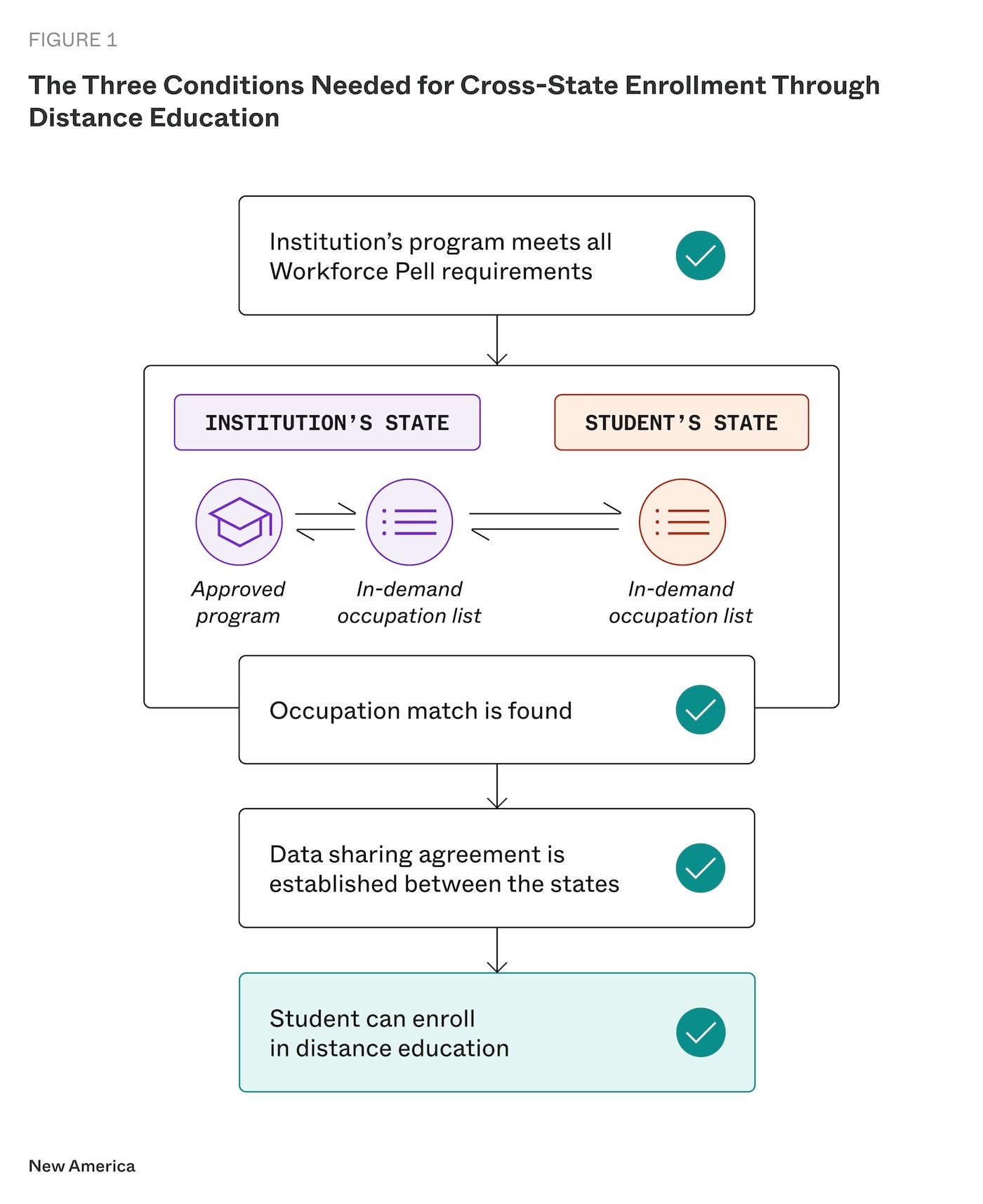
Note: States should require that institutions must attest or certify that they will not enroll students in distance education programs located in a state where the institution has not received the required state approval. This is important to protect students from enrolling in programs that may not provide them with the skills necessary to find employment in their state. Requiring this attestation will also help protect institutions because if they enroll students from a state in which they do not have approval, they could be out of compliance with Title IV laws and regulations, which could result in liabilities or other negative consequences from the Department.
This certification requirement is intended to reinforce appropriate state approval and oversight, while strengthening consumer protections for students enrolling across state lines. In implementing this provision, states should consider how to ensure adequate safeguards for students, including monitoring and managing enrollment growth in order to maintain program quality and accountability.
Workforce Pell programs must be offered by accredited, Title IV–eligible institutions. While current regulations allow institutions to use written arrangements (i.e., contracts) with ineligible providers to deliver part of a program, those arrangements are limited (§ 668.5(c)). Under existing rules, an ineligible provider may deliver up to 25 percent of a program without accreditor approval, and in some cases up to 50 percent with approval as a substantive change (§ 602.22).
For Workforce Pell programs, these limits are stricter: an ineligible provider may deliver no more than 25 percent of the program. Any program exceeding this threshold would not qualify as an eligible Workforce Pell program.
States should incorporate monitoring of this limitation into their program approval and re-approval processes, which will protect students and colleges from noncompliance with the Department of Education’s regulations.
An eligible institution must be able to demonstrate that each program it offers—including eligible Workforce Pell programs—is included, either collectively or individually, within its grant of accreditation.
The Department does not require accrediting agencies to approve each eligible workforce program. However, a Department-recognized accrediting agency may establish its own processes for reviewing and approving such programs, consistent with its substantive change procedures under § 602.22. If an accrediting agency chooses to require approval of one or more eligible workforce programs—whether individually or through policies that require a substantive change request—this approval may occur either before or after the governor’s approval, but it must be completed prior to the final approval by the Department. States should consider checking for accreditor approval through their Workforce Pell approval process.
Programs that provide the Related Instruction (RI) component of a Registered Apprenticeship (as defined in 29 CFR part 29) are deemed to satisfy the “high-wage, high-skill, or in-demand” and employer-alignment requirements for state approval (§ 690.93(g)). Registered Apprenticeship programs have additional flexibility around outsourcing the instruction to an ineligible entity. While the limit on outsourcing instruction is 25 percent in most cases, for Registered Apprenticeships, it is less than 50 percent.
However, the RI portion offered as a Workforce Pell program must independently meet all other eligibility criteria. This includes: (1) culminating in a standalone, recognized postsecondary credential (separate from the credential awarded for completing the full Registered Apprenticeship), (2) meeting completion rate requirements, and (3) meeting job placement requirements.
States should account for how these programs are treated in accountability metrics. Because the RI component is itself a Workforce Pell–eligible program, students who complete the RI—but do not complete the full Registered Apprenticeship—are included in completion and placement calculations. As a result, the RI program must be designed to deliver labor market value on its own, comparable to other Workforce Pell programs.
States considering Workforce Pell for Registered Apprenticeship programs should recognize that Workforce Pell is not the most straightforward funding source for these programs, which typically span one to four years, while Workforce Pell is designed for shorter-term programs. That said, the RI component can independently meet Workforce Pell requirements, creating a pathway for these programs to participate. Even so, providers must navigate complexities related to credit alignment, tuition structures, and student eligibility. In many cases, traditional Pell Grants may be a more natural fit for supporting the full apprenticeship pathway. Institutions and providers should consider how they can make their Registered Apprenticeship programs for-credit so they can access the traditional Pell Grant, which provides more funding and is better aligned for these longer programs.
Additionally, Registered Apprenticeship programs often do not charge tuition. However, participation in Title IV programs generally requires a tuition-based structure with consistent charges for all students, regardless of aid status. States and providers should plan for how to adapt existing funding models to meet these requirements. For example, states that already invest in apprenticeship programs could consider structuring that support as a last-dollar scholarship to cover costs not met by Workforce Pell. At the same time, policymakers should be mindful that public investment is intended to expand access—not to displace existing employer contributions—and should structure funding approaches in ways that reinforce, rather than replace, employer participation.
Evidence shows that coaching and counseling help students complete training programs. This is even more true in programs like those eligible for Workforce Pell, where career counseling makes a big difference. States should consider building out an infrastructure to support this kind of coaching to help people complete their programs. Iowa, for example, provides funds that can be used to pay pathway navigators in high-need fields at community colleges. Students at Des Moines Area Community College found these navigators so useful that the college hired additional navigators for programs that the state did not support. California and Oregon both support basic needs navigators at each community college campus.
States should consider redesigning the financial aid systems that cover similar workforce programs to complement Workforce Pell. At a minimum, states should structure aid to cover the full cost of attendance—not just tuition—so students can afford to participate in short-term, intensive programs that often limit their ability to work. States should also consider last-dollar or layered aid approaches that build on Workforce Pell, allowing limited federal funds to stretch further while ensuring support reaches both Pell-eligible and non-Pell students.
States should use their aid policies to reinforce program quality and reduce system fragmentation by aligning eligibility criteria with Workforce Pell requirements, such as completion, job placement, and earnings thresholds, and streamlining approval processes so programs that meet federal standards can more easily access state funding. By coordinating definitions, minimizing duplicative reviews, and targeting resources toward high-quality, in-demand programs, states can expand access while maintaining strong accountability for outcomes.
We would like to thank JPMorgan Chase for its generous support of this work. Sabrina Detlef’s editorial comments made our work clearer and stronger, and we thank the New America Education & Work communications team of Katherine Portnoy, Mandy Dean, and Lillian Castrillon for their production and dissemination support. We would also like to thank New America’s Central Communications team for their support and flexibility with this playbook.
Project Director, Higher Education

Director, Community Colleges