Iris Palmer
Director, Community Colleges




When Workforce Pell became policy on July 1, the ground didn’t shake. Across the country, no programs were fully approved, and no students were enrolled. Like so many policies, the impact of Workforce Pell will be felt through effective implementation. Workforce Pell’s potential to expand access to opportunity will only be realized if states implement the policy thoughtfully and ambitiously.
As of this writing, states are taking a wide range of approaches to prioritizing occupations that align with the policy’s requirements and reflect their local contexts. And states across the country are reporting a limited set of credential programs expected to qualify initially. For example, the North Carolina Community College system recently estimated that fewer than one percent of programs (330 of the 50,000 short-term programs offered at community colleges last year) will meet Workforce Pell eligibility and accountability standards.
Currently, states are focused on compliance with their processes and the programs they approve. But a greater opportunity lies in using Workforce Pell strategically to grow programs aligned with each governor’s workforce vision. To do this, states need to implement ambitious processes to support the growth of high-quality programs during the foundational first year, use coalitions and data to drive continuous improvement, and align Workforce Pell with other workforce efforts.
Treating the first year as a pilot with a small number of approved programs can drive strong enrollment and workforce outcomes in the years to come, if the time is used intentionally and methodically to test, self-assess, and improve. Informed by our work with states developing their Workforce Pell policies over the past several months, we see the following steps as key to that ambitious approach that drives positive outcomes quickly.
The data collected for federal eligibility should be used to show which programs place graduates in good jobs and identify which occupational pipelines are worth strengthening. Workforce Pell champions, ranging from community college administrators to local employers to state legislators, can help operationalize opportunities for improvement identified in the data.
States should actively manage the portfolio of Workforce Pell-eligible programs to align with their workforce and economic development goals, in collaboration with colleges across their states.
Workforce Pell can align state government, bringing together higher education, workforce development, and economic development.
As states steer the program, honest self-assessment and reflection will help uncover missed opportunities, such as suitable programs whose providers did not apply due to administrative hurdles, as well as opportunities to streamline state processes and the user experience for both institutions and students. Consider using a structure or a very simple template like this with the working group to self-assess at the end of each year.
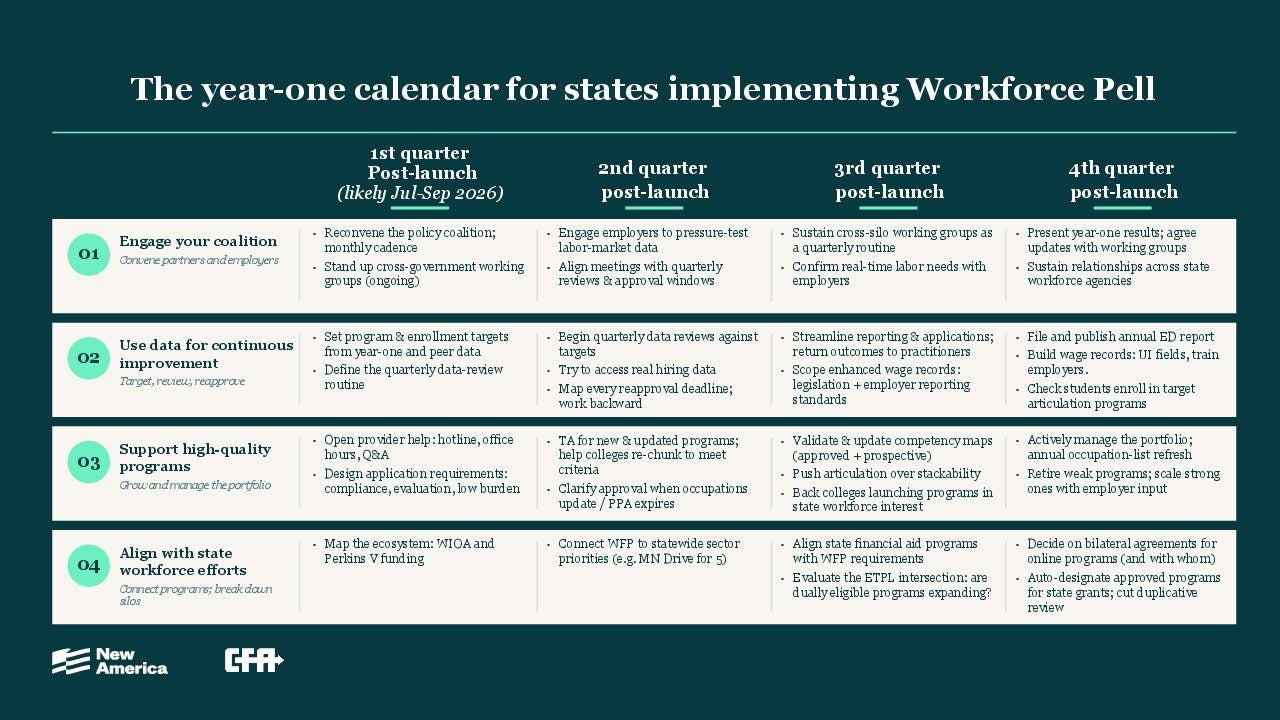
Workforce Pell will only have as much impact as effective implementation of the policy allows. With the right mindset and approach in state governments steering it to fruition and shaping its reality and reach, the policy might just live up to its lofty promise of expanding access to training, opportunity, and economic mobility across the country.
Director, Community Colleges
Senior Delivery Leader, Community Funding Accelerator, Delivery Associates
Project Leader, Community Funding Accelerator, Delivery Associates
Project Leader, Community Funding Accelerator, Delivery Associates