
Iris Palmer
Director, Community Colleges
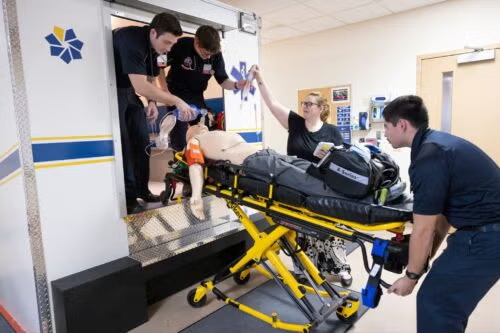



As of September 1, 35 states have an operational Workforce Pell approval process, but very few programs have been approved. North Carolina approved a first batch of 43 programs; Pennsylvania approved two, and Iowa approved nine. Federally, the Education Department has so far signed off on three: EMT programs at Iowa Central Community College and Des Moines Area Community College and an 8-week Clinical Medical Assistant program at Ivy Tech.
Most colleges are waiting to see how the first cycle goes, and others have submitted one or two programs to their states for approval. (You can find the basic requirements here.) Now is the time to take advantage of Workforce Pell to increase the share of short-term, workforce-oriented programs eligible for federal financial aid.
We have already covered what states should do this first year. Now we want to provide college leaders with benchmarks to aim for as they implement Workforce Pell: baseline, intermediate, and advanced. Here is what college implementation looks like at each level.
Colleges operating at the baseline implementation level have the basic infrastructure in place to run at least one Workforce Pell-eligible program. In this beginning level, your college may have already submitted a program for approval or may have had a few programs approved. We’ve identified four activities to tackle at this stage of Workforce Pell implementation.
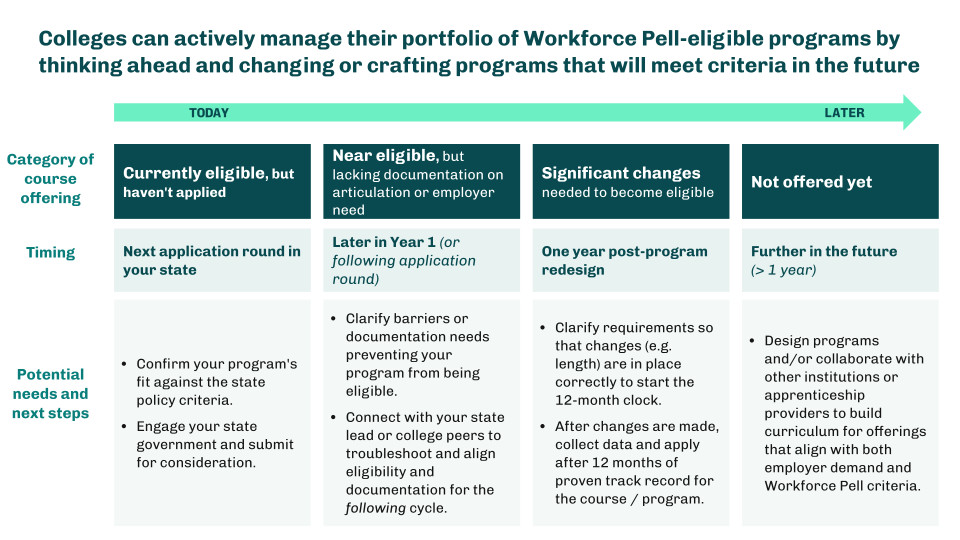
Establish leadership and eligibility screen. Get leadership, the President, and their cabinet on board with implementing Workforce Pell, and learn your state’s approval process, including its deadlines. Then screen existing programs against the federal standards for hours, weeks, and stackability. Note that the requirement that the program must be in place for a year means your first-round Workforce Pell portfolio will consist of programs you already offer. Anything new will take up to two years from now to be eligible: the time to create or adjust the course, and have it run for at least a year.
Ready the financial aid office. You also need to work with the financial aid office to ensure they are ready for both Workforce Pell implementation and broader clock-hour financial aid administration. This means ensuring that the office has guidance and systems in place to handle tasks such as applying student FAFSA eligibility to newly eligible short-term courses, tracking attendance, and determining aid disbursement timing. One benefit of establishing this readiness in the financial aid office, aside from Workforce Pell, is that students in clock-hour programs longer than 600 hours will be eligible for traditional Pell grants.
Create the data infrastructure. At the baseline, you must have a way to track student information in each program. There should be a secure way to track Social Security numbers, enrollment, withdrawals, and earned credentials, whether for credit or non-credit. Everyone at your institution responsible for Workforce Pell implementation must understand the state’s Workforce Pell reporting requirements. The state is responsible for certifying that programs meet the 70 percent completion and job placement rates, which means you will need to provide student records to the state to match with wage records. The last important step is to map Workforce Pell reporting to existing Title IV reporting workflows with the US Department of Education so that program reporting becomes a regular part of financial aid administration.
Produce student-facing information. When your college gets its first program approved, there is a minimum level of communication materials that need to be ready to go. There should be a communications strategy and tools for frontline staff, such as admissions counselors, academic advisors, and career coaches, to tell students about Workforce Pell. One option is to create a document that outlines key points, including the limited number of eligible programs and how they draw down student lifetime Pell eligibility. There should also be clear consumer information for each approved program: total clock hours, weeks, tuition/fees, credential earned, and the credit pathway it stacks into. Empowering students to make informed choices will also help to facilitate demand and registration in these courses.
At the intermediate level, your college is moving from compliance to more strategic actions. Institutional leadership should use the opportunity of Workforce Pell to make the college an even more integrated workforce partner in the community while fixing the long-broken systems that silo credit and non-credit courses that have helped prevent the use of data for continuous improvement.
Modify existing programs & explore new ones. You should begin identifying and updating existing programs to meet Workforce Pell requirements. One way to do this that helps students is to lengthen programs that are too short in ways that improve outcomes. For instance, adding a work-based learning component can both help strengthen the program’s job preparation and add hours. In allied health programs, adding clinical hours in hospital settings both meets the weeks-and-hours floor and directly supports the 70 percent job placement requirement. Using employer feedback, explore which programs to modify first and which to consider starting.
Systematize employer feedback. Share your college’s Workforce Pell efforts with your local workforce board and key employers (note that workforce boards have employer representation, so be sure to coordinate accordingly). Convene employers to ask what types of programs would be most useful. Ask specifically: where would a program of this length be useful to you? Which occupations on the state’s high-skill/high-wage/in-demand list do you hire for? This information can help prioritize programs to start or modify. Position your college’s efforts on Workforce Pell as evidence of your workforce commitment.
Integrate data systems. Clean and standardize non-credit data with defined data governance requirements. Ensure that data systems include things like consistent student identifiers, and clock-hour and attendance fields. Non-credit records should meet the same standards as credit data before connecting them. Investigate whether the current Student Information System (SIS) can support the needs of non-credit data. If it can, start the process of merging the systems. If it cannot, figure out how to automate a connection between the two systems. To the extent possible, automate financial aid workflows for clock-hour disbursement, enrollment, and state reporting for Workforce Pell. Build internal college dashboards to track course progress on the 70/70 metrics.
Create structured student support. To meet the 70 percent completion measure, colleges will need to provide structured student support. Your college should support a career navigator dedicated to Workforce Pell students to help them understand the career and education pathway they are entering, complete the FAFSA, and plan their stack from short-term credentials to credit certificates/degrees.
At this level of implementation, your college has moved from the strategic to the transformational. The college clearly and consistently combines non-credit and credit pathways, has created demand-driven systems, and uses advanced analytics to make key decisions, combined with comprehensive student supports.
Create a unified credit and non-credit architecture. College leadership should use the opportunity created by Workforce Pell to bring faculty, who tend to resist these efforts, along on a system that supports a smooth transition between non-credit and credit offerings. Use the integrated student information system to document and automate those pathways, provide automatic transcription of non-credit completions, and enable automatic credit articulation upon enrollment in a credit program. Institutionalize the structures, such as a single enrollment portal and budget models, that reward non-credit-to-credit progression.
Enable a demand-driven program portfolio. Run a standard annual review process with your employer and workforce board partners to provide feedback on the college’s programs, including those eligible for Workforce Pell. Based on that feedback, sunset or create strategies to improve ineffective programs and start new ones. Pursue sector partnerships and pre-apprenticeships with registered apprenticeship links. These types of partnerships and programs lead to the best labor market outcomes and create clear pathways for Workforce Pell-eligible programs.
Use advanced analytics and comprehensive student support. Using data on Workforce Pell job placement rates, create dashboards that show campus stakeholders how their programs perform. Expand the data to programs that are not participating in Workforce Pell to drive a culture of transparency and accountability. Proactively monitor the Value Added Earnings measure and adjust the program’s cost if needed. Create systems that support staff in changing these programs in response to outcomes data. Scale navigators into a case-management model that encompasses all programs in the college. Braid other forms of financial support to minimize students’ costs across the board.
As colleges do this work, they should establish regular contact with state policymakers to inform the evolution of state Workforce Pell policy and to ensure open communication between the state and college-level implementation. Done well, this will help inform state and federal policy on approval processes and data infrastructure. As Workforce Pell gets underway, colleges will play a foundational role in ensuring that programs are training students for in-demand, high-wage careers.
Director, Community Colleges
Senior Delivery Leader, Community Funding Accelerator, Delivery Associates
Project Leader, Community Funding Accelerator, Delivery Associates
Project Leader, Community Funding Accelerator, Delivery Associates