A Chapter of: The Muslim Brotherhood, Hamas, and Bedouin Gun Runners
Sunni Bedouin Traffickers: Marriage of Convenience
The Jordanian Muslim Brotherhood and other Jordanian weapons traffickers would not have been able to arm Palestinian militants in the West Bank if not for the network of organized crime groups backed by Iran in southern Syria who helped traffic weapons and explosives alongside drugs into Jordan. This section will begin by outlining the structure of both Iranian-backed smuggling networks and Russian proxies in the area, along with the incentives driving tensions between both patrons following the Assad regime’s takeover of southern Syria in July 2018.
It will then provide a granular analysis of the Sunni Bedouin trafficking networks in Syria’s southeastern Suwayda province who possess kinship ties in Jordan’s northeastern Mafraq province and who eventually aligned with Iran. Though these groups represent just one node of Iran’s broader trafficking network in southern Syria, Bedouin tribesmen in Suwayda were responsible for smuggling the majority of weapons into Jordan after August 2022, the same month that Iran committed to expand its effort to arm militant groups in the West Bank.174
Lastly, this section will analyze the push and pull factors that enabled Iran to cultivate allies in an overwhelmingly Sunni region. First, it will show how Bedouin tribesmen in Suwayda were drawn to Iranian patronage following disputes with their previous patron, Jordan, which scaled back support for the area’s main Bedouin faction in 2017 and 2018. The need for alternative financing served as a powerful pull factor that lured Suwayda Bedouin groups into taking part in trafficking and eventually partnering with Iran.
Similarly, Russia’s partial withdrawal from the area after Moscow’s full-scale invasion of Ukraine in February 2022 enabled Iran to expand its military footprint and purge figures and groups backed by rival patrons, including Russia, the United States, Jordan, and the Arab Gulf states. With a lack of true competitors, Iran’s capacity to push through its agenda in southern Syria throughout 2022 and 2023 became almost uncontested.
Great Power Competition: Russia and Iran
On July 12, 2018, the Assad regime retook southern Syria from rebel forces, capturing Dara’a province, where the country’s revolution had begun in 2011.175 The Syrian regime’s recapture of the region was enabled by support from both Russia and Iran. However, Syria’s two foreign sponsors had distinct visions for the area and different relationships with local organized crime groups.
In southern Syria and across the country, Syria’s Military Intelligence was informally tasked with overseeing the activities of Iranian militias and coordinating their activities with local organized crime groups.176 In Syria’s southwestern Dara’a province, local Military Intelligence Chairman Lu’i al-Ali served as one of the top power brokers following the Assad regime’s capture of southern Syria until its overthrow on December 8, 2024. There, al-Ali coordinated with traffickers led by Aimad Abu Zrayg who smuggled contraband through the Nassib border crossing with Jordan and others who oversaw routes in remote parts of the Dara’a countryside.177
In Suwayda province, the local Military Intelligence branch cycled through five chairmen during the same period.178 As a result, real power lay with Jamil al-Bala’as, the former director of the office of Wafiq al-Nasser, ex-chairman of Suwayda Military Intelligence from 2011 to 2018, who cultivated close ties to national-level Military Intelligence Chairman Kifah al-Mulhim.179 Al-Bala’as is also a leading sheikh of the Jarah clan, a Sunni Bedouin tribe based in Lajat, a volcanic rock field in northern Dara’a and Suwayda provinces. Lajat has long served as a refuge for smugglers who use the area to collect, package, and assemble contraband.180
For years, Lu’i al-Ali, Jamil al-Bala’as, and others from Military Intelligence served as the link between local traffickers on the Syrian-Jordanian border and groups with direct ties to Iran, such as Hizbollah and the Syrian Arab Army (SAA) 4th Division—led by Maher al-Assad, Bashar al-Assad’s brother—who smuggled contraband into southern Syria from other parts of the country.181
From July 2018 until the outbreak of the war in Ukraine in February 2022, Russia and Russian-backed groups in southern Syria cooperated with Jordan to limit the spread of these groups and stem the flow of weapons and narcotics over the border.182 This came as part of a broader initiative pursued by Russia and the United States to ease the concerns of Jordan and Israel, which had long sought to limit the presence of Iranian-backed groups on their borders since the outbreak of the Syrian civil war in 2011.183
However, Russia had its own incentive for limiting Iranian expansion. Despite Russia and Iran both supporting the regime of Bashar al-Assad, their interests in Syria began to diverge following the large-scale defeat of ISIS in late-2017. Beginning in 2018, Moscow led efforts to rehabilitate the Assad regime among the international community in the hopes of lifting UN and Western sanctions on Syria and triggering the release of hundreds of billions of dollars in reconstruction aid that Russian firms were poised to benefit from.184 Iran, by contrast, aimed to continue using the country as a corridor to supply weapons to proscribed terror groups, including Hizbollah in Lebanon and Palestinian militant groups in the West Bank, sabotaging the likelihood of Assad securing sanctions relief.185
Russia led efforts to finance regime forces responsible for preserving security in the area. The majority of the forces it backed were Sunni ex-rebels granted amnesty by Moscow after formally surrendering and reconciling with the regime, becoming official SAA units.186 For Russia, reconciled Sunni rebels could be relied upon to resist Iranian encroachment for ideological and sectarian reasons more so than Syrian security forces, many of which were led by Alawites, a breakaway sect of Shi’a Islam to which the Assad family, Lu’i al-Ali, and others belong.
For the next several years, Russia cooperated closely with Jordan to finance and support reconciled rebels, in particular the SAA 5th Corps’ 8th Brigade in the east Dara’a countryside and a select number of other groups, with the aim of preventing Iranian encroachment.187
However, in the months following Russia’s February 2022 invasion of Ukraine, Moscow withdrew thousands of troops from the country and shut down several forward military positions, including four in Damascus and Suwayda provinces.188 Speaking about the subject in May 2022 in an interview with the Hoover Institution, Jordanian King Abdullah II described the situation by saying, “The presence of the Russians in the south, in Syria, was a source of calm….That vacuum will be filled by the Iranians and their proxies.189
Iran’s efforts to fill the vacuum were already underway. From March to July, Iranian proxies in southern Syria carried out a wave of assassinations aimed at solidifying Tehran’s control of the Syrian-Jordanian border region, beginning with director of the Nassib border crossing, Maher Wasouf.190 By August, weapons trafficking from Syria grew significantly, the majority of which occurred in Syria’s Suwayda province, located adjacent to Jordan’s Mafraq province, a remote desert region along the border with Iraq which Jordanian security forces have traditionally found difficult to patrol.191
This occurred the same month that Iran and Palestinian Islamic Jihad leadership reached a deal to expand arms trafficking to the West Bank on August 6, and that Hamas and the Al-Aqsa Martyrs Brigade militants in the city of Nablus formed the Lion’s Den faction on August 15, suggesting a coordinated effort by Iran to organize the efforts of its proxies across multiple theaters.192 Unsurprisingly, it was also around this time that violence began to spike in the West Bank.
Events in southern Syria, Jordan, and the West Bank reflected a continuing stream of weapons seizures by both Jordan and Israel, with Jordanian security forces making at least seven seizures of heavy weapons on its border with Syria in 2022, followed by nine in the first ten months of 2023.193 On the border with Israel, the Israel Defense Forces (IDF) thwarted at least 22 attempts to smuggle weapons from Jordan in 2022, compared to four in 2021.194
Suwayda’s Bedouin and the Smuggling Route to Jordan
By August 2022, Suwayda province became a more effective location for Iranian-backed weapons traffickers than traditional routes through Dara’a. Understanding this shift requires understanding the demographics of the area and the history of the local forces involved in trafficking. Despite the majority of Suwayda’s population being Druze—a breakaway sect of the Ismaili branch of Shi’a Islam—Suwayda province is also home to a large Sunni Bedouin minority whose members belong to tribes that possess kinship ties in Jordan’s northeastern Mafraq province.
Beginning in October 2015, many of these tribes—in particular the al-Shanabala, al-Masa’id, Bani Khalid, al-Ghiyath, and others—joined the Army of Free Tribes (AFT), a Sunni rebel faction in Syria formed by Jordan and tasked with protecting Jordan’s northeastern border from ISIS. Also known as the “Free Tribes Collective” or “Southern Tribes Collective,” AFT’s connection to related clansmen in towns and villages across Mafraq meant the group was well positioned to work with Jordanian security forces to protect the country from cross-border threats.
As a result, shortly after its founding, AFT began as the Jordanian monarchy’s most important Syrian proxy. Its leader, Rakan al-Khudayr, was granted Jordanian citizenship and developed close ties to some of Jordan’s top leaders.195
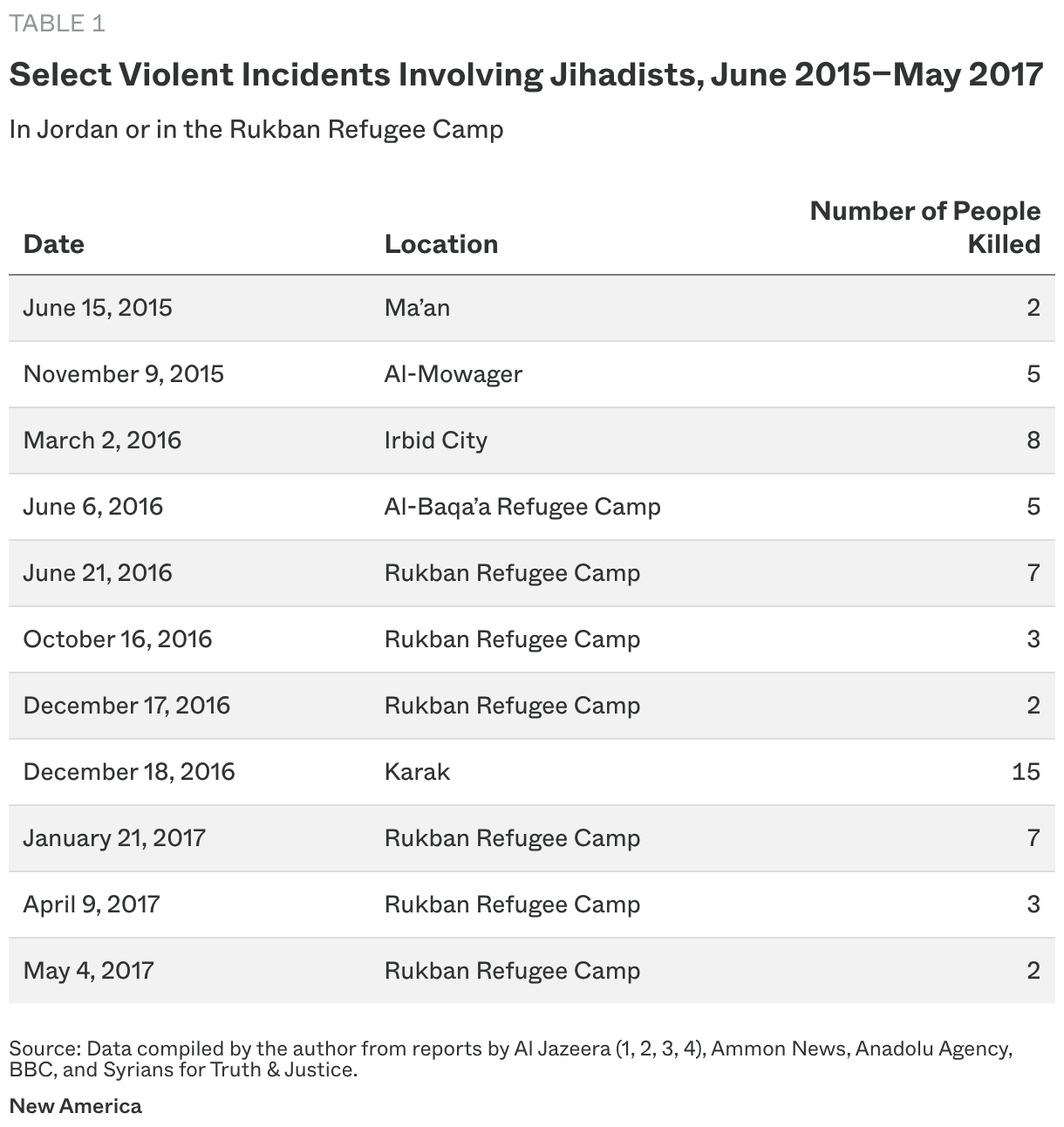
Jordan’s reliance on AFT grew as the threat of ISIS began to manifest domestically. As shown in Table 1, from June 2015 to May 2017, at least 59 people were killed and more than 100 injured in 11 violent incidents involving ISIS and other jihadists in Jordan and the Rukban refugee camp, located inside a poorly delineated section of the Syrian-Jordanian border demarked by walls of sand erected by bulldozers known as “the berm.”
AFT’s presence across southern Syria was key to ensuring that ISIS groups on both sides of the border did not establish direct links or supply lines with one another. However, following the collapse of ISIS in late 2017 and the Assad regime’s takeover of southern Syria in July 2018, AFT quickly reconciled with regime forces and exploited its presence in critical parts of the border to manage and oversee cross-border drug and weapons trafficking networks.
AFT commanders maintained influence along seven key legs of the smuggling route linking southern Syria and Jordan, beginning with the village of al-Mutila, Rakan al-Khudayr’s hometown where Jamil al-Bala’as also maintained a second residence.196 Al-Khudayr is a member of the al-Shanabala tribe, whose members live in several dozen towns in the southeastern Suwayda countryside and 13 villages in Mafraq centered around Um al-Qatin. Though originally from the town of Malah in the southeast Suwayda countryside, al-Khudayr’s family relocated to al-Mutila during his youth.197
Following the outbreak of Syria’s civil war in 2011, al-Mutila became a strategic location as it was the last major population center on the Damascus-Suwayda highway before Lajat, the volcanic rock field home to Jamil al-Bala’as that serves as an assembly point for smugglers before disbursing contraband to traffickers closer to the Syrian-Jordanian border.
Militias that controlled checkpoints in al-Mutila could extort large fees from traffickers or sabotage their shipments further south. Even today, after the overthrow of Assad in December 2024, AFT and other militias in al-Mutila exploit their control over the area to secure concessions from Syria’s interim government, including being merged into the country’s formal security apparatus.198
The second area where AFT enjoyed significant influence was in Lajat itself, alongside the Al-Aumari Brigades (AAB), a tribal militia dominated by members of the al-Jawabara clan and al-Ghiyath tribe’s al-Madalja branch.199 Both AAB and AFT were founded in October 2012 and October 2015, respectively, by Hossam al-Karahsha, an enigmatic rebel leader about whom little is known.200 By 2016, both AAB and AFT occupied territory in the central Lajat villages of Masika, Shiyah, and Jadl and received support from Jordan to combat ISIS in northern Lajat around the village of Hosh Hamad, eventually forming a joint operations room in May 2017.201
By the time of the Assad regime’s takeover of southern Syria in July 2018, Jordan had reduced its support for AFT due to allegations of embezzlement and corruption. This created a gap that was filled by Iran and Hizbollah, which provided support for both AFT and AAB, particularly in Lajat.202 There, AAB commanders Faysal Sabih al-Madalja and Muflih al-Sabra, along with AFT leaders Hassan al-Ruwaydan, Mansur al-Ruwaydan, and Safi al-Khalaf, became the largest drug traffickers in the region, partnering directly with Lu’i al-Ali and Jamil al-Bala’as to smuggle contraband through Dara’a and Suwayda.203 Eventually, AAB became a sub-unit of AFT, with Muflih al-Sabra becoming Rakan al-Khudayr’s top deputy, a position he retains today.204
From Lajat, contraband is smuggled to Bedouin neighborhoods of Suwayda city, in particular the al-Muqawas and al-Shaqrawia neighborhoods—home to al-Shanabala and al-Jawabara tribesmen, respectively—and the al-Musharab district, where AFT partnered with Bedouin organized crime figures affiliated with Jamil al-Bala’as.205
From Suwayda city, contraband is trafficked in two directions. Throughout much of 2022, most contraband was taken south toward al-Shih hill, an elevated mound a mile north of the Jordanian border, and the Jordanian al-Shanabala town of Um al-Qatin. From there, and the nearby village of Khirbat al-Awwad, traffickers conducted cross-border raids or used drones to transport contraband to smugglers in villages around Um al-Qatin.206
However, as Jordanian security forces increased their presence in the area, smugglers increasingly pursued routes farther east, near the villages of Sha’ab and Um Shama in the southeast Suwayda countryside, home to the al-Shanabala tribe’s al-Ramthan and al-Shuwa’ayr clans. Located just east of the al-Khudayr family’s hometown of Malah, trafficking in both villages was led by Mara’i al-Ramthan, a Syrian-Jordanian dual national, and Jihad al-Sa’id, a member of the al-Masa’id tribe whose members live in Um al-Jimal and other north Mafraq towns west of Um al-Qatin.
Because of their cross-border kinship ties, the al-Ramthan and al-Sa’id families have been entrusted with smuggling many of the most sensitive weapons material into Jordan, including C4, TNT, mines, anti-tank mines, RPG launchers, and anti-armor and anti-personnel mines, many of which were sourced from Wafiq Safa, chairman of Hizbollah’s external security office in Lebanon.207 The al-Ramthan and al-Sa’id families’ importance has often made them the target of Jordanian airstrikes, with Mara’i al-Ramthan himself killed in one such strike on May 8, 2023, after which his brother, Muhammad al-Ramthan, took over his role.208 Jordanian airstrikes continue to target the vicinity of the village of al-Sha’ab, including on December 24, 2025.209
From al-Sha’ab, al-Ramthan and al-Sa’id clansmen moved further east across the Safa volcanic zone toward the southern stretches of the Syrian Central Desert in the Damascus countryside province. Along the way, traffickers utilized numerous valleys across the volcanic zone around the informal Sharshuh crossing to transport contraband into Jordan.210 By mid-2023, traffickers increasingly moved into the Central Desert itself, handing contraband to members of the al-Harayra clan, a branch of the larger al-Ghiyath tribe whose members also dominated the ranks of AAB and AFT in Lajat. Perhaps more than any other group, al-Ghiyath tribesmen became critical for the success of Iranian-backed smuggling routes in the area due to the geographic distribution of their members, who are concentrated in border regions in Syria, Jordan, and Saudi Arabia.
After receiving contraband near Safa, al-Ghiyath tribesmen move goods into Mafraq province’s far eastern al-Ruwayshid district via al-Handalat, the site of a former Syrian IDP camp in the southeast Damascus desert that was abandoned when the area was taken over by pro-Assad forces from U.S.-backed rebels. The al-Handalat camp is located adjacent to the al-Handalat dam in Jordan’s al-Ruwayshid district, which are both connected by a valley that provides cover to smugglers to cross the border without being noticed. Despite being abandoned, the tents of the former al-Handalat camp remain in place, providing smugglers cover from aerial surveillance.211
From al-Ruwayshid, traffickers move narcotics south to Saudi Arabia via the al-Haditha crossing, located near the Saudi cities of al-Quryat and Turayf, also home to al-Ghiyath tribesmen. Weapons are moved west to the village of al-Halaywa, one of several towns in al-Mafraq home to members of both the al-Ramthan and al-Sa’id clans, who thereafter move contraband farther west. As in al-Sha’ab, traffickers in this area are allegedly led by Muhammad al-Ramthan and members of the al-Sa’id family.212
Push and Pull: How the AFT Aligned with Iran
At its founding in October 2015, the AFT was tasked by Jordan to protect its border with Syria from penetration by ISIS cells in the desert south and east of Damascus and to oversee aid distribution and security at the Rukban and al-Handalat refugee and IDP camps. However, by late 2016, allegations of embezzlement and extortion involving AFT leaders at Rukban and al-Handalat, together with the group’s failure to prevent ISIS attacks on the border, pushed Jordan to reduce its support for the group, limit AFT’s functions in both camps, and increase funding for other factions.213 Keen to preserve their status, AFT leaders quickly sought new ways to self-finance, with the pull of smuggling presenting itself as the most expedient option.
A leaked copy of a Jordanian State Security Court report reviewed by this author reveals that, in early 2017, Jordan’s General Intelligence Directorate allowed AFT to traffic and resell $21.8 million in low-cost Syrian tobacco into Jordan in order to plug its funding deficits.214 The report, circulated internally within Jordanian institutions on December 3, 2019, was commissioned to investigate allegations that Rakan al-Khudayr and Jordanian military officials embezzled much of the $21.8 million, which was not used to fund AFT.
The report was part of a Jordanian State Security Court crackdown on tobacco smugglers launched in July 2018 in response to large protests that began on May 30, 2018. The protests objected to new sales taxes and austerity measures imposed as part of an IMF reform package and led to the resignation of Prime Minister Hani Mulki less than a week later, on June 4.215 Beginning in January 2018, Jordan’s government imposed a JD0.2 ($0.28) tax on packs of cigarettes, a 10–20 percent tax on carbonated drinks, and a 30 percent tax on 95 and 98 octane gasoline while also reducing bread subsidies, leading to a spike in bread prices for the first time since 1996.216 Throughout the year, new sales taxes were also imposed on more than 160 goods, along with proposed increases of 5 percent and 20–40 percent on income and corporate taxes, respectively.217
The tax on cigarettes proved particularly unpopular in light of allegations that Mulki had turned a blind eye to black market cigarette factories being operated in Jordan’s Zarqa Free Zone by Awni al-Muti’a, a businessman who allegedly had evaded $760 million in taxes since 2006 by smuggling cigarettes meant only for export on to the domestic market.218
The political firestorm over the tobacco tax produced a crackdown on tobacco smuggling. Shortly after taking office, Mulki’s replacement, Omar Razaz, launched a ministerial committee to investigate cigarette smuggling in July 2018, formally charging Awni al-Muti’a with tax evasion and arresting several dozen of his associates.219 Among those arrested was Wadah al-Hamud, Jordan’s former director of customs, who allegedly turned a blind eye to al-Muti’a’s operations in the Zarqa Free Zone and provided him with tip-offs on raids in exchange for bribes.220 The aforementioned Jordanian State Security Court report detailing Rakan al-Khudayr’s tobacco smuggling operations also lists Wadah al-Hamud as al-Khudayr’s chief partner responsible for facilitating the passage of at least 55 illicit tobacco shipments between Syria and Jordan in 2017, seven of which purportedly were intended for the Zarqa Free Zone, home to Awni al-Muti’a’s cigarette production.221
Following three years of trials, the same State Security Court sentenced Awni al-Muti’a in September 2021 to 22 years of prison time; Wadah al-Hamud was given a sentence of 10 months.222 However, at no point did the State Security Court implicate Rakan al-Khudayr in illicit tobacco smuggling, despite repeatedly identifying him as a trafficker in its internal report.
It remains unconfirmed whether AFT ever stopped trafficking tobacco, either after the July 2018 arrest of Awni al-Muti’a or following the December 2019 circulation of the State Security Court report. However, the crackdown, alongside other challenges, likely diminished its available funding. Over the next several years, AFT commanders became heavily involved in Captagon production and smuggling, providing them with an alternative source of funds, albeit one that ran through Iranian and Syrian power brokers, as detailed above.223
While AFT’s need to plug its funding gaps acted as a strong pull factor drawing many of its commanders into Iran’s orbit, Russia’s partial withdrawal from southern Syria, starting in February 2022, and the expansion of Iranian-backed groups along the Syrian-Jordanian border served as powerful push factors that incentivized reconciled rebels across the region to move closer to Tehran to avoid violent reprisals. The set of events that drove this shift began almost immediately.
First, in late February 2022, unknown assailants assassinated Maher Wasouf, director of the Nassib border crossing. Wasouf had been appointed to the position shortly before via a formal order issued by the Office of the Syrian President, which tasked him with curbing Captagon flows in response to complaints received from Jordan. After his assassination, Wasouf was replaced with Yahya Miya, a Syrian with close ties to Hizbollah and Iranian officials. Following Wasouf’s replacement, other security officials in Dara’a aligned with Iran were appointed to lead the area’s three local intelligence bureaus.224
Months later, Hizbollah launched a campaign to eliminate the Anti-Terror Force, a U.S.-backed faction formed a year before to combat ISIS and Iranian influence in Suwayda that was based in the town of Khazma, southwest of al-Sha’ab along the route to al-Handalat. On June 9, 2022, 500 Hizbollah and other pro-Assad troops besieged Khazma and killed the group’s commander, Samir al-Hakim, thereafter forcing the group to dissolve.225 These and other killings led to a new outpouring of contraband into Jordan, with security forces seizing 33 million Captagon pills in the first nine months of 2022, more than twice the 16 million seized in all of 2021.226
In order to address the uptick, representatives from Jordan, Saudi Arabia, the United Arab Emirates, and Egypt met in Abu Dhabi in late June with leaders of five former rebel factions in southern Syria to discuss the formation of a 35-kilometer safe zone in Dara’a province. On July 1, 2022, these five leaders, led by Kanan al-Aid (aka Abu Talib), returned to Syria. Two days later, al-Aid was assassinated.227 These killings marked Iran’s final takeover of large swaths of the Jordanian-Syrian border, just weeks before IDF soldiers killed Palestinian militant leader Ibrahim al-Nabulsi, triggering the formation of the Lion’s Den faction in Nablus.
The pull of a revived Palestinian militant movement in the West Bank, together with the consolidation of Iranian control over the Syrian-Jordanian border, led to an explosion of new weapons being trafficked into Jordan.228 In the six months from October 2022 to March 2023, Syrian smugglers made at least 108 crossings into Jordan, adopting increasingly audacious tactics, often moving in groups of hundreds separated into teams, including drone-equipped units tasked with reconnaissance.229 It was also around this time that JMB members returned to Jordan from Lebanon and began planning to build a missile production factory outside Amman, granting Iran and its proxies their first-ever fixed military position inside the Kingdom and eventually leading to the April 15 arrests.230

Citations
- “Study: South Syria’s Drug Supply Chains – June 2023,” https://etanasyria.org/study-south-syrias-drug-supply-chains-june-2023/.
- Associated Press, “Syria Government Forces Plant Flag in Daraa, the Cradle of Rebel Uprising,” CBC, July 12, 2018, https://www.cbc.ca/news/world/syria-daraa-recapture-1.4744308; Emma Graham-Harrison, “Syria: Southern Towns Surrender to Assad Forces After Thousands Flee Homes,” The Guardian, June 30, 2018, https://www.theguardian.com/world/2018/jun/30/syria-southern-towns-surrender-to-assad-forces.
- “Study: Changes Within South Syria’s Drug Network – September 2023,” Etana, September 13, 2023, https://etanasyria.org/study-changes-within-south-syrias-drug-network-september-2023/; Abdulah al-Ghadawi, “Al-Assad’s Strategy to Avoid Becoming a Puppet of Russia and Iran,” New Lines Institute, March 11, 2021, https://newlinesinstitute.org/middle-east-center/al-assads-strategy-to-avoid-becoming-a-puppet-of-russia-and-iran/; “Death Finances Death...the South in the Tornado of Drugs” [in Arabic], Enab Baladi, March 22, 2021, https://www.enabbaladi.net/468263/; Hossam al-Baram, “Captagon Militia...Tablets Draw the Features of the Future Youth in Syria’s South” [in Arabic], Horan Free League, December 9, 2020, https://www.horanfree.com/archives/7630.
- “Drug Trafficker Close with Syrian Regime Intelligence in Dara’a is Killed” [in Arabic], Syria TV, March 10, 2023, https://tinyurl.com/y3dmc6sv; Adnan Ahmed, “Dara’a Province in Turmoil: [Caught] Between Security Forces, ISIS and Drug Traffickers” [in Arabic], The New Arab, March 11, 2023, https://tinyurl.com/yc8jyha7; Salam Abdullah, “Why is the 8th Brigade Conducting a Campaign in Eastern Dara’a?” [in Arabic], Horan Free League, March 8, 2023, https://www.horanfree.com/archives/13464; “[Conflict Over Fees and Extortion Leads to the Removal] of a Security Official at the Nassib Crossing Between Syria and Jordan” [in Arabic], Syria TV, September 20, 2024, https://tinyurl.com/bd4nxw8e; “Dara’a...Commander Aimad Abu Zrayg [Survives] 4th Assassination Attempt” [in Arabic], Enab Baladi, May 21, 2022, https://tinyurl.com/4tas6xpw.
- “‘From Suwayda to Hama then Aleppo’...Wafiq Nasser the Joker of Assad’s Intelligence” [in Arabic], Orient News, January 21, 2021, https://orient-news.net/ar/news_show/187467; “Suwayda: Colonel Lu’i al-Ali Still Working at the Intelligence Directorate” [in Arabic], Syria TV, February 1, 2021, https://tinyurl.com/3mx3f9a9; “Decree Issued Transferring Military Intelligence Official in Suwayda Eight Months After his Appointment” [in Arabic], SHAAM Network, April 21, 2023, https://shaam.org/news/syria-news/sdwr-qrar-bnql-msuwl-alamn-alaskry-balswydaa-bad-thmanyh-ashhr-mn-tayynh; “Military Intelligence in Suwayda Extorts Activists and Wanted [Individuals] in Suwayda to ‘Reconcile their Status’” [in Arabic], SHAAM Network, April 11, 2024, https://tinyurl.com/wwjryte7; “In Suwayda...Malicious Reports Target University Students,” Sy-24, October 10, 2024, https://www.sy-24.com/135321/.
- Karam Mansur, “How Did Suwayda Turn into a [Corridor] for Drugs to Jordan?” [in Arabic], Syria Direct, March 12, 2024, https://tinyurl.com/33hrzdhv; “The National Guard in Suwayda Targets Smuggling Networks in the Eastern Badia and Responds to Accusations of Threatening Jordan’s Security” [in Arabic], Yalla News Syria, December 16, 2025, https://yallasyrianews.com/a/78638.
- Zain al-Halabi, “Suwayda: ‘Military Security’ Agitates Bedouin Against the Druze?” [in Arabic], Al-Mudun, August 13, 2019, https://tinyurl.com/mv8ttaex.
- Zain al-Halabi, “Suwayda: ‘Military Security’ Agitates Bedouin” [in Arabic], https://tinyurl.com/mv8ttaex; Khalid al-Jara’atli, “Israel Focuses on ‘Military Intelligence’ in Syria” [in Arabic], Enab Baladi, November 17, 2024, https://tinyurl.com/yuw8983a; Ben Hubbard and Hwaida Saad, “On Syria’s Ruins, a Drug Empire Flourishes,” New York Times, December 5, 2021, https://www.nytimes.com/2021/12/05/world/middleeast/syria-drugs-captagon-assad.html.
- Armenak Tokmajyan, How Southern Syria Has Been Transformed into a Regional Powder Keg (Carnegie Endowment for International Peace, July 2020), 8, 15, https://assets.carnegieendowment.org/static/files/files__Tokmajyan_DFID_Syria-updated.pdf; Abdullah al-Jabassini, The Eighth Brigade: Striving for Supremacy in Southern Syria (Middle East Directions, December 1, 2020), 1, https://tinyurl.com/25j6yzef.
- Barak Ravid, “U.S. and Israel Coordinate Terms for New Deal in Southern Syria,” Axios, June 1, 2018, https://www.axios.com/2018/06/01/us-and-israel-coordinate-on-new-ceasefire-deal-in-syria; Ibrahim Hamidi, “New Deal Reached on Southern Syria,” Asharq Al-Awsat, June 3, 2018, https://english.aawsat.com/home/article/1288661/new-deal-reached-southern-syria.
- Jeremy Hodge, “The Wagner Mutiny Could Strengthen Iran in Syria,” Foreign Policy, July 5, 2023, https://foreignpolicy.com/2023/07/05/putin-russia-wagner-mutiny-syria-iran/.
- David Adesnik, H. R. McMaster, and Behnam Ben Taleblu, “Burning Bridge: The Iranian Land Corridor to the Mediterranean,” Foundation for the Defense of Democracies, June 18, 2019, https://www.fdd.org/analysis/2019/06/18/burning-bridge/.
- Keeping the Calm in Southern Syria (International Crisis Group, June 21, 2018), https://www.crisisgroup.org/middle-east-north-africa/syria-jordan-united-states-russia-internal/187-keeping-calm-southern-syria; “South Syrian Rebels to Lay Down Arms as Assad Seizes Crossing,” Middle East Eye, July 6, 2018, https://www.middleeasteye.net/news/south-syrian-rebels-lay-down-arms-assad-seizes-crossing.
- Tokmajyan, How Southern Syria Has Been Transformed, 6, 9–11, https://assets.carnegieendowment.org/static/files/files__Tokmajyan_DFID_Syria-updated.pdf; Al-Jabassini, The Eighth Brigade, 1, 3, 6–8, 15, https://tinyurl.com/25j6yzef; Lina Khatib and Lina Sinjab, Syria’s Transactional State: How the Conflict Changed the Syrian State’s Exercise of Power (Chatham House, October 2018, https://www.chathamhouse.org/2018/10/syrias-transactional-state/2-origins-and-evolution-syrias-shadow-state.
- Kingsley and Bergman, “Russia Shrinks Forces in Syria,” https://www.nytimes.com/2022/10/19/world/middleeast/russia-syria-israel-ukraine.html; Shawakh et al., “Foreign Forces Positions in Syria Mid-2022” [in Arabic], 11, https://jusoor.co/storage/posts/old-pdf/1892.pdf; Shawakh et al., “Foreign Forces Military Positions in Syria Mid-2023” [in Arabic], 12, https://tinyurl.com/w6kwjtkb.
- Hoover Institution, “Battlegrounds w/H.R. McMaster | Jordan: Perspective On Integration, Conflict, Middle East Stability,” YouTube video, May 18, 2022, https://www.youtube.com/watch?v=TjYH5LeHh2I.
- Walid Al Nofal, “Amid War in Ukraine, Russia Withdraws and Iran Expands in Syria,” Syria Direct, May 4, 2022, https://syriadirect.org/amid-war-in-ukraine-russia-withdraws-and-iran-expands-in-syria/.
- “South Syria’s Drug Supply Chains – June 2023,” https://etanasyria.org/study-south-syrias-drug-supply-chains-june-2023/.
- Ben Menachem, “Iran Supporting New West Bank Terrorist Groups,” https://jcfa.org/iran-supporting-new-west-bank-terrorist-groups-with-money-and-weapons/; Dthuqan, “The ‘Lion’s Den’ in Photos” [in Arabic], https://tinyurl.com/4rckbr6u.
- Sune Engel Rasmussen and Benoit Faucon, “Weapons Flood West Bank, Fueling Fears of New War Front with Israel,” Wall Street Journal, October 25, 2023, https://www.wsj.com/world/middle-east/iran-weapons-west-bank-israel-war-8bf12d1f.
- Matthew Levitt and Lauren von Thaden, “Guns, Drugs, and Smugglers: A Recent Heightened Challenge at Israel’s Borders with Jordan and Egypt,” CTC Sentinel 11, no. 7 (July 2023): 4, https://ctc.westpoint.edu/wp-content/uploads/2023/07/CTC-SENTINEL-072023.pdf.
- “‘Army of Free Tribesmen’ Military Parade in Dara’a (Video)” [in Arabic], Enab Baladi, June 5, 2018, https://tinyurl.com/yj5kw9hn; Orient News, “[What] is the Tribes Army in Dara’a and Why Does Jordan Support it at the Expense of the Southern Front?- Here is Syria” [in Arabic], YouTube video, December 2, 2015, https://www.youtube.com/watch?v=yBj-eUmYZSE; “Dara’a...‘Army’ of the South’ on ‘Mamluk’s’ Table and Russia Seeks to Establish ‘Army of Stability’” [in Arabic], Zaman al-Wasl, January 31, 2019, https://www.zamanalwsl.net/news/article/119544/; Mazen Azi, “Suwayda Tribes: Social Map and Conflict Dynamics” [in Arabic], Daraj, July 26, 2025, https://tinyurl.com/msa8ftwd.
- “Similar to al-Ramthan Before His Killing...Regime Security Arrests ‘Jamil al-Bala’as’ and Releases him After [Interventions from Security Forces]” [in Arabic], SHAAM Network, August 14, 2024, https://shaam.org/news/syria-news/ala-ghrar-alrmthan-qbl-mqtlh-ajhzh-alnzam-tatql-jaml-alblaas-wtfrj-anh-bad-wsatat-amnyh.
- “The Bedouin’s Honor Stems from the Honor of its Men,” Facebook, July 6, 2020, https://www.facebook.com/photo/?fbid=143388554035380&set=pcb.143388720702030; interviews with three al-Shanabala tribal notables, conducted August 2024–April 2025.
- Azi, “Suwayda Tribes: Social Map and Conflict Dynamics” [in Arabic], https://tinyurl.com/msa8ftwd; Southern Tribes Collective, Facebook, February 13, 2025, https://www.facebook.com/100088574370045/posts/614036211558853/.
- Interviews with three al-Ghiyath tribal notables, conducted April 2025.
- Zajil Network, “Howran = Formation of Liwa al-Aumari, Led by Captain Qays Qata’ana Daraa 24 10” [in Arabic], YouTube video, October 25, 2012, https://www.youtube.com/watch?v=TizzrVGL_ME; Azi, “Suwayda Tribes: Social Map and Conflict Dynamics” [in Arabic], https://tinyurl.com/msa8ftwd; “Who is Rakan al-Khudayr [the Man] Being Attacked by Ramtha’s al-Bahhara” [in Arabic], The New Arab, August 24, 2019, https://tinyurl.com/3h6sedc4.
- “Airstrikes Target ‘al-Lajat’ [Amidst] Continued Violations by the Regime and its Militias” [in Arabic], Zaman al-Wasl, June 19, 2018, https://www.zamanalwsl.net/news/article/87999; “Assassination of ‘Tribal Division’ Commander with an IED in Dara’a” [in Arabic], Enab Baladi, February 15, 2017, https://www.enabbaladi.net/131507/%D8%A7%D9%81/; “In Detail...Iranian Missile Base Near Suwayda, and New “[Iranian] Deployment in Dara’a and Quneitra” [in Arabic], Jesr Press, July 4, 2019; “The Opposition Fails to Penetrate [ISIS] Positions in the Lajat Region” [in Arabic], Enab Baladi, June 6, 2016, https://www.enabbaladi.net/83372/%d8%a7%d9%84%d9%85f/; “’Free Tribes in Dara’a: [He] Who Formed a Pro-Regime Tribes Army is [a Dead Man Walking]’” [in Arabic], Micro Syria, December 4, 2017; Tal Beeri, Iran & Hezbollah Drug Industry in Southern Syria (Alma Research and Education Center, November 2021), 19, https://israel-alma.org/wp-content/uploads/2021/11/Iran-Hezbollah-drug-industry-in-southern-Syria.pdf.
- Al-Jabassini, The Eighth Brigade, 9, https://tinyurl.com/25j6yzef.
- Zain al-Halabi, “Suwayda: ‘Military Security’ Agitates Bedouin Against the Druze?” [in Arabic], Almodon, August 13, 2019, https://tinyurl.com/mv8ttaex; “In Detail...Iranian Missile Base” [in Arabic], https://tinyurl.com/yes2pfzb; “Orient Reveals Names: Hizbollah Turns the Hajj Road to the Drugs Road and Jordan is Targeted!” [in Arabic], Orient News, August 3, 2021, https://orient-news.net/ar/news_show/191790; “Assassination Attempt Against a Leader of Iranian Militias in Eastern Dara’a (Pictures)” [in Arabic], Syria TV, August 19, 2020, https://tinyurl.com/489azvzt; Suwayda24 (@Suwayda24), “Formation of Armed Groups in Dara’a Overseen by Intelligence and Hizbollah,” September 24, 2018, https://www.facebook.com/Suwayda24/posts/1005681729611444/.
- Southern Tribes Collective, Facebook, February 13, 2025, https://tinyurl.com/4cz9eyde; Southern Tribes Collective, Facebook, February 18, 2025, https://www.facebook.com/watch/?v=1913782729449539.
- Azi, “Suwayda Tribes: Social Map and Conflict Dynamics” [in Arabic], https://tinyurl.com/msa8ftwd; Rafiq Latif, “Attempts to Infiltrate our People in Suwayda, Please be Careful and Immediately Disseminate the Names of these Agents” [in Arabic], Kawalees, August 24, 2023, https://www.kawalees.net/?p=205988; Suwayda24 (@Suwayda24), July 23, 2025, https://www.facebook.com/watch/?v=2313770309026005; interview with four Suwayda based Syrian arms traffickers conducted August 2024–April 2025; Suwayda24 (@Suwayda24), “#Watch | Large Quantities of Drugs Left by Bedouin Tribal Smugglers in the al-Mashurb Neighborhood in Suwayda City, For the First Time Local Suwayda Factions Entered the al-Mashurb Neighborhood North of the City, Yesterday Tuesday, July 22, After the Evacuation of Residents According to the Agreement Overseen by The American Envoy Tomas Barack, for Posterity,” Facebook, July 23, 2025, https://www.facebook.com/watch/?v=2313770309026005; Azi, “Suwayda Tribes: Social Map and Conflict Dynamics” [in Arabic], https://tinyurl.com/msa8ftwd.
- Interviews with three al-Shanabala tribal notables, conducted August 2024–April 2025; interviews with two al-Masa’id tribal notables, conducted August 2024–April 2025; interview with four Suwayda-based Syrian arms traffickers, conducted August 2024–April 2025; Nawras Aziz, “Suwayda...Transport Station for Assad’s Drugs and the Victim of his Militias’ Exploitation” [in Arabic], Noon Post, https://www.noonpost.com/236309/.
- Interviews with three al-Shanabala tribal notables, conducted August 2024–April 2025; interviews with two al-Masa’id tribal notables, conducted August 2024–April 2025; interview with four Suwayda-based Syrian arms traffickers, conducted August 2024–April 2025; Jonathan Spyer, “Tracking Iran’s Weapons Route into the West Bank,” Jerusalem Post, July 5, 2024, https://www.jpost.com/middle-east/article-809009.
- Suleiman Al-Khalidi, “Jordan Strikes Iran-Linked Drugs Factory in Southern Syria – Sources,” Reuters, May 8, 2023, https://www.reuters.com/world/middle-east/jordan-strikes-iran-linked-drugs-factory-southern-syria-sources-2023-05-08/; Sharif Abd al-Rahman, “Eight Killed in an Airstrike Thought to be Jordanian in Southern Syria” [in Arabic], Horan Free League, May 8, 2023, https://www.horanfree.com/archives/13585; Spyer, “Tracking Iran’s Weapons Route,” https://www.jpost.com/middle-east/article-809009; Suwayda24 (@Suwayda24), January 14, 2025, Facebook, https://www.facebook.com/story.php?story_fbid=1033134918856318&id=100064794576009&rdid=6KyZlIv8NArJHijt#.
- Ben Rezaei et al., “Iran Update, January 2, 2026,” Critical Threats Project, January 2, 2026, https://www.criticalthreats.org/analysis/iran-update-january-2-2026.
- Interview with four Suwayda based Syrian arms traffickers conducted August 2024–April 2025; Ahmad Qweidar and Jacob Wirtschafter, “’This Winter Will Be the Most Dangerous’: Desert Smugglers Drive Syria’s Captagon Surge,” The Media Line, December 4, 2025, https://themedialine.org/top-stories/this-winter-will-be-the-most-dangerous-desert-smugglers-drive-syrias-captagon-surge.
- Interviews with three al-Shanabala tribal notables, conducted August 2024–April 2025; interviews with two al-Masa’id tribal notables, conducted August 2024–April 2025; interview with four Suwayda-based Syrian arms traffickers, conducted August 2024–April 2025; interviews with three al-Ghiyath tribal notables, conducted April 2025.
- Ibid; Spyer, “Tracking Iran’s Weapons Route,” https://www.jpost.com/middle-east/article-809009.
- Jordan and the Berm Rukban and Hadalat 2017-2018 (Institut de Relations Internationales et Strategiques, March 2017), 9, 20–21, https://www.iris-france.org/wp-content/uploads/2017/03/Sensitive-Jordan-and-the-Berm-1.pdf; “Leader in the ‘Tribal Army’ Survives an Assassination Attempt in the ‘Rukban’ Camp” [in Arabic], Enab Baladi, November 8, 2016, https://tinyurl.com/22f6rxnp; “Blast Kills Four in Syrian Camp Near Jordan – Monitor,” Reuters, January 21, 2017, https://web.archive.org/web/20181011220218/https://uk.reuters.com/article/uk-mideast-crisis-syria-jordan-idUKKBN1550EV; “Syria: Car Bombs Hit al-Rukban Camp and Kill Dozens of Civilians,” Syrians for Truth & Justice, June 13, 2017, https://stj-sy.org/en/147/; Suleiman Al-Khalidi, “Islamic State Launches Two Suicide Attacks on U.S.-Backed Syrian Rebels,” Reuters, April 10, 2017, https://www.reuters.com/article/mideast-crisis-syria-border-idINKBN17B095/; interviews with an al-Shanabala tribal notable, conducted October 2025.
- Jordanian State Security Court Prosecutor and Military Judge Hazem Abd al-Salam al-Majali’s Report No. 12.14 year 2019 issued to the Chairman of the Jordanian Army Joint Chief of Staff on December 3, 2019.
- Mohammad Ersan, “Jordan’s King Facing Mounting Pressure as Tribal Support Ebbs Away,” Middle East Eye, February 13, 2019, https://www.middleeasteye.net/news/jordans-king-facing-mounting-pressure-tribal-support-ebbs-away; “Jordan PM Hani Mulki Quits After Austerity Protests,” BBC, June 4, 2018, https://www.bbc.com/news/world-middle-east-44358039.
- “Budget Law, Economic Measures Go into Effect,” Jordan Times, January 17, 2018, https://jordantimes.com/news/local/budget-law-economic-measures-go-effect; Suleiman Al-Khalidi, “Jordan Ends Bread Subsidy, Doubling Some Prices, to Help State Finances,” Reuters, January 26, 2018, https://www.reuters.com/article/us-jordan-economy-subsidies-bread/jordan-ends-bread-subsidy-doubling-some-prices-to-help-state-finances-idUSKBN1FF2CP/.
- “Jordan 2018...[Tax] Increases on Citizens’ Livelihood (Report)” [in Arabic], Anadolu Agency, January 3, 2019, https://tinyurl.com/3c3kuv7m; Kersten Knipp, “Jordan’s Middle Class Revolt,” DW, May 6, 2018, https://www.dw.com/en/jordans-middle-class-revolt/a-44074984.
- “Jordan: Public Outrage Over Illegal Tobacco Operation,” Organized Crime and Corruption Reporting Project (OCCRP), July 24, 2018, https://www.occrp.org/en/news/jordan-public-outrage-over-illegal-tobacco-operation; Frank Andrews, “Fake Cigarette Ring Exposes Jordan’s Corruption Woes,” OCCRP, August 21, 2019, https://www.occrp.org/en/feature/fake-cigarette-ring-exposes-jordans-corruption-woes.
- Osama Al Sharif, “Cigarette Scandal Shifts Attention to Institutionalized Corruption in Jordan,” Al-Monitor, July 31, 2018, https://www.al-monitor.com/originals/2018/07/jordan-cigarette-scandal-public-corruption-1.html.
- Andrews, “Fake Cigarette Ring Exposes Jordan’s Corruption Woes,” https://www.occrp.org/en/feature/fake-cigarette-ring-exposes-jordans-corruption-woes.
- Jordanian State Security Court Prosecutor and Military Judge Hazem Abd al-Salam al-Majali’s Report No. 12.14 year 2019 issued to the Chairman of the Jordanian Army Joint Chief of Staff on December 03, 2019, 2.
- “Jordan...Awni al-Muti’a the Primary Suspect in the ‘Cigarette Factory’ Case Sentenced to Prison” [in Arabic], Al Jazeera, September 29, 2021, https://tinyurl.com/m95jf6yc; Andrews, “Fake Cigarette Ring Exposes Jordan’s Corruption Woes,” https://www.occrp.org/en/feature/fake-cigarette-ring-exposes-jordans-corruption-woes.
- Beeri, Iran & Hezbollah Drug Industry in Southern Syria, 18–19, https://israel-alma.org/wp-content/uploads/2021/11/Iran-Hezbollah-drug-industry-in-southern-Syria.pdf.
- Al Nofal, “Amid War in Ukraine, Russia Withdraws,” https://syriadirect.org/amid-war-in-ukraine-russia-withdraws-and-iran-expands-in-syria/; “Fears of the Return of the Iran-Backed 4th Division in Southern Syria” [in Arabic], Syria TV, January 13, 2023, https://tinyurl.com/mrx4m5me.
- Armenak Tokmajyan, “Making the Druze Choose,” Carnegie Middle East Center, August 29, 2022, https://carnegieendowment.org/middle-east/diwan/2022/08/making-the-druze-choose; Ali Aid et al., “‘Wait for What’s Next’...the [Threat of the Iranian Noose] in Suwayda” [in Arabic], Enab Baladi, June 26, 2022, https://www.enabbaladi.net/584668/; Abbas Sharifa, “‘The Syrian Hizb al-Liwa’ in Suwayda...How Was it Formed? And What are its Goals?” [in Arabic], Al-Majalla, March 12, 2025, https://tinyurl.com/nc2ztjhu; Walid Al Nofal, “After Uprooting the ‘Anti-Terror Forces’: Is Suwayda on the Precipice of Family Feuds?” [in Arabic], Syria Direct, June 13, 2022, https://tinyurl.com/yzxy2sxw; Musa’ab al-Mujbil, “Unknown Funding...Who Stands Behind the ‘Anti-Terror Forces’ in Syria’s Suwayda?” [in Arabic], Al-Istiqlal, 2021, https://www.alestiklal.net/ar/article/dep-news-1631192324.
- Charles Lister, “The Folly of Reengaging Assad,” Foreign Policy, September 28, 2022, https://foreignpolicy.com/2022/09/28/jordan-syria-assad-relations-normalization-captagon-trade-russia/.
- Salam Abdullah, “Dara’a: Assassination Exposes ‘ISIS’ Connection to Iran” [in Arabic], Horan Free League, July 4, 2022, https://www.horanfree.com/archives/11955; Orient News, “Safe Zone in Southern Syria, Does It Serve the Desires of Syrians or Regional States? | Here Is Syria” [in Arabic], YouTube video, July 5, 2022, https://www.youtube.com/watch?v=jMjklSqVWOQ; “Assassination of Former FSA Leader by Unidentified [Individuals] in Northern Dara’a” [in Arabic], Syria TV, July 4, 2022, https://tinyurl.com/yftwpkm7; “What Is Happening in Jassim City? The Factions Issue a Statement Regarding Events” [in Arabic], Daraa24, October 23, 2022, https://tinyurl.com/yc3bhkxz; Ayman Abu Nuqta, “Despite [Suffering] Large Losses...Why Does ISIS Insist on Expanding on Dara’a?” [in Arabic], Syria TV, August 7, 2023, https://tinyurl.com/3npn4vyc.
- Emanuel Fabian, “Shin Bet Says It Foiled Iranian Plot to Smuggle Advanced Weapons to W. Bank Terrorists,” Times of Israel, March 25, 2024, https://www.timesofisrael.com/shin-bet-says-it-foiled-iranian-plot-to-smuggle-advanced-weapons-to-w-bank-terrorists/; Spyer, “Tracking Iran’s Weapons Route,” https://www.jpost.com/middle-east/article-809009.
- “Study: Normalization, One Year On,” Etana, June 18, 2024, https://etanasyria.org/study-normalization-one-year-on/; “Al-Ramthan Tribe Pledges to Prevent Smuggling Operations and Aid Syrian Border Guards’ Forces” [in Arabic], Al Quds Al-Arabi, January 7, 2024, https://www.alquds.co.uk/%D8%B9%D8%B4%D9; interview with four Suwayda based Syrian arms traffickers conducted August 2024–April 2025.
- Roya News, “Full Details and Confessions of the Brotherhood Cell That Planned to Threaten Jordan’s [National Security] and Sow Chaos” [in Arabic], YouTube video, April 15, 2025, https://www.youtube.com/watch?v=RCqL2htUoTQ.