An-Me Chung
Director, Teaching, Learning & Tech; Strategic Advisor, Education & Work
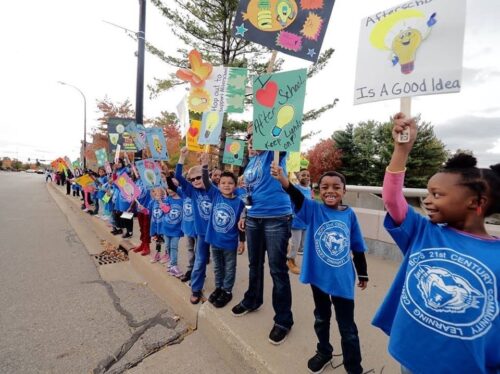
On October 22, 2026, communities nationwide will celebrate the 27th annual Lights On Afterschool, highlighting the opportunities afterschool programs provide to millions of children. The occasion also offers an opportunity to reflect on the policy successes of the 21st Century Community Learning Centers (21stCCLC) program, the largest federal investment in afterschool and summer learning, and the partnerships and advocacy that have sustained it.
The stakes became clear on June 30, 2025, when the Trump administration announced it was withholding nearly $6.8 billion in federal education funding scheduled for release the next day. States and school districts scrambled to address potential cuts to staffing, contracts, and programs, while 1.4 million students faced the prospect of losing federally supported afterschool and summer learning opportunities through 21stCCLC.
Instead, something remarkable happened. Within weeks, 21stCCLC became the first education program to have its funding fully restored. Just months later, the bipartisan FY 2026 education spending included level support for 21stCCLC despite the administration’s proposed cut.
This was not luck. It was the result of over twenty-five years of intentional field-building, trust-based relationships, and a national infrastructure designed to move quickly and together when it mattered most.
The Roots of Resilience: Infrastructure and Relationships Before Crisis
Drawing on lessons learned from extensive work in community education, the Charles Stewart Mott Foundation recognized early on the unique potential of afterschool programs to shape the future of learning and support children and families. Gaining and sustaining widespread support for afterschool would require strong infrastructure, durable partnerships and a long-term strategy for impact.
In 1998, the Mott Foundation and the U.S. Department of Education partnered to expand 21stCCLC, establishing the first dedicated federal grant program for afterschool programs. The historic private-public partnership kicked off a decades-long effort to make high-quality programs accessible to families nationwide.
Over time, infrastructure for the afterschool field took shape. New partnerships emerged among funders, schools, community-based organizations and policymakers to strengthen and align the national, state and local systems that support programs for millions of young people.
The funding freeze in 2025 wasn’t the first time 21stCCLC funding had been threatened. As Jodi Grant, executive director of the Afterschool Alliance recalls, the infrastructure and partnerships that have become the backbone of afterschool education were crucial in the survival of 21st CCLC when it faced its first major threat in 2004 when the Bush administration proposed a 40 percent cut that Congress ultimately rejected.
When the current administration withheld the release of 21stCCLC funding in 2025, the field didn’t scramble to invent a response. It activated a powerful network that already existed.
Within days, the Alliance activated tens of thousands of advocates to educate policymakers and others about the devastating impact that losing funds would have on youth, families and the economy.
National partners, afterschool providers, education groups and other supporters stepped up and raised their voices in support of 21stCCLC funding. The media had access to credible spokespeople in every state who could humanize the impact of the cuts. “The strategy was not to demonize but educate people about what afterschool programs do for working families, communities, and for students themselves,” shared Grant.
After the summer of 2025, Congress acted in a bipartisan way in early 2026 to protect funding for the 21stCCLC program as part of the FY 2026 spending bill. This past summer, 21stCCLC funding flowed on time and without interruption to states and territories, and bipartisan Congressional support for the programs continues.
Evidence and Infrastructure: Making the Case and Spreading the Word
Decades of research and evaluation have strengthened the afterschool field’s ability to make its case. During each funding crisis, evidence of impact, paired with stories from states and local communities, has reinforced the value of afterschool programs.
As Bronwyn Bevan, former vice president of research at The Wallace Foundation, observed, a key strength of the field is its investment in research and its ability to communicate findings in ways that resonate across red, blue, and purple states. For more than two decades, Wallace, like the Mott Foundation, has supported research on afterschool and youth development, including the Afterschool Alliance’s America After 3PM, AIR’s Youth Workforce, Child Trends’ Measuring Youth Development, and RAND’s Skills for Success.
Additional evidence comes from the 26-year longitudinal study supported by the National Institute of Child Health and Human Development, with support from the Mott and W.T. Grant foundations, documenting lasting benefits of afterschool participation for young people’s social, behavioral, and academic development.
Equally important has been the infrastructure to translate research into practice and policy. Beginning in 2003, Wallace invested in 14 out-of-school time (OST) intermediaries to coordinate funding, data, professional development, advocacy, and continuous improvement. Today, 40 intermediaries affiliated with Every Hour Counts, along with other community organizations, support similar efforts across the country.
As Bevan emphasized, “investments in research and evidence are crucial to the field infrastructure, but just as crucial are the formal networks, intermediaries, and other community-level mechanisms for implementing and disseminating the evidence, whether into practice or policy.” Together, this research base and network infrastructure have enabled the field not only to demonstrate its value but also to mobilize quickly when funding is threatened.
Bipartisanship Was the Strategy, Not an Afterthought
From the beginning, the Afterschool Alliance and its partners worked intentionally to build bipartisan buy-in. By 2025, Republican and Democratic members of Congress alike saw 21stCCLC not as a “special interest,” but as a program their constituents depend on.
When the funding freeze crisis hit, having educated policymakers across the political spectrum over time about the importance of afterschool programs for families and communities mattered as much as public pressure. Republican leaders who had long supported afterschool spoke directly with administration officials. A letter led by Shelly Moore Capito, signed by ten Senate Republicans, helped shift the internal calculus. As Grant emphasized, this kind of coordination only works when it’s built on trust and everyone is aligned around the same mission of serving kids and families.
COVID’s Pressure Test for Afterschool
Gwynn Hughes, Senior Program Officer at the Mott Foundation, reflected how the afterschool networks proved they could operate as rapid-response infrastructure during the pandemic. When COVID first hit Washington state, weekly calls with state network leaders allowed those affected to share lessons in real time during those first critical weeks, developing ready-made guidance and response packages that could quickly be adapted as the crisis spread to New York and then across the country. In Georgia, where schools initially remained open longer, the state network rapidly designed a virtual summer curriculum that became a model for state networks.
Hughes noted that infrastructure made it possible to deploy “boots on the ground,” quickly connecting not just afterschool providers, but also schools, libraries, and community-based organizations. As legal, health, and funding questions emerged, organizations like the Afterschool Alliance coordinated solutions, developed toolkits in real time, and addressed urgent gaps such as students lacking devices or internet access. This coordination led to the creation of community learning hubs in libraries and community centers.
One of the key lessons from COVID was a greater appreciation for the role of intermediaries. They do not replace direct service providers, but they strengthen them by aligning policy, funding, quality standards, and rapid information-sharing so frontline programs can operate effectively.
Lessons for Funders and the Field
The survival of 21stCCLC was not an accident or a short-term advocacy win. It has been the result of more than two decades of investing in intentional field-building, infrastructure, research and evaluation, bipartisan relationship development, and strategic communication.
Lessons for philanthropy and the field include:
In quiet times, infrastructure can feel invisible. In moments of crisis, it becomes indispensable.
Note: This In Short is based on a panel at the 2025 GFE Conference.
Director, Teaching, Learning & Tech; Strategic Advisor, Education & Work