José Luis Vilson
Education Research Fellow, Education Policy

The conversation about artificial intelligence is changing almost as quickly as the technology itself. Across the country, a deluge of pushback against generative AI from college graduation disruptions to mass protests in school districts is signaling a broader reckoning with its adoption. Many tech CEOs are pitching competing narratives: AI will make people’s jobs easier while eliminating jobs, enhance human intelligence while replacing it, and let people create popular art while building its knowledge base from reputable artists. This duality has perplexed and frustrated many so much that recent polling suggests people’s disapproval of the technology.
Amid the myriad reasons for the consternation is this idea that major AI corporations have not listened to the public’s concerns about the technology, including those of their own employees. Environmental issues, intellectual effects on students, and growing economic inequality are challenging industry’s promises. Some evangelists have used the tagline: “You’re not losing your job to AI; you’re losing your job to a person who can use AI better than you.” This, however, clashes with the thousands of jobs lost largely to companies’ broad assumptions about the technology’s capabilities.
More tech giants have started to sound the alarm on AI safety. As more “agents” within the tech sandbox have gone out of control, the narrative has become more specious and sometimes frightening. To his credit, New York City Mayor Zohran Mamdani and his administration have proffered an AI moratorium of sorts accompanied by screen time limitations. The significance of the intersection between schools as society-building institutions and this exponential technology cannot be overstated.
This calls for a different approach that doesn’t center the desires of the market and focuses more on regulated use cases. Some evidence points to approaches that center the human beings behind the work instead of leading with the technology:
Educators and experts in the field see the use of AI as complicated. As I stated in previous articles, the technology is only as powerful as the person using it. The teachers’ knowledge base, instructional moves, and relationships with students form the aspects of education that gen-AI can’t simply replicate. In their report “From ‘Replacement’ to Redesign: A Vision for Teaching in the AI Era,” Michael Ham and Dr. Beth Holland at FullScale assert:
Whether the human expertise to interpret evidence, understand learners in context, build relationships, and guide progress over time shows up in practice depends on the broader design of both the educator role and the system itself. Policy and system leaders determine who holds this expertise, how it is developed, and the conditions under which it can be sustained over time. Each domain of expertise therefore reflects both a form of human capability and a set of design choices that enable or constrain its use within educator roles.
As the report explains, teachers’ jobs have become increasingly burdensome and bureaucratic. While some have tried to compartmentalize the job, teachers generally understand their work as a holistic effort, combining skills toward a breadth of student experiences.
In that light, new efforts have tried to align competency-based rubrics for students and educators with AI, most prominently Ed3. Their “Portrait of a Teacher in the Age of AI” research project has shown how teachers across the board have used AI in their work even when they’re leery about its uses. One theory for this dichotomy is the conceptualization of a knowledge base, i.e., teachers’ perceptions of students’ background knowledge. While this theory may be nascent in the education space, evidence from the business world may support this thinking. Recently, a study showed that AI may have contributed to 20% less productivity in business due largely to experts having to prompt and re-prompt for more accurate results. In parallel, more start-up companies are hiring white-collar professionals to help train AI models on their expertise. While that might seem like a happy medium, the underlying idea of replacing experts with this technology still feels unproven at best.
In subsequent publications, Ed3 seeks to outline how teachers can engage the new technologies towards authentic student learning. Scholars like Dr. Prudence Carter and the Center for the Study of Race and Ethnicity in America have engaged communities in rejecting singular frames of how to use AI in favor of community-centered learning. Others have inverted the question, centering human ingenuity and creativity through such a technology. For example, Drs. Victor Lee and Ibrahim Adisa examined the use of AI in two high schools and found divergence in how students and teachers used it in their project-based learning. In another study, Adisa found that students are developing interest-based mechanisms for solving local problems via AI.
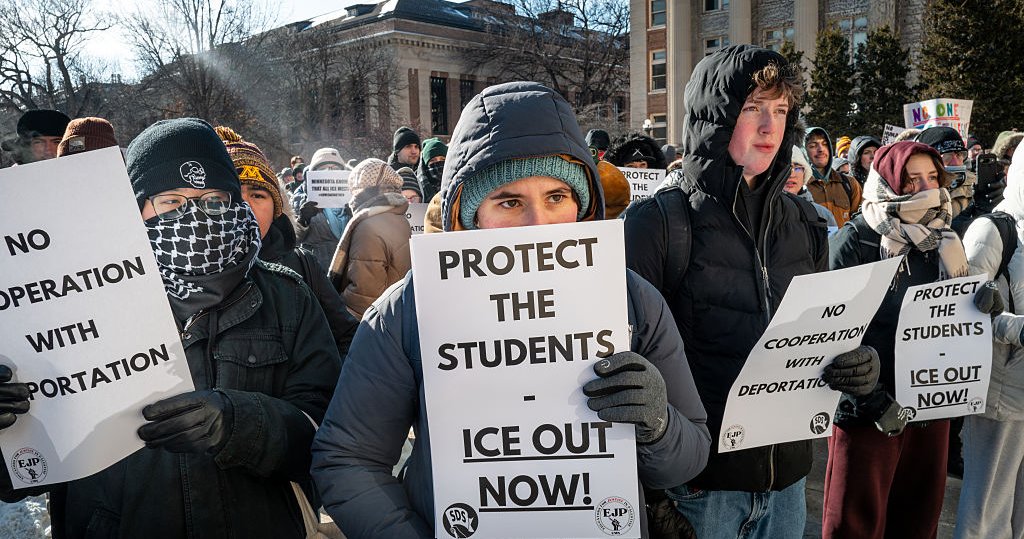
Unfortunately, in an environment without real guardrails around AI, the worst outcomes feel like the most likely ones. In the short term, organizations like the Electronic Frontier Foundation and Encode have developed multiple strategies to combat the excesses of AI and advanced surveillance techniques through policy and practice. On the education front, coalitions in multiple sites (e.g. New York City and DMV) have begun to push back on AI implementation in schools. Recently, high school students convened in Boston, MA to develop a framework about AI use in schools (aptly named “The STUDENTS FIRST Act.”) However, gen-AI tools have already been embedded in almost every prominent technology tool used by students and teachers, regardless of whether they consented to participate, i.e. from Internet searches and e-mails to online classrooms and customer service bots.
As these factors run in parallel, fewer people are clear about school policies and practices that affect their AI use. In many instances, districts do not have a stated policy on its use. Perhaps some of it is due to the federal government’s current position on AI advocacy and funding. But generally, institutions – for better or worse – are slower than the technological field. That’s why it matters that society builds responsive boundaries to this ever-changing machinery.
Agency and Cooperation Are More Critical Than Ever
As we look at trends regarding AI, the prevailing narrative has promoted a sense of inevitability, but that often discounts the role of agency and mass movement. Yet, the work of researchers like Dr. Safiya Noble and Tiera Tanksley suggests that, contrary to the dystopia proffered by a handful of CEOs, we can build technologies towards a more humane future. Much of it necessitates a focus on agency, voice, and purpose. The waves of resistance and research suggest important pathways forward, but, for the general public, there must be appropriate cultural, social, political, and economic safeguards.
Some recommendations:
In the classroom, we must protect the cerebral and intellectual work of teachers in attending to curriculum, pedagogy, assessment, and the whole child. It also means that how we know what we know matters as much as what we know. In other words, it matters how teachers – and students – enact their knowledge base as much as what they’ve already learned. Lastly and in conjunction, our policies and practices should reflect these intentions with appropriate boundaries. While some may want to flood the market and experiment, we must also recognize that constant experimentation with children has been and continues to be unethical without the effective implementation of safeguards
While true that the technology is here, it can exist in the scope of the learning and teaching cycle with human beings across generations and together.
Education Research Fellow, Education Policy