
Solid Foundations: Four State Policy Approaches for Supporting College-Connected Apprenticeships
Table of Contents
- Introduction
- Instructional Costs of Apprenticeship
- Four State Approaches to Supporting Instructional Costs
- Student Financial Aid: Kentucky’s Educational Excellence Scholarship
- Startup Grants: New Jersey’s PACE and GAINS initiatives
- Reimbursement Systems: Texas and California
- Tuition Waivers: North Carolina, and Unintended Consequences in Washington and Florida
- Recommendations
- Appendix: Methodology and Interviewees
Abstract
Existing state policies to support the costs of apprentices’ classroom training at colleges are a patchwork. Some states have implemented effective subsidies to support credit-bearing apprenticeship offerings without any cost to the apprentice; other policies are well-intentioned but counterproductive. Across the country, though, many states already have the policy groundwork to support college classes for apprentices, even with rather modest investments. In this brief, I explore the advantages and drawbacks of four current approaches to funding the classroom component of apprenticeship and provide recommendations for policymakers looking to support college-connected apprenticeships in their state.
Acknowledgments
Thank you to J.P. Morgan Chase & Co. for their generous support of the research and production of this brief.
Additionally, I would like to acknowledge the many experts who graciously contributed their time and input during interviews. I am especially grateful for the help and guidance of Dr. Pamela Howze of Wake Technical Community College; Dr. Sallie Kay Janes of San Jacinto College; Dr. Elizabeth Standafer and Ryan McCarty of the North Carolina Community College System; and Mary Taylor of the Kentucky Department of Education's Office of Career and Technical Education. I would also like to thank my colleagues at the Center on Education & Skills at New America, and Kimberly Hauge of the National Governors Association, for their helpful feedback on drafts of this report.
Downloads
Introduction
The vast majority of jobs created since the end of the Great Recession require a college degree.1 But though degrees are practically indispensable for success in today’s economy, the rising costs of college education put them out of reach for many Americans. A year’s full-time tuition and fees at a typical community college cost between $3,000 and $4,000, even before factoring in living expenses and foregone earnings. At four-year public colleges, average tuition and fees are over $10,000 per year.2
Stubbornly high college costs, combined with employers’ inability to recruit enough skilled workers through conventional channels, have contributed to resurgent public interest in apprenticeship. A growing number of apprenticeship programs for youth and adults now include the possibility of obtaining college credit or even degrees at the same time, providing learners both the near-term security of a wage and the long-term career-building potential of a college education. But though many states have incorporated apprenticeship expansion into their economic development strategies, a critical policy gap separates the current apprenticeship landscape from more widespread college-connected apprenticeship offerings.
To attain their maximum potential for social benefit, college-connected apprenticeships must provide a more affordable—and ideally tuition-free—pathway to a college degree, without sacrificing the employer relevance of a conventional registered apprenticeship. This combination requires a committed partnership and shared investment from employers and higher education institutions. As it stands, however, it is often much easier for apprenticeships to incorporate non-college training—or to simply pass tuition costs onto the learners.
In the building trades, which account for at least two-thirds of all active American apprentices,3 the cost of college tuition has rarely been a problem for apprentices or their employers. In these occupations, which are among the few that still provide job seekers a viable route to economic stability without a college degree, noncredit coursework suffices to make apprentices job-ready. But when we talk about apprenticeships in healthcare, information technology, finance, and advanced manufacturing—just a few of the nontraditional apprenticeship occupations championed by two successive presidential administrations—we cannot avoid the issue of college costs. To make the most of apprenticeship in a skills-hungry economy where degrees are still out of reach financially for many learners, we need more clarity about who pays for the development of college-connected apprenticeship programs and for apprentices’ instructional costs.
Existing state policies to support the costs of apprentices’ classroom training at colleges are a patchwork. Some states provide effective subsidies to support credit-bearing apprenticeship offerings; others have implemented well-intentioned but counterproductive policies. But across the country, most states already have the policy groundwork to support college classes for apprentices, even with rather modest investments. From insurance and business services giants to mid-sized software firms to small manufacturing shops, employers do not just need employees with the deep specialization of a traditional apprentice, or with the intellectual breadth and adaptability of a college graduate. They need employees with both. In this brief, I explore the advantages and drawbacks of four current approaches to funding the classroom component of apprenticeship and provide recommendations for policymakers looking to support college-connected apprenticeships in their state.
Citations
- Georgetown University Center on Education and the Workforce analysis, cited in Politico working group report, Ladders to Success: Rethinking Education and Skills Training for Tomorrow’s Workforce (Arlington, VA: Politico, January 16, 2019), 2, source.
- According to a 2018 College Board report, the average published yearly tuition and fees for in-district community college students were $3,660 during the 2018–19 academic year. For full-time, in-state students, average tuition and fees at four-year public were $10,230. Jennifer Ma, Sandy Baum, Matea Pender, and C. J. Libassi, Trends in College Pricing 2018 (New York: The College Board, 2018), 3, source.
- U.S. Department of Labor (DOL) data cited in 2016 report by Case Western Reserve University and U.S. Department of Commerce. Susan Helper, Ryan Noonan, Jessica R. Nicholson, and David Langdon, The Benefits and Costs of Apprenticeship: A Business Perspective (Washington, DC: U.S. Department of Commerce, November 2016), 45, source.
Instructional Costs of Apprenticeship
An apprenticeship has two primary components: on-the-job training (OJT) and classroom instruction, often referred to as related technical instruction (RTI). OJT provides what many conventional higher education programs now lack: applied experience and the built-in economic security of a wage. But alongside OJT, effective RTI is indispensable for providing apprentices with the theoretical background to continue growing in their field, especially as technologies and occupations change. When it leads to college credit or degrees, moreover, high-quality classroom instruction provides on-ramps into further education and more senior roles in a variety of fields, and rescues apprentices from choosing between college and career at a time when the two increasingly go hand in hand.
Of course, connecting apprenticeship to college degrees comes at a price. Facilities, instructor salaries, and supplies all contribute to the costs of the classroom component of apprenticeship. Historically, these expenses have not resulted in significant tuition costs for apprentice employers, or apprentices themselves. In the building trades, employer associations and joint training committees often provide instructors, facilities, and curricula for apprenticeship coursework at no cost to apprentices. But when classroom instruction is provided through a college, as it must be for learners to access college credit or degrees, the question of who pays instructional costs becomes a lot less clear and a lot more pressing. When curricula must be created or updated to support a new program, moreover, the total cost of building an apprenticeship rises even further, potentially scaring away prospective new apprenticeship sponsors in nontraditional apprenticeship fields.
Community colleges have the experience and expertise needed to build effective coursework in nontraditional apprenticeship occupations in fields such as healthcare and information technology but are often strapped for cash and may be discouraged from taking on the additional effort that new programs require if no supports or incentives exist. And if apprentices themselves pay tuition, they risk losing a key advantage of the apprenticeship model: its affordability. College-connected apprenticeships in the United States reach across two educational systems that were never designed to work together, and which have evolved in parallel through separate bodies of federal legislation that make no mention of one another.1 But though our federal policy infrastructure is currently ill-equipped to bridge this gap, thoughtful state policies provide a variety of approaches to support the costs of training apprentices at colleges.
Citations
- The National Apprenticeship Act of 1937, also known as the Fitzgerald Act, established the national system of Registered Apprenticeship; the Higher Education Act of 1965 authorizes most of the federal funding for academic higher education. For more on the separation of apprenticeship and academic higher education systems, see Mary Alice McCarthy, Iris Palmer, and Michael Prebil, Eight Recommendations for Connecting Apprenticeship and Higher Education (Washington, DC: New America, December 6, 2017), source.
Four State Approaches to Supporting Instructional Costs
Staff from government agencies and colleges in 12 states with existing supports for college-connected RTI were interviewed for this brief.1 These conversations revealed a variety of state policy approaches aimed at supporting apprenticeship expansion.
Tax credits are a commonly discussed topic in apprenticeship policy. But though they have supported noteworthy apprenticeship expansion in some of the 14 states where they are used,2 tax credits serve as a general subsidy to apprentice employers and do not specifically address the costs of credit-bearing instruction for apprentices or colleges. However, my research uncovered four other incentive strategies that do directly address these costs and can support the development of an expanded infrastructure to support apprentices, colleges, and employers making use of college-connected apprenticeships.
These four approaches—student financial aid, startup grants, reimbursement systems, and tuition waivers—all affect different stages of the apprenticeship program lifecycle and have different implications for apprenticeship stakeholders. As this analysis will show, some approaches are better suited to connecting apprenticeship to college than others.
- Student financial aid approaches are student-focused, aiming to make college instruction more affordable for apprentices, and may be paid to the learner or to the college to cover tuition costs. Although financial aid has received relatively little attention among apprenticeship researchers and advocates, apprentices can and do draw on a variety of federal and state student aid options. This brief focuses on student grants and scholarships authorized by states.
- Startup grants are program-focused, aiming to increase the capacity of employers, colleges, and apprenticeship intermediaries3 to develop and deliver apprenticeship programs. Though startup grants may have different allowable uses, they typically support development of apprenticeship curricula; instructor training and hiring; and marketing, recruitment, and screening of prospective new apprentices. In some cases, startup grants may subsidize apprentice wages.
- Reimbursement systems are largely program-focused, and provide additional funding to colleges, school districts, and other apprenticeship training providers through a regular application process. Standardized timetables and budget processes are used to allocate funds to training providers, and reimbursed funds typically support instructor salaries, facilities, and equipment or supplies, as well as a portion of administrative expenses.
- Tuition waivers, like financial aid, are student-focused, primarily serving to reduce or eliminate the cost burden of college coursework on apprentices. However, tuition waivers can vary greatly in their incentive structure and their corresponding effects on colleges that enroll apprentices. If colleges are reimbursed for waived tuition costs, apprentices are no different than any other students for accounting purposes. These “funded” waivers have program-focused components that resemble reimbursement systems. If colleges are not reimbursed, however, the waiver serves as a tuition exemption, which can create a potent disincentive for colleges to provide apprenticeship coursework.
There is no one right way to support apprenticeship coursework at college: Policymakers will need to find the ideal mix of support approaches to balance speed and sustainability as they expand apprenticeship opportunities in their states and regions.
Table 1: Pros and Cons of Four Supports for College-Connected Apprenticeship
| Support type | Model state system(s) | Pros | Cons |
|---|---|---|---|
| Student financial aid | Kentucky | Addresses college cost burdens for students and can integrate with dual enrollment and college promise initiatives. | Provides no direct incentive for employers to develop apprenticeship in nontraditional sectors. |
| Startup grants | New Jersey | Can be used to target college participation in apprenticeship partnerships, especially in nontraditional apprenticeship sectors. | May encourage proliferation of short-lived programs or provide insufficient support for cost-intensive programs in the long term. |
| Reimbursement systems | California and Texas | Reduces instructional costs for both apprentices and employers; can be accessed by both college-connected and traditional apprenticeship programs. | Generally, more expensive for states to provide, and may not sufficiently support nontraditional programs in early phases. |
| Tuition waivers | North Carolina | “Funded” waivers, which reimburse participating colleges, can eliminate apprentices’ costs and encourage employers and colleges to cooperate on RTI coursework. | “Unfunded” waivers, or tuition exemptions, can discourage colleges from providing credit-bearing RTI. |
State policies to support the costs of apprenticeship coursework at colleges depend on processes and constraints that are unique to each state and policy option. To help conceptualize how each of the four policy approaches affects the learners, employers, and institutions involved in apprentice instruction, the following sections contain vignettes exploring each policy approach from the perspective of two hypothetical apprentices, Christopher and Hana.
Christopher and Hana
Christopher is the average American apprentice. He is 30 years old, and is training to be an electrician—the most common apprentice occupation for men, and one that commonly requires a postsecondary certificate or associate degree. Electricians are well paid, earning a median wage of about $24 an hour when fully trained; this is important for Christopher, who has a young family. However, Christopher also aspires to one day become an electrical engineer, a job that generally requires a bachelor degree, so he is only interested in pursuing an apprenticeship that culminates in an associate degree or at least a credit-bearing certificate.
As far as American apprentices go, Hana is not so average. She is 19 years old, works part-time as a certified nursing assistant, and lives with her parents. A recent high school graduate, Hana got good grades and intends to pursue a bachelor degree but wants to save up money and get a better sense of her options and goals first. Hana’s mother, a registered nurse, encourages her to apply for a new degree apprenticeship in nursing offered by the regional health system where they both work. The program is three years long and will allow Hana to earn an associate degree and become a registered nurse while advancing in her current role.
Citations
- Interviewees represented the following states: California, Florida, Georgia, Indiana, Kentucky, New Jersey, North Carolina, Pennsylvania, South Carolina, Texas, Washington, and Wisconsin. See Appendix for a full list of these experts and their titles.
- According to an online U.S. Department of Labor resource, Alabama, Arkansas, Connecticut, Louisiana, Maryland, Missouri, Montana, Nevada, Rhode Island, South Carolina, Virginia, and West Virginia provide tax credits for apprentice employers. New York and Illinois also enacted state apprenticeship tax credits in January 2018 and August 2019, respectively. U.S. Department of Labor, Employment and Training Administration, “States that Offer Tax Credits for Hiring Apprentices,” source.
- Many types of organizations can play the role of an apprenticeship intermediary, including colleges, industry associations, or community-based organizations. A 2017 DOL guidance document, TEGL 13-16, defines intermediaries as organizations that “can serve as program sponsors when they take responsibility for the administration of a Registered Apprenticeship program. They can also provide expertise such as curriculum development, classroom instruction, and supportive services, as appropriate.” United States Department of Labor, Employment and Training Administration, “Training and Employment Notice No. 13-16: Operating Guidance for the Workforce Innovation and Opportunity Act,” January 12, 2017, source.
Student Financial Aid: Kentucky’s Educational Excellence Scholarship
A commonly held belief about apprenticeship is that it is by definition a free, or at least debt-free, postsecondary pathway for students.1 Indeed, many employers pay all apprentice training costs, including tuition. That makes sense—apprentices are trained to their employers’ specifications, after all. However, federal regulations do allow apprentices to access federal financial aid for credit coursework taken during a registered apprenticeship, 2 and in most states’ laws nothing prohibits apprenticeship programs from charging tuition for RTI.
Registered apprentices can draw on several sources of federal aid to support their classroom instruction, including G.I. Bill benefits, individual training accounts provided under the Workforce Innovation and Opportunity Act, and—if coursework is taken at Title IV eligible institutions as part of a certificate or degree program—federal student financial aid including Pell grants and direct loans.3 These federal programs are often targeted at particular populations—needy students, laid-off workers, or job seekers with young families, for example—and none are specifically intended to support apprenticeship.
To provide further support for apprenticeship specifically, Georgia, South Carolina, and Pennsylvania have all leveraged existing state aid programs to fund apprentices’ college coursework. In both Georgia and South Carolina, youth apprentices who are dual-enrolled in high school and college coursework draw on state grant initiatives (HOPE Grants and the Lottery Tuition Assistance Program, respectively) in the same way as conventional degree-seeking college students. In Pennsylvania, degree apprenticeships in early childhood education are eligible for the state’s T.E.A.C.H. Early Childhood Scholarship Program, funded by the state’s Department of Human Services.
Georgia, South Carolina, and Pennsylvania have all leveraged existing state aid programs to fund apprentices’ college coursework.
None of these states took an explicit legislative action to allow the use of their student financial aid programs for college-connected apprenticeship costs—it was a simple matter of convenience, and sometimes necessity, for program administrators and state apprenticeship agency staff. In Kentucky, on the other hand, a 2017 bill expressly permitted the use of the state’s merit-based Educational Excellence Scholarship (KEES) for registered apprentices.4
For each year they attain a GPA of 2.5 or better, students at any Kentucky high school earn a KEES allowance that they can apply towards in-state college education, with bonuses for high scores on college aptitude tests or AP/IB coursework. The 2017 legislation, which was the product of three years of advocacy after a tax credit initiative fell through, allows registered apprentices to access the same benefits. For apprentices, in fact, the money goes even further: Unlike conventional KEES recipients, they are eligible to receive their allowance directly, and can use it at their own discretion to pay for tuition, books, equipment, and licensure exams.
According to Mary Taylor of Kentucky’s Department of Education, the $42,000 in KEES funding disbursed to registered apprentices so far has served several valuable purposes. First, in keeping with apprenticeship’s traditional reputation as “the other college degree,” it has encouraged students who otherwise would not care about KEES funding to apply themselves towards the program’s merit benchmarks. But the scholarship’s new apprenticeship availability has had less intuitive benefits as well. Employers see the legislation as a signal of the state’s endorsement of the apprenticeship model, says Taylor, and so have some college-bound students who might not have considered apprenticeship to be a feasible college pathway.
Christopher and Hana: Kentucky
In Kentucky, Hana’s straight-A grades for almost every year of high school would earn her a $1,575 KEES allowance for each year she attends a participating Kentucky college, for up to eight semesters in total. Because she is a registered apprentice, she could elect to have money sent to her college to pay for RTI or be reimbursed for the costs of uniforms, equipment, certification exams, or even work travel. Because Christopher graduated from high school more than five years ago, he would not be eligible for a KEES allowance. Though his employer pays for his coursework and equipment, he might draw on federal student aid to help cover additional living expenses during his apprenticeship.
Hana’s KEES allowance is funded out of an account in Kentucky’s state treasury that receives net lottery revenues and other public and private gifts, grants, and endowments. Hana’s tuition payments go straight to the bursar’s office at her college if she asks; for accounting purposes, she is just like any other student. Her employer never touches any KEES funding.
State financial aid strategies are a student-focused incentive and provide a valuable mechanism for states to signal their endorsement and support for apprenticeship pathways to students and parents as well as employers. The increasing prevalence of college promise programs (where states and localities guarantee college tuition for high-school graduates) and of tuition-free dual enrollment initiatives provides policymakers in several states5 with convenient groundwork for building up further apprenticeship supports. But though state financial aid can reduce cost barriers for apprentices, whether they use aid to pay for credit coursework or for other supplies, it does not provide any additional support to employers or colleges just getting started with apprenticeship. To help out, states can invest in startup grant initiatives to support the development of nontraditional apprenticeship pathways.
Citations
- Mainstream news articles and even government publications sometimes inaccurately describe apprenticeship as necessarily debt-free. Recent federal data provide no way of determining with certainty the overall debt burden on apprentices, but the National Postsecondary Student Aid Surveys conducted in 1996 and 2000 did include a variable indicating whether a student was employed as an apprentice in the survey year. In 2000, student apprentices had taken out an average of $836 in loans over the past year, compared to $1,701 for non-apprentice students. Analysis of 1999–2000 NPSAS (NPSAS:00) data, computed using National Center for Education Statistics PowerStats. Variables: APPRENT, TOTLOAN2. Weight: WTA000. Additionally, interviewees from my own research in South Carolina and Texas confirmed that apprentices may be liable for a portion of their classroom costs, and that some use federal grants and loans to pay for them. Still, though currently impossible to confirm, apprentice debt burdens are likely much lower than those of conventional college students. According to the Institute for College Access and Success, approximately two-thirds of college seniors graduating from four-year institutions in 2017 took out debt; these students borrowed an average of $28,650. Diane Cheng and Veronica Gonzalez, Student Debt and the Class of 2017 (Washington, DC: Institute for College Access and Success, September 2018), 1, source.
- The most recent guidance regarding apprentices’ eligibility for federal student aid, a 2014 Dear Colleague letter from the Department of Education, makes clear that apprentices are eligible for financial aid in some cases, including loans and Pell grants. United States Department of Education, Office of Postsecondary Education, “GEN-14-22: Apprenticeships and the Federal Student Aid Programs,” December 18, 2014, source.
- Other federal assistance programs that may be applied towards apprenticeship costs include Trade Adjustment Assistance, Temporary Assistance for Needy Families (TANF), and Supplemental Nutrition Assistance Program (SNAP) Employment and Training benefits. All of these federal benefits may only be applied towards apprenticeships that are registered with the U.S. Department of Labor.
- See Kentucky Revised Statutes 164.7884, “Eligibility of student in a registered apprenticeship program for a Kentucky educational excellence scholarship,” effective April 10, 2017.
- A 2018 report from The Century Foundation found that 16 states operated statewide college promise programs, and a 50-state scan conducted by the Education Commission of the States in 2016 found that dual enrollment was fully funded (either by the state or by students’ school districts) in nine states. See Jen Mishory, The Future of Statewide College Promise Programs: A State Guide to Free College (Washington, DC: The Century Foundation, March 5, 2018), source; and Jennifer Dounay Zinth, “Dual Enrollment: Who Is Primarily Responsible for Paying Tuition,” in 50-State Comparison: Dual/Concurrent Enrollment Policies, Education Commission of the States (website), March 2016, source.
Startup Grants: New Jersey’s PACE and GAINS initiatives
To judge by the few studies available, the social and economic benefits of investing in apprenticeship can be enormous. Especially in the case of nontraditional programs, however, the costs of starting an apprenticeship can be very large as well.1
Federal grants made through the U.S. Department of Labor (DOL) have provided hundreds of millions of dollars over the past five years to support the expansion of apprenticeship into nontraditional sectors and to reach populations historically underserved by apprenticeship opportunities. Increasingly, state legislatures and governors have signaled their endorsement of apprenticeship expansion by funding their own grant initiatives to support program development and startup. According to the National Conference for State Legislatures, seven of the 30 states that have enacted apprenticeship legislation since 2016 have included some form of startup grant funding in their new laws,2 while governors in Florida, New York, Pennsylvania, and North Carolina have also announced grant initiatives to catalyze employer interest and scale up apprenticeship offerings.
Hundreds of millions of dollars in federal grants have supported the expansion of apprenticeship into nontraditional sectors. Increasingly, state legislatures and governors have funded their own apprenticeship grants as well.
In New Jersey, a two-pronged startup grant initiative is a central component of Governor Phil Murphy’s apprenticeship expansion strategy. Part of a $10 million investment announced in 2018 to support the New Jersey Apprenticeship Network, the Growing Apprenticeship in Nontraditional Sectors (GAINS) and Pre-Apprenticeship in Career Education (PACE) competitive grant initiatives target different parts of the apprenticeship ecosystem with the goal of enabling statewide connections between apprenticeship, K–12 schools, higher education, and the business community. The $4.5 million GAINS initiative supports both existing and in-development apprenticeship programs looking to expand enrollment and reach into nontraditional sectors,3 paying for materials and supplies, tuition and instructor salaries, and the wages of qualified mentors, as well as up to half of an apprentice’s wages (which must be $15 per hour or more) for up to six months. PACE grants, announced in January 2019, will provide $3 million to support pre-apprenticeship,4 a distinct but related area of the apprenticeship ecosystem, to help build a pipeline of qualified applicants.
Christopher and Hana: New Jersey
In New Jersey, Hana’s nursing apprenticeship might have started with the help of GAINS funding. Though Christopher’s apprenticeship program has existed for decades, the trade association that sponsors the program could also receive one of New Jersey’s GAINS grants to expand the program and better connect it to college pathways.
The sponsors of both programs—the hospital system and the electricians’ trade association—use GAINS funding to support curriculum design and apprentice recruitment while starting up and expanding their programs. Under contracts with a local college, both employers also use GAINS funding to subsidize the costs of their apprentices’ classroom instruction. Neither Hana nor Christopher receives any GAINS funding directly, though the hospital uses some of its funding to pay a portion of Hana’s wages during her first six months on the job. Hana and Christopher must still pay some student fees.
Because startup grant initiatives provide program-focused funding that can be used for instructional costs as well as for coalition-building and awareness campaigns, they are especially useful for catalyzing new programs in nontraditional fields. By targeting two- and four-year colleges and school districts in addition to employers and intermediaries, moreover, as New Jersey has done with GAINS funding, startup grants can attract new educational stakeholders who might not consider apprenticeship otherwise. In this study, ambitious startup investments were also underway in Pennsylvania, where $7 million of the state’s PAsmart STEM grants are targeted at Registered Apprenticeship, and in California, where the California Apprenticeship Initiative benefitted from a $15 million investment in the 2017–2018 fiscal year alone.
Despite their short-term advantages, however, grant initiatives that are not supported by recurring state appropriations may be liable to produce a flurry of short-lived projects. Karen Morgan, director of Wisconsin’s Bureau of Apprenticeship, is cautious about their long-term value. “When the money’s gone, will the programs go too?” she wonders. The risk of backsliding on apprenticeship expansion is acute if states do not develop systems to consistently fund apprenticeship in the long term.
Citations
- A 2012 Mathematica report estimated that Registered Apprenticeship confers over $120,000 in net social benefits over the career of an apprentice. The above-cited 2016 Department of Commerce report highlights the experience of two employers who obtained 40 and 50 percent internal rates of return from their apprenticeship investments; these employers invested about $60,000 and $187,000 per apprentice, respectively. See Debbie Reed, Albert Yung-Hsu Liu, Rebecca Kleinman, Annalisa Mastri, Davin Reed, Samina Sattar, and Jessica Ziegler, An Effectiveness Assessment and Cost-Benefit Analysis of Registered Apprenticeship in 10 States (Oakland, CA: Mathematica Policy Research, July 25, 2012), source; and Helper, Noonan, Nicholson, and Langdon, The Costs and Benefits of Apprenticeship, 2, 40.
- National Conference of State Legislatures (website), “Apprenticeships in K–12 and Higher Education,” November 26, 2018, source. The seven states whose legislatures passed apprenticeship legislation between 2016 and 2018 that included provisions for startup funding were California, Colorado, Iowa, Michigan, New Hampshire, Rhode Island, and Washington.
- These include advanced manufacturing, pharmaceuticals, financial services, healthcare, and other STEM fields. “Energy, Utilities, and Infrastructure” is also named as an eligible sector, encompassing some construction trades.
- A 2012 Training and Employment Notice from USDOL defines pre-apprenticeship as “a program or set of strategies designed to prepare individuals to enter and succeed in a Registered Apprenticeship program, [which] has a documented partnership with at least one, if not more, Registered Apprenticeship program(s).” United States Department of Labor, Employment and Training Administration, “Training and Employment Notice No. 13-12: Defining a Quality Pre-Apprenticeship Program and Related Tools and Resources,” November 30, 2012, source.
Reimbursement Systems: Texas and California
Along with the startup costs that colleges and employers incur when building new apprenticeships, any program will also involve smaller, recurring costs in the long term. Reimbursement systems, which cover a portion of instructional costs through regular budget processes, are one model for supporting these long-term apprenticeship program costs.
Three states that use reimbursement systems to subsidize the instructional costs of apprenticeship are Texas, California, and Wisconsin. The Texas Workforce Commission (TWC) has provided reimbursement funding under Chapter 133 of the state education code since 1996, while in California, a similar incentive called related and supplemental instruction (RSI), or Montoya funds, has been available since 1970. Wisconsin’s Apprenticeship Completion Award Program has existed since 2013 and provides a maximum reimbursement of $1,000 per apprentice, payable to the sponsor or the apprentice when the program’s classroom instruction is delivered through a technical college.
Historically, reimbursements in Texas and California have been based on a single contact hour rate. Contact hours, also known as clock hours, represent the amount of time a learner is physically present in a class or training setting.1 Both states’ contact hour reimbursement rates are set through regular budget processes, with the total yearly funds allocated according to a schedule that allows training providers to anticipate available funding for the coming year.2 Contact hour reimbursement rates are a convenient fit for traditional apprenticeships, as the recommended 144 hours of total RTI in a conventional Registered Apprenticeship are also counted in contact hours. To connect with college degrees, however, apprenticeship programs need to reckon with a different metric: the credit hour.
Credit hours, which are used to allocate federal student aid, represent a larger unit of class time, including time spent in class as well as time learners are expected to study on their own.3 A traditional apprenticeship program’s 144 total contact hours of classroom training only adds up to about nine credit hours if taken in credit-bearing courses—about three college classes. For an apprenticeship to include a college degree or even a shorter certificate, this is not enough. Existing degree apprenticeships, such as those provided by Aon and Siemens USA, include anywhere from 54 to 72 credit hours of class time—the equivalent of roughly 900 contact hours, plus outside study.
The disconnect between apprenticeship’s contact hours and higher education’s credit hours is more than a procedural inconvenience. Traditional apprenticeship providers do not typically provide such a large amount of classroom instruction, and they are not accredited to award degrees in any case. Colleges, on the other hand, can provide credit coursework, but often incur additional expenses to create and staff new courses if none exist that are suited to an apprenticeship program’s needs.
The necessity of delivering a large amount of credit-bearing coursework through a degree apprenticeship presents a unique challenge for contact hour reimbursement systems. In Texas’s Chapter 133 system, for example, an apprentice’s program may be reimbursed for up to 200 contact hours of coursework per year—enough to fully cover about 12 credit hours’ worth of class time. However, the $4.00 contact hour reimbursement rate for education providers under Chapter 133 provides colleges with less funding than they would receive under the base rate of Texas’s formula for funding credit coursework at its community colleges—$5.49 per contact hour—and also does not include the state’s performance-based Student Success Points funding. In California, the gap between the RSI contact hour reimbursement rate and the usual reimbursement formula is even greater: RSI is reimbursed at $6.26 per contact hour, while the credit hour funding rate equates to about $9 per contact hour.4
Reimbursement systems that draw on regular state appropriations can help to sustain long-term college participation in apprenticeship training.
Colleges are less likely to serve as effective partners in degree-connected apprenticeships if they receive less funding for an apprentice than they would for an ordinary student in credit coursework. To address this disincentive, both Texas and California have adapted state legislation and regulations to allow apprenticeship programs to make use of either contact hour or credit hour reimbursement rates.5 Though a sizable proportion of apprenticeship programs continue to benefit from contact hour reimbursements in both Texas and California—about 40 percent in Texas, and over 90 percent in California—these new credit hour options ensure that colleges do not lose out on funding when enrolling apprentices in degree-aligned coursework.
Christopher and Hana: Texas
In Texas, Christopher’s electrician apprenticeship could benefit from Chapter 133 contact hour funding, with college districts providing classroom instruction for electrician apprentices under contract with trade association chapters in their own region. Each year, colleges would submit requests for Chapter 133 funding, including enrollment estimates and plans for how the funding will be used. After TWC sets a final contact hour rate based on the total number of requests received, colleges can file reimbursement requests every month for the costs of providing classroom instruction. These reimbursements cover most of the costs of Christopher’s classes; his local apprenticeship committee pays the remainder.
In Hana’s program, by contrast, the college contracted by the hospital system to provide her apprenticeship’s classroom instruction might opt to receive state funding from the Texas Higher Education Coordinating Board instead of from TWC. Hana would pay resident tuition ($50 per semester credit hour) and fees; luckily, she could be reimbursed for these costs under the health system’s own tuition support benefit. Hana and her fellow apprentices would be counted towards the total enrollment used to calculate her college’s state funding allocation in the following year.
Though they do not provide any exceptional support to colleges just beginning to scale up their apprenticeship participation, reimbursement systems benefit from regular state appropriations and help to sustain long-term college participation in apprenticeship. In states like Texas and California with large apprentice populations, this type of reliable support is essential. As a program-focused strategy, moreover, reimbursement systems may also make it easier for employers to avoid shifting training costs to apprentices, as can occur if student-focused financial aid strategies are the only support available. Though programs in Texas and California are not prohibited by law from charging tuition or fees, most do not do so because they are able to count on their state’s reimbursement systems.
Citations
- Definitions of credit and clock (or contact) hours are set out in 34 CFR §600.2. If used when referring to credit coursework that is also measured in credit hours, clock hours refer to the amount of time that a student is physically present in a classroom or learning environment.
- The contact hour reimbursement rates were $4.00 and $6.26 for Texas and California, respectively, in the 2018–19 fiscal year.
- The Department of Education’s definition of a credit hour also provides for alternative measurements based on “evidence of student achievement” and “amount of work represented” in achieving learning outcomes. These alternatives support competency-based and online education programs that would be difficult to measure by the traditional class- and study-time measurement described above and may become increasingly relevant to apprenticeship programs if RTI incorporates online delivery or competency-based characteristics. See Amy Laitinen, Cracking the Credit Hour (Washington, DC: New America and Education Sector, September 2012), 9, source.
- Texas’s Chapter 133 reimbursement rate includes funds drawn from federal sources such as WIOA and TANF; the reimbursement rate for credit-bearing coursework is set out in its biennial formula funding recommendations. Texas Higher Education Coordinating Board, “Formula Funding Recommendations—2020–2021 Biennium,” source. California’s RSI contact hour rate is set in the state’s yearly budget act; the credit-hour equivalency estimate was provided by an interviewee for this project. See appropriations bill SB 840 (2018), Chapter 29, item 6870-101-0001.
- Texas higher education institutions have been able to access funding for apprenticeship coursework through the Texas Higher Education Coordinating Board (THECB), in addition to TWC, since 2015 (see HB 2628 of the 84th Legislative Session); colleges may receive such funding from THECB or TWC, but not both. Similarly, in California, AB 1809 (2018) modified the California Education Code to allow community colleges to be reimbursed for credit-bearing apprenticeship coursework through RSI or through the more generous formula funding for regular college coursework.
Tuition Waivers: North Carolina, and Unintended Consequences in Washington and Florida
The large, well-established funding systems that support apprentice tuition in Texas and California take time and significant investment to build, and many states may have to start smaller. North Carolina’s youth apprenticeship waiver, which incorporates some characteristics of a reimbursement system, provides a valuable example of how to do it.
Until recently, North Carolina provided no state support for any apprentice’s tuition. For a time, in fact, the state charged employers an apprenticeship participation fee. After the fee was eliminated in 2014, state policymakers and apprenticeship advocates worked to advance a tax credit to encourage new employers to develop apprenticeships. When the tax credit initiative failed in the state legislature, they opted to try a new strategy: a tuition waiver for youth apprentices.
North Carolina’s youth apprentice tuition waiver, which became law in 2016,1 is available to apprentices who begin their program within 120 days of graduation from high school. The waiver fills an important funding gap in the state’s college and career readiness pipeline: The well-funded Career & College Promise (CCP) dual enrollment program is available only to current high school students, meaning that recent high school graduates could be on the hook for apprenticeship tuition that would have been covered only a few months prior. High school students are able to access either program; students who are awarded the CCP tuition benefit can simply transition to the youth apprentice tuition waiver upon graduation, with no lapse in tuition coverage. Colleges that provide classroom instruction do not lose any money by participating either, as they are reimbursed for waived tuition out of the yearly budget of the state’s apprenticeship agency, ApprenticeshipNC.
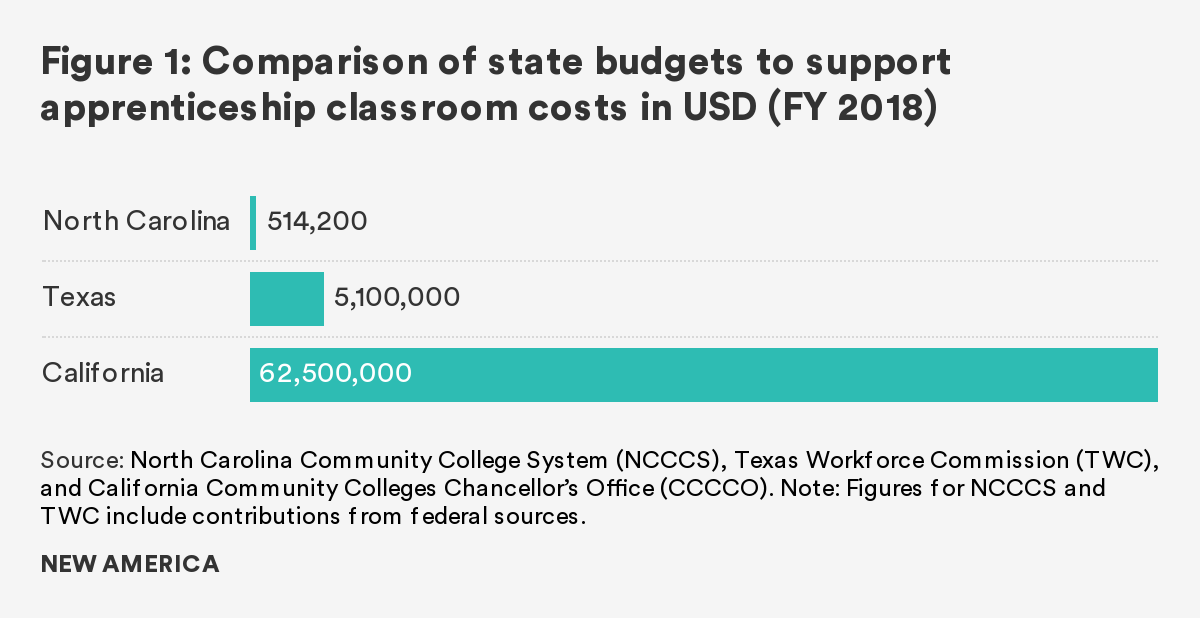
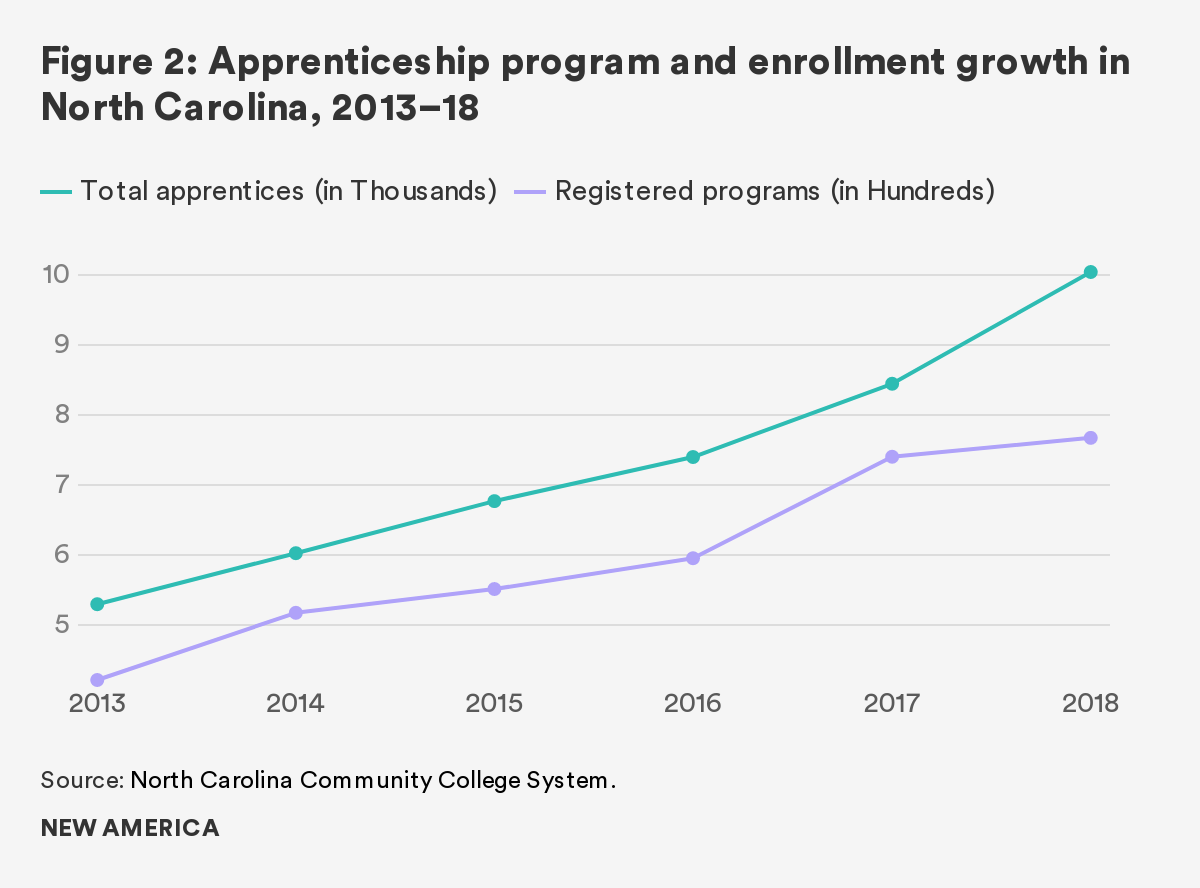
Apprentice tuition supports in North Carolina focus on youth, and as a result do not fund nearly as many students as incentives in Texas and California (see Figure 1), where a majority of apprenticeships benefit from one of each state’s two reimbursement options. But alongside other ambitious state initiatives, including the use of grant funding from the U.S. Department of Labor to defray instructional expenses for adult apprentices, the youth apprenticeship waiver has raised apprenticeship’s profile in North Carolina, propelling the state past its goal of 10,000 apprentices statewide by 2018 (see Figure 2).
Christopher and Hana: North Carolina
Hana graduates from high school in May and starts her nursing apprenticeship in September. In North Carolina, she would be eligible for the state’s youth apprenticeship waiver, and would pay no tuition or fees at the community college where she takes her classroom instruction. As Christopher graduated from high school years ago, he would not qualify for the tuition waiver in North Carolina, and would pay for his tuition and fees through a combination of savings, support from his employer, and federal financial aid.
When Hana enrolls in apprenticeship coursework at her community college, her entry in the school’s data system is flagged as a youth apprentice enrollment. She counts as a regular student under the state’s formula funding system, and for as long as she continues in her apprenticeship coursework, her college receives yearly reimbursements from ApprenticeshipNC for her waived tuition and fees.
Though North Carolina’s state-funded youth apprenticeship waiver and DOL-supported adult waivers have helped make apprenticeship affordable for more employers, learners, and institutions, states should beware of waiver policies that may unintentionally stifle new program development. Tuition exemptions, which currently exist in Florida and Washington, replace one disincentive for employers—the high initial costs of apprentice instruction—with another for colleges: the requirement that they provide instruction at a deep discount, or for free. In effect, colleges in these states are penalized for providing credit coursework for apprentices.
Colleges are less likely to serve as effective partners in degree-connected apprenticeships if they receive less funding for an apprentice than they would for an ordinary student in credit coursework.
In Washington, technical and community colleges must waive 50 percent of standard tuition and fees charged for apprentices’ coursework.2 Although most of the state’s apprenticeship programs articulate into degree pathways after apprenticeship completion, the unfunded partial tuition waiver discourages colleges from partnering with employers and intermediaries to build their coursework and credentials into apprenticeship programs. “A tuition waiver sounds great, but for colleges it creates a disincentive to work on apprenticeships, especially when the economy tanks and they’re flooded with people looking to upskill or retrain,” says Jody Robbins, the state’s apprenticeship director, “When we’re in a boom economy, registered apprenticeships at colleges are an employer’s best friend. When it’s bust, it’s really perilous for the colleges.”
In Florida, the disincentive is even more pronounced. The state’s public colleges are statutorily prohibited from charging any tuition or fees for students enrolled in coursework as part of an apprenticeship;3 and until it was rescinded in June, another state law forbade apprenticeship in sales or managerial fields, or for “professional and scientific vocations for which entrance requirements customarily require an academic degree.”4 Such laws make building college-connected apprenticeships extremely difficult, according to staff at Miami Dade College, the state’s largest two-year institution and the first to serve as an apprenticeship sponsor. Though Florida is twice the size of North Carolina, its overall apprentice population is only 50 percent larger, and growth in the number of apprentices affiliated with the college system over the past five years has been slow.5
Promising work is afoot in both states,6 but college-connected apprenticeship programs will continue to lag in Florida and Washington unless colleges receive consistent incentives to participate. North Carolina has provided such an incentive with its funded youth apprenticeship waiver, which supports colleges delivering credit coursework to apprenticeship programs, reduces overhead for apprentice employers, and avoids shifting tuition costs to apprentices themselves. In connection with its college promise, dual enrollment, and competitive grant initiatives, the state has become a national leader in apprenticeship innovation.
Citations
- General Assembly of North Carolina, SL 2016-94 (HB 1030), Session 2015.
- Washington State Board for Community and Technical Colleges (website), “Apprenticeship Waiver,” source.
- Florida Statutes §1009.25.
- The section of Florida Statutes §446.092 that prohibited apprenticeship in traditionally academic fields was removed by amendments through FL House Bill 7071, which was signed into law on June 24, 2019.
- According to data from the Florida Department of Education, apprentice enrollments connected with the Florida College System grew from 1,839 in 2013–14 to 2,825 in 2017–18.
- In Florida, Miami Dade College became the state’s first Registered Apprenticeship sponsor in April 2018, allowing it to develop multi-employer programs built around college curricula, and in March 2019, Governor Ron DeSantis announced $1.75 million in startup funding to support apprenticeship expansion. HB 7071 (2019-119) also created startup grant funding (FL Statutes §1011.82), though this cannot currently be used for “recurring instructional costs.” In April 2019, Washington’s state legislature passed HB 2158, a bill establishing the Washington College Grant Program, a financial aid initiative that would cover full tuition and fees for students demonstrating financial need, including apprentices taking college coursework part-time.
Recommendations
Apprenticeship’s earn-and-learn model resonates across the political spectrum1 as Americans facing a skills-hungry job market choose among expensive and often perilous options in conventional academic higher education. Across the country, a number of programs now allow job seekers to pursue college degrees while apprenticing as software developers, early childhood educators, nurses, and risk managers. But if apprenticeship is to fully satisfy Americans’ demands for economic and educational mobility, states must do more to encourage connections between apprenticeship and their college systems.
With the exception of unfunded tuition waivers, each of the policy approaches discussed above can support the participation of colleges in apprenticeship and provide apprentices improved access to degree pathways. Even modest state investments to encourage colleges to play a more active role in apprenticeship can go a long way towards bridging the historical divides between apprenticeship and higher education: North Carolina and Wisconsin each spend just over $200,000 per year on their waiver and reimbursement programs. For some apprentices in North Carolina, like Phillip Fuller of Bright Plastics in Greensboro, this amount has meant getting through college without paying a dime—not even for parking fees.
Differing objectives, funding constraints, and political contexts will enable or restrict policy options for apprentice support in different states. For any state that chooses to support apprentice tuition, the experiences of existing state models highlight six best practices:
- Dismantle existing disincentives to college participation. Colleges can serve a valuable role as providers of apprenticeship instruction, or even as sponsors or intermediaries for multi-employer apprenticeship programs, but structural disincentives must be eliminated first. Most importantly, states must fully fund tuition waivers and adjust funding formulas so that colleges are compensated equally for apprentice enrollments and conventional students.
- Start with startup grants to specific sectors or apprenticeship types, if necessary. Whether they aim to develop talent in high-wage emerging industry sectors, connect underserved populations to economic opportunities, or retrain dislocated workers,2 states can tailor apprenticeship supports to meet their particular economic goals. States that are not yet able to establish recurring appropriations to support all apprentices’ college coursework may still choose to support college costs as part of one-time grant initiatives aimed at supporting nontraditional apprenticeships, as New Jersey has done through its GAINS program.
- Demand quality but allow flexibility in funding recipients. Though states should develop policies that encourage apprenticeship programs to include credit-bearing college coursework in nontraditional fields, a big-tent approach to apprenticeship supports is often useful. Reimbursement systems in Texas and California allow participation of colleges, K–12 districts, and traditional apprenticeship committees alike. California has even set up a separate office within its Department of Apprenticeship Standards, the Interagency Advisory Committee on Apprenticeship, to support and register apprenticeships outside the building trades.3 These models support expansion of Registered Apprenticeships in nontraditional occupations without alienating providers of well-established non-college pathways.
- Develop and maintain a single guidebook. It is crucial that prospective sponsors and college partners have a definitive central resource to help them plan apprenticeship development and funding. John Wensveen, vice provost of academic schools at Miami Dade College, compared his institution’s apprenticeship guidance needs to an airplane pilot’s flight checklist, with pre-takeoff, takeoff, and landing phases. Texas provides such a resource in the form of its Apprenticeship Training Program Administrator’s Guide, which includes the yearly timeline for Chapter 133 funding.4
- Establish credit equivalency for on-the-job training. States just beginning work on their apprenticeship expansion initiatives should focus on ensuring that employers can use credit-bearing courses for their apprentices’ classroom instruction. They can go even further, however, by working with colleges and their accreditors to establish college credit equivalencies for apprentices’ on-the-job training. Texas and North Carolina both have statewide provisions to count a portion of on-the-job training for credit, as do some early childhood education apprenticeships in Pennsylvania.5 A strategy being developed in New Jersey would provide additional funding to colleges that award up to 12 credits for on-the-job apprenticeship training.
- Connect supports for apprentice training to existing education and workforce initiatives. Many states already have systems in place that could be adapted to better support college-connected apprenticeship. Dual enrollment and college promise initiatives, available in an increasing number of states, provide an ideal platform for expanding support for college-connected apprenticeships for youth apprentices.
Policymakers have a wide array of tools they can use as they build apprenticeship opportunities to meet their state’s economic goals. Few can do as much to support the expansion of nontraditional, college-connected apprenticeships as supporting the costs of apprentices’ classroom instruction, however, especially with such modest investments. Until the historical separation between apprenticeship and higher education systems is dismantled at the federal level, states hoping to leverage apprenticeship towards equitable economic development must devise their own strategies to make it affordable for learners to pursue apprenticeship and a degree at the same time.
Citations
- Iris Palmer, “What Americans Think of Apprenticeship,” EdCentral (blog), New America, March 14, 2018, source.
- Center on Education & Skills at New America, Building Strong and Inclusive Economies through Apprenticeship (Washington, DC: New America, February 27, 2019), source.
- California Assembly Bill No. 235, September 24, 2018.
- Texas Workforce Commission, “Apprenticeship Training Program Administrator’s Guide,” source.
- In Texas, a maximum of nine credit hours may be credited for on-the-job learning per apprenticeship program (see Texas Higher Education Coordinating Board, “Guidelines for Instructional Programs in Higher Education,” 2015, 17); Chapter 1D, §400.10 of the North Carolina State Board of Community Colleges Code allows registered apprentices in diploma or associate of applied science programs to apply their on-the-job learning to up to 16 semester hours of credit; and in Pennsylvania, the Philadelphia Early Childhood Education Career Pathways Partnership allows apprentices to apply their on-the-job learning towards nine credits at the Community College of Philadelphia.
Appendix: Methodology and Interviewees
Research for this policy brief began with consultation of a DOL resource cataloging apprentice tuition support available in several states.1 Beginning from this foundation, and drawing on existing contacts from New America’s past apprenticeship advocacy efforts, I sought out other existing tuition support policies and worked to develop a typology to describe the different strategies encountered. I developed summaries of each strategy through interviews with practitioners as well as desk research of relevant legislation and regulations.
The present work does not constitute a complete catalog of state apprenticeship support policies, but I hope that its publication will reveal other existing practices and that my typology will be useful for evaluating support policies that develop in the future.
The following experts were consulted in the preparation of this report:
- California:
- Nicholas Esquivel, specialist, Community Colleges of California Chancellor’s Office
- Joshua Modlin, manager, Education to Work Partnerships, Foundation for California Community Colleges
- Florida:
- Renee Lambert, apprenticeship services coordinator, Miami Dade College
- John Wensveen, vice provost of academic schools, Miami Dade College
- Georgia:
- Dwayne Hobbs, work-based learning specialist, Georgia Department of Education
- Indiana:
- Sue Smith, vice president of technology and applied science, Ivy Tech Community College
- Kentucky:
- Mary Taylor, industry training and development specialist, Kentucky Department of Education Office of Career & Technical Education
- New Jersey:
- Nicholas Toth, assistant director, NJ Division of Workforce Development Office of Apprenticeship
- North Carolina:
- Pamela Howze, program director for Work-Based Learning, National Fund for Workforce Solutions; formerly of NC Department of Commerce
- Ryan McCarty, information processing technician, North Carolina Community College System
- Elizabeth Standafer, youth apprenticeship coordinator, ApprenticeshipNC
- Pennsylvania:
- Gwen Ross, director of Workforce Development Initiatives, PA Department of Community & Economic Development
- South Carolina:
- Carla Whitlock, senior apprenticeship consultant, South Carolina Technical College System
- Texas:
- Tara Cole, program lead, Texas Workforce Commission
- Desi Holmes, apprenticeship director, Texas Workforce Commission
- Sarah Janes, associate vice chancellor, Continuing and Professional Development, San Jacinto College
- Washington:
- Jody Robbins, program manager, Washington State Department of Labor and Industries
- Wisconsin:
- Karen Morgan, director, Wisconsin Bureau of Apprenticeship
Citations
- U.S. Department of Labor, Employment and Training Administration, “States that Offer Tuition Support for Registered Apprentices,” source.
More About the Authors