Azalea Renfield
Chief Executive Officer/Executive Director, Williams & Russell CDC
This article is part of The Rooftop, a blog and multimedia series from New America’s Future of Land and Housing program. Featuring insights from experts across diverse fields, the series is a home for bold ideas to improve housing in the United States and globally.
Reparative development is a framework for repairing the lasting harm caused by urban renewal and government-led displacement. It is based on the principle that redevelopment should do more than build housing or attract investment; it should intentionally repair communities harmed by public policy while creating pathways to ownership, opportunity, generational wealth, and long-term economic stability.
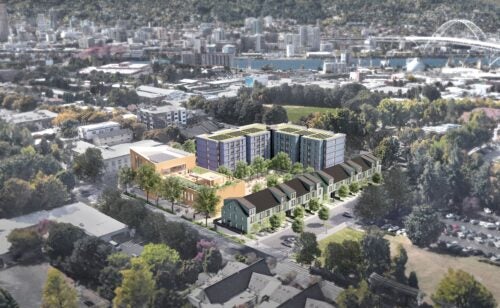
As CEO of Williams & Russell Community Development Corporation, I am applying a reparative development framework to the redevelopment of the historic Hill Block in Portland’s Albina neighborhood. Once a thriving center of Black commerce and community life, the block was cleared in the late sixties, during an era of government-driven displacement, and remained vacant for more than 50 years. Today, we are transforming that land into a community-led development that will provide 85 affordable rental homes, 20 affordable homeownership opportunities, and a business hub supporting local entrepreneurs, workforce development, and community organizations.
Through years of community engagement, secured investment, environmental remediation, and the start of construction, Hill Block is moving beyond an idea into a tangible example of what reparative development can accomplish. It is designed to create opportunities for displaced families and their descendants to return to while strengthening the economic future of the surrounding community. As highlighted in Affordable Housing News, this is no ordinary build.
But Hill Block is only the beginning. The next step is much larger: making reparative development a lasting commitment of American public policy.
For decades, the Housing Act of 1949, enacted to address postwar housing shortages and urban decline, provided federal support for local governments to acquire and clear areas designated as blighted. The Housing Act of 1954 expanded and reshaped these efforts under the banner of urban renewal. Although these policies were presented as tools for progress, they frequently displaced established communities, destroyed local businesses, and dismantled neighborhood networks that had taken generations to build.
The United States has struggled to find common ground on how to address the consequences of these decisions. Conversations about race, reparations, equity, and justice too often become politically polarized before practical solutions can take shape. Yet the physical and economic damage left behind by urban renewal remains visible in neighborhoods across the country.
Conversations about race, reparations, equity, and justice too often become politically polarized before practical solutions can take shape.
The time has come to move reparative development beyond individual projects and establish it as a national public policy priority. If urban renewal was created through public policy, then repairing its consequences requires equally intentional public policy. This responsibility belongs not only to cities but also to state and federal governments. The same institutions that once funded displacement should now help fund restoration.
Every election cycle brings another shift in priorities. Funding appears, disappears, and reappears under a different name. Communities spend years waiting for the political pendulum to swing back in their favor. Meanwhile, displacement continues under the more appealing term “redevelopment.”
This cycle has become one of the greatest barriers to creating lasting change, when the real challenge has always been repairing the places where harm occurred and ensuring that the people who sustained those communities have a meaningful stake in their future.
While urban renewal’s harms fell disproportionately on Black communities, reparative development offers a place-based framework for repair: it identifies where government policy caused displacement and disinvestment, then directs resources toward restoring opportunity in those places, acknowledging those most directly harmed without implying that restoration must benefit only one group. Stronger schools, safer streets, affordable homeownership, small business growth, parks, and economic opportunity lift entire neighborhoods, regardless of race, age, politics, or income.
But shared benefits don’t just happen. They require deliberate anti-displacement protections, meaningful community participation, and investment strategies that let longtime residents and displaced families share in the value created.
When approached thoughtfully, reparative development can become the great equalizer: not by erasing the past, but by ensuring the opportunities redevelopment creates are broadly shared. For too long, redevelopment has measured success by cranes in the sky, rising property values, and increased tax revenue. If longtime residents are displaced, if local businesses disappear, or if families cannot build wealth in the very neighborhoods being revitalized, then redevelopment has simply become another version of urban renewal.
Reparative development demands a different measure of success. How many families gain access to affordable housing, how many residents become homeowners, how many local businesses can remain and grow, and whether public investment creates lasting economic stability. Perhaps most importantly, success means preventing displacement before it occurs.
This framework requires a new relationship between government and community. Everyone has a role to play: Community organizations bring trust and lived experience. Local governments bring funding, policy, and the authority to turn community priorities into enforceable commitments. The federal government provides consistent funding, national policy direction, and long-term investment that extends beyond election cycles. Financial institutions expand access to capital. Philanthropy fills critical funding gaps for operations and community capacity. Universities contribute research and innovation. Private developers contribute technical expertise and construction capacity.
None of these sectors can accomplish reparative development alone, but together they can create a model for community restoration that is larger than any individual project.
What would a national reparative development policy look like in practice?
Hill Block provides an early example of how community leadership, public investment, private-sector expertise, and a commitment to economic opportunity can come together. The challenge now is to make that approach possible in communities across America, rather than leaving progress dependent on extraordinary local efforts.
America has never lacked the ability to build. Our challenge has always been deciding what to build and who to build for. We must create a foundation for reparative development that can withstand political change because repairing communities should never depend on which party happens to be in power.
Public policy once dismantled communities, and public policy can help rebuild them.
Editor’s note: The views expressed in the articles on The Rooftop are those of the authors alone and do not necessarily reflect the opinions or policy positions of New America.
Chief Executive Officer/Executive Director, Williams & Russell CDC