Yuliya Panfil
Senior Fellow and Director, Future of Land and Housing
Key Takeaways from New America’s Convening in October 2026

America’s housing stock is deteriorating, and unmet home repair needs are overwhelming and urgent. The estimated cost nationwide is $189 billion, with much of these repair needs concentrated among low- and moderate-income (LMI) homeowners and small building owners.
And yet there is no national-scale strategy or system for financing home repair. The repair assistance programs that do exist are small and under-funded, and typically carry strict eligibility requirements or are targeted to specific types of repairs. When homeowners can’t access the resources they need to repair their homes, these homes often become unsafe and uninhabitable, lose value, become unsellable, or fall out of supply altogether. The ripple effects drain generational wealth and destabilize neighborhoods. As the nation races to close our housing supply gap with new construction, it is estimated that roughly 400,000 homes fall out of supply annually due to deterioration, demolition, or abandonment.
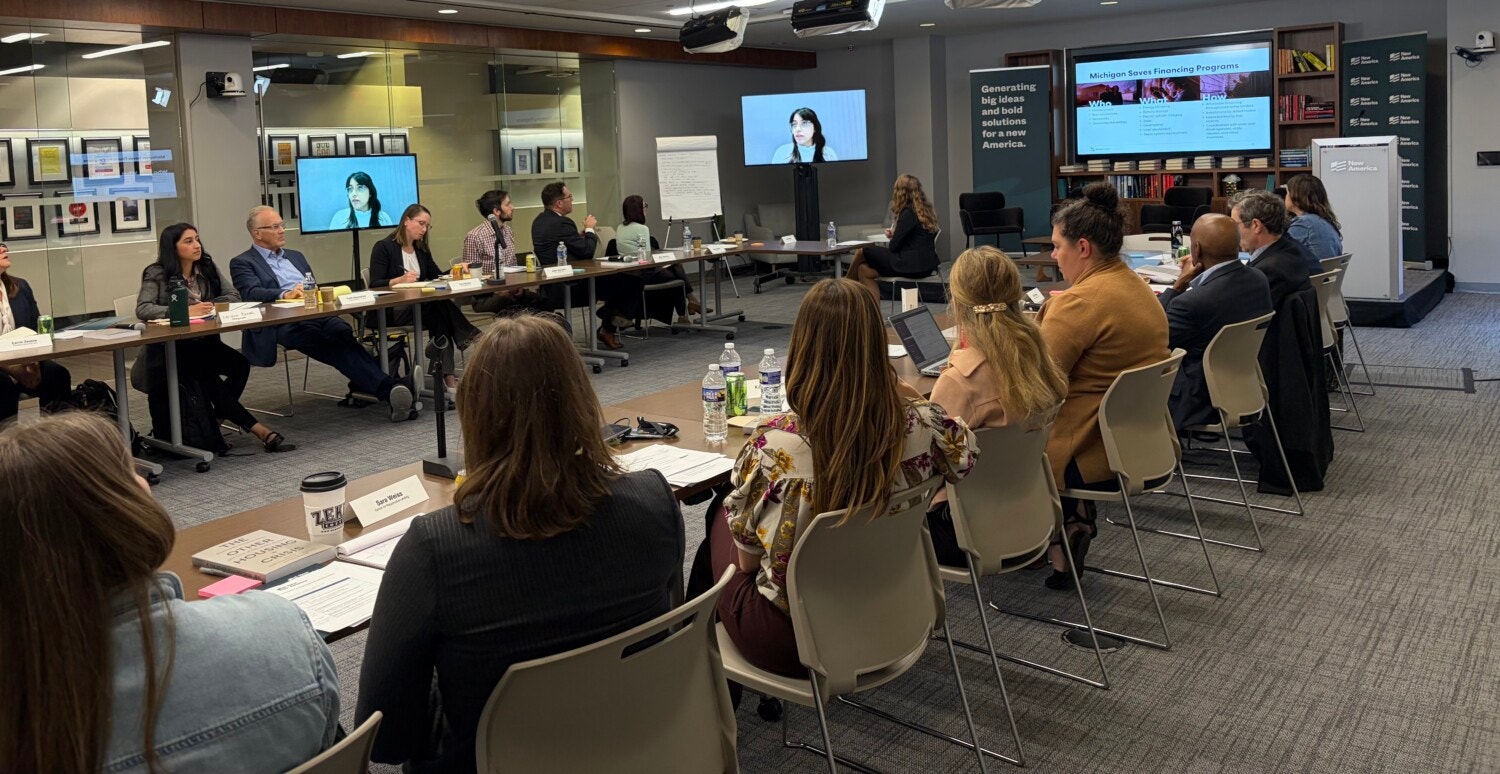
On October 20, 2026, New America held a closed door convening in Washington, D.C. to pose the question: What might a 21st century home repair system for America look like?
We gathered 40 leaders from local and federal government, financial institutions, research, philanthropy, and practice to envision a more sustainable and coordinated home repair financing ecosystem —one that recognizes housing as critical public infrastructure.
Repair is “the other housing crisis,” and needs a new narrative. Our national housing conversation focuses almost entirely on supply shortages. Repair challenges consistently sabotage efforts to boost both supply and affordability, yet repair is not prioritized in the same way as new construction. Keynote speakers Alan Mallach and Todd Swanstrom argue that housing should be treated like public infrastructure, similar to roads and sewers, and framed as a practical answer to the supply and affordability crisis rather than a niche need.
We can’t grant our way out of this. An effective home repair assistance system needs a continuum of grants and loans to meet the repair needs of every household and community. Grant assistance is extremely limited, and our current system offers moderate-income homeowners few repair products aside from HELOCs and cash-out refinances. Hybrid models that blend forgivable and repayable financing, such as Cleveland’s program pairing $25,000 in forgivable city funds with $25,000 in 0% repayable bank financing, and Providence Revolving Fund’s mix of forgivable loans and very low-interest financing for households just above 80% AMI, are two innovative models.
We're not going to build our way out of this problem, and we can’t grant everything.
Repair programs need dedicated funding for administrative and delivery system capacity. Home repairs are delivered by a patchwork of city agencies, nonprofits, CDFIs, lenders, and small contractors. But repair programs are chronically understaffed, making outreach, trust building, and coordination across funding sources difficult, if not impossible. The pressure to deploy funding quickly leaves little room to improve programs or apply lessons about who is being served and how repairs are made. Philanthropy, local governments, and other funders could cover the upfront costs of building and maintaining these delivery systems, including shared intake and data systems, maintaining pre-approved contractor lists, and managing blended funds.
Blending public and private funds can de-risk lending and help programs scale. Repair systems can blend public and private capital to reach scale. Public funds can absorb risk and lower costs through loan-loss reserves, guarantees, and interest-rate buydowns, while private lenders can help supply the loan capital to reach more homeowners. For example, LISC matches each public dollar with private bank dollars, offering loans at 0% interest in Detroit, 2% in Cincinnati, and 3% in Memphis. In Iowa, Neighborhood Finance Corporation draws on city-funded loan-loss reserves and a $20 million pool from local banks that receive Community Reinvestment Act credit.
State housing finance agencies are an underleveraged player in the space. State housing finance agencies are an underused source of capital and credit enhancements for home repair financing, yet many state housing resources are only focused on new production. State HFAs have access to capital markets, cash reserves, and lender relationships, and could offer guarantees and rate buydowns for homeowners and small landlords. Governors and state HFAs should align priorities and programs targeted in part towards repairs.
Federal repair and renovation loan products are underutilized. The U.S. has never had a large-scale federal home repair program, and existing federal repair programs are scant and underused. FHA 203(k) loans and Fannie Mae and Freddie Mac renovation loans are hard to originate and sell because of their complexity and administrative requirements. Meanwhile, FHA Title I loans remain relatively unknown. At the federal level, exploring a Fannie Mae and Freddie Mac second-lien product, a secondary market and securitization for repair loans, and federal investment that spurs banks to develop repair products of their own could help scale repair resources nationwide.
Homeowners need one front door and simpler vetting. A homeowner seeking repairs help must navigate over a dozen federal programs, each with its own rules and application, plus a patchwork of state, local and nonprofit resources. We need a single, integrated point of entry where homeowners can be routed to the programs and resources they qualify for. Case managers, in coordination with social service providers and legal assistance organizations, could help homeowners navigate available resources and resolve legal or administrative issues—such as tangled titles, insurance, or property tax problems—that might otherwise disqualify them from assistance.
It’s a balance between getting money out the door and running a [home repair] program that's meeting all the benchmarks.
Eligibility rules should be harmonized and simplified. Aligning eligibility, compliance, and income verification across funding sources and the patchwork of different repair programs would help ensure owners are not falling through the cracks of our system. Greater consistency would also reduce administrative burdens for program administrators and make it easier for homeowners to navigate and access available assistance.
Contractor participation is often constrained less by labor shortages than by cash-flow challenges. Contractors may favor private jobs that pay right away over publicly funded projects with reimbursement delays of several months. Short-term financing solutions, such as 0% program-related investments (PRIs) for nonprofit repair providers or lines of credit for contractors to cover upfront material costs, could help address this bottleneck.
Home repair needs better data and evidence. Poor data hampers efforts to elevate repair challenges, properly diagnose repair needs, and monitor whether repair programs are working. The Philadelphia Federal Reserve’s $189 million unmet repair needs estimate is the best estimate we have, but is likely an undercount, and we don’t know by how much. The City of Detroit’s Home Repair Census and St. Louis’s Vacancy Collaborative are good examples of local data gathering on home repairs that could be replicated elsewhere.
These insights from the workshop offer a starting point for building a more coordinated, accessible, and adequately resourced home repair ecosystem—one that addresses housing deterioration and deferred maintenance today while establishing the financing tools and policy infrastructure needed to support home repair and preservation over the long-term.
Senior Fellow and Director, Future of Land and Housing
Deputy Director, Future of Land and Housing Program