The Challenging Context of Health Care Workforce Development
Any health care employer will tell you that workforce issues—recruiting, retaining, and advancing skilled professionals—present a perennial challenge. An aging U.S. population will require increasing amounts of care, while an aging health care workforce forebodes increasing strain on the system unless new professionals enter, and stay in, the industry. It remains difficult for institutions of higher education and employers to provide education to enough individuals to meet health care workforce needs. And it remains difficult for Americans to enter and progress through nursing and allied health career pathways.
The health care workforce development system has three fundamental challenges: it lacks the capacity to produce the workers we need, is inefficient, and shuts low-income people out from opportunity. Degree apprenticeship cannot solve these complex challenges on its own, but it can mitigate all three.
Capacity
College and university nursing and allied health programs are not producing enough graduates to meet demand. A 2025 national survey of hospitals estimated that we have a national shortfall of 158,600 registered nurses,2 and the Human Resources and Services Administration projects the shortage will continue through 2038 at the current rate that the country is producing nurses.3 In 2024, nearly one in six jobs for radiographers—the technologists responsible for performing X-rays—was vacant.4 Yet nursing and some allied health degree programs are actually turning prospective students away. The National League for Nursing reported that associate degree nursing programs rejected nearly one in five qualified applicants in 2023.5 The California Board of Nursing reported that registered nursing programs in that state turned away 37,238 qualified applications in 2022–23.6 A survey by the American Society of Radiologic Technologists found that radiography programs turned away an estimated 22,780 qualified applicants in 2024.7 Grand Rapids Community College’s radiologic technology program has a six-year waiting list.8
Programs are restricting enrollment chiefly because there are not enough faculty or trained professionals to serve as preceptors or clinical supervisors. There is also an insufficient number of clinical sites that are used for training. The National League of Nursing reported that about 8 percent of total full-time faculty positions in associate and bachelor’s degree nursing programs were vacant in 2022–23, and that more than three-quarters of programs with vacancies reported they were difficult to fill. The inability to offer competitive salaries was the most commonly cited reason for this difficulty.9 According to the National Advisory Council on Nurse Education and Practice, the number of clinical preceptors needed to supervise nursing students in patient care is also “inadequate to meet the current need.”10 A 2024 survey by the Texas Center for Nursing Workforce Studies found that lack of clinical space was the most commonly ranked reason that nursing programs in that state could not admit all qualified students.11
Degree apprenticeship is emerging as a solution to both the health care workforce shortage and the structural barriers that prevent many prospective health care professionals from entering the field. While the model alone cannot solve the capacity challenge, it is generating some creative solutions and, at a greater scale, has the potential to increase efficiency and opportunity in the American health care sector.
Degree apprenticeship programs face capacity constraints like any other program, but the model is producing some creative solutions with potential for greater scale. For example, as we detail later, one health care system hired more registered nurses, trained them as clinical preceptors, and made them available at no cost to a college, thereby increasing the capacity of its registered nursing degree program and enabling it to add a cohort of apprentices.
Efficiency
With only enough seats to serve a fraction of students who aspire to enroll, many nursing and allied health degree programs have become stiffly competitive, admitting only students who achieve top grades in prerequisite academic courses. Despite this competition, on-time completion is still a challenge for some programs. More than half of associate degree nursing programs had on-time completion rates of less than 70 percent in 2023–24.12 The completion rate for associate degree surgical technology programs was just 72 percent, and the first-time pass rate for the Certified Surgical Technologist exam was 77 percent.13
Even when students can access and complete health care programs, the transition into practice remains inefficient. Attrition of first-year employees accounted for an average of half of the turnover of nursing, allied health, and medical employees at hospitals last year. More than one in five newly hired registered nurses in hospitals leave within their first year.14 In Florida hospitals, more than one-third of new radiologic technologists, respiratory therapists, and surgical technologists leave after their first year.15 Why? Some attribute the high rates of first-year attrition to “transition shock,”16 inadequate preparation for the stress of the health care workplace, and a lack of confidence in their professional knowledge and skills, among other factors.17 School just was not enough preparation for what they encountered after graduation.
Degree apprenticeship could make health care workforce development more efficient because it deepens the learning experience, giving students more time to apply and practice what they are learning in the classroom, labs, and clinical settings. Associate degree nursing students complete an average of 464 hours of clinical experience under the supervision of a preceptor.18 In some nursing apprenticeship models, students gain hundreds of more hours of hands-on work experience across four semesters. In contrast to distracting or irrelevant side jobs in retail or restaurants, every minute students spend at work is time spent learning in an apprenticeship. Apprentices also receive one-on-one guidance from a mentor who works alongside them—someone to ask questions, someone to model and emulate, and someone who offers support during the tough moments that are inevitable in a health care environment. When students complete their apprenticeship, they are prepared for the rigors and demands of the job on day one. There are no surprises.
Because the degree apprenticeship model is still emerging in health care, data on student success and postgraduation attrition is just starting to emerge. Anecdotal evidence from other health care apprenticeships is promising. According to Bridget Willey, executive director and chief operating officer of UW Health WorkForward, for example, the University of Wisconsin Health found that the retention of employees trained through its nondegree health care apprenticeship programs was 22 percent higher, over five years, than external hires who were not apprentices. Nearly all apprentices (99 percent) earned credentials and all graduates transferred into the roles for which they were prepared. Averaged over 17 different UW Health apprenticeship programs, attrition was less than 10 percent.
Accessibility
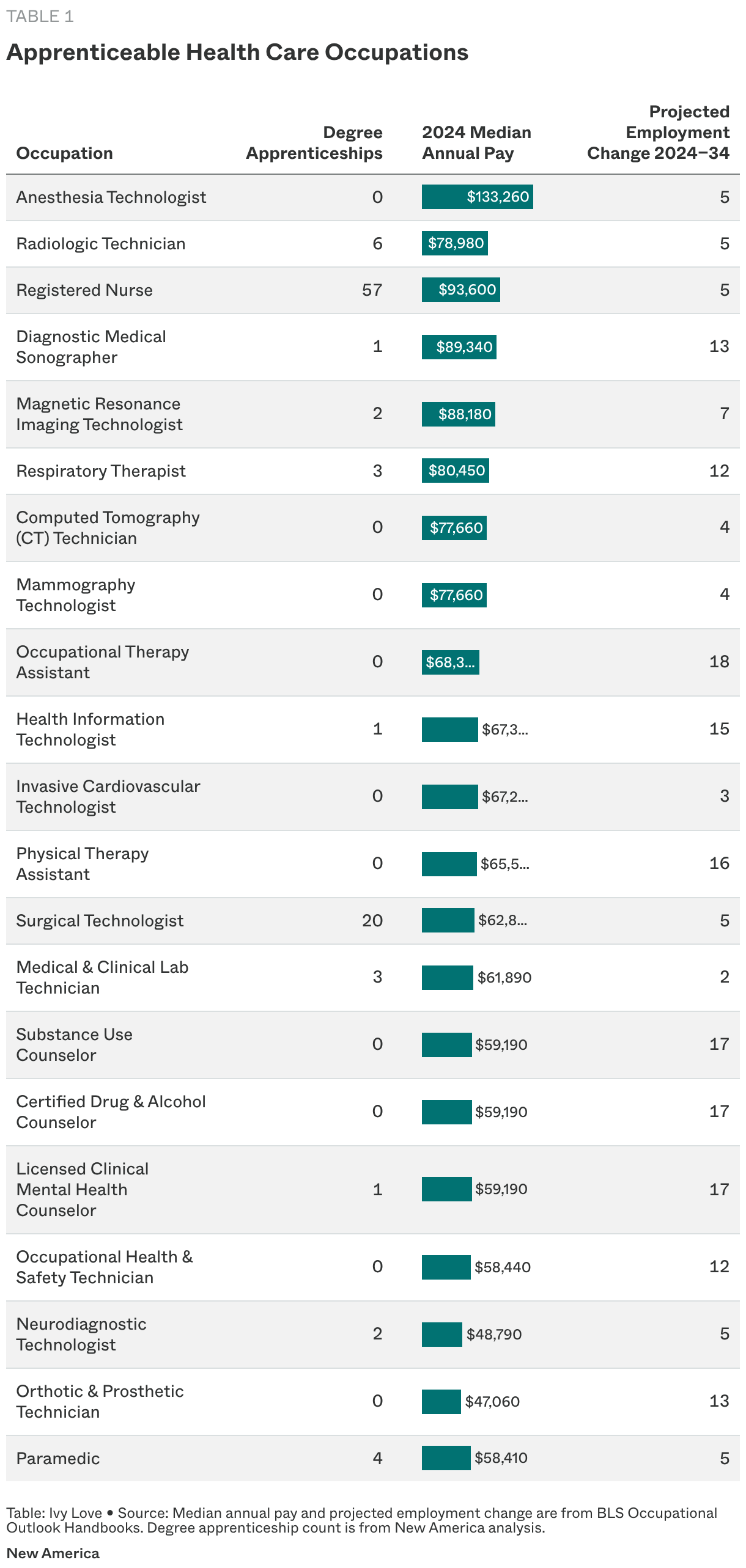
Degree apprenticeships also address a third important challenge in health care workforce development: Low-income people are shut out of good opportunities. Many health care occupations can provide genuine economic mobility for workers and their families because they pay well. The median annual earnings of radiologic technologists, respiratory therapists, and registered nurses are $78,980,19 $80,450,20 and $93,600,21 respectively, all above the national median annual wage. Yet some programs are oriented toward full-time students who are available to attend class during the day, have no caregiving responsibilities, and do not need to work to support themselves. Scanning program catalogs for nursing and allied health degree programs reveals that many are offered only to full-time students on weekdays,22 and that many strongly discourage more than part-time work while enrolled.23 Compounding the problem are the hundreds of hours of clinical experiences that nursing and allied health students must complete as part of their education and preparation for a state license or other credential, on top of their coursework.24 This experience is almost universally unpaid, under the rationale that its exclusive purpose is education,25 though some have noted that students often perform tasks for which other unlicensed employees, like patient care technicians, are compensated.26
Colleges and universities establish full-time requirements and expectations that students will minimize outside work because they know these programs are difficult, and they want students to be successful. Arguably, requiring students to complete clinical experience without pay helps ensure its focus is on learning. But degree apprenticeship offers another way to achieve those goals, and it unlocks opportunities for more people. Paid work, with progressive wage increases, is integrated with learning. As one registered nursing apprentice in Alabama told us, earning while learning makes all the difference: “I have three kids, and I’m a single mom, and I wouldn’t have had time to work on the side. If I had to choose paying my mortgage over nursing school, I’d choose my mortgage. Being paid and having pay raises each semester has helped me to afford nursing school.”
Degree Apprenticeship as a Solution
Taken together, these three challenges make a compelling case for degree apprenticeship. By integrating paid work, academic instruction, and structured training, the model has the potential to address many issues that plague health care workforce development. Yet despite this promise, degree apprenticeship remains concentrated in only a handful of health care occupations (see Table 1). Understanding why requires looking beyond the workforce challenges themselves and toward the systems responsible for preparing health care professionals.

Citations
- NSI Nursing Solutions, 2026 NSI National Health Care Retention & RN Staffing Report (NSI, March 2026), 1, https://www.nsinursingsolutions.com/documents/library/nsi_national_health_care_retention_report.pdf.
- National Center for Health Workforce Analysis, Nurse Workforce Projections, 2023–2038 (Health Resources and Services Administration, December 2025), 1, https://bhw.hrsa.gov/sites/default/files/bureau-health-workforce/data-research/nursing-projections-factsheet.pdf.
- The American Society of Radiologic Technologists reported there was a 15.6 percent vacancy rate in radiography in 2024. See American Society of Radiologic Technologists, “ASRT Staffing and Workplace Survey Shows Vacancy Rate Increases Near Record Highs, Aligning with Overall Health Care Profession Trends,” news release, July 24, 2025, https://www.asrt.org/main/news-publications/news/article/2025/07/24/asrt-staffing-and-workplace-survey-shows-vacancy-rate-increases-near-record-highs-aligning-with-overall-health-care-profession-trends.
- National League of Nursing, NLN Annual Survey of Schools of Nursing Academic Year 2022–2023: Executive Summary (NLN, 2023), 4, https://www.nln.org/docs/default-source/research-statistics/2023-nln-annual-survey-results/2023-nln-annual-survey-executive-summary-for-nln-website-ver3.pdf.
- The Board reported that 57,987 applications were found to be qualified and 18,367 were accepted. Lisel Blash and Joanne Spetz, California Board of Registered Nursing: 2022–2023 Annual School Report (University of California, San Francisco, August 19, 2024), 3, https://www.rn.ca.gov/pdfs/education/prelicensure22-23.pdf.
- American Society of Radiologic Technologists, Enrollment Snapshot 2024 (ASRT, 2024), 5, https://www.asrt.org/docs/default-source/research/enrollment-snapshot/enrollment-snapshot-2024.pdf.
- Grand Rapids Community College, “Waiting List Admission Requirements (Effective 2025–26 Catalog),” https://www.grcc.edu/schools-departments/health-programs/admission-requirements-program.
- The National League of Nursing reported that 838 of 9,509 full-time faculty positions were vacant in 2023. See NLN Annual Survey of Schools of Nursing Academic Year 2022–2023, 4, https://www.nln.org/docs/default-source/research-statistics/2023-nln-annual-survey-results/2023-nln-annual-survey-executive-summary-for-nln-website-ver3.pdf.
- National Advisory Council on Nurse Education and Practice, Preparing Nurse Faculty, and Addressing the Shortage of Nurse Faculty and Clinical Preceptors: 17th Report to the Secretary of Health and Human Services and the U.S. Congress (NACNEP, January 2021), 5, https://www.hrsa.gov/sites/default/files/hrsa/advisory-committees/nursing/reports/nacnep-17report-2021.pdf.
- Texas Center for Nursing Workforce Studies, 2024 Texas Clinical Training Needs: Educational Institutions and Clinical Training Sites (Texas Department of Health Services, January 2025), 1, https://www.dshs.texas.gov/sites/default/files/chs/cnws/2024_clinical_training_report_accessible_V2.pdf.
- Nancy Spector, Josephine Silvestre, Qiana McIntosh, and Nicole Kaminski-Ozturk, National Nursing Education Database: 2023–2024 Aggregate Data (National Council of State Boards of Nursing, June 2025), 7, https://www.ncsbn.org/public-files/2023-2024-AggregateData-digital-v2.pdf.
- Accreditation Review Council on Education in Surgical Technology and Surgical Assisting (ARC/STSA), “2024 Annual Report Highlights at a Glance,” 2024, https://arcstsa.org/2024-annual-report-highlights-at-a-glance/.
- NSI Nursing Solutions, 2026 NSI National Health Care Retention & RN Staffing Report, 7, https://www.nsinursingsolutions.com/documents/library/nsi_national_health_care_retention_report.pdf.
- Florida Hospital Association, Opportunities for Continued Growth: Workforce Report (FHA, 2025), 16, https://www.fha.org/common/Uploaded%20files/FHA/Health%20Care%20Issues/Workforce_Report.pdf.
- Khin Sandi Myint Lay and Khemaradee Masingboon, “Turnover Prevalence and the Relationship Between Transition Shock and Turnover Intention Among New Nurses: A Meta-Analysis,” International Journal of Nursing Studies Advances 9 (December 2025): 1–13, https://www.sciencedirect.com/science/article/pii/S2666142X25000955#bib0026.
- Hafidza Baharum, Aniza Ismail, Lisa McKenna, Zainah Mohamed, Roszita Ibrahim, and Nor Haty Hassan, “Success Factors in Adaptation of Newly Graduated Nurses: A Scoping Review,” BMC Nursing 22, no. 125 (2023), 1–26, https://link.springer.com/article/10.1186/s12912-023-01300-1.
- Spector, Silvestre, McIntosh, and Kaminski-Ozturk, National Nursing Education Database, 5, https://www.ncsbn.org/public-files/2023-2024-AggregateData-digital-v2.pdf.
- U.S. Bureau of Labor Statistics, “Radiologic and MRI Technologists,” in Occupational Outlook Handbook, last modified August 28, 2025, https://www.bls.gov/ooh/healthcare/radiologic-technologists.htm.
- U.S. Bureau of Labor Statistics, “Respiratory Therapists,” in Occupational Outlook Handbook, last modified August 28, 2025, https://www.bls.gov/ooh/healthcare/respiratory-therapists.htm.
- U.S. Bureau of Labor Statistics, “Registered Nurses,” in Occupational Outlook Handbook, last modified August 28, 2025, https://www.bls.gov/ooh/healthcare/registered-nurses.htm.
- For example, Century College’s associate degree nursing program warns prospective students that it is “offered in a full-time, day-time format only.” Tarrant County College’s respiratory therapy program cautions that “part-time, weekend, and distance learning are not available.” The Community College of Baltimore’s radiologic technology program notes that not only classes but also most clinical experiences are offered exclusively during the day. See Century College, “Nursing Program Highlights,” https://www.century.edu/programs/nursing/; Tarrant County College, “About Our Respiratory Care Program,” https://www.tccd.edu/academics/courses-and-programs/programs-a-z/credit/respiratory-care/resp-about-our-program/; School of Health Professions, “Radiography: Frequently Asked Questions,” https://www.ccbcmd.edu/_media/PDFs/Programs-and-Courses/SHP/radio_faq.pdf.
- Sacramento City College’s registered nursing program, for example, recommends that students work no more than 12 hours per week (A.S. in Nursing, Registered, https://scc.losrios.edu/academics/programs-and-majors/nursing?tab=2), Saddleback College’s registered nursing program recommends students work no more than 20 hours per week, and Mohave College’s radiologic technology program strongly discourages full-time employment outside the program. See Associate Degree in Nursing, “Let’s Talk About the Time Commitment for Nursing School,” https://lccc.wy.edu/Media/Website-Resources/documents/Health-Sciences-and-Wellness/Nursing/NursingTime.doc; Associate Degree in Nursing, “Program Overview,” https://www.saddleback.edu/programs-degrees/all-programs/nursing; Radiologic Technology, “Frequently Asked Questions,” https://www.mohave.edu/academics/certificates/radiologic-technology/.
- The minimum number of hours is sometimes specified in accreditation standards and sometimes it is established by individual programs based on the curricular requirements set by accreditors. Some states also establish minimum hour requirements for clinical experience in their approval standards for education programs or as a requirement for licensure. Virginia regulations, for example, require registered nursing students to complete “500 hours of direct client care supervised by qualified faculty.” See “Curriculum for Direct Client Care,” 18 Virginia Administrative Code 90-27-100, https://law.lis.virginia.gov/admincode/title18/agency90/chapter27/section100.
- Wage and Hour Division, “Fact Sheet #71: Internship Programs Under The Fair Labor Standards Act,” U.S. Department of Labor, updated January 2018, https://www.dol.gov/agencies/whd/fact-sheets/71-flsa-internships.
- Leah Huang, “It’s Time to Pay Nursing Students for Clinicals,” Michigan Daily, October 20, 2024, https://www.michigandaily.com/opinion/columns/its-time-to-pay-nursing-students-for-clinicals/.