Paving the Way for Latinx Teachers
Table of Contents
- Introduction
- Pathways Into the Teaching Profession
- Barriers Along the Pathway into Teaching
- Profile: Skagit Valley’s Supported Teacher Pathway
- Profile: San Antonio’s P–20 Partnerships
- Profile: Chicago’s Bilingual Teacher Residency Program
- Key Findings
- Policy Recommendations to Strengthen Pathways into Teaching
- Appendix A: List of Profile Interviews
Abstract
This report adds a significant perspective to the current wave of efforts aimed at diversifying the teacher workforce, specifically to address the mismatch between Latinx students and Latinx teachers. The Latinx population is the largest ethnic group in America’s public schools, currently making up a quarter of the student population, and expected to grow to one-third by 2027. Research shows that schools and districts with teachers that reflect the cultural, racial, and/or linguistic backgrounds of Latinx students are better equipped to support them. This report—one of the first focused solely on pathways into teaching for Latinx individuals—explores how Latinx teachers typically enter the profession and the barriers they face along the way. This report profiles three Latinx-focused pathways into teaching that are attempting to reduce those barriers, reflects on key findings, and offers recommendations for policymakers and practitioners.
Acknowledgments
I am grateful for the participation of students, teachers, faculty, administrators, and staff from Burlington-Edison High School, Skagit Valley College, Western Washington University, Washington’s Professional Educator Standards Board, San Antonio Independent School District, Northwest Vista College, the University of Texas as San Antonio’s College of Education and Human Development, Chicago Public Schools, National Louis University’s National College of Education, and the National Center for Teacher Residencies. For a full list of individuals that informed this work, see appendix A. Thank you to those who reviewed drafts of this paper, including Janette Martinez of Excelencia for Education, Etai Mizrav of American Institutes for Research, and Lisette Partelow of Center for American Progress. I am especially grateful to my New America colleague, Amaya Garcia, the primary author of the Chicago Public Schools profile which was adapted from a larger, previously-published paper. I am also grateful to my colleagues Melissa Tooley, Elena Silva, Jenny Muñiz, Iris Palmer, and Sabrina Detlef for providing expert and editorial insight, and Sophie Nguyen for data support. Thanks to Riker Pasterkiewicz, Julie Brosnan, Tong "Echo" Wu, Maria Elkin, Samantha Webster, Naomi Morduch Toubman, and Joe Wilkes for their graphics and communication support. New America’s PreK–12 team is generously supported by the Bill & Melinda Gates Foundation, the Heising-Simons Foundation, the Hewlett Foundation, the W. K. Kellogg Foundation, the McKnight Foundation, and the W. Clement and Jessie V. Stone Foundation. The views expressed herein represent those of the author and not necessarily the individuals or organizations named above.
Downloads
Introduction
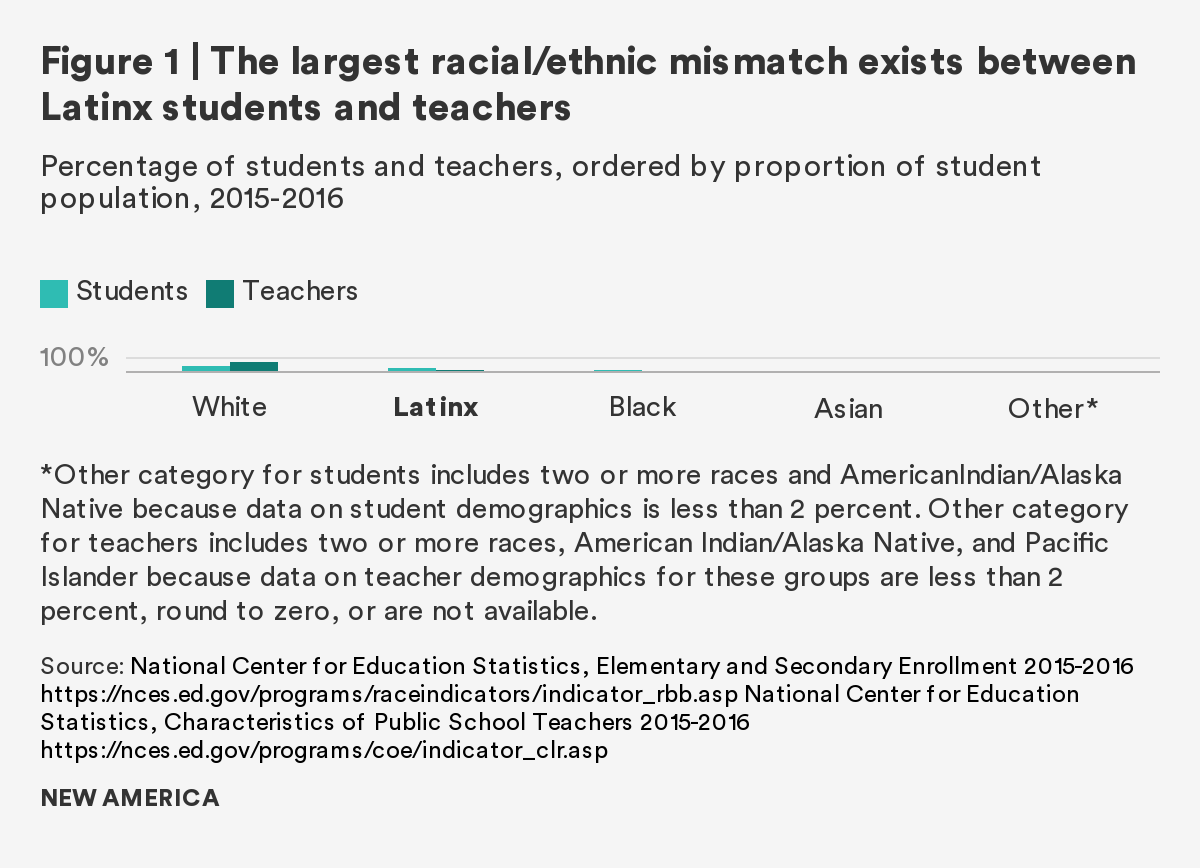
Early recruitment into the teaching profession. Ongoing mentorship from high school to postsecondary education. Structured partnerships between PreK–12 and higher education. These are a few promising steps communities across the United States are taking to fill the large and growing demographic gap that exists between students and teachers in our public elementary and secondary schools. In 2015–2016, 51 percent of students in public schools were non-White, compared to only 20 percent of teachers.1 The Latinx2 population is the largest ethnic group in American public schools, making up about a quarter of the student population and expected to grow to one-third by 2027.3 While demographic gaps exist between the other non-White student populations and teachers, this one is the largest, with Latinx teachers making up only 9 percent of the teacher workforce.4
Why does this demographic mismatch matter? While the Latinx student population has experienced some positive academic gains, its academic attainment still lags behind their White peers. The high school dropout rate is higher for Latinx students than other racial/ethnic subgroups, and four-year degree attainment is lower. Research on student-teacher racial/ethnic matching indicates that one high-potential strategy for improving Latinx student outcomes is to increase the number of effective Latinx teachers available to teach, mentor, and support them.5
While research has largely focused on the impact of Black teachers on Black students,6 some studies have found that Latinx students who are assigned to a teacher who reflects their cultural, racial, and/or linguistic backgrounds experience an array of benefits. These include more positive perceptions of their teachers,7 higher achievement scores,8 and an increase in the likelihood of attending college.9 Other studies have found that Latinx students in schools with more Latinx teachers took more advanced placement courses and international baccalaureate courses than in schools with fewer Latinx teachers,10 and that Latinx teachers improve Latinx students’ aspirations and feelings of connectedness.11
Of course non-Latinx teachers can effectively teach Latinx students,12 and not every Latinx teacher will be equally effective at doing so. This is particularly true given the wide heterogeneity of the Latinx population: any given Latinx teacher may not share the same race, country of origin, language, and/or socioeconomic background with all, or even any, of their Latinx students.13
But research suggests that, overall, Latinx teachers are more likely to be well-positioned to support Latinx students’ academic, emotional, and social success than non-Latinx teachers.14 For example, Latinx teachers who share their students’ cultural experiences are able to more easily establish confianza—trust that leads to openness and sharing of information, and which is critical to forming authentic relationships with students and their families.15 And because Latinx teachers sometimes have experienced the same inequities as their students, they are more likely to be aware of school policies and practices that affect students of color and to advocate for changes, like implementing restorative justice practices to address school discipline or adopting culturally relevant curricula.16
Latinx teachers can often bring linguistic diversity into the classroom as well. In 2016, there were roughly 13 million Latinx students in public schools. At the same time, there were approximately 4 million Latinx English learners (ELs)17—making up the majority of ELs (77 percent) in public schools.18 Not surprisingly, most states report teacher shortages in bilingual, dual language, and English as a Second Language (ESL) in their public schools.19
While the number of Latinx teachers has more than quadrupled over the last three decades—from approximately 69,000 in 1987–1988 to 338,000 in 2015–201620—the rate of growth is still not quick enough to narrow the wide gap between student and teacher demographics.
In order to really narrow the demographic gap between Latinx students and teachers, more Latinx individuals will need to first be eligible to become teachers. This will require more of them to complete high school, enroll in college, and complete a bachelor’s degree. This report takes a close look at pathways into teaching for Latinx students and the barriers they face at each of these transition points. In the sections that follow, we explore how Latinx teachers enter the profession and examine the barriers along the way. We then profile three Latinx-focused pathways into teaching that are attempting to reduce those barriers. Finally, we reflect on our four key findings and offer five recommendations for policymakers and practitioners.
Our Research Approach
To conduct this work, we engaged in:
- a literature review of peer-reviewed articles, books, and policy reports on Latinx teachers;
- semi-structured interviews with experts in the field—researchers, advocates, policy experts, and practitioners—that informed our selection of pathway programs;
- interviews with students, teachers, administrators, and researchers, associated with the three selected pathways; and
- site visits to the selected pathways.
Each of the three selected pathways—in Chicago, Illinois; in San Antonio, Texas; and in Skagit Valley, Washington—employ a variety of structured partnerships to provide academic, financial, and social support to participants. The three were selected based on their focus on innovative approaches to recruiting and preparing Latinx teachers.
Citations
- National Center for Education Statistics (website), Digest of Education Statistics, “Table 203.50. Enrollment and percentage distribution of enrollment in public elementary and secondary schools, by race/ethnicity and region: Selected years, fall 1995 through fall 2028,” March 2019, source; and National Center for Education Statistics (website), Digest of Education Statistics, “Table 209.10. Number and percentage distribution of teachers in public and private elementary and secondary schools, by selected teacher characteristics: Selected years, 1987–88 through 2015–16,” September 2017, source
- Throughout this paper, we use the term Latinx, a gender-neutral or non-binary alternative to Latino or Latina.
- Cristobal de Brey, Lauren Musu, Joel McFarland, Sidney Wilkinson-Flicker, Melissa Diliberti, Anlan Zhang, Claire Branstetter, and Xiaolei Wang, Status and Trends in the Education of Racial and Ethnic Groups, “Indicator 6: Elementary and Secondary Enrollment” (Washington, DC: U.S. Department of Education, February 2019), source, source
- Joel McFarland, Bill Hussar, Jijun Zhang, Xiaolei Wang, Ke Wang, Sarah Hein, Melissa Diliberti, Emily Forrest Cataldi, Farrah Bullock Mann, and Amy Barmer, The Condition of Education 2019, section 1.12, “Characteristics of Public School Teachers” (Washington, DC: U.S. Department of Education, May 2019), source source
- For more information on how Latinx teachers can improve Latinx student outcomes, see Cristóbal Rodríguez, Melissa A. Martinez, and Fernando Valle, “Latino Educational Leadership across the Pipeline: For Latino Communities and Latina/o Leaders,” Journal of Hispanic Higher Education 15, no. 2 (October 2016): 136–153, source; Carline S. Turner, Pedro X. Cosmé, Laura Dinehart, Raquel Martí, David McDonald, Martin Ramirez, Lester Sandres Rapalo, and Juan Zamora, Improving Diverse and Inclusive Teacher Pipelines with a Focus on Latinas/Latinos/Hispanics (Washington, DC: White House Initiative on Educational Excellence for Hispanics: 2017), source; and Mary Louise Gomez and Terri L. Rodriguez, “Imagining the Knowledge, Strengths, and Skills of a Latina Prospective Teacher,” Teacher Education Quarterly 38, no. 1 (Winter 2011): 127–146.
- Most research, particularly quantitative research, has been focused on Black teachers and Black students. One study by Travis J. Bristol found that, “to date, no quasi-experimental studies have explored the impact on Latinx students’ learning when taught by Latinx teachers.” While we can extrapolate from the various studies done on the impact of Black teachers on Black students, these effects may play out differently for different racial/ethnic groups. See Travis J. Bristol and Javier Martin-Fernandez, The Added Value of Latinx and Black Teachers for Latinx and Black Students: Implications for the Reauthorization of the Higher Education Act (Providence, RI: Annenberg Institute at Brown University, 2019), source
- Hua-Yu Sebastian Cherng and Peter F. Halpin, “The Importance of Minority Teachers: Student Perceptions of Minority versus White Teachers,” Educational Researcher 45, no. 7 (October 2016): 407–420, source
- Beatriz C. Clewell, Michael J. Puma, and Shannon A. McKay, "Does It Matter if My Teacher Looks Like Me? The Impact of Teacher Race and Ethnicity on Student Academic Achievement" (paper presented at the meeting of the American Educational Research Association, Montreal, 2005).
- Patricia Gándara, Leticia Oseguera, Lindsay Pérez Huber, Angela Locks, Jongyeon Ee, and Daniel Molina, Making Education Work for Latinas in the U.S. (Los Angeles, CA: The Civil Rights Project, 2013), source
- Todd Kettler and Luke T. Hurst, “Advanced Academic Participation: A Longitudinal Analysis of Ethnicity Gaps in Suburban Schools,” Journal for the Education of the Gifted 40, no. 1 (March 2017): 3–19.
- Belinda Bustos Flores, Ellen Riojas Clark, Lorena Claeys, and Abelardo Villarreal, “Academy for Teacher Excellence: Recruiting, Preparing, and Retaining Latino Teachers Through Learning Communities,” Teacher Education Quarterly 34, no. 4 (Fall 2007): 53–69, source
- Tara Stevens, Mary Frances Agnello, Janie Ramirez, Aretha Marbley, and Doug Hamman, “Project FUTURE: Opening Doors to Diverse West Texas Teachers,” Teacher Education Quarterly 34, no. 4 (Fall 2007): 103–120, source; Kip Téllez, “Preparing Teachers for Latino Children and Youth: Policies and Practice,” The High School Journal 88, no. 2 (2004): 43–54, source; and Barry M. Goldenberg, “White Teachers in Urban Classrooms: Embracing Non-White Students’ Cultural Capital for Better Teaching and Learning,” Urban Education 49, no. 1 (January 2014): 111–144.
- For more on the diversity of the U.S. Latinx population, see Antonio Flores, “How the U.S. Hispanic Population is Changing,” Fact Tank, Pew Research Center, September 18, 2017, source
- Ana Maria Villegas and Jacqueline Jordan Irvine, “Diversifying the Teaching Force: An Examination of Major Arguments,” The Urban Review 42, no. 3 (September 2010): 175–192; and Mary Louise Gomez, Terri L. Rodriguez, and Vonzell Agosto, “Who are Latino Prospective Teachers and What do They Bring to US Schools?” Race Ethnicity and Education 11, no. 3 (September 2008): 267–283.
- Evelyn M. Weisman, Susana Y. Flores, and Christine Valenciana, “Building Bilingual–Bicultural Learning Communities: Experiences of Latino Teacher Candidates,” Journal of Hispanic Higher Education 6, no. 3 (July 2001): 191–208.
- For more information on Latinx teachers’ experiences and how they advocate for their students, see Margarita Ines Berta-Avila, “Critical Xicana/Xicano Educators: Is It Enough to be a Person of Color?” The High School Journal 87, no. 4 (April–May 2004): 66–79; Rene Galindo, “Reframing the Past in the Present: Chicana Teacher Role Identity as a Bridging Identity,” Education and Urban Society 29, no. 1 (1996): 85–102; Mary Louise Gomez, Terri L. Rodriguez, and Vonzell Agosto, “Who are Latino Prospective Teachers and What do They Bring to US Schools?” Race Ethnicity and Education 11, no. 3 (September 2008): 267–283; Gilda L. Ochoa, Learning from Latino Teachers (San Francisco, CA: Jossey-Bass, 2007); and Zhixin Su, “Teaching as a Profession and as a Career: Minority Candidates' Perspectives,” Teaching and Teacher Education 13, no. 3 (April 1997): 325–340; Christopher Redding, “A Teacher Like Me: A Review of the Effect of Student-Teacher Racial/Ethnic Matching on Teacher Perceptions of Students and Student Academic and Behavioral Outcomes,” Review of Educational Research 89, no. 4 (August 2019): 499–535.
- The U.S Department of Education defines an English Learner (EL) as "an individual who, due to any of the reasons listed below, has sufficient difficulty speaking, reading, writing, or understanding the English language to be denied the opportunity to learn successfully in classrooms where the language of instruction is English or to participate fully in the larger U.S. society. Such an individual (1) was not born in the United States or has a native language other than English; (2) comes from environments where a language other than English is dominant; or (3) is an American Indian or Alaska Native and comes from environments where a language other than English has had a significant impact on the individual’s level of English language proficiency.” See Joel McFarland, Bill Hussar, Jijun Zhang, Xiaolei Wang, Ke Wang, Sarah Hein, Melissa Diliberti, Emily Forrest Cataldi, Farrah Bullock Mann, and Amy Barmer, The Condition of Education 2019, “Glossary,”section 1.7, “English Language Learners in Public Schools” (Washington, DC: U.S. Department of Education, May 2019), source, source, and source
- Joel McFarland, Bill Hussar, Jijun Zhang, Xiaolei Wang, Ke Wang, Sarah Hein, Melissa Diliberti, Emily Forrest Cataldi, Farrah Bullock Mann, and Amy Barmer, The Condition of Education 2019, section 1.7, “English Language Learners in Public Schools” (Washington, DC: U.S. Department of Education, May 2019), source, source; and National Center for Education Statistics (website), Digest of Education Statistics, “Table 203.50. Enrollment and percentage distribution of enrollment in public elementary and secondary schools, by race/ethnicity and region: Selected years, fall 1995 through fall 2025,” March 2019, source
- For a complete list of teacher shortage areas, see Freddie Cross, Teacher Shortage Areas: Nationwide Listing 1990–1991 through 2017–2018 (Washington, DC: U.S. Department of Education, June 2017), source
- National Center for Education Statistics (website), Digest of Education Statistics, “Number and percentage distribution of teachers in public and private elementary and secondary schools, by selected teacher characteristics: Selected years, 1987–88 through 2015–16,” September 2017, source
Pathways Into the Teaching Profession
To get more Latinx students into teaching, it is necessary to first explore how aspiring teachers are currently entering the profession.
The vast majority of teachers (78 percent) enter the profession through a traditional route—acquiring a bachelor’s degree in education at a four-year college that prepares candidates with instruction in pedagogy and a specific content area.21
Historically, traditional teacher preparation programs at four-year institutions of higher education (IHE) have struggled to recruit and retain diverse teacher candidates.22 An exception here in preparing Latinx teacher candidates is Hispanic-Serving Institutions (HSIs)—two- and four-year not-for-profit institutions whose undergraduate enrollment is at least 25 percent Latinx.23 Currently, there are over 500 HSIs, representing 17 percent of all IHEs. It is important to note that, by definition, Latinx students’ choices determine which colleges are HSIs, and research shows that Latinx students who enroll at HSIs choose them largely based on cost, proximity to home, and the perception of a welcoming environment.24 While HSIs do not prepare a large proportion of the nation's teachers overall, they do play an outsized role in preparing Latinx teachers. In 2016–2017, 12 percent of teacher candidates across all IHE-based teacher preparation programs were enrolled at an HSI, yet HSIs enrolled 39 percent of teacher candidates that identified as Latinx.25
All states also offer some form of alternative route(s) into the profession for people who do not hold an undergraduate degree in education. Alternative routes prepared approximately 22 percent of newly-minted teachers in 2016–2017.26 These programs vary by who runs them. Many are still housed in schools of education within IHEs; others are managed by school districts, or private non-profit or for-profit providers; and some are run by partnerships between these various entities. The common denominator is that alternative programs tend to be more practice-oriented, often allowing candidates to learn how to teach while acquiring experience in the classroom, although they vary by requirements for completion, level of training provided before candidates enter the classroom, and level of support given to them once in the classroom.27
Alternative route preparation programs tend to attract a broader and more diverse pool of teacher candidates, and Latinx candidates are no exception. In 2015–2016, they made up 15 percent of public school teachers who entered teaching through an alternative route, compared to 8 percent who had entered teaching through a traditional route.28 Alternative routes to certification can be more attractive to Latinx candidates for a variety of reasons, including that they tend to be less expensive and less time-consuming, and may also offer more personalized support than a traditional program.29
Alternative route programs have been criticized for often having less selective admissions criteria than traditional IHE-based preparation programs and for offering candidates less exposure to pedagogical coursework.30 That said, the lines between traditional and alternative route programs are blurring: 30 percent of teacher preparation program providers are alternative programs, but two-thirds of them are actually based at IHEs.31 And even further blurring of these lines are Grow Your Own programs, which encompass both traditional and alternative routes to the profession, but are focused on developing and training teachers from and for the local community.32
Citations
- National Center for Education Statistics (website), Digest of Education Statistics, “Table 203.50. Enrollment and percentage distribution of enrollment in public elementary and secondary schools, by race/ethnicity and region: Selected years, fall 1995 through fall 2028,” March 2019, source">source; and National Center for Education Statistics (website), Digest of Education Statistics, “Table 209.10. Number and percentage distribution of teachers in public and private elementary and secondary schools, by selected teacher characteristics: Selected years, 1987–88 through 2015–16,” September 2017, source">source
- Throughout this paper, we use the term Latinx, a gender-neutral or non-binary alternative to Latino or Latina.
- Cristobal de Brey, Lauren Musu, Joel McFarland, Sidney Wilkinson-Flicker, Melissa Diliberti, Anlan Zhang, Claire Branstetter, and Xiaolei Wang, Status and Trends in the Education of Racial and Ethnic Groups, “Indicator 6: Elementary and Secondary Enrollment” (Washington, DC: U.S. Department of Education, February 2019), source">source, source">source
- Joel McFarland, Bill Hussar, Jijun Zhang, Xiaolei Wang, Ke Wang, Sarah Hein, Melissa Diliberti, Emily Forrest Cataldi, Farrah Bullock Mann, and Amy Barmer, The Condition of Education 2019, section 1.12, “Characteristics of Public School Teachers” (Washington, DC: U.S. Department of Education, May 2019), source">source source">source
- For more information on how Latinx teachers can improve Latinx student outcomes, see Cristóbal Rodríguez, Melissa A. Martinez, and Fernando Valle, “Latino Educational Leadership across the Pipeline: For Latino Communities and Latina/o Leaders,” Journal of Hispanic Higher Education 15, no. 2 (October 2016): 136–153, source">source; Carline S. Turner, Pedro X. Cosmé, Laura Dinehart, Raquel Martí, David McDonald, Martin Ramirez, Lester Sandres Rapalo, and Juan Zamora, Improving Diverse and Inclusive Teacher Pipelines with a Focus on Latinas/Latinos/Hispanics (Washington, DC: White House Initiative on Educational Excellence for Hispanics: 2017), source">source; and Mary Louise Gomez and Terri L. Rodriguez, “Imagining the Knowledge, Strengths, and Skills of a Latina Prospective Teacher,” Teacher Education Quarterly 38, no. 1 (Winter 2011): 127–146.
- Most research, particularly quantitative research, has been focused on Black teachers and Black students. One study by Travis J. Bristol found that, “to date, no quasi-experimental studies have explored the impact on Latinx students’ learning when taught by Latinx teachers.” While we can extrapolate from the various studies done on the impact of Black teachers on Black students, these effects may play out differently for different racial/ethnic groups. See Travis J. Bristol and Javier Martin-Fernandez, The Added Value of Latinx and Black Teachers for Latinx and Black Students: Implications for the Reauthorization of the Higher Education Act (Providence, RI: Annenberg Institute at Brown University, 2019), source">source
- Hua-Yu Sebastian Cherng and Peter F. Halpin, “The Importance of Minority Teachers: Student Perceptions of Minority versus White Teachers,” Educational Researcher 45, no. 7 (October 2016): 407–420, source">source
- Beatriz C. Clewell, Michael J. Puma, and Shannon A. McKay, "Does It Matter if My Teacher Looks Like Me? The Impact of Teacher Race and Ethnicity on Student Academic Achievement" (paper presented at the meeting of the American Educational Research Association, Montreal, 2005).
- Patricia Gándara, Leticia Oseguera, Lindsay Pérez Huber, Angela Locks, Jongyeon Ee, and Daniel Molina, Making Education Work for Latinas in the U.S. (Los Angeles, CA: The Civil Rights Project, 2013), source">source
- Todd Kettler and Luke T. Hurst, “Advanced Academic Participation: A Longitudinal Analysis of Ethnicity Gaps in Suburban Schools,” Journal for the Education of the Gifted 40, no. 1 (March 2017): 3–19.
- Belinda Bustos Flores, Ellen Riojas Clark, Lorena Claeys, and Abelardo Villarreal, “Academy for Teacher Excellence: Recruiting, Preparing, and Retaining Latino Teachers Through Learning Communities,” Teacher Education Quarterly 34, no. 4 (Fall 2007): 53–69, source">source
- Tara Stevens, Mary Frances Agnello, Janie Ramirez, Aretha Marbley, and Doug Hamman, “Project FUTURE: Opening Doors to Diverse West Texas Teachers,” Teacher Education Quarterly 34, no. 4 (Fall 2007): 103–120, source">source; Kip Téllez, “Preparing Teachers for Latino Children and Youth: Policies and Practice,” The High School Journal 88, no. 2 (2004): 43–54, source">source; and Barry M. Goldenberg, “White Teachers in Urban Classrooms: Embracing Non-White Students’ Cultural Capital for Better Teaching and Learning,” Urban Education 49, no. 1 (January 2014): 111–144.
- For more on the diversity of the U.S. Latinx population, see Antonio Flores, “How the U.S. Hispanic Population is Changing,” Fact Tank, Pew Research Center, September 18, 2017, source">source
- Ana Maria Villegas and Jacqueline Jordan Irvine, “Diversifying the Teaching Force: An Examination of Major Arguments,” The Urban Review 42, no. 3 (September 2010): 175–192; and Mary Louise Gomez, Terri L. Rodriguez, and Vonzell Agosto, “Who are Latino Prospective Teachers and What do They Bring to US Schools?” Race Ethnicity and Education 11, no. 3 (September 2008): 267–283.
- Evelyn M. Weisman, Susana Y. Flores, and Christine Valenciana, “Building Bilingual–Bicultural Learning Communities: Experiences of Latino Teacher Candidates,” Journal of Hispanic Higher Education 6, no. 3 (July 2001): 191–208.
- For more information on Latinx teachers’ experiences and how they advocate for their students, see Margarita Ines Berta-Avila, “Critical Xicana/Xicano Educators: Is It Enough to be a Person of Color?” The High School Journal 87, no. 4 (April–May 2004): 66–79; Rene Galindo, “Reframing the Past in the Present: Chicana Teacher Role Identity as a Bridging Identity,” Education and Urban Society 29, no. 1 (1996): 85–102; Mary Louise Gomez, Terri L. Rodriguez, and Vonzell Agosto, “Who are Latino Prospective Teachers and What do They Bring to US Schools?” Race Ethnicity and Education 11, no. 3 (September 2008): 267–283; Gilda L. Ochoa, Learning from Latino Teachers (San Francisco, CA: Jossey-Bass, 2007); and Zhixin Su, “Teaching as a Profession and as a Career: Minority Candidates' Perspectives,” Teaching and Teacher Education 13, no. 3 (April 1997): 325–340; Christopher Redding, “A Teacher Like Me: A Review of the Effect of Student-Teacher Racial/Ethnic Matching on Teacher Perceptions of Students and Student Academic and Behavioral Outcomes,” Review of Educational Research 89, no. 4 (August 2019): 499–535.
- The U.S Department of Education defines an English Learner (EL) as "an individual who, due to any of the reasons listed below, has sufficient difficulty speaking, reading, writing, or understanding the English language to be denied the opportunity to learn successfully in classrooms where the language of instruction is English or to participate fully in the larger U.S. society. Such an individual (1) was not born in the United States or has a native language other than English; (2) comes from environments where a language other than English is dominant; or (3) is an American Indian or Alaska Native and comes from environments where a language other than English has had a significant impact on the individual’s level of English language proficiency.” See Joel McFarland, Bill Hussar, Jijun Zhang, Xiaolei Wang, Ke Wang, Sarah Hein, Melissa Diliberti, Emily Forrest Cataldi, Farrah Bullock Mann, and Amy Barmer, The Condition of Education 2019, “Glossary,”section 1.7, “English Language Learners in Public Schools” (Washington, DC: U.S. Department of Education, May 2019), source">source, source">source, and source">source
- Joel McFarland, Bill Hussar, Jijun Zhang, Xiaolei Wang, Ke Wang, Sarah Hein, Melissa Diliberti, Emily Forrest Cataldi, Farrah Bullock Mann, and Amy Barmer, The Condition of Education 2019, section 1.7, “English Language Learners in Public Schools” (Washington, DC: U.S. Department of Education, May 2019), source">source, source">source; and National Center for Education Statistics (website), Digest of Education Statistics, “Table 203.50. Enrollment and percentage distribution of enrollment in public elementary and secondary schools, by race/ethnicity and region: Selected years, fall 1995 through fall 2025,” March 2019, source">source
- For a complete list of teacher shortage areas, see Freddie Cross, Teacher Shortage Areas: Nationwide Listing 1990–1991 through 2017–2018 (Washington, DC: U.S. Department of Education, June 2017), source">source
- National Center for Education Statistics (website), Digest of Education Statistics, “Number and percentage distribution of teachers in public and private elementary and secondary schools, by selected teacher characteristics: Selected years, 1987–88 through 2015–16,” September 2017, source">source
- For more on traditional versus alternative routes into teaching see Kate Walsh and Sandi Jacobs, Alternative Certification Isn’t Alternative (Washington, DC: Thomas B. Fordham Institute, 2007), source
- Research suggests this is because students often feel silenced and marginalized in their classes—often being in courses with few to no other students of color—and encounter curricula that does not reflect their experience. See Ana M. Villegas and Danne E. Davis, “Approaches to Diversifying the Teaching Force: Attending to Issues of Recruitment, Preparation, and Retention,” Teacher Education Quarterly 34, no. 4 (January 2007): 137–147; and Jason G. Irizarry, “En la Lucha: The Struggles and Triumphs of Latino/a Preservice Teachers,” Teachers College Record 113, no. 12 (2011): 2804–2835.
- When Congress reauthorized the Higher Education Act in 1994, it created a new designation for Hispanic-Serving Institutions, schools whose undergraduate full-time equivalent enrollment is at least 25 percent or more Latinx, in order to provide additional financial support to institutions of higher education that prepared a significant portion of Hispanic students. In 2017–18, there were 523 HSIs, representing 17 percent of IHEs. See Deborah A. Santiago, Julie Laurel, Janette Martinez, Claudia Bonilla, and Emily Labandera, Latinos in Higher Education: Compilation of Fast Facts (Washington, DC: Excelencia for Education, April 2019), source
- For more on why students choose HSIs, see Deborah A. Santiago, Choosing Hispanic-Serving Institutions (HSIs): A Closer Look at Latino Students’ College Choices (Washington, DC: Excelencia in Education, 2007), source
- Percentages based on correspondence with the Office of Postsecondary Education at the U.S. Department of Education on October 4, 2019.
- Title II Higher Education Act (website), “2018 Title II Reports: National Teacher Preparation Data,” source
- For more on alternative routes into the profession, see Julie R. Woods, Mitigating Teacher Shortages: Alternative Teacher Certification (Denver, CO: Education Commission of the States, 2016), source; and Sarah E. Birkeland and Heather G. Peske, Literature Review of Research on Alternative Certification (Washington, DC: National Education Association, 2004), source
- Joel McFarland, Bill Hussar, Xiaolei Wang, Jijun Zhang, Ke Wang, Amy Rathbun, Amy Barmer, Emily Forrest Cataldi, and Farrah Bullock Mann, “The Condition of Education 2018, Characteristics of Public School Teachers Who Completed Alternative Route to Certification Programs,” Institute of Education Sciences, National Center for Education Statistics (website), May 2018), source, source
- For more on why alternative routes into the profession attract diverse teacher candidates, see Kelly M. Ocasio, “'Nuestro Camino’: A Review of Literature Surrounding the Latino Teacher Pipeline,” Journal of Latinos and Education 13, no. 4 (2014): 244–261; Julie R. Woods, Mitigating Teacher Shortages: Alternative Teacher Certification (Denver, CO: Education Commission of the States, 2016), source; and Amaya Garcia, Building a Bilingual Teacher Pipeline: Bilingual Teacher Fellows at Highline Public Schools (Washington, DC: New America, 2017), source
- Traditional programs already tend to have more lax admission criteria than other programs within the institution According to research by the National Council on Teacher Quality, teacher preparation programs often have lax admissions requirements, which are not designed to draw from the top-half of college-going students. For more on their teacher preparation review’s selection criteria, see Sam Lubell, Graham Drake, and Hannah Putman, “A Closer Look at Selection Criteria, Secondary Undergraduate Programs,” source; and “A Closer Look at Selection Criteria, Undergraduate Elementary Programs,” source. These are a component of the broader Landscapes in Teacher Prep (Washington, DC: National Council on Teacher Quality, May 2017), source. For more on alternative routes, see Carlyn Ludlow, “Alternative Certification Pathways: Filling a Gap?” Education and Urban Society 45, no. 4 (July 2013): 440–458.
- Pathways to Teaching (Washington, DC: U.S. Department of Education, 2016), source
- Research suggests Grow Your Own programs, partnerships among educator preparation programs, school districts, and community organizations, can increase access into the teaching profession for underrepresented populations, are often designed to help fill local teacher shortages and to remove common barriers to earning a teaching degree. Candidates typically earn their credential while working in schools and taking the courses necessary to earn certification. See Conra Gist, Margarita Bianco, and Marvin Lynn, “Examining Grow Your Own Programs Across the Teacher Development Continuum: Mining Research on Teachers of Color and Nontraditional Educator Pipelines,” Journal of Teacher Education 70, no. 1 (2019): 13–25; and New America, Grow Your Own Programs for Bilingual Educators: Essential Policies and Practices (Washington, DC: New America, 2019), source
Barriers Along the Pathway into Teaching
Latinx students face unique challenges at various points along their educational trajectory, which ultimately contribute to the underrepresentation of Latinx teachers in the classroom.
Completing PreK–12 Education
Inequities in the earliest years and throughout the PreK–12 system leave the Latinx student population underprepared to complete high school and succeed in higher education. Research shows that high-quality preschool can improve school readiness and academic achievement,33 but between 2009 and 2011, Latinx children had the lowest enrollment in preschool: 37 percent of Latinx children were enrolled in preschool compared to 50 percent of their White peers.34 Latinx students are more likely to attend elementary and secondary schools with higher concentrations of poverty, less qualified and experienced teachers, and fewer Advanced Placement courses.35 By the end of fourth grade, low-income Latinx students can be up to two years behind their wealthier White peers in reading and math.36 And based on data from the National Education Longitudinal Study, researchers found a variety of challenges that Latinx students face later in high school: they are more likely to complete high school with lower-math level courses, earn a “C” average or less, and earn a General Equivalency Diploma (GED).37
While high school graduation rates for Latinx students have increased in recent years, we still have a Latinx student population that is trailing other groups of students, even before they get to college.38
Enrolling in Post-Secondary Education
Successfully navigating the transition from secondary to postsecondary education is challenging, especially for students who do not have family, or often even friends, with the knowledge and experience to guide them through the process. In 2015–2016, almost half (44 percent) of Latinx college students were the first in their families to attend college, compared to 34 percent of Black students, 29 percent of Asian students, and 22 percent of White students.39 While school counselors could hypothetically help fill this support gap, 2014–2015 data show that nationally 11 million high school students do not have sufficient access to a school counselor. Making matters worse, the schools serving the most students of color and/or the most students from low-income families are the most shorthanded, leaving the students who most need it with the least access to information and support surrounding the college and financial aid application process.40
One of the most significant barriers is the cost of college, as Latinx students tend to have fewer financial resources and less comfort with taking on debt to finance their college goals than White students. While Latinx students made up 18 percent of the U.S. population in 2017, they made up a larger proportion of the population living in poverty (27 percent).41 Research suggests that Latinx students are more likely to be loan averse than White students, even after controlling for characteristics like parental education and income.42 This aversion may help explain why 41 percent of the Latinx students who do go to college choose less expensive two-year community colleges—a much higher rate than for any other race or ethnicity—or colleges that are close to home that may allow them to save on other costs such as room and board.43
Research also shows that the influence of family on educational decisions is greater for Latinx children than for children from other groups.44 The significant value placed on family and proximity to family is a cultural asset for Latinx individuals. However, it can also lead to students changing or postponing educational aspirations, particularly when they feel responsible for providing financial support for their families.45 Research shows that Latinx parents have high educational aspirations for their children, but for students, balancing the high cost of college with familial responsibilities is challenging.46 According to a study by the Pew Hispanic Center, nearly three-quarters of 16- to 25-year-old Latinx survey respondents who have a high school education or less cited needing to support their family as a reason for not continuing their education.47 The support is not always financial; caregiving can make it especially difficult for children to make decisions that require being geographically distant from family. If students do decide to move away to pursue individual aspirations, researchers at the University of Texas at San Antonio find that they can require counseling and emotional support around “phases of life difficulties, dealing with different role expectations, or guilty feelings of leaving or ‘neglecting’ the family.”48
And given that teaching is increasingly viewed as a low-status career with low pay, the decision to pursue education can also be impacted by internal or familial pressure to pursue careers that will more likely lead to social and financial advancement for the individual, and for their larger family.49 A survey of minority teacher candidates’ motivations and obstacles found that many of them face pressure from their families to choose a more lucrative career.50 Latinx survey respondents in particular shared that minorities who make it through college and attain a degree do not want to “settle for a teacher’s salary,” or they want a job with a salary that will allow them to help their families.51
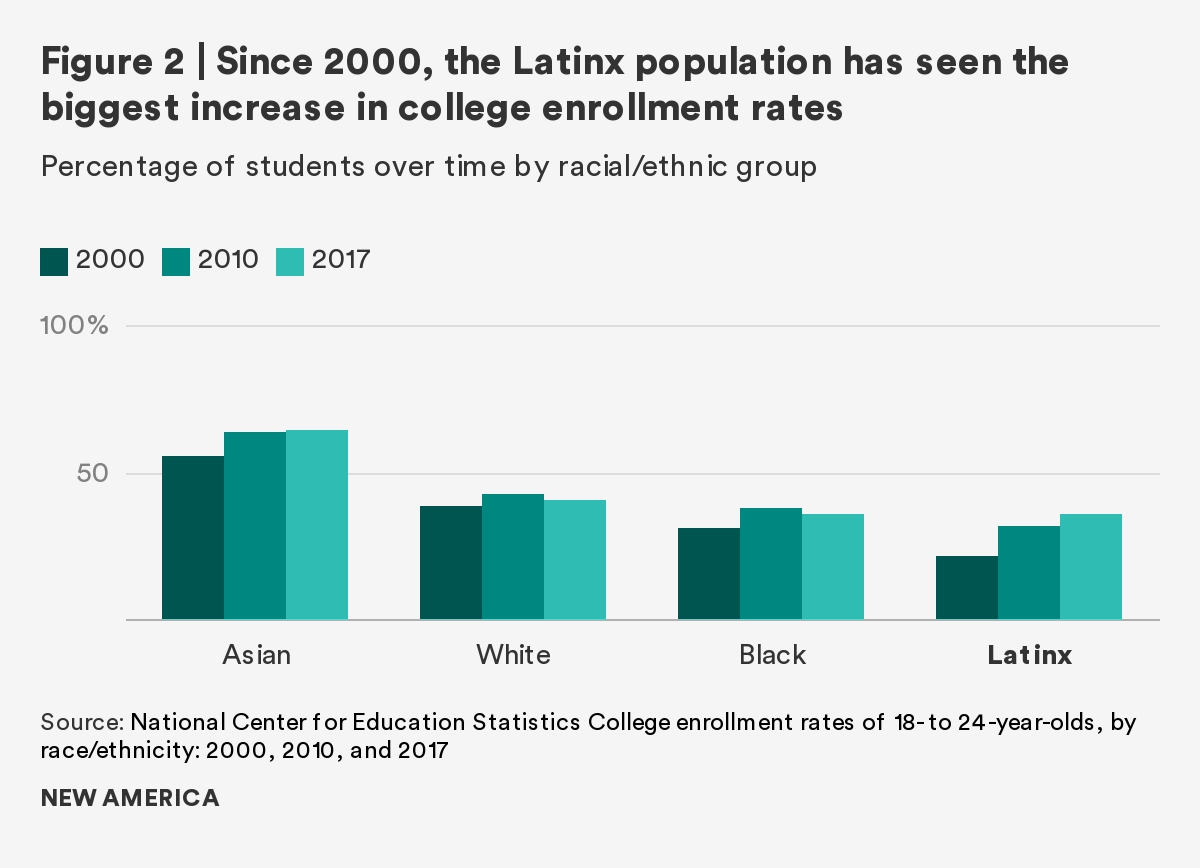
Despite these challenges, the number of Latinx individuals enrolling in college has been increasing steadily over the past two decades.52
Meeting Requirements for Educator Preparation Programs
Teacher candidates typically have to take a basic skills test and a content-specific test—and in an increasing number of states, a classroom performance assessment—on their path to becoming certified.53 The basic skills test in particular is often used as a prerequisite to being admitted into an educator preparation program. But candidates of color have lower passing rates on basic skills tests than their White peers, on average.54 The Education Testing Service, which produces the commonly used Praxis exams for prospective teachers, conducted an analysis and found that Latinx candidates were about 20 percent less likely to pass its Praxis I (core academic skills test focused on math, reading, and writing) than White test takers.55 While the intention of these tests may be to identify gaps in academic skills and to screen out candidates who do not have the knowledge or skills to be effective teachers,56 some research questions whether basic skills exams are strong predictors of effective teaching.57
Not surprisingly, then, the issue of testing requirements regularly comes up in discussions around how to recruit and prepare more teacher candidates, candidates of color and bilingual candidates in particular. What most concerns many advocates for a more diverse teaching workforce is that the basic skills test is often keeping otherwise-promising candidates from even being able to enter a preparation program. According to 2017 data from the National Council on Teacher Quality, 26 states required passing a basic skills test before entering a teacher preparation program, 20 states required passing a basic skills test during or upon completion of a preparation program, and five states did not require candidates to take a basic skills test.58
Earning a Bachelor’s Degree
Of the students who do graduate from high school and go on to college, some are so ill-prepared that they have to enroll in remedial education—courses that focus on basic skills in math and reading and do not count toward a degree—which ends up wasting time and money, and makes it less likely that they will persist and complete their college degree. In 2015–2016, 30 percent more Black and Latinx students than White students took a remedial course in college,59 which can be traced back to the English and math courses that Black and Latinx students are more likely to complete in high school, and inequitable access to strong teaching.60
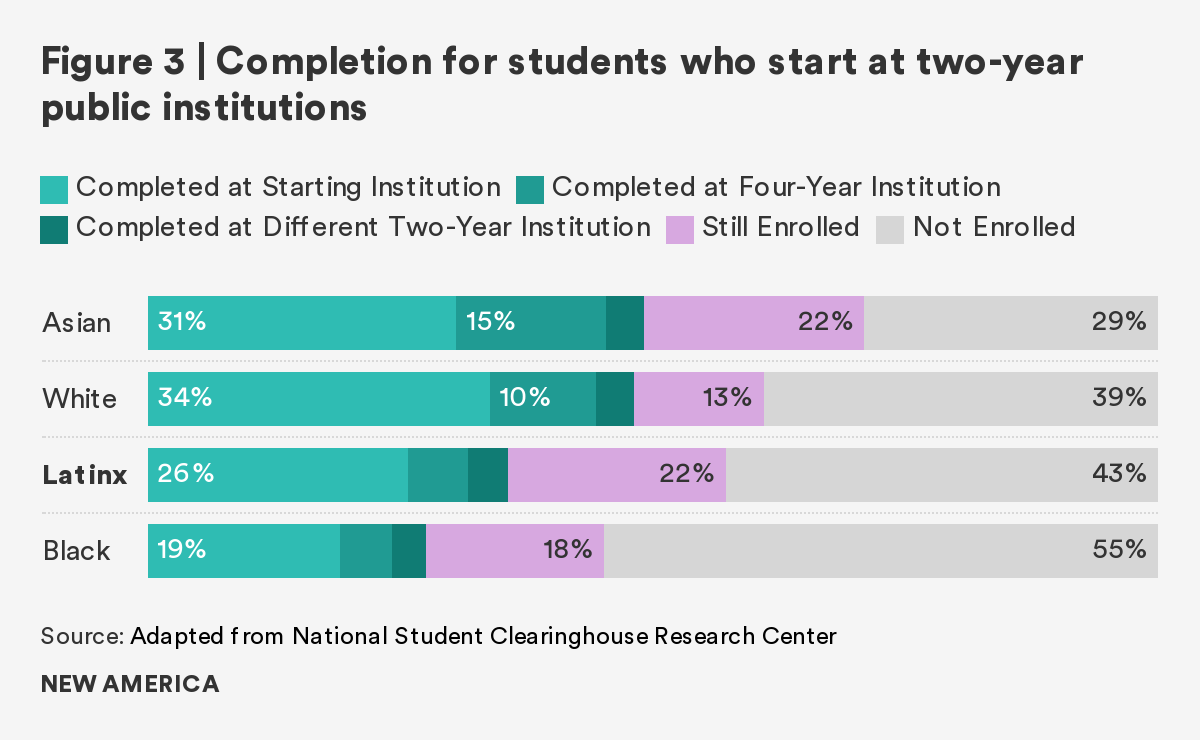
Another contributing factor to the lag in bachelor’s degrees for Latinx students is the high proportion of those who attend two-year community colleges and do not transfer to a four-year college. Once at a community college, students often struggle to transfer to a four-year college to complete their bachelor’s degree because of difficulty transferring credits or meeting more selective admission criteria at a four-year college.61 Latinx students who attend two-year colleges struggle to complete their degree more than other groups of students: of the Latinx students who started at a two-year public institution in 2012, only 36 percent completed a degree within six years, compared to 48 percent of White students.62
The pool of Latinx teachers is shallow because not enough Latinx students are graduating high school, enrolling in college, and earning a bachelor's degree.63 Of those who do attend and complete college, Latinx individuals become teachers at almost the same rate as White college graduates: 9 percent of Latinx graduates go on to teach, compared to 11 percent of White graduates.64
While the barriers on the pathway into teaching for Latinx students start early, a few key factors can help them over these barriers.
Addressing these barriers requires a multi-faceted and collaborative approach that spans the PreK–12 and higher education systems. We profile three pathways that are implementing such an approach to create a more robust Latinx teaching workforce. First is a pathway into teaching program in Skagit Valley, Washington, where collaboration between a state-funded high school teacher academy program, a local community college, and a four-year college provides Latinx students intensive advising to keep them on track to completing an education degree. Second is a long-standing program at an HSI in San Antonio, Texas that has recently extended its reach to high schools and community colleges to recruit more Latinx students into critical teaching shortage areas. And third is a partnership in Chicago, Illinois between the local public-school district and an HSI which has developed a bilingual teacher residency program that is helping non-certified staff and community members earn their teaching license.
Citations
- National Center for Education Statistics (website), Digest of Education Statistics, “Table 203.50. Enrollment and percentage distribution of enrollment in public elementary and secondary schools, by race/ethnicity and region: Selected years, fall 1995 through fall 2028,” March 2019, <a href="source">source">source; and National Center for Education Statistics (website), Digest of Education Statistics, “Table 209.10. Number and percentage distribution of teachers in public and private elementary and secondary schools, by selected teacher characteristics: Selected years, 1987–88 through 2015–16,” September 2017, <a href="source">source">source
- Throughout this paper, we use the term Latinx, a gender-neutral or non-binary alternative to Latino or Latina.
- Cristobal de Brey, Lauren Musu, Joel McFarland, Sidney Wilkinson-Flicker, Melissa Diliberti, Anlan Zhang, Claire Branstetter, and Xiaolei Wang, Status and Trends in the Education of Racial and Ethnic Groups, “Indicator 6: Elementary and Secondary Enrollment” (Washington, DC: U.S. Department of Education, February 2019), <a href="source">source">source, <a href="source">source">source
- Joel McFarland, Bill Hussar, Jijun Zhang, Xiaolei Wang, Ke Wang, Sarah Hein, Melissa Diliberti, Emily Forrest Cataldi, Farrah Bullock Mann, and Amy Barmer, The Condition of Education 2019, section 1.12, “Characteristics of Public School Teachers” (Washington, DC: U.S. Department of Education, May 2019), <a href="source">source">source <a href="source">source">source
- For more information on how Latinx teachers can improve Latinx student outcomes, see Cristóbal Rodríguez, Melissa A. Martinez, and Fernando Valle, “Latino Educational Leadership across the Pipeline: For Latino Communities and Latina/o Leaders,” Journal of Hispanic Higher Education 15, no. 2 (October 2016): 136–153, <a href="source">source">source; Carline S. Turner, Pedro X. Cosmé, Laura Dinehart, Raquel Martí, David McDonald, Martin Ramirez, Lester Sandres Rapalo, and Juan Zamora, Improving Diverse and Inclusive Teacher Pipelines with a Focus on Latinas/Latinos/Hispanics (Washington, DC: White House Initiative on Educational Excellence for Hispanics: 2017), <a href="source">source">source; and Mary Louise Gomez and Terri L. Rodriguez, “Imagining the Knowledge, Strengths, and Skills of a Latina Prospective Teacher,” Teacher Education Quarterly 38, no. 1 (Winter 2011): 127–146.
- Most research, particularly quantitative research, has been focused on Black teachers and Black students. One study by Travis J. Bristol found that, “to date, no quasi-experimental studies have explored the impact on Latinx students’ learning when taught by Latinx teachers.” While we can extrapolate from the various studies done on the impact of Black teachers on Black students, these effects may play out differently for different racial/ethnic groups. See Travis J. Bristol and Javier Martin-Fernandez, The Added Value of Latinx and Black Teachers for Latinx and Black Students: Implications for the Reauthorization of the Higher Education Act (Providence, RI: Annenberg Institute at Brown University, 2019), <a href="source">source">source
- Hua-Yu Sebastian Cherng and Peter F. Halpin, “The Importance of Minority Teachers: Student Perceptions of Minority versus White Teachers,” Educational Researcher 45, no. 7 (October 2016): 407–420, <a href="source">source">source
- Beatriz C. Clewell, Michael J. Puma, and Shannon A. McKay, "Does It Matter if My Teacher Looks Like Me? The Impact of Teacher Race and Ethnicity on Student Academic Achievement" (paper presented at the meeting of the American Educational Research Association, Montreal, 2005).
- Patricia Gándara, Leticia Oseguera, Lindsay Pérez Huber, Angela Locks, Jongyeon Ee, and Daniel Molina, Making Education Work for Latinas in the U.S. (Los Angeles, CA: The Civil Rights Project, 2013), <a href="source">source">source
- Todd Kettler and Luke T. Hurst, “Advanced Academic Participation: A Longitudinal Analysis of Ethnicity Gaps in Suburban Schools,” Journal for the Education of the Gifted 40, no. 1 (March 2017): 3–19.
- Belinda Bustos Flores, Ellen Riojas Clark, Lorena Claeys, and Abelardo Villarreal, “Academy for Teacher Excellence: Recruiting, Preparing, and Retaining Latino Teachers Through Learning Communities,” Teacher Education Quarterly 34, no. 4 (Fall 2007): 53–69, <a href="source">source">source
- Tara Stevens, Mary Frances Agnello, Janie Ramirez, Aretha Marbley, and Doug Hamman, “Project FUTURE: Opening Doors to Diverse West Texas Teachers,” Teacher Education Quarterly 34, no. 4 (Fall 2007): 103–120, <a href="source">source">source; Kip Téllez, “Preparing Teachers for Latino Children and Youth: Policies and Practice,” The High School Journal 88, no. 2 (2004): 43–54, <a href="source">source">source; and Barry M. Goldenberg, “White Teachers in Urban Classrooms: Embracing Non-White Students’ Cultural Capital for Better Teaching and Learning,” Urban Education 49, no. 1 (January 2014): 111–144.
- For more on the diversity of the U.S. Latinx population, see Antonio Flores, “How the U.S. Hispanic Population is Changing,” Fact Tank, Pew Research Center, September 18, 2017, <a href="source">source">source
- Ana Maria Villegas and Jacqueline Jordan Irvine, “Diversifying the Teaching Force: An Examination of Major Arguments,” The Urban Review 42, no. 3 (September 2010): 175–192; and Mary Louise Gomez, Terri L. Rodriguez, and Vonzell Agosto, “Who are Latino Prospective Teachers and What do They Bring to US Schools?” Race Ethnicity and Education 11, no. 3 (September 2008): 267–283.
- Evelyn M. Weisman, Susana Y. Flores, and Christine Valenciana, “Building Bilingual–Bicultural Learning Communities: Experiences of Latino Teacher Candidates,” Journal of Hispanic Higher Education 6, no. 3 (July 2001): 191–208.
- For more information on Latinx teachers’ experiences and how they advocate for their students, see Margarita Ines Berta-Avila, “Critical Xicana/Xicano Educators: Is It Enough to be a Person of Color?” The High School Journal 87, no. 4 (April–May 2004): 66–79; Rene Galindo, “Reframing the Past in the Present: Chicana Teacher Role Identity as a Bridging Identity,” Education and Urban Society 29, no. 1 (1996): 85–102; Mary Louise Gomez, Terri L. Rodriguez, and Vonzell Agosto, “Who are Latino Prospective Teachers and What do They Bring to US Schools?” Race Ethnicity and Education 11, no. 3 (September 2008): 267–283; Gilda L. Ochoa, Learning from Latino Teachers (San Francisco, CA: Jossey-Bass, 2007); and Zhixin Su, “Teaching as a Profession and as a Career: Minority Candidates' Perspectives,” Teaching and Teacher Education 13, no. 3 (April 1997): 325–340; Christopher Redding, “A Teacher Like Me: A Review of the Effect of Student-Teacher Racial/Ethnic Matching on Teacher Perceptions of Students and Student Academic and Behavioral Outcomes,” Review of Educational Research 89, no. 4 (August 2019): 499–535.
- The U.S Department of Education defines an English Learner (EL) as "an individual who, due to any of the reasons listed below, has sufficient difficulty speaking, reading, writing, or understanding the English language to be denied the opportunity to learn successfully in classrooms where the language of instruction is English or to participate fully in the larger U.S. society. Such an individual (1) was not born in the United States or has a native language other than English; (2) comes from environments where a language other than English is dominant; or (3) is an American Indian or Alaska Native and comes from environments where a language other than English has had a significant impact on the individual’s level of English language proficiency.” See Joel McFarland, Bill Hussar, Jijun Zhang, Xiaolei Wang, Ke Wang, Sarah Hein, Melissa Diliberti, Emily Forrest Cataldi, Farrah Bullock Mann, and Amy Barmer, The Condition of Education 2019, “Glossary,”section 1.7, “English Language Learners in Public Schools” (Washington, DC: U.S. Department of Education, May 2019), <a href="source">source">source, <a href="source">source">source, and <a href="source">source">source
- Joel McFarland, Bill Hussar, Jijun Zhang, Xiaolei Wang, Ke Wang, Sarah Hein, Melissa Diliberti, Emily Forrest Cataldi, Farrah Bullock Mann, and Amy Barmer, The Condition of Education 2019, section 1.7, “English Language Learners in Public Schools” (Washington, DC: U.S. Department of Education, May 2019), <a href="source">source">source, <a href="source">source">source; and National Center for Education Statistics (website), Digest of Education Statistics, “Table 203.50. Enrollment and percentage distribution of enrollment in public elementary and secondary schools, by race/ethnicity and region: Selected years, fall 1995 through fall 2025,” March 2019, <a href="source">source">source
- For a complete list of teacher shortage areas, see Freddie Cross, Teacher Shortage Areas: Nationwide Listing 1990–1991 through 2017–2018 (Washington, DC: U.S. Department of Education, June 2017), <a href="source">source">source
- National Center for Education Statistics (website), Digest of Education Statistics, “Number and percentage distribution of teachers in public and private elementary and secondary schools, by selected teacher characteristics: Selected years, 1987–88 through 2015–16,” September 2017, <a href="source">source">source
- For more on traditional versus alternative routes into teaching see Kate Walsh and Sandi Jacobs, Alternative Certification Isn’t Alternative (Washington, DC: Thomas B. Fordham Institute, 2007), source">source
- Research suggests this is because students often feel silenced and marginalized in their classes—often being in courses with few to no other students of color—and encounter curricula that does not reflect their experience. See Ana M. Villegas and Danne E. Davis, “Approaches to Diversifying the Teaching Force: Attending to Issues of Recruitment, Preparation, and Retention,” Teacher Education Quarterly 34, no. 4 (January 2007): 137–147; and Jason G. Irizarry, “En la Lucha: The Struggles and Triumphs of Latino/a Preservice Teachers,” Teachers College Record 113, no. 12 (2011): 2804–2835.
- When Congress reauthorized the Higher Education Act in 1994, it created a new designation for Hispanic-Serving Institutions, schools whose undergraduate full-time equivalent enrollment is at least 25 percent or more Latinx, in order to provide additional financial support to institutions of higher education that prepared a significant portion of Hispanic students. In 2017–18, there were 523 HSIs, representing 17 percent of IHEs. See Deborah A. Santiago, Julie Laurel, Janette Martinez, Claudia Bonilla, and Emily Labandera, Latinos in Higher Education: Compilation of Fast Facts (Washington, DC: Excelencia for Education, April 2019), source">source
- For more on why students choose HSIs, see Deborah A. Santiago, Choosing Hispanic-Serving Institutions (HSIs): A Closer Look at Latino Students’ College Choices (Washington, DC: Excelencia in Education, 2007), source">source
- Percentages based on correspondence with the Office of Postsecondary Education at the U.S. Department of Education on October 4, 2019.
- Title II Higher Education Act (website), “2018 Title II Reports: National Teacher Preparation Data,” source">source
- For more on alternative routes into the profession, see Julie R. Woods, Mitigating Teacher Shortages: Alternative Teacher Certification (Denver, CO: Education Commission of the States, 2016), source">source; and Sarah E. Birkeland and Heather G. Peske, Literature Review of Research on Alternative Certification (Washington, DC: National Education Association, 2004), source">source
- Joel McFarland, Bill Hussar, Xiaolei Wang, Jijun Zhang, Ke Wang, Amy Rathbun, Amy Barmer, Emily Forrest Cataldi, and Farrah Bullock Mann, “The Condition of Education 2018, Characteristics of Public School Teachers Who Completed Alternative Route to Certification Programs,” Institute of Education Sciences, National Center for Education Statistics (website), May 2018), source">source, source">source
- For more on why alternative routes into the profession attract diverse teacher candidates, see Kelly M. Ocasio, “'Nuestro Camino’: A Review of Literature Surrounding the Latino Teacher Pipeline,” Journal of Latinos and Education 13, no. 4 (2014): 244–261; Julie R. Woods, Mitigating Teacher Shortages: Alternative Teacher Certification (Denver, CO: Education Commission of the States, 2016), source">source; and Amaya Garcia, Building a Bilingual Teacher Pipeline: Bilingual Teacher Fellows at Highline Public Schools (Washington, DC: New America, 2017), source">source
- Traditional programs already tend to have more lax admission criteria than other programs within the institution According to research by the National Council on Teacher Quality, teacher preparation programs often have lax admissions requirements, which are not designed to draw from the top-half of college-going students. For more on their teacher preparation review’s selection criteria, see Sam Lubell, Graham Drake, and Hannah Putman, “A Closer Look at Selection Criteria, Secondary Undergraduate Programs,” source">source; and “A Closer Look at Selection Criteria, Undergraduate Elementary Programs,” source">source. These are a component of the broader Landscapes in Teacher Prep (Washington, DC: National Council on Teacher Quality, May 2017), source">source. For more on alternative routes, see Carlyn Ludlow, “Alternative Certification Pathways: Filling a Gap?” Education and Urban Society 45, no. 4 (July 2013): 440–458.
- Pathways to Teaching (Washington, DC: U.S. Department of Education, 2016), source">source
- Research suggests Grow Your Own programs, partnerships among educator preparation programs, school districts, and community organizations, can increase access into the teaching profession for underrepresented populations, are often designed to help fill local teacher shortages and to remove common barriers to earning a teaching degree. Candidates typically earn their credential while working in schools and taking the courses necessary to earn certification. See Conra Gist, Margarita Bianco, and Marvin Lynn, “Examining Grow Your Own Programs Across the Teacher Development Continuum: Mining Research on Teachers of Color and Nontraditional Educator Pipelines,” Journal of Teacher Education 70, no. 1 (2019): 13–25; and New America, Grow Your Own Programs for Bilingual Educators: Essential Policies and Practices (Washington, DC: New America, 2019), source">source
- For more information on preschool effectiveness, see Beth Meloy, Madelyn Gardner, and Linda Darling-Hammond, Untangling the Evidence on Preschool Effectiveness Insights for Policymakers (Washington, DC: Learning Policy Institute: 2019), source
- Low enrollment rates for Latinx children can be attributed to factors such as unaffordable preschool, lack of availability in local preschools, and immigration status. For more, see Kevin Lindsey and Mimi Howard, Access to Preschool for Hispanic and Latino Children (Washington, DC: First Focus, 2013), source
- For more on Latinx students’ schooling experiences, see Patricia Gándara, “Overcoming Triple Segregation,” Educational Leadership 68, no. 3 (November 2010): 60–64, source; and Emma García and Elaine Weiss, The Teacher Shortage is Real, Large and Growing, and Worse Than we Thought (Washington, DC: Economic Policy Institute, March 26, 2019), source
- Toneka M. Green, The Racial Academic Achievement Gap (online submission, 2008), source
- See page 5 for main study findings. Watson Scott Swail, Alberto F. Cabrera, and Chul Lee, Latino Youth and the Pathway to College (Washington, DC: Pew Hispanic Center, 2004), source
- Joel McFarland, Bill Hussar, Jijun Zhang, Xiaolei Wang, Ke Wang, Sarah Hein, Melissa Diliberti, Emily Forrest Cataldi, Farrah Bullock Mann, and Amy Barmer, The Condition of Education 2019, section 1.17, “Public High School Graduation Rates” (Washington, DC: U.S. Department of Education, May 2019), source source
- Deborah A. Santiago, Julie Laurel, Janette Martinez, Claudia Bonilla, and Emily Labandera, Latinos in Higher Education: Compilation of Fast Facts (Washington, DC: Excelencia for Education, 2019), source
- The Education Trust (website), “School Counselors Matter,” February 1, 2019, source; and Erin Kimura-Walsh, Erica K. Yamamura, Kimberly Griffin, and Walter Allen, “Achieving the College Dream? Examining Disparities in Access to College Information Among High Achieving and Non-High Achieving Latina Students,” Journal of Hispanic Higher Education 8, no. 3 (July 2009): 298–315.
- Ashley Edwards, “Hispanic Poverty Rate Hit an All-Time Low in 2017,” America Counts: Stories Behind the Numbers (blog), U.S. Census Bureau, February 27, 2019, source
- For more information on loan aversion, see Angela Boatman, Brent J. Evans, and Adela Soliz, “Understanding Loan Aversion in Education: Evidence from High School Seniors, Community College Students, and Adults,” AERA Open 3 (January–March 2017): 1–16,source. Despite being more loan averse, research finds that Latinx students who do attend college and train to be teachers are actually more likely to borrow federal student loans compared to White students. According to a Center for American Progress analysis of debt burden for students of color, 82 percent of Latinxs who trained to be teachers borrowed federal student loans, compared to 76 percent of White students. One possible contributing factor may be that the median family income of education students who are White and dependent is more than double that of their Latinx and Black peers. For more information, see Jacqueline E. King, Education Students and Diversity: A Review of New Evidence (Washington, DC: American Association of Colleges for Teacher Education, 2019).
- For more on why Latinx students choose two-year colleges, see Jens M. Krogstad, 5 Facts About Latinos and Education (Washington, DC: Pew Research Center, 2016), source; Deborah A. Santiago, Julie Laurel, Janette Martinez, Claudia Bonilla, and Emily Labandera, Latinos in Higher Education: Compilation of Fast Facts (Washington, DC: Excelencia for Education, 2019), source; Michal Kurlaender, “Choosing Community College: Factors Affecting Latino College Choice,” New Directions for Community Colleges 133 (Spring 2006): 7–16; Anne-Marie Núñez, Johnelle Sparks, and Eliza A. Hernández, “Latino Access to Community Colleges and Hispanic-Serving Institutions: A National Study,” Journal of Hispanic Higher Education 10, no. 1 (January 2011): 18–40; and Victor B. Saenz, “Hispanic Students and Community Colleges: A Critical Point for Intervention,” Eric Digest (2002), source
- Michael E. Woolley, “Supporting School Completion Among Latino Youth: The Role of Adult Relationships,” Prevention Researcher 16, no. 3 (January 2009): 9–12; David S. DeGarmo and Charles R. Martinez Jr., “A Culturally Informed Model of Academic Well‐Being for Latino Youth: The Importance of Discriminatory Experiences and Social Support,” Family Relations 55, no. 3 (July 2006): 267–278.
- Floralba A. Marrero, “Barriers to School Success for Latino Students,” Journal of Education and Learning 5, no. 2 (March 2016): 180–186, source
- Miguel Ceja, “Chicana College Aspirations and the Role of Parents: Developing Educational Resiliency,” Journal of Hispanic Higher Education 3, no. 4 (October 2004): 338–362, source;
- Mark Hugo Lopez, Latinos and Education: Explaining the Attainment Gap (Washington, DC: Pew Hispanic Center, 2009), source
- Belinda Bustos Flores, Ellen Riojas Clark, Lorena Claeys, and Abelardo Villarreal, “Academy for Teacher Excellence: Recruiting, Preparing, and Retaining Latino Teachers Through Learning Communities,” Teacher Education Quarterly 34, no. 4 (Fall 2007): 53–69, source
- Kelly M. Ocasio, “'Nuestro Camino’: A Review of Literature Surrounding the Latino Teacher Pipeline,” Journal of Latinos and Education 13, no. 4 (2014): 244–261; and Madeline Will, Most People Wouldn’t Want Their Child to Become a Teacher, Poll Finds (Washington, DC: Education Week, 2018), source
- Zhixin Su, “Why Teach? Profiles and Entry Perspectives of Minority Students as Becoming Teachers,” Journal of Research and Development 29, no. 3 (Spring 1996): 117–133.
- Zhixin Su, “Why Teach? Profiles and Entry Perspectives of Minority Students as Becoming Teachers,” Journal of Research and Development 29, no. 3 (Spring 1996): 117–133, 126.
- Joel McFarland, Bill Hussar, Jijun Zhang, Xiaolei Wang, Ke Wang, Sarah Hein, Melissa Diliberti, Emily Forrest Cataldi, Farrah Bullock Mann, and Amy Barmer, The Condition of Education 2019, section 2.2, “College Enrollment Rates” (Washington, DC: U.S. Department of Education, May 2019), source source; John Gramlich, Hispanic Dropout Rate Hits New Low, College Enrollment at New High (Washington, DC: Pew Research Center, 2017), source; and Jens M. Krogstad, 5 Facts About Latinos and Education (Washington, DC: Pew Research Center, 2016), source
- For example, in 2018, at least 16 states required or allowed the edTPA and/or another teacher performance assessment as part of the process for entering the teaching profession. See “State edTPA Policy Overview,” October 2018, source;
- One caveat is that there is some recent research that shows that edTPA, a performance-based certification assessment, better predicts performance in the classroom and shows smaller racial gaps. One study in North Carolina showed that candidates’ edTPA scores predict the ability to raise student achievement and their own evaluation ratings during their first year of teaching. Another study in Washington showed connections between passing the edTPA and effectiveness as English teachers, according to Linda Tyler, Brooke Whiting, Sarah Ferguson, Segun Eubanks, Jonathan Steinberg, Linda Scatton and Katherine Bassett, Toward Increasing Teacher Diversity: Targeting Support and Intervention for Teacher Licensure Candidates (Princeton, NJ: Educational Testing Service, 2011), source, source
- Linda Tyler, Brooke Whiting, Sarah Ferguson, Segun Eubanks, Jonathan Steinberg, Linda Scatton and Katherine Bassett, Toward Increasing Teacher Diversity: Targeting Support and Intervention for Teacher Licensure Candidates (Princeton, NJ: Educational Testing Service, 2011), source; and Educational Testing Service (website), “About the Praxis Tests,” source
- Drew H. Gitomer, Terran L. Brown, and John Bonett, “Useful Signal or Unnecessary Obstacle? The Role of Basic Skills Tests in Teacher Preparation,” Journal of Teacher Education 62, no. 5 (2011): 431–445.
- Jason Greenberg Motamedi, Melinda Leong, and Havala Hanson, Potential Testing Barriers for Teacher Candidates of Color (Portland, OR: Regional Educational Laboratory Northwest, 2018), source
- National Council on Teacher Quality (website), “Program Entry: 2017 General Teacher Preparation Policy,” updated July 2018, source
- National Center for Education Statistics, Web Tables, Profile of Undergraduate Students: Attendance, Distance and Remedial Education, Degree Program and Field of Study, Demographics, Financial Aid, Financial Literacy, Employment, and Military Status: 2015–16, (Washington, DC: U.S. Department of Education, 2019), source
- Laura Jimenez, How Delaware Aims to Improve College Readiness (Washington, DC: Center for American Progress, 2019), source
- Kelly M. Ocasio, “'Nuestro Camino’: A Review of Literature Surrounding the Latino Teacher Pipeline,” Journal of Latinos and Education 13, no. 4 (2014): 244–261.
- The National Student Clearinghouse examined the 2012 fall cohort of students’ first degree or certificate earned after six years, by starting institution. See Doug Shapiro, Afet Dundar, Faye Huie, Phoebe K. Wakhungu, Ayesha Bhimdiwala, and Sean Eric Wilson, Completing College: A National View of Student Completion Rates—Fall 2012 Cohort, Signature Report No. 16 (Herndon, VA: National Student Clearinghouse Research Center, 2018), source
- Constance A. Lindsay, Erica Blom, and Alexandra Tilsley, Diversifying the Classroom: Examining the Teacher Pipeline (Washington, DC: Urban Institute, 2017), source
Profile: Skagit Valley’s Supported Teacher Pathway

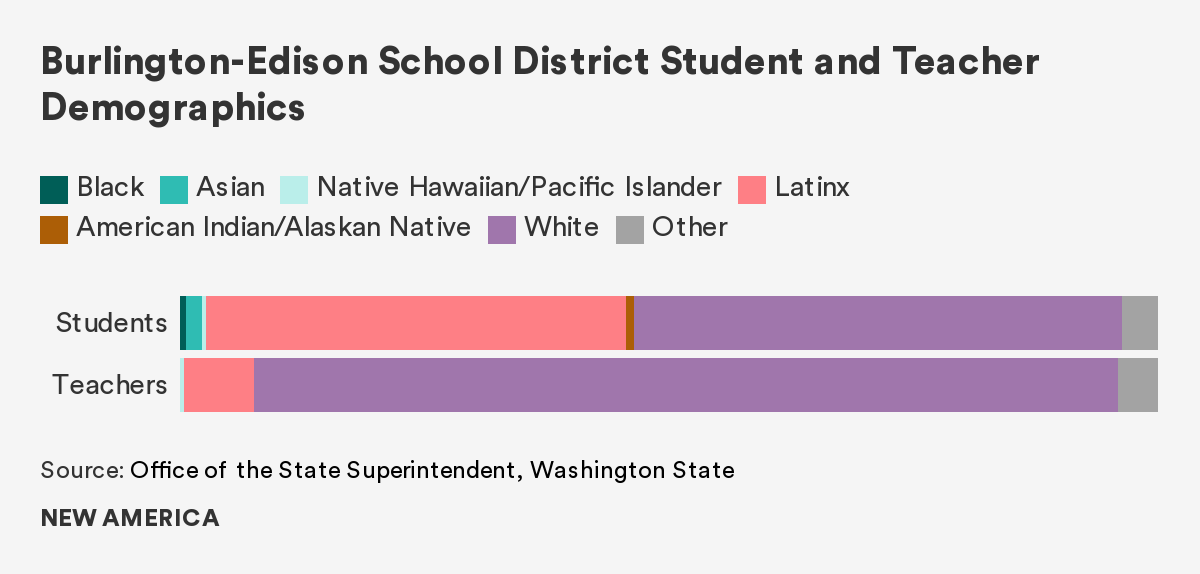
In 2012, a group of educators in Skagit Valley, just west of the Cascade mountains in northwestern Washington State, decided they needed to better serve their Latinx students. Schools in the region had experienced a rise in the Latinx student population over the last decade, with districts like Burlington-Edison surging in the decade between 2007 and 2017 from 27 percent to 43 percent. But schools were not adequately serving this growing Latinx student population, which generally had high dropout rates and were unable to meet the academic standards to enter and succeed in higher education.
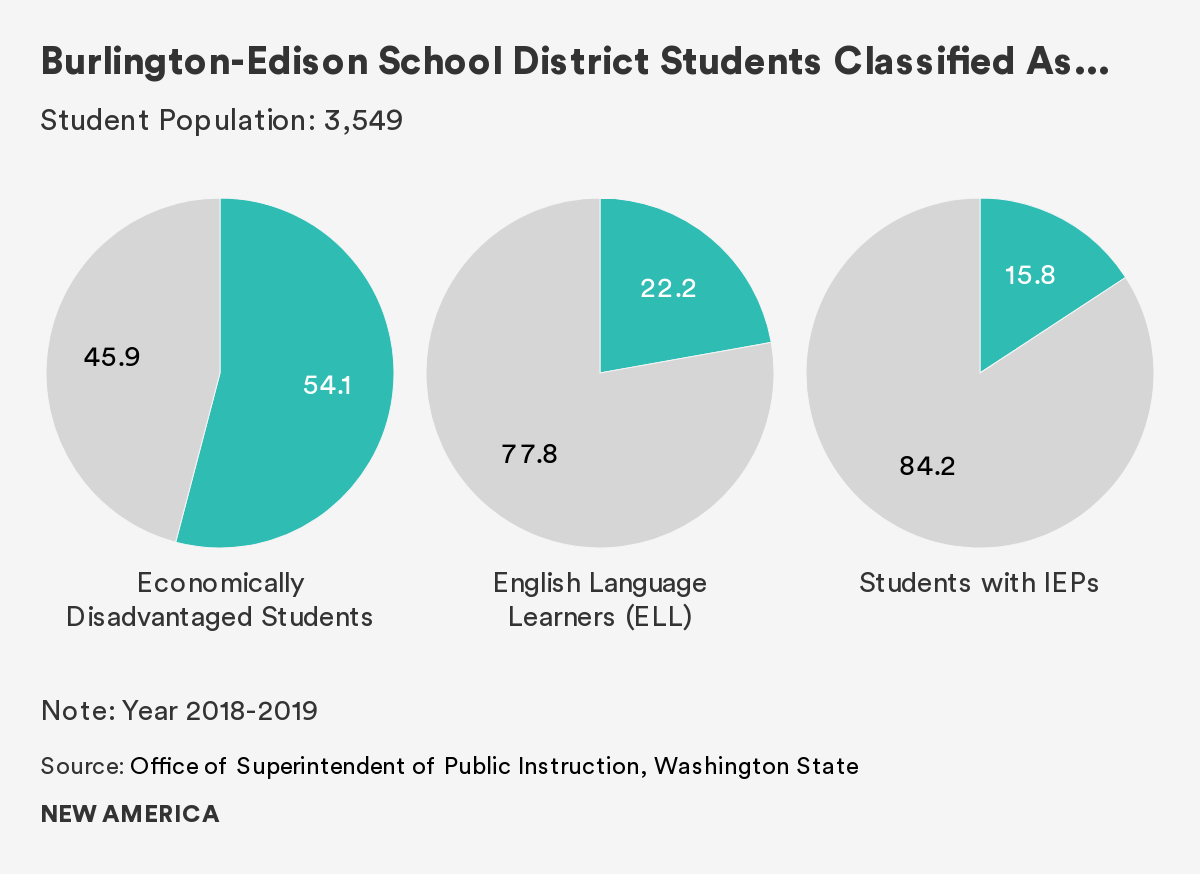
The educators believed that reducing the stark difference between students’ and teachers’ racial/ethnic identities—only 7 percent of Burlington-Edison’s teachers are Latinx—was one key strategy to improving student outcomes.65 Soon after, two local high schools (Burlington-Edison High School and Mount Vernon High School) worked with Skagit Valley College and Western Washington University’s Woodring College of Education to create the Maestros Para el Pueblo (“Teachers for the Community”) program in an effort to “grow their own” Latinx teachers.
The state of Washington already had a program that focused on diversifying the educator workforce through targeted recruitment and preparation of high school students from underrepresented backgrounds, which was run by its Professional Educator Standards Board (PESB). Named Recruiting Washington Teachers (RWT),66 the program recruits and supports students from underrepresented backgrounds, uses a curriculum focused on equity, and gives students an opportunity to tutor students in elementary and middle schools. In fact, the RWT program was having great success in boosting graduation and college enrollment for students of color: 96 percent of RWT students graduated high school on time, and 87 percent of RWT students applied to college and were accepted.67
But the Skagit Valley educators group realized that if RWT’s primary goal was to grow its own diverse teacher workforce, that goal was mostly unrealized.68 About half of the former RWT students were pursuing other career goals in college and the other half struggled to complete their degrees without the support they had in their high school program. While RWT had helped high school students overcome academic challenges, the group felt that it needed to bring some of the RWT elements like mentorship, professional relationships, and contextualized learning to the higher education level to help shepherd students through the pathway into teaching. The group also identified other challenges on the route to becoming a teacher for this community of students: the teacher candidate entrance exam, particularly for bilingual students; the need for academic advising and guidance; and a lack of financial resources.
The dean of Western Washington University’s Woodring College of Education; the president of Skagit Valley College; and teachers, staff, and superintendents of the Mount Vernon and Burlington-Edison school districts formed a leadership group for the Maestros Para el Pueblo (Maestros) program. The two districts, community college, and university hired dedicated staff in 2014 to provide comprehensive support as students make their way along each step of the path from high school to teacher certification. (see below).
Recruiting Washington Teachers (RWT) at Burlington-Edison High School
In 2006, Michael Sampson was in his first year of teaching ELs at Burlington-Edison High School when he saw the need for a course focused on college and career readiness for his mostly Latinx students.69 Three years later, in 2009, Burlington-Edison received its first RWT grant and the “Latinos in Action” course he had brought to the school transitioned into the school's RWT program.70
A decade later, students in the RWT program at Burlington-Edison are getting the chance to explore the teaching profession, while also surpassing their peers academically. State legislation mandates that the RWT program be evaluated every year to gauge its effectiveness and impact. The 2018 program evaluation highlighted the program’s success at recruiting and graduating Latinx students: at Burlington-Edison High School, 89 percent of RWT students were Latinx, and 97 percent of RWT seniors graduated on time. Although students who chose to participate in RWT may have already been more likely to graduate from high school, these graduation rates were described by grantees as “unheard of for students of comparable backgrounds in their districts.”71
| 2017–2018 | Burlington-Edison RWT (47 students) | Burlington-Edison High School (1,048 students) | State |
|---|---|---|---|
| Percent Latinx | 89% | 33% | 23% |
| Graduation rate | 97% | 83% | 81% |
Juniors and seniors start their pathway to teaching through the RWT course, which is organized into two semesters. The first semester is focused on leadership, identity/cultural background, and training for the tutoring placement they have their second semester at local elementary and middle schools. The course is articulated with Skagit Valley College as an introduction to education course and a leadership seminar—students are able to receive up to seven college credits for the year-long sequence.
The RWT course is open to any student who wants to participate, but recruitment is targeted at students from groups that are underrepresented in the field of education. Most students report hearing about the program from the RWT teacher or from a friend or classmate. In 2018–2019, the course served 22 seniors and 18 juniors, with 34 of the 40 students identifying as Latinx. Additionally, 20 of the 40 students qualified as ELs. While the program’s focus is on recruiting and training potential future teachers, Sampson’s RWT class also focuses on supporting bilingual students in exploring their culture, building leadership skills, and encouraging them to enroll in postsecondary education.
Since 2014, Sampson has had the support of Nallely Carreón Carrillo, bilingual graduation specialist at Burlington-Edison and an alumna of the school’s RWT program. Carreón Carrillo co-facilitates the course and offers guidance and support to its students. Having Carreón Carrillo support the program has helped raise students’ perceptions of what they can accomplish. One current student said, “I think what this class provides for students is the opportunity to see yourself in a successful and driven person. And you think, if she did it, I can do it too.”72
Sampson and Carreón Carrillo have helped build a strong community within the program. Reflecting on her own experience as an RWT student, Carreón Carrillo noted that by the end of the class, it felt as if they were a family. Similarly, students in the program described the benefit of being in a class with students from similar backgrounds. One current student said, “Being in a class where you all have similar backgrounds, you come from parents who are Latinos, it feels good. You feel very welcome. And you don't feel different at all; it would be great to have this in every school.”73
When asked about how he talks to RWT students about pursuing a career in teaching, Sampson said, “we're working with [teenagers] … to [expect them to] know exactly what they're going to do in the future is a little bit naive. So, our approach is much more subtle. But we hope that we're modeling a real, legitimate career choice for them.”74
Like most programs that recruit high school students, Burlington-Edison struggles to comprehensively track how many students ultimately pursue careers in education. Anecdotal evidence indicates that some do. When describing the impact of the program, one alumna who works as an elementary EL/family advocate said, “The class really made me realize how much I love working with kids. And I don't know if I'd be where I am today if I hadn't taken that class.”75 Another program alumnus who is pursuing his master’s at Woodring said, “The first time I thought of being an educator was probably my sophomore or junior year in high school. I really didn't know what I wanted. I’m a first-generation [college]student, you know. These questions don't really come up in my household. But I think the reason why I felt like I wanted to be in education was that I had a lot of teachers in high school who really pushed me to graduate.” He added, “once I got into the [RWT] career in education class, that opened up my eyes a lot. It really helped me solidify that I wanted to become a teacher.”76
Whether students end up pursuing a career in teaching or not, it is clear that Sampson makes a significant impact on his students and their future. Sampson's current and former students speak about him with deep admiration and appreciation. One former student said that Sampson provided a level of support that was rare: "Knowing that I had [a person] that I knew I could go to, even if I thought maybe it was a dumb question, [he] was there to support me whatever it was … pushed me to become better."77 Another alumna referred to Sampson as a “Swiss Army knife” because he offers to help by connecting students with colleges, accessing financial aid, helping to make decisions about their future, and more.
When reflecting on his students’ outcomes, Sampson said,
I think that students leave us with a sense of self that is incredibly strong. It is connected to their cultural/familial heritage which allows them to grow and mature in ways that are quite powerful. They are adept at navigating spaces that are incredibly diverse, and they do so with confidence. Whether they are speaking to a legislator, a big audience, or to a kindergartener, you can see that they are aware of how they fit and that they each have something important to bring to the table. When they achieve, it comes from a deep understanding of who they are, which allows them to go forward with an intention that is uncommon for high school and young college students.
Maestros Para el Pueblo at Skagit Valley College
After high school graduation, RWT students who decide to enroll at Skagit Valley College (SVC) become part of the Maestros Para el Pueblo program, which provides support by connecting them to financial resources and providing one-on-one guidance, counseling, and an articulated pathway to a degree in teaching.
In 2014, SVC and Western Washington University’s Woodring College of Education jointly hired a multicultural recruitment and retention specialist in order to help formalize the partnership and provide coherence to their respective effort. This individual is at the heart of the efforts to support RWT students’ transition from high school, persistence at SVC, and ultimately transition to WWU’s college of education.
However, Daisy Padilla-Torres, the program’s counseling and advising navigator, believed it was critical to start building relationships with students before they get to college.78 She spent time at the two partner high schools talking to RWT students about what pathway they want to pursue after high school and what they need to do in order to get there. Students who want to pursue the elementary/secondary teaching pathway, which requires transferring to a four-year university to attain a bachelor’s degree, are encouraged to attain an associate in arts Direct Transfer Agreement (AA-DTA) degree at SVC. Doing so allows all of their credits to transfer to Western Washington University, or any other four-year college in Washington state.79
Padilla-Torres saw the Maestros program as an opportunity to humanize the higher education experience, as the program is not only focused on the transactional pieces of the transition from high school to higher education, but also the humanitarian piece of it. While most institutions of higher education have historically divided the two, or ignored the latter, Padilla-Torres said she tended to mix them: “I want to get to know the students holistically. I'm not only interested in Juan the student, and what he's going to come and study here, I'm also interested in Juan the person.”80
The Maestros program has served 150 students since 2014, including 39 Burlington-Edison graduates. In 2018–2019, there were 57 Maestros students actively enrolled at SVC, 10 of whom graduated from SVC in spring 2019. In 2018–2019, the retention rate for Maestros students at SVC was 86 percent, 5 percent higher than the general student body retention rate that same year.
Continuing on the Maestros Pathway at Woodring College of Education
Nat Reilly, diversity recruitment and retention specialist at Western Washington University’s Woodring College of Education (Woodring), worked with transferring Maestros students.81 Like Padilla-Torres at SVC, Reilly started to develop relationships with students while in high school and at SVC to help them with their transition to Woodring. Even though students were not enrolled at Woodring yet, Reilly saw her time investment as an opportunity to increase the likelihood that students would actually make it to Woodring, given the challenges students have with transferring from a two-year to a four-year college.
In addition to connecting students to resources at the university and offering guidance, Reilly worked with Woodring and the university at large to understand better ways to structure and support teaching pathways for RWT and Maestros students. To strengthen the partnership between institutions, SVC and Woodring agreed to a conditional admissions process for students that come through the Maestros program and have met program entrance requirements. In order for students to apply for conditional admission, students must:82
- Complete the Recruiting Washington Teachers program in high school.
- Enroll in a Direct Transfer Agreement (DTA) associate degree program at SVC.
- Participate quarterly in SVC advising sessions to prepare to meet requirements for Woodring programs.
- Complete a minimum of 45 transferable college credits with a minimum GPA of 2.75.
- Complete a brief online pre-application.
Reilly saw a lot of potential in the conditional admissions process for keeping Latinx students on the path to teaching. “We have a shortage of not only teachers of color, but bilingual teachers, [and we] have this hand-picked [group of students] who have already demonstrated their ability and their proficiency. So why not minimize barriers for them to be able to persist?”83 Reilly said. For students going through the Maestros pathway, it is an opportunity for them to pursue their interest in teaching and stay in their local community. “The Maestros program is specifically for people who want to go back and teach in the [Skagit] valley. That's why it’s called Maestros Para el Pueblo,” said one alumnus who is currently enrolled at Woodring. “That's why I wanted to do it originally, go back to the valley and serve my community because I've lived there my whole life. Just seeing students who are like me growing up and not having somebody who looks like them or somebody that they feel connected to. That's what I missed out on.”
There are 61 students currently enrolled at Western Washington University who came up through the Maestros pathway. Three students from the first Maestros cohort graduated from Woodring in 2017–2018, and three students were expected to graduate in spring of 2019. Woodring hopes to place them in teaching positions in local districts.
Challenges
Leaders and educators in Skagit Valley have taken several steps to help students along the pathway into teaching, but challenges still exist in moving students from high school to community college to a four-year college.
Staffing and Capacity
Implementation for each program is highly dependent on one person. At the high school level, it is the RWT teacher; at the community college level, it is the navigator for the Maestros program; and at the four-year college level, it is the recruitment and retention specialist. When students talked about their experiences, it was clear that they were talking about the very personalized support that they received from these individuals, and less about systematized processes. This brings into question how much of the positive outcomes are due to the pathway itself, versus the specific staff members who are interacting with the students. It highlights the importance of hiring the right individuals for these roles.
But the fact that each program is being supported primarily by one person means that one person has a large caseload and is stretched thin. One Woodring student said, “Daisy works with 60, 70 students. It's always hard to find a time to meet with her. And usually [Daisy and Nat] are taking their days off meeting with students. I've met with Daisy a number of times on a Saturday morning, over coffee, just because we need help [and] we can never find time to meet with her. It's something that needs to change in order for us to be successful, in order for them to recruit and retain teachers of color.”
While districts receive grant funding from Washington’s PESB to run RWT—each grantee received $21,250 in FY 2017–2018—the Maestros Para el Pueblo program does not have targeted grant funding. The program is funded through the four institutions that make up the partnership, which pays for the navigator position at SVC, as well as a limited goods and services fund that supports additional programming for students, such as conferences or tutoring sessions for testing. Maestros students receive a $1,500 scholarship from Woodring, and the scholarships are paid for with donor funds. But as both staff and students pointed out, the pathways would benefit from additional personnel to meet the needs of current students. One Woodring student said that she thought Reilly deserved more support and resources, since “it's so much work that Nat has. [Woodring] only has one person of color for all the students of color that want to be in education. That doesn't help. Everybody else who's not a person of color has multiple people to go to. It’s hard to schedule a meeting with this one person who has like 70 students coming up to her for help.”84
As a result, staff burnout is a concern: Padilla-Torres and Reilly both left their roles during the course of this research.
Teacher Preparation Entrance Exams
Padilla-Torres and Reilly both highlighted how requiring students to attain a specific score on the West-B (a basic skills assessment in reading, writing, and math) before being admitted into the college of education is a significant barrier for Latinx students trying to enter the teaching workforce. In many cases, the need to take and retake the test added more than a year to students' time to complete their degree. One Woodring student discussed the difficulty she had passing the writing section of the West-B: “If students are not getting the support [they need], this is when they start wanting to drop out, especially if they are first-generation students. This is when they start to think, ‘this isn't for me.’” She said, “I started to think that. I wasn’t passing the West-B test. And I just started to tell Daisy and Nat, ‘I can't do this anymore. I can't keep spending out of my pocket to take a test. I'm just not passing it.’ And I would always think that I just might not be a good teacher. They just kept telling me that this test does not reflect how good of a teacher you'll be one day.”85
Recognizing how this test created a barrier to education program entry, the governor of Washington signed a law in April of 2019 that removed the requirement of meeting a specific score on the West-B before admission to an educator preparation program.86 While the test will still be required for admission to educator preparation programs and for teacher certification at the end of the program, it will now be one of multiple measures used to assess candidates’ skills.
Student Support Through Transitions
In interviews with students, we heard that students, particularly Latinx, first-generation students, need guidance getting into college and persisting once there. One Woodring student said, “The only college I applied to was Skagit. I am a first-generation student, so I was scared of going off to a university. I mean, just going to Skagit, I had no idea what I was getting myself into, and I just knew that I wanted to go to college. And my parents wanted me to go to college too but we just didn't know all the steps to get there.” But looking back on her experience, she said, “Maestros was a very helpful program. I've noticed how Maestros supports their students. I really enjoy how they acknowledge [students’] hard work, because they do a celebration in May [whether] students graduated or not. I feel like sometimes students need that to keep going. Like, ‘okay, someone sees my hard work. Let's go again for another year.’”
Without support during their transition to higher education, it is difficult for students to stay on the path to teaching. Student surveys and interviews of former RWT students—including students not in the Maestros program—conducted by the PESB in 2018 highlight the challenges they face once they leave high school when they do not have the necessary support to make that transition.87 A majority of surveyed students (75 percent) felt a moderate to great deal of concern about the financial challenge of paying for college while simultaneously trying to support themselves and/or a loved one.88 Former RWT students also reported that they had experienced a lack of support from their higher education institution in pursuing and persisting in their goal to become teachers. As one RWT instructor shared, many students felt ignored once they got onto their college campuses and described not getting responses to their emails and questions from faculty and staff.
Reilly said that the transition supports for students who come to Woodring straight from high school are stronger than for those coming from Skagit through the Maestros program. She attributes this to Woodring’s work to tweak the curriculum to align with that of the RWT program, but the college’s greater difficulty is in replicating this approach for transfer students who come in from various other colleges having already completed their general course requirements. Two students at Woodring who transferred from SVC commented on having a rocky experience at first. One student we interviewed described how he had trouble transferring credits and difficulty with the distribution of his scholarship when he transferred. He said, “The pipeline from high school to Skagit works very well. I think the problem is the pipeline between Skagit and [Western Washington University] … the whole scholarship situation could have been avoided if there was more communication.” The school is trying to figure out how to improve the transition for transfer students. The question is, Reilly said, “how do you get all the departments [in the college of education] to buy in to the fact that we each have a role in supporting this overarching program that's going to benefit all of teacher education, even if it's not directly your specific program?” She said, “That's a big and very long conversation, but I'm always positive that we're getting a little closer to solving [that issue].”
Additionally, Woodring is trying to figure out a system for helping students land teaching positions in the local district. Currently, it has a verbal agreement with Burlington-Edison School District that the district will interview students that came up through this pathway. While a step in the right direction, Reilly said they want to create systems that embed these interviews as the next step in the Maestros pathway process. But questions remain as to how to do so. “With these being our first students graduating, what is [this system] going to look like? Who's going to contact the district? Will there be a … letter from the dean? [If so,] is there going to be … some way to upload this letter [to the district]? [If not,] should [the letter] come from our certification office?” Those were some of the questions that Reilly was working with the district to help answer.
Data
While data are collected through the RWT program evaluation, student privacy policies and lack of longitudinal data have made it difficult to track key success metrics, such as college enrollment, retention, graduation, and eventual entry into the teaching profession. But in 2017, Washington State added an RWT student program code to its Comprehensive Education Data and Research System. Moving forward, the state anticipates being able to track these longer-term outcomes for students that go through the RWT program so that it can have a better idea of what is working and what is not.
Citations
- National Center for Education Statistics (website), Digest of Education Statistics, “Table 203.50. Enrollment and percentage distribution of enrollment in public elementary and secondary schools, by race/ethnicity and region: Selected years, fall 1995 through fall 2028,” March 2019, <a href="<a href="source">source">source">source; and National Center for Education Statistics (website), Digest of Education Statistics, “Table 209.10. Number and percentage distribution of teachers in public and private elementary and secondary schools, by selected teacher characteristics: Selected years, 1987–88 through 2015–16,” September 2017, <a href="<a href="source">source">source">source
- Throughout this paper, we use the term Latinx, a gender-neutral or non-binary alternative to Latino or Latina.
- Cristobal de Brey, Lauren Musu, Joel McFarland, Sidney Wilkinson-Flicker, Melissa Diliberti, Anlan Zhang, Claire Branstetter, and Xiaolei Wang, Status and Trends in the Education of Racial and Ethnic Groups, “Indicator 6: Elementary and Secondary Enrollment” (Washington, DC: U.S. Department of Education, February 2019), <a href="<a href="source">source">source">source, <a href="<a href="source">source">source">source
- Joel McFarland, Bill Hussar, Jijun Zhang, Xiaolei Wang, Ke Wang, Sarah Hein, Melissa Diliberti, Emily Forrest Cataldi, Farrah Bullock Mann, and Amy Barmer, The Condition of Education 2019, section 1.12, “Characteristics of Public School Teachers” (Washington, DC: U.S. Department of Education, May 2019), <a href="<a href="source">source">source">source <a href="<a href="source">source">source">source
- For more information on how Latinx teachers can improve Latinx student outcomes, see Cristóbal Rodríguez, Melissa A. Martinez, and Fernando Valle, “Latino Educational Leadership across the Pipeline: For Latino Communities and Latina/o Leaders,” Journal of Hispanic Higher Education 15, no. 2 (October 2016): 136–153, <a href="<a href="source">source">source">source; Carline S. Turner, Pedro X. Cosmé, Laura Dinehart, Raquel Martí, David McDonald, Martin Ramirez, Lester Sandres Rapalo, and Juan Zamora, Improving Diverse and Inclusive Teacher Pipelines with a Focus on Latinas/Latinos/Hispanics (Washington, DC: White House Initiative on Educational Excellence for Hispanics: 2017), <a href="<a href="source">source">source">source; and Mary Louise Gomez and Terri L. Rodriguez, “Imagining the Knowledge, Strengths, and Skills of a Latina Prospective Teacher,” Teacher Education Quarterly 38, no. 1 (Winter 2011): 127–146.
- Most research, particularly quantitative research, has been focused on Black teachers and Black students. One study by Travis J. Bristol found that, “to date, no quasi-experimental studies have explored the impact on Latinx students’ learning when taught by Latinx teachers.” While we can extrapolate from the various studies done on the impact of Black teachers on Black students, these effects may play out differently for different racial/ethnic groups. See Travis J. Bristol and Javier Martin-Fernandez, The Added Value of Latinx and Black Teachers for Latinx and Black Students: Implications for the Reauthorization of the Higher Education Act (Providence, RI: Annenberg Institute at Brown University, 2019), <a href="<a href="source">source">source">source
- Hua-Yu Sebastian Cherng and Peter F. Halpin, “The Importance of Minority Teachers: Student Perceptions of Minority versus White Teachers,” Educational Researcher 45, no. 7 (October 2016): 407–420, <a href="<a href="source">source">source">source
- Beatriz C. Clewell, Michael J. Puma, and Shannon A. McKay, "Does It Matter if My Teacher Looks Like Me? The Impact of Teacher Race and Ethnicity on Student Academic Achievement" (paper presented at the meeting of the American Educational Research Association, Montreal, 2005).
- Patricia Gándara, Leticia Oseguera, Lindsay Pérez Huber, Angela Locks, Jongyeon Ee, and Daniel Molina, Making Education Work for Latinas in the U.S. (Los Angeles, CA: The Civil Rights Project, 2013), <a href="<a href="source">source">source">source
- Todd Kettler and Luke T. Hurst, “Advanced Academic Participation: A Longitudinal Analysis of Ethnicity Gaps in Suburban Schools,” Journal for the Education of the Gifted 40, no. 1 (March 2017): 3–19.
- Belinda Bustos Flores, Ellen Riojas Clark, Lorena Claeys, and Abelardo Villarreal, “Academy for Teacher Excellence: Recruiting, Preparing, and Retaining Latino Teachers Through Learning Communities,” Teacher Education Quarterly 34, no. 4 (Fall 2007): 53–69, <a href="<a href="source">source">source">source
- Tara Stevens, Mary Frances Agnello, Janie Ramirez, Aretha Marbley, and Doug Hamman, “Project FUTURE: Opening Doors to Diverse West Texas Teachers,” Teacher Education Quarterly 34, no. 4 (Fall 2007): 103–120, <a href="<a href="source">source">source">source; Kip Téllez, “Preparing Teachers for Latino Children and Youth: Policies and Practice,” The High School Journal 88, no. 2 (2004): 43–54, <a href="<a href="source">source">source">source; and Barry M. Goldenberg, “White Teachers in Urban Classrooms: Embracing Non-White Students’ Cultural Capital for Better Teaching and Learning,” Urban Education 49, no. 1 (January 2014): 111–144.
- For more on the diversity of the U.S. Latinx population, see Antonio Flores, “How the U.S. Hispanic Population is Changing,” Fact Tank, Pew Research Center, September 18, 2017, <a href="<a href="source">source">source">source
- Ana Maria Villegas and Jacqueline Jordan Irvine, “Diversifying the Teaching Force: An Examination of Major Arguments,” The Urban Review 42, no. 3 (September 2010): 175–192; and Mary Louise Gomez, Terri L. Rodriguez, and Vonzell Agosto, “Who are Latino Prospective Teachers and What do They Bring to US Schools?” Race Ethnicity and Education 11, no. 3 (September 2008): 267–283.
- Evelyn M. Weisman, Susana Y. Flores, and Christine Valenciana, “Building Bilingual–Bicultural Learning Communities: Experiences of Latino Teacher Candidates,” Journal of Hispanic Higher Education 6, no. 3 (July 2001): 191–208.
- For more information on Latinx teachers’ experiences and how they advocate for their students, see Margarita Ines Berta-Avila, “Critical Xicana/Xicano Educators: Is It Enough to be a Person of Color?” The High School Journal 87, no. 4 (April–May 2004): 66–79; Rene Galindo, “Reframing the Past in the Present: Chicana Teacher Role Identity as a Bridging Identity,” Education and Urban Society 29, no. 1 (1996): 85–102; Mary Louise Gomez, Terri L. Rodriguez, and Vonzell Agosto, “Who are Latino Prospective Teachers and What do They Bring to US Schools?” Race Ethnicity and Education 11, no. 3 (September 2008): 267–283; Gilda L. Ochoa, Learning from Latino Teachers (San Francisco, CA: Jossey-Bass, 2007); and Zhixin Su, “Teaching as a Profession and as a Career: Minority Candidates' Perspectives,” Teaching and Teacher Education 13, no. 3 (April 1997): 325–340; Christopher Redding, “A Teacher Like Me: A Review of the Effect of Student-Teacher Racial/Ethnic Matching on Teacher Perceptions of Students and Student Academic and Behavioral Outcomes,” Review of Educational Research 89, no. 4 (August 2019): 499–535.
- The U.S Department of Education defines an English Learner (EL) as "an individual who, due to any of the reasons listed below, has sufficient difficulty speaking, reading, writing, or understanding the English language to be denied the opportunity to learn successfully in classrooms where the language of instruction is English or to participate fully in the larger U.S. society. Such an individual (1) was not born in the United States or has a native language other than English; (2) comes from environments where a language other than English is dominant; or (3) is an American Indian or Alaska Native and comes from environments where a language other than English has had a significant impact on the individual’s level of English language proficiency.” See Joel McFarland, Bill Hussar, Jijun Zhang, Xiaolei Wang, Ke Wang, Sarah Hein, Melissa Diliberti, Emily Forrest Cataldi, Farrah Bullock Mann, and Amy Barmer, The Condition of Education 2019, “Glossary,”section 1.7, “English Language Learners in Public Schools” (Washington, DC: U.S. Department of Education, May 2019), <a href="<a href="source">source">source">source, <a href="<a href="source">source">source">source, and <a href="<a href="source">source">source">source
- Joel McFarland, Bill Hussar, Jijun Zhang, Xiaolei Wang, Ke Wang, Sarah Hein, Melissa Diliberti, Emily Forrest Cataldi, Farrah Bullock Mann, and Amy Barmer, The Condition of Education 2019, section 1.7, “English Language Learners in Public Schools” (Washington, DC: U.S. Department of Education, May 2019), <a href="<a href="source">source">source">source, <a href="<a href="source">source">source">source; and National Center for Education Statistics (website), Digest of Education Statistics, “Table 203.50. Enrollment and percentage distribution of enrollment in public elementary and secondary schools, by race/ethnicity and region: Selected years, fall 1995 through fall 2025,” March 2019, <a href="<a href="source">source">source">source
- For a complete list of teacher shortage areas, see Freddie Cross, Teacher Shortage Areas: Nationwide Listing 1990–1991 through 2017–2018 (Washington, DC: U.S. Department of Education, June 2017), <a href="<a href="source">source">source">source
- National Center for Education Statistics (website), Digest of Education Statistics, “Number and percentage distribution of teachers in public and private elementary and secondary schools, by selected teacher characteristics: Selected years, 1987–88 through 2015–16,” September 2017, <a href="<a href="source">source">source">source
- For more on traditional versus alternative routes into teaching see Kate Walsh and Sandi Jacobs, Alternative Certification Isn’t Alternative (Washington, DC: Thomas B. Fordham Institute, 2007), <a href="source">source">source
- Research suggests this is because students often feel silenced and marginalized in their classes—often being in courses with few to no other students of color—and encounter curricula that does not reflect their experience. See Ana M. Villegas and Danne E. Davis, “Approaches to Diversifying the Teaching Force: Attending to Issues of Recruitment, Preparation, and Retention,” Teacher Education Quarterly 34, no. 4 (January 2007): 137–147; and Jason G. Irizarry, “En la Lucha: The Struggles and Triumphs of Latino/a Preservice Teachers,” Teachers College Record 113, no. 12 (2011): 2804–2835.
- When Congress reauthorized the Higher Education Act in 1994, it created a new designation for Hispanic-Serving Institutions, schools whose undergraduate full-time equivalent enrollment is at least 25 percent or more Latinx, in order to provide additional financial support to institutions of higher education that prepared a significant portion of Hispanic students. In 2017–18, there were 523 HSIs, representing 17 percent of IHEs. See Deborah A. Santiago, Julie Laurel, Janette Martinez, Claudia Bonilla, and Emily Labandera, Latinos in Higher Education: Compilation of Fast Facts (Washington, DC: Excelencia for Education, April 2019), <a href="source">source">source
- For more on why students choose HSIs, see Deborah A. Santiago, Choosing Hispanic-Serving Institutions (HSIs): A Closer Look at Latino Students’ College Choices (Washington, DC: Excelencia in Education, 2007), <a href="source">source">source
- Percentages based on correspondence with the Office of Postsecondary Education at the U.S. Department of Education on October 4, 2019.
- Title II Higher Education Act (website), “2018 Title II Reports: National Teacher Preparation Data,” <a href="source">source">source
- For more on alternative routes into the profession, see Julie R. Woods, Mitigating Teacher Shortages: Alternative Teacher Certification (Denver, CO: Education Commission of the States, 2016), <a href="source">source">source; and Sarah E. Birkeland and Heather G. Peske, Literature Review of Research on Alternative Certification (Washington, DC: National Education Association, 2004), <a href="source">source">source
- Joel McFarland, Bill Hussar, Xiaolei Wang, Jijun Zhang, Ke Wang, Amy Rathbun, Amy Barmer, Emily Forrest Cataldi, and Farrah Bullock Mann, “The Condition of Education 2018, Characteristics of Public School Teachers Who Completed Alternative Route to Certification Programs,” Institute of Education Sciences, National Center for Education Statistics (website), May 2018), <a href="source">source">source, <a href="source">source">source
- For more on why alternative routes into the profession attract diverse teacher candidates, see Kelly M. Ocasio, “'Nuestro Camino’: A Review of Literature Surrounding the Latino Teacher Pipeline,” Journal of Latinos and Education 13, no. 4 (2014): 244–261; Julie R. Woods, Mitigating Teacher Shortages: Alternative Teacher Certification (Denver, CO: Education Commission of the States, 2016), <a href="source">source">source; and Amaya Garcia, Building a Bilingual Teacher Pipeline: Bilingual Teacher Fellows at Highline Public Schools (Washington, DC: New America, 2017), <a href="source">source">source
- Traditional programs already tend to have more lax admission criteria than other programs within the institution According to research by the National Council on Teacher Quality, teacher preparation programs often have lax admissions requirements, which are not designed to draw from the top-half of college-going students. For more on their teacher preparation review’s selection criteria, see Sam Lubell, Graham Drake, and Hannah Putman, “A Closer Look at Selection Criteria, Secondary Undergraduate Programs,” <a href="source">source">source; and “A Closer Look at Selection Criteria, Undergraduate Elementary Programs,” <a href="source">source">source. These are a component of the broader Landscapes in Teacher Prep (Washington, DC: National Council on Teacher Quality, May 2017), <a href="source">source">source. For more on alternative routes, see Carlyn Ludlow, “Alternative Certification Pathways: Filling a Gap?” Education and Urban Society 45, no. 4 (July 2013): 440–458.
- Pathways to Teaching (Washington, DC: U.S. Department of Education, 2016), <a href="source">source">source
- Research suggests Grow Your Own programs, partnerships among educator preparation programs, school districts, and community organizations, can increase access into the teaching profession for underrepresented populations, are often designed to help fill local teacher shortages and to remove common barriers to earning a teaching degree. Candidates typically earn their credential while working in schools and taking the courses necessary to earn certification. See Conra Gist, Margarita Bianco, and Marvin Lynn, “Examining Grow Your Own Programs Across the Teacher Development Continuum: Mining Research on Teachers of Color and Nontraditional Educator Pipelines,” Journal of Teacher Education 70, no. 1 (2019): 13–25; and New America, Grow Your Own Programs for Bilingual Educators: Essential Policies and Practices (Washington, DC: New America, 2019), <a href="source">source">source
- For more information on preschool effectiveness, see Beth Meloy, Madelyn Gardner, and Linda Darling-Hammond, Untangling the Evidence on Preschool Effectiveness Insights for Policymakers (Washington, DC: Learning Policy Institute: 2019), source">source
- Low enrollment rates for Latinx children can be attributed to factors such as unaffordable preschool, lack of availability in local preschools, and immigration status. For more, see Kevin Lindsey and Mimi Howard, Access to Preschool for Hispanic and Latino Children (Washington, DC: First Focus, 2013), source">source
- For more on Latinx students’ schooling experiences, see Patricia Gándara, “Overcoming Triple Segregation,” Educational Leadership 68, no. 3 (November 2010): 60–64, source">source; and Emma García and Elaine Weiss, The Teacher Shortage is Real, Large and Growing, and Worse Than we Thought (Washington, DC: Economic Policy Institute, March 26, 2019), source">source
- Toneka M. Green, The Racial Academic Achievement Gap (online submission, 2008), source">source
- See page 5 for main study findings. Watson Scott Swail, Alberto F. Cabrera, and Chul Lee, Latino Youth and the Pathway to College (Washington, DC: Pew Hispanic Center, 2004), source">source
- Joel McFarland, Bill Hussar, Jijun Zhang, Xiaolei Wang, Ke Wang, Sarah Hein, Melissa Diliberti, Emily Forrest Cataldi, Farrah Bullock Mann, and Amy Barmer, The Condition of Education 2019, section 1.17, “Public High School Graduation Rates” (Washington, DC: U.S. Department of Education, May 2019), source">source source">source
- Deborah A. Santiago, Julie Laurel, Janette Martinez, Claudia Bonilla, and Emily Labandera, Latinos in Higher Education: Compilation of Fast Facts (Washington, DC: Excelencia for Education, 2019), source">source
- The Education Trust (website), “School Counselors Matter,” February 1, 2019, source">source; and Erin Kimura-Walsh, Erica K. Yamamura, Kimberly Griffin, and Walter Allen, “Achieving the College Dream? Examining Disparities in Access to College Information Among High Achieving and Non-High Achieving Latina Students,” Journal of Hispanic Higher Education 8, no. 3 (July 2009): 298–315.
- Ashley Edwards, “Hispanic Poverty Rate Hit an All-Time Low in 2017,” America Counts: Stories Behind the Numbers (blog), U.S. Census Bureau, February 27, 2019, source">source
- For more information on loan aversion, see Angela Boatman, Brent J. Evans, and Adela Soliz, “Understanding Loan Aversion in Education: Evidence from High School Seniors, Community College Students, and Adults,” AERA Open 3 (January–March 2017): 1–16,source">source. Despite being more loan averse, research finds that Latinx students who do attend college and train to be teachers are actually more likely to borrow federal student loans compared to White students. According to a Center for American Progress analysis of debt burden for students of color, 82 percent of Latinxs who trained to be teachers borrowed federal student loans, compared to 76 percent of White students. One possible contributing factor may be that the median family income of education students who are White and dependent is more than double that of their Latinx and Black peers. For more information, see Jacqueline E. King, Education Students and Diversity: A Review of New Evidence (Washington, DC: American Association of Colleges for Teacher Education, 2019).
- For more on why Latinx students choose two-year colleges, see Jens M. Krogstad, 5 Facts About Latinos and Education (Washington, DC: Pew Research Center, 2016), source">source; Deborah A. Santiago, Julie Laurel, Janette Martinez, Claudia Bonilla, and Emily Labandera, Latinos in Higher Education: Compilation of Fast Facts (Washington, DC: Excelencia for Education, 2019), source">source; Michal Kurlaender, “Choosing Community College: Factors Affecting Latino College Choice,” New Directions for Community Colleges 133 (Spring 2006): 7–16; Anne-Marie Núñez, Johnelle Sparks, and Eliza A. Hernández, “Latino Access to Community Colleges and Hispanic-Serving Institutions: A National Study,” Journal of Hispanic Higher Education 10, no. 1 (January 2011): 18–40; and Victor B. Saenz, “Hispanic Students and Community Colleges: A Critical Point for Intervention,” Eric Digest (2002), source">source
- Michael E. Woolley, “Supporting School Completion Among Latino Youth: The Role of Adult Relationships,” Prevention Researcher 16, no. 3 (January 2009): 9–12; David S. DeGarmo and Charles R. Martinez Jr., “A Culturally Informed Model of Academic Well‐Being for Latino Youth: The Importance of Discriminatory Experiences and Social Support,” Family Relations 55, no. 3 (July 2006): 267–278.
- Floralba A. Marrero, “Barriers to School Success for Latino Students,” Journal of Education and Learning 5, no. 2 (March 2016): 180–186, source">source
- Miguel Ceja, “Chicana College Aspirations and the Role of Parents: Developing Educational Resiliency,” Journal of Hispanic Higher Education 3, no. 4 (October 2004): 338–362, source">source;
- Mark Hugo Lopez, Latinos and Education: Explaining the Attainment Gap (Washington, DC: Pew Hispanic Center, 2009), source">source
- Belinda Bustos Flores, Ellen Riojas Clark, Lorena Claeys, and Abelardo Villarreal, “Academy for Teacher Excellence: Recruiting, Preparing, and Retaining Latino Teachers Through Learning Communities,” Teacher Education Quarterly 34, no. 4 (Fall 2007): 53–69, source">source
- Kelly M. Ocasio, “'Nuestro Camino’: A Review of Literature Surrounding the Latino Teacher Pipeline,” Journal of Latinos and Education 13, no. 4 (2014): 244–261; and Madeline Will, Most People Wouldn’t Want Their Child to Become a Teacher, Poll Finds (Washington, DC: Education Week, 2018), source">source
- Zhixin Su, “Why Teach? Profiles and Entry Perspectives of Minority Students as Becoming Teachers,” Journal of Research and Development 29, no. 3 (Spring 1996): 117–133.
- Zhixin Su, “Why Teach? Profiles and Entry Perspectives of Minority Students as Becoming Teachers,” Journal of Research and Development 29, no. 3 (Spring 1996): 117–133, 126.
- Joel McFarland, Bill Hussar, Jijun Zhang, Xiaolei Wang, Ke Wang, Sarah Hein, Melissa Diliberti, Emily Forrest Cataldi, Farrah Bullock Mann, and Amy Barmer, The Condition of Education 2019, section 2.2, “College Enrollment Rates” (Washington, DC: U.S. Department of Education, May 2019), source">source source">source; John Gramlich, Hispanic Dropout Rate Hits New Low, College Enrollment at New High (Washington, DC: Pew Research Center, 2017), source">source; and Jens M. Krogstad, 5 Facts About Latinos and Education (Washington, DC: Pew Research Center, 2016), source">source
- For example, in 2018, at least 16 states required or allowed the edTPA and/or another teacher performance assessment as part of the process for entering the teaching profession. See “State edTPA Policy Overview,” October 2018, source">source;
- One caveat is that there is some recent research that shows that edTPA, a performance-based certification assessment, better predicts performance in the classroom and shows smaller racial gaps. One study in North Carolina showed that candidates’ edTPA scores predict the ability to raise student achievement and their own evaluation ratings during their first year of teaching. Another study in Washington showed connections between passing the edTPA and effectiveness as English teachers, according to Linda Tyler, Brooke Whiting, Sarah Ferguson, Segun Eubanks, Jonathan Steinberg, Linda Scatton and Katherine Bassett, Toward Increasing Teacher Diversity: Targeting Support and Intervention for Teacher Licensure Candidates (Princeton, NJ: Educational Testing Service, 2011), source">source, source">source
- Linda Tyler, Brooke Whiting, Sarah Ferguson, Segun Eubanks, Jonathan Steinberg, Linda Scatton and Katherine Bassett, Toward Increasing Teacher Diversity: Targeting Support and Intervention for Teacher Licensure Candidates (Princeton, NJ: Educational Testing Service, 2011), source">source; and Educational Testing Service (website), “About the Praxis Tests,” source">source
- Drew H. Gitomer, Terran L. Brown, and John Bonett, “Useful Signal or Unnecessary Obstacle? The Role of Basic Skills Tests in Teacher Preparation,” Journal of Teacher Education 62, no. 5 (2011): 431–445.
- Jason Greenberg Motamedi, Melinda Leong, and Havala Hanson, Potential Testing Barriers for Teacher Candidates of Color (Portland, OR: Regional Educational Laboratory Northwest, 2018), source">source
- National Council on Teacher Quality (website), “Program Entry: 2017 General Teacher Preparation Policy,” updated July 2018, source">source
- National Center for Education Statistics, Web Tables, Profile of Undergraduate Students: Attendance, Distance and Remedial Education, Degree Program and Field of Study, Demographics, Financial Aid, Financial Literacy, Employment, and Military Status: 2015–16, (Washington, DC: U.S. Department of Education, 2019), source">source
- Laura Jimenez, How Delaware Aims to Improve College Readiness (Washington, DC: Center for American Progress, 2019), source">source
- Kelly M. Ocasio, “'Nuestro Camino’: A Review of Literature Surrounding the Latino Teacher Pipeline,” Journal of Latinos and Education 13, no. 4 (2014): 244–261.
- The National Student Clearinghouse examined the 2012 fall cohort of students’ first degree or certificate earned after six years, by starting institution. See Doug Shapiro, Afet Dundar, Faye Huie, Phoebe K. Wakhungu, Ayesha Bhimdiwala, and Sean Eric Wilson, Completing College: A National View of Student Completion Rates—Fall 2012 Cohort, Signature Report No. 16 (Herndon, VA: National Student Clearinghouse Research Center, 2018), source">source
- Constance A. Lindsay, Erica Blom, and Alexandra Tilsley, Diversifying the Classroom: Examining the Teacher Pipeline (Washington, DC: Urban Institute, 2017), source">source
- The history and rationale for the program came from Marilyn Chu, Maestros Para el Pueblo: Creating a Pathway from High School to Teaching (Bellingham, WA: Western Washington University, 2015).For district demographics, see Office of Superintendent of Public Instruction, Washington State Report Card (website), “Burlington-Edison School District,” source
- Legiscan (website), “Washington House Bill 1139: Expanding the Current and Future Workforce Supply (2019),” source
- Beth Geiger and Megan Rosenberg, Recruiting Washington Teachers Program: 2017–18 Annual Report (Olympia, WA: Professional Educator Standards Board, November 2018),source
- Marilyn Chu, Maestros Para el Pueblo: Creating a Pathway from High School to Teaching (Bellingham, WA: Western Washington University, 2015).
- Michael Sampson started a Latinos in Action chapter in 2007-2008. For more on the Latinos in Action course, see Latinos in Action (website), source
- The RWT program, funded by Washington State, currently operates in four school districts: Renton, Burlington-Edison, Mount Vernon, and Tacoma. During the spring of 2019, we conducted site visits at Burlington-Edison High School and Mount Vernon High School. We met with Mount Vernon’s RWT teacher (he is currently on leave for duties related to being Washington’s 2018 Teacher of the Year). We focus this piece on Burlington-Edison because we were able to speak with more students and staff there. The program at Burlington-Edison has also been operating for a longer period of time (since 2009).
- Beth Geiger and Megan Rosenberg, Recruiting Washington Teachers Program: 2017–18 Annual Report (Olympia, WA: Professional Educator Standards Board, 2018), source
- Author site visit, April 19, 2019.
- Phone interview with author, March 13, 2019.
- Author site visit, April 19, 2019.
- Phone interview with author, June 21, 2019.
- Author site visit, April 19, 2019.
- As of September 2019, Daisy Padilla-Torres is no longer at Skagit Valley College.
- The AA-DTA transfers to any four-year college in Washington State. For more, see Washington State Board for Community and Technical Colleges (website), “Direct Transfer Agreement,” source
- Phone interview with author, March 22, 2019.
- As of June 2019, Nat Reilly is no longer at Western Washington University.
- Marilyn Chu, Maestros Para el Pueblo: Creating a Pathway from High School to Teaching (Bellingham, WA: Western Washington University, 2015).
- Phone interview with author, April 24, 2019.
- Phone interview with author, June 21, 2019.
- Washington State Legislature (website), “HB 1621: Concerning basic skills assessments for approved teacher preparation programs,” source;
- Survey respondents include all RWT participants, not only Burlington-Edison students.
- Beth Geiger and Megan Rosenberg, Recruiting Washington Teachers Program: 2017–18 Annual Report (Olympia, WA: Professional Educator Standards Board, 2018), source
Profile: San Antonio’s P–20 Partnerships

Even in areas with a historically large Latinx population, like San Antonio, gaps exist between the proportion of Latinx teachers and students. In the San Antonio region, 69 percent of public school students are Latinx, compared to 46 percent of their teachers.89 Across the state, where 17 percent of students are English Learners (ELs), there is also a shortage of bilingual English-Spanish teachers.90 The mandate in Texas for districts to offer a bilingual program to all ELs—PreK to 12th grade—when there are more than 20 students who speak the same home language in a given school adds to the demand for bilingual teachers in the region.91
The University of Texas as San Antonio’s College of Education and Human Development (UTSA)—one of the largest producers of teachers in Texas, and a Hispanic-Serving Institution (HSI)92—is working to help districts in the region narrow the demographic gap and meet the need for teachers in areas of shortage. In 2018, UTSA’s teacher preparation program enrolled 873 students, 45 percent of which were Latinx. But Belinda Bustos Flores, professor and associate dean of professional preparation, assessment, and accreditation at UTSA, felt it was important to recruit and prepare even more Latinx teachers in critical areas, such as bilingual education and ESL, who can support the needs of students in the state and across the country.
Community colleges are a critical part of UTSA’s teacher pathway: roughly 55 percent of students in its teacher preparation program transfer from community colleges.93 Given this fact, Flores founded the Academy for Teacher Excellence (ATE) in 2003 to serve as a center for research and implementation of partnerships between UTSA and local school districts, community colleges, and the private sector that could improve students’ preparedness and transitions.94
Part of ATE is the Teacher Academy Learning Community (TALC)—established with support from a U.S. Department of Education grant aimed at developing capacity within HSIs95—to facilitate smooth transitions for aspiring teachers to and through UTSA’s education program. TALC was created to provide teacher candidates with the academic, personal, and professional support needed in order to successfully enroll, complete a bachelor’s degree, and obtain teacher certification.96
In 2018, UTSA partnered with Northwest Vista College (NVC), a local community college, to create an offshoot of the TALC program. The Latino-Teacher Academy Learning Community (L-TALC) expands the work of the TALC program by recruiting Latinx students into teaching shortage areas such as bilingual education, mathematics, science, and special education, and supporting them through the steps necessary to become a teacher.97 Students must be enrolled at either NVC or UTSA, or be high school students interested in enrolling at either institution, to be eligible to participate.
For each of the next five years, the partnership plans to enroll 250 Latinx undergraduate students at NVC or UTSA.
Recruitment: High School Outreach and Community College Partnerships
In order to deepen the pool of teachers who are Latinx and also bilingual, UTSA is working with NVC and school districts to recruit potential Latinx teacher candidates at different points along the pathway: high school students, incoming freshmen, students with undeclared majors or majors in other disciplines, and transfer students from community colleges.98
Starting Early: High School Partnerships
“Part of recruitment is making [students] aware of [teacher] pathways, and the critical shortage areas, so that they can make informed decisions,” said Flores.99 To do so, UTSA began working with high schools in San Antonio, North East, and Northside Independent school districts to help their students explore pathways into teaching, and offering guidance on how to get there. This type of guidance is critical, as many of the students UTSA is trying to recruit will be the first in their family to attend college. UTSA is also preparing to offer dual-credit courses which will count towards a bachelor’s degree and teacher certification in an effort to increase the likelihood of students enrolling in and completing college.100
In San Antonio Independent School District (SAISD), UTSA is working with the district to address two key goals: supporting their EL students' academic achievement and attainment, and growing their own diverse, bilingual teachers. In SAISD, approximately 19 percent of students are ELs,101 and among these students, the home language most commonly spoken is Spanish, which is not surprising, given that roughly 90 percent of students in the district are Latinx.
In 2016, SAISD decided to transition to a dual-language model that would continue to develop students' Spanish while also developing their English skills.102 Two years later, the district started its first high school dual-language program at Brackenridge High School. But Esmeralda Alday, senior coordinator for secondary bilingual education at the district, explained that because there was not a natural feeder pattern of students in dual language programs coming into the high school, the school and district decided to identify incoming freshmen who indicated on a home language survey that the language spoken most often at home was Spanish. The students were given a Spanish screening exam and if they scored above a certain level, they were invited into the dual-language program.
SAISD already had a shortage of English-Spanish bilingual teachers and the new dual language program further increased that need. Alday said that, for now, the high school program is relying on teachers from Spain to fill these positions, but the district would prefer to start growing its own bilingual teachers from within local high schools so that teachers and students have shared cultural experiences in addition to shared language. This goal led the district to approach UTSA about creating a partnership where, as part of the dual language program, students could get exposure to the teaching profession and could take dual-credit courses starting their junior year that would transfer to UTSA. Since the university was seeking bilingual students to enter the teaching profession, the match made sense, and a partnership was born.
The district now has three dual-language high school programs—one starting its second year and two that started their first year in the fall of 2019—serving approximately 200 students. As part of the program, students take a principles of education course their freshman year that is focused on the foundations of being a teacher. Alday stressed the need to be strategic about putting model teachers in front of students that can inspire them to be proud of their bilingualism, while also inspiring them to be teachers. She said, “A teacher can make or break the love for her discipline,” and “we hire people that have shared experience with the kids, or can push them with language, culture, and identity even if their Spanish is not perfect.”103
Alday explained that the work the district has to do around identity is one of the biggest challenges to building students’ bilingual skills. “Despite the fact that we have so many English learners and so many immigrants,” she said, speaking Spanish “is actually very stigmatized [in San Antonio] and that stigma trickles down to our kids. Our students still aren't owning the fact that they have this gift. If anything, they're dismissing it or they're hiding it.” So, much of the work the district is trying to do through the bilingual program centers around strengthening students’ language and cultural identity.
Alday added that a master teacher in SAISD can make over $70,000 a year, and if you are a bilingual master teacher, there is an additional stipend. “You can make a very comfortable living being a bilingual teacher. So we're trying to sell that vision to freshmen, but it’s not easy. That's our hiccup.”
In 2019, the district’s bilingual department funded a variety of summer activities with the students in the dual-language program geared towards making them proud and elevating their stories. One of those activities is hosted by UTSA—a one-day program called the Future Bilingual Leaders Institute. The day-long programming was focused on getting the 37 SAISD bilingual students who participated to see themselves as leaders and acknowledge the gifts that they possess and how they would be valuable to the education profession.
One way the institute does this is by bringing in motivational speakers, such as Adriana Abundis, SAISD’s distinguished master teacher of the year. Abundis shared her own story of being Latinx and bilingual, and told the students “only 50 percent of us graduate high school. It's not because we're unintelligent; it's because the system isn't supporting us. And all the beauty and gifts that we bring [are] taken away from us. … So I said, ‘I need to be a teacher. I need to be a teacher because my younger sisters never had anyone to tell them to go to college.’”104 Students attended other sessions where they engaged in self-reflection and goal setting, and they were also able to tour the UTSA campus.
“I considered what we did at UTSA a huge success because the kids went to the university and now they know that UTSA is interested in them,” said Alday. “We want the kids to identify with the campus. We want them to know that UTSA is attainable. A lot of the kids that we selected to be in this program are long-term English learners and they wouldn't have otherwise been on a college track.”105
Recognizing the importance of identity and school culture for high school students' success, UTSA is focusing on developing these skills in current and prospective teachers. It is incorporating biliteracy courses and culturally relevant pedagogy into course offerings as a way to improve teacher quality. “It's not just a matter of being Latino, or Black, or Asian, or Native American,” Flores said. “You have to have quality preparation to ensure the success of the teacher candidate as a future teacher, but also importantly, of his or her prospective students. If your teacher preparation program is making a difference, you should see that impact in the school districts.”106
As a result, Olivia Hernández, assistant superintendent for the Bilingual, ESL & Migrant Department at SAISD, has seen a change in the teachers that come out of the UTSA teacher preparation program and come to teach at SAISD. UTSA “is teaching a biliteracy course, which is very much aligned to the biliteracy model that we use in our dual-language program,” she said. “The culturally relevant pedagogy also, I'm seeing that come through.”107 This is likely to lead to better school experiences and academic outcomes for students, in addition to providing a model of what it looks like to engage students in a culturally relevant way.
Helping Students Through the Pathway into Teaching: Community College Partnership
When discussing the different pathways for teachers, Flores said, “Growing your own from the high school is one path. The other path is looking at community colleges because we know that the majority of Latinos [who go to college start at] community college because of cost, and sometimes proximity to home.” Northwest Vista College (NVC) is a feeder school for UTSA and its proximity is a big asset—the schools are about 15 minutes from each other. The partnership with NVC also provides UTSA the opportunity to reach students at high schools in the Northside Independent School District (ISD), the largest school district in San Antonio.
Claudia Verdin, mathematics professor and L-TALC program director at NVC, has spent the last semester planning and recruiting for the ramp-up of the L-TALC program at the community college, which will launch in fall 2019. She teaches math courses for STEM majors, such as college algebra and calculus, so she sees that as a surefire way to inform students of the L-TALC program and encourage them to consider teaching as a career. All incoming NVC students also take required development courses that cover topics like time management, transfer strategies, career exploration, college requirements, and financial resources.108 These courses are another way that Verdin plans to raise incoming students’ awareness of L-TALC.
Verdin’s team will also be going to high schools in Northside ISD to talk to juniors and seniors about careers in education, and the option to enroll at NVC to complete their core requirements and then transfer to UTSA to finish their teaching degree. To further enable transfers from community college to four-year colleges, Texas’s state policy allows students who complete their associate of arts in teaching (AAT) at a community college to transfer all of their credits over to a state university.109 Between 2012 and 2018, 25 students completed an AAT at NVC and transferred all of their credits to UTSA, where they were majoring in education.
According to Verdin, many of those who attend NVC are first-generation college students. Enrolling in the L-TALC program gives them the opportunity to participate in sessions on topics such as exploring what it takes to become a teacher, navigating higher education, and managing stress.
When asked about some of the other key challenges that students face at the community college, Verdin said financial barriers are a big issue. One student who just completed his AAT said that accessibility and cost played a big role in his choice of school: “I went to Northwest Vista and I fell in love with it. It was like ‘oh my gosh, it's so small, I can find my way here.’ I'm a first-generation student so college is a scary place for me. It was that [and the cost].”110
Verdin expects the cost barriers to diminish with the new AlamoPROMISE program. Starting in 2020, the Alamo Colleges District—a network of five community colleges serving the San Antonio area—will provide a “last-dollar” scholarship to fill the gap between a student’s financial aid award and the cost of tuition and fees in order to offer two years of no-cost community college for students seeking an associate degree, to transfer, or a certification.111
Transition and Persistence at UTSA
Flores explained that despite the AAT transfer policy, “our experience has been that a lot of candidates finish the two years” of credit as part of their associate degree, “but they don't continue [to our four-year institution].”
Flores recognizes that UTSA’s large urban campus—with enrollment at approximately 30,000 undergraduate and graduate students—can be intimidating for transfer students from small community colleges, especially if they are first-generation college enrollees. One way ATE works to address this is by hosting a summer bridging institute for transfer students, the Transfer Academy for Future Teachers (TAFT), a four-week, non-credit bearing course.112 TAFT is free and open to transfer students from any of the Alamo community colleges who are interested in completing their bachelor’s degree at UTSA and earning a teacher certification in English as a Second Language, special education, and/or bilingual education, as these are teacher shortage areas in San Antonio area public schools. This past summer, eight transfer students from NVC—all Latinx—attended TAFT.
Students have to submit an application to be considered, and they receive a $500 scholarship toward UTSA tuition upon completion of the program. In order to recruit students for TAFT, ATE staff teamed up with staff from the Institute of P–20 Initiatives—an office within UTSA that enables partnerships between PreK–12 and postsecondary institutions to support student success113—to extend outreach. They attended courses at community colleges to share information and they reached out to students who had been accepted to UTSA. Faculty at community colleges also promote TAFT to their students.
Latinx students who attended the 2019 TAFT institute told us it helped them learn how to navigate within the university to achieve their bachelor’s degree and teacher certification and strengthened their commitment to becoming a teacher. One said, “I had no idea that I had to go through many steps to [become a teacher]. I'm admitted to the university [and] … I just thought I was going to get a degree and then get a job. But [the TAFT advisors] helped me plan. It's not just a degree, there are steps to that degree.”114 The same student said that TAFT not only helped him learn about the education program, but also about himself. “It helped me reflect on who I am, what my identity is, what I'm bringing into the classroom. It also helped me form connections with the professors that are going to be teaching me in the fall,” he said. He added, “now … I'm not going to be as scared and lost.”
UTSA does not see its job as complete once it has successfully recruited and transitioned Latinx candidates into its educator preparation program. ATE understands that many of its teacher candidates, particularly students of color and/or first-generation students, need support structures that can help minimize the barriers that get in the way of persistence and completion, such as college and living expenses and how to find assistance with preparing for certification exams. But UTSA recognizes that it must go beyond reducing barriers to improve how the teacher candidates are prepared. “It’s also about curricula. Preparing teachers who are not just ready for teaching on day one but are adaptable to change. We're preparing culturally efficacious agents of change who are knowledgeable, community-based, and professional,” said Flores.
Students in the L-TALC program can participate in social and academic activities such as tutoring workshops and assessment-taking support; access a lending library of textbooks to alleviate financial burden; share in the eCommunity of Practice, an online community where teacher candidates, as well as novice and veteran teachers, collaborate, network, and share resources; and attend a speaker series on how to navigate the UTSA system and excel in their academics.115 Teacher candidates also have the opportunity to explore their ethnic identity and cultural competence through cultural seminars. Even after graduating, students have access to professional support, such as mentoring and coaching, as they transition into the classroom.
According to Flores, the long-term goal of L-TALC is to develop a research-based blueprint for other educator preparation programs that will help increase degree completion and certification rates for Latinx teacher candidates. While the L-TALC program at UTSA and NVC is new, the conceptual framework and support structures that undergird the program are not. UTSA has been doing this work with students through the TALC program for several years and has studied the impact of the program. For example, a 2006 study of first-year cohorts found that the education program’s retention rate for Latinx freshman participating in UTSA’s learning communities, including the TALC program, was 12 percent higher than for non-participating Latinx freshman, and their GPAs were 0.33 points higher.116 Another 2006 study found that TALC participants’ GPAs were higher than those of a randomly selected group of non-participants. UTSA plans to complete an updated study of these outcomes after the grant period ends.
Challenges
When asked to talk about some of the challenges in doing this work, Flores said that financial resources are always high on the list, particularly when it comes to sustaining programs over time with the proper personnel. Flores explained that part of her job is to figure out how to pay for this work, but that the college of education leadership at UTSA has been highly supportive and helped to prioritize funding. While the federal HSI grant provides funding to develop and implement strategies to ensure candidates’ academic, personal, and professional success, such as the summer bridging institute, transfer academy, and professional learning seminars, the college has invested for additional personnel, such as Lorena Claeys’s role as executive director of ATE.
Doing this work in partnership also means that each partner needs to invest sufficient time and resources, and that partners need to be regularly communicating and designing systems together. Flores stressed the importance, and also the challenges, of the relationship work involved between the various institutions (high schools, community colleges, and UTSA) by saying: “It takes a lot of investment, it takes a lot of listening. And it takes a lot of give and take.” And as UTSA seeks to expand their reach to more high schools across the San Antonio region, partnerships will continue to require more intensive capacity.
Citations
- National Center for Education Statistics (website), Digest of Education Statistics, “Table 203.50. Enrollment and percentage distribution of enrollment in public elementary and secondary schools, by race/ethnicity and region: Selected years, fall 1995 through fall 2028,” March 2019, <a href="<a href="<a href="source">source">source">source">source; and National Center for Education Statistics (website), Digest of Education Statistics, “Table 209.10. Number and percentage distribution of teachers in public and private elementary and secondary schools, by selected teacher characteristics: Selected years, 1987–88 through 2015–16,” September 2017, <a href="<a href="<a href="source">source">source">source">source
- Throughout this paper, we use the term Latinx, a gender-neutral or non-binary alternative to Latino or Latina.
- Cristobal de Brey, Lauren Musu, Joel McFarland, Sidney Wilkinson-Flicker, Melissa Diliberti, Anlan Zhang, Claire Branstetter, and Xiaolei Wang, Status and Trends in the Education of Racial and Ethnic Groups, “Indicator 6: Elementary and Secondary Enrollment” (Washington, DC: U.S. Department of Education, February 2019), <a href="<a href="<a href="source">source">source">source">source, <a href="<a href="<a href="source">source">source">source">source
- Joel McFarland, Bill Hussar, Jijun Zhang, Xiaolei Wang, Ke Wang, Sarah Hein, Melissa Diliberti, Emily Forrest Cataldi, Farrah Bullock Mann, and Amy Barmer, The Condition of Education 2019, section 1.12, “Characteristics of Public School Teachers” (Washington, DC: U.S. Department of Education, May 2019), <a href="<a href="<a href="source">source">source">source">source <a href="<a href="<a href="source">source">source">source">source
- For more information on how Latinx teachers can improve Latinx student outcomes, see Cristóbal Rodríguez, Melissa A. Martinez, and Fernando Valle, “Latino Educational Leadership across the Pipeline: For Latino Communities and Latina/o Leaders,” Journal of Hispanic Higher Education 15, no. 2 (October 2016): 136–153, <a href="<a href="<a href="source">source">source">source">source; Carline S. Turner, Pedro X. Cosmé, Laura Dinehart, Raquel Martí, David McDonald, Martin Ramirez, Lester Sandres Rapalo, and Juan Zamora, Improving Diverse and Inclusive Teacher Pipelines with a Focus on Latinas/Latinos/Hispanics (Washington, DC: White House Initiative on Educational Excellence for Hispanics: 2017), <a href="<a href="<a href="source">source">source">source">source; and Mary Louise Gomez and Terri L. Rodriguez, “Imagining the Knowledge, Strengths, and Skills of a Latina Prospective Teacher,” Teacher Education Quarterly 38, no. 1 (Winter 2011): 127–146.
- Most research, particularly quantitative research, has been focused on Black teachers and Black students. One study by Travis J. Bristol found that, “to date, no quasi-experimental studies have explored the impact on Latinx students’ learning when taught by Latinx teachers.” While we can extrapolate from the various studies done on the impact of Black teachers on Black students, these effects may play out differently for different racial/ethnic groups. See Travis J. Bristol and Javier Martin-Fernandez, The Added Value of Latinx and Black Teachers for Latinx and Black Students: Implications for the Reauthorization of the Higher Education Act (Providence, RI: Annenberg Institute at Brown University, 2019), <a href="<a href="<a href="source">source">source">source">source
- Hua-Yu Sebastian Cherng and Peter F. Halpin, “The Importance of Minority Teachers: Student Perceptions of Minority versus White Teachers,” Educational Researcher 45, no. 7 (October 2016): 407–420, <a href="<a href="<a href="source">source">source">source">source
- Beatriz C. Clewell, Michael J. Puma, and Shannon A. McKay, "Does It Matter if My Teacher Looks Like Me? The Impact of Teacher Race and Ethnicity on Student Academic Achievement" (paper presented at the meeting of the American Educational Research Association, Montreal, 2005).
- Patricia Gándara, Leticia Oseguera, Lindsay Pérez Huber, Angela Locks, Jongyeon Ee, and Daniel Molina, Making Education Work for Latinas in the U.S. (Los Angeles, CA: The Civil Rights Project, 2013), <a href="<a href="<a href="source">source">source">source">source
- Todd Kettler and Luke T. Hurst, “Advanced Academic Participation: A Longitudinal Analysis of Ethnicity Gaps in Suburban Schools,” Journal for the Education of the Gifted 40, no. 1 (March 2017): 3–19.
- Belinda Bustos Flores, Ellen Riojas Clark, Lorena Claeys, and Abelardo Villarreal, “Academy for Teacher Excellence: Recruiting, Preparing, and Retaining Latino Teachers Through Learning Communities,” Teacher Education Quarterly 34, no. 4 (Fall 2007): 53–69, <a href="<a href="<a href="source">source">source">source">source
- Tara Stevens, Mary Frances Agnello, Janie Ramirez, Aretha Marbley, and Doug Hamman, “Project FUTURE: Opening Doors to Diverse West Texas Teachers,” Teacher Education Quarterly 34, no. 4 (Fall 2007): 103–120, <a href="<a href="<a href="source">source">source">source">source; Kip Téllez, “Preparing Teachers for Latino Children and Youth: Policies and Practice,” The High School Journal 88, no. 2 (2004): 43–54, <a href="<a href="<a href="source">source">source">source">source; and Barry M. Goldenberg, “White Teachers in Urban Classrooms: Embracing Non-White Students’ Cultural Capital for Better Teaching and Learning,” Urban Education 49, no. 1 (January 2014): 111–144.
- For more on the diversity of the U.S. Latinx population, see Antonio Flores, “How the U.S. Hispanic Population is Changing,” Fact Tank, Pew Research Center, September 18, 2017, <a href="<a href="<a href="source">source">source">source">source
- Ana Maria Villegas and Jacqueline Jordan Irvine, “Diversifying the Teaching Force: An Examination of Major Arguments,” The Urban Review 42, no. 3 (September 2010): 175–192; and Mary Louise Gomez, Terri L. Rodriguez, and Vonzell Agosto, “Who are Latino Prospective Teachers and What do They Bring to US Schools?” Race Ethnicity and Education 11, no. 3 (September 2008): 267–283.
- Evelyn M. Weisman, Susana Y. Flores, and Christine Valenciana, “Building Bilingual–Bicultural Learning Communities: Experiences of Latino Teacher Candidates,” Journal of Hispanic Higher Education 6, no. 3 (July 2001): 191–208.
- For more information on Latinx teachers’ experiences and how they advocate for their students, see Margarita Ines Berta-Avila, “Critical Xicana/Xicano Educators: Is It Enough to be a Person of Color?” The High School Journal 87, no. 4 (April–May 2004): 66–79; Rene Galindo, “Reframing the Past in the Present: Chicana Teacher Role Identity as a Bridging Identity,” Education and Urban Society 29, no. 1 (1996): 85–102; Mary Louise Gomez, Terri L. Rodriguez, and Vonzell Agosto, “Who are Latino Prospective Teachers and What do They Bring to US Schools?” Race Ethnicity and Education 11, no. 3 (September 2008): 267–283; Gilda L. Ochoa, Learning from Latino Teachers (San Francisco, CA: Jossey-Bass, 2007); and Zhixin Su, “Teaching as a Profession and as a Career: Minority Candidates' Perspectives,” Teaching and Teacher Education 13, no. 3 (April 1997): 325–340; Christopher Redding, “A Teacher Like Me: A Review of the Effect of Student-Teacher Racial/Ethnic Matching on Teacher Perceptions of Students and Student Academic and Behavioral Outcomes,” Review of Educational Research 89, no. 4 (August 2019): 499–535.
- The U.S Department of Education defines an English Learner (EL) as "an individual who, due to any of the reasons listed below, has sufficient difficulty speaking, reading, writing, or understanding the English language to be denied the opportunity to learn successfully in classrooms where the language of instruction is English or to participate fully in the larger U.S. society. Such an individual (1) was not born in the United States or has a native language other than English; (2) comes from environments where a language other than English is dominant; or (3) is an American Indian or Alaska Native and comes from environments where a language other than English has had a significant impact on the individual’s level of English language proficiency.” See Joel McFarland, Bill Hussar, Jijun Zhang, Xiaolei Wang, Ke Wang, Sarah Hein, Melissa Diliberti, Emily Forrest Cataldi, Farrah Bullock Mann, and Amy Barmer, The Condition of Education 2019, “Glossary,”section 1.7, “English Language Learners in Public Schools” (Washington, DC: U.S. Department of Education, May 2019), <a href="<a href="<a href="source">source">source">source">source, <a href="<a href="<a href="source">source">source">source">source, and <a href="<a href="<a href="source">source">source">source">source
- Joel McFarland, Bill Hussar, Jijun Zhang, Xiaolei Wang, Ke Wang, Sarah Hein, Melissa Diliberti, Emily Forrest Cataldi, Farrah Bullock Mann, and Amy Barmer, The Condition of Education 2019, section 1.7, “English Language Learners in Public Schools” (Washington, DC: U.S. Department of Education, May 2019), <a href="<a href="<a href="source">source">source">source">source, <a href="<a href="<a href="source">source">source">source">source; and National Center for Education Statistics (website), Digest of Education Statistics, “Table 203.50. Enrollment and percentage distribution of enrollment in public elementary and secondary schools, by race/ethnicity and region: Selected years, fall 1995 through fall 2025,” March 2019, <a href="<a href="<a href="source">source">source">source">source
- For a complete list of teacher shortage areas, see Freddie Cross, Teacher Shortage Areas: Nationwide Listing 1990–1991 through 2017–2018 (Washington, DC: U.S. Department of Education, June 2017), <a href="<a href="<a href="source">source">source">source">source
- National Center for Education Statistics (website), Digest of Education Statistics, “Number and percentage distribution of teachers in public and private elementary and secondary schools, by selected teacher characteristics: Selected years, 1987–88 through 2015–16,” September 2017, <a href="<a href="<a href="source">source">source">source">source
- For more on traditional versus alternative routes into teaching see Kate Walsh and Sandi Jacobs, Alternative Certification Isn’t Alternative (Washington, DC: Thomas B. Fordham Institute, 2007), <a href="<a href="source">source">source">source
- Research suggests this is because students often feel silenced and marginalized in their classes—often being in courses with few to no other students of color—and encounter curricula that does not reflect their experience. See Ana M. Villegas and Danne E. Davis, “Approaches to Diversifying the Teaching Force: Attending to Issues of Recruitment, Preparation, and Retention,” Teacher Education Quarterly 34, no. 4 (January 2007): 137–147; and Jason G. Irizarry, “En la Lucha: The Struggles and Triumphs of Latino/a Preservice Teachers,” Teachers College Record 113, no. 12 (2011): 2804–2835.
- When Congress reauthorized the Higher Education Act in 1994, it created a new designation for Hispanic-Serving Institutions, schools whose undergraduate full-time equivalent enrollment is at least 25 percent or more Latinx, in order to provide additional financial support to institutions of higher education that prepared a significant portion of Hispanic students. In 2017–18, there were 523 HSIs, representing 17 percent of IHEs. See Deborah A. Santiago, Julie Laurel, Janette Martinez, Claudia Bonilla, and Emily Labandera, Latinos in Higher Education: Compilation of Fast Facts (Washington, DC: Excelencia for Education, April 2019), <a href="<a href="source">source">source">source
- For more on why students choose HSIs, see Deborah A. Santiago, Choosing Hispanic-Serving Institutions (HSIs): A Closer Look at Latino Students’ College Choices (Washington, DC: Excelencia in Education, 2007), <a href="<a href="source">source">source">source
- Percentages based on correspondence with the Office of Postsecondary Education at the U.S. Department of Education on October 4, 2019.
- Title II Higher Education Act (website), “2018 Title II Reports: National Teacher Preparation Data,” <a href="<a href="source">source">source">source
- For more on alternative routes into the profession, see Julie R. Woods, Mitigating Teacher Shortages: Alternative Teacher Certification (Denver, CO: Education Commission of the States, 2016), <a href="<a href="source">source">source">source; and Sarah E. Birkeland and Heather G. Peske, Literature Review of Research on Alternative Certification (Washington, DC: National Education Association, 2004), <a href="<a href="source">source">source">source
- Joel McFarland, Bill Hussar, Xiaolei Wang, Jijun Zhang, Ke Wang, Amy Rathbun, Amy Barmer, Emily Forrest Cataldi, and Farrah Bullock Mann, “The Condition of Education 2018, Characteristics of Public School Teachers Who Completed Alternative Route to Certification Programs,” Institute of Education Sciences, National Center for Education Statistics (website), May 2018), <a href="<a href="source">source">source">source, <a href="<a href="source">source">source">source
- For more on why alternative routes into the profession attract diverse teacher candidates, see Kelly M. Ocasio, “'Nuestro Camino’: A Review of Literature Surrounding the Latino Teacher Pipeline,” Journal of Latinos and Education 13, no. 4 (2014): 244–261; Julie R. Woods, Mitigating Teacher Shortages: Alternative Teacher Certification (Denver, CO: Education Commission of the States, 2016), <a href="<a href="source">source">source">source; and Amaya Garcia, Building a Bilingual Teacher Pipeline: Bilingual Teacher Fellows at Highline Public Schools (Washington, DC: New America, 2017), <a href="<a href="source">source">source">source
- Traditional programs already tend to have more lax admission criteria than other programs within the institution According to research by the National Council on Teacher Quality, teacher preparation programs often have lax admissions requirements, which are not designed to draw from the top-half of college-going students. For more on their teacher preparation review’s selection criteria, see Sam Lubell, Graham Drake, and Hannah Putman, “A Closer Look at Selection Criteria, Secondary Undergraduate Programs,” <a href="<a href="source">source">source">source; and “A Closer Look at Selection Criteria, Undergraduate Elementary Programs,” <a href="<a href="source">source">source">source. These are a component of the broader Landscapes in Teacher Prep (Washington, DC: National Council on Teacher Quality, May 2017), <a href="<a href="source">source">source">source. For more on alternative routes, see Carlyn Ludlow, “Alternative Certification Pathways: Filling a Gap?” Education and Urban Society 45, no. 4 (July 2013): 440–458.
- Pathways to Teaching (Washington, DC: U.S. Department of Education, 2016), <a href="<a href="source">source">source">source
- Research suggests Grow Your Own programs, partnerships among educator preparation programs, school districts, and community organizations, can increase access into the teaching profession for underrepresented populations, are often designed to help fill local teacher shortages and to remove common barriers to earning a teaching degree. Candidates typically earn their credential while working in schools and taking the courses necessary to earn certification. See Conra Gist, Margarita Bianco, and Marvin Lynn, “Examining Grow Your Own Programs Across the Teacher Development Continuum: Mining Research on Teachers of Color and Nontraditional Educator Pipelines,” Journal of Teacher Education 70, no. 1 (2019): 13–25; and New America, Grow Your Own Programs for Bilingual Educators: Essential Policies and Practices (Washington, DC: New America, 2019), <a href="<a href="source">source">source">source
- For more information on preschool effectiveness, see Beth Meloy, Madelyn Gardner, and Linda Darling-Hammond, Untangling the Evidence on Preschool Effectiveness Insights for Policymakers (Washington, DC: Learning Policy Institute: 2019), <a href="source">source">source
- Low enrollment rates for Latinx children can be attributed to factors such as unaffordable preschool, lack of availability in local preschools, and immigration status. For more, see Kevin Lindsey and Mimi Howard, Access to Preschool for Hispanic and Latino Children (Washington, DC: First Focus, 2013), <a href="source">source">source
- For more on Latinx students’ schooling experiences, see Patricia Gándara, “Overcoming Triple Segregation,” Educational Leadership 68, no. 3 (November 2010): 60–64, <a href="source">source">source; and Emma García and Elaine Weiss, The Teacher Shortage is Real, Large and Growing, and Worse Than we Thought (Washington, DC: Economic Policy Institute, March 26, 2019), <a href="source">source">source
- Toneka M. Green, The Racial Academic Achievement Gap (online submission, 2008), <a href="source">source">source
- See page 5 for main study findings. Watson Scott Swail, Alberto F. Cabrera, and Chul Lee, Latino Youth and the Pathway to College (Washington, DC: Pew Hispanic Center, 2004), <a href="source">source">source
- Joel McFarland, Bill Hussar, Jijun Zhang, Xiaolei Wang, Ke Wang, Sarah Hein, Melissa Diliberti, Emily Forrest Cataldi, Farrah Bullock Mann, and Amy Barmer, The Condition of Education 2019, section 1.17, “Public High School Graduation Rates” (Washington, DC: U.S. Department of Education, May 2019), <a href="source">source">source <a href="source">source">source
- Deborah A. Santiago, Julie Laurel, Janette Martinez, Claudia Bonilla, and Emily Labandera, Latinos in Higher Education: Compilation of Fast Facts (Washington, DC: Excelencia for Education, 2019), <a href="source">source">source
- The Education Trust (website), “School Counselors Matter,” February 1, 2019, <a href="source">source">source; and Erin Kimura-Walsh, Erica K. Yamamura, Kimberly Griffin, and Walter Allen, “Achieving the College Dream? Examining Disparities in Access to College Information Among High Achieving and Non-High Achieving Latina Students,” Journal of Hispanic Higher Education 8, no. 3 (July 2009): 298–315.
- Ashley Edwards, “Hispanic Poverty Rate Hit an All-Time Low in 2017,” America Counts: Stories Behind the Numbers (blog), U.S. Census Bureau, February 27, 2019, <a href="source">source">source
- For more information on loan aversion, see Angela Boatman, Brent J. Evans, and Adela Soliz, “Understanding Loan Aversion in Education: Evidence from High School Seniors, Community College Students, and Adults,” AERA Open 3 (January–March 2017): 1–16,<a href="source">source">source. Despite being more loan averse, research finds that Latinx students who do attend college and train to be teachers are actually more likely to borrow federal student loans compared to White students. According to a Center for American Progress analysis of debt burden for students of color, 82 percent of Latinxs who trained to be teachers borrowed federal student loans, compared to 76 percent of White students. One possible contributing factor may be that the median family income of education students who are White and dependent is more than double that of their Latinx and Black peers. For more information, see Jacqueline E. King, Education Students and Diversity: A Review of New Evidence (Washington, DC: American Association of Colleges for Teacher Education, 2019).
- For more on why Latinx students choose two-year colleges, see Jens M. Krogstad, 5 Facts About Latinos and Education (Washington, DC: Pew Research Center, 2016), <a href="source">source">source; Deborah A. Santiago, Julie Laurel, Janette Martinez, Claudia Bonilla, and Emily Labandera, Latinos in Higher Education: Compilation of Fast Facts (Washington, DC: Excelencia for Education, 2019), <a href="source">source">source; Michal Kurlaender, “Choosing Community College: Factors Affecting Latino College Choice,” New Directions for Community Colleges 133 (Spring 2006): 7–16; Anne-Marie Núñez, Johnelle Sparks, and Eliza A. Hernández, “Latino Access to Community Colleges and Hispanic-Serving Institutions: A National Study,” Journal of Hispanic Higher Education 10, no. 1 (January 2011): 18–40; and Victor B. Saenz, “Hispanic Students and Community Colleges: A Critical Point for Intervention,” Eric Digest (2002), <a href="source">source">source
- Michael E. Woolley, “Supporting School Completion Among Latino Youth: The Role of Adult Relationships,” Prevention Researcher 16, no. 3 (January 2009): 9–12; David S. DeGarmo and Charles R. Martinez Jr., “A Culturally Informed Model of Academic Well‐Being for Latino Youth: The Importance of Discriminatory Experiences and Social Support,” Family Relations 55, no. 3 (July 2006): 267–278.
- Floralba A. Marrero, “Barriers to School Success for Latino Students,” Journal of Education and Learning 5, no. 2 (March 2016): 180–186, <a href="source">source">source
- Miguel Ceja, “Chicana College Aspirations and the Role of Parents: Developing Educational Resiliency,” Journal of Hispanic Higher Education 3, no. 4 (October 2004): 338–362, <a href="source">source">source;
- Mark Hugo Lopez, Latinos and Education: Explaining the Attainment Gap (Washington, DC: Pew Hispanic Center, 2009), <a href="source">source">source
- Belinda Bustos Flores, Ellen Riojas Clark, Lorena Claeys, and Abelardo Villarreal, “Academy for Teacher Excellence: Recruiting, Preparing, and Retaining Latino Teachers Through Learning Communities,” Teacher Education Quarterly 34, no. 4 (Fall 2007): 53–69, <a href="source">source">source
- Kelly M. Ocasio, “'Nuestro Camino’: A Review of Literature Surrounding the Latino Teacher Pipeline,” Journal of Latinos and Education 13, no. 4 (2014): 244–261; and Madeline Will, Most People Wouldn’t Want Their Child to Become a Teacher, Poll Finds (Washington, DC: Education Week, 2018), <a href="source">source">source
- Zhixin Su, “Why Teach? Profiles and Entry Perspectives of Minority Students as Becoming Teachers,” Journal of Research and Development 29, no. 3 (Spring 1996): 117–133.
- Zhixin Su, “Why Teach? Profiles and Entry Perspectives of Minority Students as Becoming Teachers,” Journal of Research and Development 29, no. 3 (Spring 1996): 117–133, 126.
- Joel McFarland, Bill Hussar, Jijun Zhang, Xiaolei Wang, Ke Wang, Sarah Hein, Melissa Diliberti, Emily Forrest Cataldi, Farrah Bullock Mann, and Amy Barmer, The Condition of Education 2019, section 2.2, “College Enrollment Rates” (Washington, DC: U.S. Department of Education, May 2019), <a href="source">source">source <a href="source">source">source; John Gramlich, Hispanic Dropout Rate Hits New Low, College Enrollment at New High (Washington, DC: Pew Research Center, 2017), <a href="source">source">source; and Jens M. Krogstad, 5 Facts About Latinos and Education (Washington, DC: Pew Research Center, 2016), <a href="source">source">source
- For example, in 2018, at least 16 states required or allowed the edTPA and/or another teacher performance assessment as part of the process for entering the teaching profession. See “State edTPA Policy Overview,” October 2018, <a href="source">source">source;
- One caveat is that there is some recent research that shows that edTPA, a performance-based certification assessment, better predicts performance in the classroom and shows smaller racial gaps. One study in North Carolina showed that candidates’ edTPA scores predict the ability to raise student achievement and their own evaluation ratings during their first year of teaching. Another study in Washington showed connections between passing the edTPA and effectiveness as English teachers, according to Linda Tyler, Brooke Whiting, Sarah Ferguson, Segun Eubanks, Jonathan Steinberg, Linda Scatton and Katherine Bassett, Toward Increasing Teacher Diversity: Targeting Support and Intervention for Teacher Licensure Candidates (Princeton, NJ: Educational Testing Service, 2011), <a href="source">source">source, <a href="source">source">source
- Linda Tyler, Brooke Whiting, Sarah Ferguson, Segun Eubanks, Jonathan Steinberg, Linda Scatton and Katherine Bassett, Toward Increasing Teacher Diversity: Targeting Support and Intervention for Teacher Licensure Candidates (Princeton, NJ: Educational Testing Service, 2011), <a href="source">source">source; and Educational Testing Service (website), “About the Praxis Tests,” <a href="source">source">source
- Drew H. Gitomer, Terran L. Brown, and John Bonett, “Useful Signal or Unnecessary Obstacle? The Role of Basic Skills Tests in Teacher Preparation,” Journal of Teacher Education 62, no. 5 (2011): 431–445.
- Jason Greenberg Motamedi, Melinda Leong, and Havala Hanson, Potential Testing Barriers for Teacher Candidates of Color (Portland, OR: Regional Educational Laboratory Northwest, 2018), <a href="source">source">source
- National Council on Teacher Quality (website), “Program Entry: 2017 General Teacher Preparation Policy,” updated July 2018, <a href="source">source">source
- National Center for Education Statistics, Web Tables, Profile of Undergraduate Students: Attendance, Distance and Remedial Education, Degree Program and Field of Study, Demographics, Financial Aid, Financial Literacy, Employment, and Military Status: 2015–16, (Washington, DC: U.S. Department of Education, 2019), <a href="source">source">source
- Laura Jimenez, How Delaware Aims to Improve College Readiness (Washington, DC: Center for American Progress, 2019), <a href="source">source">source
- Kelly M. Ocasio, “'Nuestro Camino’: A Review of Literature Surrounding the Latino Teacher Pipeline,” Journal of Latinos and Education 13, no. 4 (2014): 244–261.
- The National Student Clearinghouse examined the 2012 fall cohort of students’ first degree or certificate earned after six years, by starting institution. See Doug Shapiro, Afet Dundar, Faye Huie, Phoebe K. Wakhungu, Ayesha Bhimdiwala, and Sean Eric Wilson, Completing College: A National View of Student Completion Rates—Fall 2012 Cohort, Signature Report No. 16 (Herndon, VA: National Student Clearinghouse Research Center, 2018), <a href="source">source">source
- Constance A. Lindsay, Erica Blom, and Alexandra Tilsley, Diversifying the Classroom: Examining the Teacher Pipeline (Washington, DC: Urban Institute, 2017), <a href="source">source">source
- The history and rationale for the program came from Marilyn Chu, Maestros Para el Pueblo: Creating a Pathway from High School to Teaching (Bellingham, WA: Western Washington University, 2015).For district demographics, see Office of Superintendent of Public Instruction, Washington State Report Card (website), “Burlington-Edison School District,” source">source
- Legiscan (website), “Washington House Bill 1139: Expanding the Current and Future Workforce Supply (2019),” source">source
- Beth Geiger and Megan Rosenberg, Recruiting Washington Teachers Program: 2017–18 Annual Report (Olympia, WA: Professional Educator Standards Board, November 2018),source">source
- Marilyn Chu, Maestros Para el Pueblo: Creating a Pathway from High School to Teaching (Bellingham, WA: Western Washington University, 2015).
- Michael Sampson started a Latinos in Action chapter in 2007-2008. For more on the Latinos in Action course, see Latinos in Action (website), source">source
- The RWT program, funded by Washington State, currently operates in four school districts: Renton, Burlington-Edison, Mount Vernon, and Tacoma. During the spring of 2019, we conducted site visits at Burlington-Edison High School and Mount Vernon High School. We met with Mount Vernon’s RWT teacher (he is currently on leave for duties related to being Washington’s 2018 Teacher of the Year). We focus this piece on Burlington-Edison because we were able to speak with more students and staff there. The program at Burlington-Edison has also been operating for a longer period of time (since 2009).
- Beth Geiger and Megan Rosenberg, Recruiting Washington Teachers Program: 2017–18 Annual Report (Olympia, WA: Professional Educator Standards Board, 2018), source">source
- Author site visit, April 19, 2019.
- Phone interview with author, March 13, 2019.
- Author site visit, April 19, 2019.
- Phone interview with author, June 21, 2019.
- Author site visit, April 19, 2019.
- As of September 2019, Daisy Padilla-Torres is no longer at Skagit Valley College.
- The AA-DTA transfers to any four-year college in Washington State. For more, see Washington State Board for Community and Technical Colleges (website), “Direct Transfer Agreement,” source">source
- Phone interview with author, March 22, 2019.
- As of June 2019, Nat Reilly is no longer at Western Washington University.
- Marilyn Chu, Maestros Para el Pueblo: Creating a Pathway from High School to Teaching (Bellingham, WA: Western Washington University, 2015).
- Phone interview with author, April 24, 2019.
- Phone interview with author, June 21, 2019.
- Washington State Legislature (website), “HB 1621: Concerning basic skills assessments for approved teacher preparation programs,” source">source;
- Survey respondents include all RWT participants, not only Burlington-Edison students.
- Beth Geiger and Megan Rosenberg, Recruiting Washington Teachers Program: 2017–18 Annual Report (Olympia, WA: Professional Educator Standards Board, 2018), source">source
- Texas Education Agency (website), “2017–2018 Texas Academic Performance Report,” Region 20: San Antonio, source
- Texas Education Agency (website), “Educator Initiatives: Teacher Shortage Areas,” reports for 2019–2020, source
- For more on Texas’ bilingual mandate, see “Chapter 89. Adaptations for Special Populations:Subchapter BB. Commissioner's Rules Concerning State Plan for Educating English Learners,” source
- When Congress reauthorized the Higher Education Act in 1994, it created a new designation for Hispanic-Serving Institutions, institutions of higher education with a full-time equivalent enrollment of 25 percent or more Hispanic students, in order to provide additional financial support to these IHEs. In 2017–18, there were 523 HSIs, representing 17 percent of IHEs. For more on HSIs, see Hispanic-Serving Institutions (HSIs): 2017-2018 section of Deborah A. Santiago, Julie Laurel, Janette Martinez, Claudia Bonilla, and Emily Labandera, Latinos in Higher Education: Compilation of Fast Facts (Washington, DC: Excelencia for Education, April 2019), source. For number of teachers produced at the institutional level, see Higher Education Act Title II (website), “Academic Year 2016–17 Data,” source;
- Roughly half of the transfer students come from the Alamo Colleges District, a network of five community colleges serving the San Antonio area.
- ATE was funded by a U.S. Department of Education Higher Education Act Title V (Developing Hispanic Serving Institutions Program) cooperative development grant. For more, see University of Texas at San Antonio, College of Education and Human Development (website), “Academy for Teacher Excellence Research Center,” source
- Title V of the Higher Education Act—the Developing Hispanic Serving Institutions Program—is a federal competitive grant program awarded to HSIs to build capacity, enhance quality, and improve educational outcomes for their students. In 2017, the application for new grants had a focus on the teacher preparation pipeline and to develop articulation agreements and/or student support systems that would facilitate the successful transfer from two-year community colleges to four-year colleges. See U.S. Department of Education (website), “Developing Hispanic-Serving Institutions Program—Title V,” source
- For more on the TALC program see University of Texas at San Antonio, College of Education and Human Development (website), “Academy for Teacher Excellence Research Center,” source
- UTSA and NVC applied for and were awarded a Higher Education Act Title V grant of $3.75 million for the establishment of the Latino Teacher Academy Learning Community. For the list of abstracts submitted by grantees, See U.S. Department of Education, “2018 Developing Hispanic-Serving Institutions Program New Award Abstracts,” source
- In order to inform students of the program and its benefits, ATE staff visit undergraduate courses; hold campus fairs; and share information via email, social media, and word of mouth. While the program is open to anyone who wants to participate, students who are interested submit an online application that collects information about the student, including their academic major.
- Interview with author, San Antonio, July 19, 2019.
- UTSA is already offering dual credit at North East ISD.
- The Texas Tribune (website), “San Antonio ISD,” source
- SAISD made the decision to transition out of a late-exit model for English learners. The district has gone from having only two dual language programs in elementary schools to having 49 dual language programs for the 2019–20 academic year. For more on bilingual education program models, see “Chapter 89. Adaptations for Special Populations: Subchapter BB. Commissioner's Rules Concerning State Plan for Educating English Learners,” source
- Phone interview with author, July 31, 2019.
- Author site visit, July 10, 2019.
- Long-term ELs are students who have attended U.S. schools for six or more years and have not yet attained English language proficiency.
- Interview with author, San Antonio, July 15, 2019.
- Phone interview with author, September 16, 2019.
- Alamo Colleges District (website), Northwest Vista College, “Student Development,” archived course catalog, source
- Texas Higher Education Coordinating Board, “Overview: Texas Transfer Initiatives,” February 3, 2017, source; Alamo Colleges District (website), Northwest Vista College, “Associate of Arts in Teaching,” archived course catalog, source
- Phone interview with author, July 30, 2019.
- For more on this program, see Alamo Colleges District (website), AlamoPROMISE, source
- The University of Texas San Antonio, UTSA P–20 Initiatives: TAFT and TAPP Programs, source
- For more on the institute, see The University of Texas at San Antonio, UTSA P–20 Initiatives (website), “About,” source
- Phone interview with author, July 30, 2019.
- University of Texas at San Antonio, College of Education and Human Development (website), “Teacher Academy Learning Community,” source
- Belinda Bustos Flores, Ellen Riojas Clark, Lorena Claeys, and Abelardo Villarreal, “Academy for Teacher Excellence: Recruiting, Preparing, and Retaining Latino Teachers Through Learning Communities,” Teacher Education Quarterly 34, no. 4 (Fall 2007): 53–69, source
Profile: Chicago’s Bilingual Teacher Residency Program

This profile has been adapted from: Amaya Garcia and Roxanne Garza, Chicago’s Bilingual Teacher Residency: A Partnership to Strengthen the Teacher Pipeline (Washington DC: New America, 2019)
At the start of the 2019 school year, Chicago Public Schools (CPS)—the largest district in Illinois and the third largest in the nation—was still struggling to fill over 3 percent of its teaching positions. Of the 669 vacant spots, nearly 10 percent (64) were for bilingual positions,117 a pressing need given that nearly one in five CPS students is an English learner (EL). Notably, Illinois has a bilingual mandate that specifies that any school enrolling more than 20 EL students who speak the same language must offer a bilingual education program, which places extra pressure on local schools to hire and retain bilingual educators.118
At the same time that CPS is trying to find innovative ways to attract new teachers and address a linguistic mismatch between students and teachers, the district is working to address a racial mismatch between students and teachers. The Latinx student population is the largest racial/ethnic minority group in CPS, making up almost half of the student population (47 percent), while Latinx teachers make up only 21 percent of the teaching workforce.
The district recognizes it is competing for talent with other districts in the state, and that talent is increasingly scarce. The Illinois State Board of Education found over a 50 percent drop in teacher candidate enrollment and completion in the state between 2010 to 2016.119 So CPS has been looking for innovative solutions.
In the summer of 2018, with support from the National Center for Teacher Residencies (NCTR), it launched one of those solutions: a new bilingual teacher residency program. In partnership with National Louis University (NLU), the program is designed to both help address current shortages in bilingual elementary and bilingual early childhood teachers and increase the diversity of its teacher workforce.120 Felicia Butts, director of teacher residencies at CPS told us that, in addition to developing bilingual teachers who meet the academic needs of English learners, the program is focused on recruiting teachers who share the experiences and backgrounds of students.121
One way the CPS residency does this is by recruiting from within and tapping paraeducators122 who hold bachelor’s degrees in a non-education field and show promise and interest in becoming licensed teachers. Similar to national trends,123 the paraeducator workforce in CPS more closely matches the demographics of the student population than the teacher workforce. While the residency program is not solely focused on recruiting Latinx candidates, nearly 100 percent of the bilingual teacher residents are Latinx.Chicago’s bilingual teacher residency program is one promising example of how school districts are leveraging partnerships with teacher education programs to recruit, prepare, and retain bilingual teacher talent from within the local community.
The Constriction of the Latinx Teacher Pipeline in Illinois
Illinois state-level data indicate that the pipeline of diverse teacher candidates in the state is constricted. A 2013 study by the Illinois Education Research Consortium tracked two cohorts of high school students through college and into the workforce to examine the state’s teacher supply pipeline.124 First, the study revealed that initial interest in becoming a teacher varied, with 10.5 percent of white, 6.5 percent of Latinx, and 5 percent of African American high school students aspiring to major in education in college. As students progressed through the pipeline into teaching, large numbers fell out and, in the end, the percentage of students who actually earned teacher licensure was quite small. Over 4 percent (6,104) of white students went on to earn their certification and worked as a teacher in an Illinois public school, compared to 1.5 percent (356) of Latinx students and less than 1 percent (241) of African American students.125
Part of the challenge in retaining Latinx and African American teacher candidates was a result of state certification requirements. State-level data in Illinois revealed disproportionate outcomes for these students on the basic skills exam (known as the Test of Academic Proficiency or TAP) that the state used as a gatekeeper for entry into a teacher preparation program, and one of the three tests required for teacher licensure:126 35 percent of white candidates received a passing score, as compared to 14 percent of Latinx candidates, and 12 percent of African American candidates.127 In August, Illinois Governor J. B. Pritzker signed legislation eliminating the state’s basic skills exam as a requirement for teacher licensure—a big win for advocates who had long argued that the TAP served as a barrier for teacher candidates of color.128
By removing this barrier, the state hopes to ease a long-standing teacher shortage and increase the diversity of the educator workforce. In the case of Chicago’s bilingual residency program, it already has: This year, one-third of CPS teacher residents were provisionally accepted based on the expectation that the basic skills test requirement would be eliminated.
A Residency Program that Fits the Needs of the District
What is a teacher residency?
The first urban teacher residency program was started in Chicago in 2001, and established the foundational elements present in the majority of urban teacher residencies today.129 Graduate-level residencies, like Chicago’s bilingual residency, provide individuals who have completed bachelor’s degrees in non-education fields with a pathway into teaching that provides more hands-on experience and mentorship than most traditional teacher preparation pathways. Candidates typically work in a classroom alongside a more experienced teacher for an entire school year before they take on responsibility for leading their own classroom, in the way that medical residents work alongside experienced medical practitioners before receiving their license. This on-the-job approach to teacher preparation is paired with coursework that will result in a graduate degree in education and a teaching license.130 Residencies can also be designed to offer financial, academic, and other support to encourage program persistence, completion, and retention.131
Program Features
Chicago Public Schools’ bilingual residency program was launched as a small pilot in 2018, with a cohort of 11 residents working towards their elementary education license and bilingual endorsement. In 2019, the program was expanded to include new tracks for bilingual early childhood education and early childhood special education. Currently, all of the bilingual residents are being prepared to work in Spanish-English bilingual programs, as that is the greatest area of need in CPS.
Residents work for one year alongside mentor teachers while simultaneously taking courses at NLU to earn their master’s of arts in teaching in either early childhood education (birth to grade 2) or elementary education (grades 1–6). Residents also earn their Professional Educator License (PEL), which is necessary to teach in the state. Upon completion of this first year, candidates are eligible to work as full-time teachers in CPS as they continue to take the classes necessary to receive an ESL and bilingual endorsement. All teacher residents are required to have a bachelor's degree, a 3.0 undergraduate GPA average, a passing grade on a Spanish language proficiency exam, and until recently, a passing grade on a basic skills test.132
Before receiving their final school site placement and CPS mentor teacher, candidates take summer courses five days a week at NLU’s downtown Loop campus. Once the school year starts, residents work in their CPS classrooms four days a week (M–Th) and take classes at NLU on Friday. They also receive ongoing professional development from CPS and work closely with the faculty supervisor who teaches the graduate courses and also observes residents in the field. Each resident receives discounted tuition at NLU and a $35,000 salary from CPS. Of this, $15,000 is provided as a zero-interest loan which will be paid back to the district incrementally over the course of three years. “At the very basic level, it's just a part of us trying to build some sustainability for the program model.” She added, “we can then reinvest those dollars to support residents who come in the future.”
In the second year, program graduates take five additional courses with their cohort with the goal of earning their ESL/bilingual endorsement before the start of the next school year. However, two of these courses are offered online and three follow a blended model that combines in-person meetings with online components. This blended design is due in part to the preferences of the residents, who stated emphatically that they preferred face-to-face instruction. As one resident reflected, a key strength of the courses were in-class discussions that helped enhance learning. “Even though we are all part of the bilingual residency, we all come from different perspectives and different points of view [based] on our own experiences,” she said. “And so I learned from their perspective and I was able to share mine. I wasn’t afraid to ask questions. I wasn’t afraid to share my opinion because I knew it was going to be respected and open a dialogue. Our professors allowed that to happen and we were able to learn from each other.” This type of dialogue is simply not possible through an online format, said another resident.
The program design was the result of a collaboration between CPS, NLU, and NCTR, which received a $300,000, 18-month grant from the Chicago Community Trust for consulting services and technical assistance for the design and launch. NCTR Program Director Christine Brennan Davis said NCTR assisted in three key areas:133
- Partnership and program sustainability, which included clearly defining roles and responsibilities and helping to formalize the partnership through the creation of a memorandum of understanding, providing financial modeling, and helping to map out a theory of change for the residency.
- Recruitment and selection, which included revamping a school training site and mentor recruitment and selection. NCTR helped CPS create an application process for sites, along with visiting schools to observe prospective mentor teachers and interview principals.
- Aligning coursework with clinical experience by supporting NLU and CPS to ensure that coursework is aligned with what residents are experiencing in the classroom. This included helping CPS and NLU map out co-teaching models that allow for a gradual increase of teaching responsibilities for residents and mid- and end-of-year surveys to provide implementation feedback.
Resident Recruitment, Selection, and Support
When the pilot residency program launched in 2018, a majority of the cohort was made up of current employees of CPS (as are a majority of residents in the 2019 cohort). As Benjamin Felton, executive director of teacher recruitment and equity strategy at CPS explained, “we think that the person who has been an excellent classroom assistant for the past six years is a really good bet to be an effective teacher.”134 Since the residency program is housed in the talent division at CPS, program recruiters have access to a wealth of data that allow them to target prospective candidates. For example, they can pull together a list of current non-certified staff who have a bachelor’s degree and reach out with information about the program.
When it came to recruiting prospective participants, Butts and her team were attentive to the question of how to build an equitable and accessible selection process. She said, “We put a lot of thought and design into the interview process for residents, [as well as] how to build a budget that is both sustainable and also helps to break down [financial] barriers for program entry.” To that end, the program has built-in funding support for testing, licensure, and registration costs and emergency funds to help residents who may need support purchasing books or paying their tuition.
The teacher residency program in CPS offers candidates a high level of guidance and assistance navigating a bureaucratic system. “I think one of the key levers,” Felton said, “is the relationship between the recruiter and the resident. We are supporting them through everything. First, you give us your transcripts, and then we support you to take all the tests that you need. And then we support you with matriculation into the university.”One bilingual teacher resident told us that the support offered by CPS was part of what made the program attractive. She compared the residency program with an online master’s in education program and realized that she would get more benefit from “partnering up with CPS” than doing it on her own. She noted that the residency would allow her to earn her degree in a year and put her on a faster track to increasing her salary than if she went through a traditional program that would take more time to complete.135
A Vision of Residency Programs: Collaboration, Context, and Strong Teaching
National Louis University’s National College of Education (NCE) provides a range of pathways to teacher licensure and has a growing portfolio of residency programs in partnership with districts across Illinois. Its vision for residency programs includes three components: (1) context-specific design that responds to the characteristics of local candidates, districts, and communities; (2) core practices that ensure program curriculum and field experiences are aligned with high-leverage teaching practices; and (3) collaborative partnerships with districts that prioritize identifying core practices and systems of communication and feedback to program participants.
Collaborating to Support Student Enrollment
The collaborative partnership between NLU and CPS includes clearly defined roles, and this is particularly true when it comes to admission to the program. This is important because residents have to go through many steps, from filling out an interest form and submitting their college transcripts, to interviewing for a placement, being paired with a mentor, taking tests, applying to the university, and more.
Once candidates make it through the screening and interview process at CPS, they are paired with an enrollment specialist at NLU who assists them with the application process. CPS recruiters and the enrollment staff at NLU work closely together to ensure they are providing residents with consistent information and directing their questions to the appropriate person. To that end, they hold regular meetings throughout the recruitment process and copy each other on email communication with residents to ensure they are on the same page.
Sandra Salas, enrollment specialist at NLU, helps students into all of the university’s graduate teacher education programs, but over the past two years has focused more of her time on teacher residents. She assists candidates to ensure they have all of the documentation needed for acceptance into the program and eases any concerns. Some residents have previously tried to enter a graduate level education program but were unsuccessful because of testing requirements and language barriers. “A lot of them feel like this is their one and only chance, which adds a level of stress and anxiety,” Salas told us.136 And this is why having sufficient designated support personnel is so critical to the success of these programs. Salas notes that the majority of support staff are Latinx and speak Spanish, which helps students feel more comfortable and empowered for success.
Grounding Coursework in Context
Janet Lorch, assistant professor and residency coordinator at NLU, teaches the Teaching and Learning in Context summer course, which is one of the first classes that residents take. During one class session, she led a group of 20 in an activity centered around how to use an asset-based approach when working with students. Residents engaged in several small-group activities focused on strategies for highlighting the strengths that students bring into the classroom. They talked through how to share their own cultures and ideas for learning about the cultures and needs of students. Lorch talked about how the predominant narrative around students of color and EL students has largely focused on deficits and why it is important to turn that paradigm on its head.
This exemplifies the focus of NLU’s residency programs on making coursework context-specific so that teachers are armed with the skills and knowledge necessary to be successful in the school community in which they will be working. Based on the work of researchers Kavita Kapadia Matsko and Karen Hammerness in CPS, this approach provides aspiring teachers opportunities to build their knowledge of how classroom, school, community, district, and federal contexts intersect and influence teacher practice and student learning.137 As part of his or her initial preparation over the summer, each resident plans, researches, and goes on a community walk to learn more about the neighborhoods where his or her students live and the assets and resources within those communities. As one former resident reflected,
prior to starting the community walk, I was opposed to the idea and believed that it was arbitrary to walk in the community because I knew it was a neighborhood that lives in high-poverty … and because I grew up in Chicago, I only saw this area as being [a place] where people should not travel. However, as we began walking around the neighborhood … I became more willing to participate. After the community walk, I was inspired for the first day of school and ready to immerse [in the] rich culture within the community.138
These community walks are also part of an approach to family and community engagement that draws on the work of teacher education researcher Ken Zeichner and looks beyond school events, activities, and parent/teacher conferences to what is going on in a child’s daily life.139 Beyond helping residents get a strong sense of what happens outside the school walls, NLU faculty supervisors also spend time observing residents in their classrooms as they work alongside their mentor teachers. Theresa DeCicco serves a dual role in the program as both a course instructor and faculty supervisor for the residents. As one resident shared with us, she “was a huge asset, because not only was she our professor and our [supervisor], but she also previously worked with CPS so she understood some of the dynamics and some of the policies that we were dealing with. I think having that support helped us immensely.”140
Challenges
CPS provides one example of how districts can work with local educator preparation programs to design pathways into teaching that are designed to both meet the needs of the district and to provide Latinx teacher candidates with extensive supports to help them persist and succeed in their professional goals. The residency program is still in its early stages and, while it shows great promise, there are a few challenges that stand out.
Program Operations
CPS is a very large school system with layers of processes to navigate (e.g., hiring, benefits, etc.). The residency program has many components that must work together to create a seamless experience for residents, which makes it quite labor intensive for the staff. Felton described the operation side of the program as a “beast,” given the many moving parts that require attention: resident pay, placement, benefits, and the process of finding and supporting mentor teachers. Given the operational lift, he suggested that other districts who are thinking of starting a residency program have a good plan in place to support running it.
The bureaucratic nature of a large school system can also have implications for aspiring teachers. As the bilingual residency program seeks to broaden its pool of candidates beyond paraeducators already working in CPS schools, the support offered to help candidates navigate the process may also need to deepen. “A special education classroom assistant … [who] has been a part of CPS … is somewhat familiar with the structures,” Butts pointed out. “Imagine coming into that system for the first time, and never having [had to] enroll in benefits, or anything at all. And there's just so many moving pieces.”
Alignment Across Preparation and Practice
NLU has deep experience partnering closely with school districts across Illinois to ensure its curricula are aligned with local contexts. there is a tension in designing residency programs that both meet the needs of a district and align with evidence-based best practices taught as part of teachers’ preparation.
Scott Sullivan, an NLU faculty member who oversees a different residency program with the Academy for Urban School Leadership (AUSL)—a partnership that has spanned 16 years and counting—told us that since candidates spend most of their time as a resident in the PreK–12 classrooms where they will ultimately work, those field experiences often trump the learning in their graduate courses.
The presence of faculty in schools has helped to shed light on the disconnect that can happen between what residents are being taught in their courses and the practices they are using in the classroom. Lorch told us that they “discovered challenges last year, that while maybe they were learning the SIOP [EL instructional] model, they weren’t doing any of that in their schools. We can't tell the school to do it differently—we can nudge a little bit, try to do some PD—but we can help the residents come to terms with how they can do the best they can with what they have.”141
But the strength of these partnerships varies, in part due to time and communication. To help foster alignment of expectations, program partners use a matrix that includes month-by-month expectations for the resident, mentor, and NLU faculty and field supervisors that helps provide a residency structure.
Resident Feedback
Teacher residencies are extremely demanding programs and can be all-consuming for the student. Given that reality, the supports and feedback offered to residents can be critical to ensuring their persistence in the program. When asked about how the program could be improved, one resident reflected that she would have liked for CPS to check in on each resident to ask about their experience on a regular basis. She said, “We started out as 12. Unfortunately, not everybody was able to complete the program together. We all have different things happening in our lives and just checking in and making sure personally, how’s everything going. Just because it is such an intense program. We all knew that it was going to be intense, but I think experiencing it is much different than just reading about the expectations.” She acknowledged that offering these check-ins would be challenging given the numbers of residents in the cohort.
Beyond check-ins, another resident noted that she would have appreciated more direct feedback from CPS on how she was doing in the program and how it aligned with the expectations of the district versus the expectations of NLU. This resident said, “At the end of the day, that’s who you’re going to work for, Chicago Public Schools, so for [the district] to tell you, ‘this is working well or this is working well’ [would be helpful] because what might work well for NLU might not work well [for CPS], but that’s what we learned.” Ongoing conversations with residents would help ensure clear expectations throughout the course of the program.
Citations
- National Center for Education Statistics (website), Digest of Education Statistics, “Table 203.50. Enrollment and percentage distribution of enrollment in public elementary and secondary schools, by race/ethnicity and region: Selected years, fall 1995 through fall 2028,” March 2019, <a href="<a href="<a href="<a href="source">source">source">source">source">source; and National Center for Education Statistics (website), Digest of Education Statistics, “Table 209.10. Number and percentage distribution of teachers in public and private elementary and secondary schools, by selected teacher characteristics: Selected years, 1987–88 through 2015–16,” September 2017, <a href="<a href="<a href="<a href="source">source">source">source">source">source
- Throughout this paper, we use the term Latinx, a gender-neutral or non-binary alternative to Latino or Latina.
- Cristobal de Brey, Lauren Musu, Joel McFarland, Sidney Wilkinson-Flicker, Melissa Diliberti, Anlan Zhang, Claire Branstetter, and Xiaolei Wang, Status and Trends in the Education of Racial and Ethnic Groups, “Indicator 6: Elementary and Secondary Enrollment” (Washington, DC: U.S. Department of Education, February 2019), <a href="<a href="<a href="<a href="source">source">source">source">source">source, <a href="<a href="<a href="<a href="source">source">source">source">source">source
- Joel McFarland, Bill Hussar, Jijun Zhang, Xiaolei Wang, Ke Wang, Sarah Hein, Melissa Diliberti, Emily Forrest Cataldi, Farrah Bullock Mann, and Amy Barmer, The Condition of Education 2019, section 1.12, “Characteristics of Public School Teachers” (Washington, DC: U.S. Department of Education, May 2019), <a href="<a href="<a href="<a href="source">source">source">source">source">source <a href="<a href="<a href="<a href="source">source">source">source">source">source
- For more information on how Latinx teachers can improve Latinx student outcomes, see Cristóbal Rodríguez, Melissa A. Martinez, and Fernando Valle, “Latino Educational Leadership across the Pipeline: For Latino Communities and Latina/o Leaders,” Journal of Hispanic Higher Education 15, no. 2 (October 2016): 136–153, <a href="<a href="<a href="<a href="source">source">source">source">source">source; Carline S. Turner, Pedro X. Cosmé, Laura Dinehart, Raquel Martí, David McDonald, Martin Ramirez, Lester Sandres Rapalo, and Juan Zamora, Improving Diverse and Inclusive Teacher Pipelines with a Focus on Latinas/Latinos/Hispanics (Washington, DC: White House Initiative on Educational Excellence for Hispanics: 2017), <a href="<a href="<a href="<a href="source">source">source">source">source">source; and Mary Louise Gomez and Terri L. Rodriguez, “Imagining the Knowledge, Strengths, and Skills of a Latina Prospective Teacher,” Teacher Education Quarterly 38, no. 1 (Winter 2011): 127–146.
- Most research, particularly quantitative research, has been focused on Black teachers and Black students. One study by Travis J. Bristol found that, “to date, no quasi-experimental studies have explored the impact on Latinx students’ learning when taught by Latinx teachers.” While we can extrapolate from the various studies done on the impact of Black teachers on Black students, these effects may play out differently for different racial/ethnic groups. See Travis J. Bristol and Javier Martin-Fernandez, The Added Value of Latinx and Black Teachers for Latinx and Black Students: Implications for the Reauthorization of the Higher Education Act (Providence, RI: Annenberg Institute at Brown University, 2019), <a href="<a href="<a href="<a href="source">source">source">source">source">source
- Hua-Yu Sebastian Cherng and Peter F. Halpin, “The Importance of Minority Teachers: Student Perceptions of Minority versus White Teachers,” Educational Researcher 45, no. 7 (October 2016): 407–420, <a href="<a href="<a href="<a href="source">source">source">source">source">source
- Beatriz C. Clewell, Michael J. Puma, and Shannon A. McKay, "Does It Matter if My Teacher Looks Like Me? The Impact of Teacher Race and Ethnicity on Student Academic Achievement" (paper presented at the meeting of the American Educational Research Association, Montreal, 2005).
- Patricia Gándara, Leticia Oseguera, Lindsay Pérez Huber, Angela Locks, Jongyeon Ee, and Daniel Molina, Making Education Work for Latinas in the U.S. (Los Angeles, CA: The Civil Rights Project, 2013), <a href="<a href="<a href="<a href="source">source">source">source">source">source
- Todd Kettler and Luke T. Hurst, “Advanced Academic Participation: A Longitudinal Analysis of Ethnicity Gaps in Suburban Schools,” Journal for the Education of the Gifted 40, no. 1 (March 2017): 3–19.
- Belinda Bustos Flores, Ellen Riojas Clark, Lorena Claeys, and Abelardo Villarreal, “Academy for Teacher Excellence: Recruiting, Preparing, and Retaining Latino Teachers Through Learning Communities,” Teacher Education Quarterly 34, no. 4 (Fall 2007): 53–69, <a href="<a href="<a href="<a href="source">source">source">source">source">source
- Tara Stevens, Mary Frances Agnello, Janie Ramirez, Aretha Marbley, and Doug Hamman, “Project FUTURE: Opening Doors to Diverse West Texas Teachers,” Teacher Education Quarterly 34, no. 4 (Fall 2007): 103–120, <a href="<a href="<a href="<a href="source">source">source">source">source">source; Kip Téllez, “Preparing Teachers for Latino Children and Youth: Policies and Practice,” The High School Journal 88, no. 2 (2004): 43–54, <a href="<a href="<a href="<a href="source">source">source">source">source">source; and Barry M. Goldenberg, “White Teachers in Urban Classrooms: Embracing Non-White Students’ Cultural Capital for Better Teaching and Learning,” Urban Education 49, no. 1 (January 2014): 111–144.
- For more on the diversity of the U.S. Latinx population, see Antonio Flores, “How the U.S. Hispanic Population is Changing,” Fact Tank, Pew Research Center, September 18, 2017, <a href="<a href="<a href="<a href="source">source">source">source">source">source
- Ana Maria Villegas and Jacqueline Jordan Irvine, “Diversifying the Teaching Force: An Examination of Major Arguments,” The Urban Review 42, no. 3 (September 2010): 175–192; and Mary Louise Gomez, Terri L. Rodriguez, and Vonzell Agosto, “Who are Latino Prospective Teachers and What do They Bring to US Schools?” Race Ethnicity and Education 11, no. 3 (September 2008): 267–283.
- Evelyn M. Weisman, Susana Y. Flores, and Christine Valenciana, “Building Bilingual–Bicultural Learning Communities: Experiences of Latino Teacher Candidates,” Journal of Hispanic Higher Education 6, no. 3 (July 2001): 191–208.
- For more information on Latinx teachers’ experiences and how they advocate for their students, see Margarita Ines Berta-Avila, “Critical Xicana/Xicano Educators: Is It Enough to be a Person of Color?” The High School Journal 87, no. 4 (April–May 2004): 66–79; Rene Galindo, “Reframing the Past in the Present: Chicana Teacher Role Identity as a Bridging Identity,” Education and Urban Society 29, no. 1 (1996): 85–102; Mary Louise Gomez, Terri L. Rodriguez, and Vonzell Agosto, “Who are Latino Prospective Teachers and What do They Bring to US Schools?” Race Ethnicity and Education 11, no. 3 (September 2008): 267–283; Gilda L. Ochoa, Learning from Latino Teachers (San Francisco, CA: Jossey-Bass, 2007); and Zhixin Su, “Teaching as a Profession and as a Career: Minority Candidates' Perspectives,” Teaching and Teacher Education 13, no. 3 (April 1997): 325–340; Christopher Redding, “A Teacher Like Me: A Review of the Effect of Student-Teacher Racial/Ethnic Matching on Teacher Perceptions of Students and Student Academic and Behavioral Outcomes,” Review of Educational Research 89, no. 4 (August 2019): 499–535.
- The U.S Department of Education defines an English Learner (EL) as "an individual who, due to any of the reasons listed below, has sufficient difficulty speaking, reading, writing, or understanding the English language to be denied the opportunity to learn successfully in classrooms where the language of instruction is English or to participate fully in the larger U.S. society. Such an individual (1) was not born in the United States or has a native language other than English; (2) comes from environments where a language other than English is dominant; or (3) is an American Indian or Alaska Native and comes from environments where a language other than English has had a significant impact on the individual’s level of English language proficiency.” See Joel McFarland, Bill Hussar, Jijun Zhang, Xiaolei Wang, Ke Wang, Sarah Hein, Melissa Diliberti, Emily Forrest Cataldi, Farrah Bullock Mann, and Amy Barmer, The Condition of Education 2019, “Glossary,”section 1.7, “English Language Learners in Public Schools” (Washington, DC: U.S. Department of Education, May 2019), <a href="<a href="<a href="<a href="source">source">source">source">source">source, <a href="<a href="<a href="<a href="source">source">source">source">source">source, and <a href="<a href="<a href="<a href="source">source">source">source">source">source
- Joel McFarland, Bill Hussar, Jijun Zhang, Xiaolei Wang, Ke Wang, Sarah Hein, Melissa Diliberti, Emily Forrest Cataldi, Farrah Bullock Mann, and Amy Barmer, The Condition of Education 2019, section 1.7, “English Language Learners in Public Schools” (Washington, DC: U.S. Department of Education, May 2019), <a href="<a href="<a href="<a href="source">source">source">source">source">source, <a href="<a href="<a href="<a href="source">source">source">source">source">source; and National Center for Education Statistics (website), Digest of Education Statistics, “Table 203.50. Enrollment and percentage distribution of enrollment in public elementary and secondary schools, by race/ethnicity and region: Selected years, fall 1995 through fall 2025,” March 2019, <a href="<a href="<a href="<a href="source">source">source">source">source">source
- For a complete list of teacher shortage areas, see Freddie Cross, Teacher Shortage Areas: Nationwide Listing 1990–1991 through 2017–2018 (Washington, DC: U.S. Department of Education, June 2017), <a href="<a href="<a href="<a href="source">source">source">source">source">source
- National Center for Education Statistics (website), Digest of Education Statistics, “Number and percentage distribution of teachers in public and private elementary and secondary schools, by selected teacher characteristics: Selected years, 1987–88 through 2015–16,” September 2017, <a href="<a href="<a href="<a href="source">source">source">source">source">source
- For more on traditional versus alternative routes into teaching see Kate Walsh and Sandi Jacobs, Alternative Certification Isn’t Alternative (Washington, DC: Thomas B. Fordham Institute, 2007), <a href="<a href="<a href="source">source">source">source">source
- Research suggests this is because students often feel silenced and marginalized in their classes—often being in courses with few to no other students of color—and encounter curricula that does not reflect their experience. See Ana M. Villegas and Danne E. Davis, “Approaches to Diversifying the Teaching Force: Attending to Issues of Recruitment, Preparation, and Retention,” Teacher Education Quarterly 34, no. 4 (January 2007): 137–147; and Jason G. Irizarry, “En la Lucha: The Struggles and Triumphs of Latino/a Preservice Teachers,” Teachers College Record 113, no. 12 (2011): 2804–2835.
- When Congress reauthorized the Higher Education Act in 1994, it created a new designation for Hispanic-Serving Institutions, schools whose undergraduate full-time equivalent enrollment is at least 25 percent or more Latinx, in order to provide additional financial support to institutions of higher education that prepared a significant portion of Hispanic students. In 2017–18, there were 523 HSIs, representing 17 percent of IHEs. See Deborah A. Santiago, Julie Laurel, Janette Martinez, Claudia Bonilla, and Emily Labandera, Latinos in Higher Education: Compilation of Fast Facts (Washington, DC: Excelencia for Education, April 2019), <a href="<a href="<a href="source">source">source">source">source
- For more on why students choose HSIs, see Deborah A. Santiago, Choosing Hispanic-Serving Institutions (HSIs): A Closer Look at Latino Students’ College Choices (Washington, DC: Excelencia in Education, 2007), <a href="<a href="<a href="source">source">source">source">source
- Percentages based on correspondence with the Office of Postsecondary Education at the U.S. Department of Education on October 4, 2019.
- Title II Higher Education Act (website), “2018 Title II Reports: National Teacher Preparation Data,” <a href="<a href="<a href="source">source">source">source">source
- For more on alternative routes into the profession, see Julie R. Woods, Mitigating Teacher Shortages: Alternative Teacher Certification (Denver, CO: Education Commission of the States, 2016), <a href="<a href="<a href="source">source">source">source">source; and Sarah E. Birkeland and Heather G. Peske, Literature Review of Research on Alternative Certification (Washington, DC: National Education Association, 2004), <a href="<a href="<a href="source">source">source">source">source
- Joel McFarland, Bill Hussar, Xiaolei Wang, Jijun Zhang, Ke Wang, Amy Rathbun, Amy Barmer, Emily Forrest Cataldi, and Farrah Bullock Mann, “The Condition of Education 2018, Characteristics of Public School Teachers Who Completed Alternative Route to Certification Programs,” Institute of Education Sciences, National Center for Education Statistics (website), May 2018), <a href="<a href="<a href="source">source">source">source">source, <a href="<a href="<a href="source">source">source">source">source
- For more on why alternative routes into the profession attract diverse teacher candidates, see Kelly M. Ocasio, “'Nuestro Camino’: A Review of Literature Surrounding the Latino Teacher Pipeline,” Journal of Latinos and Education 13, no. 4 (2014): 244–261; Julie R. Woods, Mitigating Teacher Shortages: Alternative Teacher Certification (Denver, CO: Education Commission of the States, 2016), <a href="<a href="<a href="source">source">source">source">source; and Amaya Garcia, Building a Bilingual Teacher Pipeline: Bilingual Teacher Fellows at Highline Public Schools (Washington, DC: New America, 2017), <a href="<a href="<a href="source">source">source">source">source
- Traditional programs already tend to have more lax admission criteria than other programs within the institution According to research by the National Council on Teacher Quality, teacher preparation programs often have lax admissions requirements, which are not designed to draw from the top-half of college-going students. For more on their teacher preparation review’s selection criteria, see Sam Lubell, Graham Drake, and Hannah Putman, “A Closer Look at Selection Criteria, Secondary Undergraduate Programs,” <a href="<a href="<a href="source">source">source">source">source; and “A Closer Look at Selection Criteria, Undergraduate Elementary Programs,” <a href="<a href="<a href="source">source">source">source">source. These are a component of the broader Landscapes in Teacher Prep (Washington, DC: National Council on Teacher Quality, May 2017), <a href="<a href="<a href="source">source">source">source">source. For more on alternative routes, see Carlyn Ludlow, “Alternative Certification Pathways: Filling a Gap?” Education and Urban Society 45, no. 4 (July 2013): 440–458.
- Pathways to Teaching (Washington, DC: U.S. Department of Education, 2016), <a href="<a href="<a href="source">source">source">source">source
- Research suggests Grow Your Own programs, partnerships among educator preparation programs, school districts, and community organizations, can increase access into the teaching profession for underrepresented populations, are often designed to help fill local teacher shortages and to remove common barriers to earning a teaching degree. Candidates typically earn their credential while working in schools and taking the courses necessary to earn certification. See Conra Gist, Margarita Bianco, and Marvin Lynn, “Examining Grow Your Own Programs Across the Teacher Development Continuum: Mining Research on Teachers of Color and Nontraditional Educator Pipelines,” Journal of Teacher Education 70, no. 1 (2019): 13–25; and New America, Grow Your Own Programs for Bilingual Educators: Essential Policies and Practices (Washington, DC: New America, 2019), <a href="<a href="<a href="source">source">source">source">source
- For more information on preschool effectiveness, see Beth Meloy, Madelyn Gardner, and Linda Darling-Hammond, Untangling the Evidence on Preschool Effectiveness Insights for Policymakers (Washington, DC: Learning Policy Institute: 2019), <a href="<a href="source">source">source">source
- Low enrollment rates for Latinx children can be attributed to factors such as unaffordable preschool, lack of availability in local preschools, and immigration status. For more, see Kevin Lindsey and Mimi Howard, Access to Preschool for Hispanic and Latino Children (Washington, DC: First Focus, 2013), <a href="<a href="source">source">source">source
- For more on Latinx students’ schooling experiences, see Patricia Gándara, “Overcoming Triple Segregation,” Educational Leadership 68, no. 3 (November 2010): 60–64, <a href="<a href="source">source">source">source; and Emma García and Elaine Weiss, The Teacher Shortage is Real, Large and Growing, and Worse Than we Thought (Washington, DC: Economic Policy Institute, March 26, 2019), <a href="<a href="source">source">source">source
- Toneka M. Green, The Racial Academic Achievement Gap (online submission, 2008), <a href="<a href="source">source">source">source
- See page 5 for main study findings. Watson Scott Swail, Alberto F. Cabrera, and Chul Lee, Latino Youth and the Pathway to College (Washington, DC: Pew Hispanic Center, 2004), <a href="<a href="source">source">source">source
- Joel McFarland, Bill Hussar, Jijun Zhang, Xiaolei Wang, Ke Wang, Sarah Hein, Melissa Diliberti, Emily Forrest Cataldi, Farrah Bullock Mann, and Amy Barmer, The Condition of Education 2019, section 1.17, “Public High School Graduation Rates” (Washington, DC: U.S. Department of Education, May 2019), <a href="<a href="source">source">source">source <a href="<a href="source">source">source">source
- Deborah A. Santiago, Julie Laurel, Janette Martinez, Claudia Bonilla, and Emily Labandera, Latinos in Higher Education: Compilation of Fast Facts (Washington, DC: Excelencia for Education, 2019), <a href="<a href="source">source">source">source
- The Education Trust (website), “School Counselors Matter,” February 1, 2019, <a href="<a href="source">source">source">source; and Erin Kimura-Walsh, Erica K. Yamamura, Kimberly Griffin, and Walter Allen, “Achieving the College Dream? Examining Disparities in Access to College Information Among High Achieving and Non-High Achieving Latina Students,” Journal of Hispanic Higher Education 8, no. 3 (July 2009): 298–315.
- Ashley Edwards, “Hispanic Poverty Rate Hit an All-Time Low in 2017,” America Counts: Stories Behind the Numbers (blog), U.S. Census Bureau, February 27, 2019, <a href="<a href="source">source">source">source
- For more information on loan aversion, see Angela Boatman, Brent J. Evans, and Adela Soliz, “Understanding Loan Aversion in Education: Evidence from High School Seniors, Community College Students, and Adults,” AERA Open 3 (January–March 2017): 1–16,<a href="<a href="source">source">source">source. Despite being more loan averse, research finds that Latinx students who do attend college and train to be teachers are actually more likely to borrow federal student loans compared to White students. According to a Center for American Progress analysis of debt burden for students of color, 82 percent of Latinxs who trained to be teachers borrowed federal student loans, compared to 76 percent of White students. One possible contributing factor may be that the median family income of education students who are White and dependent is more than double that of their Latinx and Black peers. For more information, see Jacqueline E. King, Education Students and Diversity: A Review of New Evidence (Washington, DC: American Association of Colleges for Teacher Education, 2019).
- For more on why Latinx students choose two-year colleges, see Jens M. Krogstad, 5 Facts About Latinos and Education (Washington, DC: Pew Research Center, 2016), <a href="<a href="source">source">source">source; Deborah A. Santiago, Julie Laurel, Janette Martinez, Claudia Bonilla, and Emily Labandera, Latinos in Higher Education: Compilation of Fast Facts (Washington, DC: Excelencia for Education, 2019), <a href="<a href="source">source">source">source; Michal Kurlaender, “Choosing Community College: Factors Affecting Latino College Choice,” New Directions for Community Colleges 133 (Spring 2006): 7–16; Anne-Marie Núñez, Johnelle Sparks, and Eliza A. Hernández, “Latino Access to Community Colleges and Hispanic-Serving Institutions: A National Study,” Journal of Hispanic Higher Education 10, no. 1 (January 2011): 18–40; and Victor B. Saenz, “Hispanic Students and Community Colleges: A Critical Point for Intervention,” Eric Digest (2002), <a href="<a href="source">source">source">source
- Michael E. Woolley, “Supporting School Completion Among Latino Youth: The Role of Adult Relationships,” Prevention Researcher 16, no. 3 (January 2009): 9–12; David S. DeGarmo and Charles R. Martinez Jr., “A Culturally Informed Model of Academic Well‐Being for Latino Youth: The Importance of Discriminatory Experiences and Social Support,” Family Relations 55, no. 3 (July 2006): 267–278.
- Floralba A. Marrero, “Barriers to School Success for Latino Students,” Journal of Education and Learning 5, no. 2 (March 2016): 180–186, <a href="<a href="source">source">source">source
- Miguel Ceja, “Chicana College Aspirations and the Role of Parents: Developing Educational Resiliency,” Journal of Hispanic Higher Education 3, no. 4 (October 2004): 338–362, <a href="<a href="source">source">source">source;
- Mark Hugo Lopez, Latinos and Education: Explaining the Attainment Gap (Washington, DC: Pew Hispanic Center, 2009), <a href="<a href="source">source">source">source
- Belinda Bustos Flores, Ellen Riojas Clark, Lorena Claeys, and Abelardo Villarreal, “Academy for Teacher Excellence: Recruiting, Preparing, and Retaining Latino Teachers Through Learning Communities,” Teacher Education Quarterly 34, no. 4 (Fall 2007): 53–69, <a href="<a href="source">source">source">source
- Kelly M. Ocasio, “'Nuestro Camino’: A Review of Literature Surrounding the Latino Teacher Pipeline,” Journal of Latinos and Education 13, no. 4 (2014): 244–261; and Madeline Will, Most People Wouldn’t Want Their Child to Become a Teacher, Poll Finds (Washington, DC: Education Week, 2018), <a href="<a href="source">source">source">source
- Zhixin Su, “Why Teach? Profiles and Entry Perspectives of Minority Students as Becoming Teachers,” Journal of Research and Development 29, no. 3 (Spring 1996): 117–133.
- Zhixin Su, “Why Teach? Profiles and Entry Perspectives of Minority Students as Becoming Teachers,” Journal of Research and Development 29, no. 3 (Spring 1996): 117–133, 126.
- Joel McFarland, Bill Hussar, Jijun Zhang, Xiaolei Wang, Ke Wang, Sarah Hein, Melissa Diliberti, Emily Forrest Cataldi, Farrah Bullock Mann, and Amy Barmer, The Condition of Education 2019, section 2.2, “College Enrollment Rates” (Washington, DC: U.S. Department of Education, May 2019), <a href="<a href="source">source">source">source <a href="<a href="source">source">source">source; John Gramlich, Hispanic Dropout Rate Hits New Low, College Enrollment at New High (Washington, DC: Pew Research Center, 2017), <a href="<a href="source">source">source">source; and Jens M. Krogstad, 5 Facts About Latinos and Education (Washington, DC: Pew Research Center, 2016), <a href="<a href="source">source">source">source
- For example, in 2018, at least 16 states required or allowed the edTPA and/or another teacher performance assessment as part of the process for entering the teaching profession. See “State edTPA Policy Overview,” October 2018, <a href="<a href="source">source">source">source;
- One caveat is that there is some recent research that shows that edTPA, a performance-based certification assessment, better predicts performance in the classroom and shows smaller racial gaps. One study in North Carolina showed that candidates’ edTPA scores predict the ability to raise student achievement and their own evaluation ratings during their first year of teaching. Another study in Washington showed connections between passing the edTPA and effectiveness as English teachers, according to Linda Tyler, Brooke Whiting, Sarah Ferguson, Segun Eubanks, Jonathan Steinberg, Linda Scatton and Katherine Bassett, Toward Increasing Teacher Diversity: Targeting Support and Intervention for Teacher Licensure Candidates (Princeton, NJ: Educational Testing Service, 2011), <a href="<a href="source">source">source">source, <a href="<a href="source">source">source">source
- Linda Tyler, Brooke Whiting, Sarah Ferguson, Segun Eubanks, Jonathan Steinberg, Linda Scatton and Katherine Bassett, Toward Increasing Teacher Diversity: Targeting Support and Intervention for Teacher Licensure Candidates (Princeton, NJ: Educational Testing Service, 2011), <a href="<a href="source">source">source">source; and Educational Testing Service (website), “About the Praxis Tests,” <a href="<a href="source">source">source">source
- Drew H. Gitomer, Terran L. Brown, and John Bonett, “Useful Signal or Unnecessary Obstacle? The Role of Basic Skills Tests in Teacher Preparation,” Journal of Teacher Education 62, no. 5 (2011): 431–445.
- Jason Greenberg Motamedi, Melinda Leong, and Havala Hanson, Potential Testing Barriers for Teacher Candidates of Color (Portland, OR: Regional Educational Laboratory Northwest, 2018), <a href="<a href="source">source">source">source
- National Council on Teacher Quality (website), “Program Entry: 2017 General Teacher Preparation Policy,” updated July 2018, <a href="<a href="source">source">source">source
- National Center for Education Statistics, Web Tables, Profile of Undergraduate Students: Attendance, Distance and Remedial Education, Degree Program and Field of Study, Demographics, Financial Aid, Financial Literacy, Employment, and Military Status: 2015–16, (Washington, DC: U.S. Department of Education, 2019), <a href="<a href="source">source">source">source
- Laura Jimenez, How Delaware Aims to Improve College Readiness (Washington, DC: Center for American Progress, 2019), <a href="<a href="source">source">source">source
- Kelly M. Ocasio, “'Nuestro Camino’: A Review of Literature Surrounding the Latino Teacher Pipeline,” Journal of Latinos and Education 13, no. 4 (2014): 244–261.
- The National Student Clearinghouse examined the 2012 fall cohort of students’ first degree or certificate earned after six years, by starting institution. See Doug Shapiro, Afet Dundar, Faye Huie, Phoebe K. Wakhungu, Ayesha Bhimdiwala, and Sean Eric Wilson, Completing College: A National View of Student Completion Rates—Fall 2012 Cohort, Signature Report No. 16 (Herndon, VA: National Student Clearinghouse Research Center, 2018), <a href="<a href="source">source">source">source
- Constance A. Lindsay, Erica Blom, and Alexandra Tilsley, Diversifying the Classroom: Examining the Teacher Pipeline (Washington, DC: Urban Institute, 2017), <a href="<a href="source">source">source">source
- The history and rationale for the program came from Marilyn Chu, Maestros Para el Pueblo: Creating a Pathway from High School to Teaching (Bellingham, WA: Western Washington University, 2015).For district demographics, see Office of Superintendent of Public Instruction, Washington State Report Card (website), “Burlington-Edison School District,” <a href="source">source">source
- Legiscan (website), “Washington House Bill 1139: Expanding the Current and Future Workforce Supply (2019),” <a href="source">source">source
- Beth Geiger and Megan Rosenberg, Recruiting Washington Teachers Program: 2017–18 Annual Report (Olympia, WA: Professional Educator Standards Board, November 2018),<a href="source">source">source
- Marilyn Chu, Maestros Para el Pueblo: Creating a Pathway from High School to Teaching (Bellingham, WA: Western Washington University, 2015).
- Michael Sampson started a Latinos in Action chapter in 2007-2008. For more on the Latinos in Action course, see Latinos in Action (website), <a href="source">source">source
- The RWT program, funded by Washington State, currently operates in four school districts: Renton, Burlington-Edison, Mount Vernon, and Tacoma. During the spring of 2019, we conducted site visits at Burlington-Edison High School and Mount Vernon High School. We met with Mount Vernon’s RWT teacher (he is currently on leave for duties related to being Washington’s 2018 Teacher of the Year). We focus this piece on Burlington-Edison because we were able to speak with more students and staff there. The program at Burlington-Edison has also been operating for a longer period of time (since 2009).
- Beth Geiger and Megan Rosenberg, Recruiting Washington Teachers Program: 2017–18 Annual Report (Olympia, WA: Professional Educator Standards Board, 2018), <a href="source">source">source
- Author site visit, April 19, 2019.
- Phone interview with author, March 13, 2019.
- Author site visit, April 19, 2019.
- Phone interview with author, June 21, 2019.
- Author site visit, April 19, 2019.
- As of September 2019, Daisy Padilla-Torres is no longer at Skagit Valley College.
- The AA-DTA transfers to any four-year college in Washington State. For more, see Washington State Board for Community and Technical Colleges (website), “Direct Transfer Agreement,” <a href="source">source">source
- Phone interview with author, March 22, 2019.
- As of June 2019, Nat Reilly is no longer at Western Washington University.
- Marilyn Chu, Maestros Para el Pueblo: Creating a Pathway from High School to Teaching (Bellingham, WA: Western Washington University, 2015).
- Phone interview with author, April 24, 2019.
- Phone interview with author, June 21, 2019.
- Washington State Legislature (website), “HB 1621: Concerning basic skills assessments for approved teacher preparation programs,” <a href="source">source">source;
- Survey respondents include all RWT participants, not only Burlington-Edison students.
- Beth Geiger and Megan Rosenberg, Recruiting Washington Teachers Program: 2017–18 Annual Report (Olympia, WA: Professional Educator Standards Board, 2018), <a href="source">source">source
- Texas Education Agency (website), “2017–2018 Texas Academic Performance Report,” Region 20: San Antonio, source">source
- Texas Education Agency (website), “Educator Initiatives: Teacher Shortage Areas,” reports for 2019–2020, source">source
- For more on Texas’ bilingual mandate, see “Chapter 89. Adaptations for Special Populations:Subchapter BB. Commissioner's Rules Concerning State Plan for Educating English Learners,” source">source
- When Congress reauthorized the Higher Education Act in 1994, it created a new designation for Hispanic-Serving Institutions, institutions of higher education with a full-time equivalent enrollment of 25 percent or more Hispanic students, in order to provide additional financial support to these IHEs. In 2017–18, there were 523 HSIs, representing 17 percent of IHEs. For more on HSIs, see Hispanic-Serving Institutions (HSIs): 2017-2018 section of Deborah A. Santiago, Julie Laurel, Janette Martinez, Claudia Bonilla, and Emily Labandera, Latinos in Higher Education: Compilation of Fast Facts (Washington, DC: Excelencia for Education, April 2019), source">source. For number of teachers produced at the institutional level, see Higher Education Act Title II (website), “Academic Year 2016–17 Data,” source">source;
- Roughly half of the transfer students come from the Alamo Colleges District, a network of five community colleges serving the San Antonio area.
- ATE was funded by a U.S. Department of Education Higher Education Act Title V (Developing Hispanic Serving Institutions Program) cooperative development grant. For more, see University of Texas at San Antonio, College of Education and Human Development (website), “Academy for Teacher Excellence Research Center,” source">source
- Title V of the Higher Education Act—the Developing Hispanic Serving Institutions Program—is a federal competitive grant program awarded to HSIs to build capacity, enhance quality, and improve educational outcomes for their students. In 2017, the application for new grants had a focus on the teacher preparation pipeline and to develop articulation agreements and/or student support systems that would facilitate the successful transfer from two-year community colleges to four-year colleges. See U.S. Department of Education (website), “Developing Hispanic-Serving Institutions Program—Title V,” source">source
- For more on the TALC program see University of Texas at San Antonio, College of Education and Human Development (website), “Academy for Teacher Excellence Research Center,” source">source
- UTSA and NVC applied for and were awarded a Higher Education Act Title V grant of $3.75 million for the establishment of the Latino Teacher Academy Learning Community. For the list of abstracts submitted by grantees, See U.S. Department of Education, “2018 Developing Hispanic-Serving Institutions Program New Award Abstracts,” source">source
- In order to inform students of the program and its benefits, ATE staff visit undergraduate courses; hold campus fairs; and share information via email, social media, and word of mouth. While the program is open to anyone who wants to participate, students who are interested submit an online application that collects information about the student, including their academic major.
- Interview with author, San Antonio, July 19, 2019.
- UTSA is already offering dual credit at North East ISD.
- The Texas Tribune (website), “San Antonio ISD,” source">source
- SAISD made the decision to transition out of a late-exit model for English learners. The district has gone from having only two dual language programs in elementary schools to having 49 dual language programs for the 2019–20 academic year. For more on bilingual education program models, see “Chapter 89. Adaptations for Special Populations: Subchapter BB. Commissioner's Rules Concerning State Plan for Educating English Learners,” source">source
- Phone interview with author, July 31, 2019.
- Author site visit, July 10, 2019.
- Long-term ELs are students who have attended U.S. schools for six or more years and have not yet attained English language proficiency.
- Interview with author, San Antonio, July 15, 2019.
- Phone interview with author, September 16, 2019.
- Alamo Colleges District (website), Northwest Vista College, “Student Development,” archived course catalog, source">source
- Texas Higher Education Coordinating Board, “Overview: Texas Transfer Initiatives,” February 3, 2017, source">source; Alamo Colleges District (website), Northwest Vista College, “Associate of Arts in Teaching,” archived course catalog, source">source
- Phone interview with author, July 30, 2019.
- For more on this program, see Alamo Colleges District (website), AlamoPROMISE, source">source
- The University of Texas San Antonio, UTSA P–20 Initiatives: TAFT and TAPP Programs, source">source
- For more on the institute, see The University of Texas at San Antonio, UTSA P–20 Initiatives (website), “About,” source">source
- Phone interview with author, July 30, 2019.
- University of Texas at San Antonio, College of Education and Human Development (website), “Teacher Academy Learning Community,” source">source
- Belinda Bustos Flores, Ellen Riojas Clark, Lorena Claeys, and Abelardo Villarreal, “Academy for Teacher Excellence: Recruiting, Preparing, and Retaining Latino Teachers Through Learning Communities,” Teacher Education Quarterly 34, no. 4 (Fall 2007): 53–69, source">source
- Email correspondence from Benjamin Felton, September 13, 2019.
- Illinois General Assembly, School Code 105 ICLS 5, Article 14C. Transitional Bilingual Education, source
- Teach Illinois: Strong Teachers, Strong Classrooms: Policy Solutions to Alleviate Teacher Shortages in Illinois (Springfield: Illinois State Board of Education, September 2018), source
- The residency program includes a track for early childhood special education teachers who will teach in English-speaking classrooms. Special education is the biggest shortage area in Chicago Public Schools, with 284 vacant positions at the start of the 2019 school year.
- Interview with authors, Chicago, July 17, 2019.
- Paraeducators (also known as paraprofessionals, teaching assistants, instructional aides) usually support instruction in special education, early education, and/or bilingual classrooms. Their responsibilities include providing one-on-one tutoring, assisting with classroom management, instructing small groups of students, and translating between students, students’ families, and the lead teacher.
- Conor P. Williams, Amaya Garcia, Kaylan Connally, Shayna Cook, and Kim Dancy, Multilingual Paraprofessionals: An Untapped Resource for Supporting American Pluralism (Washington, DC: New America, 2016), source
- Bradford R. White, Karen J. DeAngelis, and Eric J. Lichtenberger, The Student Has Become the Teacher: Tracking the Racial Diversity and Academic Composition of the Teacher Supply Pipeline (Edwardsville: Illinois Education Research Council at Southern Illinois University Edwardsville, 2013), source
- These data include all students who went on to earn a teaching certificate, regardless of whether they indicated an interest in becoming a teacher previously. The report notes on page 15 that “students who aspired to teach while in high school became IPS teachers at nearly seven times the rate (13.1%) of those who did not do so (1.9%).”
- The TAP, a subject area exam, and the edTPA are the three tests Illinois required for teachers to obtain licensure until August 2019. After August, teachers are only required to pass a subject area exam and the edTPA.
- Illinois State Board of Education, “Illinois Licensure Testing System Best Attempt Pass Rate by Test of Academic Proficiency Subtest January 1, 2019 and March 31, 2019,” source
- Yana Kunichoff, “Illinois Says Goodbye to the Basic Skills Test, Long a Barrier for Teacher Candidates of Color,” Chalkbeat, August 8, 2019, source
- Roneeta Guha, Maria E. Hyler, and Linda Darling-Hammond, “The Power and Potential of Teacher Residencies,” Phi Delta Kappan 98, no. 8 (2017): 31–37, source; and Tim Silva, Allison McKie, Virginia Knechtel, Philip Gleason, and Libby Makowsky, Teaching Residency Programs: A Multisite Look at a New Model to Prepare Teachers for High-Need Schools (Washington, DC: National Center for Education Evaluation and Regional Assistance, Institute of Education Sciences, U.S. Department of Education, 2014), source
- National Center for Teacher Residencies (website), “About: The Residency Model,” source
- Amaya Garcia, Building a Bilingual Teacher Pipeline: Bilingual Teacher Fellows at Highline Public Schools (Washington, DC: New America, 2017), source
- The basic skills exam was a requirement for the 2018 cohort and for the 2019 when it initially applied. However, the requirement will be waived for future applicants due to its recent elimination.
- Phone interview with Roxanne Garza, August 2, 2019.
- Interview with authors, Chicago, July 17, 2019.
- Phone interview with authors, July 26, 2019.
- Kavita Kapadia Matsko and Karen Hammerness, “Unpacking the “Urban” in Urban Teacher Education: Making a Case for Context-Specific Preparation,” Journal of Teacher Education 65, no. 2 (2014): 128–144.
- This quote was shared in a presentation by Janet Lorch and Elizabeth Allen during our visit to National Louis University’s National College of Education on July 17, 2019 and used with their permission.
- Ken Zeichner, Michael Bowman, Lorena Guillen, and Kate Napolitan, “Engaging and Working in Solidarity with Local Communities in Preparing the Teachers of Their Children,” Journal of Teacher Education 67, no. 4 (2016): 277–290.
- Phone interview with authors, August 7, 2019.
- Interview with authors, Chicago, July 17, 2019.
Key Findings
Our research confirms a clear need for more intentional and creative recruitment of Latinx students into the teaching profession. But it also demonstrates that the underrepresentation of Latinx individuals in teaching is due largely to the academic, financial, and sociocultural challenges they face along the pathway into teaching. Many of these challenges begin early in their educational trajectory, when they are segregated in schools with fewer experienced teachers and fewer financial resources, for example. These types of systemic inequities will likely take substantial time to overcome. In the meantime, this research pinpoints a key approach that could be used to address many of the challenges to getting and keeping Latinx students on the pathway into teaching: collaborative partnerships across PreK–12 and postsecondary systems.
The three pathways to entering teaching profiled here each demonstrate how faculty at two-year and four-year colleges, leaders within PreK–12 schools and districts, and non-profit organizations can collaborate to design programs that meet the needs of Latinx students interested in the teaching profession. When it comes to recruiting future teachers and ensuring that they are prepared for postsecondary education, colleges are aware that they cannot do this work in isolation from PreK–12 schools—and vice versa.
When it comes to recruiting future teachers and ensuring that they are prepared for postsecondary education, colleges are aware that they cannot do this work in isolation from PreK–12 schools—and vice versa.
While different in many ways, the partnerships we studied share four key areas of focus that purposefully address the needs of prospective Latinx teachers:
1) Transitions into Postsecondary Education and Beyond
Becoming an elementary or secondary school teacher requires a bachelor’s degree, so ensuring Latinx students make a successful transition from high school to college and from two-year to four-year college is critical. Meeting this goal takes a lot of coordination and capacity, such as figuring out how to offer courses for college credit in high school and making sure these classes will raise interest in teaching or aligning coursework and curricula between two- and four-year colleges so students transferring from one to the other do not lose time or money by repeating classes. In order to do this well, institutions need to have dedicated personnel that coordinate between schools and offer guidance to students along the way.
State policy also plays a role in making it more or less difficult for students to make necessary transitions on the pathway to teaching. In Texas, for example, state policy allows students who complete their AAT at a community college to transfer all of their credits over to any public college in the state that offers baccalaureate degree programs leading to an initial teacher certification.142
In states where a basic skills test is required for entrance to an educator preparation program, the test can be another barrier, but some states are recognizing this and working to address it. In Chicago, some residents were provisionally admitted into the bilingual residency program even though they had not passed the basic skills exam. But in August 2019, the governor signed a bill removing the requirement for teachers to have to take the test.143 If the governor had not signed the bill eliminating the basic skills requirement, those residents would have had to leave the program, even though CPS’s staff felt confident in their residents’ ability because of the recruitment and selection process that they have in place. And in Skagit Valley, one student talked about the difficulty she had passing the writing section of the exam and how that held her back from enrolling in courses she needed to advance in her teacher preparation program. But in April 2019, the governor of Washington signed a law that removes the requirement of meeting a specific score on the basic skills exam before being admitted to an educator preparation program.144 The test is still required for admission, but will be one of multiple measures that assess a candidate’s skills.
The implications of these testing policy changes are unclear, particularly as the disparities in passage rates could be explained by a variety of other factors, such as testing bias, stereotype threat, or inadequate preparation in students’ PreK–12 education.145 In both Illinois and Washington, teacher candidates still have to take content exams to earn certification, but they no longer have an exam barring them from entering a teacher preparation program.146
As students prepare to enroll in an educator preparation program, they need clear communication about the requirements needed to enter the program and access to academic tutoring to ensure that they are prepared for those requirements.
Through partnerships, districts and educator preparation programs can also facilitate the transition for teacher candidates into the classroom once they complete the program. Data currently collected by the federal government on preparation programs are not connected to the PreK–12 education system,147 making it difficult for preparation programs to meet the needs of regional teacher labor markets without purposeful collaboration. Partnerships can actively recruit and prepare Latinx students for the teaching positions that districts are likely to have and then help place teachers in those positions. Partnerships can also design programs that are informed by what is happening in schools, in ways that are likely to bolster new teachers’classroom readiness, as well as the ultimate success of their students. In San Antonio, in addition to working to prepare more bilingual teachers to meet a regional need, UTSA’s preparation program is incorporating biliteracy courses which are aligned to the biliteracy model that one of its largest local public school district uses.
2) Intensive Mentorship and Academic Support
Partnerships that provide intensive mentorship and academic support for students aid them both in their current educational institution and in their transitions from one institution or system to the next.148 Students that we interviewed for this project talked about being the first in their family to attend college and the difficulties of navigating a complex higher education system while also having to deal with financial and academic responsibilities.
Students who participated in these pathway programs talked about how helpful it was to have connections—whether to a mentor, guidance counselor, or a summer bridge program—during their transition from high school to a postsecondary institution, or during their transition from community college to a four-year college. These supports were key in whether students felt like they were able to succeed. Students from Skagit Valley spoke in depth about the invaluable support that they received from their high school teacher and college navigator at SVC—from helping them apply to college and finding the information they needed for financial aid to providing cheerleading when they needed it. In San Antonio, one transfer student talked about how the information he received at the summer bridge program between his two-year and four-year college helped him chart a path for success, and also helped him see the assets he brings to the classroom. In Chicago, bilingual residents talked about how they could not have made it through the application process without the step-by-step information and support from CPS staff. All three pathways are attempting to provide support structures that help combat academic, financial, and personal barriers.
3) Early and Creative Recruitment Efforts
A core element of the three programs that we profiled is targeted recruitment—early and often—into the profession. In Skagit Valley's RWT program, high school students have the opportunity to explore teaching through coursework and they can volunteer as tutors in elementary schools. For some students, this solidified their interest in teaching, but for others, it made them realize that teaching was not the career they wanted to pursue before they had sunk time and money into an education degree. In San Antonio, students in a bilingual high school program explore their own identities and cultures, and what that would mean if they became educators, through summer activities like identity-building workshops and institutes hosted by UTSA. In Chicago, residents are recruited from the current pool of CPS employees who already have bachelor’s degrees but are not certified to teach. All three programs encourage culturally responsive teaching through programming that helps students to explore their own identities and appraise what assets they bring to the classroom, which also helps attract Latinx and bilingual students to teaching.149
While early recruitment programs are gaining popularity as a way to recruit more diverse educators, we do not yet know how effective these programs actually are at getting students to stay on a pathway into the teaching profession. Student privacy policies and lack of longitudinal data collection and alignment make it difficult to track students once they graduate from high school and enter postsecondary education, which is critical to understand the effect of these pathway programs. Washington State has been collecting and reporting data on the success of the RWT high school program, but it was not following and collecting data on where students ended up after graduation until 2017, when it added an RWT student program code to its Comprehensive Education Data and Research System so that students can be followed over time.150
4) A Focus on the Role of Finances and Family
In recruiting and preparing Latinx students for college and for careers in teaching, these partnerships consider the role that finances and family play in students’ educational decision-making and trajectory. Latinx individuals tend to have strong social and family ties. The partnerships that we profiled make efforts to engage parents along the way when recruiting teacher candidates.
The decision to pursue a career in education can be impacted by familial pressure to pursue higher paying or more prestigious careers that will lead to financial security.151 In San Antonio, district staff began encouraging parents to attend summer bridging activities along with students, so that they have a better understanding of the opportunities that exist in the teaching profession.
That decision is further impacted by the cost of the degree, although each community we researched has different levels of financial resources and stability.152 Students that we spoke with talked about the influence of finances in their decision-making process, particularly as it related to choosing whether to attend a four-year or two-year college. In interviews, students often said that they could not rely on their parents for financial support, and that sometimes their parents or other family members relied on them for financial support instead. Additionally, students did not want to take out significant amounts of debt. They cited lower costs as a primary reason for choosing to enroll at a community college instead of a four-year college. Bilingual residents in Chicago talked about how the ability to continue working in a school and earning a stipend pushed them to choose the CPS/NLU residency program over other programs.
Citations
- National Center for Education Statistics (website), Digest of Education Statistics, “Table 203.50. Enrollment and percentage distribution of enrollment in public elementary and secondary schools, by race/ethnicity and region: Selected years, fall 1995 through fall 2028,” March 2019, <a href="<a href="<a href="<a href="<a href="source">source">source">source">source">source">source; and National Center for Education Statistics (website), Digest of Education Statistics, “Table 209.10. Number and percentage distribution of teachers in public and private elementary and secondary schools, by selected teacher characteristics: Selected years, 1987–88 through 2015–16,” September 2017, <a href="<a href="<a href="<a href="<a href="source">source">source">source">source">source">source
- Throughout this paper, we use the term Latinx, a gender-neutral or non-binary alternative to Latino or Latina.
- Cristobal de Brey, Lauren Musu, Joel McFarland, Sidney Wilkinson-Flicker, Melissa Diliberti, Anlan Zhang, Claire Branstetter, and Xiaolei Wang, Status and Trends in the Education of Racial and Ethnic Groups, “Indicator 6: Elementary and Secondary Enrollment” (Washington, DC: U.S. Department of Education, February 2019), <a href="<a href="<a href="<a href="<a href="source">source">source">source">source">source">source, <a href="<a href="<a href="<a href="<a href="source">source">source">source">source">source">source
- Joel McFarland, Bill Hussar, Jijun Zhang, Xiaolei Wang, Ke Wang, Sarah Hein, Melissa Diliberti, Emily Forrest Cataldi, Farrah Bullock Mann, and Amy Barmer, The Condition of Education 2019, section 1.12, “Characteristics of Public School Teachers” (Washington, DC: U.S. Department of Education, May 2019), <a href="<a href="<a href="<a href="<a href="source">source">source">source">source">source">source <a href="<a href="<a href="<a href="<a href="source">source">source">source">source">source">source
- For more information on how Latinx teachers can improve Latinx student outcomes, see Cristóbal Rodríguez, Melissa A. Martinez, and Fernando Valle, “Latino Educational Leadership across the Pipeline: For Latino Communities and Latina/o Leaders,” Journal of Hispanic Higher Education 15, no. 2 (October 2016): 136–153, <a href="<a href="<a href="<a href="<a href="source">source">source">source">source">source">source; Carline S. Turner, Pedro X. Cosmé, Laura Dinehart, Raquel Martí, David McDonald, Martin Ramirez, Lester Sandres Rapalo, and Juan Zamora, Improving Diverse and Inclusive Teacher Pipelines with a Focus on Latinas/Latinos/Hispanics (Washington, DC: White House Initiative on Educational Excellence for Hispanics: 2017), <a href="<a href="<a href="<a href="<a href="source">source">source">source">source">source">source; and Mary Louise Gomez and Terri L. Rodriguez, “Imagining the Knowledge, Strengths, and Skills of a Latina Prospective Teacher,” Teacher Education Quarterly 38, no. 1 (Winter 2011): 127–146.
- Most research, particularly quantitative research, has been focused on Black teachers and Black students. One study by Travis J. Bristol found that, “to date, no quasi-experimental studies have explored the impact on Latinx students’ learning when taught by Latinx teachers.” While we can extrapolate from the various studies done on the impact of Black teachers on Black students, these effects may play out differently for different racial/ethnic groups. See Travis J. Bristol and Javier Martin-Fernandez, The Added Value of Latinx and Black Teachers for Latinx and Black Students: Implications for the Reauthorization of the Higher Education Act (Providence, RI: Annenberg Institute at Brown University, 2019), <a href="<a href="<a href="<a href="<a href="source">source">source">source">source">source">source
- Hua-Yu Sebastian Cherng and Peter F. Halpin, “The Importance of Minority Teachers: Student Perceptions of Minority versus White Teachers,” Educational Researcher 45, no. 7 (October 2016): 407–420, <a href="<a href="<a href="<a href="<a href="source">source">source">source">source">source">source
- Beatriz C. Clewell, Michael J. Puma, and Shannon A. McKay, "Does It Matter if My Teacher Looks Like Me? The Impact of Teacher Race and Ethnicity on Student Academic Achievement" (paper presented at the meeting of the American Educational Research Association, Montreal, 2005).
- Patricia Gándara, Leticia Oseguera, Lindsay Pérez Huber, Angela Locks, Jongyeon Ee, and Daniel Molina, Making Education Work for Latinas in the U.S. (Los Angeles, CA: The Civil Rights Project, 2013), <a href="<a href="<a href="<a href="<a href="source">source">source">source">source">source">source
- Todd Kettler and Luke T. Hurst, “Advanced Academic Participation: A Longitudinal Analysis of Ethnicity Gaps in Suburban Schools,” Journal for the Education of the Gifted 40, no. 1 (March 2017): 3–19.
- Belinda Bustos Flores, Ellen Riojas Clark, Lorena Claeys, and Abelardo Villarreal, “Academy for Teacher Excellence: Recruiting, Preparing, and Retaining Latino Teachers Through Learning Communities,” Teacher Education Quarterly 34, no. 4 (Fall 2007): 53–69, <a href="<a href="<a href="<a href="<a href="source">source">source">source">source">source">source
- Tara Stevens, Mary Frances Agnello, Janie Ramirez, Aretha Marbley, and Doug Hamman, “Project FUTURE: Opening Doors to Diverse West Texas Teachers,” Teacher Education Quarterly 34, no. 4 (Fall 2007): 103–120, <a href="<a href="<a href="<a href="<a href="source">source">source">source">source">source">source; Kip Téllez, “Preparing Teachers for Latino Children and Youth: Policies and Practice,” The High School Journal 88, no. 2 (2004): 43–54, <a href="<a href="<a href="<a href="<a href="source">source">source">source">source">source">source; and Barry M. Goldenberg, “White Teachers in Urban Classrooms: Embracing Non-White Students’ Cultural Capital for Better Teaching and Learning,” Urban Education 49, no. 1 (January 2014): 111–144.
- For more on the diversity of the U.S. Latinx population, see Antonio Flores, “How the U.S. Hispanic Population is Changing,” Fact Tank, Pew Research Center, September 18, 2017, <a href="<a href="<a href="<a href="<a href="source">source">source">source">source">source">source
- Ana Maria Villegas and Jacqueline Jordan Irvine, “Diversifying the Teaching Force: An Examination of Major Arguments,” The Urban Review 42, no. 3 (September 2010): 175–192; and Mary Louise Gomez, Terri L. Rodriguez, and Vonzell Agosto, “Who are Latino Prospective Teachers and What do They Bring to US Schools?” Race Ethnicity and Education 11, no. 3 (September 2008): 267–283.
- Evelyn M. Weisman, Susana Y. Flores, and Christine Valenciana, “Building Bilingual–Bicultural Learning Communities: Experiences of Latino Teacher Candidates,” Journal of Hispanic Higher Education 6, no. 3 (July 2001): 191–208.
- For more information on Latinx teachers’ experiences and how they advocate for their students, see Margarita Ines Berta-Avila, “Critical Xicana/Xicano Educators: Is It Enough to be a Person of Color?” The High School Journal 87, no. 4 (April–May 2004): 66–79; Rene Galindo, “Reframing the Past in the Present: Chicana Teacher Role Identity as a Bridging Identity,” Education and Urban Society 29, no. 1 (1996): 85–102; Mary Louise Gomez, Terri L. Rodriguez, and Vonzell Agosto, “Who are Latino Prospective Teachers and What do They Bring to US Schools?” Race Ethnicity and Education 11, no. 3 (September 2008): 267–283; Gilda L. Ochoa, Learning from Latino Teachers (San Francisco, CA: Jossey-Bass, 2007); and Zhixin Su, “Teaching as a Profession and as a Career: Minority Candidates' Perspectives,” Teaching and Teacher Education 13, no. 3 (April 1997): 325–340; Christopher Redding, “A Teacher Like Me: A Review of the Effect of Student-Teacher Racial/Ethnic Matching on Teacher Perceptions of Students and Student Academic and Behavioral Outcomes,” Review of Educational Research 89, no. 4 (August 2019): 499–535.
- The U.S Department of Education defines an English Learner (EL) as "an individual who, due to any of the reasons listed below, has sufficient difficulty speaking, reading, writing, or understanding the English language to be denied the opportunity to learn successfully in classrooms where the language of instruction is English or to participate fully in the larger U.S. society. Such an individual (1) was not born in the United States or has a native language other than English; (2) comes from environments where a language other than English is dominant; or (3) is an American Indian or Alaska Native and comes from environments where a language other than English has had a significant impact on the individual’s level of English language proficiency.” See Joel McFarland, Bill Hussar, Jijun Zhang, Xiaolei Wang, Ke Wang, Sarah Hein, Melissa Diliberti, Emily Forrest Cataldi, Farrah Bullock Mann, and Amy Barmer, The Condition of Education 2019, “Glossary,”section 1.7, “English Language Learners in Public Schools” (Washington, DC: U.S. Department of Education, May 2019), <a href="<a href="<a href="<a href="<a href="source">source">source">source">source">source">source, <a href="<a href="<a href="<a href="<a href="source">source">source">source">source">source">source, and <a href="<a href="<a href="<a href="<a href="source">source">source">source">source">source">source
- Joel McFarland, Bill Hussar, Jijun Zhang, Xiaolei Wang, Ke Wang, Sarah Hein, Melissa Diliberti, Emily Forrest Cataldi, Farrah Bullock Mann, and Amy Barmer, The Condition of Education 2019, section 1.7, “English Language Learners in Public Schools” (Washington, DC: U.S. Department of Education, May 2019), <a href="<a href="<a href="<a href="<a href="source">source">source">source">source">source">source, <a href="<a href="<a href="<a href="<a href="source">source">source">source">source">source">source; and National Center for Education Statistics (website), Digest of Education Statistics, “Table 203.50. Enrollment and percentage distribution of enrollment in public elementary and secondary schools, by race/ethnicity and region: Selected years, fall 1995 through fall 2025,” March 2019, <a href="<a href="<a href="<a href="<a href="source">source">source">source">source">source">source
- For a complete list of teacher shortage areas, see Freddie Cross, Teacher Shortage Areas: Nationwide Listing 1990–1991 through 2017–2018 (Washington, DC: U.S. Department of Education, June 2017), <a href="<a href="<a href="<a href="<a href="source">source">source">source">source">source">source
- National Center for Education Statistics (website), Digest of Education Statistics, “Number and percentage distribution of teachers in public and private elementary and secondary schools, by selected teacher characteristics: Selected years, 1987–88 through 2015–16,” September 2017, <a href="<a href="<a href="<a href="<a href="source">source">source">source">source">source">source
- For more on traditional versus alternative routes into teaching see Kate Walsh and Sandi Jacobs, Alternative Certification Isn’t Alternative (Washington, DC: Thomas B. Fordham Institute, 2007), <a href="<a href="<a href="<a href="source">source">source">source">source">source
- Research suggests this is because students often feel silenced and marginalized in their classes—often being in courses with few to no other students of color—and encounter curricula that does not reflect their experience. See Ana M. Villegas and Danne E. Davis, “Approaches to Diversifying the Teaching Force: Attending to Issues of Recruitment, Preparation, and Retention,” Teacher Education Quarterly 34, no. 4 (January 2007): 137–147; and Jason G. Irizarry, “En la Lucha: The Struggles and Triumphs of Latino/a Preservice Teachers,” Teachers College Record 113, no. 12 (2011): 2804–2835.
- When Congress reauthorized the Higher Education Act in 1994, it created a new designation for Hispanic-Serving Institutions, schools whose undergraduate full-time equivalent enrollment is at least 25 percent or more Latinx, in order to provide additional financial support to institutions of higher education that prepared a significant portion of Hispanic students. In 2017–18, there were 523 HSIs, representing 17 percent of IHEs. See Deborah A. Santiago, Julie Laurel, Janette Martinez, Claudia Bonilla, and Emily Labandera, Latinos in Higher Education: Compilation of Fast Facts (Washington, DC: Excelencia for Education, April 2019), <a href="<a href="<a href="<a href="source">source">source">source">source">source
- For more on why students choose HSIs, see Deborah A. Santiago, Choosing Hispanic-Serving Institutions (HSIs): A Closer Look at Latino Students’ College Choices (Washington, DC: Excelencia in Education, 2007), <a href="<a href="<a href="<a href="source">source">source">source">source">source
- Percentages based on correspondence with the Office of Postsecondary Education at the U.S. Department of Education on October 4, 2019.
- Title II Higher Education Act (website), “2018 Title II Reports: National Teacher Preparation Data,” <a href="<a href="<a href="<a href="source">source">source">source">source">source
- For more on alternative routes into the profession, see Julie R. Woods, Mitigating Teacher Shortages: Alternative Teacher Certification (Denver, CO: Education Commission of the States, 2016), <a href="<a href="<a href="<a href="source">source">source">source">source">source; and Sarah E. Birkeland and Heather G. Peske, Literature Review of Research on Alternative Certification (Washington, DC: National Education Association, 2004), <a href="<a href="<a href="<a href="source">source">source">source">source">source
- Joel McFarland, Bill Hussar, Xiaolei Wang, Jijun Zhang, Ke Wang, Amy Rathbun, Amy Barmer, Emily Forrest Cataldi, and Farrah Bullock Mann, “The Condition of Education 2018, Characteristics of Public School Teachers Who Completed Alternative Route to Certification Programs,” Institute of Education Sciences, National Center for Education Statistics (website), May 2018), <a href="<a href="<a href="<a href="source">source">source">source">source">source, <a href="<a href="<a href="<a href="source">source">source">source">source">source
- For more on why alternative routes into the profession attract diverse teacher candidates, see Kelly M. Ocasio, “'Nuestro Camino’: A Review of Literature Surrounding the Latino Teacher Pipeline,” Journal of Latinos and Education 13, no. 4 (2014): 244–261; Julie R. Woods, Mitigating Teacher Shortages: Alternative Teacher Certification (Denver, CO: Education Commission of the States, 2016), <a href="<a href="<a href="<a href="source">source">source">source">source">source; and Amaya Garcia, Building a Bilingual Teacher Pipeline: Bilingual Teacher Fellows at Highline Public Schools (Washington, DC: New America, 2017), <a href="<a href="<a href="<a href="source">source">source">source">source">source
- Traditional programs already tend to have more lax admission criteria than other programs within the institution According to research by the National Council on Teacher Quality, teacher preparation programs often have lax admissions requirements, which are not designed to draw from the top-half of college-going students. For more on their teacher preparation review’s selection criteria, see Sam Lubell, Graham Drake, and Hannah Putman, “A Closer Look at Selection Criteria, Secondary Undergraduate Programs,” <a href="<a href="<a href="<a href="source">source">source">source">source">source; and “A Closer Look at Selection Criteria, Undergraduate Elementary Programs,” <a href="<a href="<a href="<a href="source">source">source">source">source">source. These are a component of the broader Landscapes in Teacher Prep (Washington, DC: National Council on Teacher Quality, May 2017), <a href="<a href="<a href="<a href="source">source">source">source">source">source. For more on alternative routes, see Carlyn Ludlow, “Alternative Certification Pathways: Filling a Gap?” Education and Urban Society 45, no. 4 (July 2013): 440–458.
- Pathways to Teaching (Washington, DC: U.S. Department of Education, 2016), <a href="<a href="<a href="<a href="source">source">source">source">source">source
- Research suggests Grow Your Own programs, partnerships among educator preparation programs, school districts, and community organizations, can increase access into the teaching profession for underrepresented populations, are often designed to help fill local teacher shortages and to remove common barriers to earning a teaching degree. Candidates typically earn their credential while working in schools and taking the courses necessary to earn certification. See Conra Gist, Margarita Bianco, and Marvin Lynn, “Examining Grow Your Own Programs Across the Teacher Development Continuum: Mining Research on Teachers of Color and Nontraditional Educator Pipelines,” Journal of Teacher Education 70, no. 1 (2019): 13–25; and New America, Grow Your Own Programs for Bilingual Educators: Essential Policies and Practices (Washington, DC: New America, 2019), <a href="<a href="<a href="<a href="source">source">source">source">source">source
- For more information on preschool effectiveness, see Beth Meloy, Madelyn Gardner, and Linda Darling-Hammond, Untangling the Evidence on Preschool Effectiveness Insights for Policymakers (Washington, DC: Learning Policy Institute: 2019), <a href="<a href="<a href="source">source">source">source">source
- Low enrollment rates for Latinx children can be attributed to factors such as unaffordable preschool, lack of availability in local preschools, and immigration status. For more, see Kevin Lindsey and Mimi Howard, Access to Preschool for Hispanic and Latino Children (Washington, DC: First Focus, 2013), <a href="<a href="<a href="source">source">source">source">source
- For more on Latinx students’ schooling experiences, see Patricia Gándara, “Overcoming Triple Segregation,” Educational Leadership 68, no. 3 (November 2010): 60–64, <a href="<a href="<a href="source">source">source">source">source; and Emma García and Elaine Weiss, The Teacher Shortage is Real, Large and Growing, and Worse Than we Thought (Washington, DC: Economic Policy Institute, March 26, 2019), <a href="<a href="<a href="source">source">source">source">source
- Toneka M. Green, The Racial Academic Achievement Gap (online submission, 2008), <a href="<a href="<a href="source">source">source">source">source
- See page 5 for main study findings. Watson Scott Swail, Alberto F. Cabrera, and Chul Lee, Latino Youth and the Pathway to College (Washington, DC: Pew Hispanic Center, 2004), <a href="<a href="<a href="source">source">source">source">source
- Joel McFarland, Bill Hussar, Jijun Zhang, Xiaolei Wang, Ke Wang, Sarah Hein, Melissa Diliberti, Emily Forrest Cataldi, Farrah Bullock Mann, and Amy Barmer, The Condition of Education 2019, section 1.17, “Public High School Graduation Rates” (Washington, DC: U.S. Department of Education, May 2019), <a href="<a href="<a href="source">source">source">source">source <a href="<a href="<a href="source">source">source">source">source
- Deborah A. Santiago, Julie Laurel, Janette Martinez, Claudia Bonilla, and Emily Labandera, Latinos in Higher Education: Compilation of Fast Facts (Washington, DC: Excelencia for Education, 2019), <a href="<a href="<a href="source">source">source">source">source
- The Education Trust (website), “School Counselors Matter,” February 1, 2019, <a href="<a href="<a href="source">source">source">source">source; and Erin Kimura-Walsh, Erica K. Yamamura, Kimberly Griffin, and Walter Allen, “Achieving the College Dream? Examining Disparities in Access to College Information Among High Achieving and Non-High Achieving Latina Students,” Journal of Hispanic Higher Education 8, no. 3 (July 2009): 298–315.
- Ashley Edwards, “Hispanic Poverty Rate Hit an All-Time Low in 2017,” America Counts: Stories Behind the Numbers (blog), U.S. Census Bureau, February 27, 2019, <a href="<a href="<a href="source">source">source">source">source
- For more information on loan aversion, see Angela Boatman, Brent J. Evans, and Adela Soliz, “Understanding Loan Aversion in Education: Evidence from High School Seniors, Community College Students, and Adults,” AERA Open 3 (January–March 2017): 1–16,<a href="<a href="<a href="source">source">source">source">source. Despite being more loan averse, research finds that Latinx students who do attend college and train to be teachers are actually more likely to borrow federal student loans compared to White students. According to a Center for American Progress analysis of debt burden for students of color, 82 percent of Latinxs who trained to be teachers borrowed federal student loans, compared to 76 percent of White students. One possible contributing factor may be that the median family income of education students who are White and dependent is more than double that of their Latinx and Black peers. For more information, see Jacqueline E. King, Education Students and Diversity: A Review of New Evidence (Washington, DC: American Association of Colleges for Teacher Education, 2019).
- For more on why Latinx students choose two-year colleges, see Jens M. Krogstad, 5 Facts About Latinos and Education (Washington, DC: Pew Research Center, 2016), <a href="<a href="<a href="source">source">source">source">source; Deborah A. Santiago, Julie Laurel, Janette Martinez, Claudia Bonilla, and Emily Labandera, Latinos in Higher Education: Compilation of Fast Facts (Washington, DC: Excelencia for Education, 2019), <a href="<a href="<a href="source">source">source">source">source; Michal Kurlaender, “Choosing Community College: Factors Affecting Latino College Choice,” New Directions for Community Colleges 133 (Spring 2006): 7–16; Anne-Marie Núñez, Johnelle Sparks, and Eliza A. Hernández, “Latino Access to Community Colleges and Hispanic-Serving Institutions: A National Study,” Journal of Hispanic Higher Education 10, no. 1 (January 2011): 18–40; and Victor B. Saenz, “Hispanic Students and Community Colleges: A Critical Point for Intervention,” Eric Digest (2002), <a href="<a href="<a href="source">source">source">source">source
- Michael E. Woolley, “Supporting School Completion Among Latino Youth: The Role of Adult Relationships,” Prevention Researcher 16, no. 3 (January 2009): 9–12; David S. DeGarmo and Charles R. Martinez Jr., “A Culturally Informed Model of Academic Well‐Being for Latino Youth: The Importance of Discriminatory Experiences and Social Support,” Family Relations 55, no. 3 (July 2006): 267–278.
- Floralba A. Marrero, “Barriers to School Success for Latino Students,” Journal of Education and Learning 5, no. 2 (March 2016): 180–186, <a href="<a href="<a href="source">source">source">source">source
- Miguel Ceja, “Chicana College Aspirations and the Role of Parents: Developing Educational Resiliency,” Journal of Hispanic Higher Education 3, no. 4 (October 2004): 338–362, <a href="<a href="<a href="source">source">source">source">source;
- Mark Hugo Lopez, Latinos and Education: Explaining the Attainment Gap (Washington, DC: Pew Hispanic Center, 2009), <a href="<a href="<a href="source">source">source">source">source
- Belinda Bustos Flores, Ellen Riojas Clark, Lorena Claeys, and Abelardo Villarreal, “Academy for Teacher Excellence: Recruiting, Preparing, and Retaining Latino Teachers Through Learning Communities,” Teacher Education Quarterly 34, no. 4 (Fall 2007): 53–69, <a href="<a href="<a href="source">source">source">source">source
- Kelly M. Ocasio, “'Nuestro Camino’: A Review of Literature Surrounding the Latino Teacher Pipeline,” Journal of Latinos and Education 13, no. 4 (2014): 244–261; and Madeline Will, Most People Wouldn’t Want Their Child to Become a Teacher, Poll Finds (Washington, DC: Education Week, 2018), <a href="<a href="<a href="source">source">source">source">source
- Zhixin Su, “Why Teach? Profiles and Entry Perspectives of Minority Students as Becoming Teachers,” Journal of Research and Development 29, no. 3 (Spring 1996): 117–133.
- Zhixin Su, “Why Teach? Profiles and Entry Perspectives of Minority Students as Becoming Teachers,” Journal of Research and Development 29, no. 3 (Spring 1996): 117–133, 126.
- Joel McFarland, Bill Hussar, Jijun Zhang, Xiaolei Wang, Ke Wang, Sarah Hein, Melissa Diliberti, Emily Forrest Cataldi, Farrah Bullock Mann, and Amy Barmer, The Condition of Education 2019, section 2.2, “College Enrollment Rates” (Washington, DC: U.S. Department of Education, May 2019), <a href="<a href="<a href="source">source">source">source">source <a href="<a href="<a href="source">source">source">source">source; John Gramlich, Hispanic Dropout Rate Hits New Low, College Enrollment at New High (Washington, DC: Pew Research Center, 2017), <a href="<a href="<a href="source">source">source">source">source; and Jens M. Krogstad, 5 Facts About Latinos and Education (Washington, DC: Pew Research Center, 2016), <a href="<a href="<a href="source">source">source">source">source
- For example, in 2018, at least 16 states required or allowed the edTPA and/or another teacher performance assessment as part of the process for entering the teaching profession. See “State edTPA Policy Overview,” October 2018, <a href="<a href="<a href="source">source">source">source">source;
- One caveat is that there is some recent research that shows that edTPA, a performance-based certification assessment, better predicts performance in the classroom and shows smaller racial gaps. One study in North Carolina showed that candidates’ edTPA scores predict the ability to raise student achievement and their own evaluation ratings during their first year of teaching. Another study in Washington showed connections between passing the edTPA and effectiveness as English teachers, according to Linda Tyler, Brooke Whiting, Sarah Ferguson, Segun Eubanks, Jonathan Steinberg, Linda Scatton and Katherine Bassett, Toward Increasing Teacher Diversity: Targeting Support and Intervention for Teacher Licensure Candidates (Princeton, NJ: Educational Testing Service, 2011), <a href="<a href="<a href="source">source">source">source">source, <a href="<a href="<a href="source">source">source">source">source
- Linda Tyler, Brooke Whiting, Sarah Ferguson, Segun Eubanks, Jonathan Steinberg, Linda Scatton and Katherine Bassett, Toward Increasing Teacher Diversity: Targeting Support and Intervention for Teacher Licensure Candidates (Princeton, NJ: Educational Testing Service, 2011), <a href="<a href="<a href="source">source">source">source">source; and Educational Testing Service (website), “About the Praxis Tests,” <a href="<a href="<a href="source">source">source">source">source
- Drew H. Gitomer, Terran L. Brown, and John Bonett, “Useful Signal or Unnecessary Obstacle? The Role of Basic Skills Tests in Teacher Preparation,” Journal of Teacher Education 62, no. 5 (2011): 431–445.
- Jason Greenberg Motamedi, Melinda Leong, and Havala Hanson, Potential Testing Barriers for Teacher Candidates of Color (Portland, OR: Regional Educational Laboratory Northwest, 2018), <a href="<a href="<a href="source">source">source">source">source
- National Council on Teacher Quality (website), “Program Entry: 2017 General Teacher Preparation Policy,” updated July 2018, <a href="<a href="<a href="source">source">source">source">source
- National Center for Education Statistics, Web Tables, Profile of Undergraduate Students: Attendance, Distance and Remedial Education, Degree Program and Field of Study, Demographics, Financial Aid, Financial Literacy, Employment, and Military Status: 2015–16, (Washington, DC: U.S. Department of Education, 2019), <a href="<a href="<a href="source">source">source">source">source
- Laura Jimenez, How Delaware Aims to Improve College Readiness (Washington, DC: Center for American Progress, 2019), <a href="<a href="<a href="source">source">source">source">source
- Kelly M. Ocasio, “'Nuestro Camino’: A Review of Literature Surrounding the Latino Teacher Pipeline,” Journal of Latinos and Education 13, no. 4 (2014): 244–261.
- The National Student Clearinghouse examined the 2012 fall cohort of students’ first degree or certificate earned after six years, by starting institution. See Doug Shapiro, Afet Dundar, Faye Huie, Phoebe K. Wakhungu, Ayesha Bhimdiwala, and Sean Eric Wilson, Completing College: A National View of Student Completion Rates—Fall 2012 Cohort, Signature Report No. 16 (Herndon, VA: National Student Clearinghouse Research Center, 2018), <a href="<a href="<a href="source">source">source">source">source
- Constance A. Lindsay, Erica Blom, and Alexandra Tilsley, Diversifying the Classroom: Examining the Teacher Pipeline (Washington, DC: Urban Institute, 2017), <a href="<a href="<a href="source">source">source">source">source
- The history and rationale for the program came from Marilyn Chu, Maestros Para el Pueblo: Creating a Pathway from High School to Teaching (Bellingham, WA: Western Washington University, 2015).For district demographics, see Office of Superintendent of Public Instruction, Washington State Report Card (website), “Burlington-Edison School District,” <a href="<a href="source">source">source">source
- Legiscan (website), “Washington House Bill 1139: Expanding the Current and Future Workforce Supply (2019),” <a href="<a href="source">source">source">source
- Beth Geiger and Megan Rosenberg, Recruiting Washington Teachers Program: 2017–18 Annual Report (Olympia, WA: Professional Educator Standards Board, November 2018),<a href="<a href="source">source">source">source
- Marilyn Chu, Maestros Para el Pueblo: Creating a Pathway from High School to Teaching (Bellingham, WA: Western Washington University, 2015).
- Michael Sampson started a Latinos in Action chapter in 2007-2008. For more on the Latinos in Action course, see Latinos in Action (website), <a href="<a href="source">source">source">source
- The RWT program, funded by Washington State, currently operates in four school districts: Renton, Burlington-Edison, Mount Vernon, and Tacoma. During the spring of 2019, we conducted site visits at Burlington-Edison High School and Mount Vernon High School. We met with Mount Vernon’s RWT teacher (he is currently on leave for duties related to being Washington’s 2018 Teacher of the Year). We focus this piece on Burlington-Edison because we were able to speak with more students and staff there. The program at Burlington-Edison has also been operating for a longer period of time (since 2009).
- Beth Geiger and Megan Rosenberg, Recruiting Washington Teachers Program: 2017–18 Annual Report (Olympia, WA: Professional Educator Standards Board, 2018), <a href="<a href="source">source">source">source
- Author site visit, April 19, 2019.
- Phone interview with author, March 13, 2019.
- Author site visit, April 19, 2019.
- Phone interview with author, June 21, 2019.
- Author site visit, April 19, 2019.
- As of September 2019, Daisy Padilla-Torres is no longer at Skagit Valley College.
- The AA-DTA transfers to any four-year college in Washington State. For more, see Washington State Board for Community and Technical Colleges (website), “Direct Transfer Agreement,” <a href="<a href="source">source">source">source
- Phone interview with author, March 22, 2019.
- As of June 2019, Nat Reilly is no longer at Western Washington University.
- Marilyn Chu, Maestros Para el Pueblo: Creating a Pathway from High School to Teaching (Bellingham, WA: Western Washington University, 2015).
- Phone interview with author, April 24, 2019.
- Phone interview with author, June 21, 2019.
- Washington State Legislature (website), “HB 1621: Concerning basic skills assessments for approved teacher preparation programs,” <a href="<a href="source">source">source">source;
- Survey respondents include all RWT participants, not only Burlington-Edison students.
- Beth Geiger and Megan Rosenberg, Recruiting Washington Teachers Program: 2017–18 Annual Report (Olympia, WA: Professional Educator Standards Board, 2018), <a href="<a href="source">source">source">source
- Texas Education Agency (website), “2017–2018 Texas Academic Performance Report,” Region 20: San Antonio, <a href="source">source">source
- Texas Education Agency (website), “Educator Initiatives: Teacher Shortage Areas,” reports for 2019–2020, <a href="source">source">source
- For more on Texas’ bilingual mandate, see “Chapter 89. Adaptations for Special Populations:Subchapter BB. Commissioner's Rules Concerning State Plan for Educating English Learners,” <a href="source">source">source
- When Congress reauthorized the Higher Education Act in 1994, it created a new designation for Hispanic-Serving Institutions, institutions of higher education with a full-time equivalent enrollment of 25 percent or more Hispanic students, in order to provide additional financial support to these IHEs. In 2017–18, there were 523 HSIs, representing 17 percent of IHEs. For more on HSIs, see Hispanic-Serving Institutions (HSIs): 2017-2018 section of Deborah A. Santiago, Julie Laurel, Janette Martinez, Claudia Bonilla, and Emily Labandera, Latinos in Higher Education: Compilation of Fast Facts (Washington, DC: Excelencia for Education, April 2019), <a href="source">source">source. For number of teachers produced at the institutional level, see Higher Education Act Title II (website), “Academic Year 2016–17 Data,” <a href="source">source">source;
- Roughly half of the transfer students come from the Alamo Colleges District, a network of five community colleges serving the San Antonio area.
- ATE was funded by a U.S. Department of Education Higher Education Act Title V (Developing Hispanic Serving Institutions Program) cooperative development grant. For more, see University of Texas at San Antonio, College of Education and Human Development (website), “Academy for Teacher Excellence Research Center,” <a href="source">source">source
- Title V of the Higher Education Act—the Developing Hispanic Serving Institutions Program—is a federal competitive grant program awarded to HSIs to build capacity, enhance quality, and improve educational outcomes for their students. In 2017, the application for new grants had a focus on the teacher preparation pipeline and to develop articulation agreements and/or student support systems that would facilitate the successful transfer from two-year community colleges to four-year colleges. See U.S. Department of Education (website), “Developing Hispanic-Serving Institutions Program—Title V,” <a href="source">source">source
- For more on the TALC program see University of Texas at San Antonio, College of Education and Human Development (website), “Academy for Teacher Excellence Research Center,” <a href="source">source">source
- UTSA and NVC applied for and were awarded a Higher Education Act Title V grant of $3.75 million for the establishment of the Latino Teacher Academy Learning Community. For the list of abstracts submitted by grantees, See U.S. Department of Education, “2018 Developing Hispanic-Serving Institutions Program New Award Abstracts,” <a href="source">source">source
- In order to inform students of the program and its benefits, ATE staff visit undergraduate courses; hold campus fairs; and share information via email, social media, and word of mouth. While the program is open to anyone who wants to participate, students who are interested submit an online application that collects information about the student, including their academic major.
- Interview with author, San Antonio, July 19, 2019.
- UTSA is already offering dual credit at North East ISD.
- The Texas Tribune (website), “San Antonio ISD,” <a href="source">source">source
- SAISD made the decision to transition out of a late-exit model for English learners. The district has gone from having only two dual language programs in elementary schools to having 49 dual language programs for the 2019–20 academic year. For more on bilingual education program models, see “Chapter 89. Adaptations for Special Populations: Subchapter BB. Commissioner's Rules Concerning State Plan for Educating English Learners,” <a href="source">source">source
- Phone interview with author, July 31, 2019.
- Author site visit, July 10, 2019.
- Long-term ELs are students who have attended U.S. schools for six or more years and have not yet attained English language proficiency.
- Interview with author, San Antonio, July 15, 2019.
- Phone interview with author, September 16, 2019.
- Alamo Colleges District (website), Northwest Vista College, “Student Development,” archived course catalog, <a href="source">source">source
- Texas Higher Education Coordinating Board, “Overview: Texas Transfer Initiatives,” February 3, 2017, <a href="source">source">source; Alamo Colleges District (website), Northwest Vista College, “Associate of Arts in Teaching,” archived course catalog, <a href="source">source">source
- Phone interview with author, July 30, 2019.
- For more on this program, see Alamo Colleges District (website), AlamoPROMISE, <a href="source">source">source
- The University of Texas San Antonio, UTSA P–20 Initiatives: TAFT and TAPP Programs, <a href="source">source">source
- For more on the institute, see The University of Texas at San Antonio, UTSA P–20 Initiatives (website), “About,” <a href="source">source">source
- Phone interview with author, July 30, 2019.
- University of Texas at San Antonio, College of Education and Human Development (website), “Teacher Academy Learning Community,” <a href="source">source">source
- Belinda Bustos Flores, Ellen Riojas Clark, Lorena Claeys, and Abelardo Villarreal, “Academy for Teacher Excellence: Recruiting, Preparing, and Retaining Latino Teachers Through Learning Communities,” Teacher Education Quarterly 34, no. 4 (Fall 2007): 53–69, <a href="source">source">source
- Email correspondence from Benjamin Felton, September 13, 2019.
- Illinois General Assembly, School Code 105 ICLS 5, Article 14C. Transitional Bilingual Education, source">source
- Teach Illinois: Strong Teachers, Strong Classrooms: Policy Solutions to Alleviate Teacher Shortages in Illinois (Springfield: Illinois State Board of Education, September 2018), source">source
- The residency program includes a track for early childhood special education teachers who will teach in English-speaking classrooms. Special education is the biggest shortage area in Chicago Public Schools, with 284 vacant positions at the start of the 2019 school year.
- Interview with authors, Chicago, July 17, 2019.
- Paraeducators (also known as paraprofessionals, teaching assistants, instructional aides) usually support instruction in special education, early education, and/or bilingual classrooms. Their responsibilities include providing one-on-one tutoring, assisting with classroom management, instructing small groups of students, and translating between students, students’ families, and the lead teacher.
- Conor P. Williams, Amaya Garcia, Kaylan Connally, Shayna Cook, and Kim Dancy, Multilingual Paraprofessionals: An Untapped Resource for Supporting American Pluralism (Washington, DC: New America, 2016), source">source
- Bradford R. White, Karen J. DeAngelis, and Eric J. Lichtenberger, The Student Has Become the Teacher: Tracking the Racial Diversity and Academic Composition of the Teacher Supply Pipeline (Edwardsville: Illinois Education Research Council at Southern Illinois University Edwardsville, 2013), source">source
- These data include all students who went on to earn a teaching certificate, regardless of whether they indicated an interest in becoming a teacher previously. The report notes on page 15 that “students who aspired to teach while in high school became IPS teachers at nearly seven times the rate (13.1%) of those who did not do so (1.9%).”
- The TAP, a subject area exam, and the edTPA are the three tests Illinois required for teachers to obtain licensure until August 2019. After August, teachers are only required to pass a subject area exam and the edTPA.
- Illinois State Board of Education, “Illinois Licensure Testing System Best Attempt Pass Rate by Test of Academic Proficiency Subtest January 1, 2019 and March 31, 2019,” source">source
- Yana Kunichoff, “Illinois Says Goodbye to the Basic Skills Test, Long a Barrier for Teacher Candidates of Color,” Chalkbeat, August 8, 2019, source">source
- Roneeta Guha, Maria E. Hyler, and Linda Darling-Hammond, “The Power and Potential of Teacher Residencies,” Phi Delta Kappan 98, no. 8 (2017): 31–37, source">source; and Tim Silva, Allison McKie, Virginia Knechtel, Philip Gleason, and Libby Makowsky, Teaching Residency Programs: A Multisite Look at a New Model to Prepare Teachers for High-Need Schools (Washington, DC: National Center for Education Evaluation and Regional Assistance, Institute of Education Sciences, U.S. Department of Education, 2014), source">source
- National Center for Teacher Residencies (website), “About: The Residency Model,” source">source
- Amaya Garcia, Building a Bilingual Teacher Pipeline: Bilingual Teacher Fellows at Highline Public Schools (Washington, DC: New America, 2017), source">source
- The basic skills exam was a requirement for the 2018 cohort and for the 2019 when it initially applied. However, the requirement will be waived for future applicants due to its recent elimination.
- Phone interview with Roxanne Garza, August 2, 2019.
- Interview with authors, Chicago, July 17, 2019.
- Phone interview with authors, July 26, 2019.
- Kavita Kapadia Matsko and Karen Hammerness, “Unpacking the “Urban” in Urban Teacher Education: Making a Case for Context-Specific Preparation,” Journal of Teacher Education 65, no. 2 (2014): 128–144.
- This quote was shared in a presentation by Janet Lorch and Elizabeth Allen during our visit to National Louis University’s National College of Education on July 17, 2019 and used with their permission.
- Ken Zeichner, Michael Bowman, Lorena Guillen, and Kate Napolitan, “Engaging and Working in Solidarity with Local Communities in Preparing the Teachers of Their Children,” Journal of Teacher Education 67, no. 4 (2016): 277–290.
- Phone interview with authors, August 7, 2019.
- Interview with authors, Chicago, July 17, 2019.
- For more on Texas transfer initiatives, see Texas Higher Education Coordinating Board, “Overview: Texas Transfer Initiatives,” February 3, 2017, source
- Illinois State Board of Education, “What the Elimination of the Test of Basic Skills Means for Educator Licensing,” August 2019, source
- For bill history and text, see Washington State Legislature (website), “HB 1621: Concerning basic skills assessments for approved teacher preparation programs,” (2019), source
- For more information on factors that could help explain disparities in passage rates, see Matt Barnum, “Certification Rules and Tests Are Keeping Would-be Teachers of Color Out of America’s Classrooms. Here’s How,” Chalkbeat, September 12, 2017, source; and American Psychological Association, Research in Action (web compendium), “Stereotype Threat Widens Achievement Gap,” July 15, 2006, source
- For more on educator licensure testing information in Illinois and Washington, see Illinois State Board of Education (website), “Educator Licensure Testing Information,” source; and Office of Superintendent of Public Instruction (website), “Teacher Assessments,” source
- The federal government collects some data on educator preparation programs through Title II of the Higher Education Act.
- For more on how academic and social guidance can support student success, see Ivy Love, Navigating the Journey: Encouraging Student Progress through Enhanced Support Services in TAACCCT (Washington, DC: New America, October 2019), source
- For more information on CRT and how teaching standards may or may not reflect it, see Jenny Muñiz, Culturally Responsive Teaching: A 50-State Survey of Teaching Standards (Washington, DC: New America, March 2019), source
- It is important to note that the RWT program is funded by the state and has its own curriculum and credit-bearing courses, so data collection and evaluation of the program are required.
- Kelly M. Ocasio, “’Nuestro Camino’: A Review of Literature Surrounding the Latino Teacher Pipeline,” Journal of Latinos and Education 13, no. 4 (2014): 244–261.
- See pathway profiles for more information on district and school demographics.
Policy Recommendations to Strengthen Pathways into Teaching
The P–20 partnerships that we studied recognize the difficulty that Latinx students—particularly first-generation, low-income students—experience in navigating and succeeding in higher education and see the value in helping them stay on a path to attain their degree and enter the teaching profession. However, ensuring a strong system of recruitment and preparation for Latinx teachers requires policy support at the federal, state, and local levels. We recommend five areas in which to bolster this support:
1) Invest and incentivize P–20 partnerships through new and current funding streams
Because of the importance of partnerships between educator preparation programs and other entities in developing a pathway for prospective Latinx teachers, we encourage the federal government to continue to fund residency programs through its Teacher Quality Partnership grants program.153
The federal government should also continue to invest in Hispanic-Serving Institutions and other minority-serving institutions that graduate a large number of Latinx students and teachers, and continue to use grants that encourage and support collaboration between two- and four-year colleges to promote completion and successful transfer. Federal grants such as the Developing Hispanic-Serving Institutions Program in the Higher Education Act can be used to fund programs like the Latino-Teacher Academy Learning Community in San Antonio that support pathways into teaching for Latinx students.
Any P–20 partnership grant should also encourage the use of strategies that attract and retain Latinx candidates such as early recruitment initiatives, intensive mentoring, and cohort models that facilitate relationship building among peers, support with academic preparation, and navigation of university structures and bureaucracy.
2) Expand high-quality, community-based teacher pathways
States should invest in high-quality Grow Your Own (GYO) programs at the state and local level that support individuals in attaining a degree and teacher certification and that are grounded in research to support Latinx students. In a time of increasing teacher shortages, GYO partnerships give policymakers an opportunity to invest in recruiting and preparing a diverse set of educators from local communities who are likely to stay and teach in those communities, while also providing students the chance to pursue a teaching degree without going somewhere else.154 The federal government can also help encourage these types of partnerships by expanding the Teacher Quality Partnership grant to include GYO Programs.155
In March 2019, New America released a set of essential policies and practices to help guide states and school districts in their efforts to develop high-quality GYO programs,156 a core component of which is that bachelor degree programs are geographically accessible to teacher candidates.157 In rural areas, though, this will be difficult to accomplish except with the use of online and hybrid course offerings, which are less well-suited to the collaborative, human-centered profession of teaching. One way that states and institutions can provide four-year degree granting opportunities to students in their local communities, while stepping up efforts to diversify the teaching workforce, is through approving applied baccalaureate (AB) programs in education.158 The AB allows community and technical colleges to offer four-year degree programs that support working and non-traditional students.159 Community colleges are essential to Latinx student attainment, as these institutions typically come with lower price tags, proximity to home, and flexible or open admissions policies.160 For states, this type of policy change can mean meeting workforce demands and increasing baccalaureate degree attainment while being more responsive to working adults.161 Almost half of states have community colleges that confer baccalaureate degrees,162 which can build on a two-year associate degree, an especially useful feature for professionals currently working in schools but not fully certified to teach, such as paraprofessionals.163
3) Provide financial support to students
States are implementing financial support programs—such as loan forgiveness and relocation incentives—to recruit teachers for high-need subject areas and to diversify their workforce. Expanding access to these types of support for prospective Latinx teachers could help recruit and retain individuals, particularly from low-income families, if the financial benefit substantially offsets the cost of preparation.164 For example, states could follow the model of the North Carolina Teaching Fellows grant, a competitive program that provides forgivable loans to students with up to $4,125 per semester for up to four years in exchange for teaching special education or a STEM field in the state’s public schools.165 Loans are forgiven for every year the recipient serves as a teacher (i.e., one year of a loan is forgiven for one year of teaching).166 A study of the program found that more than 90 percent of fellows returned for a third year of teaching, and 75 percent returned for a fifth year.167 If states do adopt these types of money-in-return-for-service “grants”, policymakers should be clear with students that the program is in fact a loan, and not a grant, as this type of labeling can be confusing and misleading to students. However, because of loan aversion among the Latinx population, initial uptake of these kinds of programs may be limited without loan education and counseling.
4) Collect and align data that will facilitate program improvement
Pathway programs connecting high school students to postsecondary programs can only know if they are succeeding if they can follow whether the students they began recruiting in middle or high school are getting to and through the pathway into teaching. Because PreK–12 data systems and post-secondary data systems are not always connected, it is very difficult to assess effectiveness and make improvements in early recruitment pathways.168 To overcome this barrier, states should align data systems that follow students over time. An advantage of state-funded high school pathway programs is that data collection and evaluation can be mandated as part of the program agreement.
Scant data on educator preparation program retention rates, completion rates, and eventual entry into the teaching profession keeps the public from understanding which programs and strategies are most or least effective for teachers of color. While the federal government collects some data on educator preparation programs through Title II of the Higher Education Act, the data collected are largely focused on the “inputs” to teacher preparation rather than the outputs. That is, the data provide little to no insight into which aspects of educator preparation are related to effective programs or effective teaching. For example, the number of past year program enrollees and completers are reported in Title II report cards, but there is no way to calculate the completion rate of any given cohort of enrollees. Without this information, states—and the public—have no information about which groups of students successfully complete teacher preparation programs.169
Furthermore, we lack data that would indicate whether some programs are more successfully producing teachers from certain demographic groups than others. For this reason, all metrics, to the extent possible, should be disaggregated by race/ethnicity, sex, and family income status when reported to the public. Collecting better data on educator preparation programs and connecting that data with PreK–12 data for students participating in pathway programs would help states learn which program characteristics are most correlated with success, and aid districts in determining which programs may be able to best help them meet their teacher workforce diversity goals.
5) Assess testing barriers that impact Latinx teacher candidates
States should assess whether the basic skills requirement is impacting potential Latinx candidates, or whether they are being lost at other points along the pathway. States can use a free tool developed by AIR’s Center on Great Teachers and Leaders to help identify and visualize exactly where diversity gaps are occurring along teacher pathways.170 The tool can then help state, district, educator preparation, and school-level leaders make informed decisions about how to best address the specific barrier(s) that they see.171
In states where basic skills tests are disproportionately keeping Latinx candidates from entering teaching, states and educator preparation programs should consider using the basic skills test to identify candidates who have gaps in their academic skills and provide support to address areas of weakness. In addition, or alternatively, they should incorporate some flexibility on cut-off scores, when considered in conjunction with other evidence that shows a candidate’s potential to be an effective teacher. States should also help subsidize test preparation and support.
Citations
- National Center for Education Statistics (website), Digest of Education Statistics, “Table 203.50. Enrollment and percentage distribution of enrollment in public elementary and secondary schools, by race/ethnicity and region: Selected years, fall 1995 through fall 2028,” March 2019, <a href="<a href="<a href="<a href="<a href="<a href="source">source">source">source">source">source">source">source; and National Center for Education Statistics (website), Digest of Education Statistics, “Table 209.10. Number and percentage distribution of teachers in public and private elementary and secondary schools, by selected teacher characteristics: Selected years, 1987–88 through 2015–16,” September 2017, <a href="<a href="<a href="<a href="<a href="<a href="source">source">source">source">source">source">source">source
- Throughout this paper, we use the term Latinx, a gender-neutral or non-binary alternative to Latino or Latina.
- Cristobal de Brey, Lauren Musu, Joel McFarland, Sidney Wilkinson-Flicker, Melissa Diliberti, Anlan Zhang, Claire Branstetter, and Xiaolei Wang, Status and Trends in the Education of Racial and Ethnic Groups, “Indicator 6: Elementary and Secondary Enrollment” (Washington, DC: U.S. Department of Education, February 2019), <a href="<a href="<a href="<a href="<a href="<a href="source">source">source">source">source">source">source">source, <a href="<a href="<a href="<a href="<a href="<a href="source">source">source">source">source">source">source">source
- Joel McFarland, Bill Hussar, Jijun Zhang, Xiaolei Wang, Ke Wang, Sarah Hein, Melissa Diliberti, Emily Forrest Cataldi, Farrah Bullock Mann, and Amy Barmer, The Condition of Education 2019, section 1.12, “Characteristics of Public School Teachers” (Washington, DC: U.S. Department of Education, May 2019), <a href="<a href="<a href="<a href="<a href="<a href="source">source">source">source">source">source">source">source <a href="<a href="<a href="<a href="<a href="<a href="source">source">source">source">source">source">source">source
- For more information on how Latinx teachers can improve Latinx student outcomes, see Cristóbal Rodríguez, Melissa A. Martinez, and Fernando Valle, “Latino Educational Leadership across the Pipeline: For Latino Communities and Latina/o Leaders,” Journal of Hispanic Higher Education 15, no. 2 (October 2016): 136–153, <a href="<a href="<a href="<a href="<a href="<a href="source">source">source">source">source">source">source">source; Carline S. Turner, Pedro X. Cosmé, Laura Dinehart, Raquel Martí, David McDonald, Martin Ramirez, Lester Sandres Rapalo, and Juan Zamora, Improving Diverse and Inclusive Teacher Pipelines with a Focus on Latinas/Latinos/Hispanics (Washington, DC: White House Initiative on Educational Excellence for Hispanics: 2017), <a href="<a href="<a href="<a href="<a href="<a href="source">source">source">source">source">source">source">source; and Mary Louise Gomez and Terri L. Rodriguez, “Imagining the Knowledge, Strengths, and Skills of a Latina Prospective Teacher,” Teacher Education Quarterly 38, no. 1 (Winter 2011): 127–146.
- Most research, particularly quantitative research, has been focused on Black teachers and Black students. One study by Travis J. Bristol found that, “to date, no quasi-experimental studies have explored the impact on Latinx students’ learning when taught by Latinx teachers.” While we can extrapolate from the various studies done on the impact of Black teachers on Black students, these effects may play out differently for different racial/ethnic groups. See Travis J. Bristol and Javier Martin-Fernandez, The Added Value of Latinx and Black Teachers for Latinx and Black Students: Implications for the Reauthorization of the Higher Education Act (Providence, RI: Annenberg Institute at Brown University, 2019), <a href="<a href="<a href="<a href="<a href="<a href="source">source">source">source">source">source">source">source
- Hua-Yu Sebastian Cherng and Peter F. Halpin, “The Importance of Minority Teachers: Student Perceptions of Minority versus White Teachers,” Educational Researcher 45, no. 7 (October 2016): 407–420, <a href="<a href="<a href="<a href="<a href="<a href="source">source">source">source">source">source">source">source
- Beatriz C. Clewell, Michael J. Puma, and Shannon A. McKay, "Does It Matter if My Teacher Looks Like Me? The Impact of Teacher Race and Ethnicity on Student Academic Achievement" (paper presented at the meeting of the American Educational Research Association, Montreal, 2005).
- Patricia Gándara, Leticia Oseguera, Lindsay Pérez Huber, Angela Locks, Jongyeon Ee, and Daniel Molina, Making Education Work for Latinas in the U.S. (Los Angeles, CA: The Civil Rights Project, 2013), <a href="<a href="<a href="<a href="<a href="<a href="source">source">source">source">source">source">source">source
- Todd Kettler and Luke T. Hurst, “Advanced Academic Participation: A Longitudinal Analysis of Ethnicity Gaps in Suburban Schools,” Journal for the Education of the Gifted 40, no. 1 (March 2017): 3–19.
- Belinda Bustos Flores, Ellen Riojas Clark, Lorena Claeys, and Abelardo Villarreal, “Academy for Teacher Excellence: Recruiting, Preparing, and Retaining Latino Teachers Through Learning Communities,” Teacher Education Quarterly 34, no. 4 (Fall 2007): 53–69, <a href="<a href="<a href="<a href="<a href="<a href="source">source">source">source">source">source">source">source
- Tara Stevens, Mary Frances Agnello, Janie Ramirez, Aretha Marbley, and Doug Hamman, “Project FUTURE: Opening Doors to Diverse West Texas Teachers,” Teacher Education Quarterly 34, no. 4 (Fall 2007): 103–120, <a href="<a href="<a href="<a href="<a href="<a href="source">source">source">source">source">source">source">source; Kip Téllez, “Preparing Teachers for Latino Children and Youth: Policies and Practice,” The High School Journal 88, no. 2 (2004): 43–54, <a href="<a href="<a href="<a href="<a href="<a href="source">source">source">source">source">source">source">source; and Barry M. Goldenberg, “White Teachers in Urban Classrooms: Embracing Non-White Students’ Cultural Capital for Better Teaching and Learning,” Urban Education 49, no. 1 (January 2014): 111–144.
- For more on the diversity of the U.S. Latinx population, see Antonio Flores, “How the U.S. Hispanic Population is Changing,” Fact Tank, Pew Research Center, September 18, 2017, <a href="<a href="<a href="<a href="<a href="<a href="source">source">source">source">source">source">source">source
- Ana Maria Villegas and Jacqueline Jordan Irvine, “Diversifying the Teaching Force: An Examination of Major Arguments,” The Urban Review 42, no. 3 (September 2010): 175–192; and Mary Louise Gomez, Terri L. Rodriguez, and Vonzell Agosto, “Who are Latino Prospective Teachers and What do They Bring to US Schools?” Race Ethnicity and Education 11, no. 3 (September 2008): 267–283.
- Evelyn M. Weisman, Susana Y. Flores, and Christine Valenciana, “Building Bilingual–Bicultural Learning Communities: Experiences of Latino Teacher Candidates,” Journal of Hispanic Higher Education 6, no. 3 (July 2001): 191–208.
- For more information on Latinx teachers’ experiences and how they advocate for their students, see Margarita Ines Berta-Avila, “Critical Xicana/Xicano Educators: Is It Enough to be a Person of Color?” The High School Journal 87, no. 4 (April–May 2004): 66–79; Rene Galindo, “Reframing the Past in the Present: Chicana Teacher Role Identity as a Bridging Identity,” Education and Urban Society 29, no. 1 (1996): 85–102; Mary Louise Gomez, Terri L. Rodriguez, and Vonzell Agosto, “Who are Latino Prospective Teachers and What do They Bring to US Schools?” Race Ethnicity and Education 11, no. 3 (September 2008): 267–283; Gilda L. Ochoa, Learning from Latino Teachers (San Francisco, CA: Jossey-Bass, 2007); and Zhixin Su, “Teaching as a Profession and as a Career: Minority Candidates' Perspectives,” Teaching and Teacher Education 13, no. 3 (April 1997): 325–340; Christopher Redding, “A Teacher Like Me: A Review of the Effect of Student-Teacher Racial/Ethnic Matching on Teacher Perceptions of Students and Student Academic and Behavioral Outcomes,” Review of Educational Research 89, no. 4 (August 2019): 499–535.
- The U.S Department of Education defines an English Learner (EL) as "an individual who, due to any of the reasons listed below, has sufficient difficulty speaking, reading, writing, or understanding the English language to be denied the opportunity to learn successfully in classrooms where the language of instruction is English or to participate fully in the larger U.S. society. Such an individual (1) was not born in the United States or has a native language other than English; (2) comes from environments where a language other than English is dominant; or (3) is an American Indian or Alaska Native and comes from environments where a language other than English has had a significant impact on the individual’s level of English language proficiency.” See Joel McFarland, Bill Hussar, Jijun Zhang, Xiaolei Wang, Ke Wang, Sarah Hein, Melissa Diliberti, Emily Forrest Cataldi, Farrah Bullock Mann, and Amy Barmer, The Condition of Education 2019, “Glossary,”section 1.7, “English Language Learners in Public Schools” (Washington, DC: U.S. Department of Education, May 2019), <a href="<a href="<a href="<a href="<a href="<a href="source">source">source">source">source">source">source">source, <a href="<a href="<a href="<a href="<a href="<a href="source">source">source">source">source">source">source">source, and <a href="<a href="<a href="<a href="<a href="<a href="source">source">source">source">source">source">source">source
- Joel McFarland, Bill Hussar, Jijun Zhang, Xiaolei Wang, Ke Wang, Sarah Hein, Melissa Diliberti, Emily Forrest Cataldi, Farrah Bullock Mann, and Amy Barmer, The Condition of Education 2019, section 1.7, “English Language Learners in Public Schools” (Washington, DC: U.S. Department of Education, May 2019), <a href="<a href="<a href="<a href="<a href="<a href="source">source">source">source">source">source">source">source, <a href="<a href="<a href="<a href="<a href="<a href="source">source">source">source">source">source">source">source; and National Center for Education Statistics (website), Digest of Education Statistics, “Table 203.50. Enrollment and percentage distribution of enrollment in public elementary and secondary schools, by race/ethnicity and region: Selected years, fall 1995 through fall 2025,” March 2019, <a href="<a href="<a href="<a href="<a href="<a href="source">source">source">source">source">source">source">source
- For a complete list of teacher shortage areas, see Freddie Cross, Teacher Shortage Areas: Nationwide Listing 1990–1991 through 2017–2018 (Washington, DC: U.S. Department of Education, June 2017), <a href="<a href="<a href="<a href="<a href="<a href="source">source">source">source">source">source">source">source
- National Center for Education Statistics (website), Digest of Education Statistics, “Number and percentage distribution of teachers in public and private elementary and secondary schools, by selected teacher characteristics: Selected years, 1987–88 through 2015–16,” September 2017, <a href="<a href="<a href="<a href="<a href="<a href="source">source">source">source">source">source">source">source
- For more on traditional versus alternative routes into teaching see Kate Walsh and Sandi Jacobs, Alternative Certification Isn’t Alternative (Washington, DC: Thomas B. Fordham Institute, 2007), <a href="<a href="<a href="<a href="<a href="source">source">source">source">source">source">source
- Research suggests this is because students often feel silenced and marginalized in their classes—often being in courses with few to no other students of color—and encounter curricula that does not reflect their experience. See Ana M. Villegas and Danne E. Davis, “Approaches to Diversifying the Teaching Force: Attending to Issues of Recruitment, Preparation, and Retention,” Teacher Education Quarterly 34, no. 4 (January 2007): 137–147; and Jason G. Irizarry, “En la Lucha: The Struggles and Triumphs of Latino/a Preservice Teachers,” Teachers College Record 113, no. 12 (2011): 2804–2835.
- When Congress reauthorized the Higher Education Act in 1994, it created a new designation for Hispanic-Serving Institutions, schools whose undergraduate full-time equivalent enrollment is at least 25 percent or more Latinx, in order to provide additional financial support to institutions of higher education that prepared a significant portion of Hispanic students. In 2017–18, there were 523 HSIs, representing 17 percent of IHEs. See Deborah A. Santiago, Julie Laurel, Janette Martinez, Claudia Bonilla, and Emily Labandera, Latinos in Higher Education: Compilation of Fast Facts (Washington, DC: Excelencia for Education, April 2019), <a href="<a href="<a href="<a href="<a href="source">source">source">source">source">source">source
- For more on why students choose HSIs, see Deborah A. Santiago, Choosing Hispanic-Serving Institutions (HSIs): A Closer Look at Latino Students’ College Choices (Washington, DC: Excelencia in Education, 2007), <a href="<a href="<a href="<a href="<a href="source">source">source">source">source">source">source
- Percentages based on correspondence with the Office of Postsecondary Education at the U.S. Department of Education on October 4, 2019.
- Title II Higher Education Act (website), “2018 Title II Reports: National Teacher Preparation Data,” <a href="<a href="<a href="<a href="<a href="source">source">source">source">source">source">source
- For more on alternative routes into the profession, see Julie R. Woods, Mitigating Teacher Shortages: Alternative Teacher Certification (Denver, CO: Education Commission of the States, 2016), <a href="<a href="<a href="<a href="<a href="source">source">source">source">source">source">source; and Sarah E. Birkeland and Heather G. Peske, Literature Review of Research on Alternative Certification (Washington, DC: National Education Association, 2004), <a href="<a href="<a href="<a href="<a href="source">source">source">source">source">source">source
- Joel McFarland, Bill Hussar, Xiaolei Wang, Jijun Zhang, Ke Wang, Amy Rathbun, Amy Barmer, Emily Forrest Cataldi, and Farrah Bullock Mann, “The Condition of Education 2018, Characteristics of Public School Teachers Who Completed Alternative Route to Certification Programs,” Institute of Education Sciences, National Center for Education Statistics (website), May 2018), <a href="<a href="<a href="<a href="<a href="source">source">source">source">source">source">source, <a href="<a href="<a href="<a href="<a href="source">source">source">source">source">source">source
- For more on why alternative routes into the profession attract diverse teacher candidates, see Kelly M. Ocasio, “'Nuestro Camino’: A Review of Literature Surrounding the Latino Teacher Pipeline,” Journal of Latinos and Education 13, no. 4 (2014): 244–261; Julie R. Woods, Mitigating Teacher Shortages: Alternative Teacher Certification (Denver, CO: Education Commission of the States, 2016), <a href="<a href="<a href="<a href="<a href="source">source">source">source">source">source">source; and Amaya Garcia, Building a Bilingual Teacher Pipeline: Bilingual Teacher Fellows at Highline Public Schools (Washington, DC: New America, 2017), <a href="<a href="<a href="<a href="<a href="source">source">source">source">source">source">source
- Traditional programs already tend to have more lax admission criteria than other programs within the institution According to research by the National Council on Teacher Quality, teacher preparation programs often have lax admissions requirements, which are not designed to draw from the top-half of college-going students. For more on their teacher preparation review’s selection criteria, see Sam Lubell, Graham Drake, and Hannah Putman, “A Closer Look at Selection Criteria, Secondary Undergraduate Programs,” <a href="<a href="<a href="<a href="<a href="source">source">source">source">source">source">source; and “A Closer Look at Selection Criteria, Undergraduate Elementary Programs,” <a href="<a href="<a href="<a href="<a href="source">source">source">source">source">source">source. These are a component of the broader Landscapes in Teacher Prep (Washington, DC: National Council on Teacher Quality, May 2017), <a href="<a href="<a href="<a href="<a href="source">source">source">source">source">source">source. For more on alternative routes, see Carlyn Ludlow, “Alternative Certification Pathways: Filling a Gap?” Education and Urban Society 45, no. 4 (July 2013): 440–458.
- Pathways to Teaching (Washington, DC: U.S. Department of Education, 2016), <a href="<a href="<a href="<a href="<a href="source">source">source">source">source">source">source
- Research suggests Grow Your Own programs, partnerships among educator preparation programs, school districts, and community organizations, can increase access into the teaching profession for underrepresented populations, are often designed to help fill local teacher shortages and to remove common barriers to earning a teaching degree. Candidates typically earn their credential while working in schools and taking the courses necessary to earn certification. See Conra Gist, Margarita Bianco, and Marvin Lynn, “Examining Grow Your Own Programs Across the Teacher Development Continuum: Mining Research on Teachers of Color and Nontraditional Educator Pipelines,” Journal of Teacher Education 70, no. 1 (2019): 13–25; and New America, Grow Your Own Programs for Bilingual Educators: Essential Policies and Practices (Washington, DC: New America, 2019), <a href="<a href="<a href="<a href="<a href="source">source">source">source">source">source">source
- For more information on preschool effectiveness, see Beth Meloy, Madelyn Gardner, and Linda Darling-Hammond, Untangling the Evidence on Preschool Effectiveness Insights for Policymakers (Washington, DC: Learning Policy Institute: 2019), <a href="<a href="<a href="<a href="source">source">source">source">source">source
- Low enrollment rates for Latinx children can be attributed to factors such as unaffordable preschool, lack of availability in local preschools, and immigration status. For more, see Kevin Lindsey and Mimi Howard, Access to Preschool for Hispanic and Latino Children (Washington, DC: First Focus, 2013), <a href="<a href="<a href="<a href="source">source">source">source">source">source
- For more on Latinx students’ schooling experiences, see Patricia Gándara, “Overcoming Triple Segregation,” Educational Leadership 68, no. 3 (November 2010): 60–64, <a href="<a href="<a href="<a href="source">source">source">source">source">source; and Emma García and Elaine Weiss, The Teacher Shortage is Real, Large and Growing, and Worse Than we Thought (Washington, DC: Economic Policy Institute, March 26, 2019), <a href="<a href="<a href="<a href="source">source">source">source">source">source
- Toneka M. Green, The Racial Academic Achievement Gap (online submission, 2008), <a href="<a href="<a href="<a href="source">source">source">source">source">source
- See page 5 for main study findings. Watson Scott Swail, Alberto F. Cabrera, and Chul Lee, Latino Youth and the Pathway to College (Washington, DC: Pew Hispanic Center, 2004), <a href="<a href="<a href="<a href="source">source">source">source">source">source
- Joel McFarland, Bill Hussar, Jijun Zhang, Xiaolei Wang, Ke Wang, Sarah Hein, Melissa Diliberti, Emily Forrest Cataldi, Farrah Bullock Mann, and Amy Barmer, The Condition of Education 2019, section 1.17, “Public High School Graduation Rates” (Washington, DC: U.S. Department of Education, May 2019), <a href="<a href="<a href="<a href="source">source">source">source">source">source <a href="<a href="<a href="<a href="source">source">source">source">source">source
- Deborah A. Santiago, Julie Laurel, Janette Martinez, Claudia Bonilla, and Emily Labandera, Latinos in Higher Education: Compilation of Fast Facts (Washington, DC: Excelencia for Education, 2019), <a href="<a href="<a href="<a href="source">source">source">source">source">source
- The Education Trust (website), “School Counselors Matter,” February 1, 2019, <a href="<a href="<a href="<a href="source">source">source">source">source">source; and Erin Kimura-Walsh, Erica K. Yamamura, Kimberly Griffin, and Walter Allen, “Achieving the College Dream? Examining Disparities in Access to College Information Among High Achieving and Non-High Achieving Latina Students,” Journal of Hispanic Higher Education 8, no. 3 (July 2009): 298–315.
- Ashley Edwards, “Hispanic Poverty Rate Hit an All-Time Low in 2017,” America Counts: Stories Behind the Numbers (blog), U.S. Census Bureau, February 27, 2019, <a href="<a href="<a href="<a href="source">source">source">source">source">source
- For more information on loan aversion, see Angela Boatman, Brent J. Evans, and Adela Soliz, “Understanding Loan Aversion in Education: Evidence from High School Seniors, Community College Students, and Adults,” AERA Open 3 (January–March 2017): 1–16,<a href="<a href="<a href="<a href="source">source">source">source">source">source. Despite being more loan averse, research finds that Latinx students who do attend college and train to be teachers are actually more likely to borrow federal student loans compared to White students. According to a Center for American Progress analysis of debt burden for students of color, 82 percent of Latinxs who trained to be teachers borrowed federal student loans, compared to 76 percent of White students. One possible contributing factor may be that the median family income of education students who are White and dependent is more than double that of their Latinx and Black peers. For more information, see Jacqueline E. King, Education Students and Diversity: A Review of New Evidence (Washington, DC: American Association of Colleges for Teacher Education, 2019).
- For more on why Latinx students choose two-year colleges, see Jens M. Krogstad, 5 Facts About Latinos and Education (Washington, DC: Pew Research Center, 2016), <a href="<a href="<a href="<a href="source">source">source">source">source">source; Deborah A. Santiago, Julie Laurel, Janette Martinez, Claudia Bonilla, and Emily Labandera, Latinos in Higher Education: Compilation of Fast Facts (Washington, DC: Excelencia for Education, 2019), <a href="<a href="<a href="<a href="source">source">source">source">source">source; Michal Kurlaender, “Choosing Community College: Factors Affecting Latino College Choice,” New Directions for Community Colleges 133 (Spring 2006): 7–16; Anne-Marie Núñez, Johnelle Sparks, and Eliza A. Hernández, “Latino Access to Community Colleges and Hispanic-Serving Institutions: A National Study,” Journal of Hispanic Higher Education 10, no. 1 (January 2011): 18–40; and Victor B. Saenz, “Hispanic Students and Community Colleges: A Critical Point for Intervention,” Eric Digest (2002), <a href="<a href="<a href="<a href="source">source">source">source">source">source
- Michael E. Woolley, “Supporting School Completion Among Latino Youth: The Role of Adult Relationships,” Prevention Researcher 16, no. 3 (January 2009): 9–12; David S. DeGarmo and Charles R. Martinez Jr., “A Culturally Informed Model of Academic Well‐Being for Latino Youth: The Importance of Discriminatory Experiences and Social Support,” Family Relations 55, no. 3 (July 2006): 267–278.
- Floralba A. Marrero, “Barriers to School Success for Latino Students,” Journal of Education and Learning 5, no. 2 (March 2016): 180–186, <a href="<a href="<a href="<a href="source">source">source">source">source">source
- Miguel Ceja, “Chicana College Aspirations and the Role of Parents: Developing Educational Resiliency,” Journal of Hispanic Higher Education 3, no. 4 (October 2004): 338–362, <a href="<a href="<a href="<a href="source">source">source">source">source">source;
- Mark Hugo Lopez, Latinos and Education: Explaining the Attainment Gap (Washington, DC: Pew Hispanic Center, 2009), <a href="<a href="<a href="<a href="source">source">source">source">source">source
- Belinda Bustos Flores, Ellen Riojas Clark, Lorena Claeys, and Abelardo Villarreal, “Academy for Teacher Excellence: Recruiting, Preparing, and Retaining Latino Teachers Through Learning Communities,” Teacher Education Quarterly 34, no. 4 (Fall 2007): 53–69, <a href="<a href="<a href="<a href="source">source">source">source">source">source
- Kelly M. Ocasio, “'Nuestro Camino’: A Review of Literature Surrounding the Latino Teacher Pipeline,” Journal of Latinos and Education 13, no. 4 (2014): 244–261; and Madeline Will, Most People Wouldn’t Want Their Child to Become a Teacher, Poll Finds (Washington, DC: Education Week, 2018), <a href="<a href="<a href="<a href="source">source">source">source">source">source
- Zhixin Su, “Why Teach? Profiles and Entry Perspectives of Minority Students as Becoming Teachers,” Journal of Research and Development 29, no. 3 (Spring 1996): 117–133.
- Zhixin Su, “Why Teach? Profiles and Entry Perspectives of Minority Students as Becoming Teachers,” Journal of Research and Development 29, no. 3 (Spring 1996): 117–133, 126.
- Joel McFarland, Bill Hussar, Jijun Zhang, Xiaolei Wang, Ke Wang, Sarah Hein, Melissa Diliberti, Emily Forrest Cataldi, Farrah Bullock Mann, and Amy Barmer, The Condition of Education 2019, section 2.2, “College Enrollment Rates” (Washington, DC: U.S. Department of Education, May 2019), <a href="<a href="<a href="<a href="source">source">source">source">source">source <a href="<a href="<a href="<a href="source">source">source">source">source">source; John Gramlich, Hispanic Dropout Rate Hits New Low, College Enrollment at New High (Washington, DC: Pew Research Center, 2017), <a href="<a href="<a href="<a href="source">source">source">source">source">source; and Jens M. Krogstad, 5 Facts About Latinos and Education (Washington, DC: Pew Research Center, 2016), <a href="<a href="<a href="<a href="source">source">source">source">source">source
- For example, in 2018, at least 16 states required or allowed the edTPA and/or another teacher performance assessment as part of the process for entering the teaching profession. See “State edTPA Policy Overview,” October 2018, <a href="<a href="<a href="<a href="source">source">source">source">source">source;
- One caveat is that there is some recent research that shows that edTPA, a performance-based certification assessment, better predicts performance in the classroom and shows smaller racial gaps. One study in North Carolina showed that candidates’ edTPA scores predict the ability to raise student achievement and their own evaluation ratings during their first year of teaching. Another study in Washington showed connections between passing the edTPA and effectiveness as English teachers, according to Linda Tyler, Brooke Whiting, Sarah Ferguson, Segun Eubanks, Jonathan Steinberg, Linda Scatton and Katherine Bassett, Toward Increasing Teacher Diversity: Targeting Support and Intervention for Teacher Licensure Candidates (Princeton, NJ: Educational Testing Service, 2011), <a href="<a href="<a href="<a href="source">source">source">source">source">source, <a href="<a href="<a href="<a href="source">source">source">source">source">source
- Linda Tyler, Brooke Whiting, Sarah Ferguson, Segun Eubanks, Jonathan Steinberg, Linda Scatton and Katherine Bassett, Toward Increasing Teacher Diversity: Targeting Support and Intervention for Teacher Licensure Candidates (Princeton, NJ: Educational Testing Service, 2011), <a href="<a href="<a href="<a href="source">source">source">source">source">source; and Educational Testing Service (website), “About the Praxis Tests,” <a href="<a href="<a href="<a href="source">source">source">source">source">source
- Drew H. Gitomer, Terran L. Brown, and John Bonett, “Useful Signal or Unnecessary Obstacle? The Role of Basic Skills Tests in Teacher Preparation,” Journal of Teacher Education 62, no. 5 (2011): 431–445.
- Jason Greenberg Motamedi, Melinda Leong, and Havala Hanson, Potential Testing Barriers for Teacher Candidates of Color (Portland, OR: Regional Educational Laboratory Northwest, 2018), <a href="<a href="<a href="<a href="source">source">source">source">source">source
- National Council on Teacher Quality (website), “Program Entry: 2017 General Teacher Preparation Policy,” updated July 2018, <a href="<a href="<a href="<a href="source">source">source">source">source">source
- National Center for Education Statistics, Web Tables, Profile of Undergraduate Students: Attendance, Distance and Remedial Education, Degree Program and Field of Study, Demographics, Financial Aid, Financial Literacy, Employment, and Military Status: 2015–16, (Washington, DC: U.S. Department of Education, 2019), <a href="<a href="<a href="<a href="source">source">source">source">source">source
- Laura Jimenez, How Delaware Aims to Improve College Readiness (Washington, DC: Center for American Progress, 2019), <a href="<a href="<a href="<a href="source">source">source">source">source">source
- Kelly M. Ocasio, “'Nuestro Camino’: A Review of Literature Surrounding the Latino Teacher Pipeline,” Journal of Latinos and Education 13, no. 4 (2014): 244–261.
- The National Student Clearinghouse examined the 2012 fall cohort of students’ first degree or certificate earned after six years, by starting institution. See Doug Shapiro, Afet Dundar, Faye Huie, Phoebe K. Wakhungu, Ayesha Bhimdiwala, and Sean Eric Wilson, Completing College: A National View of Student Completion Rates—Fall 2012 Cohort, Signature Report No. 16 (Herndon, VA: National Student Clearinghouse Research Center, 2018), <a href="<a href="<a href="<a href="source">source">source">source">source">source
- Constance A. Lindsay, Erica Blom, and Alexandra Tilsley, Diversifying the Classroom: Examining the Teacher Pipeline (Washington, DC: Urban Institute, 2017), <a href="<a href="<a href="<a href="source">source">source">source">source">source
- The history and rationale for the program came from Marilyn Chu, Maestros Para el Pueblo: Creating a Pathway from High School to Teaching (Bellingham, WA: Western Washington University, 2015).For district demographics, see Office of Superintendent of Public Instruction, Washington State Report Card (website), “Burlington-Edison School District,” <a href="<a href="<a href="source">source">source">source">source
- Legiscan (website), “Washington House Bill 1139: Expanding the Current and Future Workforce Supply (2019),” <a href="<a href="<a href="source">source">source">source">source
- Beth Geiger and Megan Rosenberg, Recruiting Washington Teachers Program: 2017–18 Annual Report (Olympia, WA: Professional Educator Standards Board, November 2018),<a href="<a href="<a href="source">source">source">source">source
- Marilyn Chu, Maestros Para el Pueblo: Creating a Pathway from High School to Teaching (Bellingham, WA: Western Washington University, 2015).
- Michael Sampson started a Latinos in Action chapter in 2007-2008. For more on the Latinos in Action course, see Latinos in Action (website), <a href="<a href="<a href="source">source">source">source">source
- The RWT program, funded by Washington State, currently operates in four school districts: Renton, Burlington-Edison, Mount Vernon, and Tacoma. During the spring of 2019, we conducted site visits at Burlington-Edison High School and Mount Vernon High School. We met with Mount Vernon’s RWT teacher (he is currently on leave for duties related to being Washington’s 2018 Teacher of the Year). We focus this piece on Burlington-Edison because we were able to speak with more students and staff there. The program at Burlington-Edison has also been operating for a longer period of time (since 2009).
- Beth Geiger and Megan Rosenberg, Recruiting Washington Teachers Program: 2017–18 Annual Report (Olympia, WA: Professional Educator Standards Board, 2018), <a href="<a href="<a href="source">source">source">source">source
- Author site visit, April 19, 2019.
- Phone interview with author, March 13, 2019.
- Author site visit, April 19, 2019.
- Phone interview with author, June 21, 2019.
- Author site visit, April 19, 2019.
- As of September 2019, Daisy Padilla-Torres is no longer at Skagit Valley College.
- The AA-DTA transfers to any four-year college in Washington State. For more, see Washington State Board for Community and Technical Colleges (website), “Direct Transfer Agreement,” <a href="<a href="<a href="source">source">source">source">source
- Phone interview with author, March 22, 2019.
- As of June 2019, Nat Reilly is no longer at Western Washington University.
- Marilyn Chu, Maestros Para el Pueblo: Creating a Pathway from High School to Teaching (Bellingham, WA: Western Washington University, 2015).
- Phone interview with author, April 24, 2019.
- Phone interview with author, June 21, 2019.
- Washington State Legislature (website), “HB 1621: Concerning basic skills assessments for approved teacher preparation programs,” <a href="<a href="<a href="source">source">source">source">source;
- Survey respondents include all RWT participants, not only Burlington-Edison students.
- Beth Geiger and Megan Rosenberg, Recruiting Washington Teachers Program: 2017–18 Annual Report (Olympia, WA: Professional Educator Standards Board, 2018), <a href="<a href="<a href="source">source">source">source">source
- Texas Education Agency (website), “2017–2018 Texas Academic Performance Report,” Region 20: San Antonio, <a href="<a href="source">source">source">source
- Texas Education Agency (website), “Educator Initiatives: Teacher Shortage Areas,” reports for 2019–2020, <a href="<a href="source">source">source">source
- For more on Texas’ bilingual mandate, see “Chapter 89. Adaptations for Special Populations:Subchapter BB. Commissioner's Rules Concerning State Plan for Educating English Learners,” <a href="<a href="source">source">source">source
- When Congress reauthorized the Higher Education Act in 1994, it created a new designation for Hispanic-Serving Institutions, institutions of higher education with a full-time equivalent enrollment of 25 percent or more Hispanic students, in order to provide additional financial support to these IHEs. In 2017–18, there were 523 HSIs, representing 17 percent of IHEs. For more on HSIs, see Hispanic-Serving Institutions (HSIs): 2017-2018 section of Deborah A. Santiago, Julie Laurel, Janette Martinez, Claudia Bonilla, and Emily Labandera, Latinos in Higher Education: Compilation of Fast Facts (Washington, DC: Excelencia for Education, April 2019), <a href="<a href="source">source">source">source. For number of teachers produced at the institutional level, see Higher Education Act Title II (website), “Academic Year 2016–17 Data,” <a href="<a href="source">source">source">source;
- Roughly half of the transfer students come from the Alamo Colleges District, a network of five community colleges serving the San Antonio area.
- ATE was funded by a U.S. Department of Education Higher Education Act Title V (Developing Hispanic Serving Institutions Program) cooperative development grant. For more, see University of Texas at San Antonio, College of Education and Human Development (website), “Academy for Teacher Excellence Research Center,” <a href="<a href="source">source">source">source
- Title V of the Higher Education Act—the Developing Hispanic Serving Institutions Program—is a federal competitive grant program awarded to HSIs to build capacity, enhance quality, and improve educational outcomes for their students. In 2017, the application for new grants had a focus on the teacher preparation pipeline and to develop articulation agreements and/or student support systems that would facilitate the successful transfer from two-year community colleges to four-year colleges. See U.S. Department of Education (website), “Developing Hispanic-Serving Institutions Program—Title V,” <a href="<a href="source">source">source">source
- For more on the TALC program see University of Texas at San Antonio, College of Education and Human Development (website), “Academy for Teacher Excellence Research Center,” <a href="<a href="source">source">source">source
- UTSA and NVC applied for and were awarded a Higher Education Act Title V grant of $3.75 million for the establishment of the Latino Teacher Academy Learning Community. For the list of abstracts submitted by grantees, See U.S. Department of Education, “2018 Developing Hispanic-Serving Institutions Program New Award Abstracts,” <a href="<a href="source">source">source">source
- In order to inform students of the program and its benefits, ATE staff visit undergraduate courses; hold campus fairs; and share information via email, social media, and word of mouth. While the program is open to anyone who wants to participate, students who are interested submit an online application that collects information about the student, including their academic major.
- Interview with author, San Antonio, July 19, 2019.
- UTSA is already offering dual credit at North East ISD.
- The Texas Tribune (website), “San Antonio ISD,” <a href="<a href="source">source">source">source
- SAISD made the decision to transition out of a late-exit model for English learners. The district has gone from having only two dual language programs in elementary schools to having 49 dual language programs for the 2019–20 academic year. For more on bilingual education program models, see “Chapter 89. Adaptations for Special Populations: Subchapter BB. Commissioner's Rules Concerning State Plan for Educating English Learners,” <a href="<a href="source">source">source">source
- Phone interview with author, July 31, 2019.
- Author site visit, July 10, 2019.
- Long-term ELs are students who have attended U.S. schools for six or more years and have not yet attained English language proficiency.
- Interview with author, San Antonio, July 15, 2019.
- Phone interview with author, September 16, 2019.
- Alamo Colleges District (website), Northwest Vista College, “Student Development,” archived course catalog, <a href="<a href="source">source">source">source
- Texas Higher Education Coordinating Board, “Overview: Texas Transfer Initiatives,” February 3, 2017, <a href="<a href="source">source">source">source; Alamo Colleges District (website), Northwest Vista College, “Associate of Arts in Teaching,” archived course catalog, <a href="<a href="source">source">source">source
- Phone interview with author, July 30, 2019.
- For more on this program, see Alamo Colleges District (website), AlamoPROMISE, <a href="<a href="source">source">source">source
- The University of Texas San Antonio, UTSA P–20 Initiatives: TAFT and TAPP Programs, <a href="<a href="source">source">source">source
- For more on the institute, see The University of Texas at San Antonio, UTSA P–20 Initiatives (website), “About,” <a href="<a href="source">source">source">source
- Phone interview with author, July 30, 2019.
- University of Texas at San Antonio, College of Education and Human Development (website), “Teacher Academy Learning Community,” <a href="<a href="source">source">source">source
- Belinda Bustos Flores, Ellen Riojas Clark, Lorena Claeys, and Abelardo Villarreal, “Academy for Teacher Excellence: Recruiting, Preparing, and Retaining Latino Teachers Through Learning Communities,” Teacher Education Quarterly 34, no. 4 (Fall 2007): 53–69, <a href="<a href="source">source">source">source
- Email correspondence from Benjamin Felton, September 13, 2019.
- Illinois General Assembly, School Code 105 ICLS 5, Article 14C. Transitional Bilingual Education, <a href="source">source">source
- Teach Illinois: Strong Teachers, Strong Classrooms: Policy Solutions to Alleviate Teacher Shortages in Illinois (Springfield: Illinois State Board of Education, September 2018), <a href="source">source">source
- The residency program includes a track for early childhood special education teachers who will teach in English-speaking classrooms. Special education is the biggest shortage area in Chicago Public Schools, with 284 vacant positions at the start of the 2019 school year.
- Interview with authors, Chicago, July 17, 2019.
- Paraeducators (also known as paraprofessionals, teaching assistants, instructional aides) usually support instruction in special education, early education, and/or bilingual classrooms. Their responsibilities include providing one-on-one tutoring, assisting with classroom management, instructing small groups of students, and translating between students, students’ families, and the lead teacher.
- Conor P. Williams, Amaya Garcia, Kaylan Connally, Shayna Cook, and Kim Dancy, Multilingual Paraprofessionals: An Untapped Resource for Supporting American Pluralism (Washington, DC: New America, 2016), <a href="source">source">source
- Bradford R. White, Karen J. DeAngelis, and Eric J. Lichtenberger, The Student Has Become the Teacher: Tracking the Racial Diversity and Academic Composition of the Teacher Supply Pipeline (Edwardsville: Illinois Education Research Council at Southern Illinois University Edwardsville, 2013), <a href="source">source">source
- These data include all students who went on to earn a teaching certificate, regardless of whether they indicated an interest in becoming a teacher previously. The report notes on page 15 that “students who aspired to teach while in high school became IPS teachers at nearly seven times the rate (13.1%) of those who did not do so (1.9%).”
- The TAP, a subject area exam, and the edTPA are the three tests Illinois required for teachers to obtain licensure until August 2019. After August, teachers are only required to pass a subject area exam and the edTPA.
- Illinois State Board of Education, “Illinois Licensure Testing System Best Attempt Pass Rate by Test of Academic Proficiency Subtest January 1, 2019 and March 31, 2019,” <a href="source">source">source
- Yana Kunichoff, “Illinois Says Goodbye to the Basic Skills Test, Long a Barrier for Teacher Candidates of Color,” Chalkbeat, August 8, 2019, <a href="source">source">source
- Roneeta Guha, Maria E. Hyler, and Linda Darling-Hammond, “The Power and Potential of Teacher Residencies,” Phi Delta Kappan 98, no. 8 (2017): 31–37, <a href="source">source">source; and Tim Silva, Allison McKie, Virginia Knechtel, Philip Gleason, and Libby Makowsky, Teaching Residency Programs: A Multisite Look at a New Model to Prepare Teachers for High-Need Schools (Washington, DC: National Center for Education Evaluation and Regional Assistance, Institute of Education Sciences, U.S. Department of Education, 2014), <a href="source">source">source
- National Center for Teacher Residencies (website), “About: The Residency Model,” <a href="source">source">source
- Amaya Garcia, Building a Bilingual Teacher Pipeline: Bilingual Teacher Fellows at Highline Public Schools (Washington, DC: New America, 2017), <a href="source">source">source
- The basic skills exam was a requirement for the 2018 cohort and for the 2019 when it initially applied. However, the requirement will be waived for future applicants due to its recent elimination.
- Phone interview with Roxanne Garza, August 2, 2019.
- Interview with authors, Chicago, July 17, 2019.
- Phone interview with authors, July 26, 2019.
- Kavita Kapadia Matsko and Karen Hammerness, “Unpacking the “Urban” in Urban Teacher Education: Making a Case for Context-Specific Preparation,” Journal of Teacher Education 65, no. 2 (2014): 128–144.
- This quote was shared in a presentation by Janet Lorch and Elizabeth Allen during our visit to National Louis University’s National College of Education on July 17, 2019 and used with their permission.
- Ken Zeichner, Michael Bowman, Lorena Guillen, and Kate Napolitan, “Engaging and Working in Solidarity with Local Communities in Preparing the Teachers of Their Children,” Journal of Teacher Education 67, no. 4 (2016): 277–290.
- Phone interview with authors, August 7, 2019.
- Interview with authors, Chicago, July 17, 2019.
- For more on Texas transfer initiatives, see Texas Higher Education Coordinating Board, “Overview: Texas Transfer Initiatives,” February 3, 2017, source">source
- Illinois State Board of Education, “What the Elimination of the Test of Basic Skills Means for Educator Licensing,” August 2019, source">source
- For bill history and text, see Washington State Legislature (website), “HB 1621: Concerning basic skills assessments for approved teacher preparation programs,” (2019), source">source
- For more information on factors that could help explain disparities in passage rates, see Matt Barnum, “Certification Rules and Tests Are Keeping Would-be Teachers of Color Out of America’s Classrooms. Here’s How,” Chalkbeat, September 12, 2017, source">source; and American Psychological Association, Research in Action (web compendium), “Stereotype Threat Widens Achievement Gap,” July 15, 2006, source">source
- For more on educator licensure testing information in Illinois and Washington, see Illinois State Board of Education (website), “Educator Licensure Testing Information,” source">source; and Office of Superintendent of Public Instruction (website), “Teacher Assessments,” source">source
- The federal government collects some data on educator preparation programs through Title II of the Higher Education Act.
- For more on how academic and social guidance can support student success, see Ivy Love, Navigating the Journey: Encouraging Student Progress through Enhanced Support Services in TAACCCT (Washington, DC: New America, October 2019), source">source
- For more information on CRT and how teaching standards may or may not reflect it, see Jenny Muñiz, Culturally Responsive Teaching: A 50-State Survey of Teaching Standards (Washington, DC: New America, March 2019), source">source
- It is important to note that the RWT program is funded by the state and has its own curriculum and credit-bearing courses, so data collection and evaluation of the program are required.
- Kelly M. Ocasio, “’Nuestro Camino’: A Review of Literature Surrounding the Latino Teacher Pipeline,” Journal of Latinos and Education 13, no. 4 (2014): 244–261.
- See pathway profiles for more information on district and school demographics.
- The federal government currently funds partnerships between institutions of higher education and high-need school districts/early childhood education programs through the Teacher Quality Partnership (TQP) competitive grant program, which provides funding for teacher residency programs in an effort to improve the quality of initial preparation that teachers and school leaders receive. See U.S. Department of Education (website), “Teacher Quality Partnership Grant Program,” source
- New America, “Grow Your Own Programs for Bilingual Educators: Essential Policies and Practices,” March 18, 2019, source
- In March, New America released a set of policy recommendations for teacher and leader preparation in the Higher Education Act. For more on our recommendations for pathways into the profession, see Roxanne Garza and Melissa Tooley, Recommendations for Teacher and Leader Preparation in the Higher Education Act (Washington, DC: New America, March 21, 2019), source
- New America, “Grow Your Own Programs for Bilingual Educators: Essential Policies and Practices,” March 18, 2019, source
- For example, in Washington State, Highline Public Schools became an accredited Western Washington University site so that it could offer courses on site and save fellows a two-hour (each way) trip to Bellingham, where Western Washington University is located.
- For more on how an applied baccalaureate in education can help build local pipelines for teachers, see Mary Alice McCarthy and Debra Bragg, “Escaping the Transfer Trap,” Washington Monthly, September/October 2019, source
- Barbara K. Townsend, Debra D. Bragg, and Collin M. Ruud define the AB degree as “a bachelor’s degree [that is] designed to incorporate applied associate courses and degrees once considered ‘terminal’ or non-baccalaureate level while providing students with higher-order thinking skills and advanced technical knowledge and skills.” See The Adult Learner and the Applied Baccalaureate: National and State-by-State Inventory (Champaign, IL: Office of Community College Research and Leadership, October 2008).
- For more on why Latinx students choose two-year colleges, see Jens M. Krogstad, 5 Facts About Latinos and Education (Washington, DC: Pew Research Center, 2016), source A. Santiago, Julie Laurel, Janette Martinez, Claudia Bonilla, and Emily Labandera, Latinos in Higher Education: Compilation of Fast Facts (Washington, DC: Excelencia for Education, 2019), source; Michal Kurlaender, “Choosing Community College: Factors Affecting Latino College Choice,” New Directions for Community Colleges 133 (March 2006): 7–16; Anne-Marie Núñez, Johnelle Sparks, and Eliza A. Hernández, “Latino Access to Community Colleges and Hispanic-Serving Institutions: A National Study,” Journal of Hispanic Higher Education 10, no. 1 (January 2011): 18–40; and Victor B. Saenz, “Hispanic Students and Community Colleges: A Critical Point for Intervention,” Eric Digest (2002), source
- Debra Bragg and Collin Ruud, “Why Applied Baccalaureates Appeal to Working Adults: From National Results to Promising Practices,” New Directions for Community Colleges 158 (Summer 2012): 73–85.
- For more on the landscape of applied baccalaureates in states, see Debra Bragg and Ivy Love, “At the Tipping Point: The Evolving—and Growing—Landscape of the Community College Baccalaureate,” EdCentral (blog), New America, February 14, 2019, source
- Paraeducators are required to have at least two years of postsecondary education, an associate degree or higher, or a passing score on an assessment of knowledge and skills in assisting instruction in math, reading, or writing. See Amaya Garcia, Building a Bilingual Teacher Pipeline: Bilingual Teacher Fellows at Highline Public Schools (Washington, DC: New America, 2017), source
- The Learning Policy Institute suggests five design principles to guide loan forgiveness and service scholarship programs: Cover all or a large percentage of tuition; target high-need fields and/or schools; recruit and select candidates who are academically strong, committed to teaching, and well-prepared; commit recipients to teach with reasonable financial consequences if recipients do not fulfill the commitment (but not so punitive that they avoid the scholarship entirely); and make bureaucratically manageable for participating teachers, districts, and higher education institutions. See Anne Podolsky and Tara Kini, How Effective Are Loan Forgiveness and Service Scholarships for Recruiting Teachers? (Washington, DC: Learning Policy Institute: 2016), source
- For more information on the North Carolina Teaching Fellows program, see North Carolina Teaching Fellows (website), “The Program,” source
- Students who apply for the teaching fellows program have to be accepted at one of five partner institutions that have been deemed most effective in the state. Programs selected as partner institutions have to, “(1) demonstrate high rates of educator effectiveness on value-added models and teacher evaluations, including using performance-based, subject-specific assessment and support systems, such as edTPA or other metrics for evaluating candidate effectiveness that have predictive validity. (2) Demonstrate measurable impact of prior graduates on student learning, including those teaching in STEM or special education licensure areas. (3) Demonstrate high rates of graduates passing exams required for teacher licensure. (4) Provide curricular and co-curricular enhancements in leadership; facilitate learning for diverse learners; and promote community engagement, classroom management, and reflection and assessment. (5) Require at least a minor concentration of study in the subject area that the candidate may teach. (6) Provide early and frequent internship or practical experiences, including the opportunity for participants to perform practicums in diverse school environments. (7) Carry approval from the State Board of Education as an educator preparation program.” See General Assembly of North Carolina: Session 2017, “North Carolina Teaching Fellows,” source
- Retention for the program was higher than the other in-state prepared teachers—80 percent for three years and 68 percent for five years. See Gary T. Henry, Kevin C. Bastian, and Adrienne A. Smith, “Scholarships to Recruit the ‘Best and Brightest’ Into Teaching: Who Is Recruited, Where Do They Teach, How Effective Are They, and How Long Do They Stay?” Educational Researcher 41, no. 3 (2012): 83–92, source
- For more on Grow Your Own program data, see Conra D. Gist, Margarita Bianco, and Marvin Lynn, “Examining Grow Your Own Programs across the Teacher Development Continuum: Mining Research on Teachers of Color and Nontraditional Educator Pipelines,” Journal of Teacher Education 70, no. 1 (2019): 13–25.
- In March, New America released a set of policy recommendations for teacher and leader preparation in the Higher Education Act. For more information on data currently collected, see Roxanne Garza and Melissa Tooley, Recommendations for Teacher and Leader Preparation in the Higher Education Act (Washington, DC: New America, March 21, 2019), source
- For more information on AIR’s data tool, see Center on Great Teachers and Leaders at American Institutes of Research (website), “Insights on Diversifying the Educator Workforce: A Data Tool for Practitioners,” 2019, source
- For more information on how states are using this tool, see Roxanne Garza, “Why Increasing Teacher Diversity Will Improve Teacher Quality: An Interview with Etai Mizrav,” EdCentral (blog), New America, June 25, 2019, source
Appendix A: List of Profile Interviews
Skagit Valley, Washington
- Burlington-Edison High School: Nallely Carreón Carrillo and Michael Sampson
- Skagit Valley College: Alison Fernandez and Daisy Padilla
- Western Washington University’s Woodring College of Education: Maria Timmons Flores, Bruce Larson, Nat Reilly, and Horacio Walker
- Professional Educator Standards Board: Beth Geiger
San Antonio, Texas
- San Antonio Independent School District: Esmeralda Alday and Olivia Hernández
- Northwest Vista College: Claudia Verdin
- University of Texas as San Antonio’s College of Education and Human Development: Lorena Claeys, Belinda Bustos Flores, Claudia Garcia, and Emily Young
Chicago, Illinois
- Chicago Public Schools: Felicia Butts and Benjamin Felton
- National Louis University’s National College of Education: Elizabeth Allen, Theresa DeCicco, Olga Govea, Shaunti Knauth, Janet Lorch, Liza Mozer, Robert Muller, Sandra Salas, Scott Sullivan, and Kavita Venkatesh
- National Center for Teacher Residencies: Tamara Azar and Christine Brennan Davis
Citations
- National Center for Education Statistics (website), Digest of Education Statistics, “Table 203.50. Enrollment and percentage distribution of enrollment in public elementary and secondary schools, by race/ethnicity and region: Selected years, fall 1995 through fall 2028,” March 2019, <a href="<a href="<a href="<a href="<a href="<a href="<a href="source">source">source">source">source">source">source">source">source; and National Center for Education Statistics (website), Digest of Education Statistics, “Table 209.10. Number and percentage distribution of teachers in public and private elementary and secondary schools, by selected teacher characteristics: Selected years, 1987–88 through 2015–16,” September 2017, <a href="<a href="<a href="<a href="<a href="<a href="<a href="source">source">source">source">source">source">source">source">source
- Throughout this paper, we use the term Latinx, a gender-neutral or non-binary alternative to Latino or Latina.
- Cristobal de Brey, Lauren Musu, Joel McFarland, Sidney Wilkinson-Flicker, Melissa Diliberti, Anlan Zhang, Claire Branstetter, and Xiaolei Wang, Status and Trends in the Education of Racial and Ethnic Groups, “Indicator 6: Elementary and Secondary Enrollment” (Washington, DC: U.S. Department of Education, February 2019), <a href="<a href="<a href="<a href="<a href="<a href="<a href="source">source">source">source">source">source">source">source">source, <a href="<a href="<a href="<a href="<a href="<a href="<a href="source">source">source">source">source">source">source">source">source
- Joel McFarland, Bill Hussar, Jijun Zhang, Xiaolei Wang, Ke Wang, Sarah Hein, Melissa Diliberti, Emily Forrest Cataldi, Farrah Bullock Mann, and Amy Barmer, The Condition of Education 2019, section 1.12, “Characteristics of Public School Teachers” (Washington, DC: U.S. Department of Education, May 2019), <a href="<a href="<a href="<a href="<a href="<a href="<a href="source">source">source">source">source">source">source">source">source <a href="<a href="<a href="<a href="<a href="<a href="<a href="source">source">source">source">source">source">source">source">source
- For more information on how Latinx teachers can improve Latinx student outcomes, see Cristóbal Rodríguez, Melissa A. Martinez, and Fernando Valle, “Latino Educational Leadership across the Pipeline: For Latino Communities and Latina/o Leaders,” Journal of Hispanic Higher Education 15, no. 2 (October 2016): 136–153, <a href="<a href="<a href="<a href="<a href="<a href="<a href="source">source">source">source">source">source">source">source">source; Carline S. Turner, Pedro X. Cosmé, Laura Dinehart, Raquel Martí, David McDonald, Martin Ramirez, Lester Sandres Rapalo, and Juan Zamora, Improving Diverse and Inclusive Teacher Pipelines with a Focus on Latinas/Latinos/Hispanics (Washington, DC: White House Initiative on Educational Excellence for Hispanics: 2017), <a href="<a href="<a href="<a href="<a href="<a href="<a href="source">source">source">source">source">source">source">source">source; and Mary Louise Gomez and Terri L. Rodriguez, “Imagining the Knowledge, Strengths, and Skills of a Latina Prospective Teacher,” Teacher Education Quarterly 38, no. 1 (Winter 2011): 127–146.
- Most research, particularly quantitative research, has been focused on Black teachers and Black students. One study by Travis J. Bristol found that, “to date, no quasi-experimental studies have explored the impact on Latinx students’ learning when taught by Latinx teachers.” While we can extrapolate from the various studies done on the impact of Black teachers on Black students, these effects may play out differently for different racial/ethnic groups. See Travis J. Bristol and Javier Martin-Fernandez, The Added Value of Latinx and Black Teachers for Latinx and Black Students: Implications for the Reauthorization of the Higher Education Act (Providence, RI: Annenberg Institute at Brown University, 2019), <a href="<a href="<a href="<a href="<a href="<a href="<a href="source">source">source">source">source">source">source">source">source
- Hua-Yu Sebastian Cherng and Peter F. Halpin, “The Importance of Minority Teachers: Student Perceptions of Minority versus White Teachers,” Educational Researcher 45, no. 7 (October 2016): 407–420, <a href="<a href="<a href="<a href="<a href="<a href="<a href="source">source">source">source">source">source">source">source">source
- Beatriz C. Clewell, Michael J. Puma, and Shannon A. McKay, "Does It Matter if My Teacher Looks Like Me? The Impact of Teacher Race and Ethnicity on Student Academic Achievement" (paper presented at the meeting of the American Educational Research Association, Montreal, 2005).
- Patricia Gándara, Leticia Oseguera, Lindsay Pérez Huber, Angela Locks, Jongyeon Ee, and Daniel Molina, Making Education Work for Latinas in the U.S. (Los Angeles, CA: The Civil Rights Project, 2013), <a href="<a href="<a href="<a href="<a href="<a href="<a href="source">source">source">source">source">source">source">source">source
- Todd Kettler and Luke T. Hurst, “Advanced Academic Participation: A Longitudinal Analysis of Ethnicity Gaps in Suburban Schools,” Journal for the Education of the Gifted 40, no. 1 (March 2017): 3–19.
- Belinda Bustos Flores, Ellen Riojas Clark, Lorena Claeys, and Abelardo Villarreal, “Academy for Teacher Excellence: Recruiting, Preparing, and Retaining Latino Teachers Through Learning Communities,” Teacher Education Quarterly 34, no. 4 (Fall 2007): 53–69, <a href="<a href="<a href="<a href="<a href="<a href="<a href="source">source">source">source">source">source">source">source">source
- Tara Stevens, Mary Frances Agnello, Janie Ramirez, Aretha Marbley, and Doug Hamman, “Project FUTURE: Opening Doors to Diverse West Texas Teachers,” Teacher Education Quarterly 34, no. 4 (Fall 2007): 103–120, <a href="<a href="<a href="<a href="<a href="<a href="<a href="source">source">source">source">source">source">source">source">source; Kip Téllez, “Preparing Teachers for Latino Children and Youth: Policies and Practice,” The High School Journal 88, no. 2 (2004): 43–54, <a href="<a href="<a href="<a href="<a href="<a href="<a href="source">source">source">source">source">source">source">source">source; and Barry M. Goldenberg, “White Teachers in Urban Classrooms: Embracing Non-White Students’ Cultural Capital for Better Teaching and Learning,” Urban Education 49, no. 1 (January 2014): 111–144.
- For more on the diversity of the U.S. Latinx population, see Antonio Flores, “How the U.S. Hispanic Population is Changing,” Fact Tank, Pew Research Center, September 18, 2017, <a href="<a href="<a href="<a href="<a href="<a href="<a href="source">source">source">source">source">source">source">source">source
- Ana Maria Villegas and Jacqueline Jordan Irvine, “Diversifying the Teaching Force: An Examination of Major Arguments,” The Urban Review 42, no. 3 (September 2010): 175–192; and Mary Louise Gomez, Terri L. Rodriguez, and Vonzell Agosto, “Who are Latino Prospective Teachers and What do They Bring to US Schools?” Race Ethnicity and Education 11, no. 3 (September 2008): 267–283.
- Evelyn M. Weisman, Susana Y. Flores, and Christine Valenciana, “Building Bilingual–Bicultural Learning Communities: Experiences of Latino Teacher Candidates,” Journal of Hispanic Higher Education 6, no. 3 (July 2001): 191–208.
- For more information on Latinx teachers’ experiences and how they advocate for their students, see Margarita Ines Berta-Avila, “Critical Xicana/Xicano Educators: Is It Enough to be a Person of Color?” The High School Journal 87, no. 4 (April–May 2004): 66–79; Rene Galindo, “Reframing the Past in the Present: Chicana Teacher Role Identity as a Bridging Identity,” Education and Urban Society 29, no. 1 (1996): 85–102; Mary Louise Gomez, Terri L. Rodriguez, and Vonzell Agosto, “Who are Latino Prospective Teachers and What do They Bring to US Schools?” Race Ethnicity and Education 11, no. 3 (September 2008): 267–283; Gilda L. Ochoa, Learning from Latino Teachers (San Francisco, CA: Jossey-Bass, 2007); and Zhixin Su, “Teaching as a Profession and as a Career: Minority Candidates' Perspectives,” Teaching and Teacher Education 13, no. 3 (April 1997): 325–340; Christopher Redding, “A Teacher Like Me: A Review of the Effect of Student-Teacher Racial/Ethnic Matching on Teacher Perceptions of Students and Student Academic and Behavioral Outcomes,” Review of Educational Research 89, no. 4 (August 2019): 499–535.
- The U.S Department of Education defines an English Learner (EL) as "an individual who, due to any of the reasons listed below, has sufficient difficulty speaking, reading, writing, or understanding the English language to be denied the opportunity to learn successfully in classrooms where the language of instruction is English or to participate fully in the larger U.S. society. Such an individual (1) was not born in the United States or has a native language other than English; (2) comes from environments where a language other than English is dominant; or (3) is an American Indian or Alaska Native and comes from environments where a language other than English has had a significant impact on the individual’s level of English language proficiency.” See Joel McFarland, Bill Hussar, Jijun Zhang, Xiaolei Wang, Ke Wang, Sarah Hein, Melissa Diliberti, Emily Forrest Cataldi, Farrah Bullock Mann, and Amy Barmer, The Condition of Education 2019, “Glossary,”section 1.7, “English Language Learners in Public Schools” (Washington, DC: U.S. Department of Education, May 2019), <a href="<a href="<a href="<a href="<a href="<a href="<a href="source">source">source">source">source">source">source">source">source, <a href="<a href="<a href="<a href="<a href="<a href="<a href="source">source">source">source">source">source">source">source">source, and <a href="<a href="<a href="<a href="<a href="<a href="<a href="source">source">source">source">source">source">source">source">source
- Joel McFarland, Bill Hussar, Jijun Zhang, Xiaolei Wang, Ke Wang, Sarah Hein, Melissa Diliberti, Emily Forrest Cataldi, Farrah Bullock Mann, and Amy Barmer, The Condition of Education 2019, section 1.7, “English Language Learners in Public Schools” (Washington, DC: U.S. Department of Education, May 2019), <a href="<a href="<a href="<a href="<a href="<a href="<a href="source">source">source">source">source">source">source">source">source, <a href="<a href="<a href="<a href="<a href="<a href="<a href="source">source">source">source">source">source">source">source">source; and National Center for Education Statistics (website), Digest of Education Statistics, “Table 203.50. Enrollment and percentage distribution of enrollment in public elementary and secondary schools, by race/ethnicity and region: Selected years, fall 1995 through fall 2025,” March 2019, <a href="<a href="<a href="<a href="<a href="<a href="<a href="source">source">source">source">source">source">source">source">source
- For a complete list of teacher shortage areas, see Freddie Cross, Teacher Shortage Areas: Nationwide Listing 1990–1991 through 2017–2018 (Washington, DC: U.S. Department of Education, June 2017), <a href="<a href="<a href="<a href="<a href="<a href="<a href="source">source">source">source">source">source">source">source">source
- National Center for Education Statistics (website), Digest of Education Statistics, “Number and percentage distribution of teachers in public and private elementary and secondary schools, by selected teacher characteristics: Selected years, 1987–88 through 2015–16,” September 2017, <a href="<a href="<a href="<a href="<a href="<a href="<a href="source">source">source">source">source">source">source">source">source
- For more on traditional versus alternative routes into teaching see Kate Walsh and Sandi Jacobs, Alternative Certification Isn’t Alternative (Washington, DC: Thomas B. Fordham Institute, 2007), <a href="<a href="<a href="<a href="<a href="<a href="source">source">source">source">source">source">source">source
- Research suggests this is because students often feel silenced and marginalized in their classes—often being in courses with few to no other students of color—and encounter curricula that does not reflect their experience. See Ana M. Villegas and Danne E. Davis, “Approaches to Diversifying the Teaching Force: Attending to Issues of Recruitment, Preparation, and Retention,” Teacher Education Quarterly 34, no. 4 (January 2007): 137–147; and Jason G. Irizarry, “En la Lucha: The Struggles and Triumphs of Latino/a Preservice Teachers,” Teachers College Record 113, no. 12 (2011): 2804–2835.
- When Congress reauthorized the Higher Education Act in 1994, it created a new designation for Hispanic-Serving Institutions, schools whose undergraduate full-time equivalent enrollment is at least 25 percent or more Latinx, in order to provide additional financial support to institutions of higher education that prepared a significant portion of Hispanic students. In 2017–18, there were 523 HSIs, representing 17 percent of IHEs. See Deborah A. Santiago, Julie Laurel, Janette Martinez, Claudia Bonilla, and Emily Labandera, Latinos in Higher Education: Compilation of Fast Facts (Washington, DC: Excelencia for Education, April 2019), <a href="<a href="<a href="<a href="<a href="<a href="source">source">source">source">source">source">source">source
- For more on why students choose HSIs, see Deborah A. Santiago, Choosing Hispanic-Serving Institutions (HSIs): A Closer Look at Latino Students’ College Choices (Washington, DC: Excelencia in Education, 2007), <a href="<a href="<a href="<a href="<a href="<a href="source">source">source">source">source">source">source">source
- Percentages based on correspondence with the Office of Postsecondary Education at the U.S. Department of Education on October 4, 2019.
- Title II Higher Education Act (website), “2018 Title II Reports: National Teacher Preparation Data,” <a href="<a href="<a href="<a href="<a href="<a href="source">source">source">source">source">source">source">source
- For more on alternative routes into the profession, see Julie R. Woods, Mitigating Teacher Shortages: Alternative Teacher Certification (Denver, CO: Education Commission of the States, 2016), <a href="<a href="<a href="<a href="<a href="<a href="source">source">source">source">source">source">source">source; and Sarah E. Birkeland and Heather G. Peske, Literature Review of Research on Alternative Certification (Washington, DC: National Education Association, 2004), <a href="<a href="<a href="<a href="<a href="<a href="source">source">source">source">source">source">source">source
- Joel McFarland, Bill Hussar, Xiaolei Wang, Jijun Zhang, Ke Wang, Amy Rathbun, Amy Barmer, Emily Forrest Cataldi, and Farrah Bullock Mann, “The Condition of Education 2018, Characteristics of Public School Teachers Who Completed Alternative Route to Certification Programs,” Institute of Education Sciences, National Center for Education Statistics (website), May 2018), <a href="<a href="<a href="<a href="<a href="<a href="source">source">source">source">source">source">source">source, <a href="<a href="<a href="<a href="<a href="<a href="source">source">source">source">source">source">source">source
- For more on why alternative routes into the profession attract diverse teacher candidates, see Kelly M. Ocasio, “'Nuestro Camino’: A Review of Literature Surrounding the Latino Teacher Pipeline,” Journal of Latinos and Education 13, no. 4 (2014): 244–261; Julie R. Woods, Mitigating Teacher Shortages: Alternative Teacher Certification (Denver, CO: Education Commission of the States, 2016), <a href="<a href="<a href="<a href="<a href="<a href="source">source">source">source">source">source">source">source; and Amaya Garcia, Building a Bilingual Teacher Pipeline: Bilingual Teacher Fellows at Highline Public Schools (Washington, DC: New America, 2017), <a href="<a href="<a href="<a href="<a href="<a href="source">source">source">source">source">source">source">source
- Traditional programs already tend to have more lax admission criteria than other programs within the institution According to research by the National Council on Teacher Quality, teacher preparation programs often have lax admissions requirements, which are not designed to draw from the top-half of college-going students. For more on their teacher preparation review’s selection criteria, see Sam Lubell, Graham Drake, and Hannah Putman, “A Closer Look at Selection Criteria, Secondary Undergraduate Programs,” <a href="<a href="<a href="<a href="<a href="<a href="source">source">source">source">source">source">source">source; and “A Closer Look at Selection Criteria, Undergraduate Elementary Programs,” <a href="<a href="<a href="<a href="<a href="<a href="source">source">source">source">source">source">source">source. These are a component of the broader Landscapes in Teacher Prep (Washington, DC: National Council on Teacher Quality, May 2017), <a href="<a href="<a href="<a href="<a href="<a href="source">source">source">source">source">source">source">source. For more on alternative routes, see Carlyn Ludlow, “Alternative Certification Pathways: Filling a Gap?” Education and Urban Society 45, no. 4 (July 2013): 440–458.
- Pathways to Teaching (Washington, DC: U.S. Department of Education, 2016), <a href="<a href="<a href="<a href="<a href="<a href="source">source">source">source">source">source">source">source
- Research suggests Grow Your Own programs, partnerships among educator preparation programs, school districts, and community organizations, can increase access into the teaching profession for underrepresented populations, are often designed to help fill local teacher shortages and to remove common barriers to earning a teaching degree. Candidates typically earn their credential while working in schools and taking the courses necessary to earn certification. See Conra Gist, Margarita Bianco, and Marvin Lynn, “Examining Grow Your Own Programs Across the Teacher Development Continuum: Mining Research on Teachers of Color and Nontraditional Educator Pipelines,” Journal of Teacher Education 70, no. 1 (2019): 13–25; and New America, Grow Your Own Programs for Bilingual Educators: Essential Policies and Practices (Washington, DC: New America, 2019), <a href="<a href="<a href="<a href="<a href="<a href="source">source">source">source">source">source">source">source
- For more information on preschool effectiveness, see Beth Meloy, Madelyn Gardner, and Linda Darling-Hammond, Untangling the Evidence on Preschool Effectiveness Insights for Policymakers (Washington, DC: Learning Policy Institute: 2019), <a href="<a href="<a href="<a href="<a href="source">source">source">source">source">source">source
- Low enrollment rates for Latinx children can be attributed to factors such as unaffordable preschool, lack of availability in local preschools, and immigration status. For more, see Kevin Lindsey and Mimi Howard, Access to Preschool for Hispanic and Latino Children (Washington, DC: First Focus, 2013), <a href="<a href="<a href="<a href="<a href="source">source">source">source">source">source">source
- For more on Latinx students’ schooling experiences, see Patricia Gándara, “Overcoming Triple Segregation,” Educational Leadership 68, no. 3 (November 2010): 60–64, <a href="<a href="<a href="<a href="<a href="source">source">source">source">source">source">source; and Emma García and Elaine Weiss, The Teacher Shortage is Real, Large and Growing, and Worse Than we Thought (Washington, DC: Economic Policy Institute, March 26, 2019), <a href="<a href="<a href="<a href="<a href="source">source">source">source">source">source">source
- Toneka M. Green, The Racial Academic Achievement Gap (online submission, 2008), <a href="<a href="<a href="<a href="<a href="source">source">source">source">source">source">source
- See page 5 for main study findings. Watson Scott Swail, Alberto F. Cabrera, and Chul Lee, Latino Youth and the Pathway to College (Washington, DC: Pew Hispanic Center, 2004), <a href="<a href="<a href="<a href="<a href="source">source">source">source">source">source">source
- Joel McFarland, Bill Hussar, Jijun Zhang, Xiaolei Wang, Ke Wang, Sarah Hein, Melissa Diliberti, Emily Forrest Cataldi, Farrah Bullock Mann, and Amy Barmer, The Condition of Education 2019, section 1.17, “Public High School Graduation Rates” (Washington, DC: U.S. Department of Education, May 2019), <a href="<a href="<a href="<a href="<a href="source">source">source">source">source">source">source <a href="<a href="<a href="<a href="<a href="source">source">source">source">source">source">source
- Deborah A. Santiago, Julie Laurel, Janette Martinez, Claudia Bonilla, and Emily Labandera, Latinos in Higher Education: Compilation of Fast Facts (Washington, DC: Excelencia for Education, 2019), <a href="<a href="<a href="<a href="<a href="source">source">source">source">source">source">source
- The Education Trust (website), “School Counselors Matter,” February 1, 2019, <a href="<a href="<a href="<a href="<a href="source">source">source">source">source">source">source; and Erin Kimura-Walsh, Erica K. Yamamura, Kimberly Griffin, and Walter Allen, “Achieving the College Dream? Examining Disparities in Access to College Information Among High Achieving and Non-High Achieving Latina Students,” Journal of Hispanic Higher Education 8, no. 3 (July 2009): 298–315.
- Ashley Edwards, “Hispanic Poverty Rate Hit an All-Time Low in 2017,” America Counts: Stories Behind the Numbers (blog), U.S. Census Bureau, February 27, 2019, <a href="<a href="<a href="<a href="<a href="source">source">source">source">source">source">source
- For more information on loan aversion, see Angela Boatman, Brent J. Evans, and Adela Soliz, “Understanding Loan Aversion in Education: Evidence from High School Seniors, Community College Students, and Adults,” AERA Open 3 (January–March 2017): 1–16,<a href="<a href="<a href="<a href="<a href="source">source">source">source">source">source">source. Despite being more loan averse, research finds that Latinx students who do attend college and train to be teachers are actually more likely to borrow federal student loans compared to White students. According to a Center for American Progress analysis of debt burden for students of color, 82 percent of Latinxs who trained to be teachers borrowed federal student loans, compared to 76 percent of White students. One possible contributing factor may be that the median family income of education students who are White and dependent is more than double that of their Latinx and Black peers. For more information, see Jacqueline E. King, Education Students and Diversity: A Review of New Evidence (Washington, DC: American Association of Colleges for Teacher Education, 2019).
- For more on why Latinx students choose two-year colleges, see Jens M. Krogstad, 5 Facts About Latinos and Education (Washington, DC: Pew Research Center, 2016), <a href="<a href="<a href="<a href="<a href="source">source">source">source">source">source">source; Deborah A. Santiago, Julie Laurel, Janette Martinez, Claudia Bonilla, and Emily Labandera, Latinos in Higher Education: Compilation of Fast Facts (Washington, DC: Excelencia for Education, 2019), <a href="<a href="<a href="<a href="<a href="source">source">source">source">source">source">source; Michal Kurlaender, “Choosing Community College: Factors Affecting Latino College Choice,” New Directions for Community Colleges 133 (Spring 2006): 7–16; Anne-Marie Núñez, Johnelle Sparks, and Eliza A. Hernández, “Latino Access to Community Colleges and Hispanic-Serving Institutions: A National Study,” Journal of Hispanic Higher Education 10, no. 1 (January 2011): 18–40; and Victor B. Saenz, “Hispanic Students and Community Colleges: A Critical Point for Intervention,” Eric Digest (2002), <a href="<a href="<a href="<a href="<a href="source">source">source">source">source">source">source
- Michael E. Woolley, “Supporting School Completion Among Latino Youth: The Role of Adult Relationships,” Prevention Researcher 16, no. 3 (January 2009): 9–12; David S. DeGarmo and Charles R. Martinez Jr., “A Culturally Informed Model of Academic Well‐Being for Latino Youth: The Importance of Discriminatory Experiences and Social Support,” Family Relations 55, no. 3 (July 2006): 267–278.
- Floralba A. Marrero, “Barriers to School Success for Latino Students,” Journal of Education and Learning 5, no. 2 (March 2016): 180–186, <a href="<a href="<a href="<a href="<a href="source">source">source">source">source">source">source
- Miguel Ceja, “Chicana College Aspirations and the Role of Parents: Developing Educational Resiliency,” Journal of Hispanic Higher Education 3, no. 4 (October 2004): 338–362, <a href="<a href="<a href="<a href="<a href="source">source">source">source">source">source">source;
- Mark Hugo Lopez, Latinos and Education: Explaining the Attainment Gap (Washington, DC: Pew Hispanic Center, 2009), <a href="<a href="<a href="<a href="<a href="source">source">source">source">source">source">source
- Belinda Bustos Flores, Ellen Riojas Clark, Lorena Claeys, and Abelardo Villarreal, “Academy for Teacher Excellence: Recruiting, Preparing, and Retaining Latino Teachers Through Learning Communities,” Teacher Education Quarterly 34, no. 4 (Fall 2007): 53–69, <a href="<a href="<a href="<a href="<a href="source">source">source">source">source">source">source
- Kelly M. Ocasio, “'Nuestro Camino’: A Review of Literature Surrounding the Latino Teacher Pipeline,” Journal of Latinos and Education 13, no. 4 (2014): 244–261; and Madeline Will, Most People Wouldn’t Want Their Child to Become a Teacher, Poll Finds (Washington, DC: Education Week, 2018), <a href="<a href="<a href="<a href="<a href="source">source">source">source">source">source">source
- Zhixin Su, “Why Teach? Profiles and Entry Perspectives of Minority Students as Becoming Teachers,” Journal of Research and Development 29, no. 3 (Spring 1996): 117–133.
- Zhixin Su, “Why Teach? Profiles and Entry Perspectives of Minority Students as Becoming Teachers,” Journal of Research and Development 29, no. 3 (Spring 1996): 117–133, 126.
- Joel McFarland, Bill Hussar, Jijun Zhang, Xiaolei Wang, Ke Wang, Sarah Hein, Melissa Diliberti, Emily Forrest Cataldi, Farrah Bullock Mann, and Amy Barmer, The Condition of Education 2019, section 2.2, “College Enrollment Rates” (Washington, DC: U.S. Department of Education, May 2019), <a href="<a href="<a href="<a href="<a href="source">source">source">source">source">source">source <a href="<a href="<a href="<a href="<a href="source">source">source">source">source">source">source; John Gramlich, Hispanic Dropout Rate Hits New Low, College Enrollment at New High (Washington, DC: Pew Research Center, 2017), <a href="<a href="<a href="<a href="<a href="source">source">source">source">source">source">source; and Jens M. Krogstad, 5 Facts About Latinos and Education (Washington, DC: Pew Research Center, 2016), <a href="<a href="<a href="<a href="<a href="source">source">source">source">source">source">source
- For example, in 2018, at least 16 states required or allowed the edTPA and/or another teacher performance assessment as part of the process for entering the teaching profession. See “State edTPA Policy Overview,” October 2018, <a href="<a href="<a href="<a href="<a href="source">source">source">source">source">source">source;
- One caveat is that there is some recent research that shows that edTPA, a performance-based certification assessment, better predicts performance in the classroom and shows smaller racial gaps. One study in North Carolina showed that candidates’ edTPA scores predict the ability to raise student achievement and their own evaluation ratings during their first year of teaching. Another study in Washington showed connections between passing the edTPA and effectiveness as English teachers, according to Linda Tyler, Brooke Whiting, Sarah Ferguson, Segun Eubanks, Jonathan Steinberg, Linda Scatton and Katherine Bassett, Toward Increasing Teacher Diversity: Targeting Support and Intervention for Teacher Licensure Candidates (Princeton, NJ: Educational Testing Service, 2011), <a href="<a href="<a href="<a href="<a href="source">source">source">source">source">source">source, <a href="<a href="<a href="<a href="<a href="source">source">source">source">source">source">source
- Linda Tyler, Brooke Whiting, Sarah Ferguson, Segun Eubanks, Jonathan Steinberg, Linda Scatton and Katherine Bassett, Toward Increasing Teacher Diversity: Targeting Support and Intervention for Teacher Licensure Candidates (Princeton, NJ: Educational Testing Service, 2011), <a href="<a href="<a href="<a href="<a href="source">source">source">source">source">source">source; and Educational Testing Service (website), “About the Praxis Tests,” <a href="<a href="<a href="<a href="<a href="source">source">source">source">source">source">source
- Drew H. Gitomer, Terran L. Brown, and John Bonett, “Useful Signal or Unnecessary Obstacle? The Role of Basic Skills Tests in Teacher Preparation,” Journal of Teacher Education 62, no. 5 (2011): 431–445.
- Jason Greenberg Motamedi, Melinda Leong, and Havala Hanson, Potential Testing Barriers for Teacher Candidates of Color (Portland, OR: Regional Educational Laboratory Northwest, 2018), <a href="<a href="<a href="<a href="<a href="source">source">source">source">source">source">source
- National Council on Teacher Quality (website), “Program Entry: 2017 General Teacher Preparation Policy,” updated July 2018, <a href="<a href="<a href="<a href="<a href="source">source">source">source">source">source">source
- National Center for Education Statistics, Web Tables, Profile of Undergraduate Students: Attendance, Distance and Remedial Education, Degree Program and Field of Study, Demographics, Financial Aid, Financial Literacy, Employment, and Military Status: 2015–16, (Washington, DC: U.S. Department of Education, 2019), <a href="<a href="<a href="<a href="<a href="source">source">source">source">source">source">source
- Laura Jimenez, How Delaware Aims to Improve College Readiness (Washington, DC: Center for American Progress, 2019), <a href="<a href="<a href="<a href="<a href="source">source">source">source">source">source">source
- Kelly M. Ocasio, “'Nuestro Camino’: A Review of Literature Surrounding the Latino Teacher Pipeline,” Journal of Latinos and Education 13, no. 4 (2014): 244–261.
- The National Student Clearinghouse examined the 2012 fall cohort of students’ first degree or certificate earned after six years, by starting institution. See Doug Shapiro, Afet Dundar, Faye Huie, Phoebe K. Wakhungu, Ayesha Bhimdiwala, and Sean Eric Wilson, Completing College: A National View of Student Completion Rates—Fall 2012 Cohort, Signature Report No. 16 (Herndon, VA: National Student Clearinghouse Research Center, 2018), <a href="<a href="<a href="<a href="<a href="source">source">source">source">source">source">source
- Constance A. Lindsay, Erica Blom, and Alexandra Tilsley, Diversifying the Classroom: Examining the Teacher Pipeline (Washington, DC: Urban Institute, 2017), <a href="<a href="<a href="<a href="<a href="source">source">source">source">source">source">source
- The history and rationale for the program came from Marilyn Chu, Maestros Para el Pueblo: Creating a Pathway from High School to Teaching (Bellingham, WA: Western Washington University, 2015).For district demographics, see Office of Superintendent of Public Instruction, Washington State Report Card (website), “Burlington-Edison School District,” <a href="<a href="<a href="<a href="source">source">source">source">source">source
- Legiscan (website), “Washington House Bill 1139: Expanding the Current and Future Workforce Supply (2019),” <a href="<a href="<a href="<a href="source">source">source">source">source">source
- Beth Geiger and Megan Rosenberg, Recruiting Washington Teachers Program: 2017–18 Annual Report (Olympia, WA: Professional Educator Standards Board, November 2018),<a href="<a href="<a href="<a href="source">source">source">source">source">source
- Marilyn Chu, Maestros Para el Pueblo: Creating a Pathway from High School to Teaching (Bellingham, WA: Western Washington University, 2015).
- Michael Sampson started a Latinos in Action chapter in 2007-2008. For more on the Latinos in Action course, see Latinos in Action (website), <a href="<a href="<a href="<a href="source">source">source">source">source">source
- The RWT program, funded by Washington State, currently operates in four school districts: Renton, Burlington-Edison, Mount Vernon, and Tacoma. During the spring of 2019, we conducted site visits at Burlington-Edison High School and Mount Vernon High School. We met with Mount Vernon’s RWT teacher (he is currently on leave for duties related to being Washington’s 2018 Teacher of the Year). We focus this piece on Burlington-Edison because we were able to speak with more students and staff there. The program at Burlington-Edison has also been operating for a longer period of time (since 2009).
- Beth Geiger and Megan Rosenberg, Recruiting Washington Teachers Program: 2017–18 Annual Report (Olympia, WA: Professional Educator Standards Board, 2018), <a href="<a href="<a href="<a href="source">source">source">source">source">source
- Author site visit, April 19, 2019.
- Phone interview with author, March 13, 2019.
- Author site visit, April 19, 2019.
- Phone interview with author, June 21, 2019.
- Author site visit, April 19, 2019.
- As of September 2019, Daisy Padilla-Torres is no longer at Skagit Valley College.
- The AA-DTA transfers to any four-year college in Washington State. For more, see Washington State Board for Community and Technical Colleges (website), “Direct Transfer Agreement,” <a href="<a href="<a href="<a href="source">source">source">source">source">source
- Phone interview with author, March 22, 2019.
- As of June 2019, Nat Reilly is no longer at Western Washington University.
- Marilyn Chu, Maestros Para el Pueblo: Creating a Pathway from High School to Teaching (Bellingham, WA: Western Washington University, 2015).
- Phone interview with author, April 24, 2019.
- Phone interview with author, June 21, 2019.
- Washington State Legislature (website), “HB 1621: Concerning basic skills assessments for approved teacher preparation programs,” <a href="<a href="<a href="<a href="source">source">source">source">source">source;
- Survey respondents include all RWT participants, not only Burlington-Edison students.
- Beth Geiger and Megan Rosenberg, Recruiting Washington Teachers Program: 2017–18 Annual Report (Olympia, WA: Professional Educator Standards Board, 2018), <a href="<a href="<a href="<a href="source">source">source">source">source">source
- Texas Education Agency (website), “2017–2018 Texas Academic Performance Report,” Region 20: San Antonio, <a href="<a href="<a href="source">source">source">source">source
- Texas Education Agency (website), “Educator Initiatives: Teacher Shortage Areas,” reports for 2019–2020, <a href="<a href="<a href="source">source">source">source">source
- For more on Texas’ bilingual mandate, see “Chapter 89. Adaptations for Special Populations:Subchapter BB. Commissioner's Rules Concerning State Plan for Educating English Learners,” <a href="<a href="<a href="source">source">source">source">source
- When Congress reauthorized the Higher Education Act in 1994, it created a new designation for Hispanic-Serving Institutions, institutions of higher education with a full-time equivalent enrollment of 25 percent or more Hispanic students, in order to provide additional financial support to these IHEs. In 2017–18, there were 523 HSIs, representing 17 percent of IHEs. For more on HSIs, see Hispanic-Serving Institutions (HSIs): 2017-2018 section of Deborah A. Santiago, Julie Laurel, Janette Martinez, Claudia Bonilla, and Emily Labandera, Latinos in Higher Education: Compilation of Fast Facts (Washington, DC: Excelencia for Education, April 2019), <a href="<a href="<a href="source">source">source">source">source. For number of teachers produced at the institutional level, see Higher Education Act Title II (website), “Academic Year 2016–17 Data,” <a href="<a href="<a href="source">source">source">source">source;
- Roughly half of the transfer students come from the Alamo Colleges District, a network of five community colleges serving the San Antonio area.
- ATE was funded by a U.S. Department of Education Higher Education Act Title V (Developing Hispanic Serving Institutions Program) cooperative development grant. For more, see University of Texas at San Antonio, College of Education and Human Development (website), “Academy for Teacher Excellence Research Center,” <a href="<a href="<a href="source">source">source">source">source
- Title V of the Higher Education Act—the Developing Hispanic Serving Institutions Program—is a federal competitive grant program awarded to HSIs to build capacity, enhance quality, and improve educational outcomes for their students. In 2017, the application for new grants had a focus on the teacher preparation pipeline and to develop articulation agreements and/or student support systems that would facilitate the successful transfer from two-year community colleges to four-year colleges. See U.S. Department of Education (website), “Developing Hispanic-Serving Institutions Program—Title V,” <a href="<a href="<a href="source">source">source">source">source
- For more on the TALC program see University of Texas at San Antonio, College of Education and Human Development (website), “Academy for Teacher Excellence Research Center,” <a href="<a href="<a href="source">source">source">source">source
- UTSA and NVC applied for and were awarded a Higher Education Act Title V grant of $3.75 million for the establishment of the Latino Teacher Academy Learning Community. For the list of abstracts submitted by grantees, See U.S. Department of Education, “2018 Developing Hispanic-Serving Institutions Program New Award Abstracts,” <a href="<a href="<a href="source">source">source">source">source
- In order to inform students of the program and its benefits, ATE staff visit undergraduate courses; hold campus fairs; and share information via email, social media, and word of mouth. While the program is open to anyone who wants to participate, students who are interested submit an online application that collects information about the student, including their academic major.
- Interview with author, San Antonio, July 19, 2019.
- UTSA is already offering dual credit at North East ISD.
- The Texas Tribune (website), “San Antonio ISD,” <a href="<a href="<a href="source">source">source">source">source
- SAISD made the decision to transition out of a late-exit model for English learners. The district has gone from having only two dual language programs in elementary schools to having 49 dual language programs for the 2019–20 academic year. For more on bilingual education program models, see “Chapter 89. Adaptations for Special Populations: Subchapter BB. Commissioner's Rules Concerning State Plan for Educating English Learners,” <a href="<a href="<a href="source">source">source">source">source
- Phone interview with author, July 31, 2019.
- Author site visit, July 10, 2019.
- Long-term ELs are students who have attended U.S. schools for six or more years and have not yet attained English language proficiency.
- Interview with author, San Antonio, July 15, 2019.
- Phone interview with author, September 16, 2019.
- Alamo Colleges District (website), Northwest Vista College, “Student Development,” archived course catalog, <a href="<a href="<a href="source">source">source">source">source
- Texas Higher Education Coordinating Board, “Overview: Texas Transfer Initiatives,” February 3, 2017, <a href="<a href="<a href="source">source">source">source">source; Alamo Colleges District (website), Northwest Vista College, “Associate of Arts in Teaching,” archived course catalog, <a href="<a href="<a href="source">source">source">source">source
- Phone interview with author, July 30, 2019.
- For more on this program, see Alamo Colleges District (website), AlamoPROMISE, <a href="<a href="<a href="source">source">source">source">source
- The University of Texas San Antonio, UTSA P–20 Initiatives: TAFT and TAPP Programs, <a href="<a href="<a href="source">source">source">source">source
- For more on the institute, see The University of Texas at San Antonio, UTSA P–20 Initiatives (website), “About,” <a href="<a href="<a href="source">source">source">source">source
- Phone interview with author, July 30, 2019.
- University of Texas at San Antonio, College of Education and Human Development (website), “Teacher Academy Learning Community,” <a href="<a href="<a href="source">source">source">source">source
- Belinda Bustos Flores, Ellen Riojas Clark, Lorena Claeys, and Abelardo Villarreal, “Academy for Teacher Excellence: Recruiting, Preparing, and Retaining Latino Teachers Through Learning Communities,” Teacher Education Quarterly 34, no. 4 (Fall 2007): 53–69, <a href="<a href="<a href="source">source">source">source">source
- Email correspondence from Benjamin Felton, September 13, 2019.
- Illinois General Assembly, School Code 105 ICLS 5, Article 14C. Transitional Bilingual Education, <a href="<a href="source">source">source">source
- Teach Illinois: Strong Teachers, Strong Classrooms: Policy Solutions to Alleviate Teacher Shortages in Illinois (Springfield: Illinois State Board of Education, September 2018), <a href="<a href="source">source">source">source
- The residency program includes a track for early childhood special education teachers who will teach in English-speaking classrooms. Special education is the biggest shortage area in Chicago Public Schools, with 284 vacant positions at the start of the 2019 school year.
- Interview with authors, Chicago, July 17, 2019.
- Paraeducators (also known as paraprofessionals, teaching assistants, instructional aides) usually support instruction in special education, early education, and/or bilingual classrooms. Their responsibilities include providing one-on-one tutoring, assisting with classroom management, instructing small groups of students, and translating between students, students’ families, and the lead teacher.
- Conor P. Williams, Amaya Garcia, Kaylan Connally, Shayna Cook, and Kim Dancy, Multilingual Paraprofessionals: An Untapped Resource for Supporting American Pluralism (Washington, DC: New America, 2016), <a href="<a href="source">source">source">source
- Bradford R. White, Karen J. DeAngelis, and Eric J. Lichtenberger, The Student Has Become the Teacher: Tracking the Racial Diversity and Academic Composition of the Teacher Supply Pipeline (Edwardsville: Illinois Education Research Council at Southern Illinois University Edwardsville, 2013), <a href="<a href="source">source">source">source
- These data include all students who went on to earn a teaching certificate, regardless of whether they indicated an interest in becoming a teacher previously. The report notes on page 15 that “students who aspired to teach while in high school became IPS teachers at nearly seven times the rate (13.1%) of those who did not do so (1.9%).”
- The TAP, a subject area exam, and the edTPA are the three tests Illinois required for teachers to obtain licensure until August 2019. After August, teachers are only required to pass a subject area exam and the edTPA.
- Illinois State Board of Education, “Illinois Licensure Testing System Best Attempt Pass Rate by Test of Academic Proficiency Subtest January 1, 2019 and March 31, 2019,” <a href="<a href="source">source">source">source
- Yana Kunichoff, “Illinois Says Goodbye to the Basic Skills Test, Long a Barrier for Teacher Candidates of Color,” Chalkbeat, August 8, 2019, <a href="<a href="source">source">source">source
- Roneeta Guha, Maria E. Hyler, and Linda Darling-Hammond, “The Power and Potential of Teacher Residencies,” Phi Delta Kappan 98, no. 8 (2017): 31–37, <a href="<a href="source">source">source">source; and Tim Silva, Allison McKie, Virginia Knechtel, Philip Gleason, and Libby Makowsky, Teaching Residency Programs: A Multisite Look at a New Model to Prepare Teachers for High-Need Schools (Washington, DC: National Center for Education Evaluation and Regional Assistance, Institute of Education Sciences, U.S. Department of Education, 2014), <a href="<a href="source">source">source">source
- National Center for Teacher Residencies (website), “About: The Residency Model,” <a href="<a href="source">source">source">source
- Amaya Garcia, Building a Bilingual Teacher Pipeline: Bilingual Teacher Fellows at Highline Public Schools (Washington, DC: New America, 2017), <a href="<a href="source">source">source">source
- The basic skills exam was a requirement for the 2018 cohort and for the 2019 when it initially applied. However, the requirement will be waived for future applicants due to its recent elimination.
- Phone interview with Roxanne Garza, August 2, 2019.
- Interview with authors, Chicago, July 17, 2019.
- Phone interview with authors, July 26, 2019.
- Kavita Kapadia Matsko and Karen Hammerness, “Unpacking the “Urban” in Urban Teacher Education: Making a Case for Context-Specific Preparation,” Journal of Teacher Education 65, no. 2 (2014): 128–144.
- This quote was shared in a presentation by Janet Lorch and Elizabeth Allen during our visit to National Louis University’s National College of Education on July 17, 2019 and used with their permission.
- Ken Zeichner, Michael Bowman, Lorena Guillen, and Kate Napolitan, “Engaging and Working in Solidarity with Local Communities in Preparing the Teachers of Their Children,” Journal of Teacher Education 67, no. 4 (2016): 277–290.
- Phone interview with authors, August 7, 2019.
- Interview with authors, Chicago, July 17, 2019.
- For more on Texas transfer initiatives, see Texas Higher Education Coordinating Board, “Overview: Texas Transfer Initiatives,” February 3, 2017, <a href="source">source">source
- Illinois State Board of Education, “What the Elimination of the Test of Basic Skills Means for Educator Licensing,” August 2019, <a href="source">source">source
- For bill history and text, see Washington State Legislature (website), “HB 1621: Concerning basic skills assessments for approved teacher preparation programs,” (2019), <a href="source">source">source
- For more information on factors that could help explain disparities in passage rates, see Matt Barnum, “Certification Rules and Tests Are Keeping Would-be Teachers of Color Out of America’s Classrooms. Here’s How,” Chalkbeat, September 12, 2017, <a href="source">source">source; and American Psychological Association, Research in Action (web compendium), “Stereotype Threat Widens Achievement Gap,” July 15, 2006, <a href="source">source">source
- For more on educator licensure testing information in Illinois and Washington, see Illinois State Board of Education (website), “Educator Licensure Testing Information,” <a href="source">source">source; and Office of Superintendent of Public Instruction (website), “Teacher Assessments,” <a href="source">source">source
- The federal government collects some data on educator preparation programs through Title II of the Higher Education Act.
- For more on how academic and social guidance can support student success, see Ivy Love, Navigating the Journey: Encouraging Student Progress through Enhanced Support Services in TAACCCT (Washington, DC: New America, October 2019), <a href="source">source">source
- For more information on CRT and how teaching standards may or may not reflect it, see Jenny Muñiz, Culturally Responsive Teaching: A 50-State Survey of Teaching Standards (Washington, DC: New America, March 2019), <a href="source">source">source
- It is important to note that the RWT program is funded by the state and has its own curriculum and credit-bearing courses, so data collection and evaluation of the program are required.
- Kelly M. Ocasio, “’Nuestro Camino’: A Review of Literature Surrounding the Latino Teacher Pipeline,” Journal of Latinos and Education 13, no. 4 (2014): 244–261.
- See pathway profiles for more information on district and school demographics.
- The federal government currently funds partnerships between institutions of higher education and high-need school districts/early childhood education programs through the Teacher Quality Partnership (TQP) competitive grant program, which provides funding for teacher residency programs in an effort to improve the quality of initial preparation that teachers and school leaders receive. See U.S. Department of Education (website), “Teacher Quality Partnership Grant Program,” source">source
- New America, “Grow Your Own Programs for Bilingual Educators: Essential Policies and Practices,” March 18, 2019, source">source
- In March, New America released a set of policy recommendations for teacher and leader preparation in the Higher Education Act. For more on our recommendations for pathways into the profession, see Roxanne Garza and Melissa Tooley, Recommendations for Teacher and Leader Preparation in the Higher Education Act (Washington, DC: New America, March 21, 2019), source">source
- New America, “Grow Your Own Programs for Bilingual Educators: Essential Policies and Practices,” March 18, 2019, source">source
- For example, in Washington State, Highline Public Schools became an accredited Western Washington University site so that it could offer courses on site and save fellows a two-hour (each way) trip to Bellingham, where Western Washington University is located.
- For more on how an applied baccalaureate in education can help build local pipelines for teachers, see Mary Alice McCarthy and Debra Bragg, “Escaping the Transfer Trap,” Washington Monthly, September/October 2019, source">source
- Barbara K. Townsend, Debra D. Bragg, and Collin M. Ruud define the AB degree as “a bachelor’s degree [that is] designed to incorporate applied associate courses and degrees once considered ‘terminal’ or non-baccalaureate level while providing students with higher-order thinking skills and advanced technical knowledge and skills.” See The Adult Learner and the Applied Baccalaureate: National and State-by-State Inventory (Champaign, IL: Office of Community College Research and Leadership, October 2008).
- For more on why Latinx students choose two-year colleges, see Jens M. Krogstad, 5 Facts About Latinos and Education (Washington, DC: Pew Research Center, 2016), source">source A. Santiago, Julie Laurel, Janette Martinez, Claudia Bonilla, and Emily Labandera, Latinos in Higher Education: Compilation of Fast Facts (Washington, DC: Excelencia for Education, 2019), source">source; Michal Kurlaender, “Choosing Community College: Factors Affecting Latino College Choice,” New Directions for Community Colleges 133 (March 2006): 7–16; Anne-Marie Núñez, Johnelle Sparks, and Eliza A. Hernández, “Latino Access to Community Colleges and Hispanic-Serving Institutions: A National Study,” Journal of Hispanic Higher Education 10, no. 1 (January 2011): 18–40; and Victor B. Saenz, “Hispanic Students and Community Colleges: A Critical Point for Intervention,” Eric Digest (2002), source">source
- Debra Bragg and Collin Ruud, “Why Applied Baccalaureates Appeal to Working Adults: From National Results to Promising Practices,” New Directions for Community Colleges 158 (Summer 2012): 73–85.
- For more on the landscape of applied baccalaureates in states, see Debra Bragg and Ivy Love, “At the Tipping Point: The Evolving—and Growing—Landscape of the Community College Baccalaureate,” EdCentral (blog), New America, February 14, 2019, source">source
- Paraeducators are required to have at least two years of postsecondary education, an associate degree or higher, or a passing score on an assessment of knowledge and skills in assisting instruction in math, reading, or writing. See Amaya Garcia, Building a Bilingual Teacher Pipeline: Bilingual Teacher Fellows at Highline Public Schools (Washington, DC: New America, 2017), source">source
- The Learning Policy Institute suggests five design principles to guide loan forgiveness and service scholarship programs: Cover all or a large percentage of tuition; target high-need fields and/or schools; recruit and select candidates who are academically strong, committed to teaching, and well-prepared; commit recipients to teach with reasonable financial consequences if recipients do not fulfill the commitment (but not so punitive that they avoid the scholarship entirely); and make bureaucratically manageable for participating teachers, districts, and higher education institutions. See Anne Podolsky and Tara Kini, How Effective Are Loan Forgiveness and Service Scholarships for Recruiting Teachers? (Washington, DC: Learning Policy Institute: 2016), source">source
- For more information on the North Carolina Teaching Fellows program, see North Carolina Teaching Fellows (website), “The Program,” source">source
- Students who apply for the teaching fellows program have to be accepted at one of five partner institutions that have been deemed most effective in the state. Programs selected as partner institutions have to, “(1) demonstrate high rates of educator effectiveness on value-added models and teacher evaluations, including using performance-based, subject-specific assessment and support systems, such as edTPA or other metrics for evaluating candidate effectiveness that have predictive validity. (2) Demonstrate measurable impact of prior graduates on student learning, including those teaching in STEM or special education licensure areas. (3) Demonstrate high rates of graduates passing exams required for teacher licensure. (4) Provide curricular and co-curricular enhancements in leadership; facilitate learning for diverse learners; and promote community engagement, classroom management, and reflection and assessment. (5) Require at least a minor concentration of study in the subject area that the candidate may teach. (6) Provide early and frequent internship or practical experiences, including the opportunity for participants to perform practicums in diverse school environments. (7) Carry approval from the State Board of Education as an educator preparation program.” See General Assembly of North Carolina: Session 2017, “North Carolina Teaching Fellows,” source">source
- Retention for the program was higher than the other in-state prepared teachers—80 percent for three years and 68 percent for five years. See Gary T. Henry, Kevin C. Bastian, and Adrienne A. Smith, “Scholarships to Recruit the ‘Best and Brightest’ Into Teaching: Who Is Recruited, Where Do They Teach, How Effective Are They, and How Long Do They Stay?” Educational Researcher 41, no. 3 (2012): 83–92, source">source
- For more on Grow Your Own program data, see Conra D. Gist, Margarita Bianco, and Marvin Lynn, “Examining Grow Your Own Programs across the Teacher Development Continuum: Mining Research on Teachers of Color and Nontraditional Educator Pipelines,” Journal of Teacher Education 70, no. 1 (2019): 13–25.
- In March, New America released a set of policy recommendations for teacher and leader preparation in the Higher Education Act. For more information on data currently collected, see Roxanne Garza and Melissa Tooley, Recommendations for Teacher and Leader Preparation in the Higher Education Act (Washington, DC: New America, March 21, 2019), source">source
- For more information on AIR’s data tool, see Center on Great Teachers and Leaders at American Institutes of Research (website), “Insights on Diversifying the Educator Workforce: A Data Tool for Practitioners,” 2019, source">source
- For more information on how states are using this tool, see Roxanne Garza, “Why Increasing Teacher Diversity Will Improve Teacher Quality: An Interview with Etai Mizrav,” EdCentral (blog), New America, June 25, 2019, source">source