
Olivia Sawyer
Policy Analyst, Higher Education
Public Insight is New America’s monthly newsletter that reviews recent data on public opinion of higher education in the US. Public Insight #73 was sent to subscribers on September 29, 2026. If you’re interested in this content, please subscribe here.
Drastic changes to several aspects of higher education are underway this fall. Among them are the overhaul of the student loan system, the creation and implementation of Workforce Pell, and the proposed regulations to reshape accreditation. This month, Public Insight summarizes these recent policy shifts and reveals how both public and university leaders view them.
The One Big Beautiful Bill Act (OBBBA), passed last year, includes sweeping updates to the federal student loan program. Beginning July 1of this year, many students face new limits on how much they can borrow. New graduate students, for example, are generally limited to $20,500 in federal loans per year and $100,000 total, with exceptions for students in select fields. Part-time students, who previously could borrow the same amount as full-time students, will now only be eligible for prorated loan amounts based on their enrollment intensity. Parent borrowers also face new limits: Instead of borrowing up to the cost of attendance for their dependents, they are capped at $20,000 per child per year and $65,000 per child overall.
Furthermore, new borrowers will have access to just two new repayment plans created under OBBBA: the Repayment Assistance Plan and the Tiered Standard plan. Current borrowers, meanwhile, face a more complicated transition as two existing options—the Income Contingent Repayment (ICR) plan and the Pay as You Earn (PAYE)—are being phased out.
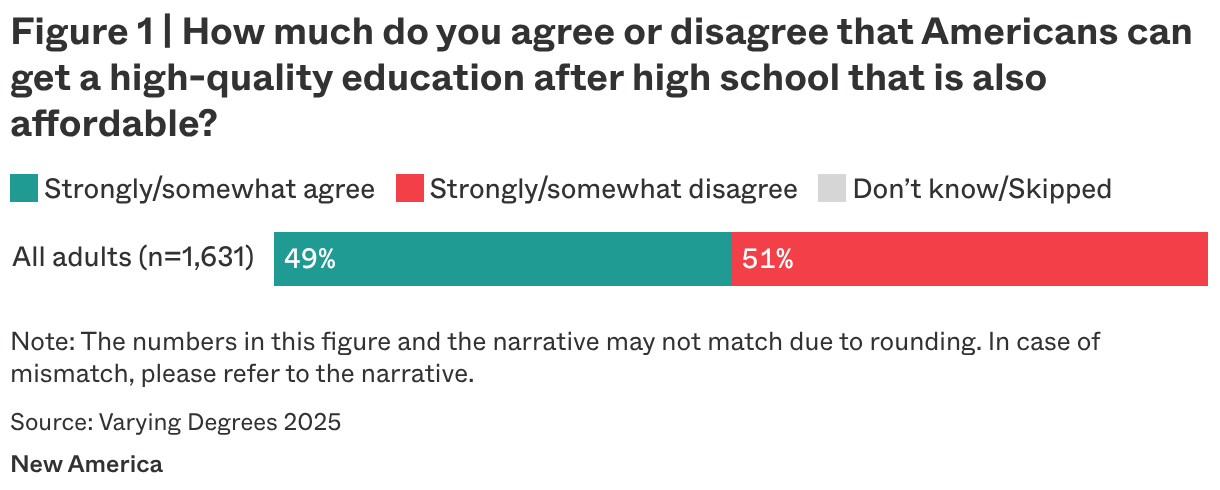
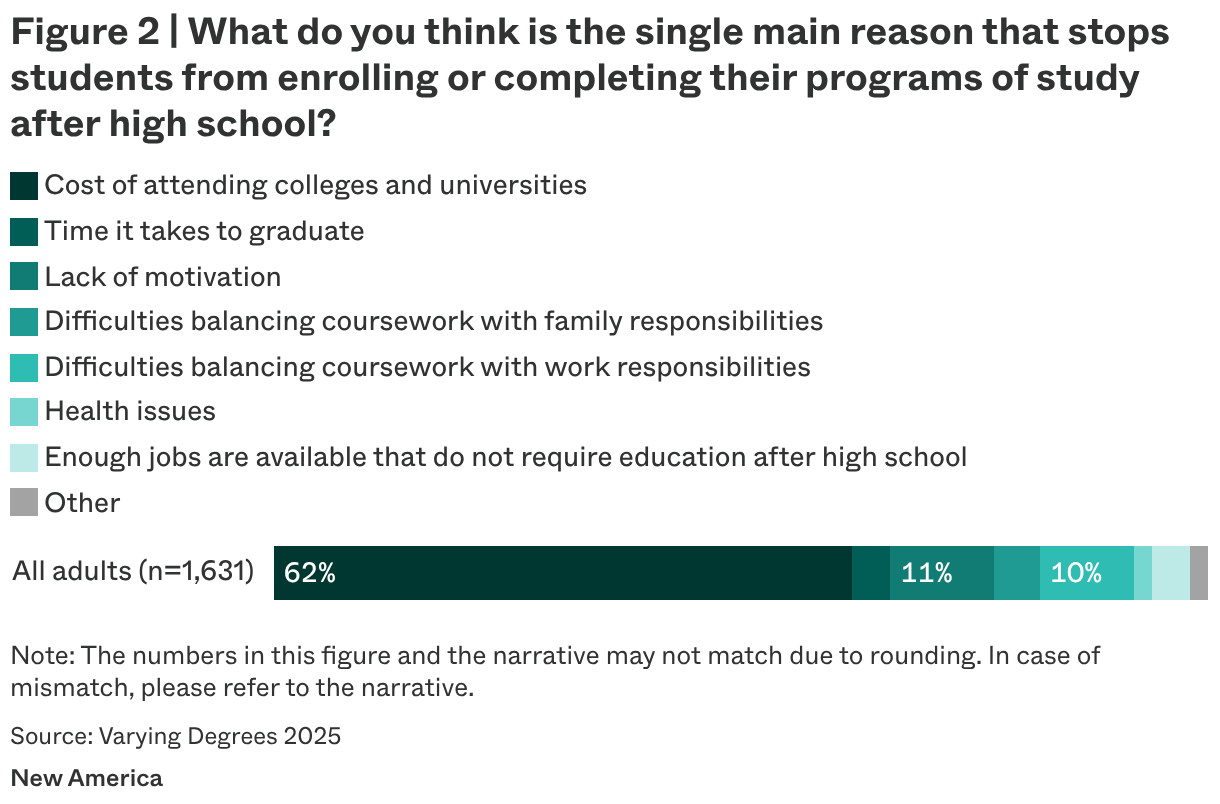
These changes to federal borrowing and repayment come at a time when Americans already have serious concerns about college costs. Varying Degrees 2025, New America’s nationally representative survey of public views on higher education, found that only 49 percent of the public agrees that Americans can find a high-quality education after high school that is also affordable (see Figure 1). Even more respondents (62 percent) believe cost is the main reason students do not enroll or complete a postsecondary credential (see Figure 2).
One in two students and families borrow to help pay for college, meaning these changes to the federal student loan system could significantly reshape how Americans finance higher education, potentially for years to come.
Alongside its student loan provisions, OBBBA also created Workforce Pell, which extends need-based federal aid to students enrolled in very short-term, workforce-oriented programs. The original Pell Grant program still exists, but as of July 1, 2026, students can apply their grants toward programs as short as eight weeks.
In a recent survey conducted by the American Council on Education, 328 college presidents were asked how their institutions are implementing Workforce Pell. Thirty-nine percent responded that they are working to embed Workforce-Pell eligible certificates or credentials within existing academic programs, while another 34 percent are creating short-term programs that lead to certificates.
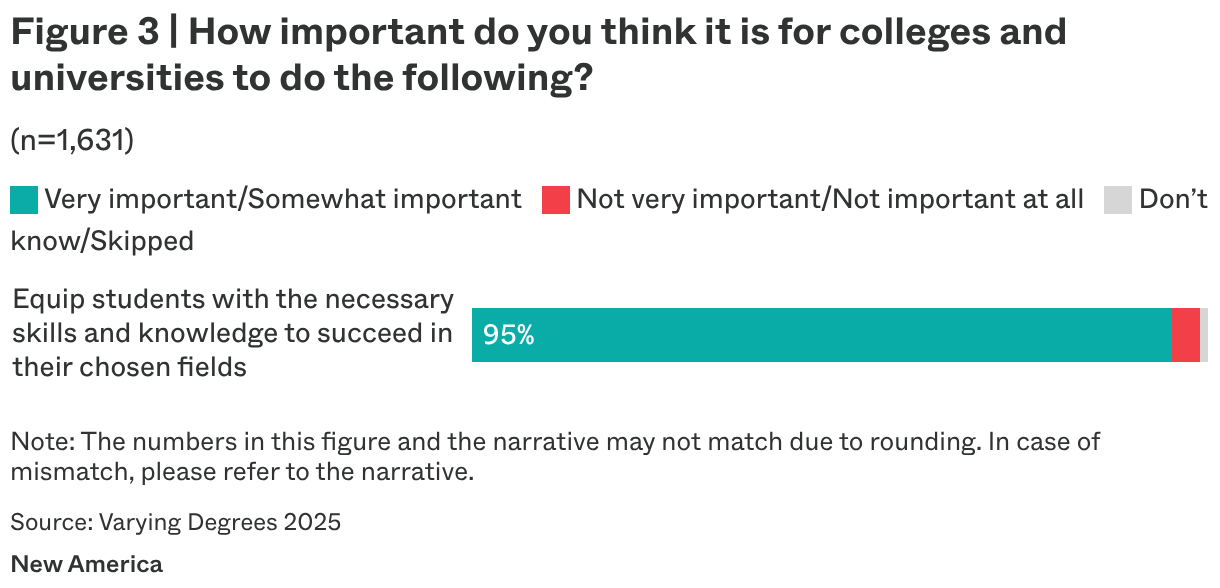
However, the growth of these short-term programs also raises concerns about quality. Research has shown that the shorter the credential, the less return for students. Americans place a high value on program quality: Nine in ten respondents in Varying Degrees 2025 believe that colleges and universities should ensure their programs prepare graduates for desirable outcomes (see Figure 3). As Workforce Pell programs expand, ongoing evaluation and accountability will be necessary to maximize their benefits while protecting students from low-value options.
In August, the U.S. Department of Education released a new proposed rule on accreditation that, if finalized, would dramatically weaken the key accountability mechanism for ensuring quality among postsecondary institutions. The proposal is the Department’s second iteration this year, but it remains largely unchanged from the initial version negotiated in May.
College presidents in the American Council on Education survey expressed mixed views on how the proposed accreditation changes will affect their institutions. Forty-four percent expect that the new rule will have a meaningful impact on their institution, compared to 33 percent who neither agree nor disagree and 25 percent who anticipate that it will have no impact.
New America is concerned that these draft regulations, in their current form, would weaken the accountability triad—which is made up of states, accrediting agencies, and the federal government—by removing safeguards designed to prevent low-quality accreditors from receiving federal recognition. The proposal would also expand the government’s role into matters historically reserved for academic institutions, including by attempting to define academic freedom.
For these reasons, our comment to the Department recommends revising the proposed rule to strengthen accreditation—rather than undermine it as an independent system of quality assurance in higher education. The Department should preserve its focus on student achievement, transparency, and protections for students when colleges and universities fail to meet standards. Accrediting agencies also should prioritize accountability and student outcomes, while remaining sufficiently independent to make informed judgments about educational quality.
Policy Analyst, Higher Education