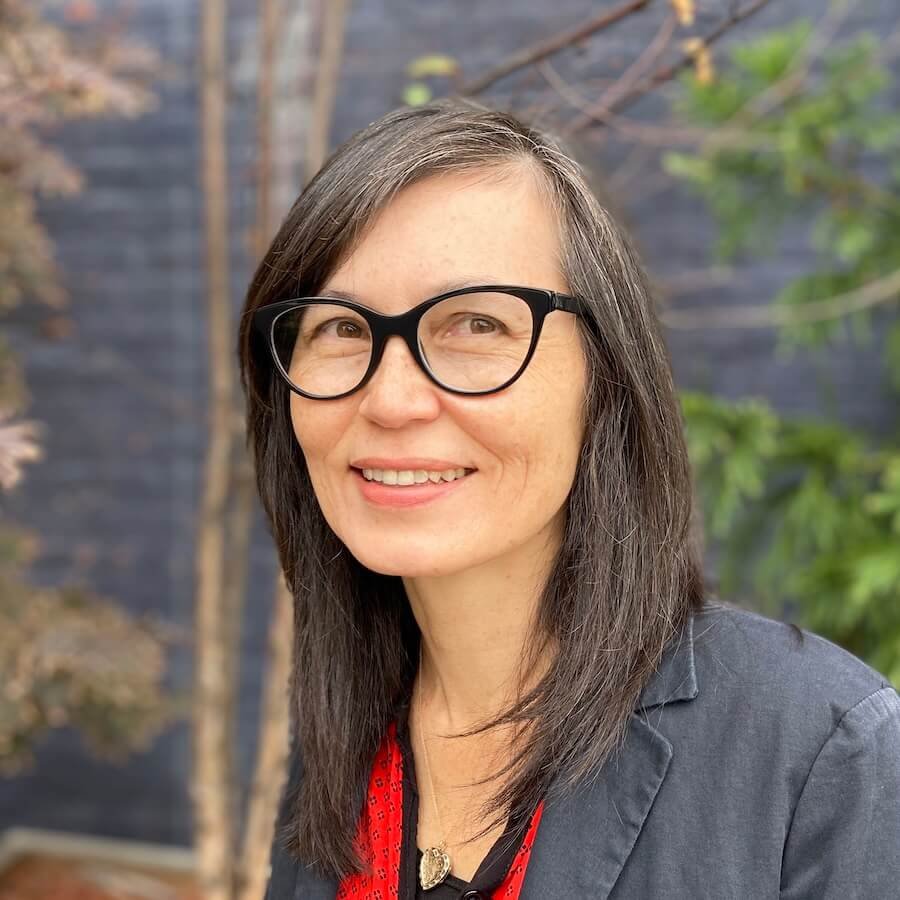
Grace M. Cho
New America (ASU Future Security) Fellow, 2026
New America 2026 Fellow Grace M. Cho spoke about her forthcoming book, We Will Go To Jinju, for “Three questions” in The Fifth Draft, the Fellows Program’s monthly newsletter. Cho is a nonfiction writer and Professor of Sociology at the College of Staten Island, City University of New York (CUNY).
Your three books all return to the Korean War from different angles: Haunting the Korean Diaspora, Tastes Like War, and your forthcoming We Will Go to Jinju. What does the new book let you do that the first two could not?
While all my books explore how the past is in the present, this book takes that idea to the next level. We know much more about the Korean War now than we did when I first started writing, partly because of the work of the truth movement. After South Korea transitioned to democracy in the 1990s, activists and truth commissions found that the government deliberately killed hundreds of thousands of its own citizens in the name of anti-communism—essentially a genocide of the left. The elders, who were children at the time, have finally come forward with their stories of having lost their families to the massacres, and South Korea has been in a state of perpetual mourning and exhumation for the past 20 years.
I write for the reader who is justice-oriented and curious about exploring taken-for-granted narratives, someone who’s not afraid to confront ugly truths.
In Tastes Like War, Korean dishes opened the door to your mother’s life and to Korean history. What opens the door in We Will Go to Jinju?
When my mother died in 2008, I took her ashes back to Korea and I had the most vivid dream. We were packing for a trip, and she said, “We will go to Jinju, we will go to a nearby mountain, and then I can go home and rest.” I woke up wondering if Jinju was a real place, and I spent years puzzling over the mystery of my mother’s words in the dream. By 2022, as I began to absorb the truth commission findings, I realized that “Jinju” and “a nearby mountain” were signposts to some of the worst civilian massacres of the 1940s and ‘50s. The world of dreams, spirits, and ancestors—as a force of memory—opens the door.
Who is the reader you’re writing We Will Go to Jinju for?
I write for the reader who is justice-oriented and curious about exploring taken-for-granted narratives, someone who’s not afraid to confront ugly truths. Because of the broader footprint of the Cold War and U.S. imperialism, there are a lot of groups that can relate, but I’m always writing for Korean Americans who have been denied access to their own history. Most of us became American because of the Korean War, yet the forgetting of that war is constantly reinforced in the U.S. It has taken me decades to understand how the Korean War made me, and I want to pass on that knowledge to people who don’t have the same luxury of time. I want to say, “Here, let me pull back the veil for you.”
Subscribe here to receive next month’s issue of The Fifth Draft.
New America (ASU Future Security) Fellow, 2026