Worker Voices: A Guide to Solutions
This executive brief is a summary of more extensive report findings found within the full research presentation.
Introduction
The best apps, platforms, and gadgets are designed with the end user in mind. Perhaps unsurprisingly, that approach also translates to public problem solving, where the best solutions are human-centered, and integrate the perspectives of those with lived experience in the design of programs and policies. However, to date, economic inclusion and research efforts on how we prepare for the future of work seldom take worker voices into account. These voices are a critical missing piece of the puzzle, and listening to their perspectives should be a key part of unlocking solutions for the present and future of work.
Building on our prior research, this worker voice project has capitalized on the policy window presented in Fresno, California by the Developing the Region's Inclusive and Vibrant Economy (DRIVE) initiative and the willingness of initiative leaders to focus on and incorporate this important community feedback in their strategy and policy implementation.
This research may prove particularly useful during this time, when a pandemic has thrust economic precarity into the center of many policy conversations. It now provides an interesting time stamp—a mere two months before the first COVID-19 shutdowns which exacerbated existing challenges and introduced new ones—on the state of family economic security in Fresno.

Background
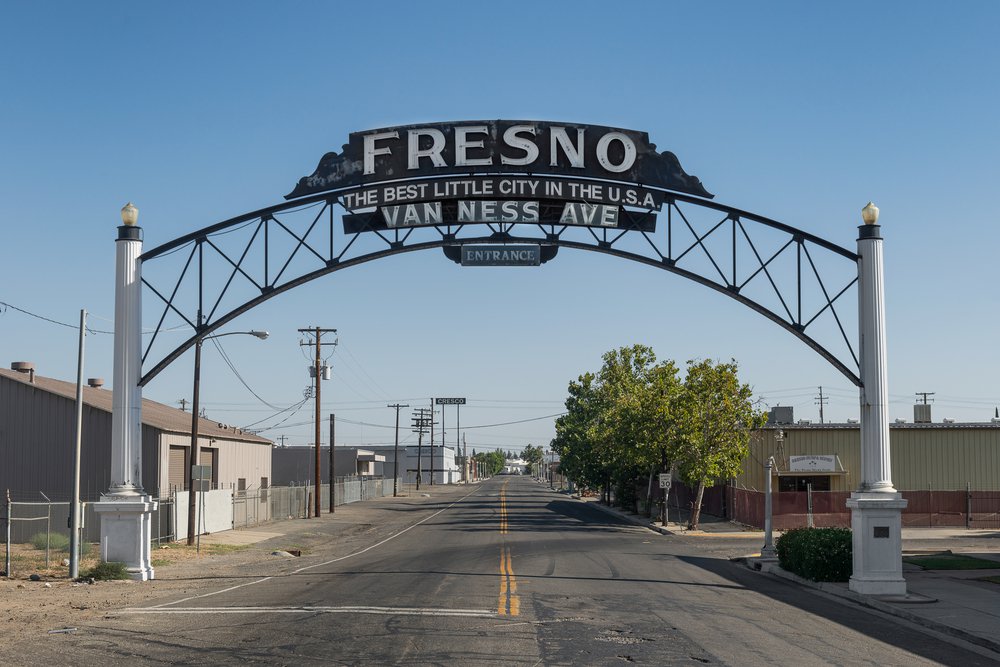
Fresno lies at the heart of California’s Central Valley and is home to more than half a million people. As the largest metro area in the region, Fresno is often the focus of the valley’s aspirations for growth. It is also a place of economic struggle and inequity. In 2018 the Urban Institute found that, of California’s 59 largest cities, Fresno had the greatest economic and racial disparities.
The Fresno DRIVE Initiative strives to advance neighborhood and economic development to help Fresnans thrive over the next decade. It was co-developed by a steering committee with representatives from more than 150 local organizations, and, with racial equity at its core, “envisions an inclusive, vibrant and sustainable economy so all residents can move from poverty to prosperity.”
To ground its plans in the realities of residents’ lives, the steering committee consistently referenced data about Fresno’s economy, neighborhoods, and people. New America CA was engaged to support this effort, conducting interviews with Fresno workers to surface their lived experiences and priorities, and to enable their voices to inform DRIVE’s strategy. The research was grounded in the understanding that worker voice is critical to unlocking solutions for the present and future of work, and for building inclusive economies.
Demographics
In order to better understand the lived experiences of workers, we spoke with 35 Fresno County residents in prevalent regional industries* whose lives could be most affected by job change or loss—due to automation or otherwise.
These 15 women and 20 men, most already experiencing some level of economic precarity, represented the following industries and ethnic and racial backgrounds.
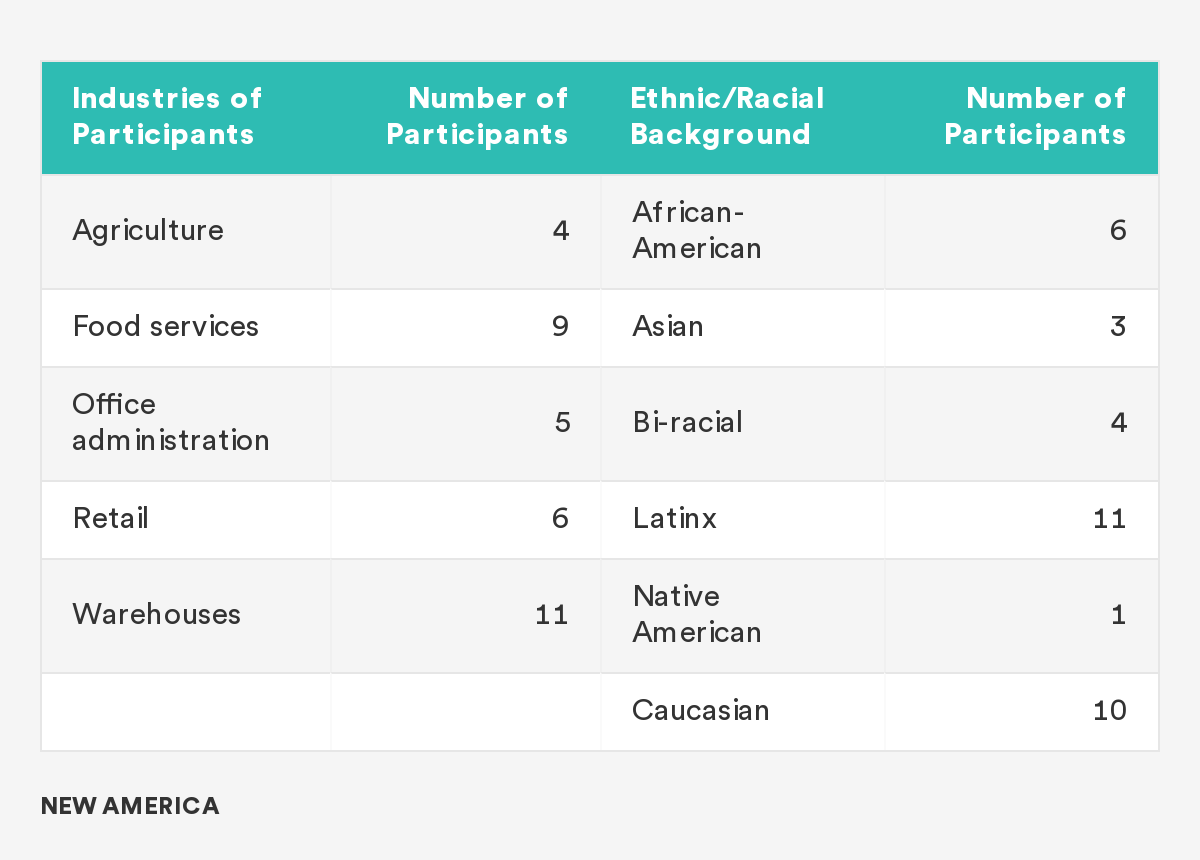
*Selected occupations are at medium or high risk of automation and from the top ten largest industries in Fresno (as sourced via Burning Glass Technologies data).
Why a Human-centered Approach?
Human-centered research is a deeper and more nuanced way of understanding authentic experiences and perspectives. This form of robust conversation can gather stories that point to actionable insights, trends, and recommendations. Human-centered research does not extract statistically significant answers from a representative sample as with traditional scientific research. Rather, it focuses on understanding individuals’ rich and complex experiences to actively solve problems in partnership with the people affected by them.
Clear boundaries were drawn between worker voices and researcher observations in order to avoid oversimplification or misrepresentation of ideas. The interview guide was designed to encourage participants to direct the conversation and to gather holistic information on the day to day lives of workers in Fresno.
High-level Findings
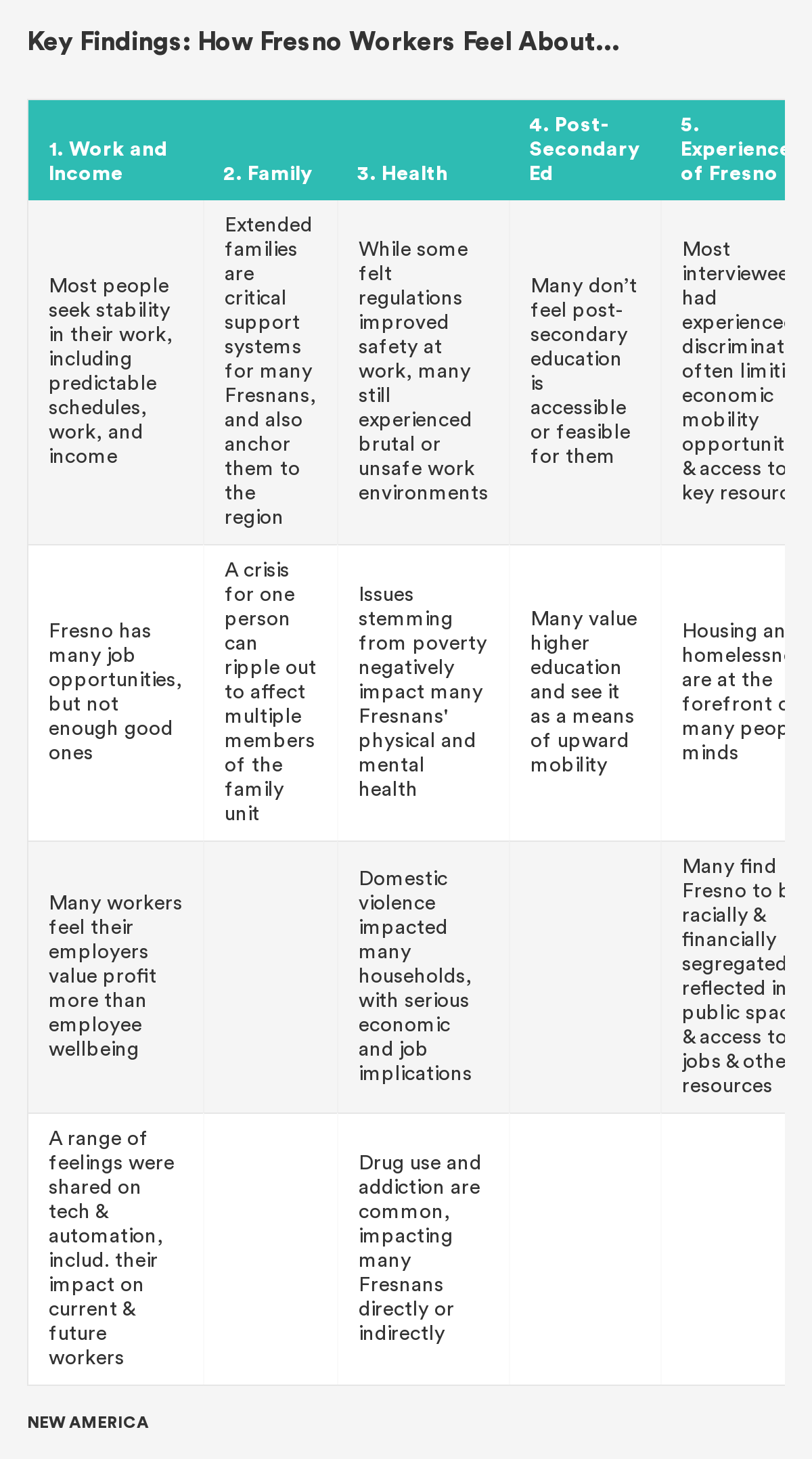
The names below have been changed to ensure the privacy of our participants
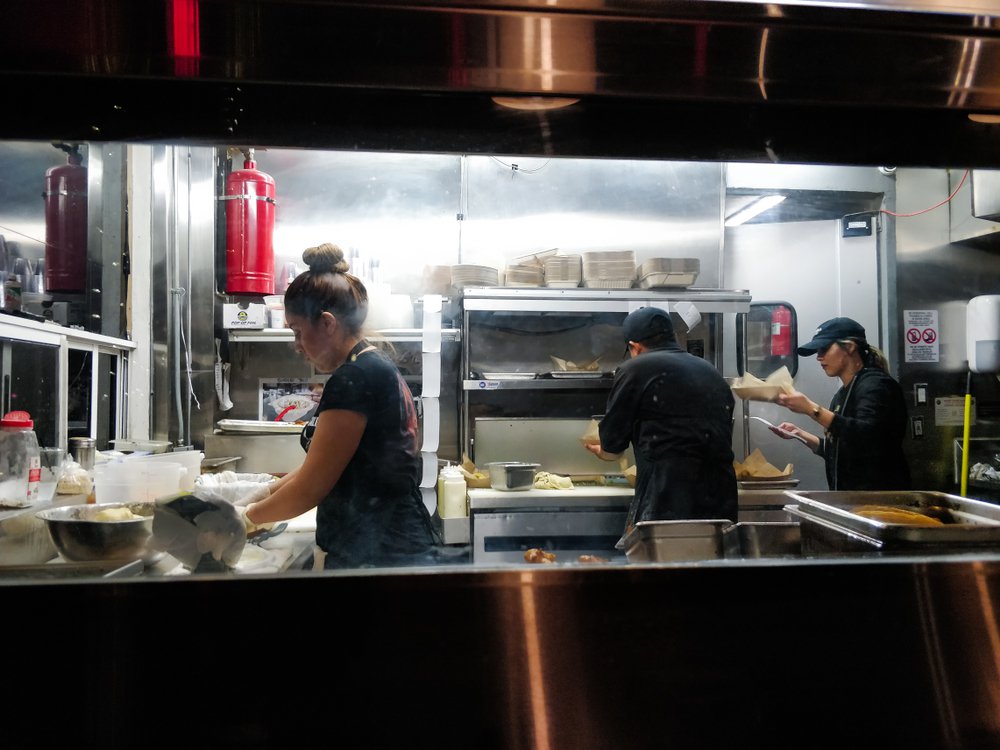
1. Work and Income
When Jonathan signed a contract to help build a major shipping distribution center in Fresno, he knew the hours would be long but he needed the job to pay his bills. On average, he expects to work at a job site between six to nine months, for 12 hours a day. If he gets sick, or needs time off, he risks getting laid off and the stability that comes with a paycheck and consistent hours. “They work you to death. And then, when you’re too tired and you ask for time off, they’re like, ‘Sure go ahead. Take a few days off.’” But that flexibility is limited to whether there are workers available to replace you he explains, “You go home, you come back to the job site, and they’re like, ‘What are you doing here? We called somebody else on the out of work list, so you’re off the job site now.’” When it comes to the future, Jonathan suspects that businesses will be quick to replace workers since “we’re humans. We make mistakes; these robots don’t, they do it perfect, you know what I mean? So it’s scary to think that.”
To hear more of what Fresno residents have to say about work and income, click here.
Workers in Fresno seek stability and respect in their places of employment, through predictable schedules, hours, and income. However, many aren’t finding this in the workplace, which they feel values profit margin over employees. Many workers experienced instability through layoffs—sometimes structural and expected, such as with temporary work (e.g., a clothing store with a holiday rush) and seasonal work (e.g., agriculture, following crop cycles). Others found their work to be irregular, but frequent (e.g., hourly work). Many workers viewed job loss as an expected part of their career experiences.
Many people viewed Fresno as a place with lots of job opportunities, but not enough good ones. Too few jobs offered pathways to a sustainable income. Interviewees generally estimated that Fresnans need to make a bit over $15 an hour, or $2,000 a month, to live comfortably, but some workers couldn’t secure more hours because of active hour suppression by employers aiming to avoid paying the benefits that must accompany full-time work. One job was often not enough to cover workers’ needs, and some expressed that juggling multiple jobs led to conflicting responsibilities between jobs and at home.
Workers shared a range of experiences with automation at work, and differed in their beliefs about how technology-driven job change might impact them and future employees. While some didn’t anticipate tech having much impact on their work beyond increasing their productivity, others envisioned future workplaces with few humans. In some cases, this led to fear or paralysis regarding taking steps to upskill, with repercussions such as loss of jobs or an inability to progress at work. Additionally, new technology implemented without proper training, or broken from lack of upkeep created consequences for workers in the form of stalled work and layoffs.

2. Family
“There’s times that my mother-in-law stays with us,” Caroline starts to explain, “She’s in a not too healthy relationship with her husband, so that can be anywhere from a couple days to a couple months.” Caroline not only supports her mother-in-law financially during those times, but also her father-in-law in Mexico. “If it wasn’t for our financial help he would be destitute. So we have a lot of people that we take care of.” In addition to this support, Caroline also works and takes care of her extended family, nieces and nephews whose “family home life isn’t the greatest.” At any given point in time she could be caring for just her own three children or five additional family members.
To hear more of what Fresno residents have to say about family, click here.
Fresno residents often rely on extended family members as critical support systems. Family can serve as an anchor to the city, sometimes leading to the return of residents who had previously moved away. In an environment of low wages, high costs, and an incomplete social safety net, extended and multigenerational households are often a means of receiving and providing the resources—like housing, emergency financial support, or child care—that workers need to thrive. Because of this, a crisis for one person can ripple out to affect multiple members of the family unit, and many Fresnans support people outside of their immediate family.

3. Health and Safety
“Forklifting is good, but the thing is your back,” explains Malcolm, a 21 year old warehouse worker. “You're right next to a propane tank or a gas tank so – you're inhaling sometimes fumes, dirt, debris. It could mess up my lungs and my nostrils.” Another aspect of the work, welding, also has potential negative health impacts, “I know I can get zinc poisoning. Stuff like that.” Because of the nature of his work, health and safety is frequently on Malcolm’s mind, but luckily newer regulations mean he feels a bit more protected—although he’s still exposed to dangerous fumes, “They have it regulated to a point where I don't have to worry about it so much. Like the tanks are far back enough for me not to smell so much but I do get a whiff of it.”
To hear more of what Fresno residents have to say about health and safety, click here.
When it comes to safety in the workplace, some felt federal and state policy regulations improved working conditions, but many still experience brutal or unsafe work environments (e.g., in agriculture and warehouse roles). In addition to the physically taxing or dangerous nature of work for many, a number of respondents witnessed or experienced physical or sexual violence in the workplace. At home, issues of domestic violence impact many households, with serious economic and job implications. Health and safety, family, and economic precarity appear to be interconnected, and lives are, at times, upended by abuse. Leaving an abusive partner can require steep court fees, leaning on family, or finding multiple jobs, meaning that relationship conflict and economic precarity often seem to work in a vicious cycle.
Within communities, issues stemming from poverty—like neighborhood gang violence and lack of access to healthy food—negatively impact many respondents’ physical and mental health. Interviewees’ experiences ranged from light stress to severe anxiety; many felt pressure to get by on their own, and stressed by the reality of solely supporting themselves and their families. Many of the lowest-income workers are unable to access the healthy food that they help grow, pick, and package. Drug use and addiction are common, impacting many directly or indirectly. And, while many had health insurance and believed it contributed to financial stability, high deductibles and healthcare costs made the benefit less viable.
4. Post-Secondary Education
“I tried going to school, a trade school for aestheticians,” says Janelle, “but it got hard because of family time, family issues. My dad got sick so I couldn’t finish my school.” At 25, Janelle works the night shift at a hotel. She spends her days doing gig work, applying for additional part-time jobs online, catching up on sleep, and trying to find time with her boyfriend and his young daughter. Although they live together, her boyfriend works day shifts, so family time must be carefully stewarded and planned. Janelle grew up in foster care and dreams of being a social worker. “I would want to go back to be a social worker, to be an advocate for children,” she says. “Just someone who could be there for children in foster care, something like that. I want to do stuff like that. But it’s hard because I don’t have the time to go to school.” Figuring out how to pay for college is also a challenge. “I tried going to be an aesthetician…I still have my school loan for that…I have half of that to get paid off.”
To hear more of what Fresno residents have to say about post-secondary education, click here.
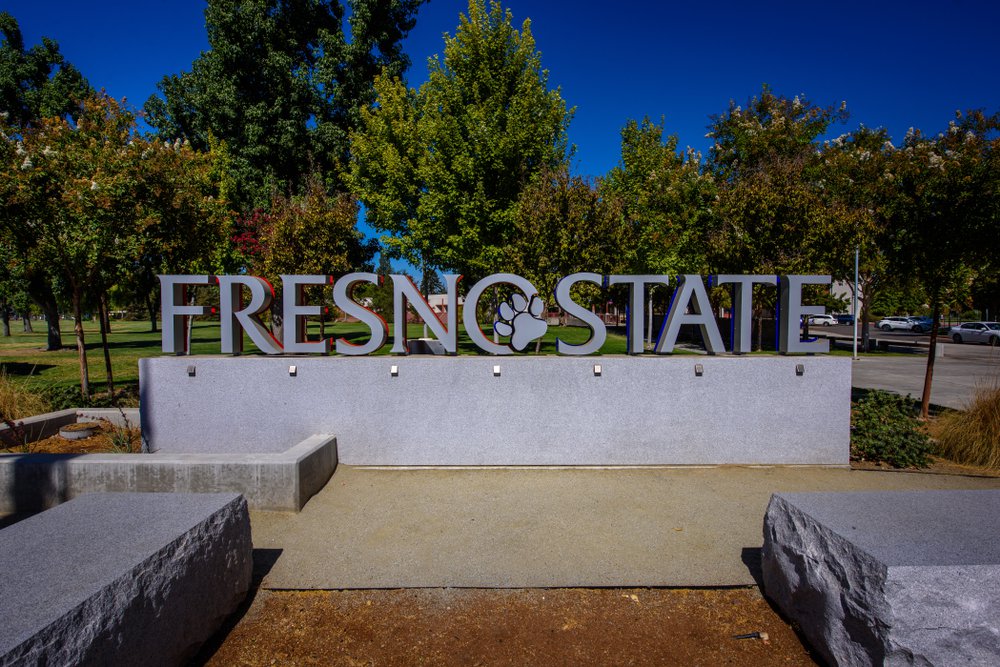
Although many Fresnans value higher education and see it as a means of upward mobility, many feel post-secondary education is not accessible or feasible for them. Jobs shifts that were of interest to respondents—medical care, care jobs, apprenticeships, and tech jobs—tended to fall into categories that required additional education. The local public university system was seen by many as a good resource for both work and education. However, many people’s post-secondary education had been disrupted by life events, leaving some with student debt and no degree.
5. Experiences of Fresno
Valerie, who self-identifies as Asian and Hispanic, recalled an experience with discrimination from when she worked retail at a game shop, “My manager is in the back, obviously busy. I'm up at the register just smiling, ready and he [a white customer] clears his throat. I go ‘Are you ready to check out sir?’ And [the customer] goes ‘Excuse me sir?’ And got my boss' attention and goes ‘I need to be helped.’ Unsure of what the issue might be, Valerie’s manager, who was white, pointed the customer back to Valerie. “And my boss goes ‘She can help you, she's right there.’ And [the customer] kind of went like that [lifted and pointed] to his [confederate flag] belt buckle and goes ‘I need your help.’" Rather than refusing service, the manager decided to help the customer himself.
To hear more of what Fresno residents have to say about living in Fresno, click here.
Race, gender, and age discrimination among Fresnans leads to regular experiences of interpersonal hostility. Many believe it also limits residents' access to critical resources and opportunities for economic mobility, especially because Fresnans so often rely on each other to provide work opportunities and safety nets.
Many reported age-related biases at work, from suggestions that older workers are not easily adaptable to technological change, to suspected outright age discrimination in hiring. Workplaces and roles were also sometimes segregated by race and language. Many found Fresno to be racially and financially segregated—reflected in disparities in the quality of public spaces, access to jobs and resources, air quality, nutrition, and experiences with violence. In addition, many residents seem to be increasingly impacted by homelessness, either through witnessing it in the community or experiencing it themselves. As a result, housing and homelessness are at the forefront of many peoples’ minds, and homeownership is seen as a mark of financial stability for which to strive.
Pain Points and Opportunities
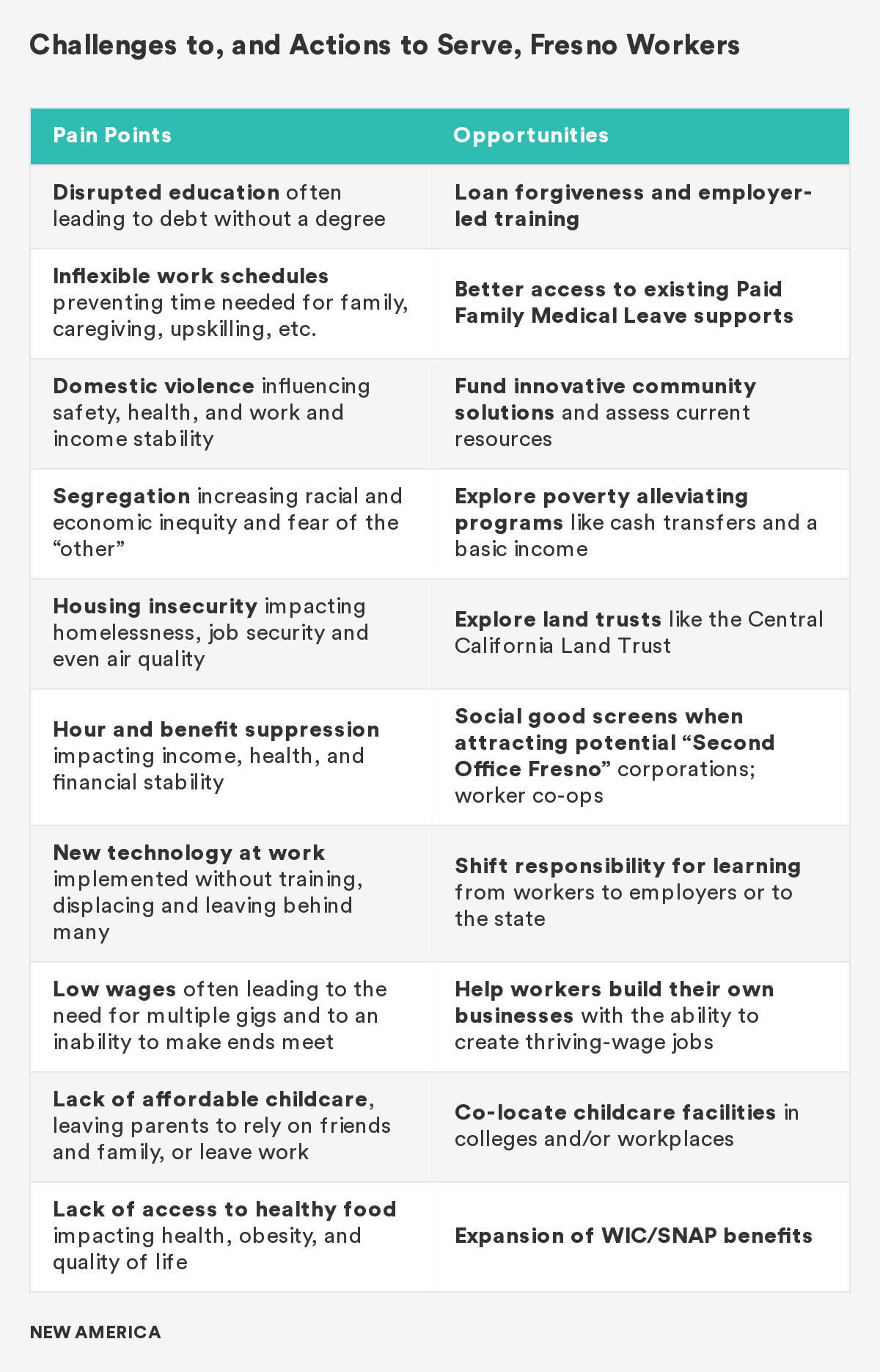
Fresnans contributed time and emotional labor to provide their authentic lived expertise, and it is important that this information be utilized by local leaders, so as not to relegate workers’ contributions to the equivalent of a “comment card.” Therefore, our goal from the beginning was to translate these accounts into the key pain points and opportunities they represent. This sense-making element of the research is geared at helping turn voice into action, solutions, and policy.
This research generated 32 pain points and 46 opportunities. The top 10 of each are highlighted below.
Researcher Observations
While focused on lifting the voices of Fresno workers, the New America CA research team also made observations based on themes surfaced from conversations:
- The three interrelated root causes that appeared to underlie much of what was shared, are racism and discrimination, geographic disparities, and trauma. These underscore the importance of DRIVE’s racial equity focus, and may indicate that embedding trauma-informed and place-based approaches could be important for the success of each of DRIVE's investment initiatives.
- Many potential interviewees worried about sharing their stories due to their immigration status. Lack of protective policies and trust may present a broader barrier to understanding and meeting the needs of undocumented Fresnans, and may indicate potential value in developing sanctuary/immigrant-inclusive policies within Fresno institutions.
- For some, daily challenges—such as low pay, experiences with racism, or needing to choose between equally critical priorities—can aggregate into toxic stress, with multiple life impacts. There was widespread acknowledgment of the importance of mental health, indicating some public acceptance of the issue from which to build interventions.
- There are both community assets and major stressors for families in Fresno. Many live in Fresno for key extended family support (e.g., help with child rearing), yet issues such as violence and health disparities can temper those benefits.
- Several interviewees were previously incarcerated, or impacted by the incarceration of a family member. Incarcerations proved disruptive, leading to limited options for quality work, financial aid, child support, and legal immigration pathways. They also led to profound personal losses, including homes, jobs, and relationships with loved ones. Impacts were long-lasting and compounded the economic precarity of respondents and their families. Many perceived Fresno policing practices as disproportionately targeting communities of color.
- While much shared by participants was sobering, residents also highlighted aspects they loved about their city. This included its thriving arts scene, diversity, libraries, resources associated with Fresno State University, ongoing city development and upgrades to its public spaces, and technologies that have made work safer and easier.
Worker Recommendations and Community Next Steps
Residents had clear recommendations for how to improve life for their fellow Fresnans.
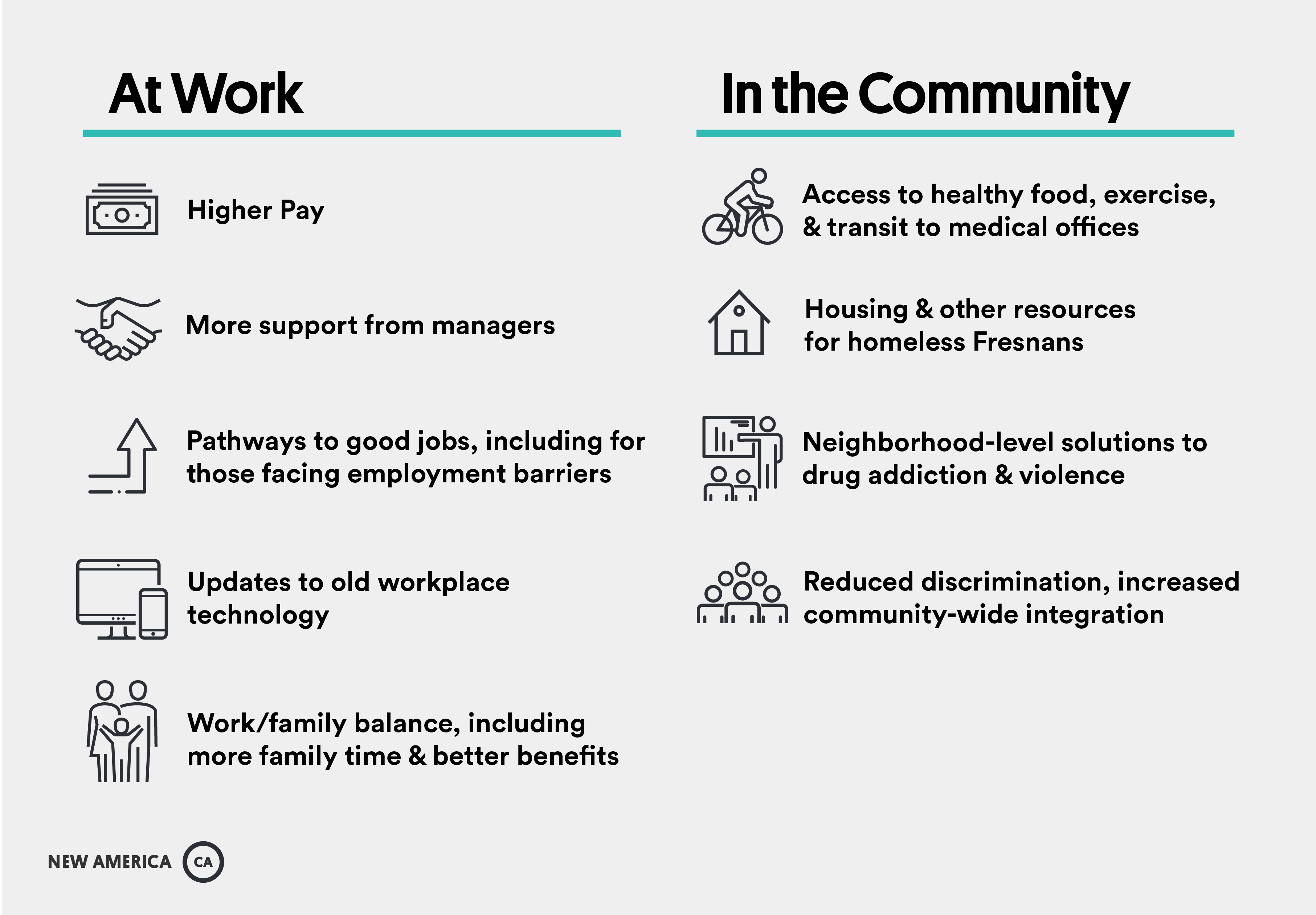
Some of New America CA’s recommendations for the DRIVE Initiative include:
- Using the research findings to test and add to current investment plans by seeking alignment to the priorities outlined by community members
- Ensuring that workers’ voices influence policy and programming, by using its platform to broadly share insights with local decision makers, through presentations, social media campaigns, and other media
- Considering the implications of this data for helping workers change industries in response to automation, including leveraging their transferable skills.
DRIVE leaders indicated that the research provided new insights and would help the Initiative’s racial equity working group in planning further community engagement, strategy, and implementation. Leaders also indicated that it could help engage the local business community in determining how to improve employee well-being, and deepen existing plans to engage residents in developing new programs and policies.
Conclusion
Though work and life experiences in Fresno are as diverse as the residents themselves, there are themes of economic precarity and anxiety about the future that affect many individuals and families. Even prior to COVID-19, workers spoke of gaping holes in work, housing, care, and health policies and practices, and the impact of these shortfalls on their daily lives. The global pandemic has made these weaknesses in the social safety net even more clear, demonstrating how many American families are one emergency away from economic crisis. Now, in a moment of collective health crisis and economic uncertainty, it is more important than ever to support solutions and take actions that center the stability of front-line, vulnerable, and essential workers.
Therefore, while research that centers worker voices is always critical, it is particularly so in the COVID-19 era. Those who have lived experiences of economic insecurity can help to address it. Worker voices and perspectives lift up the true issue at hand, can quickly clarify constraints, and can and should be actively incorporated into regional conversations such as the DRIVE Initiative. Indeed, as those with the greatest proximity to the challenges, any solutions generated without their input will not be as effective. The nature of work is changing, but the need for work to be good, safe, sufficiently-compensated, and balanced with other life priorities, has not. The obstacles to overcome and the means to surmount them can be spelled out by those in greatest proximity to these challenges. Leaders, across sectors, should listen and follow.
Reference the full presentation, here, for more detail on this research.
Acknowledgments
We are deeply grateful to the people who spent the time to thoughtfully engage with us in coffee shops, restaurants, and libraries across Fresno. Thank you for sharing your stories, the good and bad, in service of your community. Thank you, also, to the many community leaders who connected us with residents.
This project would not be possible without the collaboration of the DRIVE Initiative—in particular Ashley Swearingen, CEO of the Central Valley Community Foundation—and the support of the Kresge Foundation and Blue Shield of California Foundation.
Many thanks to the New America communications team, including Maria Elkin, Samantha Webster, and Joe Wilkes.
And finally, we are very grateful to members of the research team who provided invaluable expertise and assistance with this project: Ximena Arias Orozco, Margaret Streeter, and Emily Tavoulareas. Thank you for the long days and your support in sensemaking. Your contributions helped us ensure that these stories are accurate and do justice to the people who shared them.
Downloads
More About the Authors

Autumn McDonald

Rachel Alexander

Roselyn Miller Champion
Grant Analyst, City of Portland