How Young Men View Care
In designing our 2026 Men and Care survey, we sought to answer the question of how young men differed, if at all, from older men and from women of the same age. Recent polling and research have suggested a trend among young men away from gender egalitarianism. The survey included an oversample of men ages 18–29 to enable closer analysis of these claims.
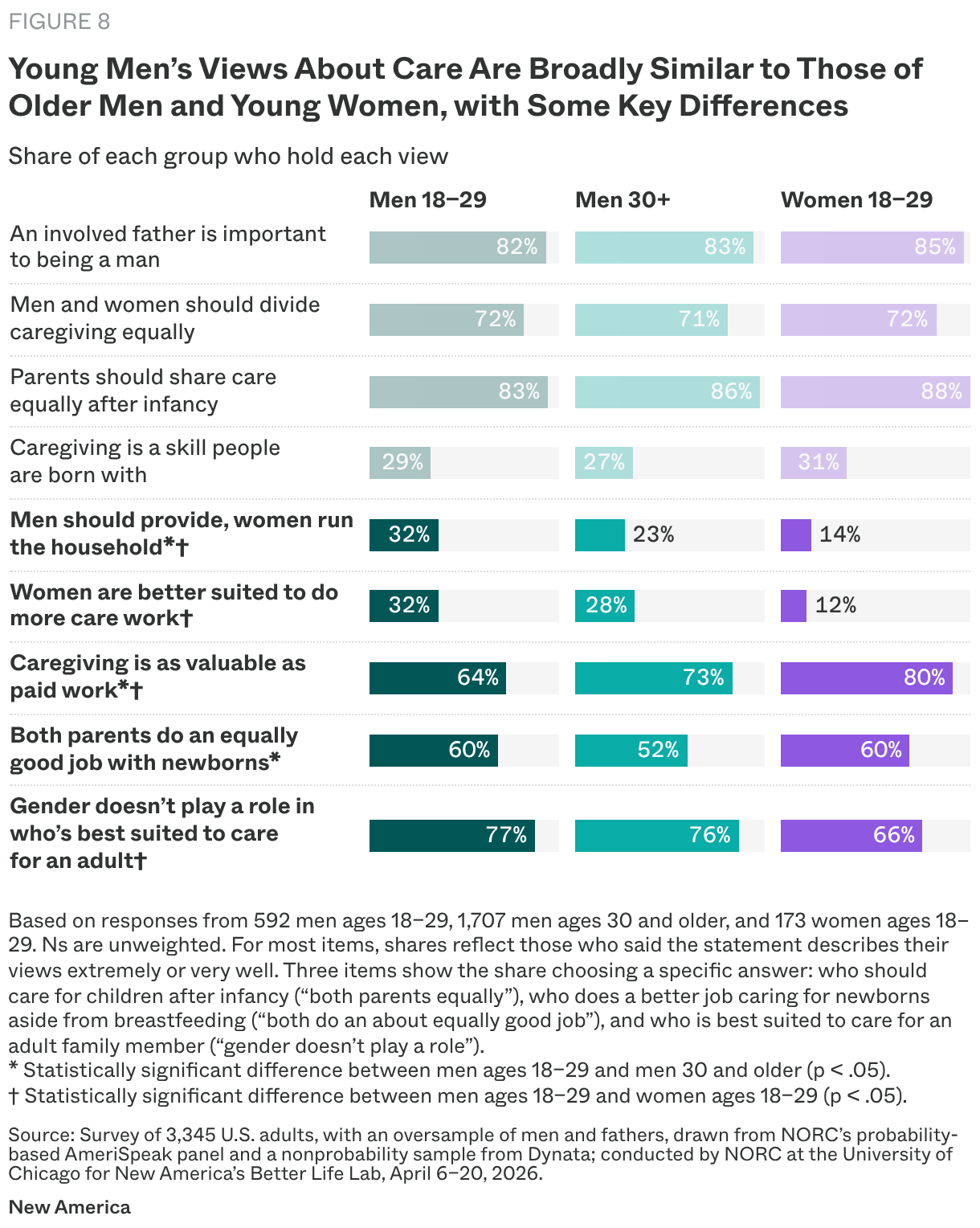
In general, young men’s views about care are broadly similar to those of older men and to young women in their age group. (See Figure 8.) Young men are as likely to say caregiving is meaningful, that they feel respected as caregivers, and that caregiving can be stressful. They are also as likely to say, “Involved fatherhood is central to masculinity,” and “Caregiving should be divided equally.” Like women and older men, fewer than one-third of younger men believe that “caregiving is a skill people are born with.”
On the flip side, 67 percent of non-caregiving young men believe that care is a skill that can be learned with time and experience, a share similar to young women, and significantly higher than young men who care for adults or children with extra needs (52 percent).
About one-third of young men have provided care to an adult or child with extra needs. Seventy-one percent of young fathers expressed at least some interest in being a full-time caregiver to an adult, compared to 47 percent of fathers over the age of 60, a significant gap.
Young men differ from other groups in several important ways, particularly in how many of them value unpaid care relative to paid work and support a traditional male-breadwinner role. But the survey found that the more traditional attitudes are minority views among young men, not majority views. And on some of the most explicitly gendered questions—for example, whether women are naturally suited to caregiving—young men are not particularly traditional, and in some comparisons are less traditional than their women peers.
Young men express more egalitarian views than older men about who should care for babies during the breastfeeding and bottle-feeding stages, when 60 percent of young men say both parents do an equally good job, compared to 52 percent of older men; women fall in between, at 58 percent. Although women overall are more likely than men overall to say that mothers and fathers should share care equally after infancy (89 percent versus 85 percent), young men are just as likely as older men to say so.
On the question of who is best suited to do adult caregiving, young men look more egalitarian than women their own age: Just 15 percent said “mainly women,” while twice as many young women said the same (32 percent), a statistically significant gap. Seventy-seven percent of young men said that “gender doesn’t play a role,” compared to 66 percent of young women, another significant gap.
Yet young men were more than twice as likely as young women to say that men’s primary role should be financial providing while women take care of the household (32 percent versus 14 percent said this described their views “extremely well”). Still, this was a minority point of view among young men: 36 percent said the statement either did not describe their views “very well” or “not at all,” with the remainder falling in the middle. As in the general population, young women were significantly more likely than young men to say the idea that they’d choose to be a stay-at-home parent if there were no financial penalties matches their feelings at least “somewhat well” (89 percent versus 70 percent of young men). That share was also higher than among older men (60 percent).
Young men were no different than women their age to agree that caregiving is valuable to society, but they were less likely to agree on this point than men 30 and older (66 percent versus 76 percent). Just 53 percent of young Black men said care is valuable to society, compared to 70 percent of white men—one of the few instances of statistically significant racial variation among young men in the survey (young Hispanic men fell in between at 66 percent). Young women’s views are similar to young men’s on this question (71 percent), perhaps suggesting that age and caregiving experience may matter alongside gender in attitudes about care’s value to society.
Young men were also less likely than older men to say that care is as valuable as paid work (64 percent versus 73 percent). Unlike the question of care’s value to society, young men also diverge from young women on this question. Eighty percent of young women say care is as valuable as paid work. Still, on both questions, the majority of young men believe care is valuable.
Fewer Young Men Identify as Caregivers
As shown in Figure 9, fewer young men identify as caregivers: Just under one-third (30 percent) of men 18–29 identify as caregivers, significantly fewer than older men (43 percent) but comparable to young women (31 percent). But there are significant racial differences among young men. Young white men in this age group are significantly less likely than young Hispanic men to identify as caregivers (22 percent versus 44 percent), with young Black men falling in between (36 percent).
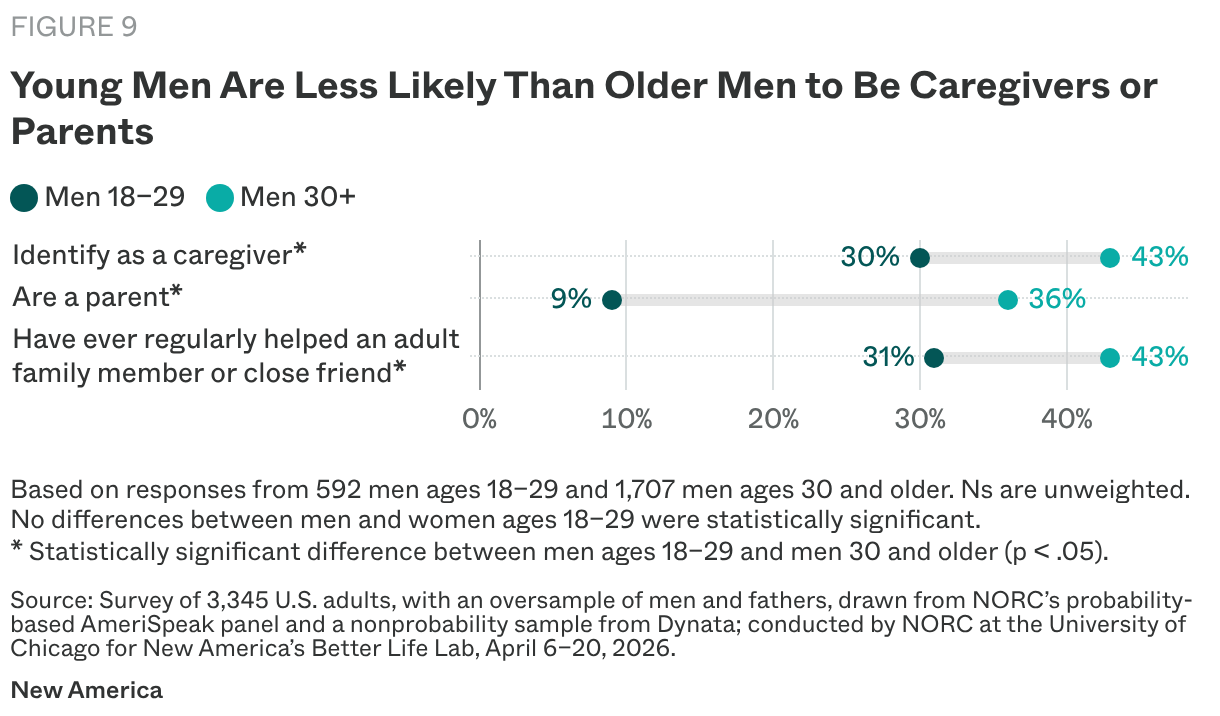
Only 9 percent of young men are fathers. Unsurprisingly, young men are less likely to be fathers than older men (36 percent of men 30 and older). Young fathers are just as likely as older fathers to say they have given care to a child with additional medical or educational needs (37 percent and 39 percent, respectively).
Like other dads, fathers in the 18–29 age group are equally likely to be engaged in parenting tasks such as making meals, comforting their children, providing transportation, managing schedules and activities, disciplining their children, playing with their kids, cleaning up after them, and taking part in educational activities. Not surprisingly, young fathers are more likely to have children ages 0–5 than older fathers (57 percent of young dads have a child two and under and 43 percent have a child ages 3–5, compared to 23 percent of older dads who have a child under two and 24 percent who have a child 3–5).
Young Men Cite Barriers to Caregiving
Younger fathers are the most likely to say they face barriers to being the dads they want to be (33 percent), almost three times more so than the oldest fathers (12 percent of fathers over the age of 60). Young fathers anticipate needing more support to combine work and care: 58 percent say they are “very” or “extremely” likely to need paid leave to care for a child in the future, compared to 42 percent of fathers ages 30–44, and even older fathers (the rate of anticipating needing leave declines with age). In keeping with this finding, as noted above, 70 percent of the young fathers who actually took leave cited access to paid leave policies as an enabler.
In open-ended answers, young men described the barriers they face, especially financial constraints, as reflecting their significantly lower incomes relative to parents in older age brackets (though, in general, young men earn more than young women).32 “I have to work full time, manage 2 households, provide care for my grandmother, and make sure my little sister is working and paying her bills,” wrote one respondent, a married father of two from Texas.
“My own self doubt, stupidity, financial stability, choices,” wrote another young father.
“My financial situation and need for therapy due to my own upbringing,” said a 25-year-old, unmarried father of two children. Mental health was also cited as a barrier by other young fathers: “Breaking down generational trauma,” wrote an unmarried father of one child who has additional needs from Kentucky.
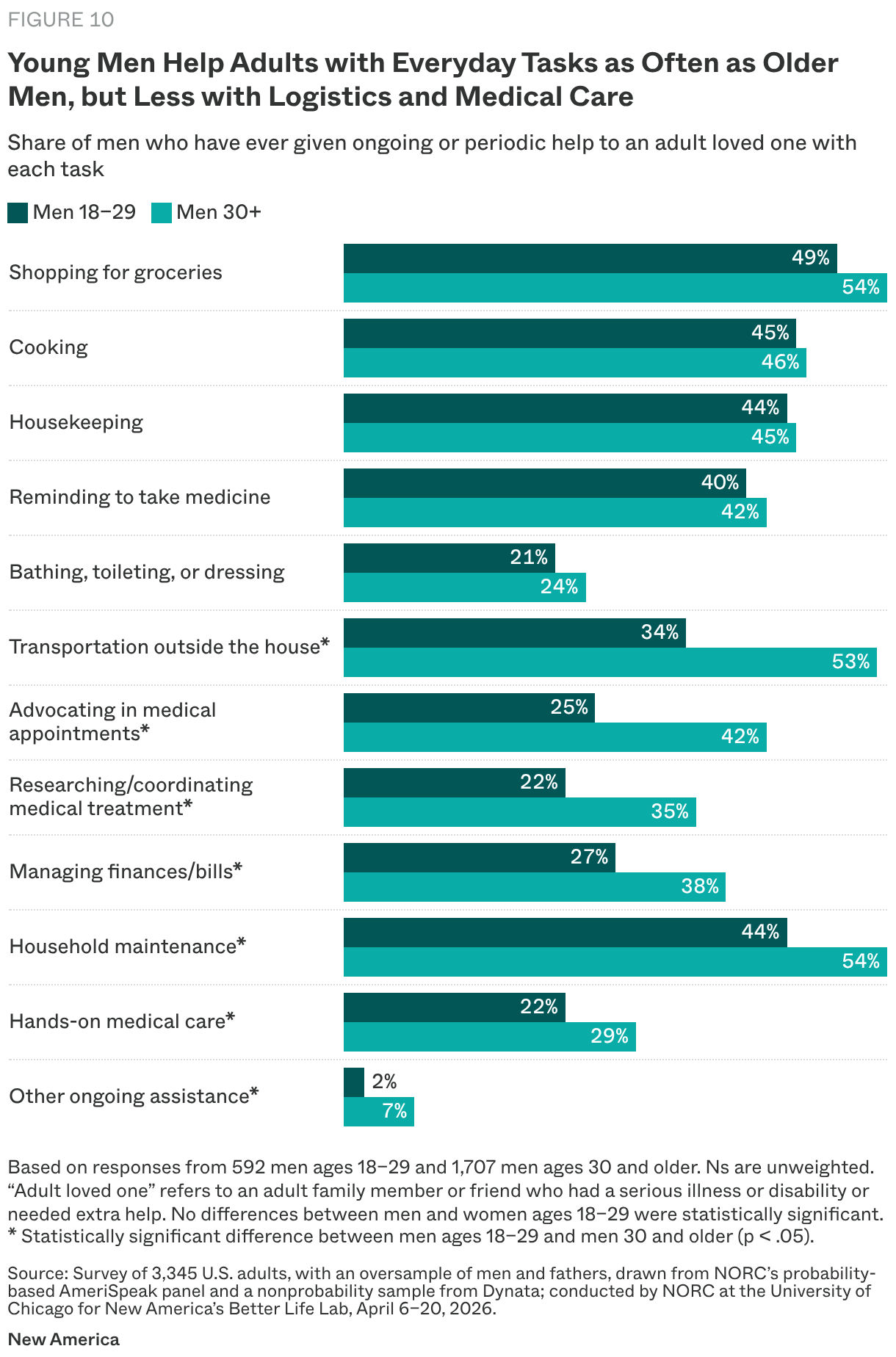
Although few young men identify as caregivers, young men and young women are equally likely to report having ever provided care for an adult friend or family member (31 percent), in contrast to the gender gap among adults ages 30 and over (among whom 51 percent of women and 43 percent of men identify as caregivers). Again, unsurprisingly, young men and women are less likely than older respondents to have cared for an adult (with rates increasing from 40 percent among respondents age 30–44 up to 53 percent of respondents age 60 and older). Young men who are caregivers for adults do many of the same tasks as older caregivers, though they are less likely to take part in administrative or financial caregiving tasks, likely due to their lack of financial resources and experience navigating these institutions. (See Figure 10.)
Young men are as likely as other caregivers to say there are barriers preventing them from being the caregiver they want to be, often suggesting they feel overwhelmed and insufficiently supported. Like young fathers, young male caregivers cite financial barriers to adult caregiving: “Finances, as everything is so expensive these days that a young person cant even consider taking care of someone as they can barely take care of themselves,” wrote a 23-year-old caregiver from Ohio. He elaborated further: “My friend just had a kid and he struggles heavily with paying rent, car payments, and anything financial. This is the biggest problem he faces. Without that, he would be more available to his kid. These necessary expenditures are so high now we can’t even take care of our children the way we want.”
“Financial mostly. It’s hard balancing figuring out my career while also doing all of the cooking, cleaning, maintenance, shopping, and the majority of the transportation,” wrote a 22-year-old man from Colorado. “It’s very overwhelming and money is constantly on my mind.”
Other young men suggested their caregiving was at odds with their need to earn money, citing workplaces and schedules that were incompatible with their caregiving. “[M]ostly my job get at risk because of the time I put in for caregiving,” wrote a 22-year-old carer from Maryland. “I need to work more to contribute to the household,” wrote a 25-year-old man from rural Illinois. “The time, money, and resources. I get very little financial support for the work I do and the time I am expected to give. I need more money,” wrote a 26-year-old man from Kentucky who reduced his work hours because of caregiving. At the conclusion of his survey, when asked if he had anything else to share about caregiving, he wrote, “It’s hard. And you get no thanks for it. You put your life on hold for years, even decades. And no one recognizes or understands the sacrifice. And if you complain, you are branded as heartless.”
The 22-year-old from Colorado felt slightly more positive about his experience but still acknowledged its difficulty: “Everyone should be a caregiver at some point in their life, once they are ready. It’s really helped me in my growth, but on the other hand, I don’t think everyone could be caregivers.”
In sum, young men do not fit into either an egalitarian or traditionalist narrative. While on some questions, young men tend to be more traditional than their peers, they do not do so uniformly or as a majority. Young men’s attitudes about who can care are quite egalitarian: Most support equal caregiving, and young men are even more likely than older men to say fathers and mothers are equally capable of caring for newborns.
At the same time, although a majority (two-thirds) of young men say that they value unpaid care work, this group is still more likely to express traditional views than are older men and women of all ages. Young men are more likely than young women to hold to the traditional male-breadwinner/female-homemaker model of families (32 percent versus 14 percent).
Though young men are less likely to have yet become parents or identify as caregivers, nearly one-third have cared for an adult, and young fathers anticipate substantial care responsibilities in the future. Despite all this, the majority of young men say care is valuable. The father from Texas caring for his grandmother mentioned above closed his survey with this thought: “I don’t think people understand the full picture of what goes into caregiving until they have to do it themselves. In my opinion, awareness needs to be spread so people are more understanding and companies are more willing to work with you.”

Citations
- U.S. Bureau of Labor Statistics, “Median Usual Weekly Earnings of Full-Time Wage and Salary Workers by Age and Sex,” accessed September 10, 2026, https://www.bls.gov/charts/usual-weekly-earnings/usual-weekly-earnings-current-quarter-by-age.htm.