Men’s Caregiving Is Colliding with Unforgiving Workplaces
Perhaps one of the clearest trends the 2026 Men and Care survey unearthed is that an overwhelming majority of men have either a desire, or a need, to care for others, and, just as women have long reported, those care responsibilities are colliding with inflexible work cultures and a dearth of supportive policies that would enable them to effectively combine work and care. Although relatively few men said there are barriers to being the caregiver they want to be (25 percent) or father they want to be (27 percent) and approximately 15 percent of those caregivers and 16 percent of those fathers cited the workplace as the barrier in an open-ended question, the data paint a different picture. A growing share of men are missing work to provide care, a statistically significant increase from 2019. And the work disruptions are highest for those men who can least afford them.
What do men need in order to give care? The data show that workplaces that give workers more autonomy, flexibility, and control over their schedules, along with public policies, families, and workplace cultures that support men taking paid time off, are key factors that enable them to be the fathers they want to be and to care for loved ones the way they want to.
“Before a lot of people were working from home, I was one of the only people doing that,” said Tom Capuano, an educational instructional designer and father of five in upstate New York who has worked a flexible schedule for years. “I spent a lot of time taking care of my own kids—changing diapers, feeding them, taking them to appointments, getting them to the bus stop, or waiting for them at the bus stop. I loved doing all that.”
Men Want to Spend Time on Care
Full-Time At-Home Caregiving
As the social media figure of the “tradwife” dominates discourse and Trump administration officials contemplate “motherhood medals” and other means of encouraging mothers to stay home, men’s choices and interests in stay-at-home parenting have been overlooked.27
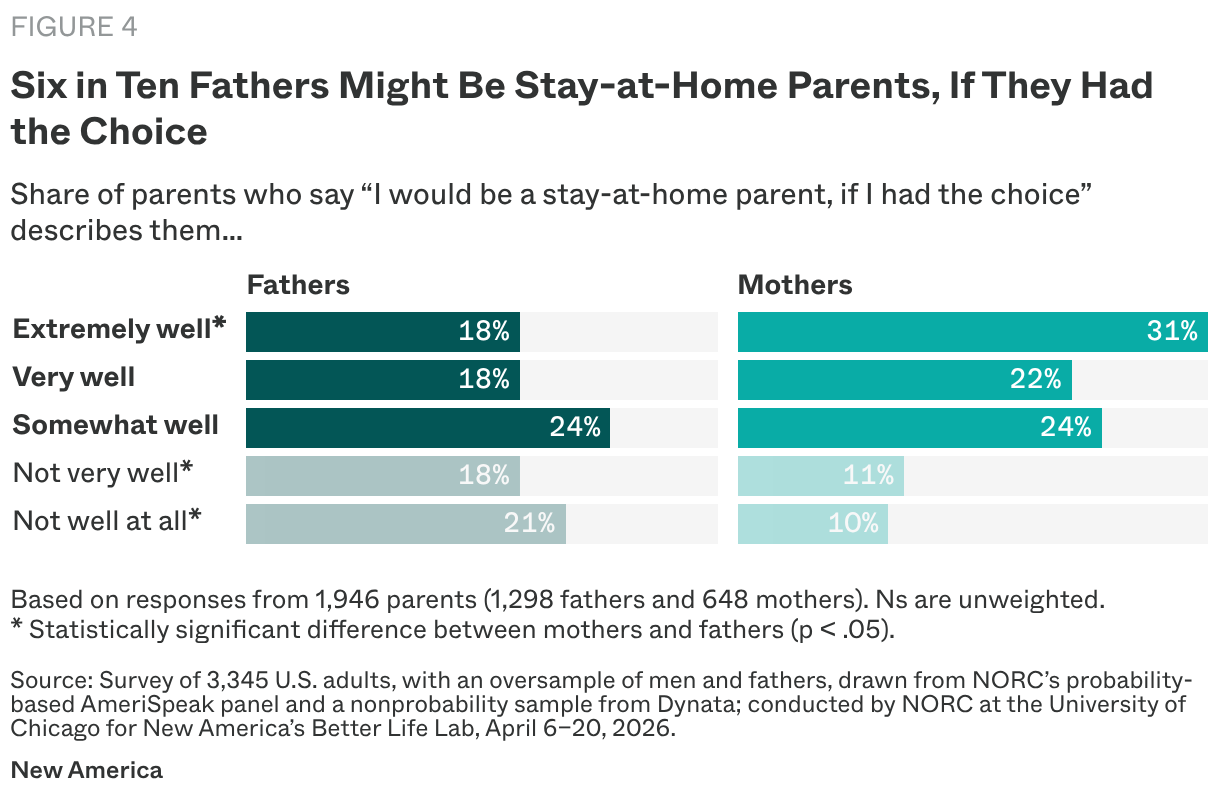
Far from embracing dominant norms such as the “ideal worker” who puts work first or the distant breadwinner caring for his family by providing financial support, we found that six in 10 fathers expressed at least some interest in being a full-time, stay-at-home parent if they had the choice, with 36 percent saying this described them “extremely” or “very well” and an additional 24 percent saying this described them “somewhat well.” (See Figure 4.) More mothers (77 percent) said they’d choose to be stay-at-home parents if they had the choice, with 53 percent saying this described them “extremely” or “very well” and 24 percent “somewhat well.”
The desire to be a full-time stay-at-home father was strongest among fathers of young children (69 percent compared to fathers of older children, 56 percent), non-college-educated fathers (64 percent, compared to 53 percent of fathers with a college degree), and fathers with lower incomes (71 percent for fathers earning $30,000 a year or less, compared to 51 percent for fathers earning $100,000 or more). Otherwise, there were no significant differences across age, political ideology, or race in the desire to be an at-home father.
In contrast to the desire among a majority of fathers to be a full-time, stay-at-home parent, just under half of both men and women expressed at least some interest in being a full-time caregiver to an adult (47 percent each). (See Figure 5.) Fathers of children ages five and under were more likely to report a desire to be a full-time caregiver for an adult (72 percent versus 53 percent of fathers of older children). Among fathers, young fathers—those between the ages of 18 and 29—expressed far more interest in being a full-time caregiver (71 percent) than did those over the age of 60 (47 percent).
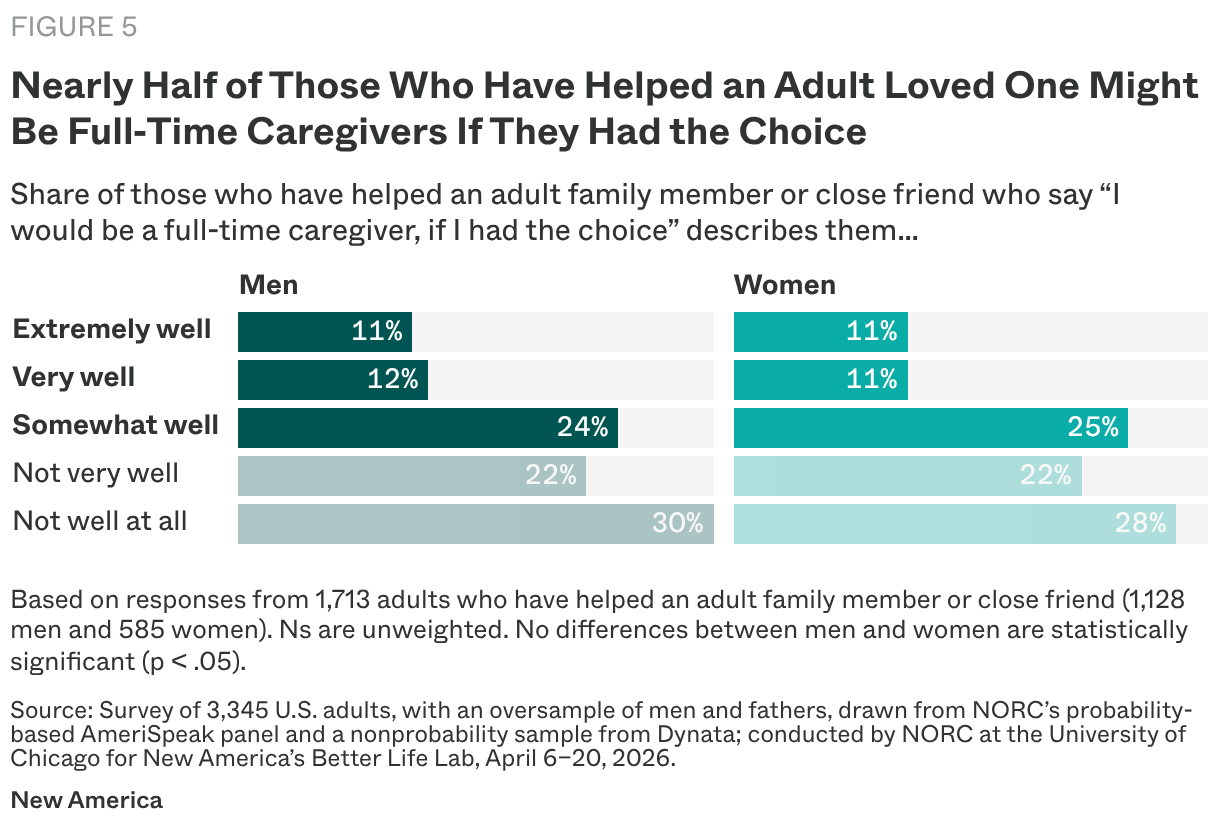
Fathers who identified politically as Democratic or Independent were significantly more likely to report at least some desire to be a full-time caregiver (58 percent and 73 percent, respectively) than Republican fathers (50 percent). Black and Hispanic fathers were also significantly more likely to report a desire to be a full-time caregiver (70 percent and 63 percent, respectively) than white fathers (52 percent). Non-college-educated fathers also showed significantly more of a desire to be a full-time caregiver for an adult (63 percent) than those with college degrees (49 percent).
Sandwich generation caregivers who care for both adults and children with special needs were far more likely than non-sandwich generation survey participants to say they would choose to be both full-time, stay-at-home parents (81 percent versus 65 percent) and full-time, stay-at-home caregivers (67 percent versus 42 percent).
Ian Matthew Lima, 35, works nights for an automotive wholesaler in Rhode Island while his wife works days. That way, he said, they can care for their two children under two at home—a decision sparked in part by how prohibitively expensive child care is. He said he would be a full-time, stay-at-home parent if he had the choice. “I would take staying home with my kids any day of the week,” he said. “I can’t get enough time with them. Even when I’m here at the office, every other minute, I wonder, ‘What’s my daughter doing? I wonder if my son is up yet.’ It’s a lot more rewarding being at home with my kids.”
Another survey respondent, former IT professional Mark Hackl in Oklahoma, who has a stepson and helps care for his aging parents, said the question of full-time caregiving left him feeling torn. He said has always been more career-focused and had “more work than I could do in a week,” so he felt more comfortable being a provider. “I wonder why I want what I want sometimes. Is it instinct? Is it programming?” he said. “Being a better provider makes you feel like you’re being a better protector. And I can see being home, not earning income, being dependent on someone else making me feel more vulnerable, more anxious. Maybe that’s a way that many women feel.”
Anticipating the Need for Paid Leave
Men’s desire to care is also apparent in their reports that they anticipate needing to take paid leave to give care. Much like we found in the 2019 survey, similar shares of men and women report that it’s “very” or “somewhat” likely that they’ll need to take paid family leave sometime in the future to care for a child (32 percent men and 28 percent women) or to care for an adult (46 percent men and 50 percent women).
Higher shares of young fathers (18–29 years old) and fathers of young children anticipated needing paid time off to care for a child in the future (58 percent and 51 percent). Noticeable differences among those anticipating leave to care for children included more Hispanic fathers than white fathers (41 percent versus 27 percent) and more fathers earning $30,000 a year or less compared to fathers earning more than $100,000 (40 percent versus 26 percent).
Interestingly, fathers of young children are also seeing more need to prepare for care at the other end of the age spectrum: 57 percent report being “very” or “somewhat” likely to need paid leave to care for an adult compared to 46 percent of other fathers. In this regard, fathers of young children are similar to all mothers, of whom 56 percent expect to need to take leave to care for an adult. More middle-income fathers—those earning between $60,000 and $100,000 a year—anticipate needing paid leave for adult care (55 percent) than those earning less than $30,000 (41 percent). Fully 63 percent of sandwich caregivers anticipate needing time off to care for an adult loved one in the future.
Care Gives Men Joy and Meaning
Men’s desire to give care is also clear from the high numbers of respondents who find caregiving to be meaningful and joyful. More than 80 percent of parents and caregivers combined said they found the caregiving they do to be meaningful. Slightly more than half of all fathers and mothers (55 percent) said their caregiving is a source of joy. Among fathers, those with young children were more likely than those with older children to say that their caregiving brought them joy (62 percent versus 52 percent). Fathers with college degrees were also more likely than non-college-educated fathers to say caregiving brought them joy (61 percent versus 52 percent). While fathers with household incomes of more than $100,000 a year were more likely to report joy from their caregiving than fathers earning less income, 60 percent compared to 53 percent for fathers earning less than $30,000 a year, the difference was not statistically significant.
Joy was more associated with caring for children. Among caregivers, those who were parents were significantly more likely to describe their caregiving as a source of joy than caregivers who were not parents (54 percent versus 35 percent)—a reflection, perhaps, that while people find caregiving deeply meaningful, caring for loved ones toward the end of life can also be difficult and emotionally complicated.
Inflexible Work Makes it Harder for Men to Provide Care
A Majority of Parents and Caregivers Work
A majority of men and women with care responsibilities are also employed: 76 percent of fathers and 65 percent of mothers, with more fathers working as full-time employees (61 percent of fathers versus 42 percent of mothers). Higher shares of fathers ages 30–44 are working (89 percent) compared to fathers of other ages, as are fathers of young children (86 percent). Higher shares of Hispanic fathers are working compared to white fathers (82 percent versus 72 percent). Similarly, more fathers in higher-income households—those with incomes of $100,000 or more a year—are working than fathers earning lower wages (84 percent versus 60 percent of fathers earning less than $30,000 a year). Likewise, college-educated fathers are more likely to be working than non-college-educated fathers (83 percent versus 72 percent).
Fifty-seven percent of those who care for adults or children with extra needs are working, as are 79 percent of sandwich caregivers.
Few Control Their Work Time
When it comes to organizing work to make time for care, one-quarter of respondents across the board say they have full control over their work schedule. Fully 33 percent of fathers said they had “no control” over their work schedule, as did 30 percent of mothers. Although there was little difference across income, the survey found that more Hispanic fathers reported having no control over their work schedule than white fathers (42 percent versus 30 percent). And for fathers without a college degree, 37 percent said they had no control over their schedules, compared to 28 percent of college-educated fathers. Mothers, however, were significantly more likely to report they had full control over their schedules compared to fathers (29 percent versus 21 percent).
The survey revealed that higher-income and more-educated fathers (like respondents overall) tended to have more control over the hours they worked but not the days—suggesting they have some ability to control job start and end times but not the shape of the work week, which can be inflexible in higher-paying professional or white-collar jobs. One-third (33 percent) of fathers earning $100,000 a year or more said they had some control over the hours they work but not the days, compared to just 12 percent of fathers earning less than $30,000.
On the other hand, young fathers—those 18–29—and Hispanic fathers tended to say they had more control over their days but not their hours, perhaps reflecting hourly, shift-based contract or gig work that can offer some flexibility over which days to work, but often at the cost of stable or predictable income. Twenty-eight percent of young fathers, compared to 17 percent of fathers aged 45–59, said they had some control over the days but not the hours they work, while 27 percent of Hispanic fathers said the same, compared to 17 percent of white fathers.
What Work Arrangements Do Men Want?
Many respondents reported substantial gaps between their current work situation and their ideal. Just one-quarter (25 percent) of both parents and caregivers for adults or children with extra needs said they worked from home or a place of their choice, while about twice that (47 percent of both parents and caregivers) would prefer that work arrangement if they could make that choice without facing a career or financial penalty.
The gap is even more pronounced when hybrid work is included. Forty percent of parents and 40 percent of caregivers for adults or children with extra needs currently work from home or in a hybrid setting, while three-fourths (74 percent of both groups) would prefer that arrangement—a 34 percentage point gap between the real and ideal arrangement.
Conversely, 49 percent of parents say they work in an office, while just 21 percent would choose to. About 46 percent of caregivers work in an office, while only 19 percent would choose to. Although the majority of both mothers and fathers prefer to work at home or in a hybrid setting, more mothers (83 percent) said that was their ideal work situation than fathers (65 percent). Nearly one-third (29 percent) of fathers said they’d prefer to work in an office, compared to just 13 percent of mothers.
The desire for flexible work or control over schedules has long been associated with mothers and women with care responsibilities, and, for years, flexible work arrangements were often seen as an accommodation for less-committed workers who were then “mommy-tracked” off the promotion and pay ladders. This survey, however, shows that the lack of schedule control at work and the desire for flexible work is widespread among all workers, regardless of age, gender, income, race and ethnicity, and education levels, and points to a deeper, shared structural problem with the way work is organized rather than a gendered one.
Work-Care Spillover and Stress
The mismatch between inflexible work and the desire or need to care continues to create work-care conflict and stress, as shown in Figure 6.
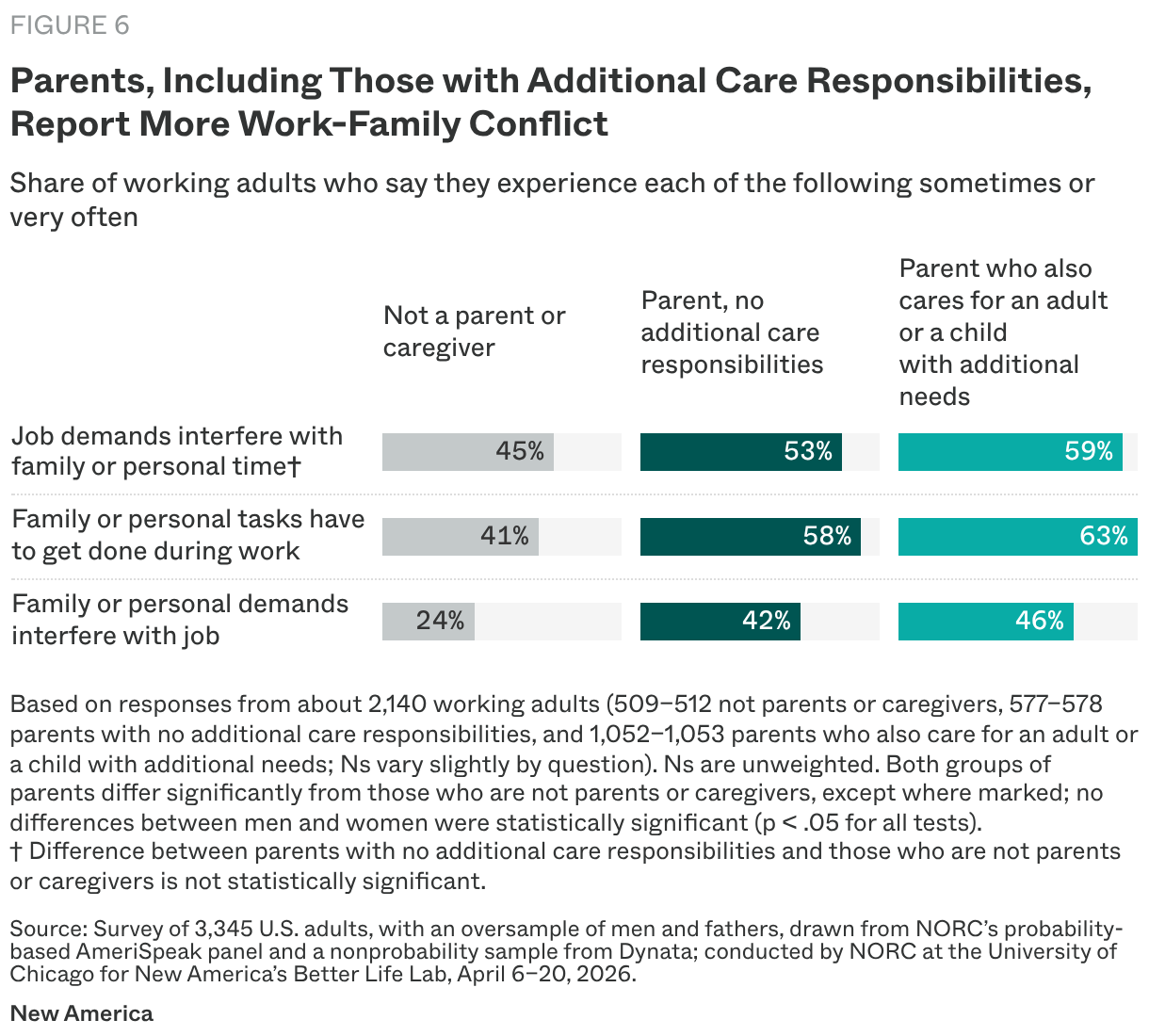
As in the 2019 survey, we found that working parents and caregivers report significantly higher levels of work intruding into family life and family matters spilling into work life. Among those who work, 60 percent of caregivers caring for an adult or child with extra needs said their job demands interfered with family time, compared to 45 percent of those without care responsibilities (parents without caregiving responsibilities for an adult or for a child with special needs fell in between, at 53 percent). Sixty-four percent of working caregivers and 58 percent of working parents “very often” or “sometimes” have to get personal tasks done during work hours, compared to 41 percent of workers who are not parents or caregivers. And 45 percent of working caregivers and 42 percent of working parents reported that their family or personal relationships interfere with their jobs, compared to just 24 percent of workers who are not parents or caregivers.
Among parents, fathers experience similar levels of work-care spillover in both directions, as do mothers: 62 percent of fathers said the demands of their job interfered with their family or personal time, as did 55 percent of mothers; and 48 percent of fathers reported that their family interfered with their job, as did 43 percent of mothers. These differences are not statistically significant.
It’s hardly surprising, then, that 84 percent of survey respondents who had ever given care to a child or adult said they found their caregiving to be stressful, including 80 percent of fathers and 89 percent of mothers. Interestingly, fathers reported that caregiving was stressful, regardless of their income level. That finding is a reminder that work-care stress exists across the income spectrum, even though lower-income caregivers often face greater economic consequences. It’s another indicator that inflexible work is squeezing workers with care responsibilities, regardless of gender or income.
The Work Penalty of Care Is Ratcheting Up, Especially for Men
Perhaps one of the most striking findings of the 2026 survey is that care pressure is ratcheting up, as are the penalties. Far more men who care for an adult or for children with extra needs reported missing work or reducing work hours than in 2019. The share of men missing work rose markedly from 64 percent in 2019 to 76 percent in 2026, while the share of women caregivers missing work increased from 71 percent to 78 percent over the same time (though this was not a significant increase).
Significantly more men who care for adults or children with extra needs are missing work.
-
64%
in 2019
-
76%
in 2026
When it comes to reducing work hours to provide care, 50 percent of men who care for adults or children with extra needs reported having to do so in 2026, a significant increase from 42 percent in 2019. Women caregivers reducing work hours for care held steady over the years at 45 percent.
More men than women also reported temporarily reducing their work hours by a statistically significant margin, 39 percent versus 30 percent. And among fathers, those earning less than $30,000 a year were more likely than fathers with higher incomes to reduce work hours both temporarily (48 percent versus 27 percent) and permanently (12 percent to 5 percent). Fathers of children under the age of six were twice as likely as other fathers to reduce work hours permanently because of care (12 percent versus 6 percent). And 18 percent of sandwich caregivers reported permanently reducing their work hours, significantly more than the 8 percent of other caregivers.
However, mothers are still significantly more likely to say that caregiving was a major reason they left the workforce, 28 percent, compared to fathers, 10 percent.
Our finding that more men are not working due to care pressure is in line with recent research by Matthew Nestler, senior economist at KPMG, who analyzed data from the Federal Reserve and found that, in 2025, more than 3 million prime-age men (29–54) were not working because of child care and older age care responsibilities.28 And our findings reflect the fact that men make up 40 percent of the 63 million unpaid family caregivers providing care for adults, according to a recent study by AARP and National Alliance for Caregiving.29 That share is only likely to grow as the country continues to age.
In our survey, differences in permanently reducing work hours appear more pronounced by income and intensity of care than by gender. Seven percent of men and 11 percent of women permanently reduced their work hours for care (a nonsignificant difference).
Caregivers of adults or children with extra needs are more likely to report missing a few hours of work to provide care than parents who aren’t caregivers (38 percent versus 29 percent), and they’re more likely to both reduce work hours permanently (11 percent versus 3 percent) or temporarily (37 percent versus 23 percent). Among survey respondents as a whole, more parents than nonparents report taking a full day off of work or more for caregiving (46 percent versus 34 percent), perhaps indicating that parents may need to take entire days off work when children are sick, while people with intensive care responsibilities caring for adults or children with extra needs require more intermittent flexibility to care for medical appointments or ongoing, chronic, complex, or unpredictable care when health or other emergencies arise.
But even while more men are missing or reducing work hours, women are still more likely than men to cite that care was a reason that they retired or left the workforce early (34 percent of women versus 22 percent of men). Among parents, mothers are more likely to say care was a reason they left the workforce (44 percent), compared to 25 percent of fathers. Caring for children also appears to be a factor pushing people out of work: Parents were more likely to say care was a reason they left the workforce than caregivers who provide care for adults or children with extra needs (37 percent versus 28 percent). For young parents, the share rises to nearly half (49 percent).
What the data suggests is that, much as women have for years, fathers and caregiving men are not just experiencing the work-care conflict but are adjusting their employment when work schedules or arrangements fail to accommodate their desire or need to provide care to loved ones.
Survey respondent William Cobb is a case in point. When his mother, a retired hospice worker, became ill, Cobb, who is also a father of three, needed time off work to care for her. He was in charge of administering her medicines, helping her to the bathroom, and managing her day-to-day care. “There were times when I was taking care of my mom that I’d miss all kinds of work,” he said. “Toward the end, when I was her hospice caregiver, she needed intensive care a lot of the time. I wanted to be there for her.”
He wasn’t sleeping. “I was distracted,” he said. “And honestly, I should’ve been on a leave of absence, but I didn’t have anything like that available. So I tried to work because I needed the money.” He made a simple mistake, one dwarfed by his 23-year performance record. “My supervisor gave me an unreasonably hard time for that, given the circumstances.” He wound up moving to a different department.
While his caregiving experience was stressful, it was also deeply important and meaningful, and he was willing to risk his job and career in order to protect time for it, despite an unempathetic boss and a lack of supportive workplace policies.
So what would make combining work and care possible, for men and for women?
Work Flexibility and Schedule Control
The survey unearthed a deep dissatisfaction with the way work is organized that held steady across gender, class, age, race and ethnicity, and type of care. As noted above, nearly three-fourths of parents and caregivers who provide care to adults or extra-needs children said their ideal work arrangement would be from home, a hybrid situation, or a place of their choice. Yet just 40 percent actually worked in their preferred environments.
Similarly, just a quarter of respondents across gender and other demographics reported having full control over their work schedules. Those factors added up to high levels of stress and work-care collision, as noted above.
In interviews with survey respondents, men who were able to effectively combine work and care cited flexible work and control over their schedules as key factors. Paul Bianchi, a retired YMCA executive who lives in Tennessee, said flexible work allowed him to be an engaged parent to his three children and, later, to help care for his mother at the end of her life. “That was a real positive thing about working for the YMCA, it was so flexible,” he said. “If I called my boss and said I had to take a few days off to deal with something for the family, it was never a problem.”
Bianchi said he knowingly chose to make a trade-off of time for money. He knew that working for a nonprofit would mean he wouldn’t be earning a big salary. But having flexibility and time for family made the arrangement worth it. “I counsel people, if you could pick any profession you want, pick one that gives you flexibility,” he said. “When it comes time to be a caregiver or to take care of kids, the most important thing is that you’re available. That’s number one. Finances are number two.”
Paid Family Leave Is a Pressure Release Valve
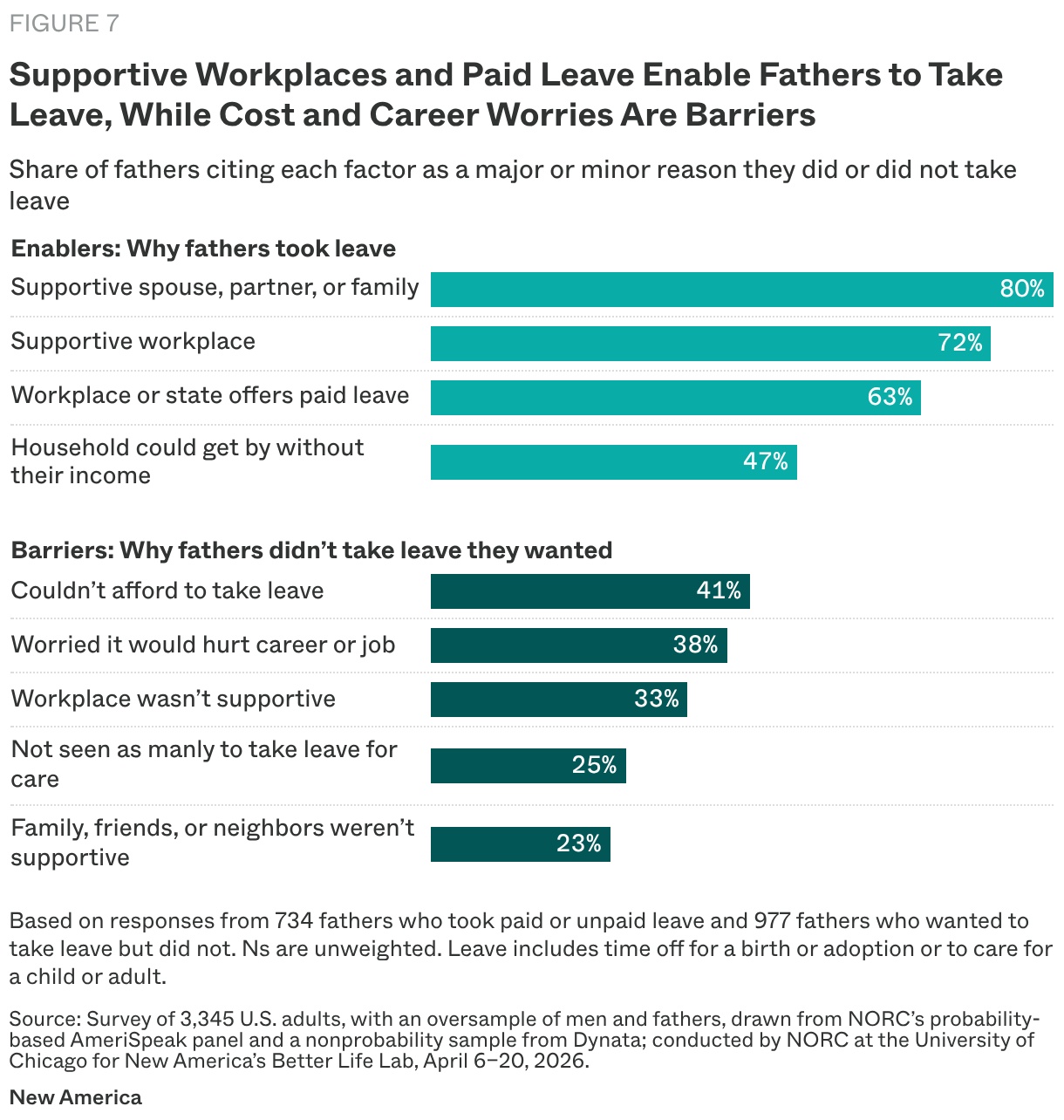
As in 2019, our survey found that paid leave tells a complicated story: Men and women take caregiving leave at similar rates, and they anticipate needing paid caregiving leave in the future at similar rates. But men were much more likely to take fully paid leave, while women were more likely to take partly paid or unpaid leave and to take longer leaves. Affordability remained a major barrier, but supportive workplaces and families and access to paid leave through employers or state policies were important enablers. (See Figure 7.)
As in 2019, half of parents took paid or unpaid leave after the birth or adoption of a child, with mothers and fathers taking leave at similar rates. Nearly one-third (29 percent) covered the cost of their most recent leave (whether after birth or adoption or for adult caregiving) with paid time off, nearly one-third (29 percent) used savings intended for other purposes, and about a quarter (23 percent) limited their spending on basic needs.
One in five adults took paid or unpaid leave to care for a family member with a serious illness, disability, or who is aging, with men and women taking leave at the same rate (21 percent). The share of sandwich generation caregivers was much higher, at 37 percent.
Our survey found that, even as more states have passed state paid family leave laws to make paid leave more accessible, many workers still lack access to paid leave, especially those who earn the lowest wages and those with the most intensive care needs. About half (49 percent) of all sandwich caregivers said they didn’t take leave when they needed it because they couldn’t afford to.
In 2019, four states and the District of Columbia had paid family leave laws. By 2026, that number has risen to fourteen states, plus Washington, DC.30 Though the states that have passed such laws tend to be led by Democrats, the survey found no differences between Republicans or Democrats in opting to take leave: About half each took paid or unpaid leave after the birth or adoption of a child, compared to 42 percent of Independents.
Of the respondents who took leave to care for a loved one, nearly half of those earning $100,000 a year or more (47 percent) were also more likely to take fully paid leave, compared to just 18 percent of those earning $30,000 or less, even though the survey found that those earning the lowest wages tended to do more day-to-day caregiving tasks for both children and adults.
And, as in 2019, when asked about their most recent leaves, men said they were more likely than women to take fully paid caregiving leave after the birth or adoption of a child or to care for a loved one (47 percent for men versus 31 percent for women). Women were still taking more unpaid leave (36 percent versus 23 percent for men), a signal perhaps of how powerful the male breadwinner expectation remains,31 how critical male earnings (which are usually higher than women’s) are to many families’ economic stability, and how women are still expected to be the default caregivers who sacrifice their own careers and even the family’s financial security in order to put care first.
Julio Lopez, 58, a Mexican immigrant who works in a restaurant in Chicago, is a case in point. Lopez didn’t take paid leave when his daughter was born. And while he didn’t provide much hands-on care for her as she grew, he considers himself a caregiver because of his financial providing for his family. “I’m always the one putting the money down,” he said. “I think I inherited that from my own father, my own culture. Men are always the caregivers, willing to listen to you and provide means and money to fix things when someone’s in trouble or give you a shoulder to cry on.”
Among men who wanted to take leave from work for caregiving but didn’t, affordability (37 percent), fears of career penalty (33 percent), and unsupportive workplaces (27 percent) were reasons for this choice, more than worrying that it was not seen as manly (21 percent). The share of fathers reporting they couldn’t afford to take leave was high even for those earning $100,000 a year (35 percent) but rose to 58 percent for fathers earning $30,000 or less. In other words, practical and workplace barriers were more commonly cited than concerns about whether taking leave would be seen as unmanly.
In contrast, people who took leave for care said the reasons they were able to do so were supportive workplaces (64 percent), supportive families or partners (74 percent), and having access to paid leave through their employer or living in states with paid leave policies (55 percent). For fathers specifically, 80 percent said having a supportive family or partner was a reason for being able to take leave, but having a supportive workplace was also a key reason for fathers, with 72 percent of all fathers citing it as a reason and 83 percent of fathers of young children. Sixty-three percent of fathers also cited having access to paid leave through their employer or enabled by state policy, as did 55 percent of all mothers (not a significant difference). For fathers of young children under the age of six, that share rose to 73 percent.
Ian Matthew Lima, the father of two from Massachusetts, said the flexibility he gets from work helps him manage work and care. “I’m fortunate that my boss is the father to young children as well,” Lima said. “He gets what it’s like.” While his wife’s employer provided three months of paid leave, and the state’s paid-leave policy provided her with another three months, Lima took six weeks of “hybrid” leave when each of his children were born, meaning he didn’t stop working completely. “It sucked, but it kept me from having to take a pay cut,” he said. He would have taken more, but because he works in Rhode Island, he didn’t qualify for Massachusetts’s more generous paid leave policy. “I took what I could get,” he said.
As in 2019, the 2026 survey shows the challenge is not persuading men that care matters or is valuable. Many, as noted above, already believe that and want or need to provide care for others. The challenge is whether public policies, norms, and workplace cultures make it possible for them to act on that desire or need without suffering career penalties or economic consequences.

Citations
- Coral Davenport, “Trump Officials Draft Plan to Pay At-Home Parents, Using Funds for Working Ones,” New York Times, September 5, 2026, https://www.nytimes.com/2026/09/05/us/politics/stay-at-home-parents-subsidies.html.
- Matthew Nestler, “More Men Not Working Due to Caregiving,” LinkedIn, July 28, 2026, https://www.linkedin.com/pulse/more-men-working-due-caregiving-matthew-nestler-phd-arwjc/.
- AARP and National Alliance for Caregiving, Caregiving in the US 2025 (AARP, July 2025), https://doi.org/10.26419/ppi.00373.001.
- Vicki Shabo, “Explainer: Paid and Unpaid Leave Policies in the United States,” New America, May 19, 2026, https://www.newamerica.org/insights/explainer-paid-and-unpaid-leave-policies-in-the-united-states/.
- Pilar Gonalons-Pons and Markus Gangl, “Marriage and Masculinity: Male-Breadwinner Culture, Unemployment, and Separation Risk in 29 Countries,” American Sociological Review 86, no. 3 (2021): 465–502, https://pmc.ncbi.nlm.nih.gov/articles/PMC8211126/.