Beliefs About Care and Caregiving
U.S. culture has moved quite far toward seeing men as caregivers and care as gender-equal and a learnable skill rather than biologically innate. But practice, identity, social trust, and structural barriers haven’t fully caught up with these shifting attitudes.
Who Identifies as a Caregiver?
In the 2019 survey, respondents were identified as caregivers based on whether they reported participating in daily caregiving activities for their own children or actively caring for an adult friend or family member. In 2026, we sought to better understand whether and how these labels match respondents’ own understandings of the word “caregiver” and whether they believe it applies to them.
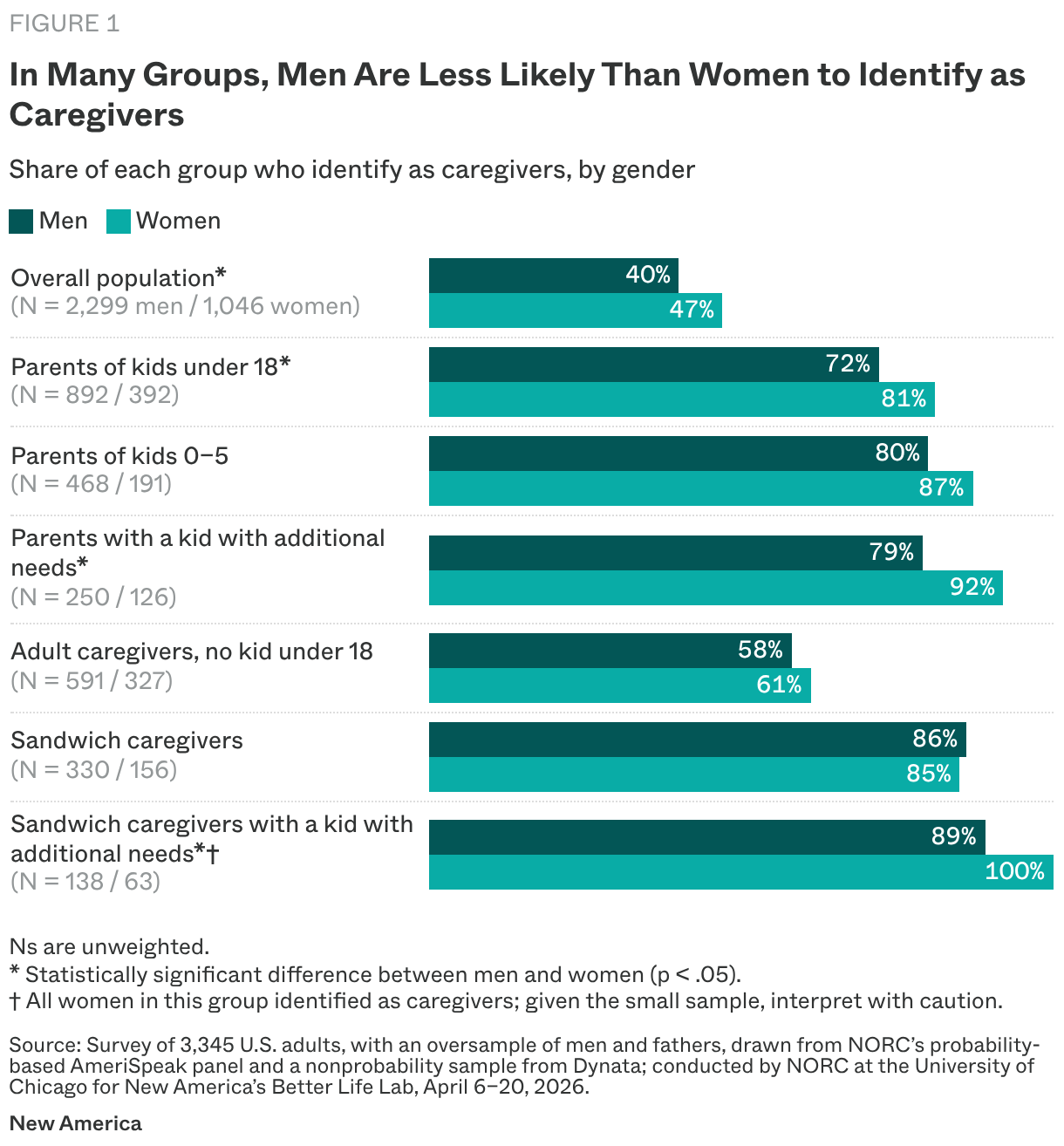
When it comes to identifying as a caregiver, 44 percent of adults overall consider themselves caregivers, with women (as shown in Figure 1) more likely than men to identify as caregivers (47 percent versus 40 percent).
At age 19, Abdul, one of the 2026 survey respondents who requested we only use his first name, became the primary caregiver for his father, who had chronic liver disease, until he passed four years later. A college student at the time, Abdul, now 26, missed classes and was forced to quit his job in order to take his father to doctor appointments or to sit with him in the hospital during one of his many long stays. “I had to do it. There was no one else, so I didn’t have much choice,” he said. Living with his extended immigrant family helped ease the financial strain. And he came to find the time with his father meaningful. “It was always nice to be there for my father, because he was there for me when I was young.” Even though it was a difficult time, he said, “I have no regrets. I would do it again.”
White respondents were less likely than Black and Hispanic respondents to say they identify as caregivers (41 percent of white respondents versus 53 percent of Black respondents and 50 percent of Hispanic respondents).
While the majority of parents of children ages 0–18 believe they are caregivers, not all do, and a significant gender gap remains. Overall, 81 percent of mothers with children 18 and under and 72 percent of fathers with children 18 and under identify as caregivers, a statistically significant difference. Having a child under the age of five increases the likelihood of a parent identifying as a caregiver. Having a child with more medical or educational needs than other children also makes a parent more likely to identify as a caregiver.
Among the general population, 64 percent of those who have been a caregiver for an adult identify as caregivers, as do 79 percent of those who have been a caregiver for a child with extra needs. Parents of children under the age of five are also more likely to identify as caregivers. Just 20 percent of fathers with children ages 5 and under and 14 percent of mothers with children ages 5 and under do not identify as caregivers (a nonsignificant difference).
Two-thirds of those who give care to adults identify as caregivers regardless of gender. Sandwich caregivers—parents of a child under age 18 who also provide care for an adult—are especially likely to describe themselves as caregivers (85 percent). Among sandwich caregivers, men and women are equally likely to identify as caregivers.
What Does “Caregiver” Mean to Those Who Give Care?
To better understand what people think the word “caregiver” connotes, the 2026 survey asked respondents to describe the images or words that come to mind when they think of the word “caregiver.” Respondents provided a diverse array of answers, with no single idea or image shared by a majority.
NORC researchers coded the answers and separated them into a few thematic categories: 36 percent of respondents said they think of providing care or assistance to someone else. Thirteen percent described emotional support or warm attributes (“kindness,” “love,” etc.). Eight percent of respondents mentioned nurses, doctors, or professional care workers, or health care settings. Five percent mentioned parenting, mothers, or fathers. Three percent described care for older age adults, and two percent care for children. Two percent of respondents used explicitly gendered imagery, referencing a mother, a nanny, or a woman. Overall, this question reveals a mix of associations with the term “caregiver,” which may help explain whether one identifies as a caregiver regardless of the behaviors one engages in.
“When I think of a caregiver, I immediately think of someone taking care of an elderly parent,” Tom Capuano, one of the survey respondents, told us in a follow-up interview. “So if someone asked me if I was a caregiver, right off the bat I might have said no, even though I’m taking care of five kids.”
Similarly, Ian Matthew Lima, a father of two children under the age of two, said calling himself a caregiver would feel like “stolen valor.” His mother and brother suffer from a debilitating disease that has left them immobile; the intensive care they require is what he thinks of when he thinks of caregiving. “Being a father is parenting,” he said. “In my mind, those are two completely separate things.”
What Kinds of Caregiving Do Men Engage In?
Overall, 41 percent of men and 48 percent of women say they have, at some point, provided ongoing or periodic care to adults. Adults in lower-income households are more likely to care for an adult (52 percent of those earning less than $30,000 a year versus 38 percent earning $100,000 or more). Parents in lower-income households are also more likely to have cared for a child with extra needs (56 percent versus 36 percent in households with at least $100,000 of annual income). As in 2019, men are less likely than women to engage in adult caregiving, and when they are adult caregivers, they report performing fewer adult caregiving tasks than women do.
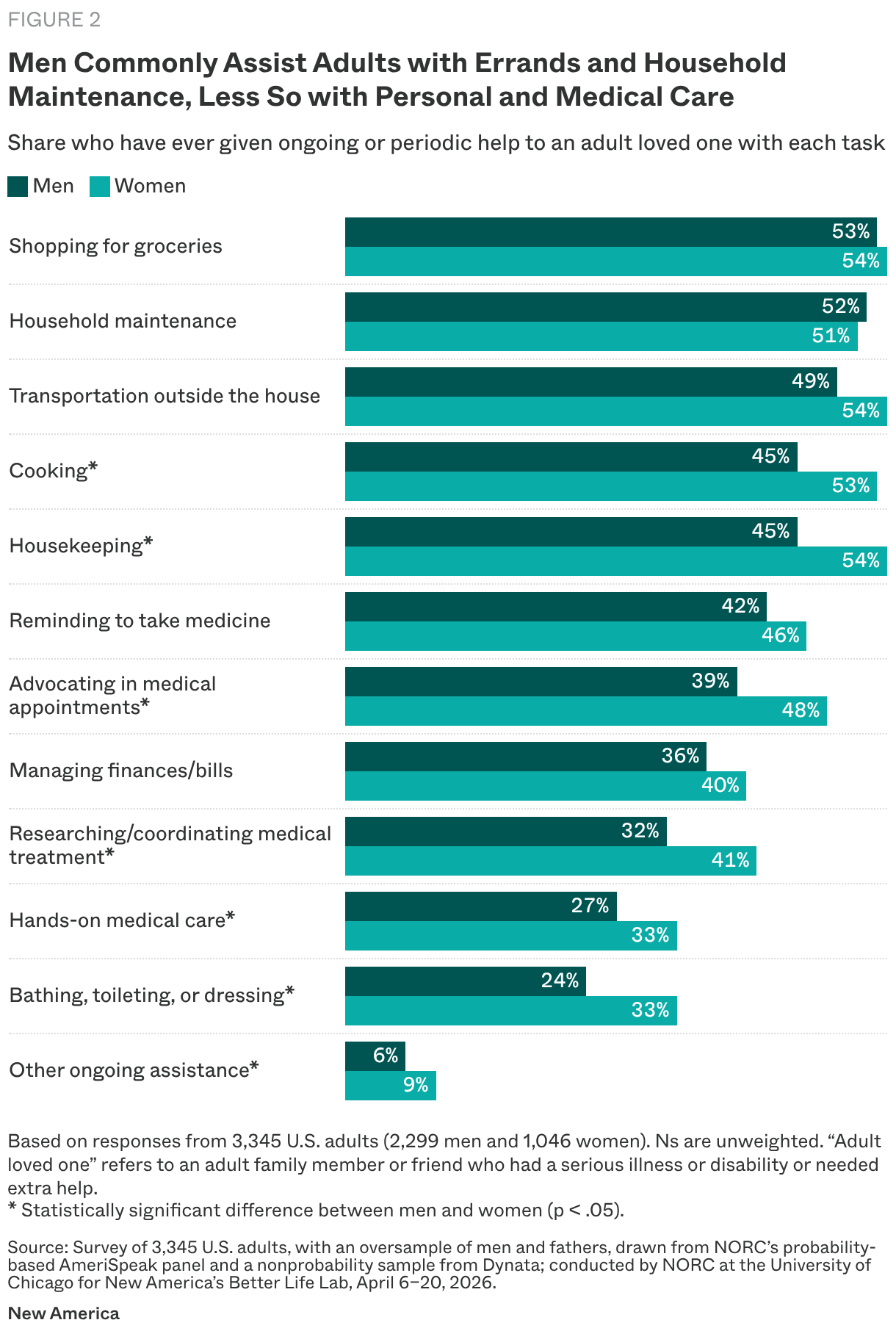
Across the general population, women are more likely than men to perform the more intimate hands-on caregiving tasks like bathing and toileting in adult caregiving (33 percent versus 24 percent). In addition, women are also more likely than men to cook, housekeep, and dress; research, arrange, and coordinate medical or therapeutic treatments; give hands-on medical care; advocate for adults in medical appointments/services; and provide other types of ongoing living assistance. (See Figure 2.)
When it comes to caring for their own children, women and men continue to overlap in terms of the tasks they report doing on a daily basis. Mothers and fathers are equally likely to say they play with their children, clean up after them, provide transportation, and participate in educational activities. The share of Americans who say it is “very important” for fathers to provide direct care to young children rose from 78 percent in 2019 to 84 percent in 2026. In 2026, 82 percent of fathers said providing direct care is “very important.” (See Figure 3.)
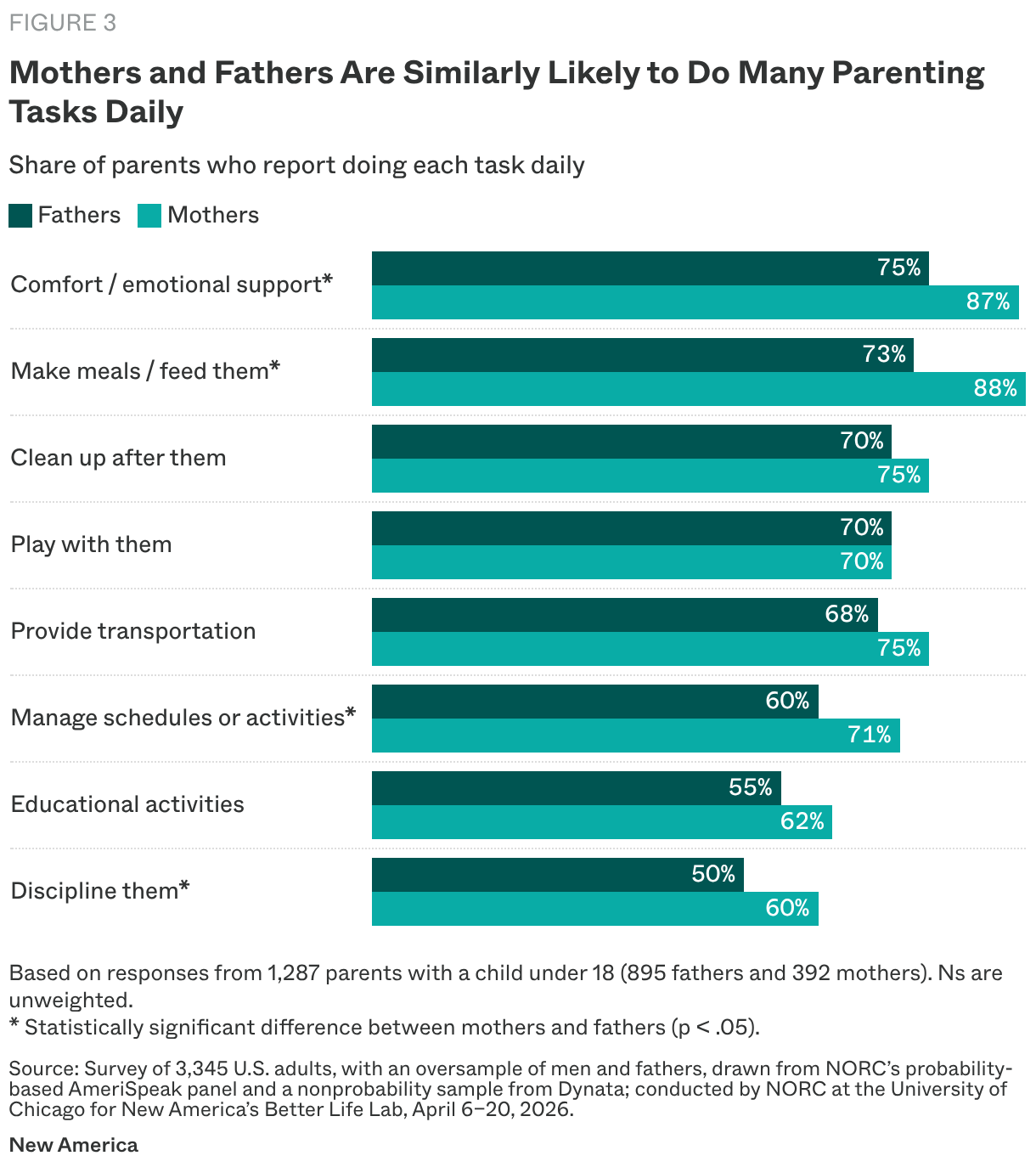
However, as in 2019, mothers are more likely than fathers to manage their child’s schedule, feed their child, and provide emotional support daily. Mothers and fathers perform other tasks at similar rates.
Fathers across the political spectrum report similar rates of engagement with each parenting task except for managing their child’s schedule. Republican (64 percent) and Independent (68 percent) fathers are more likely than Democratic fathers (49 percent) to say they manage their child’s schedules or activities daily.
White fathers are more likely to take part in some child care tasks on a daily basis: 77 percent of white fathers say they clean up after their children daily, compared to 58 percent of Black fathers and 57 percent of Hispanic fathers. Seventy-seven percent of white fathers say they play with their children daily, compared to 63 percent of Black fathers and 61 percent of Hispanic fathers. Seventy-seven percent of white fathers say they make meals for their children daily, compared to 67 percent of Hispanic fathers. Eighty percent of white fathers say they comfort or provide emotional support to their kids on a daily basis, compared to 66 percent of Hispanic fathers. One possible contributor may be Hispanic fathers’ greater likelihood of saying they have no control over the days and hours in which they work (42 percent versus 33 percent of all other fathers), though no significant differences were seen between fathers by racial identity in terms of daily engagement in the other tasks measured by the survey (discipline, transportation, education, and schedule management).
Fathers with children ages 0–5 are more likely than fathers with older children to engage in all care tasks daily. Compared to fathers without a young child, fathers of very young children are 19 percentage points more likely to say they comfort their kids or provide them emotional support, 9 points more likely to make meals or feed them, 30 points more likely to play with them, 14 points more likely to provide transportation, 18 points more likely to take part in educational activities, and 21 points more likely to discipline them.
Beliefs About Gender and Caregiving
U.S. adults’ beliefs about gender and caregiving vary not only by demographic group but also, in some cases, by the age of the person needing care. Seventy-one percent of men and 82 percent of women believe caregiving is as valuable as paid work, a nonsignificant difference.
When it comes to beliefs about child care and gender, beliefs are more mixed. Overall, 56 percent say that aside from breastfeeding, mothers and fathers do an equally good job of caring for a newborn baby, a significant increase from 49 percent in 2019. At the same time, 42 percent said mothers do a better job, a significant drop from the 50 percent who said mothers do a better job in 2019. Adults ages 18–29 and Democrats are more likely to think both mothers and fathers do an equally good job (60 percent and 58 percent, respectively), while adults over the age of sixty and Republicans are more likely to say mothers do a better job (47 percent and 48 percent, respectively).
When it comes to caring for children beyond the breastfeeding or bottle feeding stage, there is widespread agreement among U.S. adults that mothers and fathers should care for children equally (89 percent of women and 85 percent of men). Just 10 percent of women and 12 percent of men said this care should fall mostly to mothers. Two percent of men and less than 1 percent of women said this care should be done mostly by fathers. Republicans are more likely than Democrats and Independents to say mothers should do more care for older children. Still, 83 percent of Republicans believe care should be equally shared.
When asked who is best suited to care for an adult family member who needs assistance, three-fourths (74 percent) said, “gender doesn’t play a role.” Twenty-three percent of respondents said “mainly women” are best suited to care for an adult, while 3 percent said “mainly men” are.
Women were more likely than men to say mainly women are suited to this care (26 percent versus 19 percent for men), while men were more likely than women to say men were best suited to this care (5 percent versus 1 percent for women). (Both of these small differences were statistically significant.) This pattern holds among people who are caregivers themselves: 27 percent of female caregivers and just 18 percent of male caregivers say women are better suited to care for adults.
The age group most likely to say gender doesn’t play a role is the 30–44 cohort (80 percent). Republicans are less likely than Democrats and Independents to say gender doesn’t play a role (67 percent) and more likely to say women are more suited to the care (29 percent).
Although there has long been a pervasive and powerful narrative that women are innately better suited to give care, and that it is the result of a biological “maternal instinct,”26 Americans in the survey tended to see caregiving as learned rather than innate and associated with one gender. Roughly two-thirds (68 percent) say that caregiving is a skill that can be learned with time and experience describes their view “extremely” or “very well,” while just 29 percent say the same of the idea that caregiving is a skill people are born with.
Fathers’ and Mothers’ Views on the Parenting Experience
When it comes to the experience of parenting, mothers and fathers answered similarly on several questions: The vast majority of parents feel others respect them as parents often or sometimes (94 percent of fathers and 95 percent of mothers) and say they find their parenting meaningful at least often or sometimes (96 percent of fathers and 97 percent of mothers). Majorities of mothers and fathers also agree that parenting can often or sometimes be stressful (81 percent of fathers and 79 percent of mothers).
However, mothers are more likely to report barriers to being the parent they want to be (27 percent of fathers versus 34 percent of mothers), perhaps suggesting less satisfaction with their current status quo. The gap between men and women disappears among parents who have a child with additional medical or educational needs: 46 percent of fathers and 46 percent of mothers of children with additional needs cite barriers to their being the parents they want to be. Among fathers, significantly more of those earning high incomes, $100,000 or more, reported barriers to being the father they wanted to be, compared to those earning less than $30,000 a year, 31 percent versus 16 percent. This could reflect the significant time expectations of long hours and work devotion that high-paying work often can take.
The biggest gap seen in this survey between mothers and fathers in how they feel about parenting is their perception of others’ mistrust of their parenting: Fathers are twice as likely as mothers to say people sometimes or often do not trust them to do their parenting because of their gender (26 percent versus 13 percent). That’s similar to the findings in the 2019 survey on a similar question (“People do not trust me to do my parenting in a safe and caring manner because of my gender”).
Men and Women Value Care, but Differences Remain
Those who provide care for an adult friend or family member were asked a series of questions about their feelings about caregiving. Seventy-nine percent of caregivers say, “The care work people do inside their home is as valuable as the paid work others do outside the home,” and 76 percent of caregivers say, “The care work people do at home is valuable to society.”
Female caregivers are more likely than male caregivers to feel that the care work people do inside the home is as valuable as the paid work others do outside the home (82 percent versus 72 percent) and that men and women should divide caregiving responsibilities equally (77 percent versus 68 percent).
A vast majority of caregivers find their caregiving meaningful (91 percent) and report that people respect them in their role as a caregiver (88 percent). Survey respondent James Matthews, 74, a former Vietnam veteran and law enforcement officer in North Carolina, raised his siblings as a young man, then five children as a single father, and later cared for his dying mother. He even left law enforcement and opened his own floor maintenance company to have a more flexible schedule in order to provide care. “I’ve done a lot of things in life. Taking care of my mother and my children, it’s one of the best things I’ve ever done,” he said.
Care “takes every part of your soul to do,” he continued. “Care is absolutely as important as anything else out there. You’re raising the next generation. What you do and how you handle things in their young lives will make a difference. If you do it wrong, then society has to suffer those consequences. Is care as important as being a police officer? I believe that. Is it as important as going to war and fighting? I believe that. It’s one of the most important things you can ever do.”
While the majority of respondents who care for adults or children with extra needs find giving care meaningful, and some find it joyful, 84 percent also say that the caregiving they do can be stressful at least sometimes, and 15 percent say people don’t trust them to do their caregiving because of their gender. A quarter (24 percent) of male caregivers say that people do not trust them to do their caregiving because of their gender, compared to 8 percent of female caregivers.
When asked how well each of the following statements describes their caregiving, 50 percent of caregivers say “I am proud to talk with friends or family about caregiving” describes them “extremely” or “very well,” and 35 percent say it describes them “somewhat well.”
Overall, just 22 percent of caregivers for adults or children with extra needs say that the phrase, “I would be a full-time caregiver if I had the choice,” describes them “very” or “extremely well,” with another 24 percent saying it describes them “somewhat well.”
More than half of such caregivers (54 percent) say the statement, “I want to share caregiving equally at home, but there are barriers in my way,” captures their views either “extremely,” “very,” or “somewhat well.” Male caregivers are more likely than female caregivers to say that they share caregiving responsibilities equally at home (44 percent versus 33 percent).
Just under one-third (28 percent) say there are barriers standing in their way to becoming the caregiver they want to be, most commonly their own physical health (15 percent), their work situation (15 percent), or their financial situation (14 percent). Compared to 2019, fewer report money and finances as their largest barrier (14 percent in 2026 versus 23 percent in 2019). But today, more cite their own health (15 percent in 2026 versus 8 percent in 2019) or their lack of knowledge or training (3 percent in 2019 versus 9 percent in 2026) as a barrier.
Citations
- Ruth Gaunt and Francine M. Deutsch, “Mother’s Instinct? Biological Essentialism and Parents’ Involvement in Work and Childcare,” Sex Roles 90, no. 2 (February 2024): 267–279, https://link.springer.com/article/10.1007/s11199-024-01451-8.