
Sarah Gilliland
Senior Policy Manager, New Practice Lab

Members of the New Practice Lab penned a groundbreaking new child care proposal guided by experts in the field and parents on the ground. To nail down the policy design questions and implementation details, we’ll need to hear from program leaders—and we have just the right group of people to help kick the tires.
Americans treasure families, with nearly half naming families a top-three personal value. Even so, the United States lags far behind peer countries in supporting parents and children. It’s a problem many decades in the making. Families need time off to care for children, money to meet increased household needs, and child care that they can afford and trust. In each of these areas, we have room to grow.
Child care in particular is a sticky wicket, as families often cannot afford the actual cost of care, especially for infants and toddlers. In many places across the country, child care is prohibitively expensive, hard to find, or both. Demand for services is high, though poorly understood because of a lack of real-time data.
Further, our current measures of demand may signal what families need, or can find, more than what they actually want. Through our team’s 2026 National Parent Survey, we are learning more about what ideal arrangements look like for parents across the country. While parent preferences vary widely, one thing is certain: The gap between what families see as ideal and what they can attain is wide, with 78 percent of parents reporting care arrangements that do not meet their ideal.
Families, advocates, and providers have long called for stronger federal investment in early childhood, and help is long overdue. But, whatever we design going forward should account for variation in family needs, while ideally being easy for parents to understand and reasonable for the government to implement.
These are the strengths of the Child Care Choice Guarantee, a policy proposal recently co-authored by my colleagues at the New Practice Lab and experts in the field. The proposal calls for a sizeable investment—some 10 times existing federal spending on the early years—to give all families with young children in the United States a real choice to help meet their needs: a guaranteed child care spot in their preferred setting, or a $1,000 monthly stipend to address the costs of raising young kids as they see fit (and for the lowest-income families, both).
No one knows when supporters of stronger family policy will get another bite at the apple, but conversations are taking shape about what a future federal system might look like. The Child Care Choice Guarantee is a bold idea and deserves serious consideration from policymakers across the political spectrum who agree we should do more to help families.
As with all good ideas, the devil is in the details, and efforts to move the needle can break down in conversations about how policy will work. This is a feature, not a bug. The legislative process is designed less to pass laws than to keep bad laws from passing.
A healthy debate is nothing to be scared of, and discussions about the shape of future policy—and impacts both intended and unintended—are normal and good. The original Americans with Disabilities Act was about 50 pages of printed material as passed. The compiled legislative history as printed by the House Committee on Education and Labor (vols. I, II, and III) was over 3,000 pages, and 18 separate hearings were held. While the act had critics, it also had champions and a grassroots movement underscoring the need for change. This support ultimately broke through, and though some original provisions were tempered, the Americans with Disabilities Act passed with overwhelming bipartisan votes. As a result, buildings, sidewalks, public transportation, and schools are easier to access not just for disabled people, but for everyone.
No single key guarantees a bill’s passage: favorable public opinion, bipartisan support, lobbying, projected costs, and party margins all play a part. Less tangible but still important are practical considerations like “can we do the thing we are trying to do?” Persuading Congress that something can be done is as important as persuading that it should be done. One approach is to pressure-test ideas with people who will be on the hook to implement them. This is pragmatic, but also helps anticipate and mitigate potential impacts to people closest to policy.
The Child Care Choice Guarantee was designed with the voices and experiences of parents with young children in mind. Delivering care that honors nationwide needs will require a massive infusion of federal funds. Much of the funding, however, will be managed and distributed at the state and local level. Early childhood program administrators at those levels will have opinions, and the ultimate success of any child care proposal—Project 2029’s included—will depend on tapping into their expertise running programs.
Members of our Early Care and Education Implementation Working Group have launched, sustained, and scaled successful early childhood programs in communities across the country to meet the needs of families with young kids. They’ve been convening as a group since 2021, and just launched a third cohort—our biggest and most politically and geographically diverse yet.
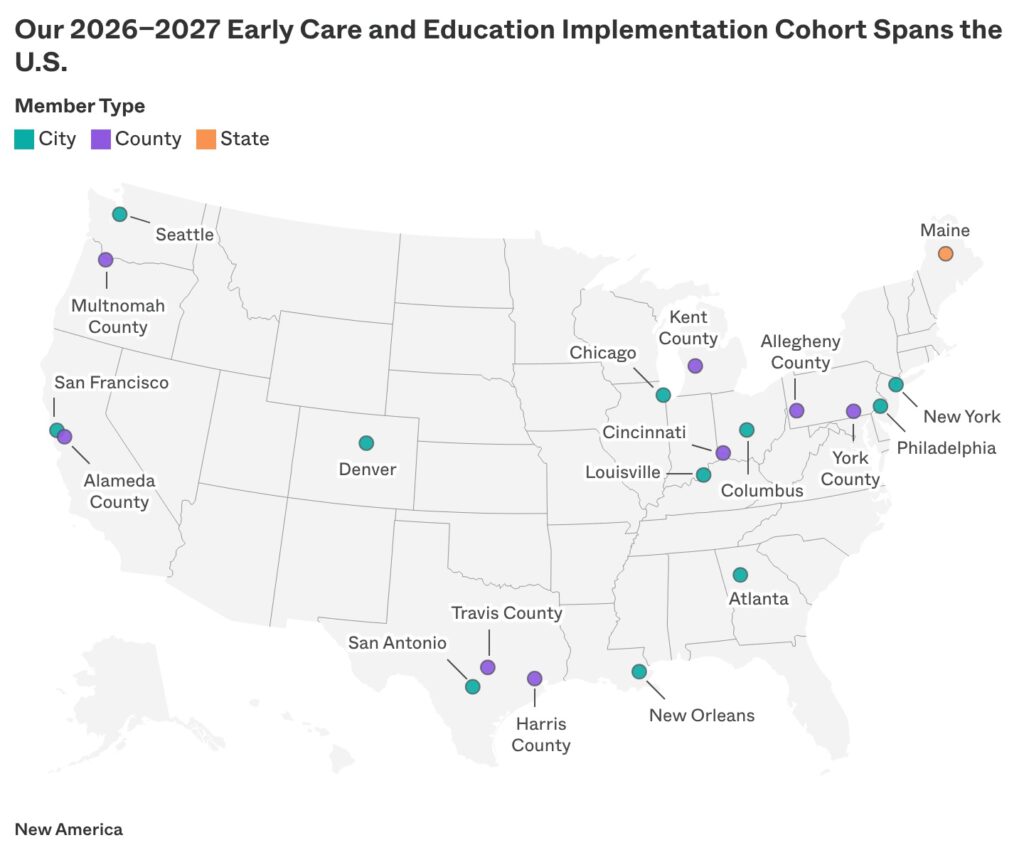
Using dedicated funds secured through locally led ballot initiatives or elected officials’ campaign priorities, these program leaders understand the complex dynamics of running innovative early childhood programs on the ground.
To further pressure-test the proposal, we will engage the cohort for feedback on the Child Care Choice Guarantee: what they think will work well, what might be challenging, and what scenarios to account for. This practitioner perspective will complement family-provided insights we’ve heard through our 2026 National Parent Survey, New York City Parent Survey, and Thriving Families listening efforts, and the provider-focused implementation work we continue to do with state and local governments—and we see it as just the beginning.
It’s helpful that the Implementation Working Group has been considering the potential ramifications of future federal programs on local delivery for a while.
In spring of 2025, a DC-based convening put our members into direct dialogue with federal-level counterparts, kicking off a discussion about how better communication between levels of government could improve future policymaking efforts. That summer, the group convened to imagine what roles and authorities should be left to the federal government versus state and local governments under a future federal expansion of early childhood education.
Why did the group take this on? Each level of government has comparative advantages and shortcomings when it comes to delivering a large-scale program. Only the federal government can require or fully fund a more comprehensive, nationwide program, while state and local governments are better suited to administer and deliver services. To move an ambitious agenda for early childhood forward, the politics will need to be navigated at every level, and across the country.
Without a specific proposal to anchor to, the group weighed in on the roles and functions that might be delegated to each level across 10 design questions. We’re sharing our findings here to help jump-start conversations about how state and local perspectives can inform the design of emerging and future federal proposals, including the Child Care Choice Guarantee. Some spaces are intentionally blank, because this framework is meant to open the door to future conversations.
There are arguments to be made for different approaches, and we welcome them. This set of policy approaches is not set in stone, and doesn’t represent every member of our group. If we reconvened tomorrow to take up the same questions, we might arrive at different answers depending on who is in the room. Furthermore, these perspectives are largely the product of local delivery experiences, and advocates of stronger state and federal systems will have differing and valid opinions. We will continue to seek input and engage in constructive conversations about the structure of an expanded federal program.
Our group met twice in October to discuss implementation specifics of the Child Care Choice Guarantee. We are synthesizing the feedback we gathered, which will inform future engagement opportunities on the proposal.
To learn more about feedback opportunities for Child Care Choice Guarantee, email [email protected].
To sign up for quarterly updates from the local Early Care and Education Implementation Working Group, use this form.
Senior Policy Manager, New Practice Lab