Tara Dawson McGuinness
Founder & Executive Director, New Practice Lab


1971 was a big year in America: the Pentagon Papers, troop withdrawal from Vietnam, Apollo 14, Nixon’s China announcement, the first network email, the release of Marvin Gaye’s What’s Going On.
It was also the last time the United States came close to a bipartisan plan for universal child care—and the start of an ideological fight that still shapes our politics today.
In 1969, President Nixon had made the case directly to Congress to tackle child care. “So crucial is the matter of early growth,” he said, “that we must make a national commitment to providing all American children an opportunity for healthful and stimulating development during the first five years of life.”
The Senate and House responded by passing the bipartisan Comprehensive Child Development Act, a universal approach that would have funded community child care centers open to any American family that wanted a spot. Then, in a surprise twist, Nixon vetoed the bill under pressure from his most conservative base, calling it “a long leap into the dark” that would “commit the vast moral authority of the National Government to the side of communal approaches to child rearing over against the family-centered approach.”
The debates of the day erected a false choice, pitting public childcare investments against the vital role of families and communities. 55 years later, the answer is clear and urgent: America needs both.
While the U.S. still remains without any national universal child care policy, raising a family has only gotten harder over the last half century. At the beginning of the 1970s, 49 percent of women (18–64) and 42 percent of moms with kids under 18 were in the labor force. Today, that figure is 74 percent for both groups, according to our analysis of American Community Survey 2024 1-year data. How Americans work and parent has changed dramatically, but the way we support parents has hardly changed at all.
Federal investments in children under three represent less than one percent of the federal budget. In 2019, public spending on child care and education averaged about $1,500 per child per year for kids under five, versus $12,800 for kids ages five to 18.
We spend more to pay the interest on our national debt than we do on children.
Meanwhile, the price of child care takes up a huge share of the average family’s take-home pay—8.9 percent of the median family income for full-day care for school-aged children, and as high as 16 percent for infant care. Families often spend more on child care than rent.
Family earnings are often too low to support these prices, but most families can’t afford not to work—even if they want to be home while their children are small. Those who come up with the money may still not be able to find a provider, since the country is short more than 4 million licensed child care slots. They may spend months, or even years, on waitlists. Many will never find a spot at all.
It’s hard to think of anything more vital to America’s future than the way we take care of our children in the most developmentally important years of their lives. And yet, the American child care system is clearly failing.
Over the last three years, our team at the New Practice Lab asked American families what ‘better’ would look like. We started in small, in-person meetings with moms, dads, and caregivers, asking what helps them raise a family and what gets in the way. Then we went big, launching the largest-ever nongovernmental survey of parents with young kids.
We spoke to moms working night shifts at the hospital, dads who wanted to stay home with their toddlers, parents working full-time dayjobs, and grandparents raising grandkids while struggling to find just a little time for themselves.
What we heard doesn’t fit neatly into the debates of the 1970s, nor the polarized politics of today. Parents want child care policies that enable them to spend time with their kids and that soften the financial crunch they face in doing so. They want flexible policies that can support all work schedules, including staying home. They want an affordable child care system that allows them to work, and one that recognizes and makes time for the vital role parents and family members play in the earliest years of a child’s life.
Intuitively, the answers also change as children grow. Parents want (and children need) very different things at age one, five, and eight. We need to offer more choices that meet parents where they are.
There is no single solution, but we heard two things clearly: the path forward must include more (and more affordable) child care, and it must help parents spend more time with their kids. More than half (58 percent) of stay-at-home parents nevertheless seek some amount of child care, and many full-time working parents told us they wanted more time with their children, even if it meant working less.
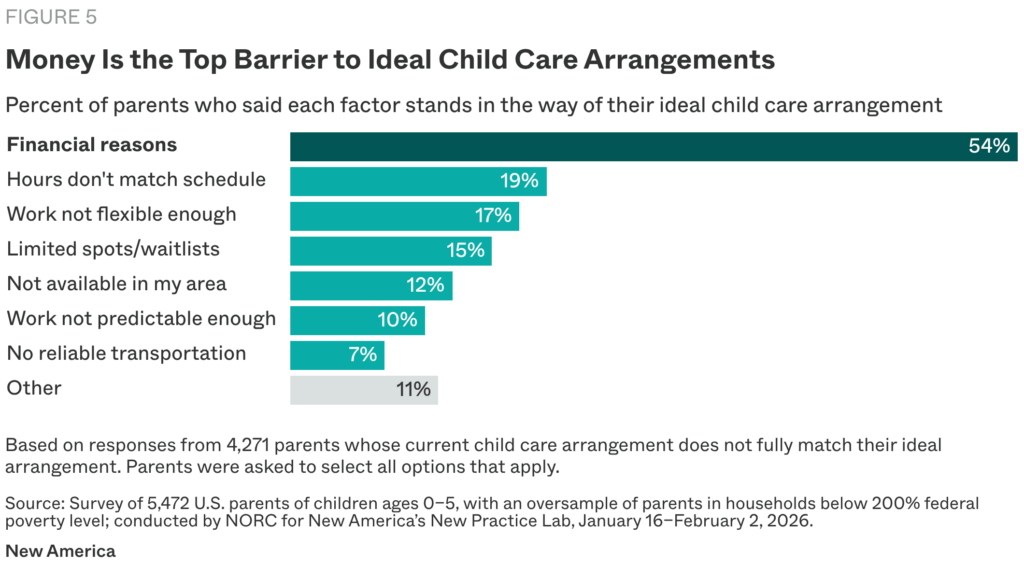
What’s getting in the way? Fifty-four percent of parents with young children say “financial reasons” are the barrier, far beyond all others, to finding their ideal child care arrangements.
| “The most challenging thing about being a parent of a young child now is deciding if you can support your family off of one income, or for your entire paycheck to go to child care costs.”
—Mom of three, Oklahoma |
Is it possible to turn the page on the arguments of the past and focus on what parents say they need today?
We think so.
This week Project 2029 published our Child Care Choice Guarantee proposal, a flexible, workable solution to providing parents with the choices they’ve lacked for far too long.
The pitch is simple: we need to shake up the politics of child care in America. Our proposal offers every family a free, high-quality child care slot in whatever setting works for them—neighborhood centers, faith-based programs, Head Start, home-based providers, schools. And for parents who don’t want that offer or would prefer a different child care option, including caring for their child themselves, we offer a $1,000-a-month CareCredit instead. At the same time, we propose long overdue investments to build the child care capacity and workforce American families need.
Americans care deeply about family, and many say raising children is among the most challenging but rewarding things they do. So why have we made raising a family so maddeningly difficult?
Our Child Care Choice Guarantee helps to fix that problem. It puts an end to decades of leaving families on their own in a broken marketplace and provides federal investments to states to build and grow the child care choices parents say they want. It uplifts the American economy and helps it work better for parents and childcare providers alike. And most importantly, it ensures American parents don’t have to choose between making ends meet and making time to watch their kids grow up.
America has done far harder things in its history—now, what could be more important than this? Let’s break free from the false choices of the past, invest in families, and give families real choices on how to support their kids.
Founder & Executive Director, New Practice Lab
Senior Policy Advisor, New Practice Lab