Alyson Silkowski
Senior Policy Advisor, New Practice Lab

A few months after the release of the 2026 National Parent Survey, our team at the New Practice Lab is excited to announce the results of the New York City Parent Survey—a first-of-its-kind representative survey of more than 4,000 New Yorkers that seeks to understand the child care experiences and preferences of parents in the U.S.’s largest city.
Funded by the Robin Hood Foundation and launched in partnership with the New York City Mayor’s Office of Child Care and Early Childhood Education, the survey offers unprecedented insight into how New York City families think about care for their youngest children, what matters most to them about their children’s earliest environments, how familiar they are with existing government supports, and when and where they want to be able to access care.
For policymakers in New York City, the study could not be more timely. Mayor Mamdani has made universal child care a key plank of his policy agenda, committing to delivering quality, affordable care for all children under five. Building on the City’s existing Pre-K and 3-K programs, which launched in 2014 and 2017 and offer free care to families with four- and three-year-olds, NYC recently launched the first 2-K classrooms—new fully subsidized seats for two-year-olds—with a five-fold expansion planned for next year. Still, thousands of families in NYC receive no public assistance to access or afford care.
The success of such an ambitious effort will depend heavily on implementation decisions the City makes in the coming months: where new public investments are targeted, who is eligible, what hours programs are available, how educators will be recruited (and retained), and more.
Announcing the public release of the survey results last week, Mayor Mamdani noted: “As we deliver the truly universal child care system New York City families need and deserve, the voices of parents must be our north star.”
Listening to families is an idea that’s central to the work we do here at the New Practice Lab, and we were thrilled to partner with the City in these early stages of their planned expansion to understand upfront what families are looking for and need in child care.
One key insight from the National Parent Survey was that the early childhood settings that parents prefer shift based on a child’s age. Parents tend to favor more individualized care—namely, parental care—in infancy, and are more open to more formal settings, such as school-based, center-based, and home-based care, for toddlers. The share of U.S. parents preferring formal child care doubles from 9 to 19 percent between infancy and age three.
As we found with the average U.S. parent with a child under six, NYC parents also want more time with their children in their first months. Roughly 70 percent of parents most want a parent to be the primary caregiver in infancy, and four in five parents said they would have wanted more leave than they had after the birth of their youngest child. If money and job security were not concerns, most parents say they would prefer five to six months of leave.
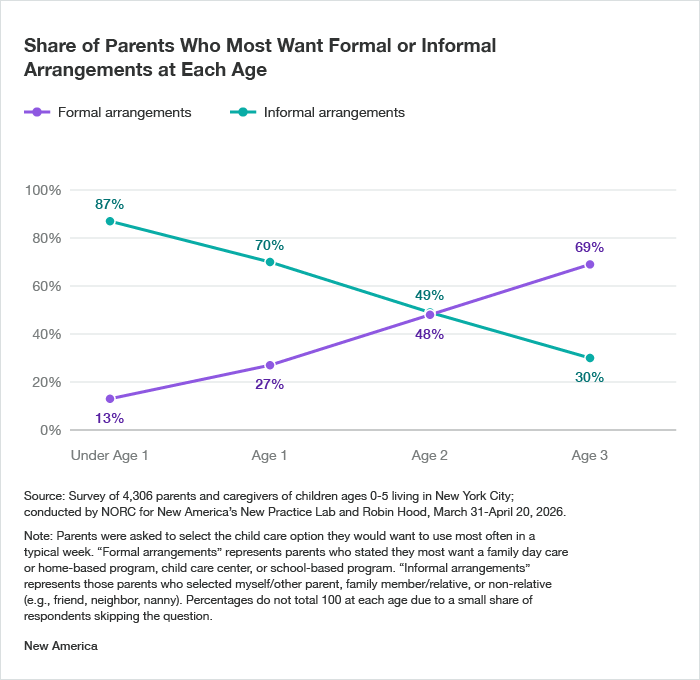
As we found with the average U.S. parent with a child under six, NYC parents also want more time with their children in their first months. Roughly 70 percent of parents most want a parent to be the primary caregiver in infancy, and four in five parents said they would have wanted more leave than they had after the birth of their youngest child. If money and job security were not concerns, most parents say they would prefer five to six months of leave.
The preference among parents for more leave and for greater access to non-parental care beyond age one are clear. But the data also underscore that policymakers should not paint with a broad brush. Parents’ preferences for child care settings, hours, features, and leave duration vary widely by demographic characteristics, including income, gender, geography, language, and work schedules.
Many parents want and need full-day care every weekday. But child care, like the city, has to run 24/7. Forty percent of parents need child care during “nontraditional” hours, and other parents only need care a handful of days a week or want the flexibility to add hours of non-parental care as their children grow.
What families want, above all, is child care they can trust. Roughly half of the respondents named trust as one of the most important factors in choosing a child care provider. As the City expands access to publicly funded options, we hope they not only continue to use the survey data to inform family outreach and also engage families directly through focus groups and other qualitative methods. Understanding what families are looking for—and how to earn their trust in those options—is the next step.
We’re grateful to the Robin Hood Foundation for funding this effort and their collaboration, to NORC for their expertise and for fielding the survey, to the Mayor’s Office of Child Care and Early Childhood Education for their commitment to hearing from New York City families directly, and above all to the thousands of New York City parents who took the time to share their experiences and perspectives with us.
See the full results and public-use data files from the 2026 New York City Parent Survey here.
Senior Policy Advisor, New Practice Lab