A Chapter of: Leading on LEO Satellite Policy: U.S. Priorities for the 2027 World Radiocommunication Conference
Modernize NGSO/GSO Spectrum Sharing
Among the many challenges associated with deploying and operating communications infrastructure hundreds of kilometers above Earth, one regulatory obstacle stands above the rest: the International Telecommunication Union’s equivalent power-flux density (EPFD) limits.22
EPFD limits govern how much signal power an NGSO system may deliver to the receiving antenna of a GSO system operating in the same frequency band.23 These limits have remained essentially unchanged since their adoption nearly 25 years ago despite dramatic advances in satellite technology and major changes in the composition of satellite systems in orbit. As the U.S. delegation argued at WRC-23, and as the Federal Communications Commission (FCC) has repeatedly observed, the ITU’s current EPFD limits are excessively protective of GSO systems, wasting spectrum and unnecessarily constraining the power, capacity, and performance of LEO satellite networks.24
Despite today’s vastly different operating environment and repeated calls for reform from operators and national administrations, modernizing the ITU’s NGSO/GSO sharing framework is not formally on the WRC-27 agenda. Countries with significant investments in legacy GSO systems mounted strong opposition to EPFD reform at WRC-23, viewing expanded NGSO operations as a threat to existing GSO services and infrastructure. Notably, this opposition rests less on technical evidence than on preserving a regulatory framework that advantages GSO systems at the expense of newer satellite technologies. The current rules continue to reflect assumptions and market conditions from a different era.
Even so, a pathway to reform remains open. The final minutes of WRC-23 called for technical studies examining whether and how the current EPFD limits could be modified to improve NGSO performance while continuing to protect GSO systems from harmful interference.25 NGSO operators have already produced numerous studies addressing this question and have supplemented them with real-world measurement campaigns conducted around the globe.
The remaining challenge is political rather than technical. If the United States hopes to modernize EPFD limits at the international level, it must build consensus by engaging with countries that currently oppose reform and by demonstrating how updated rules can serve their interests as well. EPFD reform should move forward now. The United States should treat this issue as a priority and bring it to CITEL with the goal of developing a regional proposal for consideration at WRC-27, where a path remains available to adopt updated EPFD limits.26 At the same time, the U.S. government should intensify engagement with administrations that have yet to support meaningful reform.
What Is Broken: The EPFD Limits Are Unfit for Purpose
When the ITU adopted the EPFD framework at WRC-2000, the satellite industry looked very different from today. NGSO constellations had not yet demonstrated commercial viability and remained largely theoretical in the fixed-satellite service (FSS) bands that now support modern broadband systems. Existing NGSO constellations primarily operated in the less-crowded L-band, while many proposed NGSO systems in the more heavily used C-, Ku-, and Ka-bands had already failed or been abandoned. As a result, both practical considerations and incumbent influence shaped the EPFD framework around a single principle: NGSO systems would have secondary priority in spectrum shared with GSO operators.
The United States has since recognized that EPFD limits “represent the most constraining regulatory restrictions imposed on non-GSO systems” and rely on assumptions that “significantly differ from the modern satellite systems in operation and under development today.”27 Three fundamental flaws explain this disconnect.
Incorrect Design Assumptions
The reference links used to derive the EPFD limits, as specified in ITU Circular Letter CR/116, rely on assumptions that no longer reflect modern satellite operations.
They assume ground-level power levels that exceed current regulatory limits, noise temperatures inconsistent with actual FSS operations, and propagation models that are more than a generation out of date.28 The reference antenna patterns are based on theoretical parabolic antennas common at the time, overstating potential interference by roughly 7.7 decibels.29 The methodology also assumes a worst-case operating geometry in which an NGSO operator consistently selects the satellite closest to the GSO arc. In reality, operators routinely use configurations that produce signal levels as much as 30 decibels lower than those assumed in the ITU model.30
Flawed Derivation Methodology
The process used to establish the EPFD framework was also fundamentally flawed.
When administrations negotiated the original limits, they could agree only on a short-term interference protection criterion based on the 10 percent metric adopted in ITU Recommendation S.1323.31 No comparable consensus existed for long-term interference protections. Rather than deriving long-term limits from technical evidence or operational experience, administrations extrapolated them from the short-term criterion.32 This approach ignored the fact that short- and long-term interference metrics address different phenomena and therefore serve different purposes.
Because no technical foundation existed for the resulting long-term limits, political bargaining filled the gap. The outcome was a patchwork of aggregate EPFD masks across different frequency bands, creating inconsistent management criteria even among bands with similar propagation characteristics.
Misconceived Operating Environment
The ITU also had to determine how to translate aggregate EPFD limits into rights and obligations for individual satellite systems.
The resulting framework assumed a world with 3.5 homogeneous NGSO systems operating simultaneously and holding secondary status relative to GSO operators.33 Why 3.5 systems was chosen remains unclear. Many administrations now believe the figure emerged as part of a political compromise between U.S. and French negotiators.34
More importantly, the framework assumed all NGSO systems would resemble the proposed SkyBridge constellation, which served as the model for the calculations.35 SkyBridge never became commercially viable and never launched a single commercial satellite. As a result, today’s EPFD limits rest on assumptions about a satellite architecture that never existed in practice. The combination of flawed assumptions and an outdated methodology has produced EPFD limits that are excessively conservative, waste substantial spectrum capacity, and impose unnecessary constraints on modern LEO constellations.
In practice, NGSO operators are left with three options:
- Avoid operating near the GSO arc, often maintaining avoidance angles as large as 18 degrees. This significantly reduces coverage, particularly in equatorial and midlatitude regions.36
- Reduce transmission power, even when operating far outside GSO avoidance zones. This lowers data rates and degrades service quality for NGSO users.
- Limit the number of satellite beams that can simultaneously serve a location using the same frequencies. As a result, available satellite capacity often goes unused even when multiple satellites are visible to users on the ground.
A Reform Strategy: Three Sources of Influence
Before turning to specific reform proposals, it is important to recognize how dramatically the satellite marketplace has changed since the current EPFD limits were adopted. NGSO systems now account for more than 90 percent of all new satellite broadband capacity, a figure that has tripled over the past five years.37 Nearly all active satellites launched in 2025 entered low-Earth orbit, and commercial subscriptions to NGSO broadband services now outnumber those to traditional GSO networks by several multiples.38
At the same time, GSO systems have evolved. Many now employ adaptive coding and modulation (ACM) technologies that help maintain service quality when signal conditions deteriorate. Consumer demand has changed as well. Traditional GSO services, such as television distribution, have declined as internet-based alternatives have proliferated.39 At a minimum, modern interference rules should place NGSO and GSO systems on equal footing. The current framework does not.
Three more recent regulatory models provide a road map for reform, and all converge on roughly the same protection criteria.
Q-/V-Band Sharing Regime: When developing sharing rules for fixed-satellite service (FSS) spectrum between 37.5 and 51.4 GHz—the Q- and V-bands—the ITU chose not to apply the traditional EPFD framework. Instead, it adopted a methodology based on actual system performance.40
Recognizing that modern satellite systems increasingly rely on ACM technologies, regulators adopted a degraded-throughput approach under ITU Recommendation S.2131.41 This framework established a long-term protection criterion of 3 percent degraded throughput and a short-term protection criterion of 3 percent link unavailability during brief periods of intense interference.42
NGSO/NGSO Sharing: In 2024, the FCC adopted a sharing framework for NGSO systems operating in the United States that draws heavily on the ITU’s Q-/V-band approach.43
The FCC incorporated the same long-term protection metrics and relied on extensive validation studies demonstrating their effectiveness.44 The principal difference involved short-term interference protection. The FCC concluded that relative short-term metrics do not work well for ACM-enabled systems and instead adopted an absolute increase in link unavailability of 0.4 percent based on simulation results from hundreds of case studies.45
GSO/GSO Sharing: A third pathway starts from a different premise: Rather than examining sharing between NGSO systems, it asks how much interference GSO operators already tolerate from one another.
The logic is straightforward. Existing GSO operators coordinate only with neighboring satellites within a defined distance along the geostationary arc. Beyond that distance, interference is generally considered negligible and does not require coordination. If operators sharing the same spectrum should receive comparable treatment regardless of orbital altitude, then the same coordination thresholds can serve as benchmarks for NGSO systems. Using measured interference-to-noise (I/N) levels between neighboring GSO systems, regulators can derive corresponding protection criteria for NGSO operations.46
The FCC recently adopted this approach. For ACM-enabled systems, the agency established a long-term protection criterion of 3 percent time-weighted average throughput degradation and a short-term criterion of a 0.1 percent absolute increase in link unavailability.47 For non-ACM systems, including many broadcast satellite service (BSS) networks, it adopted an I/N threshold of -10.5 dB for 80 percent of the time.48 Real-world testing demonstrates that these standards protect GSO systems from harmful interference while allowing substantially more efficient use of spectrum.
These three independent reform pathways all point toward essentially the same conclusion. They correct the methodological flaws embedded in the current EPFD framework and replace them with metrics grounded in modern operating realities. Just as importantly, they encourage good-faith coordination among operators. As New America and the International Center for Law & Economics (ICLE) have observed, the current EPFD framework creates incentives for incumbent GSO operators not to coordinate with NGSO systems because it relies on rigid technical restrictions that cannot be adjusted through negotiation.49 Performance-based standards, by contrast, allow operators to negotiate practical solutions that balance interference protection with efficient spectrum use.50
As the FCC has noted, “private agreements, not heavy-handed regulation, lead to the most efficient satellite spectrum sharing outcomes.”51 That principle should guide the ITU’s future NGSO/GSO framework.
Real-World Validation: Proven Metrics
The most significant weakness of the current EPFD framework is that it relies on assumptions that are either decades out of date or were never realized in practice. Reform therefore requires more than theoretical analysis. It requires evidence that modern systems can operate successfully under updated protection criteria.
The evidence now exists. As the FCC recently observed, real-world testing demonstrates that NGSO systems can operate beyond current EPFD limits while protecting typical GSO service links.52 These results provide a valuable reference point for the ITU’s ongoing work.53
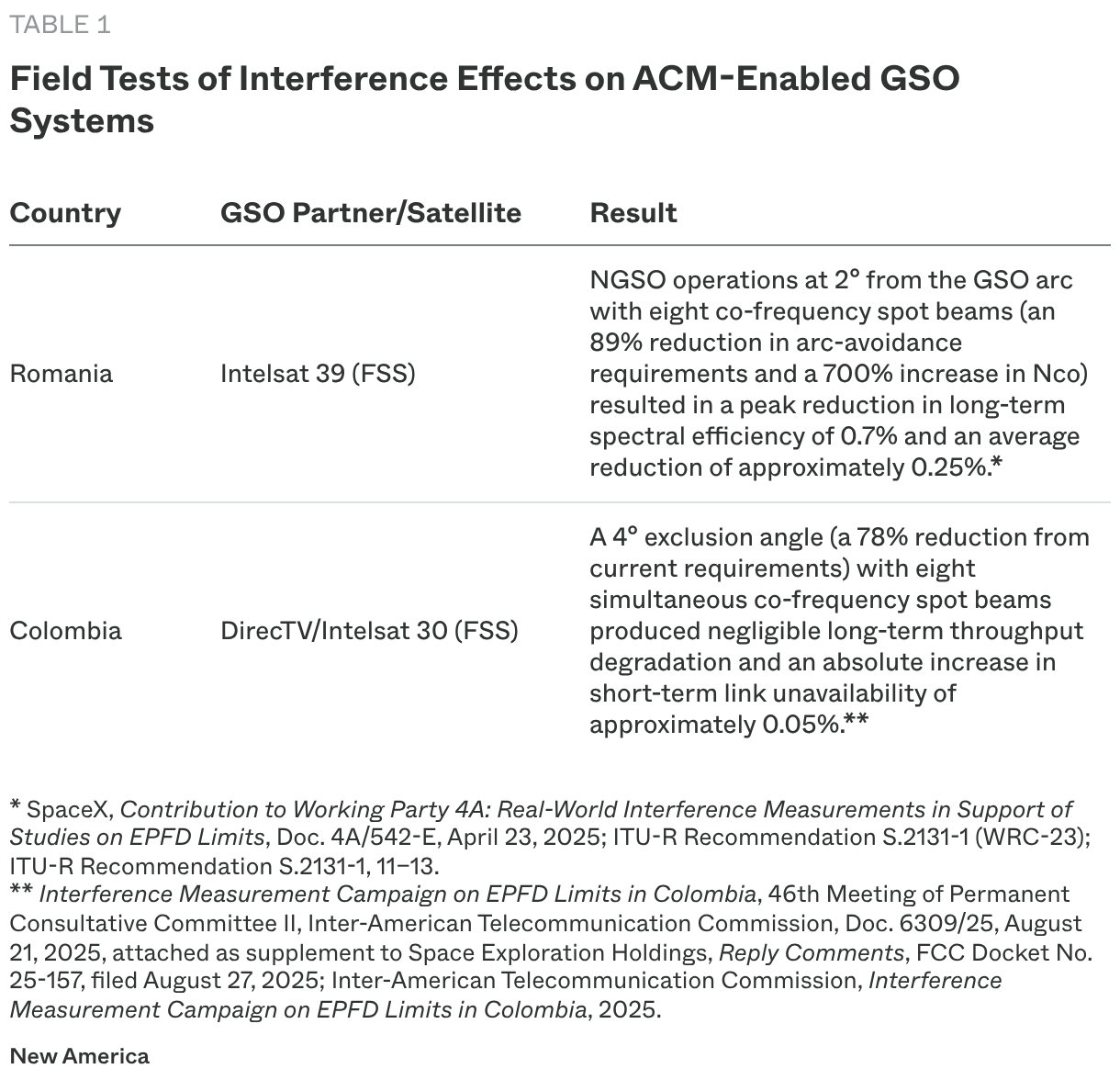
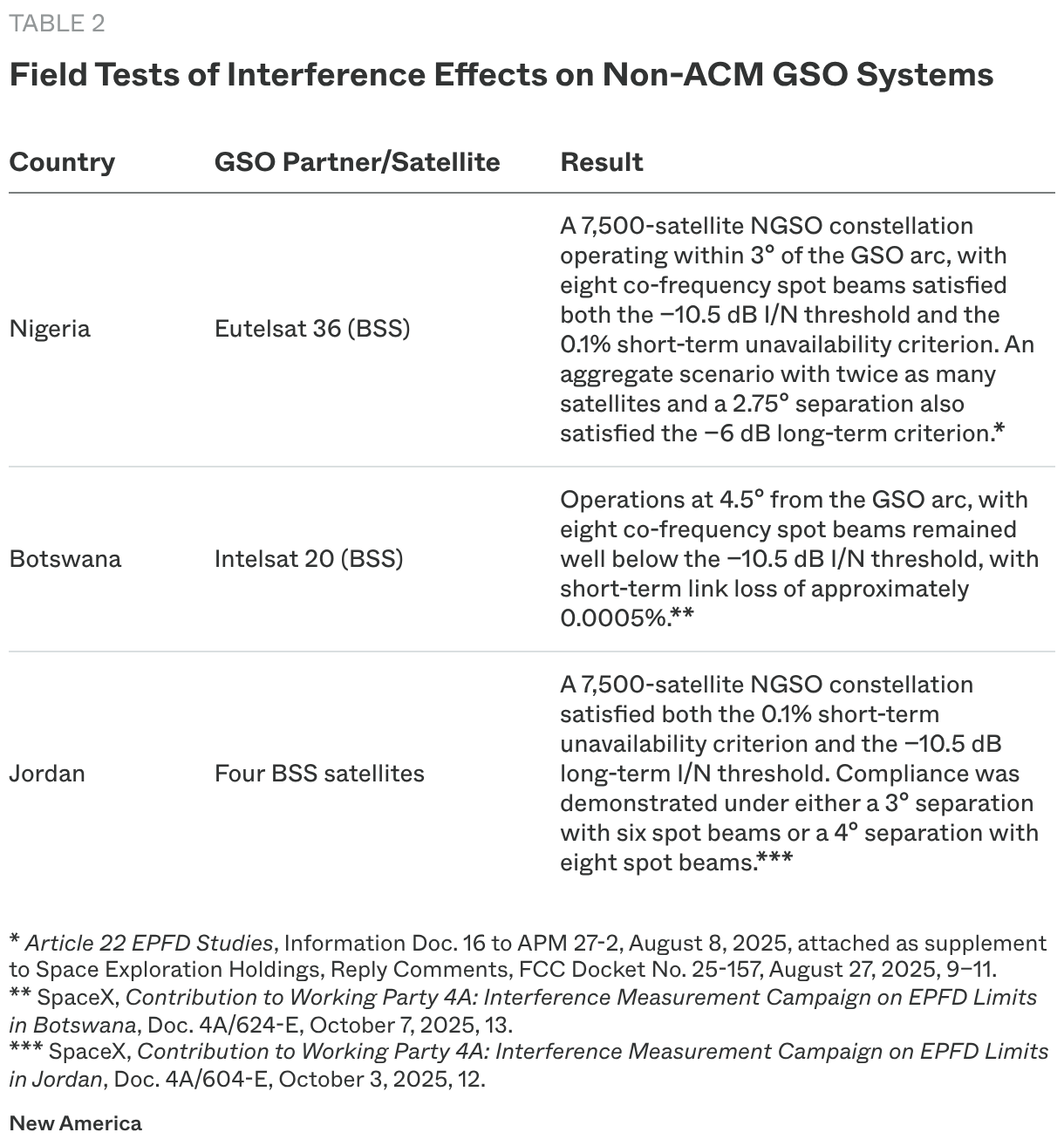
SpaceX has conducted extensive field-testing campaigns in partnership with GSO operators across four continents. These studies examined both ACM-enabled and legacy non-ACM systems in countries including Romania (Table 1), Colombia (Table 1), Nigeria (Table 2), Botswana (Table 2), and Jordan (Table 2). Collectively, they demonstrate that throughput-based interference metrics can successfully protect modern satellite systems while enabling substantially greater use of spectrum by NGSO operators.
The results consistently show that expanded NGSO operations can generate significant capacity gains while imposing little or no meaningful impact on GSO service quality.
Field testing represents the strongest form of validation, but simulation studies have reached similar conclusions. For example, a recent study conducted by the U.S. delegation examined interference impacts from a hypothetical 30,000-satellite NGSO constellation on 230 GSO reference links across the United States.54 The study found that no customer terminal would experience interference exceeding the FCC’s proposed 0.1 percent protection threshold, and 90 percent of links would experience increases in unavailability of 0.00125 percent or less.55
Industry studies point in the same direction. A recent report by the Computer & Communications Industry Association analyzed NGSO interference across 12 U.S. locations and found that exceedances of current EPFD limits would occur only 0.2 to 0.6 percent of the day.56 Most events involved a single satellite rather than aggregate interference from multiple constellations, and average spectral-efficiency losses remained below 1.5 percent.57
The study further found that technologies such as phased-array antennas, dynamic beam nulling, and narrower avoidance angles can significantly increase LEO network capacity without causing harmful degradation to incumbent GSO services.
What Is at Stake: The Benefits for LEO Operators and the World
The resulting benefits could be substantial. Studies indicate that GSO-arc avoidance angles could fall by more than 80 percent, from current levels to roughly 3 to 4 degrees. This would unlock access to spectrum that is effectively unavailable today. Depending on the frequency band, overall spectrum capacity could increase by 74 to 180 percent, while average capacity costs could decline by 43 to 64 percent.58
The number of co-frequency satellite beams serving a particular area could increase from one to as many as eight, resulting in a roughly 700 percent increase in capacity. A hypothetical NGSO system that currently requires 462 satellites to provide global coverage could achieve comparable performance with approximately 360 satellites under updated protection criteria—a reduction of roughly 28 percent.59 Meanwhile, estimated reductions in GSO spectral efficiency remain below 2 percent.60
Taken together, these changes could produce between $10 billion and $100 billion in economic benefits while imposing negligible costs on incumbent GSO operators.61 The trade-off is overwhelmingly favorable. The current EPFD framework should be modernized.
The implications extend beyond economics. For millions of Americans—and billions of people worldwide—satellite broadband represents the most practical path to reliable internet access. Unlike terrestrial networks, satellite systems face few geographic cost barriers. NGSO systems already deliver performance comparable to many terrestrial broadband services.
Expanding capacity by as much as 700 percent in key Ku- and Ka-band frequencies would improve coverage, increase speeds, and allow providers to serve far more users. Recognizing this potential, the U.S. government has revised its approach to the $42.5 billion Broadband Equity, Access, and Deployment (BEAD) program to consider NGSO services as a tool for connecting unserved areas.62 If adopted globally, modernized NGSO/GSO sharing rules could prove even more transformative in developing countries where broadband access remains limited.
A Way Forward: EPFD at WRC-27
WRC-23 directed the International Telecommunication Union Radiocommunication Sector (ITU-R) to conduct technical studies of the EPFD limits contained in Article 22 and report its findings to WRC-27.63 That effort has produced a growing body of studies and field-testing results supporting reform.
The substantive case for action is now well established. The United States has already implemented updated protection criteria domestically through FCC action. As the FCC observed in its recent order modernizing NGSO/GSO sharing rules, the technical record and operational experience developed through that proceeding can serve as a valuable reference point for the ITU.64
One objection to addressing EPFD reform at WRC-27 is procedural. Critics argue that the United States is effectively reversing the traditional ITU process by demonstrating the viability of reforms through domestic regulation and real-world implementation before achieving international consensus.
That criticism misses the point. Demonstrating workability before formal multilateral adoption is not unusual. It is often how international standards evolve. The studies and operational experience generated since WRC-23 provide ample evidence to support meaningful reform at WRC-27 without waiting for another four-year study cycle and WRC-31.65 Further delay would serve procedure rather than substance.
A second challenge comes from incumbent GSO operators that are now developing NGSO capabilities of their own. Some have proposed modest revisions to the most restrictive EPFD limits, particularly in upper Ka-band frequencies. While these proposals would create greater consistency across frequency bands, they leave the fundamental flaws of the existing framework intact. They do not address the outdated reference links, propagation models, antenna assumptions, or extrapolated long-term protection criteria underlying today’s EPFD limits. Nor do they correct the mistaken assumption that NGSO systems should be treated as secondary users in bands where they enjoy co-primary status.
In effect, these proposals would preserve a fundamentally outdated framework while making only incremental adjustments around the edges. Satellite innovation is advancing rapidly. The regulatory framework should evolve with it, not remain anchored to assumptions developed a quarter-century ago.

Citations
- This section summarizes a forthcoming report on EPFD from the International Center for Law & Economics.
- International Telecommunication Union, Radio Regulations, No. 22.2. Individual jurisdictions later incorporated the limits into their national rules. See, for example, 47 C.F.R. §§ 25.146; 25.289.
- Federal Communications Commission, Modernizing Spectrum Sharing for Satellite Broadband, Notice of Proposed Rulemaking, SB Docket No. 25-157, para. 11, released April 29, 2025, https://www.fcc.gov/document/fcc-review-spectrum-sharing-rules-unleash-space-innovation-0.
- This work falls to ITU Working Party 4A, which addresses efficient orbit and spectrum use for satellite services. See International Telecommunication Union, “Working Party 4A (WP 4A): Efficient Orbit/Spectrum Utilization for FSS and BSS,” accessed June 7, 2026, https://www.itu.int/en/ITU-R/study-groups/rsg4/rwp4A/Pages/default.aspx.
- Although WRC-23 did not approve a formal agenda item, it issued a directive calling for further study of the issue, creating a pathway to reform at WRC-27. See International Telecommunication Union, Minutes of the Eleventh Plenary Meeting for WRC-23, Doc. 526-E, January 15, 2024, 4–5, https://www.itu.int/md/R23-WRC23-C-0526/en.
- United States of America, Contribution to Working Party 4A: Working Document Towards a Preliminary Draft New Report [Article 22 EPFD Limit Studies], Document 4A/84-E, April 19, 2024, 1–2.
- United States of America, Contribution to Working Party 4A: Proposed Updates to Technical Studies in Response to WRC-23 Minutes on Article 22 EPFD Limits, Doc. 4A/789-E, October 17, 2025, 13–14. For an overview of these shortcomings, see Article 22 EPFD Limit Studies, 2–6.
- United States of America, Contribution to Working Party 4A: Working Document Containing Technical Work Relating to the GSO Earth Station Gain Patterns Used by Recommendation ITU-R S.1503, Doc. 4A/792-E, October 20, 2025, 1–2; Amazon Kuiper Systems LLC, Comments of Amazon Kuiper Systems LLC, Modernizing Spectrum Sharing for Satellite Broadband, SB Docket No. 25-157, filed July 28, 2025, 6–7.
- Amazon Kuiper Systems LLC, Comments of Amazon Kuiper Systems LLC, Modernizing Spectrum Sharing for Satellite Broadband, SB Docket No. 25-157, filed July 28, 2025, 6–7. Although worst-case geometry concerns the compliance process for NGSO systems rather than the specific EPFD criteria imposed, this verification method further compounds the effect of already restrictive metrics by evaluating compliance under the worst possible interference scenarios rather than across all operating contexts. See Amazon Kuiper Systems LLC, Reply Comments of Amazon Kuiper Systems LLC, Modernizing Spectrum Sharing for Satellite Broadband, SB Docket No. 25-157, filed Aug. 27, 2025, 9.
- ITU-R Recommendation S.1323-0, adopted 1997, superseded by ITU-R Recommendation S.1323-2, approved September 2002. Regulators, including the FCC, have since recognized that relative metrics such as the 10 percent measure are technically unjustified for measuring short-term interference. See Federal Communications Commission, Revising Spectrum Sharing Rules for Non-Geostationary Orbit, Fixed-Satellite Service Systems, SB Docket No. 21-456, para. 19, released November 15, 2024.
- Chairman, Joint Task Group 4-9-11, Report of the Third Meeting of JTG 4-9-11, Doc. 4-9-11/367-E, February 5, 1999, 16.
- A similar number was adopted in Recommendation S.1323. See ITU-R Recommendation S.1323-0, adopted 1997, superseded by ITU-R Recommendation S.1323-2, approved September 2002.
- Although this compromise is well known in ITU circles, no formal documentation explains why that number was selected. Nor is there much explanation of what real-world operations would constitute a “0.5” system or how to evaluate an operating scenario that differs from that assumption.
- United States of America, SkyBridge System Parameters Needed for Simulations of Interference Between NGSO and GSO Systems, Doc. 4-9-11/192-E, June 29, 1998.
- United States of America, Contribution to Working Party 4A: Working Document Towards a Preliminary Draft New Report [Article 22 EPFD Limit Studies], Doc. 4A/84-E, April 19, 2024), 9–10.
- Euroconsult, “Non-Geostationary Orbit Constellations Redefining the High Throughput Satellites Market Landscape,” news release, April 25, 2024, https://nova.space/press-release/non-geostationary-orbit-constellations-redefining-the-high-throughput-satellites-market-landscape.
- Jonathan McDowell, Space Activities in 2025, Jonathan’s Space Report, version 1.4, last updated February 4, 2026, https://planet4589.org/space/papers/space25.pdf; See, for example, Mike Dano, 2025 Global Satellite Broadband Performance Report (Ookla, 2026), https://www.ookla.com/articles/2025-global-satellite-broadband-performance-report.
- Helen Jameson, “OTT: New Business Models Disrupting the Satellite Industry,” Via Satellite, July 24, 2023, https://interactive.satellitetoday.com/via/articles/ott-new-business-models-disrupting-the-satellite-industry.
- ITU-R Resolution 769 (WRC-19); ITU-R Resolution 770 (rev. WRC-23).
- ITU-R Recommendation S.2131-1 (WRC-19).
- International Telecommunication Union, Radio Regulations, art. 22, No. 22.5L; administrations such as the United States have since recognized that relative unavailability metrics are technically unjustified and should be replaced with absolute metrics. See infra notes 52–54.
- 47 C.F.R. § 25.261; Federal Communications Commission, Revising Spectrum Sharing Rules for Non-Geostationary Orbit, Fixed-Satellite Service Systems, Second Report and Order on Reconsideration, IB Docket No. 21-456, released November 15, 2024, https://docs.fcc.gov/public/attachments/FCC-24-117A1.pdf.
- Federal Communications Commission, Revising Spectrum Sharing Rules for Non-Geostationary Orbit, Fixed-Satellite Service Systems, Second Report and Order on Reconsideration, IB Docket No. 21-456, paras. 11–16, released November 15, 2024, https://docs.fcc.gov/public/attachments/FCC-24-117A1.pdf.
- Because baseline availability for ACM systems frequently exceeds 99 percent, the baseline unavailability measure used as the denominator for deriving the change in carrier-to-noise ratio can produce very large relative increases from even minimal changes in link conditions. See Federal Communications Commission, Revising Spectrum Sharing Rules for Non-Geostationary Orbit, Fixed-Satellite Service Systems, para. 28; Federal Communications Commission, Revising Spectrum Sharing Rules for Non-Geostationary Orbit, Fixed-Satellite Service Systems, para. 28; Letter from Jayson L. Cohen, Director of Satellite Policy, Space Exploration Technologies Corp., to Marlene H. Dortch, Secretary, Federal Communications Commission, IB Docket No. 21-456, 2, S-6 to S-9, filed July 25, 2024.
- For GSO systems using ACM, the long-term degraded-throughput values from either ITU Recommendation S.2131 (for Q- and V-band systems) or the FCC’s NGSO/NGSO sharing regime (for Ku- and Ka-band systems) can be used, as both reach the same value. See supra notes 46–54 and accompanying text.
- Federal Communications Commission, Revising Spectrum Sharing Rules for Non-Geostationary Orbit, Fixed-Satellite Service Systems, paras. 9–10.
- Federal Communications Commission, Revising Spectrum Sharing Rules for Non-Geostationary Orbit, Fixed-Satellite Service Systems, paras. 9–10.
- Public Knowledge and New America’s Open Technology Institute, Comments of Public Knowledge and New America’s Open Technology Institute, Modernizing Spectrum Sharing for Satellite Broadband, SB Docket No. 25-157, filed July 28, 2025, 6.
- International Center for Law & Economics, Comments of the International Center for Law & Economics, Modernizing Spectrum Sharing for Satellite Broadband, SB Docket No. 25-157, filed July 28, 2025, 7.
- Federal Communications Commission, Modernizing Spectrum Sharing for Satellite Broadband, Report and Order, SB Docket No. 25-157, para. 37, released May 1, 2026, https://docs.fcc.gov/public/attachments/DOC-420708A1.pdf.
- Federal Communications Commission, Modernizing Spectrum Sharing for Satellite Broadband, Notice of Proposed Rulemaking, SB Docket No. 25-157, para. 21, released April 29, 2025.
- Federal Communications Commission, Modernizing Spectrum Sharing for Satellite Broadband, Notice of Proposed Rulemaking, SB Docket No. 25-157, para. 41, released April 29, 2025.
- United States of America, Contribution to Working Party 4A: Proposed Updates to Technical Studies in Response to WRC-23 Minutes on Article 22 EPFD Limits, Doc. 4A/1030-E, April 24, 2026, 2–4.
- United States of America, Proposed Updates to Technical Studies in Response to WRC-23 Minutes on Article 22 EPFD Limits, 2026, 2.
- Cornel Balint and Sebastian Ventz, Considerations on Interference Impact in GEO-LEO Spectrum Sharing Systems (Computer & Communications Industry Association, April 2026), https://ccianet.org/research/reports/considerations-on-interference-impact-in-geo-leo-spectrum-sharing-systems; Balint and Ventz, Considerations on Interference Impact, 4.
- Balint and Ventz, Considerations on Interference Impact, 4, 8.
- Harold Furchtgott-Roth, The Economic Benefits of Updating Regulations That Unnecessarily Limit Non-Geostationary Satellite Orbit Systems (Furchtgott-Roth Economic Enterprises, 2023), 7, https://allianceforsatellitebroadband.org/wp-content/uploads/2023/10/The-Economic-Benefits-of-Updating-Regulations-that-Unnecessarily-Limit-Non-Geostationary-Satellite-Orbit-Systems.pdf; Balint and Ventz, Considerations on Interference Impact, 8, appendix A.
- Balint and Ventz, Considerations on Interference Impact, 8.
- Balint and Ventz, Considerations on Interference Impact, 7, appendix B.
- Balint and Ventz, Considerations on Interference Impact, 7.
- National Telecommunications and Information Administration, Broadband Equity, Access, and Deployment (BEAD) Program: BEAD Restructuring Policy Notice (U.S. Department of Commerce, 2025), 8–11, https://www.ntia.gov/sites/default/files/2025-06/bead-restructuring-policy-notice.pdf.
- International Telecommunication Union, Minutes of the Eleventh Plenary Meeting for WRC-23, Doc. 526-E, January 15, 2024, 4–5.
- Federal Communications Commission, Modernizing Spectrum Sharing for Satellite Broadband, Notice of Proposed Rulemaking, SB Docket No. 25-157, para. 41, released April 29, 2025.
- Federal Communications Commission, Modernizing Spectrum Sharing for Satellite Broadband, Notice of Proposed Rulemaking, SB Docket No. 25-157, para. 41, released April 29, 2025.