Michael Calabrese
Director, Wireless Future, New America; Senior Advisor, Technology & Democracy, New America




Next year’s World Radiocommunication Conference (WRC-27) in Shanghai will set global rules for access to spectrum frequency bands that could determine whether America’s currently dominant low-Earth orbit (LEO) satellite operators have the market access and capacity needed to scale, reduce costs, and innovate new services for consumers at home and worldwide. This paper describes the WRC process and recommends that the United States prepare early, establish strong positions, and build winning coalitions. It then focuses on five issues that should rank among the highest U.S. priorities at WRC-27 and recommends positions for each that will best advance American economic interests and values.
The authors extend their thanks to the members of the LEO Policy Working Group, which our two organizations jointly convened last year, culminating in the in-depth report we rely on here to explain and recommend U.S. positions and priorities concerning the most important global satellite issues likely to be decided at the World Radiocommunication Conference (WRC-27) next year in Shanghai. In particular, we’d like to thank Patricia Cooper, Ruth Pritchard-Kelly, Jeffrey Carlisle, Armand Musey, Joe Kane, Mark Jamison, and Karina Perez for their very helpful comments, edits, and suggestions. We are solely responsible for any errors herein, but those are no doubt minimal thanks to their expert advice.
Editorial disclosure: The views expressed in this report are solely those of the authors and do not reflect the views of New America, its staff, fellows, funders, or board of directors.
Decisions made at next year’s World Radiocommunication Conference (WRC-27) in Shanghai concerning the global harmonization of spectrum frequency bands for terrestrial and satellite services will have significant and long-lasting effects on the competitiveness of leading U.S. industries. Held every four years, the WRC is the treaty-level conference of the International Telecommunication Union (ITU), the United Nations agency responsible for coordinating the shared global use of radio spectrum and developing worldwide technical rules for communications networks. By updating the international Radio Regulations, each WRC helps shape global economies of scale for telecommunications equipment, consumer devices, and services.
WRC-27 will be particularly important in determining whether America’s emerging and currently dominant low-Earth orbit (LEO) satellite providers have the market access and spectrum capacity needed to scale, reduce costs, and develop new services for consumers in the United States and around the world. Spectrum-sharing and interference rules adopted by the ITU are especially important for satellite services because, unlike most terrestrial wireless systems, virtually all satellite spectrum is shared.
As an innovative and rapidly growing sector, LEO satellite constellations have attracted significant attention at the ITU. More than 80 percent of the items currently on the WRC-27 agenda directly or indirectly affect LEO satellite operators—an industry in which U.S. firms currently lead the world. ITU decisions are particularly consequential for satellite operators. Unlike cellular providers, which can obtain exclusive-use licenses within national markets, satellite operators must function within a globally shared spectrum environment governed by both ITU rules and national regulations. For LEO constellations, global spectrum harmonization, power limits, and country-by-country market access are essential to achieving economies of scale. A balanced ITU spectrum policy that reflects U.S. interests and values can further expand the benefits of wireless communications by supporting interoperable global markets and enabling truly ubiquitous, seamless connectivity.
In short, the U.S. delegation to WRC-27 must work to shape satellite spectrum allocations, market-access rules, and interference protections that will govern future communications networks. Doing so will benefit major U.S. industries while advancing democratic approaches to communications policy. The alternative is to cede influence to geopolitical rivals advancing different, self-interested and often illiberal policy agendas. This task will be especially important—and especially challenging—in Shanghai, where China will enjoy significant home-field advantages.
This paper focuses on five issues that should rank among the highest U.S. priorities at WRC-27. The first section provides background on the WRC process and recommends steps the United States can take to prepare early, establish strong positions, and build coalitions that begin with countries in ITU Region 2 (the Americas). The remainder of the paper examines six current agenda items—along with one additional issue that should be added to the WRC-27 agenda—and explains why strong U.S. positions on each would best advance American economic interests and values.
Global spectrum allocations and other policies are harmonized through study cycles that culminate in rules adopted by the International Telecommunication Union (ITU) at World Radiocommunication Conferences (WRCs), which are held every four years. Member states negotiate binding regulations covering a wide range of radiocommunication issues, including how spectrum is allocated, assigned, and managed on a global scale.1 The decisions reached at each WRC are codified in the ITU Radio Regulations, which carry the force of an international treaty, although individual countries retain the authority to adapt them for their own national regulatory frameworks.
While some countries, including the United States, often modify the regulations to reflect national priorities, many others incorporate the Radio Regulations directly into domestic law. As a result, the ITU Radio Regulations play a major role in shaping spectrum policy worldwide.
At WRCs, decisions are generally made by multinational consensus, although the host country often exercises significant influence over how the conference operates. China’s selection as host of WRC-27 has therefore raised concerns in Washington, where policymakers worry both about security issues and about the outcomes that could emerge from an unfriendly conference environment.2
Decisions reached at any given WRC are a product of years of preparatory work set in motion by previous conferences. Before each WRC, the Radiocommunication Assembly convenes to review and approve the technical standards, recommendations and questions developed by the ITU Radiocommunication Sector’s (ITU-R) specialized study groups, which consist of experts representing participating administrations.3 For WRC-27, the assembly will be held October 11-15 in Shanghai, immediately before the conference itself.
The agenda for each WRC includes not only final decisions on allocations and regulations but also an item establishing the agenda for the next conference and, in some cases, identifying preliminary issues for conferences further in the future. Because the WRC is the primary mechanism through which topics are formally placed on future agendas, moving a spectrum-allocation change or regulatory reform from initial proposal to final adoption often takes two conference cycles—eight years or more.4
The process is intentionally slow and deliberate, prioritizing international consensus over speed. Increasingly, however, both the length of the process and the ability of countries resistant to change to delay decisions on globally harmonized allocations and rules have frustrated regulators and innovative firms. This is particularly true for the Federal Communications Commission (FCC) and leading U.S. non-geostationary orbit (NGSO) satellite operators seeking to modernize regulations to keep pace with rapidly evolving technologies.
Following each WRC, a Conference Preparatory Meeting (CPM) assigns new agenda items to the relevant study groups.5 Those groups develop potential approaches to each item and identify additional areas requiring study. Their work feeds into a comprehensive CPM report that is finalized at a second meeting shortly before the next WRC. While the CPM seeks to reconcile competing approaches, the report may present multiple alternatives when consensus proves impossible.
The ITU also convenes a separate Plenipotentiary Conference every four years to establish the organization’s broader strategic direction, elect leadership, and address governance and membership issues. The next conference, PP-26, is scheduled for November 9–27, 2026, in Doha, Qatar.6
Like other member states, the United States participates in the WRC process both independently and through a regional bloc. In the Americas, that bloc is the Inter-American Telecommunication Commission (CITEL), one of six regional organizations that participate in WRC preparations.7 CITEL members have already begun meeting to discuss proposals and identify areas of agreement.
Regional consensus significantly increases the influence of proposals at the ITU and improves their chances of adoption. The ITU divides the world into three regions for spectrum-management purposes: Region 1 (Europe, Africa, and most of northern Asia), Region 2 (the Americas), and Region 3 (South Asia and Australasia).8 Because ITU rules permit some variation among regions, regional agreement is often essential to securing new allocations and regulatory changes.
Before the United States can advocate a position internationally, however, it must first navigate a complicated domestic process. Reaching a formal U.S. position requires reconciling two parallel tracks: one led by the National Telecommunications and Information Administration (NTIA), which represents federal government interests, and one led by the FCC, which represents private-sector and public-interest stakeholders. Those interests do not always align. Ultimately, the Department of State, informed by NTIA and FCC recommendations, finalizes U.S. positions and appoints an ambassador-level official to lead the U.S. delegation.
On the federal side, NTIA’s Office of Spectrum Management coordinates participation through the Interdepartment Radio Advisory Committee’s Radio Conference Subcommittee (IRAC RCS), which includes representatives from federal departments and agencies.9 The RCS develops preliminary government views and proposals. Once approved by the full IRAC, NTIA develops a final position and submits it to the FCC’s Office of International Affairs. Although the FCC is not a member of IRAC, it appoints a liaison to work with the RCS.
On the private-sector side, the FCC chair convenes the WRC Advisory Committee (WAC), which consists of industry representatives granted special government employee status for the duration of the process.10 The WAC is organized into four working groups covering maritime, aeronautical and radar services; mobile and fixed services; fixed-satellite service and regulatory matters; and mobile-satellite and space science services.
The full WAC typically meets four times per year. The current committee, whose chair and vice chair were announced in May 2024 and whose renewed charter applications were due in January 2026, held its fourth meeting in February 2026.11 FCC staff also contribute technical and regulatory expertise through specialized bureaus and offices. Following each meeting, the FCC’s Office of International Affairs solicits public comment on WAC recommendations. The most recent comment cycle closed on March 6.12 NTIA’s RCS also provides updates at WAC meetings, creating a regular point of coordination between the two processes.
Once the WAC completes its work, FCC and NTIA officials reconcile any remaining differences through their respective WRC coordinators. The resulting draft U.S. positions are transmitted to the Department of State. The State Department then submits approved proposals either to CITEL, if sufficient time remains for regional consideration, or directly to the ITU when deadlines require.13
CITEL’s Permanent Consultative Committee II (PCC.II) meets twice annually. Member states use those meetings to debate national proposals and consolidate them into regional positions that carry substantially greater weight at WRC than any individual country submission. In theory, the goal is straightforward: develop unified U.S. positions early enough to build coalitions and secure regional support before arriving at the conference. In practice, weaknesses in the process have repeatedly undermined that objective.
At WRC-23, many of those weaknesses were on full display. Critics argued that the United States appointed its delegation head too late, moved too slowly to reach consensus on key issues, and therefore found itself excluded from important negotiations because it lacked regional support and was advancing largely unilateral positions.14
These shortcomings were not isolated incidents. They reflect deeper structural problems that have appeared repeatedly across multiple WRC cycles.
Domestic coordination challenges, particularly between the FCC and the NTIA, have been a recurring concern for years. A 2019 Government Accountability Office (GAO) report found that the absence of a clear definition of “consensus” complicated efforts to reach agreement. Although the FCC and NTIA signed a new memorandum of understanding in 2022, they had previously operated under a decades-old framework.15 GAO testimony following WRC-19 further suggested that a highly public interagency dispute over several spectrum bands weakened the U.S. position and delayed submission of technical studies.16
The U.S. process will always be complex. Reconciling diverse and sometimes competing interests is unavoidable. But with WRC-27 approaching rapidly, critical satellite issues at stake, and an adversarial host nation, the United States cannot afford to repeat past mistakes.
Several areas deserve particular attention:
The United States has a long-standing practice of appointing delegation heads relatively late in the WRC process. Current FCC Commissioner Anna Gomez was appointed to lead the WRC-23 delegation only nine months before the conference, and her successor was appointed even later, after Gomez’s Senate confirmation required her to step aside.
This pattern should change. The delegation head plays a central role in building relationships across U.S. stakeholder groups, within CITEL, and with international partners. Late appointments shorten the time available to cultivate those relationships and reduce opportunities to develop expertise on both the technical issues and political dynamics involved.17
Although formal ambassadorial appointments may limit how early the State Department can act, prospective delegation heads can still be selected well in advance and begin attending meetings, building expertise, and developing coalitions. The administration’s recent appointment of an ambassador-at-large for cyberspace and digital policy may signal movement in this direction.
A core premise of U.S. preparation for WRC-27 should be support for modern, flexible spectrum-management policies that maximize the productive use of scarce spectrum resources.
The United States has undertaken a broad spectrum- and space-policy modernization effort in recent years that should serve as the foundation for its engagement at the ITU. Beginning with its 2023 spectrum-management policy statement, the FCC signaled a shift away from rigid, worst-case regulatory assumptions toward modern sharing frameworks based on real-world interference conditions, efficient protection criteria, and shared coordination responsibilities.18
Several recent FCC actions reflect this approach, including the agency’s 2023 and 2026 reforms governing spectrum sharing among NGSO systems and between NGSO and geostationary orbit (GSO) systems as well as proposals to streamline the licensing of satellite and terrestrial ground equipment operating in millimeter-wave bands.
The ITU Radio Regulations, by contrast, remain rooted in a command-and-control model that often relies on outdated assumptions, overprotects incumbents, limits spectrum capacity, and slows innovation. The United States should use the WRC-27 process to advocate a broader modernization of ITU rules consistent with its own evolving spectrum-management philosophy.
Success at the WRC depends on consensus—first domestically, then regionally, and finally internationally.
For the United States, that process begins with developing clear, technically supported positions through the FCC and NTIA. Although the current process has often worked, delays have sometimes prevented the United States from developing positions early enough to advance them through CITEL. Proposals that do not become regional submissions generally carry less influence at the ITU.
The United States should prioritize reaching decisions early enough for them to become CITEL proposals. Doing so requires identifying potential disagreements early, conducting technical studies where necessary, and ensuring that both industry participants and government agencies approach negotiations with a willingness to compromise in pursuit of broader national interests.
Satellite issues will be especially important at WRC-27. The United States has a strong interest in shaping global regulations that support innovation in a rapidly growing industry led by American firms. Consider broadband connectivity. Unlike terrestrial cellular providers, satellite operators deploy global systems that depend on worldwide customer bases and favorable regulatory treatment across multiple jurisdictions. ITU decisions regarding spectrum harmonization, power limits, and market access therefore have significant implications for the ability of U.S. satellite operators to deploy networks and compete globally.
For that reason, U.S.-led satellite providers are likely to face competing regulatory initiatives from countries seeking to strengthen domestic rivals. One notable example is the European Union’s proposed Space Act, which imposes requirements that appear designed to burden large non-European operators while protecting European competitors.19 Similar concerns arise from regulatory frameworks in Canada, Brazil, Japan, India, China, and elsewhere.20 As the International Center for Law & Economics (ICLE) has observed, these policies can function as nontariff barriers that disadvantage foreign providers, shield less-efficient domestic operators from competition, reduce incentives to invest and innovate, and slow the deployment of new technologies and network capacity.21
Industry and government agencies should jointly identify the satellite-related agenda items that present the greatest risks to U.S. interests and make them the organizing focus of the U.S. preparatory effort. These include issues involving additional Earth station backhaul capacity, spectrum for direct-to-device (D2D) services, and the equivalent power-flux-density (EPFD) limits on co-frequency low-Earth orbit (LEO) system sharing with GSOs. Several of these issues are discussed in greater detail below.
The value of CITEL-backed proposals is widely recognized. In practice, however, the United States has sometimes arrived at CITEL meetings with underdeveloped positions that were unable to serve as the basis for regional coalitions.
Coalition-building is as much a diplomatic exercise as a technical one. Other Region 2 countries are far more likely to support U.S. proposals when the United States engages them early, listens to their concerns, and develops proposals they can confidently endorse.
Political considerations will also shape coalition-building at WRC-27. Some recent decisions by the Trump administration concerning tariffs and military actions may create additional diplomatic headwinds for U.S. negotiators. At the same time, many CITEL member states have demonstrated strong demand for the NGSO satellite services that would benefit from the ITU reforms discussed in this paper. That demand creates an opportunity.
The head of the U.S. delegation should begin building support as early as possible by strengthening relationships and socializing U.S. positions with counterparts across the region. Outreach should focus on fostering a shared understanding of both the benefits and the trade-offs associated with U.S. proposals on satellite issues. It could also include workshops and other convenings that help regulators and policymakers better understand the technical issues at stake and the perspectives of U.S. companies and experts.
As noted above, next year’s World Radiocommunication Conference is remarkable for its unprecedented focus on satellite and space issues. More than 80 percent of the tentative agenda items affect the rapidly growing LEO satellite sector, an industry in which U.S. companies currently hold a leading position.
The sections that follow examine four established agenda items of major importance to the LEO satellite industry. Before turning to those items, however, it is important to address a separate issue that, while not formally on the WRC-27 agenda, remains highly consequential to U.S. interests. The issue stems from unresolved debates at WRC-23 over the rules governing spectrum sharing between traditional geostationary orbit (GSO) satellites and the increasingly prevalent non-geostationary orbit (NGSO) systems, including LEO constellations.
Among the many challenges associated with deploying and operating communications infrastructure hundreds of kilometers above Earth, one regulatory obstacle stands above the rest: the International Telecommunication Union’s equivalent power-flux density (EPFD) limits.22
EPFD limits govern how much signal power an NGSO system may deliver to the receiving antenna of a GSO system operating in the same frequency band.23 These limits have remained essentially unchanged since their adoption nearly 25 years ago despite dramatic advances in satellite technology and major changes in the composition of satellite systems in orbit. As the U.S. delegation argued at WRC-23, and as the Federal Communications Commission (FCC) has repeatedly observed, the ITU’s current EPFD limits are excessively protective of GSO systems, wasting spectrum and unnecessarily constraining the power, capacity, and performance of LEO satellite networks.24
Despite today’s vastly different operating environment and repeated calls for reform from operators and national administrations, modernizing the ITU’s NGSO/GSO sharing framework is not formally on the WRC-27 agenda. Countries with significant investments in legacy GSO systems mounted strong opposition to EPFD reform at WRC-23, viewing expanded NGSO operations as a threat to existing GSO services and infrastructure. Notably, this opposition rests less on technical evidence than on preserving a regulatory framework that advantages GSO systems at the expense of newer satellite technologies. The current rules continue to reflect assumptions and market conditions from a different era.
Even so, a pathway to reform remains open. The final minutes of WRC-23 called for technical studies examining whether and how the current EPFD limits could be modified to improve NGSO performance while continuing to protect GSO systems from harmful interference.25 NGSO operators have already produced numerous studies addressing this question and have supplemented them with real-world measurement campaigns conducted around the globe.
The remaining challenge is political rather than technical. If the United States hopes to modernize EPFD limits at the international level, it must build consensus by engaging with countries that currently oppose reform and by demonstrating how updated rules can serve their interests as well. EPFD reform should move forward now. The United States should treat this issue as a priority and bring it to CITEL with the goal of developing a regional proposal for consideration at WRC-27, where a path remains available to adopt updated EPFD limits.26 At the same time, the U.S. government should intensify engagement with administrations that have yet to support meaningful reform.
When the ITU adopted the EPFD framework at WRC-2000, the satellite industry looked very different from today. NGSO constellations had not yet demonstrated commercial viability and remained largely theoretical in the fixed-satellite service (FSS) bands that now support modern broadband systems. Existing NGSO constellations primarily operated in the less-crowded L-band, while many proposed NGSO systems in the more heavily used C-, Ku-, and Ka-bands had already failed or been abandoned. As a result, both practical considerations and incumbent influence shaped the EPFD framework around a single principle: NGSO systems would have secondary priority in spectrum shared with GSO operators.
The United States has since recognized that EPFD limits “represent the most constraining regulatory restrictions imposed on non-GSO systems” and rely on assumptions that “significantly differ from the modern satellite systems in operation and under development today.”27 Three fundamental flaws explain this disconnect.
The reference links used to derive the EPFD limits, as specified in ITU Circular Letter CR/116, rely on assumptions that no longer reflect modern satellite operations.
They assume ground-level power levels that exceed current regulatory limits, noise temperatures inconsistent with actual FSS operations, and propagation models that are more than a generation out of date.28 The reference antenna patterns are based on theoretical parabolic antennas common at the time, overstating potential interference by roughly 7.7 decibels.29 The methodology also assumes a worst-case operating geometry in which an NGSO operator consistently selects the satellite closest to the GSO arc. In reality, operators routinely use configurations that produce signal levels as much as 30 decibels lower than those assumed in the ITU model.30
The process used to establish the EPFD framework was also fundamentally flawed.
When administrations negotiated the original limits, they could agree only on a short-term interference protection criterion based on the 10 percent metric adopted in ITU Recommendation S.1323.31 No comparable consensus existed for long-term interference protections. Rather than deriving long-term limits from technical evidence or operational experience, administrations extrapolated them from the short-term criterion.32 This approach ignored the fact that short- and long-term interference metrics address different phenomena and therefore serve different purposes.
Because no technical foundation existed for the resulting long-term limits, political bargaining filled the gap. The outcome was a patchwork of aggregate EPFD masks across different frequency bands, creating inconsistent management criteria even among bands with similar propagation characteristics.
The ITU also had to determine how to translate aggregate EPFD limits into rights and obligations for individual satellite systems.
The resulting framework assumed a world with 3.5 homogeneous NGSO systems operating simultaneously and holding secondary status relative to GSO operators.33 Why 3.5 systems was chosen remains unclear. Many administrations now believe the figure emerged as part of a political compromise between U.S. and French negotiators.34
More importantly, the framework assumed all NGSO systems would resemble the proposed SkyBridge constellation, which served as the model for the calculations.35 SkyBridge never became commercially viable and never launched a single commercial satellite. As a result, today’s EPFD limits rest on assumptions about a satellite architecture that never existed in practice. The combination of flawed assumptions and an outdated methodology has produced EPFD limits that are excessively conservative, waste substantial spectrum capacity, and impose unnecessary constraints on modern LEO constellations.
In practice, NGSO operators are left with three options:
Before turning to specific reform proposals, it is important to recognize how dramatically the satellite marketplace has changed since the current EPFD limits were adopted. NGSO systems now account for more than 90 percent of all new satellite broadband capacity, a figure that has tripled over the past five years.37 Nearly all active satellites launched in 2025 entered low-Earth orbit, and commercial subscriptions to NGSO broadband services now outnumber those to traditional GSO networks by several multiples.38
At the same time, GSO systems have evolved. Many now employ adaptive coding and modulation (ACM) technologies that help maintain service quality when signal conditions deteriorate. Consumer demand has changed as well. Traditional GSO services, such as television distribution, have declined as internet-based alternatives have proliferated.39 At a minimum, modern interference rules should place NGSO and GSO systems on equal footing. The current framework does not.
Three more recent regulatory models provide a road map for reform, and all converge on roughly the same protection criteria.
Q-/V-Band Sharing Regime: When developing sharing rules for fixed-satellite service (FSS) spectrum between 37.5 and 51.4 GHz—the Q- and V-bands—the ITU chose not to apply the traditional EPFD framework. Instead, it adopted a methodology based on actual system performance.40
Recognizing that modern satellite systems increasingly rely on ACM technologies, regulators adopted a degraded-throughput approach under ITU Recommendation S.2131.41 This framework established a long-term protection criterion of 3 percent degraded throughput and a short-term protection criterion of 3 percent link unavailability during brief periods of intense interference.42
NGSO/NGSO Sharing: In 2024, the FCC adopted a sharing framework for NGSO systems operating in the United States that draws heavily on the ITU’s Q-/V-band approach.43
The FCC incorporated the same long-term protection metrics and relied on extensive validation studies demonstrating their effectiveness.44 The principal difference involved short-term interference protection. The FCC concluded that relative short-term metrics do not work well for ACM-enabled systems and instead adopted an absolute increase in link unavailability of 0.4 percent based on simulation results from hundreds of case studies.45
GSO/GSO Sharing: A third pathway starts from a different premise: Rather than examining sharing between NGSO systems, it asks how much interference GSO operators already tolerate from one another.
The logic is straightforward. Existing GSO operators coordinate only with neighboring satellites within a defined distance along the geostationary arc. Beyond that distance, interference is generally considered negligible and does not require coordination. If operators sharing the same spectrum should receive comparable treatment regardless of orbital altitude, then the same coordination thresholds can serve as benchmarks for NGSO systems. Using measured interference-to-noise (I/N) levels between neighboring GSO systems, regulators can derive corresponding protection criteria for NGSO operations.46
The FCC recently adopted this approach. For ACM-enabled systems, the agency established a long-term protection criterion of 3 percent time-weighted average throughput degradation and a short-term criterion of a 0.1 percent absolute increase in link unavailability.47 For non-ACM systems, including many broadcast satellite service (BSS) networks, it adopted an I/N threshold of -10.5 dB for 80 percent of the time.48 Real-world testing demonstrates that these standards protect GSO systems from harmful interference while allowing substantially more efficient use of spectrum.
These three independent reform pathways all point toward essentially the same conclusion. They correct the methodological flaws embedded in the current EPFD framework and replace them with metrics grounded in modern operating realities. Just as importantly, they encourage good-faith coordination among operators. As New America and the International Center for Law & Economics (ICLE) have observed, the current EPFD framework creates incentives for incumbent GSO operators not to coordinate with NGSO systems because it relies on rigid technical restrictions that cannot be adjusted through negotiation.49 Performance-based standards, by contrast, allow operators to negotiate practical solutions that balance interference protection with efficient spectrum use.50
As the FCC has noted, “private agreements, not heavy-handed regulation, lead to the most efficient satellite spectrum sharing outcomes.”51 That principle should guide the ITU’s future NGSO/GSO framework.
The most significant weakness of the current EPFD framework is that it relies on assumptions that are either decades out of date or were never realized in practice. Reform therefore requires more than theoretical analysis. It requires evidence that modern systems can operate successfully under updated protection criteria.
The evidence now exists. As the FCC recently observed, real-world testing demonstrates that NGSO systems can operate beyond current EPFD limits while protecting typical GSO service links.52 These results provide a valuable reference point for the ITU’s ongoing work.53
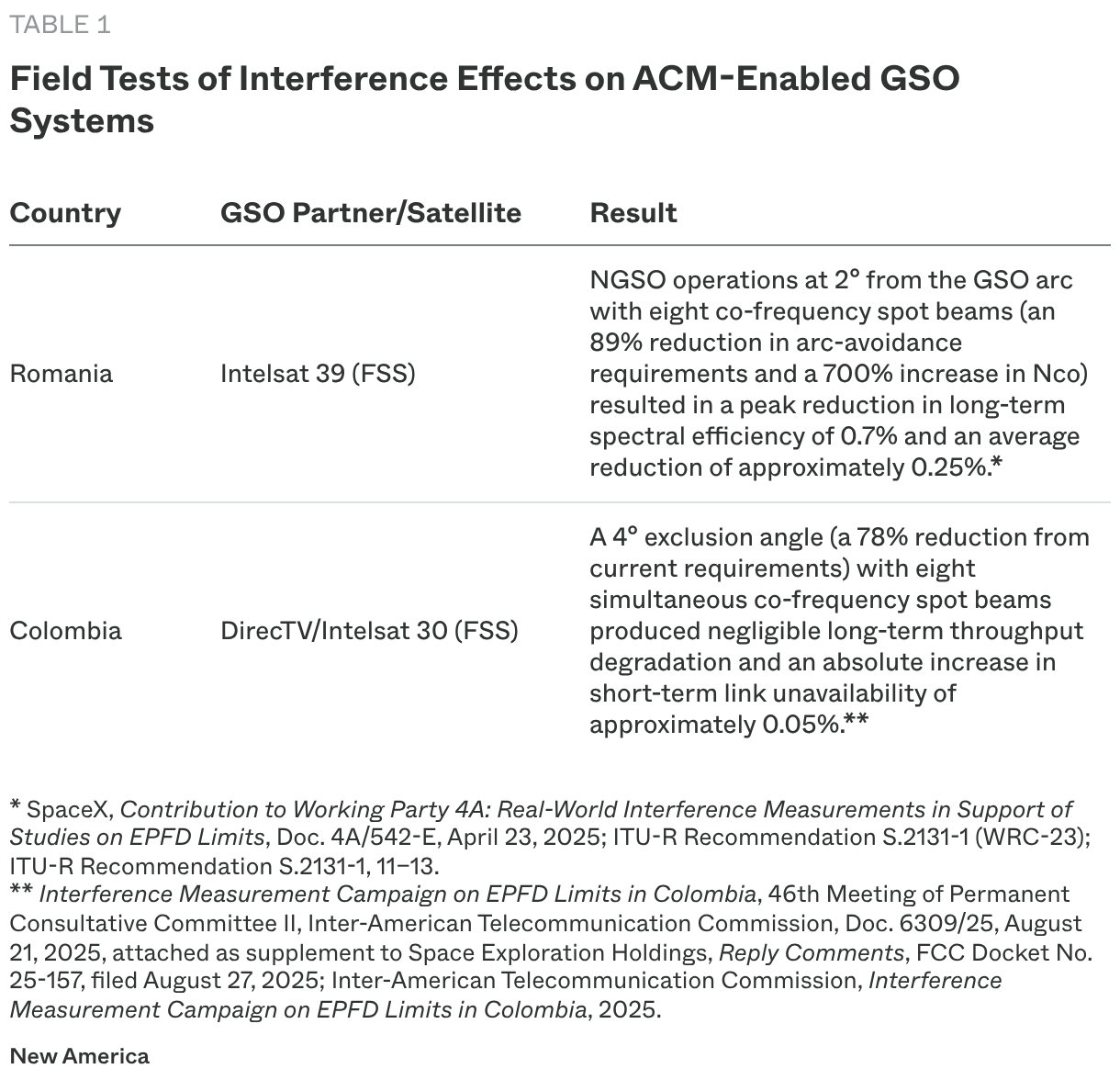
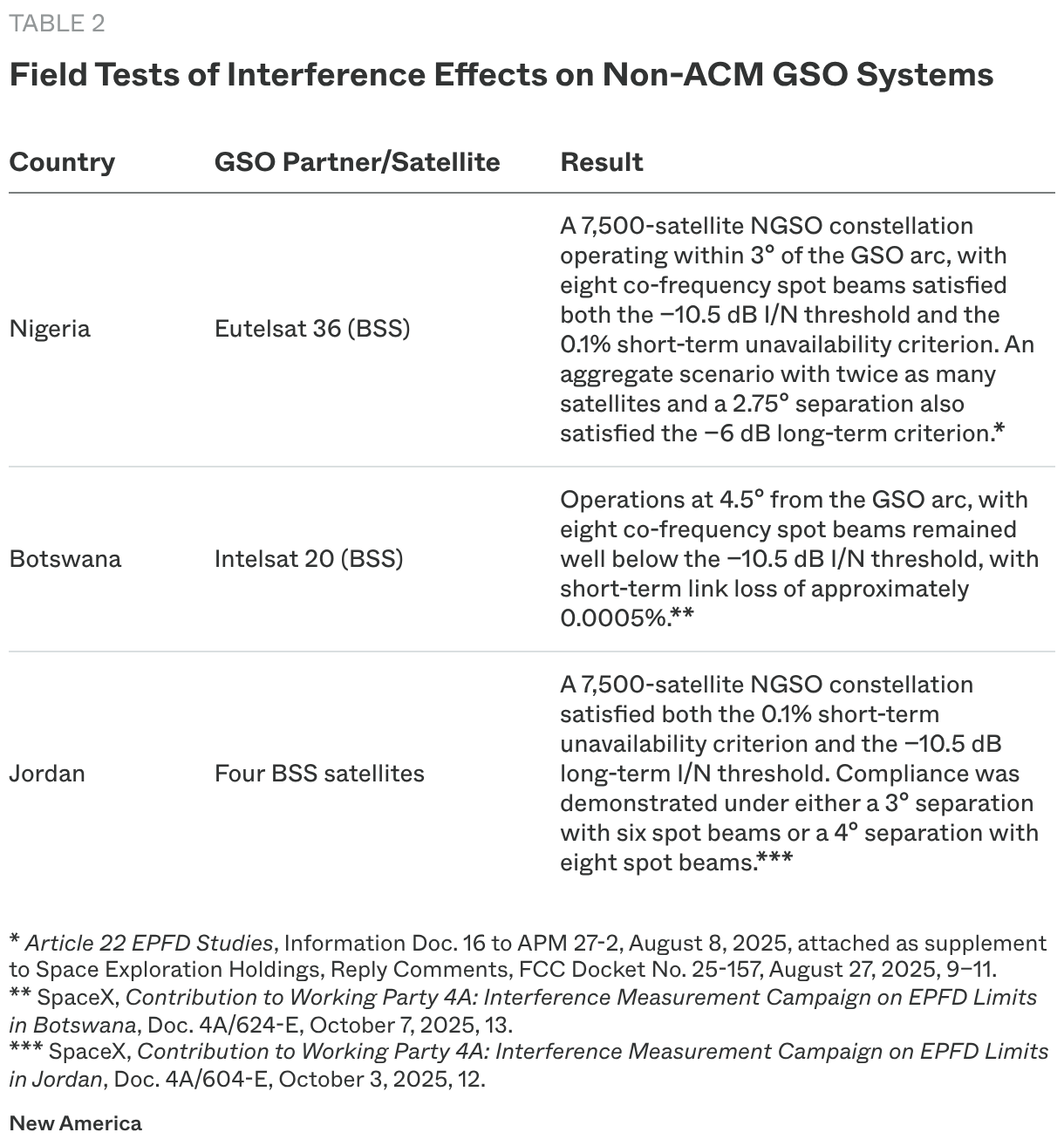
SpaceX has conducted extensive field-testing campaigns in partnership with GSO operators across four continents. These studies examined both ACM-enabled and legacy non-ACM systems in countries including Romania (Table 1), Colombia (Table 1), Nigeria (Table 2), Botswana (Table 2), and Jordan (Table 2). Collectively, they demonstrate that throughput-based interference metrics can successfully protect modern satellite systems while enabling substantially greater use of spectrum by NGSO operators.
The results consistently show that expanded NGSO operations can generate significant capacity gains while imposing little or no meaningful impact on GSO service quality.
Field testing represents the strongest form of validation, but simulation studies have reached similar conclusions. For example, a recent study conducted by the U.S. delegation examined interference impacts from a hypothetical 30,000-satellite NGSO constellation on 230 GSO reference links across the United States.54 The study found that no customer terminal would experience interference exceeding the FCC’s proposed 0.1 percent protection threshold, and 90 percent of links would experience increases in unavailability of 0.00125 percent or less.55
Industry studies point in the same direction. A recent report by the Computer & Communications Industry Association analyzed NGSO interference across 12 U.S. locations and found that exceedances of current EPFD limits would occur only 0.2 to 0.6 percent of the day.56 Most events involved a single satellite rather than aggregate interference from multiple constellations, and average spectral-efficiency losses remained below 1.5 percent.57
The study further found that technologies such as phased-array antennas, dynamic beam nulling, and narrower avoidance angles can significantly increase LEO network capacity without causing harmful degradation to incumbent GSO services.
The resulting benefits could be substantial. Studies indicate that GSO-arc avoidance angles could fall by more than 80 percent, from current levels to roughly 3 to 4 degrees. This would unlock access to spectrum that is effectively unavailable today. Depending on the frequency band, overall spectrum capacity could increase by 74 to 180 percent, while average capacity costs could decline by 43 to 64 percent.58
The number of co-frequency satellite beams serving a particular area could increase from one to as many as eight, resulting in a roughly 700 percent increase in capacity. A hypothetical NGSO system that currently requires 462 satellites to provide global coverage could achieve comparable performance with approximately 360 satellites under updated protection criteria—a reduction of roughly 28 percent.59 Meanwhile, estimated reductions in GSO spectral efficiency remain below 2 percent.60
Taken together, these changes could produce between $10 billion and $100 billion in economic benefits while imposing negligible costs on incumbent GSO operators.61 The trade-off is overwhelmingly favorable. The current EPFD framework should be modernized.
The implications extend beyond economics. For millions of Americans—and billions of people worldwide—satellite broadband represents the most practical path to reliable internet access. Unlike terrestrial networks, satellite systems face few geographic cost barriers. NGSO systems already deliver performance comparable to many terrestrial broadband services.
Expanding capacity by as much as 700 percent in key Ku- and Ka-band frequencies would improve coverage, increase speeds, and allow providers to serve far more users. Recognizing this potential, the U.S. government has revised its approach to the $42.5 billion Broadband Equity, Access, and Deployment (BEAD) program to consider NGSO services as a tool for connecting unserved areas.62 If adopted globally, modernized NGSO/GSO sharing rules could prove even more transformative in developing countries where broadband access remains limited.
WRC-23 directed the International Telecommunication Union Radiocommunication Sector (ITU-R) to conduct technical studies of the EPFD limits contained in Article 22 and report its findings to WRC-27.63 That effort has produced a growing body of studies and field-testing results supporting reform.
The substantive case for action is now well established. The United States has already implemented updated protection criteria domestically through FCC action. As the FCC observed in its recent order modernizing NGSO/GSO sharing rules, the technical record and operational experience developed through that proceeding can serve as a valuable reference point for the ITU.64
One objection to addressing EPFD reform at WRC-27 is procedural. Critics argue that the United States is effectively reversing the traditional ITU process by demonstrating the viability of reforms through domestic regulation and real-world implementation before achieving international consensus.
That criticism misses the point. Demonstrating workability before formal multilateral adoption is not unusual. It is often how international standards evolve. The studies and operational experience generated since WRC-23 provide ample evidence to support meaningful reform at WRC-27 without waiting for another four-year study cycle and WRC-31.65 Further delay would serve procedure rather than substance.
A second challenge comes from incumbent GSO operators that are now developing NGSO capabilities of their own. Some have proposed modest revisions to the most restrictive EPFD limits, particularly in upper Ka-band frequencies. While these proposals would create greater consistency across frequency bands, they leave the fundamental flaws of the existing framework intact. They do not address the outdated reference links, propagation models, antenna assumptions, or extrapolated long-term protection criteria underlying today’s EPFD limits. Nor do they correct the mistaken assumption that NGSO systems should be treated as secondary users in bands where they enjoy co-primary status.
In effect, these proposals would preserve a fundamentally outdated framework while making only incremental adjustments around the edges. Satellite innovation is advancing rapidly. The regulatory framework should evolve with it, not remain anchored to assumptions developed a quarter-century ago.
Agenda Items 1.3, 1.10, and 1.18 concern opening 11,000 megahertz of satellite spectrum in millimeter-wave frequencies to support non-geostationary orbit (NGSO) gateway Earth stations that provide internet backhaul for fixed-satellite broadband and other services. Agenda Item 1.3 addresses V-band spectrum at 51.4 to 52.4 GHz, while Agenda Items 1.10 and 1.18 address E-band spectrum at 71 to 76 GHz (space-to-Earth) and 81 to 86 GHz (Earth-to-space), respectively.
These gateway Earth stations are the satellite equivalent of middle-mile fiber networks. They aggregate traffic from many users and use highly directional, high-gain beams to move data among satellite networks and internet exchange points, data centers, and other terrestrial infrastructure.
The need for additional gateway spectrum is increasingly evident. Studies submitted to the ITU-R before WRC-19 concluded that additional fixed-satellite service (FSS) spectrum would help make broadband connectivity more widely available and affordable, particularly through high-throughput satellite systems.66 Since then, NGSO operators have consistently emphasized that V- and E-band spectrum is especially well suited for the narrow “pencil-beam” transmissions used for satellite data backhaul.
Agenda Item 1.3 examines opening 1 additional gigahertz of spectrum in the 51.4 to 52.4 GHz band for NGSO gateway operations. WRC-19 created an FSS allocation in this band but limited its use to geostationary orbit (GSO) systems and gateway Earth stations with antennas of at least 2.4 meters in diameter. Agenda Item 1.3 calls for compatibility studies that would extend access to NGSO gateway Earth stations, an overdue response to rapidly growing demand for low-Earth orbit (LEO) satellite services. Access to this band could help alleviate a looming shortage of gateway spectrum needed to move data between NGSO networks and the broader internet. Recognizing this need, the Federal Communications Commission’s WRC Advisory Committee recommended early support for Agenda Item 1.3.
Agenda Items 1.10 and 1.18 address sharing rules in E-band spectrum between NGSO systems and terrestrial services and passive sensors, respectively. The ITU allocated these frequencies on a co-primary basis to satellite services more than 25 years ago but only began studying detailed sharing frameworks after WRC-23. Because E-band operations rely on extremely narrow beams, sharing is often feasible even among systems operating in close proximity. In some circumstances, colocation may be possible.
Strong U.S. support for these agenda items would also align with ongoing FCC initiatives. The items closely mirror proposals in the FCC’s pending Satellite Spectrum Abundance proceeding and its earlier rulemaking efforts to expand coordinated sharing in the 71 to 76 GHz and 81 to 86 GHz bands.67
The FCC observed in its Spectrum Abundance Notice of Proposed Rulemaking that opening the 51.4 to 52.4 GHz band and other millimeter-wave frequencies to NGSO FSS operations would promote innovation and growth in next-generation satellite services. Just as increasing demand for LEO broadband services requires additional downlink capacity, it will also require substantial increases in gateway capacity to backhaul what could become exponentially larger volumes of data traffic.
Although the FCC is expected to approve domestic NGSO use of the 51.4 to 52.4 GHz band, international harmonization remains critical. Future growth in satellite traffic will be global, not merely domestic. The United States should therefore work to build a coalition capable of securing consensus support at WRC-27. There is little downside to making this spectrum available in anticipation of future demand. Combined with more efficient NGSO/GSO sharing rules, these additional 11 gigahertz of capacity can support more intensive spectrum use and significantly expand the capabilities of LEO satellite services worldwide.
Agenda Item 1.5 represents a counterproductive and potentially dangerous step toward greater governmental control of global satellite communications and should be firmly opposed by the U.S. delegation. Advanced by Russia and Iran, the proposal would establish regulatory restrictions that could prohibit satellite transmissions over countries and territories where operators lack authorization from national regulators.
At first glance, preventing unauthorized satellite services may seem uncontroversial. In practice, however, the proposal would significantly expand national control over an inherently global communications infrastructure. It also raises an important question: Is the stated goal of preventing unauthorized radiocommunications the real motivation, or is the proposal a vehicle for authoritarian governments seeking greater control over information flows?
To the extent that Agenda Item 1.5 is intended to limit the operations of foreign satellite providers and restrict access to information, the United States has strong economic, national security, and principled reasons to oppose it.
National spectrum sovereignty is well established under international law, but global satellite constellations complicate its application. Existing International Telecommunication Union (ITU) rules already address unauthorized satellite services. Operators cannot legally offer commercial service in a country without obtaining market access and the necessary approvals from national authorities, such as the FCC in the United States.
Satellite operators already have strong incentives to avoid communicating with unauthorized user terminals. But the measures that Agenda Item 1.5 could require—such as geofencing, coverage exclusions, or forcing satellites to cease transmissions while passing over certain countries—are often impractical and could undermine service that neighboring nations have explicitly authorized.
As the FCC has noted in its preliminary proposals, some of these requirements could also interrupt critical and potentially lifesaving satellite services.68 More broadly, the proposal appears to extend concepts analogous to national airspace sovereignty into outer space in ways that are unprecedented, premature and potentially harmful to the continued development of satellite communications.
The proposal also raises potential concerns about space safety. Satellites depend on continuous telemetry, tracking, and command (TT&C) communications with ground-control facilities. These links allow operators to monitor satellite health, issue commands, avoid collisions, respond to anomalies, and maintain proper orbital positioning. Taken to an extreme, a rule requiring satellites to suspend all transmissions whenever they pass over particular territories could disrupt these critical functions and increase operational risks in an increasingly crowded orbital environment.
The broader implications are even more troubling. Russia and Iran, the proposal’s principal sponsors, maintain some of the world’s most restrictive information-control regimes. While governments have legitimate interests in preventing unauthorized use of satellite equipment within their borders, Agenda Item 1.5 risks turning the ITU into a mechanism for enforcing censorship and restricting access to communications technologies.
Nor would this be the first attempt to use international telecommunications institutions in this way. In 2012, Russia and several allies sought major revisions to the International Telecommunication Regulations that would have expanded governmental control over areas such as data privacy, international telecommunications rates, and internet governance.69 Those efforts ultimately failed. Policymakers recognized that such matters were better addressed either by national regulators or by established multi-stakeholder institutions such as the Internet Corporation for Assigned Names and Numbers and the Internet Engineering Task Force.
Agenda Item 1.5 follows a similar pattern and should meet a similar fate.
Iran’s heavily restricted national intranet already limits its citizens’ access to information and outside communications. Neither the United States nor the ITU should facilitate those restrictions, particularly when doing so would conflict with the ITU’s long-standing commitment to open communications.70 Article 33 of the ITU Constitution affirms the organization’s commitment to public access to international telecommunications networks.71
While member states are not obligated to guarantee unrestricted access at all times, they should remain guided by the broader principles embodied in both the ITU framework and the United Nations system, including freedom of expression and access to information through communications networks and media.72 The connection between communications technologies and the exercise of those fundamental freedoms is well established.73 The ITU should not adopt regulations that risk undermining them.
Agenda Items 1.13 and 1.14 both address the need for additional spectrum to support satellite direct-to-device (D2D) services, but they do so through two distinct regulatory frameworks. D2D services enable satellites to connect directly to mobile devices, including smartphones, vehicles, and internet-of-things (IoT) devices, virtually anywhere in the world. Today, these services primarily support texting and basic data applications, but they are expected to provide increasingly robust broadband connectivity in the coming years. Such capabilities could deliver significant benefits to consumers in rural and remote areas, as well as in places where terrestrial mobile coverage is weak or unavailable. Enterprise applications include connectivity for vehicle fleets, ships, drones, robots, and other connected devices.
Despite its promise, D2D remains constrained by two related challenges. First, satellite operators generally lack authorization to operate in most spectrum bands assigned to terrestrial mobile networks, known internationally as international mobile telecommunications (IMT) bands. Second, the amount of spectrum allocated to the mobile satellite service (MSS)—particularly spectrum suitable for communicating directly with handheld devices—remains limited both in the United States and globally.
The United States should strongly support both Agenda Item 1.13 and Agenda Item 1.14. Together, they offer a pathway to greater capacity, innovation, and potentially ubiquitous mobile connectivity.
Agenda Item 1.13 examines whether satellite operators should be authorized to provide D2D connectivity in spectrum bands already used for terrestrial mobile services.
The FCC pioneered this approach in 2024 when it authorized satellite D2D operations in certain exclusively licensed terrestrial mobile bands under a framework known as Supplemental Coverage from Space (SCS). Agenda Item 1.13 would establish a similar concept internationally by considering secondary MSS allocations in selected IMT bands.
Under the FCC’s framework, satellite operators partner with terrestrial mobile carriers to extend coverage into areas where conventional cellular networks are unavailable.74 T-Mobile and Starlink, for example, have partnered to provide T-Satellite, a direct-to-cell service that supports texting, messaging, location sharing, and other basic functions in areas without cellular coverage.75 AT&T and Verizon have formed similar partnerships with AST SpaceMobile.76 Most recently, the three major U.S. mobile carriers announced a joint venture to coordinate their D2D efforts.77
While promising, SCS remains constrained by its secondary status. Satellite operators may provide service only with the consent of the terrestrial license holder and generally only in areas lacking terrestrial coverage.78 D2D operations must also protect neighboring terrestrial networks, including those operating across national borders. These requirements can limit the availability of service in border regions where multiple operators use the same frequencies.79
Agenda Item 1.13 would effectively create a comparable framework at the international level. ITU Working Party 4C has been tasked with studying possible MSS allocations in IMT bands between 694/698 MHz and 2.7 GHz as well as the technical, operational, and regulatory issues necessary to support direct satellite-to-device connectivity without disrupting existing terrestrial services.80
The potential benefits are substantial. D2D services can improve network resilience, close coverage gaps, and provide connectivity in locations where terrestrial networks remain uneconomic or impractical to deploy. Other countries are already moving in this direction. Australia’s Universal Outdoor Mobile Obligation incorporates satellite-enabled D2D connectivity as part of its coverage strategy, and Telstra has partnered with SpaceX to provide satellite messaging services.81 In 2025, Canada adopted its own supplemental mobile coverage framework, allowing satellite operations on a secondary, noninterference basis in certain mobile bands.82
The United States should strongly support broader D2D authorizations. At the same time, it should oppose technical restrictions that would unnecessarily limit the usefulness of these services.
One concern involves a proposed interference-to-noise (I/N) protection threshold of -6 dB at national borders. As with the outdated assumptions underlying the current EPFD limits that limit NGSO operations in bands shared with legacy GSO systems (discussed above), this proposal risks imposing excessively conservative restrictions. In regions with many closely spaced borders, such as Central America and West Africa, the proposed threshold will make it difficult for satellite operators to provide D2D service at usable power levels. The resulting exclusion zones could leave substantial populations without service.
Similar concerns arise from assumptions used to derive aggregate power-flux density limits for D2D transmissions. Some proposals rely on highly conservative assumptions regarding handset antenna gain, body loss, polarization loss, and related factors.83 In practice, these assumptions could make the resulting limits even more restrictive than the underlying -6 dB I/N threshold.
The United States should continue to support expanded D2D authorizations across IMT bands while resisting technical criteria so restrictive that they undermine the very services the ITU seeks to encourage.
Agenda Item 1.14 advances a related but distinct objective: expanding the amount of spectrum allocated to the mobile satellite service, allowing satellite operators to provide D2D connectivity as a primary service rather than a secondary one. Globalstar’s partnership with Apple illustrates this model. Using MSS spectrum, Globalstar enables texting and related satellite capabilities on newer iPhone models at any location, including very rural and remote areas.
Although both SCS and MSS-based D2D services connect satellites directly to mobile devices, they serve different purposes. Under the SCS model, satellites extend the reach of terrestrial mobile networks and remain dependent on partnerships with terrestrial carriers. Under the MSS model, satellite operators control both the service and the spectrum they use. As a result, MSS operators can offer service across broader geographic areas, support a wider variety of devices, develop new applications, and potentially compete directly with terrestrial providers. MSS spectrum can support not only smartphones but also vehicles, ships, trains, drones, robots, and a wide range of enterprise IoT applications.
In the United States, MSS spectrum is concentrated in a small number of bands, including the so-called “Big LEO” allocations and the 2 GHz MSS bands.84 Access to these frequencies is limited, and a small number of incumbent operators hold exclusive licenses. As demand for D2D services has grown, so has competition for this spectrum. SpaceX, for example, petitioned for access to portions of MSS spectrum currently assigned to incumbents.85 Incumbent operators argued that additional sharing would create harmful interference, while proponents of expanded access contended that modern technologies could enable coexistence and that portions of the spectrum remain underutilized. The debate ultimately ended with the FCC’s Space Bureau declining to open those bands to new entrants in April 2026.86
Recent transactions highlight the market’s assessment of MSS spectrum’s value. SpaceX agreed to pay $19.6 billion for 65 megahertz of EchoStar spectrum authorized for MSS/D2D services, while Amazon’s Project Kuiper agreed to acquire Globalstar and its MSS assets for $11.6 billion. These transactions suggest that demand for MSS spectrum substantially exceeds current supply.
Even successful services such as Apple and Globalstar’s partnership remain constrained by limited spectrum resources. Significantly more MSS spectrum would be required to support richer satellite capabilities on consumer devices or to enable robust competition among providers.
As debate over additional MSS allocations moves to the international stage, the United States should strongly support efforts to identify new MSS spectrum bands that can be allocated globally or regionally for D2D services.
The United States should also support studies examining greater spectrum sharing among MSS operators and applications. For example, consumer handset services may be able to share spectrum with maritime services or certain IoT applications. With the exception of some low-band MSS allocations, most satellite spectrum is coordinated and shared among multiple users. Future allocations should be guided by technical feasibility and consumer demand rather than by the interests of incumbent license holders.
Demand for MSS spectrum is growing rapidly. The ITU should ensure that spectrum policy evolves accordingly.
Next year’s World Radiocommunication Conference (WRC-27) agenda is unusual for its heavy emphasis on satellite issues. That focus presents an important opportunity for the United States to shape the global policies that will influence the future of one of the world’s fastest-growing communications industries.
In many respects, the International Telecommunication Union (ITU) is now addressing satellite policy issues that the United States has already resolved—or is in the process of resolving—through domestic regulatory reforms. This places the United States in a strong position to lead international discussions and advocate proven policies that promote innovation, competition, and efficient spectrum use. A sustained U.S. focus on the agenda items discussed in this paper is essential both to maintaining American leadership in satellite communications and to preventing competitors and geopolitical rivals from shaping international rules in ways that disadvantage U.S. firms and technologies.
The best path forward is clear: establish strong U.S. positions early, build domestic consensus, develop regional support through the Inter-American Telecommunication Commission (CITEL), and engage actively in coalition-building before WRC-27 convenes. Doing so will maximize the likelihood that the conference produces outcomes consistent with U.S. economic interests, technological leadership, and broader policy values.
Director, Wireless Future, New America; Senior Advisor, Technology & Democracy, New America
Director of Innovation Policy, International Center for Law & Economics
Policy Analyst, Open Technology Institute and Wireless Future, New America
George Sharswood Fellow, University of Pennsylvania Carey Law School