Danila Crespin Zidovsky
Senior Policy and Leadership Specialist
Saul Zaentz Early Education Initiative
This resource is for state and local policymakers, agency leaders and staff, and early childhood advocates working to expand access to early education through facilities and space.




This resource is part of Insights to Action: Perspectives for Early Education Policy and Systems Change, a series produced by the Zaentz Early Education Initiative at the Harvard Graduate School of Education in collaboration with New America. The series surfaces promising early education policy strategies from states, counties, and cities across the country—sharing the approaches leaders are taking, the lessons they have learned, and connections to research—so that policymakers, advocates, and systems-builders can learn from and build on this work.
This resource is for state and local policymakers, agency leaders and staff, and early childhood advocates working to expand access to early education through facilities and space. It draws on interviews with policy leaders in Hawai’i and San Carlos, California, and on policy research in several additional jurisdictions. The leadership and implementation lessons we share are grounded in conversations with the people who led the work.
High-quality, affordable early education supports children’s development and lets families fully participate in work and community life. Yet in most of the country, supply falls short of demand. Expanding access requires sustained investment in many areas, but safe, suitable physical space for children and classrooms is vital. States and communities are taking smart, practical steps—like updating zoning codes, repurposing public buildings, and adjusting tax policies—to increase the supply of early learning settings.
Findings from the Early Learning Study at Harvard (ELS@H) show that families want and need options. Families choose settings based on personal preferences and practical constraints like location, cost, and hours, often selecting different settings for different ages and developmental needs. Quality exists across all types of settings. While quality may vary across early childhood programs, differences within setting types are larger than differences between them. That is, no single model is inherently better—what matters is access to high-quality options that meet diverse needs. Expanding access means creating a mix of high-quality spaces where families live and work.
Research also indicates that facilities are a significant and often overlooked constraint on the supply of early childhood education and care. The availability of suitable, affordable physical space determines whether programs can open, expand, or sustain operations. High start-up and capital costs, zoning restrictions—which may limit where child care programs can legally operate—and insufficient funding to acquire, build, or renovate space make it difficult for providers to secure appropriate facilities; these challenges fall most heavily on low-income and rural communities.
Research also shows that infant and toddler care is especially scarce, in part because it requires specialized and more costly physical environments—including dedicated spaces for safe sleep and diapering—that add to facilities’ cost and complexity. Recent state and local initiatives point to several promising strategies—including the reuse of public buildings, capital grants, and zoning reform—that can expand supply and increase access.
Early learning spaces were scarce in underserved communities, yet unused public facilities sat idle. Leaders needed to authorize new uses for public assets while ensuring that community-based providers weren’t displaced. Hawai’i’s Act 152, enacted in 2024, authorizes use of unused public facilities for early learning. Act 204, enacted in 2025, clarifies the authority of the School Facilities Authority—the state agency responsible for public school planning and construction—to work across property types and pursue public-private partnerships.
Secured champions and coalitions early. A high-visibility champion—the lieutenant governor—was pivotal in moving the work along and securing funding. Leaders identified allies and built advocacy networks before the policy push, creating political momentum.
Engaged communities through trusted intermediaries. Groups like Hawai’i Children’s Action Network (HCAN) were able to reach local communities that policymakers couldn’t easily convene. Regular stakeholder meetings surfaced practical considerations and built trust.
Communicated “kitchen table” impact. Leaders framed the policy around expanding access to communities previously excluded. One noted: “If we just talk policy … okay, well, what does that mean at my kitchen table?”1 Translating statutes into everyday impacts built support.
Addressed provider concerns directly. Community providers initially feared Department of Education (DOE) expansion would create competition. Providers had “seen their students leaving … DOE is free, whereas community-based still had tuition.”2 Leaders responded by acknowledging these fears and clarifying that Ready Keiki—Hawai’i’s initiative to ensure all children are ready for kindergarten, launched in 2023 and led by Lieutenant Governor Sylvia Luke—was designed to support all providers, not compete with them: “That’s not the intention of Ready Keiki. It is to support all providers.”3 Acts 152 and 204 helped operationalize this commitment by creating the legal framework for public-private partnerships and mixed-delivery approaches.
Built flexibility into policy design. Act 152 enabled public-private partnerships and co-location in housing projects. Act 204 clarified the School Facilities Authority’s authority to work across properties, making “the building process more effective, because it’s under one house.”
Key insight: Hawai’i’s success depended on securing high-level champions early, engaging hard-to-reach communities through trusted intermediaries, and designing mixed-delivery commitment directly into statute to address provider skepticism—not as afterthoughts, but as core elements of policy design.
San Carlos faced a documented shortage of 640 child care spaces, but child care had not yet been recognized as essential infrastructure for the city. New development was not contributing to the care infrastructure families needed. San Carlos charges developers a fee on new commercial, industrial, or office projects. Revenue supports building new facilities, acquiring land, or expanding existing programs. Developers can avoid paying the impact fee by building a child care center on-site and contracting with a licensed child care provider to run it.
Grounded policy in data and narrative. A 2017 county report documenting a 640-space shortage created urgency. Leaders framed child care as infrastructure—”as fundamental as roads, sewers, or parks”4—broadening support beyond early childhood advocates. A nexus study (an analysis linking new development to community impacts) balanced community needs with economic feasibility by examining cumulative fees on developers.
Cultivated a sustained champion. Mayor McDowell was described as “our champion for child care,”5 consistently keeping the issue visible and helping normalize it as routine city business—”below the waterline”6 work—rather than a special initiative.
Embedded priorities in formal structures. Strategic documents (Council Strategic Plan, Economic Development Plan) gave staff authoritative proof that child care was a priority, allowing them to act confidently. The city hired a designated child care person—Senior Management Analyst Andrew Douglass—to make it routine municipal work.
Leveraged regional networks. San Mateo County 4Cs, the Child Care Partnership, and advocates assisted with implementation.
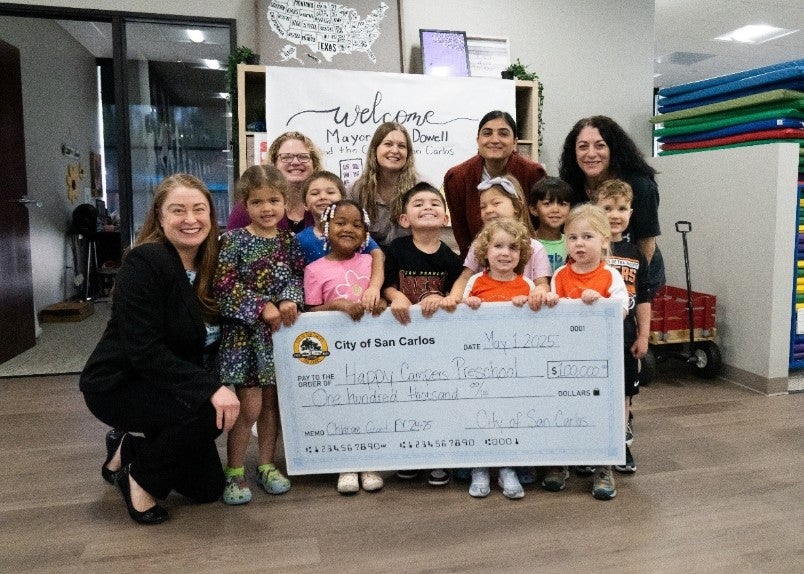
Key insight: San Carlos shows how linking child care to community growth (through impact fees) becomes sustainable when leaders ground it in data, frame it as core infrastructure, embed it in formal plans and staffing, and cultivate champions who keep it on the agenda across political cycles.
A few patterns stand out across these examples:
Braiding public and private funding for capital improvements. Leaders at Promise All Atlanta Children Thrive (PAACT), an initiative of the Georgia Early Education Alliance for Ready Students (GEEARS), braided funding from the Office of the Mayor, Atlanta Public Schools, and local philanthropists to create a capital improvement grant program. With the support of local technical assistance partners and contractors, PAACT awarded grants to over 70 programs. Using evidence of widespread demand, benefit to providers, and political attractiveness, they also created a proof of concept for a statewide capital improvement fund for early learning programs.
Creating dedicated facility grant funds. Harris County, Texas’s Supportive, Healthy, Innovative, Nurturing Environments (SHINE) Child Care Facilities Fund, created in 2023, awards grants to expand or rehabilitate facilities and offers free technical assistance. Eligible expenses include renovations, health and safety equipment, playgrounds, security, parking, and ADA accessibility. New Jersey’s Child Care Facilities Improvement Program provided grants to child care providers across the state for capital improvement projects, matching each grantee with a Grant Project Specialist to provide guidance throughout the process.
Updating zoning and planning. Pittsburgh updated its zoning code to allow family child care in more areas. Colorado’s HB 1237 gives local governments incentives to improve planning and zoning processes, funded by a Child Care Facility Development Cash Fund. Seattle passed the Childcare Near You ordinance in 2020, amending the city’s Land Use Code to allow child care centers to operate in all commercial and residential zones, including areas zoned for single-family housing.
Supporting home-based educators through property tax policy and legal protections. In December 2024, Boise, Idaho, expanded its Property Tax Rebate Program to include licensed in-home child care providers. The program provides up to $500 in property tax relief for providers who own their homes and are actively offering care. In Oregon, SB 599 restricts landlords from raising rent, terminating a tenancy, or taking other retaliatory actions against tenants who choose to operate a family child care program in their rental unit.
Involving educators in design. Kentucky’s Certified Child Care Community Designation Program encourages local governments, when considering zoning rules, to create a community-wide child care task force that includes center- and home-based providers, design professionals, business partners, and community members.
Policy changes do not automatically produce new spaces. Common friction points include:
Consider tracking:
Senior Policy and Leadership Specialist
Saul Zaentz Early Education Initiative
Research Assistant, Policy and Professional Learning
Saul Zaentz Early Education Initiative
Senior Writer and Editor
Saul Zaentz Early Education Initiative
Assistant Director, Learning Design and Communications
SaulZaentz Early Education Initiative