A Chapter of: Worker Voices: Technology and the Future for Workers
Introduction

The meaning of work is profoundly personal, and deeply felt. For many people, work means a paycheck to keep them afloat, a roof overhead, and the food they provide their families. For those who have it, a job can mean health insurance. It means stability and peace of mind that many depend on—or struggle to find. It is little wonder that the prospect of work changing is similarly personal and deeply felt. When work changes, it is not only jobs that are disrupted. So too are the lives of the people who hold those jobs and the families they support.
Economic shifts in recent decades have eroded the stability and financial security of many American workers. Earnings for those without a college degree have fallen sharply over the last several decades,5 while costs have risen and fewer workers have access to employer-provided benefits.6 Structural trends such as trade liberalization,7 automation,8 declining unionization,9 growing market concentration and monopsony power,10 the decline in real value of the minimum wage,11 and the fissuring of the workplace12 have contributed to rising inequality, reduced worker power and the hollowing out of the middle class. Given these changes, it is not surprising that nearly half of Americans do not have the financial security to weather an unexpected expense.13
When work changes, it is not only jobs that are disrupted. So too are the lives of the people who hold those jobs and the families they support.
Adding to these headwinds, technological advances have the potential to exacerbate the instability many workers already experience and the inequality that has marked the last three decades. Despite sensational headlines, fears of a robot apocalypse are overblown. Automation and artificial intelligence are unlikely to cause mass unemployment. However, technological change will impact the livelihoods and stability of millions of workers, disproportionately affecting those who are already struggling to secure a stable foothold in the economy.14 Technology has the potential to boost economic growth, create decent paying jobs, and unleash productivity and innovation. Yet the extent to which workers benefit from these gains depends on the institutional, legal, and social context, and the decisions that policymakers and employers will make. Without concerted effort to redesign the rules of the game, most workers will continue to be excluded from prosperity.
Three limitations of the current future of work conversation
Interest in the topic of automation and the future of work has grown significantly in recent years. The prospect of job losses from technological change has captured media headlines and even emerged as a question at an October 2019 debate of Democrat presidential candidates. Consultants, economists, and technical experts have published numerous reports offering predictions of job losses and skill changes.
The media coverage and mainstream discussions of the future of work have been limited in three key ways. Often, the macro analyses and high-level estimates of job impacts miss the important context of workers’ lives and the many obstacles and challenges that undermine their resilience to change. People often consider technological change in isolation from broader structural challenges in the economy when they consider the future of work, apart from the many other factors that contribute to workers’ insecurity, stagnant wages, and poor job quality. To fully understand the impact of technological change and to design solutions to help workers adapt, context is key.
Second, the popular conception of who the workers are in the future of work is at odds with the identity of those at greatest risk of change. Media coverage of automation and the future of work focus on a narrow demographic: (white) men, mainly in manufacturing and blue-collar jobs. This coverage overlooks the women and communities of color who will shoulder a greater burden from the impact of job automation.15 As detailed in our previous research, the costs of displacement and adjustment will fall disproportionately on women, people of color, and workers with less formal education and economic stability.16
Finally, missing from most future of work discussions are the voices of workers themselves. This gap matters. Without a voice in the discussions and decisions that impact them, workers feel that technology change is happening to them and that they lack agency in their own future. Furthermore, if policymakers and practitioners do not understand the perspectives, preferences, and challenges of those whose lives will be most impacted by technological change, they risk putting forward solutions that fail to meet the needs of workers they intend to support.
Giving voice to workers at the front lines of change
We aim, with this report, to bring more context, diversity, and human perspective to the discussions of the future of work and the design of policies and solutions. We want to give voice to the workers who are at the forefront of change, but who are all too often absent from these discussions.
Over the past year, we undertook a human-centered initiative to explore the views and personal experiences of a diverse group of workers who hold some of the jobs most likely to change. We set out to better understand the context of their lives, their hopes and plans for the future, the challenges and struggles they face, their experience with technological change on the job, and their beliefs about what their jobs might look like in the future.
In our approach to the interviews and qualitative research in this report, we drew inspiration from the principles of human-centered design, a process about developing solutions, policies, and products with the individual who experiences the problem in mind. The first step is understanding the people who are most affected and their needs,17 by interviewing them about their perspective, in an open-ended way. By listening and allowing the workers who will experience change to provide the context and challenges of their own lives, we (and experts in general) are less likely to offer solutions that are out of touch with what they want or need.
Through the interviews, we learned about workers’ struggles to get enough hours, their desire for respect from their employers, and the basic challenges of making ends meet in a low-wage job, especially one without benefits. We heard about some workers’ enthusiasm for new career opportunities but also the challenges they face in even imagining what they will do in the future, let alone the hurdles of trying to learn new skills and pay for more education. We learned about the iterative technological change in clerical jobs as well as the more abrupt, and seemingly cataclysmic, change visible to frontline workers. We heard about workers’ appreciation for new technology that works well in their workplaces and their fear for what their role will be in a future with fewer humans in their workplace.
Data, methodology, and limitations
We conducted hour-long, semi-structured interviews with a total of 40 workers in four metropolitan areas—Buffalo, Indianapolis, Oakland, and Washington, DC. While our study represents a diversity of workers across race, age, gender, occupation, employer, immigration status, geography, and union membership, it is not a nationally representative sample and thus the views expressed by workers in our study should not be interpreted as representative of all workers.
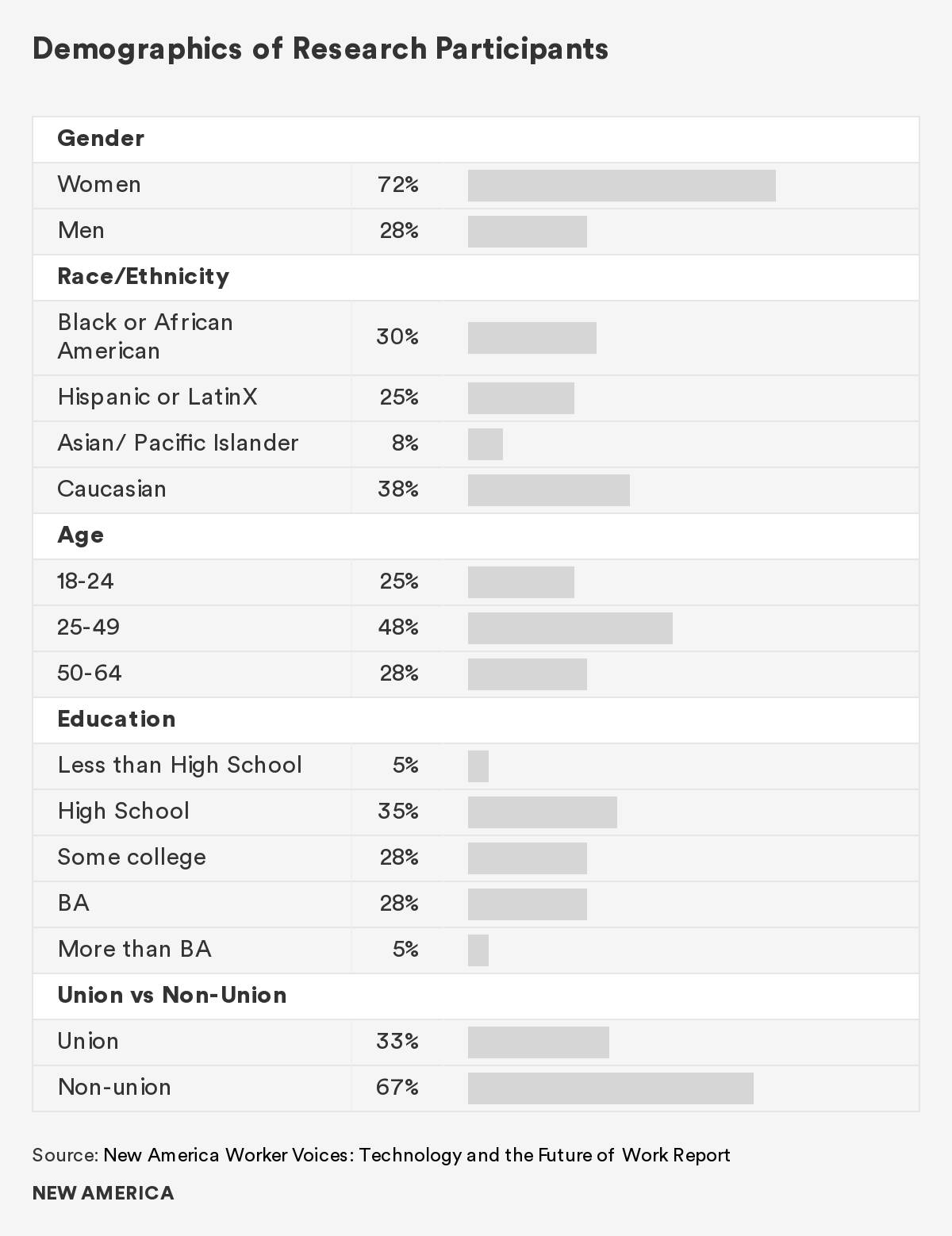
To recruit interviewees, we deployed multiple tactics including partnering with worker organizations, leveraging personal networks, and using online message boards, cold calls, and other “walk up” recruiting. The diversity of these recruitment approaches helped mitigate potential biases in our sample. However, it is possible that the workers we spoke with differed from a more nationally representative sample due to some of their connections to worker groups, their comfort level in speaking with us, the locations we selected for interviews, and their specific employers and occupations.
The Appendix includes a more detailed description of our methodology.
In the interviews, most of our questions centered on the context of the workers’ lives at home and at work, and their hopes and concerns for the future. We were careful not to lead interviewees toward discussions of technology. We did our best to use more general and open-ended questions about the future of jobs to explore the extent to which workers are already thinking about issues like technology and automation. All the questions we asked were open-ended and we gave instructions to our interviewees that there were no right or wrong answers. We took steps to minimize any potential harm to the workers with whom we spoke. To protect the identities of those involved, we use pseudonyms and have changed other personal attributes of the workers featured in the report.
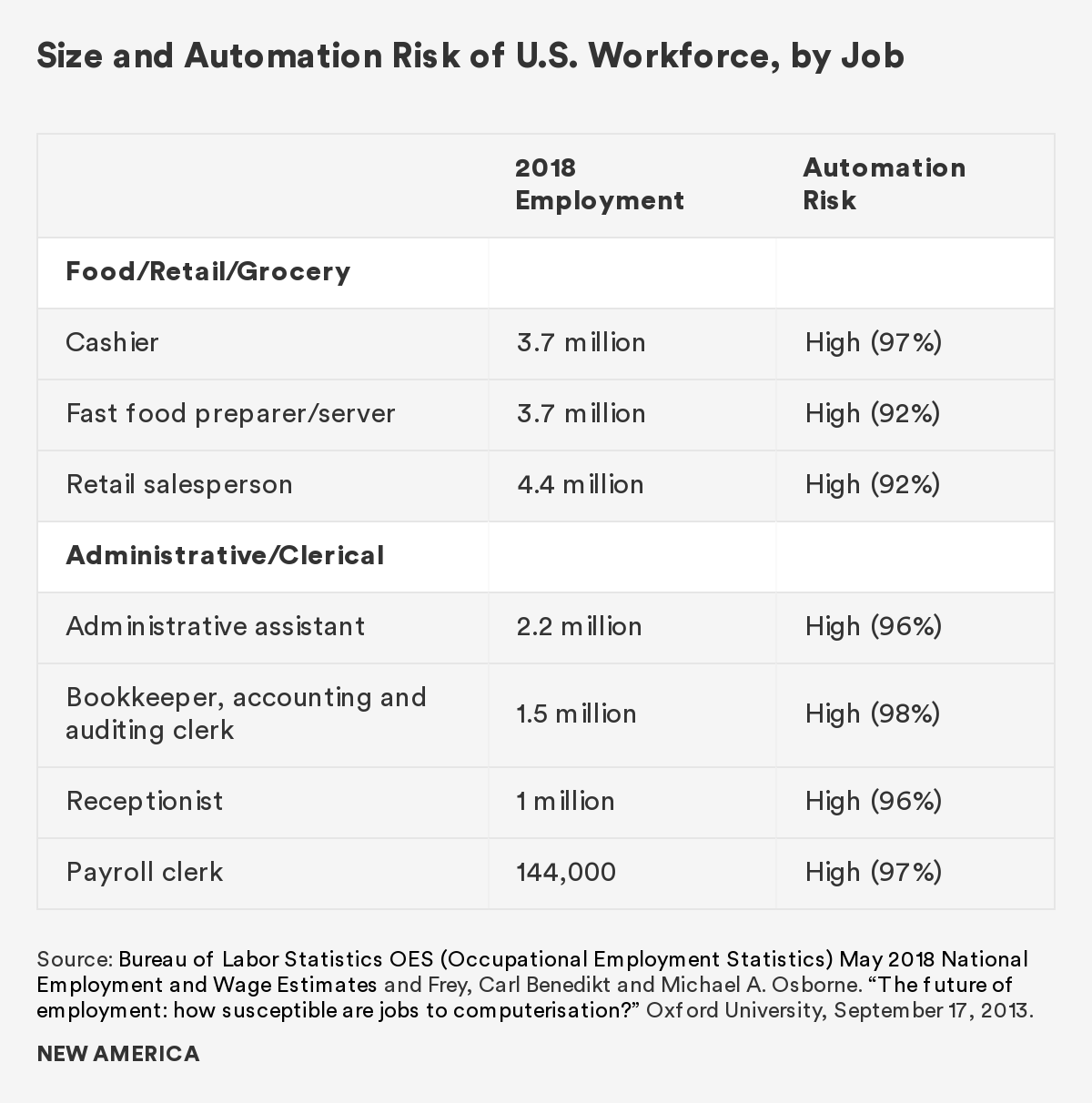
We selected two categories of workers to interview. The first group comprised retail, fast food, and grocery workers, primarily in front-line positions like cashiers and food preparers. The second group comprised non-managerial administrative and clerical workers in roles such as administrative assistants and bookkeepers. We selected these two groups of workers for our study for three reasons: the jobs they hold are at high risk of automation and technological change,18 they employ many workers across the country, and they are frequently overlooked in future of work discussions compared to other types of workers.
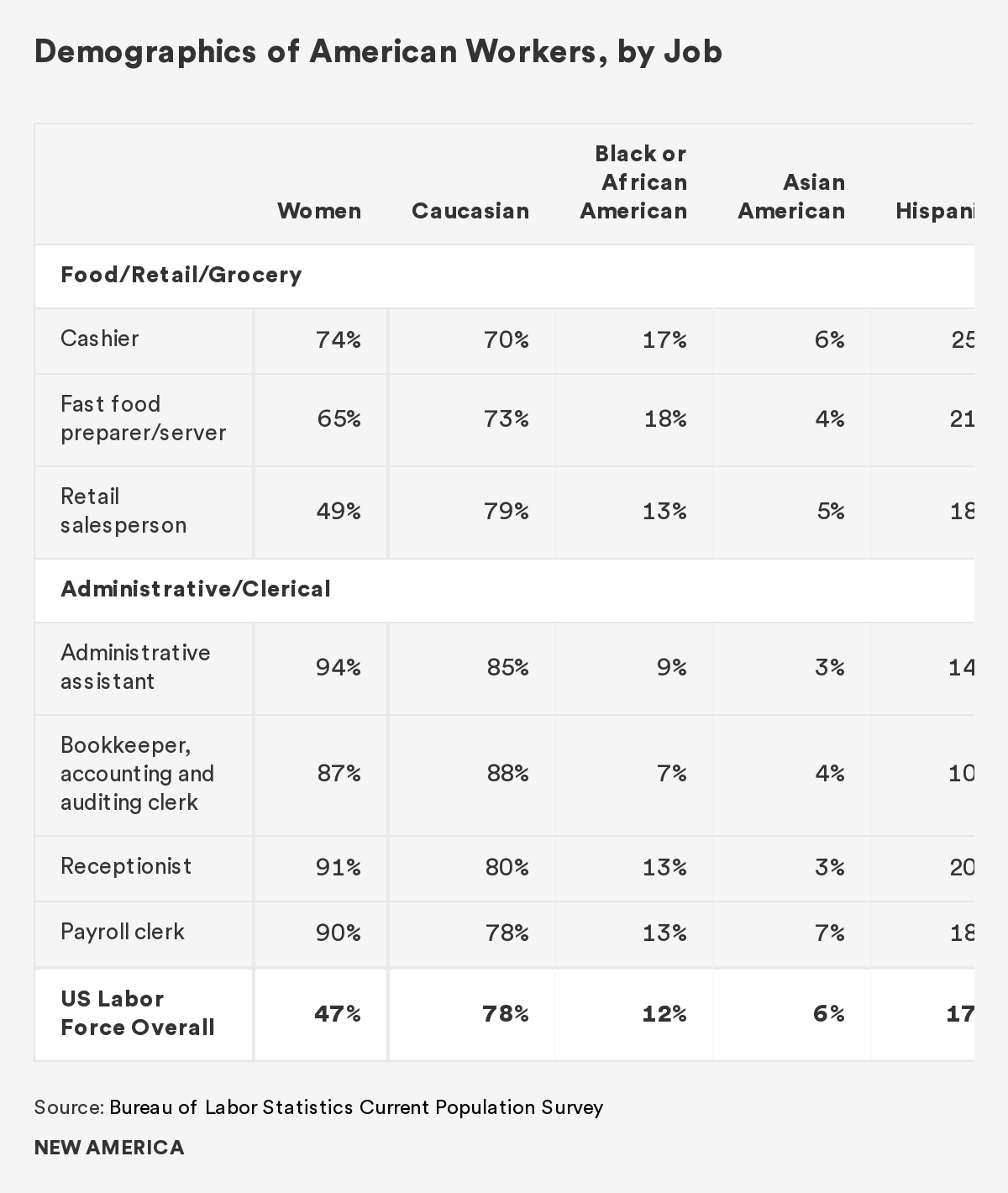
Jobs in retail, fast food, and administrative work are some of the biggest sources of employment in the U.S. overall. Approximately 17 million Americans, or nearly 12 percent of the entire U.S. workforce, are employed in seven of the job titles we interviewed. The high automation risk of these jobs suggest they could change significantly in the future—and the likelihood of this change is higher for these jobs than for most other jobs that American workers hold. To the extent that policymakers and the public are concerned about the potential for technology to displace workers, our data suggest that these occupations should be a key part of that conversation.
Worker Voices: Technology and the Future for Workers
- Executive Summary
- Acknowledgements
- Introduction
- Economic Insecurity and the Future for Low-Wage Workers
- The Search for Stability While Work is Changing
- Workers Want to Feel Respected and That They Matter
- Technology on the Job Today
- How Workers Imagine Their Jobs in the Future
- Barriers to a Better Future for Workers, Especially Women
- Obstacles to Obtaining Skills and Degrees
- Career Transitions are Difficult and Often Out of Reach
- Conclusion and a Human-Centered Agenda for the Future of Work
- Appendix: Study Methodology
Citations
- David Autor, David A. Mindell, and Elisabeth B. Reynolds, The Work of the Future: Shaping Technology and Institutions (Cambridge, MA: MIT Work of the Future, September 2019), https://workofthefuture.mit.edu/sites/default/files/2019-09/WorkoftheFuture_Report_Shaping_Technology_and_Institutions.pdf
- Pamela Loprest and Demetra Nightingale, The Nature of Work and the Social Safety Net (Washington, DC: Urban Institute, July 2018), https://www.urban.org/sites/default/files/publication/98812/the_nature_of_work_adn_the_social_safety_net.pdf
- Ali Alichi, Rodrigo Mariscal, and Daniela Muhai, Hallowing Out: The Channels of Income Polarization in the United States, working paper (Washington, DC: International Monetary Fund, November 15, 2017), https://www.imf.org/en/publications/wp/issues/2017/11/15/hollowing-out-the-channels-of-income-polarization-in-the-united-states-45375
- David Autor, The Polarization of Job Opportunities in the U.S. Labor Market: Implications for Employment and Earnings (Washington, DC: The Center for American Progress and the Hamilton Project, April 2010), https://economics.mit.edu/files/5554
- Jake Rosenfield, Patrick Denice, and Jennifer Laird, Union Lowers Wages of Nonunion Workers: The Overlooked Reason Why Wages are Stuck and Inequality is Growing (Washington, DC: Economic Policy Institute, August 30, 2016), https://www.epi.org/files/pdf/112811.pdf
- David Autor, David Dorn, Lawrence F. Katz, Christina Patterson, and John Van Reenan. Concentrating on the Fall of Labor Share. National Bureau of Economic Research, Working Paper 23108, January 2017. https://www.nber.org/papers/w23108.pdf
- Lawrence Minshel, Declining Value of the Federal Minimum Wage is a Major Factor Driving Inequality (Washington, DC: Economic Policy Institute, February 21, 2013), https://www.epi.org/publication/declining-federal-minimum-wage-inequality/
- David Weil, The Fissured Workplace: Why Work Became So Bad for So Many and What Can Be Done to Improve It (Cambridge, MA: Harvard University Press, 2014).
- Jeff Larrimore, Alex Durante, Kimberly Kreiss, Christina Park, and Claudia Sahm, Report on the Well-Being of U.S. Households in 2017 (Washington, DC: Board of Governors of the Federal Reserve System, May 2018), https://www.federalreserve.gov/publications/2018-economic-well-being-of-us-households-in-2017-dealing-with-unexpected-expenses.htm
- Mark Muro, Robert Maxim, and Jacob Whiton, Automation and Artificial Intelligence: How Machines are Affecting People and Places (Brookings Institution Metropolitan Policy Program, January 2019), https://www.brookings.edu/wp-content/uploads/2019/01/2019.01_BrookingsMetro_Automation-AI_Report_Muro-Maxim-Whiton-FINAL-version.pdf
- Molly Kinder, “The Future of Work for Women: Technology and the Overlooked Workforce,” Work, Workers, and Technology blog post, New America, February 25, 2019, https://www.newamerica.org/work-workers-technology/shiftlabs/blog/future-work-women/
- Molly Kinder, “Learning to Work with Robots,” Foreign Policy, July 11, 2018, https://foreignpolicy.com/2018/07/11/learning-to-work-with-robots-automation-ai-labor/
- The Field Guide to Human-Centered Design (San Francisco, CA: IDEO, 2015), https://bestgraz.org/wp-content/uploads/2015/09/Field-Guide-to-Human-Centered-Design_IDEOorg.pdf
- We used several data sources to identify jobs at high risk of automation, including data from a 2013 study by Oxford researchers Carl Benedikt Frey and Michael A. Osborne, in which they evaluated the technical feasibility of computerizing or automating the underlying tasks of an occupation with technology that exists today. In their analysis, the occupations we focus on in this report each have greater than 90 percent risk of automation, which is within the top quartile of risk among all occupations they studied. See Benedikt Frey and Osborne, The Future of Employment: How Susceptible Are Jobs to Computerisation? working paper (Oxford, U.K.: Oxford Martin School, University of Oxford, September 17, 2013), https://www.oxfordmartin.ox.ac.uk/downloads/academic/The_Future_of_Employment.pdf. Similarly, a recent McKinsey report on automation calculated that office support workers are the highest-risk job category for the potential for total displaced full-time employees by 2030, followed by food service, and customer service. See Susan Lund, James Manyika, Liz Hilton Segel, André Dua, Bryan Hancock, Scott Rutherford, and Brent Macon, The Future of Work in America: People and Places, Today and Tomorrow (New York: McKinsey Global Institute, July 2019), https://www.mckinsey.com/~/media/McKinsey/Featured%20Insights/Future%20of%20Organizations/The%20future%20of%20work%20in%20America%20People%20and%20places%20today%20and%20tomorrow/MGI-The-Future-of-Work-in-America-Report-July-2019.ashx